Positioning Strategy to Attract
International Master Students
– Católica Lisbon Case Study
Benyi Heider
Dissertation written under the supervision of Professor Pedro Celeste
Dissertation submitted in partial fulfillment of requirements for the MSc in
Management, at the Universidade Católica Portuguesa, May 31, 2017.
Abstract (EN)
Dissertation Title: “Positioning Strategy to Attract International Master Students – Católica
Lisbon Case Study”
Author: Benyi Heider
Católica Lisbon is a leading Portuguese business schools that managed to establish itself with-in the Top25 of European buswith-iness schools.
During the next decade Católica Lisbon aims to further grow and improve the reputation of its Master of Science programs. The big challenge for the Portuguese business school thereby is to attract a greater number of diverse and high quality international students in a strong com-petitive environment. In order to evaluate if the current marketing and positioning strategy is adequate to achieve this mission, it is crucial for Católica Lisbon to understand international students and their decision patterns to choose a business school.
This dissertation aims to analyze which drivers influence a student´s choice and if internation-al business students differ in how much they vinternation-alue hedonic and utilitarian dimensions in their decision. The literature review of this thesis gives an overview about hedonic and utilitarian decision making and introduces findings of previous researches in the area of higher educa-tion marketing. The case study describes the above stated challenge of Católica Lisbon in the context of its history and the developments in the European higher education market.
Findings of a market research among international business students reveal that there are segments of utilitarian and hedonic-utilitarian driven students. These segments differ signifi-cantly in the importance they attribute to different factors in their choice and how likely they would choose a business school with Católica’s features.
Keywords: Marketing, Strategy, Positioning, Targeting, Higher Education Marketing,
Resumo (PT)
Título da Dissertação: Estratégia de Posicionamento para Atração de Estudantes
Internacionais de Mestrado - Caso de Estudo Católica Lisbon"
Autor: Benyi Heider
A Católica Lisbon é uma proeminente Escola de Gestão Portuguesa que conseguiu estabelecer-se no Top 25 Europeu de Escolas de Gestão.
Durante a próxima década, a Católica Lisbon ambiciona crescer ainda mais e melhorar a reputação dos seus programas de Mestrado em Gestão. O seu grande desafio é como tal a atração do maior número de candidatos internacionais de alta qualidade, numa indústria bastante competitiva. De forma a avaliar se a sua atual estratégia de marketing e posicionamento é adequada ao objetivo pretendido, é crucial que a Católica Lisbon compreenda os seus clientes internacionais e o seu processo de tomada de decisão.
Esta dissertação visa analisar que fatores influenciam a escolha do estudante e se estudantes internacionais diferem entre si na sua avaliação de dimensões hedónicas e utilitárias. A Revisão Literária desta tese fornece uma visão geral sobre a tomada de decisão hedónica e utilitária e introduz resultados de diversos estudos na área da Educação Superior. O Caso de Estudo descreve o desafio da Católica Lisbon citado acima no contexto da sua história e do seu desenvolvimento no mercado europeu de Educação Superior.
Os resultados do Estudo de Mercado revela que há estudantes motivados por fatores utilitários e estudantes motivados por fatores hedónico-utilitários, e que estes dois segmentos diferem significativamente no que respeita aos factores que mais valorizam na sua escolha, e na propensão de escolha de uma escola de gestão com as características da Católica Lisbon.
Palavras-Chave: Marketing, Estratégia, Posicionamento, Targeting, Marketing de Educação
Superior, Católica Lisbon, Tomada de Decisão Hedónica Utilitária, Nova SBE, Hedonismo, Utilitarismo.
Acknowledgements
After the two years master in management program at Católica Lisbon, my academic journey comes to a preliminary end. I want to use this opportunity to express my gratitude to everyone who supported me throughout this time.
My greatest thanks go to my parents for enabling me to study and live in Portugal, for always being there for me and for giving me the right advices when needed. Thanks to my sister and soul mate Anya, who I can always trust with everything.
I want to thank Sofia for her endless support and companionship. Without you, my journey would have been not so happy and successful like I perceive it to be today.
A great thanks also goes to all my friends and colleagues with who I shared two of the best years of my life with.
I would like to express my appreciation to my dissertation´s advisor, Pedro Celeste, for his guidance throughout the last 4 months. I would also like to show my thankfulness to Pro-fessor Fernando Machado, ProPro-fessor Kyryl Lakishyk and ProPro-fessor Rita Coelho do Vale for their thesis advices and support as well as for shaping my marketing knowledge during the first year.
Finally, I am truly grateful to Católica´s Dean Francisco Veloso and Vice Dean José Guilherme de Almeida e Brito for providing their collaboration and making this work possi-ble.
My dissertation deals with the decision of international business students where to study for their master´s degree. I myself had to take this decision two years ago. Today I can say that doing my master´s studies at Católica Lisbon was definitely the right choice. I had an amazing time, grew academically as well as personally and I feel perfectly prepared for what´s coming next.
Table of Contents
List of figures ... VII List of tables ... VIII List of abbreviations ... IX
1 Introduction ... 1
1.1 Problem statement ... 1
1.2 Key research questions ... 1
1.3 Methodology ... 2
2 Literature Review ... 3
2.1 Marketing in the education sector: A service marketing oriented approach ... 3
2.1.1 Definition and evolution of Services Marketing ... 3
2.1.2 Classification and marketing implications for education as a service ... 4
2.2 Consumer Behavior: Hedonic and utilitarian dimensions of the consumer decision making process ... 5
2.3 Insights on students´ decision making process of choosing a university – ... implications for university marketing ... 6
3 Case Study ... 9
3.1 Católica Lisbon ... 9
3.1.1 Becoming the leading business school in Portugal ... 10
3.1.2 Transformation into a prestigious international business school ... 11
3.1.3 Outlook and vision ... 13
3.1.4 The MSc programs of Católica Lisbon ... 13
3.2 The market of higher business education in Europe ... 15
3.2.1 Developments and trends in the higher education market ... 15
3.2.2 International (business) students in Europe ... 16
3.3 Competitive environment ... 17
3.3.1 Competitors in Europe ... 17
3.3.2 Master´s programs in Europe - Benchmarks... 18
3.3.3 Competition in Portugal – Nova School of Business and Economics ... 19
3.3.4 Master´s programs at Nova SBE ... 20
3.4 Positioning and marketing strategy for Católica Lisbon´s MSc programs ... 22
3.4.1 The marketing challenge: Attract more international students ... 22
4 Market Research ... 27
4.1 Aim and scope of the research ... 27
4.2 Students´ decision making criteria for choosing a business school ... 27
4.3 Market research structure ... 28
4.4 Pre-survey results ... 29
4.5 Respondents – Demographics and segmentation ... 29
4.6 Evaluation of business schools and perception of the decision itself ... 30
4.7 Preferences of segments for different business schools ... 31
4.8 Importance of decision criteria – hedonic versus utilitarian segment ... 32
4.8.1 Regression with all decision criteria ... 32
4.8.2 Regression with factorized decision criteria ... 33
4.9 Information channels of international business students ... 34
4.10Analysis of Católica´s target students ... 35
5 Conclusions... 37
5.1 Decision making factors of hedonic-utilitarian driven international students ... 37
5.2 Touch points to attract and influence international business students ... 37
5.3 Managerial implications & recommendations for Católica Lisbon ... 38
5.4 Limitations and future research ... 38
6 Teaching Note ... 40
6.1 Synopsis ... 40
6.2 Target audience and teaching objectives ... 40
6.3 Teaching plans ... 41
References ... XI
Academic references ... XI Other references ... XIII
Appendix 1: Case study Appendixes ... XV Appendix 2: Methodology, structure and hypotheses of the market research ... XX Appendix 3: Market research – Pre-survey (online questionnaire) ... XXIII Appendix 4: Market research – Main survey (online questionnaire) ... XXV Appendix 5: SPSS analyses ... XXXI
List of figures
Figure 1: Pre-survey results: Hedonic and utilitarian criteria in a university choice ... 29 Figure 2: Double degree partner universities of Católica Lisbon ... XVII Figure 3: Number of foreign students in the EU-28 by gender and stage of study ... XVIII Figure 4: Share of foreign students in the EU-28 by continent (Eurostat, 2016) ... XIX Figure 5: Hypotheses about results and relationships of the survey ... XXII Figure 6: Age, Gender, stage of study and nationalities of respondents ... XXXII
List of tables
Table 1: Extended Financial Times Master in Management ranking 2016 ... 18
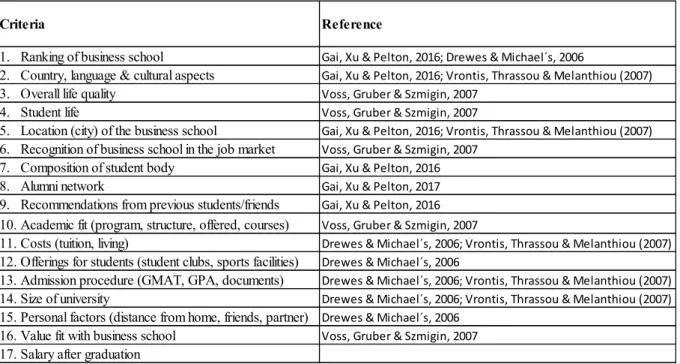
Table 2: International student´s decision criteria of choosing a master´s program at a business school ... 28
Table 3: Respondents´ evaluation of business schools (A, B ,C) on presented decision criteria (scale from 1 to 5) ... 31
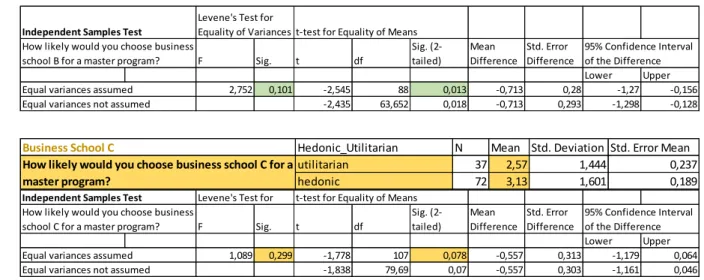
Table 4: SPSS outputs - Independent sample t-test for likelihood of choosing business school A, B, C (hedonic versus utilitarian segment) ... 32
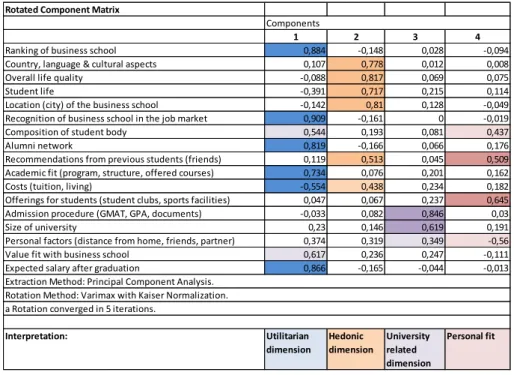
Table 5: SPSS output – Factor loadings of factor analysis with 17 decision criteria ... 33
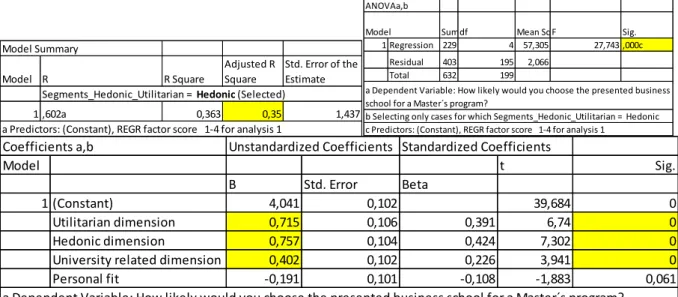
Table 6: SPSS output Hedonic segment – Regression model with created factors ... 34
Table 7: Influence of channels in the decision making process ... 35
Table 8: SPSS outputs – Target students only: Regression model Hedonic segment with 17 decision criteria (dependent variable: likelihood of choosing business school) ... 36
Table 9: SPSS outputs – Target students only: Regression model Utilitarian segment with created factors (dependent variable: likelihood of choosing business school) ... 36 Table 10: Financial Times ranking of European Business schools 2016 – Comparison of Católica Lisbon with the Top 12 business schools ... XVI Table 11: Tuition fees of the MSc programs at Católica Lisbon ... XVII Table 12: Tuition fees of Master´s programs at Nova SBE ... XVIII Table 13: Pre-survey results ... XXXII Table 14: Segmentation of international students into hedonic and utilitarian driven
decision makers ... XXXII Table 15: SPSS output - Respondents´ perception of decision (choosing a master´s
program at a business school) itself ... XXXIII Table 16: SPSS output – Independent sample t-test perception of decision (hedonic
versus utilitarian segment) ... XXXIII Table 17: SPSS outputs – Regression model Hedonic segment with 17 decision criteria
(dependent variable: likelihood of choosing business school) ... XXXIII Table 18: SPSS outputs – Regression model Utilitarian segment with 17 decision criteria
(dependent variable: likelihood of choosing business school) ... XXXIV Table 19: SPSS outputs – factor analysis on the 17 decision criteria: Total variance
explained, Eigenvalues and KMO and Bartlett´s Test ... XXXIV Table 20: SPSS outputs – Regression model Utilitarian segment with created factors
(dependent variable: likelihood of choosing business school) ... XXXV Table 21: SPSS output – Target students only: Factor analysis on the 17 decision criteria:
Total variance explained, Eigenvalues and KMO and Bartlett´s Test . XXXV Table 22: SPSS output - Target students only: Factor loadings ... XXXV
List of abbreviations
AACSB Association to Advance Collegiate Schools of Business
AMBA Association of MBA´s
BCG Boston Consulting Group
BS Business School
CBS Copenhagen Business School
CEMS Community of European Management Schools and International
Com-panies
ECTS European Credit Transfer System
EHEA European Higher Education Area
EQUIS European Quality Improvement System
ESADE Escuela Superior de Administración y Dirección de Empresas
EU European Union
EUR Euro
FT Financial Times
GMAT Graduate Management Admission Test
GPA Grade Point Average
LBS London Business School
MBA Master of Business Administration
MIM Master in International Management
Nova SBE Nova School of Business and Economics
ICT Information and Communications Technology
MIT Massachusetts Institute of Technology
Ph. D. Doctor of Philosophy
UK United Kingdom
WHU Wissenschaftliche Hochschule für Unternehmensführung (scientific
university for management)
1 Introduction
Católica Lisbon is facing a major strategic marketing challenge. In order to achieve its growth strategy for the MSc programs, the Portuguese business school needs to attract more international high quality business students. Thereby it is crucial for the university to under-stand how the customer group of international business students chooses a business school and which the factors are that influence the decision the most.
Previous research about decision making outlines that there are two contrary fields of drivers within the decision making process, a utilitarian one and a hedonic one, and that a product choice is driven by both utilitarian and hedonic factors (Voss, Spangenberg & Grohmann, 2003). It can be concluded that for the students´ choice of an educational offering like the master´s program of a business school - a service by definition – there should be also hedonic and utilitarian drivers. In the end the choice itself should be influenced by both types of factors to different extends. Hereby it is expected that international business students can-not be treated as one homogenous group, but rather that there are patterns and similarities within specific groups of these students.
Besides its international reputation, Católica Lisbon also offers very strong hedonic benefits to its customers. The right positioning and marketing strategy could be the key for Católica to increase its attractiveness for international business students.
1.1 Problem statement
How should Católica Lisbon position itself in order to attract a greater number of high quality international business students?
1.2 Key research questions
1. Do international students differ in how much they value utilitarian and hedonic dimen-sions in their choice of a business school´s master´s program? [Hedonic versus Utili-tarian decision makers]
2. Which are the decision criteria of Católica Lisbon´s target customers when choosing a business school´s master´s program and how do they influence their choice?
3. Which touch points does a business school have with the potential target students and which are the ones that influence the student´s decision making process the most?
1.3 Methodology
The insights of this dissertation derived from both primary and secondary data. A litera-ture review containing relevant articles from international top journals introduces the theoreti-cal background for this thesis. For the development of the case study, three interviews with the Dean, the Vice Dean and the Head of the Marketing & Admissions office of Católica Lis-bon as well as nine interviews with international business students were conducted. Quantita-tive data was gathered through an online questionnaire.
2 Literature Review
This chapter introduces the theoretical foundation for this dissertation.
2.1 Marketing in the education sector: A service marketing oriented approach
Chapter 2.1 defines education a service and gives theoretical implications from a service marketing perspective.
2.1.1 Definition and evolution of Services Marketing
The definition and classification of services in demarcation to (tangible) goods is a topic controversially discussed in the marketing literature. By reviewing the research conducted in this field Zeithaml, Parasuraman, and Berry (1985) worked out four characteristics, which distinguish services from goods, namely:
Intangibility – services are intangible performances rather than sensible and touchable objects,
Heterogeneity – because of their high dependency of different actors and circumstances involved, the service performance comes with high variation,
Inseparability – production and consumption happens at the same time, therefore making the process highly interactive; and
Perishability – services cannot be stored like goods. (IHIP)
These four service characteristics shaped the definition of services marketing. But as the service industry started to account for an increasing share of the economy, the service charac-teristics approach faced more and more critiques arguing that it arose from a time when manu-facturers´ perspectives were predominant (Vargo and Lusch 2004b; Gummesson, 2007). In-stead and by revising the “four service marketing myths”, Vargo and Lusch (2004) argued in favor of a more service oriented approach for the marketing discipline in general. Lovelock and Gummesson (2004) even went a step further and propose a new rental/ access paradigm, in which the distinction of services (and goods) focuses rather on the ownership situation of objects. Services thereby characterize transactions in which the customers gain benefits of objects without a transfer of ownership.
A recent work of Moeller (2010) comes back to the IHIP characteristics but puts them into the stages of the service provision process to identify the situations in which they really apply.
Summarizing the findings of relevant literature, it can be concluded that services mar-keting follows different rules than the marmar-keting of tangible goods. The inseparable interac-tion with the customer in the producinterac-tion process as well as the difficulty to ”store” services thereby play a crucial role (Zeithaml, Parasuraman & Berry, 1985). Important managerial implications that derive from the distinction of services are to focus on customization and customer involvement in order to increase customer value (Vargo & Lusch, 2004). Capacity and price management can be used in order to overcome the problem of fluctuations of de-mand (Moeller, 2010).
2.1.2 Classification and marketing implications for education as a service
According to Miles (2008), educational offerings are classified as services and serve as an input to the economy. Their purpose is to train individuals by creating, organizing and re-producing knowledge.
In order to better understand similarities and patterns between different services and to derive valuable managerial marketing implications, Lovelock (1983) developed five classifi-cation schemes for services. Educlassifi-cation hereby finds itself being classified as a service that addresses people´s mind. It is offered in a fixed continuous relationship between provider and consumer with a rather low level of individual customization but a high influence of service contact personnel on the service output.
Based on these classifications, the same author gives the following managerial implica-tions: As a service where customers need to be mentally (and physically) present, customer interaction plays a crucial role for the customer satisfaction. Available customer data should be used for segmentation purposes in order to shape marketing communication and pricing strategies. Furthermore there is a high importance for educational institutions to understand the customer choice criteria in order to find the right balance between standardization and customization of offerings and to develop a strong competitive positioning.
2.2 Consumer Behavior: Hedonic and utilitarian dimensions of the consumer decision making process
Previous research has found that the decision making process of consumers is influ-enced by utilitarian and hedonic dimensions. The findings hereby offer different perspectives on how consumers perceive hedonic and utilitarian values of brands and product classes and how these perceptions affect consumer´s choices.
Hirschman and Holbrook (1982) defined hedonic consumption as those aspects of the consumer behavior that are driven by affective and sensory experiences like emotions and fantasies. Utilitarian aspects on the contrary refer to instrumental and goal oriented consump-tion experiences that are more cognitively driven (Strahilcvitz & Myers, 1998). Building up on these definitions, Botti and McGill (2011) argue that hedonic experiences follow intrinsic motivations whereas utilitarian experiences are rather extrinsically motivated.
A somewhat similar but slightly different explanation for a hedonic and utilitarian phe-nomenon gives the work of Bazerman, Tenbrunsel, and Wade-Benzoni (1998). The authors distinguish between a want-self and should-self on an intrapersonal level to explain consumer tensions in the decision making and consumption process. In a world of many options, “Wants” hereby classify affective and emotional choices. “Shoulds” on the other hand refer to rather rational and cognitive decision considerations.
Hedonic and Utilitarian aspects in consumer behavior have been studied in various con-texts. The following paragraph gives a short summary about findings related to consumer be-havior and the consumer decision making process.
Okada (2005) shows that a hedonic alternative is preferred over a utilitarian one when each of them is presented separately. Contrarily, the preference switches when both alterna-tives are presented jointly. This preference reverse is explained by the higher degree of justifi-cation, which a hedonic choice requires when comparing to the utilitarian option. Furthermore Okada´s studies reveal that consumers would rather pay in time for hedonic purchases where-as money is the preferred currency for utilitarian purchwhere-ases. Research of Dhar and Wertenbroch (2000) find that the decision making process between hedonic or utilitarian choices is highly influenced by the consumer´s initial situation and the trade-offs that come with the choice. Hedonic benefits hereby are significantly different from utilitarian benefits. The former ones add value for the consumer in terms of enjoyment and aesthetics while the latter ones are beneficial through instrumental and practical functionalities (Chitturi, Raghunathan & Mahajan, 2008).
When it comes to the measurement and classification of hedonic/ utilitarian consumer perspectives on goods and product classes, findings and conclusions changed throughout the time. Building on the work of Hirschman and Holbrook (1982), Batra and Ahtola (1991) sug-gest a bidimensional explanation for product classification, products being either hedonic or utilitarian. Yet, it has to be noted that the developed hedonic/ utilitarian scales were only test-ed on a brand level. This limitation was criticiztest-ed and ustest-ed by Crowley, Spangenberg and Hughes (1992) in order to analyze the discovered attitudes also on a product category level. Their results support the argument that hedonic/ utilitarian dimensions of consumer attitudes are clearly separable and measurable, but raised concerns about the applicability of Batra and Ahtola´s (1991) measurement scales. On a product category level the scales were not applica-ble and could not prove a distinct classification between hedonic or utilitarian product catego-ries. In fact, the study revealed that except of some outliers the great majority of product cate-gories showed both hedonic and utilitarian features in the consumers´ perception. A more recent research of Voss, Spangenberg and Grohmann (2003) as well supports the approach that for the consumer, products do not necessarily fall in one of the two ends, hedonism or utilitarianism, but rather consist of both high or low hedonic and utilitarian dimensions.
2.3 Insights on students´ decision making process of choosing a university – implica-tions for university marketing
This section closes with academic insights about the customer (students) choice per-spective and its implications for university marketing. As the top marketing journals have not addressed this topic explicitly, the following findings rely primarily on the Journal of Busi-ness Research and other more specialized Journals for Higher Education.
Several authors outline that educational institutions (just like business organizations) more than ever find themselves in a competitive market environment in which they, as service providers, need to understand and satisfy customer needs as well as engage in the marketing mix in order to attract their customers (Vronti, Thrassou & Melanthiou, 2007; Gai, Xu, & Pelton, 2016; Petruzzellis & Romanazzi, 2010). Especially in the case of international stu-dents and Graduate programs, universities nowadays compete already globally due to easier information access, globalized markets and a higher student mobility (Gai, Xu, & Pelton, 2016). In order to reach customer satisfaction and thereby a higher attractiveness, it is ex-tremely important to understand the needs that influence the decision making process of a student when choosing a university (Vronti, Thrassou & Melanthiou, 2007).
Vronti, Thrassou and Melanthiou (2007) combined representative research and models of consumer behavior and decision making to illustrate the “education student-choice pro-cess” of students in developed countries as a five-stage model. The decision making starts with need recognition followed by the stages info search, evaluation of alternatives and pur-chase and ends in a post consumption evaluation. Thereby the process is influenced by indi-vidual determinants of the students such as socio-demographic (background, sex, religion etc.) and personal attributes (lifestyle, beliefs, aspiration etc.) as well as by environmental determinants like cultural or economic conditions. The authors conclude that marketing com-munications is increasingly important for creating need recognition while the information search for students gets more complex. However, due to technology enhancement a shift of power towards the customer is observable. The same one requires a more liberal education, innovative approaches and personal customer care. Alongside with these conclusions, Petruzzellis & Romanazzi´s (2010) findings highlight the active role of the consumer, the growing consumerism and the need for universities to engage in the marketing mix in order to match university related and student related factors.
Drewes and Michael´s (2006) study of Canadian university applications in Ontario re-vealed that in a rather heterogeneous market with just public universities and similar tuition fees, students´ preferences of universities was significantly affected by the distance from home and the availability of scholarships (tuition fees). Furthermore choices were also di-rected by previous academic performances of the student. In a more global context analyzing
Chinese applicants of U.S. universities with a netrographic approach1, Gai, Xu, and Pelton,
2016 found that the rankings of the university, the location, its alumni network, the composi-tion of students as well as the word-of-mouth effect like recommendacomposi-tions played a crucial role in the decision making process. The study of Voss, Gruber and Szmigin (2007), conduct-ed at a European university, showconduct-ed that for the surveyconduct-ed students the preparation for the pro-fessional career weighted higher than academic interests. European students furthermore seek for self-esteem, well being and hedonism, which can only be acquired through security in the first hand, that is the feeling of being prepared for their future profession.
In the context of differentiating oneself from the competitors in the higher education sector, several authors point out the importance of building a strong brand (Vronti, Thrassou & Melanthiou, 2007; Dennis et al., 2016; Wæraas & Solbakk, 2009). Dennis et al. hereby suggest focusing branding efforts more on the improvement of customer satisfaction instead
of building prestige – this would result in a stronger brand attachment. A higher brand loyalty is achieved when customers identify themselves with the academic learning experience (Lowrie, 2007). However, Wæraas and Solbakk (2009) conclude that defining and consistent-ly communicating the essence of a brand is difficult for universities due to their complexity.
Prospects of future marketing challenges for universities forecast a higher demand for price-value, an increasing competition for private universities against public universities and a rise of strategic marketing (functions) (Hayes, 2007).
3 Case Study
It was a warm and cloudless evening in May 2017. Francisco Veloso, the Dean of Católica Lisbon School of Business and Economics, stood in front of the window of his office in the fourth floor. He looked towards the horizon. Somewhere behind all the buildings he could imagine how the sun was disappearing behind the Tejo and turning the sky into a lucent red color festival.
Francisco Veloso was in his last months at Católica Lisbon. After five years, he would leave the Portuguese business school towards England to lead the Imperial College London.
Looking back at his time as the Dean of Católica Lisbon, he was quite proud of what Católica Lisbon had achieved in the recent past. 2016 had been the best year and preliminary peak of the school´s history, and also of his career. The international standing of the universi-ty had never been better, revenues never been higher. The offer to become the Dean of Impe-rial College London was clearly also a confirmation of his good work at Católica Lisbon. Alt-hough looking forward to the new challenge in England, he was also a bit sad to leave his matter of the heart behind. Before going, Francisco Veloso wanted to prepare everything to guide Católica into a successful future.
The Dean saw the university heading in a positive direction, but one challenge caused some concerns: In order to fulfill the vision of becoming one of the Top10 business schools in Europe, he knew that the school needed to further grow. This also included the MSc programs and here was where Católica was facing the big challenge. At a national level, the demand to study at Católica Lisbon was sufficient to follow the growth strategy. But for the attraction of international top students, the school was competing against many other international business schools and furthermore a strong national rival…
How should Católica Lisbon position itself to attract a larger number and a more diverse group of high quality international students? How could Católica´s MSc programs actually grow while at the same time increasing the quality of its student body?
3.1 Católica Lisbon
Católica Lisbon School of Business & Economics is a private Portuguese business
school2 that was founded in 1972, two years before the Carnation Revolution3 and the end of
the dictatorship Estado Novo. At the time of its establishment, Católica Lisbon was the first and only university in Portugal that offered business studies for students on an Undergraduate level.
From its beginning, “Católica´s DNA was defined as to deliver and attract high level quality in the area of business and economics”, stated Vice Dean José Guilherme de Almeida e Brito. “This concerned academic research, education as well as the attraction of the best teachers and students. Already in the early stages and before many other European schools, we started to implement challenging admission and recruiting standards for both students and teachers in order to build and retain a high quality within the institution”, he elaborated.
3.1.1 Becoming the leading business school in Portugal
In the years after the Carnation Revolution when the private economy in Portugal start-ed to grow again, Católica Lisbon managstart-ed to establish itself as the leading Portuguese uni-versity for business studies.
By the late 80´s, Católica Lisbon had already built up a strong Alumni network within the Portuguese economy – at a time when the state for the first time strongly invested in state
schools, resulting in a higher competition in the higher education4 sector in Portugal. “With
prices five to six times higher than competing state universities, we more than ever had the pressure to exceed in quality”, remembered Professor José Guilherme. This lead the school to pursue a strategic move, from which it was still benefitting around 30 years after: “In the late 80´s we decided to award scholarships to the best 30 Católica Alumni to pursue their PhD´s at the best universities of the world - with the hope that they would return to Católica Lisbon as teaching professors, afterwards. This strategy paid off. If you have a closer look at our teach-ing professors today, you will notice that a lot of them were educated in some of the best uni-versities of the world like Stanford University or MIT,” was the Vice Dean (himself with a Ph.D. in Finance and a MBA from NYU) proud to say. “With this step, the school built its foundation for future academic excellence and adopted many of the procedures and approach-es of thapproach-ese top universitiapproach-es,” he stated.
In the beginning of the 90´s, Católica Lisbon invested in a new building to further dif-ferentiate itself. The need for financial resources and additional revenue streams moved the school to also target a more lucrative segment with its offering – the executives. In 1991 a
3 See Appendix 1 for more information about the Carnation Revolution. 4 See definition of Higher education in the Appendix 2.
first part time MBA with around 100 executives was offered. In 1992 this path continued and the Executive Education was launched, “a step that later turned out to become not only the major revenue stream but also a major competitive advantage for Católica Lisbon,” said Pro-fessor José Guilherme. “In contrast to many other business schools, our university today can serve the whole portfolio of programs with strong, already established offerings for execu-tives.”
In 1996, Católica was one of the first universities in Europe to implement a promotion scheme for its professors that was much similar to the ones of the best American universities. This promotion scheme, which became another core strategy of Católica to strengthen its aca-demic quality and reputation, had a strong emphasis on research as well as demanding re-quirements for professors to get promoted i.e. to publish academic articles within top journals in their fields.
3.1.2 Transformation into a prestigious international business school
By the early 2000´s, Católica Lisbon was considered Portugal´s leading business school. However, the school found itself being still very national with a faculty and student body al-most exclusively from Portugal. With upcoming and promising opportunities resulting from the Bologna process, the management of Católica saw the chance to aim higher. Professor Guilherme remembered the day, “when it became explicit what was already implicit: Católica would become more international. The claim was no longer to be just a Portuguese top busi-ness school, but also to become one of the leading European schools in the field of busibusi-ness and economics.”
The Bologna process: Starting from 1999, the Bologna process was initiated as a series of ministerial conferences in order to create a harmonization of educational offerings in Eu-rope. Its name goes back to the University of Bologna, where the first declaration was signed. As a result of the Bologna process, the European Higher Education Area (EHEA) with a Eu-ropean Credit Transfer and Accumulation System (ECTS) as well as a new framework of higher education qualifications including a Bachelor´s degree (typically 3-4 years & 180-240 ECTS), a Master´s degree (typically 1-2 years & 60-120 ECTS) and a doctorial degree (3-4 years of research) were created. The EHEA is built on the key values such as “freedom of expression, academic freedom and autonomy for institutions” and has the “main goal to in-crease staff and students’ mobility and to facilitate employability” (EHEA, 2017). An under-lying goal of the Bologna process was to increase competition among European universities in
order to build up a new class of top universities that was able to compete with their bench-marks from overseas.
The transformation process of Católica into a European top school was realized fast. Soon after the new strategy was announced, Católica started to recruit international professors directly from the United States. About 15 years after, the share of international professors had already increased from 0 to 40%.
In order to gain international recognition and to build up a reputation beyond the bor-ders of Portugal, international proofs of quality were essential. Therefore, in 2006 Católica decided to enter the process of the Triple Crown Accreditation, an accreditation by the three largest international business school associations. At that time only around 50 business schools worldwide were certified with the Triple Crown. Once again, the Portuguese universi-ty achieved the required changes very fast benefitting from a small and flexible institution body. In a period of just 18 months the accreditation was completed.
For several other reasons, 2007 was a breakthrough year for Católica Lisbon: A PhD partnership with Carnegie Mellon University – one of the top U.S. universities in the field of business – was established and first negotiations about a collaboration for a joined Executive Education program began. In the same year, the Lisbon MBA in cooperation with Nova School of Business & Economics and the Massachusetts Institute of Technology (MIT) was established. Both partnerships with MIT and with Carnegie Mellon University were mile-stones for Católica and could be seen as a tribute for its excellent academic work and offer-ings.
Another major step for building up a stronger international reputation was the placement in the Financial Times (FT) business school ranking, one of the most prestigious indicators for quality in the higher education business sector. As the first Portuguese business school, Católica Lisbon entered the FT European Business School Ranking in 2007, was ranked
with-in the Top 50 with-in 2008 (47th position) and managed to climb up the ranks to the 23rd place in
the FT ranking of 2016. This way of success also showed up in other dimensions. “2016 was the best year in the history of Católica Lisbon, not only in terms of the rankings. Our revenues and the interests in our programs were higher than ever,” recognized Professor Guilherme confirming that Católica´s chosen strategic path beard fruits.
By the end of 2016, Católica Lisbon had as much as 1,800 students, 100 faculty mem-bers and offered programs in the fields of business and economics on a Bachelor´s, Master´s, full-time and part-time MBA as well as on an executive level.
3.1.3 Outlook and vision
Católica Lisbon´s vision was nothing more than “to be among the top 10 European Business Schools within the next decade”, as stated on the institution´s website in May 2017 (Católica 2017). “The group of the top business schools has already built up a very strong reputation, but the ranks behind it are still not yet fully established. We do believe that it is possible for Católica Lisbon to enter the Top15 within the next years,” defined Professor Guilherme the next milestone for the near future.
3.1.4 The MSc programs of Católica Lisbon
In line with the Bologna requirements, Católica Lisbon launched its first Master in Sci-ence (MSc) program in 2007. This and the following MSc programs of the Portuguese busi-ness school were conceptualized for recent Bachelor graduates with little work experience and covered the whole spectrum of international management. From their beginning, the Master´s programs were fully taught in English and aimed to attract international students and thereby foster the exchange between Portuguese and international students. However, in terms of their recognition and reputation, the MSc programs of Católica Lisbon could not keep up with their successful peers on the Executive level (see Table 1).
In 2014 the school revised its initial approach for the Master programs and followed students´ demand for more specialized study interests. For the intake of 2017, Católica Lisbon offered six different fulltime MSc programs (3-4 semesters long, 90-120 ECTS): The Interna-tional MSc in Management, a MSc in Economics, a MSc in Finance, a MSc in Management with specialization in Strategic Marketing, a MSc in Management with specialization in Strat-egy & Entrepreneurship and a MSc in Business. Furthermore double degree opportunities with nine different prestigious international business schools from Europe and America were offered including business schools like WHU (Germany), Universitá Commerciale Luigi Bocconi or BI Norwegian business school (see Figure 2).
3.1.4.1 Master programs´ strategy
The ambition for the MSc programs was to improve their reputation and attractiveness by climbing up the ranks also in the FT Master in Management ranking.
With the specialization of the Master´s programs and a stronger strategic focus on spe-cific academic areas (Marketing and Entrepreneurship), crucial steps for achieving this goal had already been initiated and first results of the strategic changes could be seen. For the
in-take of the MSc programs 2017, the applications went up by 60% compared to 2016. The Dean was optimistic that this positive development would continue during the next years.
3.1.4.2 Student body, tuitions and scholarships
In total, Católica Lisbon accepted 350 students (average age of 23 years) per year to the MSc programs, 50% of which were international. The tuition fees for the different programs ranged from 9,500 EUR for a three-semester long Master in Management to 13,400 EUR for a two years double degree (see Table 11).
In order to be attractive for the top segment of students, Católica offered the Top+ Scholarship program for its MSc programs. This scholarship functioned as a partial waver of tuition fees (from 25% up to 90%) and was granted to students “with an outstanding academic record” (Católica Lisbon, 2017).
3.2 The market of higher business education in Europe
The Bologna process had changed the higher education market in Europe completely. With the harmonization of the education system through the EHEA and ETCS, an interna-tional higher education market in Europe was created. This market became more competitive than ever. “Suddenly universities competed not only against national players but also against other European universities,” remembered Professor Guilherme. In many aspects universities irrespectively of their profit or non-profit orientation had to follow more and more the same rules like normal business organizations with an increasingly powerful customer group of students on the other side.
“The international market for education in Europe is very young – this market exists maybe for ten, fifteen years. It is still a green field and establishing itself,” analyzed Francisco Veloso. “This is also a chance for Católica Lisbon,” he concluded.
3.2.1 Developments and trends in the higher education market
The EU Trends 2015 for Learning and Teaching in European Universities revealed that in the five years time period from 2010 the university landscape in Europe, besides the chang-es the Bologna procchang-ess brought with it, was also much affected by the financial and economic crisis. State funds decreased and universities had to rely increasingly on private contributions. Through this development, a blurring between private and public institutions as well as a growing marketization in higher education took place. Furthermore an increase of student enrolments, a stronger focus on internationalization in universities as well as a greater atten-tion on the posiatten-tioning in rankings was observed. ICT developments enabled the rise of a new segment of online educational providers, which could develop itself into a main competitor of traditional universities in the future.
For the upcoming years in the EU as well as in the U.S., different studies predicted that the importance of international students for universities would further increase, that students would demand a higher return on their investments and that private institutions would face a stronger competition from public universities, which increasingly adopt marketing and busi-ness techniques of their private counterparts. Strategic marketing would become a key for student attraction. (European University Association, 2015; BCG, 2014)
3.2.2 International (business) students in Europe
After the Bologna process, students were no longer tied to national borders or national degrees. Increasing mobility opportunities and a stronger multicultural curiosity moved more and more European students to study outside of their home countries. According to Eurostat, the total number of students in the EU-28 countries mounted up to 19.6 million in 2013, 28.1% (5.5 million students) of which were enrolled in a Master´s degree. Looking at the fields of study, 32.7% of the total student population in Europe (6.4 million students) and therefore the biggest share of students was enrolled in social sciences, business and law (Eu-rostat, 2015).
In 2012, the same source counted 663.7 thousand European students studying in
anoth-er of the othanoth-er EU28 countries outside of their home countries. This numbanoth-er corresponded to
an increase of 87.36% in a 10-years time period when comparing to the same figure in 2002
(354.2 thousand students) (Eurostat, 2012). The total number of foreign mobile students5
in-cluding students from outside of Europe added up to 1.48 million in 2014 (see Figure 3). Of those foreign students, in line with the total student population, the biggest share (35.9%, 519.5 thousand students) by far was studying in the field of social sciences, business and law (Eurostat, 2016).
When looking at the country of origin of mobile students in Europe it could be noticed that in “several of the EU Member States, the distribution by continent of origin of tertiary students from abroad reflected a common language or cultural ties, for example with countries that were formerly colonies,” said the corresponding Eurostat article. In Portugal this phe-nomena was also true: 35.1% of the foreign students were from Brazil, followed by students from Spain (4.3 %) and from Italy (2.1%) (Eurostat, 2016).
Besides the greater opportunities to study abroad, another technological market dynamic worked in favor of the customer group and increased its power against the educational service providers: The information transparency created by the internet. Students were not only more mobile but also much better informed than before. Through the World Wide Web they now had the chance to directly compare different offerings and choose study programs on an inter-national level following their preferences. Independent rankings and accreditations as a sign of quality thereby became more impactful.
3.3 Competitive environment
For Católica Lisbon, the major ranking of reference and therefore also the benchmark for its competition was the Financial Times ranking of European business schools. Ranked
23rd in 2016, Católica Lisbon was directly competing against the other business schools in this
ranking. Catarina Silva, Head of the Marketing and Admissions for the Master Programs of Católica Lisbon even went a step further: “Basically we are competing against every interna-tional business school, worldwide,” she said.
With the same position in the 2016 FT ranking and a similar target group, “the main competitor in Portugal is Nova School of Business and Economics (SBE),” she stated.
The Financial Times Ranking of European Business Schools is one of seven rankings of higher education management institutions that the business news and information company "Financial Times" publishes every year. It ranks business schools and universities that are specialized in the field of business/ management or related fields, taking into consideration indicators for quality such as number of articles published in top journals, salary of students three years after graduation, percentages of faculty with a PhD or the percentage of interna-tional faculty.
3.3.1 Competitors in Europe
The Financial Times European Business School ranking 2016 included 90 business schools from countries all over Europe. The leading business schools in Europe were the benchmarks for Católica Lisbon and the ones the school wanted to compare itself with.
The Top12 business schools of Europe included universities like London Business
School, HEC Paris, University of St. Gallen or the Erasmus University in Rotterdam (see
Ta-ble 10). A benchmark with these business schools showed that “for a better placement in the FT ranking, Católica Lisbon has two major disadvantages: Its age and the level of salaries in Portugal,” realized Professor Guilherme. “Católica is a relatively young business school that is international for just ten years. Many of the Top12 business schools can look back to a much longer history. They are a very stable group that already had more time to establish their reputation,” he explained. “In terms of salary we cannot compete with other European coun-tries due to the economic situation in Portugal.” This was especially harmful for Católica´s master in management programs.
3.3.2 Master´s programs in Europe - Benchmarks
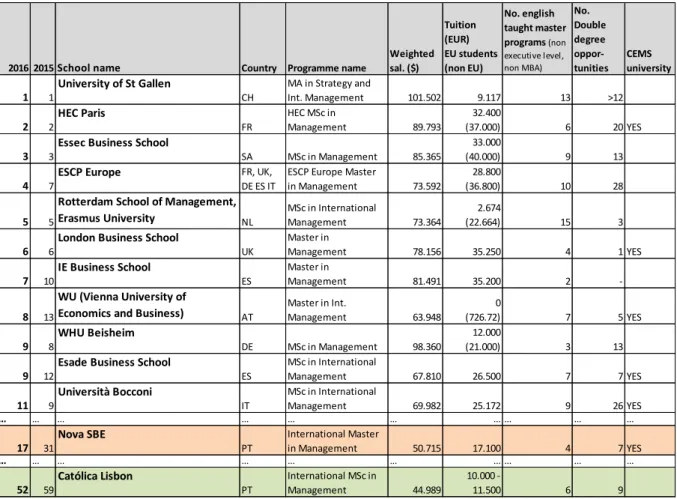
Compared to the benchmarks in Europe, Católica´s MSc programs were significantly cheaper (with exception of St. Gallen and WU, see Table 1). On the other hand, a reported average salary of 44,989 $ of Master in Management graduates three years after graduation was by far the lowest income within the Top25 European business schools and could be one of the major reason for the placement within the FT Master in Management ranking.
Table 1: Extended Financial Times Master in Management ranking 20166
Regarding the number of offered programs as well as double degree opportunities, no clear conclusions about best practices could be drawn. However, it was remarkable that five of the eleven best ranked Master in Management programs were from universities of the CEMS Global Alliance.
CEMS Global Alliance in Management Education is an international cooperation of thirty leading business schools with more than 70 multinational companies and social partners
6 Own created table referring to the Financial Times Master in Management ranking 2016 (Financial Times,
2016). Information about number of master´s programs and double degree opportunities retrieved from websites of Top11 universities (see Other references).
2016 2015School name Country Programme name
Weighted sal. ($) Tuition (EUR) EU students (non EU) No. english taught master programs (non executive level, non MBA) No. Double degree oppor-tunities CEMS university 1 1 University of St Gallen CH MA in Strategy and Int. Management 101.502 9.117 13 >12 2 2 HEC Paris FR HEC MSc in Management 89.793 32.400 (37.000) 6 20 YES 3 3
Essec Business School
SA MSc in Management 85.365
33.000
(40.000) 9 13
4 7
ESCP Europe FR, UK, DE ES IT
ESCP Europe Master
in Management 73.592
28.800
(36.800) 10 28
5 5
Rotterdam School of Management,
Erasmus University NL MSc in International Management 73.364 (22.664)2.674 15 3
6 6
London Business School
UK Master in Management 78.156 35.250 4 1 YES 7 10 IE Business School ES Master in Management 81.491 35.200 2 -8 13 WU (Vienna University of
Economics and Business) AT Master in Int. Management 63.948 (726.72)0 7 5 YES
9 8 WHU Beisheim DE MSc in Management 98.360 12.000 (21.000) 3 13 9 12
Esade Business School
ES MSc in International Management 67.810 26.500 7 7 YES 11 9 Università Bocconi IT MSc in International Management 69.982 25.172 9 26 YES … … … … … 17 31 Nova SBE PT International Master in Management 50.715 17.100 4 7 YES … … … … … 52 59 Católica Lisbon PT International MSc in Management 44.989 10.000 - 11.500 6 9
across the globe. CEMS mission is to “educate and prepare future generations of international business leaders” on the basis of values of “cultural diversity, respect, high performance, ethi-cal standards” as well as showing “professional responsibility for the society”( CEMS, 2017). The product for achieving this mission is the joint CEMS Master´s in International Manage-ment (MIM).
3.3.3 Competition in Portugal – Nova School of Business and Economics (Nova SBE)
Nova School of Business and Economics is a faculty of Universidade Nova de Lisboa and was established as Faculdade de Economia (Faculty of Economics) in the year 1978, five years after the founding of the university. In contrast to Católica Lisbon, Universidade Nova de Lisboa was founded as a state university. Throughout its history, Nova School of Business and Economics followed a path much alike the one of Católica Lisbon.
Similar to Católica, Nova SBE adapted to the developments in the educational market in the 2000´s and fulfilled a strategic change from only serving the local market towards a more international orientation. Together with this strategic shift also a rebranding of the business school took place. “Nova SBE” as an international name was created and positioned to be the present name of the business school. Nova´s vision changed to “be among the best in Europe” and sounded very similar to the one of Católica Lisbon.
Like Católica, Nova School of Business and Economics was present in the FT ranking and furthermore also one of the few business schools worldwide that acquired the Triple crown accreditation by EQUIS, AMBA and AACSB. In both cases, Católica Lisbon was the first Portuguese university to accomplish these prestigious steps but Nova SBE followed shortly afterwards. The FT ranking of European business schools ranked Nova SBE together
with Católica head-to-head on the 23rd position in 2016. In a five years period, Nova followed
a similar development to Católica in the ranking, being even a bit more impressive with the jump from position 39 in 2011 to its peak in 2016. Since 2007, the rival of Católica was fur-thermore a member of the CEMS Global Alliance.
When comparing the two leading Portuguese business schools, Francisco Veloso consti-tuted that "both schools are very similar. In some aspects, Católica Lisbon is doing better, in other ones it's the other way round," he said. "But the recognition that both schools got throughout the past years is amazing, for us and also for Portugal as a small and rather unrec-ognized country in Europe. There are two Portuguese universities within the Top25 business schools of Europe - together with two German and only one Italian school. In which industry
can you find a constellation like this?," was Professor Guilherme proud to say. Although it was always Católica's ambition to be recognized as Portugal's best business school and there-fore ahead of Nova SBE, the Dean and his management team agreed that the rivalry between the two universities had been very beneficial for both parties. "The competition between Católica Lisbon and Nova SBE helped both universities to get the most out of themselves," believed the Dean.
One major difference between the two leading Portuguese business universities was their size. With a faculty of 135 professors, 1400 enrolled Bachelor students and another 1400 Master students, Nova SBE was significantly bigger. And the school wanted to continue ex-panding its size. In September 2016 Nova SBE started to build a new Campus in Carcavelos, a small town about 20 kilometers western from Lisbon, which was located directly at the beach. By the end of 2020, the school would relocate its whole campus to Carcavelos. The university described this move as one of the most important steps in the recent history and as the cornerstone to “become a hub of talent attraction in the European scene of college and executive formation in the fields of Economics, Management and Finance (Nova SBE, 2016).”
Católica was aware that Nova SBE´s relocation to Carcavelos created a huge publicity. Outsiders could get the impression that the rival was on the fast lane to pass Católica Lisbon. But the Dean saw the signs of the time positively. "I am sure that Nova's move to go to Carcavelos will be good for Católica. It will help to create a clearer differentiation between the two universities," he believed. "Students that prefer the beach will probably decide in fa-vor for Nova SBE. The ones that want to live in the city will rather choose Católica."
3.3.4 Master´s programs at Nova SBE
As a member of the CEMS Global Alliance, Nova SBE offered the opportunity to do the CEMS MIM in conjunction with its three offered master´s programs (MSc in Finance, MSc in Economics, MSc in Management).
The CEMS MIM: This one year degree program, which was exclusively open for stu-dents selected and enrolled in a master´s program in one of the CEMS institutions, consisted of different modules such as an international study stay abroad at another CEMS university, an international internship, two different language exams and the completion of a business project. The CEMS MIM was the first supranational MSc program and established itself to one of the best and most prestigious Master in Management programs in the world.
The CEMS Master´s in International Management, ranked 4th in the FT Master in
Man-agement ranking 20157, was the flagship of Nova SBE and a major mean to position itself
against Católica Lisbon.
Nova leveraged upon the strong reputation of this program. They explicitly promoted themselves as the most prestigious Portuguese business school "with the best Master in Man-agement in Portugal". In terms of pricing of the MSc programs, there was no major difference between the offerings of the two schools (see Table 12). A master in management at Nova SBE (1.5 years) for example cost 9,900 EUR compared to 9,500 EUR for a Master in Man-agement with Specialization (three semesters) at Católica Lisbon. An exception was Nova’s CEMS MIM program. With prices of 17,100 EUR and more it exceeded all other programs offered by far.
7 In the FT ranking of 2016, the CEMS MIM was not ranked as a separate Master´s program anymore as it was
3.4 Positioning and marketing strategy for Católica Lisbon´s MSc programs
Francisco Veloso thought about the developments of the higher business education market in Europe and in Portugal during the past ten years. So much had changed. A strong national rival had come up. Business education in Europe had developed itself into a highly competitive, marketable service with heterogeneous and demanding customers. The develop-ments required universities to engage more and more in marketing and branding activities in order to attract high level students. Particularly for private institutions like Católica Lisbon it was more crucial than ever to create a strong image serving as a competitive advantage.
In order to achieve its vision, the Dean was sure that “Católica Lisbon needed to grow.” This growth ambition brought difficult challenges with it. The schools size had roughly dou-bled throughout the past ten years and the objective was to do the same within the next dec-ade. This strategy would include the investment in a new building and in new facilities. ´A huge step for the school. Necessary and investment intensive. But feasible,´ thought the Dean. Another challenge that the growth would bring with it, concerned him a bit more - doubling the university´s size while at the same time increasing its overall quality level was a tough ambition. For the school´s faculty and in the areas of Executive education, the Dean was op-timistic to achieve the growth targets.
But for the MSc programs Francisco Veloso saw greater tasks coming up for Católica Lisbon. A larger number of diverse, international high quality students had to be attracted.
3.4.1 The marketing challenge: Attract more international students
As one of the two best Portuguese business schools, Católica Lisbon never had and still did not have any problems to attract Portuguese students. For international students the cir-cumstances were different.
Objectively, the Master´s programs of Nova SBE were better ranked and in terms of their reputation more attractive for international students when comparing the two Portuguese universities (see Table 1). In order to anyhow attract and enlarge the number of students for the MSc programs while keeping the level of students´ quality or rather increasing it, it would require Católica Lisbon to develop an elaborate strategy as well as targeted marketing efforts. Points of differentiation and respective communication messages had to be found.
Another factor to be considered for the growth ambition was the composition of the stu-dent body. Increasing the diversity of stustu-dents was one of the major targets for Católica Lis-bon during the next years. Although the share of international students in Católica´s Master´s
programs already mounted up to 50%, the great majority of these international students came from the big European countries Germany, Italy and France. Currently the German students alone made up around half of all international students in the MSc programs. The manage-ment of the Portuguese business school agreed that a greater diversity would be enriching for the programs in many aspects.
“But in order to increase the diversity of our MSc programs, a broader application pool of students from all over the world is required,” said Francisco Veloso. “The level of applica-tions from different countries has to be sufficient to choose between the nationalities without compromising the overall quality of the student body,” he explained. “When comparing an excellent German student to a medium candidate from Tunisia, why should we not choose the German one?,” he constituted. For the Dean it was clear that marketing efforts had to be ex-panded beyond the borders of Europe in order to increase the diversity of students.
3.4.1.1 Targeted student profile
For the admission to the programs, the Portuguese business school highly valued “inter-national experiences, internships and extra-curricular activities.” The average age of Católica’s master students was 23 according to the university (Católica Lisbon, 2017b). The double degree programs of Católica Lisbon searched for candidates with “an exceptional cur-riculum and with strong international orientation”. These students had to hand in further proofs of English proficiencies or GMAT results according to requirements of the partner universities.
3.4.1.2 Positioning strategy
Católica Lisbon´s positioning strategy for international master students had a clear fo-cus. “We want to be one of the top schools in the consideration set of top students that are looking for a study destination in the south of Europe,” stated the Dean of Católica Lisbon. “Students as a customer group are heterogeneous. The decision of choosing a university is always performed on a micro level. There are a lot of criteria to be considered and different students value different factors. We need to attract those, who want to explore the south and who base their decision also on hedonic features,” he explained. “Católica has a great ad-vantage to respond to these customers – its destination. Lisbon as a location has all the condi-tions to be very attractive to students: The weather, the sea, the city life.” Another mean to position and differentiate Católica´s MSc programs from its competitors in Europe, was their pricing. “The tuition fees for our MSc programs are comparable low. And the costs of living
in Lisbon are also cheap. With this combination, we offer a very attractive cost-quality bundle to students,” described the Dean the pricing strategy.
3.4.1.3 Past and current marketing efforts
Past marketing efforts had targeted rather the rich countries in Europe, where students had a higher mobility and also would increase the average salary level of Católica graduates. For the future, the marketing activities of the school should be expanded also to other conti-nents. “We are currently following the developments that we see in the markets outside of Europe and trying to tap into them,” he explained. “I can give you an example: In the last years we saw that due to the economic crisis in Brazil there was a greater demand from Bra-zilian students that wanted to study in Portugal. Therefore we invested back in our online marketing efforts to reach exactly this group of students with our messages.”
According to Catarina Silva, Católica´s Head of Marketing and Admissions for the Master Programs, the school´s current marketing efforts for attracting master students “in-cluded the attendance of national and international fairs, the Católica website as well as email marketing and further online marketing means.” An important influence was furthermore generated through the creation of word of mouth via Alumni networks and exchange students.
3.4.1.4 Marketing messages
Besides giving detailed information about the different MSc programs, Católica´s cur-rent marketing messages to attract international students were primarily highlighting accredi-tations and the placement in the Financial Times European business school ranking. Thereby Católica pointed out that it was the “#1 Portuguese Business School according to the
Finan-cial Times”, the “1st Portuguese Business in international rankings” as well as the “1st
Portu-guese Business School accredited by the Triple Crown.” These statements were also designed to promote Católica Lisbon as the leading Portuguese business school against Nova SBE. The school´s marketing communication furthermore outlined additional hard facts like the excel-lent placement rate of Católica students after graduation, the number of partnerships with uni-versities worldwide or the share of international students. In order to illustrate the study expe-rience and diversity at Católica Lisbon, different testimonials and videos of international stu-dents from all over the world were shown.
A second but minor focus of the school´s marketing messages lied on the attractiveness of Lisbon. Among other facts, the Portuguese capitol was promoted as a city with “252 sunny days per year, a 26 degrees average summer temperature, the largest beach in Europe nearby