Portfolio Rule‐based Clustering at Automobile
Insurance in Portugal
Octaviani Devi
Internship report presented as partial requirement for
obtaining the Master’s degree in Statistics and Information
Management Proposal
NOVA Information Management School
Instituto Superior de Estatística e Gestão de Informação
Universidade Nova de LisboaPORTFOLIO RULE‐BASED CLUSTERING
AT AUTOMOBILE INSURANCE IN PORTUGAL
by
Octaviani Devi
Internship report presented as partial requirement for obtaining the Master’s degree in Advanced Analytics Proposal. Advisor / Co Advisor: Roberto Henriques
June 2016
ACKNOWLEDGEMENTS
I wish to express my gratitude to my supervisor, Professor Roberto Henriques, for all his time, effort, understanding, generous guidance and assistance that made it possible to work in this project. Also, I would like to extend my gratitude to my supervisors, Paula Santos and Andre Rufino for their vital comments, supports and valuable discussion. It is a pleasure working with them. I am pleased to thank Sjoerd Smeets for the opportunity and Luis Cardoso who prepare this protocol. Also I would like to thank the office team, Tiago Cavaleiro, Diana Duarte and Filipe Santos for their help and support during the project.
I am pleased to thank Professor Leonardo Vanneschi as the head of Master Advanced Analytics who also support me with his advice. His lectures are amazing. I am also thankful to friends in Master Advanced Analytics, especially to Thies Bucker, Bruno António, Minang Suh Franklin and Ali Godjali for their support and help. Also, I would like to express my gratitude to all my teachers in Master Advanced Analytics.
Finally, I am thankful to my beloved friends, Maria Tjahjadi and Iput Pudji Astuti for their endless love, help and care. Also, I dedicate this thesis to my beloved parents and families.
ABSTRACT
Defining pricing strategy is a challenge for every insurance company. Competition makes insurers need to be more careful to adjust the premium since it may affect the reaction of the existing customer or the new ones. Correspondingly, it may impact the relationship with customer, also the profitability of the company. Moreover, the increment of number of policies will lead to the diversity of policy’s risk profile and characteristics which becomes a challenge for insurer to manage their portfolio. Therefore, a deep understanding of portfolio segmentation is important for the company to fine tune the pricing strategy and gain more profit. The project aims to discover portfolio clusters by using k‐means clustering algorithm and extract the rules of each cluster by developing classification model using Decision Tree algorithm. The result of the model shows that the clusters give different characteristics and behavior. Complement with KPI metrics, the company is able to monitor the performance of each clusters. So that, the company may use the analyses to optimize the strategy of growth and profitability.
Keywords: automobile insurance, rule‐based clustering, k‐means, clustering, classification, decision tree.
.
CONTENTS
1.
Introduction ... 1
1.1.
Background and Problem Identification ... 1
1.2.
Study Objectives ... 2
2.
Literature Review ... 3
2.1.
Introduction ... 3
2.2.
Clustering Based on Rules ... 4
2.3.
K‐means ... 5
2.4.
Decision Tree ... 6
2.5.
Basic Insurance Terms and Ratios ... 6
3.
Study Relevance and Importance ... 9
4.
Methodology ... 10
4.1.
Business Understanding ... 10
4.2.
Data Understanding and Preparation ... 11
4.3.
Clustering and Classification Modeling ... 11
4.4.
KPI Report and Analyses ... 12
5.
Data Understanding and Preparation Process ... 13
5.1.
Introduction ... 13
5.2.
Data Understanding Initialization... 13
5.2.1.
Variables and Data Sources Identification ... 13
5.2.2.
Data Dictionary Building ... 15
5.3.
Source Data Exploration ... 16
5.3.1.
Source Data Exploration ... 16
5.3.2.
Data Quality Verification ... 17
5.4.
Dataset Construction ... 18
5.4.1.
Dataset Construction ... 18
5.4.2.
Dataset Exploratory Analysis ... 19
5.5.
Dataset Preparation ... 20
5.5.1.
Input Variable Reduction ... 20
5.5.2.
Dataset Cleaning ... 20
5.5.3.
Dataset Transformation ... 23
6.
Modeling ... 24
6.1.
Modeling Framework ... 24
6.2.
Cluster Model ... 25
6.2.1.
Cluster Development Scenario ... 25
6.2.2.
Selected Meaningful Input Variables ... 26
6.2.3.
Cluster Model Parameters ... 28
6.2.4.
Final Cluster Model ... 30
6.3.
Rule Extraction Model ... 31
7.
Key Performance Indicator Reports ... 35
8.
Cluster Characteristic Analyses and Discussion ... 38
8.1.
Cluster Characteristic Analyses ... 38
8.2.
Further Characteristics Discussion ... 40
9.
Summary ... 44
9.1.
Conclusion ... 44
9.2.
Limitation and Further Work ... 45
10.
Bibliography ... 46
APPENDIX A. DATASET ... 48
APPENDIX B. CLUSTER MODEL ... 51
LIST OF FIGURES
Figure 1: Project Methodologies ... 10
Figure 2: Data Understanding and Preparation Process ... 13
Figure 3: Model Framework ... 24
Figure 4: Cluster Development Scenario ... 25
Figure 5 Elbow Method ... 28
Figure 6: Proportion of First 12 Cluster Model ... 30
Figure 7 Claim Frequency of 12 First Cluster Model ... 31
Figure 8: Renewal vs New Business Average Premium ... 41
Figure 9: Claim Frequency vs Average Severity ... 41
Figure 10: Loss Ratio per Cluster ... 42
Figure 11: Loss Ratio vs Claim Frequency ... 42
Figure 12: Loss Ratio vs %Growth Policies ... 42
LIST OF TABLES
Table 1: Possible Input Variables ... 15
Table 2: Data Source ... 15
Table 3: Example of Data Dictionary ... 16
Table 4: Data Error Handling ... 18
Table 5: Dataset Process Flow ... 18
Table 6: Exploratory Analysis ... 19
Table 7: Summary Statistics ... 19
Table 8: Input Variable Reduction ... 20
Table 9: Missing Value Handling Strategies ... 21
Table 10: Missing Value Handling ... 21
Table 11: Interval Outlier Handling Strategies ... 22
Table 12: Nominal Outlier Handling Strategies ... 22
Table 13: Interval Outlier Handling ... 23
Table 14: Nominal Outlier Handling ... 23
Table 15: Selected Input Variables ... 27
Table 16: Number of Cluster of Automatic Option ... 29
Table 17: First Stage Cluster Model Comparison ... 29
Table 18: Second Stage Cluster Model Comparison ... 30
Table 19: Final Cluster Model ... 31
Table 20: Decision Tree Comparison ... 32
Table 21: Interactive Rule Extraction Model ... 33
Table 22: Final Ruled‐based Cluster Model... 34
Table 23: Key Performance Indicator ... 40
LIST OF ABBREVIATIONS AND ACRONYMS
CBR Clustering Based on Rules CCC Cubic Clustering Criterion CRISP‐DM Cross‐Industry Standard Process for Data Mining GWP Gross Written Premiums KPI Key Performance Indicator LOB Line of Business MAD Median Absolute Deviation SSE Sum of Squared Error TPL Third Party Liability1. INTRODUCTION
1.1. B
ACKGROUND ANDP
ROBLEMI
DENTIFICATIONOnce a policy holder is signing the contract and or is renewing it, the insurer is exposed to the risk. Insurer classifies each risk and calculates the applicable premium associated with that risk. This premium is the price that a policy holder has to pay for insurance coverage. It can vary significantly based on difference characteristic of the risk (Werner and Modlin, 2010). Insurance premiums need to cover not only the expected claims but also certain level of profitability of the company. Therefore, the challenge of pricing strategy is to set premium prices not too high so that market share is not impacted as customers have right to exercise the price and to choose their insurers (Yeo, et all, 2001b).
Competition is forcing insurers to adjust rates to retain existing customers and to attract new ones. Insurance companies such as automobile insurances operate in a more competitive environment. A policy holder easily switches from one insurer to another because of the price sensitivity. The price changes do not need to be the same across all customers. For instance, the increment by 5% will give different reaction to the policy holder (Guelman, et al, 2014a). Because of this price change, some policy holders are likely to switch to an alternative insurer, while others will remain with the same company. Insurers that implement pricing strategy may take benefit from customers’ preferences (Dolgui and Proth, 2010). Customers have different purchasing behavior over time and their willingness to pay. They are attracted by different benefits offered by the same type of products. For instance, the same car model may be proposed in different versions and may attract a particular type of customer (Dolgui and Proth, 2010).
One of the automobile insurance in Portugal faces the same challenge in defining the pricing strategy. The policy holders are very sensitive to price changes as well as claim management. In August 2015, the insurer’s loss ratio is in line with the market which the market’s is 66.8%. However, this loss ratio is higher about 6.5 pp compare to one of the other insurance company in Portugal. In addition, it is important to the company to manage cancellation rate and to see if it is needed to adjust pricing strategy without damaging the relationship with policy holders and to stay competitive in the market. Customer‐oriented pricing can make a significant contribution to performance enhancement and strengthening the customer relationship (Murdock and McGrail, 1994, cited from Stomer, 2013). Stomer (2013). It presents evidence regarding the importance of adjusting pricing models by considering consumers’ perception. According to Stomer (2013), in automobile insurance, vehicle specific attributes are also taken into consideration in premium calculation as well as customer characteristics. Therefore, it is crucial to understand the customer and vehicle characteristics. In this case, clustering is used to discover the characteristic similarity by grouping a heterogeneous population into a number of more homogeneous clusters (Berry and Gordon, 2004). Furthermore, rule extraction will be explored in order to know the characteristics of each cluster. This project is aligned with the strategic initiative 2015 of the company which is “Capture the non‐life stand‐alone opportunity in bancassurance” and “Foster Customer Centricity”, also strategic initiative 2020 which are Customer and Innovation.
1.2. S
TUDYO
BJECTIVESFrom the stated problems, the project aims to discover cluster model that has better split to the existing portfolio in homogeneous groups. The cluster model is extended by building a set of rules that extracted from the defined clusters. So that, the rule‐based cluster model is defined and can be used to assess the pricing strategy. The main objectives of rule‐based cluster model development are as follow:
a. Create portfolio segments with technical characteristics such as customer characteristics, vehicle characteristics or any important characteristics.
b. Increase knowledge of Motor portfolios on the technical Key Performance Indicators (KPIs) such as Loss Ratio, Claim Frequency, Average Claim Cost, Renewal Rate and Customer Growth.
c. Able to be used to fine‐tune motor pricing strategy to achieve an optimized portfolio mix based on discovered cluster model.
Based on the objectives above, the scope of works of this project is defined. The portfolio data in this project is limited to the personal portfolio as the majority of the data. Following is the scope of works:
a. Identify variables used in clustering model and identify parameters such as number of clusters.
b. Develop portfolio clusters of insurance portfolios based on their characteristics by using k‐ means clustering algorithm. Choose the best cluster based on meaningful interpretation and mathematical decision.
c. Extract the rules within the clusters by developing classification model. The model is developed using Decision Tree Algorithm with the respect to the cluster id.
d. Design and create Key Performance Indicator (KPI) dashboards to enable a better knowledge of the cluster characteristics. Provide analyses to understand the characteristics for each cluster.
2. LITERATURE REVIEW
2.1. I
NTRODUCTIONBerry and Linoff (2014, p 11, 350) mention that clustering provides a way to learn about the structure of complex data and break up into similar pieces. In clustering, there are no pre‐classified classes and no distinction between explanatory and response variables. The algorithms discover similarities and group the data into clusters. Clustering methods have been widely used in many domains, including marketing, pattern recognition, biology and many areas. In business, clustering help marketer to characterize customer segmentation (Brito et al, 2015) and then target the marketing efforts to the most attractive segment. In biology, it can be used to categorize gene (Hasan and Duan, 2015) and to derive plant and animal taxonomies (Han and Kamber, 2006). Clustering is not only used as segmentation but can be used for outlier detection, such as credit card fraud (He, Xu, Huang & Deng, 2004). However, according to Mirkin (2005), the implementation of clustering is not straightforward because of two factors. First, similarity distance measurement and clustering techniques frequently give different results. Even though the same technique is implemented, it may lead to different cluster solutions dependent on the choice of parameters such as initial setting or number of clusters. Second, the interpretation of cluster structures is not straightforward. In this case, the clusters to be found are not depending only to data but also the user’s goal and degree of granulation. That is why, clustering method often considered as art rather than science. Although, Mirkin (2005) mentions that discovered clusters must be treated as an “ideal” representation of the data that could be used for recovering the original data from aggregate clusters.
After in depth study about available clustering techniques (Han and Kamber, 2006), this project will focus on partitioning methods. Partitioning methods, k ‐Means, determine the clusters in such a way that objects within a cluster are “similar”, whereas the objects of different clusters are “dissimilar”. The clusters have to satisfy the following requirements: (1) each group must contain at least one object, and (2) each object must belong to exactly one group.
According to Han and Kamber (2006), one of the most well‐known partitioning methods is k‐ means algorithm. The k‐means algorithm takes the input parameter, k, and partitions a set of n objects into k clusters so that the resulting intra cluster similarity is high but the inter cluster similarity is low. Cluster similarity is measure in regard to the mean value of the objects in cluster. The algorithm attempts to determine k partitions that minimize the square error function. It works well when the clusters are compact cloud separated from one another. Also, Han and Kamber say that the method is relatively scalable and efficient in processing data sets. Correspondingly, Madhulatha (2012) says the reason behind choosing the k‐means algorithm is because of its popularity for the following advantages: (1) Time complexity of the algorithm is O(nkl), where n is the number of points, k is the number of cluster, and l is the number of iterations taken by the algorithm to converge, it shows that the k‐means is linear to number of points, so that k‐means is scalable and efficient in processing large dataset (2) Space complexity is O(k+n), the space complexity is modest because only depend on number of data points and number of clusters (3) Order‐ independent, for a given initial seed set of clusters, it generates the same partition of the data regardless the order of presented data to the algorithm. A k‐means algorithm often used as customer segmentation technique among the other clustering techniques (Wang & Keogh, 2008; Liao, Chen & Lin, 2011; Ghoreyshi, 2015).
The major drawback of k‐means that mentioned by Hand and Kamber is that it often terminates at a local optima and the result largely depends on the initial clusters centers. Furthermore, the k‐means method can be applied only when the mean of a cluster is defined. This may not be the case in some applications, such as when the data have categorical attributes. The necessity for users to specify k in advance can be seen as a disadvantage. The k‐means method is not suitable for covering clusters with non‐convex shapes of clusters of very different size. Moreover, it is sensitive to noise and outlier data points because a small number of such data can substantially influence the mean value.
2.2. C
LUSTERINGB
ASED ONR
ULESDescribing the structure and obtaining the knowledge of a complex system are difficult tasks. As mentioned by Berry and Linoff (2014), the clustering is a way to understand about it, however according to Mirkin (2005), the interpretation of clusters is not straightforward. Gibert, Aluja and Cortes (1998) introduce Clustering Based on Rules (CBR) as a methodology that is developed to find the structure of complex domains. This approach performs better than traditional clustering algorithms or knowledge based system approaches. Gibert, et al explains that the CBR methods combine clustering algorithm and inductive learning or supervised learning method that focus to the problem of finding, interpreting special patterns and extracting useful knowledge. The CBR can be seen as a process of building knowledge model of a set of rules.
Similar approach is introduced by Williams and Huang (1997) which combine clustering method and supervised learning method. The motivation of this approach is driven by the fact that datasets become more complex and extremely large nowadays. The key knowledge or discoveries may be lost in this wealth of knowledge clusters and difficult to be analyzed. Therefore, it is needed to adopt a strategy to better focus on the most precious nugget. In this paper, it is presented hot spots methodology by adopting multi strategies to find the important nugget. Two cases are demonstrated in this study, which are insurance premium setting and fraud detection. The hot spot methodology has three steps as follows: (1) Develop unsupervised clustering; in this case, k‐means clustering algorithm is used. (2) Perform supervised learning to build a symbolic description of the clusters. In this project, decision tree is used to produce a rule set. The result of rule is called nugget which each nugget corresponds to a subset of original dataset. (3) The final step is to evaluate each nugget in the nugget set to find particular importance based on key variables. Statistical summaries are performed to evaluate the nuggets. Lastly, visualization tools are used to provide effective presentations.
Moreover, Han and Kamber (2006) mention that classification as supervised learning is an effective means for distinguish groups or classes of objects. However, it requires labeling and costly collection to model each group. It is often more desirable to proceed in the reverse direction. First, separate the set of data into groups based on similarity by clustering and assign labels to the relatively small number of groups. Berry and Linoff (2014, p11) also suggest to do clustering as the first step in a market segmentation effort instead of trying to come up with a one‐size‐fits‐all rule. Cluster analysis can be used as a standalone tool to gain insight into the distribution of data, to observe the characteristics of each cluster, and to focus on a particular set of clusters for further analysis. A number of studies have introduced clustering model as a first step before doing
classification or prediction model. For instance, study from Peng et al (2005) explored unsupervised learning method for credit card accounts classification. Jurek and Zakrzewska (2008) use cluster analysis to improve Naïve Bayes Models of Insurance Risk. Lastly, Yeo et al (2001a), use clustering to classify policy holders into homogeneous risk groups. Within each cluster, a prediction model is developed to predict the effect of premium changes on motor insurance.
Furthermore, data mining technique for application to insurance is introduced by Guo (2003). Two important data mining techniques: cluster discovery methods and decision tree analysis are presented to address the issues and techniques for casualty actuaries. Cluster analysis is implemented to discover groups and to identify interesting distributions and patterns in the underlying data, such as segmenting existing policy holders into groups and associating a distinct profile with each group. This analysis helps insurance company to make rate making strategies and to select accurately which policies and services to offer to which customers. The example that is showed by Guo is clustering automobile drivers based on geographic and demographic factors. These segmented drivers will be used to estimate the claim frequency that allows actuaries to evaluate the potential profit for specific segments. After clustering process, claim frequency model is created by using combination of decision tree techniques and logistic regression. First, decision tree algorithm is used to identify the factors that influence claim frequency. After the factors are identified, the logistic regression technique is used to quantify the claim frequency and the effect of each risk factor.
Rule‐based cluster model will be proposed in this project. Firstly, cluster analysis will be implemented in the interest of discovering the knowledge about insurance portfolios. This knowledge is important for the company to understand portfolio patterns in order to implement the appropriate strategy for each cluster. A k‐means clustering is used to perform segmentation tasks in this study. It is necessary to exercise the result of clustering to achieve a reliable and good result. Secondly, after getting the final clusters, further analysis of the characteristics of clusters are performed. An empirical tree represents a segmentation of the data is created by applying a series of simple rules. Decision trees as part of the Induction class of data mining technique will be used in the respect of cluster id. Statistical analysis and reports based on key performance indicator will be created to understand more the characteristics of the clusters. Finally, the analyses of the clusters will be created.
2.3. K‐
MEANSThe k‐means is clustering algorithm that attempts to divide the entity set in K non‐overlapping clusters. These clusters are represented by lists of entities and by their centroids. The cluster centroid is the vectors of means characteristics across the clusters members as a result of iterative procedure. Formally, the cluster structure is represented by (subset) I and M‐dimensional, 1, … , . Subsets form partition , … , with a set of centroids , … , .
The clustering process of k‐means is as follows. First, K initial centroids are selected, where K is pre‐specified by the user and indicate the desired number of clusters. The algorithm then selects cluster centers and each of the observations in the data is assigned to a cluster based on the shortest distance of the data point from the cluster centroid. New cluster centers are created by averaging
the observations assigned to a cluster. The centroid of each cluster is then updated based on the points assigned to that cluster. This process is repeated until a convergence criterion is satisfied (Wu, 2012). Suppose , … , is the dataset. The k‐means can be expressed by a function that depends on the proximities of the data points to the cluster centroids as follows:
min
, ,
Where is the weight of x, is the number of data objects assigned to cluster , ∑ is the centroid of cluster , K is the number of clusters set by the user and the function “ ” computes the distance between object x and centroid , 1 . The selection of the distance function is based on the squared Euclidean distance, i.e. .
2.4. D
ECISIONT
REEDecision tree models are exploratory models that produce a series of decision rules, which can be expressed in English so they are easy to understand and to interpret by people (Berry and Linoff, 1997). The decision tree model is an algorithm that uses various ways to split large of data into smaller set of records that represents segments with the respect of the target. These segments are called as node which originates with a root node at the top of the tree that consists of entire data. The set of rules that is represented as a branch is applied until the tree is pruned or there is no possible split and become a leaf node. Each leaf node of the decision tree has a group of observations as a result of unique rule that can be represented as IF‐THEN logic. The algorithms for building decision trees uses a sample for the split search by computing the worth and by observing the splitting criteria such as number of splits, level of the tree, input variables type, and target variables type (Guo, 2003). Decision trees have two techniques of splits into branches, which are binary splits and multi splits.
The decision trees are classified into two models based on the target variable type. The model is called a classification tree, in the case that target variable type is categorical. In the other hand, if the target variable is continuous, the decision tree model is called regression tree. The decision tree algorithm decides which input variable makes the best split that can separate the records so that a single class predominates in each group. The measure used to evaluate a potential split is purity. The purity measures evaluate the splits using gini, entropy, information gain ratio or chi square test for categorical target variables, while for continuous variable, the algorithm use reduction in variance or F test. The ability to handle missing value in splitting data becomes one of the advantages of using decision tree. The effectiveness of a decision tree is determined by observing the percentage classified correctly. Decision tree could be combined with the clustering algorithm to find rules and pattern (Berry and Linoff, 1997).
2.5. B
ASICI
NSURANCET
ERMS ANDR
ATIOSAs part of the business understanding, it is important to know basic insurance terms and ratios. Given that some terms and ratios will be used in this project for example in the input variables, analyses and reporting. This section provides some basic concepts of fundamental insurance terms
and ratios, based on the interview with Actuary and based on summary of basic ratemaking by Werner and Modlin (2010). Basically, insurance has two fundamental characteristics according to Vaughn (2008), those are shifting risk from individual (called as insured) to another party (called as insurers) and sharing losses on some equitable basis by substitutes the premium to the uncertainty loss. The process to predict future losses and expenses becomes one of the main activities in insurance that is called as ratemaking or insurance pricing. This process will determine the price per unit of insurance for each exposure unit. Risk exposure is the basic unit of risk that underlies the insurance premium. The exposure level is measured in years “insurance”. If the contract is valid for the whole year, then the exposure is 1‐ year insurance. If the insurance only has half year contract (canceled after 6 months or only have 6 months contract) that the insurance will exhibit 0.5 (half year insurance). While pure premium is a measure of the average loss per exposure of cost per unit of time. This premium must be sufficient to cover losses and expenses. To obtain the premium, the insurer must predict the claim cost. The pure premium is calculated as:
Pure Premium Frequency Severity Pure Premium N . C
N . E
T . C
N . C
Pure Premium Tot. cost of Claims Num. of Exposure⁄
Pure premium shows industry trends in overall loss costs because of the changes in both frequency and severity. Pure premium only covers cost of claims. The company has expenses for example cost of operation and maintenance, cost reinvestment, profit margin, inflation and commissions. These expenses will be added into pure premium and it is called commercial premium. The difference between them is usually big.
As can be seen above, frequency and severity of loss is used in determining the premium. Frequency is important feature of an insurance portfolio. The frequency is not the number of accident that occur or number of a contract claim. It is a measure of claims ratio over risk exposure. Below is the formula:
Frequency Num. of Claims Num. of Exposure⁄
Intuitively, the frequency is zero if number of claims is zero and there is no maximum value of the frequency. It is useful to compare between portfolios with different characteristics. For example, let portfolio A has 2,000,000 exposures and 100,000 numbers of claims and portfolio B has 1,000,000 exposures and 100,000 numbers of claims.
The frequency of Portfolio A 100,000/2,000,000 5% The frequency of Portfolio B 100,000/1,000,000 10%
It can be seen that even though the number of claims are the same, the frequencies are different. Based on example above, it can be said that portfolios B is more likely to have accidents. Analysis of changes in claims frequency can identify general industry trends associated with the incidence of claims or the utilization of the insurance coverage. It can also help measure the effectiveness of specific underwriting actions.
Furthermore, severity or average claim cost is average value of the cost of claims. It is also called as intensity or severity. For example, in highway, the frequency of accidents is very low but in general the costs associated with accidents at high speeds are high. In this case, it can be categorized as high intensity. Analyzing changes in severity provides information about loss trends and highlights the impact of any changes in claims handling procedures. Below is the formula:
Severity Total amount of Claim Costs Num. of Claims⁄
Claim cost itself is sum of all costs associated with the claim such as cost of investigation,
compensation and repairs. In the beginning, claims are not known by the insurer because there is time lag between initiation of claim process and establishment of final cost. The date when the loss happens is called accident date or date of loss. Claims not currently known by the insurer are referred to as unreported claims or incurred but not reported (IBNR) claims. In this case, the insurer estimates of the cost of the claim (called reserve) and will be adjusted later. The report date is the date when the claim is known by the insurer and is called as a reported claim. Before the claim is settled, the reported claim is considered as an open claim. Once the claim is settled, this claim is categorized as a closed claim. Loss is the amount of compensation paid under the terms of the insurance policy. The difference between claim and loss is term claim to refer to the demand of compensation, while loss to refer to the amount of compensation.
Lastly, to assess the profitability of the business, the insurers uses loss ratio. Loss Ratio is the portion of total losses that is paid by each premium dollar. It is calculated as:
Loss ratio Pure Premium Average Premium⁄ Loss ratio Tot. cost of Claims Earned Premium⁄
, which Earned Premium is the amount of the premium that the insurers has already earned in relation to the exposure. It can be expressed as Premium * Exposure. Loss ratio is used also to determine the appropriate pricing and the creation of business strategies.
3. STUDY RELEVANCE AND IMPORTANCE
The insurer is the largest bancassurance operator in Portugal. It offers a wide range of life and non‐life insurance. Currently, Life insurance of the Insurer is in the third, while Non‐Life insurance is in the sixth position in the market. The automobile insurance as part of Non‐Life insurance is in the eleventh position with only 2% of market share. Since 2011, a set of company strategies for 2011 – 2015 has been formulated not only to expand the opportunity and to do penetration in the market but also to focus on maintaining the customers. As automobile insurance is a very competitive sector in the market, several actions for automobile insurance have been done to execute the strategies such as creating new product. Additionally, this project becomes the most recent of strategy execution.
Several analyses have been done using data of August 2015 regarding to the automobile performances to give insight about the current condition. The analyses are done based on year on year basis. Total amount of Gross Written Premiums (GWP) in increases about 13.4% compared to August 2014 or 1.4% compared to the market growth. This increment expands the market share from 1.8% to 2%. However, total GWP is still below to the company ambition. Also, the cancellation rate can be improved by understanding the portfolio characteristics. Number of new policies also increases about 26.6% and number of renewal policies increases about 9.3% compared to same month of the last year. However, the increment of number of polices is followed by the increment of gross claim for about 25% year on year. Moreover, the gross loss ratio which is proportion of claim cost and premium is also very high with range between 65% and 72% in 2015. Those analyses become the importance of this study.
Looking at the current condition of automobile figures, one of the initiatives in accord with company strategic is to understand the portfolio characteristics. For instance, the increment of gross claims will impact to the pricing strategies (Werner & Modlin, 2010). While adjusting the pricing should be done carefully since the reaction of each customer can be different (Guelman, et al, 2014a). A rate increase has a direct impact on the premium customer payment, but there is also an indirect impact as a result of the “causal” effect of the rate change on the customer’s decision to renew the policy term (Guelman and Guillen, 2014b). As a result, understanding the nature of price sensitivities at the insurance policy level is valuable for insurers. Moreover, the increment of number of policies will lead to the diversity of policy’s risk profile and characteristics which becomes a challenge for insurer to manage their portfolios. Therefore, a deep understanding of portfolio segmentation is important for the company to maintain the relationships and gain more profit.
For this reason, in this study, portfolio data will be explored by using clustering technique. The clustering algorithm, k‐means, will be demonstrated to get the best clustering result. Hence, insurers can gain insights from the discovered clusters and natural patterns can be revealed (Wang & Keogh 2008). For further analysis, will be developed classification model using Decision Tree algorithm in order to build a set of rules to extract the knowledge regarding to the cluster. KPI reports will be created to explore further the behavior of the portfolio inside the clusters.
4. METHODOLOGY
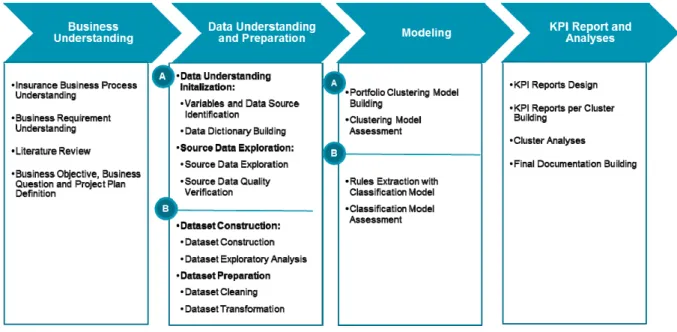
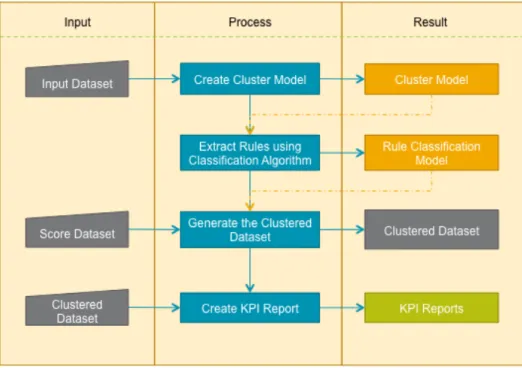
Several methodologies are available in data mining field. Azeved and Santos (2008) do parallel comparison between KDD, SEMMA and CRISP‐DM. Based on the study, it is mentioned that CRISP‐ DM is more complete methodologies compared to others. In CRISP‐DM methodology, it includes business understanding phase which is an important phase in data mining project while others do not include it. By understanding the problems, goals and resources in the business understanding phase, it can minimize the project risk (IBM SPSS Modeler CRISP‐DM Guide, Chapman, 2000). Some adjustments are made in the methodology in order to adapt to the project. There are four phases in the project: (1) Business Understanding, (2) Data Understanding and Data Preparation, (3) Modeling, and (4) KPI Reports and Analyses. Below is the brief description of the phases based on IBM SPSS Modeler CRISP‐DM Guide and Chapman (2000) with some adaption to the project.
Figure 1: Project Methodologies
4.1. B
USINESSU
NDERSTANDINGAccording to CRISP‐DM Guide, it is important to explore what the organization expects to accomplish from the data mining project. Therefore, in the initial phase, the first task is to gain as much insight as possible to understand business objectives by clarifying problems and goals and discussing with as many key people. However, in order to understand the business requirement, it is important to know insurance business concept such as business process, insurance terms and ratios. It is useful not only to understand the context of the problem but also to work on data mining process. According to Ahlemeyer and Coleman (2014), the domain knowledge is a major part of successful data mining, because taking advantage of the knowledge in data mining decision is done most of the time, for example in data preparation on how to treat zero and missing values. The next step is assessing the situation regarding the available resources to the project such as business expert, data experts, dataset and software tools. Lastly, converts the knowledge of business objectives into data mining goals and preliminary plan designed to achieve the objectives.
4.2. 0D
ATAU
NDERSTANDING ANDP
REPARATIONThe data understanding phase starts with data acquisition by performing any analysis and discussion with business experts. These activities give benefit because specific information regarding data problem can be provided, so unnecessary process can be avoided (Wang & Keogh, 2008). In this step, the possible input variables and data sources are identified and collected. Also, data is selected according to the relevancy of data mining goal. The next process is describing the data including format, quantity and sampling of the records by building data dictionary. In this step, simple statistical analysis and some graphs or plots are made in order to find some interesting data that may feed into the transformation phase. The last step is verifying data quality to discover of data completeness, errors and missing data.
The data preparation phase covers all activities to produce the final dataset (data that will be used by modeling). This process normally takes a lot of time and effort in the project. Basic tasks in data preparation phase are as follows:
• Data Construction and Integration
This task is creating new data which operations such as creating derived attributes, generating records, discretization of data by reducing the number of levels of attribute and any transforming data activities. There are two basic methods of integrating data which are merging data set and appending data. Merging data refers to joining together two or more datasets that have different information but have the same object information. In the opposite, appending data refers to joining two or more datasets that have same information but have different object information. Deriving variable building and simplification of the data such as by aggregating are done in this step. The result of these processes is dataset that is used by the project.
• Data Cleaning and Data Transformation
Data cleaning involves several techniques to solve the data problem such as filling in missing values, smoothing out noise, handling outliers, detecting and removing redundant data. In this step, it is possible to drop some variables. Last step is data formatting which refer to data transformation. Sometimes, certain modeling technique requires particular format or order to the data.
4.3. C
LUSTERING ANDC
LASSIFICATIONM
ODELINGIn this phase, various modeling techniques are selected and applied. It is possible that this step has been done in business understanding which refers to the specific modeling technique. Modeling is usually conducted in multiple iterations because of the needs to fine‐tune the parameters or revert to the data preparation phase for manipulation required by the model. Some experiment will be done before making final conclusions. In order to track the progress with a variety model, it is necessary to keep notes of the parameter setting and data used for each model and description of model result. This phase will be divided into two which are portfolio clustering modeling and classification modeling based on cluster data.
4.4. KPI
R
EPORT ANDA
NALYSESAt this stage in the project, the data mining models have been built. To understand the result of clustering model in more detail, KPI reports will be developed. Further analyses per cluster will be done. Before proceeding to final step, it is important to more thoroughly evaluate the model and review the steps executed to construct the model to be certain it properly achieves the business objectives. A key objective is to determine if there is some important business issue that has not been sufficiently considered. Final documentation is created to record all the activities and results from this project.
5. DATA UNDERSTANDING AND PREPARATION PROCESS
5.1. I
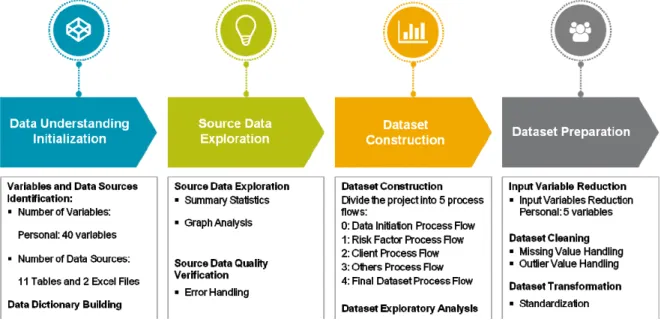
NTRODUCTIONReal world data are generally noisy, incomplete and inconsistent that may impact the result of data mining (Han and Kamber, 2006). Analyzing data that has such problems can produce misleading or wrong results. Thus, the representation and quality of data is first and foremost before running an analysis. Data understanding and preparation process will be divided into four groups which are Data Understanding Initialization, Source Data Exploration, Dataset Construction and, lastly, Dataset Preparation. The detail of the process is follow:
Figure 2: Data Understanding and Preparation Process
5.2. D
ATAU
NDERSTANDINGI
NITIALIZATIONThe data understanding initialization is started with the identification of variables and data sources based on Business Understanding phase and Interview with data expert. After the variables and data sources are defined, the next step is building data dictionary to document the metadata and to understand the characteristics of the data.
5.2.1. Variables and Data Sources Identification
The main objective of creating clusters is to determine pricing strategies based on the characteristics of the clusters. The pricing itself is a function of some observable variables describing the risk. In motor vehicle insurance, the pricing can be determined as a function of vehicle characteristics such as power, weight and capacity and customer’s characteristics such as age of the policy holder (
Pelessoni and Picech, 1998)
. Therefore, the input variables that are defined will consider risk of portfolio that is used in pricing. The interview with an actuary has been conducted to decide which variables that possible to be used to create the clustering model.There are two types of customer who buy insurance portfolio which are Individual and Commercial Line. These customer types have different data characteristics. Thus, it is necessary to
split the data into two. The individual data has the majority of the data, in this case, the project only focus on individual data and filter out the company data.
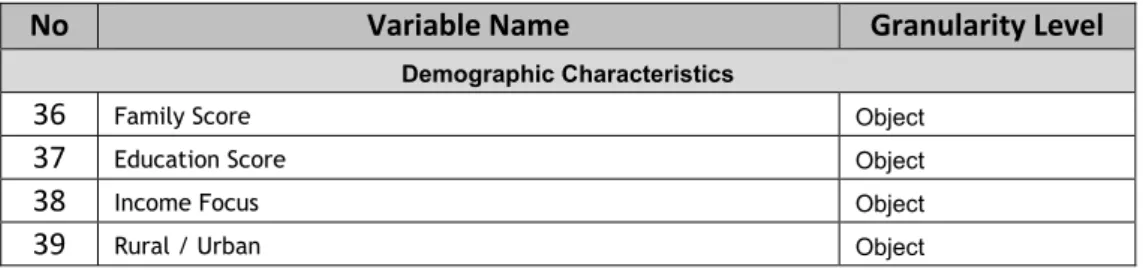
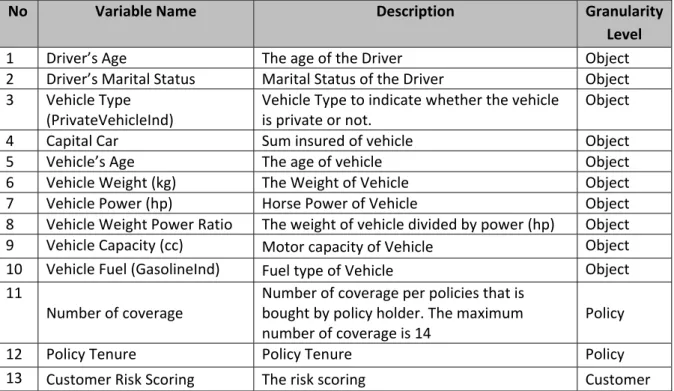
For the initial step, there are 39 possible input variables that has been defined which are grouped into five business perspectives. The business perspectives are driver characteristics, vehicle characteristics, policy characteristics, insurance customer characteristics and demographic characteristics. More detail variables are listed below:
No Variable Name Granularity Level
Driver Characteristics
1 Driver’s Age Object
2 Number of Years of Driving License Object
3 Driver’s Gender Object
4 Driver’s Marital Status Object
Vehicle Characteristics
5 Vehicle Type Object
6 Capital Car (The current price of the vehicles or sum of insured) Object
7 Vehicle’s Age Object
8 Vehicle Weight Object
9 Vehicle Power (hp) Object
10 Vehicle Weight Power Ratio Object
11 Vehicle Capacity (cc) Object
12 Vehicle Fuel Object
13 Vehicle Brand Object
14 Vehicle Number of Seats Object
15 Vehicle Number of Doors Object
Policy Characteristics
16 Policy Tenure Policy
17 Payment Type Policy
18 Claim Frequency Policy
19 Claim Frequency based on profile Policy
20 Average Claim Cost of Contract Policy
21 Average Percentage Premium changes at renewal Policy 22 Number of average changes of data Policy
23 Number of Coverage Policy
24 Collision Coverage Indicator (with or without collision) Policy
25 Discount per contract Policy
Insurance Customer Characteristics
26 Customer Tenure Customer
27 Number of Active LOB product Customer
28 Number of Active Non-Life Ex. Health LOB product of clients Customer
29 Number of Active Motor policies Customer
30 Number of Active Life policies Customer
31 Number of Active Health policies Customer
32 Number of Active Accident policies Customer 33 Number of Active Multi Risk policies Customer
34 Customer Risk Scoring Customer
No Variable Name Granularity Level
Demographic Characteristics
36 Family Score Object
37 Education Score Object
38 Income Focus Object
39 Rural / Urban Object
Table 1: Possible Input Variables
After, the possible input variables are identified, the next step is to do the mapping between input variables and data source. The mapping document is called as codebook, but it cannot be presented here because of the confidentiality. In summary, there are 10 tables and 2 excel files of data sources that will be used in this project, they are:
No Source Name Description
1 Non‐life Policy Table This table provides information of all non‐life policies. In this project this table is used to get the status of policies.
2 Underwriting Table
This table is snapshot values per month based on underwriting point of view. Underwriting View shows the accumulation value annuity. In this view, the claim cost will be reported on the transaction date. This table only contains Motor Policies.
3 Coverage Table
This table is information about portfolio per underwriting period. In this table, information about coverages is used. This table only contains Motor Policies.
4 Transaction Table This is table transaction. This table is used to get number of changes per policies.
5 Policy Table This is table from Marketing Data Mart that provides information for all policies in the company.
6 Discount Table This is table for discount of Motor Policies 7 Risk Score Table This is table for Risk Score Information
8 Customer Table This is table from Marketing Data Mart that provides information about clients in the company.
9 Demographic Table This is table from Marketing Data Mart that provides information about demographics data. 10 Object Table This is table that contains detail information of objects. 11 Excluded Policies Excel This is an excel file that contains information of policies that belong to the company. These policies need to be excluded. 12 Urban Rural Excel This is an excel file that contains mapping between postal code and information of Urban, Rural or Mix. Table 2: Data Source 5.2.2. Data Dictionary Building
One of the most valuable tools before performing data understanding is building data dictionary. Data dictionary can give idea about what the data contains. The data dictionary includes information about data definitions, as follows:
1. Location of source table 2. The description of the source table 3. Key column(s) of source table 4. Variable Names, Types, Length, English description, example data and some notes. The full data dictionary document cannot be presented because of the confidentiality. Below is the example of data dictionary which column ‘Example Data’ uses dummy values: SAS Folder: Seguros/Seguros User Data/Marketing/Tabelas Description: Table from Marketing Data Mart about all policies Key Column: Id_Apolice, ValidoDe
Name Type Label Description Example Data
Cod_Nif Character Id Customer 123456789 Id_Apolice Character Policy Number AU12345678 Cod_RamoSimples Character LOB
Line of Business such as health, life, and motor.
AUX‐Protecção Automóvel Cod_RamoAgregado Character LOB Group AU‐Automóvel Dt_EmissaoApolice Date Create Date 1/16/13 Dt_InicioApolice Date Active Date 1/16/13 Dt_EfeitoAnulacaoApolice Date Cancel Date 6/16/15 Nif_EntPagadora Character Payer Insurance Id Customer Life insurance use this customer id 123456789 Nif_EntTomadora Character Insured Id Customer Non‐Life insurance use this customer id 123456789 ValidoDe Date Start Valid Date 8/31/15 ValidoAte Date End Valid Date 12/31/99
Table 3: Example of Data Dictionary
5.3.
S
OURCED
ATAE
XPLORATION5.3.1. Source Data Exploration The second step after data understanding initialization is starting to explore the source data to get some insights of the data. Following actions are done to analyze the source data: 1. Checking the data integrity 2. Checking key column uniqueness for each table 3. Creating basic information including total records, number of non‐missing value (N), Number of missing value, Distinct Value 4. Doing univariate analysis, which are divided into two based on the type of variables:
-
Continuous Variables: Summary Statistics / Histogram Chart / Box Plot-
Categorical Variables: One‐way Frequency / Bar Chart / Pie Chart (see the distribution) The detail data understanding result cannot be presented because of confidentiality.5.3.2. Data Quality Verification
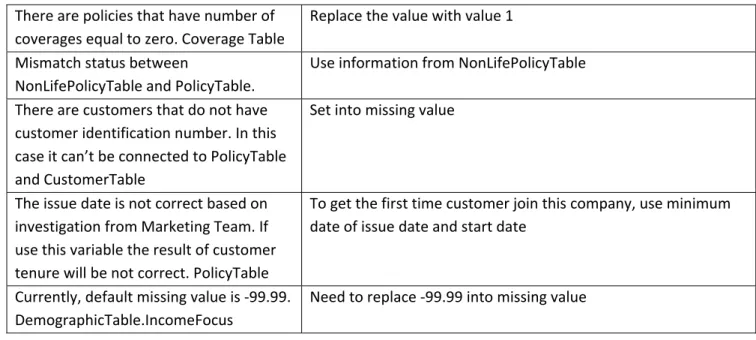
While doing exploration of source data, the verification of data quality is analyzed. Several problems such as data error and inconsistencies are found during understanding data process. The summary of error data handling is follows: Problem Explanation and Solution There are individual ages that higher than 100. UnderwritingTable: - IDD_COND_VALOR - ANO_CARTA - CONDSEXO - CONDESTC This data means that there is more than 1 driver, so in this case the ages of the drivers are unknown. There are rules to change the value into missing. This rule will be applied for below variables for all data: - Age - Marital Status - Gender - Number of years driving license The solution is setting variables to missing for all objects that fit certain rule condition. There are values of E and T at Marital Status. UnderwritingTable.CONDESTC This is error data. Need to be changed into missing value. There are values of E and A at Gender. UnderwritingTable.CONDSEXO This is error data. Need to be changed into missing value. There are negative values of total claim cost. UnderwritingTable (I_FECHADO + I_CURSO ‐I_IDS_credor) One of the reasons is because of the rejected claim. Set to zero for claim cost below than 0 There are zero weight. UnderwritingTable ‐ PESOBRUT In reality, it doesn’t make sense to have zero weight. In this case, the zero weight values are replaced with the median weight (exclude zero values) based on cross join between TP_VIAT (Vehicle Type) and group of VMARCA (Vehicle Brand). It is applied also for variable WeightPowerRatio. Zero power of vehicles. UnderwritingTable ‐ POTENCIA Normally zero power is for trailer which is only available at OTHERS vehicle type. In this case, zero power values are replaced with median of power based on cross join between TP_VIAT (Vehicle Type) and group of VMARCA (Vehicle Brand). It is applied also for variable WeightPowerRatio. There are differences of Client Type in same policy but different object. UnderwritingTable.CLIENT_T Use the latest CLIENT_T at policy level and use max CLIENT_T at customer level. There is difference payment type between UnderwritingTable. tipfracc and NonLifePolicyTable. tipfracc Based on sample policies, the payment type from UnderwritingTable are correct. Use information from NonLifePolicyTable Discrepancy status between NonLifePolicyTable.sitapol and UnderwritingTable. I_CANCELATION_POLICE. Use information from NonLifePolicyTable.
There are policies that have number of coverages equal to zero. Coverage Table Replace the value with value 1 Mismatch status between NonLifePolicyTable and PolicyTable. Use information from NonLifePolicyTable There are customers that do not have customer identification number. In this case it can’t be connected to PolicyTable and CustomerTable Set into missing value The issue date is not correct based on investigation from Marketing Team. If use this variable the result of customer tenure will be not correct. PolicyTable To get the first time customer join this company, use minimum date of issue date and start date Currently, default missing value is ‐99.99. DemographicTable.IncomeFocus Need to replace ‐99.99 into missing value Table 4: Data Error Handling
5.4. D
ATASETC
ONSTRUCTION5.4.1. Dataset Construction
After process of data source exploration and data quality verification, the next step is building dataset. In this process, the cleaner dataset can be created. The dataset is built using SAS Enterprise Guide. Based on analysis in the previous step, the project was designed into five process flows, as follows:
No Project Name Project Description Table Output
0. Data Initiation This is used to create active or in‐force policies that become base dataset for the other process flows. CLS_ACTIVE_OBJECTS CLS_ACTIVE_POLICIES 1. Risk Factor Process Flow This is used to create variables related to risk factor CLS_RISK_FACTOR
2. Customer Process Flow This is used to create variables at customer level CLS_CUSTOMER 3. Others Process Flow This is used to create other variables CLS_OTHER 4. Final Dataset Process Flow This is used to create final dataset for individual after filtering Company Policies CLS_PERSONAL_DATASET Table 5: Dataset Process Flow
Table CLS_PERSONAL_DATASET is the final dataset that is used for modeling. The dataset uses inforce policies of November 2015 and consists about 120,000 records after excluding commercial line data. There are 39 variables that have been developed based on data understanding initialization phase. The business rules and error handling are also applied in this dataset. Detail process flow diagram from source data into final datasets can be seen at Appendix A.1.
5.4.2. Dataset Exploratory Analysis
Dataset exploratory analysis is also called as descriptive statistics normally based on fundamental statistical analysis. The dataset is examined to get prior information on variables and their correlation before they are selected as input variables in the modeling process. The dataset exploratory analyses are very useful not only for understanding the variables’ characteristics but also for giving fundamental statistics information before they are selected for further steps in clustering analysis. In this project, three analyses have been conducted including univariate analysis, summary statistics and variable correlations. The analysis is done using SAS Enterprise Guide. SAS Guide Tools Description Characterize Data To analyze the data including frequency and univariate analysis Summary Statistics To analyze the data including basic statistics and percentiles Correlation To analyze the correlation between Interval Variables Table 6: Exploratory Analysis
Characterize data feature in SAS is a simple approach to quickly getting a summary information of all variables in dataset. In summary, the result of characterize data shows:
a. Frequency table of categorical variables. This summary displays 10 most frequent distinct values per variable, frequent count and percent of total frequency.
b. Descriptive statistics of interval variables. This summary displays basic statistics such as N (Number of non‐missing values), NMiss (Number of missing values), Total, Min, Mean, Median, Max and StdMean.
c. Frequency Chart of categorical variables. This chart displays frequent count of each value per variables in bar chart.
d. Histogram Graph of interval variables. This graph displays frequent count of binning value per variables.
For Summary Statistics, there are 3 categories statistics has been analyzed, those are central tendency, dispersion and shape of distribution. These summary statistics are complement from previous analysis, which includes shape of distribution such as percentile and skewness. Category Common Measures Central Tendency Mean and Median Dispersion Standard Deviation and Range Shape of Distribution Maximum, Minimum, P1, P5, P25, P50, P75, P95, P99, and skewness Table 7: Summary Statistics
Correlation analysis is used to detect input variable redundancy in the dataset (Han and Kamber, 2004). The analysis uses correlation coefficient (also known as Pearson’s coefficient) to measure how strongly one attribute implies the other. However, the correlation does not imply causality. Below are the input variables that are correlated (more than 80%), those are:
a. Customer Tenure and Policy Tenure have a correlation of 92.3% b. Driver Age and Years Driving License have a correlation of 83%