UNIVERSIDADE DE LISBOA FACULDADE DE CIÊNCIAS
Salema, Sarpa salpa (Linnaeus 1758): stock structure in the
eastern Atlantic and biological characterization off the
Portuguese coast
Doutoramento em Biologia
Especialidade em Biologia Marinha e Aquacultura
Rafaela Barros Paiva
Tese orientada por:
Prof. Doutor Leonel Serrano Gordo e pela Prof.ª Doutora Maria José Costa
UNIVERSIDADE DE LISBOA FACULDADE DE CIÊNCIAS
Salema, Sarpa salpa (Linnaeus 1758): stock structure in the
eastern Atlantic and biological characterization off the
Portuguese coast
Doutoramento em BiologiaEspecialidade em Biologia Marinha e Aquacultura
Rafaela Barros Paiva
Tese orientada por:
Prof. Doutor Leonel Serrano Gordo e pela Prof.ª Doutora Maria José Costa Júri:
Presidente:
● Henrique Manuel Roque Nogueira Cabral Vogais:
● Nuno Eduardo Malheiro Magalhães Esteves Formigo ● Pedro Miguel Raposo de Almeida
● Jorge Manuel Santos Gonçalves ● Henrique Manuel Roque Nogueira Cabral ● Leonel Paulo Sul de Serrano Gordo
Documento especialmente elaborado para a obtenção do grau de doutor
Instituição Financiadora: Fundação para a Ciência e a Tecnologia (bolsa de doutoramento com a referência SFRH/BD/80268/2011)
Doctoral dissertation in Biology (scientific area of
Marine Biology and Aquaculture) presented to the
University of Lisbon
Dissertação apresentada à Universidade de Lisboa
para obtenção do grau de Doutor em Biologia
(especialidade Biologia Marinha e Aquacultura)
Rafaela Carla Viseu Barros Paiva
2015
Table of contents
Agradecimentos (PT) ... 1
Resumo e palavras-chave ... 5
Abstract and keywords ... 7
Resumo alargado ... 9
List of papers ... 15
CHAPTER 1... 19
General introduction ... 21
Objectives and thesis structure ... 27
PART I - Stock structure ... 31
CHAPTER 2 - Morphometric analysis ... 33
Body geometric morphometric and otolith shape analysis: Complementary tools for stock discrimination of Sarpa salpa in the Northeast Atlantic Ocean ... 35
CHAPTER 3 - Genetic analysis ... 57
Post glacial expansion and current reduced gene flow in salema population Sarpa salpa (Linnaeus 1758) (family Sparidae) ... 59
PART II - Biology ... 91
Age, growth and reproduction of the protandrous hermaphrodite fish, Sarpa salpa,
from the Portuguese continental coast ... 95
CHAPTER 5 - Cystic structures ... 125
Cystic structures in fish ovaries: more common than we think - the case study of Sarpa salpa (Sparidae) ... 127
CHAPTER 6... 135 General discussion ... 137 Conclusions ... 146 CHAPTER 7... 149 References ... 151 CHAPTER 8... 169 Supplementary Material ... 171
Agradecimentos (PT)
Nestes quatro anos que passaram tive a oportunidade de conhecer e de
conviver com diversas pessoas. Tudo o que aprendi e realizei corresponde ao reflexo
de toda a ajuda, apoio e partilha de experiências que recebi da vossa parte, muito
obrigada!
Gostaria de agradecer especialmente:
- Ao Professor Doutor Leonel Serrano Gordo, MUITO OBRIGADA por TODO o apoio, interesse, disponibilidade, paciência, por partilhar comigo a Sua experiência e
conhecimentos e sobretudo por me deixar aprender Consigo;
- À Professora Doutora Maria José Costa, MUITO OBRIGADA por ser minha
orientadora e por TODO o apoio disponibilizado;
- Ao pessoal do Laboratório de Biologia Pesqueira, nomeadamente à Ana
Neves, Vera Sequeira, Ana Rita Vieira e Catarina Vendrell obrigada por TUDO durante
as diversas fases do trabalho e sobretudo por aturarem o “aroma” das salemas… vocês
são pessoas incríveis! Cada uma de vocês teve a capacidade de partilhar comigo
conhecimentos e experiências distintas, independentemente do âmbito profissional ou
pessoal;
- À Ana Sofia Rodrigues, Carla Ribeiro da Silva e ao Francisco Pina-Martins pela
preciosa ajuda nas diversas tarefas incluídas na análise genética;
- Ao Professor Doutor Octávio Paulo, que mesmo sendo uma pessoa
- A todas as pessoas que me ajudaram a obter as amostras: Domingo Lago,
Dimitrios Moutopoulos, João Barreiros, Jorge Gonçalves, Karim Erzini, Luciana Sola,
Mafalda Freitas, Sanja Matid-Skoko, Sérgio Barbosa e Tibério Simões. Muito obrigada
também ao Senhor de etnia cigana que me ajudou a “passar o tempo” enquanto eu
esperava que as minhas amostras vindas da Madeira estivessem prontas para levantar
na área de cargas do aeroporto de Lisboa…estávamos ambos à espera que a
mercadoria estivesse disponível;
- A todos os pescadores que me permitiram obter amostras, em especial aos
Mestres Zé Neves, Zé Oliveira e Jacinto pois durante o período de amostragem, rara foi
a semana em que não falámos ao telefone;
- A todos os amigos que tiveram um papel essencial nas gargalhadas…em todos
os almoços, lanches e jantares que organizámos;
- Um obrigada especial à Maria e à Filipa pela companhia na hora do almoço e
do café;
- À família, por TUDO E MAIS ALGUMA COISA e também por estarem sempre dispostos a provar salema confecionada nas mais diversas formas;
- Ao Tiago, por estar presente na MINHA VIDA….e ao Baltazar, que embora
tenha vindo alterar completamente as nossas rotinas é o melhor cão que podíamos
A autora desta tese foi financiada com uma bolsa de doutoramento da Fundação para
a Ciência e a Tecnologia (Referência SFRH/BD/80268/2011).
The author of this thesis was funded by Fundação para a Ciência e a Tecnologia with a
Resumo e palavras-chave
Resumo: Esta tese contempla o primeiro estudo multidisciplinar de salema, Sarpa salpa, no sul do Nordeste Atlântico porque analisa a estrutura do seu manancial e carateriza alguns dos parâmetros biológicos da espécie. Para analisar a estrutura do
manancial, estudaram-se indivíduos de três regiões de Portugal continental e do
Arquipélago da Madeira, complementados com informações de indivíduos do Mar
Mediterrâneo para a análise genética, enquanto a análise biológica da espécie foi baseada em exemplares capturados na região centro do País. Considerando a análise
da estrutura do manancial, técnicas morfo-geométricas aplicadas à forma do corpo e a
análise elíptica de Fourier aplicada à forma do otólito indicaram alguma sobreposição
dos indivíduos de Portugal continental, especialmente entre o centro e o sul, e uma
forte separação dos indivíduos do Arquipélago da Madeira. Ambas as técnicas
indicaram que devem existir pelo menos dois mananciais, um na Madeira e outro em
Portugal continental. No entanto, os resultados não foram claros quanto à existência
de mais um manancial no norte do país deixando em aberto a questão se realmente
existe um manancial no norte e outro que contempla o centro e sul de Portugal. A
existência de mananciais, colocada em evidência pelas análises morfológicas, indica
que os indivíduos foram sujeitos à acção de divergência genética ou à adaptação em
locais com condições ambientais particulares, sendo este último o mais plausível no
presente caso. Em relação à genética, a análise dos dados mitocondriais e nucleares
suportam as seguintes hipóteses: a) não há evidência de estruturação do manancial
redução actual no fluxo de genes entre os locais de amostragem; c) há um claro sinal
de expansão dos possíveis locais de refúgio na costa de Africa, com uma acumulação
de mutações in situ; d) a introgressão de ADN, encontrada nos dados mitocondriais e
nucleares, parece ser antiga, existente muito provavelmente antes da expansão.
Relativamente ao estudo da biologia da espécie em Portugal continental, foram
obtidas novas informações no âmbito das análises da idade, crescimento e
reprodução, onde não existiam dados prévios. Foram estimados os parâmetros de
história de vida que são particularmente importantes pois podem ser usados em
modelos ecológicos, para informar, avaliar e melhorar a gestão dos mananciais
pesqueiros. Os parâmetros de história de vida estimados incluem a duração da época
de reprodução (Setembro a Novembro), o padrão de crescimento (médio-baixo), o
comprimento de primeira maturação dos machos (25 cm), a determinação do tipo de
fecundidade (determinado) e o seu cálculo. Foram encontradas estruturas císticas nos
ovários e os resultados obtidos indicaram que estas estruturas podem fazer parte da
estratégia reproductiva de S. salpa.
Palavras-chave: Sarpa salpa, Oceano Atlântico, morfometrias do corpo e do otólito,
Abstract and keywords
Abstract: This thesis comprises the first multidisciplinary study of Sarpa salpa in the
southern Northeast Atlantic Ocean because it analyzes its stock structure and
characterizes the biological parameters of the specimens off the Portuguese coast. To
achieve those goals, specimens from three areas of mainland Portugal and Madeira
were collected and supplementary samples from Mediterranean Sea were obtained for
genetic analysis. Considering the analysis of the stock structure, the body geometric morphometric techniques and the elliptical Fourier analysis indicated some overlap in
the mainland specimens, especially between the central and south areas, and a clear
separation of Madeira individuals. Both techniques indicated that at least two stocks
may occur, one in Madeira and the other in mainland waters but were not clear
regarding to the existence of an additional stock in mainland waters, separating the
northern region from the central and south areas. Evidence of stocks through
morphometric analysis indicated that individuals have been underlying some genetic
divergence or adaptation to local conditions, being the latter the most applicable to
the present case. Regarding genetics, the analysis of mitochondrial and nuclear data of
S. salpa support the hypothesis that: a) there is no evidence of stock structure between Atlantic and Mediterranean samples; b) exists a reduction of the current gene
flow among sampling sites; c) there is a clear expansion signal from the possible
refuges in the coast of Africa with accumulation of mutation in situ; d) the
mitochondrial and nuclear DNA introgression detected seems to be ancient, probably
reproduction new information was given for the Portuguese continental coast, where
no information was available. This new information is particularly valuable because life
history parameters of S. salpa were estimated and that can be used to provide
baseline data to be applied in ecological modelling, to inform, improve and assess the
fisheries towards a sustainable management. The information determined on S. salpa
life history parameters, captured in the Portuguese waters, included: the duration of
the spawning season (from September to November); the determination of growth
pattern (medium-slow); the estimation of L50 for males (25 cm); the clarification of the
fecundity type (determinate) and its estimation. Cystic structures have been
documented in S. salpa ovaries and the results indicated that the cysts may be part of
the species reproductive strategy.
Keywords: Sarpa salpa, Atlantic Ocean, body and otolith morphometrics, genetic
Resumo alargado
A salema, Sarpa salpa (Linnaeus 1758), pertence à Família Sparidae e encontra-se
amplamente distribuída pelo Mar Mediterrâneo, Mar Negro, Oceano Atlântico Oriental
(desde a Baía da Biscaia até ao Cabo da Boa Esperança) e Oceano Índico Ocidental
(desde Moçambique até ao Cabo da Boa Esperança). É explorada comercialmente ao
longo de toda a sua área de distribuição sendo capturada quer pela pesca artesanal
quer pelo arrasto. Esta espécie é largamente consumida, principalmente devido ao seu baixo custo e, devido a este facto, é frequentemente procurada por pessoas de classes
económicas mais baixas. Até ao momento, os trabalhos efectuados na presente
espécie foram realizados principalmente no Mar Mediterrâneo e no Oceano Índico
Ocidental, e tiveram como principais objectivos o estudo dos hábitos e conteúdos
alimentares, da distribuição espacial, do crescimento e da biologia da reprodução. Pelo
contrário, poucos estudos foram publicados para o Oceano Atlântico Oriental. Apesar
de a espécie ser explorada comercialmente, não existem dados sobre as diferentes
populações que podem existir ao longo da sua área de distribuição e também não
existem medidas de gestão tendo em vista a sua sustentabilidade pesqueira.
Deste modo, o presente estudo teve como principais objectivos definir a estrutura do
manancial de S. salpa no sul do Nordeste Atlântico e caracterizar a biologia da
população de Portugal continental. Esta tese é composta por seis capítulos, quatro dos
quais referentes a artigos científicos, publicados ou em revisão em revistas
No capítulo 1, introdução geral, é apresentado o enquadramento do tema da presente
tese, destacando os principais aspectos sobre o conhecimento actual em relação à
biologia, ecologia e pesca de S. salpa.
De forma a cumprir os objectivos propostos, a presente tese foi dividida em duas
Partes: Parte I - Estrutura do manancial e Parte II – Biologia. Os capítulos 2
(morfometria do corpo e do otólito) e 3 (análise genética) estão incluídos na Parte I, e
os capítulos 4 (idade, crescimento e reprodução) e 5 (estruturas císticas) estão
incluídos na Parte II.
Para a Parte I, foram escolhidos diferentes métodos para detectar a estruturação do
manancial de S. salpa no sul do Nordeste Atlântico, de modo a implementar uma
abordagem holística para responder ao primeiro objectivo da tese.
No capítulo 2 foram usados indivíduos capturados ao longo de Portugal continental
(norte, centro e sul) e no Arquipélago da Madeira, e encontram-se descritas as técnicas
morfo-geométricas aplicadas à forma do corpo e a análise elíptica de Fourier aplicada
ao contorno do otólito. Ambas as técnicas indicaram alguma sobreposição dos
indivíduos de Portugal continental, especialmente entre o centro e o sul, e uma forte separação dos indivíduos da Madeira. Os resultados indicados por ambas as técnicas
sugerem que devem existir pelo menos dois mananciais, um na Madeira e outro em
Portugal continental; no entanto, os resultados não foram claros quanto à existência
de um segundo manancial no norte do país. A existência de mananciais, colocada em
evidência pelas análises morfológicas, indica que os indivíduos foram sujeitos à acção
No capítulo 3 foram analisados indivíduos de 11 locais de amostragem distintos
distribuídos pelo Oceano Atlântico nordeste [quatro regiões de Portugal Continental
(Apúlia, Peniche, Setúbal, Algarve), Marrocos, Açores e Madeira] e pelo Mar
Mediterrâneo (Espanha, Itália, Croácia e Grécia). O padrão filogeográfico foi analisado
através de 109 sequências da região de controlo do ADN mitocondrial e através de 86
sequências do primeiro intrão da proteína ribossomal S7 do gene nuclear. A análise
dos dados mitocondriais e nucleares encontra-se descrita no capítulo 3 e os principais
resultados obtidos indicaram que: a) não há evidência de estruturação do manancial
entre os indivíduos amostrados no Oceano Atlântico e no Mar Mediterrâneo; b)
actualmente existe uma redução no fluxo de genes entre os locais de amostragem; c)
há um sinal de expansão dos possíveis locais de refúgio na costa de Africa, com uma
acumulação de mutações in situ; e d) a introgressão de ADN mitocondrial e nucleares
aparenta ser antiga, existente muito provavelmente antes da expansão ter ocorrido. O
facto da análise genética não ter evidenciado nenhum nível de estruturação do
manancial entre os indivíduos amostrados no Oceano Atlântico e no Mar
Mediterrâneo pode ser devida ao pequeno número de indivíduos utilizados ou ao poder dos marcadores genéticos seleccionados não ser apropriado para detectar
subdivisões em S. salpa.
A Parte II corresponde à resposta ao segundo objectivo proposto, caraterizando-se
pela descrição dos parâmetros biológicos da população de S. salpa de Portugal
continental.
Para o capítulo 4 foram obtidas amostras comerciais de S. salpa, capturadas em
directa de otólitos inteiros, variaram entre os zero (5.2 cm) e os 14 anos (41.4 cm). A
análise do padrão de crescimento dos incrementos detectou um incremento falso,
entre os 1.08 e os 1.25 mm, que foi designado por anel juvenil; este anel foi
encontrado em todos os indivíduos, inclusive nos indivíduos de menor dimensão (que
variaram entre 5.2 e 9.8 cm), e deve corresponder à migração dos juvenis para uma
área de berçário. Os parâmetros de crescimento de von Bertalanffy foram estimados
pela leitura directa e pelo retrocálculo e, de acordo com o valor informativo de Akaike,
o segundo método foi o que melhor descreveu o crescimento de S. salpa. Esta espécie
é hermafrodita protândrica, tendo o processo de mudança de sexo dos indivíduos
amostrados ocorrido entre os 28.6 e os 40.9 cm. Foram determinados alguns
parâmetros de história de vida tais como a época de reprodução (que decorreu entre
Setembro e Novembro), o comprimento de primeira maturação para os machos
(estimado em 24.5 cm, o que corresponde a uma idade de primeira maturação de 2
anos); o tipo de fecundidade (determinada) e a fecundidade relativa anual (variou
entre 462 e 2 662 oócitos por grama de fêmea eviscerada). Este capítulo contém
informações fundamentais sobre os parâmetros de história de vida de S. salpa capturada em Portugal continental, onde até ao momento, não existia nenhuma
informação deste tipo. Por exemplo, o tamanho de captura mínimo permitido em
águas portuguesas, para S. salpa, é de 18 cm, inferior ao comprimento de primeira
maturação estimado para os machos, o que significa que existe uma necessidade real
de modificar o actual tamanho de captura mínimo permitido.
No capítulo 5 encontra-se descrita a presença de estruturas rígidas, facilmente
nenhuma referência para tal ocorrência nos ovários de S. salpa, estas estruturas foram
descritas morfologicamente e analisadas estatisticamente. A análise histológica
sugeriu que estas estruturas correspondem a oócitos hidratados remanescentes que
aparecem isoladamente ou em grupo, formando uma estrutura cística e que podem
corresponder a um evento de desova incompleto ou sem sucesso. As estruturas
císticas foram encontradas frequentemente (em todos os meses excepto em Outubro)
e com valores médios de prevalência mais elevados nos meses que antecedem a época
de reprodução. A presença de oócitos hidratados remanescentes em ovários de peixes,
documentados como isolados ou agregados em cistos, é considerada rara e
encontra-se deficientemente documentada mas, no preencontra-sente caso, os resultados sugerem que
as estruturas císticas possam fazer parte da estratégia reproductiva de S. salpa.
Finalmente, no capítulo 6 é apresentada uma discussão geral que inclui os principais
resultados obtidos nos capítulos anteriores e, como conclusão, também são
List of papers
This thesis is comprised by the papers listed below, each corresponding to a chapter,
from 2 to 5. The author of this thesis is the first author in all papers and was
responsible for conception and design of the work, field surveys, sample collection and
processing, laboratory analytical procedures, data analysis and manuscript writing of
all the papers. Remaining authors collaborated in some or several of these procedures.
All papers published were included with the publishers’ agreement.
CHAPTER 2 - Morphometric analysis
Body geometric morphometric and otolith shape analysis: Complementary tools for stock discrimination of Sarpa salpa in the Northeast Atlantic Ocean
Rafaela Barros Paiva, Vera Sequeira, Ana Neves, Ana Rita Vieira, Maria José Costa and Leonel Serrano Gordo
Submitted to Helgoland Marine Research
CHAPTER 3 - Genetic analysis
Post glacial expansion and current reduced gene flow in salema population Sarpa salpa (Linnaeus 1758) (family Sparidae)
Rafaela Barros Paiva, Ana Sofia Rodrigues, Ana Neves, Vera Sequeira, Ana Rita Vieira, Carla Ribeiro Da Silva, Francisco Pina-Martins, Maria José Costa, Leonel Serrano Gordo and Octávio S. Paulo
CHAPTER 4 - Age, growth and reproduction
Age, growth and reproduction of the protandrous hermaphrodite fish, Sarpa salpa, from the Portuguese continental coast
Rafaela Barros Paiva, Ana Neves, Vera Sequeira, Ana Rita Vieira, Maria José Costa and Leonel Serrano Gordo
Accepted in the Journal of the Marine Biological Association UK
CHAPTER 5 - Cystic structures
Cystic structures in fish ovaries: more common than we think - the case study of Sarpa salpa (Sparidae)
Rafaela Barros Paiva, Ana Neves, Ana Rita Vieira, Vera Sequeira, Catarina Vendrell, Maria José Costa, Maria Peleteiro and Leonel Serrano Gordo
C
HAPTER
1
General introduction
General introduction
Sarpa salpa (Linnaeus 1758) (Figure 1) belongs to the Family Sparidae that consists of approximately 115 species in 33 genera. This Family is widely distributed in
tropical and temperate coastal waters,
includes a large number of species of
high economic value (Herrán et al.,
2001) and constitutes one of the most important fish resources in the Atlantic
Ocean and in the Mediterranean Sea. S. salpa is the only species present in the Genus Sarpa and is commonly known as
salema, salema porgy, cow bream or goldline (Russell et al., 2014). Morphologically is
characterized by an oval to oblong body, is laterally compressed, with greenish to blue
colors back , silvery on the sides and a dozen of longitudinal lines yellow (Vitale et al.,
2002).
S. salpa is a benthopelagic oceanodromus marine fish that lives in shallow waters (up to 70 meters) and inhabits predominantly rocky areas with algal or seagrass
coverage, such as Posidonia oceanica and Cymodocea nodosa, and also sandy bottoms
(Villamil et al., 2002; Criscoli et al., 2006; Pallaoro et al., 2008). The young fish are
carnivorous and the adults are almost exclusively herbivorous, being considered a
species with an age related mix diet (Havelange et al., 1997). In the Mediterranean Sea
Figure 1. Sarpa salpa individuals.
this species is responsible for up to 75 % of the total herbivorous consumption (Jadot
et al., 2006) and the daily requirements of vegetable food is about 6 - 20 % of its body weight (Criscoli et al., 2006). In addition, its ecological importance is well recognized
while the economic value of S. salpa in fisheries is quite limited (Abecasis et al., 2012).
As most species of Sparidae family, S. salpa presents a hermaphroditic
behavior. Two patterns of functional hermaphroditism are recognized in fishes,
simultaneous, when both eggs and sperm mature at the same time, and sequential,
when fish functions as either male or female at any one time (Price, 1984). Sequential
hermaphrodites may be either protogynous, individuals mature as females and then
transform into males, or protandrous, males are the initial sex and females the
terminal sex (Mitcheson and Liu, 2008). Initially, this species was described as both
protandrous (D’Ancona, 1949; Lissia-Frau, 1966) and as a rudimentary hermaphrodite
(Michèle and Lafaurie, 1974; Joubert, 1981) but nowadays is characterized by
protandric hermaphroditism (Walt and Mann, 1998).
It is a widely distributed species (Figure 2), occurring along the Mediterranean
(Jadot et al., 2006) and Black Sea (Pashkov and Reshetnikov, 2012), in the eastern Atlantic (from the Bay of Biscay to Cape of Good Hope) and in the Western Indian
Ocean (from Mozambique to Cape of Good Hope) (Walt and Mann, 1998).
Additionally, this species is gregarious, sometimes forming sizeable schools, often
reaching hundreds of individuals (Gera et al., 2013; Russell et al., 2014). S. salpa is used
for human consumption by coastal fishery populations being captured by artisanal
fisheries in the west coast of Africa (Walt and Beckley, 1997), Canary Islands (Villamil et
Portuguese mainland (INE, 2011) and in the Mediterranean Sea (Criscoli et al., 2006).
In Portugal, the species has a low commercial value which reflects their low
importance in the fisheries statistics, being the maximum landings obtained in 1991
with a value of 364 tonnes (Figure 3) (DGRM, 2015). These values are much lower
when compared with landings in the Mediterranean Sea where Food and Agriculture
Organization (FAO) landing statistics show a steady increase over the last 50 years,
with a peak in the early 1990s at around 4 000 tonnes and stabilizing at around 2 000
tonnes during the period from 1996 to 2005 (Russel et al., 2014).
Figure 2. Distribution map of Sarpa salpa. (Available at: www.fishbase.com)
Due to its low cost, S. salpa is frequently found in the menu of the lower
income classes (Bellassoued et al., 2014). Furthermore, some human intoxication cases
have been described after their consumption (Spanier et al., 1989) because the species
may ingest P. oceanica as part of their diet, which can contain ciguatera toxins
(Bellassoued et al., 2014) originating the so-called ciguatera fish poisoning (CFP).
However it must be said that these cases are extremely rare. Fish contaminated with
ciguatera toxins were first captured in 2004 at the Canary Islands, then in 2008 at
Selvagens Islands (Madeira Archipelago), and again in Canary Islands (Vale, 2011).
Ciguatera toxins affect the central nervous system and cause a hallucinatory syndrome
(Bellassoued et al., 2014).
Until now, investigation on S. salpa occurred mainly on the Mediterranean sea
and in the Indian Ocean focusing on feeding habits (Gerking, 1984; Antolic et al., 1994;
Havelange et al., 1997), spatial distribution (Dulčid et al., 1997; Ruitton et al., 2000;
Jadot et al., 2006), and growth and reproductive biology (e.g. Walt and Beckley, 1997;
Walt and Mann, 1998; Criscoli et al., 2006; Pallaoro et al., 2008; El-Etreby et al., 2015).
On the contrary, little information has been published from Atlantic Ocean: Villamil et al. (2002) gave some information on its growth and reproductive biology in the Canary Islands, and behavior studies were made in a coastal lagoon in the south of Portugal by
Abecasis et al. (2012).
The essential population parameters, such as abundance, age, growth, survival,
reproduction, maturity and recruitment, are also called life history parameters (Begg,
2005) and their estimation can be used to provide baseline data to be applied in
assessments. For stock identification, in addition to the life history parameters, other
different methods can be used: natural markers (body and otolith morphometrics,
meristics, genetics, parasites, otolith elemental composition, and fatty acid profiles)
and applied marks (internal and external tags, electronic tags, and otolith thermal
marking) (Cañás et al., 2012). The expression of these methods are under the control
of environmental and genetic factors or by the combination of both factors;
environmental factors tend to influence phenotypic characteristics within stock
although, phenotypic differences do not provide direct evidence of genetic isolation
between stocks (Begg and Waldman, 1999). This is because many individual
characteristics are phenotypically plastic whereby a single genotype can develop
different phenotypes in different environments (Heino, 2014).
The incorporation of multiple stock identification methods (holistic approach)
has several advantages to single approach studies (Begg and Waldman, 1999): one of
these techniques may detect stock structure where others fail to do so; greater
confidence is obtained when contrasting approaches provide congruent results;
additional levels of stock structure may be observed with approaches that offer different sensitivities; and finally, multiple applications of discrete approaches, to stock
identification problems, provide more empirical information on the relative merits of
alternative approaches to this still developing field (Waldman, 2005). Begg and
Waldman (1999) recommended the use of at least a genetic procedure and at least
one phenotypic-based approach for an integrated stock identification. And the ideal
approach is to apply multiple stock identification methods to the same sample of fish
2009). In the present thesis, three techniques were selected: body and otolith
morphometrics and genetics. Body and otolith morphometrics are the two most
frequently employed and cost-effective methods (Begg and Waldman, 1999; Burke et
al., 2008; Sajina et al., 2011). There was a great improvement from the body traditional morphometric methods to the actual technique of landmark-based
geometric morphometric, which enables a more powerful stock identification allowing
better data collection, suitable descriptions of shape and the potential of new
analytical techniques (Cadrin and Friedland, 1999; Cadrin, 2000). The otolith
morphology is considered species-specific and the most routinely method used to
describe it involve elliptical Fourier series analysis (Leguá et al., 2013; Stransky, 2014).
The utilization of elliptical Fourier analysis surpasses some of the limitations of
conventional Fourier analysis: equal divisions over the interval sampled; dependency
of the coordinate system; and the difficulty of dealing with the outlines that curve back
on themselves (Lestrel, 1989). Genetic markers are ideal stock discriminators because
they are: a) independent of environmental changes during the course of an individual’s
lifetime; b) composed of discrete units of information (so that population differences can be readily quantified); c) encoded the universal language of DNA (which is
applicable to all forms of life); d) measurable with reasonable efforts and costs; and e)
analyzed with statistical procedures that provide estimates of error associated with the
process (Antoniou and Magoulas, 2014).
Despite the commercial exploitation of the fishery, no information is available
on the different populations that may exist along the distribution area, being the
measures have ever been implemented towards the sustainable use of this resource.
Furthermore, a comprehensive study of S. salpa life history from the Atlantic Ocean
does not exist. Taking into account the poor knowledge on the biology of S. salpa in
the eastern Atlantic, it becomes imperative to develop studies in order to understand
the species dynamics towards the understanding of its stock structure.
Objectives and thesis structure
This thesis has two main goals: G1) to define the stock structure of S. salpa in the eastern Atlantic, and G2) to characterize the biology of the Portuguese mainland
population. The thesis includes four scientific papers published, in review or submitted
in peer reviewed international journals, each corresponding to a chapter.
Chapter 1 comprises the present general introduction, highlighting the main
aspects regarding the present knowledge on S. salpa biology, ecology and fisheries.
To accomplish G1 the application of different methodological approaches in
different sampling sites, covering the distribution area, were proposed: body and
otolith morphometrics, and genetic analysis. These approaches are included in PART I -
Stock structure and comprise two chapters: CHAPTER 2, Morphometric analysis, and
G2 will be achieved through the analysis of biological parameters of S. salpa
from Portuguese mainland and were included in PART II – Biology. This second part
comprises two chapters: CHAPTER 4, Age, growth and reproduction, and CHAPTER 5,
Cystic structures.
Finally, Chapter 6 encompasses a general discussion, covering the results
attained throughout the thesis and some future research objectives are considered.
The results expected in this thesis will allow the elaboration of a database with
the most relevant information for future assessment of the species through the
identification of stock units. In Portuguese mainland, this database will benefit from
information from both the fishery (available from Portuguese directorate of fisheries
and aquaculture) and the biological parameters. This database will allow the
implementation of reliable assessment models, which can lead to the proposal of
PART I
C
HAPTER
2
Body geometric morphometric and otolith
shape analysis: Complementary tools for
stock discrimination of Sarpa salpa in the
Northeast Atlantic Ocean
SUMMARY
Understanding the stock structure of the species is fundamental to define appropriate management strategies in fisheries. Body geometric morphometric techniques and elliptical Fourier analysis were applied on salema, Sarpa salpa, individuals from three areas along the mainland coast of Portugal (north, central, and south regions) and from Madeira waters, in order to clarify the stock structure. Both techniques indicated some overlapped in the mainland specimens, especially between the central and south areas, and a clear separation of Madeira individuals. Concerning the body geometric morphometric analysis, individuals were highly correctly classified to geographic areas (86.7 %), being specimens from Madeira and the north mainland well differentiated from the other areas; on the contrary, specimens from central and south mainland which are geographically closer showed some overlap. For the otolith shape data analyses, size-corrected normalized elliptic Fourier descriptors showed significant effect of area on otolith contour shape. An overall classification success of 70.2 % on the canonical discriminant analyses was achieved suggesting populations discrimination on Portuguese waters, although an overlap between the three areas along the mainland coast, particularly between central and south areas, was present. The results support the existence of two or three stocks of S. salpa in the southern Northeast Atlantic.
INTRODUCTION
Modern fisheries management is moving towards a precautionary approach to ensure
sustainable use of the marine resources (ICES, 1998; Sajina et al., 2011). To achieve
this goal, the knowledge of stock structure is essential for designing appropriate
management regulations in fisheries where multiple stocks are differentially exploited (Waldman, 2005). According to Begg and Waldman (1999), the term stock is defined as
a population or portions of a population, in which all members are characterized by
similarities, and which may include members of several different subpopulations.
Stock identification employs many techniques, such as, traditional tags, parasites as
natural tags, otolith microchemistry, genetic markers, meristics, morphometric
characters and otolith shape, being the latter two most frequently employed and
cost-effective methods (Begg and Waldman, 1999; Burke et al., 2008; Sajina et al., 2011).
There was a great improvement from the traditional morphometric methods to the
actual technique of landmark-based geometric morphometric, which enables a more
powerful stock identification allowing better data collection, suitable descriptions of
shape and the potential of new analytical techniques (Cadrin and Friedland, 1999;
Cadrin, 2000). Morphometric expression is simultaneous under the control of genetic
and environmental factors (Begg and Waldman, 1999), such as temperature, salinity,
radiation, dissolved oxygen, water depth and current flow (Turan et al., 2006). A large
number of authors successfully implemented this technique discriminating populations
of fish species, e.g. sea bream (Sparus aurata) (Loy et al., 1999), topsmelt silverside
(Atherinops affins) (O’Reilly and Horn, 2004), Pacific sardine (Sardinops sagax) (García-Rodríguez et al., 2011), bluemouth (Helicolenus dactylopterus) ((García-Rodríguez-Mendoza et
al., 2011; Sequeira et al., 2011), beaked redfish (Sebastes mentella) (Valentin et al., 2014), acadian redfish (Sebastes fasciatus) (Valentin et al., 2014).
Otoliths are hard, calcium carbonate structures located directly behind the brain of
teleost fish, and they help with balance, orientation, and sound detection-much like
the inner ear of mammals (Wright et al., 2002). Otolith shape is considered to be
thought to be related to variation in environmental conditions, food supply and also
genetic dissimilarities (Arechavala-Lopez et al., 2012; Hamer et al., 2012). Despite
these influences, it cannot be infer between genetic and environmental differences
but otolith shape can provide a phenotypic basis for stock separation (Pothin et al.,
2006). Its use in distinguishing stocks of the same species have been applied in diverse
studies (Wakefield et al., 2014), with levels of classification success ranging from 60 to
95 % (Burke et al., 2008). Stock identification is a central theme in fisheries science and
is a prerequisite for the tasks of stock assessment and fishery management (Cadrin et
al., 2014), because high exploitation combined with ineffective fisheries management, may result in depletion of fish stocks (Turan, 2006).
Salema, Sarpa salpa (Linnaeus 1758), is an eurytherm fish that lives in shallow waters
and predominantly inhabits sandy bottoms and seagrass beds between 0 and 70
meters (Villamil et al., 2002). It is a widely distributed species, occurring throughout
the Mediterranean (Jadot et al., 2006) and Black Sea (Pashkov and Reshetnikov, 2012),
and in eastern Atlantic from the Bay of Biscay to South Africa (Walt and Mann, 1998).
This species is a protandrous hermaphrodite, changing from male to female through a nonfunctional intersexual phase (Criscoli et al., 2006). Until now, investigation on S.
salpa occurred mainly on the Mediterranean region focusing on feeding habits (Gerking, 1984; Antolic et al., 1994; Havelange et al., 1997) and spatial distribution
(Dulčid et al., 1997; Ruitton et al., 2000; Jadot et al., 2006). In the Atlantic, information
is only available for the Canary Islands regarding life history pattern (Villamil et al.,
2002).
The Sparidae family constitutes one of the most important fish resources in the
landings of sparid fishes have reached 5 917 tonnes during 2014, in which 227 tonnes
are of S. salpa (INE, 2015). This species is used for human consumption by coastal
fishery populations being captured by artisanal fisheries in the west coast of Africa
(Walt and Beckley, 1997), Canary Islands (Villamil et al., 2002) and Azores archipelago
(INE, 2011), and by trawl and artisanal fisheries in Portuguese mainland (INE, 2011)
and in the Mediterranean Sea (Criscoli et al., 2006). Despite the commercial
exploitation of the fishery, no information is available on the different populations that
may exist along the distribution area, being the species treated, for managing
purposes, as one stock unit and no management measures have ever been
implemented towards the sustainable use of this resource.
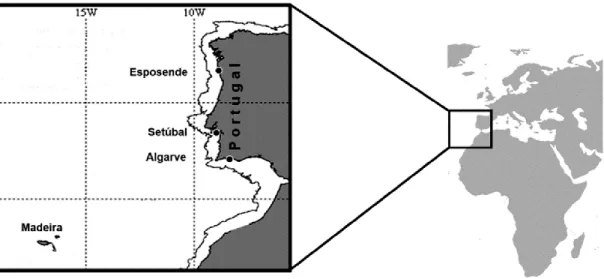
The present study investigates the stock structure of S. salpa population in Portuguese
waters analyzing individuals from three areas along the mainland coast of Portugal
(north region - Esposende, central region - Setúbal, and south region - Algarve) and
from Madeira waters, using geometric morphometric techniques and elliptical Fourier
analysis which could be useful to further develop a management strategy.
MATERIALS AND METHODS
Sampling
A total of 166 individuals were sampled: 131 from de Portuguese mainland (32 from
the north region, 54 from the central region, and 45 from the south region) and 35
from Madeira (Figure 4; Table 1). Adult individuals were obtained from commercial
the spawning season.
Table 1. Details of Sarpa salpa individuals analyzed in each study area. Nbgm Nos Size range (TL, cm) Mean TL (cm) ± standard deviation North mainland 32 32 35.9 - 44.2 40.2 ± 2.19 Central mainland 54 52 29.3 - 35.6 32.8 ± 1.18 South mainland 45 45 29.3 - 40.0 35.2 ± 3.07 Madeira 35 32 18.2 - 28.9 21.9 ± 5.68 Total 166 161
TL, total length; Nbgm, total number of individuals used in the body geometric morphometric analysis,
Nos, total number of otoliths used in the otolith shape analysis
All samples were placed individually into plastic bags, deep-frozen (-20ºC) and stored
in a horizontal position to avoid any deformation of the body until the time of the
analysis. Total length (TL, ± 0.1 cm) was recorded for each fish. As suggested by Tuset
et al. (2006), an analysis by sex within the geographic areas was not performed
because the present species is a protandrous hermaphrodite.
Figure 4. Map of the sampling area with the sampling sites in the Northeast Atlantic: three areas along
the mainland coast of Portugal (north mainland - Esposende, central mainland - Setúbal, and south mainland - Algarve) and other in Madeira.
Body geometric morphometric analysis
Landmark capture
To take digital images, the individuals were placed on a box with sand to overcome the
body roundness. The fins were erected to make the origin and insertion points visible
and each individual was labeled with a specific identification code. A total of 17
anatomic landmarks were selected (Figure 5) to provide an adequate coverage of body
shape, and they were defined based on previous works made on Sparidae family
species (Loy et al., 2000; Palma and Andrade, 2002; Costa and Cataudella, 2007;
Antonucci et al., 2009). The left side of each fish was photographed using a Canon EOS
1100D 12.2 Mega Pixels digital camera on a tripod, with a fixed focal length of 53 mm
to avoid optic distortions of the images, and a ruler was placed next to each specimen
to obtain scaling information. Individuals from the four areas were randomly selected
to image acquisition to avoid any bias related to geographical area and in the way the
operator performed his tasks (Fruciano et al., 2012). The Cartesian coordinates of each
anatomical mark were obtained using the software tpsDig version 2.10 (Rohlf, 2006).
Geometric morphometrics
The body shape was analyzed using landmark-based geometric morphometric
methods described by Rohlf (1990) and Bookstein (1991). A superimposition method
based on generalized Procrustes analysis to unit centroid size (Rohlf, 1990; Zelditch et
al., 2004; Valentin et al., 2014) was used to remove differences attributed to the position, orientation and scale between homologous landmarks of all individuals, using
the Morpho J software package (Klingenberg, 2011). The new Procrustes coordinates
were used for the subsequent analysis.
Since the size composition was different among geographical areas (Table 1), a
multivariate regression of the Procrustes coordinates on centroid size (described in
detail by Monteiro (1999)) was used to estimate and remove the effect of size on the shape of the individuals. A percentage of the total variation around the sample mean
was chosen to show the amount of shape variation for which each regression accounted. To test the null hypothesis of independence between shape and size a
permutation test using 10,000 runs was applied (Good, 1994), using the Morpho J software package. The residuals of this regression were then used as ‘size-free’
variables in subsequent statistical analysis.
Figure 5. Landmarks used on Sarpa salpa geometric morphometric analysis. (1) anterior tip of the snout;
(2) posterior point of the neurocranium: (3) and (5) origin and posterior end of the dorsal fin; (4) first soft ray of the dorsal fin; (6) and (8) points of maximum curvature of caudal peduncle; (7) end of lateral line; (9) and (10) insertion and origin of the anal fin; (11) origin of the pelvic fin; (12) mid-point of pectoral fin insertion; (13) insertion of the operculum on the lateral profile; (14) posterior limit of the operculum; (15) origin of lateral line; (16) posterior extremity of pre-maxillary; (17) centre of the eye. (Source: Food and Agriculture Organization of the United Nations)
Statistical analyses
Multivariate analysis of variance (MANOVA) was calculated to test the interaction
between geographic areas and TL, using the software IBM SPSS Statistics 22.0 (SPSS
Inc.). The multivariate measures used as indicator of significance were Wilks’ lambda
(λ) (Wilks, 1932) and Pillai’s trace (Pillai, 1955).
A canonical variate analysis (CVA) was performed to detect morphometric differences
in body shape of S. salpa between areas and to study the possible use of body shape in
the classification of individuals regarding their origin. Procrustes distances were used
in pairwise comparisons of mean shapes from different locations. To test the null
hypothesis of no difference between samples, a permutation test with 10,000 runs
was performed using the Morpho J software package. Visualization of mean shapes
from different locations was executed using warped outline drawings, performed with
the wireframe function of Morpho J software package.
Discriminant analysis was performed using the software IBM SPSS Statistics 22.0 (SPSS
Inc.) to calculate the jackknife cross-validation procedure (described by Ripley (1996)).
To access the discriminatory effectiveness of the analysis Wilks’ λ and the Cohen’s Kappa (К) (Cohen, 1960) were calculated.
Otolith shape analysis
Otolith extraction and image acquisition
Sagittae otoliths (thereafter referred as otoliths) were extracted, cleaned in distilled
water, dried and kept in tubes. A total of 161 otoliths were used in the analysis.
To maintain consistency and avoid asymmetric effects, only the left otolith was used
for shape analysis. Each otolith was systematically placed on a dark background,
immersed in a 1:1 glycerin-alcohol solution, positioned with the sulcus acusticus down
and the anterior region to the left, and was examined under a Wild Heerbrugg
stereomicroscope connected with a high-resolution camera (Leica DFC 290) linked to a
computer. Digital images of each otolith were then acquired with the free image
acquisition software Irfan View 32. The magnification was kept constant at 9× for all
the photographed otoliths.
Elliptical Fourier descriptors (EFDs)
The shape of each otolith was assessed with the elliptic Fourier descriptors (EFDs),
proposed by Kuhl and Giardina (1982). EFDs can define any type of shape with a closed two-dimensional contour and it consists of the decomposition of a curve into a sum of
harmonically related ellipse.
Each harmonic yields four coefficients that are used as input variables for standard
multivariate statistics, such as discriminant analysis (Baylac and Frieβ, 2005). SHAPE
the otoliths and to evaluate biological contour shapes based on the EFDs. The
coefficients of the EFDs were subsequently normalized to be invariant with respect to
size, rotation and starting point, with the procedure based on the ellipse of the first
harmonic, which causes the degeneration of the first three coefficients (a1=1,
b1=c1=0). A total of 100 harmonics were generated for each individual. In order to be
able to use multivariate analysis the number of harmonics must be reduced. To
determine the appropriate number of harmonics to adequately describe the otolith
shape, a sub-sample of 60 otoliths (15 otoliths from each area) were randomly chosen;
the threshold of 99 % of accumulated variance, suggested by Lestrel (1997), was used
to select the minimum number of harmonics for the best reconstruction of the otolith
outline. To visualize the shape differences between the geographic areas, average
otolith shapes were plotted for each group by means of the reproduced outlines of the
averaged normalized EFDs (NEFDs) within a group; these visualizations were made in
the PrinPrint package of SHAPE software version 1.3.
Statistical analyses
The relationship between the NEFDs and fish TL was analyzed using Pearson’s
correlation coefficient (r) in all geographic areas. Following the example of Cañás et al.
(2012), the standard residuals from a linear regression of each significantly correlated
NEFD between fish TL were calculated for the whole data to eliminate the effect of the
fish TL on the NEFDs. The normality and homoscedasticity of variance of the
‘size-free’ variables in subsequent statistical analysis. MANOVA was used to test for
significant differences in size-corrected NEFDs between geographic areas. Only the
size-corrected NEFDs that met the assumptions of normality and homoscedasticity
were included in the MANOVA analysis; the geographic areas were used as
independent variables and the normalized EFDs as the dependent variables. The
multivariate measures used as indicator of significance were Wilks’ λ and Pillai’s trace.
Canonical discriminant analyses (CDA) were performed with the stepwise method and
the jackknife cross-validation procedure was used to calculate an unbiased estimation
of classification success. To access the discriminatory effectiveness of the analysis the
Wilks’ λ and the Cohen’s К were calculated. All statistical analyses were performed
using IBM SPSS Statistics 22.0 (SPSS Inc.) and a significant level of 0.05 was used.
RESULTS
Body geometric morphometric analysis
Despite obtaining different size compositions among geographical areas (Table 1), only
a small amount of shape variation (7.2 % of total shape variation, P = 0.002), estimated
by multivariate regression of the Procrustes coordinates on centroid size, was related
to the size of individuals. Furthermore and according to MANOVA, shape differences
between the interaction geographical area and TL were not significant (Wilks’ λ =
0.043, F (330.000, 1036.928) = 1.113, p value = 0.111, = 0.248; Pillai = 2.540, F (330.000,
1177.000) = 1.071, p value = 0.212, = 0.231), which showed that different TL do not
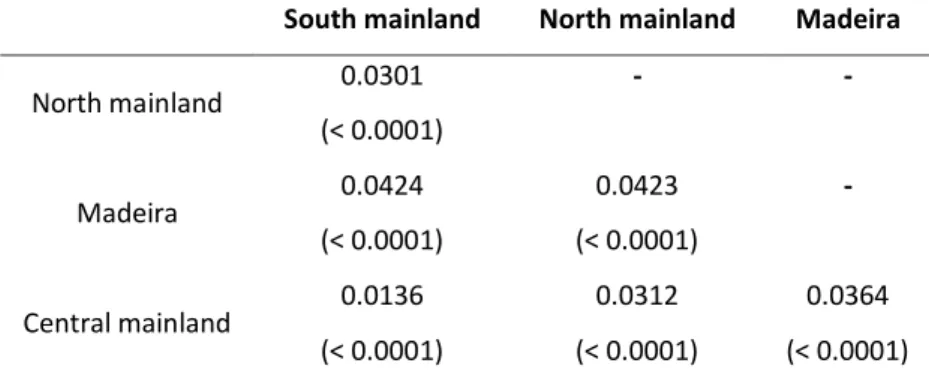
The analysis of mean body shapes of S. salpa from the four geographical areas showed
statistical differences (Figure 6; Table 2). The first two canonical variates of the CVA
explained 60.9 % and 27.2 % of the variance, respectively (Figure 6). The plot showed
that north mainland and Madeira are well differentiated from the other locations
while central and south mainland are geographically close showing some overlap.
Table 2. Procrustes distances between mean body shapes of Sarpa salpa individuals from the four study
areas and the corresponded P value (in brackets) obtained from permutation tests (10,000 permutation runs).
South mainland North mainland Madeira
North mainland 0.0301 - - (< 0.0001) Madeira 0.0424 0.0423 - (< 0.0001) (< 0.0001) Central mainland 0.0136 0.0312 0.0364 (< 0.0001) (< 0.0001) (< 0.0001)
Illustration of mean body shapes for S. salpa from the different locations (Figure 7)
present marked differences in the head and pectoral region, affecting the position of
snout, pre-maxillary, operculum and pectoral fin. Furthermore, individuals from central
and south mainland presented a similar mean body shape (almost all the landmarks
were overlapped) having only a slight difference in the insertion and origin of the anal
Figure 7. Illustration of mean body shapes for Sarpa salpa from the four locations,
represented by a warped outline drawing.
Figure 6. Two-dimensional ordination of Sarpa salpa individuals from the four locations
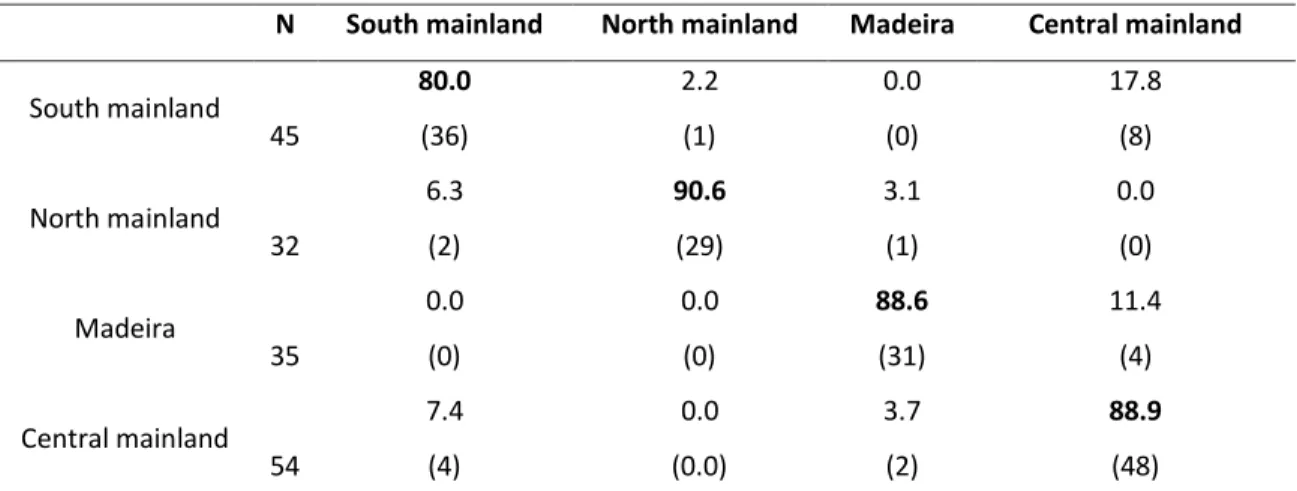
An overall classification success of 86.7 % was achieved (Cohen’s К = 0.820) (Table 3).
High correct classifications rates were obtained with north mainland showing the
highest (90.6 %) and south mainland the lowest (80.0 %) values. The percentage of
individuals incorrectly classified between central and south mainland was considered
low (< 17.8 %), even being geographically close.
Table 3. Jackknife classification matrix of the discriminant analysis between geographic areas performed
on Sarpa salpa body shape analysis.
N South mainland North mainland Madeira Central mainland
South mainland 80.0 2.2 0.0 17.8 45 (36) (1) (0) (8) North mainland 6.3 90.6 3.1 0.0 32 (2) (29) (1) (0) Madeira 0.0 0.0 88.6 11.4 35 (0) (0) (31) (4) Central mainland 7.4 0.0 3.7 88.9 54 (4) (0.0) (2) (48)
Percentages in rows represent the classification into the areas given in columns (correct classification in bold). Number of individuals (N) allocated in each area are given in brackets. Overall classification
success: 86.7 %, Wilks’λ = 0.029, Cohen’s К = 0.820.
Otolith shape analysis
Otolith shape analysis
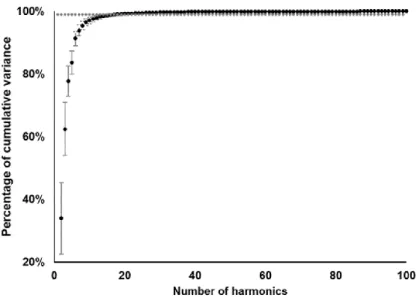
To visualize differences in average shapes, the
reproduced outlines of the mean of NEFDs by
geographic areas were plotted in Figure 8. It was
determined that 13 harmonics were needed to
represent the complex morphology of the otolith of
S. salpa, as they were responsible for over 99 % of
Figure 8. Illustration of the average shapes
for Sarpa salpa, from the different geographic areas, represented by the outlines of the mean normalized elliptic Fourier descriptors (NEFDs). (south mainland – light grey solid line; north mainland – dark grey solid line; Madeira – black solid line; central mainland - dark grey dot line)
the shape variation (Figure 9). So, 13 harmonics and thus 53 Fourier coefficients (one
coefficient from the first harmonic and 52 coefficients from harmonics 2-14) were used
for the data analyses.
The relationship between the NEFDs and fish TL was analyzed using Pearson’s correlation coefficient (r) in all geographic areas. From a total of 53 NEFDs used in the
analysis, only two were significantly correlated (p < 0.05) with TL in North mainland and Madeira areas; one NEFDs in central mainland and ten in south mainland.
MANOVA results to compare otolith size-corrected NEFDs from the four areas showed
a significant effect of area on otolith contour shape differences (Wilks’ λ = 0.022, F
(159.000, 315.688) = 5.081, p value < 0.01, = 0.719; Pillai = 1.954, F (159.000, 321.000) = 3.773, p
value < 0.01, = 0.651). The differences between the otolith contour shape among
areas evidenced by the MANOVA were also indicated by the CDA. The variables used in
the discriminant analysis are shown in Table 4. The results of CDA show that
Figure 9. Mean and standard deviation of the cumulative variance of 100
differences in otolith contour were found between individuals from all areas although
some overlap was observed. The CDA highlighted a significant discrimination between
the mainland coast of Portugal and from Madeira waters (Figure 10). The first two axes
of the CDA explained 81.0 % and 13.7 % of the variance, respectively; in general, these
two axes accounted for > 90 % of the total dispersal of the groups. The CDA showed
some overlap between the three areas along the mainland coast of Portugal, although
north mainland area was more separated from the others. The overlap was more
evident between central and south mainland’s which are geographically closer.
Table 4. Jackknife classification matrix of the discriminant analysis between geographic areas performed
on Sarpa salpa otolith contour shape.
N South mainland North mainland Madeira Central mainland
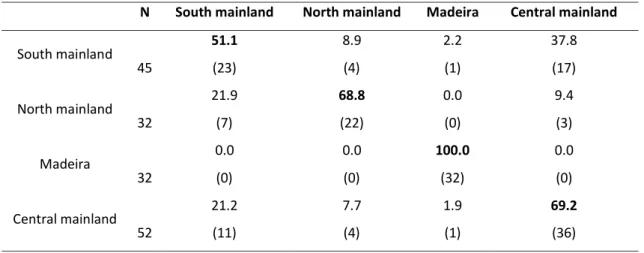
South mainland 51.1 8.9 2.2 37.8 45 (23) (4) (1) (17) North mainland 21.9 68.8 0.0 9.4 32 (7) (22) (0) (3) Madeira 0.0 0.0 100.0 0.0 32 (0) (0) (32) (0) Central mainland 21.2 7.7 1.9 69.2 52 (11) (4) (1) (36)
Variables b2, a3, b3, b4, c4, d4, a5, b5, d5, a6, b6, c6, a7, d8, b9, c9, c12, c13, b14 Percentages in rows represent the classification into the geographic areas given in columns (correct classification in bold). Number of individuals (N) allocated in each area are given in brackets. Overall
Overall jackknifed classification success was 70.2 %, ranging from 51.1 % correct
classification for south mainland to 100 % for Madeira (Table 4). Differences between
areas were significant (Wilks’ λ = 0.063, p < 0.001) and the results from the Cohen’s К
procedure confirmed the classification success obtained by the discriminant analysis
(Table 4).
DISCUSSION
Both techniques proved to be a powerful tool in stock identification as other authors
have already shown (e.g. Rodríguez-Mendoza et al. (2011), Sequeira et al. (2011),
Stransky et al. (2014)), providing a fast, reliable, and sustainable method of identifying
Figure 10. Two-dimensional ordination plot of Sarpa salpa individuals from the four
stocks, with lower costs associated (Burke et al., 2008). The expression of both
techniques are under the simultaneous control of genetic and environmental factors,
such as water temperature, salinity, food availability and type of substrate (Begg and
Waldman, 1999; Vignon, 2012). Even in the absence of genetic differences, various
environmental factors, (e.g. water temperature and food availability) (Vignon, 2012)
are thought to influence fish growth rate that in turn can affect the body fish growth
and the otolith growth, affecting the otolith shape, and producing different
expressions.
Body form in fishes is a product of their ontogeny (Cadrin, 2005). It is affected by the
genetic makeup of an individual, but it also reflects adaptations to the environmental
characteristics of their ecological niches since associations between body shape and
ecological variables are commonly observed among populations of related fishes
(Swain et al., 2005). Shape analysis has become an efficient and powerful tool in stock
identification (Stransky et al., 2014). It is less time-consuming, has lower running costs
(with the software for carrying out the analysis once images are taken being freely
available) and the procedure is also far less destructive to otoliths (only images of whole otoliths are used) (Burke et al., 2008). Therefore, and as stressed by Cardinale et
al. (2004), otolith shape analysis can be seen as a complement technique towards an effective fisheries management.
The differences observed in the present study between the mean body shapes of the
four areas, particularly in the head area, can also be due to particular adaptations to
environmental conditions where each population lives. S. salpa is considered to be an
mainly carnivorous (crustacean) while adults are almost exclusively herbivorous
(Havelange et al., 1997). This adjustment in diet is certainly affected by the food
resources available in the studied areas and the variations in mouth shape and position
(anterior tip of the snout and posterior extremity of pre-maxillary) can be related to
differences in diet (Cadrin, 2005). Love and Chase (2009) studied the scup (Stenotomus
chrysops) (family Sparidae) populations from the north-western Atlantic Ocean and found that most morphological differences were related to forehead shape, which may
not be related to important growth or reproductive characteristics of interest in stock
assessments. For other species of the family Sparidae (e.g., squirefish Chrysophrys
auratus), forehead shape naturally differs among populations and sexes (Love and Chase, 2009).
Both body shape and otolith shape analysis results showed differences in the
individuals from the four geographic areas, although some overlap was observed
between individuals from the three mainland areas, which was more evident between
central and south areas, those that are geographically closer. It is known that fish
distribution and recruitment rates are intrinsically linked to hydrographic conditions where the species lives (Keating et al., 2014), so the principal cause of these results
may be the hydrological conditions that occur in the Portuguese coast. The Portuguese
continental shelf is reached by a diversity of hydrological and oceanographic features
characterized by narrow and large continental platform areas, and deep submarine
canyons and valleys (Gomes, 2009). Canyons, in particular, potentially disrupt and
influence the general faunal relationships between depth, latitude and surface
along the mainland coast of Portugal, for both analysis, specimens from the north area
are more separated from those of center and southern areas and this fact can be
explained by the presence of Nazaré canyon (39º 30’ 36’’N, 9º 55 12’’W), a very deep
canyon northwards Setúbal, which is coincident with the latitude of Merrett’s faunal
division (Merrett, 1987), being important in the separation of fish communities limiting
the mixture of northern and central-southern communities (King et al., 2008).
Considering the Nazaré canyon as a latitudinal boundary that determines the
distribution of fish assemblages from the north and central-southern areas of the
Portuguese mainland, then the closest affinities between the specimens from the
central and south mainland areas can be explained by the larval drift and the presence
of the Portuguese current (the result of the combination of North Atlantic Drift Current
and the Azores current) that has a characteristic movement north to south reaching
the Canary Current (Neves et al., 2008). S. salpa is a marine fish that spawn pelagic
eggs (Strydom et al., 2014), and had already been described that planktonic eggs and
larvae can be dispersed over large areas due to transport by ocean currents, leading to
a mixing of early life stages among spawning locations, which results in less stock structure (Hare, 2005). Pattrick and Strydom (2009) tested the swimming abilities of
late-stage larvae, wild-caught in temperate South Africa, of cape white seabream
(Diplodus capensis) and S. salpa in controlled swimming chambers and stated that the
late-stage larvae of these Sparidae are strong swimmers. The observed overlap among
the geographically closer areas, central and south mainland, can be explained by the
mixing of early life stages, or by adult’s migration, or some specimens from these two