Pirelli & SpA
Equity Valuation Research
Diogo Macedo
Dissertation written under the supervision of
Professor José Carlos Tudela Martins
Dissertation submitted in partial fulfilment of requirements for the MSc in
Finance, at the Universidade Católica Portuguesa, January 8th 2020
Pirelli & SpA Equity Valuation
Diogo Macedo
Abstract
The goal of this academic dissertation is assessing the correct value of Pirelli & SpA’s shares on the 31st December of 2019. Two distinct valuation methods are applied, the first being the
Discounted Cash Flow (DCF) approach and the second being the relative valuation methodology, with the multiples used being the P/E, EV/EBITDA and EV/Sales. Then, the result yielded by the valuation approaches is compared to an equity research report made by Banca IMI. The conclusion of this dissertation is that Pirelli is marginally undervalued in the market, being the fair value of one unit of common stock estimated to be €5.28 at the end of 2019, while the share is trading at €5.15 on the 29th November of 2019. Hence, the
recommendation given in this dissertation is that investors should buy Pirelli’s shares. This recommendation is solely based on the DCF methodology, since the relative valuation produced inconsistent results across the different multiples used and when compared with the value computed through the DCF approach. Banca IMI estimates the value of one unit of common stock at the end of 2019 to be €6.10, which is a higher valuation than the one expected by this dissertation. As Netflix’s stock was trading at €5.41 at the time of valuation, Banca IMI also advises to buy Pirelli’s stock. This difference can be justified by different assumptions regarding the evolution of Netflix’s FCFFs and Perpetual growth, as the WACC in both valuations differs only 24 basis points.
Keywords: Equity Valuation, Discounted Cash Flow Model, Relative Valuation
-
O objectivo desta dissertação académica é estimar o justo valor de acções da Pirelli & SpA no dia 31 de Dezembro de 2019. Para isso são utilizados dois métodos distintos, o primeiro chamado Discounted Cash Flow (DCF) e o segundo Relative Valuation, sendo que os múltiplos usados são o P/E, EV/EBITDA e EV/Sales. De seguida, é comparada a avaliação produzida por esta dissertação com um equity research report feito à Pirelli pelo Banca IMI. A conclusão gerada por esta dissertação é que a Pirelli está neste momento ligeiramente subvalorizada pelo mercado, sendo que o justo valor de uma acção estimado para o fim de 2019 é de €5.28, enquanto no dia 29 de Novembro de 2019 essa mesma acção estava cotada a 5.15€. Por isso, a recomendação dada nesta dissertação é que investidores devem comprar acções da Pirelli. Esta recomendação é exclusivamente baseada no modelo DCF, visto que a Relative Valuation apresenta resultados inconsistentes entre os múltiplos utilizados e também díspar do resultado chegado através do modelo DCF. O Banca IMI estima que o valor de uma acção no fim de 2019 deveria ser €6.10, produzindo assim uma recomendação semelhante à desta dissertação, visto que à data da sua análise uma acção da Pirelli estava cotada a €5.41. A presente diferença pode ser justificada por diferentes pressupostos considerados no calculado de FCFF futuros e também Perpetual Growth, sendo que o WACC utilizado pelas duas análises apenas difere em 24 pontos base.
Acknowledgements
The delivery of this dissertation represents the end of my time at Católica-Lisbon, in which I completed my BSc in Business Administration and now my MSc in Finance. Joining this prestigious institution was the correct choice for me, as all the challenges presented during my period there have helped shape the human I am today.
Firstly, I would like to thank my parents for all their support, not exclusively during this last few months, while completing this dissertation, but also for the positive influence they have had on me since I was born. Thanks to them I was provided all the necessary tools to have the level of education I have today, for which I am grateful for.
I also want to express my gratitude to my closest friends for helping me keeping a healthy work-life balance, between working full time and completing this dissertation, as well as for all the support and advice given in the most stressful moments.
Additionally, I would like to thank my co-workers at KPMG for all the knowledge they have shared with me, specially thanking my most direct work colleague Eduardo Afonso for the support given during the completion of this dissertation.
At last, I want to express my gratitude for Professor José Tudela Martins’s availability and valuable advice.
Table of Contents
1. Introduction ... 1
2. Literature Review ... 2
2.1. Valuation Methods ... 2
2.2. Discounted Cash-Flow Model ... 3
2.2.1. Free Cash-Flow to the Firm ... 3
2.2.3. Discount Rates ... 4
2.2.4 Terminal Value ... 7
2.2.5 Limitations of the DCF Model ... 7
2.3 Relative Valuation Models ... 8
2.3.1 Price to Book Ratio ... 9
2.3.2 Price to Earnings Ratio ... 10
2.3.3 Enterprise Value Multiples (Enterprise Value to EBITDA) ... 10
2.3.4 Revenue Multiples (Price to Sales and Enterprise Value to Sales Ratios) ... 11
2.3.4.1 Price to Sales Ratio ... 11
2.3.4.2 Enterprise Value to Sales Ratio ... 12
2.4 Conclusions ... 12
3. Macroeconomic Outlook ... 12
4. Tyre Manufacturing Industry Outlook ... 13
4.1 Driver 1: Rising Penetration of Premium and Prestige Cars ... 16
4.2 Driver 2: Increase in the Number of Homologations ... 16
4.3 Driver 3: Growing Demand for Specialties ... 17
4.4 Driver 4 & 5: Rising Penetration of SUVs & Car Development to Bigger Rims ... 17
4.5 Driver 6: New Car Technologies ... 18
5. Company Overview ... 18
5.1 Shareholder Structure ... 20
5.2 Business Summary ... 20
6. Valuation ... 23
6.1. Forecast Assumptions – Income Statement & Balance Sheet ... 23
6.1.1. Revenue Forecast ... 23
6.1.3. Operational Expenses (OPEX) ... 26
6.1.4. Capital Expenditures (CAPEX) ... 27
6.1.5. Depreciation & Amortization ... 29
6.1.6. Property Plant & Equipment ... 30
6.1.7. Intangible Assets ... 30
6.2. Discounted Cash Flow ... 34
6.2.1. Weighted Average Cost of Capital (WACC) ... 34
6.2.2. Free Cash Flow to the Firm (FCFF) ... 37
6.2.3. Terminal Value (TV) ... 37 6.2.4. Conclusion ... 38 6.3. Relative Valuation ... 39 6.3.1. Peer Selection ... 39 6.3.2. Multiple Valuation ... 40 6.4. Sensitivity Analysis ... 42 7. Valuation Comparison ... 44 8. Conclusion ... 45 9. Appendixes ... 47
9.1. Car Parc Forecast ... 47
9.2. Pirelli’s SWOT Analysis ... 47
9.3. Porters Five Forces ... 48
9.4. Raw Materials ... 50
9.5. Forex Impact ... 51
9.6. Market Risk Premium Calculations ... 51
9.7 Beta Calculations ... 52
9.8. Interest Coverage Ratio and Cost of Debt Calculations ... 53
9.9 Financial Statements Forecast ... 54
Table of Figures
Figure 1 – Real GDP Growth (annual percentage)………...13
Figure 2 – O.E. Segment Evolution (2014-2019)………..…...15
Figure 3 – Replacement Segment Evolution (2014-2019)………...15
Figure 4 – Prestige & Premium Segment Evolution (2014-2019)………16
Figure 5 – Number of Car Models Evolution………...17
Figure 6 – Shareholder Structure………..20
Figure 7 – Financial KPIs……….21
Figure 8 – 2018 Revenue by Region……….21
Figure 9 – 2018 Revenue by Segment………..22
Figure 10 – Standard & HV Units Evolution (2016H-2024P)……….25
Figure 11 – Average Tyre Sale Price (2016H-2024P)………..25
Figure 12 – Revenue Evolution (2016H-2024P)………..26
Figure 13 – Cost of Goods Sold Evolution (2016H-2024P)……….26
Figure 14 – Personnel Expenses Evolution (2016H-2024P)………27
Figure 15 – Other OPEX Evolution (2016H-2024P)………27
Figure 16 – Property, Plant & Equipment CAPEX Evolution (2016H-2024P)………...28
Figure 17 – Intangible Assets CAPEX Evolution (2016H-2024P)………..28
Figure 18 – Total CAPEX Evolution (2016H-2024P)………..28
Figure 19 – Depreciation & Amortization Evolution (2016H-2024P)……….29
Figure 20 – Property, Plant & Equipment Depreciation Evolution (2016H-2024P)…………29
Figure 21 – Intangible Assets Depreciation Evolution……….30
Figure 22 - Property, Plant & Equipment Evolution (2016H-2024P)………..30
Figure 23 – Intangible Assets Evolution (2016H-2024P)……….30
Figure 24 – Account Receivables Evolution (2016H-2024P)………..31
Figure 25 – Inventories Evolution (2016H-2024P)………..32
Figure 26 – Account Payables Evolution (2016H-2024P)………...32
Figure 27 – Tax Receivables/Payables Evolution (2016H-2024P)………..33
Figure 28 – Other Current Assets/Liabilities (2016H-2024P)………..33
Figure 29 – Cost of Equity Components………...35
Figure 30 – Theoretical Tax Rate……….36
Figure 31 – Free Cash Flow to the Firm………...36
Figure 33 – DCF Model Conclusion……….38
Figure 34 – Pirelli’s Peer Companies………...40
Figure 35 – Peer’s Multiples……….41
Figure 36 – Pirelli’s Relative Valuation………...41
Figure 37 – WACC & Perpetual Growth Sensitivity Analysis……….42
Figure 38 – Tyre Units Growth Sensitivity Analysis………43
Figure 39 – Price & Mix Growth Sensitivity Analysis……….43
Figure 40 – Investment Bank Comparison – FCFF………..43
Figure 41 - Investment Bank Comparison – WACC Components………...44
Figure 42 - Investment Bank Comparison – Recommendation………45
Figure 43 – Global Car Parc Evolution (2016-2022)………47
Figure 44 – Total Car Parc CAGR………47
Figure 45 – Premium & Prestige Car Parc CAGR………...47
Figure 46 – Market Risk Premium Calculation………51
Figure 47 – Estimated 2Y Beta……….52
Figure 48 – Ratings, Interest Coverage Ratios and Default Spread……….53
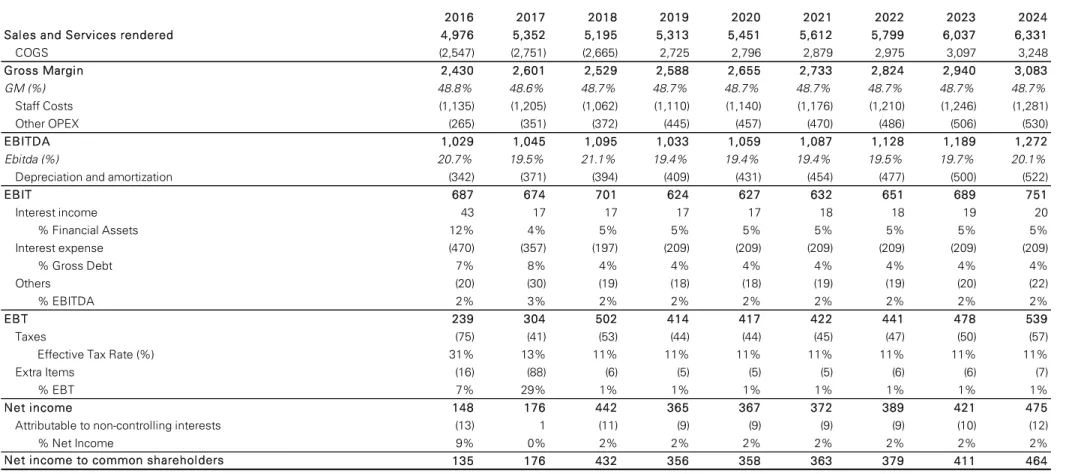
Figure 49 – Income Statement………..54
Figure 50 – Balance Sheet (Assets)………..55
Figure 51 – Balance Sheet (Financial Assets)………..56
Figure 52 – Balance Sheet (Equity)………..56
Figure 53 – Balance Sheet (Liabilities)………57
1
1. Introduction
This dissertation focus on utilizing Equity Valuation methods to provide investment advice about the company Pirelli & C SpA as of 31st of December of 2019. Hence, the central point of this dissertation is to obtain a value of the company in question and then recommend to either buy, sell or hold shares.
Pirelli & C SpA was the company chosen for this dissertation as it suffered a profound restructuring, which even included changes to its core business. After a hiatus from the stock markets, Pirelli returned in the 4th of October of 2017 to the Milan stock exchange. Additionally, the car tyre industry has been suffering changes, due to a shift in car manufacturers' tyre demands and technological innovations, which can potentially help Pirelli gain market share over its more direct competitors in the future.
Through the course of this dissertation, several assumptions were made based on up to date public information and reliable projections about the economy and industry, so that this valuation could reflect a future environment as close to reality as possible. Then, the second section of this dissertation was reserved for the explanation of the theoretical knowledge and methodologies used throughout this equity valuation. In the next sections of this dissertation, a macroeconomic and industry outlook were performed, followed by an overview of Pirelli & C SpA, focusing on past and future trends regarding the economy, industry, and company.
Moving on to the valuation part of this academic dissertation, in section 6, a Discount Cash Flow and a Relative valuation are executed. Still, before drawing conclusions about this equity valuation, in section 7, results originated by this dissertation are compared to results of an equity research report done by the renowned Banca IMI.
2
2. Literature Review
2.1. Valuation Methods
To be able to accurately evaluate a company is extremely important and considered by many as one of the most important tasks in corporate finance, "Valuation lies at the heart of much of what we do in Finance" (Damodoran, 2006). Considering that valuing a company is something done very regularly and is one of the most common tasks performed by finance professionals worldwide, one would assume that it is very well researched matter and that everyone would follow precise and flawless methodologies. However, valuation is still a very subjective matter that creates controversy among very prestigious experts in the area. Additionally, topics such as risk management, how to best estimate cash flows, and what valuation model retrieves the best results, are not being addressed as they should be.
According to one of the experts in the area, Damodaran (2006), there are four existing methods to perform a valuation. The first is called discounted cash flow, which values an asset to the present value of its future cash flows. The second, relative valuation, consists in valuing an asset by observing the pricing of "comparable" assets relative to a common variable such as Cash Flows, earnings, book value or sales. The third one, contingent claim valuation, utilizes pricing models to assess the value of assets with similar option characteristics. Moreover, accounting valuation utilizes book value to determine the value of an asset.
To this day, no method has proved to deliver an utterly accurate valuation of an asset, and each method has its strong points and weak points. Thus, choosing the correct methods to use, and which retrieve the most accurate valuation for the specific asset being valued is vital, as by comparing the market value of the asset to its projected value, an investor can either opt to sell, hold or buy the asset (Reilly and Brown, 2012).
As there are no perfect valuation models, it is essential to choose the ones that adapt better to the imperfections of the information about the future. Nevertheless, considering various methodologies when valuing an asset is considered to be good practice by (Young et al., 1999).
3
2.2. Discounted Cash-Flow Model
“
Thevalue of an asset is not what someone perceives it to be worth, but it is a function of the expected cash flows on that asset” (Damodaran, 2006).The DCF model estimates the present value of the future Cash Flows produced by an asset, discounted at a rate which incorporates the risk of the business, as the formula demonstrates:
Where:
𝐶𝐹𝑛= Cash Flow 𝑇𝑉𝑡= Terminal Value
r = Discounted rate for the appropriate cash flows’ risk n = time periods, time = 1 to t
Two key factors are considered in the formula above: expected Cash Flows and the discount rate. In order to determine them, one needs to make a set of assumptions. Better assumptions result in more accurate expected Cash Flows, leading to a more accurate valuation.
In its essence, the DCF model presents results considering three main assumptions: "First, we assume a long-term constant sustainable growth, since the terminal value usually represents more than 75% of the firm's market value. Second, no new equity issues are expected, because if we assume that companies do not typically issue equity above or below fair value, this assumption has no impact on our valuation. Third, no change in holdings of cash or marketable securities, since it makes it easier to calculate the firm's value, we assume companies do not accumulate piles of cash" (Young et al., 1999).
The DCF method is arguably the most used valuation method, as it is "the most accurate and flexible method for valuing projects, divisions, and companies." (Koller et al., 2005). However, it is advisable to consider other methods when performing a valuation.
2.2.1. Free Cash-Flow to the Firm
𝑃𝑟𝑒𝑠𝑒𝑛𝑡 𝑉𝑎𝑙𝑢𝑒 = 𝐶𝐹𝑛 (1 + 𝑟)𝑛 + 𝑡 𝑛=1 𝑇𝑉𝑡 (1 + 𝑟)𝑡 𝐹𝐶𝐹𝐹 = 𝐸𝐵𝐼𝑇 ∗ (1 − 𝑇𝑎𝑥 𝑟𝑎𝑡𝑒) + 𝐷𝑒𝑝𝑟𝑒𝑐𝑖𝑎𝑡𝑖𝑜𝑛 − 𝐶𝐴𝑃𝐸𝑋 − ∆𝑤𝑜𝑟𝑘𝑖𝑛𝑔 𝐶𝑎𝑝𝑖𝑡𝑎𝑙
4 The FCFF formula to be applied in this dissertation was created by Modigliani and Miller (1958), and it is the most commonly used.
FCFF comprises the totality of all the cash generated by a company to be distributed through its shareholders. It is necessary to make some adjustments, as the after-tax result is distributed only to shareholders, and since not all the constituents of the Net Income are cash related. Thus, depreciations are re-added to remove their effect. Additionally, as CAPEX reveals the investments and divestments made by a company and bearing in mind that these are not considered in the Net Income, there is a need to subtract them. Finally, the variation in NWC is also deducted from the financial result generated by a company, as it represents the company's ability to honour its short-term obligations.
In the end, FCFFs are plugged in the formula presented in section 2.2. resulting in the present value of the asset.
2.2.2. Free Cash Flow to Equity
Starting with the FCFF formula, it is possible to reach the Cash Flow reserved to equity holders by subtracting the remaining sum of cash after all the needed debt repayments, and reinvestments are done.
Using FCFE instead of FCFF might produce different results when applied in the DCF model since the discount rates considered are not equal. While the FCFF is discounted at the WACC, the FCFE is discounted at the rate of return required by equity holders. Both of these discount rates will be explained in the next section.
2.2.3. Discount Rates
Discount rates reflect the reward demanded by investors to bear the risk of investing in a particular asset. Naturally, these fluctuate with both the characteristics of the asset and the macroeconomic environment. 𝑃𝑉 = 𝐹𝐶𝐹𝐹𝑛 (1 + 𝑟)𝑛 + 𝑡 𝑛=1 𝑇𝑉𝑡 1 + 𝑟 𝑡 𝐹𝐶𝐹𝐸 = 𝐹𝐶𝐹𝐹 − 𝑁𝑒𝑡 𝐵𝑜𝑟𝑟𝑜𝑤𝑖𝑛𝑔
5 2.2.3.1 Weighted Average Cost of Capital
Simply, WACC is no more than the expected return a company could get by investing in other assets with similar risk characteristics (Luehrman, 1997). The opportunity cost faced by investors incorporates concepts such as time value and nominal risk-free investment, resulting from not investing money in risky alternatives. The kind of risk profile of the investor is also included in the WACC, called the risk premium, which reflects the return for the extra risk investors are willing to take. Additionally, by being a tax-adjusted discount rate, the WACC attempts to incorporate the effect of the interest tax shields (ITS). ITS results from the fiscal advantage associated with the level of debt of a company.
The WACC formula incorporates the cost of debt, 𝑟𝑑, multiplied by the weight of debt in the
capital structure of the company and deducted by the effect of taxes. As for the return on equity, re, it is weighted by the level of equity of the company on its total value.
As stated by (Goedhart et al., 2010), the Debt and Equity values used in the WACC formula for mature companies, should be market values, so that they represent the true capital structure of the company.
2.2.3.2 Return on Equity
In theory, the return on equity, as the name suggests, represents the return demanded by equity holders of a particular company. According to the CAPM model, it can be calculated having in mind three main elements. For quite some time, the CAPM model has been the standard when it comes to the cost of equity calculations (Damodaran, 2002).
The CAPM determines the risk level of a specific company considering its sensitivity to the stock market. It does so by taking into account the risk-free rate, 𝑟𝑓; the market risk premium,
MRP, that represents the difference between the return of the market and the risk-free investment return and also the risk of a certain company compared to the average company’s risk, 𝑖. This risk measurement approach is quite unique and different from how other models measure risk. 𝑊𝐴𝐶𝐶 = 𝑁𝑒𝑡 𝐷𝑒𝑏𝑡 𝑀𝑉 𝐸𝑞𝑢𝑖𝑡𝑦 + 𝑁𝑒𝑡 𝐷𝑒𝑏𝑡 × 𝑟𝑑× (1 − 𝑇𝑎𝑥 𝑟𝑎𝑡𝑒) + 𝑀𝑉 𝐸𝑞𝑢𝑖𝑡𝑦 𝑀𝑉 𝐸𝑞𝑢𝑖𝑡𝑦 + 𝑁𝑒𝑡 𝐷𝑒𝑏𝑡 × 𝑟𝑒 𝐶𝐴𝑃𝑀 = 𝑟𝑒 = 𝑟𝑓 + 𝛽(𝑀𝑅𝑃)
6 The CAPM model assumes certain aspects that need to be taken into consideration: the first one, the non-consideration for transaction costs. The second one, the principle of infinitely divisible investments, stating that anybody is able to buy or sell fractions of the underlying. The last one, no asymmetry of information, meaning that are no over or undervalued assets being traded in the market.
𝑖 is the element in the equation responsible for allowing the model to adapt to a company’s specific risk level, comparing the company’s market price variation with the market variation. So, for companies with a higher risk relative to the market, 𝑖 > 1, investors will demand more
return, resulting in a higher 𝑟𝑒, which is higher than the MRP plus the 𝑟𝑓. The opposite happens
when the 𝑖 < 1. (Goedhart et al., 2010)
2.2.3.4 Return on Debt
The return on debt is nothing more than the return debt holders’ demand for borrowing funds to a particular firm. Usually, as interest payments are tax-deductible, it is calculated in an after-tax basis. Depending on the characteristics of a company, there are different ways to compute 𝑟𝑑 (Goedhart et al., 2010).
If the company subject to analysis has debt being traded in the open market, the most reliable way to determine its cost of debt is to calculate the Yield to Maturity (YTM) of its traded bonds (Goedhart et al., 2010). If the company being valued does not issue public debt in a consistent manner, one should use its debt rating in order to achieve a more honest estimation of the YTM, while considering the company’s marginal tax rate so that 𝑟𝑑 maintains its after-tax nature.
In case the company in question is considered investment-grade, implying that default is very unlikely to happen, to estimate the return on debt, one should consider the YTM of non-option, long-term bonds.
To conclude, in case of a non-listed firm, (Damodaran, 2001) suggests that a reasonable estimate for the cost of debt is to compute the interest coverage ratio, which concerns to the recently borrowed funds.
7 2.2.4 Terminal Value
As per (Young et al., 1999), the expected future growth of the company in perpetuity is represented in the Terminal Value. Usually, analysts, while performing a DCF valuation, choose a number of years to perform individual yearly forecasts and then calculate the terminal value.
As time progresses in the performance forecasting of a company, it becomes harder to predict future results. Questions such as: “Can the company maintain its current growth?” or “Is it going to keep up with the overall growth of the economy at a sustainable pace?” are questions that are normally asked. (Damodaran, 2002) defends that the second option is the only one that companies can sustain in perpetuity.
According to (Damodaran, 2002) it exists three distinct ways of computing the terminal value: The first one is to determine the potential payment by other sources for liquidated assets of a firm in terminal value. The second one consists in estimating terminal value by applying a multiple to book value, earnings or revenues. Finally, the terminal value can be calculated by, assuming that the FCFF will grow at a steady pace in perpetuity (Young et al., 1999).
2.2.5 Limitations of the DCF Model
The DCF firm valuation method is the most used and appraised. However, this model has some limitations, mainly related to the assumptions we have to assume.
As (Damodaran, 2002) has explained, the DCF model has as its base for estimating the value of a company its future Cash Flows and an appropriate discount rate. If the company being subject to valuation has been presenting consistently positive Cash Flows, it becomes easy to implement the DCF model. Though, as we move away from this scenario, it becomes more challenging to apply the model.
As said by the author, there is a lot of hidden information about companies that analysts need to make educated guesses to perform valuations, meaning that, the intrinsic value reached by a DCF model for an individual company might not be the intrinsic value needed to reach an accurate valuation.
TV= 𝐹𝐶𝐹𝐹𝑛 ∗ (1 + 𝑔)
8 Another common problem area in a DCF valuation is related to WACC (Luehrman, 1997). If the company being analyzed has a complicated capital structure, funding policy or tax position, it is more typical for the discount rate not to be totally accurate. The WACC is more correct if the firm being valued has a static and straightforward capital structure.
On an ending note, (Fernandez, 2013) suggests that there several fallacies and mistakes that result from the usage of WACC. For example, determining the amount of tax shields is a crucial factor for calculating WACC, and the latters are directly connected to the debt policies of the companies. So, except when capital structures are fixed, it becomes difficult to predict the correct discount rate to use.
2.3 Relative Valuation Models
Relative Valuation Models is directly connected to the use of Multiples. Multiples can be an excellent tool to create a proxy to the forecasts estimated by other valuation methods. It is a good practice to compare other valuation models to the DCF model, as the latter is very dependent on key estimated factors, such as: Growth rates, discount rates and return on invested capital.
As stated by (Damodaran, 2005), Relative Valuation allows determining the value of a company based on the value of similar companies. Naturally, it is imperative to perform a Relative Valuation considering companies with similar expectations for the key metrics used. A well-executed Relative Valuation enables to examine what are the expectations for the market or industry the company operates. Meaning that if markets are correctly pricing company, both DCF and Multiples methods should retrieve the same values. If the markets are over or underpricing assets of a particular industry, the opposite will happen (Damodaran, 2005).
In order to perform a precise Relative Valuation, it is essential to determine a group of comparable companies, generally called peer group, which is reasonable to compare the company being analyzed. First of all, companies composing the peer group need to be priced in the market. Another common practice is to consider companies operating in the same sector to be considered comparable, although sometimes that might not be the case. Nonetheless, by choosing a peer group composed of companies of the same sector, we are guaranteeing that risk, growth and cash flows are similar between companies, enabling to make comparisons and ultimately creating a more accurate valuation (Liu et al., 2002).
9 At times, performing a Relative Valuation can be tough as a sector might have a limited number of firms. Adding to that, as firms can have different sizes, it is needed to standardize. Standardization consists of converting market prices into variables that allow making comparisons. When considering shares, this process usually means turning market cap values of companies into multiples, such as earnings, book value, revenues or even specific attributes that are applicable to certain industries.
After computing the most appropriate multiples, the next and final step is to make an analysis
and compare results. Logically, different
attributes of companies lead to different multiples.
A vital aspect to be considered is that specific multiples value certain industries better than others, and so it is imperative to know which multiples should be applied to a given industry so that the most reliable valuation possible is performed. For example, (Damodaran, 2005) has concluded that in for companies with big infrastructures, such as cable and telecom, EV/EBITDA is the most suitable ratio. Also, (Fernandez, 2001) suggests that for investment banking firms, P/E and EV/EBITDA multiples are the ones that retrieve the best valuations.
To conclude, (Koller et al., 2005) recommends that, grounded on empirical evidence, multiples should be reflected forecasts and not past values, and if that is not possible, they should be based in the latest available values, so that one-time events are not considered.
Now, more detailed information about a number of commonly used multiples is going to be presented.
2.3.1 Price to Book Ratio
For a long time, investors have been using the Price to Book Ratio (PBR) with the belief that stocks being traded for a price lower than the book value of equity are undervalued and vice-versa. (Damodaran, 2002) presents a number of reasons justifying why PBR is valuable. Firstly, and enabled by strict accounting regulation, it gives a consistent proxy for determining if assets are under or overvalued. Secondly, the number of firms with negative book values is much lower than the number of firms with negative results, meaning that the PBR can be more frequently utilized.
10 As with anything, the PBR has disadvantages that need to be taken into account. To start, in the eventuality of a company reporting numerous years of negative results, book values can become negative, and in those cases, PBR cannot be used. Additionally, book values can be affected by accounting regulation. If the accounting standards used across companies is not the same, PBR can turn out to be irrelevant. Also, if the companies do not report any significant tangible assets, such as services and technology firms, PBR is of no use.
2.3.2 Price to Earnings Ratio
Due to its straightforwardness, it is one of the most used valuation multiples and even commonly used in initial public offerings (Damodaran, 2002). Nevertheless, (Koller et al., 2005) was able to recognize a couple of faults of this ratio. One being its dependence on the capital structure, as managers can increase the Price to Earnings Ratio (PER) by switching debt with equity. The other being that is centred on earnings and with that one-time events might be included.
Two main disadvantages of the PER include the following: Assuming everything else is constant, a firm fully financed by equity will return a higher PER than a firm partially financed by debt (Koller et al., 2005). Plus, PER is not appropriate for companies with negative companies, so, seasonable companies, in some cases, should not be valued by this ratio (Damodaran, 2002).
2.3.3 Enterprise Value Multiples (Enterprise Value to EBITDA)
Stating (Koller et al., 2005), Enterprise Value Multiples (EVM) are considered to be a worthy alternative to other multiples as they are not affected by certain biases. He also says that it is exceptionally efficient if the companies being compared operate in the same sector.
Enterprise value to EBITDA is the most used multiple in all Relative Valuations and is calculated in the following manner:
11 Earnings before Interest, Taxes, Depreciation and Amortization (EBITDA) is the closest to the actual operational cash flow of the company, and such, it is less prone to the effect of changes in the capital structure of the company, unless those changes have an impact in the cost of capital. (Pinto, 2010 & Koller et al., 2005)
As per (Fernandez, 2001), this kind of multiples have two drawbacks: They do not reflect variations in WC requirements and Capital Expenditures.
2.3.4 Revenue Multiples (Price to Sales and Enterprise Value to Sales Ratios)
The conceptual basis of this kind of multiples is the relationship between the revenue of a firm and its value. So, firms with lower value for revenue ratio should be priced lower in the market than firms with higher ratios.
Revenue Multiples are a fine choice for investors looking to value a company as they can never return negative values, meaning that investors will not need to exclude companies from samples. Furthermore, Revenue Multiples are difficult to manipulate since they are less dependent on rules and regulations. Additionally, Revenue multiples are very useful when valuing cyclical firms, as they are not as affected by macroeconomic variations (Damodaran, 2002).
The disadvantages of this class of multiples include: Questionable ways firms find to report sales, which can cause investors to reach incorrect valuations. By looking at revenues and denoting high values to firms with high revenues might not be correct as other factors like costs and profits might not reflect the good revenue number. As a consequence, many consider other performance indicators like profits and cash flows as more important when valuing a firm (Damodaran, 2002).
There are two possible Revenue Multiples to use, and they are the following:
2.3.4.1 Price to Sales Ratio
Price to Sales Ratio is the simpler and more popular of the two. It relates the market value of the equity of a firm and its sales.
12 2.3.4.2 Enterprise Value to Sales Ratio
Enterprise Value to sales is considered to be more robust than the Price do Sales Ratio as it considers not only market value of equity but also market value of debt.
2.4 Conclusions
The valuation methods chosen to evaluate Pirelli are the DCF model and Multiples approach. It was decided to consider the DCF model as it is arguably the most used valuation method and is the one that provides the most quantitative and detailed analysis. The Multiples approach will be used as a way to have a comparison to the DCF valuation while checking it validity. At the same time, it will allow to compare Pirelli against its peers in terms of performance.
3. Macroeconomic Outlook
In terms of global economic growth, it is expected that it will grow by 3% in 2019 and improve to 3.4% in 2020. 2019 growth will be heavily impacted by the downgrades in the growth of China and other emerging Asian countries caused by effects of the trade tensions between the United States of America and China. (World Bank)
It is projected that global economy will pick up its growth in 2020 and it is mainly due to the expected stabilization or recovery of stressed economies, such as Iran and Venezuela and emerging economies, such as Argentina and Turkey. This stabilization of individual economies should account for 70% of the growth forecast for 2020 relative to 2019. It is essential to mention that economic growth for 2020 is very dependent on trade tensions between China and the United States of America and Brexit. (World Bank)
The following graphic contains economic growth forecasts, done by the International Monetary Fund, for the next five years, which will be considered in the forecasting of future Pirelli’s revenues.
13 Also, by examining the above, we can see that there will be deceleration of the economic growth of developed regions, namely North America and Europe. Emerging regions are expected to be the ones supporting the next five years economic growth. Latin America, especially Brazil looking recover from its presidential election, is the region that is expected to improve compared to previous years. Asia and Pacific are still expected to keep growing at a steady pace, despite its leading player China having trouble to keep growing at its current pace of 6%.
4. Tyre Manufacturing Industry Outlook
The tyre market can be divided into two major segments, the O.E. and Replacement segments. The O.E. segment consists of the tyres fitted into vehicles that are brand new, leaving the factories of car manufacturers worldwide. The Replacement segment, as the name suggests, represents the tyres that are fitted in used vehicles when the O.E. tyres get worn down and need to be replaced.
On the one hand, in 2018, the total number of tyre pieces composing the O.E. segment was 457 million, compared to the 462 million pieces of 2017. For 2019 it is expected that the number of
3.6 3.0 3.4 3.6 3.6 3.6 3.6 -2 -1 0 1 2 3 4 5 6 2018H 2019F 2020F 2021F 2022F 2023F 2024F
Real GDP growth (Annual percent change)
Africa Asia and Pacific Europe Middle East North America Latin America World
14 pieces O.E. segment, according to Pirelli’s own forecast, decreases even more to 437 million. This is due to the deceleration of the automotive production.
On the other hand, the total number of pieces produced for the Replacement segment was 1133 million, increasing 16 million pieces when compared to 2017. For 2019, contrary to the O.E. segment, it is projected that the number of pieces produced for the Replacement segment increases to 1135 million.
Additionally, the tyre market can be further divided into more segments. Most tyre manufacturers segment their tyre offering into Standard tyres, for rim sizes 16 inches or lower, and High Value (HV) tyres, for rim sizes 17 inches or higher.
There is a clear trend in the tyre market, the demand for HV tyres has been growing at a very promising pace, as car manufacturers fit bigger rim sizes in their models. As a consequence, since the number HV pieces being produced for the O.E. segment was 45.7% of the total number of tyres produced for that segment, while in 2017 that number was 42.7%, meaning that between 2017 and 2018 there was a 3%. For the Replacement segment, the trend is the same. In 2018, the number of Replacement tyres that were HV was 25.7% of the total Replacement segment, whereas in 2017 it was 24.2%. The 2019 forecast for the HV segment is that it continues to grow, while the opposite happens for the Standard tyres.
Regarding Standard tyres, for the O.E. segment the trend is that with manufacturing fitting bigger rims on their vehicles, the need for this tyre type will decrease every year at a quite fast pace. For the Replacement sector, naturally, the trend is the same but at a slower pace, since there are still a considerable amount of vehicles that were bought with rim sizes below 16 inches that are still going to need to replace tyres from time to time. The following graphics display
15 how the tyre market has been evolving over time, divided between the segments and tyre types explained above.
There are six key drivers expected to influence demand for the next few years for the Tyre Manufacturing Industry. The first one is the penetration of premium & prestige cars, which is already one of today’s market drivers, but its influence is undoubtedly going to be higher in the future. Next, the increase in the number of homologations is also going to have an impact on the demand for tyres. Thirdly, there is an increasing demand for specialty tyres with the more specific demand from the manufacturers and the necessities of more educated car users. The fourth driver is the rising penetration of SUVs, which is a vehicle category that requires the use of bigger size rims. Next, the car evolution is also forecasted to impact the demand of the market, as all automotive segments, starting at the entry-level models, are being fitted with
20% 23% 24% 26% 27% 80% 77% 76% 74% 73% 1,002 1,082 1,117 1,133 1,135 2014H 2016H 2017H 2018H 2019F Replacement Segment HVA Traditional 1.5% 3.2% 36% 40% 43% 46% 47% 64% 60% 57% 54% 53% 432 453 462 457 437 2014H 2016H 2017H 2018H 2019F O.E. Segment HVA Traditional -1.1% 2.0%
16 bigger rims, that require bigger tyres. Finally, new car technologies are going to be, on a more long term approach, are going to influence what car manufacturers’ tyre demand will be.
4.1 Driver 1: Rising Penetration of Premium and Prestige Cars
The graph above demonstrates how the number of vehicles prestige and premium vehicles has been evolving since 2014. It is clear that there is a definite increase in the demand for this kind of vehicles. Cars in these segments are fitted from the factory with HV tyres, meaning that for the future, the demand for this tyre segment will be growing as the manufacturers are producing more premium and prestige vehicles.
4.2 Driver 2: Increase in the Number of Homologations
With the recent trend of individualization in all kinds of industries, the automotive industry is no exception and customers are looking to differentiate themselves through the type of car they drive. As a consequence of this recent trend, manufacturers are creating more car models than ever. 1,076 1,154 1,196 1,237 1,276 112 127 135 142 150 2 3 3 3 4 1,190 1,284 1,333 1,382 1,431 2014H 2016H 2017H 2018H 2019F
Evolution of Prestige & Premium Segment
Others Prestige Premium 3.7%
17 The previous graphic puts in numbers what was said above. It is essential to mention that as manufacturers are adding each year more electric-powered vehicles to their model lines, increasing the number of homologations exponentially.
Additionally, caused by the individualization trend, manufacturers are offering more wheel options to fit their model lines, allowing customers to choose between vast varieties of wheel options varying in size. As a result, tyre producers need to produce a more diverse variety of tyres.
4.3 Driver 3: Growing Demand for Specialties
Both for the O.E. segment and the Replacement segment, there is a demand for more speciality tyres to fit different kinds of needs and the new technology being fitted to vehicles. For example, manufacturers are looking for noise-cancelling tyres to fit their silent electric models or run-flat that increases the safety of their vehicles. As for the Replacement sector, car owners are looking more into personalized colour tyres, racing-oriented tyres and even collection tyres to fit classic models.
4.4 Driver 4 & 5: Rising Penetration of SUVs & Car Development to Bigger Rims
Sport Utility Vehicles, or more commonly known as SUVs, are vehicle type that increased the most its market penetration in the last 20 years. SUVs, in most cases, are bigger than other
12 14 17 5 15 24 25 6 22 27 31 7 23 31 34 11 37 33 40 15 Evolution of Number Car Models
2010 2015 2018 2020 2022
18 vehicles and as a result, need bigger wheels and tyres. In 2000 it was sold around 5 million SUVs worldwide with a penetration of 10%, while in 2020 it is expected that the number of SUVs sold is 33 million with a penetration of 38%.
Moreover, there is a clear tendency for car manufacturers to increase the wheel size of their cars, for either esthetical reasons and to accommodate the higher performances of modern cars. For example, the BMW M5 model sold between 1985 and 1987 was fitted with 15-inch rims while today’s BMW M5 model is fitted with 20-inch rims.
4.5 Driver 6: New Car Technologies
The future of the automotive industry is projected to be heavily impacted by technology. Technology has enabled cars to be connected to a mobile data connection, allowing tyre manufacturers to allow car users to assess tyre conditions, such as load and wear. Next, with the increasing penetration of electric-powered cars, tyre makers are developing tyres that eliminate rolling noise and accommodate the immediate torque delivered by high powered electric motors. Another trend of the car industry enabled by technology is the ability to share cars, considering this tendency tyre producers are developing cloud base solutions for fleets. Finally, the technology that is set to influence the most the automotive industry is the autonomous driving, accounting for this tyre manufacturers are studying ways to provide ways for cars to have real-time tyre information in order to improve safety.
5. Company Overview
Pirelli & C SpA has its headquarters in Milan, Italy, in the same place it was created in 1872 by Giovanni Battista Pirelli. Pirelli is a global player focused on the consumer tire market, producing and selling tyres for cars, motorcycles and bicycles. For a long time, Pirelli’s business could be divided into two main segments: Tyres for consumer cars and motorcycles and tyres for industrial vehicles, such as buses, heavy trucks and agricultural machinery. Nevertheless, since 2017 after a reorganization of the company it decided to drop the industrial segment. Pirelli was able to establish many partnerships with renowned carmakers such as Bentley, Aston Martin and Porsche, among others. The consumer tyre segment is the predominant segment in terms of revenue, where Pirelli is the leader in the High-Value tyre segment.
19 In 1901, Pirelli started producing car tyres and was able to grow at a fast pace due to rapid development of processes and products and also by establishing a significant presence in car racing associate with a substantial geographic expansion.
By 1922, Pirelli was able to be listed in the Milan Stock Exchange, and still in the 1920s was able to be a listed company in the New York Stock Exchange. 1929 was the year of Pirelli’s outside of Europe expansion, with the inauguration of its first Brazilian plant.´
After the First World War until the 1960s, Pirelli continued growing its operation by building new plants in emerging economies of the time and by also being pioneers in tyre technology.
During 1963, Pirelli made its first major acquisition, by acquiring a Germany based tyre maker, called Veith Gummiwerke AG.
During the eighties, Pirelli consolidated its international expansion by opening two additional Brazilian Plants, establishing Brazil as a critical country for Pirelli´s operations, where a large number of Pirelli´s tyres were manufactured. Also, in 1986, in order to reinforce its presence in the motorcycle tyre segment, Pirelli acquired another Germany tyre maker, called Metzeler Kaotscuck AG. With the goal of entering the North American market, in 1988, Pirelli acquired Armstrong Tyre Company, in what was the first of many movements to enter that market.
Following a market recession and a failed acquisition of Continental AG, where many funds were wasted, in the early nineties, Pirelli had to go through a severe corporate and financial reorganization.
The 2000s were times of consolidation and reorganization of Pirelli’s business. In 2001, Pirelli acquired a share in Telecom Italia SpA and became the reference shareholder until 2007.
In 2005 Pirelli made a massive leap into the Asian market by opening its first Chinese plant.
Moving on the 2010s, in 2010 Pirelli finalized its conversion into a “pure tyre company” by dismissing Pirelli BroadBans Solutions and a spin-off of Pirelli & C. Real Estate. Still, in 2010, Pirelli returns to Formula 1, and in 2011 it becomes the exclusive supplier of the series.
In the spring of 2017, following a reorganization process, there was a transfer of Pirelli’s Industrial Tyre business to shareholder Marco Polo. On October 4, 2017, Pirelli returned to the
20 stock market, enriched with the creation of new departments and businesses, such as Consumer Marketing, Digital, Data Science, Cyber and Velo.
5.1 Shareholder Structure
As displayed in the graphic above, Marco Polo International Italy Sri is the largest shareholder of the company detaining 46% of Pirelli & C SpA. The free-float part of the shareholder structure is 38% of the overall equity. Additionally, the majority of the institutional investors are distributed through Europe, the U.K. and North America.
5.2 Business Summary
In order to better understand the revenues forecast to be presented in section 6, an overview of Pirelli´s strategic progression in terms of product categories, geographical focus and distribution channels is presented.
Institutional Investors
Reatil Investors Marco Polo
International Italy Sri LTI Camfin SpA Shareholder Structure 3% 6% 10% 46% 35% 52% 27% 17%
4% Rest of the World North America
U.K.
Europe Institutional Investor
21 In 2018, sales were 5,194 million euros, a slight decrease when compared to 2017. Still, both EBITDA and Net Income increase substantially compared to 2017, being around 1,247 and 432 million euros, respectively. In summary, Pirelli was able to meet its goals for the year 2018 and improve in 2017.
In terms of Revenues in 2018, it is important to mention that Europe, North America, Asia Pacific (APAC) and Russia and CIS gained weight in the total revenue generation at the expense of a severe reduction of the South America region that went from being responsible for generating 17.1% of sales in 2017 to just 13.3% in 2018. Also, Middle East/Africa/India region decreased its contribution slightly, from 4.7% in 2017 to 4% in 2018. Both these regions’ demand for tyres is mostly composed of tyres for smaller rim sizes, so it is natural that sales decrease in these regions since Pirelli is divesting in the Standard Segment.
4,976.4 5,352.3 5,194.5 985.3 135.1 1,043.7 176.4 1,246.7 431.6 19.8% 19.5% 24.0% 3.3% 4.9% 8.6% 2016 2017 2018 Financial KPIs
Revenues EBITDA Net Income
EBITDA Margin Net Income/Sales
MEAI Russia and CIS 3%
4% 13%
17% 19%
43%
Revenue by Geographic Region Europe
North America APAC South America
22 In 2018, Pirelli was able to strengthen its High-Value segment, increasing its weight in the total revenues to 63.7%, increasing from 57.5% in 2017. HV recorded a growth of 11% due to a gain in market share in the New Car Premium segment. Furthermore, Pirelli sales volume for car tyres larger than 17 inches grew 14.3% compared to the 10.0% of the market in that segment. In terms of EBITDA generation, the HV segment was responsible for 83% of it in 2018.
In the Standard segment, there was a reduction of exposure on with a -14.0% contraction in volumes caused by the progressive exit from products with a lower rim diameter and lower profitability, in context of the general slowdown of the Standard market. Regarding EBITDA generation, the Standard segment was responsible for 17% of that.
It is still important to mention that most of the analysis is focused on car-oriented tyres, since around 93% of the revenues come from this segment, while the remaining 7% comes from the motorcycle segment.
Moreover, it is still possible to divide revenues between the O.E. segment and the Replacement segment. In 2018, the O.E. segment was responsible for 25%, and the remaining 75% was generated by the Replacement segment.
Finally, regarding production capacity, Pirelli had in 2018 19 plants distributed through 12 different countries. Plus, in 2018, 79% of the production was done in low-cost countries, while the rest, 21%, was produced in developed countries.
HVA 57.5% HVA 63.7% Traditional 42.5% Traditional 36.3% 2017 2018 Revenue by Segment
23
6. Valuation
Supported on sections 4 and 5 where it was provided a macroeconomic outlook as well as an overview of Pirelli, this section will have into account a set of assumptions for the forecast periods allied to historical financial information. Additionally, all methodologies used to reach the value of Pirelli and consequently, its share price will be fully clarified in this section. To end this section, a sensitivity analysis will be performed so that the uncertain nature of certain assumptions can be considered.
As it was described in section 5, in 2017 re-entered the stock markets following a period of restructuring of the company. That will not have any detrimental impact on this valuation, as the company was already operating in a similar way to what it is today in the historical period chosen, which is between 2016 and 2018. According to the company’s strategy of continuous investment and growth, cash flow projections will be made until 2024, entering in a stable growth from 2025 onwards.
Concluding, a forecast period of 6 years will be covered, with 2019 being based on Pirelli’s own estimations for that year, and the following based forecasts for the company based on a set of assumptions until the company reaches its stable state.
6.1. Forecast Assumptions – Income Statement & Balance Sheet
6.1.1. Revenue Forecast
Revenue is the first item of any income statement and is unarguably the most crucial element of any forecast. Two methods are typically used when estimating future sales: (1) Applying an aggregate growth rate or (2) Sum of parts to reach a growth rate (segment level approach).
The growth rate assumed for the future sales of Pirelli will be determined based on the second method presented. Tire sales have no specific trends, meaning that sales are distributed evenly throughout the year. The following projections will have into account information given in sections 3 through 5.
6.1.1.1. Product & Mix
As explained in section 4, tires are divided into segments according to their size, belonging either to the HV segment or the Standard Segment. Moreover, they can be segmented between Replacement and O.E. tires. Regarding the segmentation between Replacement and O.E., the
24 percentage of number of tyres sold by Pirelli to each segment (75% and 25% respectively) has been constant over time, and so I will assume that that trend continues in the future, as most of the possible car manufacture tyre supply contracts that Pirelli could have made were made already. Therefore, this will not impact the valuation. As for the segmentation between HV and Standard tyres, we know that the number of HV tyres being sold has been increasing while the number of Standard tyres being sold has been decreasing. Also, HV tyres were responsible for around 60% of the Revenues of Pirelli in 2018, which combined to the increase in the global demand for HV tyres would cause Pirelli’s sales to increase. However, the decrease in the Standard tyre Revenue has been offsetting the gains from the higher HV sales volume. As a consequence, the overall number of tyres sold by Pirelli has decreased from 2017 to 2018 and considering Pirelli’s estimates for 2019, there will be a decrease for that year too. To estimate the remaining years of the projection period, it was used the expected growth in the overall car parc as, according to Pirelli in its 2019 Outlook presentation, there is a correlation between that number and the demand for tyres. Again, as stated in the 2019 Outlook presentation, from 2016 to 2019, the CAGR of the total car parc is 4% while the projected CAGR for the 2019 to 2022 period decreases to 3%. Additionally, from 2016 to 2019, the CAGR of the prestige and premium segments car parc is 6% while the projected CAGR of those segments for the 2019 to 2022 period decreases to 5%.
It is already confirmed by Pirelli, in its 2019 Outlook, that HV volumes increase 7.5% and Standard volumes decrease 10.5%. The remaining years were projected considering the decrease in the number of cars, and consequently, the demand for tyres, assuming that the increase in HV tyre units sold will decrease at constant rate until it reaches 6.5% in 2022, 1% down from 2019 Pirelli’s own projections, to accommodate the 1% decrease in the prestige & premium car parc CAGR. Regarding Standard tyre units, the same methodology applied to the HV was implemented, since the overall car parc CAGR also decreases by 1% until 2022. For the years following 2022, as there is no forecasted information, the growth rates of 2022 were kept.
25 6.1.1.2. Price & Mix
Price & Mix has been the biggest driver of the growth in revenue for the last few years, and in the future, it is expected to continue to be moving forward. Pirelli was able to vastly improve its Price & Mix with increases of over in each year, and this was crucial for Pirelli to manage their results and offset eventual losses due to foreign exchange. Pirelli was able to improve its Price & Mix mainly due to the growing share of the High-Value segment and by the increase in prices in emerging markets to counter exchange rates’ volatility.
What was said on section 6.1.1.1. regarding the evolution of units sold in each segment being correlated with the decrease in car parc, also has an implication to this Revenue driver. In this case, the effect of the projected decreasing CAGR should impact less this driver, since it is also impacted by inflation. As a consequence, it was assumed, similarly to what was assumed for the Product & Mix driver, that until 2022 Price & Mix gains should decrease from the confirmed for 2019 by Pirelli 4,5% to 4%. From 2022 onwards, as there is no information available for that period, it will be assumed that the Price & Mix driver remains constant at 4%.
Concluding, the second main revenue driver for the future is the fact that Pirelli has been successful in improving its average price. This is possible has the average price of an HV tyre is superior to the average Standard tyre price. Adding to that, Pirelli has been efficient in adapting its sale prices in unstable regions such as Latin America.
2016H 2017H 2018H 2019F 2020P 2021P 2022P 2023P 2024P Standard 32.7 37.0 31.8 28.5 25.4 22.6 20.0 17.7 15.6 growth (%) 13.1% -14.0% -10.5% -10.8% -11.2% -11.5% -11.5% -11.5% HV 20.9 24.2 27.6 29.6 31.8 33.9 36.2 38.5 41.0 growth (%) 15.4% 14.1% 7.5% 7.2% 6.8% 6.5% 6.5% 6.5% Total 53.63 61.15 59.38 58.12 57.16 56.49 56.13 56.18 56.65 growth (%) 14.0% -2.9% -2.1% -1.3% -1.0% -0.6% 0.1% 0.8% 2016H 2017H 2018H 2019F 2020P 2021P 2022P 2023P 2024P Avg Sell Price 92.79 87.53 87.48 91.42 95.38 99.35 103.32 107.46 111.76
26 6.1.2. Cost of Goods Sold (COGS)
There were two factors that helped determine what would be COGS for future periods. The first one was the fact that the percentage of Cost of Goods Sold in the total Revenue has been remarkably stable for every year of the historical period of 2016-2018. In that period, the ratio COGS/Revenue has ranged between 51.2% and 51.4%. The second one is related to Pirelli’s already high cost-efficiency compared to its peers, being the benchmark in this department with 75% of its production done in low-cost countries taking advantage of the lower raw material costs of those locations, meaning that there is not much room to improve in this department.
Considering the two factors explained above, COGS were estimated as a percentage of Revenue of the year and that percentage will be an average of the historical period’s COGS/Revenue ratio, which is 51.3%.
6.1.3. Operational Expenses (OPEX)
Operational Expenses are divided in two main categories: Personnel and Other Operational Expenses.
6.1.3.1. Personnel Expenses
Pirelli has historically been an extremely volatile company when it comes to Personnel expenses. There are two main components that constitute any Personnel expense, which are number of employees and average cost per employee.
The increases in the number of employees was estimated by doing an average of the increases in the past years considered. Throughout the historical period chosen to support this valuation Pirelli’s employee number increased every year, and it would be expected that personnel costs
2016H 2017H 2018H 2019F 2020P 2021P 2022P 2023P 2024P
Revenues 4976 5352 5195 5313 5451 5612 5799 6037 6331
2016H 2017H 2018H 2019F 2020P 2021P 2022P 2023P 2024P COGS -2546.90 -2751.10 -2665.30 -2725.28 -2796.35 -2878.97 -2974.85 -3096.75 -3247.54 % of revenues 51.2% 51.4% 51.3% 51.3% 51.3% 51.3% 51.3% 51.3% 51.3%
27 would increase as a result of new hires combined with inflation. However, despite seeing the expected effect in 2017, in 2018 the overall Staff cost decreased. Historically the same situation has happened before. As a consequence, it becomes complicated to forecast future Personnel Expenses. Nonetheless, it was decided that the best possible forecast for this part of the valuation would be to grow average cost per employee of each year at the average of the previous two years growth rates, applying a moving-average technique.
6.1.3.1. Other Operational Expenses
Other OPEX includes expenses such as R&D and other unspecified costs. Again, these costs were calculated in percentage of revenues to understand if there were any patterns over the years of the historical period. Other OPEX ranged between 7.1% and 9.8% without any clear upward or downward trends. Thus, in the end, it was considered that the future Other Operational Expenses would be determined considering the three-year average Other OPEX/Revenue ratio of the historical period, which is 8.4%.
6.1.4. Capital Expenditures (CAPEX)
Naturally, it makes sense to distinguish between capital expenditures done on Property Plant & Equipment (PPE) and capital Expenditures of Intangible Assets.
6.1.4.1. Property Plant & Equipment CAPEX
Through its website, as previously stated, Pirelli shares an outlook for 2019, which was used as a source of assumptions for the future. Therefore, PPE CAPEX for 2019 would be 367 million
2016H 2017H 2018H 2019F 2020P 2021P 2022P 2023P 2024P Other OPEX 414.30 522.05 366.42 445.09 459.07 473.80 489.57 509.62 534.42 % of revenues 8.3% 9.8% 7.1% 8.4% 8.4% 8.4% 8.4% 8.4% 8.4% 2016H 2017H 2018H 2019F 2020P 2021P 2022P 2023P 2024P Nr of Emplyees 29787 30189 31489 32340 33191 34042 34893 35744 36595 +/- 402 1300 851 851 851 851 851 851
Cost per Emplyee 0.033 0.034 0.034 0.034 0.034 0.035 0.035 0.035 0.035
growth (%) 3.5% -1.1% 1.2% 0.1% 0.6% 0.4% 0.5% 0.4%
28 €, being around 11.5% of the total Property Plant & Equipment of that year. Having in consideration Pirelli’s own estimations I decided to consider the same percentage of PPE CAPEX over total PPE for the following periods PPE CAPEX calculations, as the rate computed in 2019 is already reflecting Pirelli’s most recent investment policies to be applied in the future. It is essencial to mention that PPE CAPEX is growing at a faster rate than the depreciation (which will be discussed further ahead) to accommodate the growing state of the company.
6.1.4.2. Intangible Assets CAPEX
Contrary to PPE CAPEX, in which Pirelli has been investing at a good pace each year, Pirelli has been less prominent when it comes to Intangible Assets CAPEX. During the historical period, IA CAPEX as always been less than 0.5% of total Intangible Assets value, a rate inferior to the Intangible Assets depreciation rate. Subsequently, it was assumed that the same trend continues for the future periods of the forecast, and so, upcoming IA CAPEX will be computed based on the average of the historical period’s IA CAPEX/Intangible Assets rate, which is approximately 0.23%.
This valuation considers that for 2019 total CAPEX is 380 million €, which is already confirmed by Pirelli as the actual CAPEX value for 2019.
2016H 2017H 2018H 2019F 2020P 2021P 2022P 2023P 2024P Total CAPEX 372.18 489.35 463.44 380.11 389.04 396.87 404.01 409.36 413.28 2016H 2017H 2018H 2019F 2020P 2021P 2022P 2023P 2024P IA CAPEX 8.72 18.97 11.64 13.11 12.81 12.52 12.81 12.71 12.68 % of IA 0.1% 0.3% 0.2% 0.2% 0.2% 0.2% 0.2% 0.2% 0.2% 2016H 2017H 2018H 2019F 2020P 2021P 2022P 2023P 2024P PPE CAPEX 363.47 470.38 451.80 367.00 376.24 384.35 391.20 396.65 400.60 % PPE 10.2% 15.8% 14.6% 11.5% 11.5% 11.5% 11.5% 11.5% 11.5%
29 6.1.5. Depreciation & Amortization
In what is concerned with depreciation and amortization, it was assumed that Pirelli will continue depreciating and amortizing its assets at a similar pace. As expected, Pirelli differentiates between the depreciation of its fixed assets and amortization of its intangible assets, and so, it was followed the same approach in this valuation.
6.1.5.1. Property Plant & Equipment Depreciation
Referring to the historical period of 2016-2018, Pirelli’s depreciation rate of PPE has been constantly rising. This increase can be credited to the fact that Pirelli’s Capital Expenditures are made mostly on assets with higher depreciation rates such as vehicles, furniture and equipment. Meaning that the average depreciation of total intangible assets will also rise as a consequence. Bearing in mind this increasing tendency, to estimate future PPE depreciation it was considered the growth between 2017’s PPE depreciation rate and 2018’s PPE depreciation rate, and after that it was applied that growth rate to the projected period. Once calculations were made, the projected percentage at what PPE Depreciation will grow in the future is 3.4% with depreciation rates expected to range between 9.0% in 2019 to 10.7% in 2024.
6.1.5.2. Intangible Assets Amortization
Again, just like PPE depreciation, IA Amortization has shown a clear upward and has proved to be steadily growing throughout the historical years. This is a natural tendency since Capital Expenditures are mainly done on Intangible Assets with higher amortization rates, increasing
2016H 2017H 2018H 2019F 2020P 2021P 2022P 2023P 2024P Depreciation & Amortization 392.38 370.87 394.30 408.58 431.44 454.37 477.17 499.63 521.53 Depreciation 273.82 250.67 269.08 278.33 296.15 314.04 331.83 349.35 366.40 Amortization 118.55 120.20 125.22 130.25 135.30 140.33 145.34 150.28 155.14
2016H 2017H 2018H 2019F 2020P 2021P 2022P 2023P 2024P Gross Tangible Assets 3935.82 3587.71 3921.00 4288.00 4664.24 5048.59 5439.78 5836.44 6237.04 Accumulated Depreciation 379.18 607.42 828.10 1106.43 1402.58 1716.62 2048.45 2397.80 2764.19 Yearly Depreciaton 273.82 250.67 269.08 278.33 296.15 314.04 331.83 349.35 366.40 Average depreciation rate (%) 7.7% 8.4% 8.7% 9.0% 9.3% 9.6% 10.0% 10.3% 10.7%
30 their value in the total IA composition. The same procedure applied to determine PPE depreciation was used to compute future amortization rates. As a result, Amortization will be growing at the same rate it grew in 2018, 6.2%, for the totality of the forecast period with amortization rates projected to range between 2.3% in 2019 to 3.1% in 2024.
6.1.6. Property Plant & Equipment
After determining the Capital Expenditures as well done on PPE as well as the depreciation suffered, reaching an estimation of this asset category for the forecast period was possible. As stated in section 6.1.4.1. PPE CAPEX is going to be a stable 12.1% of total Fixed Asset value for the period 2019-2024, and that combined with the increasing rate of depreciation still allows for Property Plant & Equipment to grow in the forecast period, although at a decreasing rate. This is consistent with the company reaching its mature state as time advances.
6.1.7. Intangible Assets
As seen before in previous sections, IA Amortization will be growing at a stable rate combined with a lower and fixed IA Capital Expenditure value throughout the estimated period will result in a decreasing value of Intangible Assets. This is in line with the evolution of past years Intangible Assets and as there are no announced plans to change the way this kind of Assets have been evolving, it seems fitting that the same trend is kept in the foreseeable future.
2016H 2017H 2018H 2019F 2020P 2021P 2022P 2023P 2024P
Gross intangible Assets n.a. n.a. n.a. n.a. n.a. n.a. n.a. n.a. n.a.
Accumulated amortization n.a. n.a. n.a. n.a. n.a. n.a. n.a. n.a. n.a.
Yearly amortization 118.55 120.20 125.22 130.25 135.30 140.33 145.34 150.28 155.14 Average depreciation rate (%) 1.8% 2.0% 2.2% 2.3% 2.4% 2.6% 2.8% 2.9% 3.1%
growth (%) 11.8% 6.2% 6.2% 6.2% 6.2% 6.2% 6.2% 6.2%
2016H 2017H 2018H 2019F 2020P 2021P 2022P 2023P 2024P PPE 3556.64 2980.29 3092.90 3181.57 3261.66 3331.97 3391.34 3438.64 3472.84
2016H 2017H 2018H 2019F 2020P 2021P 2022P 2023P 2024P Intangible Assets 6496.89 5893.70 5783.34 5666.20 5543.71 5415.90 5283.37 5145.79 5003.34