THE LIZARDFISH, SYNODUS SAURUS (ACTYNOPTERYGII: SYNODONTIDAE)
IN THE AZORES
by
Luís SOUSA (1), João Pedro BARREIROS (1), Marta S.C. SOARES (1),
Maurício HOSTIM-SILVA (2) & Ricardo S. SANTOS (3)
ABSTRACT. - Between March and November 2000, 307 specimens of the lizardfish Synodus saurus (Linnaeus,1758) were captured on several coastal areas of Terceira Island, Azores. This species is an important coastal epibenthic predator. Although common, its biology, namely its reproduction, is virtually unknown. During the study period, 206 females (155 mm to 460 mm TL) and 101 males (269 mm to 290 mm TL), were captured. Sex ratio was 2:1 with more males in June. Gonados-somatic Index (GSI) for females and males, attained its maximum values during Spring and Summer, showing that these are the most intensive reproduction periods. Hepato-somatic Index (HSI) suggests that this species may well recur on body reserves for energy metabolization in gonad development. Nevertheless, more studies are necessary in order to confirm this assumption. Ovarian histology, presenting different oocytarian phases, indicates that this species has an asynchronous posture. The male increment of June, associated to higher GSI values, suggests that this could represent a moment of intense competition for females, within the studied area.
RÉSUMÉ. - Notes préliminaires sur la reproduction du poisson lézard, Synodus saurus (Actinopterygii : Synodontidae)
aux Açores.
Entre mars et novembre 2000, 307 poissons lézard, Synodus saurus (Linnaeus, 1758) ont été capturés à divers endroits de la côte de l’île Terceira, aux Açores. Cette espèce est un important prédateur épibenthique. Bien qu’elle soit une espèce assez commune, sa biologie, et surtout sa reproduction, est virtuellement inconnue. Pendant cette étude, 206 femelles (de 155 mm à 460 mm LT) et 101 mâles (de 269 à 290 mm LT) ont été capturés. Le sex ratio était de 2:1, avec plus de mâles en juin. L’indice gonado-somatique (GSI) pour les femelles et les mâles, a atteint ses valeurs les plus élevées au printemps et en été, ce qui montre que ces mois constituent la période de reproduction la plus intense. L’indice hépato-somatique (HSI), indique que les réserves corporelles sont susceptibles d’être utilisées pour le développement des gonades. Cependant, cette hypothèse doit être confirmée par d’autres études. L’histologie de l’ovaire, qui présente des phases ovo-citaires différentes, indique que S. saurus a une ponte asynchrone. L’augmentation du nombre de mâles en juin, associée aux valeurs plus élevées de GSI, suggère l’existence, à cette période, d’une intense compétition pour les femelles. Key words. - Synodontidae - Synodus saurus - ANE - Azores - Reproduction - sex ratio.
Teleost fishes achieved success in distinct environments
for having a large array of reproductive tactics and
strate-gies. The great adaptive capacity of teleost fishes allowed
them to overcome both abiotic and biotic changes, with the
possibility to reproduce successfully in changing and
unsta-ble environments (Vazzoler, 1996). Studies of fish
repro-duction are biologically and ecologically important (Lam,
1983; Garcia-Diaz et al., 1996) and constitute a valuable
tool in assessing data for fisheries management purposes
(Cadima, 1984).
Reproduction in fishes is a cyclical process (Munro,
1990), that is reflected in gonadic weight gain (Vlaming et
al., 1992) due to maturation, increases in liver weight,
where energy reserves are stored (Love, 1970; Podroschko
et al., 1985) together with other parts, such as muscle, and
(1) University of the Azores, Dpt. Agricultural Sciences, 9701-851 Angra do Heroísmo, PORTUGAL. [[email protected]]
(2) University of Vale do Itajaí, Center of Technological Sciences from the Earth and Sea, R. Uruguai, C.P. 360, 88302-202 Itajaí, SC, BRAZIL.
(3) University of the Azores, Dpt. Oceanography and Fisheries, 9901-862 Horta, PORTUGAL.
directly from food (Vazzoler et al., 1989). Several methods
were developed to study fish reproduction. Quantitative and
qualitative methods were used. One of the most important
quantitative methods is the Gonado-somatic Index (GSI),
which allows identification of the breeding season (Erickson
et al., 1984), together with histological observations to
verify maturation of gonads (Hunter and Macewicz, 1985).
The Hepato-somatic Index (HSI) (Patzner, 1980) allows to
assess the role of the liver on reproduction.
Synodontidae are represented in the Azores by the
fol-lowing species: Bathysaurus ferox Günther, 1878,
Bathysaurus mollis Günther, 1878, and Synodus saurus
(Linnaeus, 1758) (Santos et al., 1997). The lizardfish,
S. saurus has a cylindrical shaped body, and inhabits sandy
bottoms in shallow waters (Saldanha, 1997). It is a
carnivo-rous species that eats mainly small pelagic fish, such as
Sardina pilchardus (Soares, 2001), and occasionally,
crusta-ceans and molluscs, using both ambush and chase tactics
(Golani, 1993). Only Golani (1983) described a
reproduc-tive period between February and August in the
Mediterranean. Its reproductive biology is widely
unknown.
The species occurs in the Eastern Atlantic (Azores,
Madeira, Cabo Verde and Canary islands), Mediterranean
and Morocco Atlantic shelf waters. In the western Atlantic
it is known from the Bermudas, Bahamas and Leeward
islands (Sulak, 1989).
Here we give preliminary results on the reproductive
biology from a sample of S. saurus caught in Terceira
Island, Azores (NE Atlantic).
MATERIAL AND METHODS
Specimens were collected by spearfishing between
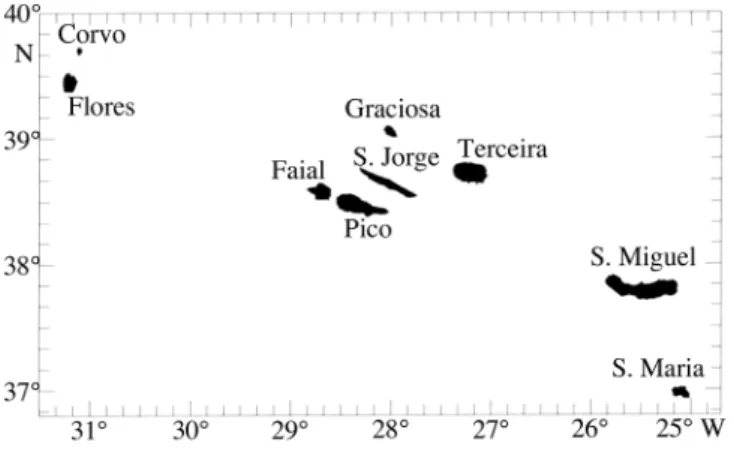
March and November 2000 in Terceira island, Azores
(Fig. 1). This method makes selection easy (Derbal and
Kara, 1996) and was used in previous works (e.g., Barreiros
and Santos, 1998)
Specimens were measured to the nearest millimeter
(Total length - TL and Standard length - SL) and weighed
with a precision of 0.01g. Sex determination was only
pos-sible after gonad removal. Gonads were preserved in Bouin
solution for 24 to 48 h, and transferred to ethanol 70%
(Vazzoler, 1996). Sections were taken from the medial part
of the left gonad and embedded in parafin. Gonads were
histologically prepared and Gonado-somatic (GSI) and
Hepato-somatic (HSI) indexes were determined both for
females and males. Sectioned at 2 µm, and stained with
“Harris” hematoxylin and eosin, each sample was examined
microscopically to determine the reproductive state.
Classification of gonads followed an adaptation based on
the maturity criteria of Budnichenko and Dimitrova (1981),
Vazzoler (1996) and Lourinho (1998). Ovarian and testis
maturation scales are presented in table I.
Gonado-somatic index (GSI), was calculated as
(Vazzoler, 1996):
GSI = (GW/(TW-GW)) x 100,
where GW is the gonad weight (g) and TW is the total fish
weight (g).
Hepato-somatic index (HSI) was calculated as (Patzner,
1980):
HSI = (LW/TW-LW) x 100,
where LW is the liver weight (g) and TW is the total fish
weight (g).
Average indexes were plotted to show seasonal
repro-ductive pattern. Sea surface temperature was measured in
all sampling dates with a thermometer.
RESULTS
Two hundred and six females were captured ranging in
size from 155 mm to 460 mm TL. The commonest size
range was between 307 mm and 338 mm TL (SE = 3.6).
Similarly, 101 males where captured during the study
peri-od. Their commonest size ranged between 269 mm and 290
mm TL (SE = 4.7), with a minimum at 185 mm to a
maxi-mal at 395 mm TL. The sex ratio observed was 2:1. In June
the number of males increased turning the sex ratio from 2:1
to 1:1.
Water surface temperature gave average values
some-how atypical, reaching a maximum value in October
(20.7°C) (Fig. 2).
For females, GSI results showed a pronounced growth
reaching a maximal peak in July (8.26). From July to
August, GSI has an evident decrease, reaching a minimal
value in October (0.75). HSI has an increase until May
(2.06), followed by a maximal peak in July (2.26), with a
Figure 1. - The Azores Islands (NE Atlantic) - ImagDOP.Females Males
Stage A Immature Stage A Immature Stage B In Maturation Stage B In Maturation
Stage C Mature Stage C Mature
Stage D In recovery post-spawning Stage D In recovery
Stage Bp Ovaries in maturation Stage Bp In maturation after ripe Stage Cp Mature Ovaries
Table I. - Gonad maturation scale used for S. saurus. Adapted from Lourinho (1998).
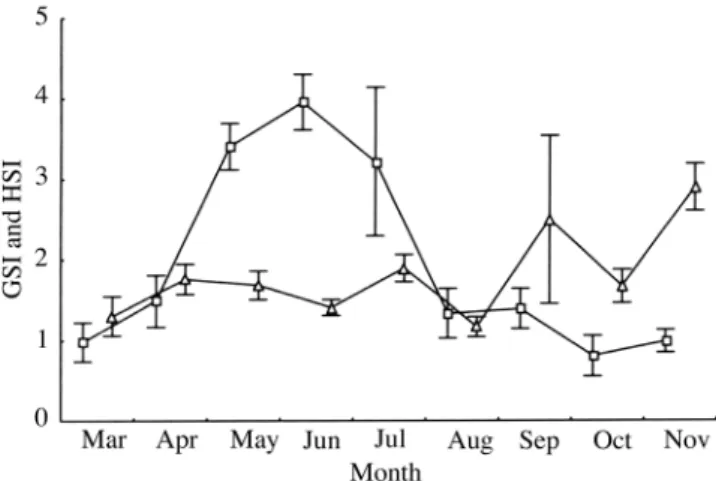
minimum in August (1.65) (Fig. 3). For males, GSI has a
maximal peak in June (3.96) and a minimal value in October
(0.71). The HSI has several peaks during the study period.
Two, less intense peaks occurred in April (1.76) and in July
(1.89), and were followed by a maximal peak in September
(2.52). In November, it reaches the maximal value of 2.90
(Fig. 4).
The percentage of the maturing stage for females after
histological observation is presented in figure 5. Stages C
and Cp represent the maximal ovarian development, and
show that the percentage of mature individuals, increases
until 100% in July. In October it reaches a minimum (9.5%),
and increases again in November (to 38%). Testis
histologi-cal observation produced the following results for each
maturation stage (Fig. 6). The percentage of individuals on
maturation stage C, shows that 50% of mature males occur
in March, decreasing to a minimal in May with only 10%.
In August, 86% of males are mature and in October the
maximal value is reached (93%).
Figure 2. - Average temperatures of sea water during sampling period.
Figure 3. - GSI () and HSI (Δ) variation for females of S. saurus (mean values).
Figure 4. - GSI () and HSI (Δ) variation for males of S. saurus (mean values).
Figure 5. - Distribution of the maturation stages (%) for females of S. saurus during the collection period. A - Immature, B1 - Beginning of maturation, B2 - End of maturation, C - Mature, D - In recovery post-spawning, Bp - Ovaries in maturation, Cp - Mature ovaries.
Figure 6. - Distribution of the maturation stages (%) for males of S. saurus during the collection period. Abbreviations as in figure 5. Bp - Mature testicles.
DISCUSSION
GSI results for females, suggest that Synodus saurus in
the Azores have a more intensive reproduction period
dur-ing Sprdur-ing and Summer, with a peak in July. This fact is
confirmed by histological observation. The maximal
aver-age value obtained for females was 8, which, according to
Tyler and Sumper (1996), indicates asynchronous spawning
cycles. GSI for males suggest that, like females, the most
intense reproduction period is during Spring and Summer.
However, the histological observation did not confirm this
fact and the percentage of males in stage C in this period is
smaller than the values found during Autumn months. The
cause of this can be due to a smaller number of specimens
sampled during Spring and Summer which made the
histo-logical results inconsistent with the analytic results.
It is known that energy stored in the liver, both in males
and in females, is channelled to muscular activity and for
reproduction effort, being more evident in females, where
the lipidic reserves are later transferred to oocytes for initial
embryo development (Love, 1970). HSI results for females,
during the more intensive reproduction period (July), have
a peak, suggesting that the liver reserves may not be used in
the final maturation stages. Nevertheless, care must be
taken on this observation, because accumulation and
stor-age of fat within the liver, in the course of ovary maturation,
is known in many fish species (Bailey, 1952; Smith, 1957).
For males, the minimal value obtained in June, when
GSI is highest, suggest that the liver has a weight loss,
which may indicate the mobilization of hepatic reserves for
testis maturation. However, this mobilization could also be
derived to body condition. Once again this must be viewed
with care. Other methods would be needed in order to test
this hypothesis such as hepatic histological analysis.
The maturation type found in females shows similar
macroscopic and microscopic characteristics to those
observed by Budnichenko and Dimitrova (1981) in the
con-familial species Saurida tumbil and S. undosquamis. The
resemblance is in the type of development until it gets to a
mature stage. In this are included all stages of oocyte
devel-opment until spawning and the type of gonad coloration
during that process. Budnichenko and Dimitrova (1981)
described maturation stages after spawning, where it was
possible to find oocytes in early and late vitellogenesis,
referring to Saurida tumbil and S. undosquamis as having
intermittent spawning periods. The continuous maturation
of several generations of oocytes during the spawning
sea-son provides evidence of an unbroken type of maturation
(Oven, 1976).
It appears that males have continuous sperm production
cycles, where they ripe, and simultaneously start a new
cycle of sperm production. This fact was already described
in other teleost fish, such as Ophidion sp. (Mattei et al.,
1993). The percentage of mature males during Spring and
Summer was too low and inconsistent with GSI results. This
can be connected with the fact that the number of males
col-lected during Spring and Summer was not enough to
achieve consonance between histological observations and
GSI results. The high percentage of mature males in October
and November and mature females in October and
September, may be explained by the higher temperatures
verified in those months, probably causing an unusual
matu-ration period, that could only be detected by histological
analysis.
The role of liver reserves during the reproduction effort
did not become clear.
Our results indicate that the increment of males during
June, one month before the maximal GSI of males, can be
due to some kind of competition strategy between males
resulting in the selection of the more fit for reproduction.
This work leads to new research possibilities that are
important to complement the information exposed above. It
is necessary to collect more specimens for longer periods in
order to test our results and detect eventual seasonal and/or
inter-annual variations. The small size of our sample did not
allow an efficient analysis of data from different size
class-es. It is also important to produce age-determination studies
for this species.
The results presented in this paper should be considered
as preliminary.
Acknowledgments. - We thank Alfredo Borba, for logistic
sup-port. Hernâni Martins, for the use of Histopathology equipments, and to Durval Costa, for the huge help. We thank Pedro Barreiros, and the two anonymous referees for their comments and sugges-tions, which greatly improved previous versions of the ms. This project was partly financed by the Departamento de Ciências Agrárias of the Universidade dos Açores.
REFERENCES
BaileY B.e., 1952. - Marine oils with particular reference to those of Canada. Fish. Res. Can. Bull., 89: 1-413.
BarreiroS J.P. & r.S. SantoS, 1998. - Notes on the food habits and predatory behaviour of the dusky grouper. Epinephelus marginatus (Lowe, 1834) (Pisces: Serranidae) in the Azores. Arquipélago. Life Mar. Sci., 16A: 29-35.
BuDniCHenKo v.a. & o.S. Dimitrova, 1981. - The repro-ductive biology of Saurida undosquamis and Saurida tumbil (Family Synodontidae) in the Arabian Sea. J. Ichthyol., 19: 80-86.
CaDima e.l., 1984. - Avaliação do estado de um recurso e da pesca. Seminário conjunto Mocambique/NOPAD sobre “Os Recursos Marinhos de Mocambique”. Rev. Inv. Pesq., 9: 141-177.
DerBal F. & m.H. Kara, 1996. - Alimentation estivale du mérou, Epinephelus marginatus (Serranidae), des côtes est Algériennes. Cybium, 20(3): 295-301.
eriCKSon l.D., HiGHtoWer e.J. & D.G. GroSSman, 1984. - The Relative Gonadal Index: An alternative index for quantification of reproductive condition. Comp. Biochem. Physiol., 78A: 151-156.
GarCÍa-DÍaZ m.m., Santana J.l., tuSet v.m., riCo v. & J.a. GonZÁleZ, 1996. - Aspectos reproductivos de Serranus atricauda y S. cabrilla (Osteichthyes, Serranidae) en Canarias. In: IX Simposio Iberico de Estudios del Bentos Marino, pp. 90-91. Resúmenes.
Golani D., 1993. - The biology of the Red Sea migrant, Saurida undosquamis in the Mediterranean and comparison with the indigenous confamilial Synodus saurus (Teleostei: Synodontidae). Hydrobiol., 271: 109–117.
Hunter J.r. & B.J. maCeWiCZ, 1985. - Rates of atresia in the ovary of captive and wild northern anchovy, Engraulis mordax. Fish. Bull., 83: 119-136.
iSaaC-naHum v.J. & a.e.a. De m. vaZZoler, 1987. - Biologia reprodutiva de Micropogonias furnieri (Desmarest, 1823) (Teleostei, Sciaenidae). 2. Relação gonado-somática, comprimento e peso dos ovários como indicadores do periodo de desova. Bol. Inst. Ocean. São Paulo, 35(2): 123-134. lam t.J., 1983. - Environmental influences on gonadal activity in
fish. Fish Physiol., 9B: 65-115.
lourinHo P.m., 1998. - Estudo da reprodução da garoupa Serranus atricauda (Günther, 1974). Estágio de Licenciatura em Engenharia Zootécnica, 48 p. Departamento de Ciências Agrárias. Univ. dos Açores.
love r.m., 1970. - The Chemical Biology of Fishes. 547 p. London: Academic Press.
mattei X., Siau Y., tHiaW o.t. & D. tHiam, 1993. - Peculiarities in the organization of testis of Ophidion sp. (Pisces Teleostei). Evidence for two types of spermatogenesis in teleost fish. J. Fish Biol., 43(6): 931-937.
oven l.S., 1976. - Features of the Oogenesis and the Nature of Spawning of marine Fishes. 321 p. Kiev: Naukova Dumka Press.
PatZner r.a., 1980. - Cyclical changes in weight and fat con-tent of the liver and their relationship to reproduction in the Hagfish Eptatretus burgeri (Cyclostomata). Acta Zool., 61: 157-160.
PoDroSCHKo S., PatZner r.a. & H. aDam, 1985. - The reproduction of Blennius pavo (Teleostei, Blenniidae). IV. Seasonal variation in HSI, the liver glycogen value and histo-logical aspects of the liver. Zool. Anz., 215(5/6): 256-273. SalDanHa l., 1997. - Fauna Submarina Atlântica (3rd edit.).
270 p. Lisboa: Publicações Europa América.
SantoS r.S., Porteiro F.m. & J.P. BarreiroS, 1997. - Marine fishes of the Azores. Annotated checklist and bibliog-raphy. Arquipélago. Life Mar. Sci., Supp. 1: 1-231.
SmitH S., 1957. - Early development and hatching. In: The Physiology of Fishes, Vol. I (Brown M.E., ed.), pp. 323-359. New York: Academic Press.
SoareS m., 2001. - Ecologia alimentar e aspectos comportamen-tais de Synodus saurus (Linnaeus, 1758) (Actinopterygii: Synodontidae) dos Açores. Estágio de Licenciatura em Biologia Aplicada aos Recursos Animais Variantes Marinhos, 49 p. Departamento de Zoologia e Antropologia. Faculdade de Ciências da Universidade de Lisboa.
SulaK K.J., 1989. - Synodontidae. In: Fishes of the North-eastern Atlantic and Mediterranean, Vol. I (Whitehead P.J.P., Bauchot M.-L., Hureau J.-C., Nielsen J. & E. Tortonese, eds), pp. 405-411. Paris: UNESCO.
tYler C.r. & J.P. SumPter, 1996. - Oocyte growth and devel-opment in teleosts. Rev. Fish Biol. Fish., 6: 287-318.
VAZZOLER A.E.A. DE M., 1996. - Biologia da Reprodução de Peixes Teleósteos. Teoria e Prática. 169 p. Maringá, São Paulo: EDUEM/SB.
vaZZoler a.e.a. De m., CaraCiolo-malta m.C. & S.a. amaDio, 1989. - Aspectos biológicos dos peixes amazónic-os. XII. Indicadores quantitativos do período de desova das espécies do género Semaprochilodus (Characiformes, Prochilodontidae) do baixo rio Negro, Amazonas, Brasil. Rev. Bras. Biol., 49(1): 175-181.
VLAMING V., GROSSMAN G. & F. CHAPMAN, 1982. - On the use of Gonado-somatic Index. Comp. Biochem. Physiol., 73A(1): 31-39.
Reçu le 6 février 2002.