THE DIET OF SWORDFISH (XIPHIAS GLADIUS)
IN AZOREAN WATERS
M.R. CLARKE, D.C.CLARKE, H.R.MARTINS A N D H.M.SILVA
A R Q U I P ~ L A G ~
CLARKE, M.R.. D.C. CLARKE. H.R. MARTINS & H.M .SILVA 1995. T h e diet of swordfish(Xiphias gladius) in Azorean waters. Arquipe'lago. Life and Marine Sciences 13A:
53-69. Angra d o Heroismo. ISSN 0870-658 1.
A total of 132 stomachs were collected in 1992-93 from swordfish caught on drifting
longlines near the Azores. Contents were sorted completely into components which comprised all stages of digested fish and cephalopods from complete fish to fragments of muscle, bones. otoliths and beaks of cephalopods. Fish and larger bones which could be identified all belonged to Capros aper. Lepidopus caudatus, Pagellus bogaraveo, myctophids, and the fish used as bait, Trachurus picturatus. Flesh of the squids Todarodes
sagittatus, Pholidoteuthis boschmai and the squid used as bait Illex sp. was also prescnt.
1249 otoliths and 120 cephalopod lower beaks were identified to genus or species. There was a mean of 3.1 species and 18 animals represented in each stomach. Fish remains occurred in 98.4% of the stomachs and contributed 93.4% of animals in the diet. Cephalopod remains occurred in 37.4% and contributed 5.8% of animals. Estimates of the weights of fish and cephalopods show that cephalopods provide 50.5% and fish species 49.5% of the stomach contents. The most important constituents of the diet by decreasing % estimated weight are Ommastrephes bartrami (24.4%), Lepidopus caudatus (17.4%).
Pholidoteuthis boschmai (15.9%), Capros aper (14.9%), Beryx spp. (5.4%), Micromesistius poutassou (4.3%), Onychoteuthis sp. (3.9%). Moroteuthis sp. (2.7%) and Pagellus bogaraveo (2.2%). In all, there are more than 18 species of fish and 22 species of
cephalopod in the diet. Size distributions of otoliths and beaks are presented. The species include bottom and midwater forms from both oceanic and near island water and depths. A number of rare species of cephalopods and species not recorded for the Azores are in the diet. Diet does not differ according to the size of swordfish sampled or between female and male swordfish. Preliminary calculations were made on the minimum biomass eaten by the swordfish off the Azores as 7280 - 8680 t per year, approximately half fish and half cephalopods.
CLARKE, M.R., D.C. CLARKE, H.R. MARTINS & H.M. SILVA 1995. A dieta d o espadarte
(Xiphias gladius) e m Bguas A ~ o r i a n a s . Arquipe'lago. Ciencias Biol6gicas e
Marinhas 13A: 53-69. Angra d o Heroismo. ISSN 0870-6581.
Um total de 132 est6magos de espadarte foram recolhidos durante os anos de 1992193 em individuos capturados em palangre derivante perto do arquip6lago dos A~ores. 0 s contelidos foram completamente separados em componentes que incluiam: todos os estados de digest20 de peixes e cefal6podes, desde peixes completes at6 fragmentos de mdsculo, ossos e ot6litos e bicos de cefal6podes. 0 s peixes e os ossos maiores, que podem ser identificados, pertenciarn todos a Capros aper, Lepidopus caudatus, Pagellus bogaraveo. rnictofidecs e. o peixe que servia de isco, Trachurus picturatus. Mdsculo das lulas
Todarodes sagittatus, Pholidoteuthis boschmai e a lula que servia de isco Illex sp. tambCm
foi encontrada. 1249 ot6litos e 120 bicos (inferiores) de cefal6podes foram identificados at6 ao g6nero ou espCcie. Encontrou-se uma media de 3.1 esp6cies e 18 animais representados em cada estbmago. 98.4% dos est6magos apresentavem restos de peixes que contribuiam com 93.4% dos animais na dieta. Encontraram-se cefal6podes em 37.4% dos estbmagos que contribuiram com 5.8% dos animais. Estimou-se que os pesos dos cefal6podes e peixes
THE
DIET OF SWORDFISH
(XIPHIAS
GLADIUS)
lN AZOREAN W
A
T
ER
S
M.R. CLARKE, D.CCLARKE, H.R.MARTINS AND H.M.SIL V A
ARQ
UIPÉLAG
O
CLARKE, M.R., D.C. CLARKE, H.R. MARTINS & H.M .SILVA 1995. The diet of swordfish(Xiphias gladius) in Azorean waters. Arquipélago. Life and Marine Sciences l3A: 53-69. Angra do Heroísmo. ISSN 0870-6581.
A total of 132 stomachs were collected in 1992-93 from swordfish caught on drifting longlines near the Azores. Contents were sorted completely into components which comprised ali stages of digested fish and cephalopods from complete fish to fragments of muscle, bones, otoliths and bealcs of cephalopods. Fish and larger bones which could be identified aI! belonged to Capros aper. Lepidopus caudalUs, Pagellus bogaraveo, myctophids, and the fish used as bait, Trachurus piclUratus. Flesh of the squids Todarodes
sagittatus, Pholidoteuthis boschmai and the squid used as bait lllex sp. was also presento
1249 otoliths and 120 cephalopod lower bealcs were identified to genus or species. There was a mean of 3.1 species and 18 animaIs represented in each stomach. Fish remains occurred in 98.4% of the stomachs and contributed 93.4% of animals in the diet. Cephalopod remains occurred in 37.4% and contributed 5.8% of animais. Estimates of lhe weights of fish and cephalopods show that cephalopods provide 50.5% and fish species 49.5% of the stomach contents. The most important constituents of the diet by decreasing % estimated weight are Ommastrephes bartrami (24.4%), Lepidopus caudatus (17.4%),
Pholidoteuthis boschmai (J 5.9%), Capros aper (J 4.9%), Beryx spp. (5.4%), Micromesistius
poutassou (4.3%), Onychoteulhis sp. (3.9%), Moroteuthis sp. (2.7%) and Pagellus
bogaraveo (2.2%). ln ali, there are more than 18 species of fish and 22 species of cephalopod in lhe diet. Size distributions of otoliths and bealcs are presented. The species include bottom and midwater forms from both oceanic and near island water and depths. A number of rare species of cephalopods and species not recorded for lhe Azores are in the diet. Diet does not differ according to lhe size of swordfish sampled or between female and male swordfish. Preliminary calculations were made on the minimum biomass eaten by the swordfish off the Azores as 7280 - 8680 t per year, approximately half fish and half cephalopods.
CLARKE, M.R., D.C. CLARKE, H.R. MARTINS & H.M. SILVA 1995. A dieta do espadarte
(Xiphias gladius) em águas Açorianas. Arquipélago. Ciências Biológicas e Marinhas 13A: 53-69. Angra do Heroísmo. ISSN 0870-6581.
Um total de 132 estômagos de espadarte foram recolhidos durante os anos de 1992/93 em indivíduos capturados em palangre derivante perto do arquipélago dos Açores. Os conteúdos foram completamente separados em componentes que incluiam: todos os estados de digestão de peixes e cefalópodes, desde peixes completos até fragmentos de músculo, ossos e otólitos e bicos de cefalópodes. Os peixes e os ossos maiores, que podem ser identificados, pertenciam todos a Capros aper, Lepidopus caudatus, Pagellus bogaraveo, mictofidecs e, o peixe que servia de isco, Trachurus picturalUs. Músculo das lulas
Todarodes sagillatus, Pholidoteuthis boschmai e a lula que servia de isco Illex sp. também
foi encontrada. 1249 otólitos e 120 bicos (inferiores) de cefalópodes foram identificados até ao género ou espécie. Encontrou-se uma média de 3.1 espécies e 18 animais representados em cada estômago. 98.4% dos estômagos apresentavem restos de peixes que contribuiam com 93.4% dos animais oa dieta. Encontraram-se cefalópodes em 37.4% dos estômagos que contribuiram com 5.8% dos animais. Estimou-se que os pesos dos cefalópodes e peixes
INTRODUCTION
contribuiarn respectivamente corn 50.5% e 49.5% .dos conteddos estornacais. 0 s constituintes mais irnportantes da dieta, determinados por dep1ec;Zo de % peso estirnado s5o
Ommastrephes bartratni (24.4%), Lepidopus caudatus (17.4%), Pholi-doteuthis boschmai
(15.9%), Capros aper (14.9%), Beryx spp. (5.4%), Micromesistius poutassou (4.3%),
Onychoteuthis sp. (3.9%), Moroteuthis sp. (2.7%) e Pagellus bogoraveo (2.2%). Ao todo,
hB mais do que 18 espCcies de peixe e 22 de cefaldpodes na dieta. Apresentarn-se as distribuic;Bes por tarnanho de otdlitos e bicos. H i espCcies bentdnicas e rnesopelfigicas de Bguas oce%nicas, costeiras e profundas. Aparecem, na dieta, algumas espCcies raras e n5o registadas para os A~ores. As dietas n5o variam de acordo corn a dimens50 do espadarte arnostrado ou entre sexos. CBlculos perliminares sobre a biomassa minima consumida pel0 espadarte dos &ores apontarn para um ndmero entre 7280 a 8680 t por ano, sendo aproxirnadarnente metade peixe e metade cefaldpodes.
M.R. Clarke & D.C. Clarke, "Ancarvan, Southdown, Millbrook, Torpoint, Cornwall, PLIO 1EZ U.K. - H. R. Martins & H. M. Silva, Departamento de OceanograBa e Pescas, Universidade dos &ores University, PT-9900 Horta, Acores, Portugal.
The present analysis of swordfish stomach contents from the Azores is the forth part of a continuing programme to analyse the diets of large predators in the food web of Azores waters. Previously, the diets of the cetaceans Physeter macrocephalus (CLARKE et al. 1993), one Kogia breviceps (MARTINS et al. 1985) and Loligo forbesi (MARTINS 1982) have been described
from the Azores.
The study of diets of marine fish has previously been attempted by the application of several methods involving greater or lesser complication; the work on swordfish diet is a typical example of progress in this field. Work before 1968 comprised notes of the species occurring in swordfish stomachs, sometimes with reference to the most numerous species (summarised by SCOTT &
TIBBO
1968). SCOTT & TIBBO (1968) were the first to provide quantitative data such as occurrence, number of individuals and volumes of the component groups and these were taken from a large sample of 514 swordfish. While the fish species were identified, only the most prolific squid (Zllex illecebrosus)was identified and that not adequately distinguished from other cephalopods. STILLWELL
& KOHLER (1985) also considered only the identifiable specimens of the food organisms and
included both fish and cephalopod species by occurrence, number of individuals and volumes.
Here, the method of voluming was not considered of value since very few cephalopods were represented by flesh and many fish were at an advanced stage of dissolution. Instead of only utilising flesh remains, we also identified otoliths and cephalopod lower beaks and used them to indicate occurrence, numbers and wet weights of the species identified. This was also done, for some of the prey species by MOREIRA (1990), GUERRA et al. (1993) and HERNANDEZ-GARCIA (1995). The use of beaks for such studies is well established and has fewer problems (discussed below and by CLARKE 1986a) than the use of otoliths which has been much discussed and criticised (HYSLOP 1980; JOBLING & BREIBY 1986). Certainly, caution must be exercised in using otoliths because they dissolve at different rates according to their size and species (JOBLING & BREIBY 1986; HERNANDEZ-GARCIA 1995). However, our observations suggest that, with the species occurring here, otoliths can be used to give certain valid conclusions.
Increasing interest in the role of cephalopods in food webs and the use of beaks in its elucidation has led several authors (TOLL & HESS 1981; BELLO 1991; GUERRA et al. 1993; HERNANDEZ-GARCIA 1995) to concentrate on cephalopods and neglect the fish in their diet studies of swordfish.
contribuiam respectivamente com 50.5% e 49.5%' .dos conteúdos estomacais. Os
constituintes mais importantes da dieta, determinados por depleção de % peso estimado são
Ommastrephes bartrami (24.4%), Lepidopus caudatus (17.4%), Pholi-do/euthis boschmai (15.9%), Capros aper (14.9%), Beryx spp. (5.4%), Micromesistius pou/assou (4.3%), Onycholeuthis sp. (3.9%), MorOleuthis sp. (2.7%) e Pagellus bogoraveo (2.2%). Ao todo,
há mais do que 18 espécies de peixe e 22 de cefalópodes na dieta. Apresentam-se as
distribuições por tamanho de otólitos e bicos. Há espécies bentónicas e mesope1ágicas de
águas oceânicas, costeiras e profundas. Aparecem, na dieta, algumas espécies raras e não
registadas para os Açores. As dietas não variam de acordo com a dimensão do espadarte
amostrado ou entre sexos. Cálculos perliminares sobre a biomassa mínima consumida pelo
espadarte dos Açores apontam para um número entre 7280 a 8680 t por ano, sendo
aproximadamente metade peixe e metade cefalópodes.
M.R. Clarke & D.e. Clarke, "Ancarva", Southdown, Millbrook, Torpoint, Cornwall, PUO JEZ u.K. - H. R. Martins & H. M. Silva, Departamento de Oceanografia e Pescas, Universidade dos Açores University, PT-9900 Hor/a, Açores, Portugal.
INTRODUCTION
The present analysis of swordfish stomach
contents from the Azores is the forth part of a
continuing programme to analyse the diets of
large predators in the food web of Azores waters.
Previously, the diets of the cetaceans Physeter
macrocephalus (CLARKE et aI. 1993), one Kogia breviceps (MARTINS et a!. 1985) and Loligo forbesi (MARTINS 1982) have been described from the Azores.
The study of diets of marine fish has
previously been attempted by the application of several methods involving greater or lesser complication; the work on swordfish diet is a
typical example of progress in this field. Work
before 1968 comprised notes of lhe species
occurring in swordfish stomachs, sometimes with
reference to lhe most numerous species
(summarised by SCOTT & TlEBO 1968). SCOTT &
TlEBO (1968) were the first to provide
quantitative data such as occurrence, number of
individuaIs and volumes of the component groups
and these were taken from a large sample of 514 swordfish. While the fish species were identified,
only the most prolific squid (I11ex illecebrosus)
was identified and that not adequately
distinguished from other cephalopods. STILLWELL & KOHLER (1985) also considered only the identifiable specimens of the food organisms and 54
included both fish and cephalopod specJes by
occurrence, number of individuaIs and volumes.
Here, the method of voluming was not
considered of value since very few cephalopods were represented by flesh and many fish were at
an advanced stage of dissolution. Instead of only
utilising flesh remains, we also identified otoliths and cephalopod lower beaks and used them to
indicate occurrence, numbers and wet weights of
the species identified. This was also done, for
some of the prey species by MOREIRA (1990),
GUERRA et a!. (1993) and HERNANDEZ-GARCIA
(1995). The use of beaks for such studies is well
established and has fewer problems (discussed below and by CLARKE 1986a) than the use of otoliths which has been much discussed and
criticised (HYSLOP 1980; JOBLING & BRElEY
1986). Certainly, caution must be exercised in using otoliths because they dissolve at different
rates according to their size and species (JOBLING
& BRElEY 1986; HERNANDEZ-GARCIA 1995). However, our observations suggest that, with the
species occurring here, otoliths can be used to
give certain valid conc1usions.
Increasing interest in the role of cephalopods
ln food webs and the use of beaks in its
elucidation has led several authors (TOLL & HESS
1981; BELLO 1991; GUERRA et aI. 1993;
HERNANDEZ-GARCIA 1995) to concentrate on cephalopods and neglect the fish in their diet studies of swordfish.
Previous work was for swordfish caught in the western North Atlantic (SCOTT & TIBBO 1968; STILLWELL & KOHLER 1985; TOLL & HESS l98l), the coast of Portugal (MOREIRA 1990), the eastern North Atlantic (GUERRA et al. 1993; HERNANDEZ- GARCIA 1995), the eastern Mediterranean (BELLO 1991) and the North Pacific (summarised by MARKAIDA 1995). The results show distinct differences depending on the region studied and on the type of analysis employed (see Discussion).
The present work should have value for understanding the role of fish and cephalopods in the foodweb of the Azores as well as for a greater understanding of the diet of the swordfish.
MATERIAL AND METHODS
Stomachs were collected from 132 swordfish, caught by drifting longlines near the surface during commercial (105) and research fishing (27) off the islands of Pico and Faial during the period 25.10.92 - 25.12.93. Line setting began at about 17:OO-18:OOh and hauling started at about 08:OOh the following morning. The sampling area for the research fishing, carried out R.V. "ArquipClago" of DOP, was between the three islands Faial, SHo Jorge and Pico to the Azores Bank and Princesse Alice Bank. Commercial catches were from the same general area.
Of the 132 swordfish, 113 were collected in October-December 1992 and 19 in February to December 1993. The monthly distribution of the samples was February (2), August (2), October (53), November (33), December (33) which reflects the seasonal presence of the species in the area.
~ o w e r jaw fork lengths of the swordfish were measured from the tip of the lower jaw to the fork of the tail. Stomachs were removed at sea immediately after capture. After being deep frozen, the contents of each stomach were thawed out in the laboratory and weighed; the average weight of the stomach contents was found by deducting the mean of empty stomachs from the mean of stomachs with food. Stomach contents were carefully sifted and sieved for all identifiable
animal remains. Volumes of the major components of the stomach contents were not measured because the variation in condition made such measurements worthless. General identification of flesh and bone remains was followed by examination of otoliths and cephalopod beaks. Where almost complete animals were present their lengths (fork length in the case of fish) were measured, they were weighed and their otoliths were removed for comparative studies. Collection and identification of fishes was aided by help from fish specialists in the Department of Oceanography and Fisheries, University of the Azores, Horta, Faial (DOP, see Acknowledgements). Identification of otoliths (DCC) was achieved by comparison with a collection removed from a variety of local fishes both from catches and from stomach contents and, for myctophids, from the literature (FITCH 1969; GRENFELL 1984; HECHT & HECHT 1987; NOLFE
& CAPETTA 1988). Two species were identified by fish and otolith specialists (see Acknowledgements, Smale and Merrett). 1249 otoliths in reasonable condition were identified. 50 (3.8%) were too digested for identification to be possible.
Identification of cephalopod beaks (MRC) was carried out with a large reference collection and methods prescribed by CLARKE (1986a). Seven small lower beaks could not be identified but were probably in three species of small cranchiids.
Estimates of the weights and lengths of Reryx species were made from unpublished size relationships supplied by E.Isidro of the D.O.P. Estimates for Micromesistius poutassou were taken from Ln Wt(in g) = 2.83 x Ln OL(in
rnrn.)-
1.29 (MOREIRA 1990) and SL = 23.17 x OL-25.54 (JOBLING & BREIBY 1986), for Pagellus
bogaraveo Wt(g) = EXP(Ln(39.4177)
+
(1.189 x Ln(0Radius))) and Wt(g) = EXP(Ln(0.0124)+
(3.137 x LN(FL in cm))) (derived from KRUG 1989), and for Trachurus picturatus FL (in cm) =(OL-1.759) 10.224 and Log Wt(g) = Ln 0.00819
+
3.1 1 x Ln(FL in cm) (ISmRO 1990). A sufficient number of Capros aper were present inthe stomachs to relate otolith size to fish weight. This shows considerable variation but several stomachs were dilated with Capros in good condition and the total weight and number of fish present showed that Capros taken by the swordfish averaged near to 5 g. This agreed with estimates made on fewer fish from otolith length relationships. No weights for myctophids were available but their total weight was calculated from a mean volume of 8.5 ml obtained by data of SCOTT & TIBBO (1968). Other estimates were based on relationships given in SMALE et al. (1995). From the overall totals of food items the sum totals of each species represented in the diet were calculated by adding the number of fish identified from flesh to half the number (rounded up to the next even number) of otoliths, taking account of instances where two otoliths in a stomach only represented a single fish.
Estimates of the weights and mantle lengths (ML) of cephalopods were made from known relationships for the lower beak rostra1 length or hood length
(LRL,
LHL) of each species or family found (CLARKE 1986a).Eye lenses of cephalopods can be distinguished from those of fish by being easily fractured into two unequal hemispheres. This allows digestives fluids to enter between the onion-like layering and the lenses break up under mechanical pressures so that they disintegrate and disappear from the stomachs much more quickly than the fish eye lenses. The ratio between fish and eye lenses does not, therefore, indicate the relation of cephalopods to fish in the diet, as was formerly supposed (CLARKE 1986b; HERNANDEZ- GARCIA 1995).
Two items removed from the stomachs, the horse mackerel, Trachurus (12 in 5 stomachs) and the squid Illex (one only) were in an undigested state and were almost certain to have been bait used in catching the swordfish. These have been excluded from the calculations. However, where
Trachurus otoliths alone were present, they were taken to be indicative of Trachurus in the diet.
RESULTS
General description of stomach contents
Nine of the total samples were empty except for a few fish eye lenses. The 123 swordfish containing food remains other than fish eye lenses averaged 107 cm in fork length (SD. = 37 cm, range: 49- 240 cm) which we calculate to equal 13.4 kg from published relationships (see PALKO et al. 1981).
An attempt to categorise the condition of the stomach contents is shown in Fig. 1. The categories show the state of the least digested food in the stomachs; some of the stomachs also contain food in other states of digestion e.g. some have otoliths and debris together with fresh specimens but are placed in the 'good ID'
category. The stomach weights plotted against the swordfish fork lengths (Fig. 2) shows that the weights of the stomachs with no identifiable flesh are broadly spread over the size range but there is a suggestion that more swordfish below 100 cm (35.6%) ate less recently than swordfish over 100 cm (25.6%). The stomachs containing remains averaged 518 g in weight. If only the stomachs containing identifiable remains (other than otoliths and beaks) are included, the mean is 739 g. A swordfish of 100 cm (close to the mean FL=lO7 cm) had a stomach weighing 1660g which might be taken as an indication of the maximum weight for the mean fish and the mean fish then had about 50% of its stomach capacity filled. Subtraction of the mean weight of stomachs with no contents from the mean weight of stomachs with contents gives a mean weight of 334 g for the stomach contents.
Stomach contents were often bones with macerated fish attached and could be identified as
Capros aper, Lepidopus caudatus, Pagellus bogaraveo or myctophid remains. In total, 2189 animals were represented by either flesh, bones, otoliths or beaks in the stomachs (Table 1). A
mean of 18.0 animals (SD. 18.0, range: 1-108) (fish, cephalopods or crustaceans) were represented in each stomach. Thirty-nine species of fish and cephalopods were identified from
Percentage (%)
Identification
I
Fig. 1. The percentage of stomachs with contents in a particular stage of digestion. Only the least digested state is shown for each stomach.
Stomach & contents weight (g)
5050
,
Imyctophids. Cephalopod flesh comprised two heads and a body of Todarodes sagittarus in one sample and a tentacular crown (with beaks) of
Pholidoteurhis boschmai in another.
Fish remains occurred in all but two stomachs containing food (98.4%). Cephalopod remains occurred in 37.4% and crustacean remains in only 12.2%. Two samples (1.6%) 'contained cephalopod but no fish remains. The total number of fish represented by remains was 2045 and cephalopods was 127, a ratio of 16:l. The ratio of fish lenses to cephalopod lenses was 472:1, reflecting the faster digestion and loss of cephalopod lenses compared with those of fish. The number of fish otoliths was 1299 and the number of cephalopod beaks was 263 giving a ratio of 5: 1.
Fish comprised 93.4% by number of all animals represented in the stomachs. cephalopods 5.8% and crustaceans 0.8%.
Fish averaged 2.2 species and 16.9 individuals per stomach containing fish and 2.2 species and 16.8 per stomach containing food. Cephalopods averaged 1.81 species and 2.81 individuals per
4550 -
4050 -
3550 3050
~ o r k Lenqth (mm) stomach containing cephalopods and 0.78 species
Fig. 2. Weight of stomach including contents plotted and .21 individuals per sample with food. against the lower fork length of the swordfish. The
w ldffltfiied prey
x NO identified remsins d flesh
:,Mean
w
W
&an stomach length is plotted against the mean
fork length. Species contributions
otoliths, beaks, bones and flesh remains (including an unidentified myctophid and excluding 3 very small cephalopod species, probably cranchiids). The state of the crustaceans prevented specific identification but 4 penaeid shrimps, 3 'shrimps', 1 euphausid and 3 isopods (which may have been parasites off fish) were collected. Crustaceans were too damaged and their weight was too small to be included in calculations of weight.
Fish 'flesh' (including bones with flesh attached and pieces of muscle) occurred in 60.2% of samples and cephalopod flesh in only 2
samples (1.6%) containing food remnants. The fish 'flesh' included recognisable, complete
Capros aper and the heads and bones of
Lepidopus caudatus, Pagellus bogaraveo and
Forty-two species were present (including three cephalopod and one fish species which could not be identified) including 18 species of fish and 24 species of cephalopod and there was an average of 3.2 species per stomach (SD. 1.8, 1-1 1). The number of individual animals represented in the stomachs averaged 17.9 per stomach.
Fish
Numerical composition of the fish and estimates of the wet weights are shown in Table 2. Otolith length distributions for the commonest species (Fig. 3) show that all species except
- Beryx splendens Notoscopelus N=47
I
Otolith length(mrn)
Diretmus N=148 Beryx decadactylus N=18 Other Myctophids N=175 Micromesistus N=55 Otolith length(rnm)
argenteus have distinct unimodal peaks. The
smallest species, Notoscopelus sp. and Diaphus spp., have skewed distributions suggesting that the swordfish selects for the larger fish of these small species.
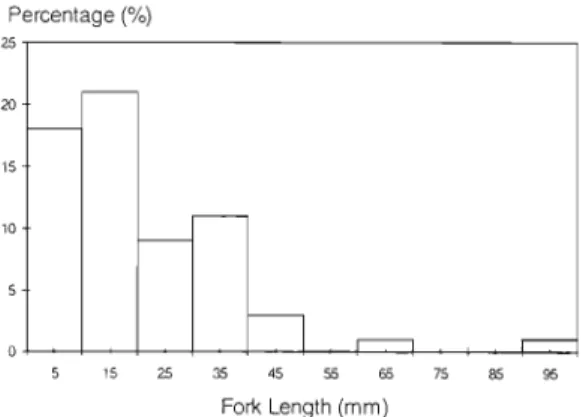
All the fish in good condition and most of the identifiable poor specimens were Capros aper and these had a fork length distribution with a peak at 10-20 mm (Fig. 4 ) .
Percentage (%)
Fork Length (mm)
Fig. 4. Histogram of the fork lengths of complete
Capros aper from stomachs of swordfish.
Diretmus argenteus has previously been
regarded as rare in this area.
Four small Lepidopus caudatus measured 320-380 mm in length but other specimens were too digested for measurement.
The myctophid otoliths included Lumpadena sp., Lampanyctus sp., Notoscopelus sp. and several species of Diaphus. Although it is not possible, with material available to us, to estimate their contribution by weight from otolith size, a rough approximation afforded by applying a mean derived from SCOTT & TIBBO (1968) is probably not too far from reality.
No flesh of Micromesistius poutassou was found and otoliths were identified by comparison with material of J. Castro (see Acknowledge- ments). The bimodal peak to the length distribution (Fig. 3) may suggest a second species is included.
The thirteen complete Trachurus picturatus in the stomachs are considered to be bait swallowed at the time of capture and their weights are not included in calculations. Because they must have
been in the stomach some time before capture, otoliths are assumed to represent natural food and are used in calculations. However, the heads from which they came may also have been taken off hooks.
Cephalopoda
The pelagic octopods Argonauta argo, Ocythoe
tuberculara and Haliphron atlanticus (=Alloposus mollis) make a surprisingly large
numerical contribution to the cephalopods in the diet (40.1%) but the larger, strong-swimming squids of the Ornrnastrephidae and the Pholidoteuthidae together contribute 79% of the cephalopods and 41.6% of all the food by weight (Table 3). Another 12.3% of cephalopod weight and 6.5% of the weight of the food is contributed by onychoteuthids, one being Moroteuthis sp. which has not been recorded for the North Atlantic but is known to occur here from unpublished data of one of the authors (MRC).
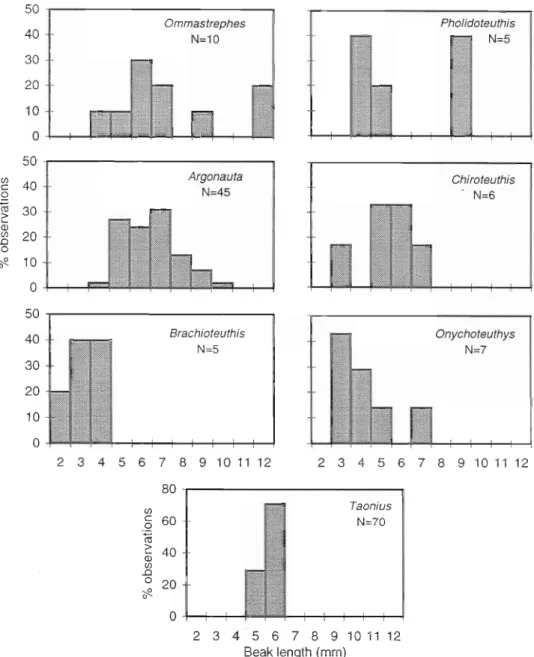
Beak measurements (LRL's and LHL's) are too few to give well-based distributions (Fig. 5) but they do show some grouping in each species.
Very rarely collected genera which are represented are Discoteuthis, Valbyteuthis and
Grimalditeuthis.
General
A histogram of estimated mean weights of all the species (Fig. 6) shows that most are less than 100 g in weight and only three species, all cephalopod, are over 400 g.
Figure 7a shows the % weight contributed, of species contributing more than 1%, arranged in descending order of importance. The steep part of the curve includes five fish genera, Lepidopus,
Capros, Beryx, Micromesistius and Pagellus and
four cephalopod genera, Ommastrephes, Pholido-
teuthis, Onychoteuthis and Moroteuthis.
Figure 7b gives the cumulative curve of the same species and shows that these nine species contribute over 91 % to the food of the swordfish. This is in contrast to the cumulative curve of numbers in which Capros comprises 75% of the number of animals in the diet and only another six species contribute more than 1 %.
Brachioteuthis 50
I
Pholidoteuthis 40 Chiroteuthis N=6I
Ommastrephes -- N=10 Onychoteuthys N=7 2 3 4 5 6 7 8 9 1 0 1 1 1 2Beak
length(mm)
Fig. 5. Lower rostra1 lengths of the beaks of the commoner cephalopods present in the stomachs of swordfish
Size and habits of prey targeted measurement for expressing size of a prey item in
the way fork lengths are and a better dimension
is
the standard length from the tip of the arms to the Estimates of the mantle and standard lengths of tip of the mantle. Head and arm lengths can be the cephalopods (Table 3) and the fork lengths of between 0.4-3.75 times the mantle length some of the fish (Table 2) range between 7 m m according to the species. If the estimates of mean
0 Fish
mcephalcpods
50 250 450 650 850 IDSO 12% 1450 1650
Estimated Mean Weight (g)
Fig. 6. Histogram showing the estimated mean weights of fish and cephalopods from swordfish stomachs. from the otoliths are plotted in decreasing values for the fish and cephalopods separately (Fig. 81, it is evident that the mean of no fish exceeds the means of the 7 largest cephalopods. Six of the eight largest cephalopods are muscular, fast swimming and negatively bouyant squids. Seven cephalopods with means between 125
mm
and 280 mm are all neutrally bouyant and slow swimming except for Brachioteuthis. Five of the 6 smallest genera are negatively buoyant, fast jetters. Ocythoe has an air-bladder to control bouyancy.Influence of swordfish sex on food
Forty-one male and 33 female swordfish were sexed and contained food: 49 were not sexed. The males averaged 102 cm in fork length and the females 121 cm. Stomachs with contents weighed an average of 574 g in the males and 838 g in the females. Females had a mean of 13.6 animals and 2.3 species while males had 21.5 animals and 3.0 species represented in the stomachs. No significant differences between the food species of the two sexes could be detected.
Influence of swordfish length on food
To examine differences in diet attributable to the sizes of the swordfish we compared the samples from 21 fish in each of three size groups with fork lengths less than 80 cm (mean 69 cm), 90-120 cm (mean 100 cm) and over 130 cm (mean 147 cm). Weight of stomach contents were 207 g, 191 g
Weiaht f044 25 Ommastrephes
n
4
~e'yx~cmmesistius \ Onychoteuthis SpeciesFig. 7a. The estimated % total weights of species with more than 1 % arranged in descending values.
Cumulative %
1W1 I
I
Species
Fig. 7b. Cumulative % weights of the species in 7a and cumulative numbers of species in descending value showing Capros aper as the first species. and 608 g respectively for the smallest to the largest fish. As one might expect from this, the weight of Capros aper flesh (the main component by bulk of the contents) increased from
a
mean of 4.4 g through 8.8 g to 10 g but no other trends were evident in fish or cephalopods.DISCUSSION Methodology
Although otoliths in diet studies must be used with care, we believe that the present work demonstrates their value and justifies their use. If only identifiable flesh were used for identification, only five instead of 18 species of fish and two instead of 21 species of cephalopod would have been recognised. If size and number
Table 3
Numbers and estimated sizes of cephalopods represented in swordfish stomachs by lower beaks. (No.- number; ML- mantle length; Std 1- standard length; 0cc.-occurrence)
Family Genus No. Mass ML Std I Occ.
No % % all total % % all Mean Min. Max. Mean Mean %
Wt Argonautidae Argonaura 45 35.4 2.05 297 1.04 0.55 16 58 36 80.64 Ocythoidae Ocyrhoe Alloposidae Huliphron Sepiolidae Hereroteurhis Loliginidae Loligo Ommastrephidae Otntnustrephes Todurodes Onychoteuthidae Onychoteuthis Moroteuthis Pholidoteuthidae Pholidoteuthis Brachioteuthidae Brachioreurhis Enoploteuthidae Abraliopsis Pyroteuthidae Pyroteurhis Histioteuthidae Hisrio A Hisrio B Discoteuthidae Discoteuthis Chiroteuthidae CI7iroreuthis Valbyteuthis Grimalditeuthidae Grbnalditeuthis Mastigoteuthidae Masrigoteufhis Cranchiidae Tuonius 3 unidentified SP TOTALS U D D ~ ~
. .
beaks 136 Total animals 2189 56336of otoliths and beaks had been ignored, Capros aper would have been considered the overwhelmingly most important food species instead of providing only14.9% of the food. Such computations from beak and otolith size must be considered rough estimates but are much better thari relying on weights of partially and variably digested stomach contents.
In determining the relative importance of fish and cephalopods from flesh, or beaks and otoliths, various problems arise. The flesh of many cephalopod species is digested much more rapidly than fish flesh; cephalopods have no bones, which take longer to digest than flesh. On the other hand, beaks are not digested in the stomach while some otoliths take only a few hours to digest
(JOBLING & BREIBY 1986; HERNANDEZ-GARCIA
1995). These factors would clearly make comparisons meaningless if the time in the
stomach was appreciably longer than the time taken to dissolve otoliths; the counts would be biassed towards cephalopods.
The conclusion drawn below that the food has been in the stomachs for less than 12 hours makes it unlikely that many of the otoliths have dissolved completely in stomach juices (JOBLING & BREIBY
1986; HERNANDEZ-GARCIA 1995) and this is supported by there being few halves of Capros
otoliths which are small and easily break into two. Thus, we consider the ratios between the otoliths are meaningful for determining diet.
As pointed out by JOBLING & B R E I B Y ( ~ ~ ~ ~ ) reduction of the lengths of otoliths after a short
time in the stomach could materially affect estimates of body lengths and weights of the fish. For the commonest fish, Capros aper, the estimates from the better otoliths gave similar results to direct weighing and measuring of intact
Mean Length (mm) Moroteuthis Coelorhynchus Epigonus sp. A A A Beryx dec A f ~ s h (fork length) muscular cephalopods (standard length)
I Ch~roteuth~s l ammonlocal cephalopods
Phol~doteuthis 0 gelatmous cephalopod Taonu~s I rn Om mastrephe Loligo a r Onychoteuthis Todarodes f@ Haliphron
0
Discoteuthis & r Histioteuthis A. Mastigoteuthis.
a Grimalditeuthis Pagellus A Be'YXsPl.Epigonus :p, i; A Micromesistius Brachioteuthis Histioteuthis B. I Pyroteuthis
Lepidopk A Macrorhamphosus Ocythoe Argonauts
Lampanyctus
A A A A Notoscopelus ~braliopsis' mVa~yteuthis Diretmus Diaphus A A Hoplostethus
Heteroteuthis
Soecies
Fig. 8. Estimated mean fork lengths for fish and standard lengths for cephalopods arranged in descending values, fish and cephalopods plotted separately. Square points are ammoniacal squids.
fish from the stomachs. In other species the weights were estimated from the better otoliths or, where appropriate the mean, and multiplied by the total number of otoliths present. Cephalopod estimates depend upon beaks whose rostra1 lengths do not reduce with digestion. The main limits to accuracy for cephalopod estimates are imposed by the limited accuracy of body weight and length to LRLs relationships. For the species occurring here, most relationships are reasonably accurate except for Ocythoe, Haliphron, Discoreuthis, Valbyteuthis and Grirnalditeuthis,
together only comprising 9.6% of the number of beaks.
Other possible errors in this kind of analysis are acquisition of food organisms from the stomachs of the food targeted by swordfish. This could be the source of the smallest beaks, and should be borne in mind when species are considered, but this is not likely to be a cause of error in considering the commonest and larger cephalopods. Evidence from flesh showed that
Todarodes and Pholidoteuthis were eaten directly
by the swordfish but that is also highly likely for all species but the smallest such as Hereroteuthis,
Abraliopsis, Pyroteuthis. Flesh was identified
from the smallest fish, Capros aper and the myctophids.
Regional comparisons
Comparisons with other studies on swordfish from the Atlantic are sumrnarised in Table 4. Oceanic samples showed a numerical dominance of cephalopods in the diet and samples near or on the Continental shelves showed a dominance of fish. The difference in this respect between the results of SCOTT & TIBBO (1974) and STILLWELL & KOHLER (1985), from much the same region was explained by the latter as a result of the increase in squid in the time between the sampling years. It could also partly be explained by the difference in latitude and depth of water of the main areas of sampling.
Table 4
Comparison of general results with the literature. (No.-number; 0cc.-occurrence: Vol-volume: wt-weizht: Sw- swordfish: s.-same: F-Fish: C- Cephalopod: f-family: p- genera).
-
Region group No.% Occ.90 VoVwt% Main food No.Sw LJW Sw % empty S. taxa No spp Author
as here
Azores fish 93.1 98.4 Lepidopus 132 107cm 7 14 This paper
cephalopods crustacea N.E.Atl. fish (oceanic) cephalopods crustacea Equator fish (oceanic) cephalopods crustacea Portugal fish cephalopods crustacea Str.Gib, fish cephalopods crustacea W.Afr. fish cephalopods crustacea N.W.Atl fish cephalopods crustacea N.W.Atl. fish cephalopods crustacea N.W.At1. fish cephalopods crustacea E.Med fish cephalopods crustacea W.Baja. fish Calif cephalopods crustacea N.Baja fish Calif Omtnustrephes 22 Ommastrephids selected for C Sthenofeuthis Mlcrotnesisrius Illex Micromesistius Todarodes Sthenoteuthis Scomber Illex (Mar-Oct) Illex; Histioteuthis Merluccius Illex Todurodes Sthenoteuthis Trachipterus 13 1 o c g GUERRA et al. 17 cephalopods 38 16
The specific composition of fish and et al. 1993) which share 9-11 species (or genera) cephalopods in the samples varies greatly between of 28 named specieslgenera recorded in the two areas, particularly for the fish. The closest studies. The most notable difference, similarity to the Azores region is, not surprisingly, Sthenoteuthis pteropus, which is the most
occur in the Azores samples has a usual northern limit to the South of the Azores and this is reflected in the samples. The abundance of
Argotzauta argo in the present samples may
reflect an unusual abundance in the year or possibly the time of year (the months of sampling were not recorded by GUERRA et al. 1993) sampled off the Azores as they did not occur in the Spanish samples. However, they did occur in swordfish off Portugal (MOREIRA 1990) showing that they are probably a regular part of the diet. In all regions, species in the Ommastrephidae were the most important cephalopods by number and, where measured, by weight or volume.
Predator comparisons
Twelve of the 40 species of cephalopods from stomachs of sperm whales caught near the Azores (CLARKE et al. 1993) also occurred in the swordfish diet of the area which comprised 21 identified species. Genera eaten by swordfish but not found in stomachs of sperm whales in the region are Argonauts, Ocythoe, Moroteuthis,
Loligo, Hereroreuthis, Brachioteuthis, Abraliop- sis, Pyroteuthis, Valbyreurhis and Grimaldireu- this. Squids of the last six genera are all too small
to be likely targets of the whales. The first two genera may live too near the sea surface to fall within the whale's normal sampling depth range. As explained above, Moroteuthis is a new record for the area and may be extremely rare here.
Loligo lives close to the edge of what little shelf is
present off the Azores islands and may be too close to the islands to be a regular prey of the whales. Considering the importance of octopoteuthids to sperm whales (5.9% by number) it is surprising they were not found in the diet of swordfish although they are eaten elsewhere in the eastern North Atlantic (MOREIRA 1990; GUERRA et al. 1993; HERNANDEZ-GARCIA 1995).
Prey distribution
The fish eaten by swordfish include species from all the ecological niches near these oceanic islands. Species living in island-influenced waters such as the near surface shoaling species Capros
aper, Micromesistius poutassou and Trachurus picturatus, near bottom species such as Pagellus bogaraveo and slope species such as
Coelorhynchus and midwater slope species such
as Lepidopus caudatus. The myctophids are oceanic shoaling species and share the same water between 200 m and 1000 m with many of the neutrally bouyant squids also found in the swordfish stomachs. Most of these have die1 vertical migrations bringing them into the top 200 m at night so that their presence in the diet does not contradict the conclusion that the swordfish is a nocturnal feeder. Heteroteuthis is particularly associated with sea mounts. Thus, the swordfish appears to search all the sea around the islands and the adjacent sea mounts for a wide diversity of prey, perhaps having little preference except for size.
It would clearly be to the swordfish's advantage to select for the largest prey items but its adaptability in accepting a large variety of species, large and small, arnmoniacal as well as muscular, mesopelagic as well as epipelagic assures it of an ample food supply when large species are scarcer. The mean weights of the cephalopods in the diet is 224 g and for the fish it is 13.6 g.
Food consumption
Finding the time taken for a swordfish to eat the estimated mean stomach contents cannot be done directly. If food is eaten more or less continuously and leaves the stomach continuously, we might expect to find all stomachs to be in more or less the same state of balance between the constituents. This is clearly not so (Fig. 1). Such a system would have the problem of clearing bones and beaks from the stomach in a regular manner with the fine breakdown products, without losing recently eaten food at the same time. More likely, is that a feeding bout of some duration is accompanied by, and followed by, reduction of all the muscle food to a particulate state followed by expulsion of the harder tissues before the next feeding bout begins. The variation of our samples supports this. Such a natural break could be night and day and work by CAREY & ROBISON (1981)
shows that swordfish spend nights near the surface and days at considerable depths in cold water where they may be far less active and may, indeed, feed less. As the present samples were all collected from fish caught at night and many have fresh fish and identifiable, deteriorating fish, they, at least, must be assumed to be that night's food intake. W e might conclude that the night's feeding bout, is followed by a daylight period of digestion and an emptying of the stomach prior to the swordfish's migration to shallower depths at dusk. JOBLING & BREIBY (1986) suggested that marine mammals and birds may have an interdigestive migrating myoelectric complex (IMMC) of muscular activity as in terrestrial mammals. To quote from them: "This cyclic pattern of contractions includes a series of powerful bursts of contractions which pass from the stomach to the upper intestine and serve to sweep any indigestible remains from the stomach." The present work suggests a similar mechanism in swordfish and that beaks and otoliths are therefore not held up in the stomach. However, we cannot rule out the possibility that the clearout of food remains is not totally effective and some beaks and otoliths may remain from the previous night's feeding.
If some holdup takes place a clue to the magnitude of this may be obtained by reviewing the contents of stomachs with no flesh but only otoliths and or beaks. From these stomachs 200 otoliths (15.5% of all otoliths) and 29 lower beaks (22.8% of all lower beaks) were collected. These otoliths represent 1360 g and the lower beaks 6489 g of the food represented in the stomachs. If the total, 7849 g, is subtracted from the total food represented in the stomachs, 56336 g, the weight left for the average feed is 382 g. This compares with 458 g if one assumes no otoliths or beaks are carried over from one feeding period to the next. A rough weight for the mean stomach contents is derived from subtracting the mean weight for empty stomachs from the mean weight of the stomachs containing food and is 334 g. The difference between this and the estimates of 382 g and 458 g can be accounted for by loss of digestive products from the stomachs but this is so small as to suggest that most loss is not a
continuous process but is more an explosive process after one feeding and before the next.
W e believe the estimated weight of the stomach contents are most likely to be the product of only one night's feeding because, if the food remains had been obtained in two nights, one might expect the otoliths, beaks and the unidentifiable slurry to be the product of the first night's feeding and to have, on average, much the same constituents as the second night. This is clearly not so. In addition, the work on disappearence of otoliths due to digestion is sufficiently fast to remove all traces of the smallest otoliths, Caprus and myctophids, from a previous night's feeding period.
As the mean swordfish weight, calculated from the mean fork length is 13.4 kg, in one day the average swordfish would eat 2.8-3.4% of its body weight per day and 10.4-12.4 times its body weight annually. This is higher than the estimate of 3.4-5.8 times derived by STILLWELL & KOHLER (1985) using digestion time intervals of sharks, although it is below estimates for some other fish.
From knowing the annual requirement of food and the proportion of the components of the diet, it is possible to estimate the minimum mass of each component eaten by swordfish in various regions (STILLWELL & KOHLER 1985; HERNAN- DEZ-GARCIA 1995). In the Azores region about 344 t of swordfish are landed annually. As these are probably three years old (OVCHINNIKOV 1970) and the catch has been sustained over a number of years, our sample might be expected to represent a population at least 3 times as many and weighing at least twice as much. However, the catches suggest they may only spend three months in the region. The consumption of the 700 t of swordfish would consume while in the Azores region over 7280-8680 t. This would include, for example, something in the region of 1387 t of
Lepidopus caudatus and 435 t of Beryx, tonnages considerably exceeding those taken commercially (=255 t and 176 t respectively). The 2045 t of ommastrephids also eaten by swordfish shows the importance of these squids in a region where they are not caught commercially. Such computations should not be carried through to other years since
we have no idea of the inter-year stability of the diet until the work is repeated.
Future
While several papers now show the considerable regional variation in the species eaten by swordfish, there is no evidence for annual changes or their magnitude in any one place. Assessing the stability and reproducibility of the results of such analyses is of crucial importance in assessing their value for prediction and must involve collections made in a s precisely similar ways as possible at different times. Comparisons should not only involve species composition of whole specimens but should include both flesh, otoliths and beaks and their size distributions.
A s more species are treated in the same way as here, it is hoped that well based modelling of the foodwebs in this area will b e possible. Seeing changes in the ecostructure may then b e practical by monitoring the changes in diet composition of a few selected, high predators in the system. It is our conviction that such monitoring will b e much more effective and a much cheaper way of observing change than collection with nets from oceanographic vessels; such will give direct information of the interaction of animals by means of rather few samples including a good spread of species and sizes.
This paper has involved the help of many people involving the sampling of many species of fish for otolith comparisons as well as swordfish for stomach contents. The authors extend their warmest thanks to all the fishermen and the Captain and crew of R./V. "Arquiptlago" as well as to various members of the DOP staff including Norberto Serpa, Filipe Porteiro, Humberto Rodrigues, Patricia Sim6es for diligently sampling from the swordfish and other fishes. Helena Kmg kindly gave her collection of otoliths to form the basis for the reference collection used in the present study. Eduardo Isidro and Gui Menezes very kindly made available their unpublished curves of otolith to body weight relationships. Dr. Malcolm Smale of the Port Elizabeth Museum, KSA identified Diretmus
otoliths and Nigel Merrett of the London Natural
History Museum identified Epigonus otoliths and confirmed several other species identifications. Dr. Vicente Hernandez-Garcia and Dr. Jose Castro of the University of Las Palmas, Canary Islands kindly let us examine their collections of otoliths. To all the above, we are most grateful. Our special thanks are given to Carmelina Leal whose energy and thoroughness in the unenviable task of sorting the total stomach contents into Classes and sometimes Genera, counting, measuring and note-taking has made the final analysis possible.
REFERENCES
BELLO, G. 1991. Role of cephalopods in the diet of swordfish, Xiphias gladius, from the eastern Mediterranean Sea. Bulletin of Marine Science 46 (1 -2): 3 12-324.
CAREY, F.G. & B.H. ROBISON 1981. Daily patterns in the activities of swordfish, Xiphias gladius,
observed by acoustic telemetry. Fishery Bulletin 79 (2), 277-292
CLARKE, M.R. (Ed.) 1986a. A Handbook for the Identification of Cephalopod Beaks. Clarendon Press, Oxford. 273pp.
CLARKE, M.R. 1986b. Cephalopods in the diet of odontocetes. Pp. 281-321 in: Research on dolphins. BRYDEN, M.M. & R. HARRISON (Eds) Clarendon Press, Oxford.
CLARKE, M.R., H. MARTINS & P. PASCOE 1993. Sperm whale diet of the Azores. Philosophical Transactions of the Royal Society of London B
339: 67-82.
FITCH, J.E. 1969. Fossil lanternfish otoliths of California, with notes on fossil Myctophidae of North America. Contributions to Science, Los Angeles County Museum (1 73): 1-20
GRENFELL, H.R. 1984. Early Miocene teleost otoliths from Parengarenga Harbour, New Zealand. New Zealand Journal of Geology & Geophysics 27: 51-
96.
GUERRA, A., F. SIMON & A.F. GONZALEZ 1993. Cephalopods in the diet of the swordfish, Xiphias gladius, from the northeastern Atlantic ocean. Pp. 158-164 in: OKUTANI, T., R.K. O'DOR, & T. KUBODERA (Eds), Recent Advances in Fisheries Biology, Tokai University Press. Tokyo.
HECHT, T. & A. HECHT 1987. A guide to the otoliths of Southem Ocean Fishes. South African Journal of Antarctic Research 17(1): 1-87.
HERNANDEZ-GARCIA, V. 1995. The diet of the swordfish (Xiphias gladius Limaeus, 1758) in the
central East Atlantic with an emphasis on the role of ccphalopods. Fishery Bulletin 93(2): 403-41 1. HESS. S.C. & R.B. TOLL 1981. Methodology for
specific diagnosis of cephalopod remains in stomach contents of predators with reference to the broadbill swordfish, Xiphias gladius. Journal of
Shellfish Research l(2): 161 -1 70
HYSLOP. E.J. 1980. Stomach contents analysis- a review of methods and their application. Journal of
Frshery Biology 17: 41 1-429.
ISIDRO, H.A. 1990. Age and growth of Trachurus
picturatus (Bowdich, 1825) (Teleostei: Carangidae) from the Azores. Arquipelago. Life and Earth Sciences 8: 45-54
JOBLING. M. & A. BREIBY 1986. The use and abuse of fish otoliths in studies of feeding habits of marine piscivores. Sarsia 7 1 : 265-274.
KRUG, H. 1989. The Azorean blackspot seabream,
Pagellus bogaraveo (Bninnich, 1768) (Teleostei: Sparidae): Age and growth. Cybium 13(4): 347- 355.
MARKAIDA. U. 1995. Caracterizacion de la dieta del pez espada (Xiphias gladius Linnaeus. 1758) en la costa occidental de Baja California, Mexico. 1 19pp.
MARTINS, H.R. 1982. Biological studies of the exploited stock of Lolrgo forbesi (Molluscs: Cephalopoda) in the Azores. Journal of Marine
Biology Association of the U.K. 62: 799-808. MARTINS, H.R., M.R. CLARKE, M.R., R. REINER & R.S.
SANTOS 1985. A pygmy sperm whale, Kogia
breviceps (Blainville.1838) (Cetacea: Odontoceti) stranded on Faial Island, Azores, with notes on cephalopod beaks in the stomach. Arquipe'lago SCrie Ciencias da Nature~a 6: 63-70.
MOREIRA, F. 1990. Food of the swordfish Xiplzias
gladius Linnaeus, 1758 off the Portuguese coast.
Journal of Fishery Biology 36: 623-624.
NOLFE, D. & H. CAPPETTA 1988. Otolithes de pliocenes du Sud-est de la France. Bulletin de l'lnstitut Royal
des Sciences Naturelles de Belgique. 58: 209-271. OVCHINNIKOV, V.V. 1970. Swordfishes and billfishes
in the Atlantic Ocean. Ecology and functional morphology. Israel Programe For Scientific Translations 1971: 1-75.
PALKO, B.J., G.L. BEARDSLEY & W.J. RICHARDS 198 I. Synopsis of the biology of the swordfish, Xiphias
gladius Linnaeus. NOAA Technical Report NMFS
Circular 441. 25 pp.
Scorn, W.B. & S.N. TIBBO 1968. Food and feeding habits of swordfish, Xiphias gladius, in thc western north Atlantic. Journal of the Fisheries Resesearch
Board of Canada, 25: 903-9 19.
SCOTT, W.B. & S.N. RBBO 1974. Food and feeding habits of swordfish, Xiphias gladius, in the northwest Atlantic ocean. Pp. 138-141. in: Procedings of the International Billfish Symposium Kailua-Kona, Hawaii, 9-12 Aug 1972 Part 2 Review and contrib. papers, U.S. Department of Commerce, NOAA Technical Report NMFS SSRF- 675.335 pp.
SMALE, M.J, G. WATSON & T. HECHT 1995. A Otolith Atlas of southern African marine fishes.
Icthyological Monographs. J.L.B. Smith Institute of Ictltyology. 253pp, 149pls.
STILLWELL, C.E. & N. E. KOHLER 1985. Food and feeding ecology of the swordfish Xiphias gladius in the western North Atlantic Ocean with estimates of daily ration. Marine Ecology Progress Series 22: 239-247.
TOLL, R.B. & S. C. HESS 1981. Cephalopods in the diet of the swordfish, Xiphias gladius, from the Florida straits. Fi~hery Rulletin U.S. 79(4): 765-774.