Published by:
Croatian Society of Food Technologists, Biotechnologists and Nutritionists
Editor –in – Chief:
Helga Medić
Editorial board:
Rajka Božanić, Danijela Bursać Kovačević, Draženka Komes, Tibela Landeka Dragičević, Ines Panjkota Krbavčić, Anita Slavica, Verica Dragović-Uzelac, Karin Kovačević Ganić, Božidar Šantek, Hami Alpas, Mauro Serafini, Jasminka Z. Ilich
Printed by:
BARIS d.o.o., Zaprešić
ISBN 978-953-99725-4-5
A CIP catalogue record for this book is available from the National and University Library in Zagreb under 779446
Organised by:
CROFOST - Croatian Society of Food Technologists, Biotechnologists and Nutritionists, Zagreb, Croatia
PBF - University of Zagreb, Faculty of Food Technology and Biotechnology, Zagreb, Croatia
Proceedings
7th International Congress of
FOOD TECHNOLOGISTS, BIOTECHNOLOGISTS AND
NUTRITIONISTS
Content
BIOTECHNOLOGY AND BIOPROCESS
ENGINEERING ...9
3DIS: AN EXPERT SYSTEM FOR IN SILICO DRUG DESIGN AND DISCOVERY ... 10
OPPORTUNITIES IN SUCCINIC ACID PRODUCTION BY YEAST ... 16
WASTEWATER DISCHARGE FROM FISH PROCESSING PLANTS IN CROATIA ... 23
GROWTH AND SURVIVAL OF PROBIOTIC BACTERIA IN OAT-BASED SUSPENSION ENRICHED WITH GLUCOSE ... 28
IMPROVEMENT OF CITRIC ACID PRODUCTION FROM RAPESEED OIL BY YEAST YARROWIA LIPOLYTICA THROUGH INITIAL STEPS OF TRIGLYCERIDE METABOLI-SM AND ITS REGULATION ... 34
GAS CROMATOGRAPHIC DETERMINATION OF FREE AMINO ACIDS IN SAMPLES WITHDRAWN DURING LACTIC ACID PRODUCTION BY LACTOBACILLUS AMYLO-VORUS DSM 20531T ... 40
CLINICAL NUTRITION
FOOD AND CONSUMERS
FOOD, HEALTH AND NUTRITION ...45
CONSUMERS’ OPINIONS ABOUT OLIVE OIL AND CEREALS AS FUNCTIONAL FOOD ... 46
MARKET SEGMENTATION BASED ON CONSUMERS PERCEPTION OF BOSNIAN AND HERZEGOVINIAN VINE QUALITY ... 51
FUZZY LOGIC BASED MENU PLANNING IN PREVENTION AND TREATMENT OF HYPERTENSION ... 58
A FERMENTED WHEY PRODUCT BENEFITS MALE PATIENTS WITH LOWER URI-NARY TRACT SYMPTOMS ... 63
DO ZADAR COUNTY NURSERIES FOLLOW THE MEDITERRANEAN DIET? ... 69
LIGHT OR NOT? - AN OVERVIEW ON STUDENTS\’ DIETARY HABITS ... 76
RESEARCH ON THE DIETARY HABITS OF POPULATION OF DIFFERENT AGES IN THE REGION OF VELES - MACEDONIA ... 83 THE SENSORY PROPERTIES OF SPECIAL BRANDY WITH GANODERMA LUCIDUM 89
FOLATE RELATED KNOWLEDGE, DIETARY INTAKE AND SUPPLEMENTATION PATTERNS IN CROATIAN PREGNANT WOMEN ... 93
FOOD CHEMISTRY ...99
STUDIES ON FURAN FORMATION IN FOODS PREPARED IN DOMESTIC PRESSURE COOKER ... 100 COMPARATIVE ANALYSIS OF DIFFERENT ALGINATE-BASED IMMOBILIZATION SYSTEMS FOR ENCAPSULATION OF POLYPHENOLIC ANTIOXIDANTS FROM RED RASPBERRY LEAVES (RUBUS IDAEUS L.) BY ELECTROSTATIC EXTRUSION ... 106 THE MARMALADES OF SWEET ROWANBERRIES AS AN EXAMPLE OF A FUNCTIO-NAL FOOD ... 112 EVALUATION AND IDENTIFICATION OF VOLAT LE COMPOUNDS OF STRAWBERRI-ES AND APPLSTRAWBERRI-ES ... 121 LIGNANS, TOTAL PHENOLS AND ANTIOXIDANT ACTIVITY OF SELECTED CEREAL GRAINS COMPARED TO FLAXSEED ...126 SAMPLE DISCRIMINATION OF MANDARIN CULTIVARS AND PRODUCTS USING NIR DATA CHEMOMETRIC ANALYSIS ... 131 ESTABLISHMENT OF A PROCESS FOR THE RECOVERY OF A NATURAL YELLOW COLORANT FROM OPUNTIA FRUITS ... 136 USE OF CHEMOMETRIC ANALYSIS OF NIRS DATA AND ANTIOXIDANT CAPACITY DURING THE PRODUCTION OF WINE PROŠEK FROM CV. POŠIP ... 144 ANTIOXIDANT AND ANTI-MICROBIAL PROPERTIES OF CAMELLIA SINENSIS PRO-DUCTS ... 150 CONCENTRATIONS OF L-TRYPTOPHAN, INDOLE-3-ACETIC ACID AND 2-AMINOA-CETOPHENONE IN MALVASIA FROM ISTRIA WINES ... 157 SCREENING OF FRUITS AND VEGETABLES FOR OLIGOSACCHARIDES INTENDED FOR PREBIOTIC EXPLOITATION ... 161 ANTIOXIDANT ACTIVITY AND PHYSICOCHEMICAL CHARACTERISTICS OF MUL-TIFLORAL HONEY PRODUCED IN CROATIA ... 167 ANTIMICROBIAL EFFECT OF LACTIC ACID BACTERIA FROM MACEDONIAN WI-NES ... 167 IDENTIFICATION OF POLYPHENOLS AND METHYLXANTHINES IN TEAS, HERBAL INFUSIONS, COFFEE AND COCOA PRODUCTS BY NEAR INFRARED SPECTROS-COPY (NIRS) COMPARED TO HIGH PERFORMANCE LIQUID CHROMATOGRAPHY (HPLC) ... 180 CHARACTERIZATION OF OLIVE VARIETIES FROM ALBANIA: FATTY ACID PROFILE AND TOTAL PHENOLIC CONTENT ... 185 THE EFFECT OF EXTRACTION CONDITIONS ON THE TOTAL PHENOLIC CONTENT, TANNIN CONTENT AND ANTIRADICAL ACTIVITY OF CAROB EXTRACTS ... 191
INFLUENCE OF TECHNOLOGICAL PROCESSING ON AVAILABLE METHIONINE
STABILITY IN DIETETIC TEA BISCUITS ... 197
FOOD ENGINEERING ...201
NEW METHODOLOGY TO INVESTIGATE THE CRYSTALLINE STATE OF COCOA BUTTER IN CHOCOLATE USING DSC ... 202
THE EFFECT OF AGGLOMERATION ON PHYSICAL PROPERTIES AND BIOACTIVE COMPOUNDS OF COCOA DRINK MIXTURES PREPARED WITH VARIOUS SWEETE-NERS ... 208
INFLUENCE OF HULL AND IMPURITIES IN THE SEED ON SENSORY QUALITY OF COLD-PRESSED OLEIC TYPE SUNFLOWER OIL ... 215
DEHULLING EFFICIENCY OF HIGH-OLEIC SUNFLOWER SEED ON THE LABORA-TORY \”AIR-JET\” IMPACT DEHULLER ... 221
ANALYSIS OF THE SENSITIVITY OF FLAVONOÏDS UNDER HEAT PROCESS ACCOR-DING TO THEIR STRUCTURES ... 227
EXTRACTION OF LYCOPENE TOMATO OLEORESIN ... 234
RHEOLOGICAL CHANGES AND SENSORY PROPERTIES OF CHOCOLATE DURING CONCHING PROCESS ... 241
APPLE CHIPS PRODUCED BY COMBINED DRYING TECHNIQUES ... 248
PRESERVATION OF DIOSPYROS KAKI WITH EDIBLE FILMS ... 253
THE EFFECT OF SELECTED CONDITIONS ON DEMINERALIZATION OF WHEY USING ULTRA- AND NANOFILTRATION ... 258
ANALYSIS OF MUSCAT GRAPES AND WINES FROM KUTJEVO REGION DURING THE THREE CONSECUTIVE YEARS ... 264
FOOD QUALITY, SAFETY AND REGULATION ...268
BEER FLAVOR STABILITY IN DIFFERENT TYPES OF PACKAGING ... 269
BUFFER CAPACITY AS A PARAMETER FOR HONEY CHARACTERIZATION ...275
CHARACTERIZATION OF BLACK LOCUST (ROBINIA PSEUDOACACIA) HONEY FROM THREE GEOGRAPHICAL REGIONS OF NORTH-WEST BOSNIA AND HERZE-GOVINA ... 280
HYDROXYMETHYLFURFURAL FORMATION IN MUESLI WITH HONEY ADDITIVE...285
INFLUENCE OF ALBANIAN OLIVE VARIETIESON THE QUALITY OF ORGANIC EXTRA VIRGIN OLIVE OILS ... 290
INFLUENCE OF THERMAL TREATMENT ON NUTRITIONAL VALUE OF SEVERAL FROZEN BAKERY PRODUCTS AND SIDE DISHES ...296
PHENOLS IN OLIVE PASTE AS MODULATORS OF VOLATILES FROM LOX PATHWAY IN VIRGIN OLIVE OILS FROM BUŽA CULTIVAR ... 304 EXPERIMENTAL RESEARCH REGARDING THE ANALYSIS OF TERPENES IN FO-RAGES BY HEADSPACE SOLID-PHASE MICROEXTRACTION COUPLED TO GAS CHROMATOGRAPHY-MASS SPECTROMETRY ... 311 THE COMPARISON OF QUALITY PARAMETERS OF CONVENTIONALLY AND ORGA-NICALLY GROWN POTATOES ... 317 COMPARISON OF RACTOPAMINE AND CLENBUTEROL ACCUMULATION IN PIGS AS MEAT PRODUCTION ANIMALS ... 323
FUSARIUM GRAMINEARUM AND F. CULMORUM CHEMOTYPES AS POTENTIAL
PRODUCERS OF MYCOTOXINS IN DURUM WHEAT, GROWN IN SOME ITALIAN . 328 CAN THE GEOGRAPHICAL ORIGIN OF FLORAL HONEYS BE DETERMINED? COM-PARISON OF VOLATILE PROFILES OF FLORAL HONEYS FROM BOSNIA AND HERZE-GOVINA ... 334 THE DYNAMICS OF MICRO-ORGANISMS IN MARSHMALLOW BASED CHOCOLATE COATED CANDY MAIGUMS DURING THE STORAGE TIME ... 340 LEVELS OF CHLOROPROPANOLS IN FOODS CONTAINING HYDROLYZED VEGETA-BLE PROTEIN (HVP) IN BRAZIL ... 345
CHARACTERIZATION OF OLIVE VARIETIES FROM
ALBANIA: FATTY ACID PROFILE AND TOTAL PHENOLIC
CONTENT
D. Topi 1, F. Thomaj 2, A. Bacu 1, I. Malollari 1, A. P. Carvalho 3, A. M. Gomes 3 1 Faculty of Natural Sciences, University of Tirana, Tirana, Albania 2 Agricultural University of Tirana, Faculty of Agriculture and Environment, Tirana, Albania 3 Escola Superior de Biotecnologia – Universidade Católica Portuguesa, Porto, Portugal
ABSTRACT
The research study presented in this paper, the first of its kind in Albania, characterizes the fatty acid profile and total phenolic content of some olive varieties, namely, Boçi, Ulli i Kuq, Ulli i bardhe Lezha, Sterbjak and
Micka all harvested during crop year 2010-2011.
Annual production capacity of the country is 56 000 tons of olive fruits and 7000 tons of olive oil. Fatty acid (FA) profiles to the studied olive cultivars exhibit a great variation in oleic acid, from 66.32 ± 0.14 % (Ulli i Kuq) to 75.13 ± 0.31 % (Sterbjak), values which are within the normal range for such FA. The content of linoleic acid varies from 7.23 ± 0.04 % (Sterbjak) to whereas the content of linolenic acid varies from 0.45 ± 0.01 % (Ulli i Kuq) to 0.96 ± 0.01 % (Sterbjak). All studied olive varieties revealed moderate levels of palmitic acid, which varied between 10.76 ± 0.05 % (Sterbjak) and 13.05 ± 0.02 % (Boçi). From a nutritional point of view, it is worth noticing that the Sterbjak variety has an n-6/n-3 ratio of 7.68, while the Ulli i bardhe Lezha goes to 10.20.
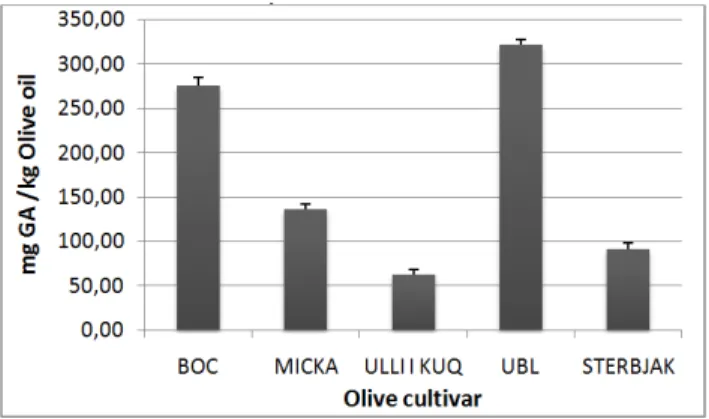
The Total Phenolic Content for the studied olive cultivars varied from 63.02 ± 5.63 GA mg/kg olive oil (Ulli i kuq) to 322.05 ± 3.97 GA mg/kg olive oil Ulli i bardhe Lezha such variation reflect differentness among studied olive varieties.
KEYWORDS: Albanian Native Olive Cultivars; Sterbjak; Ulli i Bardhe Lezha, Ulli i Kuq, Fatty acid Profiles INTRODUCTION
The origin of olive trees in Albania is not different from the road of the distribution of this tree in Mediterra-nean region. Archaeological evidences on the agriculture activities such as wheat cobs, truss grapes, olive lop are stamped in stones and coins of the Illyrian tribes. Olive tree is planted mainly in the Western Lowland, by penetrating the mainland through the river valleys (Kafazi, Muço, 1984; Thomaj, Panajoti, 2003). The ana-lyzed olive cultivars belong to the regions of Tirana and Lezha, in the Central and Northern part of Country. The actual annual producing capacity is 56 000 tons of olive fruits and 7000 tons of Olive oil (FAOSTAT, 2011). Recent genetic studies concluded that Albania owns 22 native olive cultivars (Bacu-Grazhdani et al, 2008). They are grouped according to their region of cultivation and classified as primary and secondary cultivars based on cultivar distribution (Thomaj, Panajoti, 2003).
Olive oil is a vegetable oil, extracted by the olive fruits, that can be consumed without prior refining treat-ment (Angerosa et al, 2006; Aparicio, Luna, 2002). Triglycerides are its major components and represent more than 98 % of the total weight. The remaining part are non-saponifiable chemical compounds such as sterols, polyphenols, alcohols, waxes, hydrocarbons, etc (Servilli, Montedoro, 2003; Mannina et al, 2003). Its composition depends on numerous factors such as the interaction between the cultivar and the envi-ronment, cultivation techniques, fruit ripeness and the oil extraction system (Aparicio, Luna, 2002). The characterisation of fatty acid profiles of olive oils from different olive cultivars is usually proposed as a meth-odology to differentiate these products according to their cultivar and geographical origin (Aparicio, Luna, 2002; Mannina et al, 2003).
In this study, are analysed the fatty acid composition and total polyphenol content of five olive cultivars:
Boçi, Ulli i bardhe Lezha (UbL), Sterbjak, Ulli i Kuq and Micka which belong to the Tirana and Lezha regions.
These cultivars are mainly used in the oil production, although Boçi is used also in parallel as table olives. The
UbL is the most planted by 2 % of the total of 6 million olive trees.
The scope of the study presented herein is linked with chemical evaluation of the Monovarietal Virgin Olive Oils. Assessment of quality parameters and nutritional value of olive oils from studied cultivars is presented in this paper. Nowadays, an attempt to modify the national fund of olive tree is an ongoing process. Such pioneering study will allow for the identification of native cultivars that produce good quality olive oil and that are very well adapted to the pedo-climatic conditions in Albania.
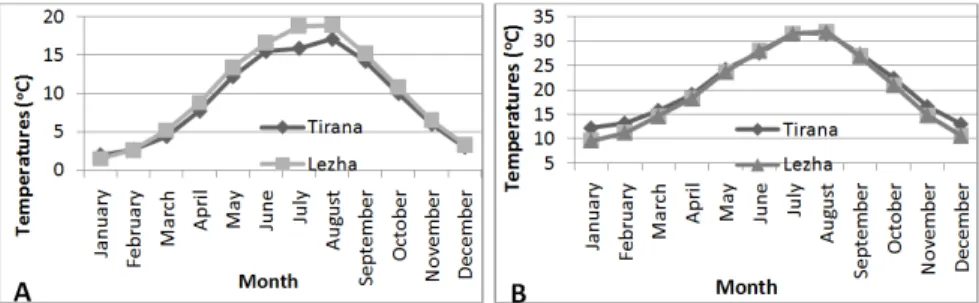
Figure 1: Monthly minimum (A) and maximum (B) average temperatures of Tirana and Lezha regions
MATERIALS AND METHODS
Sample collection and oil extraction
Native olive varieties, namely: Boçi, Ulli i Bardhe Lezha, Sterbjak, Ulli i Kuq and Micka were harvested in their main area of Tirana and Lezha (Table 1). The climatic characteristics of the production areas, in terms of temperature, are reported in Figure 1.
Oil extraction was performed with a SPREMOLIVA Press (an Italian TEM technology, Italy). The extraction condition was cold, mechanical pressing. SPREMOLIVA apply discontinuous process with 20-25 kg/cycle. After extraction the oil samples were stored in the dark at 4 oC until analysis.
Table 1: Olive varieties, harvesting and extraction day
Chemicals
The chemical reagents were analytical grade, from Sigma-Aldrich Chemie (Steinheim, Germany). Internal standard C 15:0 was purchased from Sigma-Aldrich. Gallic acid and Folin-Ciocalteau reagent were supplied by Fluka Chemie GmbH (Buchs, Switzerland).
Determination of fatty acid profiles
Fatty acid methyl esters (FAME) were prepared through direct acidic transesterification, as originally pro-posed by Lepage and Roy (1984) and later modified by Carvalho and Malcata (2005), using Pentadecanoic acid (C 15:0) as internal standard. The assay of FAME was carried out with a HP-6890 Gas chromatograph,
equipped with a Flame Ionization Detector (GC-FID). Separation was achieved in a SP-2380 capillary column (60 m × 0.25 mm × 0.20 □m) from Supelco. Hydrogen was used as carrier gas at a flow rate of 1.0 mL/min. The temperatures in the injector and detector were 240 oC and 260 oC, respectively. The injection was performed
in split mode (1:50). Oven temperature was set to 150 oC increased to 200 oC at a rate of 1 oC/min and held at
200 oC for 20 min. Calculations were performed according to AOCS Official Method Ce 1b-89 (AOCS, 1994).
Determination of Total Polyphenol Content Fractionation of olive oils
The method used to perform the fractionation of oils was proposed by Kalantzakis et al (2006). Briefly, samples were dissolved in n-hexane (Sigma, Germany) and extracted with a methanol/water mixture (60:40, vol/vol). After dissolving 2.5 g of oil with 5 mL n-hexane, 5 mL of methanol/water 60:40 were added, and the mixture was shaken vigorously and centrifuged at 3500 rpm for 10 min. The polar fraction was used, as it was, for further analysis.
Colorimetric determination of total polyphenol content
The Colorimetric method was used to determine the total polyphenol content (TPC) of samples, according to method proposed by Kalantzakis et al. (2006). An UV-VIS Mini-1240 Spectrophotometer (Shimadzu) was used at 725 nm. Results were expressed as Gallic acid equivalent (mg/kg olive oil), calculated from the following calibration curve, determined by linear regression.
Statistical analysis
The complete data were evaluated by randomized block design, with three replicates from fatty acid analysis and duplicates for TPC values. Results were displayed as mean values and standard error (n=3). Significance of the differences among the values was determined by analysis of variance using One-way ANOVA test. The level of significance was determined at P < 0.05. The employed statistical program was SPSS 17.0 Statistics 2008 (SPSS Inc., Chicago, IL, USA).
RESULTS AND DISCUSSION
Fatty acid profiles
Olive cultivars studied are described in Table 2. One-way ANOVA analysis showed that fatty acid profiles of the seven olive cultivars were statistically significantly different. Results revealed that, in what concerns Pal-mitic acid (PA), the cultivars can be grouped in two groups: (i) those with lower PA content, such as Sterbjak (10.76 ± 0.05 %) and Micka (10.79 ± 0.01 %) cultivars, and those with higher PA content, such as UbL (12.85 ± 0.01 %), Ulli i kuq (12.95 ± 0.03 %), and Boçi (13.05 ± 0.02 %).
The oleic acid (OA) content was: 67.65 ± 0.01 % (Boçi), 75.13 ± 0.31 % (Sterbjak), 70.84 ± 0.07 % (UbL); 66.26 ± 0.14 % (Ulli i kuq) and Micka 73.471 ± 0.14 %. Cluster analysis of the studied cultivars regarding the FA profiles indicate that olive cultivars are grouped in two groups; those with low content of OA such as: Boçi and Ulli i Kuq; and with high content of OA: UbL, Sterbjak and Micka.
Linoleic acid (LA) content showed high variation among the studied cultivars; olive cultivars such as Ster-bjak (7.23 ± 0.04 %), Micka (9.10±0.02 %) and UbL (8.69 ± 0.00 %), presented low content of LA while the others Ulli i kuq (13.29 ± 0.02 %) and Boçi (12.47 ± 0.01 %), presented high contents – almost two-fold the amount in some cases. The □-Linolenic acid (ALA) is below 1 %, a condition for the quality of the Extra Virgin Olive Oils (EEC 2568/91). The ALA content varied according to the following ascending order: 0.45 ± 0.01 % (Ulli i kuq), 0.64±0.00 % (Boçi), 0.86 ± 0.00 % (UbL), 0.94 ± 0.01 % (Sterbjak) and 0.54±0.00 % (Micka).
A high content of ALA contributes to the n-6/n-3 ratio, a very important value for the nutritional evaluation of lipids of different origin. Regarding such ratio, the Sterbjak cultivar show a n-6/n-3 ratio of 7.68, followed
by 10.12 for UbL, while the remaining cultivars show higher values, 16.98 (Micka) and 19.5 for Boçi. Table 2: Fatty acid profile (in % of total FA), Iodine Value, n-6/n-3 and 18:1/18:2 ratios of the olive cultivars
End note 1: SFA= Saturated Fatty Acids; PUFA = Polyunsaturated Fatty Acids; MUFA= Monounsaturated
Fatty Acids; ‡-Statistically significant among the different olive cultivars (p<0.005); and †-Statistically sig-nificant (p<0.05); NS-Statistically Non Sigsig-nificant among olive cultivars.
Comparison of the FA profiles of the olive oils from Albanian native cultivars with those in neighbouring countries: Italy, Greece (Aparicio, Luna 2002; Pinelli et al. 2003; Paz Aguilera et al. 2005) and Northern Afri-ca (Haddada et al. 2008) gives indiAfri-cation that they are comparable with Italian and Greek olive cultivars (Paz Aguilera, et al. 2005). For example, the level of palmitic acid in the studied native cultivars is comparable with Italian cultivars Leccino (14.3 %) and Moraiolo (10.5 %); Spanish cultivars Arbequina (14.3 %); Lechin (10.5 %) and Redondilla (12.5 %), and Greek cultivar Koreiniki (13.3 %). The level of oleic acid in Albanian cultivars is comparable with Frantoio (78.2 %), Arbequina (75.3 %) and Koreiniki (71.9 %) (Aparicio, Luna, 2002). Related to the linoleic acid trends is not as even since the Albanian olive cultivars present content dif-ferences. While the Boçi cultivar presents high content of linoleic acid comparable to the Spanish cultivars Redondilla and Lechin (Aparicio, Luna, 2002).
Oxidation stability
Analysis of the ratio 18:1/18:2 is an indication that refers to the oil oxidation stability. The lowest value proposed is 18:1/18:2 ≥ 7 (Kiritsakis et al. 1998). The results show that the Monovarietal olive oils from 8.08 (Micka) and 10.39 (Sterbjak) have acceptable oxidation stability, whereas the 4.99 (Ulli i kuq); and 5.38 (Boçi) cultivars have ratios under the minimum threshold meaning a minimal oxidation stability. The ratio between monounsaturated and saturated fatty acids of the studied cultivars had an average value of 4.86, whereas the ratio between monounsaturated and polyunsaturated fatty acids presented an average value of 7.09 (Table 2), which are relatively low; however, the high phenol content could indicate that oil quality was maintained without lipid deterioration.
The estimation of oil stability for the analyzed olive cultivars was analyzed based on the proposed equation for Iodine Value (Kiritsakis et al. 1998). The Iodine Values recorded for the seven cultivars are in the referred range of 80-90 for olive oils. The Iodine Value belongs vary from Ulli bardhe Lezha (82.76), to the max value Boçi (85.81) cultivars.
Phenolic compounds
Quantitative determination of phenolic compounds in olive oil was performed according to the colorimetric method (Kalantzakis et al. 2006). The amount of phenolic compounds in olive oil varies from 50 to 1000 mg/ kg and depends on several factors such as: climate, and extraction technology, degree of maturation (Servilli, Montedoro, 2003) and cultivar (Montedoro et al. 1992).
The results for the five olive cultivars (Figure 2) reveal that the highest value belongs to the UbL cultivar 322.05 ± 3.97 mg/kg olive oil, and the lowest value belongs to Ulli i kuq by 63.02 ± 3.98 mg/kg olive oil. The results show that the polyphenol content of the studied olive oils had significant differences (p<0.05) among the cultivars. According to the classification for the TPC level of the olive oils proposed by Montedoro et al (1992) the studied cultivars can be classified as: “low” (50-200 mg/kg) Ulli i kuq, Sterbjak and Micka culti-vars; “medium” (200-500 mg/kg) UbL and Boçi cultivars. The results obtained for the studied cultivars can be related mainly with the cultivar differences.
Figure 2: TPC values of the studied olive cultivars (as Gallic acid Equivalent mg/kg olive oil)
The actual stage of agriculture in Albania does not have premise for irrigation of the olive plantations. Fur-thermore, concerning the maximum and minimum temperature values in the different regions, respectively, give evidence that differences are not significant. Hence, differences reported in TPC content are not due to climatic conditions, but they might come from the cultivar caracteristics. The TPC values of UbL and Boçi are comparable with Koreiniki (Greece), Picual (Spain) and Frantoio (Italy) olive cultivars (Paz Aguilera et al. 2005).
CONCLUSIONS
The results presented show significant differences in the chemical composition of the studied cultivars. Those variations, observed in fatty acid composition and phenolic compounds, are probably due to both ge-netic factors and environmental conditions. By comparison with results from literature, it can be concluded that the levels of fatty acids in the oils of the studied cultivars are similar to those found in the group of olive cultivars typical from Northern Mediterranean regions. The nutritional profile of Sterbjak cultivar is highly interesting, as well as the UbL olive cultivar, due to its n-6/n-3 ratio and total phenolic content.
ACKNOWLEDGEMENTS
The first author acknowledges CBQF - Escola Superior de Biotecnologia – Universidade Católica Portuguesa for having hosted the experimental work.
REFERENCES
12. Angerosa, F., Campestre, Ch., Giansante, L. 2006. Analysis and Authentication. In: Olive Oil Chemistry and Technology, D. Boskou: (Ed.) 2nd edition, AOCS Press, Champaign, USA. pp.
113-172.
13. AOCS Official method Ce 1b-89, 1994. Official Methods and Recommended Practices of the American Oil Chemists’ Society, 4th edition; AOCS Press: Champaign, IL, USA.
14. Aparicio, R., Luna, G. 2002. Characterization of Monovarietal virgin olive oils, European Journal of Lipid Science and Technology, 104, 614–627.
15. Bacu-Grazhdani, A., Thomaj, F., Ibro, V. 2008. Molecular characterization of native olive cultivars (O. europea L.) of Central Albania, based on AFLP and RAPD methods, Kërkime, 16; Akademy of Sciences and Arts of Kosova; KDU 633.852.73 (496.51) (In Albanian).
16. Carvalho, A. P., Malcata, F. X. 2005. Preparation of fatty acid methyl esters for gas-chromatographic analysis of marine lipids: Insight Studies, Journal of Agricultural and Food Chemistry. 53(13), 5049-5059.
17. EEC No 2568/91, 1991. On the characteristics of olive oil and olive-residue oil and on the relevant methods of analysis, Official Journal of European Communities, p. 248.
18. FAOSTAT, 2011. Factsheet in agricultural products. Accessed 2 June 2011on the web address www.fao.org.
19. Haddada, F. M., Krichène, Dh., Manai, H., Oueslati, I., Daoud, D., Zarrouk, M. 2008. Analytical evaluation of six Monovarietal virgin olive oils from Northern Tunisia, European Journal of Lipid Science and Technology. 110(10), 905–913.
20. Kafazi, N., Muço, Dh. 1984. Olive Culture, ILB Tirana. Albania p. 230 (In Albanian).
21. Kalantzakis, G., Blekas, G., Pegklidou, K., Boskou, D. 2006. Stability and radical scavenging activity of heated olive oil and other vegetable oils, European Journal of Lipid Science and Technology. 108(4), 329-335.
22. Kiritsakis, A. K., Nauos, G. G., Polymenoupoulos, Z., Thomai, T., Sfakiotakis, E. Y. 1998. Effect of fruit storage conditions on olive oil quality, Journal of American Oil Chemists Society, 75, 721-724.
23. Lepage, G., Roy, C. C. 1984. Improved recovery of fatty acids through direct transesterification without prior extraction or purification, Journal of Lipid Research, 25, 1391-1396.
24. Mannina, L., Dugo, G., Salvo, F., Cicero, L., Ansanelli, G., Calcagni, C. 2003. Study of the cultivar –composition relationship in Sicilian Olive oils by GC, NMR, and statistical methods, Journal of Agricultural and Food Chemistry. 51(1), 120-127.
25. Montedoro, G., Servilli, M., Miniati, M. E. 1992. Simple and hydrolysable Phenolic Compounds in Virgin Olive oil. 1. Their extraction, separation and quantitative and semi quantitative evaluation by HPLC, Journal of Agricultural and Food Chemistry. 40, 1571-1576.
26. Pinelli, P., Galardi, C., Mulinacci, N., Vincieria, F. F., Cimato, A., Romani, A. 2003. Minor polar compound and fatty acid analyses in monocultivar virgin olive oils from Tuscany, Food Chemistry. 80(3), 331-336.
27. Paz Aguilera, M., Beltran, G., Ortega, D., Fernandez, A., Jimenez, A., Uceda, M. 2005. Characterization of virgin olive oil of Italian olive cultivars: ‘Frantoio’ and ‘Leccino’, grown in Andalusia, Food Chemistry. 89, 387–391.
28. Servilli, M., Montedoro, G. 2003. Contribution of phenolic compounds to virgin olive oil quality,
European Journal of Lipid Science and Technology. 104(9-10), 602–613.