Luís André Simões de Pinho Oliveira
Cardiovascular risk factors in a
homeless population
Luís André Simões de Pinho Oliveira
Supervisor
Nuno Miguel de Sousa Lunet MPH, PhD
Institute of Public Health University of Porto (ISPUP) Porto, Portugal
Department of Clinical Epidemiology, Predictive Medicine and Public Health, University of Porto Medical School Porto, Portugal
Porto, October 2011
Cardiovascular risk factors in a
homeless population
iii
This dissertation is based in one manuscript in which I actively collaborated in the conception of the study, design and acquisition of data from a sample of homeless people from Porto, as well as on the analysis of data and interpretation of results.
- Luís Pinho Oliveira, Maria de Lurdes Pereira, Ana Azevedo, Nuno Lunet. The burden of cardiovascular risk factors among the homeless: differences according to setting of sampling and comparison with the general population.
iv
ACKNOWLEDGEMENTS
The work presented in this thesis was carried out in the period of October 2008 to October 2011, at the Institute of Public Health University of Porto (ISPUP), Porto, Portugal.
My first acknowledgment goes to my supervisor, Professor Nuno Lunet, a brilliant epidemiologist, whose ideas, knowledge and encouragement were essential for the development of this work.
I also express my gratitude to Ana Azevedo, who contributed to a critical revision of this manuscript.
To Lurdes Pereira, for the advice, words and effort which had helped to make this work possible.
To all friends that accepted this challenge, Ana, Elisete, Leonor, Marco and Nuno.
To those colleagues at ESE-UM, who understand the importance of this work, in particular to Prof. Isabel Lage.
To Associação dos Albergues Nocturnos do Porto, Serviço de Assistência Organizações de Maria, Centro Social e Paroquial Nossa Senhora da Vitória and to Médicos do Mundo for their willingness to collaborate in the present investigation.
And, finally, my last words go...
... to Vicente, Joana, Maria, Sofia e Ana... por não me deixarem envelhecer...
... to my mother, my father, my brothers Vítor and Tiago...and Rosinha... pelo amor, pelo
exemplo, pela presença... por me mostrarem que “Para tudo há um momento e um tempo para cada coisa que se deseja debaixo do céu...”
v CONTENTS Acknowledgements iv List of figures vi List of tables vi Abbreviations vii Resumo 8 Abstract 11 1. Background ... 13 1.1. Definition of homelessness ... 14
1.2. Sampling homeless populations ... 15
1.3. Homelessness in the United States of America and Europe ... 18
1.4. Sociodemographic characteristics of the homeless populations ... 19
1.5. Mortality and morbidity in homeless populations ... 19
1.6. Cardiovascular disease in homeless populations ... 20
1.7. Objectives ... 23
2. The burden of cardiovascular risk factors among the homeless: differences according to setting of sampling and comparison with the general population (manuscript) ... 24
vi
LIST OF FIGURES
Figure 1. Selection of homeless and general population participants ... 28
LIST OF TABLES Table 1. Definitions of roofless, houseless, people with insecure housing and people with inadequate housing, according to the European Federation of National Organizations Working with the Homeless (FEANTSA) ... 16
Table 2. Sampling strategies used for the study of “hard-to-reach” subjects ... 17
Table 3. Prevalence of hypertension in homeless populations ... 22
Table 4. Sample characteristics of houseless according to the recruitment setting ... 33
Table 5. Cardiovascular risk factors according to the recruitment setting ... 34
Table 6. Cardiovascular risk factors in Portuguese homeless subjects and general population living in Porto ... 36
vii
ABBREVIATIONS
AANP Associação dos Albergues Nocturnos do Porto
BMI Body Mass Index
BP Blood Pressure
CI Confidence Interval
CSPNSV Centro Social e Paroquial Nossa Senhora da Vitória
DBP Diastolic Blood Pressure
ETHOS European Typology of Homelessness and housing exclusion
FEANTSA European Federation of Organizations Working with the People who are Homeless
GP General Population
HH Homeless Hostels
ISPUP Institute of Public Health of the University of Porto
MP Meals Programs
NGO Non Governmental Organization
NHS National Health Service
PR Prevalence Ratios
SAOM Serviço de Assistência Organizações de Maria
SBP Systolic Blood Pressure
SD Standard Deviation
USA United States of America
8
RESUMO
A associação entre doenças cardiovasculares e fatores socioeconómicos tem sido amplamente estudada. No entanto, o risco cardiovascular em populações em situações de carência extrema, como as populações sem-abrigo, tem sido pouco estudado.
Ser “sem-abrigo” é uma forma de exclusão social, fortemente associada à pobreza, que afeta milhões de pessoas em todo o mundo. É uma realidade essencialmente urbana, que resulta de uma interação complexa entre fatores individuais e sociais, como são o desemprego, a rutura de relações familiares, a doença mental ou o consumo excessivo/dependência de álcool ou drogas. Adicionalmente, este fenómeno tem sido descrito como um importante determinante de saúde e a compreensão da relação entre ser “sem-abrigo” e o risco cardiovascular, em particular, pode contribuir para a melhoria do trabalho desenvolvido pelas diversas instituições que prestam apoio social junto destas populações e, em última análise, poderá influenciar as políticas de saúde que visam a redução das desigualdades sociais e a inclusão das pessoas sem-abrigo.
Esta dissertação teve como objetivo avaliar o efeito de diferentes locais de recrutamento de indivíduos sem-abrigo [albergues de sem-abrigo (ASA) e refeitórios sociais (RS)] nas estimativas de distribuição de fatores de risco cardiovascular, e quantificar a associação entre ser “sem-abrigo” e estes determinantes da saúde, comparando-os com a população geral (PG).
Foram convidados a participar no estudo, todos os indivíduos classificados como “sem-casa” pela Federação Europeia das Associações Nacionais que Trabalham com os Sem-Abrigo (FEANTSA), que estavam presentes em qualquer um dos dois ASA ou dos dois RS nos dias selecionados para as avaliações. As proporções de resposta foram de 78,4% (n=91) no HH e 76,4% (n=55) no MP. Apenas um participante foi identificado nos dois locais, mas recusou o primeiro convite tendo sido incluído em apenas uma das amostras. Foi selecionada uma sub-amostra de participantes na coorte EPIPorto, residentes do Porto, seguidos entre 2005 e 2008, emparelhada (1:1) com indivíduos sem-abrigo portugueses. Não foi possível emparelhar 12 indivíduos, a sua maioria jovens e com níveis de escolaridade muito baixos. As informações sobre características sociodemográficas e de comportamento (incluindo o consumo de tabaco e de álcool), história pessoal de doença (incluindo diagnóstico prévio de diabetes, hipertensão e dislipidemia, e consumo de
9
medicamentos) e acesso/utilização de cuidados de saúde, foram recolhidas nos locais de recrutamento por uma equipa treinada, utilizando um questionário estruturado. Além disso, todos os indivíduos foram submetidos a um exame físico para avaliação da pressão arterial, peso, altura e perímetro da cintura.
A comparação da distribuição dos fatores de risco cardiovascular entre os indivíduos selecionados nos ASA e RS, e entre este e a população geral, foi efetuada através do cálculo de razões de proporções (RP) ajustadas, e respetivos intervalos de confiança de 95% (IC95%), utilizando regressão de Poisson, e através do cálculo coeficientes β ajustados, com IC95%, utilizando regressão linear, para variáveis categóricas e contínuas respetivamente.
A idade média de idade dos participantes sem-abrigo era de 45 anos (mínimo-máximo: 18-77), a maioria eram homens (86,3%), desempregados (78,8%), e menos de 10% tinham idade acima dos 60 anos. A duração média de tempo de “sem-abrigo” foi de 24 meses (mínimo-máximo: 1-480). Não se observaram diferenças estatisticamente significativas entre as características sociodemográficas das duas sub-amostras de pessoas sem-abrigo. Relativamente às características de comportamento e relacionadas com o “estado de sem-abrigo”, os participantes selecionados nos RS apresentaram uma prevalência duas vezes maior de consumo de drogas, e de indivíduos com história prévia de prisão (18,7% vs. 32,7%; P=0,054), e (16,5% vs. 29,1%; P=0,071), respetivamente. Comparando os participantes selecionados em ASA com os selecionados em RS em relação aos fatores de risco cardiovascular, não houve diferenças significativas entre os dois grupos, exceto para as médias de pressão arterial sistólica 10,37; IC95%: -17,02 a -3,72) e diastólica (β=-6,82; IC95%: -10,85 a -2,78) que foram menores entre os RS. Relativamente à comparação com a população geral, o consumo de tabaco foi significativamente mais frequente entre os sem-abrigo (RP=1,47; IC95%: 1,04 a 2,08), em contraste com o observado para o consumo de álcool com uma proporção de consumidores semelhante nos dois grupos. Os sem-abrigo apresentaram menores valores médios de índice de massa corporal (β=-1,64; IC95%: -2,82 a -0,46) e de perímetro da cintura (β=-4,18; IC95%: -7,16 a -1,21), assim como de prevalências de excesso de peso (RP=0,63; IC95%: 0,40 a 0,98) e obesidade (RP=0,47; IC95%: 0,24 a 0,92). Os sem-abrigo apresentaram também uma probabilidade 5 vezes menor de referir um diagnóstico prévio de dislipidemia (RP=0,21; IC95%: 0,10 a 0,43). Não se observaram diferenças estatisticamente significativas relativamente à distribuição de outros fatores de risco cardiovascular.
10
Conclusões:
- Entre a população sem-abrigo, observam-se diferenças pequenas na distribuição dos fatores de risco cardiovascular de acordo com o local de recrutamento dos participantes, com exceção da menor pressão arterial observada entre os indivíduos selecionados em RS, em comparação com os recrutados em ASA.
- A obesidade é menos frequente entre os sem-abrigo, contrastando com o consumo de tabaco que é mais prevalente nestes indivíduos do que na população geral, independentemente das diferenças sociodemográficas entre estas populações.
11
ABSTRACT
A growing body of research has been focusing on the association between cardiovascular disease and socioeconomic factors. However, cardiovascular risk has seldom been addressed in populations with an extremely underprivileged socioeconomic condition, such as the homeless.
Homelessness is an example of social discrimination, strongly associated with poverty, which affects millions of persons worldwide. This is essentially an urban phenomenon that results from a complex interplay between individual and societal factors, such as unemployment, family breakdown, mental illness or substance abuse. It has been described as an important health determinant, and the understanding of the relation between homelessness and cardiovascular risk may contribute to improve the work developed by the institutions that provide social support to these populations, and ultimately influence public health policies towards the reduction of inequalities and a gradual social inclusion of the homeless.
This dissertation aimed to assess the effect of different recruitment settings [homeless hostels (HH) and institutions that manage meal programs (MP)] in the estimates of the distribution of cardiovascular risk factors among the homeless, and to quantify the association between homelessness and these health determinants, by comparing homeless subjects with the general population (GP).
We invited all the homeless classified as “houseless” according to the European Federation of Organizations Working with the People who are Homeless (FEANTSA) that were attending any of two HH and two MP in the days selected for the evaluations. The response proportions were 78.4% (n=91) in HH and 76.4% (n=55) in MP. Only one participant was present in both settings, but refused the first invitation and was considered in only one sample. We selected a subsample of non-homeless Porto dwellers from the participants in the EPIPorto cohort follow-up conducted between 2005 and 2008, matched (1:1) with the Portuguese homeless from Porto. A match could not be found for 12 subjects, most of them young and with very low education levels. All subjects were evaluated in the places where they were recruited, by trained staff, using a structured questionnaire to characterize the sociodemographic and behavioral characteristics (including tobacco and alcohol consumption), medical history (including previous diagnosis of hypertension,
12
diabetes and dyslipidemia, and medication use) and healthcare access/utilization. A physical examination was also performed to evaluate blood pressure, weight and height and waist circumference.
We compared the distribution of cardiovascular risk factors between the homeless selected in HH and MP, and between the homeless and the general population, through adjusted prevalence ratios (PR) and 95% confidence intervals (95%CI), computed using Poisson regression, or adjusted β coefficients with 95%CI, computed using linear regression, for categorical and continuous variables, respectively.
The overall median age of the homeless participants was 45 years (range: 18 to 77 years), most were men (86.3%), unemployed (78.8%), and less than 10% were aged above 60 years. The median duration of homelessness was 24 months (range: 1 to 480 months).
There were no statistically significant differences between the sociodemographic characteristics of the two sub-samples. Regarding homelessness status and behaviour characteristics, MP reported a twofold higher prevalence of previous consumption of drugs (18.7% vs. 32.7%, P=0.054) and imprisonment (16.5% vs. 29.1%, P=0.071). When comparing HH with MP, there were no significant differences regarding most cardiovascular risk factors, except for the lower mean systolic (β=-10.37, 95%CI: -17.02 to -3.72) and diastolic (β=-6.82, 95%CI: -10.85 to -2.78) blood pressures among the MP.
Regarding the comparison with the general population, smoking was significantly more frequent among the homeless (PR=1.47, 95%CI: 1.04 to 2.08) in contrast with alcohol drinking, with a similar prevalence of current drinkers in the two groups. The homeless presented lower mean body mass index (β=-1.64, 95%CI: -2.82 to -0.46) and waist circumference (β=-4.18, 95%CI: -7.16 to -1.21), and were less often overweight (PR=0.63, 95%CI: 0.40 to 0.98) and obese (PR=0.47, 95%CI: 0.24 to 0.92). The homeless were nearly 5 times less likely to report dyslipidemia (PR=0.21, 95%CI: 0.10 to 0.43). No statistically significant differences were observed regarding the distribution of other cardiovascular risk factors.
Conclusions:
- Among the homeless there were small differences in the distribution of cardiovascular risk factors according to the place of recruitment, except for lower blood pressures observed in those selected in MP in comparison with the subsample recruited in HH.
- Obesity was less frequent and smoking more likely to occur in the homeless than in the general population, independently of the differences in socio-demographic factors observed between these populations.
13
1.
BACKGROUND
14
BACKGROUND
Homelessness is perhaps one of the most visible and extreme examples of social discrimination in modern societies, which illustrates not only the absence of a safe and adequate accommodation, but essentially a social condition whose subjects present peculiar characteristics and behaviours (1-7).
This social phenomenon, strongly associated with poverty, is caused by a complex interplay between a person's individual circumstances and adverse “structural” factors out of their direct control (1, 7-10). Homelessness is a result of a number of unresolved problems building up over time, that progressively interfere with the satisfaction of essential needs as housing, food, child-care, healthcare or education, with profound social, physical and mental implications (3, 7, 11-22).
Health and homelessness are closely related, with poor health status contributing to
being homeless, and the latter also leading to a poor health status (9, 23). Homelessness
has been associated with an increased risk of cardiovascular disease, probably explained by the fact that several traditional cardiovascular risk factors, such as alcohol, tobacco, or unhealthy eating habits are also related to this social condition (6, 8, 24-29).
The understanding of the relation between homelessness and cardiovascular risk may contribute to improve the work developed by the institutions that provide social support to these populations, and ultimately influence public health policies towards the reduction of inequalities and a gradual social inclusion of the homeless.
1.1. Definition of homelessness
There is no precise and appropriate globally accepted definition of homelessness (1, 4, 30-33). It is a social phenomenon, related to economic, political, social and cultural contexts, and therefore may be perceived and defined differently across communities and settings (4, 7, 30, 34).
Classically, this term is used in relation to people that live only on the street (35). However, homelessness can be defined more broadly, including not only the “roofless”, but also people without a regular, safe, and adequate housing (1).
The United Nations classify as homeless people those that live on the street or in shelters, or those who live without the conditions considered indispensable for health, social
15
and human development (33). A similar definition is used by the United States Department of Housing and Urban Development, which considers homeless the subjects unable to acquire and maintain regular, safe, and adequate housing, and those who do not have a permanent, regular, and adequate night-time residence (36).
Since 2004 the European Union countries use a classification created by the European Federation of National Organizations Working with the Homeless (FEANTSA) to classify and screen situations of homelessness and housing exclusion: the European Typology Homelessness and Housing Exclusion (ETHOS). Under this framework, people who do not have a roof or a house to live, or have an unsafe or inappropriate house are classified as homeless (1). A house is defined as a space on which a person and his/her family can exercise exclusive possession (physical domain), that meets conditions that allow privacy and establishment of social relations (social domain), and on which person have the legal title of occupation (legal domain) (1). Based on these domains, the FEANTSA proposed four conceptual categories of homelessness and housing exclusion, described in detail in Table 1: roofless; houseless; people with insecure housing; people with inadequate housing (1).
The lack of a consensus on a standard operational definition of homelessness, with mutually exclusive and unambiguous categories, allows different approaches to data collection and may preclude direct comparisons of the data referring to homeless people obtained in different settings (4, 7, 34). Moreover, homelessness is not a static phenomenon, since people can be homeless for a short or long period and can have recurrent episodes of homelessness in their lives, which contributes further to the lack of standardization.
1.2. Sampling homeless populations
The homeless are considered “rare”, “hidden” or “hard-to-reach” populations, since generally it is difficult to identify, sample and interview/evaluate their members (7, 31, 37-40). They belong to numerically small populations, that are unevenly distributed, live in anonymity and frequently also have some illegal or socially sanctioned behaviors. As a consequence, the homeless tend to feel stigmatized and frightened and to restrain new social contacts outside their community, which makes them often reluctant to participate in epidemiological studies (39-43).
16
Table1. Definitions of roofless, houseless, people with insecure housing and people with inadequate housing, according to the European Federation of National Organizations Working with the Homeless (FEANTSA)
Category Description
Roofless ● People who live in public spaces, or stay in night shelters (homeless accommodation with direct access, where the period of stay tend to be only one night) and/or are forced to spend several hours a day in public space.
Houseless ● People who live in a place, but are excluded from the legal rights of occupancy and do not have conditions to enjoy normal social relations, including:
People who live in accommodations for the homeless:
- homeless hostels (accessed directly or by referral from agencies; period of stay lower than six months);
- temporary accommodations (planned access or by referral from agencies; period of stay lower than six months, intended for people awaiting re-housing);
- e.g. low budget hotels, bed and breakfast, pensions or similar housing paid for
by social services or non-governmental organization;
- transitional supported accommodations (planned access; longer period of stay; supported accommodations for rehabilitation and re-settlement);
- e.g. rooms or houses paid for by social services;
People who live in women’s shelters (shelter accommodations for women who suffered domestic violence);
People who live in accommodations for immigrants (repatriates’ accommodations, immigrant workers’ accommodations);
People who are about to be released from penal, medical or child-care institutions, for whom no accommodation has been found;
People who receive long-term supported accommodation due to homelessness; the intended period of stay is normally more than one year;
e.g. residential care accommodations for older homeless people; accommodations for formerly homeless people.
People with insecure housing
● People who live temporarily with family and friends or in houses or land illegally occupied;
● People with risk of expulsion, or persons living under threat of violence by a partner or family (incidents registered in the police).
People with inadequate housing
● People who live in temporary/non-conventional structures (e.g. caravans, cars, tents or shacks on land, or illegally occupied buildings), people in unfit housing (in accordance with national legislation), and people living in extreme overcrowding (e.g. according to national law).
Simple random sampling or cluster sampling, frequently used by studies that evaluate the general population are not suited to reach homeless populations (39, 40, 44). Strategies such as snowball sampling, respondent driven sampling, indigenous field worker sampling, targeted sampling, and venue based time-location sampling, have gained increased recognition on study of this “hard-to reach” group (Table 2).
17
Table 2. Sampling strategies used for the study of “hard-to-reach” subjects
Strategy Description
Snowball sampling (40, 42, 44-46)
An initial sample of the population is randomly selected.
The individuals recruited initially are evaluated and asked to identify other members of the same target population to be included in the sample. This process can be repeated as many times as necessary, until either the sample size has been reached, the sample has become “saturated” (no new individuals are identified), or the limits of the study’s resources (time or financial) are reached.
Although the initial group should be randomly selected, in practice, this is usually difficult to accomplish when dealing with “hard-to-reach” populations. Therefore, the initial group is frequently chosen through convenience sampling.
Since the first steps of this process affect the constitution of the final sample, it may not be representative of the target population. Moreover, this strategy tends to favor the selection of the more cooperative subjects.
Respondent driven sampling (42, 43, 47-51)
This strategy is inspired by the “small world theory”, which suggests that every person is indirectly associated with every other person through approximately six intermediaries. Therefore, everyone in a defined population may be potentially reached through several waves of recruitment.
The sampling occurs at a fixed location where all potential participants are approached. Interviewees are enlisted as temporary recruiters, and after receiving an explanation of study objectives they are asked to invite their peers to participate. This sample method uses a double incentive to participate (an initial incentive for participation in the study, and a second incentive for the recruitment of peers). This process continues until the target sample size is attained.
Since peer respondents must present themselves at the study site, recruitment is entirely voluntary. To minimize the influence of the initial interviewees on the final sample composition, the number of peers recruited by the initial individuals is limited.
Information about the relationship between recruiters and the selected participants is documented so that selection bias can be discussed.
Indigenous field worker sampling (48, 52)
Indigenous individuals of the populations under study are used as interviewers. After receiving training, these subjects identify, invite and evaluate their peers in community settings, following a standardized protocol for data collection. They received an incentive to participate and to recruit their peers. The use of multiple recruiting networks ensures a wide coverage of the population, which contributes to the representativeness of the sample.
Targeted sampling (53, 54)
An ethnographic assessment is performed initially, to identify different networks or subgroups within the population of interest. The subgroups identified are treated as sampling strata, and subsequently a systematic sampling is carried out.
The occurrence of sampling biases depends on the rigor of ethnographic assessment, since members of the population of interest could not attend the areas that have been identified. Exhaustive assessments are less likely to yield biased samples, but are more time-consuming and require more human and material resources.
Venue based
time-location sampling (54-57)
This method is based on the assumption that the members of “hard-to-reach” populations tend to get together in specific places. Researchers previously list the meeting places, which will be randomly sampled and used as sampling frames. Data are collected among all individuals present, or among a sample of individuals selected from a group present in a specific place in a precise period of time. This method is limited by the impossibility of identifying all the meeting places, as well by the fact that the stopping points can change over time, and not all individuals regularly visit the sites identified.
18
These sampling strategies provide different frameworks for obtaining representative samples, which may contribute to unbiased assessments of the homeless populations (39).
Homeless individuals are frequently poorly motivated and reluctant to participate in epidemiological studies. Several studies have focused on the effect of using incentives to increase the participation rates, as proposed by some sampling strategies. However, these issues have been seldom studied in homeless populations (58-60). It has been observed a direct association between monetary incentives and participation rates of minority, low-education and low-income individuals or households, with incentives leading to higher participations (61). However, low-income respondents that participates by the lure of an incentive may well differ from those who participate for other reasons, compromising the representativeness of those samples (58).
1.3. Homelessness in the United States of America and Europe
Homelessness is essentially an urban phenomenon that affects a wide range of people across countries with different levels of economic development (4, 7). It is a social condition closely related with poverty, and therefore the economic and social crisis that has affected many countries in recent years may contribute to an increasing number of individuals experiencing homelessness worldwide (7, 10, 32, 34, 62, 63). This, however, is difficult to ascertain as the available data is likely to underestimate the burden of homelessness and the heterogeneity of methodologies used does not allow the direct comparison between countries or regions, or in different moments (4, 30, 64).
An estimated 100 million people across the globe are homeless, having absolutely nowhere to live, and over one billion have inadequate housing (34). The United States Department of Housing and Urban Development estimated that in 2009 there were more than 600 thousand sheltered and unsheltered homeless in the United States of America (32). According to these data, approximately 20,000 more people were homeless in 2009 than in 2008, corresponding to a 3% increase (32). The European Federation of National Organizations Working with the Homeless estimated that in 2009, in 23 European countries, there were nearly 600 thousand homeless that lived in public spaces, hostels or temporary accommodations (64).
In Portugal, national data about homelessness prevalence are scarce (35). The Institute of Social Security, based on data made available by several organizations that provide social support, estimated that 2242 to 8718 of people have experience homelessness between 2004 and 2005; 48% of these cases were reported in district of Lisboa, and 16% in the district of Porto. In other districts, such as Braga, Viseu or Évora, the
19
proportions ranged between the 1% and 2 % (18). These results referred to people that lived on the streets, abandoned cars our houses, homeless hostels or accommodations payed by social services (18).
1.4. Sociodemographic characteristics of the homeless populations
Homelessness affects mostly men aged between 30 and 60 years, unmarried, without children or other family or social relationships, and with low education level (17, 18, 27, 65-67). Recent studies indicate a trend towards an increase in the number of sheltered families and homeless elderly adults (32, 68).
This phenomenon is usually caused by the interaction of individual and socioeconomic factors that increased the vulnerability or the risk of social exclusion. Poverty, family breakdown, sexual abuse, violence, mental illness, substance abuse, previous institutional history (e.g. prisons, reformatories or psychiatric hospitals) have been reported as individual factors associated to homelessness (4, 7, 8, 10, 18, 69, 70). The low salaries, employment insecurity, unemployment and lack of institutional support, contribute to difficulties in supporting essential needs such as food, clothing, health or housing (4, 7, 8, 17, 18). As a result, illegal or socially sanctioned activities, such as begging, prostitution or theft are often adopted as a source of income (7, 8, 10, 18). All these factors became also a barrier to the recovery of the work activity, family relationships, health status, and to the restoration of schedules, routines and social norms with obviously implications to social inclusion (4, 7, 10, 18).
1.5. Mortality and morbidity in homeless populations
Homelessness is an important health determinant. It has been associated with an increased risk of physical and mental diseases, which are also important causes of homelessness (3, 9, 19, 20, 22, 23, 71-73). In comparison with general population, homeless individuals are reported to have higher rates of mortality and premature death (6, 19, 21, 22, 41, 74-78).
Although these individuals suffer from the same spectrum of medical illness as the general population, the risk of several diseases are enhanced due to the living conditions and behaviours associated with homelessness (3).
Homeless individuals, particularly rough sleepers, present a high prevalence of skin lesions and infections, such as fungal infections, pediculosis or traumatic injuries. These
20
problems are associated with frequent fights or falls, lack of personal hygiene, clean clothes, inappropriate footwear and the exposure to low temperatures (19, 79, 80).
These populations are also more likely than other groups to engage in behaviours that increase the risk of HIV, Hepatitis B or C infection, including needle sharing, unprotected sex, multiple sexual partners, and prostitution (19, 80-82). As a result, the prevalence of HIV/AIDS in the homeless populations is 3 to 9 times higher than in the general population (71, 83, 84). This increased risk, together with delayed diagnoses and difficulties in adhering to antiretroviral therapeutic regimens, also contributes to a high prevalence of opportunistic infections related to HIV/AIDS (71).
Respiratory diseases are also very common among the homeless (80, 85-87). Higher frequencies of asthma, chronic bronchitis, emphysema and tuberculosis have been reported in these populations (80, 85). Tuberculosis is closely related to immune system depression, frequently caused by substance abuse, HIV infection, and poor nutrition (71, 80, 86, 87). Therefore, compared with the general population, these individuals have a higher risk of becoming infected and developing active disease (71, 86, 87).
Mental illnesses are both a cause and a consequence of homelessness, since can trigger, or be part of a series of events that can lead to homelessness (69). It is widely acknowledged that mental health problems are more frequent among the homeless than in the general population (69, 72, 88). Estimates of the prevalence of mental illness consistently show that approximately half of all homeless individuals have had mental illnesses at some time in their lives (73). Among these individuals the prevalences of alcohol and tobacco consumption, and episodes of depression and schizophrenia are much more frequent than in the general population. The co-existence of multiple mental problems is also frequent (69, 73, 88).
Although little is known about the cancer mortality in the homeless, some studies have reported an increased incidence of cancer risk factors in these populations (89, 90). Compared with the general population, homeless individuals have a higher risk of developing lung, liver, colon oral cavity and cervical cancers, which may be explained by the high prevalence of smoking, alcohol consumption, B and C hepatitis, and multiple sexual partners (71, 82, 90).
1.6. Cardiovascular disease in homeless populations
Cardiovascular disease is the leading cause of morbidity and mortality among the homeless (8, 74, 75, 77, 91). Several studies reported that homeless adults are more likely to have cardiovascular diseases at younger ages than the general population. This can is
21
explained by a high prevalence of undiagnosed and/or untreated hypertension, smoking, excessive alcohol intake, cocaine use, diabetes and hypercholesterolemia (6, 8, 11, 21, 24-29, 69, 72, 92-95).
Hypertension is a major risk factor for cardiovascular diseases, growing in prevalence and poorly controlled everywhere (96). The increased blood pressure is directly associated with the risk of myocardial infarction, heart failure, stroke, and kidney disease, and therefore it is the leading risk factor for mortality, and the third cause of disability-adjusted life-years worldwide (96). It was estimated that in 2000 approximately more than a quarter of the world’s adult population (nearly one billion) had hypertension, and that in 2025 this proportion would reach the 29% (96).
Among homeless populations, few studies have been published reporting the prevalence of hypertension. However, some authors considered that this risk is higher in homeless than in general population (8, 24, 27, 92, 97, 98). The available data comes from studies conducted predominantly in European countries, which sampled mostly sheltered men, with a mean age ranging from 34 to 45 years. The estimates of the prevalence of hypertension are heterogeneous, ranging from 14.0% to 51.0%, which is probably explained by the use of different sampling strategies, differences in the protocols adopted for blood pressure measurement, and definitions of hypertension, as depicted in Table 3.
The homeless may also have more difficulties in obtaining and maintaining stable sources of medical care (11-14), which may contribute to the lack of awareness of hypertension and difficulties in adhering to anti-hypertensive treatment regimens, and persistent failure in hypertension control (99, 100). Therefore, when homeless individuals seek health care institutions, they are more likely than the general population to have several medical problems related to hypertension (3, 14, 24, 101).
Table3. Prevalence of hypertension in homeless populations *
1st author
(Publication yr), Country
Yr of data collection Sampling method Sample participation Sample characteristics Age BP measurement Hypertension definition Prevalence of hypertension Mean SBP/DBP (mmHg)
Men Men and
women
Gelberg (1989), USA
1989 - Stratified convenience sample
- n=529 (73% men)
Proportion of participants: 70.8%
- Homeless adults from outdoor sites, shelters, hotels or motels, family or friends house, vehicles, abandoned buildings or public facility and correctional facility institutions - Mean age: 34 yrs
- Device: NA
2 measures (right arm) - average of the 2 measures - SBP ≥140mmHg and/or DBP ≥90 mmHg NA NA 28.0% NA Takano (1999), Japan 1992-1996 - Convenience sample - n=1938 (100% men) Proportion of participants: 100%
- Homeless adults from shelters - Age range: 20-79 yrs
- NA - NA 15.0% NA 15.0% NA Kleinman (1996), USA Gelberg (2000), USA † 1990-1991 - Stratified sample - n=363 (80.2% men) Proportion of participants: 93.3%
- Homeless adults from shelters, places not designed for shelter and from temporary accommodations - Median age: 37 yrs - Age range: 18-70 yrs
- Device: digital blood pressure monitor 2 measures - SBP ≥140mmHg and/or DBP ≥90 mmHg (second measure) NA NA 14.0% SBP: 120.9 DBP: 72.6 Folsom (2002), USA
1999-2000 - Convenience sample / random
sample (control group) - n=94 (53% men)
Proportion of participants: 100%
- Homeless adults (older than 45 years), from shelters, with schizophrenia or depression
- Mean age: 51.4 yrs
- NA - NA NA NA 24.5% NA Lee (2005), Canada 2002-2003 - Random sample - n=202 (89% men) Proportion of participants: 72.4 %
- Homeless adults (older than 20 yrs) from shelters
- Mean age: 42.3 yrs - Age range: 20-74 yrs
- Device: digital blood pressure monitor 4 measures (twice in each arm) - average of the 4 measures
- SBP ≥140mmHg and/or DBP ≥90 mmHg and/or antihypertensive drug therapy
NA NA 35.0% NA Kim (2008), USA
2002-2004 - Venue based time-location sample
- n=287 (100% men) Proportion of participants: NA
- Homeless adults from shelters - Mean age: 42.4 yrs
- Device: NA
3 measures - average of the 3 measures - SBP ≥140mmHg and/or DBP ≥90 mmHg 24.4% SBP: 124.0 DBP: 76.9 24.4% SBP: 124.0 DBP: 76.9 Kaldmae (2011), Estonia NA - Convenience sample - n=51 (90.2% men) Proportion of participants: 100%
- Homeless adults from shelters. - Mean age: 45 yrs
- Age-range: 19-66 yrs
- Device: mercury sphygmomanometer - SBP ≥140mmHg and/or DBP ≥90 mmHg NA NA 51.0% SBP: 143.4 DBP: 82.3
* The studies described were identified through PubMed, (http://www.ncbi.nlm.nih.gov/pubmed) ISI Web of Science (http://www.isiwebofknowledge.com/) and Scopus (http://www.scopus.com/home.url) searches, using the following searching expression: (hypertension OR blood pressure OR systolic OR diastolic) AND (homeless OR roofless OR indigent OR destitute). Searches were undertaken in March and repeated in end of September 2011.To be eligible, the studies had to be written in English, Sp anish, French, Portuguese or Italian, had to report hypertension prevalence in population-based samples of homeless adults, either with cross-sectional, cohort (information collected from the baseline evaluation) or population-based case-control (information collected from the control groups). Only the studies providing data for “roofless” and/or “houseless” population, as defined by the European Typology of Homeless and Housing Exclusion, were considered. Studies that evaluated women suffering from domestic violence and accommodated in short period shelters, people in temporary accommodation for immigr ants, people due to be released from institutions (penal or medical institutions) with no housing available prior to release, and people who live in specific homeless accommodations (e.g. residential care accommodations for older homeless; mothers and children homeless accommodation) were excluded.
SBP–Systolic Blood Pressure; DBP–Diastolic Blood Pressure; yrs–years; USA–United States of America; NA–Not Available; †
23
1.7. Objectives
A growing body of research has been focusing on the association between cardiovascular disease and socioeconomic factors. However, cardiovascular risk has seldom been addressed in populations with an extremely underprivileged socioeconomic condition, such as the homeless.
Homelessness is an example of social discrimination, strongly associated with poverty, which affects millions of persons worldwide. This is essentially an urban phenomenon that results from a complex interplay between individual and societal factors, such as unemployment, family breakdown, mental illness or substance abuse. It has been described as an important health determinant, and the understanding of the relation between homelessness and cardiovascular risk may contribute to improve the work developed by the institutions that provide social support to these populations, and ultimately influence public health policies towards the reduction of inequalities and a gradual social inclusion of the homeless.
This dissertation aimed to assess the effect of different recruitment settings (homeless hostels and institutions that manage meal programs) in the estimates of the distribution of cardiovascular risk factors among the homeless, and to quantify the association between homelessness and these health determinants, by comparing homeless subjects with the general population.
24
2.
THE BURDEN OF CARDIOVASCULAR RISK FACTORS
AMONG THE HOMELESS: DIFFERENCES ACCORDING TO
SETTING OF SAMPLING AND COMPARISON WITH THE
GENERAL POPULATION
(MANUSCRIPT)
25
THE BURDEN OF CARDIOVASCULAR RISK FACTORS AMONG THE HOMELESS: DIFFERENCES ACCORDING TO SETTING OF SAMPLING AND COMPARISON WITH
THE GENERAL POPULATION
ABSTRACT
Introduction: The association between cardiovascular risk and socioeconomic factors is an
increasing concern, but has seldom been addressed in populations with an extremely underprivileged socioeconomic condition, such as the homeless.
Objective: To describe the distribution of cardiovascular risk factors in homeless people
living in Porto, and to compare the homeless recruited in different settings and with the general population.
Methods: We invited all “houseless” individuals that were attending any of two homeless
hostels (HH) or two meal programs (MP) in selected days. Subjects from the general population were sex-, age- and education-matched (1:1) with the homeless. All participants underwent a face-to-face evaluation, following similar protocols. We estimated sex-, age- and education-adjusted prevalence ratios or mean differences.
Results: The homeless were aged 18 to 77 years, 86.3% were men and had been homeless
for 1 to 480 months. MP reported a nearly twice higher prevalence of previous illicit drug consumption, and imprisonment. MP had a lower mean systolic (-10.4 mmHg) and diastolic (-6.8 mmHg) blood pressures than HH, with no further significant differences. The homeless
had a nearly 50% higher prevalence of smoking, lower mean body mass index (-1.6 kg/m2)
and waist circumference (-4.2 cm), and were nearly 5 times less likely to report dyslipidemia.
Conclusions: Among the homeless there were small differences in the distribution of
cardiovascular risk factors according to the place of recruitment, except for lower blood pressures observed in MP, while obesity was less frequent and smoking was more likely to occur than in the general population.
26
INTRODUCTION
Homelessness is a social phenomenon built over the concepts of housing adequacy and possession (1). It affects predominantly urban subjects, regardless of age and gender, and is closely associated with individual (e.g. long term unemployment, family breakdown, mental illness, substance abuse) and societal factors (e.g. poverty, high housing costs, unfavorable labor market conditions) (1-7). In 2009, it was estimated that nearly 600 thousand homeless people lived in public spaces, hostels or in temporary accommodation across Europe (8). In the United States the figures were similar, for sheltered and unsheltered individuals that experienced homelessness (9).
Homeless populations suffer an increased burden of morbidity, mortality and early death (10-18). Cardiovascular diseases are the main cause of death among the homeless (2, 10, 11, 16, 19), which is according to the high prevalence of cardiovascular risk factors, such as hypertension, diabetes, hypercholesterolemia, smoking, and alcohol abuse observed in these populations (2, 6, 13, 14, 20-29). This vulnerability to cardiovascular diseases is also justified by the difficulties experienced by the homeless in obtaining and maintaining stable sources of medical care, namely due to lack of awareness of their health problems, previous negative experiences with the healthcare system and/or social support services, and lack of resources to adhere to treatment regimens (13, 14, 20, 23, 25, 30-38).
Although in recent years a growing body of research has focused on the association between cardiovascular disease and socioeconomic factors, (39-43) cardiovascular risk has seldom been addressed in populations with an extreme underprivileged socioeconomic condition, such as the homeless (2, 23, 24, 26, 44, 45). Furthermore, the epidemiological
studies that target such “hard-to-reach” populations face important methodological
challenges, both due to the variety of operational definitions of homelessness and to the difficulties in sampling populations that are numerically small, dispersed over large geographical areas and living in anonymity (1, 7-9, 46-48).
We evaluated two samples of homeless people, one assembled in homeless hostels (HH) and the other in institutions that manage meals programs (MP), to assess the effect of different recruitment settings in the estimates of the distribution of cardiovascular risk factors, and compared them with the general population (GP) to quantify the association between homelessness and these health determinants.
27
METHODS
The present study comprises a sample of homeless subjects living in Porto and a sex-, age- and education-matched sample of the general population from the same city. Both groups of participants were evaluated by trained interviewers that collected data using a structured questionnaire and conducted blood pressure and anthropometric evaluations following standardized protocols.
Homeless subjects living in Porto
Selection of the study participants
Between February and September 2009 we conducted a cross-sectional evaluation of homeless adults from Porto, Portugal. Participants were selected among the subjects attending institutions that provide social services (e.g. food; clothes; accommodation). Initially we contacted three of the most well-known organizations of this type in Porto, and asked the people in charge in each of them to identify other similar homeless meeting venues in the city. Eleven local institutions were listed and invited to collaborate in the study. Three agreed to participate, namely one that provides accommodation to homeless people (Associação
dos Albergues Nocturnos do Porto – AANP), that administers two HH (Albergue D.
Margarida and Albergue de Campanhã), and two institutions that manage MP (Serviço de Assistência Organizações de Maria – SAOM and Centro Social e Paroquial Nossa Senhora da Vitória – CSPNSV). The other institutions that were invited did not reply to the research team’s request in due time, according to the study chronogram, to allow their participation.
For the present analyses we only considered the participants classified as “houseless” by the European Federation of Organizations Working with the People who are Homeless (FEANTSA) (1): people who live in a place, but are excluded from the legal rights of occupancy and do not have conditions to enjoy normal social relations. This includes subjects living in HH (accessed directly or by referral from agencies; period of stay lower than six months), in temporary accommodation (planned access or by referral from agencies;
period of lower than six months – e.g. low budget hotels, bed and breakfast, pensions or
similar housing paid for by social services or Non Governmental Organizations) or in transitional supported accommodation (planned access; period of stay longer term; supported accommodations for rehabilitation and re-settlement – e.g. rooms or houses paid by social services). There was little overlap between the samples since only one participant was invited in both institutions; he refused the first invitation and is being considered in only one sample. “Roofless” people, those without a shelter of any kind, sleeping rough, were also identified with this recruitment strategy, but were in small number (n=8) and therefore
28
excluded from data analysis. All participants had to be aged 18 years or more and able to understand and speak Portuguese.
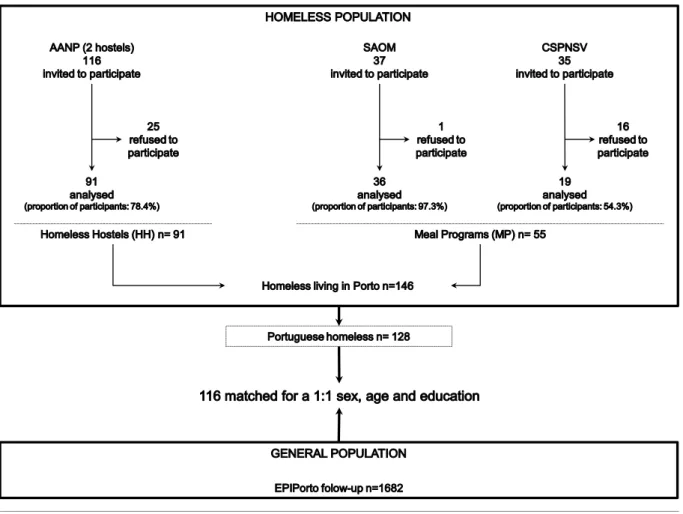
The eligible subjects attending the institutions in the days selected for recruitment (covering all the week days) were listed by the people in charge in each setting and consecutively invited to participate. In SAOM, only the subjects that were attending a professional course of hotel management were approached. The evaluations were conducted in the afternoons and evenings in the HH, and after lunchtime and evenings in the MP. Forty-two subjects refused to participate, 25 (21.6%) of those invited in the HH, 16 (45.7%) of those invited in one of the MP (CSPNSV) and only one of those approached in the other MP (SAOM), as depicted in Figure 1.
AANP – Associação dos Albergues Nocturnos do Porto SAOM – Serviço de Assistência Organizações de Maria CSPNSV – Centro Social e Paroquial Nossa Senhora da Vitória HH – Homeless Hostel
MP – Meal Program
29
A total of 146 homeless subjects underwent a face-to-face interview with a structured questionnaire and a physical examination. Overall, no statistically significant differences were observed between participants and non-participants regarding sex (women: 13.7% vs. 21.4%, P=0.222), age (median: 45 vs. 47 years, P=0.301) and education (median: 4.0 vs. 4.5 years, P=0.414), although the proportion of women was higher among the refusals observed in the HH (12.1% vs. 32.0%, P=0.017).
All the evaluations were performed by trained staff from the research team, in private and quiet rooms located in the places where they were recruited. Questionnaires administration and physical examination were performed in different rooms, by different teams of examiners, and lasted approximately 45 minutes overall.
Questionnaire evaluation
A questionnaire to characterize the homelessness status of each participant, and to collect data on sociodemographic and behavioral characteristics (including tobacco and alcohol consumption), medical history (including previous diagnoses of hypertension, diabetes and dyslipidemia, and medication use) and healthcare access/utilization was administered.
Blood pressure and anthropometric evaluation
Blood pressure was measured on a single occasion, using a digital blood pressure
monitor (Omron HEM 7000-E®, Omron Healthcare, Canada) twice, with an interval of 5
minutes between measurements, after a 10-minute rest, following the recommendations of the American Heart Association (50). The mean of the two measurements was considered, and when the difference was larger than 5 mmHg for systolic or diastolic blood pressure a third measurement was taken and the mean of the 2 closest values was registered.
Anthropometric measurements were obtained with the participant wearing light clothing and no footwear or head gear. Weight was measured with the subject upright, to the nearest 0.1 kg, using a portable electronic weighing scale, with an accuracy of +/- 100g (Tanita
UM-018®, Tanita Corporation of America Inc., Illinois, USA). Height was measured to the nearest
0.1 cm in the standing position using a portable stadiometer (Seca 214®, Hamburg,
Germany). Waist circumference was measured to the nearest 0.1 cm, directly over the skin, or over light clothing, with a flexible and non-stretchable tape, avoiding exertion of pressure on the tissues and with the subject standing, at the level of the midpoint between the inferior margin of the last rib and the crest of the ileum in the mid-axillary line at the end of a gentle expiration.
30
General population living in Porto
Selection of the study participants
The non-homeless Porto dwellers selected for comparison with the homeless were participants in the EPIPorto cohort. The recruitment of the initial sample has been previously reported elsewhere (51, 52). In brief, the cohort was assembled between 1999 and 2003 and comprised the evaluation of 2485 Portuguese individuals, selected by random digit dialing among those living in Porto, having households as the sampling unit. When a household was selected, all residents were identified by age and gender, and one adult was randomly selected as the respondent, without replacement if there was a refusal. The participation rate was 70% (52).
The follow-up, including questionnaire evaluation and physical examination, took place between May 2005 and May 2008 at the Porto Medical School, and was accomplished for 1682 participants. From the latter, we selected a subsample, matched (1:1) with the Portuguese homeless from Porto (Figure 1); 99 individuals were matched on sex, age (±5 years) and education (±1 year), 12 individuals on sex, age (±5 years) and education (±3 years), and 5 on sex, age (±10 years) and education (±3 years). A match could not be found for 12 Portuguese homeless, most of them young and with low education levels.
Questionnaire evaluation
Data were collected by trained interviewers using a structured questionnaire comprising data on sociodemographic, personal medical history (including previous diagnoses of hypertension, diabetes and dyslipidemia, and medication use) and lifestyles (including smoking and alcohol intake). The questionnaire used for the homeless was based on the one used to evaluate the participants in the EPIPorto cohort.
Blood pressure and anthropometric evaluation
Blood pressure was measured on a single occasion by non-physician trained interviewers, using a mercury sphygmomanometer, taking phase I and V Korotkoff sounds as systolic and diastolic blood pressure, respectively, and following the recommendations of the American Heart Association (50), as previously described for the homeless.
Anthropometric measurements were obtained after an overnight fast, as previously described for the homeless.
31
Statistical analysis
For analysis, arterial hypertension was defined as systolic blood pressure ≥140 mmHg and/or diastolic blood pressure ≥90 mmHg and/or antihypertensive drug therapy (53).
Body mass index (BMI) was calculated as weight in kilograms divided by the square of
the height, in meters, and subjects were categorized as: underweight (<18.5 kg/m2), normal
(18.5–24.9 kg/m2), overweight (25.0–29.9 kg/m2) and obese (≥30 kg/m2
) (54). Abdominal obesity was defined as a waist circumference greater than 102 cm in men or 88 cm in women (55).
Regarding the consumption of alcoholic beverages, participants were classified as “never-drinker”, “ex-drinker” (for more than six months) and “current drinker”. We assessed the frequency and amount of consumption of each of the main types of alcoholic beverages (wine, beer, spirits or liquors); these data were used to estimate the daily intake of ethanol (g/day), by multiplying the quantity and frequency intake of each drink by their average alcohol concentrations in volume (12% for wine, 4.7% for beer, 50% for spirits, and 25% for
liquors and similar beverages). Regarding smoking habits, subjects were classified “never
smoker”, “ex-smoker” (for more than six months) and “current smoker” (at least one cigarette per day at the time of the survey). The number of cigarettes consumed per day was also assessed.
We compared the distribution of cardiovascular risk factors between the homeless selected in HH and MP, and between the homeless and the general population, through adjusted prevalence ratios (PR) and 95% confidence intervals (95%CI), computed using
Poisson regression (56), or adjusted β coefficients with 95%CI, computed using linear
regression, for categorical and continuous variables, respectively.
Data were analyzed using STATA® version 11.2 (Stata Corporation, College Station,
Texas).
Ethics
These investigations were approved by the Ethics Committee of Hospital de São João, Porto, and all participants gave written informed consent.
32
RESULTS
From the 146 homeless subjects enrolled in the study, approximately three-quarters of the sample was recruited in HH (n=91). The overall median age was 45 years (range: 18 to 77 years), less than 10% were aged above 60 years, and most were men (86.3%), did not have a partner (55.5% single, 27.4% divorced or separated, and 4.1% widowed), reported
having less than the 10th grade (88.3%), and were unemployed (78.8%). Non-Portuguese
individuals (n=18) were mostly from eastern European countries (2.1%) and Portuguese ex-colonies (9.6%), including Angola, Guinea-Bissau and Brazil. The median duration of homelessness was 24 months (range: 1 to 480 months). Roughly one-quarter of the participants used illicit drugs in the previous year, 21.2% had ever been imprisoned before and two stated to have prostituted themselves before. Nearly one tenth reported being HIV-infected or having AIDS.
The demographic and social characteristics of the individuals recruited in MP and in HH are compared in Table 4.
There were no statistically significant differences between the two sub-samples regarding the sociodemographic characteristics, although in the HH sub-sample the proportions of individuals with less than 4 years of education or that were non-Portuguese were higher than in MP. Regarding the homelessness status and behavioural characteristics, MP reported a twofold higher prevalence of previous consumption of illicit drugs (18.7% vs. 32.7%, P=0.054) and imprisonment (16.5% vs. 29.1%, P=0.071).
When comparing MP with HH, there were no significant differences regarding most cardiovascular risk factors, except for the lower mean systolic (β=10.37, 95%CI: 17.02 to -3.72) and diastolic (β=-6.82, 95%CI: -10.85 to -2.78) blood pressures among the MP, who also had a lower prevalence of hypertension (PR=0.53, 95%CI: 0.27 to 1.04), although the latter difference did not reach statistical significance (Table 5). The magnitude of these associations remained essentially unchanged after further adjustment for body mass index (hypertension, PR=0.52, 95%CI: 0.26 to 1.04; mean systolic blood pressure, β=-9.64, 95%CI: -16.36 to -2.92; diastolic blood pressure, β=-6.38, 95%CI: -10.46 to -2.31).
The prevalence of self-reported diabetes was lower in the MP (PR=0.56, 95%CI: 0.15 to 2.16), while the homeless selected in this setting were more likely to have measured their blood pressure in the previous year (PR=1.09, 95% CI: 0.72 to 1.66), though differences were not statistically significant.
33
Table 4. Sample characteristics of the homeless, according to the recruitment setting
All homeless n (%) * MP n (%) * HH n (%) * P Socio-demographic characteristics Sex (% men) 126 (86.3) 46 (83.6) 80 (87.9) 0.467 Age (years) 18-39 40-49 50-59 60 45 (30.8) 47 (32.2) 40 (27.4) 14 (9.6) 15 (27.3) 21 (38.2) 15 (27.3) 4 (7.3) 30 (33.0) 26 (28.6) 25 (27.5) 10 (11.0) 0.607 Civil status
Married or civil union Single Divorced or separated Widowed 19 (13.0) 81 (55.5) 40 (27.4) 6 (4.1) 9 (16.4) 28 (50.9) 16 (29.1) 2 (3.6) 10 (11.0) 53 (58.2) 24 (26.4) 4 (4.4) 0.745 Education (years) None 1-4 5-9 10-12 12 4 (2.7) 70 (48.0) 55 (37.7) 14 (9.6) 3 (2.1) 1 (1.8) 21 (38.2) 28 (50.9) 5 (9.1) 0 (0.0) 3 (3.3) 49 (53.9) 27 (29.7) 9 (9.9) 3 (3.3) 0.094 Occupation status Employed Unemployed Retired 5 (3.4) 115 (78.8) 26 (17.8) 2 (3.6) 43 (78.2) 10 (18.2) 3 (3.3) 72 (79.1) 16 (17.6) 0.989 Nationality (% Portuguese) 128 (87.7) 52 (94.6) 76 (83.5) 0.050
Homelessness status/behavioural characteristics
Homelessness duration ≤ 1 month 2-6 months 7-12 months 1-5 years ≥ 6 years 14 (9.7) 32 (22.1) 17 (11.7) 43 (29.7) 39 (26.9) 5 (9.1) 12 (21.8) 3 (5.5) 17 (30.9) 18 (32.7) 9 (10.0) 20 (22.2) 14 (15.6) 26 (28.9) 21 (23.3) 0.384
Use of illicit drugs (previous year) 35 (24.0) 18 (32.7) 17 (18.7) 0.054
Self reported HIV/AIDS (infection/disease) 17 (11.8) 8 (14.8) 9 (10.0) 0.386
Practice of prostitution (ever) 2 (1.4) 1 (1.8) 1 (1.1) 0.717
Imprisonment (ever) 31 (21.2) 16 (29.1) 15 (16.5) 0.071
* Results are presented as n (%), except when otherwise specified, and the percentages may not sum 100% due to rounding. MP – Meal Programs; HH – Homeless Hostels
34
Table 5. Cardiovascular risk factors among the homeless, according to the recruitment setting
MP vs. HH All homeless n (%) * MP n (%) * HH n (%) *
Crude PR (95%CI) † Adjusted‡ PR (95%CI) †
Cardiovascular risk factors
Smoking status Never smokers Ex-smokers Current smokers Cigarettes (ner/day) § 20 (13.7) 10 (6.9) 116 (79.5) 16.5 (10.1) ǁ 5 (9.1) 2 (3.6) 48 (87.3) 16.5 (12.5) ǁ 15 (16.5) 8 (8.8) 68 (74.7) 16.6 (8.1) ǁ 1 (reference) 0.82 (0.17 to 3.87) 1.11 (0.76 to 1.60) -0.16 (-4.00 to 3.67) 1 (reference) 0.83 (0.15 to 4.51) 1.16 (0.77 to 1.62) -0.19 (-4.09 to 3.71) Current alcohol consumption
Never drinkers Ex-drinkers Current drinkers Alcohol (g/day) § 27 (18.5) 13 (8.9) 106 (72.6) 70.1 (112.4) ǁ 11 (20.0) 8 (14.6) 36 (65.5) 53.4 (85.1) ǁ 16 (17.6) 5 (5.5) 70 (76.9) 78.8 (123.8) ǁ 1 (reference) 1.77 (0.58 to 5.41) 0.94 (0.63 to 1.41) -25.42 (-71.09 to 20.26) 1 (reference) 1.89 (0.61 to 5.89) 0.95 (0.63 to 1.41) -25.38 (-71.39 to 20.62) Body mass index
Underweight (<18.5kg/m2) Normal (18.5–24.9 kg/m2) Overweight (25.0–29.9 kg/m2 ) Obese (≥30 kg/m2 ) Body mass index (kg/m2)
5 (3.4) 80 (54.8) 40 (27.4) 21 (14.4) 25.2 (5.3) ǁ 1 (1.8) 36 (65.5) 11 (20.0) 7 (12.7) 24.7 (5.0) ǁ 4 (4.4) 44 (48.4) 29 (31.9) 14 (15.4) 25.5 (5.4) ǁ 0.32 (0.04 to 2.90) 1 (reference) 0.59 (0.29 to 1.18) 0.67 (0.27 to 1.67) -0.89 (-2.67 to 0.89) 0.31 (0.03 to 2.79) 1 (reference) 0.58 (0.29 to 1.17) 0.69 (0.28 to 1.71) -0. 87 (-2.64 to 0.91) Abdominal obesity ¶ No Yes Waist circumference (cm) 119 (83.8) 23 (16.2) 88.6 (12.6) ǁ 47 (88.7) 6 (11.3) 88.6 (10.2) ǁ 72 (80.9) 17 (19.1) 88.7 (13.9) ǁ 1 (reference) 0.59 (0.23 to 1.50) -0.03 (-4.36 to 4.30) 1 (reference) 0.60 (0.24 to 1.53) 0.08 (-4.16 to 4.32) Hypertension No Yes 100 (68.5) 46 (31.5) 44 (80.0) 11 (20.0) 56 (61.5) 35 (38.5) 1 (reference) 0.52 (0.26 to 1.02) 1 (reference) 0.53 (0.27 to 1.04) Systolic blood pressure (mmHg) 127.5 (23.0) ǁ 120.7 (20.7) ǁ 131.6 (23.5) ǁ -10.83 (-18.42 to -3.24) -10.37 (-17.02 to -3.72) Diastolic blood pressure (mmHg) 80.9 (13.2) ǁ 76.6 (12.5) ǁ 83.6 (13.0) ǁ -7.01 (-11.33 to -2.69) -6.82 (-10.85 to -2.78)
Self-reported health status/healthcare use
Hypertension No Yes 132 (90.4) 14 (9.6) 50 (90.9) 5 (9.1) 82 (90.1) 9 (9.9) 1 (reference) 0.92 (0.31 to 2.74) 1 (reference) 0.90 (0.30 to 2.69) Dyslipidemia No Yes 130 (90.9) 13 (9.1) 50 (90.9) 5 (9.1) 80 (90.9) 8 (9.1) 1 (reference) 1.00 (0.33 to 3.06) 1 (reference) 1.02 (0.33 to 3.13) Diabetes No Yes 132 (92.3) 11 (7.7) 52 (94.6) 3 (5.5) 80 (90.9) 8 (9.1) 1 (reference) 0.60 (0.16 to 2.26) 1 (reference) 0.56 (0.15 to 2.16) Evaluation of blood pressure
(previous year) No Yes 55 (37.7) 91 (62.3) 19 (34.6) 36 (65.5) 36 (39.6) 55 (60.4) 1 (reference) 1.08 (0.71 to 1.65) 1 (reference) 1.09 (0.72 to 1.66) Blood biochemical analyses
(previous year) No Yes 37 (25.9) 106 (74.1) 6 (10.9) 49 (89.1) 31 (35.2) 57 (64.8) 1 (reference) 1.38 (0.94 to 2.01) 1 (reference) 1.38 (0.94 to 2.02)
* Results are presented as n (%), except when otherwise specified, and the percentages may not sum 100% due to roundings; † Results are presented as PR and 95%CI,
except when otherwise specified; ‡ Adjusted for age (continuous) and education (continuous); § Daily consumption data presented for current only; ǁ Results are presented
as mean (SD). ¶ Abdominal obesity – waist circumference ≥102 cm (men) or ≥88 cm (women) (55).
35
Table 6 depicts the comparison between homeless individuals and the general population regarding the exposure to cardiovascular risk factors.
The prevalence of current smokers was nearly 50% higher among the homeless; however, the daily mean of cigarettes consumed was lower in comparison with general population individuals (β=-3.59, 95% CI: -7.61 to 0.43). In contrast, despite the proportion of current drinkers was slightly lower among the homeless, they presented an approximately 10g higher mean daily consumption of alcohol (β=11.44, 95% CI: -7.57 to 30.45).
The homeless individuals presented lower mean body mass index (β=1.64, 95%CI: -2.82 to -0.46) and waist circumference (β=-4.18, 95%CI: -7.16 to -1.21), and were less often overweight (PR=0.63, 95%CI: 0.40 to 0.98) and obese (PR=0.47, 95%CI: 0.24 to 0.92).
The differences observed between the homeless individuals and those from the general population regarding the prevalence of hypertension, self-reported hypertension, mean systolic and diastolic blood pressure, or the measurement of the blood pressure in the previous year, were not statistically significant. Further adjustment for body mass index attenuated even more the differences in the prevalence of hypertension (PR=1.00, 95%CI: 0.65 to 1.55), and no meaningful differences were observed in the mean systolic (beta=2.01, 95% CI: -2.94 to 6.96) and diastolic blood pressure (β=-1.07, 95%CI: -4.59 to 2.46).
The homeless were nearly 5 times less likely to report dyslipidemia (PR=0.21, 95%CI: 0.10 to 0.43).