1
A Work Project, presented as part of the requirements for the Award of a Masters Degree in Management from the NOVA – School of Business and Economics.
SME COMPETITIVENESS:
STRATEGY OF LOGOPLASTE IN MOZAMBIQUE’S FLEXIBLE PLASTIC PACKAGING INDUSTRY
LEONOR SERENO CONDESSO SOUTO MIRANDA #1327
A Project carried out on the Field Lab of SME Competitiveness: Internationalization Strategy, under the supervision of Professor Sonia Dahab
2 Abstract
”Logoplaste is a specialist in operating in-house industrial sites for manufacturing rigid plastic packaging containers. In developing countries, especially in Africa, the low income of consumers does not allow a widespread adoption of products typically sold in rigid plastic containers. In these countries the flexible packages are usually adopted as they allow for better ratios of cost/litter of product, particularly in smaller packages. Should Logoplaste offer this type of technology in order to expand into developing countries?”i
3 Index
Introduction ... 4
Methodology ... 4
Flexible Plastic Packaging Technology ... 5
Production process ... 5
Innovation and Quality management ... 6
Value chain ... 7
Rigid vs Flexible ... 7
Minimum scale analysis ... 7
Adaptability of the “Hole-in-the-Wall” concept ... 8
Transferability of resources and Competences ... 8
Mozambique: Potential country of internationalization ... 9
Main facts ... 9
PEST analysis of Mozambique ... 9
Commercial relations between Portugal and Mozambique ... 11
Flexible Plastic Packaging industry in Mozambique ... 12
Industry mapping and porter 5 forces ... 12
Mozambican Government ... 13
Financial Institutions in Mozambique ... 13
Potential supply of raw materials and machinery ... 14
Potential demand of FMCG companies... 14
End consumer demand ... 15
Analysis of competitors ... 16
SWOT/TOWS analysis ... 17
Mode of entry - Strategic options ... 18
Entering the African market ... 21
Mode of entry in Mozambique ... 22
Implementation plan ... 23
Conclusion and Recommendations ... 25
4
I
NTRODUCTION
Logoplaste is a specialist manufacturing company in rigid plastic packaging – Appendix 1.1 Logoplaste can be characterized by its innovative business model – the “hole-in-the-wall” concept: the manufacturing of packaging solutions inside or very close to clients’ sites that allows the elimination of transportation costs and the just-in-time delivery of containers.
Motivated by the long term vision of becoming a global player in the plastic packaging industry, Logoplaste is interested in conquer new markets, especially in developing regions, namely Africa. However, due to the specifications of the African continent, Logoplaste’s approach must be different, and the product offering must be adapted. As explained by the company, “In developing countries, especially in Africa, the low income of consumers does not allow a widespread adoption of products typically sold in rigid plastic containers. In these countries the flexible packages are usually adopted as they allow for better ratios of cost/litter of product, particularly in smaller packages.”ii This can be justified by the fact that the flexible plastic packaging uses less material (being more economical), occupies less space (which results in decreased shipping costs) and is, at the same time, very effective, since that due to the existence of different layers’ barrier capabilities (which are adapted to the packaging content), the content is protected and keeps it quality during it shelf lifeiiiivv.
M
ETHODOLOGY
Can Logoplaste keep the core capabilities and competitive advantage that it has in the rigid technology in the development of the flexible technology? - Will be the first question to be investigated in this Work Project. For that it will be analyzed if Logoplaste core competences and competitive advantages in the rigid plastic packaging industry can be
1 Appendices 1 to 11 are in the complementary file “Appendices: Strategy of Logoplaste in Mozambique’s flexible plastic packaging industry”.
5
transferred to the flexible plastic packaging industry and, consequently, allow the company’s internationalization to an African country. Namely, it will be analyzed the differences in terms of minimum scale requirements, adaptability of the hole-in-the-wall business model and the transferability of soft and hard skills from the rigid to the flexible technology development.
This brings up the second question to be studied – Should Logoplaste internationalize its business to Africa? For that, a detailed analysis of the country characteristics will be conducted. The country here considered will be Mozambique mainly because it is an almost unexplored market in what regards packaging solutions, that simultaneously has a growing presence of consumer goods companies associated to the fast pace growth of its economy. To better know the country potential, the flexible plastic packaging industry in Mozambique was studied in detail. After that, it will be defined the best way to enter Mozambique and, based on that, an implementation plan will be suggested.
F
LEXIBLE
P
LASTIC
P
ACKAGING
T
ECHNOLOGY
PRODUCTION PROCESSIn order to get to know better the flexible plastic packaging technology, we took as reference the flexible specialist company “Plasteuropa” – Appendix 2 - and developed a deep understanding of its production process.
The manufacturing process of a flexible plastic package depends on the type of final product desired. According to the information provided by the company, there is a wide range of possibilities of raw materials – LDPE, HDPE, BOPP, BPET, BOPA, CPP and PET – that are bought in the form of pellets (if PET) or in the form of films (if other raw material than PET). The suppliers of raw materials for the flexible technology include big petrochemical companies – e.g. Repsol, Exxon – and other medium/small companies all around the world. The cost of the raw material can contribute to the total cost of a final package from 30 to 70%.
6
In terms of machinery, the manufacturing of a flexible plastic packaging can require extrusion machines, laminating, winding, printing and cutting machines. Therefore the investment on a new factory is variable, depending on the type of manufacturing involved. The suppliers of machinery are global companies such as Dolci, Shciavi (Italy), Reifenhäuser (Germany) and Comexi (Spain). The price of each type of machine is usually dependent on the velocity and production capacity of it.
In the case of Plasteuropa, there are 2 types of production process, being one for simple products (produced with only 1 raw material) and the other for the more complex products (produced with more than 1 raw material).
The simpler production process occurs in the case where the inputs are PET pellets that are then transformed into films by the extrusion machine. In some cases, the films are already the final product. However, in other cases, the films are then introduced into the printing machine and cut machine, to reach the final cut and printed plastic packaging bags. These bags are usually applied to commercial end.
In the case of the more complex products, such as packaging used in the food and beverage sector, the manufacturing process and inputs can vary according to the type of food or beverage in the packaging, and the respective isolation requirements. The films are introduced into the printing machine and, after printed, laminated. The final phase is done in the winding machine that adapts the films to the desired size. After that, there is accumulation of stock, since Plasteuropa only operates in the pre-filling phase. Just like in the Logoplaste example, that stock is “tailor-made” and exclusively manufactured to a specific client.
INNOVATION AND QUALITY MANAGEMENT
The innovation capabilities in Plasteuropa are mainly associated with the improvement of the efficiency on the production process, rather than changes on the final packaging.
7
According to the example of Plasteuropa, the innovations in the final packaging are done by the printed design.
In terms of quality, Plasteuropa commitment is reflected in the ISO 9000. Besides that, the company develops some random control tests and tries to fulfill to clients’ specific requirements in what regards the quality of the packaging.
VALUE CHAIN
Considering Plasteuropa’s value chain we can conclude that the margins in this business are lower, varying between 3-5%. The primary activities include the operations (production costs) and the outbound logistics (transportation costs), since it is an off-site manufacturer. The support activities include the procurement (50% that correspond to the cost of raw materials), human resources, infrastructure and IT (which include quality costs). There’s a high degree of similarity in the value of the activities performed by the two companies.
R
IGID VS
F
LEXIBLE
MINIMUM SCALE ANALYSISProduction process: The flexible plastic packaging manufacturing process is much more complex than the rigid packaging (Appendices 3,4 and 5). As explained, instead of only one standard process – as in the rigid – the flexible plastic packaging production includes a variety of processes that depend on the final application of the package. This results on an increased scale for a profitable production of flexible packaging when compared to the rigid one.
Raw materials: Also in what regards the raw materials, we can see that the flexible plastic packaging requires several different materials while the rigid plastic packaging only uses PET and HDPE. Therefore, in order to be profitable in the flexible industry, the minimum scale is much higher – it is required to have a greater demand of packaging in order to
8
reach significant volume discounts when purchasing the inputs, meaning that economies of scale are significant.
Equipment/Machinery: While Logoplaste only uses 2 types of machines, requiring an average investment of 1.1 Million €, Plasteuropa uses 4 types of machines, reaching an average investment of 3.2 Million € - Appendices 6 and 7. It is clear that in order to have the same break-even point, a rigid company would have to sell less packaging units than a flexible company, which, once again, lead us to the conclusion that the minimum scale in the flexible is much higher than it is in the rigid industry.
Human resources: In what regards human resources, the differences in terms of dimension and capabilities of the teams are not significant and do not affect the minimum required scale from the rigid to the flexible.
ADAPTABILITY OF THE “HOLE-IN-THE-WALL” CONCEPT
Since the minimum scale is higher in the flexible plastic packaging when compared with the rigid plastic packaging, we can conclude that applying the “hole-in-the-wall” concept to the flexible technology would not be suitable and would decrease the profitability of the company. In order to enter the flexible plastic packaging industry, Logoplaste should adapt the business model to the scale required, which in this case would definitely mean to forego the hole-in-the-wall concept. However the company should keep its competitive advantage - the fully dedication to clients, the good relation and ability to negotiate with suppliers, the focus on adaptability as tool for keeping long-term clients and the just-in-time solving problems culture, with the goal of keeping its unique and valuable strategic position: the high focus on innovation and quality suited to clients’ needs.
T
RANSFERABILITY OF RESOURCES ANDC
OMPETENCESBeing the core competences defined as “systematically clustered combinations of individual technologies and production skills underlying the variety of product lines of a company”vi we can classify it as soft competences or hard competences. Hard
9
competences can be characterized by its “high knowledge and technical content” and in the Logoplaste’s case those are represented by the engineering capabilities, production capacity and equipment innovation. Soft competences can include “behaviors and can be acquired by experience”vii, which in Logoplaste, are, above all, the just-in-time and
flexibility-focused corporate culture, the quality management concerns, the open-book policy to clients and the procurement capacity.
The previous minimum scale analysis and of the consequent lack of adaptability of the hole-in-the-wall concept to the flexible technology affect the transferability of the described soft and hard skills of Logoplaste from the rigid plastic technology to the flexible plastic technology. Due to the nature of the differences in the production process above described, it is easy to understand that the engineering capabilities, production capacity and equipment innovation will have to be adapted and, therefore, are not immediately transferable resources. However, even though the changes in the business model, Logoplaste will still be able to transfer the most of its soft skills - its reputation, its just-in-time corporate culture, its focus on long-term relationship with clients (through the open-book policy and flexibility), and its suppliers’ network.
M
OZAMBIQUE
:
P
OTENTIAL COUNTRY OF
INTERNATIONALIZATION
M
AIN FACTSMozambique is an African country, ex-colony of Portugal, where the official language is Portuguese. It is composed by a population of 25.2 million habitantsviii, spread mainly by Maputo (the capital), Matola and Beira (the biggest cities). It is a very poor population that lives with a GDP per capita of US$ 579 (2012)ix. The Mozambique’s currency is the Metical (1€=38,87 MZN) and the inflation rate in 2012 was of 1,1%x.
10
Political issues: Republic of Mozambique is a multiparty democracy under the government of Armando Guebuza (President) and Alberto Vaquina (Prime Minister). At the moment, “Frente de Libertação de Moçambique” is the party at the government and the opposition is mainly done by “Resistência Nacional de Moçambique” (Renamo). Since the end of the Civil War in 1992, the political environment of Mozambique has been characterized as stable and the country’s elections are generally peaceful with the Government presenting an ambitious reform plan for Mozambique. However, the generalized corruption and the weakness of institutions undermines its implementation. Furthermore, the recent political crisis of the country which resulted in the broke of the treat of peace of 1992 (between the government and Renamo) threatened the political stability of the country.xi It is expectable that the political stability arises in the short term, not affecting the long-term plans of Logoplaste’s internationalization to Mozambique, though this is a risk that must be taken into consideration.
Economic issues: Mozambique’s economy is directly linked with its abundance in natural resources - including natural gas, mineral resources and water resources - and with its strategic geographical position as a “point of entrance” for the African market. Due to these factors, FDI (mainly megaprojects in the extractive industry), together with Official Development Assistance (ODA) and agriculture growth have been key drivers for GDP sustained growth (~7%)xii over the last 10 years, resisting to the global financial crisis
effects.
Although it is one of the “fastest growing non-oil economy”xiii and has its economic activity relatively well diversified across Services (46,5% of GDP), Agriculture (29,5% of GDP) and Industry (23,9% of GDP)xiv, Mozambique’s economy is still very dependent from its natural resources and lacks trustful institutions, educated workforce and basic infrastructuresxv. Nevertheless, in the actual scenario of economic growth, there are
11
already several investment projects going on, with the goal of improving the country’s infrastructures – Appendix 8 - and, consequently, attract more foreign investment and develop better conditions to external commercial relationsxvi. Besides that, according to the World Bank, it is expected that the public and private investment in the extractive industry can result in long-term improvements of infrastructures and of the business environment in general – since that, according to the “Doing Business Rank 2013”, Mozambique is ranked in 146th position out of 185 countries.
Social issues: Only 31.2% of Mozambique’s population lives in urban areasxvii and, in 2011, more than 50% of the population was under 18xviii. Therefore, for such a young and
rural population, the weak Mozambican education can be considered a long term threat for Mozambique’s society, since literacy rate only reach the 54% (2008)xix, standing below Africa’s average. However, some improvements are being made to develop the educational system, with the implementation of programs such as PIREP - Technical and Vocational Education Reform Projectxx.
Poverty is another social issue in Mozambique. According to the World Bank, 54.7% of the population was leaving below the national poverty line in 2009 which definitely influences the consumption patterns of this society, turning it very price-sensitive. Technologic issues: According to the technologic achievement index TAI - Technology Achievement Index (TAI), a composite measure of technological progress that ranks countries on a comparative global scale - Mozambique is considered a “marginalized” country.xxi In what regards ICT Mozambique is also not very advanced - it is known that the demand for telecoms is growing, attracting new companies to the market. In 2009, there were 2 mobile telecom operators, 28.5% of mobile penetration and 0.9% of internet penetration in the country.
12
Mozambique as an ex-colony of Portugal, keeps a close relation with the Portuguese culture, and that is reflected in the long and traditional commercial relation between the two countries and its companies. According to “Câmara de Comércio Moçambique Portugal” (CCMP), both the foreign direct investment and the importations/exportations between the companies have been growing during last years.
Regarding the exportations from Portugal to Mozambique, these have reached 288 million euros, having an average growth rate of 33.1% from 2008 to 2012xxii. Based on the CCMP ranking that assesses the biggest clients of Portuguese products, Mozambique is in the 22º position.
When considering the direct investment, Portugal can be considered one of the main investors in the country, reaching in 2012, 98 million euros of direct investment in Mozambique and having a relevant capital investment in, at least, 28 of the 100 biggest Mozambican companies.xxiii
Besides that, the existence of investment funds such as “InvestimoZ”xxiv - a Portuguese
fund to support the investment of Portuguese countries to internationalize to Mozambique - is very common and straight the relations between the countries.
F
LEXIBLE
P
LASTIC
P
ACKAGING INDUSTRY IN
M
OZAMBIQUE
I
NDUSTRY MAPPING AND PORTER5
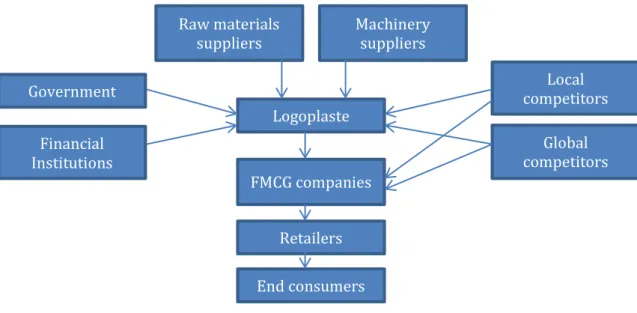
FORCESIn order to understand the potential competitive position of Logoplaste and the relevant factors of influence of the Mozambican flexible plastic packaging industry, the following industry map was designed and each of the sources of influence was then analyzed.
13
Table 1 - Industry mapping
MOZAMBICAN GOVERNMENT
The packaging industry in Mozambique is still embryonic, with a lack of diversified packaging solutions to respond to the growing demand. xxv xxviFor that reason, the
packaging industry is one of the priority areas of development of the Mozambican Government, who believes that the improvement of packaging would bring competitiveness to national producersxxvii. As a measure to fight that industry gap, the IPEME – Institute for promotion of SME’s – has been organizing the FIEI – International Fair of Packaging and Printingxxviii, targeting producers of packaging machinery, packaging producers and printing companies. Furthermore, the Government is focused on attracting investors in the sector, by giving incentives related with machinery and raw materials importation. Other initiatives have been developed such as the creation of PICxxix – Packaging Information Center – which has the goal of working as a supporting tool to increase country exports, by providing relevant information to packaging producers and users, materials importers and others.
FINANCIAL INSTITUTIONS IN MOZAMBIQUE
Logoplaste may also need to establish a relation with the Mozambican financial sector, in order to finance its activities in the country. The Mozambican financial system in 2009 was composed by 16 banks, with the deposits concentered mainly in the 4 biggest banks
Government Financial Institutions
Logoplaste Raw materials
suppliers Machinery suppliers
FMCG companies Retailers End consumers Local competitors Global competitors
14
– Banco Internacional de Moçambique, Banco Comercial de Investimentos, Standard Bank, Barclays Bank Mozambique. It is interesting to see that the 2 biggest banks are part of Portuguese Banking Groups – BIM is part of BCP and BCI is part of CGD.xxx This could be an indicator that the finance of activities should not be difficult, since the Portuguese banking groups should already know the financial stability of Logoplaste. POTENTIAL SUPPLY OF RAW MATERIALS AND MACHINERY
The common practice of Logoplaste in relation to the procurement of raw materials and specialized machinery includes regional importation. Therefore, even if there are no Mozambican raw materials and machinery suppliers, that would not be a problem for the company that is used to operate with global players. The solution would be to import raw materials and machinery from players operating in Africa - for example Eleme Petrochemical Company (Nigeria) or Warri Refining and Petrochemical Company (Nigeria).
POTENTIAL DEMAND OF FMCG COMPANIES
Logoplaste potential buyers are consumer goods companies. However, due to the lack of supply of packaging in Mozambique, some consumer goods companies operating there chose to produce their own packaging, which is, for example, the case of Coca-Cola and Cervejas de Moçambique or to import the products already properly packaged to Mozambique. Nevertheless, with the goal of knowing the potential demand, it is relevant to understand which are the current Logoplaste clients/partners and the biggest FMCG that are already operating in Mozambique.
There are only few Logoplaste’s clients with plants or subsidiaries in Mozambique: Coca-Cola (but also “Coca-Coca-Cola Sabco” the specialized Coca-Coca-Cola bottler), Danone (subsidiary), Diageo (subsidiary), and Nestlé (plant).But if considering all the FMCG present in Mozambique, the demand is more interesting. According to KPMG ranking of 100 biggest companies in Mozambiquexxxi, we can verify that many food & beverage
15
companies - A & L Enterprises, Lda, Aguas de Goba, Lda, Aguas de Moçambique, S.A.R.L, Cervejas de Moçambique, SA, Coca-cola Sabco Mocambique SARL, Lusovinhos, Lda, S.E Ginwala & filhos, Lda – are among the biggest companies in the country and this can be an indicator of great potential for packaging supplier companies. Furthermore, according to FDI Intelligence, in 2012, the biggest inward FDI projects in Mozambique in the food and beverage sector were: Maragra Acucar (UK); PescaNova (Spain); Lonrho agriculture (UK); Tongaat Hulett (South Africa); Nestle (Switzerland); Bakhresa (Tanzania); First National Choice (South Africa); RJ Corporation (India); SABMiller (UK) ; Choppies (Botswana) and Shoprite (South Africa) that are retailers. This analysis gives a general idea about the demand potential and of the companies that can be interested in Logoplaste packaging.
END CONSUMER DEMAND
The short term demand of packaging is directly influenced by the country’s GDP and by the population consumption patterns. As mentioned, the GDP has high rates of growth, nearly 7% per year. The consumption behaviors of the Mozambican population can also be a relevant indicator of the potential demand, since more purchasing power means more demand which, consequently, means more production and respective packaging.
Accordingly to Aicep, the private consumption has been growing around 7% per year.xxxii Being that, in average, on third of the monthly household expenditure is allocated to the consumer-packaged goodsxxxiii, it is predictable that there is a growing demand for packaging solutions. Knowing that the Mozambican consumer-packaged goods are mainly beverages, dairy products and other food, household and personal care – which correspond to the Logoplaste typical portfolio – we can also infer that the potential market for Logoplaste is growing.
Another important factor is that, as mentioned, Mozambique is a low income country where a big part of the population lives below the poverty line. Therefore, independently
16
from the private consumption growth, affordability is the main criteria when purchasing.xxxiv This enhances the idea that the flexible plastic packaging solutions should be the mainly offer of Logoplaste in the country.
Besides that, since it is a very rural population (70%), a big part of the population eats and uses only their own agricultural productionxxxv, what make us conclude that the FMCG consumption happens only in the urban areas – which are mainly in the South of the country. That fact, lead to the conclusion that the potential demand for Logoplaste should be the producers of products that are sold in the south urban areas of the country – as Matola, Maputo or Beira.
Considering that the typical diet of Mozambique includes corn, cassava, rice and wheat, in a further phase of the implementation process, these could be products to be analyzed by Logoplaste –in addition to the common products that Logoplaste is used to package - in order to understand the feasibility of producing appropriate flexible plastic packaging for them.
A
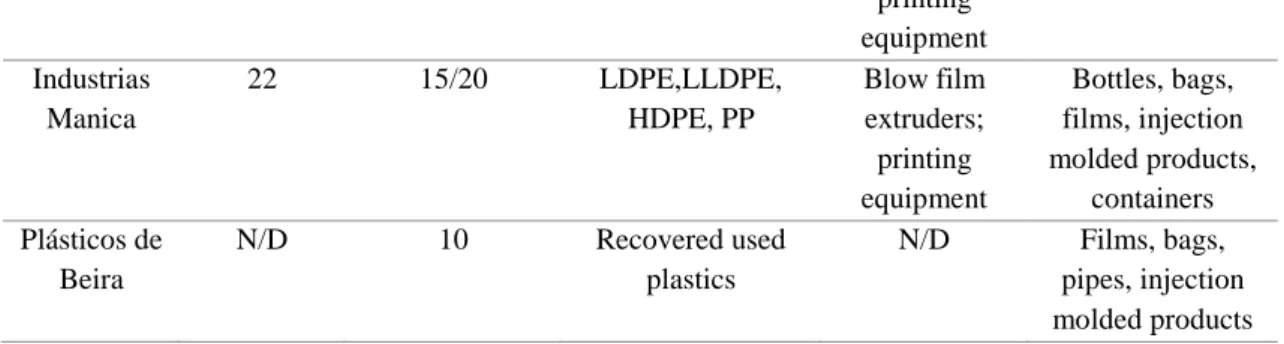
NALYSIS OF COMPETITORSAs direct competitors the producers of flexible plastic packaging in Mozambique must be considered.xxxvi The following list of competitors shows that there are few and mainly small players in the country, being this industry still in an initial stage.
Competitor Employees Average production (tons/month)
Raw materials Machinery Products
Plasteuropa (PT) 35 N/D LDPE, HDPE, BOPP, BPET, BOPA, CPP and PET Winding and cutting machine Printed films, bags Topack (PT) 100 200 LDPE, LLDPE, HDPE Blow film extruders; printing equipment Bottles, plastic containers, injection molded products, printed film
Riplex 30 N/D LDPE, LLDPE,
HDPE, PP
Blow film extruders;
Bottles, oil cans, films, bags
17 printing equipment Industrias Manica 22 15/20 LDPE,LLDPE, HDPE, PP Blow film extruders; printing equipment Bottles, bags, films, injection molded products, containers Plásticos de Beira N/D 10 Recovered used plastics N/D Films, bags, pipes, injection molded products
Table 2 - Competitors analysis
The main dynamics of the industry, were analyzed – Appendix 9 - and the main conclusions are here presented:
Threat of new entrants – MEDIUM:
- Government incentives (+) - Low post entry competition expectation (+)
- Brand loyalty (-)
- High capital requirements (-) Bargaining power of suppliers
– HIGH:
- High weight of inputs’ cost on final price (+)
- Low availability of substitutes (+)
- Low concentration (-) - No relationship-specific investments (-)
Rivalry among competitors – LOW:
- Small number of companies (-) - Low quality and innovation standards (-)
- Differentiation through packaging applications (-)
Bargaining power of buyers - MEDIUM:
- Low concentration (-) - Weak alternative (-) - Relationship-specific investments (+)
- Threat of vertical integration (+)
Threat of substitutes – MEDIUM/LOW: - Rigid plastic packaging converters (+-)
- Suppliers of plastic converting equipment (-)
Table 3 - Porter 5 forces (summarized)
SWOT/TOWS
ANALYSISBased on the information previously gathered the mains strengths, weaknesses, opportunities and threats of Logoplaste in Mozambique’s flexible plastic packaging industry were summarized – Appendix 10.
By using its strengths to make the most out of the Mozambican opportunities, Logoplaste should use the internationalization know-how - acquired through its internationalization
18
economic growth, government incentives to the industry and low competition of plastic packaging companies. The company should develop partnerships with the FMCG companies in Mozambique, providing strong dedicated solutions while using an open-book policy, and the cultural proximity to negotiate long term relations with clients. Logoplaste should overcome its weaknesses by using the opportunities, meaning, for example, to gradually expand into the country, using present clients as point of entrance and taking advantage of governmental incentives to reduce the high capital investment characteristic of its projects.
It should give up on the hole-in-the-wall concept in Mozambique in order to be able to provide flexible plastic solutions and consequently have a higher scale and a more complete portfolio of products design with the iLab capabilities to attract the new entrants in the country.
By combining the company strengths to overcome the threats, the focus in innovation should be used to gradually improve technologically the embryonic industry and the internationalization know-how to deeply understand the Mozambican market and implement a defined strategy to enter the country.
Considering both the threats and weaknesses, Logoplaste should be careful when choosing the mode of entry in Mozambique and avoid constructing plants and doing high capital investments in a low maturity market where a lot of info is not available. In Africa, Logoplaste should centralize the resources, both financial and human, until knowing well the market and have trained the adequate team to spread them across the continent.
M
ODE OF ENTRY
-
S
TRATEGIC OPTIONS
The choice of the mode of entry in Mozambique depends on many external and internal factors.xxxviixxxviiiEnvironment-specific factors such as the small size of the market and the high growth of its potential, the recent crisis of the country, the government policies and incentives to the industry, the low competitive environment of the industry, the
19
cultural proximity and the above-average development of local infrastructures were the key criteria to assess the different modes of entry. Also the firm-specific characteristics of Logoplaste were taken into consideration, including the long-term objectives of the company, the desired high level of control, the availability of internal resources, assets and capabilities.
In a scenario where Logoplaste decides to have a wholly owned subsidiary specialized in the flexible plastic packaging manufacturing in Mozambique, there are advantages and disadvantages to be weighted. On one hand, Logoplaste would have full control over its operations, it would show commitment to the local community and it would be a source of higher returns in case of success. On the other hand, also 100% of the losses would be carried by Logoplaste in case of failure and the risk would be higher since the requirements in terms of investment of resources would be very demanding, and the company would have to be exposed to the political and economic risks of the country. One possible way for Logoplaste to have a wholly owned subsidiary is by acquisition – buying an existing company in the industry, operating in Mozambique. As main benefits, Logoplaste would have a faster expansion, having a quick access to the market and to the country-specific and industry-specific assets (local networks, local knowledge, existing facilities and labor force, local financing). It would be a way of decreasing the competition (which is already low), benefiting from a known brand in the country, while fully controlling its operations. It could be an interesting way of entering an unknown market and gradually grow and understand it while improving the efficiency of the acquired firm by transferring the advanced technology, know-how and innovation of Logoplaste to the new subsidiary. Logoplaste and the eventual wholly owned subsidiary would complement each other: the innovative capabilities, the industry specific
20
knowledge and the just in time culture would be added to the country specific expertise of the existing company.
However, the acquisition process could also bring some risks such as the acquisition of an old plant and technologies, weak human resources or unsuitable corporate culture. Furthermore the acquisition can be a very costly option if the desired company is not willing to be acquired. In order to decrease this risk, the maximum information about the candidate companies should be gathered, which is actually a really difficult task to perform due to the lack of information available about the operating companies.xxxix For that reason, it would be recommended for Logoplaste to acquire or the leader company Topack – which probably has better technology and human resources and which is a Portuguese company - or the Plasteuropa – since it is also Portuguese and it would be easier to have access to complete information and to deal with the differences in the corporate culture.
Another possibility to Logoplaste could be to create a company from scratch, doing a green-field investment in Mozambique. This would be a high-risk decision, since the company would be entering in an unknown country, with an unknown technology, with a new business model, all by itself. Besides that, it would require a huge investment of resources (financial, physical and human) and the exposure to the local political and economic risks would be high. The potential benefits associated to such a risky scenario would be the 100% control and flexibility to choose suppliers, manufacturing process, human resources and the avoidance of corporate cultural differences.
In a third scenario, Logoplaste could develop an equity joint venture with an existing company on the industry, to enter Mozambique. By selecting the right company and clearly defining the goals of the joint venture, gradually, Logoplaste could create a trustful relation with an incumbent that would complement the current knowledge of the
21
company. Again, with the goal of decreasing the clash of cultural differences and degrees of technology, the recommended companies to participate in the Joint Venture would be Topack and Plasteuropa – Portuguese companies with a reasonable degree of technology. Through a mutually transfer of knowledge and expertise, both companies would benefit from risk and return sharing, and Logoplaste would certainly deep the understanding of the local environment, local networks of suppliers and clients, government role and incentives. Besides that, this scenario would decrease the investment and resources used by Logoplaste. The risks of this scenario are mainly the less control and with the possibility of eventual conflicts and costs associated to a break in the joint venture, after Logoplaste having shared the technological knowledge and reputation.
From the three scenarios analyzed, the acquisition would be the one that would bring more advantages to Logoplaste, since it would allow the company to keep full control of its operations while having a quick access to the local market. But both the 3 scenarios considered to use Mozambique as point of entrance are too risky and would not compensate in terms of market maturity and dimension, since they would not allow Logoplaste to reach an efficient scale to the flexible technology development. Furthermore, since the considered flexible technology is not yet produced in Portugal by Logoplaste, and therefore not a case of excess capacity in the domestic operations where exports would allow to reach economies of scale, it also doesn’t make sense to consider exportations of flexible plastic packaging from Portugal to Mozambique. For that reasons, Mozambique doesn’t seem a good point of entrance in Africa and therefore, other countries were analyzed as possible points of entrance in the African market.
E
NTERING THE
A
FRICAN MARKET
In the study of the other African countries as possible point of entrance for Logoplaste, South Africaxl and Nigeriaxli were also considered and, as a result, the 3 markets and its potential were compared through the grid of comparison presented in Appendix 11. In
22
comparison with the other countries, South Africa is more developed in terms of government institutions, general infrastructure, financial market and technology, the country also has a higher number of Logoplaste current clients. However it is a very tough country in what regards competition - South Africa as extremely high competitive environment, very difficult to enter.
Mozambique is not yet so developed and it has a very small market size, where only a few number of Logoplaste clients are operating. Besides being the country with the lowest competitive rivalry, the market lacks maturity and still needs to grow.
Finally, Nigeria has the highest market size and a low industry rivalry. The presence of Logoplaste clients’ in the country is significant and the country is in a medium/good level of development in relation to infrastructure and institutions. In a comparative basis, Nigeria has the best characteristics to receive Logoplaste FDI and to work as point of entry to the African market.
M
ODE OF ENTRY IN
M
OZAMBIQUE
Since Nigeria concentrates the best market characteristics, the exporting strategy to Mozambique might be the ideal way to enter the country, after Logoplaste have established its flexible plastic packaging manufacturing business in Nigeria. As seen, Mozambique is well prepared in terms of exporting-associated infrastructures, and it has a relatively low cost of exportation. Furthermore, the exportation would allow to test the Mozambican growing demand for flexible plastic packaging and to develop country-specific knowledge while avoiding doing high capital investments in an embryonic market. This would also be a way of avoiding to be so dependent of the political and economic risks of the country.
Logoplaste should implement direct exports from Nigeria to Mozambique, by setting up an exportation representative – a demanding solution in what regards financial and
23
human resources but, at the same time, a solution that would allow full control over its operations and a learning experience in what is related to country-specific knowledge. In the case of adopting an indirect exportation strategy, Logoplaste would not have guarantees on the selling quality of its products, and it could even result in decreased sales. Furthermore, indirect exportation do not make sense for a company that has as competitive advantage high quality service, just-in-time culture and fully dedication and adaptability to clients. By not having direct contact with the clients Logoplaste would not be able to keep its competitive advantage and would even risk its brand reputation. Finally, indirect exportation would result in a waste of a learning opportunity about a country with growing opportunities and would decrease Logoplaste’s margins.
I
MPLEMENTATION PLANAfter having decided the most adequate mode of entry in Mozambique, it is important to define a possible implementation plan to reach a successful internationalization.
MEN
Logoplaste’s strategy when internationalizing involves a local team that acts permanently in the destination country and an international team that keeps track of the general internationalization of the company, and that acts from the headquarters in Cascais while doing frequent visits to the international plants. Therefore, the company should nominate a team member from the Nigerian local team to be the brand representative in Mozambique, being responsible for the exportations from Nigeria to Mozambique. This person should be responsible for the pre-entrance phase, doing field research and finding interested clients for Logoplaste in Mozambique. In this initial phase, this person should move permanently to Mozambique, with the goal of deeply understanding the country organization and business culture and to start developing a business network in the country.
24
This brand representative should keep a high degree of dedication to clients, keeping long term relationships and attending to clients’ requirements as “just-in-time” as possible. For that reason, after having entered the Mozambican market, he should stay in Nigeria in order to follow closely the production process of the clients’ products and only visit Mozambique when it is necessary to meet the client.
MONEY
Since there is no investment associated to the direct exports, the incremental costs of exporting from Nigeria to Mozambique will be mainly associated with the cost of having the exporting responsible living there for 6 months and with the cost of travels from Nigeria to Mozambique of the client-dedicated responsible. A return flight from Nigeria to Mozambique can cost around 700€.xlii The accommodation in a secure apartment in
Mozambique is in average around the 2000€ per month.xliii
MINUTE
Activity Description Dependency
Pre
-en
tr
y
1. Nomination and tasks definition of the Mozambique’s exportation responsible
- 2. Mozambique’s exportation responsible travel to Mozambique 1. 2.1. Social integration and understanding of country culture,
infrastructures and business environment
2. 2.2. Definition and trial of the exportation procedure (taking into
consideration costs and reliability of the transportation)
2. 2.3. Exportation documentation and authorization 2. 2.4. Networking and meetings’ schedule with potential clients 2.
E
n
t
ry 2.5 Meetings and negotiation with clients 2.4.
2.6. Trials of the products and closing contracts 2.5.
Po
st
-en
tr
y 3.1. Training sessions to the exporting team (country specific training and firm specific training) 2.6.
3.2. The exporting responsible frequently meets its client with the goal of updating information, getting feedback for improvements and new orders for Logoplaste products.
2.6.
Table 4 - Minute - Implementation plan
MEMO
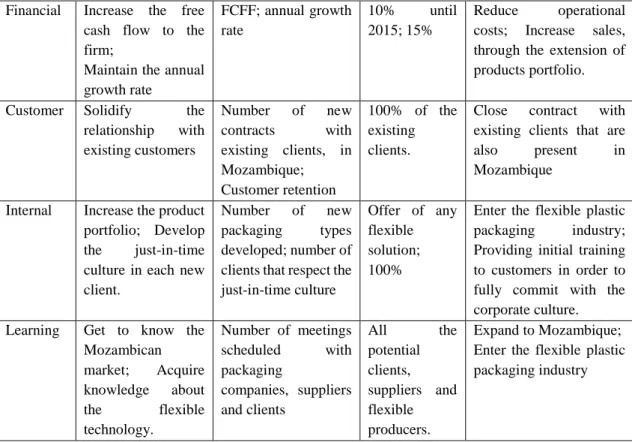
With the goal of monitoring the success of this implementation proposal the following table should be considered.
Strategic themes
25
Financial Increase the free cash flow to the firm;
Maintain the annual growth rate FCFF; annual growth rate 10% until 2015; 15% Reduce operational costs; Increase sales, through the extension of products portfolio. Customer Solidify the
relationship with existing customers Number of new contracts with existing clients, in Mozambique; Customer retention 100% of the existing clients.
Close contract with existing clients that are also present in Mozambique
Internal Increase the product portfolio; Develop the just-in-time culture in each new client.
Number of new packaging types developed; number of clients that respect the just-in-time culture
Offer of any flexible solution; 100%
Enter the flexible plastic packaging industry; Providing initial training to customers in order to fully commit with the corporate culture. Learning Get to know the
Mozambican market; Acquire knowledge about the flexible technology. Number of meetings scheduled with packaging companies, suppliers and clients All the potential clients, suppliers and flexible producers. Expand to Mozambique; Enter the flexible plastic packaging industry
Table 5 - Memo - Implementation plan
C
ONCLUSION AND
R
ECOMMENDATIONS
In order to enter the African market, Logoplaste must offer flexible plastic packaging solutions. Although adapting a adopting a new business model – off-site manufacturing of flexible plastic packaging – Logoplaste should make an effort to keep its competitive advantage. The company should start by entering Africa through FDI in Nigeria, since, from the countries studied, it is the one that presents the most relevant market potential simultaneously with a relatively low country risk and competition. Logoplaste should, then, expand for the rest of the continent, and a possible scenario could include direct exports from Nigeria to Mozambique – a fast growing economy, with a growing market potential and an embryonic industry, characterized by low competition and governmental incentives, but also by political risks and insufficient maturity of the market.
26
R
EFERENCES
iLogoplaste. 2013. Challenge presented by Logoplaste to NOVA SBE students participating in the SME Internationalization Field Lab.
ii Logoplaste. 2013. Challenge presented by Logoplaste to NOVA SBE students
participating in the SME Internationalization Field Lab.
iii Curwood. 2013. “Why flexible packaging”
http://www.curwood.com/about_curwood/264/why_flexible_packaging/
iv Fresco. 2013. “What are the advantages of Flexible Packaging over rigid containers?” http://www.fresco.com/files/pdfs/Life_Cycle_Analysis__Rigid_Container.pdf
v Plastic packaging facts. 2013. “Why Plastic Packaging”. http://www.plasticpackagingfacts.org/
vi Prahalad and Hamel. 1990.
http://web.ebscohost.com/ehost/pdfviewer/pdfviewer?sid=d0e15924-e031-4053-897d-700ce95c132a%40sessionmgr110&vid=2&hid=128
vii Elizabeth Chella & Rosemary Athaydea. 2011. “Planning for uncertainty: soft skills,
hard skills and innovation”.
http://www.tandfonline.com/doi/pdf/10.1080/14623943.2011.601561 viii World Bank. 2013. http://data.worldbank.org/country/mozambique
ix World Bank. 2013. http://data.worldbank.org/indicator/NY.GDP.PCAP.CD x World Bank. 2013. http://data.worldbank.org/indicator/FP.CPI.TOTL.ZG xi The economist. 2013. “Mozambique: Gas-fired tension”. November 9th.
http://www.economist.com/news/middle-east-and-africa/21589492-countrys-leaders-
must-and-can-prevent-slide-back-civil-war-gas-fired?zid=304&ah=e5690753dc78ce91909083042ad12e30 xii African Development Bank Group. 2011.
http://www.afdb.org/fileadmin/uploads/afdb/Documents/Policy-Documents/Mozambique%20-%202011-15%20CSP.pdf
xiii World bank. 2013.
http://siteresources.worldbank.org/AFRICAEXT/Resources/258643-1271798012256/Mozambique-growth.pdf
xiv Central Intelligence Agency. 2013. https://www.cia.gov/library/publications/the-world-factbook/fields/2012.html
xv The Africa Competitiveness Report. 2013.
http://www3.weforum.org/docs/ACR/2013/Mozambique.pdf xvi Infrastructure in Mozambique. 2013.
http://www.infrastructuremoz.com/redForms.aspx?eventid=6937&id=389080&FormID =%2011&frmType=Additional%20Content&m=2678&FrmBypass=False&mLoc=F&S ponsorOpt=False
xvii Central Intelligence Agency. 2013. https://www.cia.gov/library/publications/the-world-factbook/fields/2212.html
xviii Unicef. 2013. http://www.unicef.org/infobycountry/mozambique_statistics.html xix UNESCO. 2013. http://www.unesco.org/uil/litbase/?menu=13&programme=111 xx PIREP. 2013. http://www.pirep.gov.mz/
27 xxi United Nations Development Program. 2013.
http://hdr.undp.org/en/reports/global/hdr2002/papers/ip_desai-2.pdf xxii AICEP. 2013. Revista Portugal Global. 38-39.
http://www.revista.portugalglobal.pt/AICEP/PortugalGlobal/revista53/?Page=38 xxiii AICEP. 2013. “Moçambique - Síntese País e Relacionamento Bilateral”.
http://www.portugalglobal.pt/PT/Internacionalizar/ParaOnde/SobreMercadosExternos/ Documents/Perfil/29.pdf
xxiv SOFID. 2013. http://www.sofid.pt/pt/investimoz
xxv Portal do Governo de Moçambique. 2013. “Moçambique tem grande potencial para
investimento em embalagens”
http://www.portaldogoverno.gov.mz/noticias/news_folder_econom_neg/junho-2011/mocambique-tem-grande-potencial-para-investimento-em-embalagens/ xxvi África 21 Digital. 2013. “Inaugurada em Maputo a Feira Internacional de
Embalagens e Impressão” http://www.africa21digital.com/economia/ver/20000212-inaugurada-em-maputo-a-feira-internacional-de-embalagens-e-impressao
xxvii Macauhub. 2008. “Mozambique: Government wants to attract investment to the
packaging sector” http://www.macauhub.com.mo/en/2008/09/19/5783/ xxviii IAPMEI. 2013. http://www.iapmei.pt/iapmei-evt-02.php?eventoID=1716 xxix International trade center. 2013. “Packaging Information Centre opens at the
Instituto de Promoção de Exportação (IPEX), Mozambique”
http://www.intracen.org/pic-opens-at-ipex-mozambique/ xxx BES. 2011. “International Support Kit of opportunities :
Mozambique” https://www.bes.pt/sitebes/cms.aspx?plg=f3bb3340-0d81-4775-a9e4-eb1e0bedcd35
xxxi KPMG. 2009. “As 100 maiores empresas de Moçambique”.
http://www.kpmg.com/MZ/en/IssuesAndInsights/ArticlesPublications/top-100-companies-Mozambique/Pages/Top-100-Companies-Mozambique-2009.aspx xxxii AICEP. 2010. “Moçambique : Dossier de mercado” -
http://www.portugalglobal.pt/PT/Biblioteca/Paginas/Detalhe.aspx?documentId={CF8E 051E-4FAF-4F7B-AFB3-0B1A1C77FC19}
xxxiii Nielsen Mozambique. 2013.
http://www.nielsen.com/region/africa/countries/mozambique.html#sthash.FKgwLGpw. dpuf
xxxiv Nielsen Mozambique. 2013.
http://www.nielsen.com/region/africa/countries/mozambique.html#sthash.FKgwLGpw. dpuf
xxxv Associação Industrial Portuguesa. 2011. “Manual do Empreendedor: Moçambique”
http://newsletter.fil.pt/agro-alimentaria-mozambique/2012/news2/docs/EstudoMercadoMoz.pdf
xxxvi International Trade Center. 2008. “Packaging industry report”.
http://www.embalagens.gov.mz/docs/ind/embalagens/empresas/fotos/Packaging%20Ind ustry%20Report%202008.pdf
xxxvii Kotabe, Masaaki and Kristiaan Helsen. 2010. “Global marketing management”.
28 xxxviii Wheelen, Thomas and J. David Hunger. 2012. “Strategic management and
business policy”. Prentice Hall
xxxix Aguilera, Ruth. 2013. “Foreign Market Entry Strategies”.
http://business.illinois.edu/aguilera/teaching/gs%20entry%20mode%20freixenet.ppt xl Magalhães, Margarida. 2013. “Logoplaste: Internationalization to South Africa
through Flexible Packaging”. SME Internationalization Field Lab. Nova SBE. xli Miguel, Catarina. 2013. “Logoplaste: Implementation of Flexible packaging
technology and internationalization to Nigeria”. SME Internationalization Field Lab. Nova SBE.
xlii Skyscanner. 2013. www.syscanner.com
xliii Expresso. 2013. “Viver e trabalhar em Moçambique: nem tudo é um mar de rosas”. http://expresso.sapo.pt/viver-e-trabalhar-em-mocambique-nem-tudo-e-um-mar-de-rosas=f803421