
EUROPEAN ORGANIZATION FOR NUCLEAR RESEARCH
COMPASS
CERN-EP-2016–206 23 August 2016
Multiplicities of charged kaons from deep-inelastic muon scattering off an
isoscalar target
The COMPASS Collaboration Abstract
Precise measurements of charged-kaon multiplicities in deep inelastic scattering were performed. The results are presented in three-dimensional bins of the Bjorken scaling variable x, the relative virtual-photon energy y, and the fraction z of the virtual-photon energy carried by the produced hadron. The data were obtained by the COMPASS Collaboration by scattering 160 GeV muons off an isoscalar6LiD target. They cover the kinematic domain 1 (GeV/c)2< Q2< 60 (GeV/c)2in the photon virtuality, 0.004 < x < 0.4, 0.1 < y < 0.7, 0.20 < z < 0.85, and W > 5 GeV/c2in the invariant mass of the hadronic system. The results from the sum of the z-integrated K+and K−multiplicities at high x point to a value of the non strange quark fragmentation function larger than obtained by the earlier DSS fit.
Keywords: deep inelastic scattering, kaon multiplicities, quark fragmentation functions, strange quark.
(to be submitted to Phys. Lett. B)
The COMPASS Collaboration
C. Adolph9, J. Agarwala7, M. Aghasyan26, R. Akhunzyanov8, M.G. Alexeev28, G.D. Alexeev8, A. Amoroso28,29, V. Andrieux22, N.V. Anfimov8, V. Anosov8, K. Augsten8,20, W. Augustyniak31, A. Austregesilo17, C.D.R. Azevedo2, B. Badełek32, F. Balestra28,29, M. Ball4, J. Barth5, R. Beck4, Y. Bedfer22, J. Bernhard14,11, K. Bicker17,11, E. R. Bielert11, R. Birsa26, M. Bodlak19, P. Bordalo13,a, F. Bradamante25,26, C. Braun9, A. Bressan25,26, M. Büchele10, L. Capozza22, W.-C. Chang23, C. Chatterjee7, M. Chiosso28,29, I. Choi30, S.-U. Chung17,b, A. Cicuttin27,26, M.L. Crespo27,26, Q. Curiel22, S. Dalla Torre26, S.S. Dasgupta7, S. Dasgupta25,26, O.Yu. Denisov29,#, L. Dhara7, S.V. Donskov21, N. Doshita34, Ch. Dreisbach17, V. Duic25, W. Dünnweberc, M. Dziewiecki33, A. Efremov8, P.D. Eversheim4, W. Eyrich9, M. Faesslerc, A. Ferrero22, M. Finger19, M. Finger jr.19, H. Fischer10, C. Franco13, N. du Fresne von Hohenesche14, J.M. Friedrich17, V. Frolov8,11, E. Fuchey22, F. Gautheron3, O.P. Gavrichtchouk8, S. Gerassimov16,17, F. Giordano30, I. Gnesi28,29, M. Gorzellik10, S. Grabmüller17, A. Grasso28,29, M. Grosse Perdekamp30, B. Grube17, T. Grussenmeyer10, A. Guskov8, F. Haas17, D. Hahne5, G. Hamar25,26, D. von Harrach14, F.H. Heinsius10, R. Heitz30, F. Herrmann10, N. Horikawa18,d, N. d’Hose22, C.-Y. Hsieh23,e, S. Huber17, S. Ishimoto34,f, A. Ivanov28,29,
Yu. Ivanshin8, T. Iwata34, V. Jary20, R. Joosten4, P. Jörg10, E. Kabuß14, B. Ketzer4,G.V. Khaustov21, Yu.A. Khokhlov21,g,h, Yu. Kisselev8, F. Klein5, K. Klimaszewski31, J.H. Koivuniemi3, V.N. Kolosov21, K. Kondo34, K. Königsmann10, I. Konorov16,17, V.F. Konstantinov21, A.M. Kotzinian28,29,
O.M. Kouznetsov8, M. Krämer17, P. Kremser10, F. Krinner17, Z.V. Kroumchtein8, Y. Kulinich30, F. Kunne22, K. Kurek31, R.P. Kurjata33, A.A. Lednev21, A. Lehmann9, M. Levillain22, S. Levorato26, Y.-S. Lian23,j, J. Lichtenstadt24, R. Longo28,29, A. Maggiora29, A. Magnon22, N. Makins30,
N. Makke25,26, G.K. Mallot11,#, B. Marianski31, A. Martin25,26, J. Marzec33, J. Matoušek19,26, H. Matsuda34, T. Matsuda15, G.V. Meshcheryakov8, M. Meyer30,22, W. Meyer3, Yu.V. Mikhailov21, M. Mikhasenko4, E. Mitrofanov8, N. Mitrofanov8, Y. Miyachi34, A. Nagaytsev8, F. Nerling14,
D. Neyret22, J. Nový20,11, W.-D. Nowak14, G. Nukazuka34, A.S. Nunes13, A.G. Olshevsky8, I. Orlov8, M. Ostrick14, D. Panzieri1,29, B. Parsamyan28,29, S. Paul17, J.-C. Peng30, F. Pereira2, M. Pešek19, D.V. Peshekhonov8, N. Pierre14,22, S. Platchkov22, J. Pochodzalla14, V.A. Polyakov21, J. Pretz5,i, M. Quaresma13, C. Quintans13, S. Ramos13,a, C. Regali10, G. Reicherz3, C. Riedl30, M. Roskot19, N.S. Rossiyskaya8, D.I. Ryabchikov21,h, A. Rybnikov8, A. Rychter33, R. Salac20, V.D. Samoylenko21, A. Sandacz31, C. Santos26, S. Sarkar7, I.A. Savin8, T. Sawada23G. Sbrizzai25,26, P. Schiavon25,26, K. Schmidt10,l, H. Schmieden5, K. Schönning11,k, E. Seder22,#, A. Selyunin8, L. Silva13, L. Sinha7, S. Sirtl10, M. Slunecka8, J. Smolik8, A. Srnka6, D. Steffen11,17, M. Stolarski13, O. Subrt11,20, M. Sulc12, H. Suzuki34,d, A. Szabelski31,26, T. Szameitat10,l, P. Sznajder31, S. Takekawa28,29, M. Tasevsky8, S. Tessaro26, F. Tessarotto26, F. Thibaud22, A. Thiel4, F. Tosello29, V. Tskhay16, S. Uhl17, J. Veloso2, M. Virius20, J. Vondra20, S. Wallner17, T. Weisrock14, M. Wilfert14, R. Windmolders5,
J. ter Wolbeek10,l, K. Zaremba33, P. Zavada8, M. Zavertyaev16, E. Zemlyanichkina8, N. Zhuravlev8, M. Ziembicki33and A. Zink9
1University of Eastern Piedmont, 15100 Alessandria, Italy
2University of Aveiro, Department of Physics, 3810-193 Aveiro, Portugal
3Universität Bochum, Institut für Experimentalphysik, 44780 Bochum, Germanymn
4Universität Bonn, Helmholtz-Institut für Strahlen- und Kernphysik, 53115 Bonn, Germanym 5Universität Bonn, Physikalisches Institut, 53115 Bonn, Germanym
6Institute of Scientific Instruments, AS CR, 61264 Brno, Czech Republico
7Matrivani Institute of Experimental Research & Education, Calcutta-700 030, Indiap 8Joint Institute for Nuclear Research, 141980 Dubna, Moscow region, Russiaq 9Universität Erlangen–Nürnberg, Physikalisches Institut, 91054 Erlangen, Germanym 10Universität Freiburg, Physikalisches Institut, 79104 Freiburg, Germanymn
12Technical University in Liberec, 46117 Liberec, Czech Republico 13LIP, 1000-149 Lisbon, Portugalr
14Universität Mainz, Institut für Kernphysik, 55099 Mainz, Germanym 15University of Miyazaki, Miyazaki 889-2192, Japans
16Lebedev Physical Institute, 119991 Moscow, Russia
17Technische Universität München, Physik Department, 85748 Garching, Germanymc 18Nagoya University, 464 Nagoya, Japans
19Charles University in Prague, Faculty of Mathematics and Physics, 18000 Prague, Czech Republico 20Czech Technical University in Prague, 16636 Prague, Czech Republico
21State Scientific Center Institute for High Energy Physics of National Research Center ‘Kurchatov Institute’, 142281 Protvino, Russia
22IRFU, CEA, Université Paris-Sud, 91191 Gif-sur-Yvette, Francen 23Academia Sinica, Institute of Physics, Taipei 11529, Taiwan
24Tel Aviv University, School of Physics and Astronomy, 69978 Tel Aviv, Israelt 25University of Trieste, Department of Physics, 34127 Trieste, Italy
26Trieste Section of INFN, 34127 Trieste, Italy 27Abdus Salam ICTP, 34151 Trieste, Italy
28University of Turin, Department of Physics, 10125 Turin, Italy 29Torino Section of INFN, 10125 Turin, Italy
30University of Illinois at Urbana-Champaign, Department of Physics, Urbana, IL 61801-3080, USA 31National Centre for Nuclear Research, 00-681 Warsaw, Polandu
32University of Warsaw, Faculty of Physics, 02-093 Warsaw, Polandu
33Warsaw University of Technology, Institute of Radioelectronics, 00-665 Warsaw, Polandu 34Yamagata University, Yamagata 992-8510, Japans
#Corresponding authors
aAlso at Instituto Superior Técnico, Universidade de Lisboa, Lisbon, Portugal
bAlso at Department of Physics, Pusan National University, Busan 609-735, Republic of Korea and at Physics Department, Brookhaven National Laboratory, Upton, NY 11973, USA
cSupported by the DFG cluster of excellence ‘Origin and Structure of the Universe’ (www.universe-cluster.de)
dAlso at Chubu University, Kasugai, Aichi 487-8501, Japans
eAlso at Department of Physics, National Central University, 300 Jhongda Road, Jhongli 32001, Taiwan
fAlso at KEK, 1-1 Oho, Tsukuba, Ibaraki 305-0801, Japan
gAlso at Moscow Institute of Physics and Technology, Moscow Region, 141700, Russia hSupported by Presidential grant NSh–999.2014.2
iPresent address: RWTH Aachen University, III. Physikalisches Institut, 52056 Aachen, Germany jAlso at Department of Physics, National Kaohsiung Normal University, Kaohsiung County 824,
Taiwan
kPresent address: Uppsala University, Box 516, 75120 Uppsala, Sweden
lSupported by the DFG Research Training Group Programme 1102 “Physics at Hadron Accelera-tors”
mSupported by the German Bundesministerium für Bildung und Forschung nSupported by EU FP7 (HadronPhysics3, Grant Agreement number 283286) oSupported by Czech Republic MEYS Grant LG13031
pSupported by SAIL (CSR), Govt. of India qSupported by CERN-RFBR Grant 12-02-91500
rSupported by the Portuguese FCT - Fundação para a Ciência e Tecnologia, COMPETE and QREN, Grants CERN/FP 109323/2009, 116376/2010, 123600/2011 and CERN/FIS-NUC/0017/2015
Multiplicities of charged kaons from deep-inelastic muon scattering off an isoscalar target 3
sSupported by the MEXT and the JSPS under the Grants No.18002006, No.20540299 and No.18540281; Daiko Foundation and Yamada Foundation
tSupported by the Israel Academy of Sciences and Humanities uSupported by the Polish NCN Grant 2015/18/M/ST2/00550
Multiplicities of charged kaons from deep-inelastic muon scattering off an isoscalar target 1
1 Introduction
The study of strangeness in the nucleon has been arousing constant interest over the last decades, but the data sensitive to strangeness are still rather scarce. The parton distribution functions (PDFs) of strange quarks s(x) in the nucleon are not yet well constrained. The evaluation of the s-quark helicity distribution function ∆s(x), where x denotes the fraction of longitudinal nucleon momentum carried by the quark, is particularly difficult. Different values are obtained for its first moment ∆s when using two different methods. On the one hand, a substantially negative value is obtained from inclusive measurements of deep-inelastic scattering (DIS) of a polarised beam on a polarised target, when assuming SU(3) flavour symmetry in the hyperon sector (see for instance Ref. 1). On the other hand, the values of ∆s(x) ob-tained from semi-inclusive DIS measurements (hereafter referred to as SIDIS) of identified kaons using polarised beam and target are found to be compatible with zero in the measured kinematic range [2–4]. The latter evaluations require knowledge of the collinear quark fragmentation functions (FFs), in partic-ular knowledge of the quark-to-kaon FF. The values of the strange quark-to-kaon FF presently published differ by factors of up to three [5, 6] and thus can lead to very different values of ∆s(x) [3, 7]. Quark FFs are of general interest by themselves, as they are non-perturbative universal functions describing processes leading to the production of hadrons.
The reason for the presently large uncertainties on the values of the strange quark-to-kaon FF is the lack of appropriate kaon data. Existing data on kaon production from e+e− annihilation [8] and pp collision [9] experiments are only weakly sensitive to the quark and anti-quark flavours individually. In contrast, SIDIS data allow for a full flavour decomposition of FFs [10]. Compared to the kinematic range of the only published SIDIS results, which originate from HERMES [11], COMPASS measurements cover a wider kinematic domain. In addition, they better satisfy the Berger criterion [12] that ensures the validity of factorisation in the description of SIDIS. Kaon multiplicities measured by COMPASS are thus expected to play an important role in future next-to-leading order (NLO) pQCD analyses aiming to constrain quark-to-kaon FFs.
In this Letter, we present COMPASS results on differential multiplicities for charged kaons, which are derived from data taken simultaneously to those used for the determination of the differential multiplic-ities for charged pions [13]. In both cases, similar analysis methods are used. The multiplicity results are derived from SIDIS measurements with polarised beam and target after averaging over the target polarisation, so that they cover the same kinematic range as used for the extraction of ∆s(x) [3], as well as a large Q2range to probe evolution.
The multiplicity for a hadron of type h from the SIDIS measurement lN → lhX is defined as the differ-ential hadron production cross section σh normalised to the inclusive DIS cross section σDIS and thus represents the mean number of hadrons produced per DIS event when integrated over z:
dMh(x, z, Q2)
dz =
d3σh(x, z, Q2)/dxdQ2dz
d2σDIS/dxdQ2 . (1)
Here, x = −q2/(2P · q) is the Bjorken variable, z = (P · ph)/(P · q) the fraction of the virtual-photon energy that is carried by the final-state hadron and Q2= −q2 the negative square of the lepton four-momentum transfer. The symbols q, P and phdenote the four-momenta of the virtual photon, the nucleon N and the observed hadron h respectively. Additional variables used are the lepton energy fraction carried by the virtual photon, y = (P · q)/(P · k) with k the four-momentum of the incident lepton, and the invariant mass of the final hadronic system, W =p(P + q)2. At LO in pQCD the cross sections are not sensitive to the gluon contribution and can be expressed in terms of only quark PDFs and FFs:
d2σDIS dxdQ2 = C(x, Q 2)
∑
q e2qq(x, Q2), d 3 σh dxdQ2dz= C(x, Q 2)∑
q e2qq(x, Q2)Dhq(z, Q2). (2)2 The COMPASS Collaboration
Here, q(x, Q2) is the quark PDF for flavour q, Dhq(z, Q2) denotes the FF that describes the fragmentation of a quark of flavour q to a hadron of type h, C(x, Q2) = 2πα2(1 + (1 − y)2)/Q4and α is the fine structure constant.
2 Experimental setup and data analysis
The data were taken in 2006 using muons from the M2 beam line of the CERN SPS. The beam mo-mentum was 160 GeV/c with a spread of ± 5%. The solid-state 6LiD target was effectively isoscalar, with a small excess of neutrons over protons of about 0.2% due to the presence of additional material in the target (H,3He and7Li). The target was longitudinally polarised but in the present analysis the data are averaged over the target polarisation. The experimental setup used the same two-stage COMPASS spectrometer [14] as described in the recent publication on the pion multiplicity measurement [13]. For pion, kaon and proton separation, the ring imaging Cerenkov counter (RICH) was used. It was filled with C4F10 radiator gas leading to thresholds for pion, kaon and proton detection of about 2.9 GeV/c, 9 GeV/c and 18 GeV/c respectively. The central region from the RICH is excluded in the analysis in order to avoid particles crossing the beam pipe inside the RICH.
The data analysis includes event selection, particle identification and acceptance correction, as well as corrections for QED radiative effects and diffractive vector-meson production. The kaon multiplicities MK(x, y, z) are determined from the kaon yields NKnormalised by the number of DIS events, NDIS, and divided by the acceptance correction A:
dMK(x, y, z) dz = 1 NDIS(x, y) dNK(x, y, z) dz 1 A(x, y, z). (3)
Here, y is used as a third variable instead of Q2because of the strong correlation between x and Q2in the COMPASS fixed-target kinematics.
2.1 Event and hadron selection
The present analysis is based on events with inclusive triggers that only use information on the scattered muon. A total of 13 × 106DIS events were collected for an integrated luminosity of 0.54 fb−1. The data cover a wide kinematic range of 1 (GeV/c)2< Q2< 60 (GeV/c)2, 0.004 < x < 0.4 and W > 5 GeV/c2. The relative virtual-photon energy y is constrained to the range 0.1 < y < 0.7 in order to exclude kine-matic regions where the momentum resolution degrades and radiative effects are most pronounced. Fur-ther constraints on y are discussed in Sect. 2.3. For the selection of kaons in the SIDIS final state, z is constrained to 0.2 ≤ z ≤ 0.85. The lower limit avoids the contamination from target remnant frag-mentation, while the upper limit excludes muons wrongly identified as hadrons. Further constraints on momentum and polar angle of hadrons are discussed in Sect. 2.2.
The corrections for higher-order QED effects are calculated on an event-by-event basis and depend on x and y at a given beam energy. The correction factors are calculated separately for denominator and numerator of Eq. 3, i.e. for the number of DIS events and the number of kaons, respectively. The Dubna TERAD code is used [15] for the DIS correction factor. For the kaon yields, the TERAD correction is calculated excluding the elastic and quasi-elastic tails. As TERAD cannot account for a z dependence, which leads to an overestimate of the correction,1a conservative approach is adopted here. The correction is calculated for the two extreme cases, no correction and full correction to the number of kaons entering the numerator; half of the correction is applied to the multiplicities. This approach leads to an overall correction between 1% and 7% depending on kinematics.
1We also estimated the radiative corrections using the RADGEN code [16] together with the LEPTO generator, which
effectively incorporates a z dependence. However, by including RADGEN and LEPTO in the COMPASS full MC chain we were not able to correctly describe the data. Note also that an author of RADGEN advises caution when using the program to correct differential cross section distributions for radiative effects beyond the (x,y) dependence [17].
Multiplicities of charged kaons from deep-inelastic muon scattering off an isoscalar target 3
2.2 Kaon identification using the RICH detector
The hadron identification using the RICH detector [18] and the unfolding procedure for identified hadrons of different types follow the method described in Ref. 13. Only the main features are recalled here for completeness. A maximum likelihood method is used, based on the pattern of photons detected in the RICH detector. The likelihood values are calculated by comparing the measured photo-electron pat-tern with those expected for different mass hypotheses (π, K, p), taking the distribution of background photons into account.
The yields of identified hadrons, Ntrue, are obtained by applying an unfolding algorithm to the yields of measured hadrons, Nmeas, in order to correct for the identification and misidentification probabilities:
Ntruei =
∑
j(P−1)i j· Nmeasj . (4)
These probabilities are calculated in a matrix Pi jwith i, j ε{π, K, p}, which contains as diagonal elements the efficiencies and as off-diagonal elements the misidentification probabilities. The elements of this 3 × 3 matrix are constrained by ∑jPi j≤ 1. They are determined from data using samples of π, K and p that originate from the decay of K0S, φ , and Λ respectively, into two charged particles. The probabilities depend mostly on particle momentum ph and polar angle θ at the entrance of the RICH detector. The phdependence accounts for effects arising from momentum thresholds (see the beginning of Sect.2) and from saturation at high momentum (β → 1). The θ dependence that accounts for varying occupancy and background levels in the RICH photon detectors is weak, so that it is sufficient to divide in two the full polar angle region where the efficiencies are high and precisely measured (10 mrad < θ < 40 mrad and 40 mrad < θ < 120 mrad). In order to achieve excellent kaon-pion separation and high particle-identification probabilities for kaons, only particles with momenta between 12 GeV/c and 40 GeV/c are selected. Figure 1 shows the probabilities of positive hadrons to be identified as K+ vs momentum ph for the two θ regions. Kaons are identified with a 95% efficiency over most of the momentum range with probabilities to misidentify pions and protons as kaons being smaller than 3%. Similar values are obtained in the case of negative charge. The number NtrueK± of identified kaons available for the analysis after all particle identification cuts is 2.8 × 10⁶.
15 20 25 30 35 40 ) + K → + P(h 0 0.2 0.4 0.6 0.8 1 ) c (GeV/ h p 15 20 25 30 35 40 ) + K → + P(h 0 0.2 0.4 0.6 0.8 1 + K → + π + K → + K + K → p < 40 mrad θ 10 mrad < < 120 mrad θ 40 mrad <
Figure 1: Probabilities of RICH identification of π+, K+and p as K+, shown versus momentum for the two θ regions.
4 The COMPASS Collaboration
2.3 Acceptance correction
The overall correction for the geometric and kinematic acceptance of the COMPASS apparatus and for detector inefficiencies, resolutions and bin migration is evaluated using a Monte Carlo (MC) simulation. A good description of the kinematic distributions of experimental data is obtained using the following tools for the MC simulation: LEPTO [19] for the generation of DIS events, JETSET [20] for hadronisa-tion (tuning from Ref. 21), GEANT3 [22] for the descriphadronisa-tion of the spectrometer and FLUKA [23] for secondary hadron interactions. The acceptance correction is calculated in narrow regions of (x, y, z), thus reducing the dependence on the choice of the generator used in the simulation. It is defined as ratio of reconstructed and generated multiplicities:
A(x, y, z) = dN K
rec(x, y, z)/NrecDIS(x, y) dNK
gen(x, y, z)/NgenDIS(x, y)
. (5)
The generated kinematic variables are used for the generated events, while the reconstructed kinematic variables are used for the reconstructed events. The reconstructed MC hadrons are subject to the same kinematic and geometric selection criteria as the data, while the generated hadrons are subject to kine-matic requirements only. The average value of the acceptance correction is about 65%. The acceptance correction is almost flat in z, x and y, except at high x and low y, but it is always larger than 35%. For each bin in z, the y range for DIS events is restricted to the region accessible with kaon momenta within the range from 12 GeV/c to 40 GeV/c.
2.4 Vector meson correction
For both the DIS and the kaon SIDIS samples, it is necessary to estimate the fraction of events, in which diffractively produced vector mesons have decayed into lighter hadrons. This fraction can be considered as a higher-twist contribution to the SIDIS cross section [24]. It cannot be described by the pQCD parton model with the independent-fragmentation mechanism that is encoded in the FFs. Hence FFs extracted from data including this fraction would be biased and in particular the universality principle of the model would be violated. The correction for diffractive vector meson decay is applied separately in the DIS and kaon samples. Monte Carlo SIDIS events that are free of diffractive contributions are simulated using LEPTO. Diffractive production of exclusive ρ0 and φ events is simulated using HEPGEN [25], while further exclusive-meson production channels characterised by smaller cross sections and more particles in the final state are not taken into account. Vector meson production with diffractive dissociation of the target nucleon is also simulated and represents about 20% of the cross section given by HEPGEN. An example of the correction factor calculated for the diffractive contribution of φ -meson decay into kaons, cφK− vs z, is shown in Fig. 2 for three different Q2 ranges. It varies between 0.1% and 22% with
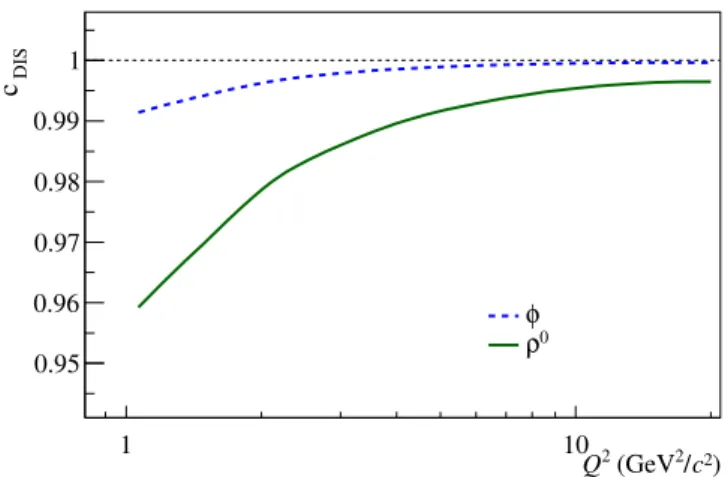
the largest contribution appearing at small Q2and z close to 0.6. The correction to DIS yields, cDIS vs Q2, is shown in Fig. 3. It is of the order of a few percent.
2.5 Systematic uncertainties
For the evaluation of systematic uncertainties the same studies are repeated as they were performed for the analysis of pions [13] and summarised here. A maximum uncertainty of 4% on the acceptance cor-rection is derived from the following studies: varying the PDF set used, varying the JETSET parameters, using a multi-dimensional space with additional variables and varying the detector efficiency applied in the MC simulation used for the acceptance calculation, as well as comparing multiplicity results from upstream and downstream target regions. The RICH identification and unfolding procedure leads to un-certainties typically below 1.5%. The uncertainty on the diffractive meson correction factor is on average below 1.5%; it is estimated assuming 30% uncertainty on the cross section for exclusive production of φ mesons [26], which is used to normalise the HEPGEN MC calculation. Possible nuclear effects due
Multiplicities of charged kaons from deep-inelastic muon scattering off an isoscalar target 5 z 0.2 0.3 0.4 0.5 0.6 0.7 0.8 − K φ c 0.75 0.8 0.85 0.9 0.95 1 1.83 < ) 2 c / 2 (GeV 2 Q < 1.13 3.50 < ) 2 c / 2 (GeV 2 Q < 2.50 10.0 < ) 2 c / 2 (GeV 2 Q < 7.00
Figure 2: Correction factor for negative kaon multiplicities due to diffractive production of vector meson φ shown versus z for three Q2regions.
) 2 c / 2 (GeV 2 Q 1 10 DIS c 0.95 0.96 0.97 0.98 0.99 1 0 ρ φ
Figure 3: Correction factor for DIS events due to diffractive production of vector mesons φ and ρ0shown versus Q2.
to the presence of3He/4He and6Li in the target material are expected to be very small and hence ne-glected. No time dependence is observed in the results obtained in 6 weeks of data taking. Also, the present results are found in agreement with an independent set of preliminary data taken in 2004 before the upgrade of the spectrometer. We chose to publish only the present set of data, which is of better quality and benefits from a larger spectrometer acceptance and an upgraded RICH detector.
In addition, a conservative estimate of 100% systematic uncertainty is assumed for the corrections for higher-order QED effects. This corresponds to a 1% to 7% systematic uncertainty on the multiplicities. All these contributions are added in quadrature and yield a total systematic uncertainty, σsyst, which varies between 5% and 10% depending on kinematics. It is generally larger than the statistical one at low z, whereas at higher z the statistical uncertainty dominates.
From the total systematic uncertainty a large fraction, 0.8σsyst, is estimated to be correlated from bin to bin, and the remaining fraction,p(1 − 0.82)σsyst, is uncorrelated.
3 Results for charged-kaon multiplicities
The results for K+and K−multiplicities represent a total of 630 experimental data points. In this section, results are shown first in the initial three-dimensional (x, y, z) representation, then averaged in y, and eventually also integrated over the z range from 0.2 to 0.85 in order to calculate the sum and ratio of K+
6 The COMPASS Collaboration
and K−multiplicities vs x. The data presented in the following figures are all corrected for the diffractive vector-meson contribution as described in Sect. 2.4. For completeness, the numerical values are available on HepData [27] for multiplicities with and without this correction. The separate correction factors for DIS and kaon yields are also provided, as are the factors used for the correction of radiative effects. The bin limits in x, y, and z are given in Table 1. The Q2 values range from 1 (GeV/c)2 at the smallest x
Table 1: Bin limits for the three-dimensional (x, y, z) representation. bin limits
x 0.004 0.01 0.02 0.03 0.04 0.06 0.1 0.14 0.18 0.4
y 0.1 0.15 0.2 0.3 0.5 0.7
z 0.2 0.25 0.3 0.35 0.4 0.45 0.5 0.55 0.6 0.65 0.7 0.75 0.85
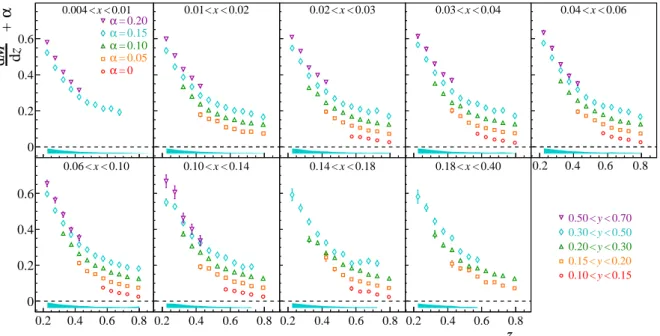
to about 60 (GeV/c)2at the largest x, with hQ2i = 3 (GeV/c)2. In Fig. 4 and Fig. 5, the results for the zand y dependences of the K+ and K− multiplicities are presented separately for the nine ranges in x. Statistical uncertainties are shown for all points, while the band on the bottom of the plots illustrates the size of the total systematic uncertainty for a single y range (0.30 − 0.50). For the other y ranges, the bands are similar or smaller in size. In Fig. 6, multiplicities of positive (closed circles) and negative (open circles) charged kaons are shown vs z, separately for the nine x ranges but averaged over y. The error bars correspond to the statistical uncertainties and the bands to the total systematic ones. A strong dependence on z is observed as in previous measurements [28] and a weak one on x. The multiplicities are systematically higher for K+as compared to K−because of u-quark dominance and since K−do not contain valence quarks from the nucleon.
α + + K z d M d 0 0.2 0.4 0.6 0.20 = α 0.15 = α 0.10 = α 0.05 = α 0 = α 0.01 < x < 0.004 0.2 0.4 0.6 0.8 0 0.2 0.4 0.6 0.10 < x < 0.06 0 0.2 0.4 0.6 0.02 < x < 0.01 0.2 0.4 0.6 0.8 0.14 < x < 0.10 0 0.2 0.4 0.6 0.03 < x < 0.02 0.2 0.4 0.6 0.8 0.18 < x < 0.14 0 0.2 0.4 0.6 0.04 < x < 0.03 0.2 0.4 0.6 0.8 0.40 < x < 0.18 0.2 0.4 0.6 0.8 0.06 < x < 0.04 0.2 0.4 0.6 0.8 0.70 < y < 0.50 0.50 < y < 0.30 0.30 < y < 0.20 0.20 < y < 0.15 0.15 < y < 0.10 zz
Figure 4: Multiplicities for K+shown vs z for the nine x ranges and the five y ranges (for better visibility staggered vertically by a constant α). The band corresponds to the total systematic uncertainty for the range 0.30 < y < 0.50. In Fig. 7, we present the ratio RK+/K−= (dMK+/dz)/(dMK−/dz) vs z in the nine x ranges. In this ratio, most of the systematic uncertainties cancel, including the one on radiative corrections, so that it provides a benchmark for future NLO fits. A steep rise in z is observed.
Since an important goal of the measurement of kaon multiplicities is the determination of quark-to-kaon FFs, the sum of positive and negative charged-kaon multiplicities is of special interest. It was used by HERMES [11] for a LO pQCD extraction of the product of the strange quark PDF and the strange
Multiplicities of charged kaons from deep-inelastic muon scattering off an isoscalar target 7 α + − K z d M d 0 0.2 0.4 0.6 0.20 = α 0.15 = α 0.10 = α 0.05 = α 0 = α 0.01 < x < 0.004 0.2 0.4 0.6 0.8 0 0.2 0.4 0.6 0.10 < x < 0.06 0 0.2 0.4 0.6 0.02 < x < 0.01 0.2 0.4 0.6 0.8 0.14 < x < 0.10 0 0.2 0.4 0.6 0.03 < x < 0.02 0.2 0.4 0.6 0.8 0.18 < x < 0.14 0 0.2 0.4 0.6 0.04 < x < 0.03 0.2 0.4 0.6 0.8 0.40 < x < 0.18 0.2 0.4 0.6 0.8 0.06 < x < 0.04 0.2 0.4 0.6 0.8 0.70 < y < 0.50 0.50 < y < 0.30 0.30 < y < 0.20 0.20 < y < 0.15 0.15 < y < 0.10 z
Figure 5: Same as Fig. 4 but for negative kaons.
K z d M d 0 0.2 0.4 0.01 < x < 0.004 0.2 0.4 0.6 0.8 0 0.2 0.4 0.10 < x < 0.06 0 0.2 0.4 0.02 < x < 0.01 0.2 0.4 0.6 0.8 0.14 < x < 0.10 0 0.2 0.4 0.03 < x < 0.02 0.2 0.4 0.6 0.8 0.18 < x < 0.14 0 0.2 0.4 0.04 < x < 0.03 0.2 0.4 0.6 0.8 0.40 < x < 0.18 0.06 < x < 0.04 0.2 0.4 0.6 0.8 z − K + K
Figure 6: Positive (closed) and negative (open) kaon multiplicities vs z for the nine x ranges. The bands correspond to the total systematic uncertainties.
quark-to-kaon FF. For the COMPASS kinematics, the applicability of the LO pQCD formalism to pion multiplicities was already demonstrated [13]. For an isoscalar target and assuming isospin and charge symmetry, the sum of K+ and K− multiplicities can be written in LO in a very simple way [24] . For multiplicities integrated over z,MK±=R
hMK±(x, y, z)iydz, the equation reads:
MK+
+MK−=UD K
U+ SDSK
5U + 2S , (6)
with U = u + ¯u+ d + ¯d, and S = s + ¯s. The z-integrated FFs,DK(Q2) =R
8 The COMPASS Collaboration − K z d M d / + K z d M d 1 2 3 0.01 < x < 0.004 0.2 0.4 0.6 0.8 0 5 10 15 0.06<x<0.10 1 2 3 0.02 < x < 0.01 0.2 0.4 0.6 0.8 0.14 < x < 0.10 1 2 3 0.03 < x < 0.02 0.2 0.4 0.6 0.8 0.18 < x < 0.14 1 2 3 0.04 < x < 0.03 0.2 0.4 0.6 0.8 0.40 < x < 0.18 1 2 3 0.06 < x < 0.04 0.2 0.4 0.6 0.8 z
Figure 7: Ratio of multiplicities (dMK+/dz)/(dMK−/dz) vs z for the nine x ranges. The bands correspond to the total systematic uncertainties.
only. The symbolsDUKandDSKdenote the combinations of FFs DUK= 4DuK++ 4DK¯u++DdK++D¯dK+and DK
S = 2DK
+
s + 2DK
+
¯s . At high values of x, the strange content of the nucleon can be neglected, and in a good approximation the sum of K+ and K−multiplicities is related toDK
U/5. This value is expected to have a rather weak Q2 dependence when integrated over z, so that it can be used at smaller values of xto determine the SDSKvalue. The result forMK++MK− is presented in Fig. 8 as a function of x at the measured values of Q2. The data are integrated over z in the range 0.20 to 0.85 and averaged over y in the range 0.1 to 0.7. Only those eight x bins which have a sufficient z coverage are shown. A weak xdependence is observed. Figure 8 also shows the HERMES results [11] that were taken at 27.6 GeV beam energy. They lie well below the COMPASS points and exhibit a different x behaviour.
From the COMPASS result onMK++MK− at high x (x = 0.25) we extractDUK≈ 0.65 − 0.70. This differs from the earlier DSS fit result at Q2= 3 (GeV/c)2, DUK= 0.43 ± 0.04 [6], which was mainly based on HERMES results. Towards low x, COMPASS data show a flat behaviour, unlike the rise that is suggested by the HERMES data and the DSS FF parametrisation [6].
2 − 10 10−1 1 0.1 0.15 0.2 x COMPASS HERMES ℳ K + + ℳ K −
Figure 8: Sum of z-integrated multiplicities,MK++MK−. COMPASS data (full points) are compared to HER-MES data [11] (open points). The bands show the total systematic uncertainties.
Multiplicities of charged kaons from deep-inelastic muon scattering off an isoscalar target 9
Another quantity of interest is the x dependence of the multiplicity ratio MK+/MK−, in which most experimental systematic effects cancel. The results are shown in Fig. 9 as a function of x. In the region of overlap, COMPASS results are found to be systematically lower than those of HERMES. In contrast, for the case of pions COMPASS and HERMES multiplicity ratios are found in good agreement [13].
2 − 10 10−1 1 1 1.5 2 2.5 x COMPASS HERMES ℳ K + /ℳ K −
Figure 9: Ratio of z-integrated multiplicities,MK+/MK−. COMPASS data (full points) are compared to HER-MES data [28] (open points). The bands show the total systematic uncertainties.
4 Summary and conclusions
Precise results for charged-kaon multiplicities are obtained from kaon SIDIS measurements using a muon beam scattering off an isoscalar target. The data are given in a three-dimensional x, y, and z representation and cover a wide kinematic range : 1 (GeV/c)2< Q2< 60 (GeV/c)2, 10−3< x < 0.7, 0.1 < y < 0.7, and 0.20 < z < 0.85 with W > 5 GeV/c2. They constitute an important input for future world-data analyses in order to constrain strange quark PDFs and FFs. The sum of K+and K−multiplicities integrated over z shows a flat distribution in x, with values significantly higher than those measured by HERMES at lower energy. By covering lower x values, the multiplicity sum data will significantly improve the constraint on the product of the strange quark PDF and FF, SDKstr. The present result points to a larger value ofDUK than obtained from the earlier DSS fit.
Acknowledgements
We gratefully acknowledge the support of the CERN management and staff and the skill and effort of the technicians of our collaborating institutes. This work was made possible by the financial support of our funding agencies.
References
[1] COMPASS Collaboration, M. G. Alekseev et al., Phys. Lett. B 647 (2007) 8; COMPASS Collaboration, C. Adolph et al., Phys. Lett. B 753 (2015) 18. [2] COMPASS Collaboration, M. G. Alekseev et al., Phys. Lett. B 680 (2009) 217. [3] COMPASS Collaboration, M. G. Alekseev et al., Phys. Lett. B 693 (2010) 227. [4] HERMES Collaboration, A. Airapetian et al, Phys. Rev D 71 (2005) 012003. [5] European Muon Collaboration, M. Arneodo et al., Nucl. Phys. B 321 (1989) 541. [6] D. de Florian, R. Sassot, M. Stratmann, Phys. Rev. D 75 (2007) 114010.
[7] E. Leader, A. V. Sidorov, and D. B. Stamenov, Phys. Rev. D 84 (2011) 014002. [8] BELLE Collaboration, M. Leitgab et al., Phys. Rev. Lett. 111 (2013) 062002;
10 The COMPASS Collaboration
BaBar Collaboration, J.P. Lees et al., Phys. Rev. D 88 (2013) 032011; ALEPH Collaboration, R. Barate et al., Phys. Rep. 294 (1998) 1; DELPHI Collaboration, O. Abreu et al., Eur. Phys. J. C 5 (1998) 585; OPAL Collaboration, R. Akers et al., Z. Phys. C 63 (1994) 181; SLD Collaboration, K. Abe et al., Phys. Rev. D 69 (2004) 072003.
[9] PHENIX Collaboration, S.S. Adler et al., Phys. Rev. Lett. 91 (2003) 241803; STAR Collaboration, J. Adams et al., Phys. Rev. Lett. 97 (2006) 152302; BRAHMS Collaboration, I. Arsene et al., Phys. Rev. Lett. 98 (2007) 252001.
[10] E. Leader, A.V. Sidorov and D. Stamenov, Importance of Semi-Inclusive DIS Processes in Determining Fragmentation Functions, Proceedings of the 15th Workshop on High Energy Physics (DSPIN-13), Dubna, Russia (2013), arXiv:1312.5200.
[11] HERMES Collaboration, A. Airapetian et al., Phys. Rev. D 89 (2014) 097101.
[12] E.L. Berger, Proceedings of the Workshop on Electronuclear Physics with Internal Targets, R. G. Arnold and R. C. Minehart (Eds.) 1987, ANL-HEP-CP-87-45.
[13] COMPASS Collaboration, C. Adolph et al., arXiv:1604.02695 submitted to Phys. Lett. B. [14] COMPASS Collaboration, P. Abbon et al., Nucl. Instrum. Meth. A 577 (2007) 455.
[15] A.A. Akhundov, D. Bardin, L. Kalinovskaya and T. Riemann, Fortschr. Phys. 44 (1996) 373. [16] I. Akushevich, H. Böttcher and D. Ryckbosch, Proceedings of the Workshop Monte Carlo
generators for HERA physics 1998/99 arXiv:9906408.
[17] I. Akushevich, public statement during the Precision Radiative Corrections for Next Generation Experiments workshop, 2016.
[18] P. Abbon et al., Nucl. Instr. Meth. A 631 (2011) 26.
[19] G. Ingelman, A. Edin and J. Rathsman, Comput. Phys. Commun. 101 (1997) 108. [20] T. Sjostrand, LU-TP-95-20, CERN-TH-7112-93-REV, hep-ph/9508391.
[21] COMPASS Collaboration, C. Adolph et al., Phys. Lett. B 718 (2013) 922. [22] R. Brun, M. Caillat, M. Maire, G. N. Patrick and L. Urban, CERN-DD/85/1.
[23] T.T. Bohlen et al., Nuclear Data Sheets 120 (2014) 211; A. Ferrari, P.R. Sala, A. Fasso, and J. Ranft, CERN-2005-10 (2005), INFN/TC-05/11, SLAC-R-773.
[24] HERMES Collaboration, A. Airapetian et al., Phys. Lett. B 666 (2008) 446.
[25] A. Sandacz and P. Sznajder, HEPGEN - generator for hard exclusive leptoproduction, arXiv:1207.0333.
[26] S.V. Goloskokov, P. Kroll, Eur. Phys. J. C 53 (2008) 367. [27] The Durham hepData Project, http://durpdg.dur.ac.ik.



![Figure 9: Ratio of z-integrated multiplicities, M K + / M K − . COMPASS data (full points) are compared to HER- HER-MES data [28] (open points)](https://thumb-eu.123doks.com/thumbv2/123dok_br/15775025.1076391/13.892.290.647.226.450/figure-ratio-integrated-multiplicities-compass-points-compared-points.webp)