Research Article
Impact Analysis of Travel Time Uncertainty on AGV Catch-Up
Conflict and the Associated Dynamic Adjustment
Jun-jun Li
,
1Bo-wei Xu
,
2Octavian Postolache
,
3Yong-sheng Yang
,
2and Hua-feng Wu
11Merchant Marine College, Shanghai Maritime University, Shanghai 201306, China
2Institute of Logistics Science & Engineering, Shanghai Maritime University, Shanghai 201306, China 3Instituto de Telecomunicacoes, ISCTE-IUL, Av. Das Forcas Armadas, 1049-001 Lisbon, Portugal
Correspondence should be addressed to Bo-wei Xu; [email protected]
Received 3 September 2017; Revised 31 December 2017; Accepted 11 February 2018; Published 19 April 2018 Academic Editor: Francisco Chicano
Copyright © 2018 Jun-jun Li et al. This is an open access article distributed under the Creative Commons Attribution License, which permits unrestricted use, distribution, and reproduction in any medium, provided the original work is properly cited. In automated logistics systems, travel time uncertainty can severely affect automated guided vehicle (AGV) conflict and path planning. Insight is required into how travel time uncertainty affects catch-up conflict, the main AGV conflict in one-way road networks. Under normal circumstances, the probability formula for catch-up conflict is deduced based on an analysis of AGV catch-up conflict. The vertex, monotonicity, and symmetry of catch-up conflict probabilities are developed, for symmetrical AGV travel time distribution densities. A dynamic adjustment method based on conflict probability for AGVs is designed. The probability features of catch-up conflicts and the performance of the associated dynamic adjustment are simulated and validated for AGVs at an automated container terminal. The simulation results show that the impact analysis of travel time uncertainty on AGV catch-up conflict is correct, and the dynamic adjustment is effective.
1. Introduction
Automated guided vehicles (AGVs) participate in unmanned transport systems for material handling [1]. In automated logistics systems, such as automated container terminals and automated warehouses, conflicts may arise when several AGVs run along a narrow lane or pass crossing roads [2]. AGV conflict (which can significantly affect actual AGV speeds, expected travel time, and automated logistic system throughput) has been a key issue in AGV path planning [3]. Many studies have focused on conflict avoidance strategies when studying AGV path planning [1, 4, 5]. Smolic-Rocak et al. used time window insertion in vector form and performed window overlapping tests to dynamically solve the shortest path problem for the supervisory control of AGVs traveling within the layout of a given warehouse [4]. Saidi-Mehrabad et al. considered a conflict-free routing problem (CFRP) for AGVs, as well as a basic job shop scheduling problem (JSSP) to minimize total completion time (make-span). They proposed a two-stage ant colony algorithm
(ACA) for this problem, especially for large-size problems [1]. Hidalgo-Paniagua et al. proposed a new multiobjective evolutionary approach based on a variable neighborhood search to produce good paths with shorter lengths, improved safety, and smoother mobile robot movements [5]. However, AGV transportation systems are subject to a high degree of uncertainty [6]. The above references simplified AGV conflict avoidance strategies for deterministic conditions, which might lead to suboptimal or even infeasible solutions. In the real world, AGV conflict on road networks is highly affected by AGV travel times, which are very uncertain because of roadway capacity variations and traffic demand fluctuations [7, 8]. Therefore, the on-time arrival probability of AGVs in automated logistics systems cannot be ensured, especially for a large number of AGVs operating in a limited area. An interesting queuing approach is used to model rout-ing problems with time-dependent travel time [9]. Strategies have been proposed to avoid stochastic travel time influence against unpredictable and random conflicts [10, 11]. Shao et al. used a two-stage traffic control strategy to resolve conflicts
Volume 2018, Article ID 4037695, 11 pages https://doi.org/10.1155/2018/4037695
and deadlock problems in AGV systems. Specifically, a traffic controller is employed to operate each moving AGV online
after utilizing an A∗algorithm to offline construct an optimal
path set for AGVs [10]. Zhang et al. formulated on-time ship-ment delivery problems as stochastic vehicle routing prob-lems with soft time windows under travel and service time uncertainties and proposed a new stochastic programming model for finding a good trade-off between the total cost borne by carriers and customer service levels [11]. However, measures such as scheduling methods and control strategies, which can temporarily prevent conflicts, may reduce the effi-ciency of AGV systems. Exclusive dependence on these mea-sures easily leads to queuing and congestion in heavy traffic. Therefore, reasonably preanalyzing AGV conflicts under random circumstances can facilitate shorter travel times and higher AGV utilization rates. However, there is not a way to compute the probability of AGV conflicts under uncertainty. Dynamic adjustment is a key measure to deal with con-flicts in the operations management of AGV systems. Lee et
al. employed a𝑘-shortest path search algorithm to construct
a path set and performed online motion planning operation in real time [12]. Li et al. proposed a set of real-time imple-mentable traffic rules to ensure the completion of all jobs with the absence of vehicle deadlocks and collisions [13]. Hoo-Lim et al. proposed a genetic algorithm to continuously optimize and adjust the traffic flow of AGVs for keeping up with the dynamically changing operational condition [14]. Different adjust strategies may result in different running state and dif-ferent productivity. It is better to analyze conflict probabilities and perform associated dynamical adjustment, rather than employ traditional adjustment as passive response measures to avoid conflicts among AGVs. Furthermore, many methods mentioned in the literature did not consider conflict proba-bilities in advance of dynamic adjustment, which might bring high frequency of control action, high operational cost, low efficiency, and service ability of automated logistics systems.
After studying the current literature, it is clear that the analysis of AGV conflicts under uncertainty has received less attention from the research community. In this work, catch-up conflict (the main type of AGV conflict in a one-way road network) probability and the associated dynamic adjustment are studied. Compared with the existing literature, the main contributions of this work are elucidated as follows. First, to meet the needs of operation management, AGVs’ travel times are set to random values and the AGV catch-up conflict problem in one-way and single lane road networks is described. Second, the catch-up conflict probability features are analyzed in detail in a situation where the probability density function for the times of AGVs passing through each node is symmetrical. Finally, the dynamic adjustment based on the conflict probability for AGVs is presented in order to reduce catch-up conflicts among AGVs.
2. AGV Catch-Up Conflict Probability and
Uncertain Travel Time
2.1. AGV Catch-Up Conflict Probability. A one-way and single
lane road network for an automated logistic system is denoted
by a graph with𝑁 nodes (𝐴1, 𝐴2, . . . , 𝐴𝑁) and 𝐵 links. 𝐴𝑘
and𝐴𝑙are the𝑘th and 𝑙th nodes, respectively, and they are
consecutive. There are 𝑃 AGVs (AGV1, AGV2, . . . , AGV𝑃).
The start node and end node of the𝑝th AGV (denoted as
AGV𝑝) are𝑆𝑝and𝐸𝑝, respectively.
Assume that AGV𝑝passes through node𝐴𝑘at time𝑡𝑝,𝑘.
The probability density function and cumulative distribution
function for time𝑡𝑝,𝑘are𝜑𝑝,𝑘(𝑡) and 𝐹𝑝,𝑘(𝑡), respectively. ∀𝑡 ∈
(−∞, +∞), 𝜑𝑝,𝑘(𝑡) < +∞. Once 𝑡𝑝,𝑘 ≤ 𝑡𝑞,𝑘and𝑡𝑝,𝑙 ≥ 𝑡𝑞,𝑙, or
𝑡𝑝,𝑘 ≥ 𝑡𝑞,𝑘 and𝑡𝑝,𝑙 ≤ 𝑡𝑞,𝑙, catch-up conflicts occur between
AGV𝑝 and AGV𝑞 (the 𝑞th AGV). A situation where two
AGVs repeatedly catch up with one another is not considered here.
Assuming that the movements of AGVs are mutually
independent, the events 𝑡𝑝,𝑘 ≤ 𝑡𝑞,𝑘 and 𝑡𝑝,𝑙 ≥ 𝑡𝑞,𝑙 are
independent of one another. Additionally,𝑡𝑝,𝑘 ≥ 𝑡𝑞,𝑘 and
𝑡𝑝,𝑙 ≤ 𝑡𝑞,𝑙are independent events. The probability of AGV
catch-up conflict event𝜍 is 𝑃(𝜍). It can be shown that
𝑃 (𝜍) = 𝑃 (𝑡𝑝,𝑘≤ 𝑡𝑞,𝑘) ⋅ 𝑃 (𝑡𝑝,𝑙≥ 𝑡𝑞,𝑙) + 𝑃 (𝑡𝑝,𝑘≥ 𝑡𝑞,𝑘) ⋅ 𝑃 (𝑡𝑝,𝑙≤ 𝑡𝑞,𝑙) , (1) where𝑃(𝑡𝑝,𝑘≤ 𝑡𝑞,𝑘) is shown in 𝑃 (𝑡𝑝,𝑘≤ 𝑡𝑞,𝑘) = ∫+∞ −∞ 𝜑𝑞,𝑘(𝜏) ∫ 𝜏 −∞𝜑𝑝,𝑘(𝑡) 𝑑𝑡 𝑑𝜏 = ∫+∞ −∞ 𝜑𝑞,𝑘(𝜏) 𝐹𝑝,𝑘(𝜏) 𝑑𝜏 (2) ∵ ∀𝑡 ∈ (−∞, +∞), 𝜑𝑝,𝑘(𝑡) < +∞, ∴ ∫𝜏𝜏𝜑𝑝,𝑘(𝑡)𝑑𝑡 = 0. ∴ 𝑃(𝑡𝑝,𝑘= 𝑡𝑞,𝑘) = ∫−∞+∞𝜑𝑞,𝑘(𝜏) ∫𝜏𝜏𝜑𝑝,𝑘(𝑡)𝑑𝑡 𝑑𝜏 = 0.
In this case,𝑃(𝜍) is shown in
𝑃 (𝜍) = 𝑃 (𝑡𝑝,𝑘≤ 𝑡𝑞,𝑘) ⋅ [1 − 𝑃 (𝑡𝑝,𝑙≤ 𝑡𝑞,𝑙)]
+ [1 − 𝑃 (𝑡𝑝,𝑘≤ 𝑡𝑞,𝑘)] ⋅ 𝑃 (𝑡𝑝,𝑙≤ 𝑡𝑞,𝑙)
= 𝑃 (𝑡𝑝,𝑘≤ 𝑡𝑞,𝑘) + 𝑃 (𝑡𝑝,𝑙≤ 𝑡𝑞,𝑙) − 2𝑃 (𝑡𝑝,𝑘≤ 𝑡𝑞,𝑘)
⋅ 𝑃 (𝑡𝑝,𝑙≤ 𝑡𝑞,𝑙) .
(3)
Let the times at which AGV𝑞passes through nodes𝐴𝑘
and𝐴𝑙be𝑡𝑞,𝑘+𝑥 and 𝑡𝑞,𝑙+𝑥, respectively, where 𝑥 indicates the
change in departure time for AGV𝑞. Meanwhile, let𝑔1(𝑥) =
𝑃(𝑡𝑝,𝑘 ≤ 𝑡𝑞,𝑘+ 𝑥 ), 𝑔2(𝑥) = 𝑃(𝑡𝑝,𝑙 ≤ 𝑡𝑞,𝑙+ 𝑥 ) and 𝑧(𝑥) = 𝑃(𝜍).
From (3), it is determined that
𝑧 (𝑥) = 𝑔1(𝑥) + 𝑔2(𝑥) − 2𝑔1(𝑥) ⋅ 𝑔2(𝑥) . (4)
2.2. Uncertain Travel Time
2.2.1. Travel Time Is Random. In an automated logistic
sys-tem, some AGVs may have the same design speed. If an AGV
travels exactly at the design speedV0, then its arrival time
at a node is𝑡 = 𝑡0. In practice, because of uncertainty (e.g.,
the actual arrival time is a random variable. Assuming that the various uncertainties are arbitrary, the probability density function of the random variable would be symmetrical about
𝑡 = 𝑡0.
Two probability distribution functions (uniform distribu-tion [8, 15] and normal distribudistribu-tion [15, 16]) widely used in engineering are specified in (5) and (6), respectively.
𝜑 (𝑡) ={{ { 0.5 𝛿 , 𝑡 ∈ (𝑡0− 𝛿, 𝑡0+ 𝛿) 0, else, (5) 𝜑 (𝑡) = 1 √2𝜋𝜎𝑒−(𝑡−𝑡0) 2/2𝜎2 , (6) where𝛿 > 0, 𝜎 > 0.
2.2.2. Travel Speed Is Random. When the speeds of AGVs
change randomly, the times at which the AGVs pass through
nodes become random. Here,V𝑝 denotes the actual speed
of AGV𝑝. Similar to (5) and (6), the uniform and normal
distributions ofV𝑝are given in (7) and (8), respectively.
𝜙 (V) ={{ { 0.5 𝛿, V ∈ (V0− 𝛿, V0+ 𝛿) 0, else (7) 𝜙 (V) = 1 √2𝜋𝜎𝑒 −(V−V0)2/2𝜎2, (8)
where𝛿> 0, 𝜎> 0. If the departure time of AGV𝑝is𝑥, then
the time at which it passes through node𝑘 is 𝑡𝑝,𝑘= 𝑥 +𝐿𝑝,𝑘/V𝑝,
where𝐿𝑝,𝑘is the distance traveled by AGV𝑝from node𝑆𝑝to
node𝑘. If the probability density function of V𝑝is𝜙𝑝(V), then
the probability density function of𝑡𝑝,𝑘is
𝜑𝑝,𝑘(𝑡) = 𝐿𝑝,𝑘
(𝑡 − 𝑥)2𝜙𝑝(
𝐿𝑝,𝑘
𝑡 − 𝑥) . (9)
In Section 3, the impact of travel time uncertainty on catch-up conflict described in Section 2.1 is analyzed; subsequently, catch-up conflicts caused by uncertain travel time described in Section 2.2 are simulated in Section 5.
3. Impact of Travel Time Uncertainty on
Catch-Up Conflict
The catch-up conflict between two AGVs is the basis for catch-up conflicts among multiple AGVs. Catch-up conflict
probabilities between AGV𝑝and AGV𝑞are analyzed here.
First, on the basis of distribution characteristics of
𝑃(𝑡𝑝,𝑘 ≤ 𝑡𝑞,𝑘 + 𝑥 ) and 𝑃(𝑡𝑝,𝑙 ≤ 𝑡𝑞,𝑙 + 𝑥 ), the symmetry
and monotonicity of 𝑃(𝜍) are analyzed by Theorem 1 and
Inference 2, respectively. Second, according to the
symme-tries of𝜑𝑝,𝑘(𝑡) and 𝜑𝑞,𝑘(𝑡), the symmetry of 𝑃(𝑡𝑝,𝑘 ≤ 𝑡𝑞,𝑘+
𝑥) is analyzed using Theorem 3. Finally, the distribution
characteristics of𝑃(𝜍) are comprehensively analyzed using
Inference 4.
Theorem 1. If 𝑃(𝑡𝑝,𝑘 ≤ 𝑡𝑞,𝑘 + 𝑥 ) and 𝑃(𝑡𝑝,𝑙 ≤ 𝑡𝑞,𝑙+ 𝑥 ) are
symmetric about point(𝑥0, 0.5), then 𝑃(𝜍) is symmetric about
𝑥 = 𝑥0and𝑧(𝑥0) = 0.5.
Inference 2. If both 𝑃(𝑡𝑝,𝑘 ≤ 𝑡𝑞,𝑘) and 𝑃(𝑡𝑝,𝑙 ≤ 𝑡𝑞,𝑙) are
symmetric about point(𝑥0, 0.5), and both 𝑔1(𝑥) and 𝑔2(𝑥)
monotonically increase (or monotonically decrease), then
𝑃(𝜍) is an increasing function when 𝑥 ≤ 𝑥0, or vice versa.
Theorem 3. If 𝜑𝑝,𝑘(𝑡) and 𝜑𝑞,𝑘(𝑡) are symmetric about 𝑡 = 𝑡1
and𝑡 = 𝑡2, respectively, then𝑃(𝑡𝑝,𝑘 ≤ 𝑡𝑞,𝑘+ 𝑥 ) is symmetric
about point(𝑡1− 𝑡2, 0.5).
Inference 4. If the following conditions are met in AGV𝑝and
AGV𝑞:
(1) the times at which AGV𝑝 and AGV𝑞 pass through
node𝐴𝑘are𝑡𝑝,𝑘and𝑡𝑞,𝑘+ 𝑥, respectively. The times at which
AGV𝑝and AGV𝑞pass through node𝐴𝑙are𝑡𝑝,𝑙and𝑡𝑞,𝑙+ 𝑥,
respectively.
(2) 𝜑𝑝,𝑘(𝑡), 𝜑𝑞,𝑘(𝑡), 𝜑𝑝,𝑙(𝑡), and 𝜑𝑞,𝑙(𝑡) are the interval
distributions 𝜑𝑝,𝑘(𝑡) > 0, 𝑡 ∈ (𝑐𝑝,𝑘, 𝑑𝑝,𝑘) , 𝜑𝑝,𝑘(𝑡) = 0, 𝑡 ∉ (𝑐𝑝,𝑘, 𝑑𝑝,𝑘) , 𝜑𝑞,𝑘(𝑡) > 0, 𝑡 ∈ (𝑐𝑞,𝑘, 𝑑𝑞,𝑘) , 𝜑𝑞,𝑘(𝑡) = 0, 𝑡 ∉ (𝑐𝑞,𝑘, 𝑑𝑞,𝑘) , 𝜑𝑝,𝑙(𝑡) > 0, 𝑡 ∈ (𝑐𝑝,𝑙, 𝑑𝑝,𝑙) , 𝜑𝑝,𝑙(𝑡) = 0, 𝑡 ∉ (𝑐𝑝,𝑙, 𝑑𝑝,𝑙) , 𝜑𝑞,𝑙(𝑡) > 0, 𝑡 ∈ (𝑐𝑞,𝑙, 𝑑𝑞,𝑙) , 𝜑𝑞,𝑙(𝑡) = 0, 𝑡 ∉ (𝑐𝑞,𝑙, 𝑑𝑞,𝑙) , (10)
respectively.𝑐𝑝,𝑘,𝑑𝑝,𝑘,𝑐𝑞,𝑘,𝑑𝑞,𝑘,𝑐𝑝,𝑙,𝑑𝑞,𝑙,𝑐𝑞,𝑙, and𝑑𝑞,𝑙are all real
numbers.𝑐𝑝,𝑘< 𝑑𝑝,𝑘,𝑐𝑞,𝑘< 𝑑𝑞,𝑘,𝑐𝑝,𝑙< 𝑑𝑞,𝑙, and𝑐𝑞,𝑙< 𝑑𝑞,𝑙.
(3)𝜑𝑝,𝑘(𝑡), 𝜑𝑞,𝑘(𝑡), 𝜑𝑝,𝑙(𝑡), and 𝜑𝑞,𝑙(𝑡) are symmetric about
𝑡 = 𝑡1, 𝑡2, 𝑡3and𝑡4, respectively, where𝑡1− 𝑡2= 𝑡3− 𝑡4.
Thence,𝑃(𝜍) is symmetric about 𝑥0 = 𝑡1 − 𝑡2, and𝑃(𝜍)
conforms to Formula (11), where𝑆𝑘= [𝑐𝑝,𝑘− 𝑑𝑞,𝑘, 𝑑𝑝,𝑘− 𝑐𝑞,𝑘],
𝑆𝑙= [𝑐𝑝,𝑙− 𝑑𝑞,𝑙, 𝑑𝑝,𝑙− 𝑐𝑞,𝑙], 𝑆𝑘∪ 𝑆𝑙= [𝑎, 𝑏]. 𝑃 (𝜍) = 𝑧 (𝑥) is { { { { { { { { { { { { { { { 0.5, 𝑥 = 𝑥0 monotonically increasing, 𝑥 ∈ [𝑎, 𝑥0] monotonically decreasing, 𝑥 ∈ [𝑥0, 𝑏] 0, 𝑥∈ (−∞, 𝑎] ∪ [𝑏, +∞) . (11)
Similarly, if some intervals of (𝑐𝑝,𝑘, 𝑑𝑝,𝑘), (𝑐𝑞,𝑘, 𝑑𝑞,𝑘),
(𝑐𝑝,𝑙, 𝑑𝑝,𝑙), and (𝑐𝑞,𝑙, 𝑑𝑞,𝑙) change to closed intervals, Inference
4 is true; if one of these intervals is adjusted to(−∞, +∞)
(such as𝑐𝑝,𝑘, 𝑑𝑝,𝑘→ −∞) Inference 4 remains true.
The above analysis can provide premise and basis for dynamic adjustment and help to reduce catch-up conflicts among AGVs.
4. Dynamic Adjustment Based on
Conflict Probability
Dynamic adjustment based on conflict probability may change the traditional passive response mode to taking the initiative in avoiding conflicts among AGVs. This could pro-vide substantial productivity improvement for AGV trans-portation systems.
If all catch-up conflict probabilities are considered, the difficulty and complexity of AGVs planning will increase and the process would involve more calculation. Hence, based on the catch-up conflict probability features revealed
in Inference 4, a catch-up conflict probability threshold𝑇ccp
(0 < 𝑇ccp< 0.5) is considered for improving the efficiency of
AGVs planning. If the catch-up conflict probability is larger
than𝑇ccp, then the AGVs with low priority replan their paths;
else, the AGVs with low priority simply slow down or wait to avoid conflicts once the potential catch-up conflicts happen. When the AGVs with low priorities replan their paths, the
links with “𝑃(𝜍) > 𝑇ccp” in path preplanning are eliminated
from their optional links in the corresponding time windows.
Checking “𝑃(𝜍) > 𝑇ccp” and path replanning by the AGVs
with low priorities are executed until “𝑃(𝜍) > 𝑇ccp” does not
exist. Then all catch-up conflict probabilities are lower than
𝑇ccp. Low conflict probabilities would result in few conflicts,
which will greatly reduce the negative impact of conflicts on AGVs operation.
Details are as follows.
The dynamic adjustment flow of AGVs is given in Figure 1. First, the priorities of AGVs are set, and the
catch-up conflict probability threshold𝑇ccpis given. The steps of
dynamic adjustment are listed below.
Step 1. After path preplanning based on Dijkstra’s algorithm
for each AGV, it can be known whether different AGVs will pass through the same nodes. If such nodes do not exist, the AGVs will move according to their path plan; else, turn to Step 2.
Step 2. Calculate the catch-up conflict probability 𝑃(𝜍). If
𝑃(𝜍) > 𝑇ccp, the AGVs with low priorities replan their paths
based on Dijkstra’s algorithm with time window and recheck
whether the catch-up conflict probability exceeds𝑇ccpuntil
the catch-up conflict probability is lower than𝑇ccp; else, turn
to Step 3.
Step 3. AGVs travel according to their path planning. In the
process of AGVs traveling, the potential catch-up conflicts are detected by sensors on AGVs. If a catch-up conflict is predicted to occur, the AGVs with low priorities slow down or wait to avoid conflicts; else, AGVs move on.
In the dynamic adjustment based on conflict probability,
it is important to check “𝑃(𝜍) > 𝑇ccp.” However, it is different
from detecting potential conflicts. On the one hand, “𝑃(𝜍) >
𝑇ccp” is checked by calculation, while potential conflicts are
detected by sensors. On the other hand, checking “𝑃(𝜍) >
𝑇ccp” is just after AGVs path preplanning and before AGVs
starting to move, whereas, detecting potential conflicts is
Y Y Y N N N
Does catch-up conflict probability exceed the threshold?
AGVs with low priorities replan path Do different AGVs pass
through the same nodes?
Is a catch-up conflict predicted to occur?
AGVs with low priorities slow down or wait to avoid conflicts
AGVs move on AGVs path preplanning
AGVs move
Potential catch-up conflicts are detected by sensors on AGVs
Figure 1: Dynamic adjustment based on conflict probability.
ahead of the node that AGVs will reach and in the process of AGVs moving.
5. Simulations on Catch-Up Conflict
5.1. Simulation Settings. Automated container terminals are
typical automated logistics systems. Because of the notable uncertainty characteristics at automated container terminals, conflicts among AGVs are particularly common, resulting in new bottlenecks of loading and unloading operations. Therefore, it is extremely important to take AGVs at auto-mated container terminals as an example for analyzing catch-up conflict probabilities, using simulations to enhance the operational abilities of AGVs and improve the overall efficiency of automated container terminals. Figure 2 shows the road network of an automated container terminal. Roads in the network are one-way and single lanes. “QC” and “YC” indicate the quay crane and yard crane, respectively.
V0is 5 m/s. The horizontal and vertical path lengths are 260
and 90 m, respectively. Nodes 1–63 are road network nodes.
1 2 3 5 6 8 9 14 15 17 18 26 28 29 31 32 30 30 30 30 20 30 10 10 10 60 D/m a 64 d 67 e 68 f 69 b 65 c 66 g 70 4 13 27 20 7 16 30 30 12 20 21 23 24 22 25 10 19 33 20 20 11 37 38 41 42 53 56 57 60 61 35 55 39 58 34 45 46 49 51 48 52 44 63 A B C 36 43 47 50 54 59 62 40 10 YC QC D: distance !'6p !'6q
Figure 2: Road network layout and AGVs’ paths at an automated container terminal.
following parameters are defined based on the statistics of an actual automated container terminal with annual throughput capacity of 5 million TEU.
The red and purple lines denote the travel paths of AGV𝑝
and AGV𝑞, respectively. Both AGV𝑝and AGV𝑞pass through
link (28, 29), which may cause catch-up conflict. It can be
calculated that𝑡1 = 20 s,𝑡3 = 26 s,𝑡2= 4 s, and𝑡4 = 10 s. If
the departure time of AGV𝑝and AGV𝑞is both 0 s, let𝑡𝑝,28
and𝑡𝑝,29denote the actual times at which AGV𝑝reach nodes
28 and 29, respectively, and let𝑡𝑞,28and𝑡𝑞,29denote the actual
times at which AGVqreach nodes 28 and 29, respectively. The
departure time of AGV𝑞 changes to𝑥 s; the actual times at
which AGV𝑞reach nodes 28 and 29 are𝑡𝑞,28+ 𝑥 and 𝑡𝑞,29+ 𝑥,
respectively. Here,𝑃(𝜍) = 𝑧(𝑥) is simulated to verify the
impact analysis of travel time uncertainty on catch-up conflict in Section 3.
𝜑(𝑡) in (5) and (6) are employed in 𝜑𝑝,28(𝑡), 𝜑𝑞,28(𝑡),
𝜑𝑝,29(𝑡), and 𝜑𝑞,29(𝑡). For the convenience, 𝛿𝑝and𝜎𝑝denote
𝛿 and 𝜎 in 𝜑𝑝,28(𝑡) and 𝜑𝑝,29(𝑡), respectively, while 𝛿𝑞and𝜎𝑞
denote𝛿 and 𝜎 in 𝜑𝑞,28(𝑡) and 𝜑𝑞,29(𝑡), respectively.
Inference 4 in Section 3 is a summary of the conflict prob-ability characteristics. Therefore, only Inference 4 is verified in Section 5. Both “Conditions of Inference 4 are exactly met” and “Conditions of Inference 4 are approximately met” are simulated with MATLAB.
5.2. Conditions of Inference 4 Are Exactly Met
5.2.1. 𝜑(𝑡) Is Unrelated to Travel Distance. 𝛿 and 𝜎 in (5) and
(6) remain constant. Generally, the times at which an AGV passes through adjacent nodes obey the same type of prob-ability distribution. According to different combinations of uniform and normal distributions, there are three situations
Table 1: Distributions and parameters in𝜑(𝑡).
𝜑𝑝,28(𝑡), 𝜑𝑝,29(𝑡) 𝜑𝑞,28(𝑡), 𝜑𝑞,29(𝑡) A Distribution Uniform Uniform
𝛿 1 or 2.5 0.25 or 1
B Distribution Normal Normal 𝜎 0.5 or 1 0.25 or 0.5 C Distribution Uniform Normal
𝛿/𝜎 1 or 2 0.25 or 0.5 Table 2: Parameters in𝜑(𝑡). 𝜑𝑝,28(𝑡), 𝜑𝑝,29(𝑡) 𝜑𝑞,28(𝑡), 𝜑𝑞,29(𝑡) A 𝛿 0.01𝐿 or 0.025𝐿 0.01𝐿 or 0.025𝐿 B 𝜎 0.005𝐿 or 0.015𝐿 0.005𝐿 or 0.015𝐿 C 𝛿/𝜎 0.01𝐿 or 0.025𝐿 0.01𝐿 or 0.015𝐿
(A, B, and C) in which the distributions and parameters are set according to Table 1.
Through simulation, catch-up probabilities changing
with𝑥 in the three situations in Table 1 are shown in Figures
3(a), 3(b), and 3(c), respectively. Four curves in each figure stand for four cases.
5.2.2. 𝜑(𝑡) Is Related to Travel Distance. 𝛿 and 𝜎 in (5) and
(6) change with travel distance. Here,𝐿 denotes the travel
distance from the start point to the current node. There are
three situations in which the distributions of𝜑𝑝,28(𝑡), 𝜑𝑞,28(𝑡),
𝜑𝑝,29(𝑡), and 𝜑𝑞,29(𝑡) are the same as shown in Table 1. The
10 12 14 16 18 20 22 0 0.25 0.5 x (s) C o nflic t p roba b ili ty p= 1, q= 0.25 p= 1, q= 1 p= 2.5, q= 0.25 p= 2.5, q= 1 (a) C o nflic t p roba b ili ty 0 0.25 0.5 10 12 14 16 18 20 22 x (s) p= 0.5, q= 0.25 p= 0.5, q= 0.5 p= 1, q= 0.25 p= 1, q= 0.5 (b) C o nflic t p roba b ili ty 0 0.25 0.5 10 12 14 16 18 20 22 x (s) p= 1, q= 0.25 p= 1, q= 0.5 p= 2, q= 0.25 p= 2, q= 0.5 (c)
Figure 3: Catch-up conflict probability changes in Section 5.2.1.
Table 3: Parameters in𝜑(𝑡).
𝜑𝑝,28(𝑡), 𝜑𝑝,29(𝑡) 𝜑𝑞,28(𝑡), 𝜑𝑞,29(𝑡)
A 𝛿 0.01𝐿 or 0.025𝐿 0.01(𝐿 + V0𝑥) or 0.025(𝐿 + V0𝑥)
B 𝜎 0.005𝐿 or 0.015𝐿 0.005(𝐿 + V0𝑥) or 0.015(𝐿 + V0𝑥)
C 𝛿/𝜎 0.01𝐿 or 0.025𝐿 0.01(𝐿 + V0𝑥) or 0.015(𝐿 + V0𝑥).
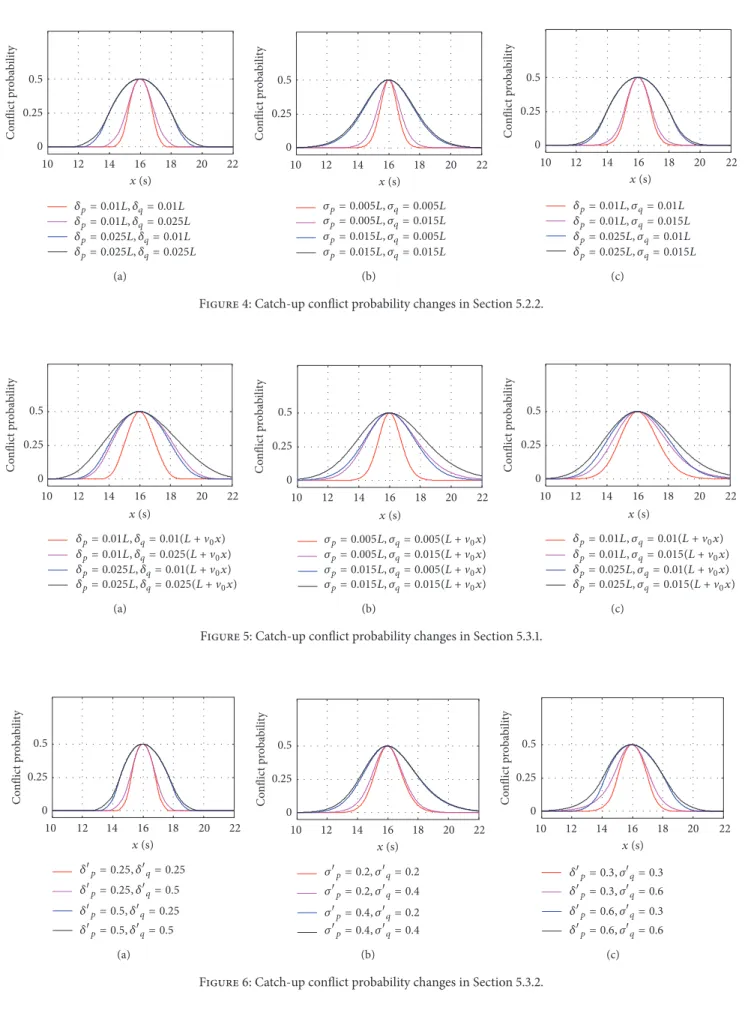
Simulated catch-up probabilities changing with𝑥 in the
three situations in Table 2 are shown in Figures 4(a), 4(b), and 4(c), respectively.
5.3. Conditions of Inference 4 Are Approximately Met
5.3.1. 𝜑(𝑡) Is Related to Travel Distance and 𝑥. For example,
the value of 𝛿𝑞 or 𝜎𝑞 in 𝜑𝑞,28(𝑡) and 𝜑𝑞,29(𝑡) is related to
𝐿 + V0𝑥. In this case, it does not exactly meet the conditions
of Inference 4. However, if 𝜑𝑞,28(𝑡) and 𝜑𝑞,29(𝑡) do not
change significantly with 𝑥, the conditions of Inference 4
are met approximately. There are three situations in which
the distributions of𝜑𝑝,28(𝑡), 𝜑𝑞,28(𝑡), 𝜑𝑝,29(𝑡), and 𝜑𝑞,29(𝑡) are
the same as shown in Table 1. The parameters are shown in Table 3.
Simulated catch-up probabilities changing with𝑥 in the
three situations in Table 3 are shown in Figures 5(a), 5(b), and 5(c), respectively.
5.3.2. Travel Speed Is Random. When the probability density
function of travel speed has symmetric distribution, 𝜑(𝑡)
often is not strictly symmetric distribution. But if𝜑(𝑡) has
an approximately symmetric distribution and 𝜑𝑞,28(𝑡) and
𝜑𝑞,29(𝑡) change little with 𝑥, it can also be approximately
consistent with the conclusions of Inference 4.
Let the probability density function of travel speed be of
both uniform and normal distributions.𝜙(V) in (7) and (8)
are employed in𝜙𝑝(V) and 𝜙𝑞(V). For convenience, 𝛿𝑝 and
𝜎𝑝denote𝛿and𝜎in𝜙𝑝(V), respectively, and 𝛿𝑞and𝜎𝑞
denote𝛿and𝜎in𝜙𝑞(V), respectively. Similarly, according to
different combinations of travel speed in uniform and normal distributions, there are three situations shown in Table 4.
Table 4: Distributions and parameters in𝜙(V). 𝜙𝑝(V) 𝜙𝑞(V) A Distribution Uniform Uniform
𝛿 0.25 or 0.5 0.25 or 0.5
B Distribution Normal Normal 𝜎 0.2 or 0.4 0.2 or 0.4
C Distribution Uniform Normal 𝛿/𝜎 0.3 or 0.6 0.3 or 0.6
Simulated catch-up probabilities changing with𝑥 in the
three situations in Table 4 are shown in Figures 6(a), 6(b), and 6(c), respectively.
5.4. Discussions
5.4.1. Discussions about Section 5.2. In the situations in
Sections 5.2.1 and 5.2.2,𝑥0 = 𝑡1 − 𝑡2 = 𝑡3 − 𝑡4 = 16 s.
In Figures 2 and 3, they are all symmetrical about𝑥 = 16 s;
when 𝑥 = 16 s, 𝑃(𝜍) = 𝑧(𝑥) reaches its maximum value
(0.5). In accordance with the cases in Sections 5.2.1 and 5.2.2,
monotonically increasing and decreasing intervals of𝑃(𝜍) =
𝑧(𝑥) obtained by simulations are shown in Tables 5 and 6, which are consistent with Inference 4.
In situation B of Sections 5.2.1 and 5.2.2, 𝑐𝑝,28, 𝑐𝑝,29,
𝑐𝑞,28, 𝑐𝑞,29 → −∞ and 𝑑𝑝,28, 𝑑𝑝,29, 𝑑𝑞,28, 𝑑𝑞,29 → +∞. In
situation C of Sections 5.2.1 and 5.2.2, 𝑐𝑝,28, 𝑐𝑝,29, 𝑑𝑝,28,
and 𝑑𝑝,29 are limited real numbers, 𝑐𝑞,28, 𝑐𝑞,29 → −∞,
𝑑𝑞,28, 𝑑𝑞,29→ +∞. In these four situations, 𝑆28= (−∞, +∞),
𝑆29= (−∞, +∞), and 𝑆𝑘∪ 𝑆𝑙= (−∞, +∞). Therefore, 𝑃(𝜍) =
0 0.25 0.5 C o nflic t p roba b ili ty 10 12 14 16 18 20 22 x (s) p= 0.01L, q= 0.01L p= 0.01L, q= 0.025L p= 0.025L, q= 0.01L p= 0.025L, q= 0.025L (a) 0 0.25 0.5 C o nflic t p roba b ili ty 10 12 14 16 18 20 22 x (s) p= 0.005L, q= 0.005L p= 0.005L, q= 0.015L p= 0.015L, q= 0.005L p= 0.015L, q= 0.015L (b) 0 0.25 0.5 C o nflic t p roba b ili ty 10 12 14 16 18 20 22 x (s) p= 0.01L, q= 0.01L p= 0.01L, q= 0.015L p= 0.025L, q= 0.01L p= 0.025L, q= 0.015L (c)
Figure 4: Catch-up conflict probability changes in Section 5.2.2.
0 0.25 0.5 C o nflic t p roba b ili ty 10 12 14 16 18 20 22 x (s) p= 0.01L, q= 0.01(L + 0x) p= 0.01L, q= 0.025(L + 0x) p= 0.025L, q= 0.01(L + 0x) p= 0.025L, q= 0.025(L + 0x) (a) 0 0.25 0.5 C o nflic t p roba b ili ty 10 12 14 16 18 20 22 x (s) p= 0.005L, q= 0.005(L + 0x) p= 0.005L, q= 0.015(L + 0x) p= 0.015L, q= 0.005(L + 0x) p= 0.015L, q= 0.015(L + 0x) (b) 0 0.25 0.5 C o nflic t p roba b ili ty 10 12 14 16 18 20 22 x (s) p= 0.01L, q= 0.01(L + 0x) p= 0.01L, q= 0.015(L + 0x) p= 0.025L, q= 0.01(L + 0x) p= 0.025L, q= 0.015(L + 0x) (c)
Figure 5: Catch-up conflict probability changes in Section 5.3.1.
0 0.25 0.5 C o nflic t p roba b ili ty 10 12 14 16 18 20 22 x (s) p= 0.25, q= 0.25 p= 0.25, q= 0.5 p= 0.5, q= 0.25 p= 0.5, q= 0.5 (a) 0 0.25 0.5 C o nflic t p roba b ili ty 10 12 14 16 18 20 22 x (s) p= 0.2, q= 0.2 p= 0.2, q= 0.4 p= 0.4, q= 0.2 p= 0.4, q= 0.4 (b) 0 0.25 0.5 C o nflic t p roba b ili ty 10 12 14 16 18 20 22 x (s) p= 0.3, q= 0.3 p= 0.3, q= 0.6 p= 0.6, q= 0.3 p= 0.6, q= 0.6 (c)
Table 5:𝑥’s intervals of 𝑃(𝜍) = 𝑧(𝑥) in situation A of Section 5.2.1.
Monotonicity of interval 𝛿𝑝= 1,𝛿𝑞= 0.25 𝛿𝑝= 1,𝛿𝑞= 1 𝛿𝑝= 2.5,𝛿𝑞= 0.25 𝛿𝑝= 2.5,𝛿𝑞= 1
Increasing [14.75, 16] [14, 16] [13.25, 16] [12.5, 16]
Decreasing [16, 17.25] [16, 18] [16, 18.75] [16, 19.5]
Table 6:𝑥’s intervals of 𝑃(𝜍) = 𝑧(𝑥) in situation A of Section 5.2.2.
Monotonicity of interval 𝛿𝑝= 0.01𝐿, 𝛿𝑞= 0.01𝐿 𝛿𝑝= 0.01𝐿, 𝛿𝑞= 0.025𝐿 𝛿𝑝= 0.025𝐿, 𝛿𝑞= 0.01𝐿 𝛿𝑝= 0.025𝐿, 𝛿𝑞= 0.025𝐿 Increasing [14.2, 16] [13.45, 16] [12.25, 16] [11.5, 16] Decreasing [16, 17.8] [16, 18.55] [16, 19.75] [16, 20.5]
Table 7:𝑥’s intervals of 𝑃(𝜍) = 𝑧(𝑥) in situation A of Section 5.3.1. Monotonicity of interval 𝛿𝑝= 0.01𝐿, 𝛿𝑞= 0.01(𝐿 + V0𝑥) 𝛿𝑝= 0.01𝐿, 𝛿𝑞= 0.025(𝐿 + V0𝑥) 𝛿𝑝= 0.025𝐿, 𝛿𝑞= 0.01(𝐿 + V0𝑥) 𝛿𝑝= 0.025𝐿, 𝛿𝑞= 0.025(𝐿 + V0𝑥) Increasing [13.52, 16.00], 2.48 [11.96, 16.00], 4.04 [11.67, 16.00], 4.33 [10.22, 16.00], 5.78 Decreasing [16.00, 18.64], 2.64 [16.00, 21.10], 5.10 [16.00, 20.62], 4.62 [16.00, 23.24], 7.24
Table 8:𝑥’s intervals of 𝑃(𝜍) = 𝑧(𝑥) in situation A of Section 5.3.2.
Monotonicity of interval 𝛿𝑝= 0.25,𝛿𝑞= 0.25 𝛿𝑝= 0.25,𝛿𝑞= 0.5 𝛿𝑝= 0.5,𝛿𝑞= 0.25 𝛿𝑝= 0.5,𝛿𝑞= 0.5 Increasing [14.24, 15.99], 1.75 [13.66, 15.99], 2.33 [13.12, 15.99], 2.87 [12.53, 15.99], 3.46 Decreasing [15.99, 17.72], 1.73 [15.99, 18.27], 2.28 [15.99, 19.18], 3.19 [15.99, 19.79], 3.8
[16, +∞), which is consistent with Figures 3(b), 3(c), 4(b), and 4(c).
In summary, the simulation results are consistent with the conclusions in Inference 4.
5.4.2. Discussions about Section 5.3. In Figures 5(a)–5(c),
the vertexes of the all curves are all (16.00, 0.50). From
the simulation results, the monotonically increasing and
decreasing intervals for 𝑃(𝜍) = 𝑧(𝑥) in situation A of
Section 5.3.1 are shown in Table 7. “[13.52, 16.00], 2.48” indicates that the increasing interval is [13.52 s, 16.00 s], and the length of this interval is 2.48 s. Although there are some differences among the lengths for increasing and decreasing intervals in each situation, it can be seen from Figure 5 that the catch-up probabilities are all approximately symmetrical
about𝑥 = 16 s.
In Figure 6(a), the vertexes of the four curves are all (15.99, 0.50). The monotonically increasing and decreasing
intervals for𝑃(𝜍) = 𝑧(𝑥) situation A of in Section 5.3.2 are
shown in Table 8. The indication of “[14.24, 15.99], 1.75” is the same as Table 7. It can be seen that the catch-up probabilities
are also approximately symmetrical about𝑥 = 16 s.
From Figures 5(b), 5(c), 6(b), and 6(c), it can be seen that, in each situation, the vertex of the catch-up probabilities is
approximately (16.00, 0.50); 𝑃(𝜍) = 𝑧(𝑥) is approximately
symmetrical about 𝑥 = 16 s; 𝑃(𝜍) = 𝑧(𝑥) monotonically
increases in (−∞, 16] and decreases in [16, +∞),
approxi-mately.
In summary, the probabilities of catch-up conflict changes in Section 5.3 are similar to the conclusions of Inference 4.
5.5. Simulation Conclusions and Time Window Setting. From
simulation results of catch-up conflict probability, it is known that the catch-up conflict probability reaches its maximum
when 𝑥 = 𝑥0. When 𝑥 gradually decreases or increases
from𝑥0, the catch-up conflict probability gradually decreases.
At last, the catch-up conflict probability is 0, or is close to 0. These probability features of AGV catch-up conflicts provide references for time window setting of the dynamic adjustment under uncertain travel time.
In the dynamic adjustment as detailed in Section 4, it is necessary to calculate the time windows. However, it is complicated to calculate them precisely according to Sec-tion 2. In contrast, it is simple and practical to apply Inference 4 and simulation conclusions of Section 5 to approximate calculation of time windows in AGVs operation. This feasible and beneficial strategy is as follows: for the link with “𝑃(𝜍) >
𝑇ccp” after path preplanning, the corresponding𝑥 is initially
recorded. And then the𝑥 which makes |𝑥−𝑥0| be the
histori-cal maximum is set as𝑥𝑚, followed by the corresponding time
window[𝑥0− |𝑥𝑚− 𝑥0|, 𝑥0+ |𝑥𝑚− 𝑥0|]. Finally, in the process
of path replanning, if𝑥 is in the range [𝑥0−|𝑥𝑚−𝑥0|, 𝑥0+|𝑥𝑚−
𝑥0|], logistics manager can determine that the corresponding
path is unacceptable (because of “𝑃(𝜍) > 𝑇ccp,” which can
be seen from Inference 4 and simulation conclusions of Section 5). Else, calculate the catch-up probability according
to Section 2. After the calculation, if “𝑃(𝜍) > 𝑇ccp” still holds,
update𝑥𝑚 and the corresponding time window. Although
this strategy cannot obtain the precise time windows at once, it is very favorable for AGV transportation systems since high time savings and improved efficiency encourage logistics
Table 9: Comparisons of adjustment effectiveness. Adjustment strategy “𝑃(𝜍) > 𝑇Number of
ccp” Maximum conflict probability Average conflict probability Number of conflicts Average travel time Sensor detection 23 0.43 0.24 13 46.58 Conflict probability 0 0.23 0.13 2 38.17
managers to implement effectively. Therefore, this strategy is employed in Section 6.
6. Simulation on Dynamic Adjustment
The dynamic adjustment in Section 4 is verified by ten AGVs at an automated container terminal as shown in Figure 1.
The priority of AGVs is set as AGV1 > AGV2 > ⋅ ⋅ ⋅ >
AGV10.𝑇ccp = 0.25, which is half of the maximum of the
probability of catch-up conflict. The design speeds of AGVs are all 5 m/s, and the departure times of AGVs are random
values in [0 s, 10 s]. The starting nodes and final nodes are
random in quayside cranes and yard cranes. The probability density functions for times AGVs passing through nodes
are related to travel distance and 𝑥, and they are random
probability density functions in Sections 5.2 and 5.3. The data about catch-up conflicts of AGVs are shown in Table 9.
The data in the second row of Table 9 are referencing AGVs which avoid conflict only by sensor detection. In this mode, AGVs with low priority slow down or wait once con-flicts happen, and no dynamic adjustment is executed. The data in the third row of Table 9 are with reference to AGVs with dynamic adjustment detailed in Section 4. From
Fig-ure 1, it can be seen that some events of “𝑃(𝜍) > 𝑇ccp” might
occur in the process of the dynamic adjustment, although
“𝑃(𝜍) > 𝑇ccp” can be avoided after the dynamic adjustment.
Here, in the third row of Table 9, “Number of ‘𝑃(𝜍) > 𝑇ccp’”
is the number of “𝑃(𝜍) > 𝑇ccp” after the dynamic adjustment.
“Number of conflicts” is the number of catch-up conflicts that have occurred after the dynamic adjustment.
From Table 9, it can be observed that the number of
“𝑃(𝜍) > 𝑇ccp,” maximum conflict probability, average conflict
probability, number of conflicts, and average travel time of AGVs adjustment strategy based on conflict probability are quite smaller than those of AGVs adjustment strategy based on sensor detection.
The number of “𝑃(𝜍) > 𝑇ccp” about AGVs adjustment
strategy based on conflict probability is 0, whereas the number of catch-up conflicts is more than 0. This is because
the situation in which𝑃(𝜍) ≤ 𝑇ccphas not been dealt with in
dynamic adjustment.
Although the catch-up conflict cannot be eliminated completely in the execution of the dynamic adjustment strategy based on conflict probability, the number of conflicts has been greatly reduced. Such few potential conflicts will not cause serious problems in AGVs, because AGVs with low priorities can slow down or wait to avoid conflicts.
In brief, the dynamic adjustment based on conflict prob-ability is superior to the traditional adjustment based on detection using sensors. The proposed method lowers the frequency of control action and brings higher efficiency and
service ability of AGVs. The proposed method is suitable for the adjustment of path planning with uncertain travel time and has a high accuracy and practicability.
7. Conclusion
Travel time is crucial for the execution of transportation tasks. However, travel time uncertainty is one of the main defects of the loading and unloading operations often used in AGVs. This uncertainty affects AGV conflict and inevitably increases the variability in automated logistics systems. Higher travel time uncertainty leads to more difficult and complex path planning for AGVs.
To meet the demands of practical applications, this work considers the travel time uncertainty of AGVs, studies the impact of travel time uncertainty on AGV catch-up conflict, and designs the dynamic adjustment based on conflict proba-bility for AGVs. The probaproba-bility features of catch-up conflicts and the performances of the associated dynamic adjustment are simulated and validated for AGVs at an automated container terminal. The simulation results show that the con-clusions proposed in this work are correct, and the dynamic adjustment is effective. Moreover, the findings of the present work provide theoretical and decision-making bases for the improvement of automated logistics systems efficiency.
In the future, related work in different areas will be extended. First, the impact of other uncertainties, such as task arrival time and task assignment, on AGV conflict will be analyzed and verified in real automated logistics systems. Second, intelligent algorithms based on conflict probability for AGVs conflict-free path planning under uncertain envi-ronments will be designed.
Appendix
Proof of Theorem 1. ∵ 𝑔1(𝑥) is symmetric about point
(𝑥0, 0.5). ∴ 𝑔1(𝑥0+ Δ𝑥 ) + 𝑔1(𝑥0− Δ𝑥 ) = 2𝑔1(𝑥0) = 1. Similarly, 𝑔2(𝑥0+ Δ𝑥 ) + 𝑔2(𝑥0− Δ𝑥 ) = 1. From (3),𝑧(𝑥) = 𝑔1(𝑥) + 𝑔2(𝑥) − 2𝑔1(𝑥) ⋅ 𝑔2(𝑥). Thence,𝑧(𝑥0+Δ𝑥) = 𝑔1(𝑥0−Δ𝑥)+𝑔2(𝑥0−Δ𝑥)−2𝑔1(𝑥0− Δ𝑥)𝑔2(𝑥0− Δ𝑥 ) = 𝑧(𝑥0− Δ𝑥 ).
Therefore,𝑃(𝜍) = 𝑧(𝑥) is symmetric about 𝑥 = 𝑥0.
In addition,𝑧(𝑥0) = 𝑔1(𝑥0) + 𝑔2(𝑥0) − 2𝑔1(𝑥0) ⋅ 𝑔2(𝑥0) =
0.5.
Then, Theorem 1 has been proven.
Proof of Inference 2.
Case 1. Both𝑔1(𝑥) and 𝑔2(𝑥) monotonically increase; then
𝑔1(𝑥1) < 𝑔1(𝑥2) ≤ 0.5 and 𝑔2(𝑥1) < 𝑔2(𝑥2) ≤ 0.5 when
From (3), 𝑧(𝑥1) − 𝑧(𝑥2) < 2𝑔1(𝑥2)[𝑔2(𝑥2) − 𝑔2(𝑥1)] +
𝑔2(𝑥1) − 𝑔2(𝑥2) ≤ 0.
Therefore,𝑃(𝜍) = 𝑧(𝑥) is an increasing function when
𝑥 ≤ 𝑥0. From Theorem 1,𝑃(𝜍) is symmetric about 𝑥 = 𝑥0.
Therefore,𝑃(𝜍) is a decreasing function when 𝑥 > 𝑥0.
Case 2. Both𝑔1(𝑥) and 𝑔2(𝑥) monotonically decrease, then
𝑔1(𝑥1) < 𝑔1(𝑥2) ≤ 0.5 and 𝑔2(𝑥1) < 𝑔2(𝑥2) ≤ 0.5 when
𝑥1 > 𝑥2 ≥ 𝑥0. Similar to Case 1, it can be derived that𝑃(𝜍) is
an increasing function when𝑥 > 𝑥0.
Therefore, Inference 2 has been proven.
Proof of Theorem 3. (1)∵ 𝜑𝑝,𝑘(𝑡) and 𝜑𝑞,𝑘(𝑡) are symmetric
about𝑡 = 𝑡1and𝑡 = 𝑡2, respectively.
∴ 𝐹𝑝,𝑘(𝑡1) = 𝐹𝑞,𝑘(𝑡2) = 0.5, 𝐹𝑝,𝑘(𝑡), and 𝐹𝑞,𝑘(𝑡2) are
symmetric about points (𝑡1, 0.5) and (𝑡2, 0.5), respectively; the
probability density function of𝑡𝑞,𝑘+ 𝑥 is 𝜑𝑞,𝑘(𝑡 − 𝑥), which is
symmetric about𝑡 = 𝑡2+ 𝑥.
∴ 𝑔(𝑥) = ∫−∞+∞𝜑𝑞,𝑘(𝜏 − 𝑥)𝐹𝑝,𝑘(𝜏)𝑑𝜏.
Let𝑥0= 𝑡1− 𝑡2; then𝑔(𝑥0) is shown in
𝑔 (𝑥0) = ∫+∞ −∞ 𝜑𝑞,𝑘(𝜏 − 𝑡1+ 𝑡2) 𝐹𝑝,𝑘(𝜏) 𝑑𝜏. (A.1) Let𝑢(𝜏) = 𝜑𝑞,𝑘(𝜏 − 𝑡1+ 𝑡2)𝐹𝑝,𝑘(𝜏); then 𝑢(𝑡1− Δ𝑡) = 𝜑𝑞,𝑘(𝑡2− Δ𝑡)𝐹𝑝,𝑘(𝑡1− Δ𝑡), ∴ 𝑢(𝑡1− Δ𝑡) + 𝑢(𝑡1+ Δ𝑡) = 𝜑𝑞,𝑘(𝑡2+ Δ𝑡) ∴ 𝑔(𝑥0) = ∫𝑡+∞ 2 𝜑𝑞,𝑘(𝑡)𝑑𝑡 = 0.5. (2) From (A.1),𝑔(𝑥0− Δ𝑥 ) + 𝑔(𝑥0+ Δ𝑥 ) = ∫−∞+∞[𝜑𝑞,𝑘(𝜏 − 𝑥0+ Δ𝑥 ) + 𝜑𝑞,𝑘(𝜏 − 𝑥0− Δ𝑥)]𝐹𝑝,𝑘(𝜏)𝑑𝜏. Let 𝜓(𝜏) = 𝜑𝑞,𝑘(𝜏 − 𝑥0+ Δ𝑥 ) + 𝜑𝑞,𝑘(𝜏 − 𝑥0− Δ𝑥 ) and 𝜅(𝜏) = 𝜓(𝜏)𝐹𝑝,𝑘(𝜏). Then,𝑔(𝑥0− Δ𝑥 ) + 𝑔(𝑥0+ Δ𝑥 ) = ∫−∞+∞𝜅(𝑡)𝑑𝑡. In addition,𝜓(𝑡1−Δ𝑡) = 𝜑𝑞,𝑘(𝑡2−Δ𝑡+Δ𝑥)+𝜑𝑞,𝑘(𝑡2−Δ𝑡− Δ𝑥), ∴ 𝜅(𝑡1−Δ𝑡)+𝜅(𝑡1+Δ𝑡) = 2𝐹𝑝,𝑘(𝑡1)𝜓(𝑡1+Δ𝑡) = 𝜓(𝑡1+Δ𝑡). ∴ ∫0+∞𝜅(𝑡1−Δ𝑡)𝑑(Δ𝑡)+∫0+∞𝜅(𝑡1+Δ𝑡)𝑑(Δ𝑡) = ∫0+∞𝜙(𝑡1+ Δ𝑡)𝑑(Δ𝑡). ∴ 𝑔(𝑥0− Δ𝑥 ) + 𝑔(𝑥0+ Δ𝑥 ) = ∫𝑡+∞ 1 𝜓(𝑡)𝑑𝑡, ∫ +∞ 𝑡1 𝜑𝑞,𝑘(𝜏 − 𝑥0+ Δ𝑥)𝑑𝜏 = 1 − 𝐹𝑞,𝑘(𝑡2+ Δ𝑥 ). Similarly,∫𝑡+∞ 1 𝜑𝑞,𝑘(𝜏 − 𝑥0− Δ𝑥)𝑑𝜏 = 1 − 𝐹𝑞,𝑘(𝑡2− Δ𝑥 ), ∴ 𝑔(𝑥0− Δ𝑥 ) + 𝑔(𝑥0+ Δ𝑥 ) = 1 = 2𝑔(𝑥0).
In summary,𝑃(𝑡𝑝,𝑘 ≤ 𝑡𝑞,𝑘+ 𝑥 ) is symmetric about point
(𝑡1− 𝑡2, 0.5).
Proof of Inference 4. Let𝑆𝑘∩ 𝑆𝑙 = [𝑒, 𝑓]; then [𝑒, 𝑓] ⊆ [𝑎, 𝑏].
From Theorem 3,𝑃(𝑡𝑝,𝑘≤ 𝑡𝑞,𝑘+ 𝑥 ) = 𝑔1(𝑥) and 𝑃(𝑡𝑝,𝑙≤ 𝑡𝑞,𝑙+
𝑥 ) = 𝑔2(𝑥) are both symmetric about the point (𝑡1− 𝑡2, 0.5).
And then from Theorem 1,𝑃(𝜍) = 𝑧(𝑥) is symmetric about
𝑥0= 𝑡1− 𝑡2, and𝑧(𝑥0) = 0.5. Then 𝑔1(𝑥) is { { { { { { { { { 0, 𝑥 ≤ 𝑐𝑝,𝑘− 𝑑𝑞,𝑘 monotonically increasing, 𝑥 ∈ [𝑐𝑝,𝑘− 𝑑𝑞,𝑘, 𝑑𝑝,𝑘− 𝑐𝑞,𝑘] 1, 𝑥 ≥ 𝑑𝑝,𝑘− 𝑐𝑞,𝑘, 𝑔2(𝑥) is { { { { { { { { { 0, 𝑥 ≤ 𝑐𝑝,𝑙− 𝑑𝑞,𝑙 monotonically increasing, 𝑥 ∈ [𝑐𝑝,𝑙− 𝑑𝑞,𝑙, 𝑑𝑝,𝑙− 𝑐𝑞,𝑙] 1, 𝑥 ≥ 𝑑𝑝,𝑙− 𝑐𝑞,𝑙. (A.2)
From Theorem 3,𝑥0= 𝑡1− 𝑡2is the midpoint of𝑆𝑘= [𝑐𝑝,𝑘−
𝑑𝑞,𝑘, 𝑑𝑝,𝑘−𝑐𝑞,𝑘] and 𝑆𝑙= [𝑐𝑝,𝑙−𝑑𝑞,𝑙, 𝑑𝑝,𝑙−𝑐𝑞,𝑙]. Therefore, 𝑆𝑘 ⊆ 𝑆𝑙
or𝑆𝑘⊇ 𝑆𝑙.
From Inference 2,𝑃(𝜍) = 𝑧(𝑥) increases when 𝑥 ∈ [𝑒, 𝑥0],
while 𝑃(𝜍) = 𝑧(𝑥) decreases when 𝑥 ∈ [𝑥0, 𝑓]. If 𝑥 ∈
(−∞, 𝑎] ∪ [𝑏, +∞), then 𝑔1(𝑥) = 𝑔2(𝑥) = 0 and 𝑧(𝑥) = 0.
Here, the relationships between𝑆𝑘and𝑆𝑙are discussed for
three cases.
Case 1.𝑆𝑘 = 𝑆𝑙; then𝑆𝑘∪ 𝑆𝑙= 𝑆𝑘∩ 𝑆𝑙(that is,[𝑒, 𝑓] ⊆ [𝑎, 𝑏]); ∴ Formula (11) is true.
Case 2 (𝑆𝑘 ⊂ 𝑆𝑙). If𝑥 ∈ [𝑎, 𝑒], then 𝑔2(𝑥) ∈ (0, 1), 𝑔1(𝑥) =
0, and 𝑧(𝑥 ) = 𝑃(𝜍) = 𝑔2(𝑥) > 0; ∴ 𝑔2(𝑥) and 𝑧(𝑥)
are monotonically increasing; if 𝑥 ∈ [𝑓, 𝑏], then 𝑔2(𝑥) ∈
(0, 1), 𝑔1(𝑥) = 1, and 𝑧(𝑥) = 𝑃(𝜍) = 1 − 𝑔2(𝑥) > 0.
Therefore,𝑔2(𝑥) is monotonically increasing, while 𝑧(𝑥) is
monotonically decreasing. Therefore, Formula (11) is true.
Case 3(𝑆𝑘⊃ 𝑆𝑙). Being similar to Case 2, Formula (11) is true
when𝑆𝑘⊃ 𝑆𝑙.
Therefore, Inference 4 has been proven.
Conflicts of Interest
The authors declare that they have no conflicts of interest.
Acknowledgments
This work was supported by the Ministry of Education of Humanities and Social Science Project (Grants nos. 15YJC630145 and 15YJC630059) and Natural Science Foun-dation of Shanghai Science and Technology Committee (Grant no. 15ZR1420200).
References
[1] M. Saidi-Mehrabad, S. Dehnavi-Arani, F. Evazabadian, and V. Mahmoodian, “An Ant Colony Algorithm (ACA) for solving
the new integrated model of job shop scheduling and conflict-free routing of AGVs,” Computers & Industrial Engineering, vol. 86, pp. 2–13, 2015.
[2] M. Zhang, R. Batta, and R. Nagi, “Modeling of workflow congestion and optimization of flow routing in a manufactur-ing/warehouse facility,” Management Science, vol. 55, no. 2, pp. 267–280, 2009.
[3] H. Fazlollahtabar, M. Saidi-Mehrabad, and E. Masehian, “Math-ematical model for deadlock resolution in multiple AGV scheduling and routing network: A case study,” Industrial Robot:
An International Journal, vol. 42, no. 3, pp. 252–263, 2015.
[4] N. Smolic-Rocak, S. Bogdan, Z. Kovacic, and T. Petrovic, “Time windows based dynamic routing in multi-AGV systems,” IEEE
Transactions on Automation Science and Engineering, vol. 7, no.
1, pp. 151–155, 2010.
[5] A. Hidalgo-Paniagua, M. A. Vega-Rodr´ıguez, and J. Ferruz, “Applying the MOVNS (multi-objective variable neighborhood search) algorithm to solve the path planning problem in mobile robotics,” Expert Systems with Applications, vol. 58, pp. 20–35, 2016.
[6] G. Zou, T. Li, and Y. Qin, “Automated Guide Vehicles Dynamic Scheduling Based on Annealing Genetic Algorithm,”
Telkom-nika, vol. 11, no. 5, pp. 2508–2515, 2013.
[7] C. Wei, Y. Asakura, and T. Iryo, “A probability model and sam-pling algorithm for the inter-day stochastic traffic assignment problem,” Journal of Advanced Transportation, vol. 46, no. 3, pp. 222–235, 2012.
[8] T. Zhang, W. A. Chaovalitwongse, and Y. Zhang, “Scatter search for the stochastic travel-time vehicle routing problem with simultaneous pick-ups and deliveries,” Computers & Operations
Research, vol. 39, no. 10, pp. 2277–2290, 2012.
[9] T. Van Woensel, L. Kerbache, H. Peremans, and N. Vandaele, “A queueing framework for routing problems with time-dependent travel times,” Journal of Mathematical Modelling and
Algorithms, vol. 6, no. 1, pp. 151–173, 2007.
[10] S. Shao, Z. Xia, G. Chen, and J. Zhang, “A new scheme of multi-ple automated guided vehicle system for collision and deadlock free,” in Proceedings of the IEEE International Conference on
Information Science & Technology, pp. 606–610, Washington, D.
C., USA, 2014.
[11] J. Zhang, W. H. Lam, and B. Y. Chen, “A stochastic vehicle routing problem with travel time uncertainty: trade-off between cost and customer service,” Networks and Spatial Economics, vol. 13, no. 4, pp. 471–496, 2013.
[12] J. H. Lee, B. H. Lee, and M. H. Choi, “A real-time traffic control scheme of multiple AGV systems for collision free minimum time motion: A routing table approach,” IEEE Transactions on
Systems, Man and Cybernetics, Part A: Systems and Humans, vol.
28, no. 3, pp. 347–358, 1998.
[13] Q. Li, J. T. Udding, and A. Y. Pogromsky, “Modeling and control of the AGV system in an automated container terminal,” in
Proceedings of the 30th IASTED Conference on Modelling, Iden-tification, and Control, AsiaMIC 2010, pp. 166–173, Thailand,
November 2010.
[14] K. Hoo-Lim, C. Ri, P. Tae-Jin, and R. Kwang-Ryel, “Dynamic Optimization of the Traffic Flow of AGVs in an Automated Container Terminal,” Journal of KIISE: Computing Practices and
Letters, vol. 16, no. 5, pp. 591–595, 2010.
[15] L. Chen, M. H. H`a, A. Langevin, and M. Gendreau, “Optimizing road network daily maintenance operations with stochastic ser-vice and travel times,” Transportation Research Part E: Logistics
and Transportation Review, vol. 64, pp. 88–102, 2014.
[16] P. Burnos, J. Gajda, Z. Marszałek et al., “Road Traffic Parameters Measuring System with Variable Structure,” Metrology and
Hindawi www.hindawi.com Volume 2018
Mathematics
Journal of Hindawi www.hindawi.com Volume 2018 Mathematical Problems in Engineering Applied Mathematics Hindawi www.hindawi.com Volume 2018Probability and Statistics Hindawi
www.hindawi.com Volume 2018
Hindawi
www.hindawi.com Volume 2018
Mathematical PhysicsAdvances in
Complex Analysis
Journal ofHindawi www.hindawi.com Volume 2018
Optimization
Journal of Hindawi www.hindawi.com Volume 2018 Hindawi www.hindawi.com Volume 2018 Engineering Mathematics International Journal of Hindawi www.hindawi.com Volume 2018 Operations Research Journal of Hindawi www.hindawi.com Volume 2018Function Spaces
Abstract and Applied AnalysisHindawi www.hindawi.com Volume 2018 International Journal of Mathematics and Mathematical Sciences Hindawi www.hindawi.com Volume 2018
Hindawi Publishing Corporation
http://www.hindawi.com Volume 2013 Hindawi www.hindawi.com
World Journal
Volume 2018 Hindawiwww.hindawi.com Volume 2018Volume 2018
Numerical Analysis
Numerical Analysis
Numerical Analysis
Numerical Analysis
Numerical Analysis
Numerical Analysis
Numerical Analysis
Numerical Analysis
Numerical Analysis
Numerical Analysis
Numerical Analysis
Numerical Analysis
Advances inAdvances in Discrete Dynamics in Nature and SocietyHindawi www.hindawi.com Volume 2018 Hindawi www.hindawi.com Differential Equations International Journal of Volume 2018 Hindawi www.hindawi.com Volume 2018