Tangram – Revista de Educação Matemática, Dourados - MS – v.3 n.3, pp. 44-59 (2020)
Este obra está licenciada com uma Licença Creative Commons Atribuição-NãoComercial-CompartilhaIgual 3.0 Brasil.
44
The Hybrid Teaching Model: A Proposal Continuing Education for First
Grade Teachers
Um Modelo de Ensino Híbrido: Uma Proposta para Formação
Continuada de Professores Pedagogos
Un Modelo de Enseñanza Híbrida: una propuesta para la Formación
Continua de los Profesores Pedagogos
Celina Aparecida Almeida Pereira Abar Programa de Estudos Pós-Graduados em Educação Matemática da PUC-SP
São Paulo, Brasil,
Orcid:0000-0002-6685-9956 Renata Udvary Rodrigues Doutoranda em Educação Matemática pelo Programa de Estudos Pós-Graduados em Educação Matemática da PUC-SP São Paulo, Brasil,
[email protected] Orcid:0000-0002-8543-5622
Marcio Vieira de Almeida Doutor em Educação Matemática pelo Programa de Estudos Pós-Graduados em Educação Matemática da PUC-SP São Paulo, Brasil,
[email protected] Orcid:0000-0001-7188-3806 Enviado:21/09/2020 Aceito:25/09/2020 DOI: 10.30612/tangram.v3i3.12742
Tangram – Revista de Educação Matemática, Dourados - MS – v.3 n.3, pp. 44-59 (2020)
Este obra está licenciada com uma Licença Creative Commons Atribuição-NãoComercial-CompartilhaIgual 3.0 Brasil.
45
Abstract: This paper presents part of the results of a project that aimed to investigate whether
strategies used for continuing education of first grade teachers, using a Hybrid Teaching model, “Flipped Classroom” could be a favorable instrument for the continued training of elementary school teachers in the context of Mathematics (Shulman,1987), in particular Geometry. The proposal was an attempt to seek the improvement of didactic concepts and practices for the teaching of Geometry in the early years of basic school, addressing theoretical (Van Hiele,1986) and methodological aspects and with the use of digital technologies, especially GeoGebra software. A training was offered with the proposal of empowering educators, who teach in elementary school, to teach Plane Geometry with the use of digital technologies and encourage them in the continuous search for professional improvement. The teachers participated for creating the proposed model, offering their respective areas of expertise, and contributing to significant results.
Keywords: Teacher training pedagogues. Inverted Classroom. GeoGebra.
Resumo: Este artigo apresenta parte dos resultados de um projeto que teve como objetivo
investigar se as estratégias utilizadas para a formação continuada de professores pedagogos utilizando um modelo de Ensino Híbrido – "Sala de Aula Invertida" poderia ser um instrumento favorável para a formação continuada de professores no contexto da Matemática (Shulman,1987), em especial da Geometria. A proposta foi uma tentativa de buscar o aprimoramento de conceitos e práticas didáticas para o ensino de Geometria nos primeiros anos do ensino fundamental, abordando aspectos teóricos (Van Hiele,1986) e metodológicos e com o uso de tecnologias digitais, especialmente o software GeoGebra. Foi oferecida uma capacitação com a proposta de capacitar educadores, que lecionam no ensino fundamental, a ensinar Geometria Plana com o uso de tecnologias digitais e incentivá-los na busca contínua pelo aperfeiçoamento profissional. Os professores participaram da criação de um modelo proposto, em suas respectivas áreas de atuação, contribuindo para resultados significativos.
Palavras-chave: Formação de professores pedagogos. Sala de Aula Invertida. GeoGebra.
Resumen: Este artículo presenta parte de los resultados de un proyecto para investigar si las estrategias utilizadas para la educación contínua de los pedagogos, utilizando un modelo de “Enseñanza Híbrida”, podría ser un instrumento favorable para la formación de los profesores en el contexto de las Matemáticas (Shulman,1987), especialmente la geometría.
Tangram – Revista de Educação Matemática, Dourados - MS – v.3 n.3, pp. 44-59 (2020)
Este obra está licenciada com uma Licença Creative Commons Atribuição-NãoComercial-CompartilhaIgual 3.0 Brasil.
46
La propuesta fue un intento de buscar la mejora de los conceptos didácticos y prácticas para la enseñanza de la Geometría en los primeros años de la escuela primaria, abordando aspectos teóricos (Van Hiele,1986) y metodológicos y con el uso de tecnologías digitales, especialmente software GeoGebra. Se ofreció formación con la propuesta de capacitar a educadores, que enseñan en la escuela primaria, para enseñar Geometría Plana con el uso de tecnologías digitales y animarlos en la búsqueda contínua de la mejora profesional. Los profesores participaron en la creación de un modelo propuesto, en sus respectivas áreas de actividad, contribuyendo con resultados significativos.
Palabras- clave: Formación de pedagogos. Aula Invertida. GeoGebra.
Introduction
This paper describes some results of a proposed approach to the continuing education of first grade teachers, which was developed by the authors, using the Flipped Classroom (FC) model. Geometry concepts were covered, including both two-dimensional and three-dimensional geometry, developed using the dynamic software GeoGebra. The Hybrid Teaching model was used to encourage the teachers to pursue continuous improvement, and to suggest that the FC may be an option to that end.
The distinct roles played by the authors in creating this proposal enabled a collaborative effort, which positively impacted the continuing education of the participants, especially at in-person meetings, when the activities presented here were discussed. Each author contributed to the activities that were to be conducted using his or her own expertise, in an effort to ensure a quality result.
This study addresses the mathematical training of teachers of the lower elementary grades in Brazil, where the need for teachers to improve is well known, especially with respect to geometry. This provides the rationale for the FC model used.
Tangram – Revista de Educação Matemática, Dourados - MS – v.3 n.3, pp. 44-59 (2020)
Este obra está licenciada com uma Licença Creative Commons Atribuição-NãoComercial-CompartilhaIgual 3.0 Brasil.
47
Aspects of some theories were presented to the teachers, using texts made available online, such as: Van Hiele’s theory of the importance of geometric thinking and his concern with reconciling different representations in the study of his objects in the process of constructing geometrical concepts; aspects of teaching geometry in accordance with official guidelines; and the potential contributions of digital technology to classroom practice.
The suggestions made through texts and meetings about the supporting materials, with regard to GeoGebra, relate to the point made by Shulman (1987), Kenski (2008) and Koehler, Mishra & Yahya (2007) that teachers require a knowledge base comprised of a set of understandings, skills, and dispositions needed for effective action in specific teaching and learning situations, and which underlie the decision-making process.
These authors justify the selection of the Technology, Pedagogy, Content Knowledge (TPCK) framework to analyze changes in the way teachers interact with technology, because TPCK consists of integrating the three pillars of knowledge: technology, pedagogy, and content. The understanding and negotiation of relationships among these three components are of special interest within group interactions.
Mishra & Koehler (2006) write that the approach to technological and pedagogical knowledge of content goes beyond training teachers in these three knowledge bases separately, emphasizing that the new skills required of teachers are found in the intersections among them.
The research methodology used, Design Research, according to Collins et al. (2004), was considered with the objective of improving the proposed model. It can be understood as an ongoing improvement of the study, which consists of applying a first version of a project, allowing verification and analysis of how it is working, and, subsequently, the ongoing revision of the project based on experiences that have been collected and evaluated, until the obstacles that arise in the process have been minimized. Theory, questions, and issues should also be addressed, for the research to be shown to be effective, thereby attaining the double goals of improvement in theory and in practice.
Tangram – Revista de Educação Matemática, Dourados - MS – v.3 n.3, pp. 44-59 (2020)
Este obra está licenciada com uma Licença Creative Commons Atribuição-NãoComercial-CompartilhaIgual 3.0 Brasil.
48
According to Collins et al. (2004), the success or failure of an innovation depends on the application of different techniques to evaluate different dependent and independent variables. Dependent variables can be understood to mean variables in mood, learning, and systemic variables; independent variables can be understood to mean the environment, the nature of the learners, the necessary resources, and support for implementation, such as professional development, financial requirements, and a pathway to implementation.
The Design Research method was used because the proposal is focused on continuing education for first grade teachers using technological resources.
Despite the interference of the variables discussed by Collins et al. (2004), the data were analyzed such that the entire process was analyzed in alignment with the objectives of the study.
The model used in this study was inspired by the Flipped Classroom model, and it is important to clarify that this method is not limited to the simple inversion of the form of presenting the content and activities. This approach requires planning and attitude changes on the part of both teachers and students.
Active methodologies, in a connected and digital world, are expressed through Hybrid Teaching models, in many possible combinations. Hybrid means mixed, or blended. It is possible to teach and learn in countless ways, at any time, in many spaces, because this process has become much more perceptible, broad, and deep due to the mobility and connectivity that now exists: this is a more open and creative ecosystem; we learn in groups and we learn alone, we learn intentionally and we learn spontaneously.
With respect to professional development, we believe the training, based on the Flipped Classroom model, achieved its purpose when it yielded more significant, productive, and participative meetings, making more effective use of time to increase the teachers’ knowledge.
Tangram – Revista de Educação Matemática, Dourados - MS – v.3 n.3, pp. 44-59 (2020)
Este obra está licenciada com uma Licença Creative Commons Atribuição-NãoComercial-CompartilhaIgual 3.0 Brasil.
49
The training was undertaken in modules with topics established in advance: the objective, mathematical content, relevant technological resources and physical spaces to be used, following the aspects of the FC model adopted in this study.
In the structure of the training, for twelve teachers, nine in-personal hours and eleven distance hours (in the Moodle environment) were planned, giving a total of twenty hours divided among seven modules. The three in-person meetings, of three hours each, were held in a Computing Lab of the school district for which the teachers work.
In each module, participants received videos and theoretical texts to guide the activities conducted, and GeoGebra was proposed for the content. In-person meetings included, in addition to activities, group discussion of suggested readings on the methodology and strategies for creating, trying, and evaluating geometry teaching and learning situations with GeoGebra, within the scope of classroom activities.
Data were gathered using the statements of teachers in the forums of each module; two questionnaires with questions about the training process; about the “Flipped Classroom;” GeoGebra and geometry. The purpose of the questions was to determine the teachers’ possible comprehension of the training model used, whether the geometry content was appropriate for the intended purpose; how participants related to digital technology, especially GeoGebra, and suggestions for improvements to the training.
During the training, especially at the first in-person meeting, some of the variables mentioned in the Design Research methodology arose, limiting certain aspects of the study, such as: the short time allotted to performing the training, insufficient computers available in the Computing Lab during in-person meetings, problems with software, and the need for early departures due to professional commitments. These variables, which related to necessary resources and support for conducting training, were taken into account in a redesign of subsequent modules, especially time management and technological devices.
Tangram – Revista de Educação Matemática, Dourados - MS – v.3 n.3, pp. 44-59 (2020)
Este obra está licenciada com uma Licença Creative Commons Atribuição-NãoComercial-CompartilhaIgual 3.0 Brasil.
50
At the beginning of each module, a learning pathway was added in the Moodle environment in order to help the teachers organize their time and activities. The pathway consisted of suggested actions for the sequence of activities conducted in the various media.
The distribution of content and structure of each module are shown in Table 1, below. Table 1: Specification of content and structure of each module
MODULE DURATION STRUCTURE
Introductory module In-person
Introduction to the project, Moodle and GeoGebra
1 hour and 30 minutes The structure and dynamic of the training, the Moodle platform, a video on what the Flipped Classroom is, and a tutorial video on GeoGebra were presented.
Module 1 In-person Exploring triangles
1 hour and 30 minutes In the Moodle environment, the purpose of the activities was to study triangles, with supporting readings and the use of GeoGebra. A video of a song was presented, and a related group activity was conducted. An individual study was conducted to determine the motivations of teachers for participating in the training, and their expectations regarding professional improvement.
Tangram – Revista de Educação Matemática, Dourados - MS – v.3 n.3, pp. 44-59 (2020)
Este obra está licenciada com uma Licença Creative Commons Atribuição-NãoComercial-CompartilhaIgual 3.0 Brasil.
51 Module 2
Online Exploring polygons
2 hours and 45 minutes Supporting readings and activities in GeoGebra on Polygons. Discussion forum on the study methodology, time management, and questions & answers.
Module 3 Online
Exploring circles and circumferences
2 hours and 45 minutes Supporting readings and activities in GeoGebra on circles and circumferences. Text and discussion on the Van Hiele Model of the Development of Geometric Thought, and questions & answers.
Module 4 In-person Answering questions
3 hours Activities on triangles, polygons, circles and circumferences, group discussion on all of the content offered to-date. Online activities on quadrilaterals. Tutorial on GeoGebra 3D. Module 5 Online Exploring polyhedrons
2 hours and 45 minutes Supporting readings and discussion; activities in GeoGebra on polyhedrons, and questions & answers.
Tangram – Revista de Educação Matemática, Dourados - MS – v.3 n.3, pp. 44-59 (2020)
Este obra está licenciada com uma Licença Creative Commons Atribuição-NãoComercial-CompartilhaIgual 3.0 Brasil.
52 Module 6 online exploring
polyhedrons and solids of revolution
2 hours and 45 minutes Supporting readings with related discussions; activities in GeoGebra on polyhedrons and solids of revolution, with questions & answers.
Module 7 In-person Answering questions
3 hours Written activities on polyhedrons and solids of revolution. Discussion of topics five and six. Interview with Ubiratan D’Ambrósio about geometry presented. Consultations and suggestions on the use of GeoGebra’s online materials. Creation of a lesson plan, and answering the final questionnaire, providing opinions and suggestions on the training.
Source: authors
Practical activities covered the tools, commands, and interfaces necessary for each step. Group discussions of the proposed activities followed, focusing on the conceptual,
Tangram – Revista de Educação Matemática, Dourados - MS – v.3 n.3, pp. 44-59 (2020)
Este obra está licenciada com uma Licença Creative Commons Atribuição-NãoComercial-CompartilhaIgual 3.0 Brasil.
53
theoretical, and methodological implications of the tasks from the perspective of the teaching and learning of geometry using GeoGebra, in the context of classroom activities.
Some data obtained and respective analyses
Below, we present some of the participants’ comments, identified by the letter P and an individual number, from each of the proposed modules.
Module 1: Participation in the group meeting on supporting texts about basic geometric concepts.
P11. The text is interesting and gives diverse benefits that geometry can contribute to students’ education, from a tender age. We saw that in classrooms where the children are more stimulated and work concretely on geometric forms, similarities among forms, laterality, ideas of left and right, you have children with a better sense of space, movement, and other benefits. I also think it’s hard to explain the concept of the point. I think that geometry should be worked on beginning in elementary education, of course, in a playful way, through games and manipulation of geometric solids. As they get older it is important to move into abstract thinking and building concepts about geometric solids. As they say in the text, I think all this knowledge should be contextualized so it makes sense to the child.
With respect to the group activities in Module 1, the teachers had some trouble getting started with GeoGebra; however, their doubts resolved naturally by using the software.
Participants’ comments from the first questionnaire follow:
Question 1: What was your motivation for participating in this training?
P6. My trouble teaching geometry in the classroom.
P10. Geometry and hybrid teaching, since, honestly, I had never heard of hybrid teaching.
Question 2: With your current experience, what do you think should have been included in your training with regard to mathematics, which was missing?
P4. During my teaching activities, I notice I have a lot of trouble with securely offering content to my students. Since I have this difficulty,
Tangram – Revista de Educação Matemática, Dourados - MS – v.3 n.3, pp. 44-59 (2020)
Este obra está licenciada com uma Licença Creative Commons Atribuição-NãoComercial-CompartilhaIgual 3.0 Brasil.
54
I always look for approaches that facilitate these activities. That is why I feel that something was missing from my training, because it was a lot of theories and not enough practical situations, which could answer my questions and significantly enrich my work in the classroom.
Question 3: What were your expectations regarding to this training? P9. According to what was presented in the first meeting, I expect to develop skills related to mastery of the technology presented and increasing my knowledge, allowing me to enrich my classroom practice.
Based on the answers to the first questionnaire, we noted challenges and even gaps in content knowledge of geometry; however, the fact that most caught our attention was the potential to broaden experiences and include the use of technology in the classroom. As Mishra & Koehler (2006) emphasize, the new skills required of teachers are found in the intersections of the three components of knowledge: content, pedagogy, and technology.
In Module 2, with respect to the forum on supporting text 2, in which content related to polygons was addressed, one participant’s answers follow:
Question posed to the forum: After reading supporting text 2, write your questions or impressions in this space. Did the text present anything new to you?
P13. This supporting text explains how the concept of flat or spherical surfaces can be developed in early childhood and contributes to the teacher knowing how to introduce this concept in the classroom, I also observed another element in the figures that are the diagonals.
From the teachers’ responses, it was evident that they understood the ideas suggested in the text, while some concepts that they did not remember, or simply did not know, or that they had not understood when they were presented, caught our attention. Above all, they perceived the importance of increasing their subject knowledge of geometry.
In Module 3, the supporting text and activities address circles and circumferences, their differences, and components. The teachers’ answers showed that some concepts are not truly clear, and some important elements of geometry were unknown to them.
Tangram – Revista de Educação Matemática, Dourados - MS – v.3 n.3, pp. 44-59 (2020)
Este obra está licenciada com uma Licença Creative Commons Atribuição-NãoComercial-CompartilhaIgual 3.0 Brasil.
55
In Module 4, in the in-person meeting and in groups, all the teachers conducted the activities to build on Modules 2 and 3, conducted the activity Exploring Quadrilaterals, and watched the tutorial for GeoGebra 3D.
Based on their comments, we noted that the teachers could improve their understanding of round solids, to understand why they are called solids of rotation. We also noticed that the software greatly facilitated their understanding. They were also able to identify other elements of these solids and realized that each new text they read added new knowledge.
In Module 7, the final meeting, the participating teachers watched an interview and accessed the supporting text about the GeoGebra materials online.
Considering the difficulties that arose due to lack of knowledge, namely the use of a new tool, the teachers had the opportunity to see the advantages of using it. They engaged, studied, asked questions, participated effectively in the purpose of the training, through the Flipped Classroom, and in in-person group meetings.
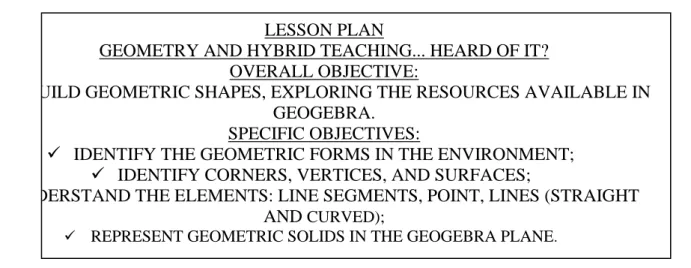
Also, in Module 7, we requested that the teacher’s hand in an individual lesson plan that included the use of digital technology, as a final project for the training. The lesson plan of Participant P1, follows.
Figure 1 – Lesson Plan – Part 1
Source: authors
LESSON PLAN
GEOMETRY AND HYBRID TEACHING... HEARD OF IT? OVERALL OBJECTIVE:
✓ TO BUILD GEOMETRIC SHAPES, EXPLORING THE RESOURCES AVAILABLE IN GEOGEBRA.
SPECIFIC OBJECTIVES:
✓ IDENTIFY THE GEOMETRIC FORMS IN THE ENVIRONMENT; ✓ IDENTIFY CORNERS, VERTICES, AND SURFACES;
✓ UNDERSTAND THE ELEMENTS: LINE SEGMENTS, POINT, LINES (STRAIGHT AND CURVED);
Tangram – Revista de Educação Matemática, Dourados - MS – v.3 n.3, pp. 44-59 (2020)
Este obra está licenciada com uma Licença Creative Commons Atribuição-NãoComercial-CompartilhaIgual 3.0 Brasil.
56
Figure 2 – Lesson Plan – Part 2
Source: authors
METHODS: 1ST STEP:
FIRST, GATHER IN A CIRCLE AND ASK STUDENTS TO OBSERVE THE FURNITURE, OBJECTS IN THE CLASSROOM, AND THEIR
SURROUNDINGS...
2ND STEP:
PRESENT A FEW OBJECTS THAT ARE SIMILAR TO GEOMETRIC SHAPES, AND ASK STUDENTS TO RELATE ONE TO THE OTHER (CUBE,
RECTANGLE, PYRAMID, CYLINDER...)
3RD STEP:
Tangram – Revista de Educação Matemática, Dourados - MS – v.3 n.3, pp. 44-59 (2020)
Este obra está licenciada com uma Licença Creative Commons Atribuição-NãoComercial-CompartilhaIgual 3.0 Brasil.
57
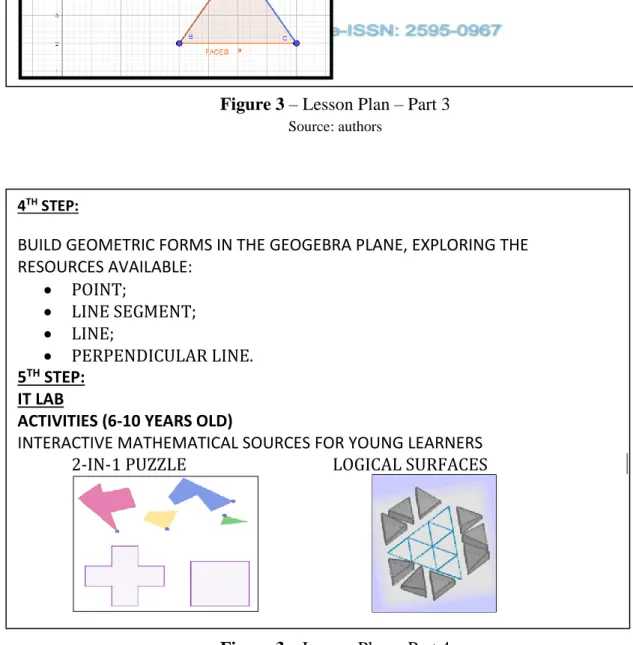
Figure 3 – Lesson Plan – Part 3
Source: authors
Figure 3 – Lesson Plan – Part 4
Source: authors
Finally, the participants answered the final questionnaire on the training. Some of their answers follow:
Question 1: What did you think of the Flipped Classroom as an option for continuing education for teachers? Indicate, if possible, positive and negative aspects.
P1. I liked the Flipped Classroom model a lot, because it enables the creation of knowledge by both parties. The teacher is no longer just the mentor with knowledge and is rather the mediator of learning. I AFTER THE CONSTRUCTIONS ARE COMPLETE, TALK WITH STUDENTS
AND IDENTIFY SEGMENTS, SURFACES, CORNERS, AND VERTICES IN THE DRAWINGS.
BUILD SOME FORMS USING TEMPLATES (PAINT, CUT OUT, AND FOLD), IDENTIFYING THE VERTICES, CORNER, AND SURFACES).
.
4TH STEP:
BUILD GEOMETRIC FORMS IN THE GEOGEBRA PLANE, EXPLORING THE RESOURCES AVAILABLE: • POINT; • LINE SEGMENT; • LINE; • PERPENDICULAR LINE. 5TH STEP: IT LAB
ACTIVITIES (6-10 YEARS OLD)
INTERACTIVE MATHEMATICAL SOURCES FOR YOUNG LEARNERS 2-IN-1 PUZZLE LOGICAL SURFACES
Tangram – Revista de Educação Matemática, Dourados - MS – v.3 n.3, pp. 44-59 (2020)
Este obra está licenciada com uma Licença Creative Commons Atribuição-NãoComercial-CompartilhaIgual 3.0 Brasil.
58
thought it was interesting in that it allowed access to materials outside the classroom, bringing only doubts to the discussion, and, so, becoming a collaborative learning experience. I don’t see any negative aspects.
One aspect of using the FC model that was noted by participating teachers was it may be possible to help students in individual ways, each according to the challenge they face. This occurred because, in this model, the object of study is presented to the student, who can then access materials form anywhere, researching the subject, taking the time necessary, bringing only their doubts to the discussion at the in-person meeting, which can transform the learning relationship into an opportunity for collaborative learning.
However, they realized that it is not easy to accomplish this inversion. According the participants, a double preparation is necessary – on the part of both the teacher and the student. This demands organization, reading, and preparation of the teacher regarding the subject, and a collaborative effort.
The teachers perceived the GeoGebra software to be a useful and functional technological resource, which allowed them to visualize and explore shapes and their properties, which they would have had trouble perceiving using the workbooks and concrete materials normally used in the classroom, especially with respect to spatial geometry.
Final Considerations
Even while emphasizing the strong participation of twelve teachers, and having analyzed the dependent and independent variables of Design Research, we can state that the model used in this study may be promising in terms of facilitating and encouraging increasing knowledge of teachers, for an improved professional practice. In addition to this possible expansion of teaching practices, the teachers also perceived the importance of teaching geometry, especially using digital technology, in this case, GeoGebra software.
Tangram – Revista de Educação Matemática, Dourados - MS – v.3 n.3, pp. 44-59 (2020)
Este obra está licenciada com uma Licença Creative Commons Atribuição-NãoComercial-CompartilhaIgual 3.0 Brasil.
59
Having completed this study, we are confident that continuing this research is viable, considering the analyses based on Design Research, the purpose of which could be restructured for other teachers, who will surely offer new contributions.
References
Collins, A. Joseph, D, Bielaczyc, K. (2004). Design Research: Theoretical and Methodological Issues. Journal of the Learning Sciences. Evanston, p.13-42
Doerr, H. M.; Wood, T. (2006). Pesquisa-Projeto (design research): aprendendo a ensinar Matemática. In: BORBA, M.C. Tendências internacionais em formação de professores
de Matemática. Belo Horizonte: Autêntica, Cap.5, p.113-128.
Kenski, V. (2008). Educação e Tecnologias - O novo ritmo da informação. São Paulo, Ed. Papirus,
Koehler, M. J.; Mishra, P.; Yahya K. (2007). Tracing the development of teacher knowledge in a design seminar: Integrating content, pedagogy and technology. Computers &
Education, v.49, p. 740-762.
Mishra, P. e Koehler, M. J. (2006). Technological Pedagogical Content Knowledge: A Framework for Teacher Knowledge. Teachers College Record, v. 108, n.6, p. 1017-1054.
Perrenoud, P. (1999). Avaliação da Excelência à Regulação das Aprendizagens. Porto Alegra: Editora Artmed.
Shulman, L. S. (1987). Knowledge and teaching: foundations of the new reform. Harvard Educational Review, v. 57, n. 1, p. 1-22.
Van Hiele, P. (1986). Structure and insight: a theory of mathematics education. Orlando: AcademicPress,