Copyright: This is an open-access article distributed under the terms of the Creative Commons Attribution License®, which permits unrestricted use, distribution, and reproduction in any medium, provided that the original author and source are credited.
The effect of Pilates practice on balance in elderly:
a systematic review
Efeito da prática do Pilates sobre o equilíbrio de idosos: uma revisão sistemática
AUTHOR’SAraceli Goedert1 Karini Borges dos Santos1 Paulo Cesar Barauce Bento1 André Luiz Felix Rodacki1
1 Universidade Federal do Paraná, Setor de Ciências Biológicas. Curitiba, Paraná, Brasil.
CORRESPONDING Karini Borges dos Santos [email protected] Rua Coração de Maria, 92,
Jardim Botânico, Curitiba, Paraná. Brasil. CEP: 80215-370
DOI
10.12820/rbafs.23e0019
ABSTRACT
The aging is accompanied by a gradual decline in balance and increases risk of falls. Pilates has been used for balance training. The purpose of this research was to systematize studies regarding the ef-fects of Pilates exercise interventions on static and dynamic balance of elderly people. A survey was conducted in three indexed databases: Medline/Pubmed, Scopus and Science Direct, using the de-scriptors “balance” or “equilibrium” with the term “Pilates”. Fifteen articles were selected and used in this systematic review. Based on the results, we observed that the practice of Pilates with a minimum frequency of two sessions per week for an hour lasting for a period of at least five weeks or three times per week for 12 sessions or more showed improvement on static and dynamic balance of elderly.
Keywords: Physical activity; Balance; Elderly; Exercise movement techniques. RESUMO
O envelhecimento é acompanhado por um declínio gradual no equilíbrio e aumento do risco de quedas. Pi-lates tem sido utilizado para o treinamento do equilíbrio. O objetivo desta pesquisa foi sistematizar estudos que evidenciem os efeitos da intervenção com exercícios de Pilates sobre o equilíbrio estático e dinâmico de idosos. Uma pesquisa foi realizada em três bases de dados indexadas: Medline/Pubmed; Scopus e Science Direct, a partir da associação dos descritores “balance” ou “equilibrium” com o termo “Pilates”. Quinze artigos selecionados e analisados foram utilizados para compor esta revisão sistemática. A partir dos resultados foi possível verificar que a prática de Pilates realizada com frequência mínima de duas sessões semanais, por uma hora por dia, em período igual ou superior a cinco semanas resultou em melhorias no equilíbrio estático e dinâmico de idosos.
Palavras-chave: Atividade física; Equilíbrio postural; Idosos; Técnicas de exercício e de movimento.
Introduction
Increased life expectancy has generated growing interest in understanding health problems related to aging. It has been well established that aging is accompanied by a gradual decline in balance due changes in proprioceptive system1, which can increase risk of falls. Falls in elderly
remain a major source of morbidity, mortality, reduced functionality and independence2.
Balance is defined as a person’s ability to control their body position within the limits of the base of support3.
Balance can be categorized in Static balance (quiet erect standing) and Dynamic balance (the capacity to main-tain or regain a stable position of the body during move-ments or in response to a perturbation)4. Maintaining
balance is crucial for the successful performance of most movements practiced in daily life or movements
involv-ing high complexity and requirinvolv-ing self-proper body con-trol5,6. Postural control is resultant of the synergy of small
muscle contractions, which maintain the center of gravity within the limits of stability and orientation of the body in order to adapt to gestures and techniques according to the demand of the activity7,8. Postural control depends on
the interaction of the sensory system (visual, vestibular and somatosensory) with the central nervous system and with the neuromuscular system. The central nervous sys-tem receives sensory information about the body position and responds by activating a specific musculature9.
The deep muscles of the trunk or core muscles have been identified as great aids to maintain balance10-12. Core
consists of 29 muscles separated into two systems: global, which are superficial muscles that perform movements dynamically; and local, which are the deep muscles
(in-cluding multifidus and transversus abdominis) responsi-ble for stabilizing the trunk during the performance of activities. The better the activation of core muscles, the better the individual’s ability to maintain balance13, 14.
The practice of Pilates has been widely used to ac-tivate the muscles of the core. The method focuses on toning the deep core stabilizer muscles using control and conscious movements that allows the practitioner to improve fitness, muscle tone, posture, flexibility and balance11,12,15. Exercises can be performed on mat using
the body weight, or with specific apparatus, such as the Reformer, Cadillac, Chair and Barrel, which were devel-oped by the creator, Joseph Pilates (1880-1967). Oth-er accessories as elastics, ball and rollOth-ers are also used during mat or apparatus classes to enable different kinds of exercises in order to improve strength, stretching and postural realignment11, 16.
Experiment results have consistently demonstrat-ed that Pilates has a positive effect on healthy subjects’ balance. Indeed, Cruz-Ferreira17 conducted a systematic
review and found evidences to support the use of Pilates to improve dynamic balance. However, there is some con-tradiction about the intervention methods, the frequency, time and the methods of evaluating balance and lack of consistent information regarding Pilates prescription for elderly people, who can be benefit with balance improve-ments and diminish risk of falls. In fact, it has not been established yet how much and what types of range of mo-tion exercises are the most effective for elderly people18.
Thus, this literature review aims to systematize studies focusing on the effects of an intervention with Pilates ex-ercises on static and dynamic balance of elderly people.
Methods
Articles were selected on April 2017, by searching three indexed databases: Medline/PubMed; Scopus and Science Direct with the key words “balance” or “equilibrium” and the term “Pilates”, which although it is not a health science descriptor, is fundamental to the development of this study.
A set of criteria were selected to compose the review and included: original articles; published in peer-reviewed journal; dated between 2006 and March 2017; written in English; conducted as randomized controlled trial, qua-si-experimental studies and cross over method; evaluated the effect on subjects’ balance; and studied healthy indi-viduals with an average equal to or greater than 65 years.
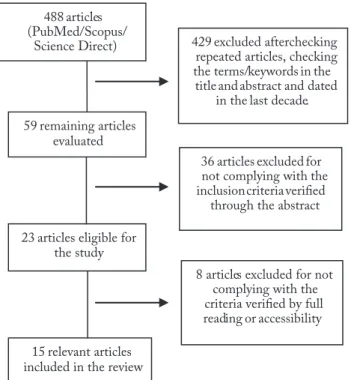
The research initially generated a total of 762 articles. Of these, 488 studies were within the period of interest
(2006 - March 2017). After checking for repeated stud-ies and verifying the terms in the title and abstract, 59 el-igible articles were further screened. Two review authors independently applied inclusion criteria for the studies after reading abstracts and selecting potential studies. The assessors critically analyzed and discussed the se-lection of article and disagreements were resolved with a third reviewer when needed.
The articles were primarily selected by analysis ac-cording to the abstract, then by reading the full article, focusing on criteria and objectives of the study. At the end of the evaluation, fifteen relevant articles were in-cluded in this systematic review. The following data were extracted independently by two reviewers: author, years of publication, subjects, study design, Pilates method of intervention, balance variables studied and key results.
Methodology quality assessment was evaluated ac-cording to a protocol developed for the present study based on Bento et al.2. The 11 criteria judged important
for this review were as follows: control group; random al-location of the subjects; initial similarity between groups; blind evaluation; intervention with Pilates method; su-pervised program; minimal frequency of training of twice a week; minimal duration of the program of eight weeks; static balance evaluation, dynamic balance evalu-ation; reliable instruments for assessment. Higher scores denoted better article quality.
Data were systematized by the comparison estab-lished between Pilates intervention and control group (in-active) or initial condition and post-intervention condi-tion for studies with a single group. The results of the static and dynamic balance were used to report the differences. Strength of scientific evidence was measured by “best evi-dence synthesis”, which determines strength by the num-ber and quality of studies and consistency of results17.
Results
Flowchart of the article selection process is showed in Figure 1. Fifteen articles were considered relevant and were used in this systematic review. All of the selected studies conducted Pilates intervention with a mini-mum of 40 minutes sessions and evaluated the effects of this exercise on balance of elderly people. The ave-rage age of the participants was 70.35 ± 2.85 years. Al-though this is quite high, participants were in general healthy and physically independent.
Score for methodological quality assessment protocol ranged from 5 to 10 (mean 8), indicating moderate quali-ty of studies. The qualiquali-ty criteria satisfied by all researches
were related to “supervised program” and “reliable instru-ments for assessment”. While the criteria least checked corresponded to “similarity between groups” (2 articles) and “blind evaluation” (6 articles). Score for methodolog-ical quality assessment protocol is presented in Table 1.
Figure 1 – Article selection process.
Regarding the methodological procedures, ten ar-ticles (66.7%) conducted a randomized controlled study19-29, while four articles30-33 (26.7%) conducted a
quasi-experimental study evaluating the data from the same population before and after the intervention. Only one study34 (6.7%) used a cross over method.
Moderate evidence was found for improving static and dynamic balance by “best evidence synthesis”. Four articles evaluated only static balance19,20,25,32, while three
evaluate dynamic balance22,31,33 and eight both
condi-tions21,23,24,27-29,30,34. Pilates exercise demonstrated ability
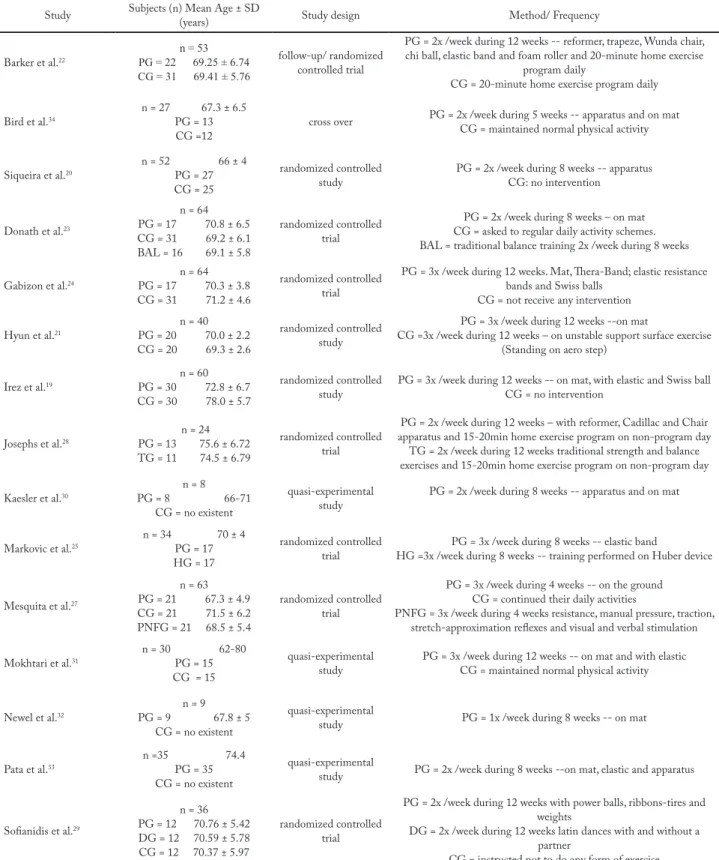
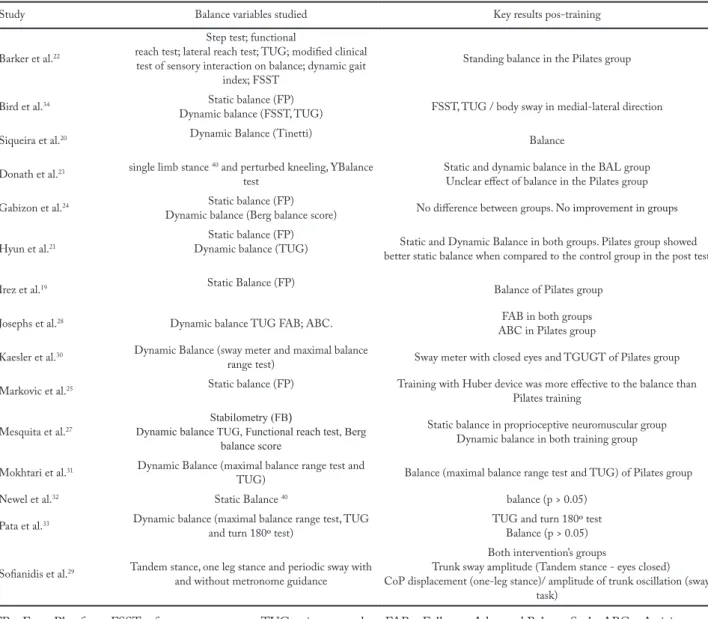
to improve static and dynamic balance in almost all stud-ies. Pilates methods, frequency, variables and results can be observed in Tables 2 and 3.
Discussion
This review was conduct in order to systematize stu-dies focusing on the effects of intervention with Pilates exercises on static and dynamic balance of elderly peo-ple. Fifteen select articles showed moderate to good methodological quality and evidence to support that exercise with apparatus or a combination of exercise on mat and with apparatus can improve both static and dynamic balance after an intervention period of twice per week or more. Mat Pilates exercises showed impro-vement when practiced with a minimum frequency of three times per week.
Although Newell et al.32 Pata et al.33 and Donath et
al.23 did not show significant results with mat and/or
apparatus exercises once or twice per week, the results portray a positive trend in relation to balance. Kaesler et al.30, Siqueira et al.20, Barker et al.22, Josephs et al.28 and
Sofianidis et al.29 observed that Pilates practiced twice Table 1 – Protocol to assessment methodology quality.
1 2 3 4 5 6 7 8 9 10 11 Total Barker et al.22 1 1 - 1 - 1 1 1 - 1 1 8 Bird et al.34 1 1 1 1 1 1 1 - 1 1 1 10 Siqueira et al.20 1 1 - - 1 1 1 1 1 - 1 8 Donath et al.23 1 1 - - 1 1 1 1 1 1 1 9 Gabizon et al.24 1 1 - 1 1 1 1 1 1 1 1 10 Hyun et al.21 - - - - 1 1 1 1 1 1 1 7 Irez et al.19 1 1 - - - 1 1 1 - 1 1 7 Josephs et al.28 - 1 - 1 - 1 1 1 1 1 1 8 Kaesler et al.30 - - - - 1 1 1 1 1 1 1 7 Markovic et al.25 - 1 - 1 1 1 1 1 1 - 1 8 Mesquita et al.27 1 1 1 1 1 1 1 - 1 1 1 10 Mokhtari et al.31 1 1 - - - 1 1 1 - 1 1 7 Newel et al.32 - - - - 1 1 - 1 1 - 1 5 Pata et al.33 - - - - - 1 1 1 - 1 1 5 Sofianidis et al.29 1 1 - - - 1 1 1 1 1 1 8
1 = Control Group; 2 = Random allocation of the subjects; 3 = Initial Similarity between groups; 4 = Blind evaluation; 5 = Intervention with Pilates method only; 6 = Supervised program; 7 = Minimal frequency of training of twice a week; 8 = Minimal duration of the program of eight weeks; 9 = Static balance evaluation; 10 = Dynamic balance evaluation; 11 = Reliable instruments for assessment.
per week between 8 to 12 weeks allow improvements in
balance and may prevent falls. Bird et al.34 suggest that after the fifth week it is already possible to identify bal-ance improvement. Mesquita et al.27 found that when
Table 2 - Methodological description of included articles.
Study Subjects (n) Mean Age ± SD (years) Study design Method/ Frequency Barker et al.22 n = 53 PG = 22 69.25 ± 6.74 CG = 31 69.41 ± 5.76 follow-up/ randomized controlled trial
PG = 2x /week during 12 weeks -- reformer, trapeze, Wunda chair, chi ball, elastic band and foam roller and 20-minute home exercise
program daily
CG = 20-minute home exercise program daily Bird et al.34 n = 27 67.3 ± 6.5PG = 13
CG =12 cross over
PG = 2x /week during 5 weeks -- apparatus and on mat CG = maintained normal physical activity Siqueira et al.20 n = 52 66 ± 4 PG = 27
CG = 25
randomized controlled
study PG = 2x /week during 8 weeks -- apparatus CG: no intervention Donath et al.23 n = 64 PG = 17 70.8 ± 6.5 CG = 31 69.2 ± 6.1 BAL = 16 69.1 ± 5.8 randomized controlled trial
PG = 2x /week during 8 weeks – on mat CG = asked to regular daily activity schemes. BAL = traditional balance training 2x /week during 8 weeks Gabizon et al.24 PG = 17 70.3 ± 3.8n = 64
CG = 31 71.2 ± 4.6
randomized controlled trial
PG = 3x /week during 12 weeks. Mat, Thera-Band; elastic resistance bands and Swiss balls
CG = not receive any intervention Hyun et al.21 PG = 20 70.0 ± 2.2n = 40
CG = 20 69.3 ± 2.6
randomized controlled study
PG = 3x /week during 12 weeks --on mat
CG =3x /week during 12 weeks – on unstable support surface exercise (Standing on aero step)
Irez et al.19 PG = 30 72.8 ± 6.7n = 60
CG = 30 78.0 ± 5.7
randomized controlled
study PG = 3x /week during 12 weeks -- on mat, with elastic and Swiss ballCG = no intervention Josephs et al.28 PG = 13 75.6 ± 6.72 n = 24
TG = 11 74.5 ± 6.79
randomized controlled trial
PG = 2x /week during 12 weeks – with reformer, Cadillac and Chair apparatus and 15-20min home exercise program on non-program day TG = 2x /week during 12 weeks traditional strength and balance exercises and 15-20min home exercise program on non-program day Kaesler et al.30 PG = 8 66-71n = 8
CG = no existent
quasi-experimental
study PG = 2x /week during 8 weeks -- apparatus and on mat Markovic et al.25 n = 34 70 ± 4PG = 17
HG = 17
randomized controlled
trial HG =3x /week during 8 weeks -- training performed on Huber devicePG = 3x /week during 8 weeks -- elastic band Mesquita et al.27 n = 63 PG = 21 67.3 ± 4.9 CG = 21 71.5 ± 6.2 PNFG = 21 68.5 ± 5.4 randomized controlled trial
PG = 3x /week during 4 weeks -- on the ground CG = continued their daily activities
PNFG = 3x /week during 4 weeks resistance, manual pressure, traction, stretch-approximation reflexes and visual and verbal stimulation Mokhtari et al.31 n = 30 62-80PG = 15
CG = 15
quasi-experimental
study PG = 3x /week during 12 weeks -- on mat and with elastic CG = maintained normal physical activity Newel et al.32 PG = 9 67.8 ± 5 n = 9
CG = no existent
quasi-experimental
study PG = 1x /week during 8 weeks -- on mat Pata et al.33 n =35 74.4PG = 35
CG = no existent
quasi-experimental
study PG = 2x /week during 8 weeks --on mat, elastic and apparatus
Sofianidis et al.29 n = 36 PG = 12 70.76 ± 5.42 DG = 12 70.59 ± 5.78 CG = 12 70.37 ± 5.97 randomized controlled trial
PG = 2x /week during 12 weeks with power balls, ribbons-tires and weights
DG = 2x /week during 12 weeks latin dances with and without a partner
CG = instructed not to do any form of exercise
PG = Pilates Group; CG: Control Group; BAL = Balance Training Group; TG = Traditional Group; HG = Huber group; PNFG = Proprio-ceptive Neuromuscular Facilitation Group; DG = dancing group.
Pilates is practiced with a higher weekly frequency, i.e. three times a week, 12 sessions were sufficient to pro-mote changes in balance. Hyun et al.21 and Mokhtari et
al.31 also found balance improvement after 12 weeks of
Pilates practice three times per week. Curiously, Gabizon et al.24 did not find improvement on balance with Pilates
intervention three times a week in 36 sessions. Maybe the exercises performed were not balance challenging enough for the population studied. In addition, Mark-ovic et al.25 observed that practice with Huber device can
be more effective to training balance than Pilates. Different methods of practicing Pilates showed posi-tive results. For example, practice using elastic or springs as resistance has shown to provide greater positive effect on increasing force19. On the other hand, mat exercises
can be performed in any place with a lower cost. Other interventions analyzed also showed improvement sim-ilar or greater in balance, i.e., traditional balance23 and
strength training28, proprioceptive neuromuscular
facili-tation27, training performed on Huber device25 and latin
dances29. Regardless the type of exercises, the frequency
of session must be considered, once exercise with ap-paratus or combined exercises (apap-paratus and mat) had shown no effect at a lower frequency (once a week for ex-ample). These results can be justified by the fact that with a lower frequency participants were not able to adapt and retain the benefits that Pilates exercise may cause.
Although these studies did not assess the mecha-nisms responsible for the effect of Pilates training, Pata et al.33 suggest that the increase in balance can be a con-Table 3 – Balance variables and outcomes description of included articles.
Study Balance variables studied Key results pos-training
Barker et al.22
Step test; functional
reach test; lateral reach test; TUG; modified clinical test of sensory interaction on balance; dynamic gait
index; FSST
Standing balance in the Pilates group
Bird et al.34 Static balance (FP)
Dynamic balance (FSST, TUG) FSST, TUG / body sway in medial-lateral direction
Siqueira et al.20 Dynamic Balance (Tinetti) Balance
Donath et al.23 single limb stance 40 and perturbed kneel ing, Y Balance
test Static and dynamic balance in the BAL groupUnclear effect of balance in the Pilates group
Gabizon et al.24 Static balance (FP)
Dynamic balance (Berg balance score) No difference between groups. No improvement in groups Hyun et al.21 Dynamic balance (TUG)Static balance (FP) Static and Dynamic Balance in both groups. Pilates group showed
better static balance when compared to the control group in the post test
Irez et al.19 Static Balance (FP) Balance of Pilates group
Josephs et al.28 Dynamic balance TUG FAB; ABC. FAB in both groups
ABC in Pilates group Kaesler et al.30 Dynamic Balance (sway meter and maximal balance
range test) Sway meter with closed eyes and TGUGT of Pilates group Markovic et al.25 Static balance (FP) Training with Huber device was more effective to the balance than
Pilates training Mesquita et al.27
Stabilometry (FB)
Dynamic balance TUG, Functional reach test, Berg balance score
Static balance in proprioceptive neuromuscular group Dynamic balance in both training group Mokhtari et al.31 Dynamic Balance (maximal balance range test and
TUG) Balance (maximal balance range test and TUG) of Pilates group
Newel et al.32 Static Balance 40 balance (p > 0.05)
Pata et al.33 Dynamic balance (maximal balance range test, TUG
and turn 180º test) TUG and turn 180º testBalance (p > 0.05) Sofianidis et al.29 Tandem stance, one leg stance and periodic sway with
and without metronome guidance
Both intervention’s groups
Trunk sway amplitude (Tandem stance - eyes closed) CoP displacement (one-leg stance)/ amplitude of trunk oscillation (sway
task)
FP = Force Plataform. FSST = four square step test. TUG = time up and go. FAB = Fullerton Advanced Balance Scale. ABC = Activi-ties-Specific Balance Confidence Scale.
sequence of the strengthening of core muscle which allows for greater distal mobility and a better control of body alignment. This idea is supported by Kibler35
who claim that the correct activation of the core ena-ble an anticipatory postural adjustments which creates a stable base of support for performing activities. While Mokhtari et al.31 state that muscle activation and
pro-prioceptive stimulus performed during intervention may cause a displacement of the center of the ankle joint, thus improving balance. Similarly, Siqueira et al.20 claim that
increases in strength might improve the speed of mus-cle activation response and proprioception. As a conse-quence, it is possible to verify an improvement in balance and autonomy of the participants.
Considering that the average age of the population of the related studies is above 65 years, minor imbalance is important so that individuals can perform activities of daily life more easily, reducing the risk of falling and increasing independency in performing the movements. Other benefits related to the practice of Pilates, which are important for the health of the elderly, are improve-ments in functionality20,30, velocity and step length32.
Thus, the practice of Pilates is recommended for preserv-ing functional abilities that change with agpreserv-ing. Despite the moderate to good score for methodological quality and strength of the scientific evidence, this literature re-view has the limitation that none of the articles evaluat-ed the mechanism responsible for the effect of practicing Pilates on balance. Thus, only speculations can be used to explain the changes between the variables tested.
Articles demonstrated moderate methodological quality and science evidence. Pilates training demon-strated in general positive results on balance, function-ality, gait speed and stride length of elderly. Core muscle strengthening, activation of proprioception, improve-ment in strength and speed of muscle activation response, might be possible explanations for the benefits founded. Improving balance is important for maintaining a better ability to perform activities of daily life, decrease the risk of falling and increase independence in performing sim-ple and comsim-plex movements5, 6.
Current literature suggests that Pilates training should be performed at least twice per week in sessions with apparatus or a combination of mat and apparatus exercise and three times per week on mat only to bal-ance improvements. The duration of the session must be at least of 40 minutes, for a period equal or greater than five weeks when practiced twice per week or from 12 sessions, when practiced three times per week with
challenge and task specific, in order to be significantly effective in improving balance of the elderly.
Conflict of Interest
The authors declare no conflict of interest
Authors’ Contribution
Goedert A, conceptualized the study, conducted the initial search and wrote the first draft of the manuscript. Santos KB, supplied the acquisition of data, analysis and interpretation. Bento PCB, was responsible for the article critically for important intellectual content. Rodacki ALF, provided the revised the article critically for important intellectual content and gave final approval of the version to be submitted.
Reference
1. Franco PG, Santos KB, Rodacki AL. Joint positioning
sense, perceived force level and two-point discrimination tests of young and active elderly adults. Braz J Phys Ther. 2015;19(4):304-10.
2. Bento PCB, Rodacki ALF, Homann D, Leite N. Exercícios
físicos e redução de quedas em idosos: uma revisão sistemática. Rev Bras Cineantropom Desempenho Hum. 2010;12(6):471-9.
3. Knudson D. Fundamentals of biomechanics.: Springer
Science & Business Media; 2007.
4. Hrysomallis C. Balance ability and athletic performance.
Sports Med. 2011;41(3):221-32.
5. Winter DA, Patla AE, Frank JS. Assessment of balance
control in humans. Med Prog Techno. 1990;16(1-2):31-51.
6. Horak FB. Postural orientation and equilibrium: what do we
need to know about neural control of balance to prevent falls? Age Ageing. 2006;35(suppl 2):ii7-ii11.
7. Horak FB, Macpherson JM. Postural orientation and
equilibrium. Compr Physiol. 1996.
8. Iqbal K. Mechanisms and models of postural stability and
control. Engineering in Medicine and Biology Society, EMBC, 2011 Annual International Conference of the IEEE; Boston, MA, USA. 2011.
9. Barela JA. Estratégias de controle em movimentos complexos:
ciclo percepção-ação no controle postural. Rev Paul Educ Fís. 2000;1(Suppl 3):79-88.
10. Muscolino JE, Cipriani S. Pilates and the “powerhouse”—I. J
Bodyw Mov Ther. 2004;8(1):15-24.
11. Kloubec J. Pilates: how does it work and who needs it?
Muscles, Ligaments Tendons J. 2011;1(2):61.
12. Marés G, Oliveira KB, Piazza MC, Preis C, Bertassoni
Neto L. A importância da estabilização central no método Pilates: uma revisão sistemática; The importance of central stabilization in Pilates method: a systematic review. Fisioter Mov. 2012;25(2):445-51.
13. Hodges PW, Richardson CA. Transversus abdominis and the
superficial abdominal muscles are controlled independently in a postural task. Neurosci Lett. 1999;265(2):91-4.
14. Fredericson M, Moore T. Core stabilization training for
middle and long distance runners. New Stud Athlet. 2005;20(1):25-37.
Quote this article as:
Goedert A, Santos KB, Bento PCB, Rodacki ALF. The effect of pilates practice on balance in elderly: a systematic review. Rev Bras Ati Fis Saúde. 2018;23:e0019. DOI: 10.12820/rbafs.23e0019
15. Iulian-Doru T, Vasilica G, Mariaa T, Claudia-Cameliaa B.
Pilates Principles-Psychological Resources for Efficiency Increase of Fitness Programs for Adults. Procedia Soc Behav Sci. 2013;84:658-62.
16. Latey P. The Pilates method: history and philosophy. J Bodyw
Mov Ther. 2001;5(4):275-82.
17. Cruz-Ferreira A, Fernandes J, Laranjo L, Bernardo LM,
Silva A. A systematic review of the effects of pilates method of exercise in healthy people. Arch Phys Med Rehabil. 2011;92(12):2071-81.
18. Chodzko-Zajko WJ, Proctor DN, Singh MAF, Minson CT,
Nigg CR, Salem GJ, et al. Exercise and physical activity for older adults. Med Sci Sports Exerc. 2009;41(7):1510-30.
19. Irez GB, Ozdemir RA, Evin R, Irez SG, Korkusuz F.
Integrating Pilates exercise into an exercise program for 65+ year-old women to reduce falls. J Sports Sci Med. 2011;10:105-11.
20. Rodrigues BGS, Cader SA, Torres NVOB, Oliveira EM,
Dantas EHM. Pilates method in personal autonomy, static balance and quality of life of elderly females. J Bodyw Mov Ther. 2010;14(2):195-02.
21. Hyun J, Hwangbo K, Lee CW. The effects of Pilates mat
exercise on the balance ability of elderly females. J Phys Ther Sci. 2014;26(2):291.
22. Barker AL, Talevski J, Bohensky MA, Brand CA, Cameron
PA, Morello RT. Feasibility of Pilates exercise to decrease falls risk: a pilot randomized controlled trial in community-dwelling older people. Clin Rehabil. 2016;30(10):984-96.
23. Donath L, Roth R, Hürlimann C, Zahner L, Faude O.
Pilates vs. balance training in health community-dwelling seniors: a 3-arm, randomized controlled trial. Int J Sports Med. 2016;37(03):202-10.
24. Gabizon H, Press Y, Volkov I, Melzer I. The Effects of Pilates
Training on Balance Control and Self-Reported Health Status in Community-Dwelling Older Adults: A Randomized Controlled Trial. J Aging Phys Act. 2016;24(3):376-83.
25. Markovic G, Sarabon N, Greblo Z, Krizanic V. Effects of
feedback-based balance and core resistance training vs. Pilates training on balance and muscle function in older women: A randomized-controlled trial. Arch Gerontol Geriatr. 2015;61(2):117-23.
26. Yanai T, Hay JG, Gerot JT. Three-dimensional videography
of swimming with panning periscopes. J Biomech. 1996;29(5):673-8.
27. Mesquita LS, Carvalho FT, Freire LS, Pinto Neto O, Zângaro
RA. Effects of two exercise protocols on postural balance of elderly women: a randomized controlled trial. BMC Geriatr. 2015;15(1):61.
28. Josephs S, Pratt ML, Meadows EC, Thurmond S, Wagner A.
The effectiveness of Pilates on balance and falls in community dwelling older adults. J Bodyw Mov Ther. 2016;20(4):815-23.
29. Sofianidis G, Dimitriou A, Hatzitaki V. A comparative study
of the effects of pilates & Latin dance on static and dynamic balance in older adults. J Aging Phys Act. 2016:1-26.
30. Kaesler D, Mellifont R, Kelly PS, Taaffe D. A novel balance
exercise program for postural stability in older adults: A pilot study. J Bodyw Mov Ther. 2007;11(1):37-43.
31. Mokhtari M, Nezakatalhossaini M, Esfarjani F. The Effect
of 12-Week Pilates Exercises on Depression and Balance Associated with Falling in the Elderly. Procedia Soc Behav Sci. 2013;70:1714-23.
32. Newell D, Shead V, Sloane L. Changes in gait and balance
parameters in elderly subjects attending an 8-week supervised Pilates programme. J Bodyw Mov Ther. 2012;16(4):549-54.
33. Pata RW, Lord K, Lamb J. The effect of Pilates based exercise
on mobility, postural stability, and balance in order to decrease fall risk in older adults. J Bodyw Mov Ther. 2014;18(3):361-7.
34. Bird ML, Hill KD, Fell JW. A randomized controlled
study investigating static and dynamic balance in older adults after training with Pilates. Arch Phys Med Rehabil. 2012;93(1):43-9.
35. Kibler WB, Press J, Sciascia A. The role of core stability in
athletic function. Sports Med. 2006;36(3):189-98.
Recebido: 29/11/2017 Aprovado: 07/08/2018