PRINCIPLES OF UNIVERSAL DESIGN IN THE CLASSROOM:
a guideline for communication, teaching, and learning
Carla Abreu-Ellis
Ashland University – Department of Curriculum and Instruction. E-mail: [email protected]
Jason Brent Ellis
Ashland University – Department of Curriculum and Instruction. E-mail: [email protected]
Abstract
This paper aimed to analyze the presence and influence of Universal Design principles in a graduate education classroom at a private university in North central Ohio. Course instructors implemented many aspects of Universal Design related to classroom climate, delivery methods, information resources/ technology, interaction, feedback, and assessment. Findings indicated that typical college students perceived the implementation of such methods beneficial to their learning across the categories.
Keywords: Universal Design. College Students. Technology. Differentiated Instruction. Assessment.
OS PRINCÍPIOS DO DESENHO UNIVERSAL EM SALA DE
AULA: orientação para a comunicação, ensino e
aprendizagem
Resumo
Este trabalho teve como objetivo analisar a presença e a influência dos princípios do Desenho Universal numa sala de aula de pós-graduação em uma universidade particular em North Central Ohio. Instrutores do curso implementaram muitos aspectos do Desenho Universal relacionados com o clima de sala de aula, métodos de entrega, recursos/ tecnologia de informação, interação, feedback e avaliação. Resultados indicaram que estudantes universitários típicos acharam a aplicação de tais métodos benéfica para a sua aprendizagem em todas as categorias.
Florianópolis, v. 10, n. 02, p. 127 – 143, jul. / dez. 2009 128 Background
Universal Design principles have traditionally been seen as applicable in instructional design for individuals of diverse abilities and disabilities. It was the intention of this study to observe if these principles would be pertinent to typical college graduate students. This study sought to observe if a correlation existed between the presence of Universal Design principles as proposed by Burgstahler (2007) and students’ perceptions of the influence of those methods on their learning processes.
Review of the Literature
Several social movements have gained momentum in the last decade which hold similar thematic goals of creating wider, if not universal, accessibility in the creation of products and spaces, and equity of access to information. These include Design for All Europe (EIDD), Web Accessibility Initiative (WAI), and the University of Washington’s U.S. Department of Education funded DO-IT program. In North America the common term for this progress towards universal accessibility through design means is known as Universal Design. Thus, in synthesis, the general goal of Universal Design is “to simplify life for everyone by making products, communications, and the built environment more usable by as many people as possible at little or no extra cost” (Center for Universal Design, 2008a, ¶ 1). McGuire, Scott, and Shaw (2006) noted several examples of Universal Design:
Examples of universally designed products and environments are increasingly common in our lives: captioning on television sets (useful for individuals with hearing impairments, but also helpful to many individuals in a noisy setting such as an airport or restaurant); curb cuts (useful for wheelchair users, but also accessed by individuals on skateboards, parents pushing baby strollers, etc.); universal symbols that communicate function, such as restroom signage (helpful to individuals who have difficulty reading, but also functional for non–English speakers). (p. 167)
It is believed that “Universal design benefits people of all ages and abilities” (Center for Universal Design, 2008a, ¶ 1).
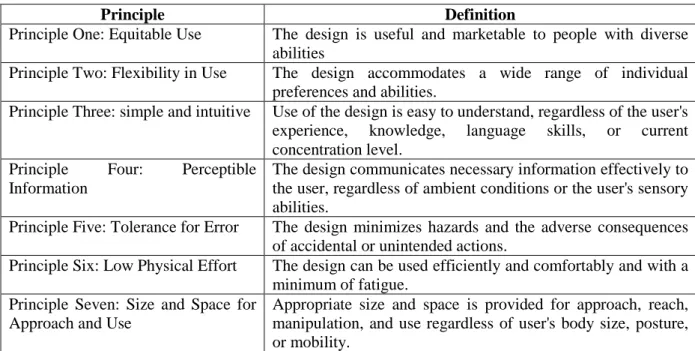
The Center for Universal Design (2008b) identified seven principles of Universal Design, which included: (1) equitable use, (2) flexibility in use, (3) simple and intuitive use, (4) perceptible information, (5) tolerance for error, (6) low physical effort, and (7) size and
Florianópolis, v. 10, n. 02, p. 127 – 143, jul. / dez. 2009 129 space for approach and use. For detailed definitions of the seven principles see table 1.
Table 1: The Seven Principles of Universal Design (Center for Universal Design, 2008b)
Principle Definition
Principle One: Equitable Use The design is useful and marketable to people with diverse abilities
Principle Two: Flexibility in Use The design accommodates a wide range of individual preferences and abilities.
Principle Three: simple and intuitive Use of the design is easy to understand, regardless of the user's experience, knowledge, language skills, or current concentration level.
Principle Four: Perceptible Information
The design communicates necessary information effectively to the user, regardless of ambient conditions or the user's sensory abilities.
Principle Five: Tolerance for Error The design minimizes hazards and the adverse consequences of accidental or unintended actions.
Principle Six: Low Physical Effort The design can be used efficiently and comfortably and with a minimum of fatigue.
Principle Seven: Size and Space for Approach and Use
Appropriate size and space is provided for approach, reach, manipulation, and use regardless of user's body size, posture, or mobility.
Rose and Meyer (2002) noted that “successful learning experiences challenge and support each learner appropriately and adjust as the learner changes over time” (¶ 2). As such, the goal of Universal Design in Learning (UDL) then becomes “to provide every student this kind of customized and responsive experience. Establishing goals is the first step. The next step is to plan instruction so that students have multiple pathways for achieving their goals” (¶ 2). As Rose (2000) observed,
The essence of UDL is flexibility and the inclusion of alternatives to adapt to the myriad variations in learner needs, styles, and preferences. Only through a process of design that recognized the differentiated strengths and weaknesses of both students and media can we hope to create learning contexts and materials that are flexible enough to accommodate all learners. (¶ 45)
In instruction, “Universal Design for Learning (UDL) has the potential not only to increase access but transform the learning process” (Rose, 2000, ¶ 1). Within this context of access and transformation, Burgstahler (2007) discussed several key concepts in incorporating principles of universal design into instruction which included the following broader categories: Class Climate, Delivery Methods, Information Resources and Technology, Interaction, Feedback, and Assessment.
Florianópolis, v. 10, n. 02, p. 127 – 143, jul. / dez. 2009 130 In terms of class climate, Burgstahler (2007) noted the importance of the adoption of
instructional practices which reflect both inclusion and high respect for the diversity of individuals coming to learn in the environment. For instance, low instructor expectations for students of diverse backgrounds are a barrier to achievement. Sleeter (2008) noted that "low expectations are common in historically underserved schools” and further, that teachers “often see students who are White or Asian as more teachable than students who are Black and Latino and student of middle or upper-class backgrounds as having more potential than those from lower-class backgrounds” (p. 214). In the UDL paradigm mutual respect for the instructor and learners is a basic underlying principle with space made available for the sharing of multiple perspectives and an underlying premise is that instructors have developed the skill set to “participate empathetically and constructively across various viewpoints” (Sleeter, 2008, p. 215). Individual student performance is the basis for measuring needs rather than the traditional approach of blanket treatments based on stereotypes attached to diverse and minority groups of peoples, cultures, ethnicities, gender, and disabilities. Classroom procedures and practices should be based on inclusion, respect for individual difference, and the tactful and private treatment of those differences to reduce segregation and stigma. Logistically, for this to occur, access to the instructor must be made available in and outside of class time.
Instructional delivery methods are also a key concept in the universal design of instruction. In this context the intention behind instruction is to reach as many learners as possible by providing wider access and alternative means of encoding information into memory. Not unlike the concept of differentiated instruction in which “instruction is tailored based on individual differences, engaging students where they are, rather than where they are expected to be, according to a prescribed curriculum” (Hall, 2009, p. 1), Burgstahler, (2007) proposed that there must be multiple pathways present in instruction to gain knowledge. That is, that differentiated modes of instructional techniques should be utilized to deliver content and motivate and engage students including lectures, collaborative based options, hands-on activities, web-based communications, educational software, and fieldwork. Further, cognitive supports must be built into instructional delivery such as scaffolding (Bruner, 1978; Tabak, 2004; Abreu-Ellis & Ellis, 2009), the provision of applied contextual learning strategies where students learn material in the context of how it will be utilized to promote learning and the ability to apply the information (Albanese, 2000), and effective prompting. Intentionality is given to instructional delivery by designing instruction around access for
Florianópolis, v. 10, n. 02, p. 127 – 143, jul. / dez. 2009 131 individuals with various ranges of abilities, disabilities, interests, learning styles, and previous
experiences. The thoughtful and logical selection of curriculum materials thus becomes a vital task in providing wider access to individuals of varying needs and ability.
As for information resources and technology, Burgstahler (2007) noted several key strategies leading toward universal design. These include the provision of the early selection and release of class materials to allow student to learn at a more self-paced rate, the use of multiple and redundant presentations of materials to ensure that learners can both easily find materials and have had the opportunity of viewing materials within several contexts, and the provision of course materials in accessible formats to accommodate readers of varying levels and various genres of disability. For instance, to look at distance education via online delivery as a context for information resources utilizing technology, Universal Design would embody curricular materials developed in many “media so that learners can select one or more ways to approach the subject matter. Text, images with no text, images with text, voice, animation, video, or a sequence of sounds can effectively convey a series of events" (Meyer & Rose, 2000, p. 40). The idea is that multi-sensory input could occur by diversifying the format of curricular materials. As Kátai, Juhász, Adorjáni observed (2008) “each sense, either singularly or in various combinations, provides a pathway to learning. While each sense is important in itself, our senses are designed to function in harmony” (p. 1708).
Interaction in instruction is the promotion of effective communication between the instructor and learners as well as the between learners. It has been found that university students not only perceive their college experiences ameliorated by in class communications with their professors but also that their retention is tied to out-of-class communication (OCC) with faculty (Astin, 1993, Pascerella & Terenzini, 2005). As such, several factors have been deemed important in the communication process including immediacy (Jaasma & Koper, 1999) and perceived aggressiveness (Rocca & McCroskey, 1999). Burgstahler (2007) suggested that the use of straightforward, accessible language and minimizing unnecessary jargon and complexity in communication is essential to quality interaction. Burgstahler, (2007) further suggested that the instructor must play a guiding role in collaborative work in the organization of groups to include varying skills and roles and to facilitate group communication.
In the UDL model, feedback should be continuous rather than solely after the termination of summative assessments once a grade has already been assigned. Burgstahler (2007) suggested that students should be allowed to “turn in parts of large projects for
Florianópolis, v. 10, n. 02, p. 127 – 143, jul. / dez. 2009 132 feedback before the final project is due” (p. 4) and further, that students should be granted
resubmission options to correct errors in assignment and/or exams. Similarly, assessment within the UDL model is a highly transparent process where the instructor sets clear expectations about assignment outcomes by utilizing comprehensive and understandable grading rubrics and explicit directions. This keeps subjective grading to a minimum, even for those students who require accommodations. Diverse assessment strategies should be utilized in gaining benchmarks for both group and individual achievement but at the same time, testing occurs in the same manner in which learners have been taught. This guarantees that tests measure “what students have learned, and not their ability to adapt to a new format or style of presentation” (Burgstahler, 2007, p. 4). Finally, timed testing is minimized (unless essential to the nature of the activity) to again allow for self-paced expression and performance of the individual learner.
Methodology Participants
A total of 53 graduate students at a private university in central Ohio participated in this study. Forty-four (83%) of the participants stated that they did not have a diagnosed disability. Three (5.7%) participants stated that they were diagnosed with one of the following disabilities: learning disability, an emotional disability, or a health condition. One (1.9%) participant stated that they had another type of disability. Five participants (9.4%) did not provide an answer to this question on the survey. Participants were asked if they were registered with the University’s Disability Office and 48 (90.6%) individuals stated that they were not registered with this office. Five (9.4%) participants did not provide data to this question.
Instrument
A total of 62 graduate students were given a request to participate in this study. Fifty three surveys were returned and were included in the data analysis. During a full semester of studies graduate students were exposed to a variety of teaching methods and strategies rooted in the performance indicator categories proposed by Burgstahler (2007). The survey consisted
Florianópolis, v. 10, n. 02, p. 127 – 143, jul. / dez. 2009 133 of 43 Likert-type items under the following categories: Class Climate, Delivery Methods,
Information Resources/ Technology, Interaction, Feedback, and Assessment.
It is important to note that Physical Access, Usability, and Safety items were not included in the survey because the building / classroom were physically accessible to all students. The category of Accommodations was also not included because additional accommodations were not requested by students. Participants were asked to identify whether the items on the survey were present during instruction throughout the semester and to indicate the degree it helped to maximize their learning.
Procedure
The authors employed pair-wise bivariate correlation with SPSS for windows (version 15.0) utilized for the analysis. This study aimed to determine if an association could be found between the presence of universally designed instructional strategies and learning amongst the participants. More specifically, this paper aimed to answer the following research question: Is there a significant relationship between the presence of universally designed instructional methods and the degree to which participants found them important to their learning?
Results
Tables 2-7 show the number of participants, the performance indicator category, the items used to measure each category, and the Pearson Correlation for each variable. In the category of Class Climate significance was found (rxy= .322, p<0.05) in the item The instructor welcomed questions in and outside of class, sought out a student’s point of view, and patiently responded. In the category Delivery Methods significance was found in several
items; accessibility of instructional methods (rxy= .580, p<0.01), organization of curriculum materials (rxy= .419, p<0.01), oral and printed delivery of instructions (rxy= .476, p<0.01), space for student questions (rxy= .485, p<0.01), and delivery of instructional materials in print and text based electronic formats (rxy= .448, p<0.01).
In the category Information Resources/ Technology participants indicated a significant correlation between the presence of all principles of universal design in this category and their learning outcomes; early preparation of print materials and the syllabus (rxy= .415, p<0.01), use of a variety of visual aides and manipulatives (rxy= .483, p<0.01), provision of the
Florianópolis, v. 10, n. 02, p. 127 – 143, jul. / dez. 2009 134
syllabus and other materials in text based, accessible electronic formats (rxy= .452, p<0.01), use of caption video and transcriptions for audio presentations (rxy= .812, p<0.01), content presented in a logical, straightforward manner that reflected levels of importance (rxy= .508,
p<0.01), avoided unnecessary jargon and complexity (rxy= .349, p<0.05), and created materials in simple, intuitive formats (rxy= .352, p<0.05).
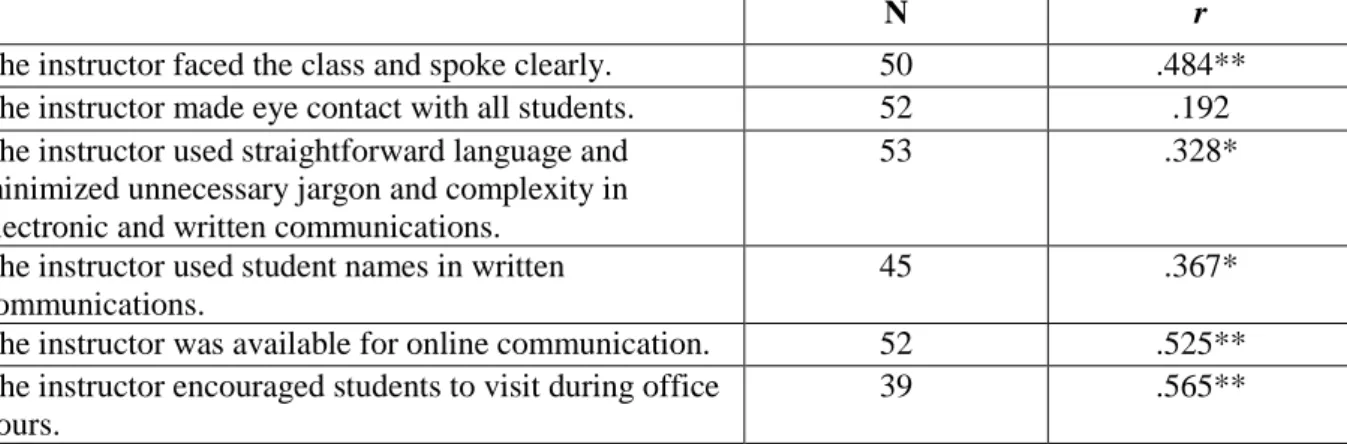
In the category Interaction participants identified a significant correlation between six items; instructor faced the class and spoke clearly (rxy= .484, p<0.01), instructor used straight forward language in electronic and written communications (rxy= .328, p<0.05), the instructor used names in written communications (rxy= .367, p<0.05), the instructor was available for online communication (rxy= .525, p<0.01), the instructor encouraged students to visit during office hours (rxy= .565, p<0.01), and instructor assigned group work where learners supported each other (rxy= .634, p<0.01). In the Feedback category participants
indicated a significant correlation in two items; instructor allowed students to turn in drafts
before the due date (rxy= .273, p<0.05), and the instructor gave students the opportunity to resubmit assignments (rxy= .293, p<0.05). In the Assessment category seven items showed a
significant correlation; the instructor provided a syllabus with clear statements and
expectations (rxy= .310, p<0.05), the instructor kept academic standards consistent for all students (rxy= .547, p<0.01), the instructor considered traditional tests with a variety of test item formats (rxy= .586, p<0.01), instructor considered a variety of methods for demonstration of knowledge (rxy= .605, p<0.01), instructor provided students choices in assessment methods
(rxy= .657, p<0.01), instructor assured that tests measured what students learned (rxy= .579,
p<0.01), and instructor announced assignments well in advance of due dates (rxy= .479,
Florianópolis, v. 10, n. 02, p. 127 – 143, jul. / dez. 2009 135 Table 2: Class Climate
Welcome everyone. Create a welcoming environment for all students. Encourage the sharing of multiple perspectives. Demonstrate and demand mutual respect (Burgstahler, 2007).
N r
The instructor created a welcoming environment for all students.
51 -.096
Students were encouraged to share multiple perspectives.
51 .186
The instructor demonstrated and demanded mutual respect.
53 .231
Avoid stereotyping. Offer instruction and support based on student performance and requests, not simply on assumptions that members of certain groups (e.g., students with certain types of disabilities or from specific racial/ethnic groups) will automatically do well or poorly (Burgstahler, 2007).
N r
The instructor offered instruction and support based on student performance and requests.
51 .263
Motivate all students. Use teaching methods and materials that are motivating and relevant to students with diverse characteristics with respect to age, gender, culture, etc. (Burgstahler, 2007).
N r
The instructor used teaching methods and materials that were motivating and relevant to students with diverse characteristics with respect to age, gender, cultures, etc.
49 .122
Be approachable and available. Learn students' names. Welcome questions in and outside of class, seek out a student's point of view, and patiently respond. Maintain regular office hours and work around student schedule conflicts with them (Burgstahler, 2007).
N r
The instructor learned student’s names. 47 .223
The instructor welcomed questions in and outside of class, sought out a student’s point of view, and patiently responded.
53 .322*
The instructor maintained regular office hours and worked around student schedule conflicts with them.
44 .162
Address individual needs in an inclusive manner. Make statements on the syllabus and in class inviting students to meet with you to discuss disability-related accommodations and other learning needs. Avoid segregating or stigmatizing any student by drawing undue attention to a difference (e.g., disability) or sharing private information (e.g., a specific student's need for an accommodation). (Burgstahler, 2007)
N r
The instructor made statements on the syllabus and in class inviting students to meet with her/him to discuss disability-related accommodations and other learning needs.
49 .219
The instructor avoided segregating or stigmatizing any student by drawing undue attention to a difference (e.g., disability) or sharing private information (e.g., a specific student's need for an accommodation).
52 .247
*. Correlation is significant at the 0.05 level. **. Correlation is significant at the 0.01 level.
Florianópolis, v. 10, n. 02, p. 127 – 143, jul. / dez. 2009 136 Table 3: Delivery Methods
Provide multiple ways to gain knowledge. Use multiple modes to deliver content and motivate and engage students—consider lectures, collaborative learning options, hands-on activities, Internet-based communications, educational software, fieldwork, etc. (Burgstahler, 2007).
N r
The instructor used multiple modes to deliver content and motivate and engage students such as: lectures, collaborative learning options, hands-on activities, Internet-based communications, and guest speakers.
49 .244
Make each teaching method accessible to all students. Make each instructional method accessible to students with a wide range of abilities, disabilities, interests, learning styles, and previous experiences. Provide the same means of participation to all students, identical when possible, equivalent when not. (Burgstahler, 2007).
N r
The instructor made each instructional method accessible to students with a wide range of abilities, disabilities, interests, learning styles, and previous experiences. They provided the same means of participation to all students, identical when possible, equivalent when not.
53 .580**
Select flexible curriculum. Choose textbooks and other curriculum materials that address the needs of students with diverse abilities, interests, learning styles and preferences, and other characteristics. Assure that curriculum materials are well organized, emphasize important points, provide references for gaining background knowledge, and have study questions and/or practice exercises, chapter outlines, comprehensive indexes, and glossaries. Consider technology-based materials that provide prompting, regular feedback, opportunities for multiple levels of practice, and access to background information, vocabulary and other supports based on student responses. (Burgstahler, 2007)
N r
The instructor made sure that curriculum materials were well organized.
51 .419**
Deliver instructions clearly and in multiple ways. Provide instructions both orally and in printed form. Ask for questions and have students repeat directions, and give feedback (Burgstahler, 2007).
N r
The instructor provided instructions both orally and in printed form.
51 .476**
The instructor asked students if they had questions. 52 .485**
Provide cognitive supports. Summarize major points, give background/contextual information, provide effective prompting, provide scaffolding tools (e.g., provide outlines, class notes, summaries, study guides, copies of projected materials with room for note-taking) and other cognitive supports. Deliver these materials in printed form and in a text-based electronic format. Provide opportunities for gaining further background information and vocabulary and different levels of practice with variable levels of support. (Burgstahler, 2007)
N r
The instructor provided scaffolding tools (e.g., provide outlines, class notes, summaries, study guides, copies of projected materials with room for note-taking).
50 .132
The instructor delivered instructional materials in printed form and in a text-based electronic format.
48 .448**
*. Correlation is significant at the 0.05 level. **. Correlation is significant at the 0.01 level.
Florianópolis, v. 10, n. 02, p. 127 – 143, jul. / dez. 2009 137 Table 4: Information Resources/ Technology
Select materials early. Choose printed materials and prepare a syllabus early to allow potential students the option of beginning to read materials and work on assignments before the class begins and to allow adequate time to arrange for alternate formats, such as books on tape (which for textbooks can take longer than a month). (Burgstahler, 2007)
N r
The instructor chose printed materials and prepared a syllabus early to allow potential students the option of beginning to read materials and work on assignments before the class begins and to allow adequate time to arrange for alternate formats.
48 .415**
Use multiple, redundant presentations of content that use multiple senses. Use a variety of visual aides and manipulatives (Burgstahler, 2007).
N r
The instructor used a variety of visual aids and manipulatives.
48 .438**
Provide all materials in accessible formats. Use textbooks that are available in digital, accessible format and with flexible features. Provide the syllabus and other teacher-created materials in text-based, accessible electronic format. Use captioned videos and provide transcriptions for audio presentations. (Burgstahler, 2007)
N r
The instructor provided the syllabus and other teacher-created materials in text-based, accessible electronic format.
52 .452**
The instructor used captioned videos and provided transcriptions for audio presentations.
41 .812**
Accommodate a wide variety of reading levels and language skills. Present content in a logical, straightforward manner and in an order that reflects levels of importance. Avoid unnecessary jargon and complexity. Create materials in simple, intuitive formats that are consistent with the expectations and intuitions of students with a diverse set of characteristics. (Burgstahler, 2007)
N r
The instructor presented content in a logical, straightforward manner, and in an order that reflected levels of importance.
46 .508**
The instructor avoided unnecessary jargon and complexity.
51 .349*
The instructor created materials in simple, intuitive formats that were consistent with the expectations and intuitions of students with a diverse set of characteristics.
50 .352*
*. Correlation is significant at the 0.05 level. **. Correlation is significant at the 0.01 level.
Florianópolis, v. 10, n. 02, p. 127 – 143, jul. / dez. 2009 138 Table 5: Interaction
Promote effective communication with you. Face the class, speak clearly, use a microphone if your voice does not project adequately for all students, and make eye contact with all students. Use straightforward language and minimize unnecessary jargon and complexity in electronic and written communications. Use student names in communications. Employ interactive teaching techniques. Be available for online communication and encourage students to visit you during office hours; consider making a student-instructor meeting a course requirement. (Burgstahler, 2007)
N r
The instructor faced the class and spoke clearly. 50 .484** The instructor made eye contact with all students. 52 .192 The instructor used straightforward language and
minimized unnecessary jargon and complexity in electronic and written communications.
53 .328*
The instructor used student names in written communications.
45 .367*
The instructor was available for online communication. 52 .525** The instructor encouraged students to visit during office
hours.
39 .565**
Encourage cooperative learning. Assign group work where learners must support each other and that places a high value on different skills and roles. Encourage different ways for students to interact with each other-e.g., in-class questions and discussion, group work, Internet-based communications. (Burgstahler, 2007)
N r
The instructor assigned group work where learners must support each other and that placed a high value on different skills and roles.
41 .634**
The instructor encouraged different ways for students to interact with each other-e.g., in-class questions and discussion, group work, Internet-based communications.
52 .264
*. Correlation is significant at the 0.05 level. **. Correlation is significant at the 0.01 level.
Table 6: Feedback
Provide feedback and corrective opportunities. Allow students to turn in parts of large projects for feedback before the final project is due. Give students resubmission options to correct errors in assignment and/or exams. (Burgstahler, 2007)
N r
The instructor allowed students to turn in drafts of projects for feedback before the final project was due.
52 .273*
The instructor gave students resubmission options to correct errors in assignments.
52 .293*
*. Correlation is significant at the 0.05 level. **. Correlation is significant at the 0.01 level.
Florianópolis, v. 10, n. 02, p. 127 – 143, jul. / dez. 2009 139 Table 7: Assessment
Set clear expectations. Create a straightforward and comprehensive grading rubric. Provide a syllabus with clear statements of course expectations; assignment descriptions, deadlines, and expectations; and assessment methods and dates. Keep academic standards consistent for all students, even for those who require accommodations. (Burgstahler, 2007)
N r
The instructor created a straightforward and comprehensive grading rubric.
51 .230
The instructor provided a syllabus with clear statements of course expectations; assignment descriptions, deadlines, assessment methods and dates.
52 .310*
The instructor kept academic standards consistent for all students, even for those who required accommodations.
49 .547**
Provide multiple ways to demonstrate knowledge. Assess group/cooperative performance as well as individual achievement. Consider traditional tests with a variety of test item formats (e.g., multiple choice, essay, short answer), papers, group work, demonstrations, portfolios, and presentations as options for demonstrating knowledge, providing students choices in assessment methods and/or allowing students to use information technology to complete exams. (Burgstahler, 2007)
N r
The instructor considered traditional tests with a variety of test item formats (e.g., multiple choice, essay, short answer).
51 .586**
The instructor considered papers, group work, demonstrations, portfolios, and presentations as options for demonstrating knowledge.
49 .605**
The instructor provided students choices in assessment methods.
39 .657**
Test in the same manner in which you teach. Assure that a test measures what students have learned, not their ability to adapt to a new format or style of presentation (Burgstahler, 2007).
N r
The instructor assured that tests measured what students had learned, not their ability to adapt to a new format or style of presentation.
48 .579**
Minimize time constraints when appropriate. Plan for variety in pace of learning and completion of work by announcing assignments well in advance of due dates. Allow extended time on tests and projects, unless speed is an essential outcome of instruction. (Burgstahler, 2007)
N r
The instructor planned for variety in pace of learning and completion of work by announcing assignments well in advance of due dates.
52 .479**
The instructor allowed extended time on tests. 48 .278
*. Correlation is significant at the 0.05 level. **. Correlation is significant at the 0.01 level.
Discussion
The current study revealed that the performance indicator categories proposed by Burgstahler (2007) were considered important for the participants in their learning
Florianópolis, v. 10, n. 02, p. 127 – 143, jul. / dez. 2009 140 experiences. In this research, within the category of Class Climate, a significant correlation
was found between the instructor welcoming questions in and out of class and seeking student’s perspectives. Myers (2004) found that professors who are perceived by their students as caring and possessing characteristics such as: kindness, empathy, understanding, and are responsive are more likely to have students communicate with them in and out of the classroom. Effective communication with faculty members was considered an essential part of the participant’s learning experiences.
Universal design principles encourage multiple ways to deliver content to facilitate student learning. Participants in this study indicated that having a clear and organized syllabus and content delivered in class and in electronic formats was an essential element in their leaning process. Further, Mino (2004) stated that “A flexible curriculum is one that provides multiple modes of representation, multiple means of student expression, different ways for students to become engaged, and the organizational and cognitive supports to provide access for all students” (p. 155). This process was further enhanced by the use of technologies (Web CT Learning Management System).
In the category of Interaction, participants noted that effective communication with faculty was important for their academic success. Similarly, Hurst (1991) noted that for successful instructor –student communication to occur the following guidelines should be implemented: (a) limit use of jargon and complexity of instructions, (b) do not digress from the objectives set in the course outlines, (c) realize that students are not experts in the area being taught, (d) realize that students may be struggling with new ideas, concepts and technology, (e) be self-confident but not arrogant when communicating with students, and (f) keep it short and simple – where possible. The findings of the current study are congruent with Hurst’s research findings.
Participants indicated that feedback from faculty was imperative to their learning. Bonnel (2008) alerts that feedback in an online environment needs to be meaningful to students. Further, Perera, Lee, Win, Perera, and Wijesuriya (2008) examined the perceptions of formative feedback between faculty and students and found that for students “effective feedback is not confined to giving a grade… Ninety three percent of students requested suggestions for improvement” (p. 396) on their assignments. Similarly, participants in this study found that being able to submit drafts before the due date for feedback from the instructor and being allowed to re-submit work for a better grade after feedback was provided were important elements in their learning.
Florianópolis, v. 10, n. 02, p. 127 – 143, jul. / dez. 2009 141 According to Mino (2004) “Learner-centered assessment is characterized by a variety
of assessment approaches, and offers students multiple opportunities to demonstrate what they know and can do at different times during the semester” (p. 158). Participants in this study noted that their learning was enhanced by having a diverse exam format which included multiple choice, short answer, and essay type questions. They also liked the opportunity of presenting what they learned through research papers, group discussions, group work, and presentations.
Limitations
As Sletter (2008) observed, mutual respect between instructor and learners is a basic underlying principle of the UDL model, which facilitates the development and sharing of multiple perspectives. A limitation of this study was the fact that the instructor teaching these graduate courses was a person of diversity; therefore, she was aware of her culture, values, and beliefs. No adaptations or modifications were made in the implementation of a positive and inclusive classroom climate as she held high expectations independent of students’ background characteristics. The instructor relied on her own diverse experiences to provide a positive learning environment for the students.
Conclusion
This paper has provided an overview of Universal Design for Learning strategies that may be successfully incorporated into academic instruction. Faculty may identify many of these aspects that they already include in their instructional delivery, but what becomes evident from the outcomes of this research is that students appreciate the intentionality of designing instructional practice around the UDL model. In a competitive academic market that places ever increasing demands on the retention of students in higher education, stakeholders have realized that wider access provided through models such as those proposed in the UDL model are not only essential strategies employed to retain students with disabilities or at risk students, but typical college students as well.
Florianópolis, v. 10, n. 02, p. 127 – 143, jul. / dez. 2009 142 References
Abreu-Ellis, C., & Ellis, J. B. (2009). Scaffolding for success in E-learning: Self-regulation of the online learner using the LASSI inventory. In: E. R. Santos, E. M. Miletto, & M. Turcsanyi-Szabo (Eds.) Education and Technology for a Better World. IFIP WCCE: Porto Alegre, RS – Brazil.
Albanese, M. (2000). Problem-based learning: Why curricula are effect on knowledge and clinical skills. Medical Education, 34, 729-738. DOI: 10.1046/j.1365-2923.2000.00753.x
Astin, A. W. (1993). What Matters in College? Four Critical Years Revisited. San Francisco: Jossey-Bass.
Bonnel, W. (2008). Improving feedback to students in online courses. Nursing Education
Perspectives, 29(5), 199-294.
Bruner, J. (1978). The role of dialogue in language acquisition. In: A. Sinclair, R.J. Jarvella and W. J. M. Levelt (Eds.) The child’s conception of language. New York: Springer-Verlag. Burgstahler, S. (2007). Equal access: Universal design of instruction. Retrieved from http://www.washington.edu/doit/
Center for Universal Design. (2008a). About UD. Retrieved from http://www.design.ncsu.edu/cud/about_ud/about_ud.htm
Center for Universal Design. (2008b). About UD: Universal Design principles. Retrieved http://www.design.ncsu.edu/cud/about_ud/udprincipleshtmlformat.html#top
Hall, B. (2009). Research into practice: Differentiated instruction. Toronto: Pearson
Education, Inc. Retrieved from http://www.pearsonschool.com/live/assets/200916/MatMon092625HS2011Hall_20703_1.pdf
Hurst, B. (1991). The Handbook of Communication Skills. London: Kogan Page.
Jaasma, M. A., & Koper, R. J. (1999). The relationship of student-faculty out-of-class communication to instructor immediacy and trust and to student motivation. Communication
Education, 48(1), 41-47. DOI: 10.1080/03634529909379151
Kátai, Z., Juhász, K., & Adorjáni, A. K. (2008). On the role of senses in education.
Computers & Education, 51(4), 1707–1717. DOI: 10.1016/j.compedu.2008.05.002
McGuire, J. M., Scott, S. S., & Shaw, F. (2006). Universal Design and its applications in educational environments. Remedial & Special Education, 27(3), 166-175. Retrieved from http://proquest.umi.com.ezproxy.lakeheadu.ca/pqdweb?did=1045931211&sid=1&Fmt=4&cli entId=29636&RQT=309&VName=PQD
Meyer, A., & Rose, D. H. (2000). Universal design for individual differences. Educational
Leadership, 58(3), 39-43.
Florianópolis, v. 10, n. 02, p. 127 – 143, jul. / dez. 2009 143 learner-centered community college classroom. Equity & Excellence in Education, 37,
154-160. DOI: 10.1080/10665680490454011
Myers, S. A. (2004). The relationship between perceived instructor credibility and college student in-class and out-of-class communication. Communication Reports, 17(2), 129-137.
Pascerella, E. T. & Terenzini, P. T. (2005). How College Affects Students Volume 2: A Thirds
Decade of Research. San Francisco: Jossey-Bass.
Perera, J., Lee, N., Win, K., Perera, J., & Wijsesuriya, L. (2008). Formative feedback to students: the mismatch between faculty perceptions and student expectations. Medical
Teacher. 30, 395-399. DOI: 10.1080/01421590801949966
Rocca, K. A., & McCroskey, J. C. (1999). The interrelationship of student ratings of instructors' immediacy, verbal aggressiveness, homophily, and interpersonal attraction.
Communication Education, 48(4), 308-316. DOI: 10.1080/03634529909379181
Rose, D. (2000). Universal Design for Learning. Retrieved from http://jset.unlv.edu/15.3/asseds/rose.html
Rose, D., & Meyer, A. (2002). Teaching every student in the digital age: universal design for
learning. Retrieved from http://www.cast.org/teachingeverystudent/ideas/tes/
Sleeter, C. (2008). An invitation to support diverse students through teacher education.
Journal of Teacher Education, 59(3), 212-219. DOI: 10.1177/0022487108317019
Tabak, I. (2004). Synergy: A complement to emerging patterns of distributed scaffolding.