faculty regarding professional ethics
Átila Barros Magalhães 1, Monique Natálle Silva Pereira 2, Bruno Nonato Pedroso Nascimento 3, Mardson Danilo Sousa de Lima 4, Rafaela Okano Gimenes 5, Renato da Costa Teixeira 6
Abstract
This study aimed to evaluate aspects relating to interest, perception and knowledge levels regarding ethics in physiotherapy among lecturers of this course at a university in the Brazilian Amazon region. Eighteen lec-turers participated and responded to 21 questions divided in sections related to “interest”, “perception” and “knowledge levels”. The data was considered in terms of absolute and relative frequency. In the “interest” section, 77.77% (n = 14) indicated internet as a primary source of updates regarding the issue of ethics in phy-siotherapy. In the “perception” section, 94.44% (n = 17) considered the ethical behavior of students in their evaluations. Regarding “knowledge levels”, 83.33% (n = 15) erred to say that treatment prescription can only be established after an appointment. Therefore, it is necessary to enhance knowledge and stimulate ethical considerations of lecturers regarding their ethical behavior for their own growth and the training of students.
Keywords: Ethics. Physical therapy specialty. Faculty.
Resumo
Percepção, interesse e conhecimento de docentes de fisioterapia sobre a ética na profissão
Este estudo objetivou avaliar aspectos relacionados ao interesse, percepção e níveis de conhecimento sobre ética em fisioterapia entre docentes da área de uma universidade pública na Amazônia brasileira. Par-ticiparam 18 professores, que responderam às 21 questões distribuídas nos eixos “interesse”, “percepção” e “níveis de conhecimento”. Os dados foram trabalhados em frequência absoluta e relativa. No eixo interesse, 77,77% (n = 14) indicaram a Internet como principal fonte de atualização sobre ética em fisioterapia. Em ter-mos de percepção, 94,44% (n = 17) consideraram a postura ética dos alunos em suas avaliações. Quanto aos níveis de conhecimento, 83,33% (n = 15) erraram ao dizer que a prescrição terapêutica só pode ser instituída depois da consulta. Portanto, é necessário aprofundar o conhecimento e estimular a reflexão ética dos docen-tes sobre sua postura ética, tendo em vista o próprio crescimento e a formação dos discendocen-tes.
Palavras-chave: Ética. Fisioterapia. Docentes.
Resumen
Percepción, interés y conocimiento de docentes de fisioterapia sobre la ética en la profesión
Este estudio tuvo como objetivo evaluar aspectos relacionados con el interés, la percepción y los niveles de conocimiento sobre la ética en la fisioterapia entre los profesores de esta carrera en una universidad pública de la Amazonia brasilera. Participaron 18 profesores que respondieron al cuestionario de 21 preguntas dis-tribuidas en los ejes de “interés”, “percepción” y “niveles de conocimiento”. Los datos fueron trabajados en frecuencia absoluta y relativa. En la escala de Interés, el 77,77% (n = 14) indicó a Internet como la fuente prin-cipal de actualización sobre la ética en fisioterapia. En términos de percepción, el 94,44% (n = 17) consideró la postura ética de los estudiantes en sus evaluaciones. En cuanto a los niveles de conocimiento, el 83,33% (n = 15) se equivocó al decir que la prescripción del tratamiento sólo puede establecerse después de la con-sulta. Por lo tanto, es necesario profundizar en el conocimiento y estimular la reflexión ética de los profesores sobre su postura ética, teniendo en cuenta su propio crecimiento y la formación de los alumnos.
Palabras clave: Ética. Fisioterapia. Docentes.
Aprovação CEP/Uepa CAAE 37649114.8.0000.5168
1. Mestrando [email protected] 2. Graduada [email protected] 3. Graduando [email protected] 4.
Graduando [email protected] 5. Doutoranda [email protected] 6. Doutor [email protected] – Universidade do Estado do Pará (Uepa) Campus XII, Santarém/PA, Brasil.
Correspondência
Átila Barros Magalhães – Rua Afonso Pena 808, Aeroporto Velho CEP 68010-140. Santarém/PA, Brasil. Declaram não haver conflito de interesse.
Resear
Understood as the study of behaviour and character, ethics consists of determining what is good or valuable for individuals, groups and society in general. Thus, ethically considered acts reflect a commitment to standards that are beyond personal preferences, which individuals, professions and
so-cieties strive to achieve 1.
Ethics is inherent in the practice of health professionals in the context of their commitment to patients and in the internal relationships of their own team. Numerous conflicts are embedded in these contexts and require that the analysis of the facts, questions and decisions are based on ethical
principles 2. These decisions will influence the quality
of life of individuals and should be guided by ethical sensitivity and moral reasoning, taking into consid-eration various factors such as the patient’s religion,
education, culture and experiences 2. This
perspec-tive, allows the physiotherapist a holistic view across the barrier of technicalities that are entrenched in medical science, and therefore legitimizes the
im-portance and effectiveness of humane treatment 3.
In assisted care and teaching, there is a need for physiotherapist lecturers to include teaching ethics as an educational resource in the teaching-learning process. For this purpose, they address topical di-lemmas as case studies in order for students to link practical experiences and theory, both in the
pres-ent and in the future 4. Thus, it will be possible to
train professionals who will be committed to theo-rizing about and practicing ethics concerning human beings in the context of globalization.
In short, this study sought to clarify the fol-lowing question: what are the perceptions, interests and levels of knowledge regarding ethics in phys-iotherapy among lecturers of the physphys-iotherapy course at the Universidade do Estado do Pará - UEPA (University of the State of Pará) - Campus XII?
Methodology
This is a quantitative, descriptive and cross-sec-tional study as approved by the Comitê de Ética em Pesquisa do Centro de Ciências Biológicas e da Saúde [Research Ethics Committee of the Centre for Biologi-cal Sciences and Health] – Campus XII/UEPA (Opinion No. 907 874) – and was performed at the university. In total, there are 19 physiotherapists lecturers in the physiotherapy course, and the sample was com-posed of 18 of them.
As a research tool, we used a questionnaire of 21 questions created by the authors, based on an existing
questionnaire 5. The study does not describe
psycho-metric properties, as it did not generate scores. The questions were divided into the following sections: Interest, Perception and Knowledge Levels. Interest en-compassed questions 1, 2 and 3; Perception issues from 4 to 12; and, finally, Knowledge Levels, from 13 to 21.
Initially, the researchers asked the UEPA-San-tarém secretariat of courses for a list with contacts of physiotherapists lecturers. An initial phone call was made to confirm the participation of each lecturer in the research and then the researchers met with each lecturer for the necessary explanations and the signing of the informed consent forms (IC), in addi-tion to the handling of the quesaddi-tionnaire, which was answered by volunteers and self-administered, that is, without interference from the researchers.
Data from the quantitative assessment, present-ed in tables, were organizpresent-ed and processpresent-ed according to measures of descriptive statistics, indicating abso-lute and relative frequency, obtained by Microsoft Excel 2013. Subsequently, some data was transferred to the BioEstat 5.3 application to analyse the probability distri-bution of variables through a G test, with p <0.05.
Results and discussion
The research involved 18 lecturers of a phys-iotherapy degree course, this means, 94.73% of the total population of 19 lecturers. The results of each question, separated by the corresponding sections, are presented below.
The first question reveals that 50% (n = 9) read the complete Código de Ética e Deontologia da Fi-sioterapia – CEDF – (Physiotherapy Code of Ethics
and Deontology) 6, a result which did not
corrobo-rate the research of Vieira and Neves 7 and Almeida
et al 8, in which medical educators claim to have
par-tially read the code of ethics of their profession: 62% (n = 75) and 86.2% (n = 87), respectively. Noteworthy is the fact that if we add the number of educators who partially read the code and those who have never read it, it would amount to the same quantity of lecturers who fully read the code 50% (n = 9).
Although the results do not show levels of statistical significance, it is noteworthy that the lack of knowledge, or ignorance, of some UEPA physio-therapy lecturers regarding the professional rules may result in unethical attitudes towards their peers and students. That is, the impoverishment of their knowledge undermines the quality of education offered to students, which may result in them
re-ceiving insufficient and outdated information 5.
Resear
Table 1. Distribution of answers from the Interest section amongst physiotherapy lecturers of UEPA-Santarém
Question n % p
1. Have you read the Código de Ética da Fisioterapia (Physiotherapy Code of Ethics) in the last three years?
Yes, entirely 9 50
0.1146
Yes, partially 7 39
No/Never 2 11
2. How often do you update yourself regarding the subject?
Once a month 1 5
0.1681
Once every six months 7 39
Once a year 5 28
I do not update myself 5 28
Non-applicable (Never read it) 0
3. Which is/are your main source of update regarding the topic?
Internet 14 77
< 0.0001*
Scientific events 1 6
Books and journals 1 6
Others 0 0
Non-applicable 2 11
*Significant results for G. test
Still regarding question 1, the fact that two lec-turers (11%) reported they had not read the code of ethics in the last three years makes us reflect on the fact that these lecturers do not exercise the profes-sion in clinical practice, or teach disciplines that are applied to specific physiotherapy techniques, which would still not justify the response, since the focus is on students’ training and their professional future.
Regarding the second question, it was found that the largest share, 39% (n = 7), search updates regarding the CEDF every six month. Even if the question does not present a significant level of statis-tical significance, the data is worrisome because the 28% (n = 5) that do not update on the subject quan-titatively represent a number similar to the one of lecturers that update themselves every six months.
This result also does not agree with the study
of Vieira and Neves 7, which reported that most
med-ical lecturers (34.7%; n = 42), in a population of 121 respondents, rarely updated themselves regarding
“ethics”. In their analysis, Almeida et al 8 and Freire 9
consider the commitment of lecturers in their search of what is new as important, not only to increase the level of knowledge in their training, but for a better basis to share updated knowledge with their students. In question 3, it was observed that most (77%; n = 14) use the Internet as their primary source of up-dates regarding “ethics in physiotherapy”, which differed
from the results of Vieira and Neves’ study 7, in which
60% of medical lecturers cited scientific events, books and journals as their main way to update. Our result can be explained by factors such as the advancement
of information technology - which facilitates access to information among the population - in addition to the informational support that the university provides to lecturers. Thus, they can update themselves, and de-velop new educational strategies that can be used to
enrich the teaching-learning process 5.
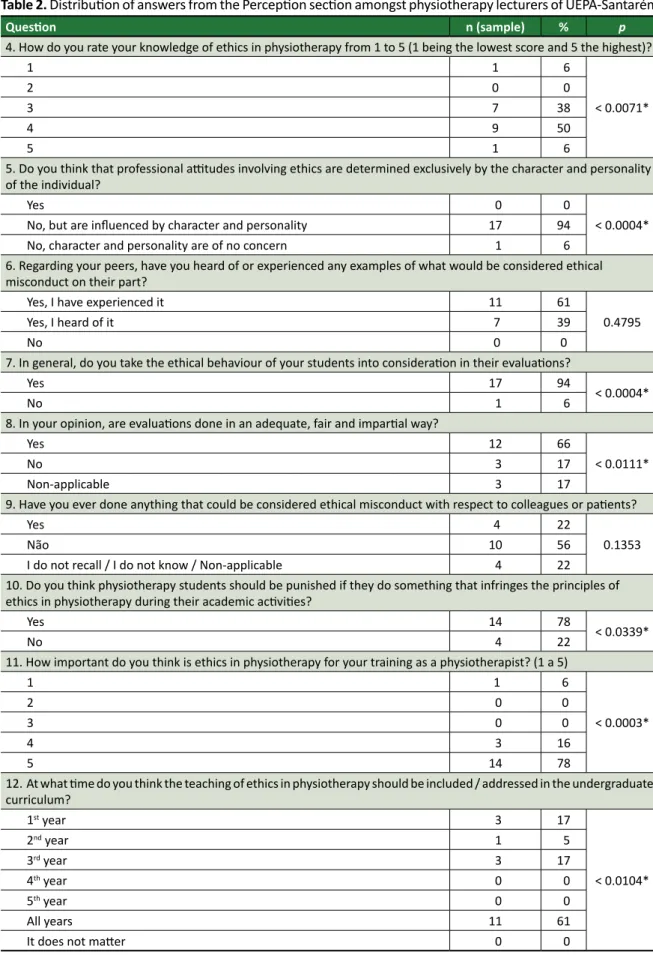
In the fourth question, 50% (n = 9) opted for the score “4” regarding the classification of their knowledge on ethics in physiotherapy. This may berelated to Table 1, in which the largest share of respondents (50%) has said they have fully read the professional code of ethics and update themselves on the subject every six months (39%).
In question 5, on being asked whether ethical attitudes are determined exclusively by character and personality, the majority of respondents - 94% (n = 17) - answered “No, but are influenced by
char-acter and personality” and only 6% (n = 1) chose “No, character and personality are of no concern.”
Coelho 10 reinforces the need for dialogue
re-garding ethics among students and lecturers, as his study revealed that physiotherapy course students (74.6%; n = 44) also recognized the influence of both character and personality in their ethical attitudes. Thus, there is a clear need for critical reflection by lecturers regarding their essential nature, in order to change their attitudes and to also direct these chang-es to the teaching-earning procchang-ess, encouraging educational strategies that link theory and practice
based on existing ethical and moral concepts 11,12, as
each individual considers their choices, attitudes and
their way of relating to others in society 13.
Resear
Table 2. Distribution of answers from the Perception section amongst physiotherapy lecturers of UEPA-Santarém
Question n (sample) % p
4. How do you rate your knowledge of ethics in physiotherapy from 1 to 5 (1 being the lowest score and 5 the highest)?
1 1 6 < 0.0071* 2 0 0 3 7 38 4 9 50 5 1 6
5. Do you think that professional attitudes involving ethics are determined exclusively by the character and personality of the individual?
Yes 0 0
< 0.0004*
No, but are influenced by character and personality 17 94
No, character and personality are of no concern 1 6
6. Regarding your peers, have you heard of or experienced any examples of what would be considered ethical misconduct on their part?
Yes, I have experienced it 11 61
0.4795
Yes, I heard of it 7 39
No 0 0
7. In general, do you take the ethical behaviour of your students into consideration in their evaluations?
Yes 17 94
< 0.0004*
No 1 6
8. In your opinion, are evaluations done in an adequate, fair and impartial way?
Yes 12 66
< 0.0111*
No 3 17
Non-applicable 3 17
9. Have you ever done anything that could be considered ethical misconduct with respect to colleagues or patients?
Yes 4 22
0.1353
Não 10 56
I do not recall / I do not know / Non-applicable 4 22
10. Do you think physiotherapy students should be punished if they do something that infringes the principles of ethics in physiotherapy during their academic activities?
Yes 14 78
< 0.0339*
No 4 22
11. How important do you think is ethics in physiotherapy for your training as a physiotherapist? (1 a 5)
1 1 6 < 0.0003* 2 0 0 3 0 0 4 3 16 5 14 78
12. At what time do you think the teaching of ethics in physiotherapy should be included / addressed in the undergraduate curriculum? 1st year 3 17 < 0.0104* 2nd year 1 5 3rd year 3 17 4th year 0 0 5th year 0 0 All years 11 61
It does not matter 0 0
*Significant results for G. test
Resear
In the sixth question, 61% (n = 11) respond-ed to having already experiencrespond-ed some example of ethical misconduct by their colleagues. In this type of situation, it is possible that patients become vic-tims of professionals’ ethical misconduct, which is something that can compromise even the quality of care. In such situations, individuals run the risk of having their right to quality health curtailed due to
the negligence of certain professionals 5.
In fact, health professionals should look at each patient and interpret them as an entity in a so-cial context. That is, as an individual with the right to humane treatment, based on a holistic perspective and not from the historically technicist roots that
formed the profession 14, which, at some point,
con-sidered in its practices the separation between body
and mind as advocated by Descartes 15. In the work
environment, sometimes the practice of unethical behaviour is ignored by colleagues in order to main-tain harmony, to ensure internship positions, or for
fear of generating any conflict 16.
Currently, there is an increasing need for the humanization of work teams, based on respect for each other’s individual knowledge and being
open to dialogue16, 17. Moreover, in the presence of
students in certain situations, there may be inter-pretations that omissions and lack of punishment for these types of behaviour may end up being
re-produced with a sense of impunity by colleagues 5.
Coelho 10 found that physiotherapy course students
already experienced situations of ethical miscon-duct by colleagues (35.6%; n = 21) or were aware of such practice (35.6%; n = 21).
In question 7, the majority (94%; n = 17) showed that they take into consideration the ethical behaviour of students in their evaluations, while only 6% (n = 1) do not take this parameter into account. The data in question was confirmed by Coelho’s
re-search 10, since the largest share of students (69.5%;
n = 41), in the study of the institution in question, stated that lecturers take into account the ethical behaviour of students in their evaluations.
In question 8, 12 respondents (66%) answered “yes” when asked if the evaluations are done in an adequate, fair and impartial way. In contrast, 3 an-swered “no” (17%), which is considered worrisome.
This is evident in the study of Coelho 10, in which
33.9% (n = 20) of physiotherapy students judged the evaluations of lecturers to be biased and unfair.
The evaluation should be based on respect, fairness, and free from any comparison between stu-dents, and in no way classify the students as good or
bad 18. In fact, discriminating and demoralizing the
student prevents the teacher from evaluating them democratically; therefore the lecturer’s consistency is very important, even if only not to hurt the self-es-teem of the student. One option is to carry out joint evaluations, through dialogue, between lecturer and student, as lecturers should try to establish a partnership with students in order to build a shared teaching-learning relationship, and not just focus solely on their own perception of performance of
those under their tutelage 9.
In the ninth question, 10 lecturers (56%) re-sponded “no” when they were asked if they had ever done anything that could be considered ethical mis-conduct with respect to colleagues or patients. In the context of the study population, possible disrespect-ful attitudes of some lecturers towards colleagues can lead to the deterioration of the group’s cohe-sion and can generate harmful consequences to the harmonious coexistence and the political and social representation of physiotherapists. This can weaken and disrupt professionals, making it difficult to fight for the collective interest, thereby making room for some circumvention of the rights and demands of the common good for the sake of satisfying personal
interests 5. This reality reveals the difficulty in
meet-ing what Rousseau 19 called a “social contract”, which
would set an invariable pact between all so that the collective interests were sovereign in relation to the personal needs of individuals.
Knowing that lecturers are seen as ethical and moral reference for students, lecturers need to be aware of their adopted words and actions, and use their own errors to guide students regarding the proper conduct, since it is possible that the students might not have the necessary discernment to do so . The fact that students have witnessed unethical actions by their lecturers was reported by
Magel-lan, Santos and Souza 5, which showed that 42.16%
of medical students had experienced situations of
ethical misconduct by their tutors; Almeida et al 7
also reported that 70.6% of students had witnessed the inappropriate attitudes of their educators when dealing with patients. The data indicates the ur-gent need for further research, as the deteriorating ethical moral may be incipient and might be being legitimized at the university itself.
In question 10, when asked whether they agree or not with the fact that physiotherapy students should be punished if they do something that infring-es the principlinfring-es of ethics in physiotherapy during their academic activities, the majority (78%, n = 14)
answered “yes”. In the study of Coelho 10, the largest
Resear
share of the physiotherapy students (77.78%) also said that the student should be punished. The four lecturers (22%) who believe that students should not be punished may at any time make an unfair and bi-ased assessment, and “condone” certain unethical attitudes of students. Our view is that, regardless of whether or not they are punished, students should be advised regarding the best professional
con-duct and the set limits that constrain them 5. In this
context, we suggest a version of the code of ethics
fo-cused on students 20, or a deep analysis and criticism
of the code of ethics in order to introduce the study of ethics from the formative training period to future situations in students’ professional lives.
Question 11 referred to the how important ethics is in physiotherapy for the training of physio-therapists, and most (78%; n = 14) attributed grade “5”. This data can be connected to some incentives presented by lecturers during the undergraduate course, and today, as faculty, it is up to them to
pres-ent ethics to studpres-ents as a fundampres-ental elempres-ent 22.
For Freire 9, the lecturer should not stick to
the simple transfer of knowledge, but rather share knowledge with students based on the knowl-edge and experience of both parties, in addition to encouraging political and ideological criticality. Otherwise, education becomes ”monetarised” and petty, as the lecturer would be like a machine that only communicates the information, and the stu-dent, a mere deposit of knowledge that only repeats what they were told. The author concurs with
Piag-et 23 by also stating that knowledge is formed not by
the simple reproduction of words, but by the pro-cess of building knowledge through assimilation.
Reinforcing the criticality reasoned by Freire 9,
it is very important that UEPA physiotherapists educators engage politically in the fight for their rights, in view of the representativeness of their professional group inserted in the globalized world and the neoliberal system, which reinforces tech-nicality, replacing individual ethics with the ethics of commodification. This statement confirms the
idea of Marx and Engels 24, who value the unity of
the working class regarding the political and social transformation that has the potential to enslave and alienate human beings. In the wake of political conscience, the philosophical and anthropological
foundation of a multidisciplinary team is essential 5.
Foucault 25, for example, claimed that the
relation-ship of power by itself already instigates the desire for the pursuit of human freedom, and this is inten-sified when these relations are crystallized without shared understanding between the parties – that is,
the willingness to resist in the face of domination emerges/rises before this context that the author calls “state of domination”.
Bringing the discussion of ethics into the class-room means not only contributing to the personal development of the student, taking them out of a state of political alienation – a condition often found in our profession - but it also consolidates the con-struction of workers that are politicized, committed
and prepared to deal with all spheres of health care 12.
In the last topic on the Perception section, the majority (61%; n = 11) responded that there is a need to teach ethics in physiotherapy in the
un-dergraduate curriculum. Coelho 10 shows the same
desire amongst students: 55.9% (n = 33) feel the need for the teaching of ethics in all semesters of their course. The change in the political education-al project can meet this demand, as currently the disciplines that focus on ethics are present un-til the third year, and it is from this year onwards that students have more contact not only with their classmates and lecturers, but mainly with patients during students’ internships. One option is to insert curriculum components to discuss ethics in physio-therapy early in the course, using the most diverse teaching-learning methodologies - preferably active - and then to contextualize it in other disciplines so that the subject becomes transdisciplinary until the end of the undergraduate course, based on the
teaching tool called transversality 4, which creates a
link between systematically learned theory and day
to day community events/experiences 26.
Another element to be considered is active methodologies, which represent an innovative
as-pect within teaching 12,27. This educational resource,
which addresses the questioning of reality, was used at the Universidade Federal do Rio Grande do Norte (Federal University of the State of Rio Grande do Norte) -UFRN, where it allowed the correlation of theoretical knowledge with practical experience through teaching methodologies such as discussion forums and case studies. Education through prob-lem-based learning (PBL) is another way of instigating reflection, criticality in coherent discussions and resolution of problematic situations through
interac-tion between groups 4. Problematization transforms
the lives of human beings, demonstrating that it is not a mere historical artifact, but rather the largest holder of the ability to reinvent themselves, to solve problems and to deal with contemporary dilemmas, which results from globalization, and thus to recre-ate not only their own, but also the narrative of the
society in which they are part of 9.
Resear
Table 3. Distribution of answers from the Knowledge Levels section amongst physiotherapy lecturers of
UEPA-Santarém
Question n (sample) % p
13. Does the CEDF regulate the relationships between physiotherapists and nurses, doctors and other professionals?
Yes (wrong) 14 78 < 0.0339*
No (correct) 4 22
14. Are physiotherapists, doctors, nurses and other health professionals subject to the CEDF?
Yes (wrong) 1 6 < 0.0004*
No (correct) 17 94
15. Is the CEDF punitive?
Yes (wrong) 11 61 0.4795
No (correct) 7 39
16. Does the CEDF deal directly with professional confidentiality?
Yes (correct) 17 94 < 0.0004*
No (wrong) 1 6
17. Does the CEDF deal directly with physiotherapist’ strikes?
Yes (wrong) 3 17 < 0.0095*
No (correct) 15 83
18. Can physiotherapists prescribe treatment without prior medical consultation?
Yes (correct) 3 17
< 0.0095*
No (wrong) 15 83
19. Does the CEDF deal directly with physiotherapy fees?
Yes (correct) 4 22
< 0.0039*
No (wrong) 14 78
20. When prescribing an exercise or completing a medical record form illegibly, does the physiotherapist hurt an article of the CEDF?
Yes (correct) 13 72
< 0.0009*
No (wrong) 5 28
21. Can physiotherapists consult or prescribe physiotherapy treatment without a face-to-face consultation?
Yes (correct) 3 17
< 0.0095*
No (wrong) 15 83
*Significant results for G. test.
In the first question from/of this section – whether or not the CEDF regulates the relationship between physiotherapists and nurses, doctors and other professionals – the majority (78%; n = 14) chose the wrong alternative. Article 1 of Resolution 424 from COFFITO (Conselho Federal de Fisioterapia e Terapia Ocupacional / Federal Council of Physiotherapy and Occupational
Ther-apy) 6 reveals that the CEDF addresses questions
regarding the ethical duties of physiotherapists, and not the relationships of these professionals with any other.
In question 14, the study questions whether other professionals are, or are not, subject to the CEDF, and 17 lecturers (94%) chose the correct option. Knowing they are part of a a professional group – and therefore that they must follow specific rules for the practice of their profession – the par-ticipants may have come to the right conclusion, as
defined in Resolution 424 from COFFITO 6.
In question 15, when asked if the CEDF is puni-tive or not, 11 (61%) participants answered wrongly. Even if the results do not have a substantial level of statistical significance, it is assumed that most of the faculty were wrong to answer the question because the CEDF is a legal provision and addresses the rules governing the profession.
In question 16, 17 (94%) chose correctly when asked if the CEDF deals with professional confi-dentiality. Educators may have been influenced to choose the correct answer provided in Chapter VI
of Resolution 424 6, because of their experiences,
in the classroom, in interships and at work environ-ments, in which information regarding patients and treatments are and should be safeguarded. It is im-portant to highlight that three of the lecturers had not read the CEDF in the last three years.
In the seventeenth question, which deals with working class strikes, 15 participants (83%) answered correctly. The current political and social
Resear
climate, in which strikes and protests are recur-rent, may have led the other 3 (17%) to choose the
wrong answer 5.
When questioning whether physiotherapists may or may not prescribe therapy without prior consultation, 83% (n = 15) of respondents chose the wrong option. Again, most physiotherapist fac-ulty participating in the survey have shown lack of knowledge regarding one of the aspects covered in the code of ethics, which concerned the prescrip-tion without compulsory prior consultaprescrip-tion.
In question 19, referring to the matter of fees in the CEDF, 14 participants (78%) answered incor-rectly. As much as fees are a topic of interest for this professional category, and a subject of discussion inside and outside the university, the lecturers still
answered incorrectly. The CEDF 6 has a specific
chap-ter regarding fees, establishing what they consider a professional right and indicating what is forbidden to professionals regarding physiotherapy procedures.
When asked whether or not illegible writing corresponds to an offense in terms of the CEDF (question 20), 13 (72%) answered correctly, indi-cating that most educators in the study knew that, when prescribing an exercise or completing a med-ical record form illegibly, the physiotherapist hurts
the CEDF and, above all, patient rights 5.
In question 21, regarding the physiotherapist consulting or prescribing physiotherapy treatment without a face-to-face consultation, 15 (83%) chose the wrong alternative. This practice can be harmful to the patient, who runs the risk of not having the complete information about their case, and may even proceed to not making a commitment to go to the clinic, as the physiotherapist is authorized to give distance consultation. In addition to problems regarding the quality and effectiveness of care, pro-fessional productivity levels may also be affected, as the trend will be an increase in attempts to get free consultations.
In the Interest section, the results are sat-isfactory, since 50% of the UEPA physiotherapy faculty have read the entire CEDF and often update themselves on this issue through media such as the Internet. Thus, they demonstrated commitment to monitor developments regarding the legal aspects of the profession, with a view to acquiring new knowledge for themselves and to share them with their students.
In the Perception section, it became evident that several lecturers in the study have high levels of knowledge regarding ethics in physiotherapy and
recognize the need for ethics in professional rela-tions, care and the teaching-learning process. Even with this information, together with the findings within the Interest section, it was observed that some lecturers do not value the ethical and mor-al precepts in their totmor-ality. They have attitudes of an unethical nature or fall short when, within the Levels of Knowledge section, they err regarding the questions that indicate the need for a deeper awareness of the CEDF, which is the guiding element of professional practice.
The results related to wrong answers are trou-bling, since faculty need to know the CEDF for the legal practice of the profession, either as faculty or as physiotherapy professionals. Also noted was the controversial aspect implicit in errors regarding the answers chosen by those who participated in the survey, especially when comparing such results with question 2, in which the majority stated that they update themselves on “ethics in physiotherapy” ev-ery six months.
Finally, it is important to report, as the main limitation of this study, the obvious impossibility of generalizing its results, given the relative restriction of the sample, since only one higher education in-stitution was involved in the research. The absence of prior validation of the questionnaire used should also be mentioned, despite the adaptation of other instruments and the idealization of new items.
Final considerations
From the results found in the questionnaires, a lack of knowledge of some resolutions from the COFFITO (Conselho Federal de Fisioterapia e Terapia Ocupacional / Federal Council of Physiotherapy and Occupational Therapy) / CREFITO (Conselho Region-al de Fisioterapia e Terapia OcupacionRegion-al / RegionRegion-al Council of Physiotherapy and Occupational Therapy) system was observed. This is a fact that consequent-ly affects the professional routine, permeating the relations of the UEPA physiotherapy lecturers with regard to the physiotherapist-patient and physio-therapist-physiotherapist relationships . Although this lack of knowledge will never fully cease to exist, it is important to identify its presence, indicating, even quantitatively, what are its negative aspects and consequences in an attempt to minimize them, avoiding generating a vicious cycle that would pass from generation to generation.
Finally, raising interest in the ethical debate, comparing specific aspects of opinion and experience
Resear
of the group of physiotherapy lecturers from UEPA, and investigating the level of knowledge regarding legal aspects of the profession, can be a way to not only point out the deficits, but mainly to contribute
to political and social improvements in health and education, in which all involved should reflect on the concepts that will accompany them in their profes-sional training and in the humanized care of others.
Referências
1. Gerber VKQ, Zagonel IPS. A ética no ensino superior na área da saúde: uma revisão integrativa. Rev. bioét. (Impr.). 2013;21(1):168-78.
2. Schneider DG. Discursos profissionais e deliberação moral: análise a partir de processos éticos de enfermagem [tese]. Florianópolis: UFSC; 2010 [acesso 10 jun 2015].
Disponível: http://bit.ly/1V9UtVr
3. Silva ID, Silveira, MFA. A humanização e a formação do profissional em fisioterapia. Ciênc Saúde Coletiva. 2011;16(1):1535-46.
4. Amorim KPC, Araújo EM. Formação ética e humana no curso de medicina da UFRN: uma análise crítica. Rev Bras Educ Méd. 2013;37(1):138-48.
5. Magalhães AB, Santos JCP, Souza ZM. Ética médica: interesse, percepção e níveis de conhecimento entre alunos do curso de medicina em uma universidade no interior da Amazônia brasileira [TCC]. Santarém: Universidade do Estado do Pará; 2013.
6. Brasil. Conselho Federal de Fisioterapia e Terapia Ocupacional. Resolução 424, de 8 de julho de 2013. Estabelece o Código de Ética e Deontologia da Fisioterapia. [Internet]. 2013 [acesso 10 jun 2015]. Disponível: http://bit.ly/1F3LNo2
7. Vieira PSPG, Neves NMBC. Ética médica e bioética no curso médico sob o olhar dos docentes e discentes. O Mundo da Saúde. 2009;33(1):21-5.
8. Almeida AM, Bitencourt AGV, Neves NMBC, Neves FBCS, Lordelo MR, Lemos KM, et al. Conhecimento e interesse em ética médica e bioética na graduação médica. Rev Bras Educ Med. 2008;32(4):437-44.
9. Freire P. Pedagogia da autonomia: saberes necessários à prática educativa. 31ª ed. Rio de Janeiro: Paz e Terra; 2005.
10. Coelho PHS. Ética em fisioterapia: interesse, percepção e níveis de conhecimento entre alunos do curso de fisioterapia em uma universidade no interior da Amazônia brasileira [TCC]. Santarém: Universidade do Estado do Pará; 2014.
11. Freire P. Pedagogia do oprimido. 50ª ed. Rio de Janeiro: Paz e Terra; 1987.
12. Ramos FRS, Brehmer LCF, Vargas MAO, Schneider DG, Drago LC. A ética que se constrói no processo de formação de enfermeiros: concepções, espaços e estratégias. [Internet]. Rev Latino-Am Enfermagem. 2013 [acesso 10 jun 2015];21(Spec):[9 telas]. Disponível: http://bit.ly/1ULE9rT 13. Foucault M. A hermenêutica do sujeito. São Paulo: Martins Fontes; 2006.
14. Haddad JGV, Zoboli ELCP. O sistema único de saúde e o giro ético necessário na formação do enfermeiro. O Mundo da Saúde. 2010;34(1):86-91.
15. Descartes R. Discurso do método: regras para a direção do espírito. São Paulo: Hemus; 2000. 16. Silva EC, Sá AC. Dilema ético do docente de graduação em enfermagem na condução do estágio
supervisionado. Bioethikos. 2009;3(1):52-8.
17. Rego S, Gomes, AP, Batista, RS. Bioética e humanização como temas transversais na formação médica. Rev Bras Educ Med. 2008;32(4):482-91.
18. Freitas ALS, Côrtes HS, Harres JBS, Campos MB, Lima VMR. Por que falar ainda em avaliação. Porto Alegre: Edipurs; 2010.
19. Rousseau JJ. O contrato social. São Paulo: Martins Fontes; 2003.
20. Monteiro MAA, Barbosa RCM, Barroso MGT, Vieira NFC, Pinheiro AKB. Dilemas éticos vivenciados por enfermeiros apresentados em publicações de enfermagem. Rev Latino-Am Enfermagem. 2008;16(6):1054-59.
21. Dantas F, Sousa EG. Ensino da deontologia, ética médica e bioética nas escolas médicas brasileiras: uma revisão sistemática. Rev Bras Educ Med. 2008;32(4):507-17.
22. Badaró AFV, Guilhem D. Bioética e pesquisa na fisioterapia: aproximação e vínculos. Fisioter Pesqui. 2008;15(4):402-7.
23. Piaget J. Cinco estudos de educação moral. São Paulo: Casa do Psicólogo; 1996. 24. Marx K, Engels F. Manifesto do partido comunista. São Paulo: Moraes; 1987.
25. Foucault M. A ética do cuidado de si como prática da liberdade. In: _____. Rio de Janeiro: Forense Universitária; 2004. (Ditos & Escritos V – Ética, Sexualidade, Política)
26. Silva RP, Ribeiro VMB. Inovação curricular nos cursos de graduação em Medicina: o ensino da bioética como uma possibilidade. Rev Bras Educ Med. 2009;33(1):134-43.
27. Nogueira SLP. Ética na avaliação [monografia]. [Internet]. Rio de Janeiro: Universidade Candido Mendes; 2010 [acesso 10 jun 2015]. Disponível: http://bit.ly/207AF4t
Resear
Authors’ participation
Monique Natálle Silva Pereira, Bruno Nonato Pedroso Nascimento and Mardson Danilo Sousa de Lima participated in the study design, handling of the questionnaire and data analysis. Rafaela Okano Gimenes and Renato da Costa Teixeira participated, in addition to the study design, in the language and content editing, and in the production of the article. Átila Barros Magalhães participated in all
stages, as supervisor of the graduation project. Recebido: 28.7.2015
Revisado: 16.3.2016 Aprovado: 24.3.2016