Effect of two types of cross training protocols on body composition and physical fitness of young adults
Effect of two types of cross training protocols on body
composition and physical fitness of young adults
Correspondence: Marzo Edir Da Silva-Grigoletto, Universidade Federal de Sergipe (UFS), Avenida Marechal Rondon, s/n – Jardim Rosa Elze, 49100-000 São Cristóvão SE, [email protected]
Received on: October 4, 2019; Accepted on: May 26, 2020.
Marzo Edir Da Silva-Grigoletto1 , Ezequias Pereira-Neto1 , Leandro Henrique Albuquerque Brandão1 ,
Leury Max da Silva Chaves1 , Marcos Bezerra de Almeida1 . 1. Universidade Federal de Sergipe, São Cristovão, SE, Brazil.
RESUMO
Introdução: Alterações em parâmetros da composição corporal são considerados fatores de risco à saúde. Com isso, programas de exercício físico como o Cross Training surgem como alternativa para reduzir fatore de risco à saúde, em especial a composição corporal dos praticantes.
Objetivo: Verificar se existe diferença entre dois protocolos diferentes de Cross Training sobre a composição corporal e aptidão física de jovens ativos.
Métodos: Sessenta adultos foram submetidos a dez semanas de dois programas de Cross Training, organizados em circuito agrupado (CTG: n=26; IMC 24±3kg/cm2) e alternado (CTA: n=29; IMC 25±4kg/cm2). Massa corporal e
adiposa foram avaliadas por meio de análise de impedância bioelétrica (BIA). Aptidão física foi verificada por meio da força muscular isométrica máxima (isometric deadlift e Handgrip test) e aptidão cardiorrespiratória (yoyo intermitent recovery test-IR2). ANOVA de medidas repetidas, seguido por post hoc test de Bonferroni fo-ram utilizados para comparação de médias, adotando p ≤ 0,05 para significância estatística.
Resultados: Ambos protocolos de treinamento apresentaram diferença estatisticamente significante em rela-ção ao tempo em parâmetros da composirela-ção corporal (massa muscular: p ≤ 0,001 e massa adiposa: p≤ 0,001) e aptidão cardiorrespiratória (p ≤ 0,01). Em relação a força isométrica máxima, o CTG apresentou diferença signi-ficativa em relação ao momento inicial (Handgrip: p=0,02; Deadlift: p=0,03), resultado observado no grupo CTA somente no Deadlift (p=0,05). Quando confrontados entre si, os grupos não apresentaram diferença estatistica-mente significativa nas comparações.
Conclusão: Ambos protocolos de treinamento foram eficazes para melhora dos parâmetros de composição cor-poral e aptidão cardiorrespiratória em jovens adultos.
Palavras-chave: Exercício, Antropometria, Treinamento resistido.
ABSTRACT
Introduction: Modifications in body composition parameters are considered health risk factors. Thus, exercise programs such as Cross Training emerge as an alternative to reduce health risk factors, especially the body com-position of practitioners.
Aim: To compare the adaptations from 10 weeks of Cross Training performed in a grouped and alternated man-ner on body composition and physical fitness of active young people.
Methods: Sixty adults underwent ten weeks of two Cross Training programs, organized in grouped circuit (CTG: n=26; BMI 24.30 ± 3.10 kg/cm2) and alternated (CTA: n=29; BMI 25.00 ± 3.60). Before and after the intervention pe-riod, the subjects were evaluated on body composition and physical fitness parameters. Body and adipose mass were evaluated by bioelectrical analyzer (bioimpedance). Verification of physical fitness was performed using isometric deadlift, handgrip test and yoyo intermittent recovery test-IR2. Analysis of variance (2x2 ANOVA) of repeated measures, followed by Bonferroni post hoc test were used to compare means and detect differences between protocols, adopting p≤0.05 for statistical significance. Percentage change and effect size were also calculated for each dependent variable.
Results: Both training protocols presented statistically significant difference in relation to time in body compo-sition parameters (muscle mass: p≤0,001 and fat mass: p≤0.001) and cardiorespiratory fitness (p≤0.01). Regarding the maximum isometric force, the CTG showed a significant difference when compared to the initial moment (Handgrip: p=0.02; Deadlift: p=0.03), a fact observed in the CTA group deadlift (p=0.05) only, (Handgrip: p=0.08). When confronted with each other, the groups showed no statistically significant difference in any comparison. Conclusion: Both training protocols were effective for improving body composition and cardiorespiratory fit-ness parameters in young adults.
Key-words: Exercise, Anthropometry, Resistance Training.
Original Article
Brazilian Journal of
Exercise Physiology
ISSN Online: 2675-1372 ISSN Printed: 1677-8510RBFEx
Introduction
Obesity and overweight are risk factors for health associated with physical inactivity, low cardiorespiratory capacity and strength [1,2]. This condition is rever-sed when a physical training program and daily eating habits is included, resulting in a healthy lifestyle standpoint of the body composition and physical fitness [3,4].
From this perspective, physical training strategies that have different charac-teristics work in a similar way to improve body composition and physical fitness. In this sense, functional training (FT) has stood out as an important method for incre-asing these components, and for maintaining adequate levels of physical activity. In addition, recently, FT was considered as one of the 20 main intervention trends by the American College of Sports Medicine (ACSM) [5].
The FT is characterized by integrated, multiplanar and multi joint exercises based on acceleration, deceleration and stabilization in order to improve mimic in-dividual’s daily function. As a result, functional capacity it is expected to improve through the upgrade of the most essential components of physical fitness [6]. The notorious good popular acceptance demanded methodological variations in order to expand its use. Cross Training, for example, is a variation of FT that has the same cha-racteristics of planning and controlling the external load of training. Like FT, Cross Training also uses functional movement patterns (inherent to the human being’s daily life), such as pulling, pushing, crouching and carrying, carried out at high in-tensity, promoting morphological structure and functionality adaptations of practi-tioners [7] from different population groups [8,9].
Control of external load training is based primarily on the manipulation of objective indicators, such as volume, intensity, training frequency and density. There is also a qualitative element in training prescription, but it can also affect the dose of external load, expressed from the perspective of the methodological organization of the session. In this sense, it is common that the exercises used in training session to be alternated according to the movement pattern. Alternatively, the session can be performed by grouping movement patterns in one, two or three exercises arranged in a sequential manner. These proposals for methodological organization differ from one another according to the time under tension in a given set of muscle groups in a short period of time. Nonetheless, to the best of our knowledge, scientific literature is still unclear whether this methodological difference can influence adaptations in body composition and components of physical fitness in active young people.
Therefore, this study aimed to verify if there is a difference between two diffe-rent Cross Training protocols on the body composition and physical fitness of active young people.
Methods
Experimental approach to the problem
To verify the adaptations on fat mass and fat free mass in young adults sub-mitted to two Cross Training programs, the participants underwent an initial evalua-tion two weeks before the beginning of the training period, in which funcevalua-tional ca-pacity and the amount of fat mass and fat-free mass were evaluated in adults. In the following week, individuals familiarized themselves with the exercises that would be used in training protocol, which lasted 10 weeks long. After that, volunteers were reassessed under the same pre-training conditions. Study protocol was previously
approved by the Humans Research Ethics Committee at the Federal University of Ser-gipe (Number: 2,099,370) and all tests and training were performed in the sports gym of that institution.
Anthropometric (weight and height), body composition and physical fitness (maximum isometric muscle strength and cardiorespiratory fitness) assessments were performed at the beginning, which preceded the intervention period (M1) and after the training period (M2). Two high intensity functional training (Cross Trai-ning) protocols, distinguished only by the methodological organization of exercises were performed by sedentary individuals over 30 training sessions, performed three times a week on alternate days.
All volunteers received information about procedures as well as risks and be-nefits of taking part in the research and signed a written consent form. All partici-pants were instructed not to perform regular physical exercise during the interven-tion period. Training protocol was conducted in a sports gym, during the afternoon, between 17:00 and 19:00.
Sample
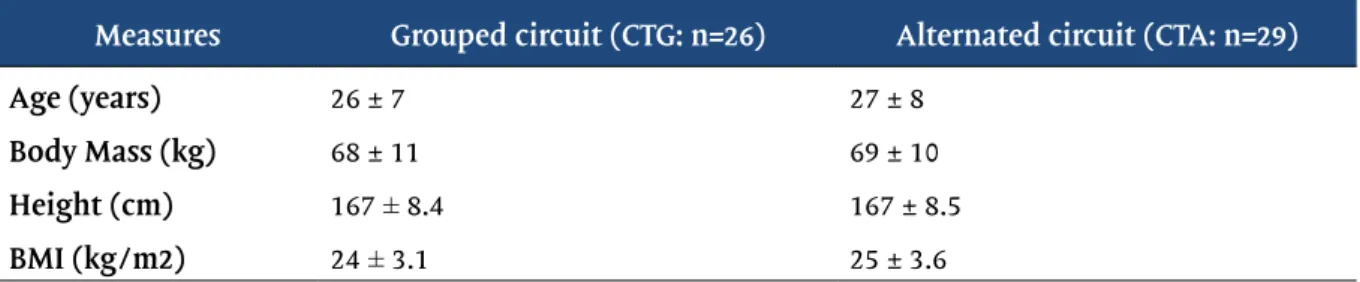
Sixty adults participated in the study. For randomization, the initial mus-cle strength values were used. Subsequently, the individuals were divided into two groups equally, named alternated (CTA) and grouped (CTG) circuit training groups (table I).
Table I - Characteristics of participants per group.
Measures Grouped circuit (CTG: n=26) Alternated circuit (CTA: n=29)
Age (years) 26 ± 7 27 ± 8
Body Mass (kg) 68 ± 11 69 ± 10
Height (cm) 167 ± 8.4 167 ± 8.5
BMI (kg/m2) 24 ± 3.1 25 ± 3.6
BMI = Body mass index; no statistically significant difference (p≤0.05) was found in the compari-sons.
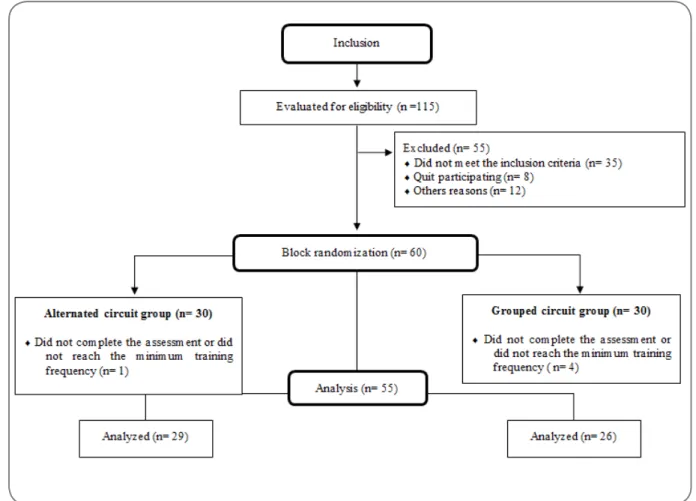
To be included in the sample, volunteers should not have any type of cardio-vascular, pulmonary or joint and/or musculoskeletal damage, nor participate in any type of training in the last three months. Individuals who presented some physi-cal discomfort during the evaluations and / or protocols, who did not complete the evaluations or who did not reach the minimum frequency of 85% of the proposed training were excluded from the final analyzes. Five individuals did not complete the assessments, four from the CTG and one from the CTA, for personal reasons unrelated to the training.
Anthropometric and body mass assessment
Determination of mass and body height were performed using an analog scale with a coupled stadiometer (Welmy® Santa Bárbara d’Oeste, São Paulo, Brazil) with a scale of 100 g and 1.0 cm, respectively. The calculation of BMI was performed based on the equation: BMI = body mass (kg) / height (m2).
A bioelectrical impedance (BIA) balance (Tanita, thetrapolar BC 558, Japan) assessed body composition [10]. Absolute measurements of fat-free and adipose mass were verified. Previous requirements for bioimpedance assessment were explained
verbally as well as through leaflets distributed to all research participants according to the guidelines suggested by ESPEN [11].
Figure 1 - Experimental design of the inclusion and analysis of the sample.
Physical fitness assessment
Physical fitness assessment was based on muscle strength and cardiorespira-tory capacity. A dorsal analog dynamometer (HOMIS, Dorsal, São Paulo-SP, Brazil) was used to evaluate muscular strength, without qualifications four; a familiariza-tion and three isometric control measures, at most, deadlift exercise on a specific dynamometer. Subjects starts with knees and hips flexed, and progressively applies force to the device until reaching the maximum isometric force. Each contraction takes five seconds long, followed by two minutes of recovery at the end of each bout. The highest value is used for analysis [12].
Handgrip isometric strength test was also used to measure the maximum iso-metric strength. Test is performed in a sitting position, with the elbow of the arm being assessed and the knees flexed 90 degrees. Subjects performed the contraction progressively until reaching the maximum isometric strength [13]. These procedures are performed in both hands and the average between the two largest measures rea-ched in both arms is used for analysis.
Cardiorespiratory fitness was assessed by the yoyo intermittent recovery tes-t-IR2t [14]. Test starts at a zero point, in which subjects run back and forth between two cones 20 meters apart. After every 40 meters covered, it is allowed a 5 meter walk recovery. An audible signal controls the ideal pace to run at a given stage and the test is ended when the participant fails to reach the cone under the designated time twice [14]. The total distance covered to the last completed stage is used for analysis.
Exercise protocols
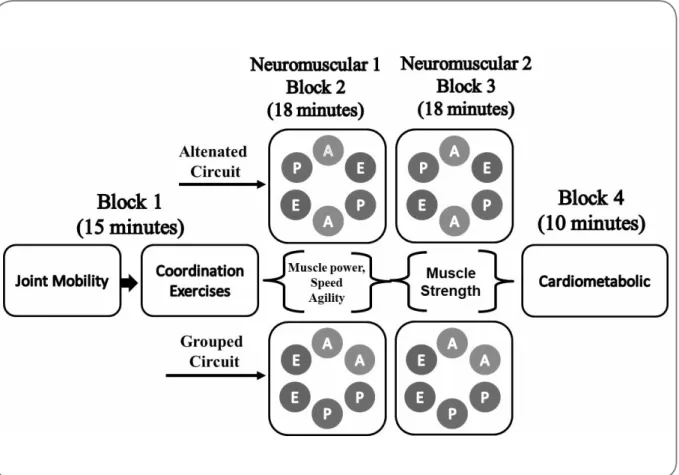
Exercise protocols of experimental groups were performed on alternate days and a 72-hour recovery interval between sessions. Both training sessions were struc-tured in circuits of six exercises, throughout the training session, which was divided into four distinct blocks. In the first block, joint mobility, muscle activation and co-ordinating activities were performed; in the second part of the training, six different exercises predominantly stimulated the speed, agility and muscle power of the lower and upper limbs, described as a neuromuscular block 1 (see table II).
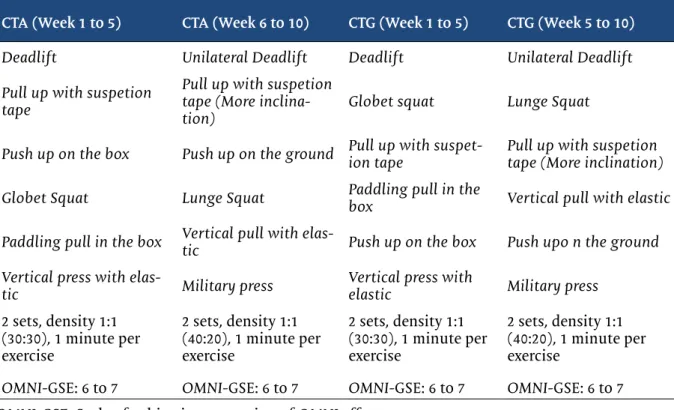
In the subsequent block (neuromuscular 2), six activities oriented to muscle strength were performed, based on functional movement patterns such as squatting, pulling and pushing, alternating organized (CTA) or grouped (CTG) according to fi-gure 2. All subjects were encouraged to perform the exercises at the maximum con-traction speed and the highest number of repetitions that they were able to perform. During all training sessions a team of Physical Education professionals and students helped controlling training load and the application of training progressions over the weeks to ensure that the individuals carried out training protocols in an effective way.
Figure 2 - Methodological organization of alternated circuit (CTA) and grouped (CTG) protocols in the neuromuscular 2 block. Methodological organization of alternated circuit (CTA) and grouped (CTG)
protocols in the neuromuscular 2 block.
In the last training block, both groups performed an intermittent activity (20 m interval running at maximum speed - all out with 15 seconds of rest), which has a cardiometabolic characteristic. The exercises used, as well as the intensity and densi-ty used during the intervention are described in tables II and III.
The training progressions were based on the principle of complexity, a strate-gy to modify training load used mainly in specific actions (sports or daily life)
stimu-lated in the functional training protocols, as previously described [15].
Table II - Exercises, progressions, intensity and density used in the neuromuscular 1 block (Second
training block) of the alternated circuit and grouped circuit groups.
CTA (Week 1 to 5) CTA (Week 6 to 10) CTG (Week 1 to 5) CTG (Week 5 to 10)
Cross pattern on the
agility ladder “T” pattern with sprint on the agility ladder Cross pattern on the agility ladder “T” pattern with sprint on the agility ladder Vertical jump Vertical jump more high Sprint with change of direction Sprint with cognitive stimulus Medicine ball launch on
the ground Medicine ball lateral launch Trunk Rotation with elastic Trunk Rotation with elastic Horizontal jump Horizontal Jump Medicine ball launch on the ground Horizontal Jump Sprint with change of
direction Sprint with cognitive stimulus Vertical Jump Vertical jump
Wall Ball Shots Wall Ball Shots Alternative waves (Rope Training) Lateral Alternative waves (Rope Training) 2 sets, density 1:1 (30:30), 1 minute per exercise OMNI-GSE: 6 to 7 2 sets, density 1:1 (40:20), 1 minute per exercise OMNI-GSE: 6 to 7 2 sets, density 1:1 (30:30), 1 minute per exercise OMNI-GSE: 6 to 7 2 sets, density 1:1 (40:20), 1 minute per exercise OMNI-GSE: 6 to 7 OMNI-GSE: Scale of subjective perception of OMNI effort.
Table III - Exercises, progressions, intensity and density used in neuromuscular 2 block (third training
block) of the alternated circuit and grouped circuit groups.
CTA (Week 1 to 5) CTA (Week 6 to 10) CTG (Week 1 to 5) CTG (Week 5 to 10)
Deadlift Unilateral Deadlift Deadlift Unilateral Deadlift
Pull up with suspetion tape
Pull up with suspetion tape (More
inclina-tion) Globet squat Lunge Squat
Push up on the box Push up on the ground Pull up with suspet-ion tape Pull up with suspetion tape (More inclination)
Globet Squat Lunge Squat Paddling pull in the box Vertical pull with elastic
Paddling pull in the box Vertical pull with elas-tic Push up on the box Push upo n the ground Vertical press with
elas-tic Military press Vertical press with elastic Military press
2 sets, density 1:1 (30:30), 1 minute per exercise OMNI-GSE: 6 to 7 2 sets, density 1:1 (40:20), 1 minute per exercise OMNI-GSE: 6 to 7 2 sets, density 1:1 (30:30), 1 minute per exercise OMNI-GSE: 6 to 7 2 sets, density 1:1 (40:20), 1 minute per exercise OMNI-GSE: 6 to 7 OMNI-GSE: Scale of subjective perception of OMNI effort.
Statistical analysis
Data were expressed as means and standard deviations for all variables ob-tained. Then, a 2x2 ANOVA (two groups x two moments) was performed with repea-ted measures on the second factor, followed by Bonferroni’s post hoc test to compa-re means and detect diffecompa-rences between protocols. Normality of data was assessed using the Shapiro-Wilk test and homogeneity by Levene test. Data were tabulated and analyzed using the Statistical Package for the Social Sciences (SPSS) software, version 23, adopting a significance level of 5% (p≤0.05). All tests were two-tailed and the effect size (ES) was calculated according to previously defined methodological procedures, interpreting the effects as trivial (<0.50), small (0.50 - 1.25), moderate (1.25 - 1.90) or large (> 1.90) (16).
Results
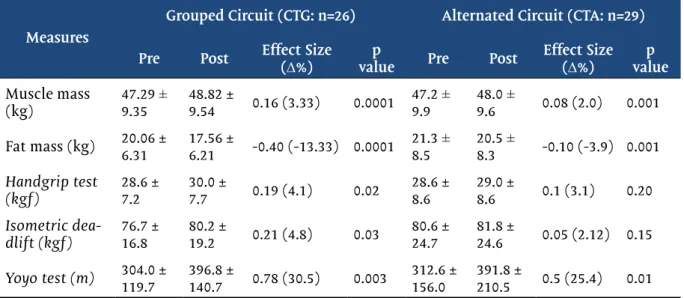
After 10 weeks of training, CTG and CTA groups showed significant improve-ment in muscle mass and reduced fat mass (CTG: p <0.001; CTA: p <0.001). CTG group proved to be efficient in all variables of physical fitness, showing a statistical diffe-rence in isometric strength of handgrip, isometric strength of the lumbar muscles and cardiorespiratory fitness. In turn, the CTA group showed a statistical difference only in terms of cardiorespiratory fitness. When compared to each other, there was no statistically significant difference in any of the variables regardless of the time when the assessment occurred in the present study (muscle mass [p = 0.1]; fat mass [p = 0.754]; Yoyo [p = 0.90]; Handgrip test (p = 0.70); Isometric deadlift (p = 0.80).
Table IV - Values of mean. standard deviation. effect size and percentage of change presented in the
assessments of physical fitness and body composition in the moments before and after intervention by the experimental groups grouped circuit (CTG) and alternated circuit (CTA).
Measures
Grouped Circuit (CTG: n=26) Alternated Circuit (CTA: n=29)
Pre Post Effect Size (∆%) valuep Pre Post Effect Size (∆%) valuep
Muscle mass (kg) 47.29 ± 9.35 48.82 ± 9.54 0.16 (3.33) 0.0001 47.2 ± 9.9 48.0 ± 9.6 0.08 (2.0) 0.001 Fat mass (kg) 20.06 ± 6.31 17.56 ± 6.21 -0.40 (-13.33) 0.0001 21.3 ± 8.5 20.5 ± 8.3 -0.10 (-3.9) 0.001 Handgrip test (kgf) 28.6 ± 7.2 30.0 ± 7.7 0.19 (4.1) 0.02 28.6 ± 8.6 29.0 ± 8.6 0.1 (3.1) 0.20 Isometric dea-dlift (kgf) 76.7 ± 16.8 80.2 ± 19.2 0.21 (4.8) 0.03 80.6 ± 24.7 81.8 ± 24.6 0.05 (2.12) 0.15 Yoyo test (m) 304.0 ± 119.7 396.8 ± 140.7 0.78 (30.5) 0.003 312.6 ± 156.0 391.8 ± 210.5 0.5 (25.4) 0.01 (*) Statistically significant difference (p≤ 0.05) favorable to CTG; (#) Statistically significant diffe-rence (p≤ 0.05) in favor of CTA. No statistically significant diffediffe-rences were detected in comparisons between groups.
Discussion
The aim of the present study was to compare the effects of two Cross Training protocols with different configurations on the body composition and physical fit-ness of active young people. Ten weeks of intervention were able to promote impro-vements in body composition, cardiorespiratory fitness and muscle strength in the studied population after both protocols. Although the magnitude of the percentage changes and the effect size values observed in CTG was greater than in CTA, there was no statistical difference between training protocols.
In addition to the traditional training dose control variables (volume, inten-sity, density and weekly frequency), Cross Training also has another characteristic way of controlling the stimulus dose of the training session, called the organization/ disposal of the exercises in the circuit. Such modifications can provide a significant reduction in the adipose mass, as already demonstrated after 20 and 40 weeks of cir-cuit training [17]. These results are in line with the findings of the present study. On the other hand, another study applied eight weeks of high-intensity functional trai-ning and found a significant reduction in the percentage of fat, but not in adipose mass, in physically inactive individuals [18].
Increased fat loss is a key factor in maintaining health. From that point on, interventions with high intensity exercises are considered fundamental strategies to increase the magnitude of fat mass loss and, consequently, to fight overweight and/ or obesity [19]. Previous studies report that 10 to 20 weeks of circuit training are suf-ficient to reduce body mass of inactive individuals by 3% [20], similar to the findings observed in the present study.
Feito et al. [21] also found improvements on body composition after 10 weeks of high-intensity functional training. However this study did not seek to compare different organizational models of a Cross Training program. It is important to note that in addition of being an effective and viable intervention, Cross Training can be organized in specific ways, aiming to improve body composition. This possibility arouses greater efficiency and favors exercise program prescription.
Nevertheless, the benefits of increasing energy expenditure through training and thus decreasing body fat levels, as observed in the present study, have a direct impact on the regulation of physiological events that promote thermogenesis and lipolysis [22,23]. The use of energetic substrates during exercise depend upon intensi-ty, however, the contributions of each substrate are directly linked to the characteris-tic and methodological organization of the training program (grouped or alternated as in the present study). Consequently, intensity and duration are responsible for de-termining more or less oxidation of fatty acids or glucose [24]. A Cross Training ses-sion consists of training blocks in which different components of physical fitness are stimulated (coordination, muscle strength and power, cardiorespiratory fitness, etc.), as a multi-component session [25]. The organization of training is carried out in an intermittent circuit, which allows different adaptations to the physical capacities of individuals [26] as observed in the present study. Improvement in maximum lumbar isometric muscle strength and handgrip was observed in the CTG group. Although both groups performed a specific block for muscle strength, recovering time for cer-tain muscle groups was shorter for CTG (figure 2), due to this fact, such adaptations had a greater magnitude of effect in this group [27].
In addition, increased isometric strength is also associated with decreased risk of death from any cause [27], representing an important health indicator for individuals. For inactive individuals, short and mid-term muscle strength increase
is justified by neural adaptation commonly observed in early phases of resistance training program. These benefits are mainly associated with coordination and re-cruitment of new motor units, as well as the greater neural impulse to activate other fibers during movement [28].
Cardiorespiratory fitness showed improvement in both groups. That is, the training protocols, most likely, promoted adaptations in the functions of capture, transport and use of oxygen by the body (hypothesized by improved endurance per-formance), characteristics of high intensity training [29]. These adaptations may re-sult from an improvement in peripheral cardiovascular system, promoting an incre-ase in capillary density, up to central adaptations, stimulating an increincre-ase in cardiac ejection volume [30]. In addition, the high intensity observed in both exercise proto-cols can also be considered a major factor for the increase in cardiorespiratory fitness in the individuals of the present study [31].
To the best of our knowledge, this is the first study that compares adaptations from two types of circuit organization in high intensity functional training. Due to this fact, some limitations can be pointed out as a basis for further studies. We were not able to control diet. The International Society of Sports Nutrition [32] pointed this out as an intervening variable in studies that aim to investigate body composi-tion as outcome. Notwithstanding, sample subjects were given an agenda to main-tain their eating habits, thus evidencing the specific influence of exercise on body composition contained in their life habits. In addition, the lack of a control group does not present a reference to daily life and influence on eating habits that could eventually contribute to the change in body composition.
Conclusion
In conclusion, the present study revealed that both Cross Training programs organized in a grouped and alternated circuit were effective in reducing fat mass, increasing muscle mass and cardiorespiratory fitness in young adults. However, the grouped circuit had a better effect size and range of change on the maximum isome-tric muscle strength of lumbar and handgrip muscles.
Potential conflict of interest
No conflicts of interest with potential potential for this article have been reported.
Financing source
There were no external sources of funding for this study.
Authors’ contributions
Conception and design of the research: Da Silva-Grigoletto ME and Almeida MB. Data collection:
Pe-reira Neto E, Brandão LHA and Chaves LMS. Analysis and interpretation of data: All authors. Statistical
analysis: Brandão LHA and Chaves LMS. Obtaining financing: Not applicable. Writing of the manus-cript: Pereira Neto E, Brandão LHA and Chaves LMS. Critical review of the manuscript for important intellectual content: Da Silva-Grigoletto ME, Almeida MB.
References
1. González K, Fuentes J, Márquez JL. Physical inactivity, sedentary behavior and chronic diseases. Korean J Fam Med 2017;38(3):111. Available from: http://kjfm.or.kr/journal/view.php?doi=10.4082/kjfm.2017.38.3.111
of exercise to prevent and treat physical impairments in CKD. Am J Kidney Dis 2017;69(6):837-52. https://doi. org/10.1053/j.ajkd.2017.01.051.
3. Hauser C, Benetti M, Rebelo FP V. Estratégias para o emagrecimento. Rev Bras Cineantropometria e Desempe-nho Hum 2004;6(1):72–81.
4. Hunter G, Fisher G, Neumeier W, Carter S, Plaisance E. Exercise training and energy expenditure following weight loss. Med Sci Sports Exerc 2017;47(9):1032–57. https://doi.org/10.1249/MSS.0000000000000622
5. Thompson W. Worldwide survey of fitness trends for 2019. Acsms Heal Fit J 2018;22(6):10–7. https://doi. org/10.1249/FIT.0000000000000438
6. Silva-Grigoletto ME, Brito CJ, Heredia JR. Treinamento funcional: Funcional para que e para quem? Rev Bras Cineantropometria e Desempenho Hum 2014;16(6):714–9. https://doi.org/10.5007/1980-0037.2014v16n6p714. 7. Santos M, Vera-Garcia F, Silva Chaves L, Brandão LH, Silva DR., Silva Grigoletto ME. Are core exercises impor-tant to functional training protocols? Rev Andaluza Med del Deport [Internet]. 2018;11(4):237–44. https://doi. org/10.33155/j.ramd.2018.02.002
8. Evangelista AL, La Scala Teixeira C, Machado AF, Pereira PE, Rica RL, Bocalini DS. Effects of a short-term of whole-body, high-intensity, intermittent training program on morphofunctional parameters. J Bodyw Mov Ther 2019. https://doi.org/10.1016/j.jbmt.2019.01.013
9. Toraman N, Erman A, Agyar E. Effects of multicomponent training on functional fitness in older adults. J Hum Kinet 2004;12(1):538–53. https://doi.org/10.1123/japa.12.4.538
10. Fonseca FR, Karloh M, Araujo SLP, Reis CM, Mayer A. Validação de um sistema de análise de impedância bioelétrica para a avaliação da composição corporal de pacientes com DPOC. J Bras Pneumol. 2018;44(4):315–20. https://doi.org/10.1590/s1806-37562017000000121.
11. Kyle UG, Bosaeus I, De Lorenzo AD, Deurenberg P, Elia M, Gómez JM, et al. Bioelectrical impedance analysis - Part II: Utilization in clinical practice. Clin Nutr. 2004;23(6):1430–53. https://doi.org/10.1016/j.clnu.2004.09.012. 12. 12. De Witt JK, English KL, Crowell JB, Kalogera KL, Guilliams ME, Nieschwitz BE, et al. Isometric mid-thi-gh pull reliability and relationship to deadlift 1RM. J Strength Cond Res 2016;1. h10.https://doi.org/10.519/ JSC.0000000000001605
13. Innes E. Handgrip strength testing: A review of the literature. Aust Occup Ther J 1999;46(3):120–40. https:// doi.org/ 10.1046/j.1440-1630.1999.00182.x
14. Oberacker LM, Davis SE, Haff GG, Gavin LM. The yo-yo IR2 test: physiological response, reliability, and applica-tion to elite soccer. J Strength Cond Res 2012;26(10):2734–40. https://doi.org/10.1249/01.mss.0000227538.20799.08. 15. La Scala Teixeira CV, Evangelista AL, Pereira PEA, Silva-Grigoletto ME, Bocalini DS, Behm DG. Complexity: a novel load progression strategy in strength training. Front Physiol. 2019;10(June). https://doi.org/10.3389/ fphys.2019.00839
16. Rhea M. Determining the magnitude of treatment effects in strength training research through the use of the effect size. J Strenght Cond Res 2004;18(4):918–20. https://doi.org/10.1519/14403.1.
17. Batrakoulis A, Jamurtas AZ, Georgakouli K, Draganidis D, Deli CK, Papanikolaou K, et al. High intensity, circui-t-type integrated neuromuscular training alters energy balance and reduces body mass and fat in obese women: A 10-month training-detraining randomized controlled trial. PLoS One 2018;13(8):1–21.
18. Brisebois M, Rigby B, Nichols D. Physiological and fitness adaptations after eight weeks of high-intensity functional training in physically inactive adults. Sports 2018;6(4):146. https://doi.org/ 10.3390/sports6040146 19. National Institute of Health. Managing overweight and obesity in adults: Systematic evidence review from the obesity expert panel [Internet]. National Heart, Lung, and Blood Institute. 2013. 501 p. Available from: ht-tps://www.nhlbi.nih.gov/sites/default/files/media/docs/obesity-evidence-review.pdf
20. Harber MP, Fry AC, Rubin MR, Smith JC, Weiss LW. Skeletal muscle and hormonal adaptations to cir-cuit weight training in untrained men. Scand J Med Sci Sports 2004;14(3):176–85. https://doi.org/10.1111/j. 1600-0838.2003.371.x/abstract
21. Feito Y, Hoffstetter W, Serafini P, Mangine G. Changes in body composition, bone metabolism, strength, and skill-specific performance resulting from 16-weeks of HIFT. PLoS One 2018;13(6):e0198324.
22. Clark JE, Goon DT. The role of resistance training for treatment of obesity related health issues and for chan-ging health status of the individual who is overfat or obese: A review. J Sports Med Phys Fitness 2015;55(3):205–22. 23. Fatouros IG. Is irisin the new player in exercise-induced adaptations or not? A 2017 update. Clin Chem Lab Med 2018;28;56(4):525–48. https://doi.org/ 10.1515/cclm-2017-0674
24. Moghetti P, Bacchi E, Brangani C, Donà S, Negri C. Metabolic effects of exercise. Front Horm Res 2016;47:44–57. https://doi.org/10.1159/000445156
25. Silva-Grigoletto ME, Santos MS, García-Manso JM. Cross Training: Treinamento Funcional de Alta Intensidade. 1st ed. São Paulo:Lura; 2018. 15–151 p.
26. Waller M, Miller J, Hannon J. Resistance circuit training: Its application for the adult population. Strength Cond J 2011;33(1):16–22. https://doi.org/10.1519/SSC.0b013e3181f45179
mortality in men: Prospective cohort study. BMJ 2008;337(7661):92–5.
28. Kliszczewicz B, McKenzie M, Nickerson B. Physiological adaptation following four-weeks of high-intensi-ty functional training. Vojnosanit Pregl Med Pharm J Serbia 2019;76(3):272–7. https://doi.org/10.2298/VS-P170228095K
29. Mcrae G, Payne A, Zelt JGE, Scribbans TD, Jung ME, Little JP, et al. Extremely low volume, whole-body aero-bic- resistance training improves aerobic fitness and muscular endurance in females. Appl Physiol Nutr Metab 2012;37(6):1124–31. https://doi.org/10.1139/h2012-093
30. MacInnis MJ, Gibala MJ. Physiological adaptations to interval training and the role of exercise intensity. J Physiol 2017;595(9):2915–30. https://doi.org/10.1113/JP273196
31. Gormley S, Swain D, High R, Spina R, Dowling E, Kotipalli U, et al. Effect of intensity of aerobic training on V˙O2max. Med Sci Sports Exerc 2008;40(7):1336–43. https://doi.org/10.1249/MSS.0b013e31816c4839.
32. Aragon AA, Schoenfeld BJ, Wildman R, Kleiner S, VanDusseldorp T, Taylor L, et al. International society of sports nutrition position stand: Diets and body composition. J Int Soc Sports Nutr 2017;14(1):1–19.