A R T I G O O R I G I N A L
V A L V U L A R I N V O L V E M E N T I N P A T I E N T S W I T H R H E U M A T O I D A R T H R I T I S
Ana Paula Beckhauser,
*Liz Vallin,
*Claudine J Burkievcz,
*Sonia Perreto,
**Marilia Barreto Silva,
*Thelma L Skare
*tação cardíaca mais facilmente reconhecida da ar-trite reumatóide (AR), essa doença afeta os três fo-lhetos do coração.
Objetivo: Estudar o comprometimento valvular na
AR tentando correlacioná-lo com variáveis clíni-cas, auto-anticorpos e índice funcional.
Metodologia: Foram estudados 122 controles e 184
pacientes com AR, assintomáticos do ponto de vis-ta cardiovascular, através de eco-cardiografia bidi-mensional. Pesquisou-se nesses mesmos pacien-tes: hábito de fumar, idade, tempo de doença, fa-tor reumatóide, fafa-tor antinuclear, anticardiolipi-nas, presença de nódulos reumatóides e classe funcional.
Resultados: Encontraram-se lesões valvulares em
28 (15,2%) dos pacientes, sendo a válvula aórtica a mais afetada. O aparecimento das lesões valvu-lares foi mais comum nos pacientes com duração de doença maior do que 15 anos (p=0,013). Não se encontrou associação entre tais lesões e sexo, ida-de do paciente, exposição ao fumo, fator de, anticorpos antinucleares, nódulos reumatói-des, classe funcional ou presença de anticardioli-pinas.
Conclusões: Uma pequena porcentagem de
pa-cientes com AR tem envolvimento valvular assin-tomático, que é mais comum em pacientes com AR de longa duração.
Palavras-chave: Artrite reumatóide; Endocárdio;
Anormalidades.
Introduction
Rheumatoid arthritis (RA) is a chronic
inflamma-tory disease that affects joints causing deformities.1
In this disease the synovial membrane is the main
target,1although extra-articular manifestations can
be found including cardiac ones.
In RA, the heart can be affected in its three
*Serviço de Reumatologia do Hospital Universitário Evangélico de Curitiba – PR – Brasil
**Serviço de Ecocardiografia do Hospital Universitário Evangélico de Curitiba – PR – Brasil
Abstract
Background: Although pericarditis is the most
commonly recognized cardiac lesion in Rheuma-toid Arthritis (RA), this disease affects all the three cardiac layers.
Objective: To study valvular lesions in RA, trying to
correlate them with other clinical variables, auto antibodies and functional class.
Methods: One hundred twenty two controls and
184 patients with RA without cardiac symptoms were studied using bidimensional echocardio-graphy. We also studied smoking habits, age and disease duration, rheumatoid factor, antinuclear antibody, anticardiolipin antibodies, rheumatoid nodules and functional class in RA patients.
Results: We found that 28 RA patients (15.2%) had
valvular lesions and that the aortic valve was the most affected. Valvular lesions were more common in patients with disease duration longer than 15 years (p=0.013). No association was found between valvular lesions and sex, age, tobacco exposure, rheumatoid factor positivity, presence of antinu-clear antibodies, rheumatoid nodules, anticardio-lipin antibodies or functional class.
Conclusion: A small part of RA patients had
asymp-tomatic valvular lesions which occurred more fre-quently in patients with long disease duration.
Keywords: Rheumatoid Arthritis; Endocardium;
Abnormalities.
Resumo
manifes-A N manifes-A Pmanifes-A U L manifes-A B E C K H manifes-A U S E R E C O L.
layers.2Pericarditis is the cardiac manifestation
most readily recognized, but myocardial disease, coronary vasculitis, diastolic dysfunction, accelera-ted atherosclerotic disease and valvular lesions can
also be found.2 The prevalence of RA valvular heart
disease is variable in the literature varying from 3%
to 70%.3,4 This high variability may be due to
diffe-rent genetic backgrounds of the studied popula-tion and to different methods used in the detecpopula-tion of valvular disease. In some studies the occurren-ce of valvular heart disease is associated with male
gender and presence of rheumatoid nodules,5age,
disease duration2and degree of inflammatory
ac-tivity.6However, in others such associations could
not be found.7,8
This study tries to verify the frequency of valvu-lar heart involvement in an RA population as well as its association with rheumatoid nodules, auto--antibodies (rheumatoid factor, antinuclear and anticardiolipin antibodies), disease duration and patients functional class.
Methods
This study was approved by the local Ethic Commit-tee and the enrolled patients gave a written con-sent. All RA patients that attended the Rheumato-logy Unit of Hospital Evangélico de Curitiba during 2007 with at least four RA Classification Criteria of
the American College of Rheumatology9were
invi-ted to participate. Patients with arterial hyperten-sion, ischemic myocardial disease, diabetes melli-tus, renal failure and chronic obstructive pulmo-nary diseases, previous rheumatic fever, congeni-tal cardiac lesions and other causes of valvular lesions were excluded. All included patients were asymptomatic from the respiratory and cardiac po-int of view.
A total of 184 patients were examined through a bidimensional echocardiograph with color Dop-pler using an Apogee 800 plus ATL apparatus. All tests were done by the same physician according to a standardized protocol. The valves were examined for thickening and a hyperechoic appearance; transvalvular gradients were measured and any re-gurgitation was quantified using color flow Dop-pler.
Data such as age, sex, disease duration, smoking habits, rheumatoid nodules at physical examina-tion, rheumatoid factor (RF), antinuclear antibo-dies (ANA), anticardiolipin antiboantibo-dies (aCl) and
functional class according to the Criteria of Ame-rican College of Rheumatology for global
functio-nal classification in RA10 were obtained.
Rheuma-toid factor was studied by immunoturbidimetry and we considered positive titers those above 15 UI/ml. ANA was studied by immunofluorescence technique using HEp-2 cells and anticardiolipin antibodies were studied by ELISA, and considered as positive values over 10 GPL for aCl IgG and 10 MPL for aCl IgM.
As controls we included 122 declared healthy persons that were going through echocardiogra-phy as part of a check up program. None of them had arterial hypertension, ischemic myocardial di-sease, diabetes mellitus, renal failure, chronic obs-tructive pulmonary diseases or previous history of valvular lesion.
Data was analyzed through contingency and frequency tables. Associations were calculated using Qui-squared and Fisher and t tests using Graph Pad Prism 4.0® software. Significance adop-ted was of 5%.
Results
Of 184 studied RA patients, 17 were male and 167 were females with ages between 20 and 85 years (mean 48.2±13.9 years) and disease duration between one and 39 years (mean 8.4± 7.4 years). In the control population 104 were females and 18 were males with ages between 19 and 82 years (mean 51.48±14.41 years). The control population was pared for sex (p=0.13, chi-squared) and age (p=0.99; Mann Whitney).
Thirty-four valvular lesions in 28 patients (15.2% of the studied population) were detected at echo-cardiography. It was possible to identify 11 cases of aortic regurgitation, six of aortic stenosis, two of aortic valvar thickening, seven cases of mitral re-gurgitation, six cases of mitral stenosis and two of tricuspide regurgitation (Figure 1). Six patients had mitral and aortic lesions, one had mitral and tricus-pid lesion, one had combined aortic and another combined mitral lesions.
In the control population we found seven (5.73%) patients with nine valvular lesions: five aortic insufficiencies, three mitral insufficiencies and one mitral stenosis. Patients with rheumatoid arthritis had more valvular lesions than control po-pulation (p=0.017, chi-square).
valvu-VA LV U L A R I N V O LV E M E N T I N PAT I E N T S W I T H R H E U M AT O I D A R T H R I T I S
lar lesions and smoking habits we found that 50% (n=14) of patients with valvular lesion were pre-vious or present smokers against 67.9% (n=106) of RA patients without valvular lesions (p=0.37; chi--squared). The study of association between valvu-lar lesions and rheumatoid nodules and rheuma-toid factor is summarized in Table I.
ANA were obtained in 26 patients with valvular lesions and were positive in eight (30.7%) and in 151 patients without valvular lesions and were po-sitive in 29 (19.2%) of them (p=0.18; chi-square).
Anticardiolipin antibodies (IgG and IgM) were obtained in 164 patients being weakly positive in 10 (6.09%). In the group with valvular lesions, only one patient was positive for IgM aCl (3.57%). In the group without valvular lesions, nine patients (6.6%) were positive for aCl (three aCl IgM, four aCl IgG and two for both) with p=1.0 (Fisher).
The study of relationship between valvular le-sions and age of diagnosis showed that patients with valvular lesion had mean age of 51.3± 18.2 years at diagnosis and patients without valvular
le-sion had mean age of 47.1± 13.7 years at diagno-sis, with p=0.12 (Mann -Whitney).
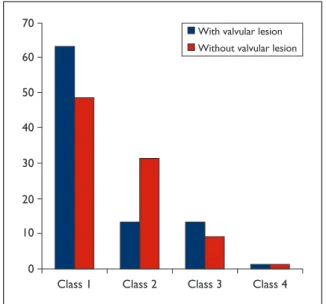
Functional status was obtained in 168 patients and the results are summarized in Figure 2.
In the study of valvular lesions according to di-sease duration we found that patients with more than 15 years of disease duration had more valvu-lar lesions than those with less than that (p=0.017, chi-square).
Discussion
The present analysis showed a low frequency of valvular lesion in RA patients detected by bidimen-sional transthoracic echocardiography. In most of them the lesions were monovalvar and aortic val-ve was the most affected.
Valvular lesions in RA result from non specific inflammatory process in the valvular base followed by fibro-sis and, sometimes,
calcifica-tion.4Rheumatoid
granuloma-ta are more specific findings that can be found within cusps
causing insufficiency.4
Most patients are asympto-matic from the clinical point of view. According to Guedes et
al6, less than 10% develop
he-modynamic abnormalities.
Figure 1. Valvular involvement in 184 rheumatoid
arthritis patients.
Figure 2. Functional class distribution (in %) in RA
patients with and without valvular lesions (p=0.31)
Table 1. Study of association between valvular lesions and RF and rheumatoid nodules in 184 RA patients
With Without valvular lesion valvular lesion
(n=28) (n=156) p
Positive RF N=21 (75%) N=106 (67.9%) 0.45 – Chi-squared Rheumatoid nodules N=3 (10.7%) N=12 (7.7%) 0.70 – Fisher RF= rheumatoid factor
A N A PA U L A B E C K H A U S E R E C O L.
However, at least 3 reasons are relevant for sear-ching for them:
1. These patients are prone to bacterial endocar-ditis;3
2. Some of the valvular lesion may cause rapid hemodynamic abnormalities requiring surgical
treatment.6 Several authors observed that
RA endocardial lesions can cause more func-tional distress than those from rheumatic fe-ver;6, 13,14
3. Valvular lesions may act as source of throm-boembolic material causing ischemic vascular lesions.11,12
In our research all studied patients were clini-cally asymptomatic but one must remember that a polyarticular disease such as RA induces low physical activity that decreases cardiac load, which might explain the lack of symptoms.
We could not find any association between val-ve lesions and tobacco exposure, patients’ age, no-dules, functional index, presence of rheumatoid
factor and antinuclear antibodies. Roldan et al15
studying valvular heart disease through transeso-phageal echocardiography also could not find any association with extra articular manifestations. The association with disease duration was positive, as
already noted by Cos,kun et al.2
The aCls prevalence in RA was found to be of
16% by Merkel et al;167% for Vittecoqet et al17and
18% for Brunet et al.18None of these authors found
any association between aCls and clinical findings
or pregnancy loss. Gabrielli et al19 studied the
as-sociation of aCl and cardiac valvular lesions and, like us, did not find any relationship.
The use of transthoracic echocardiography can be considered a limitation for this study because it is less accurate than the transesophageal route. The transesophageal route is invasive and would be unacceptable to use in patients without cardiac complaints and in healthy controls
Conclusions
The prevalence of valvular lesion in RA patients, asymptomatic from the cardiac point of view, was 15.2% and the aortic valve the most commonly af-fected.
We could not find any relationship between car-diac valvular lesions and patients’ age, smoking habits, RF, ANA, aCl antibodies, rheumatoid no-dules or functional class.
Patients with longer disease duration had hi-gher frequency of valvular lesions.
Correspondence to
Thelma L Skare
Rua João Alencar Guimarães, 796 80310-420 Curitiba PR
E-mail: [email protected]
References
1. Tehlirian CV, Bathon JM. Rheumatoid Arthritis. Clini-cal and laboratory features. In Klippel JH, Crofford LJ, Stone JH, White PH (eds). Primer on Rheumatic Di-seases, 13th Ed. Arthritis Foundation Atlanta, 2008; 114-121
2. Cos,kun S, Özoran K, Mermerci B, Aydogdu S, Kelles T. Cardiac involvement in patients with rheumatoid arthritis. APLAR J Rheumatol 2005;8:23-31
3. Killinger LC, Gutierrez PS. Heart failure and insuffi-ciency of the aortic and mitral valves in a 68-year-old woman with rheumatoid arthritis. Arq Bras Cardiol 2001;77: 373-376
4. Kitas G, Banks M, Bacon P. Cardiac involvement in rheumatoid arthritis. Clin Med 2001;1:18-21
5. Bacon PA, Gibson DG. Cardiac involvement in rheu-matoid arthritis. Ann Rheum Dis 1974;33:20-24 6. Guedes G, Bianchi-Fior P, Cormier B, Barthelemey B,
Rat A-C, Boissier M-C. Cardiac manifestations of rheumatoid arthritis: a case control transesophageal echocardiography study in 30 patients. Arthritis Rheum 2001;45:129-135
7. Corrao S, Salli L, Arnone S et al. Cardiac involvement in rheumatoid arthritis: evidence of silent heart di-sease. Eur Heart J.1995;16:253-256
8. Toumanidis ST, Papamichael CM, Antoniades LG et al. Cardiac involvement in collagen diseases. Eur Heart J 1995;16:257-262
9. Arnett FC, Edworthy SM, Bloch DA et al. The Ameri-can Rheumatology Association 1987 revised criteria for the classification of rheumatoid arthritis. Arthritis Rheum 1988;31:315-324
10. Klippel JH, Dieppe PA. Selected measures for out-come assessment of rheumatic diseases. In Klippel JH, Dieppe PA (Eds). Rheumatology 1998, 2nd Ed, Mosby, London, vol.2, S-A:1-12
11. Kang H, Baron M. Embolic complications of a mitral valve rheumatoid nodule. J Rheumatol 2004;31:1001--1003
12. Juanatey-Gonzalez C, Garcia-Porrua C, Testa A, Gon-zales-Gay MA. Potential role of mitral valve strands on stroke occurrence in rheumatoid arthritis (letter). Arthritis Rheum 2003;49:866-867
13. Didry C, Combe B, Flaisler F, Sany J. Rheumatoid aor-tic insufficiencies: severity of the prognosis Rev Rhum Mal Osteoartic 1992;59:571-576
14. Chatte G, Sab JM, Sirodot M, Robert D. Acute mitral valve insufficiency in a case of rheumatoid arthritis. Presse Med 1993;22:919
VA LV U L A R I N V O LV E M E N T I N PAT I E N T S W I T H R H E U M AT O I D A R T H R I T I S
Characterization of valvular heart disease in rheuma-toid arthritis by transesophageal echocardiography and clinical correlates. Am J Cardiol 2007;100:486--502
16. Merkel PA, Chang C, Pierangeli SS, Convery K, Harris N, Polisson RP. The prevalence and clinical associa-tion of anticardiolipin antibodies in a large incepassocia-tion cohort of patients with connective tissue diseases. Am J Med 1996;101:576-583
17. Vittecoq A, Jouen-Beades F, Krzanowska et al. Pros-pective evaluation of the frequency and clinical sig-nificance of antineutrophil cytoplasmic and
anticar-diolipin antibodies in community cases of patients with rheumatoid arthritis. Rheumatology 2000;29: 481-489
18. Bonnet C, Jauberteau M-O. Antiphospholipid anti-bodies and RA: presence of beta2 GPI independent aCL. Ann Rheum Dis 2001;60:303-304
19. Gabrielli F, Alcini E, Lucifero A, Masala C. Cardiac in-volvement in connective tissue diseases and primary antiphospholipid syndrome: echocardiographic as-sessment and correlation with antiphospholipid anti-bodies. Acta Cardiol 1996;51: 425-439