Are we building too many arteriovenous fistulas?
A single-center experience
Carla Leal Moreira1, Vanda Teixeira1,2, Lígia Bessa1,2, José Queirós1, Fernanda Silva1, António Cabrita1
1 Nephrology Department, Centro Hospitalar Universitário do Porto, Hospital Geral de Santo António 2 Nephrology Department, Hospital Militar de Luanda
ABSTRACT
Introduction: Arteriovenous fistula has been associated with improved morbimortality in hemodialysis patients.
This has resulted in the “fistula First, catheter last” initiative. Nonetheless, the survival benefit of arteriovenous fistula has been questioned.
Methods: We conducted a retrospective observational study of all patients with non-end stage renal disease
referred for first vascular access building between January 2014 and December 2015 in our hospital center. Our main goal was to evaluate the clinical impact and burden of building fistula in predialysis patients.
Results: During this period, of 178 first arteriovenous accesses placed, 87 patients remained in predialysis and
91 patients started a chronic hemodialysis program. Median follow-up time by a nephrologist was 3.9 (2.5, 9.7) years. The mean age was 65.8±14.7 years, with 50.6% (n=90) of male patients. A higher rate of thrombosis in the predialysis group (26% vs 13%, p=0.037) was observed, but vascular access survival did not differ significantly (55% vs 67%, p=0.12). Mean vascular access placing was higher in the predialysis group (1.4±0.7 vs 1.2±0.4, p=0.006) and less interventions were requested (0.2±0.5 vs 0.3±0.6, p=0.10). Median time from vascular access placement to hemodialysis start was 22 (13, 41) months. At hemodialysis initiation, 10 (10.9%) patients used a central venous catheter; 80 (87.9%) patients an arteriovenous fistula, and one patient a graft. A total of 227 vascular accesses were built; 121 (53.3%) in predialysis vs 106 (46.7%) in incident hemodialysis patients. In a multivariate model, the presence of a functional arteriovenous fistula at hemodialysis start was only associated with a trend to survival benefit (HR 0.38, 95% CI 0.14-1.00, p=0.05).
Conclusions: Our results stress the need for an individual approach and for future tools to assess the risk of
death and progression to end-stage renal disease, therefore helping reduce the number of unutilized vascular accesses and rising cost of interventions.
Keywords: Arteriovenous Fistula; Central Venous Catheter; Morbidity; Survival
Received for publication: Oct 2, 2017
Accepted in revised form: Nov 15, 2017
INTRODUCTION
The general recommendation for vascular access (VA) placement in hemodialysis patients has been fistula first.1-4
Historically, a survival benefit of arteriovenous fistula (AVF) over arteriovenous graft (AVG) and tunneled dialysis cath-eter (TDC) has been suggested.5-8 This has been the main
argument for guidelines such as the National Kidney
Foundation Kidney Disease Outcomes Quality Initiative (K/ DOQI) and the Society for Vascular Surgery prioritizing AVF as the ideal long-term vascular access; AVG as the following preferred vascular access choice, and TDC the last option.9,10 Furthermore, these recommendations are
sup-ported by available data suggesting AVF has superior patency, fewer complications, less need of re-interventions, and ultimately improved patient survival.2,11
Timely referral and placing of arteriovenous VA is one of the best preventive measures of catheter use at hemodialysis initiation, but defining the ideal timing of arteriovenous (AV) access placement, namely of AVF, remains challenging and not consensual10,12,13.
Ques-tions start to be raised when non-functionality rates of about 18% have been reported among the overall inci-dent hemodialysis patients in Canada and the US popu-lations, while a French study reported a rate of 9% nonfunctional AVF14-17. A nonfunctional AVF is
associ-ated with increased access-relassoci-ated complications and procedures18. Moreover, prior literature that describes
the benefit of AVF over AVG and TDC is based on the access first used as opposed to the access first placed19.
Furthermore, the competing risk of death must be sidered, especially in the elderly, as it results in a con-siderable number of patients with matured AVF who die before even starting hemodialysis18.
We aimed to retrospectively review the impact of vascular access placement in a cohort of predialysis patients in both vascular access-related complications and survival, and patient survival.
METHODS
We retrospectively reviewed all patients in predialy-sis who were referred to our specialized consulting at Centro Hospitalar Universitário do Porto, between Janu-ary 2014 and December 2015, for preoperative physical examination, blood vessel assessment by doppler ultra-sound (DU), and vascular access planning. Only first-time referral for AV accesses were included in this review. Patients who had undergone prior VA surgery or who were re-starting hemodialysis (after kidney transplant, for instance) were excluded from the analy-sis. The presence of a temporary or cuffed dialysis catheter was not an exclusion criterion. A total of 178 patients were included (Figure I).
DU measurements were taken by a single nephrolo-gist skilled in DU. The type of VA proposed by the con-sulting nephrologist was dependent on patient past medical history, physical examination, and DU find-ings20. The final choice of VA selected could be altered
due to findings during the surgical proceedings. All patients were informed about the planned procedure and gave informed consent.
Hospital registries were reviewed for patient demo-graphics, pertinent medical history, physical evaluation
findings, preoperative imaging studies, and findings from the postoperative follow-up. All postoperative interventions were reviewed for indication, procedure type, and outcome. Patient was considered to carry a functional AVF when it could deliver adequate blood flow and was ready to cannulate at hemodialysis (HD) start.21 The end of VA follow-up was the beginning of
HD for those enrolled in a chronic hemodialysis pro-gram. VA follow-up in patients who remained predialy-sis ended at the time of death or the first of November of 2016. All patients’ follow-up ended on the first of November of 2016.
Our primary endpoint was to assess the timing, com-plications, and survival of first VA placed in patients with non-end-stage renal disease (ESRD) referred to VA creation. Secondary endpoints were progression to ESRD and patient survival.
Chi-square test was used to compare categorical variables. Kolmogorov-Smirnov’s test was performed to assess deviation from normal distribution. T test was used for normally distributed continuous variables. Mann-Whitney was applied to skewed variables. Log-rank test was used to assess VA and patient cumulative survival, and respective curves were derived by Kaplan-Meier method. Multivariate analysis of patient and VA survival was performed using Cox regression; only clini-cally relevant or statisticlini-cally significant variables were included in the model. All tests of significance were
Figure 1
two-sided and differences were considered significant when p≤0.05. Data are reported as percentages, mean ± standard deviation (SD) or median and interquartile range (IQR) and 95% confidence interval (CI) as appropriate.
All statistical analyses were performed using Stata/ IC 14.0®.
RESULTS
Between January 1st, 2014 and December 31th, 2015, 178 adult patients with non-ESRD were evaluated for first VA creation. The mean age was 65.8±14.7 years, with 62.9% being older than 65 years-old, and 29.2% older than 75 years-old. Male patients represented 50.6% (n=90). Patients with history of diabetes repre-sented 45.5% (n=81), ischemic heart disease (IHD) 25.3% (n=45), peripheral artery disease 19.1% (n=34), and cerebrovascular disease 31.5% (n=56). Median follow-up time by a nephrologist was 3.9 (IQR 2.5, 9.7) years and mean estimated glomerular filtration rate at referral was 16.8±5.2 ml/min/1.73m2. Baseline
char-acteristics of patients who progressed and did not pro-gress to ESRD are presented in Table I.
It was possible to construct a VA in all patients; 177 AVFs and one AVG. Median time from VA referral and VA placement was 22 days (IQR 13, 37). In 19 (10.7%) patients, VA placed differed from the one suggested by the Nephrologist. There were 86 (48.3%) radio-cephalic AVF, 65 (36.5%) brachio-radio-cephalic AVF, and 26 (14.6%) brachio-basilic AVF. Median VA follow-up was 24.4 (IQR 8.1, 46.9) months. One hundred and nine VA (61.2%) were patent at the end of follow-up; 52 (47.7%) radio-cephalic AVF, 42 (38.5%) brachio-cephalic AVF, 14 (12.8%) brachio-basilic, and one AVG. By the end of the follow-up only 91 (51.1%) patients started hemo-dialysis and 21 (11.8%) patients died before starting hemodialysis. Median time from VA placement and HD initiation was 22 (IQR 13, 41) months, 14 (7.9%) patients had the VA placed <6 months before HD start, 14 (7.9%) patients between 6-12 months before HD start, and 150 (84.3%) more than one-year earlier. The first com-plication experienced was primary failure in twenty-five (14.0%) patients, 20 (11.2%) AVF thrombosed, with 40 (22.5%) AVF being abandoned. At the end of the study 26% (n=23) vs 13% (n=12) of first AVF thrombosed in predialysis and HD group, respectively (p=0.037).
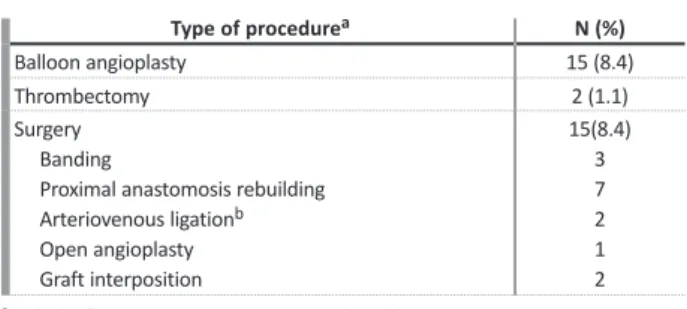
Eighty-four patients diagnosed with a potentially rectifiable VA complication underwent a total of 48 interventions during the follow-up period (Table II); 29
Table I
Patients’ baseline characteristics at the time of vascular access assessment.
Patients’ characteristics Predialysis Incident HD P-valueb
N 87 91
Age at referral, mean (SD) 66.8 (14.4) 64.9 (15.1) 0.39
Males 40 (46%) 50 (55%) 0.29
Diabetes 39 (45%) 42 (46%) 0.88
Hypertension 78 (90%) 86 (95%) 0.27
Peripheral Artery Disease 19 (22%) 15 (16%) 0.45
Ischemic Cardiac Disease 24 (28%) 21 (23%) 0.50
Cerebrovascular Disease 27 (31%) 29 (32%) 1.00
Chronic Kidney Disease etiology Unknown Diabetic nephropathy ADPKD Chronic GN Ischemic nephropathy Others 10 (11%) 23 (26%) 10 (11%) 15 (17%) 10 (11%) 19 (22%) 10 (11%) 29 (32%) 8 (9%) 18 (20%) 8 (9%) 18 (20%) 0.93
Follow-up time by a nephrologist (years), median (IQR) 4.8 (2.9,10.0) 3.6 (1.7, 8.6) 0.011
Estimated GFR, mean (SD) (ml/min/1,73m2)a 17.4 (5.1) 16.3 (5.3) 0.13
Patient follow-up time (months), median (IQR) 146.5 (88.1, 305.7) 137.7 (84.1, 317.3) 0.95
Patient survival (rate) 66 (76%) 64 (70%) 0.50
a Estimated Glomerular Filtration Rate (GFR) at referral using The Modification of Diet in Renal Disease equation.
b Data presented as mean ± SD, median (interquartile range), or frequency (percent), as appropriate. GN: glomerulonephritis; ADPKD: autosomal dominant polycystic kidney disease.
(16.3%) patients experienced one intervention, 5 (2.8%) patients were submitted to 2 interventions, and 3 (1.7%) patients underwent 3 procedures. Main vascular access characteristics are described in Table III. Of those starting hemodialysis, 10 (10.9%) patients started with TDC, 80 (87.9%) with AVF, and one with AVG. A total of 227 VA was built, of which 121 (53.3%) were in the predialysis group and 106 (46.7%) in incident HD patients, with 35 (19.6%) patients submitted to 2 VA placement, 4 (2.2%) patients submitted to 3 VA place-ment and 2 patients submitted to 4 VA placeplace-ment.
At the end of VA follow-up, 48 (55%) patients in pre-dialysis and 61 (67%) patients in the group who started HD (p=0.12) had their first VA access patent. In a multi-variate model including age, sex, diabetes, peripheral artery disease, cerebrovascular disease, ischemic heart disease (IHD), DU diameter of nurturing artery and out-flow vein, and number of VA-related interventions, only IHD (HR 1.97, 95% CI 1.06-3.66, p=0.03) and cerebro-vascular disease (HR 1.99, 95% CI 1.08-3.67, p=0.03) were significantly associated with worse VA survival.
Patient cumulative survival in the group who remained predialytic was 76% (n=66) and 70% (n=64) for those starting chronic HD (p=0.50). The presence of a func-tioning AVF at HD start did not correlate with a statisti-cally significant improved survival (HR 0.47, 95% CI 0.17-1.24, p=0.129). But in a multivariate analysis includ-ing gender, age, IHD, peripheral arterial disease, cerebro-vascular disease, diabetes, and presence of functional AVF, age was associated with increased mortality (HR 1.06, 95% CI 1.01-1.11, p=0.008), while functional AVF at HD start showed a trend towards improved survival (HR 0.38, 95% CI 0.14-1.00, p=0.05). When all patients were included in the model (HD and predialysis), only age was significantly associated with worse prognosis (HR 1.07, 95% CI 1.03-1.11, p<0.0001). Patient cumula-tive survival curves can be observed in Figure 2.
Table III
First vascular access characteristics and complications.
Vascular access characteristics Predialysis Incident HD P-value
N 87 91 AV access placed Radio-cephalic fistula Brachio-cephalic fistula Brachio-basilic fistula AV Graft 44 (51%) 34 (39%) 9 (10%) 0 (0%) 42 (46%) 31 (34%) 17 (19%) 1 (1%) 0.28
Outflow vein diameter (mm)ª, median (IQR) 3.2 (2.8, 3.9) 3.3 (2.7, 4.4) 0.36
Nurturing artery diameter (mm) ª, median (IQR) 3 (2.6, 4.2) 3.4 (2.7, 4.5) 0.11
First complication Primary failure
Juxta-anastomosis stenosis Outflow vein stenosis Central venous stenosis Thrombosis Steal syndrome Others 44 (52.3%) 12 (14%) 6 (7%) 6 (7%) 1 (1%) 12 (14%) 4 (5%) 3 (3%) 40 (47.6%) 13 (14%) 8 (9%) 8 (9%) 0 (0%) 7 (8%) 3 (3%) 1 (1%) 0.74
Number of proceduresb, median (IQR) / mean (SD) 0 (0,0) / 0.2 (0.5) 0 (0,1) / 0.3 (0.6) 0.03 / 0.10
Number of thrombosisb, median (IQR) / mean (SD) 0 (0, 1) / 0.3 (0.5) 0 (0, 0) / 0.1 (0.3) 0.02 / 0.02
Number of AV access placedb, median (IQR) / mean (SD) 1 (1, 2) / 1.4 (0.7) 1 (1, 1) / 1.2 (0.4) 0.02 / 0.006
AV access survival (rate) 48 (55%) 61 (67%) 0.12
Data presented as mean ± SD, median (interquartile range), or frequency (percent), as appropriate. A p-value<0.05 was considered statistically significant.
a Doppler ultrasound assessment at nephrologist consultation for VA planning.
b Even though these variables are skewed, for ease of reading, mean and SD are presented.
Table II
First intervention performed in the first-time AVF.
Type of procedurea N (%)
Balloon angioplasty 15 (8.4)
Thrombectomy 2 (1.1)
Surgery Banding
Proximal anastomosis rebuilding Arteriovenous ligationb Open angioplasty Graft interposition 15(8.4) 3 7 2 1 2
a Only the first procedure is considered in this table.
b Arteriovenous ligation resulting in VA closure was performed in one case because of
AVF infection and in the second case because of draining vein with multiple stenosis, but anastomosis to basilic vein was feasible.
DISCUSSION
Optimizing vascular access outcomes continues to be an uppermost priority in the management of non-ESRD and hemodialysis patients. The initial KDOQI guidelines published in 19971 and updated in 20012
and 20069 as well as the “Fistula First Initiative” in 20033
have consistently recommended preferential place-ment of AVFs over AVGs or TDCs.
Several rationales for preferring AVFs over AVGs have been proposed: (1) AVFs have better longevity, (2) require fewer interventions to maintain long-term patency, (3) lower access-related costs, and (4) HD patients with an AVF have a lower mortality4,11,22.
The “Fistula First Initiative” has been questioned, particularly in the elderly. A recent study revealed that patients older than 80 years-old had similar sur-vival outcomes whether an AVF or AVG was placed first; TDC had clearly the inferior outcome, and only 50.7% of the patients who had an AVF as their first access placed actually used an AVF at the time of dialysis initiation15. Another recent observational
study documented that older patients (≥67yo) who initiate HD with a central venous catheter (CVC), who had an AVF placed rather than an AVG, within 6 months of dialysis initiation, were associated with better overall survival, despite longer CVC depend-ence. Moreover, patients with AVF placement had
lower rates of hospitalization due to all-cause infection and septicemia/bacteremia.23
In our study two thirds of the patients were older than 65 years-old, one third of them older than 75 years-old, while showing an impressive rate of AVF use at HD initiation (87.9%). This happened at the expense of 227 arteriovenous (AV) accesses placed in 178 patients, with only 91 patients engaging HD and 21 (11.8%) deaths before even starting HD, in a 4-year period of follow-up.
Additionally, discrepancies remain in guidelines for optimal timing of vascular access placement: K/DOQI9
guidelines suggest at least 6 months before HD start; the European Best Practice Guidelines12 recommend
AVF creation at least 2-3 months before hemodialysis start, whereas the Society for Vascular Surgery10 defines
a glomerular filtration rate of 20 to 25 ml/min/1.73m2
as the criterion for fistula referral.
The timely creation of an AV access in patients with non-ESRD requires consideration of factors, such as patient preferences, life expectancy, likelihood of need-ing and timneed-ing of hemodialysis start, AV access eligibil-ity, and risk of complications. A Canadian population-based study showed, when late-referral patients were excluded, that 39% of the remaining cohort had a pre-dialysis AV access creation and 27% used an AV access at hemodialysis, with median time between AV access creation and hemodialysis start of 184 days.16 A French
study based in the REIN registry documented an overall 18% patients with nonfunctional AV access at hemo-dialysis initiation; in those with a planned hemo-dialysis start, the interval between AV access creation and hemodi-alysis initiation was <1 month for 14% of patients, 1–3 months for 27%, 3–12 months for 38%, and >12 months for 21%.17
Our results revealed a median time from VA place-ment and HD initiation of 22 months, 84.3% built a VA more than one-year before HD initiation, while 7.9% patients had the VA placed between 6-12 months, and 7.9% <6 months before HD start, respectively. This find-ing is possibly related to challenges in the anticipation of HD onset because of nonlinear chronic kidney dis-ease progression, reversible acute kidney injury and the ultimate concern for a functional AVF at the time of HD initiation. A strategy of closer follow-up of patients eligible for an AVF may facilitate determination of the ideal timing for AV access creation. Optimal tim-ing should also involve the avoidance of AV access crea-tion in patients who will not begin dialysis.
Figure 2
Kaplan‑Meier survival curves of predialysis and incident hemodialysis patients, respectively
A decision analysis assessing the ideal timing for AV access referral through Monte Carlo simulation found that earlier referral for older patients had vir-tually no impact on rates of successful AV access use at hemodialysis initiation, but increased the frequen-cy of unnecessary AV access creation.24 This outcome
was due mainly to mortality before hemodialysis initiation, which suggests that early VA placement in patients with a high comorbidity burden may often be pointless. Furthermore, a population-based study conducted in Canada showed that patients with a higher Deyo-Charlson Comorbidity Index were more likely to start hemodialysis after AVF creation, when age, sex, and the competing risk of death were considered.25
We registered 38.8% (n=69) non-functional AVF at the end of the study. In the multivariate analysis only IHD and cerebrovascular disease were associated with worse VA survival. The reason for the rate of failure seen in our cohort might be explained by an exhaustive attempt to create autologous fistulas. It has been pro-posed that, in the elderly, an AVG may be a preferable choice of second VA in a specific group of patients, such as females, blacks, and those with peripheral vas-cular disease.26 In addition to a clinical-tree decision,
DU assessment may help select the best VA option for each individual patient.
Our study has some limitations. First, due to its observational nature we are only able to infer asso-ciations rather than causality. Second, our study is probably underpowered to detect a survival benefit, yet we did find a marginal survival improvement from functional AVF at HD initiation, with age being the most important mortality predictor in our model. Brown et al. and Quinn et al. described that among patients initiating HD with a CVC, those who under-went AVF placement before HD initiation had superior survival to those without predialysis access surgery, despite having a very similar profile of comorbidi-ties.27,28 This was even if the AVF failed to mature
and was never used for HD, and thus with no correla-tion with a shorter CVC dependence period. This finding suggests that the decision to place an AVF in a patient itself reflects a healthier patient in ways that are not captured by compiling a list of known comorbidities. Moreover, an observational study sug-gested that the association between access type and mortality was nearly identical in models excluding and including access complications (HR 2.00; 95% CI 1.55-2.58 vs HR 2.01 95% CI 1.56-2.59 for CVC versus AVF, respectively).29
Regarding costs, a recent study suggests that even though AVF have been considered the most cost-effec-tive option, this benefit decreases with rising age and lower life expectancy.30
In conclusion, a high AVF placement rate was pos-sible in the K/DOQI era. Nevertheless, the improving number of functional AVF can be at the expense of an exceeding number of futile VA created, increased rate of failing AVFs and rising burden of interventions. To date no randomized controlled trial has been designed to access the real benefit from predialysis AVF place-ment. Our results highlight the aging of our population and the need for an individual approach and for future tools which can help predict the risk of death and pro-gression to ESRD.
Disclosure of potential conflicts of interest: none declared
References
1. National Kidney Foundation-Dialysis Outcomes Quality Initiative. NKF-DOQI clinical
practice guidelines for vascular access. Am J Kidney Dis 1997;30(3):S150–S191.
2. NKF-K/DOQI: III. NKF-K/DOQI clinical practice guidelines for vascular access: update
2000. Am J Kidney Dis 2001;37(1):S137–S181.
3. Lok CE. Fistula first initiative: advantages and pitfalls. Clin J Am Soc Nephrol 2007;2:1043–
1053.
4. Allon M. Current management of vascular access. Clin J Am Soc Nephrol 2007;2:786–800. 5. Dhingra RK, Young EW, Hulbert-Shearon TE, Leavey SF, Port FK. Type of vascular access
and mortality in U.S. hemodialysis patients. Kidney Int 2001;60:1443–1451.
6. Woods JD, Port FK. The impact of vascular access for haemodialysis on patient
morbid-ity and mortalmorbid-ity. Nephrol Dial Transplant 1997;12:657–659.
7. Polkinghorne KR, McDonald SP, Atkins RC, Kerr PG. Vascular access and all-cause
mortal-ity: a propensity score analysis. J Am Soc Nephrol 2004;15:477–486.
8. Xue JL, Dahl D, Ebben JP, Collins AJ. The association of initial hemodialysis access type
with mortality outcomes in elderly Medicare ESRD patients. Am J Kidney Dis 2003;42:1013–1019.
9. National Kidney Foundation. KDOQI Clinical Practice Guidelines and Clinical Practice
Recommendations for 2006 updates: hemodialysis adequacy, peritoneal dialysis ade-quacy and vascular access. Am J Kidney Dis 2006;48(1):S1–S322.
10. Sidawy AN, Spergel LM, Besarab A, Allon M, Jennings WC, Padberg FT Jr, et al. The
Society for Vascular Surgery: clinical practice guidelines for the surgical placement and maintenance of arteriovenous hemodialysis access. J Vasc Surg 2008;48(5 Suppl):2S–25S.
11. Allon M, Robbin ML. Increasing arteriovenous fistulas in hemodialysis patients: Problems
and solutions. Kidney Int 2002;62:1109– 1124.
12. Tordoir J, Canaud B, Haage P, Konner K, Basci A, Fouque D, et al. EBPG on Vascular Access.
Nephrol Dial Transplant 2007;22(2):ii88–117.
13. 2006 Updates Clinical Practice Guidelines and Recommendations [Internet]. Available
at:https://www.kidney.org/sites/default/files/docs/12-50-0210_jag_dcp_guidelines-va_oct06_sectionc_ofc.pdf. [cited Jan 5 2016].
14. Grubbs V, Wasse H, Vittinghoff E, Grimes BA, Johansen KL. Health status as a potential
mediator of the association between hemodialysis vascular access and mortality. Nephrol Dial Transplant 2014;29(4):892–898.
15. Malas MB, Canner JK, Hicks CW, Arhuidese IJ, Zarkowsky DS, Qazi U, et al. Trends in
incident hemodialysis access and mortality. JAMA Surg 2015;150(5):441–448.
16. Al-Jaishi AA, Lok CE, Garg AX, Zhang JC, Moist LM. Vascular access creation before
hemodialysis initiation and use: a population-based cohort study. Clin J Am Soc Nephrol 2015;10(3):418–427.
17. Alencar de Pinho N, Coscas R, Metzger M, Labeeuw M, Ayav C, Jacquelinet C, Massy ZA,
Stengel B; French REIN registry. Vascular access conversion and patient outcome after hemodialysis initiation with nonfunctional arteriovenous access: a prospective registry-based study. BMC Nephrol. 2017 Feb 22;18(1):74..
18. DeSilva RN, Patibandla BK, Vin Y, Narra A, Chawla V, Brown RS, et al. Fistula first is not
always the best strategy for the elderly. J Am Soc Nephrol 2013;24(8):1297–1304.
19. Yuo TH, Chaer RA, Dillavou ED, Leers SA, Makaroun MS. Patients started on
hemodialy-sis with tunneled dialyhemodialy-sis catheter have similar survival after arteriovenous fistula and arteriovenous graft creation. J Vasc Surg 2015;62(6):1590-–1597.e2.
20. Barreto P, Almeida P, de Matos N, Queirós JA, Pinheiro J, Silva F, et al. Preoperative
vessel mapping in chronic kidney disease patients – a center experience. J Vasc Access 2016;17(4):320–327.
21. Sidawy AN, Gray R, Besarab A, Henry M, Ascher E, Silva M, Jr, et al. Recommended
standards for reports dealing with arteriovenous hemodialysis accesses. J Vasc Surg 2002;35:603–610.
22. Lok CE, Foley R. Vascular access morbidity and mortality: trends of the last decade. Clin
J Am Soc Nephrol 2013;8:1213–1219.
23. Lee T, Thamer M, Zhang Q, Zhang Y, Allon M. Vascular access type and clinical outcomes
among elderly patients on hemodialysis. Clin J Am Soc Nephrol 2017;10.pii: CJN.01410217.
24. Shechter SM, Skandari MR, Zalunardo N. Timing of arteriovenous fistula creation in
patients with CKD: a decision analysis. Am J Kidney Dis 2014 Jan;63(1):95-103.
25. Oliver MJ, Quinn RR, Garg AX, Kim SJ, Wald R, Paterson JM. Likelihood of starting
dialy-sis after incident fistula creation. Clin J Am Soc Nephrol 2012;7(3):466–471.
26. Hod T, Goldfarb-Rumyantzev AS, Patibandla BK, Narra A, Brown RS. Second vascular
access after failure of the first fistula in the elderly. Clin Nephrol 2016;86:253–261.
27. Brown RS, Patibandla BK, Goldfarb-Rumyantzev AS. The survival benefit of “Fistula First,
Catheter Last” in hemodialysis is primarily due to patient factors. J Am Soc Nephrol 2016;28:645–652.
28. Quinn RR, Oliver MJ, Devoe D, Poinen K, Kabani R, Kamar F, et al. The effect of
predi-alysis fistula attempt on risk of all-cause and access- related death. J Am Soc Nephrol 2017,28:613–620.
29. Ravani P, Quinn R, Oliver M, Robinson B, Pisoni R, Pannu N, et al. Examining the
asso-ciation between hemodialysis access type and mortality: the role of access complications. Clin J Am Soc Nephrol 2017;12:955–964.
30. Hall RK, Myers ER, Rosas SE, O’Hare AM, Colón-Emeric CS. Choice of hemodialysis access
in older adults: a cost-effectiveness analysis. Clin J Am Soc Nephrol 2017;12:947–954.
Correspondence to:
Carla Leal Moreira, MD
Nephrology department, Centro Hospitalar Universitário do Porto, Hospital Geral de Santo António
Largo Prof. Abel Salazar, 4099-001 Porto E-mail: [email protected]