I
The influence of online social media platforms on the choice of
restaurants.
Daniela Portugal dos Santos
Thesis submitted as partial requirement for the degree of
Master in Marketing
Supervisor:
Paulo Rita, Full Professor, ISCTE Business School
Co-supervisor:
Sérgio Moro, Assistant Professor, Department of Information Science and
Technology, ISCTE-IUL
II
Abstract
The main objective of this study is to understand how online platforms influence customer choice in the field of restaurants. To this end, various social networking platforms were analyzed, namely TripAdvisor, Zoomato, Facebook and Yelp, these being the most commonly used by consumers when looking for information that will help them to choose a restaurant. The platforms studied are among the most widely used by consumers when searching for information that may guide their next purchase. This analysis was conducted in Portugal, and includes 487 reviews from different users. The support vector machine model provided interesting results due to the effective modelling of the user score, based on the features collected from the platforms, with a mean absolute percentage error of 10.15%.
Several variables were analyzed, namely the platform, the location, the number of photos and the day of the week. The most relevant characteristic observed was the ranking that each consumer attributed to each restaurant. Through the results that will be presented we see that the Avg.Rate shows a 24% contribution to other users he most relevant characteristic observed was the ranking that each consumer attributed to each restaurant. The variables “Platform” and “nr.photos” contribute 19% and 18% respectively and therefore do not represent a big difference. It can be confirm that the values coincide with Zoomato, which was the Platform most used by our sample, having studied the following variables: Platform, Location, District, Website, Rank, Cuisine, Avg. Rate, Number of photos, Day and Month.
In this way, it was verified that the answer to our initial motivating question, “What is consumer behaviour like and how is it influenced by these platforms?” confirms that consumers won’t go to a new restaurant before checking the ranking that has been attributed to it on the various analyzed platforms.
III
Resumo
O principal objetivo deste estudo é entender como as plataformas online influenciam a escolha do cliente no Canal dos Restautrantes.
Foi realizada uma análise em Portugal que inclui 487 comentários de diferentes usuários. O modelo de máquina de vetor de suporte proporcionou resultados interessantes devido à modelagem efetiva da pontuação do usuário, com base nos recursos coletados das plataformas, com um erro médio de porcentagem absoluta de 10,15%.
Várias variáveis foram analisadas, nomeadamente a plataforma em anáise, a localização, o número de fotos e o dia da semana. A característica mais relevante observada foi o ranking que cada consumidor atribuiu a cada restaurante. No estudo realizado nesta dissertação verificamos que o Ranking pesa 24% na escolha do consumidor no seu restaurante. De seguida, verificamos que a Plataforma escolhida e as fotografias que são mostradas nesta contribuem 19% e 18% respetivamente. Através da análise feita verificámos que a plataforma Zoomato é a mais usada pela nossa amostra.
Desta forma, verificamos que a resposta à nossa pergunta inicial realização desta dissertação: "Como é o comportamento do consumidor e como é influenciado por estas plataformas?" consegue ser respondida mais à frente através da análise dos resultados.
IV
Acknowledgment
First of all, I would like to thank my supervisor Paulo Rita and my Co-supervisor Sergio Moro for their great supervision and substantial help during the course of this work. From them I acquired the necessary marketing skills that helped me develop this thesis
It was with great satisfaction that I carried out all the research by analysing the comments on the various platforms studied and from which I learned what people think and value most.
I would like to thank my family especially my parents, brother, uncles and cousins who motivated me and demonstrated their full support throughout the preparation and elaboration of this dissertation.
V Table of contents
Chapter 1: Introduction ...1
Chapter 2: Literature Review ...4
2.1. Motivation ... 5
2.2 Satisfaction ... 6
2.3. Consumer/Company co-creation ... 6
2.4 The Influence of ICT on Restaurant Performance ... 9
2.5. Online reviews and their importance ... 13
2.6. Online Platforms ... 16 2.6.1. TripAdvisor Platform ... 16 2.6.3. Zomato platform ... 20 2.6.4. Facebook platform ... 21 2.6.5. Yelp platform ... 21 Chapter 3: Methodology ...22
3.1 Dataset collection and preparation ... 22
3.2. Data mining and knowledge discovery ... 24
Chapter 4: Results ...25
4.1. Discussion of results ... 27
Chapter 5: Conclusions ...31
5.1 Conclusion ... 31
5.2. Implications for the restaurants ...32
5.3. Limitations and future research ... 33
References ...34
VI
List of Tables
Table 1: Some performance indicators ... 40
List of Figure Figure 1: Importance of the platforms studied ... 23
Figure 2: Rank vs Predicted ... 26
Figure 4: Importance of the Variables studied ... 28
Figure 3: The most important Platforms ... 29
1
Chapter 1: Introduction
This study serves as a contribution to filling the information research gap in regard to the available literature. This study allowed the conclusion that there is a widespread use of the internet throughout the country and that Facebook is the most used platform and not TripAdvisor as had been expected.
Nowadays there is a great diversity of services with many choice options and sometimes consumers have difficulty in making a decision. In order to solve this problem, some platforms have been developed with the main objective of helping consumers to understand what type of options they have by highlighting the ranking attributed by current or old customers of each specific service, organized by areas and prices. In this particular case, our goal is to try to understand if these platforms are indeed guiding consumers in their choices. (Cornelissen, 2017)
In this sense, this study serves to make an analysis of the influence of the online platform channel Horeca. It was identifying a great contribution to the stakeholders, as it deepens the communication/information through variables on several platforms. In this study, additional information was added to the food service sector. Statistical information was collected through a multi-commentary analysis done on the main platforms.
New technical developments were covered. The topics covered include the following variables: Pricing the cuisine; Take-away food sales; Home delivery; quality of food service; Private clubs; Resorts; Tourism and its integration into and its effects on industry.
This analysis was performed using a support vector machine model, which is an advanced data mining technique based on artificial intelligence.
The focus of this work is to understand the influence of online platforms on consumers and understand how these platforms really influence consumer choice as well as whether all the variables that make up the platform are relevant.
Nowadays, there is a growth of internet users due to e-commerce. This consumer behaviour needs to be taken into consideration by the companies because they have everything to gain by it. Just as the consumer is giving his inputs, the restaurant is checking for its flaws and quickly manages to improve them. (Kumar Dubey, 2017)
2
For the PMEs it represents a possibility to expand and compete in a wider market by taking advantage of the online world and its platforms. The online consumer values the convenience and the ability to see everything from the comfort of their home. (Kumar Dubey, 2017)
Restaurant platforms are an asset to both the consumer and the restaurant because they enable the users to see what the installations are like, view the food and compare the prices of different restaurants. Good reviews on these platforms will influence the decision-making of future customers. (Kumar Dubey, 2017)
This study was done through the analysis of the TripAdvisor, Zoomato, Yelp and Facebook Platforms from where comments were extracted for analysis. This analysis helped us to understand how these online comments can influence the decision of any would be consumer to go or not to go to a particular restaurant. In addition, it was our intention to discover which variables (nr. photos, avg. rate, rank, platform, district, location, cuisine) have a greater influence on the decision of consumers in their choice of restaurant. The analyzed comments were added in an Excel file with a specific analysis of 520 users.
This work is structured as follows: the first chapter holds the theoretical background to the difference between motivation and satisfaction, where it is demonstrated that satisfaction and motivation are the two main aspects that define the consumer’s personal behaviour (Devesa, Laguna & Palacios, 2010). Satisfaction and motivation are fundamental elements of marketing strategies and fundamental to the success of an organisation in its customer approach. In addition, word of mouth is one of the strongest elements that shapes the behaviour and attitudes of future clients. In this chapter, the co-creation between the consumer and the restaurant is highlighted. Consumers act as recourse integrators, centred on their experiences and culminating in a creation of value between the client and the service/product.
Chapter umber 3 refers to the site reviews and their importance. These are fundamental for the gathering of comments for the analysis of consumer opinions. A great amount of reviews discussing several subjects are available, full comments are published without changes, proving in this way to be a reliable source of information for the final consumer.
This study may serve as a contribution to other studies and documentation already available on this matter. E-commerce platforms such as those used in this study, Facebook, Yelp, Zoomato and TripAdvisor, are a reference for many consumers especially for the younger generation
3
(Donnelly and Scaff, 2013) since this majority uses the internet to learn about products and reduce the uncertainty in relation to the risks and the costs (Hong and Park, 2012).
4 Chapter 2: Literature Review
Restaurants are characterized by offering complex services that usually require contact between employees and consumers inside the company’s facilities to deliver the service, delivering both physical product and services. Therefore, it is necessary to create perceptions regarding the tangible elements of the service and also to provide solid evidence regarding the unattainable experience, composed by abstract elements such as employee-costumer interactions, of what’s intended to sell. This will create the costumer’s satisfaction and motivation to return. (O papel das pessoas nos ambientes de Restaurantes Gastronómicos e a Satisfação do Cliente, 2009).
Social and general media sites on the Internet, such as blogs, are growing increasingly as areas of interest for social research on reviews and personal experiences. Some authors state that nowadays all consumers are different. No consumer is the same because people have different reactions to the same experiences and behave differently to the same flavours. Each consumer is unique so it is very important to study the behaviour of people who go out to restaurants. More importantly, those who search for information on the internet about restaurants, use mainly platforms such as the “zomato,” Lisboa.come,” tripadvisor” among others. These sites are considered very important to consumers because here anybody can share his or her experiences and make comments which can be seen by potential consumers. These comments will possibly influence their decision as to which restaurants to go to. (Thorbjørnsen et al., 2002).
Internet interactivity and global connectivity are considered to be very important to online marketing because they allow an increase in efficiency through a bigger fidelity of the future client (Thorbjørnsen et al., 2002). This client-restaurant relationship allows the business to get closer to the existing and potential client and in return gain a greater fidelity on the part of the client, and as a result, higher sales. This is a more original way than the direct and personal marketing (Thorbjørnsen et al., 2002). Therefore, hotels and restaurants need to adopt a virtual presence to maintain their current and future clients. This virtual presence is essential and profitable to the consumer that uses the Internet to do business transactions (Tiago et al., 2015).
Besides internet sales, electronic marketing makes it possible for consumers to look up information about the restaurant and to inter-communicate. This provides a good idea of the marketing potential of the internet era, not just in the buying process but also in consumption and
5
communication looking to establish a permanent and lasting partnership with every consumer. Sebastião (2012)
2.1. Motivation
Motivation influences the search for tourism and it is closely connected to the expectation and satisfaction of each individual, considering that expectation is the provisional representative of the itinerant experience of the future in which the tourist has a conscious feeling of desire. This factor is important to the tourism industry because there is a need or an interest to try new restaurants and to have new experiences which in turn results in the main factor that influences the search for tourism, motivation. Satisfaction and motivation cannot be separated however, because motivation is created when an individual intends to satisfy his needs and desires. ("New E-comerce Titles", 2017). It can therefore be said that motivation generates motivation and that it can be measured. There are several approaches to measuring consumer motivation for product development: service evaluation, image formation and promotion (Sun et al., 2014).
When consumers are in touch with a service, a lasting engagement is created and in the future, may have an influence on some of the activities and behaviour of people (Yeh, 2013). The e-commerce environment is very important as it offers new opportunities for the creation and maintenance of the heritage of a brand through the experience created within this environment. Using the surrounding nature of the virtual environments in E-Commerce, clients can make contacts and become aware of a wider range of products and services. Rich and interactive experiences will create a positive reaction in the future evaluations of clients. This can be seen, for example, on hotel reservation sites where opportunities are provided for customers to share their experiences. This in turn will affect business, either positively or negatively (Bilgihan, 2016).
The attitudes, interaction, friendliness and professionalism of employees are to a great extent responsible for the satisfaction or dissatisfaction of the client.
6
2.2 Satisfaction
Satisfaction and motivation are two key elements that determine the consumer’s individual behaviour (Devesa et al., 2010). Consumer satisfaction/dissatisfaction is one of the key elements of marketing strategies and it is fundamental to the success of an organisation in approaching a consumer. WOM is one of the strongest elements used to shape future client behaviour and attitude. Word of mouth has proven to be a success factor in relation to products and services. In many cases, it can be the main source of information used by the restaurants’ future consumers. WOM was 700% more effective than newspaper or magazine advertising (Yeh, 2013), 400% more effective than personal sales and 200% more effective than radio advertisements in making consumers change brands (Yeh, 2013).
With this information, it is clear that motivation, according to Yoon et al. (2005) must include integral forces that awaken, direct and integrate the activity of the consumer. This can be focused on emotions, external and internal reasons, considering that an internal reason is associated to feelings and instincts and an external reason involves mental representations, such as knowledge and beliefs. Sometimes, consumers act on impulse motivated by factors such as the desire to escape, to rest, to relax, prestige, health and fitness, adventure and social interaction, family and excitement. It can be concluded that understanding these reasons generates negotiation progress (Yoon, et al., 2005).
2.3. Consumer/Company co-creation
Consumers usually want to feel “special” in relation to what they experience and try. It is therefore important to have a co-creation between the consumer and the business itself. In the process of value co-creation, consumers, as opposed to companies and organisations, act as backup integrators. In this way, the value is focused on consumer experiences, the main goal being to create a value proposal between the client and the service/product (Prebensen et al., 2013). This will make consumers contribute to a business value creation through cultural, social and physical resources. Co-creating valuable experiences can be an identity function by changing processes and improving them (Prebensen et al., 2013). The perceived value is a different form of satisfaction.
7
While the perceived value happens at different stages of the buying process, including the pre-buying stage, it is universally accepted that satisfaction is characterised as a post-purchase and post-consumption evaluation.
Value perceptions can be generated before the service or product has been used, considering that satisfaction depends on the experience of its use (Sánchez et al., 2006). When a consumer looks for information in the comments of other consumers, he or she is, in a certain way, trying to escape from routine (Yoon and Uysa, 2005). Consumer satisfaction has become increasingly important in the planning of services and products, in restaurants and marketing in particular, because it indirectly influences consumers to try this service.
According to Yoon and Uysal, (2013), clients have already developed expectations before trying a product/service and in the future these expectations will be compared to the real experience of the product/service. As a consequence, if the real experience is better than the previously perceived expectations, then the client’s level of satisfaction will remain high, but if the opposite happens, this will lead to a negative performance of the service/product. Consumer satisfaction can therefore be seen as a scale where the amount that consumers spend is weighed against the rewards (benefits) reaped. The price, the benefits, the waiting time and the effort made are all important factors in determining satisfaction. One can say that the destination is worth its while when tourists get good benefits or value based on the time, effort and money spent to travel.
Yoon and Uysal, (2013) states that quality information refers to the quality of the information regarding the contents of the respective information. This quality information in e-WOM reflects the relevance, adequacy, accuracy, value, credibility and the utility of the information and its main goal is to be a confidence indicator to commercial site users.
Faithful consumers help to attract future clients and contribute to decision making concerning the various products and functionalities. Before making any decision, consumers need to collect a large amount of information ranging from the accommodation required, transportation, restaurants, to tourist attractions, etc. A good platform that intends to satisfy a wide variety of information needs must be able to supply relevant, current and complete information in relation to the different areas. This information is highly prized because, instead of showing promotional messages from the hotel managers (information credibility), it is totally based on the real experiences of clients (Filieri et al., 2015).
8
To conclude, the fact that consumers act as backup integrators is highlighted, focusing on their experiences and culminating in the creation of value between the client and the service/product.
9
2.4 The Influence of ICT on Restaurant Performance
According to Thorbjørnsen et al. (2002), the use of technology is very important for the understanding of consumers and there are more and more studies in the marketing field focused on the attitude and behaviour of the online target, showing that technology is essential to better understand business and promote greater profitability.
There are three different types of restaurants, according to their existence: the ones that are inside hotels; the ones that are part of a national or international group; the ones that are in private properties (Tiago et al., 2015). In this last category, the traveller’s experience can be improved by the promotion of destination marketing and the offering of a taste of local culture. Normally, these are small companies with limited resources and even more limited digital knowledge (Tiago et al., 2015).
Among the most important factors for the success of a restaurant are: the quality of the food, the design of the menu and the price charged by the restaurant (Yim et al., 2014). Even if the restaurant shows an interesting business model, it cannot justify its viability as a good business by itself. It is important to face new challenges in designing a business so as to achieve the desired goals (Zhang et al., 2013). A backup system is presented which consists of a mechanism to supply the distribution or trading service through the warranty of a product at the right moment.
Products and restaurant services are provided by a variety of characteristics such as food, services, decoration and access (Yim et al., 2014). The evaluation includes not only the quality of the food and drinks but the global experience and all the elements of the meal, from the quality of the service up to the work environment (Stierand and Wood, 2012).
Price effectiveness is a powerful tool to get the client’s attention and increase the sales when it is done correctly. In the client’s perspective, the price of a product and/or service is a quality indicator and management has to keep an eye on the pricing strategies. When a price is correctly defined, it will most certainly create long term success within an organisation (Yim et al., 2014).
10
Publishing online comments is one way of providing product information by the people based on their personal experiences and sharing general information on service attributes (Tiago et al., 2015). Word of mouth communication is more effective than any advertising of a product because it represents a phenomenon experienced by the consumer, which in turn represents credibility (Mangold and Smith, 2012). In this particular situation, consumers trust the comments that are read. This trust is defined as a trust of one of the parts through a change of reliability and integrity. In this study, the focus is on the online trust that is different from the offline trust because its goal can be represented through a site (Ilieri et al., 2015).
In the future if consumers want to look up relevant information, these platforms will provide them with quality information because, indirectly, they represent the information given by consumers with the same interests and not by people who work for the company or service and might not be providing unbiased, honest or reliable information to the consumers (Filieri et al., 2015).
The trust in the online comments is characterised as a central success factor in some electronic commerce activities. However, some research on e-tourism in relation to this subject was focused on the impact of online travel due to the credibility of hotel comments and on the role that clients play in reducing the risk for travellers when booking accommodation. A factor like source credibility is more important in this context. Nevertheless, it is important to highlight that all customers are different and have different needs. Young couples generally look for a lively restaurant with a cheerful spirit at a good price to have a great time, whereas older couples look for a more sophisticated environment at a higher price. These platforms intend therefore, to satisfy a wide range of information needs, providing relevant information in relation to completely different needs (Filieri and McLeay, 2015).
The population has a growing need for comments on travel, restaurants and other information so as to plan their routines. According to Filieri et al. (2015), the statistics from Google show that over 80% of people research their holiday plans online and in most of the cases they visit 26 websites and spend over 2 hours looking for the right place to go to on holiday. In this way, in relation to the travel and tourism industry, consumers can bypass travel agents and save money.
11
The recommendations of travellers influence consumer decisions in relation to a future lunch or dinner. Reviewing the online travel comments with the intention of facilitating their decision making, allows consumers to identify the best hotels, restaurants and sights and also to avoid the below standard products and services (Filieri et al., 2015). Using the comments provided by the clients, the restaurants can obtain a classification which is then transmitted to future interest clients on the online platform (Dai et al., 2012).
The more online comments a restaurant has, the greater the profit of the restaurant will be in any period, since this profit is acquired through the revenues generated by the consumption of meals during this period, minus the cost of producing the meals and the costs of distributing them to the consumers in the restaurant (Betancourt et al., 2016). The menu prices affect the comments directly and it is crucial that management pay attention to effective price strategies, as well as understand client characteristics and perception (Yim et al., 2014).
Nowadays, there are a lot of nationwide tendencies because according to recent data from ComScore (Caetano, 2012), Portugal is in third place in the European ranking of social network platform users. In 2008, 7 billion social network pages were visited online, with 40 million hours of consumption dedicated to them.
Considering the globalism of internet sites, virtual communities were responsible for 19% of the total of the pages visited by the Portuguese on the web. It can be added that the new consumers shop from the comfort of their home without having to go to the shops. There are 30 million consumer reviews of available hotels on Tripadvisor.com and these reviews are often more effective than advertising. It is highlighted that 70% of consumers trust online reviews while just 14% trust advertising (Sebastião, 2012).
The consumer reviews on these platforms had a significant impact on online sales, highlighting the importance of the online consumer who generates comments in relation to the performance of the tourism trade. The uses of these platforms have been perceived to be more credible and reliable than the traditional marketing communications, in the sense that most consumers consider online platforms an important tool for future travel (Tseng et al., 2015).
12
The online consumer has two important roles in this regard: providing feedback
information on the product or service and serving as a positive or negative future recommendation. The opinion of the consumers who have already used a product or service is very important to other people who seek this same product or service and helps to reduce the intangibility factor (Zhang et al., 2010). Comments on these platforms are valuable because they allow certain consumers to share and discuss their experiences with other consumers who have the same interests (Vásquez and Chik, 2015).
Clients look for more information and advice on products and services which they are thinking of buying, especially if it is an asset of experience. The main goal of the online comments is to reduce the risk associated to a service or product. Tourists, in most of the cases, aren’t tied to a group of assets, on the contrary, tourists have a wide range of choice regarding restaurants, food and prices which can make a difference in their daily lives (Mkono et al., 2013). Besides the motivation factor, reading a review may be just a way of satisfying one’s curiosity in relation to a specific restaurant or even just a matter of spending time in a more pleasant way, keeping in mind the comments read for a future opportunity (Salehi, 2015).
This search for information is a possible solution when groups of friends want to spend some time together (Chen et al., 2008). In many cases these consumers may have doubts about where to spend a special occasion with family and friends and therefore check out some of the platforms previously mentioned. Another source is e-WOM, which provides positive as well as negative statements made by real or potential consumers in relation to a product or company which provides services to groups of people and institutions (Filieri et al., 2015).
One of the ways of measuring long-term relationships with the customer is by how faithful consumers are to a brand/restaurant (Thorbjørnsen et al., 2002). Consumer experience can be defined in two ways. One is the tasting of food as a tourist experience, looking for new experiences and trying out different dishes and the other is the consumption of food as an extension to that eaten at home, where it is simply a necessary reality of daily life. Food can be a very special experience, becoming memorable through a complete, more intense experience (Mkono et al., 2013). The obvious purpose of a restaurant is to satisfy consumer expectations with a good combination of food and drinks. Taste in food is always changing and varies according to each person and therefore the appearance of the food is very important. It is really important that
13
managers analyse the negative comments made so as to correct the negative factors the best way possible (Tiago et al., 2015).
2.5. Online reviews and their importance
Review sites are fundamental for collecting reviews and opinions from multiple consumers in an independent way. These platforms focus on the exchange of comments between consumers regarding the products and services provided. There’s a huge amount of reviews where all imaginable subjects are discussed. These sites allow the complete, unique opinions to be read
(Rodrigues, 2015). As Dellarocas (2003, pp. 1407) referred, this means that for the first time in history “individuals can show their personal thoughts, their opinions and reactions, being, then,
easier to reach global community.”
A big benefit of these sites is the corresponding support provided to the consumer at every step of the purchase and of the decision making. Nowadays no e-commerce site can survive unless it includes some type of comment. The ratings on these sites influence customer choice, either positively or negatively. It is advisable that companies with unfavourable evaluations become aware of this because it is to their advantage.
There are also false, untrue and biased comments on these sites, which is unfortunate. There are two types of users on these platforms, those who only read the content and those who actively contribute to the content, all of whom trust the site they are in (Fernandes, 2015).
In order to improve information and in order to dissipate false expectations of the consumers, there are some online platforms available whose main function is to alert consumers in relation to the quality of the service in certain restaurants, of the menu, of the accommodation, the price of meals, among others (Esfahani, 2015). Besides this the internet is showing an increasingly significant growth in new forms of WOM. Information that the client might find interesting and useful about restaurants such as the menu, prices and location, is available on the internet and easily accessible to anyone with an internet connexion (Yim et al., 2014). When consumers are pleased with the service, their opinions are shared with friends and family. The same happens when consumers are displeased with the service/product. Both opinions are very important to the
14
restaurant and to other current and future consumers because it helps to improve the performance of the service in question (Wu et al., 2016).
Olery (2012), refers that 49% of consumers won’t book a hotel without previously reading the comments about it and 35% of travellers change their travel plans after checking the messages on the hotel that the consumer is planning to stay at. This is also true for restaurant users. Sites like TripAdvisor.com have shown that a 1% improvement on online reputation can lead to an increase of 1.4% in hotel revenues. According to Zhang, Z et al, (2010), an improvement in the reviews of a site leads to an increase of sales on that site and the (negative) impact of a 1 star client is bigger than the (positive) impact of 5 Star clients. Based on these results, the positive reviews by consumer are positively associated to the success of the product and platform. With this in mind, it is important to remember that, in addition to the previous data, 59% of adults that use the internet on a daily basis, use it for activities related to the dining room of the next restaurant they intend to go to and 58% of the restaurants with online platforms show their menus online (Yim et al., 2014).
Most of the time people look up what other consumers have to say before they make a decision. Nowadays it is almost impossible not to use the internet to look up opinions on the subjects which are of interest. Many e-commerce companies, such as Amazon and eBay, implement online rating systems to request and publish customer opinions in relation to the
products bought because it is believed to be useful for the public to know (Wu, 2013, pp.
971-984.). Consumer reviews on some online platforms like TripAdvisor.com and Yelp.com are becoming more and more influential in today´s global service industry (Wu, et al., 2016, pp. 224-238.).
An important method used to rate restaurant performance is by checking the comments directly related to the prices on the menu in order to check its reputation. (Yim et al., 2014). To ensure the smooth operation of a service, some tests are used. These are part of a pattern that shows some of the ways for companies to adapt to a new product development process to face the original problems on the service environment (Easingwood, 2003). These tests are used to compare several services such as the global price/quality and general quality/price (Hussain et al., 2015).
The consumer, according to Hussain et al, (2015, pp.167-175) can adopt several stances in relation to the services provided by the restaurants: As Dellarocas (2003, pp. 1407) referred:
15
- “Tangible actions to goods and other physical possessions”, in this situation, the object that requires processing must be present, but the client doesn’t have to be;
- “Intangible actions directed at people´s minds”, that represents mental stimulation. The
consumer must be mentally present, but doesn’t have to be present in person, such as in a situation that is linked to online platforms or to any other technological basis;
- “Intangible actions directed at intangible assets”, in this service, direct involvement with the consumer may not be needed, due to the fact that the requirement of the service was made in advance.
Whichever the stance adopted by the consumer, one must keep in mind that in the case of the tourism and hospitality industry, the products/services cannot be evaluated before consumption. This occurs because production and consumption don’t happen at the same time and, therefore, there isn’t an absolute certainty of its quality and efficiency (Salehi-Esfahani, 2015). There are no two equal services because two equal services are heterogeneous and intangible, produced and consumed at the same time (Easingwood, 2003). Consumers are mainly worried about the “final
output” but the way consumers are treated during the service creates a significant impact on their
satisfaction (Lovelock et al., 2011, pp.767).
If a service is adequately provided, it will generate consumer satisfaction. Based on
Hussain et al. (2015), satisfaction is an immediate response to consumption, whereas quality is an impression envisioned by the consumer before the service is experienced. This is influenced by the service, because if a service is provided as expected by the consumer, its quality will be satisfactory. On the other hand, if a service exceeds consumer expectations, the consumer will recognise the quality of the service/product and will want to return.
Regarding the article by Mkono et al. (2013), it can be understood that tourist experience is built on the consumer’s perspective. This experience unites the consumer perspective with all its vivid experience.
All services are tangible, as in the case of the restaurant and intangible as in the service and experience provided by the restaurant. Every service is unique and special and therefore it is important to provide the consumer with a unique experience, so that the consumer will remember the service as a whole (Lovelock et al., 2011).
16 into five different areas: reliability, responsiveness, assurance, empathy, and tangibles (Hussain et al., 2015).
In the marketing scenario, the following categories are of particular importance:
persuasion, attitude belief, product belief, product awareness, attitude towards the brand, attitude change, client’s belief, intention of buying, user’s satisfaction and change of behaviour. Therefore, the flux experience consequences on an e-commerce environment can offer opportunities to improve the efforts of a marketing professional (Bilgihan, 2016).
2.6. Online Platforms
During this study several platforms with restaurant recommendation were identified and if these are analysed correctly, the pertinent question of this thesis can be answered: What is consumer behaviour like and how is it influenced by these platforms?
According to Rezende Costa, J. (2016, pp.27) believes that balancing classroom and virtual can achieve great results not educational field. Share this idea not only in the educational field, since virtual contact is often more frequent than the face-to-face contact. Applications such as Facebook enable end-to-end communication with incredible speed that contemporary time requires. The speed of information is almost instantaneous. This makes it possible to introduce all the applications considered in this study onto the Facebook platform and thereby create more traffic on this platform.
2.6.1. TripAdvisor Platform
The TripAdvisor platform is an on-line platform introduced on the market in the year 2000 with the main aim of representing tourism and assisting users in planning their holidays, work trips or any other activity, assisting them in finding a hotel, a restaurant, season renting, flights, tourist destinations and attractions. In 2013 it had over 260 million monthly visits and over 150 million comments and opinions about more than 3.7 million accommodations, restaurants and attractions
17
(Esfahani, 2015). The platform is available worldwide through the web and applications for Windows, Android and iOS.
Consumers write comments on this platform expressing their opinion in relation to the service, food and drinks of several restaurants. Over 85% of the questions or issues are answered within 24 hours (Silva, 2015).
This platform has information on tourism opportunities worldwide. However, in this project only the information on restaurants in the Lisbon County was considered. The information on this platform, the reviews and the classification of a destination, of a hotel, an attraction or any other service related to tourism, is provided by the users. The adding of new services (for example hotels and restaurants) can be done by any user. This platform, in the restaurant section particularly, allows users to find the idealrestaurant using filters such as, location, menus and prices (Marques, 2016).
In conclusion, TripAdvisor has become very popular among travellers. About 200 million users visit the site every month to find restaurants, accommodation and destination recommendations.
In order for the Horeca channel to be successful, it is important that its creators understand
the effects of social networks as well as their content in order to earn customer loyalty. With this, the tourism suppliers can achieve a better understanding by analysing the comments and claims. Consumers can also reach conclusions in relation to the services provided by hotel companies. It is important that hotel companies answer any query from their customers in effective time. A company with the inability of responding quickly and efficiently may experience loss of business because clients don’t appreciate waiting too long for online replies.
One of the studies developed by O ’Connor (2010) shows that the Horeca channel and the hotels rarely reply to the client’s comments. It was used as an example on the TripAdvisor platform to demonstrate the lack of replies to clients by the hotels. Sites like TripAdvisor have a section where hotels/restaurants can answer client comments. However, in his study, O’Connor (2010) shows that this has very little use because less than 0,5% of the comments got an answer from management. This behaviour is particularly worrying because word of mouth (WOM) cannot be controlled or managed and therefore cannot be ignored. To deal with this, the Horeca channel
18
needs to be more in touch with their clients/consumers and show more interest in their opinions and provide answers to any doubts that may appear.
The future success of the Horeca channel depends on a better understanding of social networks and the platforms studied here because they are an asset and should be explored to the maximum. It is very important for Horeca to analyse in detail the projects carried out as well as all the reviews and discussions otherwise it will certainly lose out on business and its place on the market.
The online reviews increase daily as a prime source of information on the evaluation of company performance as well as an influence on the client’s decision to buy (Fernandes, 2015).
There are increasingly more studies that resort to the TripAdvisor site to gather data (e.g., Calheiros et al., 2017; Moro et al., 2017). The most popular method of extracting information is content analysis. To be able to present information in structured dataset, first, the information must be organised and then interpreted. From the data analysis, it is possible to build a consumer profile and with it check the positive and negative aspects (Cruz et al., 2016).
These platforms have a bigger target-audience, considered a young target and called Millennials, because these platforms are dynamic and the target-audience prefers new technologies and so they are more and more relevant and provide new possibilities for future research. (Hershatter and Epstein, 2010)This generation influences the market in a faster way, defining and shaping new tendencies in the world because they are completely different and stand out among the crowd. (Hershatter and Epstein, 2010)This generation is called generation “Y” and there is a great difference between this one and the previous generations because this so called generation of “digital natives” was the first generation to be born and raised in the digital era (Hershatter and Epstein, 2010) and is the pioneer of social platforms. According to the consumer Marketing Journal (2016), some authors say that most of the Millennials are not faithful to a specific brand or service like the previous generations were. This is because there are a lot of price promotions on services. Millennials do not care about the brand itself, they care about a service with character and different from the rest. Millennials have been characterised as being slow to build their own family: 75% of them are single and most of them are still studying. It is the first generation that does not need an authority figure to provide them with information, becoming a unique and advanced group of workers (Bilgihan, 2016).
19
This young generation has become technologically advanced, able to express their opinions without difficulty having a need to express their feelings in relation to products and services. Besides having the technical knowledge, these well informed online consumers (Barton et al., 2014) are willing to look up every detail before buying (for example, reviews in blogs).
According to the previous information this generation demands an extra time on service, as well as answers in real time because this generation interacts in a world with no boundaries. When this generation wants to gather information on a service or product, the answers quickly show up in the digital world. Generation Y feels that restaurants have to fulfil their expectations otherwise they will not succeed in view of the fact that there are many other alternatives (Donnelly and Scaff, 2013).
Millennials stand out as being a generation with a higher level of education than the previous ones and focused on work. Because of the 2008 recession Millennials have had to learn about the importance of being financially responsible by looking for better offers and comparing them, using the sources mentioned before, thereby strengthening their sensitivity and conscientious behaviour as consumers.
Some brands tend to strengthen their communication by involving the client through the social media so as to have a connection to the “Y” generation. However, “to reach generation Y on social media, a restaurant or a service must build a regular and permanent connection with it and provide information on products, special offers and updates, (...). The goal must be to create a positive buzz (Donnelly andScaff, 2013, pp.1-9) and listen to what this unique generation has to say, as long as generation Y “expects a mutual and two-way relationship with companies and brands” through a co-creation (Barton et al., 2014).
Nowadays, these clients are losing confidence in advertising and are increasingly looking for different reliable sources and recommendations from relatives and friends, on blogs and platforms, instead of the traditional ways of getting information. This tendency is sustained by the following: “if consumers love the experience provided by the service, consumers will have the urge to recommend it to their friends and family”. This suggests that a client only recommends a product if the client is involved, and this gives consistency to the sources used. Because of this, experience is everything and Millennials don’t need anything else. What counts is the best product with the best service, good memories and experiences and as long as the services “are turned into
20
pleasure, instead of possessions” (Abtan et al., 2014).
Millennials are hard to convince, according to the Moosylvania study (2015). For more than 1500 Millennials to like and come back to a place, some attributes are required, such as a higher quality product and the adjustment between the product and the client’s personality.
This generation spends a lot of its time searching and commenting on the internet. This generation can provide other consumers with an indirect experience of a product/service before these make their decision to buy. This generation also works for free in the role of “sales assistant” through e-commerce. Most of the consumers use the internet to find out about products and to reduce the uncertainty about the risks and the costs (Hong and Park, 2012).
It can be concluded that these experiences can be embodied through several different strategies, for example, co-creation between clients and brands, where a personalised approach is used and which leads to an unforgettable experience because of this relationship built on trust.
In conclusion, TripAdvisor has become popular among travellers who can potentially influence the travel decision of the average 200 million users that visit the site every month to look for restaurants, accommodation and destination recommendations.
2.6.3. Zomato platform
Another important platform for this study is Zomato. It is a world-wide social network, working in the field of restaurants, available for Android and Windows (Marques, 2016). It provides information and recommendation services of restaurants in 22 countries to millions of users (Bai, 2015), with approximately 90 million visits a month through the site and the apps. In 2014, on average, 30 million users used Zomato to look for restaurants per month (Sahni, 2016).
On this platform, the consumers are the main contributors because they provide their opinion on a daily basis in relation to the different dishes offered by a certain restaurant. This increases the confidence of the other users to visit the same restaurant (Marques, 2016). Zomato helps its users to find the best restaurants nearby, to study the menus and read the information about the restaurant. Consumers can then decide whether they want to eat at that restaurant according to their desires and according to the comments read. They can then evaluate the food experience for themselves (Bai, 2015).
21
This platform can be accessed via a pc website or using the application on iOS, Android or Apple smartphones. It is easy to access and people can look for restaurants using some keywords, based on a text of pre-set categories.
2.6.4. Facebook platform
Facebook is a social platform, but it is very important for business too, because it allows companies like restaurants to communicate with their clients and provide them with important information (Marques, 2016). The Facebook social network has several means of communication, namely the user profile page, a section for comments and messenger which can be used to exchange private messages.
Facebook is a platform where brands may offer and sell their products and services. It offers direct advertising opportunities such as the direct interaction with the public. Most brands and restaurants promote or sell products and services on this platform. On this platform, the client can interact quickly and intuitively with the restaurant platform because all it takes is a click on the “like” icon. This icon allows the client to access the posts (messages, content) published, and share their opinion about the business with friends (Marques, 2016).
This information can include the opening and closing time, photographs of the food, the prices, and other user opinions as well as rating the companies. All the information about the business is managed by several administrators. This platform is available for iOS, Android and Windows (Marques, 2016).
2.6.5. Yelp platform
The social network Yelp was founded in 2014 with the sole purpose of informing users about the service companies that provide the best treatment and services. This platform contains a wide range of areas, such as real estate, education and services among others with an average of 120 million viewers a month (Esfahani, 2015).
22
several filters, they can write comments and rate the companies. These comments are very important to future consumers because they allow them to keep up to date with the ratings of different businesses. The difference between this social network and the previous one is that there is a system of compliments that identifies the most important users and where information can be picked up (Marques, 2016).
On Yelp there is a positive relationship between the ratings and the stars. The restaurants with a higher number of stars tend to facilitate more the online consumer participation (Yim et al., 2014).
Chapter 3: Methodology
3.1 Dataset collection and preparation
After analyzing several authors on the theme, it was decided to use a quantitative research method. On this chapter you’ll find the cross between the views of the several authors and the results obtained thru a complex analysis made to a number of platforms and variables.
Data mining allows the identification of coherent patterns from which useful knowledge can be extracted (Turban et al., 2011). These results were acquired through the qualitative research of several platforms, having been filtered and analysed through an artificial intelligence model (Moro et al., 2016). Support vector machines were used to carry out multiple experiments.
This model analyses a sample of the input data, used to train the model to evaluate the sensitivity of the model to variations of simultaneous multiple inputs.
In this thesis, the quantitative approach method was applied based on the analysed articles and on the data and contents collected from the users of the platforms used in this study. This study is important not only for consumers, but also for the company in question, because if a attribute a good ranking and leaves a good comment on the platform in question, this will generate interest in a new consumer. In consequence, this new consumer will generate new sales for this restaurant. The analysis of the platforms (Facebook, Yelp, Zoomato and TripAdvisor) was done through a sample of 487 different comments extracted manually, where some of the trends were perceived and predicted.
23
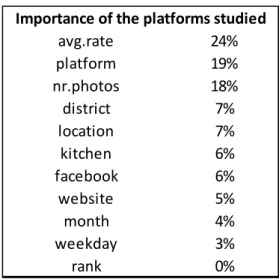
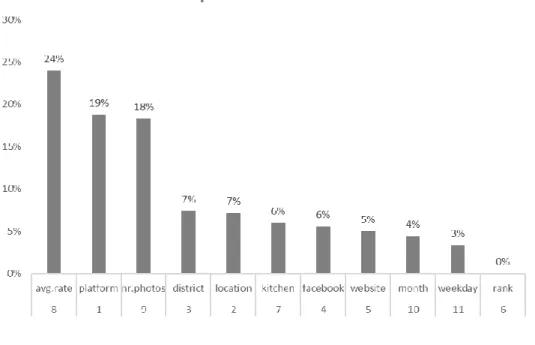
Analysing the above Figure 1, it can be seen that some indicators represent greater importance than others. The Avg.Rate shows a 24% contribution to other users.
The variables “Platform” and “nr.photos” contribute 19% and 18% respectively and therefore do not represent a big difference.
According to the author Rodrigues, (2015), review sites are fundamental for the gathering of consumer opinions and the analysis of these opinions in an independent way. These platforms focus on the consumer comment in relation to products and services. There is a huge amount of Reviews where all possible subjects are discussed. This was indeed verified, but not with the percentage expected.
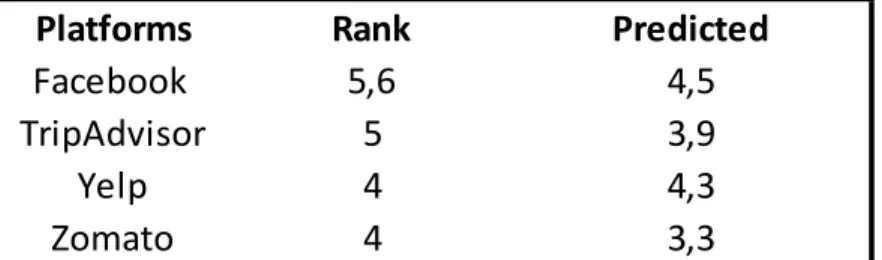
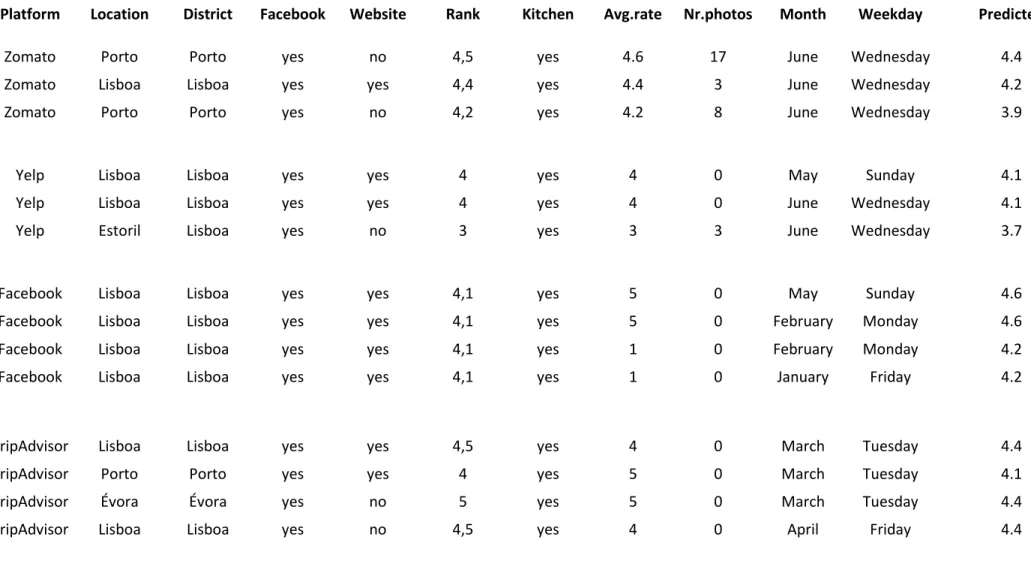
By analysing the figure above, it can be concluded that after all the data had been analysed and the variables identified, a new column called "Predicted" was created. This column shows the predicted value for the rank. In other words, the difference between the "rank" and the "Predicted" columns provides the model error.
We can confirm that the values coincide with Zoomato, which was the Platform most used by our sample, having studied the following variables: Platform, Location, District, Website, Rank, Cuisine, Avg. Rate, Number of photos, Day and Month.
avg.rate 24% platform 19% nr.photos 18% district 7% location 7% kitchen 6% facebook 6% website 5% month 4% weekday 3% rank 0%
Importance of the platforms studied
24
We found that these results are in line with the opinion expressed by Bai (2015) that this platform is very important in that consumers can read the opinions of other customers and know what to expect if they visit a specific restaurant, that is, the benefits as well as the disadvantages.
We also verified that the idea of Marques (2016) also corresponds to the results presented above, due to the fact that the Zoomato Platform allows its users to find the best restaurants nearby, to look at menus and information about the restaurant, find new restaurants according to their tastes as well as comment and evaluate their food experience. The Average Rate is the most important variable for the consumers in their choice of a restaurant. This data is perfectly in line with several authors mentioned in this dissertation, such as Devesa et al., (2010), who argued that satisfaction and motivation are two key elements that determine the consumer's individual satisfaction or dissatisfaction. This variable is therefore one of the key elements of marketing strategies and it is fundamental to the success of a restaurantin its approach to the consumer. Notwithstanding, WOM may not be forgotten because it is one of the strongest elements to shape the behavior and attitudes of future clients.
3.2. Data mining and knowledge discovery
This analysis was done in Portugal with the opinions of 487 different users on the Facebook, Yelp, TripAdvisor and Zoomato platforms. On these platforms, a set of variables was analysed and correlated and these helped us to understand consumer behaviour and the influence of the consumer on the catering market.
In this case, the specific variables that were analysed were the platform, location, district, facebook, Website, Rank, cuisine, avg.rate, nr.photos, month and weekday.
These variables were selected because according to the model used in this research only these variables obtained a ranking noteworthy and important enough to be studied.
In this specific research, the contents on the platforms referred to previously were analysed using a model to filter information. The general average of all variables was verified and it was possible to draw a general conclusion from the whole study.
25
Chapter 4: Results
It was decided to develop this question further by analysing 487 consumer comments, expressed on the various studied platforms. All the variables show that the answer to the initial question proves positive.
The support vector machine model provided interesting results due to the effective modeling of the user score, based on the features collected from the platforms, with a mean absolute percentage error of 10.15%.
After the definition of the problem, the collection of data and its preparation, the next phase was carried out where it is possible to perceive, through the model and the introduction of the data collected in several platforms.
This model consists of a technique where the data are entered into a table in which each row represents a problem to be treated and each column represents the resource to be used in solving the problem. The model used in the analysis of variables is a process that uses statistical and mathematical information in order to obtain information relevant to the research in this dissertation. A datamining project generally consists of consecutive cycles of relevant events, stages, such as understanding, preparing, modeling, and evaluating data. This model selects the characteristics and engineering of resources,that is,chooses the variables that best characterize the initial question and works them out for a general conclusion. This model was focused on the evaluation of the quantitative fields of the four platforms studied. Considering the score available for users to evaluate restaurants from the four platforms, on a scale of 1 to 5, where 1 represents the lowest and 5 the highest score, respectively the question becomes a “return problema». The model originates na error (MAE) and causes na error through na absolute percentage ( MAPE) ,being MAE the average of all absolute diferences between the real value and the predicted by the model. The MAPE metric is the mean of all absolute values, the differences between the actual and predicted value of the model divided by the actual grade, in order to extract a percentage in relation to each deviation and thus obtain the expected resuts.
One of the disadvantages of MAPE is that it becomes indeterminate for results values close to zero. However, this problema does not apply to the presente study, since the result varies between 1 and 5. (Moro et al., 2016).
26
After having analysed the results and interpreting them, a model was used where the analysis was done and the information was placed so as to obtain a final result.
The model can be verified as adequate and reliable due to the metrics obtained and shown in the chart below. This model permitted the understanding of which variables should be used and which variables had more impact on this research. It can be seen that the Model practically corresponds to the rank of the platforms, and is therefore reliable because there was no significant error. This model also shows which variables are important to be studied and which have more impact.
In order to arrive at relevant conclusions, there is a need to compare the results obtained by analysing all the comments.
Figure 2: Rank vs Predicted
In the table above we were able to analyse the rank and a new column "Predicted" was created. This column shows the predicted value for "rank". The difference between "rank" and "Predicted" provides the error of the model, that is MAE = 0.334 which is the average of the absolute differences.
In agreement with Filieri et al, (2015) that state that over 80% of people research their holidays online and normally visit 26 websites, spending over 2 hours searching for the right place to go on holidays. In this way, in relation to the travel and tourism industry, consumers can bypass tourist agencies. As has been demonstrated, consumers agree with the fact that through user’s comments, restaurants can get a rating that in the future will be broadcast on the online platform to the future users. The more online comments, the greater the restaurant profit will be, because this is acquired by the income generated by the consumption of meals minus the costs of making them and minus the costs of serving them to the restaurant consumers.
Platforms Rank Predicted
Facebook 5,6 4,5
TripAdvisor 5 3,9
Yelp 4 4,3
27
4.1. Discussion of results
This analysis will show that some categories are more important than others and that they have influence on consumer Choice as we were able to observe and detail bellow. According to Moro et al., (2017), “for extracting knowledge from the "Lifetime Post Consumers Implemented
model, data-based sensitivity analysis was performed via two complementary approaches: first, the model was assessed to understand what the outcome is the studied metric; Second, all input features from the most to the least relevant for the model were assessed to discern how each of they influenced the outcome.”
It was verified that the “avg.rate”, that is, the average of all rates, is the most influential variable, according to Bilgihan, (2016). This highlights that it is very important for consumers to share their new experiences because the satisfying experience of a service automatically generates a positive reaction in the client’s future evaluations. Even so, this variable contributes only 24% to the decision making in relation to trying out that service. Although this variable did not show the amount of influence initially predicted, the restaurants still need to keep this aspect in mind.
Because the platform represents 19% of the decision making, it is the second most important variable for restaurants to understand where to publish information. In addition, it is important to consider the amount of photos published on the platform. Providing visual stimulation by publishing photographs is an asset to the business, because these provide the client with an exact perception of what food and decoration will be encountered, among other aspects.
28
Analysing the above Figure, it can be seen that some indicators represent greater importance than others. The Avg.Rate shows a 24% contribution to other users.
The variables “Platform” and “nr.photos” contribute 19% and 18% respectively and therefore do not represent a big difference.
According to Rodrigues, (2015), review sites are fundamental for the gathering of consumer opinions and the analysis of these opinions in an independent way. These platforms focus on the consumer comment in relation to products and services. There is a huge amount of Reviews where all possible subjects are discussed. This was indeed verified, but not with the percentage expected.
We found that these results are in line with the opinion expressed by Bai (2015) that this platform is very important in that consumers can read the opinions of other customers and know what to expect if they visit a specific restaurant, that is, the benefits as well as the disadvantages.
We also verified that the idea of Marques (2016) also corresponds to the results presented due to the fact that the Zoomato Platform allows its users to find the best restaurants nearby, to look at menus and information about the restaurant, find new restaurants according to their tastes
29
as well as comment and evaluate their food experience. The Average Rate is the most important variable for the consumers in their choice of a restaurant.
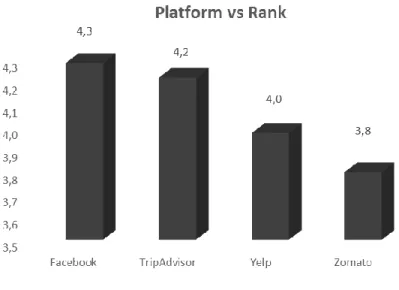
Figure above demonstrates that Facebook is the social network that consumers tend to assign a better score to find and transmit information in relation to visiting and trying out new restaurants.
TripAdvisor and Yelp are in 2nd place with 4.22% and 3.98% respectively. The Zomato platform is at the bottom of all analysed platforms, being therefore, the least visited by Portuguese people.
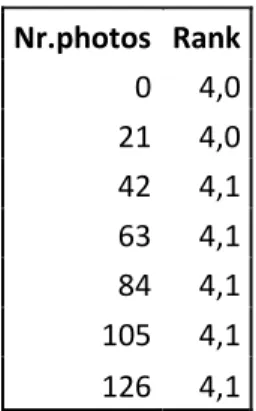
30 Nr.photos Rank 0 4,0 21 4,0 42 4,1 63 4,1 84 4,1 105 4,1 126 4,1
By analysing Figure 3 it can be concluded that the number of photos is directly related to the clicks. The more photos available, the higher the ranking attributed to the restaurant. However, after 84 photos the ranking is constant. This means that after looking at 84 photographs on average, the consumers have already made up their mind and don’t need to see any more. This data is very interesting because it shows that when a consumer goes to a site to check the attributes of a restaurant, the first thing he or she looks at, are the available photos.
It was concluded that the ideal number of photos to have of a restaurant is 42, which corresponds to a 4.07 rank. It was also concluded that when 84 photos or more are available, it proves to be too much and the users lose interest.
Figure 3 shows that the higher the average rate already held by the restaurant, the higher the rank attributed by the user will be. This result is confirmed by some authors referred to in the first part, such as Olery (2012), who states that 49% of consumers won’t book a hotel without reading the comments on it and 35% of travellers change their travel plans after analysing the comments on the restaurant or hotel they had previously chosen. Sites like TripAdvisor.com have shown that a 1% improvement of the online reputation can lead to an increase of 1.4% in hotel revenues.
31
Chapter 5: Conclusions
5.1 Conclusion
Nowadays the Internet is an essential tool in the search for any information required by the consumer. Consumers use it, increasingly, to express their frustrations in relation to services that do not fulfil their expectations. Online platforms that publish the opinions of consumers are one of the most reliable ways of obtaining and exchanginginformation. Would be consumers take into account the recommendations by other consumers while in the process of making a decision and tend to be more sensitive to negative information such as complaints made by other consumers.
This study serves as a contribution to filling the information gap in regard to the available literature. This study allowed the conclusion that there is a widespread use of the internet throughout the country and that Facebook is the most used platform and not TripAdvisor as had been expected.
Another conclusion is that the extras such as TV, Parking and WiFi offered by a restaurant weigh greatly as a decision factor. This is an interesting aspect because it shows that consumers are sensitive to the little details of sensory marketing, like smell, hearing and touch. Keeping this in mind, restaurants need to make improvements and make their space and menu more attractive and pleasant so as to get a higher score on social networks, and in consequence, more clients.
Referring to the initial question “What is consumer behaviour like on the online Platforms, namely on the Horeca Channel?” we can see that the client profile tends to be defined as being Portuguese, young and at ease with the new technologies. These consumers are curious and like to share their opinions about everything they see and try.
In conclusion, restaurants must be aware of clients with these characteristics because they have high expectations and have no problem in showing their dissatisfaction online.
Based on this study, the question asked at the beginning of this project, “What is consumer behaviour like and how is it influenced by these platforms?, is proven. After a detailed analysis, Facebook and TripAdvisor prove to be the most widely used platforms in the search for restaurants by potential customers who analyse a group of variables before they make their decision.