Mediation in Teletandem: From face-to-face
sessions to reflective journals
[Sprachlernberatung im Teletandem: von
face-to-face
Interaktionen zu reflexiven
Lerntagebüchern]
http://dx.doi.org/10.11606/1982-88372236153
Maria Cristina Reckziegel Guedes Evangelista
1Ana Cristina Biondo Salomão
2Abstract: The collaborative context of language learning in Teletandem (TELLES; VASSALLO
2006) involves the principles of autonomy, reciprocity and separation of languages, as well as the mediation of the partnerships (in Vygotskian terms). This article aims to discuss the formats of teletandem mediation, by focusing on the strategies used to reconcile the management of interactions (SALOMÃO 2008) through reflective journals in our specific educational context This
qualitative investigation is based on the analysis of a corpus of reflective journals produced after teletandem sessions by Brazilian students and the feedback offered by the mediators. The Brazilian participants wrote journal entries after practicing teletandem with speakers of the following foreign languages: English, German, Italian, and Spanish. They address a wide range of topics, covering aspects of technology, foreign language learning, methodological issues, as
well as comments on the relationship with their partners. The data suggest great potential of the
journals and the feedback for participants, mediators and coordinators to evaluate specific issues of collaborative language learning in the teletandem, as well as other relevant aspects for the
pedagogical supervision of the project.
Keywords: foreign language learning; Teletandem; mediation; reflective journals.
Zusammenfassung: Der kollaborative Kontext des Sprachenlernens im Teletandem (TELLES;
VASSALLO 2006) basiert auf den Prinzipien der Autonomie, der Gegenseitigkeit und der
Einsprachigkeit sowie auf der Sprachlernberatung oder Mediation der Partnerschaften (in der
Perspektive Vygotskys). Dieser Artikel behandelt die Möglichkeiten der Sprachlernberatung im Teletandem und die in unserem spezifischen Bildungskontext verwendeten Strategien für die pädagogische Betreuung der Tandeminteraktionen (SALOMÃO 2008) durch reflexive Lerntagebücher. Diese qualitative Untersuchung basiert auf der Analyse eines Korpus von Lerntagebüchern und vom schriftlichen Feedback der Mediatoren. Die brasilianischen Teilnehmer schrieben Lerntagebücher nach Interaktionen mit Sprechern der Sprachen Englisch, Deutsch, Italienisch und Spanisch. Sie behandeln verschiedene Themenbereiche wie Technologie, Fremdsprachenlernen, methodologische Aspekte und auch Bemerkungen zu ihrem Verhältnis zu den Partnern. Die Daten weisen auf ein großes Potenzial der reflexiven Lerntagebücher und des Feedbacks der Mediatoren für Teilnehmer, Mediatoren und Koordinatoren hin, in denen spezifische Fragen des kollaborativen Sprachenlernens im
1 Universidade Estadual Paulista Julio de Mesquita Filho, Rod. Araraquara-Jaú Km 1, 184, Araraquara,
14800-901, Brasil. E-mail: [email protected]
2 Universidade Estadual Paulista Julio de Mesquita Filho, Rod. Araraquara-Jaú Km 1, 184, Araraquara,
Teletandem sowie andere für die pädagogische Betreuung des Projekts relevante Aspekte behandelt und bewertet werden können.
Schlüsselwörter: Fremdsprachenlernen; Teletandem; Mediation; reflexive Lerntagebücher.
1 Introduction
Current developments of digital technologies have fostered intercultural contact in language learning through collaborative teaching and learning proposals. The Teletandem Brasil Project (TELLES; VASSALLO 2006; TELLES 2009; BENEDETTI;CONSOLO;
VIEIRA-ABRAHÃO 2010) is one example of how foreign language students can practice the language they are learning through videoconferencing resources on the Internet, such as Skype, and by working collaboratively with students who are in a distant place. Derived from tandem learning, which has been practiced mostly in Europe since 1960, teletandem language learning involves native (or proficient) speakers of different languages, who are paired up to work collaboratively to practice and learn the language of each other.
The basic principles underlying this partnership are the principles of equality (or separation of languages), reciprocity and autonomy. There is also the provision of pedagogic assistance to the teletandem partners, such as counseling or mediation sessions. In the Teletandem Brasil Project, mediation has been performed in different ways, by means of individual or group sessions, as well as by reflective journals.
2 Collaborative learning
Since the mid-1980s, studies on language learning have pointed out the benefits of a teaching perspective centered on the student and not only on the teacher. Such focus includes the development of activities that promote interaction and negotiation of meanings, and are the bases of collaborative learning (CRANDALL 2000). According to
Figueiredo (2006), there is a distinction between collaboration and cooperation. For him, “collaboration is more than cooperation,” referring to “the whole process of learning: students teaching students; students teaching teachers; teachers teaching students” (FIGUEIREDO 2006: 19). Thus, in collaborative projects the focus is on the learning
process (not on the product), and group activities are often not very structured, for the roles are defined as the activity develops. In cooperative ones, conversely, the focus is on the product, so the activities are generally structured and there are pre-defined roles.
Crandall (2000) states that the benefits of collaborative language learning entail emotional aspects, such as lessened anxiety and increased motivation. Collaborative learning instills positive attitudes towards learning in general, fosters self-esteem and promotes different learning styles. According to Figueiredo (2006), it maximizes linguistic production through meaningful interactions and contributes to the negotiation of meaning through communication and reciprocal understanding. Because the learning process is not centered on the teacher, it lowers students’ anxiety to express themselves in the target language and privileges the sharing of knowledge rather than merely its transmission.
In the next section, we will briefly present the origins and principles of (tele)tandem learning.
3 Collaborative language learning in-tandem
Tandem is the name given to those bikes that have two seats and two sets of pedals. It represents a metaphor for collaborative learning through the image of the two persons on such bike having to work collaboratively to ride it together. In the case of language learning, this collaborative work lies in the fact that each person in the partnership is both a foreign language learner and a tutor of his or her own language. According to O’Rourke (2007: 44), tandem learning represents a context where “learners can take control of and responsibility for their own learning”, for is it based on autonomy. The author sees the contact afforded by the partnerships as an innovation that represents a step ahead ‘the two-dimensional representations of the vibrant reality of personal and social expression’ (O´ROURKE, 2007: 42) of recorded audio in language classrooms.
Originally, according to Telles and Vassallo (2006), the conception of in-tandem learning arose in Germany in the 1960s and was based on promoting partnerships for face-to face encounters between learners of foreign languages. The authors explain that it was only in the 1970s, in Spain, that the name Tandem was used, and that during the 1990s the systematization of the principles effectively occurred. In this sense, O’Rourke (2007: 43) explains that tandem learning involves
reciprocal support and instruction between two learners, each of whom is a native speaker of the other’s target language, be it through face-to-face or any other mode of communication. In this broad sense tandem learning has likely existed in informal arrangements since people first sought to learn foreign languages. Tandem learning was thus not originally a theoretically driven method so much as a widespread practice, independently discovered many times over by individuals wishing to learn the language of an acquaintance and prepared to offer their own native-speaker expertise in return. (…) If this kind of more or less ad hoc arrangement was practised long before it was given the name ‘tandem’, though, what is a recent development is the theorisation and systematic exploitation of tandem as an open learning method. (O’ROURKE 2007: 43)
The principle of equality requires that tandem sessions be composed of two parts, and that each language should be used separately in each part, so that both learners have equal opportunities to practice the foreign language. According to Telles and Vassallo (2006), languages should not be mixed, and therefore the authors call this principle separation of languages in teletandem. Thus, each of the learners should benefit equally from the partnership by ensuring the same length of time to practice each language. This principle is linked to the active contribution and the individual and joint results to be achieved within a successful relationship of collaborative learning, mentioned by Kohonen (1992). The principles of autonomy and reciprocity, together, provide that each student will be responsible for their own learning process and for their partner’s learning. Therefore, both must work together to establish goals and choose the best ways to achieve them, thereby forging a positive interdependence (KOHONEN 1992).
Little (2002) states that the principles of reciprocity and autonomy in tandem only make sense if practiced together, for the purpose of the partnership will not be achieved unless both partners are committed to their own learning and to the learning of the other. For the author, autonomy derives from a complex dynamic between social interaction and metacognition. Regarding the latter, Schwienhorst (1998) resonates this assertion by pointing to the principle of autonomy in this kind of partnership as a stimulus for the learners to refine their perception of language learning processes, which may help them plan, monitor, and evaluate their learning. Moreover, because it is a reciprocal process of collaborative learning, each person has the opportunity to observe his/her partner's learning process, which may also foster reflections on possible different strategies to learn languages.
separately in order to facilitate students’ reflection about their practice and their partners’ as well as the dialogue with the mediator (SALOMÃO;SILVA;DANIEL 2009).
Research on the area of tandem/teletandem discusses kinds of pedagogical assistance from a counselor/mediator, who will be responsible for the practical and theoretical framework in which the process will develop. We will address this issue in more detail in the following section.
4 Counseling sessions in tandem and mediation in teletandem
Authors such as Little (2002), Brammerts, Calvert and Kleppin (2002), Stickler (2003) point to the need of counseling sessions for participants in a partnership of collaborative learning in tandem. The reason for this, according to the authors, is that despite the learner's motivation in doing this kind of work, he/she may not be able to fully explore the potential that the context offers. If they can make decisions about their goals and review them constantly, they will be better able to assess their progress in learning. Therefore, it is necessary to encourage partners to learn independently and collaboratively and to reflect on their learning process.
There are different proposals for such counseling sessions: Brammerts, Calvert and Kleppin (2002) and Stickler (2003) propose individual counseling sessions with learners, made by a person whose specialty is language teaching and learning. Helmling (2002) suggests peer-counseling sessions in which the participants themselves advise other participants from different partnerships. Walker (2002) believes in the use of semi-structured journals to promote autonomy.
dialogue established between counselor and learner follow a humanistic approach, consisting of three stages:
1 – Clarifying desires and goals (which should involve the analysis of previous learning experiences and the level of proficiency in the target language).
2 – Clarifying specific approaches to learning (which should provide theoretical knowledge that can inform learners’ decisions in relation to teaching and learning in this context).
3 – Identifying the next steps and preparing for self-assessment (which should help decision-making and evaluation of the procedures used, and a possible change, if necessary).
Stickler’s proposal (2003) also involves aspects of counseling that lead the learner into being more autonomous, through exploration and reflection. She presents a list of suggestions on what the counselor should or should not do, usually focusing on non-directing behaviors, which may foster learners’ exploration of their attitudes and actions. She also claims that such skills will only be understood and perfected by the counselor in practice.
Walker (2002) discusses a project of face-to-face tandem in which counselors advise the participants in the analysis of their needs, in setting goals to be achieved, in the use of materials and methodology as well as in time management and organization. Learners keep a journal, in which they must address the following topics: date, goals for today, theme of conversation, vocabulary and new expressions, cultural information, grammar structure/accuracy. Learners must also describe their performance and their partners’ and reflect about them.
In the Teletandem Brasil Project, counseling sessions have been called mediation
(TELLES; VASSALLO 2006), underpinned by a theoretical perspective based on
For Salomão (2011a: 659), mediation in Teletandem is not limited to providing advice as counseling theories sometimes seem to suggest, but by introducing a third person in the partnership helps participants reflect on their own practice as language learners and teachers of their own language. According to the author, the mediator in teletandem is closely linked to the concept in Vygotsky's social theory of knowledge, which addresses the constitution and development of subjects through their social relations and language interaction (p. 659).
We agree with van Compernolle (2015: 6) that Vygotskian Sociocultural Theory (SCT) offers an “alternative, non-reductive framework in which the internal-psychological and the external-social are brought together as a dialectical unity”. According to the author, unlike the limited view of cognition presented in the interaction hypothesis or the heavily social-oriented socio-interactionist perspective, sociocultural theory highlights the importance of language as a mediational means, by expanding the focus of interest in research beyond the role of interaction in facilitating the acquisition of L2 forms.
Van Compernolle also states in a previous work:
From the perspective pf SCT, the sociocultural domain is not merely a set of factors that trigger innate development processes within the mind/brain of the individual. Instead, it is the primary source, and principal driver, of mental development. When extended to formal schooling, including L2 education, such an orientation to human psychology compels us to engage in educational praxis wherein instruction drives development rather than following an assumed progression of innate developmental stages. As Vygotsky (1978:89) forcefully argued, the only good instruction ‘is that which is ahead of development’. (VAN COMPERNOLLE 2014: 1)
According to this perspective, the acquisition of an additional language bears upon a person’s psychological functioning (VAN COMPENOLLE 2014). Based upon this view,
different mediation settings have been implemented over the years in the various contexts in which the Teletandem project has taken place in Brazil and abroad. We will present the main settings described in dissertations and theses focusing on the context of the Teletandem Brasil Project for the last 10 years.
4.1 Individual mediation
to each pair of teletandem participants. We understand that this configuration was feasible because of the limited number of partnerships in this first stage of the Project. Mediators were graduate students in Applied Linguistics who were conducting research on teletandem. They usually scheduled individual mediation sessions (face-to-face or online) with the Brazilian participants. They also had access to the teletandem sessions, which were recorded mainly in audio with special programs attached to Skype (with the permission of participants).
Salomão (2008), in a study conducted in this context, defines the mediator figure as a more competent partner who will mediate, in Vygotskian terms, learning by mediational instruments, such as technological resources, by the use of language, that is, by interacting with them and providing scaffolding. The author describes the meeting between the project coordinators and graduate students in which some guidelines for mediation were released. The coordinators sought to emphasize the mediator's role as a reflection developer, by encouraging mediators not be directive or authoritarian, but rather to create an atmosphere of trust and negotiation, based on the learners’ needs. Because most of the participants were pre-service language teachers in this context, it was also suggested that mediation involved a reflective stance and provision of theory according to the participants’ needs.
In another report on the same study, Salomão (2011b) concludes that the mediator (a graduate student in Applied Linguistics) provided scaffolding to the participants (undergraduate students majoring in Foreign Language Teaching with little or no experience) that helped them to reflect on their roles as teachers and learners, attempting to bridge theory and practice in pedagogical praxis.
[…] having a first teaching experience supervised by a more experienced person, the mediator, in the role of a teacher educator who offers scaffolds for knowledge building, contributed to enable a bridging between theory and practice that starts in practice and relates it meaningfully to theory. The supervision models used by the mediator seemed to provide support for the Brazilian Teletandem partner as a student-teacher, to find elements in her practice that could lead her to see herself as a teacher and establish pedagogical objectives to her teaching in-teletandem. They also provided the opportunity for her to gain confidence and explore her pedagogical practice on different levels: in practical terms, by paying more attention to techniques and procedures used, changing or substituting the ones that she found to be ineffective; and, in more reflective terms, by exploring her decisions and actions pedagogically and relating them to the theory she had been reading. (SALOMÃO 2011b: 154)
between mediator and Brazilian participants, usually addressing pre-service teachers doing teletandem.
4.2 Group mediation
Over the years, group mediation sessions have also been conducted. Most studies that describe this type of mediation, such as Carvalho, Messias and Días (2015: 714), point to the realization of a mediation session with the group of participants after each teletandem session in the lab, in order to monitor the development of interactions and apply any necessary intervention procedures. This usually took place at the lab after the teletandem sessions with the participants sitting around a big meeting table with one or two mediators, as described by Andreu-Funo (2015), or blended with face to face contacts via videoconferencing, Facebook or other applications for group discussions (BEDRAN 2012).
Telles (2015) states that during the ten years of the Teletandem project the research team concluded that mediation sessions are an educational support, through reflective dialogue, conducted by mediators focusing on learning strategies and cultural and linguistic aspects that emerge during teletandem sessions. The author differentiates between mediation sessions and orientation sessions:
Orientation sessions are conducted by the teachers before teletandem sessions start. Their focus on what tandem learning is about and its principles - autonomy, reciprocity, and non-mixture of languages. Basic language learning strategies and ways of behaving for learning foreign languages are also presented to the students by the teacher. Mediation sessions, in turn, are conducted by the teachers after each teletandem session. They focus on aspects of the target languages, the students' learning processes and the cultural aspects and themes that emerge (implicitly or explicitly) during the interactions. Mediation sessions can be conducted in either the native or target language, depending on the students' level in the latter. The practice of conducting teletandem mediation sessions requires knowledge about intercultural contact, discourse and communication. (TELLES 2015: 607)
In the next section, we describe the type of mediation that we have been using in our context.
4.3 Mediation through reflective journals
participants. This space contains general information about teletandem, an initial needs analysis questionnaire and a list of suggestions of themes for the participants to use during the sessions at their discretion. There is also a section for the participants to post their journals divided by groups and schedules. The journals posted are read by the mediators, who give the participants feedback after each entry. The mediators are either participants (or former participants) of the project, or students who are conducting research in teletandem.
Figure 1, below, shows a print screen of the Moodle platform used for teletandem management on our campus:
Figure 1: Moodle for teletandem management
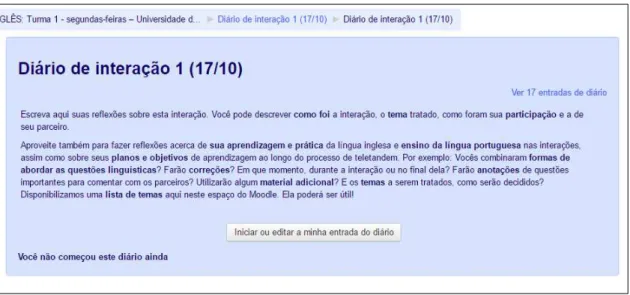
instructions with guiding questions, which we believe may be an additional way to motivate the participants to reflect on their performance and their partners’ as well as on other factors that can influence the interactions. Figure 2 shows an example of instructions for writing a journal entry.
Figure 2: Instructions for journal entry on Moodle3
The instructions for the participants focus on different aspects of the teletandem sessions every week. Figure 2 shows an example of instructions that focus on general aspects participants should address in their reflections about the first session, such as plans and objectives, error correction, choices of conversation themes, etc. From a Vygotskian perspective, we believe that the instructions and the journal writing may function as pedagogical tools that mediate learning, by inciting students to use language as a semiotic process to create meanings about their experience in teletandem.
Departing from these assumptions for the implementation of teletandem and mediation, we developed the research reported below to analyze in greater depth the impacts of mediation through reflective journals. The research is qualitative and as such, in the view of Bogdan and Biklen (1994), is more concerned with the process than with
3 Instructions in the journal entry shown in Figure 2: Please reflect about the teletandem session and write a journal entry. You can describe the interaction, the topic discussed, your participation and your partners’.
the product, that is, the data analysis tends to follow an inductive process and hypotheses arise during the analyses and not prior to them.
Our choice for qualitative research lies on the great potential it presents for rich contextualization, accounting for complexity of social/linguistic phenomena, and its “potential to resonate with readers because of accessibility, description, narrative genre and examples” (DUFF 2006: 70). We believe such investigation might be useful for
informing other teletandem contexts (or different telecollaboration contexts) by transferability of the findings determined not only by us, researchers, or, as Duff (2006) states, by the reader and “the typicality, representativeness or depth of description of case/situation” (p. 70).
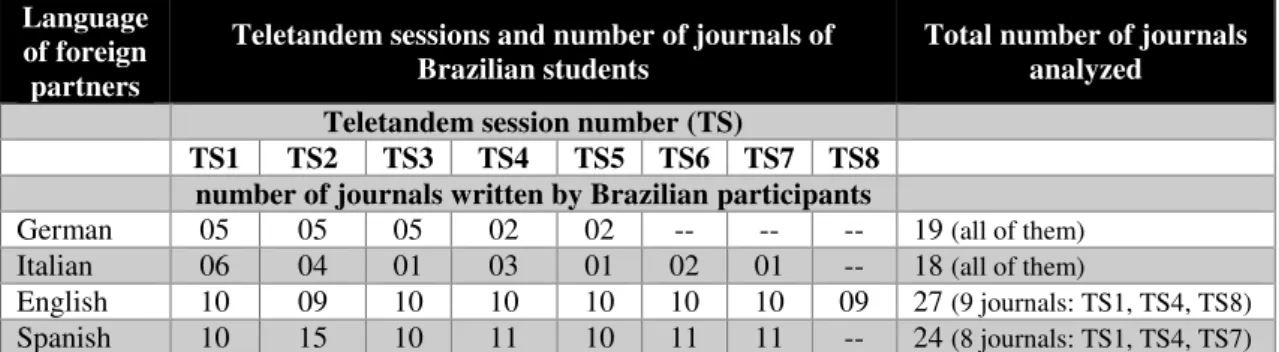
In order to evaluate the reflective diaries as mediation tools in teletandem, we analyzed journals from the Brazilian participants (speakers of Portuguese). The participants wrote journal entries after practicing teletandem with speakers from groups of the following foreign languages: English, German, Italian and Spanish. In addition to the journals produced by the participants, we also analyzed some contributions of the mediators in the form of written feedback in response to these journal entries. The methodology consisted of reading the journals and feedbacks, then selecting relevant passages considered important to understand mediation in teletandem. In the passages, we sought to identify categories of analysis according to thematic and semantic recurrences in the journals. Table 1, below, summarizes the information on the data gathered for this investigation.
Language of foreign partners
Teletandem sessions and number of journals of Brazilian students
Total number of journals analyzed
Teletandem session number (TS)
TS1 TS2 TS3 TS4 TS5 TS6 TS7 TS8 number of journals written by Brazilian participants
German 05 05 05 02 02 -- -- -- 19 (all of them)
Italian 06 04 01 03 01 02 01 -- 18 (all of them)
English 10 09 10 10 10 10 10 09 27 (9 journals: TS1, TS4, TS8)
Spanish 10 15 10 11 10 11 11 -- 24 (8 journals: TS1, TS4, TS7) Table 1: Reflective journals gathered for this investigation
after each session and, finally, the total number of journals analyzed in this research. In order to balance the number of journals analyzed, we included in the sample all the journals of the German/Portuguese and Italian/Portuguese partnerships, as well as three journals (initial, middle and final sessions) from the English/Portuguese and Spanish/Portuguese partnerships. Below we present and discuss the results of this analysis.
5 Analysis and discussion of reflective journals and feedback
The analysis shows that teletandem participants understand the production of the journals as an effective way to reflect and talk about sessions. In the journals, participants address a wide range of topics, covering aspects of technology, foreign language learning, methodological issues as well as comments on the relationship with their partners.
Qualitative and length-of-text variations were found in the journals written by the participants on different days, as well as in the journals of each group of teletandem practicing different foreign languages. Such variations are not surprising, because the content of the journal may depend on the quality of the interaction within the session, which depends upon a number of different factors, such as individual expectations and personal characteristics, the theme(s) addressed, or the conditions of the technological tools (internet, microphones etc.). In addition, the journal may be influenced by the participants' understanding of the purpose of writing an entry in the process of learning a foreign language in teletandem, or the time they are willing to dedicate to fulfilling the task.
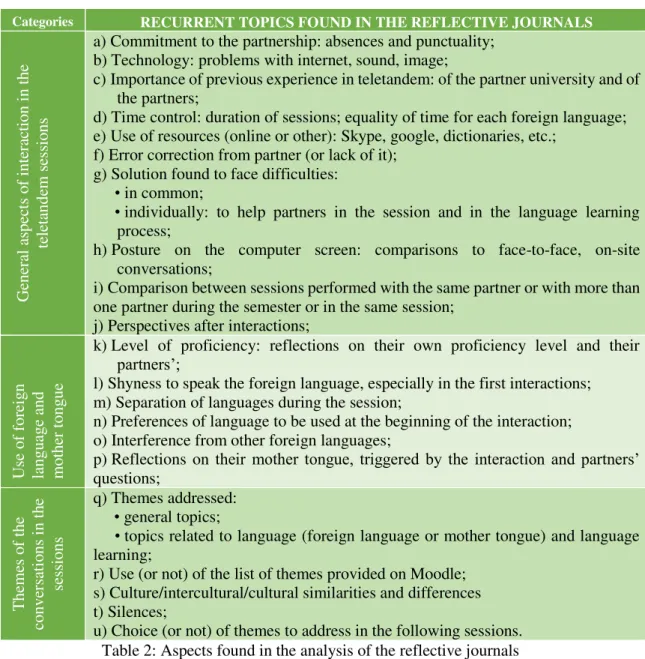
Categories RECURRENT TOPICS FOUND IN THE REFLECTIVE JOURNALS G ene ra l a spe ct s o f int er act ion i n the tel et ande m s es si ons
a) Commitment to the partnership: absences and punctuality; b) Technology: problems with internet, sound, image;
c) Importance of previous experience in teletandem: of the partner university and of the partners;
d) Time control: duration of sessions; equality of time for each foreign language; e) Use of resources (online or other): Skype, google, dictionaries, etc.;
f) Error correction from partner (or lack of it); g) Solution found to face difficulties:
• in common;
• individually: to help partners in the session and in the language learning process;
h) Posture on the computer screen: comparisons to face-to-face, on-site conversations;
i) Comparison between sessions performed with the same partner or with more than one partner during the semester or in the same session;
j) Perspectives after interactions;
U se of f or ei gn langu age and m ot her tong ue
k) Level of proficiency: reflections on their own proficiency level and their partners’;
l) Shyness to speak the foreign language, especially in the first interactions; m) Separation of languages during the session;
n) Preferences of language to be used at the beginning of the interaction; o) Interference from other foreign languages;
p) Reflections on their mother tongue, triggered by the interaction and partners’ questions; Them es o f t he conve rsa ti ons in t he se ss ions
q) Themes addressed: • general topics;
• topics related to language (foreign language or mother tongue) and language learning;
r) Use (or not) of the list of themes provided on Moodle; s) Culture/intercultural/cultural similarities and differences t) Silences;
u) Choice (or not) of themes to address in the following sessions. Table 2: Aspects found in the analysis of the reflective journals
The categories shown in Table 2 were based on the analysis of the recurring topics found in the journal entries. First, each journal was approached separately, and the recurrent topics (which appear in the right column) were highlighted as they were found in the entries and categorized according to semantic recurrences, for instance, all mentions to proficiency were assembled under one group. Second, all the topics found were grouped according to macro-thematic consistencies that gave origin to three main categories: General aspects of interaction in the teletandem sessions; use of foreign language and mother tongue; and themes of the conversations in the sessions.
interconnected within the macro-thematic categories, we decided to discuss the recurrent themes within the range of each category. In order to show the complexity of problems and respective solutions found by the participants, we present and discuss a number of excerpts taken from the journals.
5.1 General aspects of interaction in the teletandem sessions
One of the themes observed in the journals is the importance of previous experience in teletandem for the partners and/or for the professors coordinating the project in both universities. The participants understand that previous experience may contribute to a better development of the project and improvement in their performances, as following excerpts indicate.
I think that clarifying to the partner university the goal of tandem is something to be done. It happened sometimes that I had to speak with two students at the same time and they mixed Portuguese and Spanish in the conversation. (Sp 5, session 7)
And I thought it was very cool because my partner, unlike me, has participated in teletandem before and tried to help me when I spoke. (Ge 4, session 1)
It is nice to see that I can already communicate very well in Italian. I remember that even in the second time I participated in teletandem, my level was very low and I had a lot of difficulty to speak. Today, however, I can communicate smoothly with lots of spontaneity. My partner, who has been studying Portuguese for only a year, still speaks little, but it's nice to be able to help her. (It 6, session 1)
Participants' comments reinforce what has been observed in our practice: when starting a new group of teletandem, we should discuss extensively (in advance and during the process) with partner professors and the participants the guiding principles of teletandem, the procedures to be adopted, as well as other issues that can be problematic. Journals also demonstrate that experience in teletandem leads participants to acknowledge the collaborative nature of their practice and the importance of partners’ offering of scaffolding, in Vygotskian sense. This understanding seems to contribute to the success of subsequent interactions, as the previous examples demonstrate.
maintenance of interaction. The following excerpt4 illustrates the participants’ capacity
to circumvent technical problems:
Apart from that, we had problems with audio and the quality of the internet. Because of this, I could not hear him well. Despite these technical problems, we managed to communicate by writing (on the chat) and repeating when we did not understand. (Sp 5, session 7) 5
Technological difficulties vary depending a number of factors, such as group, local internet connections, availability and conditions of computers, the quality of headphones and cameras. There are also issues related to the programs used to communicate that are out of our reach (as when one day Skype had a breakdown and did not connect worldwide6). We have been working constantly with our lab technicians and
applying for support from our institution to improve the conditions for the teletandem sessions.
Another question addressed both in the journals and in oral accounts right after the teletandem sessions was the difficulty in conforming to the principle of separation of languages/equality. The reports indicate that when one participant cannot speak with some fluency in one of the foreign languages, there is a tendency to keep the conversation in the language in which both are more proficient for a longer period of time. It appears that when one participant thinks that he is not fluent enough in the foreign language, the most developed skill is listening, as shown in this excerpt of a journal from a participant in the German/Portuguese teletandem group:
I have a hard time communicating in German. At first, I was a bit stuck and so I asked to begin the session in Portuguese. [...] I believe we could split the time well for the use of the two languages. As I have more difficulty speaking German than he does speaking Portuguese, it seems that when we were supposed to communicate in German I preferred to listen rather than talk. (Ge 4, session 1)
These journal entries also show other solutions found by the participants to overcome the difficulties in relation to reciprocity and separation of languages by the use of questions, chat and pictures.
When we started speaking in German, I had a lot of difficulty formulating sentences and maintaining a dialogue. Because of this difficulty in speaking German, I suggested that
4 All the excerpts were originally written in Portuguese by the participants and translated into English by
the authors of this chapter.
5 The codes that identify the reflective journals refer to the foreign language studied by the Brazilian
participants (En: English; Ge: German; It: Italian; Sp: Spanish) and the author of the journal (participant 1, 2, 3, etc.), followed by the number of the session when it was written.
6 For more details on Skype bug on September 21, 2015, see:
she made some simple questions, for example about my family and the people with whom I live. (Ge 3, session 1)
When we did not understand something, we used the chat and tried to write in the language we were using at that time. (It 3, session 1)
I sought to use images to express terms that did not know and my partner spoke and typed to help me. (En 2, session 1)
The passages quoted in this session show instances of how participants identified their needs by reflecting on the interactions, and how working collaboratively usually led them to find solutions together, which confirms the development of positive interdependence (KOHONEN 1992). The attitudes that seem to trigger such
interdependence are joint reflection and openness to work together in the decision-making process. In this way, autonomy and reciprocity seem to be closely related, as pointed out by Salomão, Silva and Daniel (2009), and they are developed through the experiences acquired by partners in teletandem sessions.
5.2 Use of foreign language and mother tongue
In our context, a teletandem group is often formed by students who are taking different majors and want to practice a foreign language, so they sign up for teletandem sessions, which are not integrated to any discipline. The requirement is that they know how to communicate in the foreign language, but there are no tests to attest their level of proficiency prior to participation. In the foreign universities, teletandem is usually integrated into a Portuguese language course, but this does not necessarily mean that all the students have the same level of proficiency in the foreign language. Therefore, some partners present considerable differences in their knowledge of the foreign language and their ability to express themselves orally. These questions are addressed by some participant in the journals:
When we switched to Portuguese, my partner had a hard time communicating, since he had attended only one semester of this language. I tried not to speak more than my partner, always urging him to talk about some topic. (En 10, session 1)
I realized that my partner tends to mix Portuguese with Spanish, something that did not surprise me much because it happens quite often. However, I noticed that she has a hard time with Portuguese and felt ashamed to speak, so I tried to support her and said that she could feel at ease because I was there to help her. [...] I used the list of themes to make her talk about basic topics and feel more comfortable speaking Portuguese. (En 12, session 4)
in the principles of reciprocity and autonomy, as seen in this account of how the students decided on strategies to maximize oral production in the foreign language:
When we spoke German, my partner realized my difficulties with the language and how I kept on switching to Portuguese all the time. Therefore, he suggested that every time I started speaking a lot in Portuguese, he would warn me and "prevent" me from speaking only in Portuguese, for I was supposed to practice German. That was very interesting because I struggled even more to be able to speak more in German. At the end of the session, my partner also suggested that I chose a text from my German book for us to talk about that. In this way, in the next session we would be able to talk about something that I had already practiced in class in terms of vocabulary. (Ge 4, session 3)
This account shows that the student’s partner helped her to realize that she had to work harder to speak the foreign language. Autonomy is not broken in collaboration, but supported by partners’ involvement and positive interdependence, as mentioned earlier. As mediators, we can make use of the information in such reports to help other participants who might be struggling with the foreign language by showing that they are co-responsible in the partnership and must participate actively to achieve individual and joint results (KOHONEN 1992).
5.3 Themes of the conversations in the sessions
As previously mentioned, Teletandem learning is based on the principle of autonomy, that is why the decision on topics to discuss and the ways to treat them in each teletandem session is generally made available to partners. However, to help participants in our Project, they receive on Moodle a list of themes that can be explored in the sessions. Whether they use it or not is usually at their discretion. Some preferred not to use the list, as illustrated in the following excerpts:
We did not use the list of themes on Moodle because we always found a lot in common to talk about, and the list ended up being unnecessary. (En 5, session 8)
Our first Teletandem session was very smooth, and we talked about many different topics. (It 1, session 1)
Others, as can be seen in these journal excerpts, see the list as a potential help:
Others used the list of themes and also suggested the inclusion of other topics, as illustrated in this excerpt:
We use quite a lot the list placed on moodle, but a tip I give is that this list should have more “interesting” themes. For me, the topics posed are too broad. [...] The list could include issues like the differences between "partying" for American and Brazilian students, [...] it was difficult to decide on topics, so I always sought to choose before [the session] in order to study or look for something to talk about. (En 11, session 8)
Regarding the range of topics, we observed that participants usually discussed issues related to their personal lives and current events, and expanded the themes proposed in the list on Moodle. In our analysis of the journals, we found that previous definition of topics for the session as well as providing a list of themes usually seemed to help learners when there was difficulty in communicating in the foreign language, as pointed out in the following excerpt:
As I had already thought about some issues and topics to talk about, it was easier to express myself. But even though I had prepared myself a little more for this session, when the conversation moved away from what I had planned to talk about, I felt I could not say anything else. I think it's normal. [...] For the next meeting I told him that I will choose a narrower topic for the moment we are speaking in German so that I do not get lost so much and can practice more what I know how to say. (Ge 4, session 2)
In some cases, according to the profile of the course taken by the participants, some topics have been suggested for specific sessions. An example was the partnership that involved a course of Business Portuguese in the United States. For this project, we invited Brazilian undergraduate students in Economics and Public Administration and suggested that the partners discussed topics related to their field of study during the sessions.
I realized that my teletandem partner makes use of the list, so when we started she told me that her professor had chosen a topic of conversation for today. I see it as positive, because we can prepare if we do not have much knowledge on the subject or language. (En 11, session 4)
5.4 Feedback from the mediators
Mediation through reflective journals requires someone who can dialogue with participants, provide them with feedback on the issues raised in the journals. As we mentioned before, our mediators are undergraduate and graduate students doing research on teletandem, volunteers as well as a teaching coordinator from Teletandem. All of the mediators had previous experience in teletandem, having participated previously in one of the groups. They had also taken a 16-hour online course on mediation given by graduate students, which focused on theory and practice of mediation, and research findings.
The analysis of the feedback given by the mediators indicate significant issues for the study and understanding of language learning in teletandem and of mediation itself. Feedback can reinforce successful actions, give examples and suggest new actions, as shown in the following excerpts of feedbacks posted by one of the mediators:
We intend to post here in Moodle a list of possible themes for students to discuss with their partners during the session. One idea is that you talk about your tastes (e.g., movies, books, TV series, music, etc.) about your routines, your travels, current news, etc. Glad you helped your partner about the use of language! If you want him to correct you or help you, ask him as you start speaking English. You can also ask him if something you said is correct or not. The Teletandem partners are supposed to help each other. (M17, En 8, session 1)
Being aware of our learning process is essential, and your account shows that you and your partner have a good connection, which can help you both learn better. By the way, what did your partner think of the differences between Brazilian and European Portuguese? (M2, En 6, session 4)
The feedbacks show the importance of prior involvement of the mediators in teletandem, which helps them to have a better understanding of this process. In the examples below, the mediator uses her previous experiences in teletandem to bond with the participant:
Last semester I had the opportunity to interact with some students from the university X and also noticed that some of them mixed Portuguese and Spanish. When this happened, I tried to make a slight correction. For example, a young man once told me that his house was "near from" somewhere else. To confirm that I understood what he had said, I asked, "Oh, your house is 'close' to the other place?". I think with these hints they can notice the error and learn a little more. When you talked about undergraduate courses, did you realize that the education system is different from here? (M1, En 1, session 1)
It is very nice that you have noticed the difficulty of your partner and tried to help her understand you and also to be understood. I love your technique of searching for images to talk about something you did not know ... I usually suffer a bit trying to describe the
word and it takes some time, but it always works. However, I had never thought of using the computer internet to help me about it! (M1, En 2, session 1)
We see in these excerpts that the feedback of the mediators aimed to support participants to reflect about aspects of the interaction that they may not have realized before. This is usually done by offering scaffolding that may take the form of exploratory questions or alternative proposals for the situation at hand. In the previous excerpts, these strategies were used when the mediator talked about her experience and posed it as suggestion (not a prescription) that could be used by the participants to deal with error correction (“To confirm that I understood what he had said, I asked, ‘Oh, your house is 'close' to the other place?’. I think with these hints they can notice the error and learn a little more”). In addition, the question she posed at the end (“When you talked about undergraduate courses, did you realize that the education system is different from here?”) should encourage participants to reflect on the depth of their conversations and on what they have been learning from each other.
As for the dialogical purpose of the journals, it seems that the participants see feedback as potential help from the mediators, as shown in the following excerpts.
Thanks for the hints on topics to discuss and for the encouragement in your comments! They help a lot! (Ge 4, session 2)
About the last session: the dificulties on the foreign language grammar appeared naturally during our conversation (En 3, session 4)
Van Compernolle (2015) asserts, from a Vygotskian perspective, that communicative interaction mediates the development and internalization of concepts, as well as conversational routines, and cultural knowledge. In this way, the figure of the mediator appears to be essential to strengthen the educational objectives of teletandem so that the partnerships are not viewed as a simple chat between the learners, but as meaningful exchange that fosters learning.
6 Final remarks
written regularly, and the provision of feedback to each posting should establish an effective dialogue between the participant and the mediator.
Moreover, the observations made in the journals constitute support for coordinators and mediators on how to manage teletandem in order to take advantage of practices that already bring benefits to participants and to adjust aspects that need improving. It is also important to recognize that some of the journal entries analyzed were not actually reflective, but contained only a brief account of the session in descriptive terms. This is not surprising considering our learning culture, which is still not geared toward autonomy and reflection. We understand that reflective journals can be better used if they are presented to the participants before the beginning of the sessions, through an orientation session, in which examples of journals and feedback are shown to participants.
Finally, it is necessary to point out that the mediators (coordinators, collaborators and researchers), in addition to experience in teletandem, should have an adequate training to develop mediation, either in person or through journals. This should be done continually in a process that bridges theory and practice, that is, connects experiential knowledge with theoretical support given by continuing education. Mediation in teletandem has to be viewed as an essential part of the learning process, allowing participants to understand the sessions as an exercise in autonomy and self-reflecting practice.
Bibliographic references
ANDREU-FUNO, L. Teletandem: Um estudo sobre identidades culturais e sessões de mediação da aprendizagem. Tese de Doutorado. IBILCE/Unesp, São José do Rio Preto, 2015.
BEDRAN, P. F. A (re)construção das crenças do par interagente e dos professores-mediadores no teletandem. Dissertação de Mestrado. IBILCE/Unesp, São José do Rio Preto, 2008. _____. A Formação Inicial do Professor de Línguas no e para o Contexto Virtual e a Construção
de Comunidades de Prática. Tese de Doutorado. IBILCE/Unesp, São José do Rio Preto, 2012.
BENEDETTI, A. M.; CONSOLO, D. A.; VIEIRA-ABRAHÃO, M. H. Pesquisas em ensino e aprendizagem no Teletandem Brasil: línguas estrangeiras para todos. Campinas: Pontes, 2010.
BOGDAN, R. C.; BIKLEN, S. K. Investigação qualitativa em educação. Porto: Porto, 1994. BRAMMERTS, H.; CALVERT, M.; KLEPPIN, K. Objectivos e formas de aconselhamento individual.
In: DELILLE, K. H.; CHICHORRO, A. F. Aprendizagem autónoma de línguas em tandem. Lisboa: Colibri, 2002. p. 69-79.
CARVALHO, K. C. H. P. de; MESSIAS, R. A. L.; DÍAS, A. M. Teletandem within the context of closely-related languages: A Portuguese-Spanish interinstitutional experience. In: DELTA – Revista de Documentação e Estudos em Linguística Teórica e Aplicada, v. 31, n. 3, 2015, p. 711-728.
CRANDALL, J. J. El aprendizaje cooperativo de idiomas y los factores afectivos. In: ARNOLD, J. (Ed.). La dimensión afectiva en el aprendizaje de idiomas. trad. Alejandro Valero. Madrid: CUP, 2000. p. 243-260.
DUFF, P. A. Beyond generalizability: Contextualization, complexity and credibility in applied linguistics research. In: CHALHOUB-DEVILLE, M.; CHAPELLE, C. A.; DUFF, P. A. Inference and Generalizability in Applied Linguistics: Multiple Perspectives. The Netherlands: Jonh Benjamins, 2006, p. 65-95.
FIGUEIREDO, F. J. Q. A aprendizagem colaborativa: algumas considerações conceituais e terminológicas. In: FIGUEIREDO, F. J. Q. (Org.). A aprendizagem colaborativa de línguas. Goiânia: Editora UFG, 2006. p. 11-45.
HELMLING, B. Trabalho em grupos de “colegas” – os tandems aprendem com outros tandems. In: DELILLE, K. H.; CHICHORRO, A. F. Aprendizagem autónoma de línguas em tandem. Lisboa: Colibri, 2002, p. 99-111.
KOHONEN, V. Experiential language learning: second language learning as cooperative learner education. In: NUNAN, D. (Ed.). Collaborative language learning and teaching. Glasgow: CUP, 1992, p. 14-40.
LITTLE, D. A aprendizagem de línguas em tandem e a autonomia do aprendente. In: DELILLE, K. H.; Chichorro, A. F. Aprendizagem autónoma de línguas em tandem. Lisboa: Colibri, 2002, p. 27-35.
MESQUITA, A. F. Crenças e práticas de avaliação no processo interativo e na mediação de um par no tandem a distância: Um estudo de caso. Dissertação de Mestrado. IBILCE/Unesp, São José do Rio Preto, 2008.
O’ROURKE, B. Models of Telecollaboration (1): eTandem. In: O’DOWD, R. (Ed.). Online Intercultural Exchange: An Introduction for Foreign Language Teachers. Clevedon: Multilingual Matters, 2007, p. 41-61.
SALOMÃO, A. C. B. Gerenciamento e estratégias pedagógicas na mediação dos pares no teletandem e seus reflexos para as práticas pedagógicas dos interagentes. Dissertação de Mestrado. IBILCE/Unesp, São José do Rio Preto, 2008.
______. A formação do formador de professores: perspectivas de colaboração entre graduandos e pós-graduandos no projeto Teletandem Brasil. In: Revista Brasileira de Linguística Aplicada, v. 11, n. 3), 2011a, p. 653-677.
______. Collaborative Language Learning in Teletandem: A Resource for Pre-Service Teacher Education. In: PROFILE – Issues in Teachers’ Professional Development, v. 13, n. 1, 2011b, p. 139-156.
SALOMÃO, A. C. B.; SILVA, A. C.; DANIEL, F. de G. A aprendizagem colaborativa em Tandem: um olhar sobre seus princípios. In: Telles, J. A. Teletandem: um contexto virtual, autônomo e colaborativo para aprendizagem de línguas estrangeiras no século XXI. Campinas: Pontes, 2009, p. 75-92.
SCHWIENHORST, K. Co-constructing learning environments and learner identities – language learning in virtual reality. In: OTTMANN, T.; TOMEK, I. (Eds.) Proceedings of the ED-Media/ ED-Telecom. World Conference on Educational Multimedia and Hypermedia & World Conference on Educational Telecommunications, Freiburg, 1998.
STICKLER, U. Student-centred counselling for tandem advising. In: LEWIS, T.; WALKER, L. (eds.). Autonomous language learning in tandem. Sheffield, UK: Academy Electronic Publications, 2003, p. 115-122.
______. Learning foreign languages in teletandem: Resources and strategies. In: DELTA – Revista de Estudos em Linguística Teórica e Aplicada, v. 31, n. 3, 2015, p. 651-680.
TELLES, J. A.; VASSALLO, M. L. Foreign language learning in-tandem: Teletandem as an alternative proposal in CALLT. In: The ESPecialist, v. 27, n. 2, 2006, p. 189-212. VAN COMPERNOLLE, R. A. Sociocultural Theory and L2 Instructional Pragmatics. Bristol:
Multilingual Matters, 2014.
______. Interaction and Second Language Development: A Vygostkian perspective. Amsterdam: John Benjamins, 2015.
WALKER, L. O papel do diário no apoio e desenvolvimento da autonomia do aprendente tandem. In: DELILLE, K. H.; CHICHORRO, A. F. Aprendizagem autónoma de línguas em tandem. Lisboa: Colibri, 2002, p. 89-97.
WILLIAMS, M.; BURDEN, R. Psicología para profesores de idiomas. Enfoque del constructivismo social. Madrid: CUP, 1999.