UNIVERSIDADE DA BEIRA INTERIOR
Ciências Sociais e Humanas
Concurrent Training and Detraining: The Role of
Resistance and Aerobic Intensities
António Carlos Bettencourt Sousa
Tese para obtenção do Grau de Doutor em
Ciências do Desporto
(3º ciclo de estudos)
Orientador: Prof. Doutor Daniel A. Marinho
Co-orientador: Prof. Doutor Henrique P. Neiva
"
Being a teacher is not just a matter of having a body of knowledge and ability to control the lesson. This could be done with a computer and a stick. In order to be a teacher, it is also necessary to be able to establish human relations with the people to whom it is taught. Learning is a human process and arduous, the same can be said of teaching. Teaching implies simultaneously, emotions and pure reason."Acknowledgments
A Doctoral Thesis is composed by numerous challenges, uncertainties, surprises, disappointments, satisfactions and achievments. It is a path that is only possible with the mobilization of energy, perseverance and vigor to find the best course, presenting the best options and selecting the best decisions.
This path is not built alone. It is a collective work, even that its wording and responsibility being predominantly an individual act. Several people participated in this project, leaving their mark recorded. In the impossibility to mention all, I would like to express my sincere gratitude, highlighting those that deserve greater enhancement:
To the Professor DANIEL ALMEIDA MARINHO, Professor HENRIQUE PEREIRA NEIVA, I am immensely grateful to have accepted to be my adviser and scientific co-advisor, for their friendship, support, supervision and scientific rigor always manifested over the years. To the Professor MÁRIO ANTÓNIO CARDOSO MARQUES, I am highly thankful by contributing with his knowledge and vast years of experience, friendship and incredible support since the first second of this thesis.
To my parents and to my brother, for the permanent sustenance and stimulation throughout my academic journey, for always providing compatible conditions with the realization of this thesis.
To my girlfriend HELENA GIL, for the eternal support and collaboration in the execution of this thesis, helping to overcome obstacles and difficulties with all patience and availability. To Professor PEDRO MENDES for the total availability in collaboration of the study carried out at the Polytechnic Institute of Castelo Branco, as well as in the solution of problems and doubts that have arisen during the accomplishment of this investigation.
To my friends, ANA SOFIA ALVES PhD and to DAVID RODRÍGUEZ-ROSELL PhD, a special thank you for their friendship and prompt availability shown throughout this work. The human side, expressed in a unique incentive and its knowledges, translated into fruitful reflections, were fundamental throughout the present work.
To my friends ANDRÉ RAMALHO of the Polytechnic Institute of Castelo Branco and DIOGO PINTO of the University of Beira Interior a word of appreciation for all their availability and help demonstrated during the data collection.
To the undergraduate students of the University of Beira interior and the Polytechnic Institute of Castelo Branco who participated in the research.
Last but not least, I would like to thank all my colleagues, friends and family members who within his / her "area of expertise" and in the various "contexts of life" helped me to complete this stage of the journey.
List of Publications
This Doctoral Thesis is supported by the following papers:
• Sousa, A.C., Neiva, H.P., Duarte-Mendes, P., Izquierdo, M., Cadore, E.L., Alves, A.R., Marques, M.C., & Marinho, D.A. (2018). Concurrent training followed by detraining: a brief review on the effect of aerobic and resistance exercise intensities. Sports
Medicine, (Submitted for publication).
• Sousa, A.C., Marinho, D.A., Gil, M.H., Izquierdo, M., Rodriguez-Rosell, D., Neiva, H.P., & Marques, M.C. (2018). Concurrent training followed by detraining: does the resistance training intensity matter? Journal of Strength and Conditioning Research, 32(3), 632-642.
• Sousa, A.C., Neiva, H.P., Gil, M.H., Izquierdo, M., Rodriguez-Rosell, D., Marques, M.C. & Marinho, D.A. (2018). Concurrent training followed by detraining: the influence of different aerobic intensities. Journal of Strength and Conditioning Research, (in press). • Sousa, A.C., Neiva, H.P., Alves, A.R., Duarte-Mendes, P., Ramalho, A.G., Marques, M.C., & Marinho, D.A. (2018). Concurrent training intensities: a pratical approach for program design. Strength and Conditioning Journal, (Submitted for publication).
Abstract
In recent years, the concurrent training has become one of the most interesting topics in Sports Sciences research. Most of the times, training for competitive sports require combining the resistance and aerobic training to maximize the athletes’performance. However, the combination of training load variables such as the intensity is still unclear and should be further investigated for the maximization of training programs. Thus, the purpose of the current thesis was to analyze the effects of different combinations of aerobic and resistance intensities during concurrent training on vertical jump, sprint, lower limb strength and cardiorespiratory fitness. In addition, it was verified the effects of a period of detraining that followed previous concurrent training with different aerobic or resistance training intensities. For this, the following steps were adopted: (i) a literature review of this subject; (ii) the analysis of the effect of a concurrent training against three different external loads during resistance training, followed by detraining, in strength and aerobic performances; (iii) the study of the effects of three different aerobic intensities combined with the same resistance training, followed by a detraining period, in aerobic and strength variables; (iv) the recommendation of practical remarks for coaches regarding the combination of aerobic intensity and resistance during concurrent training. The main conclusions of the study were: (i) there is few literature on the effects of aerobic and / or resistance training intensities when these are performed simultaneously; (ii) a concurrent training program of 8-week with different resistance loads combined with low intensity aerobic training improved strength and aerobic performances regardless of the training intensity used during resistance training; (iii) training loads greater than 55% of 1RM tended to cause greater improvements in explosive performances when combined with low-intensity aerobic training; (iv) beneficial effects on strength and aerobic development were found after 8 weeks of resistance training, regardless of the intensity of aerobic training; (v) low aerobic intensities can lead to a significant increase strength during concurrent training; (vi) 4 weeks of detraining decrease strength and aerobic parameters, but the losses were lower when high resistance training loads were combined with low intensity aerobic training, specially for aerobic-related variables. Therefore, these intensities are recommended when cardiorespiratory gains should be maintained for longer. These studies were the first step on the understanding of the ideal combination of resistance and / or aerobic intensities during concurrent training programs, but further studies are needed to deeply understand their effects on performance.
Key words
Resumo
Nos últimos anos, o treino concorrente tornou-se um dos tópicos mais interessantes na investigação em Ciências do Desporto. Na maioria das vezes, o treino nos desportos competitivos requer a combinação de força e a resistência aeróbia para a maximizar dos atletas. No entanto, a combinação de variáveis de carga de treino, como a intensidade, ainda não está clara e deve ser investigada para a maximização dos programas de treino. Assim, o objetivo da presente tese foi analisar os efeitos de diferentes combinações de intensidades aeróbias e de força durante o treino concorrente, no salto vertical, no sprint, na força dos membros inferiores e na aptidão cardiorrespiratória. Além disso, verificou-se os efeitos de um período de destreino que se seguiu ao treino concorrente prévio com diferentes intensidades de treino de força e aeróbio. Para isso, foram adotados os seguintes passos: (i) uma revisão da literatura sobre este assunto; (ii) a análise do efeito de um treino concorrente contra três diferentes cargas externas durante o treino de força, seguido de destreino, em desempenho aeróbio e de força; (iii) estudo dos efeitos de três diferentes intensidades aeróbias combinadas com o mesmo treino de força, seguido por um período de destreino, em variáveis aeróbias e de força; (iv) recomendação de observações práticas para treinadores sobre a combinação de intensidade aeróbia e de força durante o treino concorrente. As principais conclusões provenientes deste trabalho foram as seguintes: (i) existe pouca literatura sobre os efeitos das intensidades de treino aeróbio e/ou de força quando estes são realizados simultaneamente; (ii) um programa de treino concorrente de 8 semanas com diferentes cargas de força combinado com treino aeróbio de baixa intensidade melhorou a força e o desempenho aeróbio, independentemente da intensidade de treino usada durante o treino de força (iii) cargas de treino maiores que 55% de 1RM tendem a causar maiores melhorias no desempenho explosivo quando combinadas com o treino aeróbio de baixa intensidade; (iv) efeitos benéficos na força e no desenvolvimento aeróbio foram encontrados após 8 semanas de treino de força, independentemente da intensidade do treino aeróbio; (v) baixas intensidades aeróbias podem levar a um aumento significativo da força durante o treino concorrente; (vi) 4 semanas de destreino, diminuem a força e os parâmetros aeróbios, mas com menos perdas quando altas cargas de treino de força foram combinadas com treino aeróbio de baixa intensidade, especialmente para variáveis relacionadas ao aeróbio. Portanto, essas intensidades são recomendadas quando os ganhos cardiorrespiratórios se pretendem manter por mais tempo. Estes estudos foram o primeiro passo para a compreensão da combinação ideal de força e / ou intensidades aeróbias durante os programas de treino concorrente, mas ainda são necessários mais estudos para entender profundamente os seus efeitos sobre o desempenho.
Palavras-chave
Resumen
En los últimos años, la capacitación concurrente se ha convertido en uno de los temas más interesantes en la investigación de Ciencias del Deporte. La mayoría de las veces, el entrenamiento para deportes competitivos requiere combinar la resistencia y el entrenamiento aeróbico para maximizar el rendimiento de los atletas. Sin embargo, la combinación de variables de carga de entrenamiento, como la intensidad, aún no está clara y se debe seguir investigando para maximizar los programas de entrenamiento. Por lo tanto, el propósito de la tesis actual fue analizar los efectos de diferentes combinaciones de intensidades aeróbicas y de resistencia durante el entrenamiento concurrente en el salto vertical, el esprint, la fuerza de las extremidades inferiores y la aptitud cardiorrespiratoria. Además, se verificaron los efectos de un período de desentrenamiento que siguió al entrenamiento simultáneo previo con diferentes intensidades de entrenamiento aeróbico o de resistencia. Para ello, se adoptaron los siguientes pasos: (i) una revisión bibliográfica de este tema; (ii) el análisis del efecto de un entrenamiento concurrente contra tres cargas externas diferentes durante el entrenamiento de resistencia, seguido por el desentrenamiento, la fuerza y el rendimiento aeróbico; (iii) el estudio de los efectos de tres intensidades aeróbicas diferentes combinadas con el mismo entrenamiento de resistencia, seguido de un período de desentrenamiento, en variables aeróbicas y de fuerza; (iv) la recomendación de comentarios prácticos para entrenadores sobre la combinación de intensidad aeróbica y resistencia durante el entrenamiento concurrente. Las principales conclusiones del estudio fueron: (i) hay poca literatura sobre los efectos de las intensidades de entrenamiento aeróbico y / o de resistencia cuando se realizan simultáneamente; (ii) un programa de entrenamiento concurrente de 8 semanas con diferentes cargas de resistencia combinadas con entrenamiento aeróbico de baja intensidad mejoró la fuerza y el rendimiento aeróbico independientemente de la intensidad de entrenamiento utilizada durante el entrenamiento de resistencia; (iii) las cargas de entrenamiento superiores al 55% de 1RM tendieron a causar mayores mejoras en los rendimientos explosivos cuando se combinan con el entrenamiento aeróbico de baja intensidad; (iv) se encontraron efectos beneficiosos sobre la fuerza y el desarrollo aeróbico después de 8 semanas de entrenamiento de resistencia, independientemente de la intensidad del entrenamiento aeróbico; (v) las bajas intensidades aeróbicas pueden llevar a un aumento significativo de la fuerza durante el entrenamiento concurrente; (vi) 4 semanas de desentrenamiento disminuyen la fuerza y los parámetros aeróbicos, pero las pérdidas fueron menores cuando las cargas de entrenamiento de alta resistencia se combinaron con el entrenamiento aeróbico de baja intensidad, especialmente para las variables relacionadas con el aeróbico. Por lo tanto, estas intensidades se recomiendan cuando las ganancias cardiorrespiratorias deben mantenerse durante más tiempo. Estos estudios fueron el primer paso para comprender la combinación ideal de resistencia y / o intensidades aeróbicas durante los programas de entrenamiento concurrentes,
pero se necesitan estudios adicionales para comprender en profundidad sus efectos en el rendimiento.
Palabras-clave
Table of Contents
Acknowledgements v
List of Publications vii
Abstract ix
Resumo xi
Resumen xiii
Index of Figures xvii
Index of Tables xix
List of Abbreviations xxi
Chapter 1. General Introduction 1
Chapter 2. Literature Review 5
Study 1. Concurrent training followed by detraining: a brief review on the
effect of aerobic resistance exercise intensities 5
Chapter 3. Experimental Studies 19
Study 2. Concurrent training followed by detraining: does the resistance
training intensity matter? 19
Study 3. Concurrent training followed by detraining: the influence of different
aerobic intensities 37
Study 4. Concurrent training intensities: a pratical approach for program
design 53
Chapter 4. General Discussion 63
Chapter 5. Overall Conclusions 67
Chapter 6. Suggestions for future research 69
Index of Figures
Chapter 2 Study 1.
Figure 1. PRISMA study flow diagram. 8 Figure 2. Judgements about each rish of bias item for each included study 13 Fifure 3. Rish of bias item presented as percentages across all included studies 13
Chapter 3. Study 2.
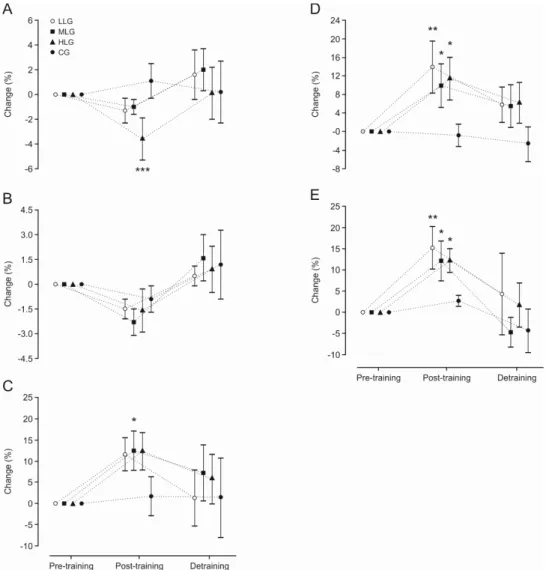
Figure 1. Relative changes in performance variables (A: T10; B: T20; C: CMJ; D: 1RMest;
E: VO2max) from baseline in the low-load (LLG), moderate-load (MLG), high-load (HLG) and control group. Error bars represent 90% of confidence interval of changes from baseline to post-training and baseline to detraining. Statistically significant differences respect to CG: * p < 0.05, ** p < 0.01, *** p < 0.001
Index of Tables
Chapter 2. Study 1.
Table 1. Charateristics of the studies included in the review. 10 Table 2. Effects of intensity during concurrent training in performance 11 Table 3. Effects of concurrent training intensities after detraining 12
Chapter 3. Study 2.
Table 1. Subject characteristics. 22 Table 2. Characteristics of the training program performed by the LLG, MLG and HLG groups
25
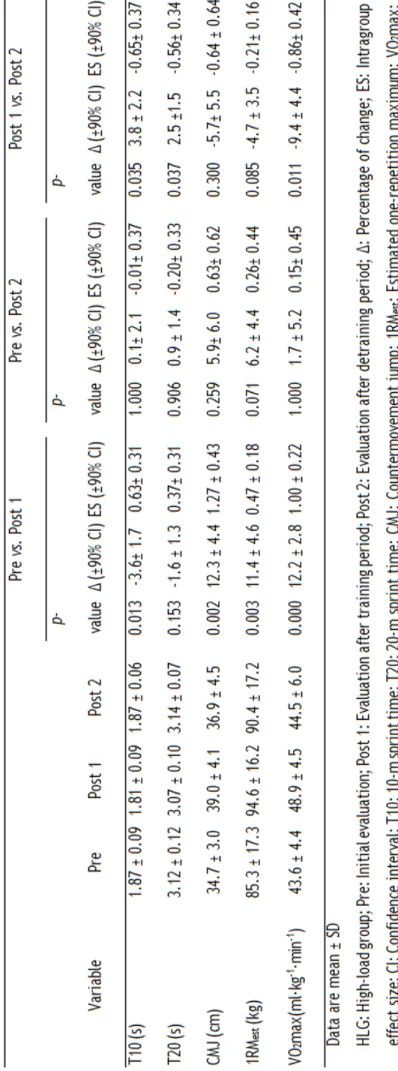
Table 3. Changes in selected neuromuscular performance variables from pre-training to post-training and detraining period for LLG.
27 Table 4. Changes in selected neuromuscular performance variables from pre-training to post-training and detraining period for MLG.
28
Table 5. Changes in selected neuromuscular performance variables from pre-training to post-training and detraining period for HLG.
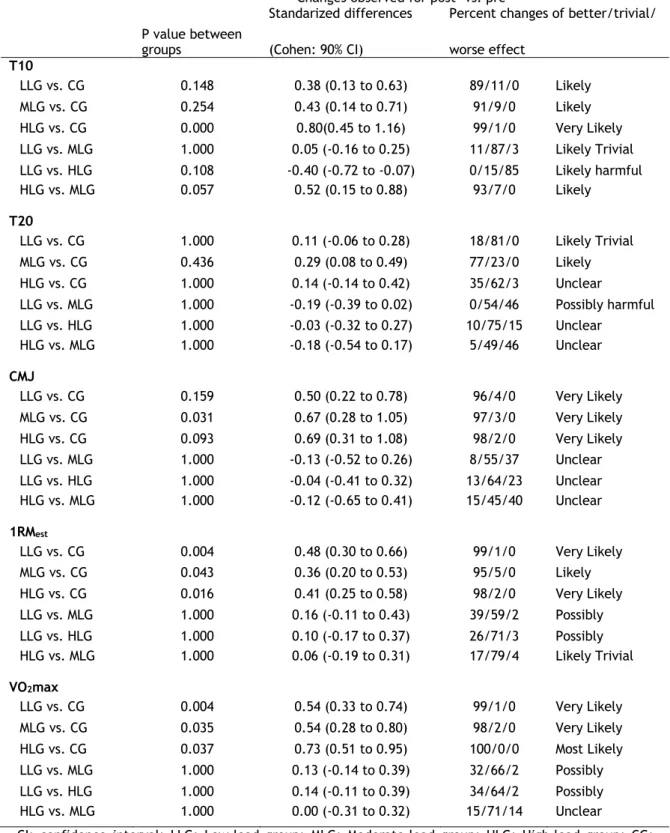
29 Table 6. Changes in selected neuromuscular performance variables from initial
evaluation (pre) to final evaluation (post) between groups.
31
Chapter 3. Study 3.
Table 1. Subject characteristics. 41 Table 2. Characteristics of the training program performed by the LIG, MIG and HIG groups
44 Table 3. Changes in neuromuscular performance variables from pre-training to post-training and depost-training period for each experimental group.
46
Table 4. Changes in neuromuscular performance variables from initial evaluation (pre)
to final evaluation (post) between groups.
48
Chapter 3. Study 4.
Table 1. Recommendations for combining intensities during concurrent training 58 Table 2. Example of an 8-weeks concurrent training program to improve lower body strength and cardiorespiratory performance.
List of Abbreviations
[La-] Blood lactate concentration
1RM One-repetition maximum
1RMest Estimated one-repetition maximum
AT Aerobic training BP Bench press CG Control group CI Confidence interval CMJ Countermovement jump CT Concurrent training CV Coefficient of variation DT Detraining period ES Effect sizes FS Full-squat Gn Experimental group n HIG High-intensity group
HIIT High intensity interval training HLG High-load group
HR Heart rate
HRmax Maximal heart rate
ICC Intra-class correlation coeficient LIG Low-intensity group
LLG Low-load croup LP Leg press
LT Lactate threshold MAS Maximal aerobic speed MIG Moderate-intensity group MLG Moderate-load group
MLSS Maximal lactate steady-state MPV Mean propulsive velocity Post 1
Post 2
Evaluation after training period Evaluation after detraining period Pre Initial evaluation
RM Repetition maximum RT Resistance training SD Standard deviation T10 10m Sprint time
T20 20m Sprint time
VO2max Maximum oxygen uptake
VO2peak Peak oxygen uptake
VT2 Second ventilator threshold
YYIRT Yo-Yo intermittent recovery test Z1 Below ventilatory threshold
Z2 Between ventilatory threshold and respiratory compensation threshold
Chapter 1. General Introduction
Concurrent training (CT) usually refers to a training session or a program that combines some form of resistance and aerobic exercitation (Docherty & Sporer, 2000; Fyfe et al., 2014; Kang & Ratamess, 2014). In fact, several sports require the organization of training programs that combine resistance and aerobic components to optimize athletes’ performances (Leveritt et al., 1999; Nader, 2006; Toraman & Ayceman, 2005). This simultaneous training of both regimens looking for cardiorespiratory and strength adaptations is widely debated by sport professionals and researchers due to the major need for overall improvement of the athletes’ capacities. This kind of training regimen is sometimes believed to be an efficient way for performance improvement but evidences still struggling with some issues regarding training planning and organization. Indeed, this training method depends on the type, intensity, duration and frequency of training for the greater efficacy (Bishop & Jenkins, 1999; Chtara et al., 2005; McCharthy et al., 1995). Moreover, in addition to these training load variables, the specific development of aerobic or resistance also depends on whether they are combined in the same training period (Bell et al., 2000; Hakkinen et al., 2003; McCarthy et al., 2002).
In recent years, the CT has acquired considerable attention from researchers, mainly due to the common use by coaches and athletes and by some controversial scientific evidences (Cadore et al., 2012; Cadore et al., 2014; García-Pallarés and Izquierdo, 2011). While some studies have shown that concurrent training can affect the development of muscle strength and power (García-Pallarés and Izquierdo, 2011; Izquierdo-Gabarren et al., 2010; Leveritt et al., 2003; Davis et al., 2008a; Davis et al., 2008b; Silva et al., 2012), others indicated that a simultaneous work of resistance and aerobic exercises did not increase strength variables, and aerobic capacity development (Davis et al., 2008; Ronnestad et al., 2012). From this, it is easily understood that there is much to know and understand on the CT issue.
One of the problems that arise when combining both physical qualities is strongly associated with the "interference" that each training type exerts on the other. In fact, CT has been criticized due to the potential for competing adaptations of resistance and aerobic training. Over last decades, several studies have reported the interference effect on the development of muscle strength when resistance and aerobic were trained simultaneously (Dudley & Djamil, 1985). The majority of the studies found that the magnitude of the increased strength was always higher in those that only performed resistance training compared to the combined training groups (e.g. Izquierdo et al., 2005; Izquierdo et al., 2004). Several mechanisms have been suggested as being responsible for interference of aerobic exercises on strength gains (Garcia-Pallares & Izquierdo, 2011). For instance, it was pointed out a negative effect of overreaching on neural adaptations (Cadore et al., 2010), the decrease on glycogen content
that promotes a chronic catabolic state (Bell et al., 2000), an interference effect on type I and II fibers (Putman et al., 2004) and/ or peripheral fatigue resulting from aerobic training that ultimately impairs strength performance gains (Lepers et al., 2001).
The details on designing a CT program become more relevant when the degree of interference between the two modes could be a concern. Althgouht researchers are aware of the abovementioned interference phenomenon, it is suggested that, if training-load components are carefully programed, CT can produce high-level of athletic performances (Coffey & Hawley, 2017). Recently, factors such as the training volume and intensity have been pointed out as a major concern for CT optimization, causing the interference on resistance and aerobic gains (Bishop & Jenkins, 1999; Chtara et al., 2005; McCarthy et al., 1995). Several studies have indicated that an interference effect exists between aerobic training and resistance training in situations where the weekly training volume is high (Bell et al., 2000; Hennessy & Watson, 1994; Hickson, 1980; Jones et al., 2013; Karavirta et al., 2011). It seemed quite clear that high volumes of aerobic training, by increasing the frequency and/or duration of aerobic exercise, resulted in the inhibition of strength, whereas low volumes of aerobic training did not. One explanation presented by research on how aerobic exercise volumes affect strength outcomes is related to increased fatigue and the consequent conditioning of the resistance training performance and thus compromising chronic adaptations (Coffey & Hawley, 2017).
Regarding the intensity of both aerobic training and resistance components of CT, studies are scarce and with no clear conclusions. The few studies on this issue focused mainly on exercise intensities during the aerobic part of CT training. These showed that a CT program improved performance variables in the experimental groups, regardless of the intensity used (Esteve-Lanao et al., 2007; Fyfe et al., 2016; Petré et al., 2018; Silva et al., 2012; Sousa et al., 2018; Varela-Sanz et al.2016; Wong te al., 2009). When higher aerobic intensities were used, maximal oxygen uptake (VO2max) and aerobic power seemed to attain greater gains (Fyfe et al., 2016;
Petré et al., 2018). Contrarly, it seemed to exist a trend toward greater neuromuscular adaptations when higher resistance training loads were used combined with low to moderate aerobic training intensities (Petré et al., 2018). The interference of CT in strength adaptations was suggested to occur because of the intensity of aerobic training and their distribution throughout the season. It was reported that interference on strength gains only occurs at high-intensities of aerobic training, as those close to VO2max (Varela-Sanz et al., 2016).
Other studies focused on the distribution of intensities during a long-term CT program and it was suggested that the polarized model (i.e.: low-volume, high-intensity aerobic exercise combined with high-volume low-intensity training) would be the most effective training intensity distribution for reducing the interference in neuromuscular performance
(Esteve-Lanao et al., 2007, Varela-Sanz et al., 2016). Running performance was approximately 25% greater with polarized training compared to the traditional distribution (Esteve-Lanao et al., 2007). Moreover, the upper and lower body maximum strengths increased 24% and 47% after 8 weeks of polarized training, respectively (Varela-Sanz et al., 2016). However, clear conclusions are difficult to report, whereas the studies compare different designs, methods, as well the intensities are also different. So, further investigation is needed for understanding the influence of resistance and aerobic intensities when combining both training modes during preparation to optimize athletes’performances.
To better understand CT effects and to optimize training programs design, it is also fundamental to know the response after the CT cessation. In fact, interruptions in the training process due to illness, post-season vacation, or other factors are ordinary in most of sports (Karavirta et al., 2009, Faigenbaum et al., 2009, Faigenbaum et al., 1996). The magnitude of this reduction may depend on the duration of the detraining period (DT), beyond the levels reached by the subject's formation (Garrido et al., 2010). Although the losses caused by the detraining occur more significantly in the first weeks of its application, the physical state of the athlete stays above the pre-training levels for a period that should be proportional to the period in which they are training. That is, the longer the training period, the longer the detraining period needed for severe performance decrements (Zatsiorsky, 2006). However, this issue is few studied and needs further development, specifically in CT context. Knowing the effects of training on subsequent detraining period will allow to better understand how to design a training program, either to optimize and reduce performance losses, or to better understand how to combine the periodization models regarding the training load and recovery phases to maximize gains and final competitive performance (Marques, 2004; Marfell-Jones et al., 2006).
It is then understood that different designs of CT have been studied, but few is known about the combination of intensities that should be combined for better performances. Considering the abovementioned, the main purpose of the current thesis was to analyze the effects of different combinations of aerobic and resistance intensities during concurrent training, on vertical jump, sprint, leg strength, and cardiorespiratory fitness. In addition, it was our secondary purpose to verify the effects of a detraining period following a CT program differing in the intensities used, by assessing those same strength and aerobic parameters.
Considering the abovementioned general purpose, the thesis is developed according to the following sequence:
o Chapter 2 presents a systematic review based on the early studies regarding the effects of the intensity used during concurrent training on performance, followed by a detraining period.
o Chapter 3 shows the experimental studies developed to accomplish the main purpose of this thesis:
o Study 2 aims to analyze the training and detraining effects of concurrent aerobic training and resistance training against three different external loads on strength and aerobic variables.
o Study 3 intends to verify the effects of three different aerobic intensities combined with the same resistance training on strength and aerobic performances.
o Study 4 was developed based on the previous results and purposes to provide practical recommendations for coaches regarding the combination of aerobic and resistance intensities during concurrent training.
Then, a general discussion of the results is obtained on the studies performed (Chapter 4), followed by the main conclusions and limitations of the thesis (Chapter 5). Some suggestions for future researches are also presented (Chapter 6).
Chapter 2. Literature review
Study 1
Concurrent training followed by detraining: a brief review on
the effect of aerobic and resistance exercise intensities
Abstract
Background. Concurrent resistance and aerobic training (CT) has been used to maximize performance. However, this combination should be carefully programmed as there are some factors, such as the intensity, that may interfere in training adaptations. Objectives. We conducted a systematic review to synthesize and analyze the scientific evidence regarding aerobic and resistance exercise intensities during CT and their effect on performance variables. Furthermore, the effects of exercise intensity on a subsequent detraining period were assessed to better understand the impact of CT intensity. Methods. A search was conducted using five databases for original articles published between January 1980 and July 2018. A total of eight studies met the inclusion criteria, and the Cochrane risk of bias tool was used to assess the risk of bias. The results were recalculated to determine changes and effect sizes. Results. CT improved performance regardless of exercise intensity used (4-47%). When higher aerobic intensities were used, aerobic gains were increased (5-9%). Greater neuromuscular adaptations were found when higher resistance loads were combined with low to moderate aerobic training (AT) (10-14%). The polarized training intensities distribution throughout the season showed to maximize aerobic gains (4-7%) and strength (24-47%). In addition, a training cessation for 2-4 weeks reversed the training-induced gains. Conclusion. Although further research is needed, it seems that higher intensities of AT or resistance training (RT) induce greater aerobic or neuromuscular gains, respectively. Nevertheless, we should be aware of an interference effect on strength for higher aerobic intensities and performance reductions with detraining (DT).
Introduction
Concurrent training (CT), which involves a combination of resistance and aerobic regimens, has attracted strong attention from the scientific community in recent years due to its potential to simultaneously induce cardiorespiratory and neuromuscular gains (Joo, 2018). While some researchers have shown that CT affects the development of muscle strength and power (i.e., interference effect) (Davis et al., 2008, 2011; Garcia-Pallares & Izquierdo, 2011; Izquierdo-Gabarren, et al., 2010; Leveritt et al., 2003; Silva et al., 2012), others have indicated that CT has no inhibitory effect on strength and aerobic development (Alves et al., 2016; Cadore et al., 2011; Docherty & Sporer, 2000; Gravelle & Blessing, 2000; Hakkinen et al., 2003; Leveritt et al., 1999; McCarthy et al., 2002; Sale et al., 1990; Wong et al., 2009). The interference between strength and aerobic training (AT) can be explained by several factors related to the training program, such as the volume, intensity, and training frequency (Bishop & Jenkins, 1999; Chtara et al., 2005; McCharthy et al., 1995) or even physical fitness level and age (Millet at al., 2002; Paavolainen et al.,1999).
The management of both resistance and aerobic exercise variables can maximize performance but also expose athletes to overreaching or overtraining if unproperly performed (Coffey & Hawley, 2017). Varying modalities, intensities, frequencies and volumes of training have been shown to affect the magnitude of molecular signaling and protein synthesis (Fyfe et al., 2014; Schoenfeld, 2010), which will therefore influence the degree of interference between exercise modes. Thus, the degree of the interference effect can vary depending on programming variables (Coffey & Hawley, 2017; Schoenfeld, 2010). Several studies have indicated that an interference effect exists between AT and resistance training (RT) in situations where the weekly training volume is high (Bell et al, 2000; Hennessy & Watson, 1994; Hickson, 1980; Jones et al., 2013; Karavirta et al., 2011). It seems quite clear that high volumes of AT, such as by increasing the frequency and/or duration of aerobic exercise, resulted in the inhibition of strength, whereas low volumes of AT did not. One explanation presented by research on how aerobic exercise volumes affect strength outcomes is related to increased fatigue and the consequent limitation of RT performance and/or compromised chronic adaptations (Coffey & Hawley, 2017). Nevertheless, it is still not clear what happens when the intensities of the AT or/and RT performances are manipulated.
Researchers focused on CT have recently tried to understand its effects by studying the detraining (DT) period after a CT program. A better understanding of the DT experience is essential for the maintenance of training-induced improvements. To the best of our knowledge, no systematic review has comprehensively examined the literature regarding the effects of CT performed with different intensities and of the subsequent DT period on performance. In addition, knowing that high volumes seem to affect results, it may be relevant to understand the role of intensity during AT or/and RT in performance. Analyzing studies that have evaluated
CT intensities would provide coaches and sports scientists with valuable knowledge and strategies to effectively combine aerobic exercise with bouts of RT when seeking improved performance in training and competition. Therefore, the current review aims to synthesize and analyze research findings on the effects of different CT intensities on performance and on the subsequent DT period.
Methods
Search strategy
A systematic review was conducted according to PRISMA (Preferred Reporting Items for Systematic reviews and Meta-analyses) guidelines (Moher et al., 2015). A disciplined literature search was independently conducted by two researchers using the Web of Science, PubMed, ScienceDirect, Scholar Google, and Scopus databases. An extensive literature search was conducted from January 1, 1980, to July 30, 2018, to identify studies related to CT with different intensities, and the effects of DT were reported for young adults. The search was performed using the Boolean search method, which limited the search results with operators including AND/OR to only those documents containing key terms relevant to the scope of this review, such as “concurrent training”, “detraining”, “intensities”, and “young adults”.
Eligibility criteria
The included studies focused on experimental interventions related to CT and DT in young adults (between 18 and 35 years old) with performance-related outcomes (i.e. time, velocity, strength, aerobic capacity and power). Studies written in English that were published in a peer-reviewed journal on CT and DT in healthy young adults were included. Review articles (qualitative review, systematic review, and meta-analysis), theses, dissertations, conference abstracts and proceedings were not considered. Regarding the research question, studies were categorized into the following two main groups: i) concurrent training and ii) detraining. The information extracted from the selected studies was based on research design, aim, subjects, procedures and findings.
Study selection
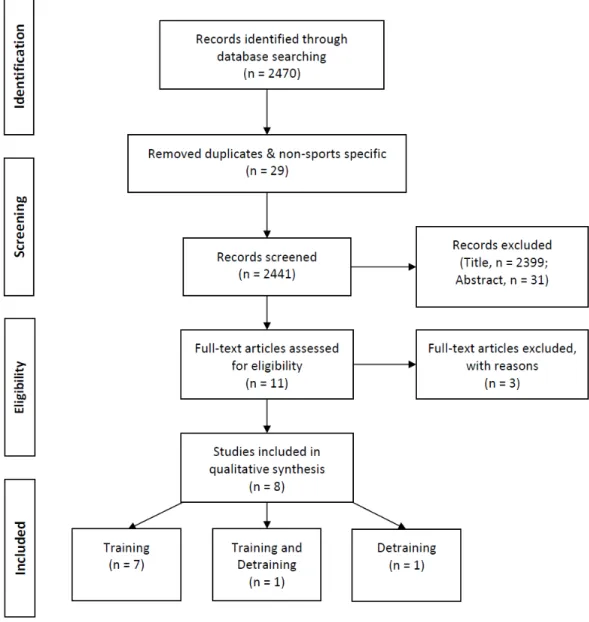
The initial search identified 2470 initial studies. After removing duplicates and studies with different types of intervention (e.g., longitudinal studies), subjects with other chronological ages (children, elderly), and subjects who did not include a session of CT in the protocol, 2459 studies were excluded. From the remaining studies, the full texts of 11 original research articles were assessed for eligibility, and those that did not meet the inclusion criteria were excluded
(e.g., inconclusive information on study procedures). For the qualitative analysis, a total of 8 studies were considered relevant for a detailed analysis. The earliest of these studies was published in 2007 (Esteve-Lanao et al., 2007), and the most recently published study was from 2018 (Joo, 2018). The articles were grouped according to the CT intervention (n=7) or to the presence of detraining (n=2). A detailed flow chart describing the process of selecting the relevant studies is shown in Figure 1.
Data analysis
Assessment of risk of bias
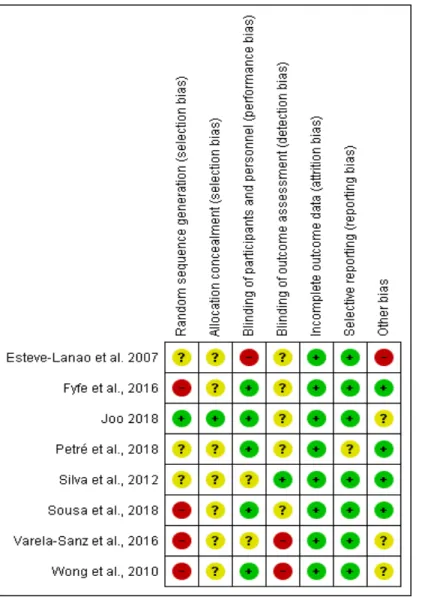
Quality analysis of the identified studies was conducted independently by two researchers using methods recommended by The Cochrane Collaboration (Higgins & Green, 2011). Any conflict was resolved by including a third member. All relevant biases, such random sequence generation, allocation concealment, blinding of participants, personnel and outcomes, incomplete outcome data, selective outcome reporting, and other sources of bias, were checked, and the studies were graded. The following classifications were used: low risk, high risk, or unclear risk (either lack of information or uncertainty regarding the potential for bias). Review Manager software (RevMan, Copenhagen, The Nordic Cochrane Centre) version 5.3.5 was used to create risk-of-bias graphs.
Statistical analysis
The results of the included studies were recalculated to determine the percentage of change for each variable during training programs ([post – pre/pre] x 100). Moreover, effect sizes (ES) provided for within-subjects’ comparisons to determine magnitude of changes during implementation, and when not provided by studies results, a calculation is performed using the Excel spreadsheet by (Lakens, 2013). The magnitude of the effect was classified as small (d = 0.2), intermediate (d = 0.5) or large (d = 0.8) (Cohen, 1988).
Results
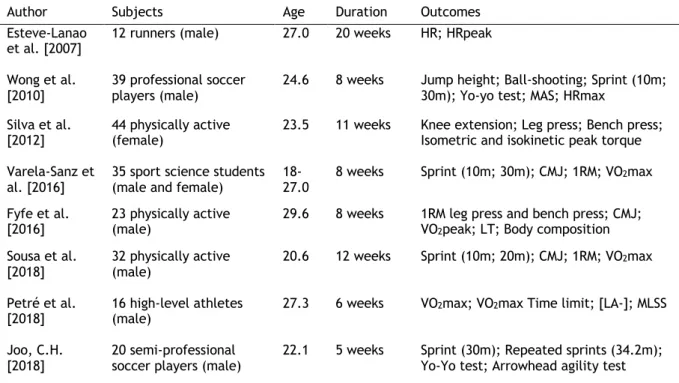
Table 1 presents a summary of the studies that monitored the intensity variations of CT in young adults (athletes and nonathletes). Of the seven studies included in the current review, most included assessments of neuromuscular maximal performance and aerobic capacity. The tests most commonly used to evaluate strength were the countermovement jump (CMJ) and one repetition maximum (1RM) test. Aerobic speed and/or oxygen uptake were variables used to evaluate cardiorespiratory fitness. Most of the subjects were males between 20 and 30 years of age. Another important issue was related to the training program duration, which ranged from 5 weeks to 20 weeks of implementation.
Table 1 - Characteristics of the studies included in the review
Author Subjects Age Duration Outcomes
Esteve-Lanao
et al. [2007] 12 runners (male) 27.0 20 weeks HR; HRpeak Wong et al.
[2010] 39 professional soccer players (male) 24.6 8 weeks Jump height; Ball-shooting; Sprint (10m; 30m); Yo-yo test; MAS; HRmax Silva et al.
[2012] 44 physically active (female) 23.5 11 weeks Knee extension; Leg press; Bench press; Isometric and isokinetic peak torque Varela-Sanz et
al. [2016] 35 sport science students (male and female) 18-27.0 8 weeks Sprint (10m; 30m); CMJ; 1RM; VO
2max
Fyfe et al.
[2016] 23 physically active (male) 29.6 8 weeks 1RM leg press and bench press; CMJ; VO2peak; LT; Body composition
Sousa et al.
[2018] 32 physically active (male) 20.6 12 weeks Sprint (10m; 20m); CMJ; 1RM; VO2max Petré et al.
[2018] 16 high-level athletes (male) 27.3 6 weeks VO2max; VO2max Time limit; [LA-]; MLSS Joo, C.H.
[2018] 20 semi-professional soccer players (male) 22.1 5 weeks Sprint (30m); Repeated sprints (34.2m); Yo-Yo test; Arrowhead agility test
[LA-]: Blood lactate concentration; 1RM: 1 maximal repetition; CMJ: Countermovement jump; HR: heart rate; HRmax: maximal heart rate; HRpeak: heart rate peak; LT: lactate threshold; MAS: maximal aerobic speed; MLSS: maximal lactate steady-state; VO2max: maximal oxygen uptake; VO2max time limit: time at maximal oxygen uptake;
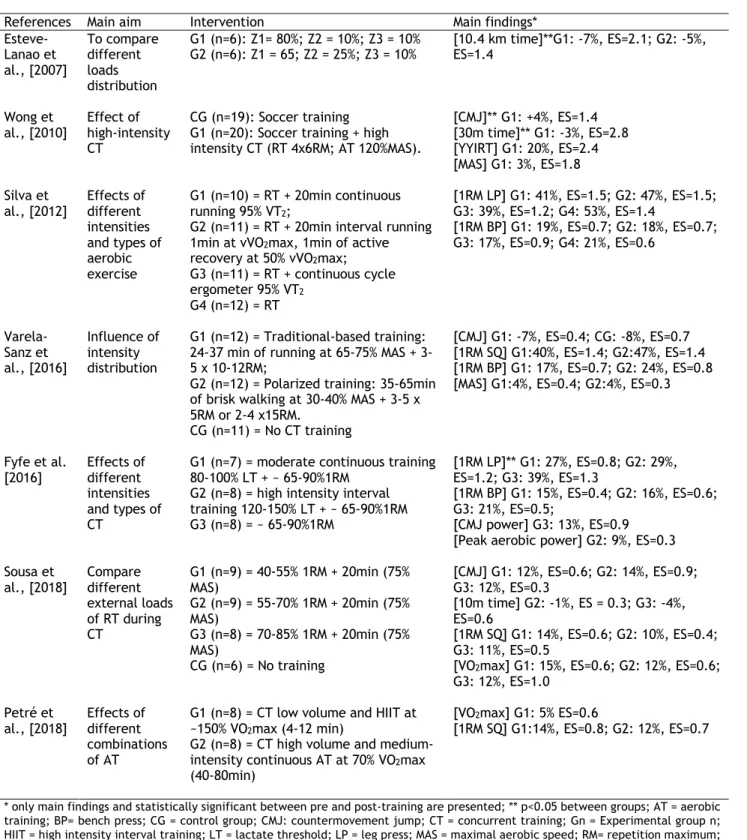
The analyzed studies were mainly focused on the exercise intensities during the aerobic component of CT training (Table 2). From the seven selected studies, all experimental interventions improved performance variables, regardless of the intensity used in CT. Nevertheless, when higher aerobic intensities were used, maximal oxygen uptake (VO2max) and
aerobic power seemed to also improve (Fyfe et al., 2016; Petré et al., 2018). Moreover, greater neuromuscular adaptations were found when higher RT loads were used with low to moderate AT intensities (Petré et al., 2018; Sousa et al., 2018). The interference from CT in strength adaptations may potentially occur by two main causes: the intensity of AT and the intensity distribution. In fact, it was reported that interference only occurs at intensities close to VO2max
(Varela-Sanz et al., 2016).
Focusing on the distribution of exercise intensities during a long-term CT program, it was suggested that the polarized model (i.e.: low-volume, high-intensity aerobic exercise combined with high-volume low-intensity training) would be the most effective training intensity distribution for reducing the interference in neuromuscular performance (Esteve-Lanao et al., 2007; Varela-Sanz et al., 2016). Running performance was approximately 2% greater with polarized training compared to the traditional distribution (Esteve-Lanao et al., 2007). Moreover, the upper and lower body maximum strengths increased 24% and 47% after 8 weeks of polarized training, respectively (Varela-Sanz et al., 2016).
Table 2 - Effects of intensity during concurrent training in performance
References Main aim Intervention Main findings*
Esteve-Lanao et al., [2007] To compare different loads distribution G1 (n=6): Z1= 80%; Z2 = 10%; Z3 = 10%
G2 (n=6): Z1 = 65; Z2 = 25%; Z3 = 10% [10.4 km time]**G1: -7%, ES=2.1; G2: -5%, ES=1.4
Wong et
al., [2010] Effect of high-intensity CT
CG (n=19): Soccer training G1 (n=20): Soccer training + high intensity CT (RT 4x6RM; AT 120%MAS). [CMJ]** G1: +4%, ES=1.4 [30m time]** G1: -3%, ES=2.8 [YYIRT] G1: 20%, ES=2.4 [MAS] G1: 3%, ES=1.8 Silva et
al., [2012] Effects of different intensities and types of aerobic exercise G1 (n=10) = RT + 20min continuous running 95% VT2;
G2 (n=11) = RT + 20min interval running 1min at vVO2max, 1min of active
recovery at 50% vVO2max;
G3 (n=11) = RT + continuous cycle ergometer 95% VT2 G4 (n=12) = RT [1RM LP] G1: 41%, ES=1.5; G2: 47%, ES=1.5; G3: 39%, ES=1.2; G4: 53%, ES=1.4 [1RM BP] G1: 19%, ES=0.7; G2: 18%, ES=0.7; G3: 17%, ES=0.9; G4: 21%, ES=0.6 Varela-Sanz et al., [2016] Influence of intensity distribution G1 (n=12) = Traditional-based training: 24-37 min of running at 65-75% MAS + 3-5 x 10-12RM;
G2 (n=12) = Polarized training: 35-65min of brisk walking at 30-40% MAS + 3-5 x 5RM or 2-4 x15RM.
CG (n=11) = No CT training
[CMJ] G1: -7%, ES=0.4; CG: -8%, ES=0.7 [1RM SQ] G1:40%, ES=1.4; G2:47%, ES=1.4 [1RM BP] G1: 17%, ES=0.7; G2: 24%, ES=0.8 [MAS] G1:4%, ES=0.4; G2:4%, ES=0.3
Fyfe et al.
[2016] Effects of different intensities and types of CT
G1 (n=7) = moderate continuous training 80-100% LT + ~ 65-90%1RM
G2 (n=8) = high intensity interval training 120-150% LT + ~ 65-90%1RM G3 (n=8) = ~ 65-90%1RM [1RM LP]** G1: 27%, ES=0.8; G2: 29%, ES=1.2; G3: 39%, ES=1.3 [1RM BP] G1: 15%, ES=0.4; G2: 16%, ES=0.6; G3: 21%, ES=0.5; [CMJ power] G3: 13%, ES=0.9 [Peak aerobic power] G2: 9%, ES=0.3 Sousa et
al., [2018] Compare different external loads of RT during CT G1 (n=9) = 40-55% 1RM + 20min (75% MAS) G2 (n=9) = 55-70% 1RM + 20min (75% MAS) G3 (n=8) = 70-85% 1RM + 20min (75% MAS) CG (n=6) = No training [CMJ] G1: 12%, ES=0.6; G2: 14%, ES=0.9; G3: 12%, ES=0.3 [10m time] G2: -1%, ES = 0.3; G3: -4%, ES=0.6 [1RM SQ] G1: 14%, ES=0.6; G2: 10%, ES=0.4; G3: 11%, ES=0.5
[VO2max] G1: 15%, ES=0.6; G2: 12%, ES=0.6;
G3: 12%, ES=1.0 Petré et
al., [2018] Effects of different combinations of AT
G1 (n=8) = CT low volume and HIIT at ~150% VO2max (4-12 min)
G2 (n=8) = CT high volume and medium- intensity continuous AT at 70% VO2max
(40-80min)
[VO2max] G1: 5% ES=0.6
[1RM SQ] G1:14%, ES=0.8; G2: 12%, ES=0.7
* only main findings and statistically significant between pre and post-training are presented; ** p<0.05 between groups; AT = aerobic training; BP= bench press; CG = control group; CMJ: countermovement jump; CT = concurrent training; Gn = Experimental group n; HIIT = high intensity interval training; LT = lactate threshold; LP = leg press; MAS = maximal aerobic speed; RM= repetition maximum; RT = resistance training; SQ= squat; VO2max = maximal oxygen uptake; VT2 = second ventilatory threshold; YYIRT= Yo-Yo intermittent
recovery test; Z1= below ventilatory threshold; Z2 = between ventilatory threshold and respiratory compensation threshold; Z3 = above respiratory compensation threshold.
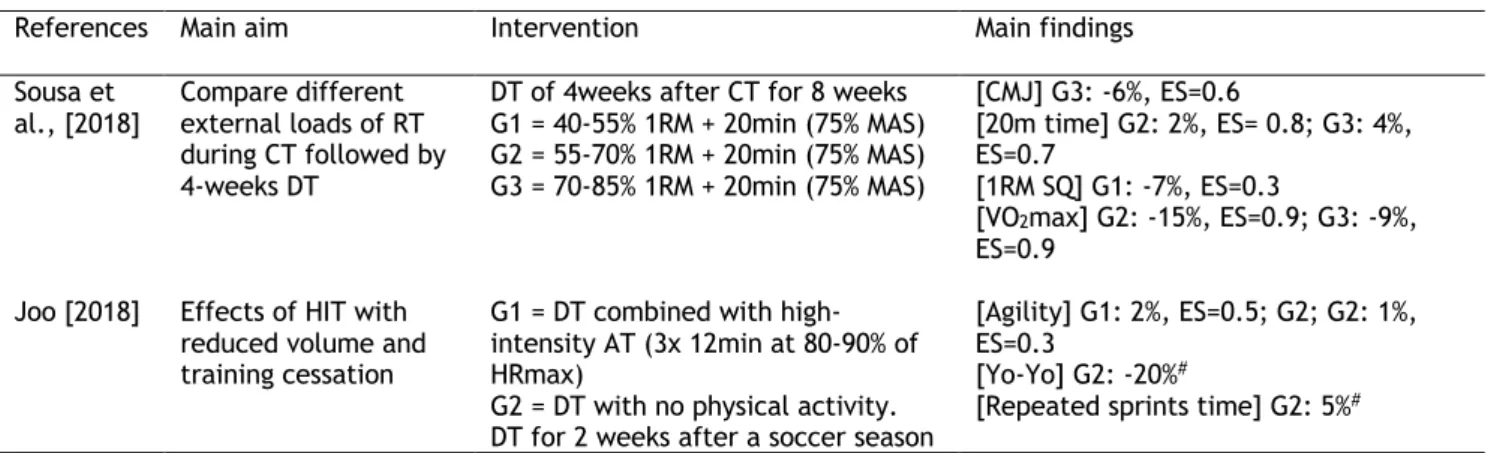
Among studies on exercise intensities during CT, only two focused on the issue of DT. Table 3 presents a summary of the studies that monitored the effects of DT on physical performance in
young adults. Sousa et al. (2018) reported that CT loads in RT seem to influence the reversibility of the training effects after a DT period of 4 weeks. In the same study, the gains in explosive strength obtained from low, moderate and high training loads combined with low-intensity aerobic training decreased between 12% and 14% after DT. In accordance with this finding, Joo (2018) verified that two weeks of DT after a competitive season resulted in marked decreases in repeated sprints and agility variables of elite soccer players.
Table 3 - Effects of concurrent training intensities after detraining
References Main aim Intervention Main findings
Sousa et
al., [2018] Compare different external loads of RT during CT followed by 4-weeks DT
DT of 4weeks after CT for 8 weeks G1 = 40-55% 1RM + 20min (75% MAS) G2 = 55-70% 1RM + 20min (75% MAS) G3 = 70-85% 1RM + 20min (75% MAS) [CMJ] G3: -6%, ES=0.6 [20m time] G2: 2%, ES= 0.8; G3: 4%, ES=0.7 [1RM SQ] G1: -7%, ES=0.3
[VO2max] G2: -15%, ES=0.9; G3: -9%,
ES=0.9 Joo [2018] Effects of HIT with
reduced volume and training cessation
G1 = DT combined with high-intensity AT (3x 12min at 80-90% of HRmax)
G2 = DT with no physical activity. DT for 2 weeks after a soccer season
[Agility] G1: 2%, ES=0.5; G2; G2: 1%, ES=0.3
[Yo-Yo] G2: -20%#
[Repeated sprints time] G2: 5%#
AT = aerobic training; CT = concurrent training; DT = detraining period; Gn = Experimental group n; MAS = maximal aerobic speed; RM= repetition maximum; RT = resistance training; VO2max = maximal oxygen uptake; # no data was available for ES calculation and for
exact percentage.
Risk of bias in the included articles
The included studies were randomized, but few described the sequence of the randomized sequence. Some were not clear regarding the blinding outcome assessment, or this was performed by the main researcher of the study, which reveals high risk of bias (Figure. 2 and 3).
Figure 2. Judgements about each risk of bias item for each included study (“+” low risk; “?” unclear risk; “-“ high risk)
Discussion
The current review aimed to analyze the findings provided in the literature regarding the exercise intensities used during CT and their effects on performance variables. Moreover, the effects of exercise intensities during CT on a subsequent DT period were also assessed to better understand the impact of CT intensities and how it is reflected after a cessation of training. The studies on this topic were relatively recent, with increased interest in the last two decades. CT has been studied since the early 1980s; however, only recently have researchers focused on the issue of training intensity. The few studies gathered showed improved strength and cardiorespiratory performance regardless of the different intensities used in AT and/or RT during CT. Nevertheless, there seems to exist a trend toward lower strength improvements when high aerobic intensities, despite the increased aerobic adaptations. Neuromuscular performance also seemed to be dependent on RT intensity, recording greater gains with higher external loads as long as RT was combined with an aerobic workout of medium/low intensity. The latest increase in interest regarding CT may be due to its potential to simultaneously provide gains in cardiorespiratory fitness and strength (Beni, 2012; Kang & Ratamess, 2014) as well as the time requirement and convenience of this training program for competitive sports (Alves et al., 2012). In several sports, CT is a usual method of training, as it combines the specific motions of sports, such as swimming or running, with RT to improve performance [e.g., Balsalobre-Fernandez et al., 2016; Botonis et al., 2016; Crowley et al., 2017; Ronnestad & Mujika, 2014). Our search revealed that among the studies on CT intensity, only a few reported data on professional athletes [Esteve-Lanao et al., 2007; Petré et al., 2018; Wong & Chaouachi, 2010). Nonathletes are also an important cohort, and they were studied in several reports (Joo, 2018; Silva et al., 2012; Sousa et al., 2018; Varela-Sanz et al., 2016), but research on CT training with a focus on performance should be developed with competitive subjects.
The study of the intensity during CT was mostly restricted to the aerobic component. For instance, Silva et al. (2012) reported that different intensities of AT, combined with the same RT, twice a week for eleven weeks, does not seem to differently affect the strength development. Thus, it would be suggested that different intensities of AT enhance athletes’ performances. Concordantly, Fyfe et al. (2016) evidenced that eight weeks of high-intensity or moderate-intensity of cycling for 15 to 33 min combined with the same RT improved maximal strength and neuromuscular performance. However, when compared with RT alone, both intensities similarly attenuated improvements in maximal lower-body strength (1RM and CMJ). So, we should highlight the similarity of the gains between the different training intensities, but we should not disregard the interference effect on strength gains by the moderate and high-intensities used.
It seems difficult for the researchers to investigate different aerobic intensities during CT without changing the volumes or methods of training. This is easily explained by the high intensities used, that require some rest or even reduction of the exercise duration, resulting in changes of training methods. As evidenced by Fyfe et al. (2016), two different methods of AT are usually compared (continuous vs. interval) and this could affect the conclusions obtained. Recently, Petré et al. (2018) compared different AT intensities (low volume of high intensity interval training vs. high volume of moderate continuous training) combined with the same RT. They found, in former competitive athletes, that strength improved with high and low intensities of AT, but VO2max only improved when training at higher AT intensities. This
suggested that higher aerobic intensities should be used during CT for greater aerobic performances. Moreover, it should be stated that when higher intensities were used, they were combined with lower volume training sessions.
From the selected studies, only Sousa et al. (2018) focused on the intensities of RT in CT. Sousa and colleagues (2018) suggested strength training programs with low, moderate and high external loads combined with low-intensity AT to produce gains in strength and aerobic capacities. Moreover, they suggested that higher loads of RT combined with low-intensity AT were efficient in improving explosive efforts. However, it remains unknown what happens if CT is combined with a high-intensity AT regimen. Higher intensities of AT can cause greater metabolic perturbation in type II muscle fibers and potentially compromise anabolic responses from strength training (Gollnick et al., 1974; Thomson et al., 1979). Thus, these findings highlight the importance of further knowledge on the intensities of RT during CT so that coaches could minimize the interference phenomenon and efficiently improve performance.
Research on CT issues has also focused on the distribution of training intensities throughout the season (Esteve-Lanao et al., 2007; Varela-Sanz et al., 2016). In this sense, the longest experimental research study was developed by Esteve-Lanao et al. (2007), whom sought to understand how the day-to-day AT intensity should be distributed and combined with the same RT program. The training intensity was typically divided into more or less arbitrary intensity zones, and the authors aimed to verify the effects of a traditional training program emphasizing moderately high-intensity aerobic training or those of a new trend of polarized training emphasizing the intensity zone. The runners who combined RT with AT emphasizing low-intensity training zones found greater performance enhancements than the others. Interestingly, others suggested that 8 weeks of traditional training-based regimens (i.e.: moderate volume and intensity of CT) produced similar improvements in neuromuscular and cardiorespiratory fitness as polarized training (Varela-Sanz et al., 2016). These results could be due to the few weeks of training implementation and because the sample was not composed of athletes but of sport science students. Therefore, training intensity distribution seems to be irrelevant for training programs lasting a few weeks for nonathletes, but polarized training is
suggested as the most effective training intensity distribution for improving competitive performance (Esteve-Lanao et al., 2007).
Regarding the DT period, only two studies analyzed the effects of CT intensities during training cessation (Joo, 2018; Sousa et al., 2018). Both studies revealed that the training-induced gains may be compromised with short-term detraining (2 – 4 weeks), leading to a return to baseline values (Joo, 2018; Sousa et al., 2018). Sousa et al. (2018) demonstrated that a 4-week period of training cessation compromised training-induced gains in young men, mainly in VO2max and
sprint time variables. In the study by Joo (2018), only 2 weeks of DT after a competitive season markedly decreased performance. Importantly, no differences were observed regarding the previous intensities of CT in both studies. Therefore, despite scarce evidence, it seemed that regardless of the intensities of the previous CT program, only 2-4 weeks of training cessation can cause severe loss of performance. In addition, to return to a previous level of ability, it was suggested that a similar or longer period of retraining using high-intensity AT methods was required (Joo, 2018).
The information gathered here was predicted to be helpful for coaches and professionals seeking to improve the training program design and consequently improve performance. Moreover, it was clear that this subject is still unknown, and that further research is required. It is important to understand the effect of different RT intensities and/or different AT intensities and then investigate methods of combining these exercise modalities. Moreover, more research on competitive athletes should be conducted. Athletes may be able to continuously improve strength during short-term periods due to their high level of stress tolerance, but over long-term periods, they might be negatively affected by adaptation mechanisms, interference effects and /or fatigue (Coffey & Hawley, 2017). Therefore, additional longer longitudinal studies should be developed to analyze the interference of CT at different intensities and how performance changes over time.
To the best of our knowledge, no detailed systematic review has comprehensively examined the literature regarding the effects of the intensities used in a CT training program, specifically in the AT or/and RT component. However, we found some limitations in the comparison of the results presented by the different investigations, and recommendations concerning optimal intensities to use during CT were designed based on the present data. It is worth noting that there were differences in the subject’s characteristics (athletes and nonathletes) and even in the training programs (frequency, intensities, type) between the included studies that conditioned the analysis. Furthermore, only few studies were found on this issue and some methodological quality flaws compromised general conclusions. Moreover, longer periods of intervention should be studied for better understanding of this subject.
Conclusion
In brief, despite the lack of longitudinal studies on CT intensities and performance, it seems evident that CT with different intensities positively influences the performance of young adults. Furthermore, short-term training cessation (2-4 weeks) compromises the training-induced gains. The few studies revealed greater strength and neuromuscular performance gains when the CT program combined high-intensity RT with low-intensity AT, and an interference effect seemed to exist for higher aerobic intensities. Higher aerobic intensities should be used to improve cardiorespiratory fitness, but improvements in strength could be compromised. Regarding the intensity distribution during the aerobic regimen, the polarized model may be better at reducing interference in neuromuscular performance. Nevertheless, we should be cautious and consider these findings to be tendencies, while being aware that further research is needed on this matter. The information shown in this review could provide useful tools for coaches to develop efficient training programs.
Chapter 3. Experimental Studies
Study 2
Concurrent training followed by detraining: does the resistance
training intensity matter?
Abstract
The aim of the present study was to analyze the training and detraining (DT) effects of concurrent aerobic training (AT) and resistance training (RT) against three different external loads on strength and aerobic variables. Thirty-two men were randomly assigned to four groups: low-load (LLG, n=9), moderate-load (MLG, n=9), high-load (HLG, n=8), and control group (CG, n=6). RT consisted of full squat (FS) with a low-load (40-55% one repetition maximum [1RM]), a moderate-load (55-70% 1RM) or a high-load (70-85% 1RM) combined with jump and sprint exercises. AT was performed at 75% of the maximal aerobic speed (MAS) for 15-20 min. The training period lasted for 8-weeks, followed by 4-weeks DT. Pre, post-training and post-DT evaluations included 20m running sprints (0-10m: T10; 0-20m: T20), shuttle run test, countermovement jump test (CMJ), and loading test (1RM) in FS. All the experimental groups showed improvements (p<0.05) in all the parameters assessed, except the LLG for T10 and the HLG for T20. The LLG, MLG and HLG showed great changes in 1RM and maximum oxygen uptake (VO2max) compared with the CG (p<0.05), whereas the HLG and MLG showed a greater
percentage change than the CG in T10 (p<0.001) and CMJ (p<0.05). The 4-week DT period resulted in detrimental effects in all variables analyzed for all three experimental groups. In conclusion, our results suggest that strength training programs with low, moderate, or high external loads combined with low-intensity AT could be effective for producing significant gains in strength and aerobic capacities. Moreover, the higher loads used increased gains in explosive efforts.
Key words: Endurance training, weight training, load-magnitude, sprint performance, jump
Introduction
Concurrent training (CT) has become a contemporary topic for coaches, strength and conditioning professionals and researchers because a large number of sports require both strength and aerobic capacities for maximize performance (Lo et al., 2011; Nader, 2006; Wilson et al., 2012). However, Aerobic and resistance trainings produce divergent metabolic and morphological adaptations with little overlap between them (Fyfe et al., 2014; Nader, 2006). Therefore, it seems necessary to find optimal combinations of both types of training regimes to obtain maximum simultaneous development of resistance and aerobic capacities.
Studies analyzing the neuromuscular adaptations and performance improvements associated with CT have reported inconsistent results. While CT does not alter the ability to positively adapt to aerobic training (AT) (Docherty & Sporer, 2000; Wilson et al., 2012), most studies have indicated that CT regimens appear to inhibit strength, hypertrophy and power development compared with resistance training (RT) alone (Hakkinen et al., 2003; Hickson, 1980; Kraemer et al., 1995). Nevertheless, some experiments have reported little or no negative effect on strength gains with the addition of AT (Balabinis et al., 2003; McCarthy et al., 1995; Sillanpaa et al., 2008).
In addition to large influence of the interindividual variation in response to a training program (Karavirta et al., 2011; Mann et al., 2014), the effects of CT on strength gains may vary markedly due to a large number of design factors, including the mode, frequency, duration, type of exercises, volume and intensity used during both RT and AT, different sequences and recovery times between RT and AT sessions, training history of participants, and dependent variables selected (Garcia-Pallares & Izquierdo, 2011; Leveritt et al., 2003; Wilson et al., 2012). The effect of most of these variables has already received considerable attention in previous studies and reviews (Nader, 2006; Wilson et al., 2012). However, to the best of our knowledge, a question that remains ignored in the literature is the possibility of manipulating the load magnitude during RT. In addition, most of resistance exercises used in studies analyzing the effect of CT on physical performance (Bell et al., 1991; Dolezal & Potteiger, 1998; Hakkinen et al., 2003; Hickson, 1980; Izquierdo et al., 2005; Karavirta et al., 2011; Kraemer et al., 1995) were open-chain, isolated, isotonic or machine-based exercises (i.e. leg extension and flexion, seated hamstring curl, leg curl, leg press, isometric plantar flexion, calf rise). It appears that RT programs which preferably include open-chain exercises may not provide adequate movement pattern specificity for optimal performance improvements in closed-chain sporting movements such as running (Beattie et al., 2014). Therefore, it has been indicated that future investigations should include traditional multi-joint resistance exercises because are believed to be superior for eliciting optimal neuromuscular adaptations and increasing the force capabilities of the leg musculature (Beattie et al., 2014). Since (i) the training load seems to
be the most important variable to consider when designing a RT program (Fry, 2004), and (ii) the exercises selected in a RT programme can influence the magnitude of neuromuscular adaptations (Beattie et al., 2014), gains in strength and aerobic variables during CT may be directly influenced by the load magnitude and exercise used during RT. Thus, the first aim of the present study was to analyze the effect of three CT programs that only differed in the load magnitude used during the full squat (FS) training on performance in vertical jump, sprint, leg strength and aerobic capacity.
Additionally, interruptions in training sessions due to several factors are normal in any sport (Kraemer et al., 2002; Mujika & Padilla, 2000, 2001; Ormsbee & Arciero, 2012). For this reason, knowing the effects of a detraining (DT) period could be important for designing better training strategies. The DT adaptations following AT or RT alone have been widely studied in different populations (Eastwood et al., 2012; Faigenbaum et al., 1996; Kraemer et al., 2002; Lo et al., 2011; Meylan et al., 2014) Unfortunately, the effect of training cessation after CT has received less scientific attention (Carvalho et al., 2009; Santos et al., 2011, 2012; Toraman, 2005). Moreover, although abrupt cessation of intense physical training is associated with a decline of physical performance (Mujika & Padilla, 2000, 2001), DT-induced changes in performance after CT are linked with multiple factors (Hasegawa et al., 2015; Lo et al., 2011; Meylan et al., 2014; Santos et al., 2012; Toraman, 2005; Toraman & Ayceman, 2005) among which is included the relative intensity used during previous resistance program. Therefore, the second aim of the present study was to analyze the effects of 4-week DT following CT programs differing in load magnitude used during RT on different resistance and aerobic parameters.
Methods
Experimental Approach to the Problem
An experimental research design was used to compare the effects of three concurrent resistance and aerobic training programs only differing in load magnitude used during RT (40-55% one repetition maximum [1RM] vs. 55-70% 1RM vs. 70-85% 1RM) on physical performance, and the subsequence DT adaptations. To address this, thirty-six male physically active men were randomly assigned to control group (CG) or RT group with low loads (LLG), moderate loads (MLG) or high load (HLG). The players assigned to experimental groups performed RT combined with endurance, while players assigned to CG merely undertook daily life activities. All the experimental groups trained twice a week for 8 weeks using a CT regimen. All subjects were evaluated using a battery of tests performed in two sessions separated by a 48 h rest interval. During the first testing session, the participants performed the 20 m running sprints and the 20 m shuttle run test. During the second testing session, subjects executed the countermovement
jump test (CMJ), and an isoinertial loading test in FS exercise. During the 2 weeks preceding this study, four preliminary familiarization sessions were undertaken to ensure a proper execution technique in both FS and CMJ exercises. To evaluate the DT effects, the resistance and aerobic parameters were tested after four weeks of training cessation. Throughout this period, the participants were asked refrain from participating in regular exercise programs aimed at developing or maintaining strength and aerobic capacity.
Subjects
Thirty-six male physically active men volunteered to participate in this study. After an initial evaluation, the participants were matched according to their estimated one-repetition maximum (1RMest) in FS exercises and then randomly assigned to four groups depending on the
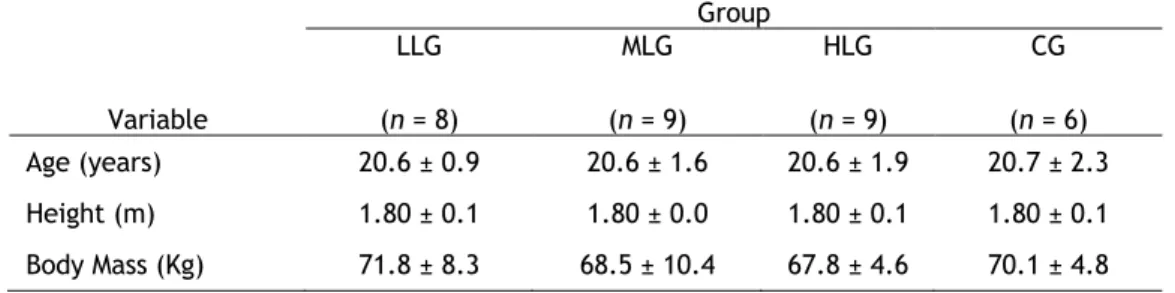
loading magnitude used during RT, as follows: i) a low-load group (LLG, 40-55% 1RM), a moderate-load group (MLG, 55-70% 1RM), a high-load group (HLG, 70-85% 1RM), and a control group (CG). Due to injury or illness, four participant (one from the HLG and three from the CG) were absent from the post-testing sessions. Thus, of the 36 initially enrolled participants, only 32 successfully completed the entire study. Player characteristics are displayed in Table 1. Participants in the CG were asked not to perform any type of RT or AT during the experimental period. All the participants provided written informed consent to the experimental procedures after the possible benefits and risks of participation were explained to them. The investigation was conducted in accordance with the Declaration of Helsinki and was approved by the local Research Ethics Committee.
Table 1. Subject characteristics.
Group Variable LLG (n = 8) MLG (n = 9) HLG (n = 9) CG (n = 6) Age (years) 20.6 ± 0.9 20.6 ± 1.6 20.6 ± 1.9 20.7 ± 2.3 Height (m) 1.80 ± 0.1 1.80 ± 0.0 1.80 ± 0.1 1.80 ± 0.1 Body Mass (Kg) 71.8 ± 8.3 68.5 ± 10.4 67.8 ± 4.6 70.1 ± 4.8 Values are mean± SD.
LLG: Low-load group; MLG: Moderate-load group; HLG: High-load group; CG: Control group