Printed version ISSN 0001-3765 / Online version ISSN 1678-2690
www.scielo.br/aabc
http://dx.doi.org/10.1590/0001-3765201520140094
E-mail: [email protected]
Infinitesimal Hartman-Grobman Theorem in Dimension Three
CLEMENTA ALONSO-GONZÁLEZ
Departamento de Estadística e Investigación Operativa, Universidad de Alicante, Carretera San Vicente del Raspeig, s/n, 03690 San Vicente del Raspeig, Alicante, Spain
Manuscript received on February 24, 2014; accepted for publication on December 22, 2014 ABSTRACT
In this paper we give the main ideas to show that a real analytic vector field in R3 with a singular point at the origin is locally topologically equivalent to its principal part defined through Newton polyhedra under non-degeneracy conditions.
Key words: Vector fields, singularities, topological type, Newton polyhedron, principal part.
INTRODUCTION
Let
ξ = a(x, y, z) @ + b(x, y, z) @ + c(x, y, z) @
@x @y @z
be a real analytic vector field defined in a neighbor hood of the origin of R3 and assume that the
origin is an equilibrium point of ξ. For hyperbolic singularities, the Hartman-Grobman theorem esta-blishes that ξ is locally topologically equivalent to its linear part. If the linear part is null, it is a natural question to ask for a representative of the topological type of ξ around the origin.
In dimension two this problem was solved
for C∞vector fields by Brunella and Miari:
Theorem. (Brunella and Miari 1990) Let ξ be a plane
C∞vector field with ξ (0) = 0 and non-degenerate
principal part Pξ such that 0 is an isolated singularity
of Pξ; then ξ is locally topologically equivalent to Pξ
modulo center-focus.
The proof of this result is based on the cons-truction of a morphism obtained from the Newton
polygon of ξ. This morphism is a sequence of blow-ups centered at singular points. Under non-degeneracy conditions it desingularises both ξ and its principal part. Moreover, given that there is no return, they found a topological equivalence around the exceptional divisor between the transformed
vector fields ξe and Pξf. By projection they get the
desired homeomorphism.
In dimension three the results of M.I. Camacho (Camacho 1985) and BonckaertDumortierVan Strien (Bonckaert et al. 1989) show that, under non degeneracy conditions, the first nonvanishing jet
jkξ(0) of ξ at the origin determines the topological
type of ξ. Their particular case co rresponds to a Newton polyhedron with a unique compact face per pendicular to the vector (1, 1, 1) 2 R3. In this situation,
the principal part of ξ is the homogeneous vector field
jk ξ(0) and the desingularisation morphism consists
of just one blowup centered at the origin.
In this paper we give an idea of the proof of the following result:
singularity at the origin. If the principal part Pξ is non-degenerate then ξ is topologically equivalent to Pξ modulo infinitesimal return.
This result can be considered as an infinitesimal version of the classical Hartman-Grobman theorem in dimension three.
Absolutely isolated singularities of vector fields
were introduced for the complex case by Camacho-CanoSad in (Camacho et al. 1989). The definition is similar in the real case: the singularity is isolated and, after a finite sequence of blowups with center at singular points, we get isolated singularities and the exceptional divisor is invariant. In (Camacho et al. 1989) it is also proved that we obtain a reduction of singularities of the vector field after a finite number of blow-ups. This result also holds in the real case.
A germ of vector field with absolutely isolated
singularity has a Newton polyhedron of barycentric
type up to change of coordinates. This type of polyhedra gives a finite sequence of combinatorial blowups (centered at the origin of the charts). Fixed such a polyhedron N, we say that the principal part Pξ of ξ given by N is non-degenerate if the associate sequence of blow-ups πNis a desingularisation of Morse-Smale
type of Pξ. In this situation, we have that πNis also a
desingularisation of MorseSmale type of ξ.
The definition of MorseSmale type desin gularisation is detailed later on. This non-degeneracy condition is a three-dimensional version of the classical MorseSmale ones and generalize the conditions imposed in (Camacho 1985) and (Bonck aert et al. 1989). We also ask for an infinitesimal non-return condition over Pξ: given any small transversal
section Σ to D and Pξf, there is a neighborhood of
D such that each orbit of Pξf cuts Σ at most once. This is the analogous to the center-focus exclusion in (Brunella and Miari 1990).
Finally, we use the study done by Alonso-Gonzalez et al. 2006, 2008 about the topological classification of vector fields whose reduction of singularities is of MorseSmale type, to get the desired topological equivalence.
BARYCENTRIC TYPE POLYHEDRA
In dimension two the Newton polygon of a vector
field ξ determines a sequence of blow-ups with center
at points. Moreover, if the singularity is of toric type, this morphism is a reduction of singularities of ξ up to change of coordinates (Camacho and Cano 1999). In dimension n ≥ 3 this result does not work in general but barycentric type polyhedra naturally gives a sequence of combinatorial blowups. Moreover, vector fields with absolutely isolated singularity have a Newton polyhedron of barycentric type.
Given a vector field ξ in R3 with ξ(0) = 0, let
us consider the associated Newton polyhedron N =
N(ξ) in fixed coordinates. Taking normal vectors to each face of N we get a set of cones whose union is a fan ∆N. The standard fan ∆sthas the first octant
R3≥ 0 as a unique cone. By construction, ∆N is a
subdivision of ∆st. Denote this by ∆N >> ∆st.
We say that a polyhedron N is barycentric if ∆N is barycentric: it is obtained from successive
barycentric subdivisions of ∆st. Moreover, we say
that N is ofbarycentric type if there is a barycentric fan B with B >> ∆N. Clearly a barycentric type fan ∆
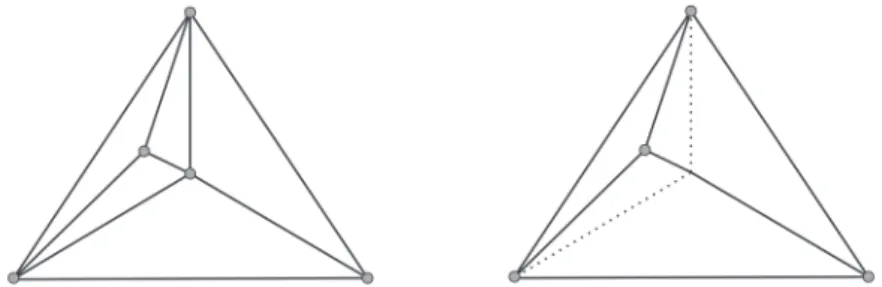
is not barycentric in general but there is a “minimal” barycentric fan B∆refining it (see Figure 1).
From toric geometry theory we know that the
first barycentric subdivision of ∆stinto the cones b1,
b2, b3 corresponds to the blow-up of R3 with center
at the origin (see Oda 1985). As a consequence,
if ∆N is of barycentric type, we can consider a
sequence of barycentric fans Birefining ∆st
B∆N = Bk >> ... >> B1>> B0 = ∆st
and then a sequence πN of blow-ups centered at points.
Theorem 2. Let ξ be an analytic three dimensional real vector field. If the origin is an absolutely isolated singularity of ξ, then the associated Newton polyhedron N= N(ξ) is of barycentric type.
Note that if N = R3≥ 0 we are done. Otherwise,
axes in three points: (a, 0, 0), (0, b, 0), (0, 0, c). This fact repeats after blowing-up given that the singularity is absolutely isolated. Let us denote h =
h(N) = a + b + c. Now, if ξei is the strict transform
of ξ after a blow-up centered at the origin of the
i-chart and Ni is its Newton polyhedron, we have that h(Ni) < h(N). Besides, the fan ∆i associated
to ξeiis isomorphic to the fan ∆N ∩bi. We conclude
taking into account that ∆N =
[3
i=1 ∆N ∩bi and
working by induction over h.
NON-DEGENERACY CONDITIONS
Let N be a fix barycentric type polyhedron and πN
the associated sequence of blow-ups. Recall that the Hartman-Grobman theorem holds for vector
fields ξ having a hyperbolic singular point. Brunella
and Miari also worked under some nondegeneracy conditions satisfied by Pξ (see Brunella and Miari 1990). In dimension three, in case the principal part is homogeneous, M.I.Camacho in (Camacho 1985) and BonckaertDumortierVan Strien in (Bonckaert et al. 1989), assumed the classical MorseSmale conditions over ξe|D(only hyperbolic singular points
and no two-dimensional saddle-connections) so that πN(only one blow-up) desingularises Pξ and ξ.
In our situation more than one blow-up is involved in πN and the exceptional divisor D
has more than one irreducible component. The dynamics around D is much more complicated and additional conditions have to be imposed: we assume that πN is a desingularisation of Pξ of
Morse-Smale type.
Definition 1.We say that πN is a desingularisation
of Pξ of Morse-Smale type if three conditions are satisfied:
(1) All the singular points on the exceptional divisor are hyperbolic.
(2) Two dimensional saddle-connections are not allowed out of the skeleton of D (the
inter-section of divisor irreducible components).
(3) No infinitesimal saddle-connections are allowed.
Let us explain the two last conditions that corres-pond to concepts already introduced in (Camacho 1985) and (AlonsoGonzalez et al. 2008):
Two-dimensional saddle-connections. Recall that a two-dimensional saddle-connection appears when two saddles are connected along their unstable-stable varieties. The second condition means that given a component Di of the exceptional divisor, there
are no two-dimensional saddle-connections of ξe|Di
along unstable-stable varieties contained exclusively in the component Di. That is, we only allow the
existence of two-dimensional saddle-connections of ξe|D along the skeleton of D. This last situation
is rigid in the sense that it is preserved under the usual deformations of the vector field (based on Melnikov’s integral) addressed to destroy interior saddle-connections. For details see (Camacho 1992).
Infinitesimal saddle-connections. The third condi-tion involves three dimensional saddles. To explain it we need to recall some concepts. Suppose that the
linear part of a vector field ξ with a saddle at p is
Lξ= λx@@ + μy@ + δz @
x @y @z
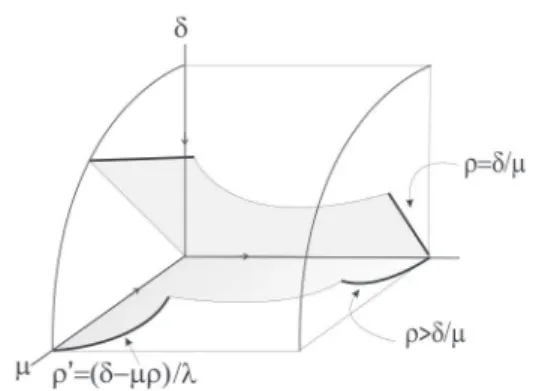
with λµδ < 0 and µδ > 0. The intrinsic (y, z) -weight of p is δ/µ. Let us describe the process of weights transition ρ →ρ'. Consider the curve x = 1,
z = yδµ. The saturated of this curve by the flow of ξ
accumulates at the invariant variety x = 0. If we take a curve x = 1, z = yρwith ρ > δ/µ, its saturated accumulates at {x = z = 0} and contains the curve
y = 1, z = xρ′, where ρ' = (δ −µρ)/λ. If ρ = δ/µ we say that there is no transition; otherwise ρ transits to ρ'. The situation is similar if ρ < δ/µ. By doing the inverse process we have a weights transition through the saddle p in the two possible senses (see Figure 2).
If we start with the intrinsic weight α of a corner p, by means of the previous rule of weights transition, the value α transits through connected saddles producing an associated weight at each step. Two situations are possible:
(1) The process does not stop at any saddle. (2) There is a saddle q (on the skeleton) where
the transition stops, i.e. the obtained value by transition coincides with the intrinsic weight of q. In this case we say that p
and q determine an infinitesimal
saddle-connection (for details, see AlonsoGonzalez
et al. 2008).
The principal part Pξ of a vector field ξ given
by a fixed polyhedron N has a finite number of
coefficients. Hence the set PNof associated principal
parts to N is isomorphic to a ndimensional affine
space Rn. Given N, there is a “generic” set G⊂ Rn
of non-degenerate principal parts. On the other hand, under the non-degeneracy condition, the restrictions to the exceptional divisor of ξe and Pξf coincide. Hence we can conclude the following result:
Theorem 3. Let Nbe a barycentric type polyhedron
in R3 and P
Nthe set ofassociated principal parts.
There is a nonempty set G ⊂PNsuch that for any
vector field ξ with ξ(0) = 0 whose principal part Pξ belongs to G, the morphism πNis a reduction of
singularities of Morse-Smale type of ξ and Pξ.
CONSTRUCTION OF THE TOPOLOGICAL EQUIVALENCE
Given a vector field ξ with ξ(0) = 0 and Pξ 2 G, the
last step to generalize the BrunellaMiari result to a three dimensional space, is the construction of the topological equivalence between ξ and Pξ around the singular point. We use the process described in the papers AlonsoGonzalez et al. 2006, 2008 to determine the πN-topological type of ξ (topological
type after desingularization). There the reader can find a complete topological classification in the class of three-dimensional real analytic vector fields whose reduction of singularities is of Morse Smale type without infinitesimal return. Let us recall the principal ideas.
Given ξ and ξ' vector fields having the same reduction of singularities. Supposse that it is of Morse Smale type. The main difficulty in the construction of the topological equivalence after desingularisation is the appearance of saddle connections along the skeleton of D. Even in the case of just two saddles
connected along their one dimensional invariant variety, three topological types could appear (see AlonsoGonzalez 2003). The key is that if the weights of ξe and ξ'eobtained by the previous transition rule at each singular point are well ordered and, infinitesimal
return does not occur, it is possible to perform a process of extension of suitable local starting homeo-morphisms to a topological equivalence between ξe and ξ'e in a neighborhood of D (consult Alonso-Gonzalez et al. 2008 for details).
As a consequence, the πN-topological type of
a vector field ξ with reduction of singularities
of MorseSmale type without infinitesimal return depends only on the eigenvalues of ξe at the singularities and on the topological type of the restriction ξe|Di to the irreducible components Diof
the exceptional divisor.
In our case, if Pξ is non-degenerate, the eigen-values of ξe and Pξfcoincide at each singular point. Hence the weights also coincide. Moreover, we have that Pξf|Di = ξe|Di. The no infinitesimal return
condition is also determined by Pξf.
Summing up all the previous ideas, we have the following result:
Theorem 4.Let N be a barycentric type polyhedron
in R3and PNthe set ofassociated principal parts.
Then, there is a nonempty set G⊂PN of genericity
such that any vector field ξ with ξ(0) = 0 whose principal part Pξ belongs to G is topologically
equivalent to Pξ around the origin modulo infinitesimal return.
Given that absolutely isolated singularity implies barycentric type polyhedron and taking G as the set of non-degenerate principal parts, Theorem 1 is a consequence of this last result.
ACKNOWLEDGMENTS
This research was partially supported by the Spanish Government (MTM2010 15471 (subpro grama MTM)).
RESUMO
Neste artigo apresentamos as ideias principais da prova de que um campo vetorial analítico real em R3
, com singularidade na origem é, localmente, topologicamente equivalente à sua parte principal definida através de poliedros de Newton, sob condições de não degeneração. Palavras-chave: Campos vetoriais, singularidades, tipo topológico, poliedro de Newton, parte principal.
REFERENCES
ALONSOGONZALEZ C. 2003. Topological Classification of Saddle Connections. Qual Theory Dyn Syst 3: 309-324. ALONSOGONZALEZ C, CAMACHO MI AND CANO F.
2006. Topological Classification of Multiple Saddle Connections. Discrete and Contin Dyn Syst 15: 395-414. ALONSOGONZALEZ C, CAMACHO MI AND CANO F. 2008.
Topological Invariants for Singularities of Real Vector Fields in Dimension Three. Discrete and Contin Dyn Syst 20: 275-291.
BONCKAERT P, DUMORTIER F AND VAN STRIEN S. 1989. Singularities of vector fields on R3 determined by their first nonvanishing jet. Ergodic Theory Dynam Systems 9: 281-308.
BRUNELLA M AND MIARI M. 1990. Topological Equivalence of a Plane Vector Field with its Principal Part Defined through Newton Polyhedra. J Differential Equations 85: 338-366.
CAMACHO C, CANO F AND SAD P. 1989. Desingularization of absolutely isolated singularities of vector fields. Invent Math 98: 351369.
CAMACHO MI. 1985. A contribution to the topological classi-fication of homogeneous vector fields. J Differential Equations 57: 159-171.
CAMACHO MI. 1992. Genericity of Hyperbolic Homogeneus Vector Fields in R3. J Differential Equations 597: 288309.
CAMACHO MI AND CANO F. 1999. Singular foliations of toric type. Ann Fac Sci Toulouse Math VIII: 4552.