! ! !
Programa Interdisciplinar de Pós-Graduação em
Computação Aplicada
Mestrado Acadêmico
Kévin Cardoso de Sá
CCMUG: A Model for the Development of Mobile and Ubiquitous
Games Focused on Chronic Diseases
! ! ! ! ! !
CCMUG:
A model for the development of mobile and ubiquitous games focused on chronic diseases
Dissertação apresentada como requisito parcial para a obtenção do título de Mestre em Computação Aplicada pela
Universidade do Vale do Rio dos Sinos — UNISINOS
Advisor:
Prof. Dr. Cristiano André da Costa
Dados Internacionais de Catalogação na Publicação (CIP) (Bibliotecário: Flávio Nunes – CRB 10/1298) S111c Sá, Kévin Cardoso de.
CCMUG : a model for the development of mobile and ubiquitous games focused on chronic diseases / Kévin Cardoso de Sá. – 2018.
134 f. : il. ; 30 cm.
Dissertação (mestrado) – Universidade do Vale do Rio dos Sinos, Programa Interdisciplinar de Pós-Graduação em Computação Aplicada, 2018.
“Advisor: Prof. Dr. Cristiano André da Costa.”
1. Informática médica. 2. Doenças crônicas. 3. Condições crônicas. 4. Jogos móveis. 5. Jogos ubíquos. 6. Jogos sérios. I. Título.
Kévin Cardoso de Sá
Título: CCMUG: A Model for the Development of Mobile and Ubiquitous Games Focused on Chronic Diseases
Dissertação apresentada à Universidade do Vale do Rio dos Sinos – Unisinos, como requisito parcial para obtenção do título de Mestre em Computação Aplicada.
Aprovado em 27/02/2018
BANCA EXAMINADORA
Cristiano André da Costa - UNISINOS
Nome do Componente da Banca Examinadora – Instituição a que pertence
Sandro José Rigo - UNISINOS
Nome do Componente da Banca Examinadora – Instituição a que pertence
Alessandra Dahmer - UFCSPA
Nome do Componente da Banca Examinadora – Instituição a que pertence
Prof. Dr. Cristiano André da Costa
Visto e permitida a impressão
São Leopoldo,
Prof. Dr. Sandro José Rigo
Coordenador PPG em Computação Aplicada
Firstly, I would like to thank my family for always being there for me and giving me support during this journey, especially my parents, my sister and my girlfriend, Fernanda, who I love. I thank my colleagues and, foremost, friends Felipe, Márcio and
only minor corrections were applied. Overall, the results are positive and all developers fully agree that our model can be used to develop games, mobile or ubiquitous, focused on chronic conditions without the restrictions identified in the related works. The re-sults confirm that CCMUG can be used as a guideline to develop games in this context. However, more evaluations with different prototypes focusing on other chronic diseases are planned as future works.
Keywords:medical informatics. chronic diseases. chronic conditions. mobile games.
Doenças crônicas são a principal causa de mortalidade, representando 59% de todas as mortes do mundo. É possível prevenir o desenvolvimento da doença por intermédio de ferramentas e métodos que instruem a população. Uma forma de alcançar esse obje-tivo é utilizando jogos, visto que eles possibilitam ensinar assuntos sem que os usuários tenham consciência de estarem aprendendo novos conceitos. Através de um mapea-mento sistemático, foi possível identificar trabalhos existentes que empregam jogos no âmbito de condições crônicas, entretanto tais trabalhos abrangem uma gama reduzida dessas condições, são principalmente direcionados para um público jovem e a maioria é de um gênero específico, exergames. Nesse contexto, este trabalho propõe um modelo, chamado CCMUG, para o desenvolvimento de jogos móveis e ubíquos com o foco em doenças crônicas. A contribuição do nosso trabalho é a definição de um modelo para o desenvolvimento de jogos móveis e ubíquos para conscientização focados em doenças crônicas, subdividindo o modelo em componentes com relações entre eles. Diferen-temente dos trabalhos relacionados considerados, não há restrições quanto ao tipo de jogo, público-alvo e doença crônica abordada. O modelo auxilia no desenvolvimento de jogos dos gêneros mais variados, para diferentes condições crônicas e indivíduos de todas as idades. Foi concebido o design e desenvolvido um jogo móvel que aborda o
tema HIV/AIDS com base no modelo proposto neste trabalho. Em seguida, realizamos uma avaliação individual com uma turma de graduandos de Jogos Digitais da Univer-sidade do Vale do Rio dos Sinos (Unisinos), com o objetivo de qualificar odesign do
jogo. Os resultados obtidos constatam que o jogo concebido desempenha sua função de entreter os jogadores e ensiná-los conceitos sobre a condição crônica. Além disso, foram identificados aspectos do design a serem aprimorados no desenvolvimento do
protótipo do jogo. Posteriormente, realizamos uma segunda avaliação, empregando a metodologia do grupo focal, com um grupo de seis alunos que participaram da primeira avaliação. O objetivo desta avaliação foi identificar se uma narrativa deve ser usada no jogo e, em caso afirmativo, como ela deve ser projetada. Os participantes concordaram que o uso de uma narrativa seria benéfico em um jogo que tenta ensinar novos concei-tos aos jogadores, mas ela deve ser bem elaborada. Através do grupo focal, criamos uma narrativa para o jogo, bem comofeaturesadicionais originadas a partir dessa
crônicas. Este passo ocorreu como uma entrevista estruturada individual que seguiu uma explicação do modelo proposto e do protótipo desenvolvido. Não houveram solici-tações para remover, adicionar ou alterar drasticamente qualquer componente do nosso modelo, apenas foram aplicadas pequenas correções. No geral, os resultados são po-sitivos e todos os desenvolvedores concordam plenamente que nosso modelo pode ser usado para desenvolver jogos, móveis ou ubíquos, focados em condições crônicas sem as restrições identificadas nos trabalhos relacionados. Os resultados confirmam que o CCMUG pode ser usado como base para desenvolver jogos neste contexto. No entanto, mais avaliações com diferentes protótipos com foco em outras doenças crônicas estão planejadas como trabalhos futuros.
Palavras-chave: informática médica. doenças crônicas. condições crônicas. jogos
1 Competencies that can be enhanced by serious games. . . 27
2 Study selection process. . . 36
3 Publications per year according to the chronic condition focused on the articles. . . 38
4 Publications arranged by chronic condition and target group focused on the articles. . . 40
5 Unhealthy food example one. . . 49
6 Unhealthy food example two. . . 49
7 A Mobile Serious Games Architecture. . . 51
8 The map shown to the user. . . 53
9 Architecture of the Integrated and Personalized Diabetes Coach for Children. . . 54
10 The proposed system architecture. . . 56
11 Tinnitus game concept. . . 57
12 Architecture of the proposed model, the arrows represent the ex-change of information between the components. . . 65
13 Example of the Motivator functionality. . . 69
14 Example of the Ubiquity functionality. . . 71
15 Example of the Quest Generator functionality. . . 73
16 Example of the Feedback functionality. . . 75
17 Initial mock-ups created for the prototype. . . 81
18 The main screen of the game, it shows the map that uses the GPS feature. . . 82
19 Other game screens. . . 84
20 Methodology used for developing the CCMUG model and its proto-type. . . 90
21 Percentages of answers to each evaluation question. . . 93
22 Synthesis of the individual evaluation. . . 94
23 Synthesis of the focus group. . . 98
24 Ages of the participants (Prototype Evaluation). . . 102
25 Percentages of answers of each evaluation item. . . 104
26 Synthesis of the EGameFlow evaluation. . . 106
27 Ages of the participants (Prototype Evaluation). . . 111
28 Experience on game and mobile development of the participants. . . 112
29 Results for the participation in the various stages of the game devel-opment process. . . 113
30 Results of the questions asked to the participants to evaluate the va-lidity and usability of the model. . . 114
1 Research questions. . . 32
2 Searches in databases. . . 34
3 Initial and final distribution of the publications according to database. 35 4 H5-index and h5-median of the conferences where the articles were published. . . 39
5 Overview of mobile games developed for patients with chronic dis-eases. . . 42
6 Overview of features per game. . . 43
7 Overview of the challenges reported in the studies. . . 47
8 Comparison of the features of the models/frameworks. . . 58
9 Statements used in the evaluation questionnaire. . . 92
10 Questions of the focus group. . . 95
11 Modified scale of EGameFlow. . . 101
12 Statistics of the prototype. . . 103
13 Questions to determine the profile, experience and participation of the developer. . . 108
14 Script of Structured Interview. . . 109
15 Additional questions to evaluate the model. . . 110
Unisinos Universidade do Vale do Rio dos Sinos
CAPES Coordenação de Aperfeiçoamento de Pessoal de Nível Superior WHO World Health Organization
CCMUG Chronic Condition Mobile/Ubiquitous Game CPR Cardiopulmonary resuscitation
GPS Global Positioning System
AIDS Acquired Immune Deficiency Syndrome HIV Human Immunodeficiency Virus
DM Diabetes Mellitus CVDs Cardiovascular Diseases SCT Social Cognitive Theory TTM Transtheoretical Model CCM Chronic Care Model RQ Research Question SQ Statistical Question GQ General Question IC Inclusion Criteria EC Exclusion Criteria
MACO Mobile Game Approach to Prevent Childhood Obesity ECG Electrocardiogram
NPAB Nutrition and Physical Activity Behavior PoA Points of Actions
IT Information Technology 2D Two Dimensional 3D Three Dimensional NPC Non-Player Character
1 INTRODUCTION . . . 17
1.1 Motivation . . . 18
1.2 Research Question . . . 19
1.3 Objective and Methodology . . . 20
1.4 Text Organization . . . 21
2 BACKGROUND . . . 23
2.1 Games and Digital Games . . . 23
2.2 Mobile Games. . . 25
2.3 Ubiquitous Computing and Games . . . 26
2.4 Serious Games and Games for Health . . . 27
3 RELATED WORK. . . 29
3.1 Literature Reviews on Healthcare . . . 29
3.2 Method . . . 31
3.3 Results . . . 37
3.3.1 Statistical Question . . . 37
3.3.2 General Question 1 . . . 40
3.3.3 General Question 2 . . . 43
3.3.4 General Question 3 . . . 45
3.3.5 General Question 4 . . . 46
3.3.6 General Question 5 . . . 48
3.4 Main Models . . . 48
3.4.1 Mobile Game Approach to Prevent Childhood Obesity . . . 48
3.4.2 StarsRace . . . 50
3.4.3 Adaptive Ubiquitous Mobile Gaming System . . . 52
3.4.4 Integrated Personalized Health Coach . . . 54
3.4.5 A Modular Mobile Exergaming System with an Adaptive Behavior . . . . 55
3.4.6 Using Mobile Serious Games in the Context of Chronic Disorders: A Mobile Game Concept for the Treatment of Tinnitus . . . 56
3.5 Comparison . . . 58
3.6 Research Gaps . . . 59
4 CCMUG MODEL . . . 61
4.1 Project Decisions . . . 61
4.2 Proposed Architecture . . . 62
4.3 Components . . . 64
4.3.1 Core . . . 65
4.3.4 Quest Generator . . . 72
4.3.5 Feedback . . . 73
4.3.6 Multiplayer/Social . . . 77
4.3.7 Storage . . . 78
5 IMPLEMENTATION . . . 81
5.1 Game Design . . . 81
5.2 Prototype . . . 85
6 EVALUATION . . . 89
6.1 Evaluation Methodology . . . 89
6.2 Individual Evaluation . . . 91
6.2.1 Results . . . 93
6.3 Group Evaluation. . . 94
6.3.1 Results . . . 97
6.4 EGameFlow Evaluation . . . 99
6.4.1 Results . . . 101
6.5 Developer Evaluation. . . 106
6.5.1 Results . . . 110
7 FINAL REMARKS . . . 117
7.1 Contributions . . . 120
7.2 Future Works . . . 122
1 INTRODUCTION
Chronic diseases are the main cause of mortality in the last few decades (QI et al., 2015), whereas these diseases and mental disorders account for 59% of all deaths in the world. It is assumed that this percentage will reach 60% by the year of 2020 and the highest incidences will be of cardiac, cerebrovascular and oncological diseases. By 2020, chronic conditions will be responsible for 78% of the global burden of disease in developing countries (WORLD HEALTH ORGANIZATION, 2002). Furthermore, chronic diseases cannot be cured completely, instead these diseases can be managed. Once a person is affected by a chronic condition, this leads to a reduced quality of life for the patient and a costly rehabilitation for the family of the patient and the society as a whole (QI et al., 2015) (XIAOSONG; GANG; YONG, 2015). That is because of the fact that the subject will need to be continuously monitored and treated (ATI; OMAR; HUSSEIN, 2015), resulting in a higher amount of medicines, healthcare professionals and supplies that will be allocated to manage the patient.
There is a wide range of chronic diseases, such as: asthma, heart disease, glaucoma, different types of diabetes (RAMKUMAR; PRAKASH; SANGEETHA, 2016), obesity which is officially recognized as a chronic disease by The American Medical Associ-ation since 2013 (CHRONIC CONDITIONS TEAM, 2013)(STONER; CORNWALL, 2014), hypertension, and many other. A considerable portion of these conditions, if not managed properly, often induce other complications to the individual, acting as risk factors. Hypertension is a risk factor to other complications including stroke, coronary heart disease, renal and heart failure (CHEN et al., 2016). Meanwhile, individuals that are defined as obese are more likely to suffer from stroke, cardiovascular disease, dif-ferent types of cancer, insulin resistance and diabetes (STRULIK, 2014). Furthermore, obesity can also lead to psychological problems and functional limitations (SALEH, 2015). Another example is arthritis, which causes symptoms, such as inflammation (swelling), tenderness, and cysts or nodules at the joints, that consequently can make everyday activities difficult and painful (SHIN; WüNSCHE, 2013).
(SOMYANONTHANAKUL; PLODGRATOKE, 2015). In Brazil, there is a large por-tion of the populapor-tion that is HIV positive, despite the reducpor-tion in the incidence of the number of AIDS cases between the years 2002 and 2007, new cases continue to emerge in recent years (TAQUETTE, 2013), with an increase of 4% between 2010 and 2015 (AVERT, 2015).
1.1 Motivation
One approach to deal with the problem of high incidence of these chronic conditions is through technology (VIANNA; BARBOSA, 2014), specifically using games. Using games as a tool for learning and treatment improve adherence of the patients involved, because it prevents boredom and instills pleasure to the experience, whether it is a treat-ment or not (SOARES et al., 2016). Studies show that, in medical context, students prefer a game based approach rather than the traditional one (BOADA et al., 2015). The reason for this may be that, through games, it is possible to teach common and specific subjects to the users (MADEIRA et al., 2011), without them actively knowing that they are learning new concepts, as well as influence attitudes, beliefs and behav-iors (BECKER, 2009)(PAPASTERGIOU, 2009)(MARCHETTI et al., 2015). Games characteristics include, but are not limited to, immersion, entertainment and motivation to perform physical and/or virtual tasks, depending on the game. Furthermore, an ef-fective approach to reduce the incidence of conditions is through the education of the population. For instance, to reduce the probability of children becoming obese, it is important to teach them about diet, physical activity and energy balance (BOAVEN-TURA P., 2015), so that they know the effects of favoring the consumption of a certain type of food and the outcomes of a sedentary lifestyle.
Games as a learning tool have been applied in diverse areas, including corporate and military training, health, education, cultural training (REGO; MOREIRA; REIS, 2010). Boada et al. (2015) proposed a serious game called LISSA to serve as a complement of CPR1teaching and refresh CPR skills in an enjoyable way. Soares et al. (2016)
de-veloped a game for the rehabilitation of elderly people affected by frailty syndrome,
which is characterized by alterations such as sarcopenia2, dynapenia3, imbalance,
im-mobility, and decrease in the level of physical activity. Boaventura P. (2015) proposed a mobile interactive game, named Nutribuddy, designed to improve nutrition literacy and, thus, prevent obesity in youngster. Similarly, a multidisciplinary team of researchers de-signed and developed a sedentary game for health, called “Gustavo in Gnam’s Planet”, with the objective to improve knowledge on and enhance consumption of healthy foods in adolescents (MARCHETTI et al., 2015).
However, to the best of our knowledge, there is not yet a model, to serve as a guide-line, embodying features that foster immersion and, therefore, provide an environment for learning for the players. Instead, each team develops its game following its own guidelines of what a game should be composed of, its characteristics and features and how they relate.
1.2 Research Question
Based on the established motivation, this work aims to answer the following research question:
“What would be the characteristics and requirements of a model for the development ofmobileandubiquitous gamesfor awareness focused onchronic diseases?”
A game is an activity with entertainment purposes, separated from the day-to-day life, governed by a set of predefined rules where the players enter in a conflict with each other or with the game itself, resulting in a quantifiable outcome Salen and Zim-merman (2004). If a game uses a digital video screen, it is characterized as digital (KHALIQ; PURKISS, 2015). Furthermore, a mobile game is a game developed to be played on mobile devices (TANIAR, 2008), whereas ubiquitous games integrate the concept of ubiquitous computing into gameplay (FROMMEL et al., 2016)(SAMOD-ELKIN; ALAVESA; VOROSHILOV, 2016).
The two important aspects of chronic diseases are: i) their long duration and ii) that, once contracted, they can not be cured, instead they must be managed, and the patients will be affected by the disease for the rest of their lives. Therefore, the first line of
de-2Sarcopenia is characterized by the gradual loss of muscle mass, muscle strength, and muscle quality (KWON; YOON, 2017).
fence against them is prevention, via vaccines. Not all chronic diseases have vaccines and, for these, prevention can be achieved with awareness, i.e. education of the popu-lation. Studies on the impact of education as a prevention method for different chronic conditions, such as diabetes (DUNKLEY et al., 2014)(AFABLE; KARINGULA, 2016), HIV (MERAKOU; KOUREA-KREMASTINOU, 2006), obesity (PÉREZ-ESCAMILLA et al., 2013) and hypertension (CAMPBELL; PETRELLA; KACZOROWSKI, 2006), show that a well instructed population is less prone to develop the disease, since they have knowledge regarding the disease, e.g. its way of transmission, dangers, burdens, risk factors and treatments. Thus, it is a challenge of this work to identify which fea-tures a game should employ in order to promote a powerful learning environment for the players, so that they feel absorbed in the game and motivated while losing the sense of effort and repetition and, thus enabling them to learn concepts through gameplay. Another challenge is how to organize a model for the development of these games in the scope of chronic diseases so that it comprises such features within it.
1.3 Objective and Methodology
games with the correct features for different scenarios.
This dissertation is based on a mapping study and four evaluations, three focused on the prototype and one on the model. We first performed a search to ascertain whether there were mapping studies or other types of literature reviews addressing studies that propose mobile games focusing on chronic conditions. The retrieved studies target other areas of healthcare and, to the best of our knowledge, research on this specific is sparse. We then conducted the mapping study, based on the procedure described by Petersen et al. (2008), to identify the state of the art for such games and the validity of the model proposed in this work. Based on the research gaps obtained through the mapping study, we aim at proposing a model to serve as a standard for the development of mobile and ubiquitous games for individuals with chronic conditions.
We conceived a design and developed a mobile game based on the model proposed here and performed four evaluations. The first one was a individual evaluation con-ducted with a group of 21 students to qualify the game design and identify features that should be improved, modified and/or removed. The second evaluation was a focus group conducted with a group of six students who participated in the first evaluation. The ob-jective of focus group was to define whether a narrative should be used for the game and, if so, how it should be designed. The third was conducted with 20 participants and employed the EGameFlow (FU; SU; YU, 2009) survey to evaluate the enjoyment and fun of the game. The last evaluation, performed with 15 participants, was focused on the model and occurred via a individual structured interview with game developer ex-perts to ascertain the validity of our model as a guideline for the development of mobile and ubiquitous games focused on chronic diseases. Finally, we present the future works planned for this dissertation.
1.4 Text Organization
2 BACKGROUND
This chapter describes some basic concepts related to this work in 4 sections. Sec-tion 2.1 provides a history background on games and digital games. SecSec-tion 2.2 ad-dresses the concept of mobile games. Section 2.3 details the aspects of ubiquitous com-puting and explains about the games that use this concept. Finally, section 2.4 focus on serious games and explains about games developed in the healthcare area, called games4health.
2.1 Games and Digital Games
To define what a digital game is, we must first understand the concept of games alone. French sociologist Caillois (1958) states that a game should have a set of six core characteristics: i)free, it is not an obligatory activity; ii)separate, it is independent
from the day-to-day life; iii)uncertain, so the outcome of the activity is unpredictable;
iv) unproductive, it does not accomplish anything; v)rules, the activity is governed by
its own set of rules; and vi)make-believe, the activity has its own different reality. The
author defines four types of play that, when combined, originate different games. Agon
represents competition, alea change, mimicry (or mimesis) role-playing, and ilinx to
alter perception. With this definition, Poker is characterized by bothagonandalea.
Crawford (2003) defines that a game is an interactive piece of entertainment, made for money, with goals associated to it, in which the player competes against and may interfere with active agents. This definition was made through a set of dichotomies:
1. Creative expression is described as art if it is made for the purpose of its own beauty. On the other hand, it is described as entertainment if it is made for money;
2. A plaything is an interactive work of entertainment. If it has no interaction for the user, it would be characterized as a non-interactive entertainment, such as movies and books;
3. If a plaything has no goals associated to it, it is a toy. Otherwise, it is a challenge;
5. In a conflict, if the player may only outperform the opponent, without being able to actively attack or interfere, it is a competition. However, if attacks are allowed, it is a game.
According to Salen and Zimmerman (2004), “a game is asystemin which players
engage in anartificial conflict, defined byrules, that results in aquantifiable outcome.”.
The authors explain the primary ideas of the definition, which are system, players, ar-tificial, conflict, rules and quantifiable outcomes. A system can be understood as a set of parts that shape a complex whole and, thus, it is clear that games are systems. They exemplify with the following excerpt:
In a game of Soccer,for example, the players, the ball, the goal nets, the playing field, are all individual elements. When a game of Soccer be-gins these elements gain specific relationships to each other within the larger system of the game. Each player, for example, plays in a certain position on one of two teams. Different player positions have roles that interrelate, both within the system that constitutes a single team (goalie vs. forward vs. halfback), and within the system that constitutes the relationship between teams (the goalie guarding the goal while an opposing forward attempts to score). The complex whole formed by all of these relationships within a system comprises the game of Soccer.
(SALEN; ZIMMERMAN, 2004)
Players interact with such system to experience the play of the game. The term
artificialresembles theseparate core characteristic defined by Caillois (1958), that is,
games maintain a boundary from the real-life. Furthermore, all games incorporate a battle of powers, which may occur as a player against player battle or even player against the game itself. This definition also concurs thatrulesare an important aspect of games,
since they are responsible for providing the structure of which play emerges. The last idea refers that a quantifiable outcomeis what differentiates a game from other lesser
formal play activities, that at the end of the game, the player must have the distinction that he/she has either won or lost or received some kind of reward.
declares that “digital games are games played on electronic devices working with mi-croprocessors.”. Through games, it is possible to teach common and specific subjects to the users (MADEIRA et al., 2011), without them actively knowing that they are learning new concepts, as well as influence attitudes, beliefs and behaviors (BECKER, 2009)(PAPASTERGIOU, 2009). Another advantage is that games are not age or gender restricted, meaning that any person may play them, some with a little more help than the others.
2.2 Mobile Games
Mobile games is a category of games developed to be played on mobile devices, such as smartphones, tablets and portable consoles. Mobile games can be defined as embedded, downloaded or networked games played on hand-held devices (TANIAR, 2008). This definition encompasses games developed for portable consoles that do not have network connection, such as Game Boy Advance, or even for other devices, such as calculators. The key element of this type of games is portability (TANIAR, 2008), rather than network functionality. However, the built-in 4G wireless network and Global Positioning System (GPS) features on these devices have enabled the mobile games category to grow.
2.3 Ubiquitous Computing and Games
The concept of Ubiquitous computing was first presented by Weiser (WEISER, 1999) in his article entitled “The Computer for the 21th Century”, where the author expresses his opinion on the computers of the next century Weiser (1999). For Weiser, the computers of the future would become imperceptible in a way that the users would consume the resources provided by the computers without active consciousness. Weiser stated that the concept of an ubiquitous computing system is established on two central aspects: ubiquity and transparency. The first aspect, ubiquity, refers to the availability of the system, that the system is readily available to be interacted with by the users, whenever and wherever they need it. Transparency indicates that the application is non-intrusive and integrated into the everyday environment of the user.
One example provided by the author is writing, a technology that enables the trans-mission of ideas between generations and that surpasses the capacity of human memory. This is considered to be an ubiquitous technology because, after acquiring it, the user may use it at all times and anywhere without effort, as well as because the user does not focus on the process of writing, but rather on the content of the text. One contem-porary example of ubiquitous computing is the smartphone. If a person is waiting in line at the market and, while waiting, this person periodically checks his/her phone for new messages. When he/she realizes that no new messages have been received, he/she puts the smartphone back in his pocket. This is ubiquitous computing. The smartphone is present and available to the users all the time, it is continuously functioning in the background and only comes to the foreground, i.e. the users become aware of it, when it is required by them, before going into background again with a smooth transition.
dedi-cated objects or concepts of real life. An example of this type of game isPokémon Go1,
which employs ubiquity and augmented reality concepts along with the features of new smartphones to provide players with experience within and outside the game.
2.4 Serious Games and Games for Health
Serious games is a category of games designed with a main purpose other than entertainment (SAMARASINGHE et al., 2017)(REGO; MOREIRA; REIS, 2010). The purpose is, generally, related to education, training, advertising, research and health (WIEMEYER; KLIEM, 2012). Serious games focus on enhancing the learning process of the players by the means of their motivation (HAMZA et al., 2016).
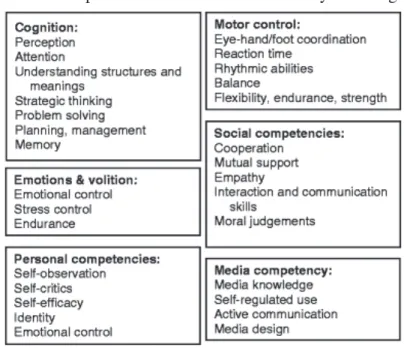
Figure 1 – Competencies that can be enhanced by serious games.
Source: Wiemeyer and Kliem (2012).
On the other hand, games developed and published by companies of the gaming
industry, such as Ubisoft2, EA Games3, Blizzard4 and Id Software5, focus on the
en-tertainment, to increase the sales for the company. Serious games may also aid in the development of mental abilities and skills, including strategy, mental calculation and decision making (ANDRÉS et al., 2014). Another advantage of these games is that they have the potential to address competencies illustrated in Figure 1 without neglecting key elements to the game like fun, flow, motivation and immersion (WIEMEYER; KLIEM, 2012).
Games for health is a category of serious games, thus inheriting the main character-istic of serious games: that a game is developed with a purpose different from entertain-ment. Games for health comprises games developed for various purposes in healthcare, such as rehabilitation, education (for example, to inform the players about good and bad eating habits), prevention and training of professionals (GUO; SINGER; BASTIDE, 2014) (MARCHETTI et al., 2015). One example of the applicability of this category is to use a game for the potential of providing motivation to its user to execute a series of repetitive exercises in a case of motor rehabilitation (SMEDDINCK; HERRLICH; MALAKA, 2015). Another example is to develop a game for health to be employed as a persuasive tool alter the behaviors and/or attitudes of the player (ORJI; VASSILEVA; MANDRYK, 2014), in this case it could be a game to modify the eating and exercising habits of obese children.
These games may employ one of the two following approaches for its creating: explicit or implicit (HUSSAIN; COLEMAN, 2014). In the explicit approach, the game is developed in a way that the player knows that the purpose of the game is to teach him something. On the other hand, the implicit approach disguises this purpose by means of gameplay mechanics.
2https://www.ubisoft.com
3https://www.ea.com
4http://us.blizzard.com
3 RELATED WORK
We decided to perform a mapping study on mobile games for patients of chronic diseases (SÁ et al., 2017) for two main reasons: i) identify the state of the art for such games and ii) identify the validity of proposing a model for the development of them. Through this method, we were able to determine open issues, trends, gaps and chal-lenges in this topic. However, before performing this study, we first conducted a search to ascertain whether there were mapping studies or other types of literature reviews already published on this topic.
3.1 Literature Reviews on Healthcare
DeSmet et al. (2014) made a systematic review and meta-analysis on the effect of interventions that use serious digital games to improve sexual health behavior. The au-thors conducted a search for the articles on four databases: Web of Science, CINAHL, PsycINFO, and PubMed. They searched for studies that employed serious digital games and whether immersive and health-promoting game features were incorporated. Fur-thermore, they investigated the overall effectiveness of serious digital games to promote sexual health behavior using meta-analysis. The number of articles retrieved, initially 7192, was reduced to 7 after employing the inclusion and exclusion criteria, such as removing duplicates, non-qualifying articles based on title, abstract or full text and the absence of a control condition. The goals of these game studies were as follows, from most to least occurring: i) delay sexual initiation among teenagers, ii) decrease sexually transmitted and HIV infections, iii) increase relationship skills and improve resistance against sexual coercion, iv) prevent unintended pregnancy and v) increased condom-protected sex. The results showed that the games had a positive, but small, overall ef-fect on behavioral determinants, and due to the low number of games that successfully satisfied the inclusion criteria, more research is required to better conclude whether the use of serious games on sexual health-promoting behavior is effective.
they established two main objectives: i) assess the background of serious games for the purpose of training professionals and their usability in surgical training and ii) assess the validity of serious games as a teaching method. They searched the articles on five different databases: PubMed, Embase, the Cochrane Database of Systematic Reviews, PyschInfo and CINAHL. The search recovered 1151 articles of which 25 were found to be relevant, describing 30 serious games. These games were split into i) those developed for specific educational purposes (17 games) and ii) commercial games useful, but not developed specifically, for developing skills relevant to medical personnel (13 games). The authors identified various educational purposes within the games: train treatment of burn injuries, train decision steps in a virtual operating room, triage, basic life support, team training, and others. Of the 30 games, six had a process of validation. Of these six games, three were developed for team training in critical care and triage, while the other three were commercially available games applied to train aparoscopic psychomo-tor skills. Moreover, no game had effectively completed a full validation process for the purpose of use. The authors concluded that these methods of interactive learning, in this case the use of serious games, may be applied to train technical and non-technical skills relevant to surgical field, but the games that are developed for this must be adequately validated before integration.
The study performed by Costa et al. (2015) has a generic disposition when com-pared with the other two aforementioned, considering it does not focus on a specific field in the medical area. It consists of a systematic review on games for healthcare. The main goal was to verify the different possibilities of use and the benefits of games applied in healthcare. To search the articles, the authors included four databases: Sci-ence Direct, IEEE Xplore, BioMed Central and PubMed. Of the initial count of 894 retrieved articles, only 99 were accessed. According to the authors, there was an in-crease of approximately 450% in publications in the usage of games on healthcare since 2009. The results showed the areas where the games are most used: rehabilitation of patients with brain damage, cerebral palsy, the reduction of the risk of fall and therapies for overweight people.
Di-rect, Google Scholar, Scielo and PubMed. This search was limited to noncomunicable chronic diseases, particularly diabetes mellitus (DM), cardiovascular diseases (CVDs) and obesity risk. CVDs include hypertension, coronary artery disease, and congestive heart failure. A total of 26 articles were selected by the authors, and the most referred theories were the Social Cognitive Theory (SCT), the Transtheoretical Model (TTM) and the Chronic Care Model (CCM). A basic premise of SCT is that people learn not only through their own experiences, but also by observing the actions of others and the results of those actions (MATIAS; SOUSA, 2016). The TTM has a concept of stages of change, which describes the sequence of steps to successfully change behav-ior: pre-contemplation; contemplation; preparation; action; and maintenance. Finally, the premise of CCM is that people can be better-attended and can live more healthily - and that in parallel, the health care costs can be reduced with the radical change in the model of health care (MATIAS; SOUSA, 2016). The authors concluded that in-terventions based on theory or explicitly described theoretical constructs were effective to influence change behavior through mHealth. Furthermore, despite the potential of mHealth, such applications must have attention to its design and its authors must con-duct rigorous clinical trials in order to prove the effectiveness of mHealth.
The studies mentioned above do not specifically target chronic conditions, they fo-cus on other areas of healthcare. The mapping study presented here targets these condi-tions while addressing the use of mobile games and highlighting the standard features in order to establish the state of the art for such games. This work will be useful for future research performed this field of study and future development of games on this topic.
3.2 Method
The systematic mapping is a method which involves the literature search in order to ascertain the nature, the extent and the quantity of published studies, called primary studies, in a specific field of interest (SOUSA BORGES et al., 2014). Following this context, the systematic mapping performed on this article was conducted based on the procedure described by Petersen et al. (2008), according to which, there are five essen-tial steps to be followed:
Table 1 – Research questions.
Reference Question
General Questions
GQ1 Which chronic diseases are being addressed by mobile games? GQ2 What is the current state of the art for mobile games focused
on patients in the scope of chronic diseases?
GQ3 Are there models/frameworks to develop these games? GQ4 Which methods are used to validate the research? GQ5 What are the challenges found in these studies?
Statistical Questions
SQ Where have the researches been published?
Source: Created by the author.
(ii) Performing the search for relevant primary studies;
(iii) Screening the articles;
(iv) Keywording of abstracts;
(v) Data extraction and mapping.
The purpose of the research questions is to guide the study, delineating the field of interest and what will be searched for. Thus, since we set out to ascertain the use of mobile games in healthcare, more specifically games that focus on patients that are af-fected by chronic diseases, our six research questions (RQs), one of which is a statistical
question (SQ), were elaborated as shown in Table 1.
The next step was to establish the inclusion (IC) and exclusion (EC) criteria based
on the defined research questions. The criteria determines the studies that will be se-lected to advance to the next stage during the systematic mapping filtering and the ones that will be removed. Both types of criteria are important because they aid to narrow down the amount of primary studies which will answer theRQs. The following criteria
were devised (IC= inclusion criteria,EC= exclusion criteria):
• IC2- If several articles reported the same study, only the most recent article was
selected;
• EC1- Articles that were not produced in English;
• EC2- Duplicated articles;
• EC3- Title outside the investigated context;
• EC4- Abstract outside the investigated context, articles consisting of a literature
review and related, articles characterized as grey literature;
• EC5- Articles that do not address chronic diseases;
• EC6- Articles that do not use/propose mobile games;
• EC7- Articles that use/propose games not focused on patients;
• EC8- Articles that do not employ/propose a model or framework.
To conduct this study, five databases were included: IEEE Xplore, ACM Digital Library, PubMed, Springer and ScienceDirect. The search string used in the databases was created by first defining the major terms and then the synonyms for those terms. The majors terms are “game" and “chronic". The synonyms for “game" are “games", “video game" and “video games", whereas the synonyms for “chronic" are “chronic disease", “chronic disorder", “chronic condition" and “chronic illness". It is necessary to highlight that we did not include the term “mobile" since this term will always appear combined with the term “game" or its synonyms. The last search date was Janurary, 12th 2017.
Table 2 – Searches in databases.
Database Search
IEEE Xplore ((“game" OR “games" OR “videogame" OR “videogames") AND ((“chronic" OR “chronic disease" OR “chronic disor-der" OR “chronic condition" OR “chronic illness") OR (“obe-sity" OR “diabetes" OR “HIV"))) NOT (“game changing" OR “game changer" OR “changing the game")
ACM Digital Library (“game" “games" “videogame" “videogames" -“game changer" -“game changing" -“changing the game") AND acmdlTitle:(“chronic disorder" “chronic disease" “chronic illness" “chronic condition" “obesity" “diabetes" “HIV") AND recordAbstract:(“chronic disorder" “chronic disease" “chronic illness" “chronic condition" “obesity" “diabetes" “HIV") PubMed ((“game"[Title/Abstract] OR “games"[Title/Abstract]
OR “videogame"[Title/Abstract] OR “videogames"[Title/Abstract]) AND (“chronic"[Title/Abstract] OR “chronic dis-ease"[Title/Abstract] OR “chronic disorder"[Title/Abstract] OR “chronic condition"[Title/Abstract] OR “chronic ill-ness"[Title/Abstract] OR “obesity"[Title/Abstract] OR “diabetes"[Title/Abstract] OR “HIV"[Title/Abstract])) NOT (“game changer"[All Fields] OR “game changing"[All Fields] OR (changing[All Fields] AND game[All Fields]))
Springer ((“game" OR “games" OR “videogame" OR “videogames") AND ((“chronic" OR “chronic disease" OR “chronic disor-der" OR “chronic condition" OR “chronic illness") OR (“obe-sity" OR “diabetes" OR “HIV"))) NOT (“game changing" OR “game changer" OR “changing the game")
ScienceDirect ((“game" OR “games" OR “videogame" OR “videogames") AND ((“chronic" OR “chronic disease" OR “chronic disorder" OR “chronic condition" OR “chronic illness") OR (“obesity" OR “diabetes" OR “HIV"))) AND NOT (“game changing" OR “game changer" OR “changing the game")
Source: Created by the author.
Table 3 – Initial and final distribution of the publications according to database.
Database Initial Results Final Results
IEEE Xplore 151 14
ACM Digital Library 14 3
PubMed 576 0
Springer 396 0
ScienceDirect 152 0
Source: Created by the author.
results per database.
The articles selection occurred in January and February 2017 and we did not restrict search by publication date. Figure 2 illustrates the selection process of the studies re-trieved. As it can be seen, the selection process encompasses six filtering steps. Using the strings denoted in Table 2 resulted in a total of 1289 studies during the first steps of the search, with no filter applied. Afterwards, the inclusion and exclusion criteria, men-tioned above, were applied to narrow down the number of studies. In the first step, the Impurity Removal step,EC1was employed, meaning that at the end of this step only
ar-ticles produced in English remained. Then, we removed the existing duplicates (EC2),
which were 25 occurrences dispersed in IEEE Xplore, PubMed and ScienceDirect. Af-terwards, we commenced the Filter by Title step, in which EC3 was applied: 86.5%
of the 1289 articles were removed, resulting in 174. The next step, Filter by Abstract, employedEC4, started with those 174 articles and had 68 remainders. We followed one
additional rule during the Filter by Title and Filter by Abstract steps: we only removed articles that we were completely confident that were not within the investigated context. When there was doubt whether the article was relevant or not, it would be passed to the next filtering step, where it would be more thoroughly reviewed and, if it was the case, removed.
Next, the articles were filtered by introduction and conclusion through EC5,
re-sulting in a total of 39 articles. Finally, in the Filter by Full Text step we employed
EC6and EC7while screening all 39 articles completely, this step narrowed the
Figure 2 – Study selection process.
were produced in English, had the text within the investigated context, did not consist of literature reviews and/or grey literature, addressed chronic diseases and used and/or proposed mobile games which were focused on patients.
3.3 Results
We employed additional filters on the Impurity Removal step for the following databases: PubMed, ScienceDirect and Springer. These three databases returned a con-siderable higher number of articles when we employed the search strings denoted in Table 2, because they encompass a wider range of areas of research. Thus, we had to apply another layer of filters to narrow down the number of articles. PubMed comprises citations for biomedical literature, life science journals, and online books; we applied filters of specific article types, text availability and to exclude articles that were not re-lated to humans. ScienceDirect provides access to scientific and medical research, it comprises Physical Sciences and Engineering, Life Sciences, Health Sciences, and So-cial Sciences and Humanitie. The filters applied on this database were related to the topic of the articles: of all the topics that were available, we selected the ones that more precisely represented the types of studies that we were trying to retrieve, which were the “hiv" and “obese" topics. Springer includes scientific documents that are distributed throughout a wide spectrum of disciplines, such as Architecture and Design, Astronomy, Chemistry, Computer Science, Law, Philosophy, Statistics, and many more. Therefore, we delimited the search for articles within the Computer Science discipline, specifically the Information Systems and Applications subdiscipline.
3.3.1 Statistical Question
cles.
Source: Created by the author.
diabetes, 4 of the 17, in the years of 2010, 2012 and 2015. Two more conditions exist: arthritis in 2013 and tinnitus in 2016.
More than half of the studies, 82% (14 articles), were published by IEEE Xplore. Followed by ACM Digital Library, who published the remaining 18% (3 articles) of the total. Thus, answering the statistical question (SQ) defined in Table 1. By analyzing
where the studies were published, we can identify that the two venues to search research on mobile games focused on patients with chronic diseases are IEEE Xplore and ACM Digital Library. Moreover, 12 of the 17 articles were published in conferences, while the other 5 articles were published in symposiums.
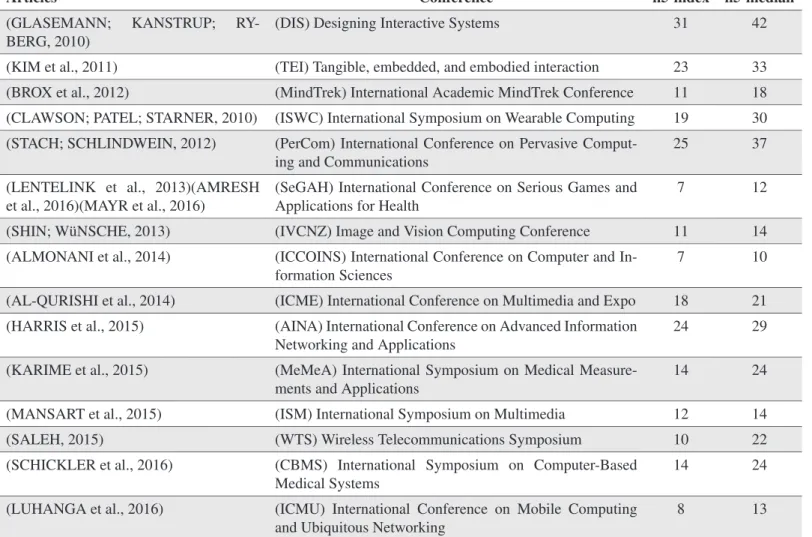
Table 4 shows the h5-index and h5-median of the conferences where the articles were published. The h5-indexes and h5-medians presented in Table 4 were obtained through the Google Scholar Metrics1, which is currently based on Google’s index as
it was in June 2017. As stated by Google, the h-index of a publication is “the largest number h such that at least h articles in that publication were cited at least h times each”, additionally the h-median is “the median of the citation counts”. Finally, the h5-index
Table 4 – H5-index and h5-median of the conferences where the articles were published.
Articles Conference h5-index h5-median
(GLASEMANN; KANSTRUP; RY-BERG, 2010)
(DIS) Designing Interactive Systems 31 42
(KIM et al., 2011) (TEI) Tangible, embedded, and embodied interaction 23 33 (BROX et al., 2012) (MindTrek) International Academic MindTrek Conference 11 18 (CLAWSON; PATEL; STARNER, 2010) (ISWC) International Symposium on Wearable Computing 19 30 (STACH; SCHLINDWEIN, 2012) (PerCom) International Conference on Pervasive
Comput-ing and Communications
25 37
(LENTELINK et al., 2013)(AMRESH et al., 2016)(MAYR et al., 2016)
(SeGAH) International Conference on Serious Games and Applications for Health
7 12
(SHIN; WüNSCHE, 2013) (IVCNZ) Image and Vision Computing Conference 11 14 (ALMONANI et al., 2014) (ICCOINS) International Conference on Computer and
In-formation Sciences
7 10
(AL-QURISHI et al., 2014) (ICME) International Conference on Multimedia and Expo 18 21 (HARRIS et al., 2015) (AINA) International Conference on Advanced Information
Networking and Applications
24 29
(KARIME et al., 2015) (MeMeA) International Symposium on Medical Measure-ments and Applications
14 24
(MANSART et al., 2015) (ISM) International Symposium on Multimedia 12 14 (SALEH, 2015) (WTS) Wireless Telecommunications Symposium 10 22 (SCHICKLER et al., 2016) (CBMS) International Symposium on Computer-Based
Medical Systems
14 24
(LUHANGA et al., 2016) (ICMU) International Conference on Mobile Computing and Ubiquitous Networking
8 13
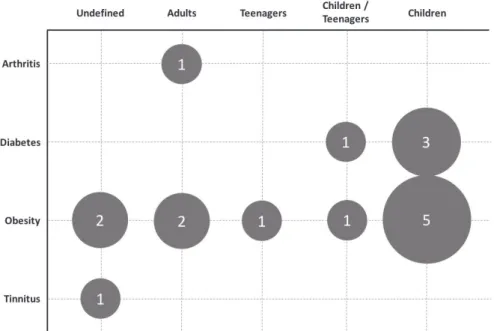
Figure 4 – Publications arranged by chronic condition and target group focused on the articles.
Source: Created by the author.
and h5-median of a publication are the h-index and h-median of the articles that were published in the last five complete calendar years.
3.3.2 General Question 1
The research questionGQ1“Which chronic diseases are being addressed by mobile games?"is answered by analyzing Figure 4, which illustrates the publications arranged
Reference Game Description Genre Platform
Glasemann, Kanstrup and Ryberg (2010) The ‘food quiz’ game is a simple training game designed for mobile smartphones and is to be used by young diabetics. The players have to select the correct amount of bread units based (10 to 12 gram carbohydrates in food) on the description and a photograph of the food.
Quiz Mobile smart-phones. OS not specified.
Kim et al. (2011) The Grocery Hunter is used by kids when accompanying their parents on shopping trips. The system provides the child with a clue about a healthy grocery store item located in the vicinity, and the child must search for this item. Once the child has found what they think is the appropriate item, they simply scan the item with the Grocery Hunter.
Puzzle Custom mobile platform.
Brox et al. (2012) The players use different types of transportation, in a race to get to the goal first. The game tricks the players into unknowingly using their knowledge about insulin – fuel is food, oil/air is insulin and speed is exercise level.
Racing Smartphones, OS not specified
Clawson, Patel and Starner (2010) Dancing game that uses wireless 3-axis accelerometers that are worn around the ankles of the players to record their movement. The mobile smartphone is used to control the game and to display graphics.
Dancing Android
Stach and Schlindwein (2012) Players build their castle with a protective wall around it by entering the value of a blood sugar level (BSL) measurement for the first time. From then on, the location of each measurement will become a tower point to give more scoring points and more protection against mysterious Dark Forces. The objective of the game is to protect the castle and earn as many points as possible. Thereby, the player is forced to walk around and measure the BSL regularly.
Exergame Web based
Lentelink et al. (2013) A exergame that strives to stimulate players to stay active. They receive rewards in the form of credits for completing a daily goal. As the players achieve daily goals, they are rewarded with extra credits and a higher level and which may also result in the character losing weight (the avatar gets slimmer). At the end of the week the remaining stored steps will be deleted and the game will start again with new daily and weekly goals.
Exergame Android
Shin and Wünsche (2013) A golf simulation game in which users have to perform two types of exercises: a swing to simulate a drive or put, and walking to the current position of the ball. A game consists of three, six or nine hole courses. Users can play against each others or play alone and try to improve their own score.
Simulation Android
Almonani et al. (2014) A series of different mini-games that teach children healthy eating habits, some games do not involve activities and others do, such as jumping and running.
Mini-games
Smartphones, OS not specified AL-Qurishi et al. (2014) Exergame in which obese patients compete against each other. The player with most
stars wins. To collect stars users have to run in real world.
Exergame Android
Harris et al. (2015) All games are basic 2D arcade games, with play mechanics that range fromAngry BirdstoPokémonandBubble Pop. Each game uses the gaming interface to teach about the topic of that particular game.
Mini-games
Smartphones/ tablets, OS not specified Karime et al. (2015) A flying cow has to avoid obstacles that are encountered on the way by jumping over
them. The users have to keep up with the speed of the cow during the game by moving their steps in a certain speed. They can also make the cow avoid the obstacles by jumping on the floor.
Exergame Android
Mansart et al. (2015) It employs a game story and the physical activity of the users with associated energy expenditure information as a motivational support for encouraging people to initiate their exercise routines. It utilizes GPS technology to keep track of the outdoor activities of the users.
Exergame Android
Saleh (2015) Treasury Hunt Game. Treasures are hidden in everyday environments, such as parks, school or shopping centers. Different physical exercises such as walking, running, etc. are integrated into the game flow. The game will ask the user to perform a certain physical activity under certain conditions and at certain location in order to gain some scores.
Exergame Smartphones, OS not specified
Schickler et al. (2016) Patients act as photographers instead of fighters. More precisely, patients must detect animals based on corresponding sounds. They change the heading of their smart mo-bile device to locate the source of the sound and they take a picture. They win points if they successfully photographed the animal.
Simulation iOS/ Android/ Windows Phone
Mayr et al. (2016) In Aquamorra, the players assume the role of a young human-like character of either gender, who crash-landed their spaceship on a strange liquid planet inhabited by three competing families, the Aquamorra. The players must find a way out of this world.
Adventure iOS/Android
Amresh et al. (2016) The players need to help the superhero to rescue his parents. The superhero needs to eat healthy, eat balanced and eat on-time. The super hero also needs to perform the correct exercises and activities to stay healthy. The narrative then breaks several times during a day long mission to ask the child to assist the superhero and make the appropriate choices.
Interactive narrative
Portable de-vice/Computer
Luhanga et al. (2016) HappyInu is a 3-level Android game that we developed where players adopt and care for a pet puppy over 30 days. At the end of the 30 days a dog competition takes place where the two healthiest puppies win cash rewards.
Pet-care Android
Table 6 – Overview of features per game.
Reference Customization Immediate Feedback Rewards GPS Social Aspects Multiplayer
Glasemann, Kanstrup and Ryberg (2010)
✗ ✓ Virtual Points ✗ ✗ ✗
Clawson, Patel and Starner (2010)
✗ ✓ ✗ ✗ ✗ ✗
Kim et al. (2011) ✗ ✓ ✗ ✗ ✗ ✗
Brox et al. (2012) ✗ ✓ ✗ ✗ ✓ ✓
Stach and Schlindwein (2012)
✗ ✗ ✗ ✓ ✗ ✗
Lentelink et al. (2013) Avatars ✓ Virtual Points ✗ ✗ ✓
Shin and Wünsche (2013) ✗ ✓ ✗ ✓ ✗ ✓
Almonani et al. (2014) ✗ ✗ ✗ ✗ ✗ ✗
AL-Qurishi et al. (2014) ✗ ?* ?* ✓ ✗ ✗
Harris et al. (2015) Avatars ✓ Virtual Points ✗ ✗ ✗
Karime et al. (2015) ✗ ✓ ✗ ✗ ✗ ✗
Mansart et al. (2015) ?* ?* Health knowledge ✓ ✓ ✗
Saleh (2015) ✗ ✓ Virtual Points ✓ ✓ ✓
Schickler et al. (2016) Number of animals ✓ ✗ ✗ ✗ ✗
Mayr et al. (2016) Upgrades for the ship ?* Virtual Points ✗ ✗ ✗
Amresh et al. (2016) ✗ ?* Real world prizes ✗ ✗ ✗
Luhanga et al. (2016) Different breeds of dogs ?* Cash and Virtual Points ✗ ✗ ✗
*A question mark indicates missing information, some game features could not be coded because of insufficient information in the article.
Source: Created by the author.
3.3.3 General Question 2
Analysing Tables 5 and 6 we can properly define the current state of the art for mobile games addressing patients with chronic conditions and, thus, answerGQ2.
indirectly learn about healthy eating habits, dancing games to encourage exercise, inter-active narratives, golf simulations to treat arthritis, pet-care games, photography simu-lations, and different types of exergames (when players are required to physically move and perform real world activities in order to play the game (BOULOS; YANG, 2013)). The 10 different game genres identified are listed as follows, from least to most amount of occurrence for that genre in the 17 articles: Exergame (n=6), Simulation (n=2) and Minigames (n=2), Quiz, Puzzle, Racing, Dancing, Adventure, Interactive Narrative and Pet-care (n=1). Given this heterogeneity, in both game genres and core features and de-scription of these games, it is possible to assert that there is no particular trend in games developed for patients with chronic diseases in general. Rather, we can identify a trend on games developed for obesity: these games are frequently developed as exergames, 5 of the 11 (45,45%) games for obesity. Moreover, Android appeared 9 times as the platform for the games, while its competitor, iOS, appeared two times and Windows Phone once.
3.3.4 General Question 3
After peer reviewing the articles, we identified that six articles (35%) proposed mod-els/frameworks to develop games, answeringGQ3. The first study, proposed by
Almo-nani et al. (2014), describes a mobile gaming approach to prevent childhood obesity. The main goal of the MACO framework is to use persuasive technologies, in this case mobile games, to induce children to be physically active and eat healthily. The system consists of two components, the first includes coursewares whereas the second compo-nent includes games, all related to healthy eating habits and physical activities. In the first stage, the players must enter their profile data, such as name, gender, age, weight and height. All this data is loaded into the system before starting the game. The sec-ond step is to calculate the points of the players. Initially the users have access to the coursewares, in which they must answer questions and with each correct answer, points are accumulated. The next stage of MACO, e.g. physical activity games, will be en-abled when the players accumulate 10 points. The persuasive approach is applied in this component to encourage them to eat healthy and perform physical activities.
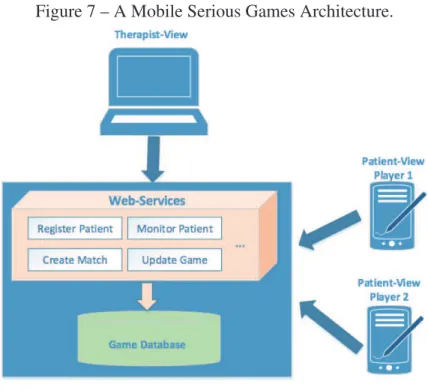
The article of AL-Qurishi et al. (2014) presents a framework whose objective is to support the treatment of obesity. The framework is structured to allow in-game activ-ities to be created and provided to the player by therapists. In this way, it is divided into three components. The component of the therapist is where therapists can register new patients/players, monitor them, create matches and provide guidance. The player component is the mobile application, the game, which allows the players to receive instructions from the therapist and play the games. This application is connected to ECG sensors via Bluetooth, and such sensors transmit the heart rate data to the cloud. The last component is called service, responsible for connecting, transmitting, receiving and manipulating the data. This framework allows therapists to define activities, such as running from point A of the city to point B, which use the GPS features of mobile smart-phones. Another important point is the competitive aspect, so that in some activities the players must compete to decide who can reach the final destination first.
The study proposed in Saleh (2015) describes a multiplayer and pervasive gam-ing system designed to encourage young people in the rehabilitation process of obe-sity, to increase social activities and to help them stay healthy. The system the system captures and processes physical phenomena, daily body activities and contextual infor-mation from the environment, as well as transmit the sensory data to a remote server autonomously. The system observes several phenomena such as blood pressure, body temperature, heart rate, blood glucose level, body movement, physical location, alti-tude, among others. These sensors form a network of body sensors that follows the player. The mobile smartphone used by the user acts as a gateway for the transmission of sensory data to the outside world.
formation about the diet, exercise and medication of the patients as well as biometric information, including weight and diabetes status (glucose and A1C level). In addi-tion, it approves certain actions suggested to the children. Initially, the system operates based on some standard recommendations and then adapts itself to better serve a specific child. All data is stored and processed by a cloud application, responsible for correlat-ing changes in diet and exercise with the correspondcorrelat-ing medical data. The system tries to optimize the actions of the child in order to obtain the best medical results, the child is rewarded in the game for positive results.
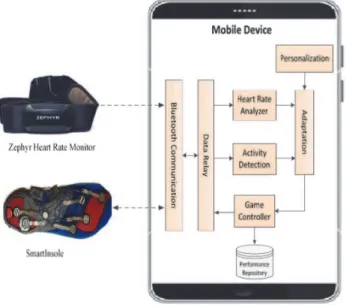
The authors of Karime et al. (2015) proposed a system which aims to encourage children in particular and users in general to interact with mobile-based games by per-forming a number of exercises. The idea is to replace the traditional mobile touching interaction with other means that promote physical activity. The system consists of two gait measuring tools that integrates a number of sensors necessary for gait and move-ment measuremove-ment, called SmartInsoles, that can be placed inside the shoes, a heart rate monitor, and a special software game developed to encourage children to perform jumping and running activities.
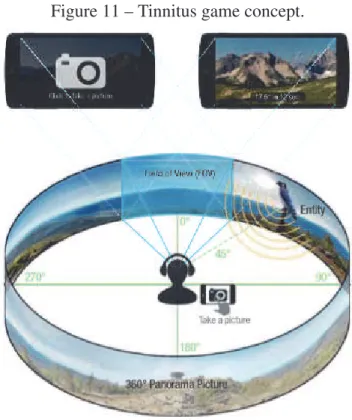
Finally, Schickler et al. (2016) describes a generic framework for serious games al-lowing clinical interventions in the auditory domain. The addressed condition of the article is Tinnitus, that is, the perception of a sound in the absence of a correspond-ing acoustic stimulus. The framework is divided into the followcorrespond-ing components: i) the “repository" component allows the management of scenarios and levels; ii) the “feed-back & evaluation component", in turn, allows to configure feed“feed-back options for players and patients; iii) the “data logger" component stores all the data collected in a database, iv) the “sensor and device" management component covers technical issues of the nec-essary mobile sensors in relation to the peculiarities of the different mobile platforms, and v) there is a component responsible for the 3D audio characteristics.
3.3.5 General Question 4
GQ4questions which methods are currently used to validate these researches. We
Table 7 – Overview of the challenges reported in the studies.
Reference Challenges
(ALMONANI et al., 2014) (BROX et al., 2012) (HARRIS et al., 2015) (MAYR et al., 2016) (SALEH, 2015) (STACH; SCHLINDWEIN, 2012)
No evaluation performed.
(AL-QURISHI et al., 2014) (KARIME et al., 2015) (MANSART et al., 2015)
?*
(GLASEMANN; KANSTRUP; RYBERG, 2010)
Young people had difficulties recognizing and learning from digital representations of food items, estimating specific food/portion sizes and handling numbers (estimation and calculation).
(KIM et al., 2011) Some children found the questions presented in the game too hard, while others found them too easy.
(CLAWSON; PATEL; STARNER, 2010)
The participants had trouble configuring the sensors.
(LENTELINK et al., 2013) How to make the game more engaging and appealing for the users, since the results showed that some users think the game would become boring after a while.
(SHIN; WüNSCHE, 2013) Difficulty to determine the parameters required to compute the driving distance of the ball after a swing and how to motivate the users to walk more instead of swinging from a fixed location.
(SCHICKLER et al., 2016) Difficulty to develop 3D audio features for the different mo-bile operating systems.
(AMRESH et al., 2016) Challenges with the aspect of families completing the game at home. While the authors identified families that had inter-net access at home to complete the game, very few actually did.
(LUHANGA et al., 2016) Certain features were ignored because the participants felt they were burdensome or occurred at inappropriate times. Some users had difficulties engaging with the puppy, be-cause they preferred other pets instead of dogs. The study timing, since it coincided with the Christmas break and many students traveled back to their hometowns. Finally, the platform and language of the game, Android and En-glish, while the participants were Japanese students and most were iPhone users.
participatory design and another used experts to evaluate the gameplay, mobility and usability of the game.
3.3.6 General Question 5
Of the 17 articles, only 8 (47.06%) reported challenges faced during the conduc-tion of the studies, see Table 7 for an overview of these challenges. To answerGQ5,
we observed that the challenges the authors faced in these studies were all specific to each case, we did not identify a common challenge shared across the articles. Not all articles had sufficient information regarding the obstacles faced during the research. Among the challenges discovered are: how to make carbohydrate counting fun for children/teenagers (GLASEMANN; KANSTRUP; RYBERG, 2010); how to properly present visual representations of food so that children may correctly estimate sizes and, thus, practice carbohydrate counting (GLASEMANN; KANSTRUP; RYBERG, 2010); difficulty to formulate health related questions that children can understand and answer (KIM et al., 2011); struggle of the users to adjust and configure external sensors used in the study (CLAWSON; PATEL; STARNER, 2010), which resulted in the partici-pants thinking that the sensors were not functioning properly; complications to develop specific 3D audio features required by the game on the different mobile operating sys-tems (SCHICKLER et al., 2016); how to make de game appealing for the users so that they fell motivated consume it (LENTELINK et al., 2013) (AMRESH et al., 2016) (LUHANGA et al., 2016); ; how to properly simulate the golfing experience and moti-vate elders to execute the physical activities that the game proposes (SHIN; WüNSCHE, 2013).
3.4 Main Models
As shown in Figure 2, we employed one additional filter, the Filter by Model step, to the final 17 results retrieved from the mapping study. This step makes use ofEC8,
which eliminates the studies that do not propose models or frameworks whatsoever. We identified six articles that proposed models or frameworks for developing games that focus on chronic conditions. In this section the models are explained in detail.
3.4.1 Mobile Game Approach to Prevent Childhood Obesity
Figure 5 – Unhealthy food ex-ample one.
Source: Almonani et al. (2014).
Figure 6 – Unhealthy food ex-ample two.
Source: Almonani et al. (2014).
first includes a courseware whereas the second comprises games, all related to healthy eating habits and physical activities. The courseware comprises “My healthy food”, “It is time to eat”, and “My active kids”.
In the first stage of MACO the player must enter his profile data, such as name, gender, age, weight and height. Next, the system asks the user to select a game and level from the available options. Finally, the player chooses between dynamic and static user options for the default system. All this data is loaded into the framework before starting the game. The second step is to calculate the points of the player. Initially the user has access to the courseware, in which he/she must answer questions and with each correct answer, points are accumulated. The next stage of MACO, e.g. physical activity games, will be enabled only when the player accumulates 10 points. Otherwise, the user must play the courseware until acquiring the necessary points to unlock the physical activity games. The persuasive approach is applied in this component to encourage the player to eat healthy and perform physical activities.