3
Expectations on team performance, collective efficacy and
team effectiveness
Catarina Raquel Teixeira
Thesis submitted as partial requirement to obtain the degree Master in Human Resources Management
Advisor:
PhD Ana Margarida Passos, Assistant Researcher ISCTE – Instituto Universitário de Lisboa
5
E
X
PE
CT
A
T
IO
N
S
O
N
T
E
A
M PE
RF
O
RM
A
N
CE
,
CO
L
L
E
CT
IV
E
E
FFICA
C
Y
A
N
D
T
E
A
M E
FFE
CT
IV
E
N
E
SS
C
a
ta
ri
n
a
R
a
que
l Te
ix
ei
ra
i O objetivo deste estudo é contribuir para a investigação sobre a eficácia de equipas, investigando o impacto das expectativas dos membros sobre o desempenho da equipa a que pertencem, considerando-se o papel mediador da eficácia coletiva, para promover a performance da equipa e satisfação. Existindo já diversa pesquisa empírica sobre a importância da eficácia coletiva como um preditor de eficácia, este estudo pretende contribuir para uma melhor compreensão do seu efeito no papel de mediador, no modelo de de eficácia da equipas, IMOI (Input-mediador-Input-Output), assumindo as expectativas de desempenho como um importante input no processo.
Os dados para este estudo correlacional foram obtidos a partir de 175 equipas (799 pessoas) que participaram numa competição de estratégia e gestão, Global Management Challenge. Uma simulação da vida empresarial onde equipas são responsáveis pela gestão de uma empresa fictícia com o objetivo de alcançar o maior valor de ação na simulada bolsa de valores.
Os resultados mostram que as expectativas dos membros da equipa sobre o desempenho estão relacionados com a eficácia coletiva, o desempenho da equipa e satisfação, e as regressões múltiplas levadas a cabo e analisadas apoiaram parcialmente o papel mediador da eficácia coletiva entre o input (expectativas) e os outputs
(performance e satisfação),considerados no modelo de eficácia da equipa analisado nesta pesquisa.
ii
Abstract
The purpose of this study is to contribute to research on the effectiveness of team, investigating the impact of members’ expectations about the team performance they belong to, considering the mediating role of collective efficacy, to promote team performance and satisfaction. Existing already diverse empirical research on the
importance of collective efficacy as a predictor of efficacy, this study aims to contribute to a better understanding of its effect in the role of mediator, in IMOI (Input-Mediator-Output-Input) model of team effectiveness, having performance expectations as an important input in the process.
Data to this correlational study was obtained from 175 teams (799 individuals) who participated on a strategy and management competition, Global Management Challenge. A simulation of business life were teams are responsible for running a fictitious
company with the aim to achieve the highest share price on the simulated stock exchange.
Results show that team members’ expectations on performance are related with collective efficacy, team performance and satisfaction, and the applied multiple regression analyzes partially support collective efficacy mediating role between the input (expectations) and outputs (performance and satisfaction) considered in the effectiveness team model analyzed on this research..
Key words: Team Effectiveness; Expectations; Collective Efficacy;
iii
Acknowledgements
Firstly I wish to express my gratitude to my advisor, Prof.Dr. Ana Margarida Passos, to whom I wish all success, happiness and luck in professional and personal life, without her guidance, tips and advices this dissertation, would not exist. Thanks for all the patience and support in times less good and relentless effort in keeping me
motivated to keep working on it to conclude it.
I also want to thank all my friends and colleagues who accompanied me on this journey, for friendship and mutual support, especially to Bernardo, Miguel, Carla and Margarida.
To my family and friends who cannot be physically present, thanks for all the strength you send me by distance.
iv
Index
1. Executive Summary ... 1 2. Introduction ... 2 3. Literature Review ... 3 3.1. Teams ... 3 3.2. Team Effectiveness... 43.2.1 Theoretical effectiveness models ... 5
3.3. Efficacy – Performance cyclical nature ... 9
3.4. Predictors of Team effectiveness ... 10
3.4.1. Expectations as an effectiveness predictor ... 11
3.4.2. Collective Efficacy ... 12
4. Study Objectives and Hypotheses ... 16
5. Methods ... 18
5.1.Sample/Participants ... 18
5.2. Simulation and Procedures ... 18
5.3. Measures ... 20 5.3.1. Predictor Variable ... 20 5.3.2. Mediator Variable ... 20 5.3.3 Dependent Variables... 20 6. Results ... 21 7. Discussion ... 27 8. Theoretical Implications ... 28
9. Limitations and Future Research ... 29
Bibliography ... 31
Figures Index Figure 1 - Input-process-output framework for analyzing group behavior and performance, by McGrath... 5
Figure 2 - IMOI model ... 7
Figure 3 - Feedback cyclical influence ... 9
Figure 4 - Model of Analyze ... 17
Figure 5 - Mediator behavior ... 23
Figure 6 - Link between predictor and mediator variable ... 23
Figure 7 – 1st Correlation between predictor and dependent variable adding mediator variable ... 24
Figure 8 – 2nd Correlation between predictor and dependent variable adding mediator variable ... 26
v
Tables Index
Table 1- Sample Charactistics ... 18
Table 2 - Descriptive Statistics, Correlation and Reliability Coefficients ... 21
Table 3 - Linear regression of Collective Efficacy... 24
Table 4 - Regression analysis of Team Performance ... 25
1 Teams have become the center of attention of much research, assumed the
increasing importance given to teamwork, where almost of the investigations have the same base of construct with the aim to contribute to knowledge of how to make a team more effective.
One of the first steps to increase team effectiveness is to firstly pay attention to their characterization, in order to understand what an effective team is and what lead to it, by doing it enhances capacity to the enabling of team structure, develop key
relationships, and monitoring external factors that can turn crucial to have effective teams. This situation is the starting point for our research which the main objective was to study the impact of team members’ performance expectations, through the mediating role of collective efficacy on team performance and team satisfaction.
Grounded on our literature review we create a conceptual model, based on three hypotheses, (1) the expectations on team performance is positively related with perceived collective efficacy, (2) the collective efficacy has a positive mediating role between expectations on team performance and final team performance, and (3) the collective efficacy has a positive mediating role between expectations on team performance and final team satisfaction. What we expect, as past investigation on expectations and collective efficacy, is to contribute with more knowledge on different perspectives to achieve more effective teams. Expectations have important
consequences that can affect how well a team, as dynamic, interdependent and adaptive interactions between members’ (Zaccaro, Rittman, & Marks, 2001), perform (Rockman & Northcraft, 2010). And collective efficacy, is an important emergent state (Marks, Mathieu,and Zaccaro, 2001; Kozlowski & Ilgen, 2006; Rico, Alcover de la Hera, & Tabernero, 2011), to achieve higher levels of team effectiveness, supported by multiple researchers.
Fortunately, our research results showed that expectations have impact on team effectiveness, plus collective efficacy mediates that existing relationship. By showing, firstly that all study variables have a direct impact over one another, secondly, positive and better members´ expectations will lead to stronger sense of collective efficacy, which thirdly in turn has a positive mediating role between expectations, team performance and satisfaction.
2 With these statements, we intend to prove that this study presents interesting insights about important predictors for the development of team effectiveness if interpreted in the right way and taken into account.
2. Introduction
In recent years we have seen deep changes in the way work is structured within organizations, and in what extent work market has been an ongoing shift from work organized around individual jobs to team-based work structures. Teams have become important foundations on organizations and they need to adapt more thoroughly their actions in the current environment (Zaccaro, Rittman, & Marks, 2001). This growing interest by teams in the organizational context has also led to a significant increase in research on teamwork.
Given this growing importance of teamwork, teams will be the target of this research, not the concept of team as set of two or more distinguishable people who are together to achieve a common goal, but a team as a whole (Hackman J. , 1990), where a team is no longer a group represented by individuals but those individuals feel
represented by that team.
Individuals as team members need to be aware of their crucial importance as a part of a whole, since team efficacy develops from group interaction and the process of collective cognition, (Gibson, 1999). It became essential to understand and be aware how the development of the cognitive, motivational, affective, and coordination processes influence team effectiveness, (Zaccaro, Rittman, & Marks, 2001).
With this research we aim to contribute to the teamwork research deepening knowledge about variables that can contribute to achieve higher levels of team effectiveness. We will have as base the IMOI (Input-Mediator-Output-Input) team effectiveness model, which support effectiveness of teams as an emergent phenomena, (Rico, Alcover de la Hera, & Tabernero, 2011), consequence of cyclical “episodes”, (Marks, Mathieu, & Zaccaro, 2001), where an input variable plus the impact of mediators as psychosocial mechanisms that allow team members to work, (Rico et al., 2011), will lead to better performance and sa tisfaction outputs which in turn through the effect of feedback turn into new inputs, (Marks, Mathieu, & Zaccaro, 2001; Ilgen, Hollenbeck, Johnson, & Jundt, 2005; Passos & Caetano, 2005).
3 Taking these words into account, the investigation objective is to test
expectations as a predictor input (Rockman & Northcraft, 2010) , and collective efficacy as a mediator (Bandura, 1997; Kozlowski & Ilgen, 2006) in the dynamic process of team effectiveness. Expectations are here represented by the members’ expectations on the performance of the entire team, and collective efficacy as an emergent state of shared belief of conjoint capability.
The decision to focus on this type of processes came firstly from my personal interest in human resources management approaches based on a more psychological and sociological intervention. Besides being aware of the actual economic, organizational, social, national and international conjecture, in my point of view and starting from some authors’ research studies, such as Lopes and Correia (2003), managing people starts to become more a question of ethical principles than a simple use of human resources management instruments.
3. Literature Review
3.1. Teams
How can a team be characterized? It is the first concept that we need to be aware to, regarding their growing importance in most of the organizations’ reality that rely on teams to obtain their goals.
Teams can be characterized as a set of two or more individuals that through a dynamic, interdependent and adaptive interaction work together aiming to achieve a common goal in organizations; (Zaccaro, Rittman, & Marks, 2001).
They can share more than one common goal and they exist to perform
organizationally relevant tasks, interact socially, exhibit task interdependencies and maintain and manage boundaries; (Kozlowski & Ilgen, 2006).
As a team, this set of interdependent individuals who contribute in a different and unique way to achieve the needed collective action, becomes necessary to coordinate and synchronize their contributions in order to achieve the defined goal; (Zaccaro, Rittman, & Marks, 2001).
It is also important to be aware that usually they are embedded in an organizational context which creates constrains and boundaries (Kozlowski & Ilgen, 2006), so teams
4 exist in context, perform across time and interact within and with others inside their context; (Ilgen, Hollenbeck, Johnson, & Jundt, 2005).
“These interactions change teams, team members and their environments” (Ilgen et al., 2005, p. 519), which interfere on the path to construct from a set of individuals an effective team.
What’s the importance of being aware of their characterization? After analyzing some literature regarding to team concept, it is clear that teams become to be seen as more than one group of individuals who give their each contribution. It becomes evident that in order to have teams as an effective element of an organization, it is needed to have awareness of their construct as interactions within members, since if individuals do not understand that to build it they need to perceive themselves as interdependent
elements that need to adapt and interact dynamically, that will create a strong barrier to form a team able to achieve goals in an effective way.
Teams’ context as literature research defined underscores the importance that should be given to variables that can positively affect the way how members can more
effectively interact socially, deal with task interdependence and manage constrains and boundaries of their work. Also team diversity is represented by the members’ individual attributes to affect team resources and efficacy, and the use of those attributes will be affected by how they perceive their context.
For last, it is important to be aware of team characterization in order to have
conscious that not all teams are alike, some have more homogeneous members some do not, certain work in intense and complex environments some in more stable, and they can be also distinct based on how long they remain together as a unit; (Mathieu, Maynard, Rapp, & Gilson, 2008).
3.2. Team Effectiveness
Team effectiveness will be the result of team members’ interactions which will represent the performance and satisfaction that they were able to achieve, (Gladstein, 1984). These interactions will have different results or outcomes according to their background, or inputs.
5 It was suggested a three-dimensional conception of group effectiveness by Hackman (1990), defended that team efficacy depends on their position in what concerns to the following dimensions:
Degree to which team’s output meet the expected standards of quality, quantity, and achieve the expectations of their receptors, reviewers or users (objective performance);
Degree to which team work processes enhances members capability to keep working together interdependently, creating or not a performing unit that becomes more capable over time;
Degree to each team experience contributes to the development and growth of members satisfaction;
The weight given to these different dimensions depend on team circumstances, moreover teams develop and enact their own versions of reality so understanding the processes that leads to that creation it becomes essential if you aim to understand determinants of team effectiveness, (Hackman J. , 1990).
3.2.1 Theoretical effectiveness models
IPO model
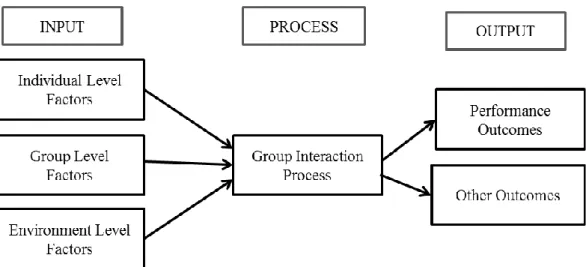
The first’s effectiveness model leaned out on an input-process-output framework initially modeled by McGrath (1964), being the framework for studyng team
effectiveness is presented by:
Figure 1 - Input-process-output framework for analyzing group behavior and performance, by McGrath
6 The assumption defended by this model is that process mediates the relationship between inputs and outputs, existing different characteristics of input-output which influences significantly team effectiveness, (Hackman R. , 1987). Where inputs are individual, group and environment antecedent factors that can empower or restrain members’ interactions, (Mathieu, Maynard, Rapp, & Gilson, 2008) as for example pattern of member skills, and level of cohesiveness and group task characteristics. The combination of these inputs drive team processes as member’s interactions to achieve task accomplishment (Mathieu et al., 2008), designed as Group Interaction Process, that is also considered as a patterned relation among team members; (Marks, Mathieu, & Zaccaro, 2001).
The importance of processes comes from the fact that they are responsible for describing how team inputs turn into outputs; (Mathieu et al., 2008).
In what concerns on effectiveness outputs they can be characterized by: Judgments of performance by important others external to the team, being in the case of this research the objective performance achieved by the analyzed teams; The meeting with team members’ needs, that in this research represent the team satisfaction; and the will of members’ to remain in the team; (Kozlowski & Ilgen, 2006).
Although IPO model has been used over the years by researchers as a value guider, there was some controversy surrounding its appropriateness in what concerns on the characterization of the team processes. More recent team literature showed that they are not really process but emergent cognitive or affective states, defining team process as “members’ interdependent acts which convert inputs to outcomes through cognitive, verbal, and behavioral activities directed toward organizing taskwork to achieve collective goals”, (Zaccaro, Rittman, & Marks, 2001, p. 356). Researchers such as Ilgen, Hollenbeck, Johnson, and Jundt (2005), notice that many of the mediator factors that interfere and conduct the influence of team inputs to outcomes are not processes, starting to heard about emergent states, that will be further discussed throughout this study.
With this it became possible to distinguish Team processes, which represent team interactions or actions that create outcomes, from Emergent states, which are products of team experiences, developed during team life and have impact in their outcomes, showing that time plays a critical role in team functioning; (Marks, Mathieu, & Zaccaro,
7 2001). These emergent states become new inputs to subsequent processes and
outcomes, showing other controversy on IPO framework that imply a linear relation from inputs to outputs, becoming deficient to explain team effectiveness achievement, which lead to increase the importance given by researchers to the temporal dynamics in teamwork leading to the development of new models, (Marks, Mathieu, and Zaccaro 2001; Ilgen, Hollenbeck, Johnson, and Jundt 2005; Mathieu, Maynard, Rapp, and Gilson 2008).
IMOI (Input-Mediator-Output-Input) model
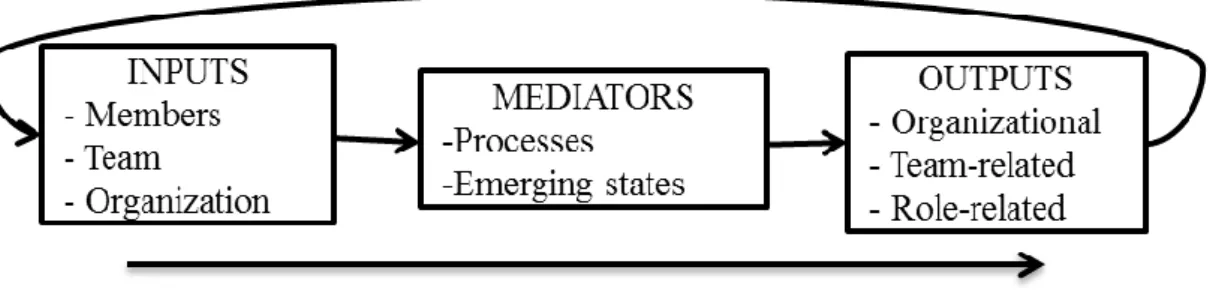
In order to feel the still existing gap in IPO model, researchers propose an alternative model IMOI, Input-Mediator-Output-Input, distinguished by relying on mediators as emergent states that explain team effectiveness variations, and by adding the also fundamental cyclical nature of team functioning, (Ilgen, Hollenbeck, Johnson, & Jundt, 2005), as the following figure shows:
Instead of considering team performance in a sequential of IPO cycles, we start to focus on the idea that it is a consequence of episodic approaches, characterized by distinguishable periods of time over which performance accrues and feedback is available (Marks, Mathieu, & Zaccaro, 2001, p. 359), and where outcomes from initial episodes often become inputs in the subsequent.
Episodic approach claim that team must perform different processes at different times adapted to task demands that return in a cyclical mode, which highlight the cyclical nature of feedback processes, (Marks et al., 2001). The developmental
8 processes, as figure 2 suggest, show how teams are differentially affected by various factors and qualitatively change as they mature over time; (Mathieu, Maynard, Rapp, & Gilson, 2008).
According these statement, inputs, mediators and outputs can be defined as: o Inputs
Inputs are resources that can be considered at different levels, members’, group and organizational resources, which can represent facilitators or inhibitors to team
effectiveness; (Rico et al., 2011).
o Mediators: Processes, Emerging states
Mediators can be defined by psychosocial mechanisms that allow team members to work, combining the available resources and overcoming the challenge of coordinate and motivate the members; (Rico et al., 2011).
- Processes: divided into task processes, as the functions members need to realize for the satisfactory performance of the teams’ task, and relational processes which involve team members’ interactions, (Marks, Mathieu, & Zaccaro, 2001). - Emerging states: defined as cognitive, motivational and affective team states,
with a dynamic nature, and variable in accord with their context, inputs, processes and outcomes; (Marks, Mathieu, & Zaccaro, 2001).
Adopting the approach of the research of Rico et al.( 2011), outcomes can come from three different levels, organizational, team-related and role-related, and can be of three different types, functioning, which represent relevant actions to achieve outcomes, performance, that are the consequences of functioning, and attitudes.
Taking into account the additions that this model brought to research, we focus on the introduction of the concept of emergent states by Marks et al. (2001). Over the years this concept has come to the attention of researchers, for example, Jehn, Greer, Levine, and Szulanski ( 2008) add a definition stating “Emergent states refer to the positive attitudes, values, motivations, and cognitions of group members that can directly influence group outcomes” (p.468).
Emergent states were also defined as processes that capture temporal dynamics such as motivational tendencies, relations among team members, and affective reactions which tend to stabilize over time, (Kozlowski & Ilgen, 2006). Research suggests that positive emergent states such as trust, team cohesion, potency and collective efficacy,
9 lead to a stronger effort, positive attitudes and cooperation of members that increase both performance and satisfaction (Kozlowski and Ilgen 2006; Jehn et al. 2008; Rico et al., 2011). Throughout this research we will assess if collective efficacy, as an emergent state, is treated as a mediator for team effectiveness. So in latter literature coverage there will be a review on what truly collective efficacy is and how its relationship with team effectiveness works.
Just a model with these characteristics fits to what we consider to be a team, it would not make sense to consider team effectiveness a not dynamic process when to consider a set of individuals a team predicts the existence of dynamic, interdependent and adaptive interactions.
Basing on the IMOI model we started to consider team effectiveness not a static perspective to be aware of the dynamic processes that underlies it, seeing that
“effectiveness of teams constitute emergent phenomena (patterns resulting from regular and repeated interaction of their members)”; (Rico, Alcover de la Hera, & Tabernero, 2011, p. 59).
This model is the one that supports this research where the aim is to check the relation between an input variable, performance expectation, through a mediator emergent state, collective efficacy, on the team performance and satisfaction. Since it’s the more appropriate and suitable for the variables in study seeing that is the one which rise up to seeing beyond tasks, functions and processes.
3.3. Efficacy – Performance cyclical nature
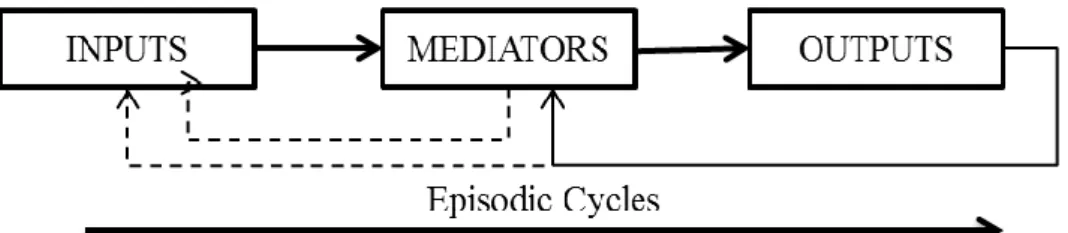
Figure 3 - Feedback cyclical influence (adapted from Mathieu et al., 2008)
As it was already mentioned, a team’s effectiveness it’s a result from cycles of episodes, where past experience can become the explanatories of predictors of a new
10 cycle. This relation is supported by the “Output-Input” phase of IMOI model, which represent the end of an episode where performance feedback is available (Marks et al., 2001), and the beginning of a new cycle where outputs turn into new inputs, (Ilgen, Hollenbeck, Johnson, & Jundt, 2005).
It’s important to note that such feedback take place only when team transact from one episode to another, (Mathieu, Maynard, Rapp, & Gilson, 2008).
Feedback can have different effects in the various interveners of team effectiveness construct, as the lines of figure 3 suggests feedback from outcomes to subsequent mediators is probable to be quite influential since team states are likely easily influenced by team progress over time and they easily adopt different processes as function of outcomes, while outcome and process influences on later inputs would probably be less potent or immediate, (Mathieu et al., 2008).
This cyclical nature of effectiveness reflects the existence of an influence
relationship between past performance feedback and future team performance, as the empirical study carried out by Passos & Caetano (2005) showed, finding strong support evidences that effective past performance feedback is positively associated with the actual team performance, therefore “past effective decisions may reinforce the decision-making processes previously used by team members” (Passos & Caetano, 2005, p. 241).
Other focal point of providing performance feedback is that it will support team members to develop expectancy on future performance based on what they recive about their past results, (Bandura, 1997).
Performance feedback can lead to three kind of individuous responses of categories, cognitive, behavioral and affective (Taylor, Fisher, & Ilgen, 1984).
3.4. Predictors of Team effectiveness
Team effectiveness as the fruits resulting from the model presented above can be affected by predictors from different levels origin, organizational, individual or team level, and with different roles in the process, this is the predictor can have the role of input or mediator.
In order to enhance team effectiveness it’s essential to know about the critical team processes and emergent states with cognitive, affective-motivational, and behavioral nature developed from repeated interactions among individuals which have the tendency
11 to regularize and then serve as a guide to new subsequent interaction episodes
(Kozlowski & Ilgen, 2006).
Team effectiveness can be influenced by diverse collective constructs, team action and behavioral processes, and by emergent states, team interpersonal, motivational and affective processes, (Kozlowski & Ilgen, 2006) being these last influencers that we will focus on. Emergent states, as group-level phenomena, were in past seen as the effect of group psychosocial traits, defined as shared understandings, beliefs, or emotional tone, (Cohen & Bailey, 1997).
3.4.1. Expectations as an effectiveness predictor
Team work implies the need of members’ discussion and sharing of ideas in order to achieve decisions (decision-making processes), and the way how individuals engage in such discussions are factors that will lead to varied expectations among team members, “expectations that can affect how well the team performs”; (Rockman & Northcraft, 2010, p. 309).
Given the importance of the expectations consequences, Rockman and Northcraft (2010) developed a model regarding the role of team member expectations on team performance and team member satisfaction.
The model focus on individual competitive expectations, that can be defined as individual expectation on the entire team in what concerns to the degree of difficulty that can exist to reach a team decision agreement (competitive or cooperative); (Rockman & Northcraft, 2010).
Expectations are formed quickly and shape perceptions and attributions, (Rockman & Northcraft, 2010), becoming then an efficacy predictor since through general
perception processes, expectations can influence behavior, such as the idea that expecting an event could happen increase the likelihood of that event really happen, (Liden, Wayne, & Stilwell, 1993). As Bandura (1997) claim team performance is usually determined by team members’ expectations that positive outcomes will be obtained through continuous success of their task as a collective.
Experimental studies found that outcome expectations were an important predictor of group efficacy, (Jung & Sosik, 2003, p. 7), being this concept another important variable of this research since we want to test if expectations are an effectiveness predictor but undertaken the possible mediator effect of collective efficacy.
12 Expectations are often studied in interpersonal relationships context, considering that individuals process and attributing all the information they receive using then expectations to determine whether they remain engaged in disengage from such relationship, (Rockman & Northcraft, 2010). Therefore, in order to study the
effectiveness outcomes at the individual and team level, satisfaction and performance as we want to test in this research, it is essential to take into account not only team
processes but also how individuals’ process, perceive, and judge the information related to their team that will direct their behavior.
Thus to our research interest, contributing to a better understanding and awareness of expectations as a effectiveness predictor, and based on the study developed by Rockman & Northcraft (2010) must retain that the expectations on team performance are the development of the degree to which members’ belief that reaching a team decision will be easy or difficult; each action in a team is conducted by the context of the past experiences (background) of team members, which influence their expectations.
“Teams are not created from empty space; they are composed of people with personalities, histories, and past team experiences”, (Rockman & Northcraft, 2010, p. 327), and each individual expectations will rely in those individual differences.
3.4.2. Collective Efficacy
So what Collective Efficacy is? Teamwork on companies has been widely used to accomplish organizational goals and objectives. Nowadays employers look for a “niche” set of skills in employees that affect positively their ability to work as a group, more known as group efficacy or collective efficacy (CE), which definition was target of various theoretical perspectives.
Jung and Sosik (2003) explain, basing themselves on Parker’s work (1994), that group efficacy refers to “group members’ collective perceptions about how efficacious their group is”. This statement sums up what collective efficacy is and how it can possibly affect team effectiveness, as a mediator variable.
Other research studies presented team efficacy or collective efficacy as group-level phenomena, and it concerns to a shared belief of conjoint capability, in an organization is the belief of the team members in what concerns to their performance capability as a whole, (Kozlowski & Ilgen, 2006; Bandura, 1997).
13 Taking these words into account, in a team level, perceived collective efficacy regard to the judgment of members that team as a whole is able to organize and execute actions to achieve positive outcomes, (Goddard, Hoy, & Hoy, 2004).
The reason behind collective efficacy being an emergent state resides in two main factors, with the two concept definitions in mind. First emergent states are identified as group of positive attitudes and motivations of group members, according to Jehn, Greer, Levine, and Szulanski (2008), and represent an influence in group outcomes. Second collective efficacy, as defined earlier, is a group-level phenomenon and represents the perceptions of group members as being able to achieve positive outcomes. In summary, both emergent states and collective efficacy are represented by groups of team
members, have the need of positive attitudes and actions (being able to organize and execute actions is positive), and influence group outcomes (also positively, but in this case, regarding the collective efficacy).
And, how does it emerge? Collective efficacy is a construct that was derivative from self-efficacy (Jung & Sosik, 2003), which refers to an individuals’ belief about his or her ability to accomplish goals. It was defended by Bandura (1997) that the
determinants of collective efficacy beliefs operate almost in the same way of those beliefs in the individual level, although further researches defended that CE may have different antecedents that shape its evolution (Gully, Incalcaterra, Joshi, & Beaubien, 2002).
It was stated that collective efficacy is not merely beliefs of the individuals in themselves or in the group, but it is formed by interaction processes “that do not occur during self-efficacy formation or when members form individual beliefs about their group” (Gibson, 1999, p. 138). Claiming that it is necessary a collective cognitive process of interaction where:
- Information is shared, weighted and assimilated;
- Group members collectively exchange, obtain, store and manipulate information about: each other, their context, process, task and prior performance;
This statement also meets Zaccaro et al. (1995), collective efficacy definition as “a sense of collective competence shared among members when allocating, coordinating,
14 and integrating their resources as a successful, concerted response to specific
situational demands” (p.309).
When these processes are putted into practice, team exchange and integrate information, members’ negotiate interpretations of factors that influenced past efforts and factors that can increase chances of success (Gibson, 1999), arguing that collective efficacy also arises from past events which influence team members. This supports the use of a team effectiveness model where cyclical episodes are considered, as it becomes evident the importance of transition phase from outputs to inputs, given the impact of past performance feedback in variables that predict team effectiveness.
Whereas that collective efficacy is a perception that obviously integrates the group’s context and constraints, (Tasa, Taggar & Seijts, 2007), so different types of teams will face different reality boundaries that can facilitate or hinder the collective efficacy construct process, however as Morgeson and Hofmann (1999) stated “it is not the collective construct, per se, that determines the behavior of individuals, it is the individuals (or collective) who determine the collective construct, and, through their actions, influence the behavior of others in the collective” ( p. 251).
What are its impacts? Collective Efficacy has impact on how members manage their plans, strategies and resources, on what they pursue to achieve and the effort they put in favor of teamwork, it also affect their reaction and vulnerability to collective efforts failure, an opposite force and discouragement, (Bandura, 1997). By previous studies it was founded that presence of high collective efficacy appear to motivate individual team members to more relevant performance team-member behavior, which led members to put in practice high-quality group processes, team to perform better, and feeds the development of collective efficacy and performance over time, (Tasa, Taggar & Seijts, 2007).
The study putted in practice by these authors also suggest that how well a team function and perform through the time it’s probably affected by the initial levels of collective efficacy which can have a positive long-lasting effect. When feedback is about the team as a whole that is on a group level and not on the individual level, individuals will feel more the presence of a link between them since they will be automatically exposed to the evidence about their capabilities together, evidence about what their team can or not put together or construct in order to achieve success, (Tasa,
15 Taggar , & Seijts, 2007), which will affect their sense of collective efficacy and in turn team performance and satisfaction.
So teamwork behaviors may be responsible for the continuous creation and
development of collective efficacy sense within the team, since those behaviors will be assessed and incorporated into future perceptions of CE, as Jung and Sosik (2003) stated based on Bandura’s (1986) work, “collective efficacy has a direct effect on performance and performance feedback affects performance via group members’ perceptions of group efficacy” (p.385). Gully et al. (2002) meta-analysis, which was based on 53 empirical studies also support by the finding of evidences that collective efficacy is positively related to performance.
Past studies testing the effect of collective efficacy on team performance, tested on new teams first performance phase and after they complete eight physically demanding tasks, showed that as they spend more time working together teams collective efficacy perceptions become more homogeneous (Zaccaro, Blair, Peterson, & Zazanis, 1995).
An empirical study result, with 40 work teams of engineering students, carried out by Katz-Navon and Erez (2005) also demonstrate a signiticant effect of collective efficacy on team performance, as theoretical support of their research authors have referred to other studies from distinct researchers which findings showed, (Katz-Navon & Erez, 2005, p. 444):
o “High collective-efficacy teams improve their performance following failures (...).”
o “Team efficacy perceptions predicted performance of hockey teams better than the aggregated self-efficacies of the players.”
o “Collective-efficacy was positively correlated with group performance in a field of nurses in hospitals (…).”
o “Collective-efficacy beliefs of teachers had positive effects on school achievements (…).”
o “Collective-efficacy also had a significant effect on the level of goal difficulty set by the team, and on the team’s consequent performance; perceptions of high collective-efficacy led to higher goals being set by the team, which resulted in high performance levels.”
16 All this referred authors by Katz-Navon & Erez (2005), fortify the acceptance of collective efficacy as an important emergent state to achieve higher levels of team effectiveness.
According all these statements, collective efficacy is strongly supported as an important predictor of performance and past performance as an important antecedent and mediator to further collective efficacy. However, less is known about the role of collective efficacy as a mediator from an input, such as performance expectations, and team performance and satisfaction.
To summarize, previous research has already found links between collective efficacy and performance, and between expectations and performance, still existing a lack of studies that have investigated whether this relation is mediated trough collective efficacy. It may be that such as positive performance feedback, influence collective efficacy which in turn influence future team effectiveness, positive expectations as the belief that team will reach positive performance may also relate to collective efficacy as a mediator to higher levels of team performance and satisfaction.
4. Study Objectives and Hypotheses
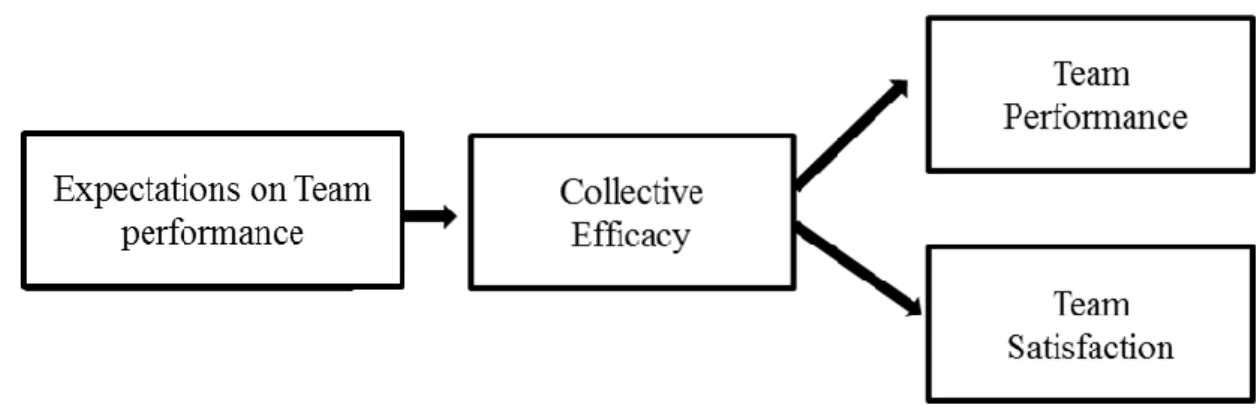
The present study aims to analyze the impact of performance expectations on team effectiveness (team performance and team satisfaction) considering the mediating role of collective efficacy.
Therefore, we intend to test whether the expectations about team capability to together achieve positive performance have impact in the creation of their sense of collective efficacy, which in turn act as a mediator to team performance and satisfaction.
In other words, the intention is to check if collective efficacy acts as a mediator in the relationship between initial members’ expectations and team performance and satisfaction.
By doing this analyze we aim to contribute for the study, understanding and given value to:
o The individual beliefs that are truly important to achieve the so indispensable teamwork;
17 o The importance that should be given to team level constructs, particularly
Collective Efficacy, which can become the support of team performance and satisfaction.
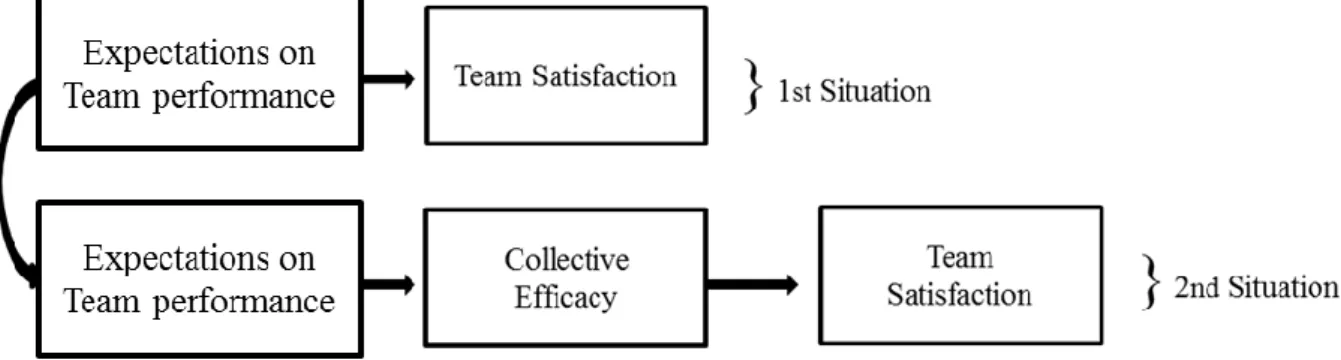
In order to give an answer to our study objective, we propose the following conceptual model of analysis:
Figure 4 - Model of Analysis
With this model of analysis we will test the following hypotheses:
Hypotheses 1: The expectations on team performance are positively related with perceived Collective Efficacy.
Hypotheses 2: The Collective Efficacy has a positive mediating role between expectations on team performance and final team performance.
Hypotheses 3: The Collective Efficacy has a positive mediating role between expectations on team performance and final team satisfaction.
18
5. Methods
5.1. Sample/Participants
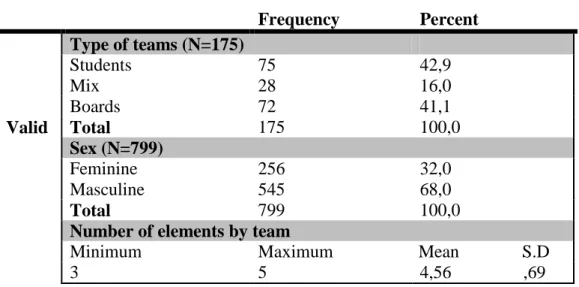
The sample comprises 799 participants, divided in 175 teams that participated in a management simulation over a 5-week period.
As table 1 shows the main sample characteristics. From the 175 teams comprised in the study, 75 (42.9%) were composed by university students, 72 (41.1%) by company managers, and the remaining 28 teams were a mix of students and managers. Teams were composed of three to five persons with an average size of 4.56 members (SD = 0.69).
From the 799 participants, 256 (32%) were feminine and 545 (68%) were male.
Table 1- Sample Characteristics
Frequency Percent Type of teams (N=175) Valid Students 75 42,9 Mix 28 16,0 Boards 72 41,1 Total 175 100,0 Sex (N=799) Feminine 256 32,0 Masculine 545 68,0 Total 799 100,0
Number of elements by team
Minimum Maximum Mean S.D
3 5 4,56 ,69
5.2. Simulation and Procedures
Sample data were collected from a competition called the Global Management Challenge (GMC), a realistic simulation of business life where teams are organized into groups. Each group with a maximum of 8 teams, that creates a competitive Market in which teams compete between them.
GMC was developed by a partnership between the SDG, Simuladores e Modelos de Gestão, and the newspaper EXPRESSO in 1980, being a strategy and management competition were teams who participate are responsible for running a fictitious company with the aim to achieve the highest share price on the simulated stock
19 exchange. The competition normally consists of 4 stages, 1st round, 2nd round, a
national final and an international final.
In the simulation teams assumed the role of administrators of the company, being responsible for:
- Top management decisions;
- Analysis of financial and economic indicators;
- Interaction with different functional areas of a company;
- Achievement of customer satisfaction by the understanding of the market conditions in which they compete;
- In an environment designed to encourage and development teamwork, becoming aware of their decisions impact in the organization;
During the 5 competition weeks which represent a year and a quarter of the company activity, teams through an online platform had to make their strategic
decisions about the various company areas, Marketing, Production, Human Resources and Finance. In order to make their decisions teams have access to:
- A manual which explain the structure, organization and functioning of the company;
- Company history, which shows it’s situation in the last 5 trimesters; - A decisions sheet, which transmits their decisions to the simulator;
- Management report, which shows their decisions impact taking into account competitors and market conditions;
In the end of each decision period, teams are evaluated by a Simulator that compare and analyze all teams in the GMC, which produces a Management Report presenting their results in financial and operational terms.
The data used in this research were collected by the method of questionnaires applied during the competition using an online platform. Team members answered to various questionnaires sent via e-mail at different times of the competition, being that questionnaire of expectations on performance as applied on the first competition week (Time 1), collective efficacy on Time 4, corresponding to the fourth competition week, and satisfaction on Time 5, the end of the competition.
20 5.3. Measures
In the present study four variables were operationalized: (1) Expectations on team performance, as predictor variable; (2) Collective efficacy, as a mediator variable; plus (3) Team performance and (4) Team satisfaction, as dependent variables.
5.3.1. Predictor Variable
Expectations on team performance were measured by an applied survey in the beginning of the competition, where members’ were questioned about in which position they expected their team to finish. Participants indicate on an 8-point Likert scale in which position they expect to end the competition, being an inverted variable in the sense that the lower value they gave to their answer the better was the result, so give value “1” to their answer it means that he/her expect that his/her team would end it in first place.
5.3.2. Mediator Variable
For collective efficacy measurement, it was used a 5-item scale adapted from Jung and Sosik (2003).
Participants answered to the following items: “My team has the necessary
competences to have a good result in the competition”; “My team is qualified to make and execute decisions required by the competition”; “I am confident in the capabilities of my team to achieve a good result”; “We are going to qualify ourselves to the second stage of the competition” and “The experience of the members in my team give me confidence that we are going to achieve a good result”, using a 7–point Likert scale (1-Strongly disagree; 7- (1-Strongly agree).
5.3.3 Dependent Variables
Team Performance
The measurement of team performance was the objective value of their teamwork performance during the competition, i.e. the share value of the company they represent as a team in the end of GMC.
21 As explained before the aim of the teams that were representing a simulated
company during the challenge, was to achieve the higher share value of their company trough the best management decisions, being that value achieved the representation of their team performance.
Team Satisfaction
Team satisfaction was measured on the last week of the competition (Time 5). We used 8-item scale adapted from Spector (1997) Job Satisfaction Scale.
The measurement included the following dimensions of Job Satisfaction Index: (1) Team that he/her is inserted; (2) Team functioning; (3) Participation in the competition; (4) Decisions taken by the team; (5) Communication between team members; (6) Team leader actions; (7) Strategy defined by the team and (8) Climate of relations between he/her team members. The answers given tend to analyze their degree of satisfaction with those various aspects of their participation in the team, by the use of a 7-point scale (1 - Very dissatisfied; 7 - Very satisfied).
6. Results
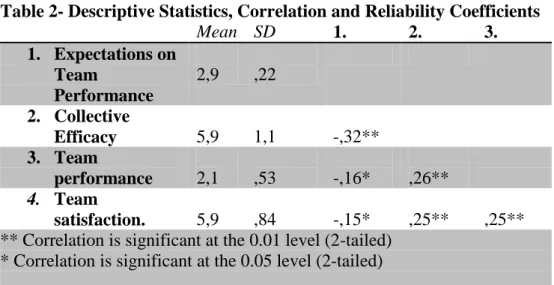
To test the hypotheses we used multiple regression analysis, through the use of SPSS program. In table 3 where we present the correlation matrix, means and standards deviations of the variables in study.
Table 2- Descriptive Statistics, Correlation and Reliability Coefficients
Mean SD 1. 2. 3. 1. Expectations on Team Performance 2,9 ,22 2. Collective Efficacy 5,9 1,1 -,32** 3. Team performance 2,1 ,53 -,16* ,26** 4. Team satisfaction. 5,9 ,84 -,15* ,25** ,25** ** Correlation is significant at the 0.01 level (2-tailed)
22 The first present data shows:
Expectation on team performance has a moderate negative correlation with collective efficacy (r = -,32**, p<0,01) and a smaller correlation but
significant with team performance and satisfaction (r = -,16*, p<0,05; r = -,15*, p<0,05);
In what concerns to Collective Efficacy variable correlations, there is a significant positive correlation between collective efficacy and the two dependent variables, team performance and team satisfaction (r = ,26**, p<0,01; r = ,25**, p<0,01);
For last we can also state that there is some correlation between the independent variables (r = ,25**, p<0,01);
To test the mediator role of collective efficacy in this research between the predictor, expectations on team performance, and the dependent variables, team performance and satisfaction, we used the 3 steps procedures suggested by Baron & Kenny (1986).
It is expected that collective efficacy will have an effect in the relation between the expectations on team performance and team performance and satisfaction in what concerns to the relation direction and/or strength, since this effect of moderation underpins that the relation between two variables changes as a function of mediator variable, (Baron & Kenny, 1986).
So in order to check the true existence of this effect, firstly it should be verified the existence of a link between the predictor and mediator variable (step 1), then is typical to associate the predictor variable to the independent variable without the presence of the mediator (step 2) and then adding the mediator that allow to test the difference in the relation (step 3), (Baron & Kenny, 1986).
23 The following figure and conclusions allow a better understanding of the
conditions of collective efficacy as a mediator:
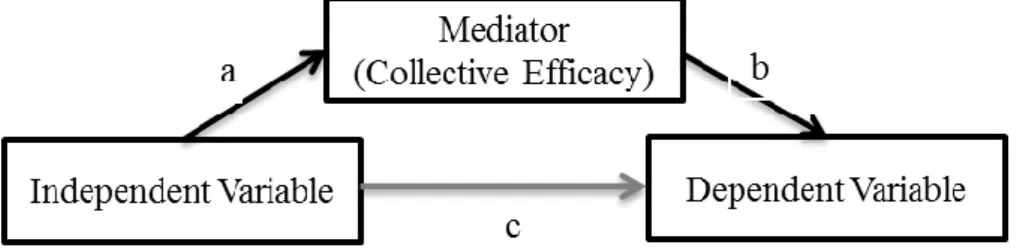
Figure 5 - Mediator behavior, by Baron and Kenny (1986)
Path a - Variations in independent variable affect variations in the presumed mediator;
Path b – Variations on collective efficacy affect significantly variations in the dependent variable;
Path c - The relation between independent and dependent variable will be no longer significant when the path (a) and (b) are controlled which shows the mediator role of collective efficacy;
So measure collective efficacy as a mediator variable will be demonstrated by a significant reduction of the strength of path (c), (Baron & Kenny, 1986).
1st
Step
So the first step was to verify the existence of a link between the predictor variable and mediator, as present in the following image:
Figure 6 - Link between predictor and mediator variable
As the data presented in table 4 shows expectations on team performance present a negative statistical relation (inverted variable) with collective efficacy, (β = -,32) adding the analyze of Adjusted R2 we can also affirm that the variability of collective efficacy its explained in 9% by this predictor, (R2a=, 09).
24
Table 3 - Linear regression of Collective Efficacy
Collective Efficacy Expectations on Team Performance Beta Adjusted R2 F -,32 ,09 19,6 2nd
and 3rd Step – Correlation between predictor and dependent variables before and after adding the mediator variable
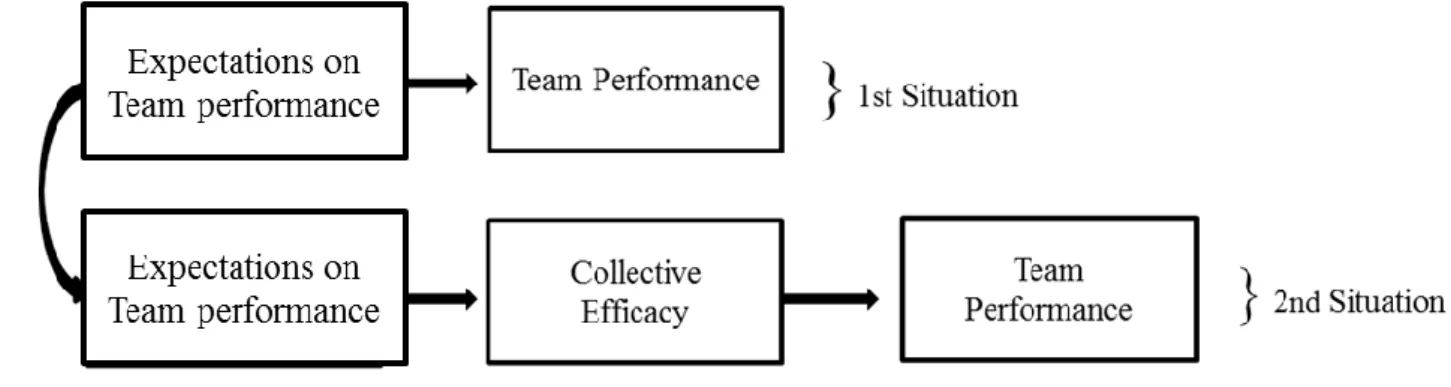
In this phase the objective is to verify two situations, on one hand the direct relation between the predictor and the dependent variable (2nd step), and on the other hand verify if that relation is altered when the mediator variable its added to the situation (3rd step), these two steps will be applied firstly considering as dependent variable, Team performance, and secondly considering Team satisfaction, as figure 7 and 8 will demonstrate.
Figure 7 – 1st Correlation between predictor and Team Performance variable adding mediator variable
Table 5 present the results of the second and third analyze step, which can show if collective efficacy has a positive mediating role between expectations on team performance and final team performance that constitute hypotheses 2.
25
Table 4 - Regression analysis of Team Performance
1st Model 2nd Model
Beta Adjusted R2 F Beta Adjusted R2 F
Expectations on Team Performance
-,16 -.08
Collective Efficacy ,24
Overall R2a and F ,03 4,5 ,07 7,1
For the 2nd step, we carried out team performance regression based on expectations on team performance, represented by the 1st model which shows:
The existence of a significant negative relationship between expectations on team performance and the dependent variable team performance (β = -, 16, p<0,01);
The predictor explains in 3% the variance on team performance, (R2
a = , 03);
On 3rd step, team performance regression was based on expectations on team performance and collective efficacy, represented by the 2nd model, which allowed affirming that collective efficacy create a mediating role between the members’ expectations and team performance, since:
Collective efficacy is significantly and positively correlated with team performance (β = , 24, p <0,01);
It leads to a reduction of strength in the relationship between the 1st
predictor variable and the dependent (β = -, 16 > β = -, 08);
The second model explains in a higher percentage team performance, which means that collective efficacy has a mediating role between expectations and team performance, (R2a=, 03 < R2a=, 07);
Now the objective is to apply step 2 and 3 but considering Team satisfaction as dependent variable, so, on one hand the check direct relation between the expectations and Team Satisfaction, and on the other hand verify if that relation is altered when collective efficacy its added to the situation, as shown in figure 8:
26
Figure 8 – 2nd Correlation between predictor and dependent variable adding mediator variable
Table 6 present the results of the second and third analyze step, which can show if collective efficacy has a positive mediating role between expectations on team performance and team satisfaction that constitute hypotheses 3.
Table 5 - Regression analysis of Team Satisfaction
Here to put in practice step 2, represented in the table represented by the 1st model, we carried out team satisfaction regression based on expectations on team performance, which shows:
A significant negative relationship between expectations on team performance and Team satisfaction (β = -, 15, p<0,01);
In this case team satisfaction it’s only explained in 2% by the expectations on team performance as the 1st model shows, (R2a=, 02);
1st Model 2nd Model
Beta Adjusted R2 F Beta Adjusted R2 F
Expectations on Team Performance
-,15 -.07
Collective Efficacy ,23
27 For the 3rd step, team satisfaction regression was based on expectations on team performance and collective efficacy, represented by the 2nd model, which also allowed affirming that collective efficacy create a mediating role between the members’ expectations and team satisfaction, since:
There is a positive and significant correlation between collective efficacy and team satisfaction (β =, 23, p< 0,01);
Insert collective efficacy lead to a reduction of strength in the relationship between the 1st predictor variable and the dependent (β = -, 15 > β= -, 07); The second model explains in a higher percentage team performance, which
means that collective efficacy has a mediating role between expectations on team performance and their actual performance, (R2a=, 02 < R2a=, 07)
7. Discussion
The aim of this research was to test a model of team effectiveness in the context of an integrated IMOI framework. Additionally, our goal was to analyze the significance of the proposed conceptual model which based on the literature review lay on several hypothesis. These hypotheses aim to examine empirically the impact and importance of team members’ expectations on team performance as a predictor of team effectiveness via collective efficacy. More concretely, the study proposes to analyze the mediating role of collective efficacy between the relation of expectations with team performance and satisfaction, which was supported by the results as explained below.
Results partially support either the influence of expectations on team effectiveness, either the fact that collective efficacy mediate that relation. The first results presented (table 1) showed that all variables in study are correlated, where the negative
correlations are reflection of the inverted predictor variable. Negative correlations means if one of the variable increases the other one will decrease, because in this case members’ expectations are an inverted variable, the higher value members gave to the variable means that their expectations about team performance are worse (i.e., give value 8 – member expect that team would finish in eighth), which will impact collective efficacy, team performance and satisfaction in a negative way.
28 But, ignoring the inverted scale that turn the correlations negative, results showed that variables have a direct impact over one another, since the better and positive are members´ expectations the higher and stronger will be the sense of collective efficacy, supporting hypotheses 1 of the study. This results support, as some literature alerted (Liden et al., 1993; Bandura, 1997; Jung and Sosik, 2003; Rockman and Northcraft, 2010), that members’ expectations can be a good and important predictor in the process of team effectiveness for which attention should be given.
Although statistical evidences do not demonstrate a strong influence, they also supported hypotheses 2 and 3 of the study by applying the 3 steps procedures suggested by Baron and Kenny (1986). First, supporting hypotheses 2, it has been shown that collective efficacy has a positive mediating role between expectations and team
performance through the evidence that the relation between the predictor, expectations on team performance, and team performance lost statistical significance when collective efficacy entered in the regression model. Showing that collective efficacy presents a positive and statistically significant impact becoming responsible for explaining in greater percentage variations on team performance. Secondly, supporting hypotheses 3, it has been shown that collective efficacy has a positive mediating role between
expectations on team performance and team satisfaction through the same type of statistical evidences occurred with the previous hypothesis, the relation between the predictor and team satisfaction lost statistical significance when collective efficacy entered in the regression model. Showing that collective efficacy presents a positive and statistically significant impact becoming responsible for explaining in greater
percentage variations on team satisfaction.
With these statements we conclude that team member’ expectations and collective efficacy can become important predictors for the development of team effectiveness if interpreted in the right way and taken into account.
8. Theoretical Implications
This study demonstrated the importance of moderating factors may have on team effectiveness (performance and satisfaction), contributing to the empirical literature about performance expectations and collective efficacy. According to the literature
29 review we found that collective efficacy has been mainly studied concerning on how other contingency factors may moderate the relationship between CE and group
effectiveness, such as task and context characteristics and others (Gibson, 1999; Myers, Feltz, & Short, 2004; Tasa, Taggar , & Seijts, 2007). Although this study showed that collective efficacy may assume a different role on the processe, such as its antecedents depending on the level of analysis and the cretirion for measuring performance.
Specifically, members performance expectations about their team, being the reflection of their confidence on group habilities, and most team-building efforts at the initial stage of group development, are important antecedents to the development of a strong and positive sense of collective efficacy (Jung & Sosik, 2003). Which then have a mediating effect to team performance and satisfaction. We hope that this study open new perspectives for research on the topic, collective efficacy impact as a mediator to team effectiveness.
The study of members expectations on team performance it seems particularly important, for example, in work contexts where uncertainty demands an ability to respond and addapt quickly to new situations, due to its impact on how individuals will react and be more or less engaged in its relationship within the team, (Rockman & Northcraft, 2010).
Concluding, the main theoretical implications that can be taken from the results of this empirical study that showed the existing relations between performance
expectations, collective efficacy and team effectivenes (performance and satisfaction), is that if members expectations are positive they will also be positively related with collective efficacy, team performance and satisfaction. But as the results show
collective efficacy have a positive mediator effect between them, then attention should not focus on expectations as a direct predictor but in their use to enhance collective efficacy sense that will lead to better performance and satisfaction levels.
9. Limitations and Future Research
Several limitations of this study should be addressed in future research. First, the study utilized an expectations measure that was evaluated by a single rater (position members expected their team to finish). A more complex analysis of the variable may lead to a better understanding on how expectations are created in the individuals minds, which in an organizational context can be truly important to
30 potentiate leaders understand how they can conduct to better expectations. Therefore, future research should use multiple raters to evaluate expectations on team performance in order to cover the multitude of reasons that can be behind their development,
allowing that way a deeper understanding on the construct and possibility of lead them in a more positive way to affect team effectiveness.
Second, reality in which teams were analyzed may not be the most appropriate for total reliability in how individuals analyze and measure the variables used in this study.GMC is a simulation that individuals decide by their own will to participate and with a team previously built by them, adding to the fact that in reality their professional and personal lives will probably not be affected, since it is not their profession in the real labor market that may be affected. So how individuals faced the competition, their role in the team, seriousness and importance given to the questionnaires applied will be reflected on how they evaluate the variables in question, but it may not reflect the reality of these same individuals as team members if it was on their real jobs and not in a simulation challenge. Therefore, it could be important for future research to rely in teams in another context so the results can be more reliable to organizational context.
Third, and last limitation that should be considered in future research it’s the time of analyze, firstly this teams work together for a limited and short time (5 weeks) and then can be dissolved and members do not need to interact more since they are not team inserted in organizations, therefore it is extremely advisable if possible to conduct a longitudinal study with real teams that prolong over time. Secondly, the importance of time in team research is crucial as Ilgen and colleagues (2005) also highlighted teams are embedded in organizations and exist over time, and team effectiveness as a dynamic construct that evolves over time should be analyzed in continuos over it and do not consider team performance and satisfaction representation on only one point of team life time.
Concluding, it seems to exist enough room in the team effectiveness literature to develop further research on variables such as expectations and collective efficacy, also appearing interesting the development of studies on the mediating role of collective efficacy. Future group research can provide several important benefits for leaders responsible for enhancing more effective teamwork, by establishing important
guidelines on how to creat work environment and context in which group members hold more positive attitudes about their team that eventually lead to higher team
31
Bibliography
Bandura, A. (1997). Self-efficacy: The exercise of control.
Baron, R. M., & Kenny, D. A. (1986). The moderator-mediator variable distinction in social psychological research: Conceptual, strategic, and statistical
considerations. Journal of personality ans social psychology, 51(6), pp. 1173-1182.
Chiochio, F., & Essiembre, H. (2009). Cohesion and performance: A meta-analytic review of disparities between project teams, production teams, and service teams. Small group research, 40, pp. 382-420.
Cohen, S. G., & Bailey, D. E. (1997). What makes teams work: Group effectiveness research from the shop floor to the executive suite. Journal of Management, 23(3), pp. 239-290.
Gibson, C. B. (1999). Do they do what they balieve they can? Group efficacy and group effectiveness across tasks and cultures. Academy of Management Journal, 42(2), pp. 138-152.
Gladstein, D. L. (1984). Groups in context: A model of task group effectiveness. Administrative Science Quarterly, pp. 499-517.
Goddard, R. D., Hoy, W. K., & Hoy, A. W. (2004). Collective efficacy beliefs: Theoretical developments, empirical evidence, and future directions. Educational researcher, 33(3), pp. 3-13.
Gully, S. M., Incalcaterra, K. A., Joshi, A., & Beaubien, J. M. (2002). A meta-analysis of team-efficacy, potency, and performance: Interdependence and level of analysis as moderators of observed relationships. Journal of applied psychology, 87, pp. 819-832.
Hackman, J. (1990). Groups that work (and those that don't). Creating conditions for effective teamwork. Jossey-Bass publishers.
Hackman, R. (1987). The design of work teams. J.Lorsch.
Ilgen, D. R., Hollenbeck, J. R., Johnson, M., & Jundt, D. (2005). Teams in
organizations: From input-process-output models to IMOI models. Annual review of psychology, 56, pp. 517 - 543.
Jehn, K. A., Greer, L., Levine, S., & Szulanski, G. (2008). The effects of conflict types, dimensions, and emergent states on group outcomes. Group decision and negotiation, 17(6), pp. 465-495.
Jung, D. I., & Sosik, J. J. (2003). Group potency and Collective efficacy. Examining their predictive validity, level of analysis, and effects of performance feedback on future group performance. Group & Organization management, 28(3), pp. 366-391.
Katz-Navon, T. Y., & Erez, M. (2005). When collective- and self-efficacy affect team performance: The role of task interdependence. Small group research, 36(4), pp. 437-465.
Kozlowski, S. W., & Ilgen, D. R. (2006). Enhancing the effectiveness of work groups and teams. Psychological science in the public interest.
Kozlowski, S. W., & Klein, K. J. (2000). A multilevel approach to theory and research in organizations: Contextual, temporal, and emergent processes.