Abstract—The purpose of this research is the analysis of the impact of ICT-related training in the adoption of a learning management systems (LMS) for teaching practicesby faculties in a higher education institution. Based on comparative analyses the impact will be obtained by the number of LMS courses created and managed by participants in ICT for teaching workshops and those who have not attended to any workshops. Involving near 1320 LMS courses and 265 faculties, the results evidence that(i) faculties who have not attend any workshop present a larger distribution of empty courses and (ii) faculties who have attended three or more workshops managed a higher distribution of courses with a considerable level of use intensity, when compared to the others groups. These findings supportthe idea that faculty training is a crucial factor in the process of LMS integration in higher education institutions and that faculties who have been enrolled in three or more workshops develop a higher level of technical and pedagogical proficiency in LMS.
Keywords—Higher Education, Faculty Training, LMS, Comparative Analyses
I. INTRODUCTION
HE vertiginous expansion of the web and related advancements in technological equipment, in conjunction with limited budgets and social demands for improved access to higher education, has produced a substantial incentive for universities to get involved in technology-integration projects both for administration and financial management, research enhancement and modernization of teaching and learning processes.
Until now, universities have been static in their structure and instructional models. However, the need for more professional qualifications and updated knowledge has never been higher, and this in conjunction with the need for attracting new publics and, therefore, for a geographically broaden learning,have prompt universities to embrace information and communication technologies (ICT) and e-learning initiatives as a reaction to the internal and external changes.Indeed, e-learning programs have enabled universities to expand their current geographical reach, to capitalize on new prospective students and to establish themselves as global educational providers [1].
Many have advocate that the challenge to universities in the 21st century is not to decide if they should have ICT for teaching-enrichment projects and online learning program, but to decide how to design and implement them. For many institutions, the adoption of online media means that their faculty members not only need to start becoming familiar with this new tools and systems, but also to understand and adopt new ways of conceptualizing teaching and learning in higher education [2].
Barbosa Cabral is with Instituto de Educação da Universidade de Lisboa, Portugal e-mails:[email protected]; [email protected]; [email protected]
A.Faculty training: A critical factor for technology integration in higher education
Any innovation process in an organization presents to be a complex and multifactorial process in which different aspects must be guaranteed in order to achieve success. Integrating ICT and promoting e-learning initiatives in conventional higher education institutions is an innovation process, therefore a significant number of interrelated variables need to be considered.
In 2003, Levy identified six areas that should be carefully addressed by universities when considering the possibility of planning ICT integration and online distance learning programs: vision and plans, curriculum, staff training and support, student services, faculty and copyright and intellectual property of materials [3]. Finley and Hartman also discussed similar issues such as clear vision, faculty skills and knowledge and departmental culture which were identified as barriers to the integration of technology into faculties’ graduate courses [4].
Discussing the adoption process of ICT in higher education teaching, Kirkup and Kirkwood identified as relevant the appropriation of ICT tools by higher education teaching staff, as well as the following contextual factors: organizational culture, teaching and assessment practices, competing priorities and the interaction of ICT with other tools and systems already used on campus [5]. Schauer, Rockwell, and Fritz (2005) also indicated as key factors: faculty commitment and skill development, technology integration and support, financial issues, student engagement and support, quality control for courses and outcomes assessment, compliance with regulations and legal matters [6].
A more recent study, focused on comparative analysis of failures and success experiences of higher education institutions in embracing online education initiatives and identified as crucial factors adequate planning, investment in marketing and in students’ recruitment, financial management, quality assurance, student retention, faculty development and innovative online course design and pedagogy [7].
All these studies addressed staff development or faculty training as a critical and imperativeissue. And this aspect seems to be seen as an institutional responsibility more than an individual responsibility. In an online survey answers by 237 north-american professors, near 70% agreed that technology training was universities responsibility [8] a sentiment that may come from the fact that most universities set up new and complex technological infrastructure without any (or very little) input collected from faculties [9].
As higher education institutions continues the rush to embrace technology-delivered learning opportunities, one requirement may be finding effective ways to prepare faculty
LMS in Higher Education: Analysis of the
Effect of a Critical Factor ‘Faculty Training’
T
for what life will be like on the o transformation [10]. An investment in fac essential for delivering quality online However in the beginning of ‘inform movements’, limited consideration was faculty training [8]. So today, an increasin higher education institutions to rapidly pr appropriate professional development ini engaging and attractive, in an appropriate f However, a clear notion about the r development initiatives is still lacking. So their indispensable benefits [3, 5, 8] others any realdevelopment in faculties practi highlight that faculty embraces technolo administration process and researcha frequently for delivering instruction. Plen do not integrate technology into systematically[9, 10, 11, 12] mainly b development programs have been short-ter designed, developed by non-specialized pedagogical competences and technocentri II. RESEARCH CONTEXT:UNIVERSIT Founded in 1911, the University of L 2010/11, 23 756 students and 2020 facultie the 282 courses available in different scien
The University is organized into five s and Humanities (which integrates the Facu Faculty of Letters), Health Sciences (w Faculty of Pharmacy, Faculty of Medic Dental Medicine), Science and Techn Science), Legal and Economic Sciences (F Social Sciences (which integrates the Sciences, Faculty of Psychology, Institut Institute of Geography and Territorial Plan One of the strategic guidelines in the UL technologies in teaching and research development of e-learning initiative.
In 2010/11, UL presented its E-learn aims to (i) promote the use of learning m (ii) sensitize and empower the faculties i learning environments as well as in management and development of online (iii) foster and give support to the develo units, so as to increase UL´s offer of e-le (iv) monitor and investigate the b-learn practices in the University, bearing in increase its knowledge, to improve its qu tailored innovative solutions.
To support the design of the blend courses, the e-Learning Program develo model that is based in four principles: learning to promote student-centered through a combination of specially resources and interactive media and flexibility and autonomy, where the stude flexibility of time and space of the co
other side of this faculty development is e learning programs. rmation technologies as given to authentic sing pressure is felt by provide their faculties initiatives, sufficiently te form and time [2].
real impact of staff Some studies advocate ers strongly suspect of ctices. These studies ology more often for hactivities and less lenty faculty members nto their curricula because most staff term initiatives, poorly ed trainers with few
tric approaches. SITY OF LISBON
Lisbon (UL) had, in lties enrolled in one of ientific areas.
e strategic areas: Arts aculty of Fine Arts and (which integrates the dicine and Faculty of hnology (Faculty of s (Faculty of Law) and e Institute of Social tute of Education and lanning).
UL focus on the use of h as well as on the rning program which management systems, s in the use of virtual in the optimization, e educational content, elopment of curricular learning courses, and arning and e-learning in mind the need to quality and to develop nded and/or distance eloped a pedagogical s: (i) resource
teaching approach y designed learning d Technologies; (ii) dent benefits from the courses and blended
learning initiatives and e-collaboration, where the inte faculties, resources and tec blended/fully online learning factors to the development of students with the use of communication tools (synch (iv) e-moderation, that acts student participation in the on
Fig. 1 E-learning Pro The University of Lisbon E areas of action which enab publicizing and dissemination the intentions and objectives (ii) training, which includes related’ workshops, specifica researchers, that take place needed in the use of techno support services and syste maintaining of infrastructur implemented online systems monitoring and assessment re actions to monitor on-going evaluation of processes and ac
A.Learning Management S
One of the more central act integration of a learning m teaching and learning practice
At the University of Lis systemimplemented is the Mo Learning (Moodle), because i possibilities to change and resources and activities accor their needs. In the other han some colleges as a support to the beginning of the E-learnin
The use of learning manage very advantageous for facultie learning: (i) the use of LMS activities that can meet learn LMS can provide to facultie student; (ii) LMS can impr process mainly be increased a efficient communication betw Provide anytime and anyw Support online assessment in can promote metacognitiv monitoring, time personal m individual learning objectives
-learning, (iii) interaction and interaction of students with peers, technologies selected to support g initiatives is seen as encouraging of collaborative work amongst the of different media, and online chronous and asynchronous), and ts as a mean of promoting active online community [13].
Program Pedagogical Model
n E-learning Program has four core nable its practical execution: (i) tion that include actions to divulge es of the programs implementation, es developing ‘ICT for teaching-fically designed for faculties and ce for the development of skills hnology and online systems, (iii) stems, which correspond to the tures to support the use of the s for teaching purposes and (iv) t related to the developed strategic ng operations, as well as regular achieved results.
t System: Moodle at UL
action of E-learning Program is the management system (LMS)into ices in higher education.
Lisbon the learning management Modular Object Oriented Dynamic it´s an open source platform with d modify and customize blocks, cording to the academic public and and, Moodle was already used in t tool to face-to-face classes before ning program in 2010.
agement system in education can be lties teaching practices and students MS allow a variety of interactive arners´ diverse needs because the ties a diversity of activities to his prove the teaching and learning d access to course content and more tween faculties and students [14]. ywhere access to students; (iii) incorporate a variety of tools that itive strategies including management, focus, and planning
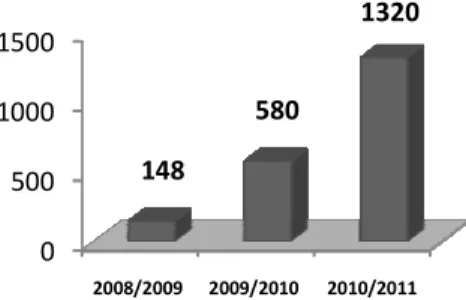
0 500 1000 1500 2008/2009 2009/2010 2010/2 148 580 132
Research shows that infusing edu resources, such as a LMS, may assist fac courses and organizing content to en decrease planning time, thus supportin process [14].
Moodle was installed for faculties University of Lisbon in 2007/2008 but on process of dissemination of this online env the E-learning program as a formal initiativ In fig.2 it´s possible to see the LMScoursesin eachacademic yearexamine ofgrowth.In 2008/09, 148 LMS courses w Moodle platform at the University of Lisb 580 LMS courses a growth of 292% was year of the e-learning program in UL, 144 created and a growth of 149% was achiev to the previous academic year.
Fig. 2 Total number of LMS courses b III. DATA COLLECTION PROC In this comparative study, each LMS the LMS platforms of the UL was analyz last two academic years. This study meas of data from each LMS course: (i) num (faculties and students), (ii) number of fac
teachers in Moodle and as participants in
workshops; (iii) number and type of reso used in each course and (iv) courses in intensity of use variable was operationaliz categories:
.‘No activity’ – The LMS cours actions were developed in it. .‘Moderate activity’ – The LMS co
resources for consultation.
.‘Considerable activity’ – The LM materials(resources) for consultat possibility of developing other (activities) to the participants. As previously referred, one of the core a program is the promotion of workshops competences in use of ICT in teaching and faculties (and researchers) of UL. In workshops were developed covering differ
Using LMS for Teaching I-Initial (W faculties and researchers with the purpose
2010/2011 1320
education technology faculty with managing engage students and ting the instructional es and institutes of only in 2008/2009 the environmentbegan and ative, started in 2010. he total number of ined, as wellas the rate s were opened, in the isbon, and in 2009/10 as resisted. In the first 442 LMS courseswere ieved,when comparing
s by academic year CEDURES
S course identified in lyzed, considering the easured different types umber of active users aculties, identifying as in ‘ICT-for-teaching’
esources and activities
intensity of use. The alized in the following urse is empty and no courses only provides LMS courses provides ltation but offers the er interactive actions e actions of E-learning for support faculties nd learning(e-skills) in n 2009/10 nearly 30
rentthematics. (W.I) – Designed for ose of promoting basic
skills in the use oflearning m activities.
. Using LMS for Teaching II-faculties and researcher promotingadvance skills in t system for teaching activities. . Designing and structuring Designedfor faculties and res skills for designing and structu . Others Workshops – Design to promote competences to tools.
Therefore,the level of facu teaching’ workshops was also collected from the workshop to identify: (i) faculties’ staff or more development works teacher or researcher took p which they took their first wo and managed LMS courses.
The two analysis of this t ‘ICT-for-teaching’ workshops impact of training in the a practices. The impact will be participants in ICT for teachin manage LMS courses for te amount of LMS courses gene created by faculty members teaching workshops.
In the research, it was percentages distribution of Pearson's chi-squared tes exploresignificant differences IV.
A.Learning Management S
First, it is important to pres of existing LMS courses, con use intensity. In 2009/10, the of the e-learning program in courses with moderate and c the program’s first year, thi increased to 883, which repre considering the value of the pr
B.ICT for teaching worksho
The following table presen involved in the thematic work the number of faculties and
T NUMBER O Lecture
year Total of cours
2009/2010 580
2010/2011 1320
management system for teaching -Advanced (A.W) – Designed for ers with the purpose of the use of learning management es.
ing online courses (D.S.O.W) - researchers forpromotethe required
cturing online LMS courses. igned for faculties and researchers to pedagogically explore web 2.0 culties attendance to the ‘ICT-for-lso analyzed. In this case, the data ops attendance lists were analyzed aff who have been involved in one rkshops, (ii) the workshops each part in; (iii) the semester during workshop; (iv) and who had created s two variables (LMS courses and ops attendance) aims to analyze the e adoption of LMS for teaching be obtained based on the number of hing workshops who did create and r teaching purposes and the total enerate by those courses, meaning, ers who participated in ICT for as analyzed manly frequencies, of the different variables but test was also calculated to
es between groups. RESULTS
t System Courses at UL
resent the evolution of the number considering their different levels of the year before the implementation in the UL, there were 439 LMS d considerable levels of use. After this number of virtual classrooms presents an increment of 2,01times
previous year (table I).
shops
sents the total number of faculties orkshops. During the year 2010/11 nd researchers who participated in
TABLE I OF LMSCOURSES
urses Courses with moderate and considerable use level
439 883
ICT for teaching workshops was 265, representing 13% of the number of UL academic staff.
Data presented of table II evidences that faculties and researchers of University of Lisbon, mainly attended to the workshop designed for faculties and researchers with the objective to promote basic skills in use of the platform Moodle (77%). Yet, some teachers and researchers who have attended to the Initial Workshop have attended also have taken the Advanced Workshop, which has the objective to promote advanced skills in use of the platform Moodle.Even though, the percentage values evidence that faculties most commonly attended only none workshop.
Only a reduced percentage of the faculties (8,8%) who attended the workshops were involved on three or more of the training initiatives.
C.Getting the mix: LMS Courses from ICT for teaching workshops
In order to analyze the impact of faculty training in the LMS courses adoption for teaching purpose the data of faculties attendance to ICT-for-teaching workshops and the use of courses in Moodle platform were crossed in 2010/11.
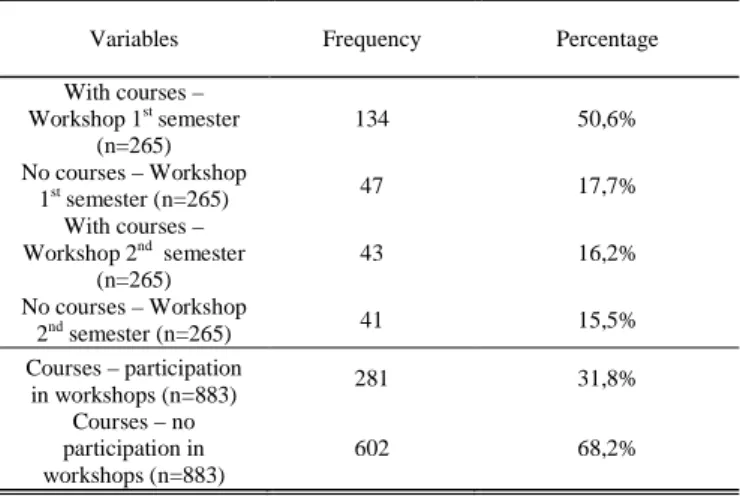
The majority of faculties participated in workshops during the first semester (181), 73% of whom have indeed managed LMS courses during this academic year. In the second semester the number of faculties and researchers who participated in the workshops decreased to 84 and only 51% of these managed their virtual classroom. The percentage of faculties who participated in workshops and have effectively created and managed LMS courses for teaching purposes in 2010/11 was 66.8%.
Looking backwards at the number of LMS courses which presented moderate or considerable levels of use and confronting this data with the number of participants in the ICT for teaching workshops, it is possible to see that 31.8% of the total amount of LMS courses was developed by faculties who participated in the workshops developed in 2010/11.
D.The amount of workshops taken: the effect on the intensity of use level
Besides the analysis in the number of courses created and managed by teacher who have and have not attended to the workshops, it is important to understand the impact of that participation in the intensity level of use in each course three groups of LMS courses were formed (no activity, moderate activity and considerable activity).
Fig. 3 Distribution of LMS courses according to intensity level and type of workshop attended
TABLEIII
IMPACT OF WORKSHOPS IN LMS COURSES (C)
Variables Frequency Percentage
With courses – Workshop 1st semester (n=265) 134 50,6% No courses – Workshop 1st semester (n=265) 47 17,7% With courses – Workshop 2nd semester (n=265) 43 16,2% No courses – Workshop 2nd semester (n=265) 41 15,5% Courses – participation in workshops (n=883) 281 31,8% Courses – no participation in workshops (n=883) 602 68,2% TABLEII
VOLUME OF ATTENDANCE IN WORKSHOPS (N=265)
Workshops Frequency Percentage
Initial W. (I.W) 204 77,0% Advanced W. (A.W) 53 20,0% Structure design W. (SdW) 18 6,8% Others Workshops (O.W) 43 16,2% 1 Workshop I.W 146 52,0% A.W 22 7,8% S.D.W 12 4,3% O.W 21 7,5% 2 Workshops I.W + A.W 37 13,2% I.W + S.D.W 3 1,1% I.W + O.W 6 2,1% A.W + S.D.W 6 2,1% A.W + O.W 6 2,1% S.D.W + O.W 0 0,0% 3 or more Workshops I.W + A.W + S.D.W 8 2,8%
I.W + A.W + O.W 2 0,7%
I.W + S.D.W + O.W 0 0,0% A.W + S.D.W + O.W 2 0,7% I.W + A.W + S.D.W + O.W 13 4,6% 0 50 100 150 200 250 300 350 400 450 500 No workshop 1 type of WS 2 types of WS 3 or more types of WS 344 79 12 2 487 160 40 11 115 47 11 12 No activity Mode rate Considerable
Considering this particular aim, three groups were formed (no activity, moderate, activity and considerable activity).
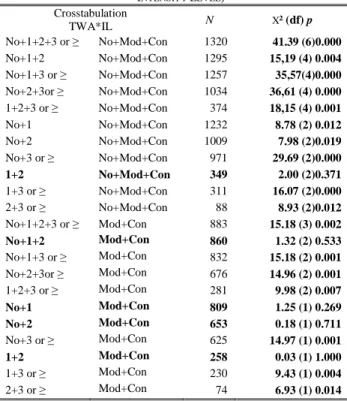
As observed in figure 3, the majority of LMS courses are created and managed by faculties who haven’t attended any workshop. Pearson's chi-squared test was used to develop a comparative analysis of the distribution. Through it, is possible to see that they are significantly different according to the number of workshops attended (χ² (6)=41.385, N=1320,
p<0,001). Results evidences that the proportions of individuals, according to their attendance in the workshops, reveal a different configuration in the intensity level of use (table 4).
Looking deeper at the distribution of each group significant differences continue to be found which represent different proportions between each group, with the exception of these two:
• When we consider all levels of intensity and when the faculties who have created LMS courses have attended one or two types of workshops (
χ
² (2)=2.002, N=349, p=0,371); • When we consider moderate and considerable levels ofintensity and when the faculties who have created LMS courses have attended none, one or two types of workshops (
χ
² (2)=1.315, N=860, p=0,533).The levels of significance propositionsidentified in Pearson chi-squared tests evidences that: (1) faculties who have attended one or two types of workshops have the same distribution in the level of intensity of use; (2) faculties who haven’t attended any workshop have a larger distribution of courses with no activity comparing with the three groups; (3) faculties who have attended three or more workshops have a different distribution in the level of intensity of use, showing
higher frequency distribution of courses with considerable intensity when compared to the others groups.
V. CONCLUSIONS
The e-learning program implementation happened at the same time as the doubling of LMS courses in the UL platform. There are many aspects that have contributed to this increment, namely the program implementation itself. Although this analysis should be addressed to another article and based on another type of data.
In this study we can say that the impact of the ICT for teaching workshops represents 31.8% of the LMS courses in the UL platform.
The majority of faculties and researchers focused their participation in workshops designed to promote the acquisition and development of basic technical and pedagogical skills for using LMS courses ina elementary level. It is also possible to understand that most faculties and researchers participated in only one workshop. This primary analysis indicates that participants are mostly focused in developing the essential skills required to use the LMS basic functionalities.
The more relevant findings in this study are related to the impact that the type of workshops attended has in the intensity level of use of the LMS courses. One of the conclusions of this study is that faculties and researchers who haven’t attended any workshop have a high proportion of courses with no activity. These teachers probably felt the need to create their virtual classroom but, for different reasons,weren’t able to use it and the online space stayed empty. The second conclusion from this study results is that those who have participated in one or two workshops seem to have the same distribution in the level of use. The lack of differences between these groups might be probably related to the fact that the groups of faculties, which has attended one or two workshops, mostly aim to achieve the same goals, meaning and to development consolidate basic ICT skills. Finally, the results indicate that the faculties who participated in three or more workshops do present a different distribution in the intensity level of use in their LMS courses. This result can lead to the conclusion that the enrollment in different training initiatives can promotemore solid and effective ICT-related competences. These courses have given faculties the opportunity to develop a higher level of technical and pedagogical proficiency in the use of the different online tools available in a LMS. As a consequence, considerable levels of intensity of use were found.
The results evidenced the idea that the faculty training factor is quite relevant in the process of the integration of LMS in Higher Education, as it encourages and eases the adoption and embracement of LMS for teaching purposes. These results therefore converge with other studies in the area [2,5,3,8,10]were faculty training reveals to be a crucial factor in ICT integration and in the implementation of e-learning projects in Higher Education.Moreover, this study supports the idea that faculty training works especially as a mechanism of promotion and its effect are more related to the quality of the use them with its quality of technology-mediated teaching practices. In fact faculty training presented limitative effects when the impact on the number of courses created was TABLEIV
PEARSON'S CHI-SQUARED TEST (TYPE OF WORKSHOPS ATTENDED * INTENSITY LEVEL) Crosstabulation TWA*IL N X² (df) p No+1+2+3 or ≥ No+Mod+Con 1320 41.39 (6)0.000 No+1+2 No+Mod+Con 1295 15,19 (4) 0.004 No+1+3 or ≥ No+Mod+Con 1257 35,57(4)0.000 No+2+3or ≥ No+Mod+Con 1034 36,61 (4) 0.000 1+2+3 or ≥ No+Mod+Con 374 18,15 (4) 0.001 No+1 No+Mod+Con 1232 8.78 (2) 0.012 No+2 No+Mod+Con 1009 7.98 (2)0.019 No+3 or ≥ No+Mod+Con 971 29.69 (2)0.000 1+2 No+Mod+Con 349 2.00 (2)0.371 1+3 or ≥ No+Mod+Con 311 16.07 (2)0.000 2+3 or ≥ No+Mod+Con 88 8.93 (2)0.012 No+1+2+3 or ≥ Mod+Con 883 15.18 (3) 0.002 No+1+2 Mod+Con 860 1.32 (2) 0.533 No+1+3 or ≥ Mod+Con 832 15.18 (2) 0.001 No+2+3or ≥ Mod+Con 676 14.96 (2) 0.001 1+2+3 or ≥ Mod+Con 281 9.98 (2) 0.007 No+1 Mod+Con 809 1.25 (1) 0.269 No+2 Mod+Con 653 0.18 (1) 0.711 No+3 or ≥ Mod+Con 625 14.97 (1) 0.001 1+2 Mod+Con 258 0.03 (1) 1.000 1+3 or ≥ Mod+Con 230 9.43 (1) 0.004 2+3 or ≥ Mod+Con 74 6.93 (1) 0.014
analyzed, but presented significant results when the level of intensity of use was analyzed taken under analysis. The results also evidenced that the sporadic involvement in one or two educational initiatives, limited in time and focus (especially determined by the limited amount of time that faculty members have available for personal investment in professional training, and which is also related to the existence of limited support and recognition mechanisms) also presents limited effects on the quality of practices. In contrast, an attitude of serious investment in the development of competences in the area of ICT and teaching (and that is materialized in this investigation by the involvement in three or more workshops) reveals favorable effects in the quality of practices associated with ICT integration in higher education.
Some studies have reported that, among other things, increasing staff support, improving training facilities and providing faculty with more assistance and incentives could motivate faculty members to invest in using technology in their instruction and other professional activities. Although faculty training is consistently seen as a critical factor, in most higher education institutions, this issue is still poorly addressed. College pedagogy or faculty professional development, in general or more specifically the area of ICT-related skills, in commonly based of voluntary-work, that consists in the development of informal, episodic and self-paced training sessions, shortly conducted and sporadically offered [15].
In many higher education institutions, providing technical support and training for faculty is a challenge mostly due to the lack financial resources and of properly prepared staff. [16].
However relevant and useful, faculty training haven´t been seriously addressed. Best practices haven´t been efficiently shared and disseminated. Universities’ staff development units, teaching and learning centers, e-learning and ICT offices tend to live encapsulated within their own university. In order to potentiate the development of more updated teaching practices in higher education institutions, faculty training needs to be considered. The way it impacts students’ academic achievement, institutional quality and prestige, as well as the best models to design and address it are some of the areas that need more systematic and longitudinal research.
Educational technology research indicates that faculty training best practices are the ones based on the preferences, expertise level and particular needs of faculty members [17], but how it should be conducted in order to effectively prepare faculty is still unanswered.The development of different initiatives such as (a) large group seminars, (b) hands-on small group workshops, (c) individual mentoring, and (d) just-in-time support have been pointed out as having a positive impact on the faculty members abilities to use technology for teaching purposes[18, 19] what mechanisms could be implemented to increment the involvement of faculties in this initiatives is still waiting for being carefully analyzed.
In conclusion it’s important to refer that the present study (although focused in a particular university and involving only a reduced number of participants) gathered relevant information and presented interesting results but mostly its intended to stimulate the development of further research in this area.
REFERENCES
[1] Singh, G., O'Donoghue, J., &Worton, H., A. (2005). Study into the effects of e-learning on higher education, Journal of University Teaching & Learning Practice, 2(1), Available at:http://ro.uow.edu.au/jutlp/vol2/iss1/3
[2] Macdonald, J., &Poniatowska, B. (2011). Designing the professional development of staff for teaching online: an OU (UK) case study. Distance Education, 32 (1), 119-134.
[3] Levy, S. (2003). Six factors to consider when planning online distance learning programs in higher education. Online Journal of Distance Learning Administration, VI(I). Available at: http://www.westga.edu/~distance/ojdla/spring61/levy61.htm
[4] Finley, L. & Hartman, D. (2004). Institutional change and resistance: Teacher preparatory faculty and technology integration, Journal of Technology and Teacher Education, 12(3), 319-337.
[5] Kirkup, G & Kirkwood, A. (2005). Information and communications technologies (ICT) in Higher Education teaching – a tale of gradualism rather than revolution. Learning, Media and Technology, 30(2), 185– 199.
[6] Shauer, J., Rockwell, S., Fritz, S. & Marx, D. (2005). Implementing Distance Education: Issues Impacting Administration.Online Journal of Distance Learning Administration, VIII(III). Available at: http://www.westga.edu/~distance/ojdla/fall83/schauer83.htm
[7] Rovai, A. P., & Downey, J. R. (2010). Why some distance education programs fail while others succeed in a global environment. The Internet and Higher Education, 13, 3, 141–147.
[8] Georgina, D. A., & Olson, M. R. (2010). Integration of technology in higher education:A review of faculty self-perceptions. Internet and Higher Education 11, 1–8.
[9] Sahin, I., & Thompson, A. (2006). Using Rogers’s theory to interpret instructional computer use by COE faculty. Journal of Research on Technology in Education, 39(1), 81-104.
[10] Becker, H. J. (2000). Findings from the teaching, learning, and computing survey: Is Larry Cuban right? Education Policy Analysis
Archives, 8(51). Available at:
http://www.crito.uci.edu/tlc/findings/ccsso.pdf
[11] Chowdhury.(2009). ICTintegration trends and practices in college classrooms. Proceedings of EDULEARN09 Conference. 6th-8th July 2009, Barcelona, Spain.
[12] Schrum, L., Skeele, R. & Grant, M. (2002). One college of education’s effort to infuse technology: A systematic approach to revisioning teaching and learning. Journal of Research on Technology in Education, 35(2), 256-271.
[13] Selwyn, N. (2007). The use of computer technology in university teaching and learning: a critical perspective. Journal of Computer Assisted Learning, 23(2), 83-94.
[14] Salmon, G. (2000). E-Moderating: the key to teaching and learning online. London: Sterling.
[15] Gautreau, C. (2011). Motivational factors affecting the integration of a learning management system by faculty. Journal of Educators Online,
8(1), January. Available at:
http://www.thejeo.com/Archives/Volume8Number1/GautreauPaper.pdf [16] Irani, T., &Telg, R. (2002). Building it so they will come: Assessing
universities’ distance education faculty training and development programs. Journal of Distance Education, 17, 36-36.
[17] Long, P. D. (2001). Technology support trio. Syllabus: New Directions in Education Technology, 14(11), 8.
[18] Schnell, M. A. (2003). Technology classroom support: A collaborative effort at Syracuse university. College & University Media Review, 9(2), 81-90.
[19] Leh, A. S. C. (2005). Lessons learned from service learning and reverse mentoring infaculty development: A case study in technology training. Journal of Technology and Teacher Education, 13(1), 25-41.