www.atmos-chem-phys.net/16/4271/2016/ doi:10.5194/acp-16-4271-2016
© Author(s) 2016. CC Attribution 3.0 License.
Can biomonitors effectively detect airborne benzo[a]pyrene? An
evaluation approach using modelling
Nuno Ratola1,2and Pedro Jiménez-Guerrero1
1Physics of the Earth, Regional Campus of International Excellence “Campus Mare Nostrum”, University of Murcia, Edificio CIOyN, Campus de Espinardo, 30100 Murcia, Spain
2LEPABE, Departamento de Engenharia Química, Faculdade de Engenharia da Universidade do Porto, Rua Dr. Roberto Frias, 4200-465 Porto, Portugal
Correspondence to: Nuno Ratola ([email protected])
Received: 29 May 2015 – Published in Atmos. Chem. Phys. Discuss.: 30 September 2015 Revised: 2 March 2016 – Accepted: 15 March 2016 – Published: 5 April 2016
Abstract. Biomonitoring data available on levels of
atmo-spheric polycyclic aromatic hydrocarbons (PAHs) in pine needles from the Iberian Peninsula were used to estimate air concentrations of benzo[a]pyrene (BaP) and, at the same time, fuelled the comparison with chemistry transport model representations. Simulations with the modelling sys-tem WRF+EMEP+CHIMERE were validated against data from the European Monitoring and Evaluation Programme (EMEP) air sampling network. Modelled atmospheric con-centrations were used as a consistent reference in order to compare the performance of vegetation-to-air estimating methods. A spatial and temporal resolution of 9 km and 1 h was implemented. The field-based database relied on a pine needles sampling scheme comprising 33 sites in Portugal and 37 sites in Spain complemented with the BaP measurements available from the EMEP sites. The ability of pine needles to act as biomonitoring markers for the atmospheric concen-trations of BaP was estimated by converting the levels ob-tained in pine needles into air concentrations by six different approaches, one of them presenting realistic concentrations when compared to the modelled atmospheric values. The jus-tification for this study is that the gaps still exist in the knowl-edge of the life cycles of semi-volatile organic compounds (SVOCs), particularly the partition processes between air and vegetation. The strategy followed in this work allows for the effective estimation by the model of concentrations in air and vegetation and of the best approaches to estimate atmo-spheric levels from values found in vegetation.
1 Introduction
Semi-volatile organic compounds (SVOCs) are widespread chemicals that even at low concentrations possess carcino-genic capacity (Baussant et al., 2001) and ecotoxicity (Solé, 2000) due to their persistence in different environmental ma-trices (air, soil, water, living organisms). In particular, poly-cyclic aromatic hydrocarbons (PAHs) originate from natu-ral and anthropogenic combustion processes or are released from fossil fuels (Mastral and Callén, 2000) and can be transported in the atmosphere over long distances in gaseous phase or as particulate matter (Baek et al., 1991). The lighter PAHs (2 or 3 aromatic rings) exist mainly in the gas phase, whereas the heavier (5 to 6 rings) consist almost entirely of the particulate phase (Bidleman, 1988), and this is the case of 5-ringed benzo[a]pyrene (BaP), arguably the most studied PAH. BaP is the reference for PAH air quality stan-dards, as defined by the European Commission, which sets a limit of 1 ng m−3over a 1-year averaging period (Directive 2008/50/EC, 2008).
The establishment of strategies for sampling and mod-elling of SVOCs in the atmosphere aiming at the definition and validation of their spatial, temporal and chemical trans-port patterns can be achieved by an integrated system of third-generation models that represent the current state of knowledge in air quality modelling and experimental data collected in field campaigns (Jiménez-Guerrero et al., 2008; Morville et al., 2011). The modelling methods currently ap-plied for SVOCs use very simple mass balance techniques or have deterministic approaches, reflecting the complexity
to characterise adequately the chemical transport processes. These limitations call for more experimentally based infor-mation, hence the need to combine field-based campaigns and modelling to address the problem properly (Jakeman et al., 2006), including multi-matrix approaches whenever pos-sible.
Moreover, measurements of pollutants such as PAHs are labour-intensive compared to those of criteria air contami-nants such as ozone and particulate matter, and the processes governing their atmospheric fate and representation within chemistry transport models (CTMs) are not yet well under-stood (Galarneau et al., 2014), particularly in terms of uncer-tainties associated with the emissions and re-emissions from sinks, partition patterns, volatility and fate of SVOCs, among others. A number of atmospheric modelling studies have tried to characterise the levels and spatial-temporal patterns of PAHs (most of them focusing on BaP) using CTMs both on global (Sehili and Lammel, 2007; Lammel et al., 2009; Friedman and Selin, 2012) and regional scales (Matthias et al., 2009; Aulinger et al., 2011; Bieser et al., 2012; San José et al., 2013). These authors identify a lack of measurement data in Europe to evaluate the behaviour of the CTMs against observations. For example, Bieser et al. (2012) use only six European Monitoring and Evaluation Programme (EMEP) stations (four in the Scandinavian region) and six additional sites in Germany and the UK to evaluate their year 2000 sim-ulations. Bernalte et al. (2012) also highlight the importance of studies on PAHs over the Western Mediterranean (Iberian Peninsula) in order to increase the knowledge of the ambient levels in this region. For that purpose, San José et al. (2013) conducted a 12-week modelling study supported by a field campaign to describe the behaviour of their WRF+CMAQ simulations, but using only a single location in Spain.
Hence, there is a strong need to have trustful informa-tion on the atmospheric levels of compounds like BaP and other SVOCs, in particular in areas with limited informa-tion, like over the Iberian Peninsula. In that sense, vegeta-tion species can play a decisive role as biomonitors of the incidence and chemical transport of atmospheric pollutants (Maddalena et al., 2003). Coniferous trees are particularly important, given their worldwide distribution and specific characteristics. However, even if some studies report geo-graphical or temporal patterns of PAHs in coniferous needles (Weiss et al., 2000; Hwang and Wade, 2008; Lehndorff and Schwark, 2009; Augusto et al., 2010; Ratola et al., 2010a, b, 2012; Amigo et al., 2011), only a few deal with their air-vegetation distribution (St-Amand et al., 2009a, b). In addi-tion, to our knowledge there is no study regarding the simul-taneous use of field and modelling data to assess the distribu-tion of PAHs between air and pine needles. Consequently, if trustful estimates of the atmospheric incidence could be ob-tained from vegetation, the abundance of biomonitors such as pine needles would provide essential information about the regional and global atmospheric behaviour of persistent contaminants.
Under these premises, the WRF+CHIMERE modelling system, coupled to BaP emission data from EMEP was run and evaluated for the Iberian Peninsula. The modelled de-positions were compared to data from biomonitoring cam-paigns carried out along 70 sites, to assess the ability of the model to reproduce BaP canopy deposition. Monitoring data from EMEP (Tørseth et al., 2012) was used to validate the modelled atmospheric BaP climatologies (2006–2010). A to-tal of six approaches were tested to estimate the conversion of BaP levels from vegetation into air. To achieve this, the atmo-spheric levels from these approaches were evaluated against the modelled air concentrations.
2 Experimental section
2.1 Pine needles sampling
The Iberian Peninsula, located in the SW of Europe, has an area close to 600 000 km2and a population of almost 60 mil-lion, the majority of which distributed along the Atlantic and Mediterranean coastlines, except for some important conur-bations such as Madrid, Seville or Zaragoza. Forests (with several pine species commonly present) are scattered through the whole territory. Mountainous areas follow the same trend, with the most elevated chains found in the northern borders (Pyrenees and Cantabria) and in the south (Sierra Nevada). Rural activities can be found almost everywhere, but are par-ticularly important for the economy in the central plateau, where population density is scarcer. A representation of the different land uses in the target domain as represented by the WRF+CHIMERE modelling system can be found in Ratola and Jiménez-Guerrero (2015). In this study, and according to their availability, needles from Pinus pinaster, Pinus pinea, Pinus halepensis and Pinus nigra with up to 1.5 years of ex-posure to contamination were collected from the bottom and outer branches, placed in sealed plastic bags, kept from light and frozen until extraction. The sampling campaigns were carried out in 33 sites in Portugal and 37 in Spain, in both cases including urban, industrial and rural or remote areas. For further description of these campaigns, the reader is re-ferred to Ratola et al. (2009, 2012).
2.2 Pine needles analysis and quantification
The analytical procedure used to quantify the levels of PAHs (BaP included) in pine needles was reported previously (Ra-tola et al., 2009, 2012). A brief description of the methodol-ogy and of some characteristics of the pine needles from the different species can be found in the Supplement.
2.3 Methods for the estimation of BaP air concentrations from vegetation
Given the lack of information on atmospheric concentrations of BaP in the sampling sites chosen for this study, an
esti-mation of those values from data provided by biomonitoring studies with vegetation (coniferous needles in this case) was required. Resorting to literature, six approaches (four of them using the same main calculation method, varying only one parameter) were tried and the resulting estimated BaP con-centrations were compared with the modelling experiments.
2.3.1 Approach 1a
This approach is based on the studies by St-Amand et al. (2007, 2009a, b), who measured the levels of PBDEs and PAHs in vegetation (Norway spruce needles in this case) and in the surrounding atmosphere (both gas-phase and partic-ulate material) and presented a strategy to estimate the air concentrations from those in vegetation and vice versa. In brief, the atmospheric concentration of SVOCs (Ca) esti-mated from the levels in vegetation can be determined by the contribution of particle-bound (Cp) and gaseous (Cg) phases. In the case of BaP, being a high molecular weight PAH, the gas-phase contribution is negligible, which means φ (ratio between particle and particle+gas phases) ≈ 1 and Cacan be given by
Ca=Cp=(Cvp·m)/(A · vp·t ), (1) where Cvp – contribution of particle-bound deposition pro-cesses to the total concentration in vegetation (ng g−1); m – dry weight of pine needles (g); A – total surface area (m2) of vegetation (in our study, pine needles); vp– particle-bound deposition velocity (m h−1); t – environmental exposure time of pine needles (h) with Cp expressed in ng m−3. Since it was impossible to calculate vpfor our samples, due to the lack of information on the atmospheric concentrations, in this first approach the value calculated by St-Amand et al. (2009a) for Norway spruce (Picea abies) needles was used: 10.8 m h−1. Values of the mass and total surface area for the pine needles studied are presented in Table S1 in the Supplement. The ex-posure time was estimated considering that the new needles sprung out on 15 April and counting the hours from this day to the sampling date.
2.3.2 Approaches 1b, 1c, and 1d
These approaches follow the same strategy, only with dif-ferent vpvalues calculated from studies in literature report-ing BaP concentrations in air and pine needles (from Pi-nus sylvestris trees in cases 1b and 1c and a coniferous for-est in 1d). Approach 1b refers to the work by Klánová et al. (2009) and the estimated vp(BaP) is 0.0039 m h−1, while approach 1c comes from the work by Tremolada et al. (1996), with vp(BaP) = 0.0263 m h−1. For the 1d approach, it was considered the deposition velocity Horstmann and McLach-lan (1998) found for BaP over a coniferous forest canopy: 2.196 m h−1. As can be seen, the variability of vpis evident, not only considering different species of vegetation, but also using the same species in different locations. In the case of
approaches 1b and 1c, Klánová et al. (2009) sampled remote areas whereas Tremolada et al. (1996) considered more ur-banised locations, which may justify the higher deposition velocity in the latter case. Differences in the uptake of PAH by different pine species in the same sampling sites are also described in literature (Piccardo et al., 2005; Ratola et al., 2011).
2.3.3 Approach 2
This approach follows the work of Tomashuk (2010), which used biomonitoring results in Pinus nigra needles and in turn profits from a study by Simonich and Hites (1994). In the latter, an air-vegetation partition coefficient (Kv) is defined by
ln Kv=(1000/T ) · slope − 35.95, (2) with T – air temperature (K); slope – calculated by Simonich and Hites (1994) for some PAHs. And from Kv, the air con-centration of PAHs (Ca) can be estimated by (in ng m−3)
Ca=Cv/(Kv·lipid), (3)
with Cv– concentration in the vegetation (ng g−1, dw); lipid – lipid content per dry weight of pine needles (mg g−1, dw). Values of the lipid content for the pine needles studied are presented in Supplement Table S1.
2.3.4 Approach 3
Chun (2011) measured PAH concentrations in Pinus koraien-sis needles and the surrounding air and came up with the fol-lowing correlation between log Koaand Cv/ Ca:
From acenaphthylene to chrysene:
Ca=Cv/exp[(log Koa−7.9603)/0.4557], (4) with Ca– concentration in air (ng m−3, dw); Cv– concentra-tion in the vegetaconcentra-tion (ng g−1, dw).
From chrysene to benzo(ghi)perylene (the equation used to calculate BaP concentrations):
Ca=Cv/exp[(log Koa−12.18)/(−0.2272)], (5) log Koais a temperature-dependent coefficient, and was cal-culated using the following equation:
log Koa=A + (B/T ), (6)
where coefficients A and B are given by Odabasi et al. (2006) and the temperature (T ) in each site was the mean from the 3 months previous to sample collection, since it corresponded to the intervals of exposure between campaigns (with a sea-sonal periodicity for most sampling points). The equilibrium between air and pine needles is still not completely under-stood and can be a slow process for compounds with high log Koasuch as BaP (Mackay, 1991); and it may not be possible to acknowledge if “non-equilibrium” conditions or alterna-tive processes occur (Tremolada et al., 1996).
2.4 Modelling experiment and validation
In this study, the Weather Research and Forecasting (WRF) (Skamarock et al., 2008) and the CHIMERE modelling sys-tem (Menut et al., 2013), with a resolution of 9 km for the entire Iberian Peninsula coupled to EMEP BaP emissions (Vestreng et al., 2009), was run and evaluated for the Iberian Peninsula in a simulation covering the years 2006 to 2010 on an hourly basis. This CHIMERE version has been modified to include gaseous and particulate BaP. Gas-phase degrada-tion by OH radicals, which represents over 99 % of the degra-dation path for gas-phase BaP, was accounted for, with a kOH=5.68 × 10⁻¹¹(Schwarzenbach et al., 2003). But more importantly, the oxidation of particulate BaP with ozone was also included, since the respective reaction rate is one order of magnitude higher than other degradation processes, and can be considered the only effective degradation path for par-ticulate BaP in the atmosphere (Bieser et al., 2012). In this case, the reaction constant follows the approach of Pöschl et al. (2001):
k = kmax[O3]/(1 + KO3[O3]), (7) being kmax=0.015 s−1and KO3=2.8 × 10
−13cm3. A bias adjustment technique was applied and is referred to in the Supplement, together with a description of the modelling set-up and validation procedures (Table S2). All modelled con-centrations presented in this work are bias-adjusted.
The BaP concentrations in pine needles used in this work are taken from biomonitoring campaigns previously per-formed in the Iberian Peninsula (Ratola et al., 2009, 2010a, b, 2012). These data were compared to the deposition over veg-etal canopies as estimated by the CHIMERE transport model. The dry deposition flux in CHIMERE is directly proportional to the local concentration C of the target compound (in this case, BaP):
F = −vd·C, (8)
where F represents the vertical dry deposition flux, the amount of material depositing to a unit surface area per unit time. The proportional constant between flux and concentra-tion, vd, is known as the deposition velocity. The main factors governing dry deposition are the grade of the atmospheric turbulence, the chemical properties of the species, and the nature of the soil and the vegetation.
The deposition over vegetal canopies in CHIMERE for particles employs a resistance scheme (Wesely, 1989). The dry deposition velocity follows the formulation of Seinfeld and Pandis (1997):
vd=(1/(ra+rb+ra·rb·vs)) + vs, (9) where rais the aerodynamic resistance (or aerodynamic drag) and rbthe resistance at the quasi-laminar sublayer. The aero-dynamics resistance is calculated as the integral of the in-verse of the diffusivity coefficient Kzup to the middle of the
model surface layer, which can be estimated using the ana-lytical formulae of the surface-layer similarity profiles for K (Seinfeld and Pandis, 1997) and vsstands for the sedimenta-tion velocity. For vegetal canopies, as in our case, correcsedimenta-tions have been implemented. These corrections are not detailed in the CHIMERE manual (http://www.lmd.polytechnique.fr/ chimere/), but rather supported on the literature presented (Giorgi, 1986; Peters and Eiden, 1992; Zhang et al., 2001). For this reason, and for the sake of brevity, the same strategy is adopted here and readers are referred to those works for further details.
3 Results and discussion
3.1 Model evaluation for vegetation and air levels
The model climatologies for BaP in canopy deposition and air concentration were done under the premise of constitut-ing a base for a broad spectrum of studies within the air-vegetation interactions. In fact, a description of these sim-ulations was mentioned previously by Ratola and Jiménez-Guerrero (2015). However, given the importance for the cur-rent study, a summary is presented here, also considering a different perspective.
3.1.1 Vegetation
The modelled deposition over vegetal canopies was evalu-ated against observations compiled from pine needles. Thus, the adequacy of the model’s deposition velocity for the Iberian Peninsula is assessed by a direct evaluation of the deposition velocity against observations. This information is summarised in Table 1 and a point-to-point comparison is shown in the Supplement (Table S3). The samples were ex-plicitly compared with the model period corresponding to their effective exposure interval. Given the assumption that there is a full uptake by the pine needles of the deposited BaP, the modelled deposition flux is converted to pine nee-dles concentration multiplying it by the respective time of exposure (equivalent for the model and the pine needles). The results indicate an overall good ability of the model to reproduce the vegetation’s uptake of BaP, when compared to the biomonitors. Generally, the modelled concentrations tend to be overpredicted DJF, MAM and SON, when the de-posited BaP is overestimated by 0.08 to 0.17 ng g−1 (MFB up to +17 %). On the other hand, in summer (JJA) the model is likely to underpredict the measured levels in vegetation (−0.41 ng g−1, −39 % as MFB), seemingly due to its ten-dency to volatilise SVOCs as a result of the high tempera-tures simulated over the Iberian Peninsula. The RMSE re-mains under 1.5 ng g−1in all seasons (Table 1), indicating a close approach of the model to the levels obtained in pine needles. Particularly noticeable is the accurate reproduction of the spatial patterns. In fact, the estimates from the spatial correlation coefficient (which is highest for MAM and lowest
Figure 1. Seasonal distribution of modelled deposition of BaP on vegetation (ng g−1)over the domain covering the Iberian Peninsula: (from top-down and left-right): winter (DJF), spring (MAM), summer (JJA), and autumn (SON) climatologies for the period 2006–2010.
Table 1. Seasonal evaluation of WRF + CHIMERE modelled BaP depositions results (over vegetal canopies) against measured
concentra-tions found in pine needles.
DJF MAM JJA SON
MFB (%) −2.17 16.77 −39.23 5.28
RMSE (ng g−1) 1.26 1.45 0.84 1.97 BIAS (ng g−1) 0.10 0.08 −0.41 0.17 OBS MEAN ± SD (ng g−1) 1.67 ± 1.66 2.39 ± 2.17 1.25 ± 0.90 1.85 ± 1.64 MOD MEAN (ng g−1) 1.76 ± 1.70 2.48 ± 2.37 0.84 ± 0.64 2.02 ± 1.42 SPATIAL CORR COEF (r) 0.86 0.87 0.85 0.77
DJF – December, January and February; MAM – March, April and May; JJA – June, July and August; SON – September, October and November; MFB – mean fractional bias; RMSE – root mean square error; OBS – pine needle concentrations; SD – standard deviation; MOD – modelled concentrations; CORR COEF – correlation coefficient.
for SON, ranging from 0.77 to 0.87 for all seasons) indicate that regardless of the model bias, the spatial reproducibility of the deposition patterns over the Iberian Peninsula is very well reproduced in all seasons, capturing also the seasonal distribution.
In terms of the modelled levels in canopies, Fig. 1 shows that the deposition of BaP is clearly lowest for JJA
(un-der 3 ng g−1 over most of the Iberian Peninsula) and has the highest values in DJF and MAM (10–20 ng g−1over the north-western Iberian Peninsula and the Cantabria coast). But apart from the geographic distribution being closely re-lated to the emitting areas, the differences in the entrap-ment of PAHs by the different land uses can play an equally significant role, as observed in the spatial uptake patterns
shown in Fig. 1. Even if a discussion on the role of the dif-ferent pine species is beyond the scope of this work, sev-eral points were brought to our attention. For instance, it was shown previously that P. pinaster needles have a supe-rior uptake capacity towards PAHs than P. pinea (Ratola et al., 2011) or P. nigra ones (Piccardo et al., 2005). The first two species have a strong implantation in the forests of the Iberian Peninsula, but while P. pinea is more equally dis-tributed (although mainly present in the south and Mediter-ranean coast), P. pinaster prevails in the north-west and At-lantic coast. This may be the reason why the model tends to present higher deviations over the northernmost biomon-itoring points (P. pinaster, MFB = 21 %) than over eastern-southern areas, with predominant P. pinea (MFB = −17 %), as shown in Table S3). It was also suggested that leaf surface properties are more a function of the environmental exposure than of the plant response (Cape et al., 1989). Given all these facts, both chemistry transport models and other parameter-isations face a huge task to represent the levels of pollutants in vegetation. In this sense, enhancing the field experimen-tal work on the uptake of these chemicals would be strongly beneficial.
3.1.2 BaP air climatology
As mentioned previously, studies in literature regarding the field monitoring of PAHs levels in the Iberian Peninsula’s vegetation are limited and, therefore, modelling strategies can represent a valuable tool to assess BaP levels over the tar-get region. The few existing studies (described in Introduc-tion) reflect two main points: the influence of local sources and the variability of the uptake abilities of the different vegetation species. Since the main focus of this work is on the climatologies of the atmospheric BaP levels, in order to assess the correct reproducibility of their spatial-temporal patterns the WRF+CHIMERE BaP modelled concentrations were evaluated against EMEP air quality data after the bias adjustment explained in the Supplement.
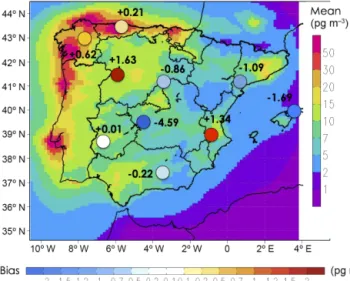
According to Ratola and Jiménez-Guerrero (2015), the modelled atmospheric concentrations of BaP present nor-malised biases that are under 30 % over all the EMEP sta-tions in the Iberian Peninsula. The fact that both positive and negative biases were found for annual mean concentra-tions indicates that the model is not generally inclined to-wards overprediction or underprediction for all the domain of study. As depicted in Fig. 2, the deviations only range between +1.63 pg m−3 over the northern Iberian Plateau (Peñausende station, close to the Spanish-Portuguese border) and −4.59 pg m−3 (San Pablo de los Montes station, in the southern-central Iberian Plateau). The low biases obtained indicate that the model is reproducing accurately the atmo-spheric concentrations of BaP, and therefore can be used as a reference for the comparison with the levels of this com-pound obtained from air-vegetation partition, as will be ex-plained in detail below.
Figure 2. BaP annual mean concentrations (pg m−3, shaded) and biases for EMEP stations (pg m−3, circles) using the available in-formation for the period 2006–2010.
Modelled BaP concentrations in the atmosphere (Fig. 3) achieve a maximum during the winter months (DJF), and can reach over 300 pg m−3in most polluted areas (NW Spain and western coast of Portugal), while background areas hardly exceed 5 pg m−3 (lowest concentrations in the SE Levan-tine coast). The highest BaP concentrations measured using pine needles as the biomonitoring matrix and atmospheric concentrations simulated by the model were found in urban and industrial settings, mainly distributed along the north-western coast of the Iberian Peninsula (as also reported by Amigo et al. (2011) and Ratola et al., 2012) followed by ru-ral and remote areas. This reflects the accumulation of an-thropogenic sources like traffic, building heating or indus-trial processes involving combustions in the most populated areas of the Iberian Peninsula. Due to the characteristics of such sources, a tendency to seasonality can be anticipated as well. In the colder months, traffic and building heating are increased and this is not only reflected by the field measure-ments (Ratola et al., 2010a), but also by the models, as shown in Fig. 3.
Given that the model represents accurately the air clima-tologies of BaP, can we use its results to evaluate the abil-ity of the air and/or vegetation methods available in scien-tific literature to estimate the atmospheric levels of BaP from biomonitoring databases? Having the accuracy of the model to capture the air concentrations evaluated against EMEP air measurements, the argument this work adopts is the fol-lowing: since the model correctly captures air concentra-tions and deposition (which have been previously assessed in Sect. 3.1.1), we can use the modelled air concentrations as a reference to evaluate the fitness of the different vegetation-air conversion approaches. Therefore, in the following section,
Figure 3. BaP climatologies (pg m−3)over the Iberian Peninsula (from top-down and left-right): winter (DJF), spring (MAM), summer (JJA) and autumn (SON) for the period 2006–2010.
the model concentrations have been considered as a consis-tent reference (due to the low biases obtained) to act as a reference to validate the approaches for this vegetation-to-air conversion.
3.2 Comparison of vegetation-to-air approaches
Databases on the atmospheric levels of SVOCs are already available, but the existing ones (like EMEP) do not cover, for instance, the entire Iberian Peninsula for a climatologi-cally representative period of time (apart from some isolated measurements). In terms of vegetation, the scenario is even worse, but since the presence of SVOCs in such environmtal matrices (and in particular in pine needles) reflects en-tirely an entrapment from the atmosphere (Hwang and Wade, 2008), these measured data can be used not only to validate the model results in vegetation but also to complement the in-formation gathered by the direct atmospheric sampling. For that purpose, six approaches to convert the concentrations found in the 70 sites where pine needles were collected into atmospheric levels were compared to the reference provided by the CTM simulations. This hypothesis is based on the fact that models represent correctly the measured atmospheric
concentrations of BaP over the Iberian Peninsula, taking into account the evaluation against EMEP field measurements available. This hypothesis was forced by the lack of simul-taneous samplings of vegetation and air concentrations over the target area. Therefore, we used the following method-ology: (a) validate simulations with WRF+CHIMERE data against EMEP network measurements, in order to check the ability of the CTM to reproduce atmospheric concentrations over the entire Iberian Peninsula; (b) once proven that er-rors are acceptable and that the model shows no trend bias, we use modelled atmospheric concentrations as a consistent reference that allows us to compare various vegetation-to-air estimating methods and check which is the most suitable ap-proach for the particular conditions of the area.
It is clear that given the numerous variables and condi-tions involved, the uptake processes of compounds like PAHs by matrices such as pine needles are not entirely understood (Barber et al., 2004). But the information we have so far indi-cates that pine needles are valid biomonitors of atmospheric loads, but also can be used to assess the performance of dif-ferent methods to convert vegetation uptake levels into at-mospheric concentrations. Thus, the objective is to test the
response of the six vegetation-to-air approaches detailed in Sect. 2.3 through a field and/or model check in the sampling points chosen.
Results (Table 2) reveal that approach 1d is the best fit to convert the levels measured in vegetation into air con-centrations, when compared to the outcome provided by the model. This approach was used by Ratola and Jiménez-Guerrero (2015) to assess differences between pine species in modelling simulations as the deposition velocity is in this case defined for an entire forest canopy and not for a given species. This general characteristic is seemingly giving this approach an advantage in terms of the vegetation-to-air cal-culations. The MFB ranges from −19 % for spring (MAM) to a slight overestimation during winter (DJF, +9 %), being the biases under 3 pg m−3 for all seasons. These errors are relatively low bearing in mind the diversity of the sampling sites considered in this work. Previous works have demon-strated the seasonal variability of PAHs uptake by pine nee-dles (Hwang and Wade, 2008; Ratola et al., 2010a), with the highest levels occurring in winter and the lowest in sum-mer. However, these differences are much more visible in the lighter PAHs (the ones in the gas-phase), given the stronger affinity of the pine needles waxy layer towards their entrap-ment, when compared to the particulate PAHs.
Being one of the latter, BaP in pine needles may not ex-perience the same level of seasonal variation as in the atmo-sphere, even if it presents a similar trend. These seasonal dif-ferences can be much stronger in the atmosphere, due to the fluctuation of the emission rates from winter to summer. It is then not surprising that the model underestimates the atmo-spheric concentrations of BaP measured in the colder months and overestimates them in the warmer ones, since in this case the field values are obtained from the levels found in the pine needles. Approach 1d is also the best representation for this seasonal variability (estimated as the standard deviation be-tween approaches and the CTM). Additionally, this approach shows the best air–vegetation relationship simulated by the model, with the rest of the methods providing unrealistic con-centrations when compared to the measurements in EMEP stations and modelling results. In fact, approaches 1a and 2 tend to underestimate the modelled concentrations by a fac-tor up to 10, yielding negative biases for all seasons. The rest of the approaches greatly overestimate the levels of BaP (by a factor of 100 in the case of 1c and 3 and of 1000 in approach 1b). These large variations are mainly caused by the difference in the deposition velocities used in each ap-proaches 1a to 1d (from 10.8 m h−1 in 1a to 0.0039 m h−1 in 1b) and in completely different vegetation-to-air estima-tion strategies in approaches 2 and 3. The deposiestima-tion veloc-ity has an important role in one of the three methodologies for estimating air concentrations from vegetation (methodol-ogy which derives into approaches 1a to 1d), but it allows precisely to understand the differences that may occur when conditions are changed (different species, different locations,
different times of the year in the same locations, different af-fecting sources, etc.).
With respect to the temporal correlation coefficients, ap-proaches 1a to 1d present the same value (0.51), as they rely on the same calculations (only changing the deposition ve-locity). This is an acceptable description of the temporal vari-ability observed in all sites. Approach 2 is not able to repro-duce these time series (correlation coefficient of −0.55), but, interestingly, it is approach 3 that presents the best correla-tion (0.80). In this latter case, although the bias for the BaP concentrations is quite high, the r value can be related with the different uptake efficiencies pine needles show for gas-phase or particulate PAHs. The two equations suggested by Chun (2011) to relate concentrations of PAHs in needles and air separate the lighter from the heavier ones. So even if the actual concentrations are not very well described, the tem-poral air-needles synergies may be better projected by this approach in this particular case.
Finally, spatial correlation coefficients (which provide a simulation for the adequate representation of the BaP spa-tial patterns over the Iberian Peninsula) are correctly repro-duced by all approaches (Table 2). The highest value is seen for winter in approach 2 (r = 0.68) and for the rest of the seasons, approaches 1a–1d present the higher correlation co-efficients (from 0.67 in JJA to 0.85 in MAM). Approach 3 generally offers the lowest spatial correlation coefficients for all seasons, except in summer. The fact that the lowest r val-ues are generally found for winter and summer (also the ex-tremes of BaP concentrations in the environment), highlights the limitations of the model to represent these extremes.
Ideally, the air levels SVOCs are measured in the field us-ing expensive active air samplus-ing equipment which also re-quire permanent power supply while operating. Thus, these devices only exist in certain parts of the world, which does not allow a proper coverage of the global presence of such contaminants, which naturally hinders the efforts of mod-elling estimation as well. As mentioned above, as living structures vegetation matrices have morphological, physical and chemical behaviour that depends on many parameters, even within the same species. Thus, the equations describing the air-vegetation partition suffer from these effects when a broad solution is searched for. Again in ideal terms, only a direct comparison of field campaigns and active air sampling performed in the same spots is bound to achieve some accu-racy, if it includes a seasonal framework as well. In fact, the main approaches presented in this work derive from these types of combined studies. But when it is impossible to have simultaneous active air and biomonitoring sampling models can help us to assess if the assumptions we are working with are sound, if a previous validation with the field-based air concentrations were successful (as is the case in our study). Naturally, there is a concern that the uncertainty associated to all the steps involved may affect the conclusions of a study like this. Even if a detailed analysis were to be extremely complex and out of the scope of this work, the main source of
Table 2. Results from the comparison of BaP concentrations in air obtained by the chemistry transport models (CTM) simulations and those
estimated from levels measured in pine needles by several approaches.
DJF MAM JJA SON
CTM MEAN∗±SD (pg m−3) 15.63 ± 15.55 16.08 ± 15.48 7.32 ± 6.84 11.19 ± 10.35 APPROACH 1a (TEMPORAL CORR. COEF.: 0.51)
DJF MAM JJA SON
SPATIAL CORR. COEF. 0.57 0.85 0.67 0.80
MFB (%) −125.46 −129.35 −125.75 −136.06
RMSE (pg m−3) 19.09 16.14 8.11 14.57
BIAS (pg m−3) −12.70 −12.58 −6.01 −9.64
METHOD MEAN ± SD (pg m−3) 3.31 ± 3.24 3.51 ± 3.21 1.31 ± 1.01 1.55 ± 1.21 APPROACH 1b (TEMPORAL CORR COEF: 0.51)
DJF MAM JJA SON
SPATIAL CORR. COEF. (r) 0.57 0.85 0.67 0.80
MFB (%) 198.97 198.81 198.83 198.95
RMSE (pg m−3) 12526.82 16294.77 4413.82 5197.87 BIAS (pg m−3) 9203.00 9945.01 3815.12 4481.39 METHOD MEAN ± SD (pg m−3) 9219 ± 8358 9961 ± 9722 3822 ± 2890 4492 ± 3424
APPROACH 1c (TEMPORAL CORR COEF: 0.51)
DJF MAM JJA SON
SPATIAL CORR. COEF. (r) 0.57 0.85 0.67 0.80
MFB (%) 193.27 192.28 193.06 193.15
RMSE (pg m−3) 1860.48 2420.65 653.60 765.74
BIAS (pg m−3) 1361.62 1474.44 563.88 660.15
METHOD MEAN ± SD (pg m−3) 1377.63 ± 1347.92 1488.53 ± 1400.05 571.20 ± 431.94 671.34 ± 511.74 APPROACH 1d (TEMPORAL CORR COEF: 0.51)
DJF MAM JJA SON
SPATIAL CORR. COEF. (r) 0.57 0.85 0.67 0.80
MFB (%) 9.21 −18.99 −6.30 −15.58
RMSE (pg m−3) 18.34 12.42 5.91 9.45
BIAS (pg m−3) 0.08 −0.81 −0.84 −2.88
METHOD MEAN ± SD (pg m−3) 15.94 ± 15.60 15.27 ± 14.86 6.48 ± 4.96 8.31 ± 8.19 APPROACH 2 (TEMPORAL CORR COEF: −0.55)
DJF MAM JJA SON
SPATIAL CORR. COEF. (r) 0.68 0.89 0.35 0.76
MFB (%) −179.73 −171.63 −115.84 −121.53
RMSE (pg m−3) 21.01 19.09 8.22 13.70
BIAS (pg m−3) −15.33 −14.96 −5.81 −8.89
METHOD MEAN ± SD (pg m−3) 0.68 ± 0.60 1.13 ± 1.06 1.51 ± 1.15 2.30 ± 2.24 APPROACH 3 (TEMPORAL CORR COEF: 0.80)
DJF MAM JJA SON
SPATIAL CORR. COEF. (r) 0.26 0.48 0.65 0.41
MFB (%) 194.93 194.88 197.07 195.66
RMSE (pg m−3) 1212.05 1166.83 897.97 916.64
BIAS (pg m−3) 1283.79 1214.75 967.09 986.96
METHOD MEAN ± SD (pg m−3) 1299.80 ± 342.94 1230.83 ± 333.38 974.41 ± 36.72 998.15 ± 41.59
∗Modelling results are considered as a consistent reference to compare the estimations from the different approaches. DJF – December, January and February; MAM – March, April and May; JJA – June, July and August; SON – September, October and November; CTM – chemistry transport model concentrations; SD – standard deviation; CORR COEF – correlation coefficient; MFB – mean fractional bias; RMSE – root mean square error.
uncertainty of our global process can be identified: the emis-sion inventories for PAHs, as stated by San José et al. (2013). In general, this uncertainty was estimated to be within a fac-tor of 2 to 5 (Berdowski et al., 1997), much larger than any other uncertainty associated with the validation process and rest of steps. For instance, EMEP individual measurements should have a precision within ±10 % and the data quality objectives for the sampling and chemical analysis set a com-bined uncertainty between 15 and 25 % (EMEP, 2001). Also, the analytical methodology to quantify BaP in pine needles has similar precision values (Ratola et al., 2009). The con-tribution of these processes to the global uncertainties would be reduced in comparison to the BaP emissions.
4 Conclusions
This work proved the good performance of pine needles as biomonitors of the BaP atmospheric concentrations. Results show that the WRF+CHIMERE modelling system repro-duces accurately not only the atmospheric presence of BaP, with deviations below 0.4 ng g−1, but also the spatial and temporal patterns of its concentrations over the vegetation in the Iberian Peninsula (biases lower than 30 % for all stations and seasons). From the six methods tested to convert vegeta-tion levels (in pine needles) into atmospheric concentravegeta-tions, approach 1d showed the most accurate results, followed by approach 1a, when compared to modelling results and ob-servations from EMEP. However, these results should not be interpreted as a ranking of the general performance of the approaches. For instance, given that approaches 1a, 1b, 1c and 1d only differ on the deposition velocity considered for BaP, we can conclude that approach 1d is the one represent-ing more closely the particular conditions of the target area. Nevertheless, for other locations and frameworks, further re-search should be conducted to verify these conclusions. An-other very important aspect to take into account is that none of the studies where the available approaches were reported used needles from the same pine species of the current study nor was located in areas of similar climatic or geographical conditions. These facts can considerably alter the uptake con-ditions of the pollutants, hence the different deposition rates reported.
Arguably, it could be said that when the model is taken as the reference, the deposition velocity in the best approach is not the most adequate for the Iberian Peninsula, but rather the one closer to the approximation of the deposition over veg-etal canopies included in the CTM. This suggestion can be rebutted given that the model results were validated against the field data available from the EMEP air sampling stations, proving that the approximation of the model is indeed the most satisfactory for the conditions of this area (and, there-fore, so are those of approach 1d). Another unprecedented perspective introduced by this work is that, contrary to the few similar studies found in literature, instead of studying
isolated episodes of contamination, the simulations cover a large period (2006–2010). This highlights a climatic view-point to the problem of BaP on a regional scale, and was not done previously (at least over the Iberian Peninsula).
Considering that the theoretical principles of the three methodologies chosen in this work that led to the air-vegetation partition calculations are valid worldwide and having some of the parameters missing for our sampling do-main, we had to resort to the ones existing in literature. With more similar studies in the future we can head towards a much better reproducibility and robustness of the modelling strategies. Our aim was to open a possible path for it and the results are encouraging. But if fieldwork continues to be as scarce as it is nowadays, the journey will be necessarily slower than we had hoped for.
The relevance of these findings opens the possibility that pine needles can be used to assess the temporal and spa-tial behaviour of BaP or other priority pollutants under com-pletely innovating perspectives; namely allowing a reliable understanding of the air quality in areas where common air sampling devices are unavailable. The comparison of levels within a regional scale will enable the strong enhancement of the knowledge available so far in the scientific literature for studies on atmospheric chemistry and transport of trans-boundary SVOCs, which is scarce (even more if we consider model validation against experimental data). Despite these promising results, further research is still needed and should be devoted to the following: (a) study the applicability of the methods tested to different areas (both geographically and in terms of land use) and (b) assess the performances of differ-ent vegetation species and their ability to act as biomonitors of the atmospheric presence of several classes of hazardous compounds.
Information about the Supplement
Information on pine needles characteristics, sampling, an-alytical methodology, as well as on the modelling and vegetation-to-air estimation strategies. This material is avail-able in the Supplement free of charge via the Internet.
The Supplement related to this article is available online at doi:10.5194/acp-16-4271-2016-supplement.
Acknowledgements. This work has been partially funded by the
European Union Seventh Framework Programme-Marie Curie COFUND (FP7/2007-2013) under UMU Incoming Mobility Programme ACTion (U-IMPACT) Grant Agreement 267143. The Spanish Ministry of Economy and Competitiveness and the “Fondo Europeo de Desarrollo Regional” (FEDER) are acknowledged for their partial funding (project CGL2014-59677-R), as well as the “Programa Jiménez de la Espada” (ref. 19641/IV/14) from Fundación Séneca – Science and Technology Agency in the Region
of Murcia.
Edited by: A. Pozzer
References
Amigo, J. M., Ratola, N., and Alves, A.: Study of geographical trends of polycyclic aromatic hydrocarbons using pine needles, Atmos. Environ., 45, 5988–5996, 2011.
Augusto, S., Máguas, C., Matos, J., Pereira, M. J., and Branquinho, C.: Lichens as an integrating tool for monitoring PAH atmo-spheric deposition: A comparison with soil air and pine needles, Environ. Pollut., 158, 483–489, 2010.
Aulinger, A., Matthias, V., and Quante, M.: An approach to tem-porally disaggregate benzo(a)pyrene emissions and their appli-cation to a 3D Eulerian atmospheric chemistry transport model, Water Air Soil Poll., 216, 643–655, 2011.
Baek, S. O., Field, R. A., Goldstone, M. E., Kirk, P. W., Lester, J. N., and Perry, R.: A review of atmospheric polycyclic aromatic hydrocarbons: sources, fate and behaviour, Water Air Soil Poll., 60, 279–300, 1991.
Barber, J. L., Thomas, G. O., Kerstiens, G., and Jones, K. C.: Cur-rent issues and uncertainties in the measurement and modelling of air–vegetation exchange and within-plant processing of POPs, Environ. Pollut., 128, 99–138, 2004.
Baussant, T., Sanni, S., Jonsson, G., Skadsheim, A., and Borseth, J. F.: Bioaccumulation of polycyclic aromatic compounds: 1. Bio-concentration in two marine species and in semipermeable mem-brane devices during chronic exposure to dispersed crude oil, En-viron. Toxicol. Chem., 20, 1175–1184, 2001.
Berdowski, J. J. M., Baas, J., Bloos, J. P. J., Visschedijk, A. J. H., and Zandveld, P. Y. J.: The European Atmospheric Emis-sion Inventory for Heavy Metals and Persistent Organic Pollu-tants, Umweltforschungsplan des Bundesministers fur Umwelt, Naturschutz und Reaktorsicherheit, Luftreinhaltung. Forschung-bericht 104 02 672/03, TNO, Apeldoorn, the Netherlands, 1997. Bernalte, E., Marín-Sánchez, C., Pinilla-Gil, E., Cerceda-Balic, F., and Vidal-Cortex, V.: An exploratory study of particulate PAHs in low-polluted urban and rural areas of southwest Spain: con-centrations, source assignment, seasonal variation and correla-tions with other pollutants, Water Air Soil Poll., 223, 5143–5154, 2012.
Bidleman, T. F.: Atmospheric processes. Wet and dry deposition of organic compounds are controlled by their vapor-particle parti-tioning, Environ. Sci. Technol., 22, 361–367, 1988.
Bieser, J., Aulinger, A., Matthias, V., and Quante, M.: Impact of emission reductions between 1980 and 2020 on atmospheric benzo[a]pyrene concentrations over Europe, Water Air Soil Poll., 223, 1391–1414, 2012.
Cape, J. N., Paterson, I., and Wolfenden, S. J.: Regional variation in surface properties of Norway spruce and Scots pine needles in relation to forest decline, Environ. Pollut., 58, 325–342, 1989. Chun, M. Y.: Relationship between PAHs concentrations in ambient
air and deposited on pine needles, Environ. Health Toxicol., 26, 6 pp., 2011.
Directive 2008/50/EC of the European Parliament and of the Coun-cil of 21 May 2008 on ambient air quality and cleaner air for Eu-rope, Official Journal of the European Union L 152, 1–44, 2008.
EMEP (European Monitoring and Evaluation Programme): EMEP manual for sampling and chemical analysis. EMEP/CCC-Report 1/1995 – revised, Norwegian Institute for Air Research, Kjeller, Norway, November 2001.
Friedman, C. L. and Selin, N. E.: Long-range atmospheric transport of polycyclic aromatic hydrocarbons: a global 3-D model analy-sis including evaluation of Arctic sources, Environ. Sci. Technol., 46, 9501–9510, 2012.
Galarneau, E., Makar, P. A., Zheng, Q., Narayan, J., Zhang, J., Moran, M. D., Bari, M. A., Pathela, S., Chen, A., and Chlum-sky, R.: PAH concentrations simulated with the AURAMS-PAH chemical transport model over Canada and the USA, Atmos. Chem. Phys., 14, 4065–4077, doi:10.5194/acp-14-4065-2014, 2014.
Giorgi, F.: A particle dry deposition scheme for use in tracer trans-port models, J. Geophys. Res., 91, 9794–9806, 1986.
Horstmann, M. and McLachlan, M. S.: Atmospheric deposition of semivolatile organic compounds to two forest canopies, Atmos. Environ., 32, 1799–1809, 1998.
Hwang, H. H. and Wade, T. L.: Aerial distribution, temperature-dependent seasonal variation, and sources of polycyclic aromatic hydrocarbons in pine needles from the Houston metropolitan area, Texas, USA, J. Environ. Sci. Heal. A, 43, 1243–1251, 2008. Jakeman, A. J., Letcher, R. A., and Norton, J. P.: Ten iterative steps in development and evaluation of environmental models, Envi-ron. Modell. Soft., 21, 602–614, 2006.
Jiménez-Guerrero, P., Jorba, O., Baldasano, J. M., and Gassó, S.: The use of a modelling system as a tool for air quality manage-ment: annual high-resolution simulations and evaluation, Sci. To-tal Environ., 390, 323–340, 2008.
Klánová, J., ˇCupr, P., Baráková, D., Šeda, Z., Andˇel, P., and Holoubek, I.: Can pine needles indicate trends in the air pollu-tion levels at remote sites?, Environ. Pollut., 157, 3248–3254, 2009.
Lammel, G., Sehili, A. M., Bond, T. C., Feichter, J., and Grassl, H.: Gas/particle partitioning and global distribution of polycyclic aromatic hydrocarbons – a modelling approach, Chemosphere, 76, 98–106, 2009.
Lehndorff, E. and Schwark, L.: Biomonitoring airborne parent and alkylated three-ring PAHs in the Greater Cologne Conurbation II: Regional distribution patterns, Environ. Pollut., 157, 1706–1713, 2009.
Mackay, D.: Multimedia Environmental Models: the Fugacity Ap-proach, Lewis Pub., Chelsea, MI, 1991.
Maddalena, R. L., McKone, T. E., and Riley, W. J.: Is there a “forest filter effect” for organic pollutants?, Stoch. Env. Res. Risk A., 17, 231–234, 2003.
Mastral, A. M. and Callén, M. S.: A review on polycyclic aromatic hydrocarbon (PAH) emission from energy generation, Environ. Sci. Technol., 34, 3051–3057, 2000.
Matthias, V., Aulinger, A., and Quarte, M.: CMAQ simulations of the benzo(a)pyrene distribution over Europe for 2000 and 2001, Atmos. Environ., 43, 4078–4086, 2009.
Menut, L., Bessagnet, B., Khvorostyanov, D., Beekmann, M., Blond, N., Colette, A., Coll, I., Curci, G., Foret, G., Hodzic, A., Mailler, S., Meleux, F., Monge, J.-L., Pison, I., Siour, G., Turquety, S., Valari, M., Vautard, R., and Vivanco, M. G.: CHIMERE 2013: a model for regional atmospheric composition
modelling, Geosci. Model Dev., 6, 981–1028, doi:10.5194/gmd-6-981-2013, 2013.
Morville, S., Delhomme, O., and Millet, M.: Seasonal and diurnal variations of PAH concentrations between rural, suburban and urban areas, Atmos. Pollut. Res., 2, 366–373, 2011.
Odabasi, M., Cetin, E., and Sofuoglu, A.: Determination of octanol– air partition coefficients and supercooled liquid vapor pressures of PAHs as a function of temperature: Application to gas–particle partitioning in an urban atmosphere, Atmos. Environ., 40, 6615– 6625, 2006.
Peters, K. and Eiden, R.: Modelling the dry deposition velocity of aerosol particles to a spruce forest, Atmos. Environ., 26, 2555– 2564, 1992.
Piccardo, M. T., Pala, M., Bonaccurso, B., Stella, A., Redaelli, A., Paola, G., and Valério, F.: Pinus nigra and Pinus pinaster nee-dles as passive samplers of polycyclic aromatic hydrocarbons, Environ. Pollut., 133, 293–301, 2005.
Pöschl, U., Letzel, T., Schauer, C., and Niessner, R.: Interaction of ozone and water vapor with spark discharge soot aerosol particles coated with benzo[a]pyrene: O3and H2O adsportion, benzo[a]pyrene degradation, and atmospheric implications, J. Phys. Chem. A, 105, 4029–4041, 2001.
Ratola, N. and Jiménez-Guerrero, P.: Combined field/modelling approaches to represent the air-vegetation distribution of benzo[a]pyrene using different vegetation species, Atmos. En-viron., 106, 34–42, 2015.
Ratola, N., Lacorte, S., Barceló, D., and Alves, A.: Microwave-assisted extraction and ultrasonic extraction to determine poly-cyclic aromatic hydrocarbons in needles and bark of Pinus
pinaster Ait. and Pinus pinea L. by GC-MS, Talanta, 77, 1120–
1128, 2009.
Ratola, N., Amigo, J. M., and Alves, A.: Comprehensive assess-ment of pine needles as bioindicators of PAHs using multivariate analysis. The importance of temporal trends, Chemosphere, 81, 1517–1525, 2010a.
Ratola, N., Amigo, J. M., and Alves, A.: Levels and sources of PAHs in selected sites from Portugal: biomonitoring with Pinus
pinea and Pinus pinaster needles, Arch. Environ. Con. Tox., 58,
631–647, 2010b.
Ratola, N., Amigo, J. M., Oliveira, M. S. N., Araújo, R., Silva, J. A., and Alves, A.: Differences between Pinus pinea and Pinus
pinaster as bioindicators of polycyclic aromatic hydrocarbons,
Environ. Exp. Bot., 72, 339–347, 2011.
Ratola, N., Alves, A., Lacorte, S., and Barceló, D.: Distribution and sources of PAHs using three pine species along the Ebro river, Environ. Monit. Assess., 184, 985–999, 2012.
San José, R., Pérez, J. L., Callén, M. S., López, J. M., and Mas-tral, A.: BaP (PAH) air quality modelling exercise over Zaragoza (Spain) using an adapted version of WRF-CMAQ model, Envi-ron. Pollut., 183, 151–158, 2013.
Schwarzenbach, R. P., Gschwend, P. M., and Imboden, D. M.: En-vironmental Organic Chemistry, 2nd Edn., John Wiley & Sons, Hoboken, New Jersey, 2003.
Sehili, A. M. and Lammel, G.: Global fate and distribution of poly-cyclic aromatic hydrocarbons emitted from Europe and Russia, Atmos. Environ., 41, 8301–8315, 2007.
Seinfeld, J. H. and Pandis, S. N.: Atmospheric Chemistry and Physics: from Air Pollution to Climate Change, Wiley- Inter-science, New Jersey, 1997.
Simonich, S. and Hites, R.: Vegetation-atmosphere partitioning of polycyclic aromatic hydrocarbons, Environ. Sci. Technol., 28, 939–943, 1994.
Skamarock, W. C., Klemp, J. B., Dudhia, J., Gill, D. O., Barker, D. M., and Duda, M. G.: A description of the Advanced Research WRF Version 3, NCAR technical note NCAR/TN20201c475+STR, http://www2.mmm.ucar.edu/wrf/ users/docs/arw_v3.pdf (last access: on 29 January 2016), 2008. Solé, M.: Assessment of the results of chemical analyses
com-bined with the biological effects of organic pollution on mussels, Trend. Anal Chem., 19, 1–8, 2000.
St-Amand, A. D., Mayer, P. M., and Blais, J. M.: Modeling atmo-spheric vegetation uptake of PBDEs using field measurements, Environ. Sci. Technol., 41, 4234–4239, 2007.
St-Amand, A. D., Mayer, P. M., and Blais, J. M.: Modeling PAH up-take by vegetation from the air using field measurements, Atmos. Environ., 43, 4283–4288, 2009a.
St-Amand, A. D., Mayer, P. M., and Blais, J. M.: Prediction of SVOC vegetation and atmospheric concentrations using calcu-lated deposition velocities, Environ. Int., 35, 851–855, 2009b. Tomashuk, T. A.: A comparison of atmospheric PAHs in pine
nee-dles and high-volume sampler filters in the Dayton metro area, MS Thesis, Wright State University, Dayton OH, 83 pp., 2010. Tørseth, K., Aas, W., Breivik, K., Fjæraa, A. M., Fiebig, M.,
Hjellbrekke, A. G., Lund Myhre, C., Solberg, S., and Yttri, K. E.: Introduction to the European Monitoring and Evalua-tion Programme (EMEP) and observed atmospheric composiEvalua-tion change during 1972–2009, Atmos. Chem. Phys., 12, 5447–5481, doi:10.5194/acp-12-5447-2012, 2012.
Tremolada, P., Burnett, V., Calamari, D., and Jones, K. C.: Spatial distribution of PAHs in the UK atmosphere using pine needles, Environ. Sci. Technol., 30, 3570–3577, 1996.
Vestreng, V., Ntziachristos, L., Semb, A., Reis, S., Isaksen, I. S. A., and Tarrasón, L.: Evolution of NOx emissions in Europe with focus on road transport control measures, Atmos. Chem. Phys., 9, 1503–1520, doi:10.5194/acp-9-1503-2009, 2009.
Weiss, P., Lorbeer, G., and Scharf, S.: Regional aspects and statis-tical characterisation of the load with semivolatile organic com-pounds at remote Austrian forest sites, Chemosphere, 40, 1159– 1171, 2000.
Wesely, M.: Parameterization of surface resistances to gaseous dry deposition in regional scale numerical models, Atmos. Environ., 23, 1293–1304, 1989.
Zhang, L., Gong, S., Padro, J., and Barrie, L.: A size-segregated par-ticle dry deposition scheme for an atmospheric aerosol module, Atmos. Environ., 35, 549–560, 2001.