Male Sexual Polymorphism, Alternative
Reproductive Tactics, and Androgens in
Combtooth Blennies (Pisces: Blenniidae)
Rui F. Oliveira,*
,1Adelino V. M. Canario,†
and Matthew S. Grober‡
*Instituto Superior de Psicologia Aplicada, Unidade de Investigac¸a˜o em Eco-Etologia, Rua
Jardim do Tabaco 34, 1149-041 Lisboa, Portugal; †Centro de Cieˆncias do Mar, Universidade do Algarve, Campus de Gambelas, 8000 Faro, Portugal; and ‡Department of Life Sciences, Arizona State University West, 4701 West Thunderbird Road, Phoenix, Arizona 85069-7100
Received August 9, 2000, accepted March 1, 2001
In species in which intense intermale competition for the access to females is present males of lower competitive ability may adopt alternative reproductive tactics (ART) to get access to mates. These ART translate in many cases into male sexual polymorphism, with individuals following distinctly different tactics. Usually two alterna-tive male morphs can be recognized in species with ART: (1) bourgeois males that compete for access to mates invest in typically male behaviors, such as build-ing elaborated nests or displaybuild-ing ornaments; and (2) parasitic males that take advantage of the success of the bourgeois males in attracting females and attempt “sneaker” fertilizations (e.g., sneaker and satellite males). In combtooth blennies (Blenniidae) the co-oc-currence of ART and male sexual polymorphism has been described for two temperate species: the peacock blenny, Salaria pavo, and the Azorean rock-pool blenny,
Parablennius sanguinolentus parvicornis. Interestingly,
while in the peacock blenny the alternative male morph adopts a sneaker tactic, in the rock-pool blenny para-sitic males act as satellites to nest-holder males. Thus, this variation in the ART expressed in these two closely related species allows for a comparative study of the proximate and ultimate factors affecting the expression of the two ART. In this article we summarize the avail-able information on androgen levels in bourgeois and parasitic males of natural populations of the two species and of recent studies on the effect of exogenous admin-istration of androgens on tactic switching in parasitic males of the two species. The information is discussed within the frame of the relative plasticity hypothesis, which predicts that plastic alternative morphs should
show differences in hormone levels and that the admin-istration of sex steroids should be effective in promoting the switch from the parasitic to bourgeois tactic. The evidence is only partly consistent with this hypothesis. Alternatively, a social transduction hypothesis that bet-ter fits the available data on androgens and ART in teleost is proposed. It states that the observed differ-ences in androgen levels between alternative morphs should not be interpreted as an organization vs activa-tion effect of steroids, but rather as the limited vs lifelong responsiveness of the neuroendocrine axis to social reg-ulation. © 2001 Academic Press
Key Words: sexual polymorphism; alternative
repro-ductive tactics; androgens; 11-ketotestosterone; te-leosts; blenniids; social transduction hypothesis, relative plasticity hypothesis.
In some species males are so different from females that in some cases they were initially classified as different species (e.g., Anas platyrhynchos and Anas
boschas; Linnaeus, 1758). It was not until Charles
Dar-win proposed the theory of sexual selection (DarDar-win 1859, 1871) that the evolutionary processes underlying these differences were understood. Basically, owing to differences in reproductive investment between sexes, individuals of one sex, usually the males, tend to compete among themselves for access to mates. In addition, the associated costs of usually larger invest-ments in reproduction by females makes their choice of mates a very selective process. The two main pri-mary factors that generate this reproductive asymme-try among sexes are anisogamy (i.e., the fact that fe-males produce much larger and more energetic and
1
To whom correspondence and reprint requests should be ad-dressed. E-mail: [email protected].
0018-506X/01 $35.00 Copyright © 2001 by Academic Press All rights of reproduction in any form reserved.
costly gametes than males) and parental investment (Maynard-Smith, 1978; Trivers, 1972; Andersson, 1994). These two factors usually promote lower repro-ductive rates and consequently smaller sexual activity (e.g., more restricted periods of sexual activity) in females than in males, which translates into biased operational sex ratios (Parker and Simmons, 1996; Kvarnemo and Ahnesjo¨, 1996). Thus, as a rule, males compete for females and their fitness depends on the number of mates with whom they breed, while fe-males are choosy and their fitness is dependent on the quality of their partners (both due to direct or to indirect benefits to females for mating with the se-lected mate). This general rule was initially pro-posed by Darwin (1859), who, referring to sexual selection, wrote that it “. . . depends, not on a strug-gle for existence, but on a strugstrug-gle between the males for possession of the females; the result is not death to the unsuccessful competitor, but few or no offspring.”
Apart from sex differences in behavior and mor-phology within sex, variation also occurs in species with intense male competition for access to mates, in which individuals of lower competitive ability may adopt alternative mating tactics (ART) to reproduce. Sexual polymorphism is a phenomenon that only re-cently attracted the attention of behavioral research-ers, although the existence of diandric species has been known for quite some time. Because males are usually the competing sex (see above) sexual polymor-phism occurs mainly among males (but see Henson and Warner, 1997, for the possible variations in female reproductive behavior). Within the vertebrates, teleost fishes are the taxa with the larger number of sexually polymorphic species that has been described (see Ta-borsky, 1999, for a review).
The known cases of sexual polymorphisms corre-spond mostly to alternative mating tactics that have been classified as bourgeois and as parasitic (Tabor-sky, 1997). Bourgeois males actively compete among themselves for access to female mates, e.g., by defend-ing breeddefend-ing territories, while parasitic males exploit the investment of bourgeois males to fertilize eggs, e.g., by mimicking female morphology and behavior (Taborsky, 1997). Thus bourgeois males invest in male-displaying characteristics such as morphological ornaments (e.g., extension of the tail in swordtails,
Xiphophorus spp.; Basolo, 1990), mating calls (e.g.,
humming calls in plainfin midshipman, Porichthys
no-tatus; Brantley and Bass, 1994), the release of sex
pher-omones (e.g., sex-pheromone producing anal gland in blennies; Laumen, Pern, and Blu¨m, 1974), or the
elab-oration and ornamentation of nests (e.g., Mediterra-nean wrasses; Lejeune, 1985). In contrast, parasitic males can (1) try to approach the mating site without being noticed, which can evolve to female mimicry (e.g., adoption of female courtship behavior by sneaker males in the sex-role-reversed population of the peacock blenny, Salaria pavo; Gonc¸alves, Almada, Oliveira, and Santos, 1996); (2) dart to the mating pair and release their sperm before the bourgeois male can react to its presence (e.g., streaking males in wrasses; Warner, 1984); or (3) cooperate with bourgeois males so that they tolerate their presence in the breeding grounds (e.g., helping behavior in the cichlid fish
Neo-lamprologus brichardi; Taborsky, 1984).
The term parasitic as used here indicates that these kinds of males exploit the investment of the bourgeois males in mate attraction. However, as is outlined be-low, the parasitic tactic encompasses a range of rela-tionships from what could be ascribed as almost true mutualism (both types of males appear to benefit) to true parasitism (only the parasitic males appear to benefit). In any scenario, without the initial bourgeois investment the alternative tactic would not be func-tional.
It must be emphasized that ART and sexual poly-morphism are not synonymous, since ART can also occur in monoandric species, when a single male morph can adopt different conditional behavior tactics (e.g., courtship vs forced copulations in guppies,
Po-ecilia reticulata; Farr, 1989). This distinction illustrates
the need for considering within-sex morphological variation (morphotypes) separately from within-sex behavioral variation (ethotypes), even if in some spe-cies both phenomena overlap while in some others only one of the two is present (e.g., color morphs in cichlids; Voss, 1980; and the above-mentioned varia-tion in sex behavior in guppies). Moreover, both the ART and the sexual polymorphism may be fixed for life (e.g., Xiphophorus nigrensis; Ryan and Causey, 1989; Zimmerer and Kallmann, 1989) or flexible, in which case individuals may switch tactic/morph type during their lifetime (e.g., initial and terminal phase males in the bluehead wrasse, Thalassoma bifasciatum; Hoffman, Schildhauer and Warner, 1985).
The occurrence of ART offers the possibility for an insight into the endocrine mechanisms underlying re-productive behaviors, since in the parasitic tactic the expression of behavioral and morphological male traits is dissociated from gonad maturation and sperm production.
TWO TALES FROM THE INTERTIDAL:
ART AND SEXUAL POLYMORPHISM
IN COMBTOOTH BLENNIES
Combtooth blennies (Blenniidae, Teleostei) are small littoral fishes that comprise about 300 species occurring from tropical to temperate waters. Blenniids are generally sexually dimorphic, with males tending to be larger than females. Males also exhibit a variety of secondary sex characteristics (SSC), especially dur-ing the breeddur-ing season, such as enlarged supraorbital tentacles (e.g., Aidablennius sphynx, and Parablennius spp.); crests on the head (e.g., Salaria spp.); an enlarged dorsal fin (e.g., A. sphynx); glands on the anal spines (Salaria spp. and Parablennius spp.); clublike glands on the tips of the soft rays of the dorsal, caudal and anal fins; and color markings on the head and/or body (e.g., Lipophrys spp.) (Zander, 1975; Papaconstantinou, 1979).
The basic blenniid breeding pattern consists of males defending a breeding territory in which females come to spawn in a cavity (crevices, holes, empty shells, and other nesting cavities). The eggs are adhe-sive and are deposited in the inner surface of the nest (Breder and Rosen, 1966; Tresher, 1984). Parental care is provided exclusively by the males that guard the eggs until hatching (Breder and Rosen, 1966; Gibson, 1969; Thresher, 1984; Almada and Santos, 1995). The fact that males are the care giving sex could lead to the prediction that females would have higher reproduc-tive rates and that the operational sex ratio would be biased toward females. However, despite male paren-tal care males are also the competing sex in blenniids. This contradiction is explained by the fact that male parental care is restricted to offspring guarding and to egg fanning, which allows males to continue breeding over the parental phase, and thus their reproductive rate is still higher than that in females (except in the cases when nests are very small and become saturated with a small number of eggs; e.g., Hastings, 1992). Thus, male reproductive competition occurs in most blenniid species and males of lower competitive abil-ity can adopt ART to get access to mates.
Two blenniid species in which ART occur have been identified, the peacock blenny S. pavo and the Azorean rock-pool blenny Parablennius sanguinolentus
parvicor-nis (Santos, 1985; Ruchon et al., 1995; Gonc¸alves et al.,
1996). In Table 1 we propose a scheme to classify the sexually active male types in these species based on their morphology and behavior. In both species the evolution of the alternative tactic seems to be related
to high regimens of intrasexual selection (e.g., male– male competition for nest sites) as indicated by the fact that mating success is highly associated with male body size among bourgeois males of both species (iveira, Almada, Forsgren, and Gonc¸alves, 1999; Ol-iveira, Miranda, Carvalho, Gonc¸alves, and Santos, 2000). Interestingly, the tactic used by the parasitic males is different between the two species, offering a unique opportunity for the comparative study of ART in closely related species.
In the peacock blenny population studied in South-ern Portugal bourgeois males (total length⬇ 12 cm, age⬇ 2–3 years old) form nest aggregations that are so dense that the territories are virtually absent (Almada, Gonc¸alves, Santos, and Baptista, 1994). As a result a sex-role reversal in courtship can be observed (mada, Gonc¸alves, Oliveira, and Santos, 1995). Al-though males retain the capacity to court when they have no eggs in the nest, they usually assume a pas-sive role in courtship while the females compete ag-gressively among themselves and actively court males, displaying a female nuptial coloration (Almada
et al., 1995). Some of the smaller and younger males
(total length⬇ 7 cm, age ⬇ 1 year old) adopt female nuptial coloration and female courting behavior to-ward nest-holder males as a means to try to enter the nest during or shortly after spawning of a female (Gonc¸alves et al., 1996).
In the Azorean rock-pool blenny P. s. parvicornis, larger and older males (total length⬇14 cm; age ⱖ2 years old) establish breeding territories in which they prepare a nest in a natural crevice. These males court females by signaling the location of the nest and cir-cling and leading the females, and spawning occurs inside the nest. The males guard, clean, and aerate the eggs until they hatch (Santos, 1985; Santos and Bar-reiros, 1993; Santos, Nash, and Hawkins, 1995). Some of the smaller and younger males (total length⬇ 10 cm; age ⬇ 1 years old) become attached to parental territories, acting as satellites to these territories which
TABLE 1
Classification of Blenniid Male Types According to Their Morphology and Behaviora
Morphology
Behavior
Site attachment Wandering
Bourgeois male (i.e., with SSC) Nest-holders Floaters Parasitic male (i.e., without SSC) Satellites Sneakers
they help to defend and try to achieve sneaker fertil-izations when the females enter the nests to spawn (Santos, 1985; Santos et al., 1995). The occurrence of few sneaker males in P. s. parvicornis has also been reported in the literature (“machos furtivos”; Santos, 1985), but recent data suggests they represent a pro-portion of satellites that do not manage to establish an association with a specific nest (R. F. Oliveira, unpub-lished data).
The occurrence of floater individuals, that is males with SSC fully expressed that do not establish a nest and that wander from nest to nest trying to take over a nest, has also been described for both species (Oliveira, Ca-nario, Grober, and Santos, 2001a; Oliveira, CaCa-nario, Al-mada, Gonc¸alves, and Forsgren, 2001b).
In both species, the gonadosomatic index (i.e., the relative size of the gonads to total body mass) of parasitic (i.e., sneaker/satellite) males is significantly higher (approx. three times, Gonc¸alves et al., 1996; Santos, Hawkins, and Nash, 1996) than that of nest-holders. In contrast to nest-holders, the gonads of the parasitic males lack or present only vestigial testicular glands, which are gonadal accessory structures in-volved in steroidogenesis and sperm maturation (Reinboth and Becker, 1986; Lahnsteiner, Richtarski, and Patzner, 1990). Nevertheless, parasitic males from both species produce active sperm suggesting that there is a potential functional difference between their sperm and that of nest-holders.
In summary, although parasitic male morphotypes are present in both species they use different ART, namely female mimicking in S. pavo and satellite be-havior in P. s. parvicornis (Table 2).
HORMONAL MECHANISMS OF ART
AND SEXUAL POLYMORPHISM: THE
RELATIVE PLASTICITY HYPOTHESIS
It has been hypothesized that the hormonal basis of ART would have a parallel in the activational-organi-zational effect of hormones (Arnold and Breedlove, 1985) depending on the plasticity of the tactics—Rel-ative Plasticity Hypothesis (Moore, 1991). The ratio-nale behind this hypothesis is that the effects of hor-mones in the differentiation of ART are equivalent to their effects in primary sex differentiation. Thus by making a distinction between fixed alternative pheno-types (i.e., in which individuals adopt one of the tac-tics for their entire life) and flexible alternative pheno-types (i.e., in which individuals may switch tactic during their lifetime) this hypothesis predicts an or-ganizational role of hormones in the former case and an activational role in the latter one (Moore, 1991).
Two further predictions can then be extracted from this hypothesis: (1) that hormone profiles would differ in plastic adult morphs but not in fixed ones (Moore,
TABLE 2
Summary of the Sexually Polymorphic Characters in Two Blenniid Species with Alternative Reproductive Tactics,
S. pavo and P. sanguinolentus parvicornis
Sexually polymorphic characters
Peacock blenny (S. pavo)
Azorean rock-pool blenny (P. sanguinoglentus parvicornis)
Bourgeois male Parasitic male Bourgeois male Parasitic male
Behavior Competition for nests Yes No Yes No
Territoriality No No Yes Yes
Parental care Yes No Yes No
Courtship Male type; almost absent
Femalelike Male-type Male type; almost absent Nuptial coloration Male coloration Female coloration Male coloration Male coloration Life history Age 2–3 years old 0–1 years old 2–3 years old 0–1 years old
Size at maturity (SL) Large (10 cm) Small (6 cm) Large (13 cm) Small (8 cm) Secondary sexual
characteristics
Head ornaments Heat crest No head crest Small head hump No head hump
Anal glands Present Absent Present Absent
Reproductive biology GSI Low High Low High
Testicular gland Present Absent or vestigial
Present Absent or vestigial
Sperm ⫹ ⫹⫹ ⫹ ⫹⫹
Sex steroids 11-Ketotesterone High Low High Low
1991); and (2) that in flexible ART the effect of hor-mone manipulations on phenotypic differences in be-havior and morphology should be effective in adults but not during early development (i.e., activational effect), while in fixed ART hormone manipulations should be effective during early development but not in adults (i.e., organizational effect) (Moore, 1991).
But in order to test the hypothesis and to under-stand the underlying mechanisms of ART what hor-mones are expected to be involved in the expression of ART in vertebrates? If one makes a parallelism with sex differentiation, sex steroids are good candidates since their role in sex differentiation in vertebrates, including fish, is well established (Nelson, 1999). Sex steroids should be considered as honest signals (sensu animal communication theory; Bradbury and Vehren-camp, 1998) that the gonads, as they mature, send to the rest of the organism to coordinate the expression of sexual behavior and the differentiation of sexual characters (i.e., indicating availability of mature ga-metes to be released; Oliveira and Almada, 1999). Among the sex steroids, the androgens were a first choice since they are greatly involved in male repro-ductive physiology (e.g., Borg, 1994).
Brantley, Wingfield, and Bass (1993) reviewed the available literature on androgen levels in species with ART and found that alternative phenotypes differ in their circulating 11-ketotestosterone (KT) levels and that there was no clear pattern regarding testosterone (T). In the species surveyed, which were not closely related to each other phylogenetically (i.e., phyloge-netical bias is probably not present), bourgeois males had significantly higher levels of circulating KT than those adopting the parasitic tactic. Thus either KT plays a major role in the expression of the male bour-geois tactic or higher KT levels in bourbour-geois males reflect the responsiveness of this hormone to the ex-pression of the tactic itself.
TESTING THE RELATIVE PLASTICITY
HYPOTHESIS IN BLENNIES:
THE FIRST PREDICTION
To test the first prediction of the relative plasticity hypothesis, androgen content of P. s. parvicornis and S.
pavo were analyzed (Oliveira et al., 2001a,b). In nature
blood androgen levels of P. s. parvicornis nest-holders had higher levels of KT than satellites, while T levels were not significantly different between tactics (Ol-iveira et al., 2001a).
In S. pavo, due to the sneakers small size, blood collection was not possible. Thus, for this species in-stead of comparing circulating androgen levels, we compared testis androgen levels. Because the sneakers lack the testicular gland (or it is only vestigial, see text above) gonadal androgen levels in sneakers are equal to testis androgen levels, while in nest-holders go-nadal androgen levels are the sum of testis plus tes-ticular gland androgen levels. Comparison of gonadal androgen content between the two male alternative phenotypes showed that even if only the androgen concentrations of the nest-holder testis (which ex-cludes the testicular gland) were compared to the whole gonad concentrations of the sneakers, nest-holder males had significantly higher levels of both KT and T than sneakers [KT testis concentrations (mean⫾ SEM): sneakers ⫽ 0.97 ⫾ 0.65 ng/g tissue; nest-holders⫽ 5.05 ⫾ 0.60 ng/g tissue; Mann–Whit-ney U test, P⬍ 0.01; T testis concentrations (mean ⫾ SEM): sneakers⫽ 1.19 ⫾ 0.60 ng/g tissue; nest-hold-ers⫽ 13.75 ⫾ 1.60 ng/g tissue; Mann–Whitney U test,
P ⬍ 0.001]. Since the testicular gland is the main
source of androgens in this species (Reinboth and Becker, 1986), and the androgen content of the testic-ular gland is even indicative of circulating androgen levels (correlation between testicular gland androgen levels and circulating levels: T: n⫽ 10, r ⫽ 0.71, P ⫽ 0.02; KT: n⫽ 10, r ⫽ 0.68, P ⫽ 0.03; Oliveira et al., 2001b), our results are a very conservative estimate of androgen production by nest-holders. If the testicular gland androgen concentrations of nest-holders were taken into account (mean⫾ SEM: KT: 33.9 ⫾ 6.1 ng/g tissue; T: 116.2⫾ 21.6 ng/g tissue) the difference to the sneakers would be more than 10-fold. Thus, in both species androgen levels in the wild support the first prediction of the relative plasticity hypothesis.
In the case of the rock-pool blenny the males can be subdivided into four groups according to the behavioral tactic (see Table 1). Among bourgeois males that express fully the secondary sex characteristics two behavioral tactics can be recognized: nest-holders and floaters. Among parasitic males not all act as satellites to nest-holder males. Some behave like sneakers, trying to get parasitic fertilizations but not helping nest-holders to defend the breeding territory (Oliveira et al., 2001a). In-terestingly, it was found that there were no significant differences in androgen levels (both KT and T) between behavioral tactics within alternative morphs (Oliveira et
al, 2001a). This result illustrates the importance of
care-fully separating sexual polymorphism from behavioral alternative tactics when analyzing the underlying mech-anisms of the phenomena. It also suggests that high KT
levels might be associated with the expression of the bourgeois morph but not with bourgeois typical behav-ior, since floater males do not defend nests and occasion-ally also try to enter nests to sneak fertilizations. How-ever, significant differences in androgens between males using the different tactics have been also described in monoandric species with ART (e.g., Mozambique tilapia,
Oreochromis mossambicus; Oliveira and Almada, 1998a;
Oliveira, Almada, and Canario, 1996). An alternative explanation for these otherwise apparently contradictory results is that the differences found between morpho-types in the case of the blennies and ethomorpho-types in the case of the tilapia are not the cause of the ART but the reflection of different social challenges to which the dif-ferent alternative phenotypes are exposed.
There is now overwhelming evidence not only that androgens modulate social interactions but also that androgen levels can be affected by social interactions, suggesting a two-way relationship between andro-gens and behavior. This has been interpreted as an adaptation for the individuals to adjust their behavior to changes in the social environment in which they are living. Thus, social interactions would stimulate the production of androgens and the levels of androgens would be a function of the stability of the social envi-ronment in which the animal is placed (“challenge hypothesis”; Wingfield, Hegner, Dufty, and Ball, 1990). Thus, it can be predicted that both population density and intrusion rate would increase circulating androgen levels in breeding male blenniids. Compar-ison of blood plasma levels of KT in nest-holder males of S. pavo and P. s. parvicornis showed that they are significantly higher in the former (Table 3). This agrees with what is predicted by the challenge hypothesis considering that nests are aggregated in S. pavo, while
they are spatially dispersed in P. s. parvicornis. The rate of territorial intrusions in S. pavo is also much higher than in P. s. parvicornis (Table 3). Moreover, in S. pavo KT plasma levels increase in the peak of the breeding season when there are more territorial intrusions by sneaker males (Oliveira et al., 2001b). In P. s. parvicornis a negative association between KT blood plasma lev-els of nest holders and egg fanning behavior, a major form of parental care in this species, was found, which is in keeping with a trade-off between parental care and high androgen levels (Oliveira et al., 2001a). Taken together these observations suggest that social modu-lation of androgen levels may be in action in the studied species and can be a confounding effect in interpretation of field data when testing the first pre-diction of the relative plasticity hypothesis.
Moore and co-workers (1991) have recognized the limitations of this prediction of the relative plasticity hypothesis due to the social modulation of sex steroids and stated that if a difference in hormone levels would be detected between adult alternative fixed pheno-types then it should be explained by different social experiences of the two morphs and not because of an activational role of the hormone on morph expression. Thus, a simple comparison of hormone levels of alter-native phenotypes in the wild may be misleading and cannot be used alone to test conclusively the first prediction. In fact the social environment faced by alternative phenotypes will most probably be different in the majority of the cases, since from an evolutionary point of view ART must have precisely evolved as an alternative to competition among individuals of lower competitive ability (either conditional or frequency dependent) (Taborsky, 1999). Thus, at least the social status will probably vary between alternative pheno-types. In order to disentangle the causal relationship between androgen level variations among alternative phenotypes and their social environment, hormone measurements should be taken in standardized social contexts (even though if by manipulating the social environment one may be affecting the expression of the alternative morphs).
TESTING THE RELATIVE PLASTICITY
HYPOTHESIS IN BLENNIES:
THE SECOND PREDICTION
To test the second prediction of the relative plastic-ity hypothesis, exogenous androgen administration experiments were conducted in the two species
(Ol-TABLE 3
Comparison of Androgen Levels, Distance to the Nearest Neighbor, and Territorial Intrusions Suffered by Nest-Holder Males of S. pavo and P. s. parvicornisa
Peacock blenny (S. pavo) Rock-pool blenny (P. sanguinolentus parvicornis) Blood plasma KT (ng/ml) 24.1⫾ 3.85 (17) 4.5⫾ 3 (17) Blood plasma T (ng/ml) ? 11.6⫾ 1.1 (17) DNN (cm) 0* 41.5⫾ 5.6 (32) Territorial intrusions (h⫺1) 24.1⫾ 1.8 (45) 17.9⫾ 2.1 (33) a
Sample sizes are given between brackets. ?, not determined; *, nests in adjacent brick holes; DNN, distance to nearest neighbor; T, testosterone; KT, 11-ketotestosterone.
iveira, Carneiro, Canario, and Grober, 2001c; Oliveira, Carneiro, Gonc¸alves, Canario, and Grober, in press). Parasitic males were implanted with silastic tubes con-taining KT, 17␣-methyltestosterone (MT, only in P. s.
parvicornis) or vehicle (i.e., control). Treated males
were kept in isolation until tested. One week after implantation the parasitic males went through the following set of behavioral tests: (a) a mirror elicited aggression test; (b) a female introduced in their tank to test their male courtship behavior (typical of the bour-geois tactic); and (c) after the first two tests, which were conducted in the tank where the subjects had been isolated, the treated individuals were introduced into a tank containing a nest-holder male, two recep-tive females, and an empty nest to test which tactic the subject would adopt (i.e., keep behaving as a sneaker/ satellite of the nest-holder present in the tank or es-tablish its own nest and act as a nest-holder competing with the established bourgeois males to attract fe-males). After this battery of behavioral tests the treated males were sacrificed and the level of expres-sion of secondary sex characteristics as well as go-nadal development were measured. A summary of the results for both species is shown in Table 4 (for further details see Oliveira et al., 2001c, in press).
For both species androgens had a positive effect on the expression of male secondary characteristics, such as the anal glands and the genital papillae. In contrast, no effect of the androgen treatments was found in neither the development of the gonads or in the de-velopment of the testicular gland. In what concerns the behavioral response, KT proved to be effective in inhibiting the expression of femalelike behavior in S.
pavo sneakers but it failed to promote the expression of
male behaviors. Both androgens had a negative effect in territorial aggression of P. s. parvicornis but only T promoted nesting behavior. Considering the nature of the satellite tactic, the negative effect of KT and T on territorial defence can be taken as an inhibition of its expression in the same way that nesting can be viewed as a sign of the expression of the bourgeois tactic. Thus, androgens seem to play a key role in reproduc-tive tactic switching in blenniids.
But what provokes increased androgen levels in a natural situation? As mentioned above, androgens are elevated in response to social challenges in most ver-tebrates, including humans (Wingfield, Ball, Dufty, Hegner, and Ramenofsky, 1987; Oliveira, 1998; Ol-iveira and Almada, 1998b). Thus, mate tactic switch-ing may be a rapid response to changes in social context, which involves induction of a variety of SCC by sex steroids, especially androgens. A possible
hy-pothesis for the endocrine basis of ART differentia-tion, taking the example of the rock-pool blenny, is that if the nest-holder, which is dominant relative to the satellite, is removed this would dramatically alter the social interactions of the satellite and allow it to experience an increase in status. This increase in status would be translated in elevation of androgen levels. This would represent a social transduction mechanism for the organism to switch to the bourgeois tactic. This social transduction mechanism is quite similar to the acquisition of social dominance that follows male re-moval and stimulates sex change in a variety of se-quential hermaphroditic fishes (e.g., Shapiro, 1981; Warner and Swearer, 1991; Reavis and Grober, 1999). In both sexual and morphological changes, behavioral dominance is an early component of the cascade (so-cial transduction) and elevated androgen levels are a later component (endocrine response). This is sup-ported by observations that androgen levels in fish deprived of social interactions for a long period (7 days) are not good predictors of the social status that will be acquired after the same fish are allowed to interact, but the social status acquired 30 min after the
TABLE 4
Effects of Androgens on the Morphology, Phenology, and Social Behavior of Blenniid Males with Alternative Reproductive Tactics (Parasitic Males) Peacock blenny (S. pavo) KT Rock-pool blenny (P. s. parvicornis) KT MT SSC Anal gland ⫹⫹ ⫹ ⫹⫹ Genital papillae ⫹⫹ ⫹⫹ ⫹⫹ Head crest 0 0 0 Sexual behavior Male-type courtship 0 0 — Female-type courtship — NA NA Female nuptial coloration (⫺) NA NA Territorial aggression 0 — —
Nesting 0 0 ⫹
Sneaking — 0 (⫺)
Reproductive biology
Gonadal investment (GSI) 0 0 0
Testicular gland 0 0 0
aLegend:⫹⫹, strong positive effect (i.e., P ⬍ 0.01); ⫹, moderate
positive effect (i.e., P⬍ 0.05); ⫺, negative effect (P ⬍ 0.05); (⫺), marginal nonsignificant negative effect (i.e., P ⬍ 0.10); (⫹), mar-ginal nonsignificant positive effect (i.e., P⬍ 0.10); 0, no effect (i.e.,
P⬎ 0.10); NA, not applicable to the species; SSC, secondary sexual characteristics; KT, 11-ketotestosterone; MT, methyltestosterone.
interactions is a good predictor of androgen levels 5 days later (Oliveira et al., 1996). Godwin and col-leagues (1996) provided further support for the social regulation mechanism by demonstrating that the in-duction of tactic switching (sex change in this case) and the speed and quality of the behavioral transfor-mation were similar in normal vs gonadectomized fish. Given that the gonad may not be necessary for the initiation of tactic switching, the key to under-standing alternative reproductive tactics may be in elucidating the mechanisms whereby animals exhibit limited vs unlimited sensitivity to social regulation of their own social behavior and reproductive function. Elevated androgen levels are a result of this process and function to induce and/or maintain a wide range of SCC in males.
The case of the ART and sexual polymorphism in blennies is a typical sequential plastic tactic. In a second generation of the relative flexibility hypoth-esis Moore and colleagues (Moore, Hews, and Knapp, 1998) extended the predictions of this hy-pothesis to accommodate the cases of irreversible plastic tactics in which one individual sequentially express the two reproductive tactics (i.e., first breeds as a sneaker and then as a bourgeois male). Since plastic irreversible species seem to represent an intermediate case between activation and orga-nization, Moore et al. (1998) proposed that activa-tional effects of hormones would be restricted to the period of tactic switching, during which the para-sitic phenotype is reorganized into the bourgeois one. In other words this could be viewed as an organizational effect in adulthood, i.e., an irrevers-ible reorganizational effect. This interpretation would have two consequences in terms of the pre-dictions generated by the first-generation model. First, the observed differences in adult alternative morphs would have not been predicted because after the reorganization period different hormone levels would not be necessary to keep the alterna-tive morphs. Thus, the observed differences must have been due to differences in social environment experienced by the alternative morphs. Second, it would be predicted that hormone manipulations would prove insufficient to reverse the bourgeois tactic. To date the effect of hormone manipulations on the bourgeois tactic to test if it can be reversed to parasitic has never been tested in species with se-quential alternative morphs (i.e., sneaker 3 bour-geois, e.g., blennies).
THE SOCIAL TRANSDUCTION
HYPOTHESIS
One goal of the relative plasticity hypothesis was to mold the organization/activation model (Phoenix et
al., 1959) into a form that would explain the sexual
variability inherent in all of the vertebrates rather than just the mammals. Unfortunately, the bulk of the data from the largest and most sexually diverse clade of vertebrates—the teleost fish—are not consistent with the predictions of the relative plasticity hypothesis.
Apart from the inconsistencies of the results with combooth blennies, previous work with sexually poly-morphic fish species also violate the predictions of the relative plasticity hypothesis. Both predictions are vi-olated by Bass’s work on the plainfin midshipman, P.
notatus (for a review see Bass, 1996). These fish exhibit
fixed alternative phenotypes, but the two adult male morphs have different KT levels (Brantley et al., 1993). Moreover, treatment with KT can induce some bour-geois-typical changes in parasitic males’ SCC. Thus, the “activational” effects of steroids seem to be trait specific and it does not appear that androgen treat-ment regularly induces the entire suite of bourgeois male traits. In the stoplight parrotfish, Sparisoma viride, a species with flexible alternative phenotypes, the al-ternative males have lower androgen levels than bour-geois males (Cardwell and Liley, 1991a; in keeping with the relative plasticty hypothesis), but individuals are sensitive to steroid hormones early in life (Card-well and Liley, 1991b), which is not consistent with Moore’s (1991) predictions. Finally, several studies in fish and other vertebrates (see above) showed that the differences in steroid levels between male morphs may be a result of their recent social interactions rather than a mechanism that drives the transformation be-tween morphs. This suggests that androgens represent one component of a complex sexual transformation that is ultimately controlled by the central nervous system.
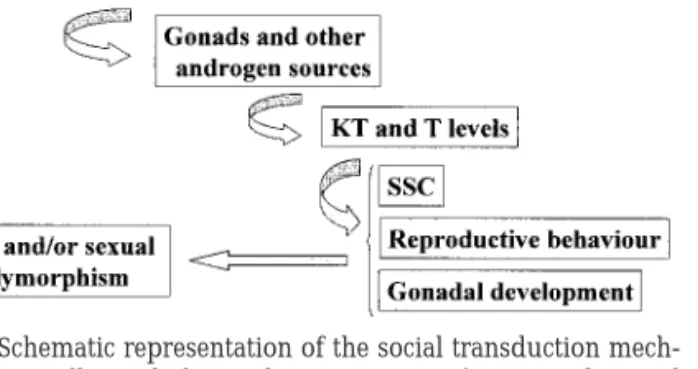
An alternative explanation for intrasexual polymor-phism is social regulation of neuroendocrine develop-ment (Francis, 1992; Grober, 1998; see Fig. 1). This concept can explain the variety of alternative repro-ductive tactics expressed by fish, ranging from multi-ple males to adult sex change. Earlier/more rapid development of the nonterritorial male morphology is a characteristic of all fish with alternative morphs, whether fixed or flexible (wrasses, parrotfish, blennies, gobies, toadfish, salmonids, and poeciliids). Even in fish with fixed morphs, early social experience may determine which developmental trajectory is taken by
a given fish (e.g., guppies; Evans and Magurran, 1999). In species with flexible morphs, social experience may mediate shifts between morphs throughout life (e.g., gobies and blennies). The difference does not seem to be based on organizational vs activation effects of steroids, but rather the limited vs life-long responsive-ness to social regulation.
ACKNOWLEDGMENTS
The preparation of this manuscript was supported by FCT Pro-grama Plurianual (UI&D 331/94), and by a research project (PRAXIS/ PCNA/BIA/94/96 to RFO) from the Portuguese Foundation for Science and Technology (FCT).
REFERENCES
Almada, V. C. , Gonc¸alves, E. J., Santos, A. J., and Baptista, C. (1994). Breeding ecology and nest aggregations in a population of Salaria
pavo (Pisces: Blenniidae) in an area where nest sites are very
scarce. J. Fish Biol. 45, 819 – 830.
Almada, V. C., Gonc¸alves, E. J., Oliveira, R. F., and Santos, A. J. (1995). Courting females: Ecological constraints affect sex roles in a natural population of the blenniid fish Salaria pavo. Anim. Behav.
49,1125–1127.
Almada, V. C., and Santos, R. S. (1995). Parental care in the rocky intertidal: A case study of adaptation and exaptation in Mediter-ranean and Atlantic blennies. Rev. Fish Biol. Fish. 5, 23–37. Andersson, M. (1994). Sexual Selection. Princeton Univ. Press,
Prince-ton, NJ.
Arnold, A. P., and Breedlove, S. M. (1985). Organizational and activational effects of sex steroids on brain and behavior: A re-analysis. Horm. Behav. 19, 469 – 498.
Basolo, A. (1990). Female preference for male sword length in the green swortail, Xiphophorus helleri (Pisces: Poeciliidae). Anim.
Be-hav. 40, 332–338.
Bass, A. H. (1996). Shaping brain sexuality. Am. Sci. 84, 352–363.
Borg, B. (1994). Androgens in teleost fishes. Comp. Biochem. Physiol.
C 109, 219 –245.
Bradbury, J. W., and Vehrencamp, S. L. (1998). Principles of Animal Communication. Sinauer, Sunderland, MA.
Brantley, R. K., and Bass, A. H. (1994). Alternative male spawning tactics and acoustic signals in the plainfin midshipman fish
Porich-thys notatus Girard (Teleostei, Batrachoididae). Ethology 96, 213–232.
Brantley, R. K., Wingfield, J. C., and Bass, A. H. (1993). Sex steroid levels in Porichthys notatus, a fish with alternative reproductive tactics, and a review of the hormonal bases for male dimorphism among teleost fishes. Horm. Behav. 27, 332–347.
Breder, C. M., Jr., and Rosen, D. E. (1966). Modes of Reproduction in
Fishes. T.F.H., Neptune City, NJ.
Cardwell, J. R., and Liley, N. R. (1991a). Androgen control of social status in males of a wild population of stoplight parrotfish,
Spari-soma viride (Scaridae). Horm. Behav. 25, 1–18.
Cardwell, J. R., and Liley, N. R. (1991b). Hormonal control of sex and color change in the stoplight parrotfish, Sparisoma viride. Gen.
Comp. Endocrinol. 81, 7–20.
Darwin, C. (1859). On the Origin of Species by Means of Natural
Selection. Murray, London.
Darwin, C. (1871). The Descent of Man, and Selection in Relation to Sex, 2nd ed., Murray, London.
Evans, J. P., and Magurran, A. E. (1999). Male mating behavior and sperm production characteristics under varying sperm competi-tion risk in guppies. Anim. Behav. 58, 1001–1006.
Farr, J. A. (1989). Sexual selection and secondary differentiation in Poeciliids: determinants of male mating success and the evolution of female choice. In G. K. Meffe and F. J. Snelson, Jr. (Eds.), Ecology
and Evolution of Livebearing Fishes (Poeciliidae), pp. 91–123. Prentice
Hall, Englewood Cliffs, NJ.
Francis, R. C. (1992). Sexual lability in teleosts: developmental fac-tors. Q. Rev. Biol. 67, 1–18.
Gibson, R. N. (1969). The biology and behavior of littoral fish. Ocean.
Mar. Biol. Ann. Rev. 7, 367– 410.
Godwin, J., Crews, D., and Warner, R. R. (1996). behavioral sex change in the absence of gonads in a coral reef fish. Proc. R. Soc.
Lond. B 263, 1683–1688.
Gonc¸alves, E. J., Almada, V. C., Oliveira, R. F., and Santos, A. J. (1996). Female mimicry as a mating tactic in males of the blenniid fish Salaria pavo. J. Mar. Biol. Assoc. UK 76, 529 –538.
Grober, M. S. (1998). Socially controlled sex-change: Integrating ultimate and proximate levels of analysis. Acta Ethol. 1, 3–17. Hastings, P. A. (1992). Nest-site size as a short-term constraint on
the reproductive success of paternal fishes. Env. Biol. Fish. 34, 213–218.
Henson, S. A., and Warner, R. R. (1997). Male and female alternative reproductive behaviors in fishes: A new approach using intersex-ual dynamics. Annu. Rev. Ecol. Syst. 28, 571–592.
Hoffman, S. G., Schildhauer, M. P., and Warner, R. R. (1985). The cost of changing sex and the ontogeny of males under contest competition for mates. Evolution 39, 915–922.
Kvarnemo, C., and Ahnesjo¨, I. (1996). The dynamics of operational sex ratios and competition for mates. TREE 11, 404 – 408. Lahnsteiner, F., Richtarski, U., and Patzner, R. A. (1990). Function of
the testicular gland in two blenniid fishes, Salaria (⫽Blennius) pavo and Lipophrys (⫽Blennius) dalmatinus (Blenniidae, Teleostei) as revealed by electron microscopy and enzyme histochemistry. J.
Fish Biol. 37, 85–97.
Laumen, J., Pern, U., and Blu¨m, V. (1974). Investigations on the function and hormonal regulations of the anal appendices in
Blennius pavo. J. Exp. Zool. 190, 47–56. FIG. 1. Schematic representation of the social transduction
mech-anism potentially underlying the expression of ART and sexual polymorphism in teleost fish.
Lejeune, P. (1985). Etude e´co-e´tologique des comportements reproduc-teurs et sociaux des labride´s Me´diterrane´ens des genres Symphodus Rafinesque, 1810 et Coris Lacepede, 1802. Cah. Ethol. Appl. 5, 1–208. Linnaeus, C. (1758). Systema Naturae, 10th ed. Stockholm, Sweden. Maynard Smith, J. (1978). The Evolution of Sex. Cambridge Univ.
Press, Cambridge, UK.
Moore, M. C. (1991). Application of organization-activation theory to alternative male reproductive strategies: A review. Horm.
Be-hav. 25, 154 –179.
Moore, M. C., Hews, D. K., and Knapp, R. (1998). Hormonal control and evolution of alternative male phenotypes: Generalizations of models for sexual differentiation. Am. Zool. 38, 133–151. Nelson, R. J. (1999). An Introduction to Behavioral Endocrinology.
Si-nauer, Sunderland, MA.
Oliveira, R. F. (1998). Of fish and men: A comparative approach to androgens and social dominance. Behav. Brain Sci. 21, 383–384. Oliveira, R. F., and Almada, V. C. (1998a). Mating tactics and male–
male courtship in the lek-breeding cichlid Oreochromis
mossambi-cus. J. Fish Biol. 52, 1115–1129.
Oliveira, R. F., and Almada, V. C. (1998b). Androgenization of dominant males in a cichlid fish: Androgens mediate the social modulation of sexually dimorphic traits. Ethology 104, 841– 858. Oliveira, R. F., and Almada, V. C. (1999). Male displaying
charac-ters, gonadal maturation and androgens in the cichlid fish
Oreo-chromis mossambicus. Acta Ethol. 2, 67–70.
Oliveira, R. F., Almada, V. C., and Canario, A. V. M. (1996). Social modulation of sex steroid concentrations in the urine of male cichlid fish Oreochromis mossambicus (Teleostei: Cichlidae). Horm.
Behav. 30, 2–12.
Oliveira, R. F., Almada, V. C., Forsgren, E., and Gonc¸alves, E. J. (1999). Temporal variation in male traits, nesting aggregations and mating success in the peacock blenny, Salaria pavo. J. Fish Biol.
54,499 –512.
Oliveira, R. F., Jason, J. A., Carvalho, N., Gonc¸alves, E. J., and Santos, R. S. (2000). Male mating success in the Azorean rock-pool blenny,
Parablennius sanguinolentus parvicornis: The effects of body size,
male behavior and nest characteristics. J. Fish Biol. 57, 1416 –1428. Oliveira, R. F., Canario, A. V. M., Grober, M. S., and Santos, R. S. (2001a). Endocrine correlates of alternative reproductive tactics and male polymorphism in the Azorean rock-pool blenny, Parablennius
sanguinolentus parvicornis. Gen. Comp. Endocrinol. 121, 278–288.
Oliveira, R. F., Canario, A. V. M., Almada, V. C., Gonc¸alves E. J., and Forsgren, E. (2001b). Androgen levels and social interactions in breeding males of the peacock blenny, Salaria pavo. J. Fish Biol. 58, 897–908.
Oliveira, R. F., Carneiro, L. A., Canario, A. V. M., and Grober, M. S. (2001c). Effects of androgens on social behavior and morphology of alternative reproductive males of the Azorean rock-pool blenny. Horm. Behav. 39, 157–166.
Oliveira, R. F., Carneiro, L. A., Gonc¸alves, D. M., Canario, A. V. M., and Grober, M. S. (in press). Effects of 11-Ketotestosterone in sneaker males of the peacock blenny, a species with male alter-native mating tactics. Brain. Behav. Evol.
Papaconstantinou, C. A. (1979). Secondary sex characters of Blen-nioid fishes (Pisces: Blenniidae). Thalassographica 1, 57–75. Parker, G. A., and Simmons, L. W. (1996). Parental investment and
the control of sexual selection: Predicting the direction of sexual competition. Proc. R. Soc. Lond. B 263, 315–321.
Phoenix, C., Goy, R., Gerall, A., and Young, W. (1959). Organizing action of prenatally-administered testosterone proprionateon the tissues mediating mating behavior in the female guinea pig.
En-docrinology 65, 369 –382.
Reavis, R. H., and Grober, M. S. (1999). An integrative approach to sex change: Social, behavioral and neurochemical changes in
Lyth-rypnus dalli (Pisces). Acta Ethol. 2, 51– 60.
Reinboth, R., and Becker, B. (1986). In vitro metabolization of [14C]testosterone by spermatogenic tissue and accessory gland of Blennius pavo (Blenniiformes, teleostei). Gen. Comp. Endocrinol. 5,
11–16.
Ruchon, F., Laugier, T., and Quignard, J. P. (1995). Alternative male reproductive strategies in the peacock blenny. J. Fish Biol. 47, 826 – 840.
Ryan, M. J., and Causey, B. A. (1989). “Alternative” mating behavior in the swordtails Xiphophorus nigrensis and Xiphophorus pygmaeus (Pisces: Poeciliidae). Behav. Ecol. Sociobiol. 24, 341–348.
Santos, R. S. (1985). Parentais e sate´lites: Ta´cticas alternativas de acasal-amento nos machos de Blennius sanguinolentus Pallas (Pisces: Blen-niidae). Arquipe´lago, Se´rie Cieˆncias da Natureza 6, 119–146.
Santos, R. S., and Barreiros, J. P. (1993). The ethogram of
Parablen-nius sanguinolentus parvicornis (Pisces: Blenniidae) of the Azores. Arq. Life Mar. Sci. 11A, 73–90.
Santos, R. S., Nash, R. D. M., and Hawkins, S. J. (1995). Age, growth and sex ratio of the Azorean rock-pool blenny, Parablennius
san-guinolentus parvicornis. J. Mar. Biol. Assoc. UK 75, 751–754.
Santos, R. S., Hawkins, S. J., and Nash, R. D. M. (1996). Reproductive phenology of the Azorean rock pool blenny, a fish with alterna-tive mating tactics. J. Fish Biol. 48, 842– 858.
Shapiro, D. Y. (1981). Size, maturation, and the social control of sex reversal in the coral reef fish Anthias squamipinnis. J. Zool. 193, 105–208.
Taborsky, M. (1984). Broodcare helpers in the cichlid fish
Lamprolo-gus brichardi: their costs and benefits. Anim. Behav. 32, 1236 –1252.
Taborsky, M. (1997). Bourgeois and parasitic tactics: Do we need collective, functional terms for alternative reproductive behav-iors? Behav. Ecol. Sociobiol. 41, 361–362.
Taborsky, M. (1999). Conflict or Cooperation: What determines optimal solutions to competition in fish reproduction? In V. C. Almada, R. F. Oliveira, and E. J. Gonc¸alves (Eds.), Behavior and
Conservation of Littoral Fishes, pp. 301–349. Lisboa, ISPA.
Thresher, R. E. (1984). Reproduction in Reef Fishes. T.F.H., Neptune City, New Jersey.
Trivers, R. L. (1972). Parental investment and sexual selection. In B. Campbell (Ed.), Sexual Selection and the Descent of Man, 1871–1971, pp. 136 –179. Heinemann, London.
Voss, J. (1980). Color Patterns of African Cichlids. T.F.H., Neptune City, NJ.
Warner, R. R. (1984). Mating behavior and hermaphroditism in coral reef fishes. Am. Sci. 72, 128 –136.
Warner, R. R., and Swearer, S. E. (1984). Social control of sex-change in the blue-head wrasse, Thalassoma bifasciatum (Pisces: Labridae).
Biol. Bull. 181, 199 –204.
Wingfield, J. C., Ball, G. F., Dufty, A. M., Hegner, R. E., and Ram-enofsky, M. (1987). Testosterone and aggression in birds: tests of the challenge hypothesis. Am. Sci. 75, 602– 608.
Wingfield, J. C., Hegner, R. E., Dufty, A. M., and Ball, G. F. (1990). The “challenge hypothesis”: Theoretical implications for patterns of testosterone secretion, mating systems, and breeding strategies.
Am. Nat. 136, 829 – 846.
Zander, C. D. (1975). Secondary sex characteristics of Blennoid fishes (Perciformes). Pubbl. Staz. Zool. Napoli 39, 717–727. Zimmerer, E. J., and Kallmann, K. D. (1989). The genetic basis for
alternative reproductive tactics in the pygmy swordtail,