Original
Received 12/6/2009 Accepted 9/7/2010 (004254)
1 Programa de Pós-Graduação em Biotecnologia – PPGBiotec, Universidade Estadual de Feira de Santana – UEFS/FIOCRUZ ² Programa de Pós-Graduação em Recursos Genéticos Vegetais, Universidade Estadual de Feira de Santana – UEFS
3 laboratório de Biotecnologia de alimentos, Departamento de Tecnologia, Faculdade de Engenharia de alimentos, universidade Estadual de Feira de santana – UEFs 4 instituto de Química, universidade Federal da Bahia – UFBa, Ba, Brazil
5 laboratório de de Enzimologia, Departamento de saúde, Faculdade de Farmácia universidade Estadual de Feira de santana – UEFS, Av. Transnordestina, s/n., Bairro Novo Horizonte, CEP 44036-900, Feira de santana, Ba, Brazil, e-mail: [email protected]
*Corresponding author
Changes in enzymes, phenolic compounds, tannins, and vitamin C in various
stages of jambolan (
Syzygium cumini
Lamark) development
Alterações enzimáticas, compostos fenólicos, taninos e vitamina C em diferentes estádios de
maturação do fruto Jamelão (Syzygium cumini Lamark)
Taís Silva de Oliveira BRANDÃO1, Amanda Reges de SENA2, Elisa TEShIMA3,
Jorge Maurício DAVID1,4, Sandra Aparecida ASSIS1,2,5*
1 Introduction
The jambolan (Syzygium cumini Lam.) is native in India, Ceylon, Malaysia, and Australia (CHANDRASEKARAN, 2004). Although not originally a Brazilian plant, the tree of the myrtle family (Myrtaceae) known as “jamelão” and “jambolan” in Portuguese and jambolan or java plum in English (PEPATO, 2005) has been widely cultivated as an ornamental and shade plant, mainly along the coast, and it can be found in several states including MG, RJ, RS, and SP (BRAGANÇA, 1996;
LOGUERCIO; BATTISTIN, 2004; LORENZI et al., 2006; SOARES et al., 2008).
The fruit is small and has very attractive characteristics, especially the high anthocyanins content that gives the skin its intense purple color characteristic of ripe fruit. Other polyphenols such as tannins are also present. Tannins are responsible for astringency caused by a taste parameter that results from the combination with salivary glycoproteins
Resumo
O estado fisiológico de um fruto está intimamente relacionado com a maturação dos frutos e das condições climáticas durante a fase de crescimento, quando o fruto apresenta mudanças que vão desde a cor, textura e sabor. O amadurecimento do fruto pode envolver uma série complexa de reações bioquímicas, com alteração nas atividades enzimáticas, fenóis, taninos, ácido ascórbico. Foram estudadas a atividade de enzimas (carboximetilcelulase, poligalacturonase, pectina liase), a concentração total de compostos fenólicos, o teor de taninos condensados e a concentração de vitamina C em cinco estádios de maturação do fruto jamelão. Alteração significativa foi observada entre os estádios de maturação. Os compostos fenólicos foram maiores no estádio verde (705.01 ± 7.41). A maior concentração de taninos foi encontrada no estádio Verde/Roxo (699.45 ± 0.22). Os resultados mostraram que o ácido ascórbico varia significativamente de 50.81 ± 1.43 para 6.61 ± 1.04 mg.100 g–1 de polpa durante a maturação. A atividade específica de pectina liase foi maior no estádio verde (1531.90 ± 5.83). A atividade
específica da enzima poligalacturonase foi maior na fase madura (1.83 ± 0.0018). A atividade específica da carboximetilcelulase foi maior na fase madura (4.61 ± 0.0024). O baixo teor de ácido ascórbico presente nos frutos de jambolão mostram que esta não é uma boa fonte deste nutriente, no entanto, outras características podem tornar os produtos de jambolão interessantes para consumo.
Palavras-chave: Syzygium cumini Lam.; maturação; compostos fenólicos totais; taninos; vitamina C; atividade enzimática.
Abstract
The physiological state of a fruit is closely related to ripening and climatic conditions during the growing period when the fruit undergo changes in color, texture, and flavor. The ripening of the fruit can involve a complex series of biochemical reactions with alteration in enzymes activities, phenols, tannins, and ascorbic acid. The activity of enzymes (carboximethylcellulase, polygalacturonase, and pectinlyase), the total concentration of phenolic compounds, condensed tannins, and vitamin C in five stages of maturation were studied. Significant changes were observed between the maturity stages. The phenolic compounds were higher at green stage (705.01 ± 7.41); tannins were higher at green/purple stage (699.45 ± 0.22). The results showed that the ascorbic acid levels of the pulp varied significantly from 50.81 ± 1.43 to 6.61 ± 1.04 mg.100 g–1
during maturation. The specific activity of pectin lyase was higher at green stage (1531.90 ± 5.83). The specific activity of polygalacturonase was higher at mature stage (1.83 ± 0.0018). The specific activity of carboximetilcelulose was higher at ripe mature stage (4.61 ± 0.0024). The low ascorbic acid content found in jambolan fruit indicates that this fruit is not a rich source of this nutrient; however, other characteristics can make jambolan products fit for human consumption.
of the jambolan fruit. Therefore, the objective of this work was to study the concentration of total phenolic compounds, condensed tannins, and the activity of polygalacturonase (EC 3.2.1.15 and 3.2.1.67), carboxymethylcellulase CMCase (3.2.1.4), pectin lyase (4.2.2.10), and vitamin C in five maturity stages of jambolan. These scientific data can contribute to stimulate the cultivation and use technology in the processing of derivatives thus avoiding the waste of raw material.)
2 Materials and methods
2.1 Chemicals
Citrus pectin (methoxylation degree 60.97%), carboxymethylcellulose, bovine serum albumin, oxalic acid, and polygalacturonic acid were purchased from Sigma (Chemical Co., St Louis, MO, USA). All other chemicals used were of high-quality analytical grade.
2.2 Fruits
The fruits of Syzygium jambolanum were collected from the State University of Feira de Santana campus, Bahia, Brazil. The coordinates were 38° 58’ 00” W and 12° 12’ 00” S and at an altitude of 252 m. The plants were identified by of the Department of Botany, State University of Feira Santana, where they were deposited in the herbarium.
The fruits of jambolan were collected randomly and manually from the tops of individual trees in March 2008, the harvest period. At the time of the samples’ collection, the trees were in the phenological development stages of flowering and fruiting. The average rainfall, temperature, relative humidity and sunstroke in the month of harvest, were 3,6 mm, 21.6-35, 1 °C, 86%, and 167.7, respectively (Climatological Station, State University of Feira of Santana). For an appropriate sample of the population, trees from all over the State University of Feira of Santana campus were selected as described by Moraes, Monteiro e Vencovsky (1999) totalizing a number of five distinct trees. On the day of collection plants, they had similar fruit loads with different maturity stages.
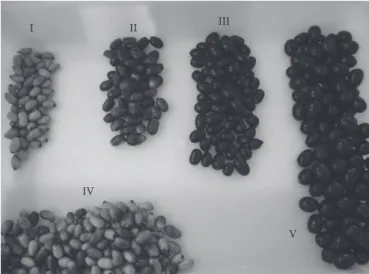
The fruits were collected by following one of the parameters described by Pantástico (1975) for determining the maturity of the fruit, visual observation, taking into account skin color, size, and shape of the fruit. Next, the fruits were placed in polyethylene bags and taken to the Laboratory of Enzymology, State University of Feira de Santana, for subsequent analysis, where they were classified into five different maturity stages based on the subjective evaluation of the fruit skin color (Figure 1 and Table 1).
Thirty fruits of each stage were individually analyzed for physical characteristics. The fruits were weighted on a balance with 0.001 g accuracy. Each sample was obtained by the mixture of fruits at the same stage of development collected from various trees. The weight of each fruit was obtained, and the mean values ± standard deviations are reported in Table 1. The pulp was obtained manually.
(MACHEIX; FLEURIET ; BILLOT, 1990; BEVILAQUA, 1995). These phenolic constituents together with other compounds exert antioxidant activity in jambolan and other fruits. According to Correia da Silva e Sá (2008), the edible parts of jambolan can be considered an excellent source of antioxidants and may be included in the ranking of the fruits with the greatest nutraceutical potential.
Studies on the development of fruits and seeds are important to establish strategies for harvesting and adequate post-harvest storage techniques to increase and thereby improve the utilization of the potential marketing of the fruit (GURJÃO, 2006). According to Pantástico (1975), various methods can be used to determine fruit maturity, including phenological development (number of days after anthesis), of physical (abscission, density and strength) and visual observations (skin color and size and shape of the fruit).However, the results obtained by these methods may vary depending on the place of cultivation, cultivars, and climate conditions of the year of growth.
Fruit ripening involves changes in cell wall components such as cellulose, hemicellulose, and pectin by increased enzymatic activity. Pectinases are a group of enzymes that degrade pectic substances and are considered a major cause of fruit softening. They are widely used in industries, in fruit juices, to reduce viscosity and to and increase the efficiency of filtration and clarification in order to improve the extraction of vegetable oils in the treatment and degumming of natural fibers in the textile and paper industry, among many other processes (ANTUNES; GONÇALVES; TREVISAN, 2006; UENOJO; PASTORE, 2007). Pectinlyase (polymetilgalacturonato lyase, PMGL) catalyzes the β-elimination of two galacturonic acid residues via trans-elimination of hydrogen from 4 and 5 carbon position in the aglycone portion of the substrate (pectin) in an endo or exo-form (UENOJO; PASTORE, 2007). On the other hand, a polygalacturonase catalyzes the hydrolysis of α-1,4-glycosidic bonds between nonesterified galacturonic acid residues (RESENDE et al., 2004). Resende et al. (2004) measured polygalacturonase activity in four maturaty stages of tomatoes (Lycopersicon esculentum) and founded that PG activity decreased with the ripening.
Cellulose has a compact structure and its hydrolysis requires a complex system of cellulolytic enzymes for its breakdown into glucose units, namely carboxymethyl cellulase – CMCase or endoglucanase, an exo-1,4-β-glucanase (EC 3.2.1.91), and a β-glucosidase (EC 3.2.1.21) (WOOD, 1989). Studies have highlighted the need for cellulase and its application in various industries (brewery and wine, textile, detergent, and pulp and paper industries), in agriculture, and in animal feeds (JANG; CHEN, 2003). CMCase hydrolyzes cellulose molecules in a random mode with products retaining the β – configuration.
2.5 Determination of tannins
Tannin concentrations were determined according to the casein precipitation method adapted by Monteiro (2005). To tubes containing 6 mL of the extracts, were added 1 g of casein, and the mixture was kept under constant agitation for three hours at room temperature. Next, the samples were filtered, and the residual phenol content was determined by the Folin-Ciocalteau method (GEORGÉ et al., 2005).
2.6 Enzyme extraction
The enzymes were extracted at 4 °C in 50 mM phosphate buffer, pH 7.0. The ratio of jambolan material to extract was 1:3 (w/v). The homogenate was squeezed through two layers of gauze, and the extract was centrifuged (Centrifuge 5804R – Eppendorf, São Paulo, Brazil) at 10000 × g.10–1 minutes to
remove the solid particles.
2.7 Assay for CMCase activity
CMCase activity was measured spectrophotometically at A540 using a UV/VIS spectrophotometer (Varian, Cary 50) by measuring the release of reducing groups using DNS assay and glucose as the standard. The reaction mixture consisting of 1 mL of crude extract and 1 mL of 1.5% CMC in 50 mM of sodium phosphate buffer (pH 4.8) was incubated at 50 °C for 10 minutes. One unit of activity corresponded to 1 µmol of glucose/minutes.
2.8 Polygalacturonase (PG) assay
Polygalacturonase activity was assayed by incubating a mixture of 350 µL of the crude extracts and 250 µL of 1% polygalacturonic acid (dissolved in 0.05 M acetate buffer, pH 5.0) at 45 °C for 1 hour. Polygalacturonase activity was carried out by the modified method of Miller (1959) by measuring the amount of reducing sugar groups derived from polygalacturonate using the DNS method. PG was measured spectrophotometrically at A540 using a UV/VIS spectrophotometer (Varian, Cary 50). The calibration curve was analyzed in triplicate using galacturonic acid as the standard. One unit of polygalacturonase activity was defined as the amount of enzyme that catalyzed the formation of 1 μmol of galacturonic acid per hour at 45 °C.
2.9 Pectin lyase activity (PL) assay
To measure the activity of this enzyme, 300 μL of crude extract were added to 2.5% (w/v) pectin citric in 0.1 M sodium phosphate buffer (pH 7.0). The reaction mixture was incubated at 40 °C for 15 minutes and was stopped by addition of 4.5 mL of 0.01 M H2SO4. Subsequent activity was measured by absorbance at A235 The reaction was monitored at 37 °C for 30 minutes. Activity was determined by measuring the increase in absorbance at 235 nm of substrate solution. One unit of enzymatic activity was defined as the amount of enzyme that released 1 µmol/minute of unsaturated products based on the molar extinction coefficient(ε = 5500 L.mol–1.cm–1) of the
unsaturated products (ALBERSHEIM, 1966). The fruits were stored immediately in conventional (–18 °C)
freezer until analysis.
2.3 Preparation of extracts
The pulps of jambolan were thawed and macerated in extraction solvents (ethanol or methanol to 60%) in a ratio of 1:2.5 (w/v), followed by stirring at room temperature. The mixture was filtered using Whatman number 1 filter paper and stored in amber bottles protected from light and used for quantification of phenolic compounds and tannins.
2.4 Determination of total phenolic compounds
The total phenolic compounds were determined according to the procedure developed by conventional spectrophotometric Folin-Ciocalteu method (ROSSI JUNIOR; SINGLETON, 1965), adapted by George et al. (2005). The reaction medium consisted of a 0.5 mL aliquot of the sample extract, 2.5 mL of Folin-Ciocaltaeu (10/01), and 2.0 mL of sodium carbonate (75 g.L–1).
The mixture was shaken on a vortex mixer and incubated for 15 minutes at 50 °C. For quantification, the UV absorbance readings of samples were taken at 760 nm (UV Visible spectrophotometer - Varian-Cary, São Paulo, Brazil). Gallic acid (100 ppm) was used as standard.
Table 1. Classification of fruits at five stages of development based on
the subjective evaluation of the fruit skin color according to Pantástico (1975).
Stage of maturation
Color Weight (g) ± standard deviations
I Green 1.83 ± 0.19
II Green/purple* 2.95 ± 0.4
III Purple/green** 2.52 ± 0.65
IV Half ripe 3.18 ± 0.61
V Ripe mature 6.43 ± 0.60
*Green/purple: although green is prevalent, it exhibits the beginning of formation of purple color”. **Purple/green: despite the prevalence of purple color, it still shows traces of green.
3.1 Determination of total phenolic compounds and tannins
Previous tests showed that the quantification of total phenolic compounds and tannins of the ethanol extract were better than methanol extracts prepared with the same ratio. The same conclusion was obtained by Kuskoski et al. (2006) in a study investigating the pulp of jambolan, in which 229.6 ± 13.6 mg.100 g–1 was determined in ethanol extract and
194.7 ± 3.5 mg.100 g–1 in methanol extract. Thus, ethanol was
the solvent chosen to determine the concentration of phenolic compounds and tannins in this study (Table 2).
During fruit development, the growth phase is characterized by high cell divisions activity, which decreases until absence throughout the development. Therefore, it occurs in various parts of the plant, where the process of fertilization is controlled by endogenous hormones and, in particular, those which are produced by developing seeds. This can be confirmed with the formation of phenolic function during growth due to the interaction of phytohormones. The accumulation of phenolic compounds is strongly related to the physiological status of the fruit, and it is the result of a balance between biosynthesis and subsequent metabolism including catabolism (MACHEIX; FLEURIET ; BILLOT, 1990). Hence, it is not surprising that unripe jambolan was sour and astringent during the maturation phase (Stage I, II and III) (VENKITAKRISHNAN et al., 1997). The decrease in the amount of total phenolics indicates maturity (Table 2).
Studies in literature (MACHEIX; FLEURIET ; BILLOT, 1990; SWAIN; HILLIS, 1958) on plum, have confirmed that the concentration of phenol is generally higher in immature fruits. These results agree with the observations made in several studies, which report reductions in the levels of phenolic compounds during ripening (MURATA et al., 1995). This decrease, associated with the accumulation of sugars that occurs with maturation, results in the loss of astringency (AZIZ; YUSOF, 1994).
Changes in tannins during fruit development cannot be separated from changes in astringency (MACHEIX; FLEURIET ; BILLOT, 1990). It is often reported in the literature that astringency decreases during maturation, usually accompanied by a decrease in the concentration of tannins in or physicochemical changes in the molecules. Maturity leads to the polymerization of tannins due to the action of acetaldehyde by converting it into sugars or consumption during respiration (GALVANI; EIDAM; AYALA, 2006). The tannins present in the fruit in non-polymerized tannic properties have
2.10 Protein determination
Total protein was determined by the Biuret method (GORNALL; BARDAWILL; MAXIMA, 1949) due the fact that the samples contain phenols Bovine serum albumin (BSA) was used as the standard.
2.11 Vitamin C determinations
Ascorbic acid was determined by 2,6-dichloroindophenol titrimetic method (ASSOCIATION…, 1984).
2.12 Statistical analysis
Data were submitted to analysis of variance (ANOVA) with multiple comparisons between their mean values (±SEM) by the Tukey test (p < 0.05). Statistical calculations were processed by SPSS (Statistical Package for the Social Sciences) version 10.1 (SPSS, 1995) at the level of significance of 5% (p < 0.05). A minimum of three replications of the experiment were performed.
3 Results and discussion
The chemical composition depends on species, environmental conditions, and also on the stage of ripeness of the fruit (VENDRAMINI; TRUGO, 2000). The physiological state of the fruit is closely related to the ripening of fruits and climatic conditions during the growth stages when the fruit undergo changes in color, texture, and flavor. A number of anabolic and catabolic changes occur during development and maturation of the fruit. The ripening of the fruit involves a complex series of biochemical reactions such as hydrolysis of starch, conversion of chloroplasts into chromoplasts production of carotenoids, anthocyanins and phenols, and formation of volatile compounds; but with respect to enzyme concentration, it may increase, decrease, or remain constant depending on the case. These reactions may affect the characteristics of ripe fruit and its flavor (SPEIRS; BRADY, 1991). However, not much is known about the biochemical, structural, and physiological changes involved in this process (AWAD, 1993; MEDEIROS; RASEIRA, 1998; FIGUEIREDO, 2001; CHITARRA; CHITARRA, 2005).
Therefore, this study investigates the biochemical changes for a better understanding of this complex process in the jambolan fruit.
Table 2. Changes in total phenolics, tanins, ascorbic acid, and protein in the jambolan fruit (Syzygium cumini Lam.) during maturation.
Stage of maturation
Total phenols (mg.100 g–1)
Tanins (mg.100 g–1)
Ascorbic acid (mg.100 g–1)
Protein (mg.mL–1)
I 671.37 ± 2.62a 606.87 ± 0.16b 50.81 ± 1.43a 2.530 ± 0.0001c
II 705.01 ± 7.41a 669.45 ± 2.20a 18.62 ± 1.04b 2.417 ± 0.0013c
III 338.89 ± 1.72b 306.62 ± 1.10c 14.41 ± 5.40c 2.730 ± 0.0011b
IV 283.06 ± 1.02b 241.52 ± 0.80d 10.81 ± 1.80d 4.130 ± 0.0086a
V 208.30 ± 2.24c 185.76 ± 0.28e 6.61 ± 1.04e 1.283 ± 0.0028d
According to Butt (1980), this decrease is due to the action of the enzyme acid ascorbic oxidase (ascorbate oxidase), which may explain the losses encountered during maturation.
3.3 Determination of polygalacturonase, carboximetilcelulase, and pectin lyase activity
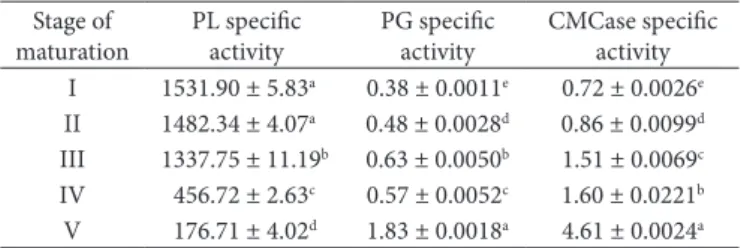
With regard to the enzymatic activity, the results showed changes during the ripening of the fruits studied. The analysis of variance (Table 3) shows significant differences between the maturation stages for the enzymes studied.
The results of specific activity of PG showed that it was significantly affected by the degree of maturation and increases during the maturation process. There was significant variation in all stages of development (Table 3). The results agree with those reported by Oliveira et al. (2006) and Giehl et al. (2008), showing greater activity in the mature phase of pequi fruits and melon, respectively.
The higher specific activity of Pectin Lyase (PL), occurred at the green stage and decreased with maturation. Although the results showed no significant variations in the three initial stages of fruit development (Table 3), the CMCase activity was significantly different between all stages of maturation, and it increased with maturity.
The control of PE activity in situ is very important in the food industry because of its influence on the final product quality, particularly to produce low methoxyl pectins in citrus peels (TAYLOR, 1982), to obtain cloudy citrus juice (NATH; RANGANNA, 1977) and high viscosity tomato juice and puree (NATH et al., 1983), and to improve texture and firmness in some processed fruits and vegetables (PILNIK; VORAGEN, 1991). Having the values of enzymes that have an important role in fruit industrialization, it is possible to choose the best maturation phase for the harvest. In this study, the enzymes CMC and polygacturonase increased with ripening, but in this phase the content of ascorbic acid was low.
4 Conclusion
This study investigated the effects of the jambolan fruit maturity on the concentration of enzymes, phenolic compounds, tannins, and vitamin C. The results showed reduction in the concentration of phenol and tannin, and low concentrations the highest value. These compounds tend to evolve into more
condensed forms with more stable combinations with proteins. This explains the decrease of astringency of the fruit during ripening (AQUARONE; BORZANI; LIMA, 1983). A decrease in the concentration of tannin during the ripening of fruit was observed. This finding is similar to that observed in the concentration of phenolic compounds (Table 2).
Venkitakrishnan et al. (1997) studied the physicochemical changes during maturation and ripening of jambolan fruit collected in India. Unlike the present study, they were collected and divided into four changes of maturity based on color and texture (Stage I – partially mature, II – mature and ripening initiation, III – ripe, IV – edible). Among the tests performed, is the concentration of total phenolic compounds comparing stages I (805 mg.100 g–1) and IV (606 mg.100 g–1) with stages I
(671.37 mg.100 g–1) and V (208.30 mg.100 g–1), it was observed
that the concentrations found in this study are lower than those found by Venkitakrishnan et al. (1997). The difference between the results found in those studies may be an indicative of the influence of the habitat from where the specimens were collected.
3.2 Determination of ascorbic acid
The results showed that the ascorbic acid levels of the pulp varied significantly from 50.81 ± 1.43 to 6.61 ± 1.04 mg.100 g–1
during maturation. The content of vitamin C in fruits and vegetables can be influenced by various factors such as genotypic differences, preharvest climatic conditions, cultural practices, maturity and harvesting methods, and posthaverst handling procedures (ASSIS; OLIVEIRA; LIMA, 2001; LEE; KADER, 2000). Many pre- and postharvest factors influence the vitamin C content of horticultural crops. Other preharvest factors include climatic conditions and cultural practices (WESTON; BARTH, 1997). All of these factors are responsible for the wide variation in the vitamin C content of fruits and vegetables at harvest (ASSIS; OLIVEIRA; LIMA, 2001; LEE; KADER, 2000; KADER, 1988).
Linhares et al. (2007) analyzed the content of vitamin C in guava. The fruits were collected and stored at 10 °C. It was observed a linear increase (26.5 to 51.9 mg.100 g–1) in the levels
throughout the storage period indicating vitamin synthesis during ripening. Araújo et al. (2009) evaluated the physical and chemical characteristics of carambola (Averrhoa carambola) during two maturation stages (Green and ripe). The vitamin C amount did not differ statistically either, and the values varied in green (25.14 mg.100 g–1) and in mature fruits (25.7 mg.100 g–1).
Ferreira et al. (2000) found an average content of ascorbic acid in the pulp of fresh mature umbu fruit of 13.31 mg.100 g–1.
Nogueira et al. (2002) studied the effect of three maturation stages (green, semi-mature, and mature) on the physical-chemical acerola fruit. The content of vitamin C decreased during ripening in the dry season (from 2626.00 to 1797.80 mg.100–1 mL). The
levels of vitamin C decrease during the maturation process and can be modified by processing and storage conditions, which will interfere in the content of ascorbic acid (Nogueira et al., 2002).
Table 3. Changes in the activities of Pectin Lyase (PL), Polygalacturonase
(PG), and CMCase in the jambolan fruit (Syzygium cumini Lam.) during maturation.
Stage of maturation
PL specific activity
PG specific activity
CMCase specific activity I 1531.90 ± 5.83a 0.38 ± 0.0011e 0.72 ± 0.0026e
II 1482.34 ± 4.07a 0.48 ± 0.0028d 0.86 ± 0.0099d
III 1337.75 ± 11.19b 0.63 ± 0.0050b 1.51 ± 0.0069c
IV 456.72 ± 2.63c 0.57 ± 0.0052c 1.60 ± 0.0221b
BRAGANÇA, L. A. R. Aspectos gerais no preparo e no controle de qualidade de plantas e fitoterápicos hipoglicemiantes. In: SIXEL, P. J. Plantas medicinais antidiabéticas: uma abordagem multidisciplinar.Rio de Janeiro: Universidade Federal Fluminense, 1996. cap. 5, p. 105-122.
BUTT, V. S. Direct oxidases and related enzymes. In: STUMPF, P. K.; CONN, E. E. (Ed.). The biochemistry of plants:a comprehensive treatise. New York: Academic, 1980. v. 2, p. 81-123.
CHANDRASEKARAN, M.; VENKATESALU, V. Antibacterial and antifungal activity of Syzygium jambolanum seeds. Journal of
Ethnopharmacology, v. 91, p. 105-108, 2004. PMid:15036477.
http://dx.doi.org/10.1016/j.jep.2003.12.012
CHITARRA, M. I. F.; CHITARRA, A. B. Pós-colheita de frutos e
hortaliças: fisiologia e manuseio. 2. ed. Lavras: UFLA, 2005.
CORREIA DA SILVA E SÁ, A. P. Potencial antioxidante e aspectos químicos e físicos das frações comestíveis (polpa e cascas) e
sementes de Jamelão (Syzygium cumini, L. Skeels). 2008. 88 f.
Dissertação (Mestrado em Ciência e Tecnologia de Alimentos)-Universidade Federal do Rio de Janeiro, Rio de Janeiro, 2008. FERREIRA, J. C. Efeitos do congelamento ultra-rápido sobre as
características físico-químicas e sensoriais de polpa de umbu (Spondias tuberosa Arruda Câmara) durante a armazenagem
frigorificada. 2000. 85 f. Dissertação (Mestrado em Engenharia
Agrícola)-Universidade Federal da Paraíba, Campina Grande, 2000. FIGUEIREDO, R. W. et al. Alterações de firmeza, pectinas e enzimas pectinolíticas durante o desenvolvimento e maturação de pedúnculos de cajueiro anão precoce (Anacardium occidentale L. Var. nanum). Proceedingsof theInteramerican Societyfor
Tropical Horticulture, v. 43, p. 82-86, 2001.
GALVANI, D. F. G.; EIDAM, T.; AYALA, L. A. C. Rendimento e análise sensorial do caqui giombo desidratado. In: ENCONTRO DE ENGENHARIA E TECNOLO GIA D OS CAMPOS GERAIS, 2., 2006, Ponta Grossa. Anais...Ponta Grossa: UEPG, 2006. GEORGÉ, S. et al. Rapid determination of polyphenols and vitamin
C in plant-derived products. Journal of Agricultural and Food
Chemistry, v. 53, n. 5, p. 1370-1373, 2005. PMid:15740008. http://
dx.doi.org/10.1021/jf048396b
GIEHL, R. F. H. et al. Crescimento e mudanças físico-químicas durante a maturação de frutos de meloeiro (Cucumis melo var. cantalupensis Naud.) híbrido torreon. Ciência Agrotécnica, v. 32, n. 2, p. 371-377, 2008.
GORNALL, A. G.; BARDAWILL, C. J.; MAXIMA, M. D. Determination of serum proteins by means of biuret reaction. Journal of Biological
Chemistry, v. 177, n. 2, p. 751-766, 1949.
GURJÃO, K. C. O. et al. Desenvolvimento de frutos e sementes de tamarindo.
Revista Brasileira de Fruticultura, v. 28, n. 3, p. 351-354, 2006. http://
dx.doi.org/10.1590/S0100-29452006000300004
JANG, H. D.; CHEN, K. S. Production and characterization of hermostable cellulases from Streptomyces transformant T 3–1.
World Journal of Microbioly and Biotechnoly, v. 19, p. 263-268,
2003. http://dx.doi.org/10.1023/A:1023641806194
KADER, A. A. Influence of preharvest and postharvest environment on nutritional composition of fruits and vegetables. In: QUEBEDEAUX, B.; BLISS, F. A. (Eds.). Horticulture and human health: contributions of fruits and vegetables: proceedings of the 1st International Symposium on Horticulture and Human Health. Englewood Cliffs: Prentice-Hall, 1988. p. 18-32.
KUSKOSKI, E. M. et al. Frutos tropicais silvestres e polpas de frutas congeladas: atividade antioxidante, polifenóis e antocianinas.
Ciência Rural, v. 36, n. 4, p. 1283-1287, 2006. http://dx.doi.
org/10.1590/S0103-84782006000400037
of ascorbic acid in all stages of maturation studied. Regarding the enzyme analyses, a decrease in the pectin lyase activity and an increase in the activity of polygalacturonase and CMCase were found. The protein concentration decreased during the maturation of the jambolan fruit.
The World Health Organization (WHO) recommends a daily intake of about 15 to 60 mg vitamin C for healthy adults, which is frequently used by the food industry as an antioxidant in food fats and fruit juices to prevent the formation of carcinogenic nitrosamines in meat and sausage products and to enrich milk products with vitamins. This study demonstrated that the Jamelão is not a good source of vitamin C, but the concentration of antioxidant compounds such as phenolic compounds (anthocyanins, tannins, etc..), and the flavor of the fruit can be considered important characteristics to encourage consumption and economic exploitation of the fruit.
Acknowledgements
The authors are grateful for the financial support provided by FAPESP, CNPq and CAPES and to LAEN (Laboratório de Enzimologia).
References
ALBERSHEIM, P. Pectin Lyase from fungi. Methods Enzymol, v. 8, p. 628-631, 1966. http://dx.doi.org/10.1016/0076-6879(66)08113-8 ANTUNES, L. E. C.; GONÇALVES, E. D.; TREVISAN, R. Alterações
de compostos fenólicos e pectina em pós-colheita de frutos de amora-preta. Revista Brasileira Agrociência, v. 57, p. 61-12, 2006. ARAÚJO, E. R. et al. Mudanças em características físicas e químicas
de carambola durante a maturação. Horticultura Brasileira, v. 27, n. 2, 2009. Suplemento - CD-ROM.
ASSOCIATION OF OFFICIAL AGRICULTURAL CHEMISTS - AOAC. Official methods of analysis of the AOAC. 13. ed. Washington: AOAC, 1984. p. 627-845.
AQUARONE, E.; BORZANI, W.; LIMA, U. A. Biotecnologia. In: AQUARONE, E., BORZANI, W.; LIMA, U. A. (Eds.). Alimentos
e bebidas produzidos por fermentação. 5. ed. São Paulo: Edgard
Blucher, 1983. v. 4.
ASSIS, S. A.; OLIVEIRA, O. M. M. F.; LIMA, D. C. Activity of pectinmethylesterase, pectin content and vitamin C in acerola fruit at various stages of fruit development. Food Chemistry, v. 74, p. 133-136, 2001. http://dx.doi.org/10.1016/S0308-8146(01)00104-2 AWAD, M. Fisiologia pós-colheita de frutos. São Paulo: Nobel, 1993. AZIZ, P. A.; YUSOF, S. Physico-chemical characteristics of soursop
fruit (Annona muricata) during growth and development. ASEAN
Food Journal, v. 9, n. 4, p. 147-150, 1994.
BASTOS, M. S. R. et al. Efeito da aplicação de enzimas pectinolíticas no rendimento da extração de polpa de cupuaçu. RevistaBrasileira
de Fruticultura, v. 240, p. 242-24, 2002.
BENGOZI, F. J. et al. Qualidades físicas e químicas do abacaxi comercializado na CEAGESP São Paulo. Revista Brasileira de
Fruticultura, v. 29, n. 3, p. 540-545, 2007. http://dx.doi.org/10.1590/
S0100-29452007000300025
BEVILAQUA, G. A. P. Avaliações físico-químicas durante a maturação de videiras cultivadas no Rio Grande do Sul. Revista Brasileira de
PEPATO, M. T. et al. Fruit of the jambolan tree (Eugenia jambolana Lam.) and experimental diabetes. Journal of Ethnopharmacology, v. 96, p. 43-48, 2005. PMid:15588649. http://dx.doi.org/10.1016/j. jep.2004.07.029
PILNIK, W.; VORAGEN, A.G. J. The significance of endogenous and exogenous pectic enzymes in fruit and vegetable processing. In: FOX, P. F. (Ed.). Food Enzymology. New York: Elsevier, 1991. v. 1, p. 303-336.
RESENDE, J. M. et al. Atividades de enzimas pectinametilesterase e poligalacturonase durante amadurecimento de tomates do grupo multilocular. Horticultura Brasileira, v. 22, p. 206-212, 2004. http:// dx.doi.org/10.1590/S0102-05362004000200009
ROSSI JUNIOR, J. A.; SINGLETON, V. L. Colorimetry of total phenolics with phosphomolybdic-phosphotungstic acid reagents. American
Journal of Enology and Viticulture, v. 16, p. 144-158, 1965.
SOARES, M. et al. Compostos fenólicos e atividade antioxidante da casca de uvas Niágara e Isabel.Revista Brasileira de Fruticultura, v. 30, n. 1, p. 59-64, 2008. http://dx.doi.org/10.1590/S0100-29452008000100013
SPEIRS, J.; BRADY, C. J. Modification of gene expression in ripening fruit. Australian Journal of Plant Physiology, v. 18, n. 5, p. 519-532, 1991. http://dx.doi.org/10.1071/PP9910519
Statistical Package Social Science (SPSS) for windows. Versão 2005. Chicago: SPSS Inc.; 2005.
SWAIN, T; HILLIS, W. E. The phenolic constituents of Prunus domestica. Journal of the Science of Food Agricultural, v. 10, p. 135-144, 1958.
TAYLOR, A. Intramolecular distribution of carboxyl groups in low methoxyl pectins-a review. Carbohydrate Polymers, v. 2, p. 9-17, 1982. http://dx.doi.org/10.1016/0144-8617(82)90041-8
THÉ, P. M. P. et al. Efeito da temperatura de armazenamento e do estádio de maturação sobre a composição química do abacaxi CV. Smooth Cayenne L. Ciência e Agrotecnologia, v. 25, n. 2, p. 356-363, 2001.
UENOJO, M.; PASTORE, G. M. Pectinases: aplicações industriais e perspectivas. Química Nova, v. 30, n. 2, p. 388-394, 2007. http:// dx.doi.org/10.1590/S0100-40422007000200028
VENDRAMINI, A. L.; TRUGO, L. C. Chemical composition of acerola fruit (Malpighia punicifolia L.) at three stages of maturity. Food
Chemistry, v. 71, p. 195-198, 2000. http://dx.doi.org/10.1016/
S0308-8146(00)00152-7
VENKITAKRISHNAN, M. et al. Physico-chemical changes during maturation and ripening of jambolan fruit. Indian Journal of Plant
Physiologic, v. 2, n. 4, p. 267-270, 1997.
WESTON, L. A.; BARTH, M. M. Preharvest factors affecting postharvest quality of vegetables. HortScience, v. 32, p. 812-816, 1997. WOOD, T. M. Mechanisms of cellulose degradation by enzymes from
aerobic and anaerobic fungi. In: Coughlan, M. P. (Ed) Enzyme
Systems for Lignocellulose Degradation. London: Elsevier, 1989,
p. 17-35. LEE, J. K.; KADER, A. A. Preharvest and posthaverst factor influencing
vitamin C content of horticultural crops. Postharvest Biology and
Technology, v. 20, p. 207-220, 2000. http://dx.doi.org/10.1016/
S0925-5214(00)00133-2
LINHARES. L. A. et al. Transformações químicas, físicas e enzimáticas de goiabas “PEDRO SATO” tratadas na pós-colheita com cloreto de cálcio e 1-metilciclopropeno e armazenadas sob refrigeração.
Ciência e Agrotecnologia, v. 31, n. 3, p. 829-841, 2007.
LOGUERCIO, A. P.; BATTISTIN, A. Microsporogênese de nove acessos de Syzygium cumini (L.) Myrtaceae oriundos do Rio Grande do Sul - Brasil. Revista da FZVA, v. 11, n. 1, p. 95-106, 2004. LORENZI, H. et al. Frutas brasileiras e exóticas cultivadas (de
consumo in natura). São Paulo: Instituto Plantarum de Estudos
da Flora, 2006.
MACHEIX, J.-J.; FLEURIET, A., BILLOT, J. Fruit Phenolics. Boca Raton: CRC, 1990.
MEDEIROS, C. A. B.; RASEIRA, M. C. B. A cultura do pessegueiro. Brasília: Embrapa, 1998.
MILLER, G. L. Use of dinitrosalicylic reagent for determination of reducing sugar. Analytical Chemistry, v. 31, p. 426-428, 1959. http://dx.doi.org/10.1021/ac60147a030
MONTEIRO, J. M. et al. Teor de taninos em três espécies medicinais arbóreas simpátricas da caatinga. Revista Árvore, v. 29, n. 6, p. 999-1005, 2005. http://dx.doi.org/10.1590/S0100-67622005000600020 MORAES, P. L. R.; MONTEIRO, R.; VENCOVSKY, R. Conservação
genética de populações de Cryptocarya moschata Nees (Lauraceae) na Mata Atlântica do estado de São Paulo. Revista Brasileira de
Boânica, v. 22, p. 237-248, 1999.
MURATA, M. et al. Relationship between apple ripening and browning: changes in polyphenol content and polyphenol oxidase. Journal of
Agricultural and Food Chemistry, v. 43, n. 5, p. 1115-1121, 1995.
http://dx.doi.org/10.1021/jf00053a001
NATH, N.; RANGANNA, S. Time/temperature relationship for thermal inactivation of pectinesterase in mandarin orange (Citrus reticulata Blanco) juice. Journal Food Technology, v. 12, p. 411-419, 1977. PMid:21848869. http://dx.doi.org/10.1111/j.1365-2621.1977.tb00123.x NATH, N.; RAO, A. ; GUPTA, R. Thermal resistance of pectin methyl
esterase in juice of pusaruby tomatoes. Indian Food Packer. v. 37, p. 30-38, 1983.
NOGUEIRA, R. J. M. C. et al. Efeito do estádio de maturação dos frutos nas características físico-químicas de acerola. Pesquisa
Agropecuária Brasileira, v. 37, n. 4, p. 463-470, 2002.
OLIVEIRA, M. N. S. et al. Estádio de maturação dos frutos e fatores relacionados aos aspectos nutritivos e de textura da polpa de pequi (Caryocar brasiliense Camb.). Revista Brasileira de Fruticultura, v. 28, n. 3, p. 380-386, 2006. http://dx.doi.org/10.1590/S0100-29452006000300010
PANTÁSTICO, E. B. Postharvest physiology, handling and utilization
of tropical and subtropical fruits and vegetables. Westport: