ISSN 0100-2945 http://dx.doi.org/10.1590/0100-29452017143
‘ROCHA’ PEARS STORED UNDER
CONTROLLED ATMOSPHERE WITH ULTRA-LOW
AND LOW O
2ASSOCIATED WITH DIFFERENT CO
2LEVELS
1MARIUCCIA SCHLICHTING DE MARTIN2, CRISTIANO ANDRÉ STEFFENS3,
CASSANDRO VIDAL TALAMINI DO AMARANTE4, AURI BRACKMANN5,
MARÍLIA FARIAS RODRIGUES6, CRISTINA SOETHE7
ABSTRACT – The storage of ‘Rocha’ pears under controlled atmosphere (CA) preserves fruit quality for
long periods. However, inadequate CA conditions might impair ripening and lead to flesh browning. This
research was carried out to assess the effects of CA with ultra-low (ULO), and low O2 (LO) associated with different CO2 levels on ripening and occurrence of flesh browning in ‘Rocha’ pears. Treatments evaluated were: pO2 = 0.5 kPa (ULO) and pCO2 < 0.03 kPa; pO2 = 1.0 kPa (LO) and pCO2 < 0.03 kPa; pO2 = 1.0 kPa and pCO2 = 1.0 kPa; pO2 = 1.0 kPa and pCO2 = 2.0 kPa;and pO2 = 1.0 kPa and pCO2 = 3.0 kPa. A completely randomized experimental design was used, with four replicates. Fruits were harvested in Vacaria, RS, and
stored under five CA conditions during 270 days (-0.5±0.1 ºC and relative humidity of 96±2%). Fruits were assessed after CA storage for respiratory rate, ethylene production, skin color, flesh firmness, texture, titratable acidity (TA), soluble solids content (SSC), sensory attributes, flesh browning incidence and severity and flesh
color. Fruits stored under LO with pCO2 < 0.03 kPa had higher flesh firmness and more yellow skin color than fruits stored under other CA conditions. Sensory attributes, SS and TA of fruits were not affected by CA conditions. Fruit stored under LO with pCO2 = 3.0 kPahad the highest incidence (48%) and severity of
flesh browning. The pO2 = 0.5 kPa and pCO2 < 0.03 kPa and pO2 = 1.0 kPa and pCO2 = 1.0 kPa conditions are the most suitable for the CA storage of ‘Rocha’ pears.
Index terms:Pyrus communis,flesh browning, physiological disorder, ripening, texture.
PERAS ‘ROCHA’ ARMAZENADAS EM ATMOSFERA CONTROLADA COM ULTRABAIXO O2 E COM BAIXO O2 ASSOCIADO A DIFERENTES TEORES DE CO2
RESUMO - O armazenamento de peras ‘Rocha’ em atmosfera controlada (AC) mantém a qualidade dos frutos por períodos prolongados. Contudo, condições inadequadas de AC podem favorecer a perda da capacidade de amadurecimento e a ocorrência de escurecimento de polpa nos frutos. Este trabalho teve como objetivo avaliar os efeitos de AC com ultrabaixo O2 (UBO) e com baixo O2 (BO), associado a diferentes teores de CO2 sobre o amadurecimento e a ocorrência de escurecimento de polpa em peras Rocha. Os tratamentos avaliados foram: pO2 = 0,5 kPa (UBO) e pCO2 < 0,03 kPa; pO2 = 1,0 kPa (BO) e pCO2 < 0,03 kPa; pO2 = 1,0 kPa e pCO2 = 1,0 kPa; pO2 = 1,0 kPa e pCO2 = 2,0 kPa;e pO2 = 1,0 kPa e pCO2 = 3,0 kPa. O delineamento experimental utilizado foi o inteiramente casualizado, com quatro repetições. Os frutos foram colhidos em
Vacaria-RS, e armazenados nas cinco diferentes condições de AC durante 270 dias (-0,5±0,1 ºC e umidade relativa de 96±2%). Os frutos foram avaliados após o armazenamento em AC, em relação às taxas respiratória e de produção de etileno, cor da casca, firmeza de polpa, atributos de textura, acidez titulável (AT), teor de sólidos solúveis (SS), análise sensorial, incidência e severidade de escurecimento de polpa, e cor da polpa.
Os frutos armazenados em BO com pCO2 < 0,03 kPa apresentaram menor perda de firmeza de polpa, além
de uma coloração da casca mais amarela. Não houve diferença entre as condições de armazenamento para a análise sensorial, teor de SS e AT. A condição de BO com pCO2 = 3,0 kPaapresentou maior incidência e severidade de escurecimento de polpa. As condições de pO2 = 0,5 kPa e pCO2 < 0,03 kPa) e pO2 = 1,0 kPa
e pCO2 = 1,0 kPa são as mais indicadas para o armazenamento de peras ‘Rocha’.
Termos para indexação: Pyrus communis, escurecimento de polpa, distúrbio fisiológico, amadurecimento,
textura.
1(Paper 078-16). Received June 13, 2016. Accepted March 06, 2017.
2Agronomist, D.Sc. Researcher at Epagri / Estação Experimental de Caçador. Caçador-SC, Brazil. Author for correspondence. E-mail:
3Agronomist, D.Sc., CNPQ Research Productivity Scholarship, Professor of the Department of Agronomy, CAV/UDESC. Lages-SC,
Brazil. E-mail: [email protected]
4Agronomist, Ph.D., CNPQ Research Productivity Scholarship, Professor of the Department of Agronomy, CAV/UDESC. Lages-SC,
Brazil. E-mail: [email protected]
5Agronomist, D.Sc., CNPQ Research Productivity Scholarship, Professor of the Department of Plant Science, CCR/UFSM. Santa
Maria-RS, Brazil. E-mail: [email protected]
INTRODUCTION
Currently, about 140 thousand tons of pears (Pyrus communis) are imported each year in order to meet the demand of the consumer market, representing the highest percentage of total fresh fruits imported by Brazil (FAORO AND ORTH,
2010). Among the numerous difficulties for the crop
development, the lack of studies and technologies aimed at the storage of pears produced in the country stands out.
‘Rocha’ pear is a European cultivar adapted to the growing conditions of some regions of southern Brazil (PETINELI et al., 2014). This cultivar has good storage capacity, tolerating up to nine months under controlled atmosphere (CA) storage (GAGO et al., 2013; MARTIN et al., 2015).
The reduction of partial O2 pressures (pO2) and the increase of partial CO2 pressures (pCO2), during CA storage decrease the respiratory activity and the synthesis and action of ethylene, delaying the ripening and senescence of fruits (WEBER et al., 2013a). However, pears stored under inadequate CA conditions may develop a number of undesirable characteristics, such as loss of ripening ability and
incidence of flesh browning (PEDRESCHI et al.,
2008; MARTIN et al., 2015).
Flesh browning is a physiological disorder characterized by the development of brown spots and
cavities inside the flesh, which can cause great loss
in the commercial value of fruits (PEDRESCHI et
al., 2009). This disorder can be due to the difficulty
of CO2 diffusion inside the fruit, which presents
higher partial pressures inside the flesh and smaller
ones in layers closer to the fruit skin (PEDRESCHI et al., 2008). Improper CA conditions, with high CO2 contents inside the chamber, can lead to an even
greater accumulation of this gas in the flesh, leading
to an increase in the damage extent (PEDRESCHI et al., 2008). On the other hand, this damage can also occur due to the reduction in partial O2 pressures in the storage environment (FRANCK et al., 2007).
For ‘Rocha’ pears produced in western
Portugal and harvested with flesh firmness of 60 N,
Cavaco et al. (2009) used CA condition with pO2 = 2.0 kPa and pCO2 = 0.5 kPa at temperature of -0.5 °C
and relative humidity (RH) of 94-96% to store fruits
with quality for a period of eight months. However, these conditions are different from those found by Martin et al. (2015) for ‘Rocha’ pears produced in
southern Brazil and harvested with flesh firmness of
67 N, where CA conditions of pO2 = 1.0 kPa with
pCO2 = 1.0 kPa and pO2 = 1.0 kPa with pCO2 = 2.0
kPa (-0.5 °C and 96% RH) maintained fruit quality
after eight and a half months of storage, allowing normal ripening without causing the incidence of
flesh browning.
Ultra-low O2 storage (ULO) is a technique complementary to CA that aims to minimize losses during the post-harvest period by reducing pO2 to values below 1.0 kPa (BRACKMANN et al., 2013). Storage under such conditions causes a ripening delay, reducing the loss of acids and sugars during respiration, as well as the ethylene biosynthesis rate in fruits (WEBER et al., 2013b). However, when
ULO storage is done beyond the tolerable period, or under excessively low partial O2 pressures, some detrimental effects may occur, such as increased
incidence of flesh browning (PEDRESCHI et al.,
2009). Until now, the effect of ULO on the storage of pears produced in Brazil remains unknown.
Depending on the orchard location, pears
may be more or less susceptible to flesh browning, which influences the ability and ideal conditions for
fruit storage (FRANCK et al., 2007). Thus, although the conditions used in the storage of ‘Rocha’ pears produced in the western region of Portugal are already well elucidated, it is necessary to determine the partial pressures of gases suitable for the storage of fruits produced in the southern region of Brazil.
The aim of this work was to evaluate the effects of CA with ultra low O2 (ULO) and with low O2 (LO) associated to different CO2 levels on ripening
and occurrence of flesh browning in ‘Rocha’ pears.
MATERIALS AND METHODS
The experiment was conducted in 2012/2013 season with ‘Rocha’ pears from a commercial orchard located in Vacaria, RS (28°30’39 “S and 50°55’47”W and 960m altitude), using six-year-old plants grafted on ‘BA29’ quince (Cydonia oblonga) and spaced 1.5m in line and 4.0m between lines. After harvest, fruits showing rot, lesions, defects or low caliber were excluded.
Fruits were stored under temperature of
-0.5 ± 0.1°C and RH of 96 ± 2% for 270 days in
experimental mini-chambers with capacity of 233 L. The CA conditions evaluated were ultra-low O2 (ULO) and low O2 (LO) associated with different CO2 proportions. Treatments were: pO2 = 0.5 kPa (ULO) and pCO2 < 0.03 kPa; pO2 = 1.0 kPa (LO) and pCO2 < 0.03 kPa; pO2 = 1.0 kPa and pCO2 = 1.0 kPa; pO2 = 1.0 kPa and pCO2 = 2.0 kPa;and pO2 = 1.0 kPa and pCO2 = 3.0 kPa. The experimental design was completely randomized, with four replicates and an experimental unit consisting of 30 fruits.
O2 in the storage environment with N2 injection from a gas generator using the “Pressure Swing Adsorption” (PSA) principle and subsequent CO2 injection from high pressure cylinders up to reaching the pre-established content in treatments with
pCO2> 0.03 kPa. The maintenance of the desired partial pressures of gases, which varied due to fruit respiration, was daily performed using automatic gas control equipment (Kronenberger / Climasul, Caxias do Sul, Brazil). When CO2 and O2 contents were not adequate, the equipment corrected the partial pressures up to the pre-established conditions in treatments. The O2 consumed by respiration was replaced by the injection of atmospheric air into the mini-chambers, and excess CO2 was absorbed by a
40% potassium hydroxide solution, through which
air from the storage environment was circulated. In treatments with reduced pCO2 (pO2 = 0.5 kPa and
pCO2 <0.03 kPa, pO2 = 1.0 kPa (LO) and pCO2 <0.03 kPa), pCO2 was maintained by placing hydrated lime inside micro-chambers for continued CO2 elimination in the storage environment.
At the end of storage, fruits were evaluated
after zero, three and six days of shelf life (20 ± 5ºC and RH of 63 ± 2%) in relation to skin color,
respiratory rate and ethylene production. After six days in the environmental condition, they were
also evaluated in relation to flesh firmness, texture,
titratable acidity (TA), soluble solids content (SSC),
sensorial analysis, incidence and severity of flesh browning and flesh color.
Respiratory rate (nmol of CO2 kg-1 s -1) and
ethylene production (nmol C2H4 kg -1 s -1) were
quantified by gas chromatography. Ten fruits of
each replicate were packed in 4.1 L containers, hermetically sealed. Respiratory rate and ethylene production were obtained by the difference in the CO2 and C2H4 content, respectively, inside the container, immediately after its closure and after half an hour. After this period, using a 1.0 mL plastic syringe, two samples were collected from the free space of these containers, which were injected into a Varian® gas chromatograph, model
CP-3800 (Palo Alto, USA), equipped with a 3 m long Porapak N® column (80-100 mesh), methanator
and flame ionization detector. The column, detector,
methanator and injector temperatures were 70, 250, 380 and 130°C, respectively. Nitrogen, hydrogen
and synthetic air fluxes used were 70; 30 and 300
mL min-1, respectively.
Skin color was evaluated in terms of ‘hue’ (h°) angle values, using a CR 400 colorimeter (Konica Minolta®, Tokyo, Japan). The hº values
present the following correspondences regarding
the colors of the vegetal tissue surface: 0º / red, 90º / yellow, 180º / green and 270º / blue. Readings were
performed at two opposite points of the equatorial region of fruits.
Flesh firmness (N) was determined in the
equatorial region of fruits, at opposite points, after removal of a small portion of the skin, using an electronic penetrometer (GÜSS Manufacturing Ltd, Cape Town, South Africa) equipped with 7.9 mm diameter probe.
Texture attributes were analyzed with a TAXT-Plus® electronic texturometer (Stable Micro
Systems Ltd, Surrey, UK), in terms of strengths
required to the skin rupture (N) and flesh penetration
(N) using a 2 mm diameter probe, which was
introduced into the flesh at a depth of 10 mm, with
pre-test, test and post-test rates of 30, 3 and 40 mm s-1, respectively.
TA (% malic acid) values were obtained
by diluting a 10 mL juice sample (obtained by processing the fruits in a centrifuge) into 90 mL of distilled water, followed by titration with 0.1 N NaOH to pH 8.1. A TitroLine® Easy automatic titrator
from SCHOTT Instruments (Mainz, Germany) was used for titration of samples.
The SSC (ºBrix) were determined in a digital
refractometer model PR201α (Atago®, Tokyo,
Japan), using an aliquot of juice obtained for TA
quantification.
For the sensory analysis, an acceptance test by hedonic scale was used, where the taster expressed the degree of liking or disliking the fruit
in relation to two specific attributes: sweetness /
acidity relationship and texture. The scale used in the test had seven points, where 1 = disliked very much, 2 = disliked much, 3 = disliked, 4 = neither liked nor disliked, 5 = liked, 6 = liked much, 7 = liked very much. For evaluation purposes, 30 untrained individuals were invited. Each judge was provided with an evaluation worksheet and fruit samples of all tested storage conditions. For this, the randomized samples were composed of a fruit slice (corresponding to ¼ of fruit with no skin and
seed), being offered (at 20 ± 5ºC) in plastic containers
coded with three-digit numbers. The judges were also questioned regarding the presence of strange
flavor in fruits and if they judged necessary they
could make observations and comments regarding the characteristics of fruits being evaluated. Fruits
with incidence of flesh browning were not used in
sensorial evaluations.
The analysis of incidence and severity of flesh
(%), the amount of pears that presented internal regions of the flesh with any kind of browning was
counted. Fruits that presented formation of cavities
inside the flesh were counted. Severity was evaluated
according to the following scale: 1 = no incidence of
flesh browning; 2 = low incidence of flesh browning, with up to 10% of flesh affected; 3 = moderate incidence of flesh browning, with 11 to 30% of flesh affected; and 4 = severe incidence of flesh browning, with more than 30% of flesh affected.
Flesh color was evaluated in terms of lightness values (L) using a Konica Minolta® CR 400
colorimeter. Thus, the lower the L value, the browner
the flesh. Two readings per fruit were performed
immediately after cut in the middle region of fruits. Before application of treatments, four samples of 15 fruits were evaluated to determine the initial quality of pears, which presented average
flesh firmness of 56.5 N, SSC of 12.9 ºBrix and TA of 0.28% of malic acid.
Data were submitted to analysis of variance (ANOVA), and percentage data were transformed by the formula: arcsin [(x + 1) / 100] 1/2 before being
submitted to ANOVA. The Tukey test was used to compare means (p <0.05). For these procedures, the SAS statistical software (SAS Institute, Cary, NC, USA) was used.
RESULTS AND DISCUSSION
CA conditions caused a significant
difference (p <0.05) in skin color, respiratory rate
and ethylene production, texture attributes, flesh firmness, sensory analysis, flesh color and flesh
browning incidence and severity. However, SS and
TA attributes showed no significant difference among
treatments (p> 0.05).
The ethylene production rate was higher in fruits kept under LO conditions with pCO2 <0.03 kPa and pCO2 = 1.0 kPa when compared to the other CA conditions (Table 1). After three days of shelf life, LO
condition with pCO2 <0.03 kPa presented the highest ethylene production rate. The increase in partial CO2 pressures for LO conditions with pCO2 of 1.0; 2.0 or even 3.0 kPa, may have limited the autocatalytic ethylene production, since CO2 has an inhibitory effect on the action of this hormone (WANG AND SUGAR, 2013). Both at three and six days of shelf life, fruits stored under ULO presented lower ethylene production compared to those stored under LO with
pCO2 = 1.0 kPa. Possibly, the storage of fruits under
ULO (pO2 = 0.5 kPa) reduced the conversion of ACC (1-aminocyclopropane-1-carboxylic acid) into ethylene, because the ACC oxidase enzyme requires
O2 for reaction (BOTH et al., 2014). Some authors also claim that storage at low partial O2 pressures may reduce the gene expression of the ACC oxidase enzyme (LARA et al., 2011; BOTH et al., 2014), which would also limit ethylene production.
At the end of storage, fruits stored under LO
with pCO2 <0.03 kPa and pCO2 = 3.0 kPa presented higher respiratory rate than those stored under ULO
(Table 1). After three days of shelf life, the respiratory rate was higher in fruits of LO treatment with pCO2 = 1.0 kPa, compared to those stored under ULO. The reduction in the respiratory activity by ULO
may be due to the decrease in the activity of several enzymes with oxidase activity, such as cytochrome c oxidase, polyphenol oxidase, ascorbic acid oxidase and glycolic acid oxidase (STEFFENS et al., 2007). In addition, O2 is the ultimate acceptor in the electron carrier chain, and thus, low O2 levels may restrict this respiration stage. After six days of shelf life, CA condition of LO with pCO2 = 3.0 kPa presented the lowest respiratory rate, followed by LO conditions with pCO2 = 2.0 kPa and ULO, which did not differ from each other. LO treatment with pCO2 = 1.0 kPa provided higher respiratory rate in relation to
ULO and LO conditions with CO2 of 2.0 and 3.0 kPa, being, however, smaller compared to LO with
pCO2 <0.03 kPa. The lower respiratory rate of fruits stored under high partial CO2 pressures is possibly related to the inhibitory effect that this gas exerts on the phosphofructokinase enzyme in the glycolytic route, as well as on the succinate dehydrogenase and isocitrate dehydrogenase enzymes in the tricarboxylic acid cycle (STEFFENS et al., 2007; WANG; SUGAR, 2013).
For evaluations carried out immediately at the end of storage and after three days of shelf life, fruits stored under LO condition with pCO2 <0.03 kPa presented more yellow skin color (lower hº) than fruits stored under other CA conditions (Table 1). At the end of storage, LO condition with pCO2 = 1.0 kPa gave fruits a less green skin color in comparison to fruits stored under LO with pCO2 = 3.0 kPa, but did not differ from those stored under ULO and
LO with pCO2 = 2.0 kPa. According to Blaszczyk (2012), for pears stored under CA, higher partial CO2 pressures provide greener fruits after storage due to the maintenance of higher chlorophyll a and b levels in the skin. Other authors have also attributed the higher retention of green color in pears stored under CA to lower O2 partial pressures (GALVIS-SÁNCHEZ et al., 2003). After six days of shelf life, there was no difference in the skin color of fruits among treatments.
exhibit a characteristic yellowish color during shelf life, and this behavior occurs due to the action of chlorophyllases, which are enzymes induced by the action of ethylene, accompanied by the synthesis of carotenoids in fruits (DHILLON AND MAHAJAN, 2011; GAGO et al., 2013). However, it is not advantageous for pears to exhibit a very yellow coloration at the end of the storage period, since this would be an indication that fruits are closer to the senescence stage. In addition, according to Cheng et al. (2012), excessive skin yellowing may cause commercial devaluation for some pear cultivars.
Storage under LO with pCO2 <0.03 kPa
provided higher flesh firmness at six days of shelf life
compared to those stored under other CA conditions (Table 2). After storage, European pears showed high
rate of flesh firmness loss during shelf life, which is
due to the synthesis and action of several enzymes associated with modifications in the texture of
fruits, such as polygalacturonases, β-galactosidases, α-arabinofuranosidase, β-xylosidases and
pectinamethyl esterases (GALVIS-SÁNCHEZ AND MORAIS, 2001). Thus, the normal ripening of fruits is necessary for them to acquire a buttery and juicy texture, which is demanded by consumer markets of most of the world (MAKKUMRAI et al., 2014). However, after prolonged storage under inadequate CA conditions, some authors have reported abnormal ripening patterns in European pears, with fruits
remaining firm and dry, being unable to develop
desirable texture for consumption (MURAYAMA et al., 2002; MARTIN et al., 2015). In the present
work, although flesh firmness of fruits stored under
LO with pCO2 <0.03 kPa is close to that indicated for the consumption of ‘Rocha’ pears (~20 N) (CAVACO et al., 2009), this condition provided lower rate of
flesh firmness loss (60.3%) when compared to fruit stored under other conditions (firmness loss between 70.2 and 74.5%).
The strength for skin rupture was higher for fruits stored under LO with pCO2 <0.03 kPa than those stored under LO with pCO2 = 1.0 and 3.0
kPa (Table 2). In relation to the strength for flesh
penetration, fruits stored under LO with pCO2 <0.03 kPa presented the highest values in comparison to the other CA conditions (Table 2). On the other hand, LO conditions with pCO2 = 2.0 and 3.0 kPa provided fruits with the lowest strength values for
flesh penetration, but did not differ from those stored
under ULO. LO condition with pCO2 <0.03 kPa, for combining the highest O2 content evaluated with
pCO2 <0.03 kPa in the storage atmosphere was, among all those evaluated, the one that caused less limitation on the metabolic activity of fruits during
storage (Table 1). Possibly, fruits stored under this condition were closer to the senescence stage in relation to the other conditions evaluated, as a result of the higher action of enzymes that act on cell wall degradation, such as pectinametersterases (GALVIS SÁNCHEZ; MORAES, 2001). Some authors also suggest that the loss of ripening capacity in European pears after prolonged storage is associated with lower content of soluble polyuronides (MURAYAMA et al., 2002), as well as a low degree of depolymerization of pectins and hemicellulosic polysaccharides in fruit
flesh (MURAYAMA et al., 2006).
There was no effect of CA conditions on TA and SSC of fruits (Table 2). Working with ‘Royal Gala’ apples, Both et al. (2014) did not observe differences in TA of fruits stored under CA conditions with ultra low (0.5 kPa) or low O2 (1.2 kPa). However, Corrêa et al. (2010) found that the increase of pCO2 from values below 0.5 kPa to 2.0 kPa caused an increase in TA in ‘Fuji’ apples. In addition to the
partial gas pressures, other factors may influence the
effect of CA on TA, such as species, crop, maturity stage at harvest and storage period (ELGAR et al., 1997). For SSC, Brackmann et al. (2005) also found no differences in the SSC levels of ‘Pink Lady’ apples in response to different CA conditions. According to these authors, large changes in SSC during CA storage are usually not perceived, since sugars are substrates of respiration, whose use only occurs after a marked consumption of organic acids.
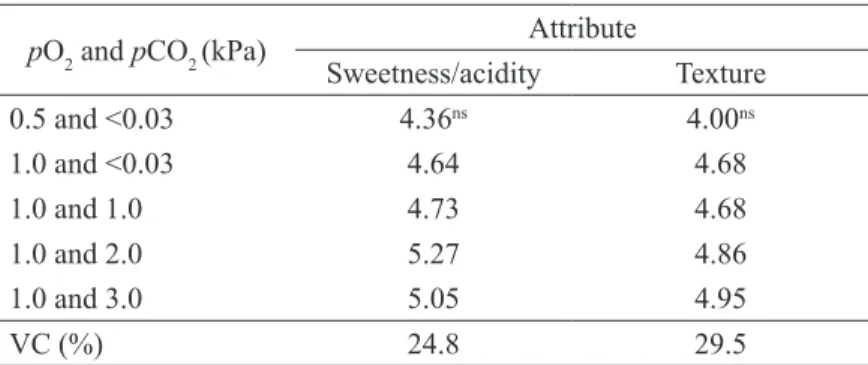
The different CA conditions evaluated had no effect on sensory attributes (Table 3). As TA and SSC content of fruits did not differ among treatments (Table 2), it is possible that this result was also perceived by consumers during the acceptance test, providing similar scores for the sweetness / acidity
attribute. Variations in flesh firmness and strength for flesh penetration, among storage conditions (Table
2), were not perceived or did not affect the tasters’ acceptance of texture attribute. Working with ‘Rocha’ pears submitted to different CA conditions for nine
months, Galvis-Sánches et al. (2004) found that fruits with different flesh firmness values presented similar scores in sensory evaluations for attribute “firmness”,
similar to results obtained in the present study. For none of the storage conditions evaluated, strange taste in fruits was observed.
The incidence of flesh browning was higher
in fruits stored under LO with pCO2 = 3.0 kPa than in fruits stored under lower CO2 content (ULO
and LO with pCO2 <0.03 kPa), but did not differ from those stored under LO combined with pCO2 of 1.0 or 2.0 kPa (Table 4). Flesh color attribute L
(2.0 and 3.0 kPa) was also lower (browner flesh)
than in fruits stored under ULO (Table 4). Thus, it is possible to observe that the increase in partial CO2 pressures (from values lower than 0.03 to 3.0 kPa)
is more related to the incidence of flesh browning,
than the decrease of partial O2 pressures (from 1.0 to 0.5 kPa), since pears stored under ULO (0.5 kPa)
had low incidence of flesh browning (6.2%). These
results indicate that LO condition with pCO2 = 3.0 kPa is not indicated for the storage of ‘Rocha’ pears
since it provides high incidence of flesh browning (48%), possibly associated with higher partial
CO2 pressures inside the flesh, which favors the occurrence of the disorder (FRANCK et al., 2007). The increase in CO2 content reduces fruit respiration by inhibiting the tricarboxylic acid cycle and the glycolytic route (WANG AND SUGAR, 2013). Thus, higher partial CO2 pressures favor the shift from aerobic respiration to anaerobic respiration in fruits, causing the synthesis of toxic products to cells and damaging the cell membranes (PEDRESCHI et al., 2009). With the loss of membrane selectivity and the cell decompartmentalization process, phenolic compounds that are located in vacuole can come into contact with the polyphenol oxidase enzyme (PPO), being oxidized in very reactive compounds that form
brown colored polymers, causing the symptoms of
flesh browning (YAN et al., 2013).
The CA conditions that provided the
lowest flesh browning severity values in the present
work, such as ULO and LO with pCO2 = 1.0 kPa, are not recommended for the storage of ‘Rocha’ pears produced in Portugal (CAVACO et al. , 2009; GAGO et al., 2013), mainly because they induce the
occurrence of flesh browning in fruits. According to Franck et al. (2007), the susceptibility to flesh
browning is related to several pre-harvest factors, especially to climatic conditions inherent to each production site. Fruits that grow under milder temperatures in the orchard are less susceptible to some physiological disorders, such as flesh browning in apples (CORRÊA et al., 2010) and pears (FRANCK et al., 2007), when compared to fruits that grow under lower temperatures. Possibly, these factors would provide pears produced in Brazil
(with milder temperatures) lower susceptible to flesh
browning than those produced in Portugal (with lower temperatures) and, therefore, greater tolerance to more limiting CA conditions, with lower partial pressures of O2 and higher of CO2.
TABLE 1 - Skin color, ethylene production and respiratory rate of ‘Rocha’ pears submitted to different
storage conditions under controlled atmosphere for 270 days (-0.5 ± 0.1 ° C and RH of 96 ± 2%) evaluated after zero, three and six days of shelf life (20 ± 5 ºC and RH of 63 ± 2%).
pO2 and pCO2 (kPa) Day 0 Day 3 Day 6
Skin color (hº)
0.5 and <0.03 96.02 ab 93.67 a 86.00 ns
1.0 and <0.03 88.18 c 87.97 b 84.86
1.0 and 1.0 93.92 b 93.26 a 85.14
1.0 and 2.0 97.59 ab 93.75 a 85.86
1.0 and 3.0 98.54 a 92.51 a 84.71
VC (%) 2.2 1.4 1.9
Ethylene production rate (nmol C2H4 kg-1 s-1)
0.5 and <0.03 0.074 b 0.063 c 0.074 b
1.0 and <0.03 0.156 a 0.202 a 0.117 ab
1.0 and 1.0 0.132 a 0.116 b 0.134 a
1.0 and 2.0 0.075 b 0.113 bc 0.099 ab
1.0 and 3.0 0.076 b 0.101 bc 0.096 ab
VC (%) 20.4 17.6 21.6
Respiratory rate (nmol CO2 kg-1 s-1)
0.5 and <0.03 103.63 b 491.12 b 756.96 c
1.0 and <0.03 143.95 a 623.58 ab 1134.11 a
1.0 and 1.0 122.71 ab 716.16 a 904.51 b
1.0 and 2.0 127.77 ab 651.22 ab 742.64 c
1.0 and 3.0 137.45 a 580.01 ab 568.49 d
VC (%) 10.2 13.5 4.6
TABLE 2 - Flesh firmness, strength for skin rupture and flesh penetration, titratable acidity and soluble solids content of ‘Rocha’ pears submitted to different storage conditions under controlled
atmosphere for 270 days (-0.5 ± 0.1 and 96 ± 2% RH), and evaluated after six days of shelf life (20 ± 5 ºC and UR of 63 ± 2%).
pO2 and pCO2 (kPa)
Flesh
firmness (N) Strength for skin rupture (N)
Strength for flesh
penetration (N)
Titratable
acidity (%) content (ºBrix)Soluble solids
0.5 and <0.03 16.00 b 4.62 ab 1.29 bc 0.149 ns 12.77 ns
1.0 and <0.03 22.41 a 5.33 a 1.70 a 0.124 13.12
1.0 and 1.0 16.83 b 4.52 b 1.40 b 0.139 12.70
1.0 and 2.0 15.12 b 4.87 ab 1.15 c 0.131 13.12
1.0 and 3.0 14.41 b 4.20 b 1.12 c 0.098 13.40
VC (%) 7.8 7.9 7.4 18.3 7.4
*Means followed by the same vertical letter did not differ by the Tukey test (p<0.05). ns: not significant (p>0.05).
TABLE 3 - Mean scores of the sensory attributes of ‘Rocha’ pears submitted to different storage conditions
in controlled atmosphere for 270 days (-0.5 ± 0.1 ºC and RH of 96 ± 1%), and evaluated after six days of shelf life (20 ± 5 ºC and RH of 63 ± 2%).
pO2 and pCO2 (kPa) Attribute
Sweetness/acidity Texture
0.5 and <0.03 4.36ns 4.00ns
1.0 and <0.03 4.64 4.68
1.0 and 1.0 4.73 4.68
1.0 and 2.0 5.27 4.86
1.0 and 3.0 5.05 4.95
VC (%) 24.8 29.5
ns: not significant (p>0.05).
TABLE 4 - Incidence and severity of flesh browning and flesh color of ‘Rocha’ pears submitted to different
storage conditions under controlled atmosphere for 270 days (-0.5 ± 0.1ºC and RH of 96 ± 2%) maintained for six days of shelf life (20 ± 5 ºC and RH of 63 ± 2%).
pO2 and pCO2 (kPa) Flesh browning incidence (%) Flesh browning severity (1-4)* Flesh color (L)
0.5 and <0.03 6.20 b 1.09 b 80.48 a
1.0 and <0.03 8.88 b 1.12 b 79.27 ab
1.0 and 1.0 18.21 ab 1.32 b 78.64 ab
1.0 and 2.0 26.52 ab 1.39 b 77.52 b
1.0 and 3.0 48.02 a 1.79 a 77.45 b
VC (%) 35.3 10.8 1.2
CONCLUSIONS
Storage of ‘Rocha’ pears in CA for 270 days under LO condition with pCO2 <0.03 kPa provides
less flesh firmness loss in fruits after the storage
period and yellower skin at the end of storage.
LO condition with pCO2 = 3.0 kPa is not indicated for the storage of ‘Rocha’ pears, as it
provides greater occurrence of flesh browning.
ULO (pO2 = 0.5 kPa and pCO2 <0.03 kPa) and LO conditions with pCO2 = 1.0 kPa are the most indicated for the storage of ‘Rocha’ pears, delaying the ripening of fruits without, however, inhibiting the development of texture or increasing the occurrence
of flesh browning.
ACKNOWLEDGMENTS
We would like to thank the Fundação de Amparo à Pesquisa e Inovação do Estado de Santa
Catarina (Fapesc) for granting the scholarship; the
Conselho Nacional de Desenvolvimento Científico e Tecnológico (CNPq) and the Fundação Universidade
do Estado de Santa Catarina (UDESC), for the
financial support.
REFERENCES
BLASZCZYK, J. Influence of harvest date and storage conditions on the content of chlorophyll pigments in pear peels. Folia Horticulturae,
Cracóvia, v.24, n.1, p.91-95, 2012.
BOTH, V.; BRACKMANN, A.; WEBER, A.; ANESE, R.O.; THEWES, F.R. Estresse inicial por baixo oxigênio seguido do armazenamento
em atmosfera controlada de maçãs ‘Royal Gala’.
Revista Ciência Agronômica, Fortaleza, v.45, n.4, p.708-717, 2014.
BRACKMANN, A.; ANESE, R.O.; WEBER, A.;BOTH, V.; GASPERIN, A.R.; PAVANELLO, E.P. Efeito do estresse inicial por baixo O2 combinado
com 1-metilciclopropeno na conservação de maçãs
‘Royal Gala’ armazenadas com ultrabaixo O2. Revista Semina, Londrina, v.34, n.3, p.1185-1194, 2013.
BRACKMANN, A.; GUARIENTI, A.J.W.; SAQUET, A.A.; GIEHL, R.F.H.; SESTARI, I.
Condições de atmosfera controlada para a maçã
‘Pink Lady’. Ciência Rural, Santa Maria, v.35, n.3, p.504-509, 2005.
CAVACO, A.M.; PINTO, P.; ANTUNES, M.D.;
SILVA, J.M.; GUERRA,R. ‘Rocha’ pear firmness
predicted by a Vis/NIR segmented model. Postharvest Biology and Technology, Amsterdam, v.51, n.1, p.311-319, 2009.
CHENG., Y.; DONG, Y.; YAN, H.; GE, W.; SHEN, C.; GUAN, J.; LIU, L.; ZHANG, Y. Effects of 1-MCP on chlorophyll degradation pathway-associated genes expression and chloroplast ultrastructure during the peel yellowing of Chinese pear fruits in storage. Food Chemistry, Washington, v.135, p.415-422, 2012.
CORRÊA, T.R.; STEFFENS, C.A.; AMARANTE, C.V.T.; BRACKMANN, A.; SILVEIRA, J.P.G.;
TANAKA, H.; BOTH, V. Qualidade de maçãs ‘Fuji’ armazenadas em atmosfera controlada e influência
do clima na degenerescência da polpa. Pesquisa Agropecuária Brasileira, Brasília,v.45, n.6, p.531-538, 2010.
DHILLON, W.S.; MAHAJAN, B.V.C. Ethylene and ethephon induced fruit ripening in pear. Journal of Stores Products and Postharvest Research, Nairobi, v.2, n.3, p.45-51, 2011.
ELGAR, H.J.; WATKINS, C.B.; MURRAY, S.H.; GUNSON, A. Quality of ‘Buerre Bosc’ and ‘Doyenne du Comice’ pears in relation to harvest date and storage period. Postharvest Biology and Technology, Amsterdam, v.10, p.29-37, 1997.
FAORO, I.D.; ORTH, A.I. A cultura da pereira no Brasil. Revista Brasileira de Fruticultura, Jaboticabal, v.32, n.1, p.1-2, 2010.
GAGO, C.M.L.; MIGUEL, M.G.; CAVACO, A.M.; ALMEIDA, D.P.F.; ANTUNES, M.D.C. Combined effect of temperature and controlled atmosphere on storage and shelf-life of ‘Rocha’ pear treated with 1-methylcyclopropene. Food Science and Technology International, Nova Iorque, v.21, n.2, p.94-103, 2013.
G A LV I S - S Á N C H E Z , A . C . ; F O N S E C A , S.C.; MORAIS, A.M.M.B.; MALCATA, F.X. Physicochemical and sensory evaluation of ‘Rocha’ pear following controlled atmosphere storage. Journal of Food Science, Chicago, v.68, n.1, p.318-327, 2003.
GALVIS-SÁNCHEZ, A.C.; FONSECA, S.C.; MORAIS, A.M.M.B.; MALCATA, F.X. Sensorial and physiocochemical quality responses of pears (cv Rocha) to long-term storage under controlled atmospheres. Journal of the Science of Food and Agriculture, Oxford, v.84, n.1, p.1646-1656, 2004.
GALVIS-SÁNCHEZ, A.C.; MORAIS, A.M.M.B. Effects of controlled atmosfere (CA) storage on pectinmethylesterase (PME) activity and texture of ‘Rocha’ pears. Journal of the Science of Food and Agriculture, Oxford, v.82, n.1, p.143-145, 2001.
LARA, M.V.; BUDDE, C.O.; PORRINI, L.; BORSANI, J.; MURRAY, R.; ANDREO, C.S.; DRINCOVICH, M.F. Peach (Prunus persica) fruit response to anoxia: reversible ripening delay and biochemical changes. Plant Cell Physiology, Kyoto, v.52, n.2, p.392-403, 2011.
MAKKUMRAI, W.; ANTHON, G.E.; SIVERTSEN, H.; EBELER, S.E; NEGRE-ZAKHAROV, F.; BARRETT, D.M.; MITCHAM, E.J. Effect of ethylene and temperature conditioning on sensory attributes and chemical composition of ‘Bartlett’ pears. Postharvest Biology and Technology, Amsterdam,v.97, p.44-61, 2014.
MARTIN, M.S.; STEFFENS, C.A.; AMARANTE, C.V.T.; BRACKMANN, A.; JUNIOR, W.L. Qualidade de peras ‘Rocha’ armazenadas em atmosfera controlada. Revista Brasileira de Fruticultura, Jaboticabal, v.37, n.1, p.73-82, 2015.
MURAYAMA, H.; KATSUMATA, T.; ENDOU, H.; FUKUSHIMA, T. SAKURAI, N. Effect of storage
period on the molecular-mass distribution profile of
pectic and hemicellulosic polysaccharides in pears. Postharvest Biology and Technology, Amsterdam, v.40, n.1, p.141-148, 2006.
MURAYAMA, H.; KATSUMATA, T.; HORIUCHI, O.; FUKUSHIMA, T. Relationship between fruit softening and cell wall polysaccharides in pears after different storage periods. Postharvest Biology and Technology, Amsterdam, v.26, n.1, p.15-21, 2002.
NASHIMA, K.; SHIMIZU, T.; NISHITANI, C.; YAMAMOTO, T.; TAKAHASHI, H.; NAKAZONO, M.; ITAI, A.; ISUZUGAWA, K.; HANADA, T.; TAKASHINA, T.; MATSUMOTO, S.; OTAGAKI, S.; OIKAWA, A.; SHIRATAKE, K. Microarray analysis of gene expression patterns during fruit development in European pear (Pyrus communis). Scientia Horticulturae, Amsterdam, v.164, p.466-473, 2013.
PEDRESCHI, R.; FRANCK, C.; LAMMERTYN, J . ; E R B A N , A . ; K O P K A , J . ; H E RT O G , M.;VERLINDEN, B.; NICOLAÏ. Metabolic
profiling of ‘Conference’ pears under low oxygen
stress. Postharvest Biology and Technology, Amsterdam, v.51, p.123-130, 2009.
PEDRESCHI, R.; HERTOG, M.; ROBBEN, J.;NOBEN, J.; NICOLAÏ, B. Physiological implications of controlled atmosphere storage of ‘Conference’ pears (Pyrus communis L.): A proteomic approach. Postharvest Biology and Technology, Amsterdam, v.50, p.110-116, 2008.
P E T I N E L I , R . ; L U Z , A . R . ; M A C E D O , T. A . ; FA G H E R A Z Z I , A . F. ; R U FATO , L . ;
KRETSZCHEMAR, A.A. Produção de pereiras
europeias enxertadas sobre marmeleiro Adams nas
condições climáticas da serra catarinense. Journal
of Agronomic Sciences, Umuarama, v.3, n.2, p.62-69, 2014.
STEFFENS, C.A.; BRACKMANN, A.; PINTO,
J.A.V.; EISERMANN, A.C. Taxa respiratória de
WANG, Y.; SUGAR, D. Internal browning
disorder and fruit quality in modified atmosphere
packaged ‘Bartlett’ pears during storage and transit. Postharvest Biology and Technology, Amsterdam, v.83, p.72-82, 2013.
WEBER, A.; BRACKMANN, A.; ANESE, R.O.; BOTH, V.; PAVANELLO, E. Atmosfera controlada
para o armazenamento da maçã ‘Maxi Gala’. Revista
Ciência Agronômica, Fortaleza, v.44, n.2, p.294-301, 2013a.
W E B E R , A . ; T H E W E S , F. R . ; S C H O R R , M.R.W.; GASPERIN, A.R.; VENTURINI, T.L.; BRACKMANN, A. ‘Gala’, ‘Royal Gala’ and
‘Brookfield’ apples stored under ultra-low oxygen and
two temperatures. Bioscience Journal, Uberlândia, v.29, n.6, p.1887-1895, 2013b.