Watermelon transformation with
Zucchini yellow mosaic virus
coat protein gene and comparison with parental cultivar
Sebahattin Çürük(1)andEbru Meşe(1)
(1)Mustafa Kemal University, Faculty of Agriculture, Department of Horticulture, TR‑31034 Antakya‑Hatay, Turkey.
E‑mail: [email protected], [email protected]
Abstract – The objective of this work was to transfer Zucchini yellow mosaic virus coat protein (ZYMV-CP) and neomycin phosphotransferase II (NPT II) genes to the watermelon ‘Crimson Sweet’ (CS) genome, and to compare the transgenic progenies T1 and T2 with the nontransformed parental cultivar for morphological, pomological, growth and yield characteristics. The ZYMV-CP gene was transferred by Agrobacterium tumefaciens. The presence of the
gene in transgenic T0, T1 and T2 plants was determined by polymerase chain reaction, and the results were confirmed
by Southern blot. Two experiments were performed, one in the winter-spring and the other in the summer-autumn.
In both experiments, the hypocotyl length of transgenic seedlings was significantly higher than that of nontransgenic
parental ones. In the second experiment, the differences between transgenic and nontransgenic individuals were
significant concerning fruit rind thickness, flesh firmness, fruit peduncle length, size of pistil scar, and a* values for fruit stripe or flesh color. Transferring ZYMV‑CP gene to CS genome affected only a few characteristics from the 80 evaluated ones. The changes in rind thickness, flesh firmness and flesh color a* values are favorable, while the increase in the size of pistil scar is undesirable. The transgenic watermelon line having ZYMV‑CP gene and the
parental cultivar CS are very similar.
Index terms: Citrullus lanatus, comparative safety analysis, genetic modification, neomycin phos photrans‑
ferase II, nontransgenic watermelon, transgenic watermelon.
Transformação de melancia com o gene da capa proteica
do
Zucchini yellow mosaic virus
e comparação com a cultivar parental
Resumo – O objetivo deste trabalho foi transferir o gene da capa proteica do Zucchini yellow mosaic virus (ZYMV-CP) e o gene neomycin phosphotransferase II (NPT II) para o genoma da melancia ‘Crimson Sweet’ (CS), e comparar as progênies T1 e T2 com a cultivar parental não transformada, quanto às características morfológicas, pomológicas, de crescimento e de produção. O gene ZYMV-CP foi transferido por meio da transformação com Agrobacterium tumefaciens. A presença do gene nas plantas transgênicas T0, T1 e T2 foi determinada pela reação de polimerase
em cadeia, e os resultados foram confirmados pelo “Southern blot”. Dois experimentos foram realizados, um no
inverno-primavera e outro no verão-outono. Nos dois experimentos, o comprimento do hipocótilo das plântulas
transgênicas foi significativamente maior do que nas plântulas não transgênicas. No segundo experimento, as diferenças entre as plantas transgênicas e não transgênicas foram significativas quanto à espessura da casca das frutas, firmeza da polpa, comprimento do pedúnculo, tamanho da cicatriz do pistilo, e valores a* da cor das listras ou
da polpa. A transferência do gene da capa proteica ZYMV-CP ao genoma CS afetou apenas algumas características,
das 80 avaliadas. As alterações na espessura da casca, firmeza e cor da polpa são favoráveis, enquanto o aumento no tamanho da cicatriz do pistilo é indesejável . A linhagem transgênica de melancia com o gene ZYMV‑CP e a cultivar
parental CS são muito similares.
Termos para indexação: Citrullus lanatus, análise de segurança comparativa, modificação genética, neomycin
phosphotransferase II, melancia não transgênica, melancia transgênica.
Introduction
Transgenic crop production in the world is in-creasing. The leading countries in transgenic crop production are USA (66.8 million ha),
Brazil (25.4 million ha), Argentina (22.9 million ha), India (9.4 million ha), Canada (8.8 million ha)
and China (3.5 million ha) (International Service for
the Acquisition of Agri-Biotech Applications, 2010). The concepts of substantial equivalence or comparative safety analysis are accepted for transgenic crop safety assessment (Organisation for Economic Co-Operation
and Development, 1993; Food and Agriculture Organization, 1996; Barros et al., 2010). Since concerns
those of conventionally bred crops, under field and
protected cultivation, have been detailed (Shewry et al.,
2007). In this sense, the genetically modified crop is
compared to its conventional genotypes for agronomic and phenotypic variation, and by compositional analysis which includes analysis of macro- and micronutrients, as well as of toxins and antinutrients (Barros et al., 2010).
There are several reports for detailed comparisons of
genetically modified crops and those of conventional
counterparts in cereals. According to Venneria et al.
(2008), no significant differences were observed for qualitative traits analyzed in wheat and corn as fatty acids content, unsaponifiable fraction of antioxidants,
total phenols, polyphenols, carotenoids, vitamin C, total antioxidant activity, and mineral composition. It was reported that the effect of transgenesis on transcriptome was lower than that of conventional breeding concerning the wheat grain (Baudo et al.,
2006; Shewry et al., 2007; Ammann, 2011). Batista
et al. (2008) have concluded that plant mutagenesis may induce more transcriptomic changes than
transgene insertion in rice. Coll et al. (2009) showed that gene expression profiles of transgenic maize
plants MON810 and its near-isogenic nontransgenic
maize genotypes were more similar than those of
conventional lines. According to Barros et al. (2010),
the differences in transcript/protein/metabolite profiles
between locations (environment) were higher than
the difference between Bt‑maize and nontransgenic
cultivar, and growing seasons had a stronger overall effect in the transcriptome, proteome and metabolome
of the maize genotypes than the genetic modification.
To our knowledge, unlike cereals, there are a few reports comparing transgenic and their nontransgenic originating conventional cultivars in fruit and vegetable crops. Catchpole et al. (2005) reported that
except for targeted traits, genetically modified potatoes
appear substantially equivalent to traditional cultivars. According to Jiao et al. (2010), the composition in transgenic papayas exhibited great similarity to the one in nontransgenic counterparts. Venneria et al.
(2008) showed that genetically modified events are
nutritionally similar to conventional tomato varieties.
Yalçın‑Mendi et al. (2010) have reported that there was no significant difference between transformed (with
ZYMV-CP) melon line and nontransformed control cultivar, except for fruit total acidity. However, there
are no reports on the detailed comparison of transgenic
watermelon [Citrullus lanatus (Thunb.) Matsum. &
Nakai] line with its nontransgenic originating cultivar.
The objective of this study was to transfer Zucchini
yellow mosaic virus coat protein (ZYMV-CP) and neomycin phosphotransferase II (NPT II) genes to watermelon cultivar Crimson Sweet (CS) genome, and to compare the transgenic T1 and T2 generations with nontransformed plants of the same cultivar (parental cultivar) for morphological, pomological, growth and yield characteristics.
Materials and Methods
Nontransgenic watermelon cultivar Crimson Sweet
‑ CS (Bursa tohumculuk A.Ş., Turkey) was used. For
genetic transformation, watermelon seed coats were removed, and the seeds were washed in 70% ethanol for 5 min, rinsed three times with sterile distilled water, and surface-disinfected in a solution of 1.2% sodium hypochlorite with two drops of Tween 20 per 100 mL, for 40 min. After rinsing, seeds were further
washed for 15 min in 500 mg L-1 cefotaxime. MS
medium (Murashige & Skoog, 1962) was used for seed
germination in a growth room at 27±1°C, in the dark.
Cotyledons were excised from four-day-old seedlings and cut across to make two explants per cotyledon,
and then were trimmed along all edges. Diferent
media were used for regeneration, shoot elongation
and rooting, as follows: RM–MS salts, modified MS
vitamins, 30 g L-1 sucrose, 2.25 mg L-1 BA, as in
Compton & Gray (1993); SE–MS salts, modified MS
vitamins, 20 g L-1 sucrose; and SR–MS salts, modified
MS vitamins, 20 g L-1 sucrose, 0.186 mg L-1 NAA or
250 mg L-1 cefotaxime. Media were solidified with
8 g L-1 agar, and sterilized at 121°C for 15 min. In vitro
cultures were incubated at 27±1°C, with a 16‑hour
photoperiod of 60–70 µmol m-2 s-1 photon flux during
regeneration-selection, elongation-selection and
rooting.
Agrobacterium tumefaciens strain EHA 105 having the plasmid pCIB10, which contained NPT II and
ZYMV‑CP genes (Fang & Grumet, 1993), was used
for transformation. A colony of this bacterium was incubated for 18 hours in 2 mL liquid LB medium
Merck, VM491085542 (Merck, Gibbstown, NJ, USA),
with 50 mg L-1 kanamycin at 28±1°C, and shaken at
‑80°C after the addition of 174 µL dimethyl sulfoxide.
Two hundred microliters of this culture were added
to 2 mL of liquid LB with 50 mg L-1 kanamycin, and
shaken (as above) for 5 hours. Then, the culture was added to 40 mL liquid LB, without antibiotics, prior to inoculation. Approximately 10 mL of this diluted culture were used for inoculation of 100 cotyledon
explants.The cotyledons of seedlings were transferred
to the Agrobacterium culture in a sterile Petri dish. The
explants were excised in the Agrobacterium culture
(approximately 10 min), inoculated for 10 min with occasional agitation, and then distributed on RM medium without antibiotics, and co-cultivated for two days in the growth room in the dark. Then, they were washed three times with sterile distilled water, and
placed in 90x15‑mm Petri dishes (approximately 20
explants per dish) with the adaxial side onto RM
medium containing 75 mg L-1 kanamycin and
400 mg L-1 timentin (Research Triangle Park, Durham,
NC, USA), and cultured for three weeks. The explants were subcultured for three weeks in the RM medium
with 100 mg L-1 kanamycin and the same concentration
of timentin.
Regenerating parts of the explants were excised and
transferred to SE medium with 125 mg L-1 kanamycin
and 400 mg L-1 timentin, and cultured for six weeks,
at three-week intervals. To stimulate root formation,
shoots growing on kanamycin were first transferred to
SR medium in test tubes (25x150 mm) and incubated for two weeks. Then, the shoots were rooted on SR medium without NAA, but supplemented with
250 mg L-1 cefotaxime, which stimulates root formation
(Çürük et al., 2005). Test tubes which had the putative transformants were gradually opened in the growth room, and the plants were transplanted to the plastic pot containing 0.2 L substrate, composed of 66% peat
Potgrond H (Klasmann‑Deilmann, GmbH, Geeste,
Germany) and 34% perlite.
For ZYMV‑CP gene detection, polymerase
chain reaction (PCR) was performed. One hundred miligrams of plant tissue were grinned in liquid
nitrogen, and DNA was isolated (Gusmini & Wehner, 2010). For each sample, 4 µL suspended DNA (approximately 100 ng) were used for 21 µL reaction
mixture. The reaction mixture was composed of
2.5 µL PCR buffer (x10), 1.5 µL of 25 mmol L-1
MgCl2, 0.5 µL of 10 mmol L-1 dNTPs, 14.3 µL double
distilled water, 1 µL each of primer 1 (5 μmol L-1,
5’-AAGTCTAGAAAATAACAAATCTCAACA-3’)
and primer 2 (5 μmol L-1,
5’-AATGAGCTCTTTTTTTTTAGGCTTG-3’), and
0.2 µL Taq DNA polymerase (Fermentas, Vilnius,
Lithuania). In the PCR reaction, final concentrations
of PCR buffer, MgCl2, dNTPs, primers, and Taq DNA
polymerase were x1, 1.5 mmol L-1, 200 µmol L-1 (each
dNTP), 0.2 µmol L-1 (each primer), and one unit,
respectively. Each PCR reaction consisted of an
initial denaturation at 95°C for 2 min (1 cycle), and denaturation at 95°C for 45 s, annealing at 50°C for 1 min, extention at 72°C for 90 s (30 cycles), and a final extention at 72°C for 5 min (1 cycle).
The presence of ZYMV-CP gene in PCR–positive plants, and the absence of the gene in nontransgenic
parental plants were detected by Southern blot. For
Southern blot analysis, a nonradioactive probe of ZYMV-CP gene was prepared. The pCIB10 plasmid
was isolated from 5 mL Agrobacterium culture
that was grown for 20 hours under the mentioned
conditions, combining the protocol by Helms (1990)
and Spin Columns of GeneJET Plasmid Miniprep
Kit (Fermentas, Vilnius, Lithuania). The ZYMV‑CP gene (approximately 1.2 kbp) was amplified by PCR with 1 µL of suspended plasmid DNA (30 ng). The
PCR product was run on 0.8% agarose gel, and the ZYMV-CP gene was gel-extracted following the
manufacturer’s instructions Silica Bead DNA Gel Extraction Kit #K0513 (Fermentas, Vilnius, Lithuania). The gel‑extracted DNA was labeled using DIG High Prime DNA Labeling and Detection Starter Kit II (Roche Diagnostics GmbH, Mannheim, Germany)
following the manufacturer’s recommendations.
For Southern blot analysis, DNA was prepared from watermelon leaves (Levi & Thomas, 1999). Approximately 10 µg of genomic DNA was
restriction-digested with XbaI, following the
manufacturer’s instructions, (Fermentas, Vilnius,
Lithuania), run on 1% agarose gel at 30 V for 8 hours, and blotted onto a charged nylon membrane NP0HY00010 (GE Infrastructure Water & Process Technologies, Vista, CA, USA), using a vacuum blotter
785 (BIO‑RAD, Hercules, CA, USA). DIG–labeled
ZYMV-CP probe and blots of restriction-digested
watermelon DNA onto charged nylon membrane were hybridized, washed and detected according to the manufacturer’s manual Roche, 11585614910
prehybridized in DIG Easy Hyb for 30 min at 44°C, with gentle agitation at 14 rpm in a hybridization oven HB‑1000 Hybridizer, UVP (Laboratory Products, Cambrige, UK). The DIG–labeled ZYMV‑CP probe which had been stored at ‑20° was denaturated by
incubation in boiling water for 5 min and, then, by rapidly cooling in ice-water for 2 min. After that, the
membrane was hybridized with this probe for four hours or overnight at 44°C and 14 rpm. After hybridization,
the wash procedure of the nylon membrane was carried
out in two steps. In the first step, the membrane was washed twice with a 2xSSC/0.1% SDS solution, for 5 min at 15–25°C, under constant agitation at 20–
30 rpm. In the second step, it was washed twice with
a 0.5xSSC/0.1% SDS solution for 15 min at 67°C. All
the incubations made for detection were performed at 30ºC with agitation at 40–50 rpm. The membrane was
agitated in washing buffer (0.1 mol L-1 maleic acid,
0.15 mol L-1 NaCl (pH:7.5), 0.3% Tween 20), and
incubated for 40 min in a blocking solution and 30 min
in an antibody solution; then, it was washed again
twice with the washing buffer for 20 min. After that, the membrane was equilibrated for 5 min in detection
buffer (0.1 mol L-1 Tris-HCl, 0.1 mol L-1 NaCl, pH:9.5).
Then, 1 mL of CSPD ready‑to‑use was applied on the membrane. Hybridization signals were detected by exposing the membrane to an X‑ray film at 15–25°C
for 60 min.
According to the growth of the putative transgenic shoots on selection medium supplemented with kanamycin, and to PCR analysis, four transformation events were obtained from transformation experiments. In vitro regenerated plants from one of these events, which were morphologically the most similar to their parental cultivar, were selected as primary transgenic (T0). Then, the seeds of T1 generation were obtained by self-pollination of T0 plants. Transgenic T1 plants were selected by PCR for transgene ZYMV-CP. The seeds of T2 generation were similarly produced by self-pollination of the PCR-positive plants of
T1 generation. The transfer of the genes was confirmed
by Southern blot detection in T1 and T2 generations. The growth and self-pollination of the plants were carried out in the glasshouse, and described as follows.
To compare transgenic and nontransgenic
watermelon genotypes, two experiments were
carried out in the winter‑spring (first experiment) and
summer-autumn (second experiment) growing seasons
in 2009, at the Agricultural Research Station of Mustafa
Kemal University, Antakya, in the Southeastern Mediterranean Region of Turkey. Plants were grown in a glasshouse with steel structure, with 10 m span width, 4 m gutter height, 5.5 m ridge height, continuous roof ventilation windows (2x10 m) and two exhaust fans. The ventilation windows of the glasshouse were closed with a 50-mesh net. The exhaust fans were on, when
the inside temperature was higher than 28°C. The
glasshouse was heated with a radiator using the central heating system, when the inside temperature was lower
than 17°C. When air temperature in the glasshouse was higher than 35°C, an inside screen XLS 15 Firebreak
(AB Ludving Svenson, Sweden) was used to reduce the temperature. Nontransformed CS and T1 (transgenic)
seeds for the first experiment, and nontransformed CS
and T2 (transgenic) seeds for the second experiment were sown in the aforementioned substrate, in January
10 and July 18 of 2009, respectively. The PCR‑negative
plants of nontransformed CS, and the positive ones of transgenic generations were transplanted to plastic pots containing 16 L of the mentioned substrate, and
grown in the glasshouse at a density of 1.33 plants m-2
(1.5x0.5 m).
The experiment was performed in a completely
randomized design, with three replicates per treatment
and 10 plants per replicate. Unless otherwise noted, measurements were made on eight plants per replicate. The plants were irrigated by hand as
needed. The total amount of applied N-P2O5-K2O was
200-120-300 kg ha‑1. Since insect activity was very low
due to the net use (with 50 meshes) on the ventilation
windows, the flowers were self‑pollinated to obtain fruit. During the first experiment, average minimum
and maximum air temperatures inside the glasshouse were approximately 15.7 and 30.6ºC in January,
18.2 and 30.3ºC in February, 19.5 and 32.1ºC in March,
21.3 and 37.3ºC in April. In the second experiment, the average minimum and maximum temperatures were approximately 28.1 and 41.1ºC in July, 26.8 and 38.5ºC in August, 22.6 and 35.4ºC in September, 20.0 and 35.2ºC in October, 20.0 and 27.2ºC in November. The photoperiod during both experiments was the natural daylength.
The measurements of hypocotyl and cotyledon length (cm) and width (cm), and the observation (absent or spotted) of cotyledon spotty status were
and second experiments, respectively. Stem thickness (mm), main stem length (cm), and number of branches and nodes in the main stem were determined three weeks before harvest. Measures were performed on two fully developed leaves of each plant for petiole length (cm), and for blade width (cm) and length (cm), and observations were done for blade blistering or spotting (absent or present), being the leaf blade
secondary lobing classified as weak (3), intermediate
(5) or strong (7), according to the International Union for the Protection of New Varieties of Plants (2004)
From each replicate, two plants at flowering were
used for the measurements of fresh and dry weigh (g),
and leaf area (cm2 per plant), using a leaf area meter
Li-cor 3100 (Li-cor, Lincoln, NE, USA). The leaves, roots and stems-branches of the plants were weighted
separately, before and after drying at 65°C for two days. Node number of the first male and female flower, and time (day) of male and female flowering were recorded. Leaf and flower measurements or observations were made on two leaves or flowers per plant from each replicate. For pomological analysis, seven or eight fruit
were used in each replicate. Petal width (mm) of male, and petal height (mm), and ovary length (mm) and width
(mm) of female flowers were measured. Petal apex shape of female flower (acute, 3; rounded, 5; obtuse, 7)
according to TC Resmi Gazete (1998), and pubescence of the ovary (weak, 3; intermediate, 5; strong, 7) as
per the International Union for the Protection of New Varieties of Plants (2004) were determined. Pollen viability (%) was determined using 1% triphenyl
tetrazolium chloride. Pollens were germinated in a
medium containing 20% sucrose, 100 mg L-1 H
3BO3,
300 mg L-1 Ca(NO
3)2.4H2O, 200 mg L-1 MgSO4.7H2O,
100 mg L-1 KNO
3 and 0.2% agar (Şensoy et al., 2003). Fruit weight (kg), length (cm), and width (cm) were measured at maturity. Fruit shape (flattened, 1; round, 2; broad elliptical, 3; elliptical, 4; pyriform, 5; oblong, 6) was classified in conformity with the
European Cooperative Programme for Plant Genetic Resources (2008). Shape of apical and basal parts of
the fruit (flat, 1; flat to rounded, 2; rounded, 3; rounded to conical, 4; conical, 5) were recorded according to TC Resmi Gazete (1998) and the International Union
for the Protection of New Varieties of Plants (2004). Grooves and marbling on fruit were observed as absent
or present. Flesh firmness was measured in newtons
(N), using a penetrometer (Nippon Optical Works Ca,
LTD, Tokyo, Japan) fitted with a 5 mm diameter probe, and fruit rind thickness (mm) were determined. Fruit
peduncle length (cm) and diameter (mm), and insertion
size of peduncle (mm) were measured just before harvest. Number of seeds per fruit, and size of pistil
scar (mm) were recorded. The watermelon fruit quality
properties, namely malic acid (%) (Sadler, 1994), pH and total soluble solid (°Brix) (Çürük et al., 2009),
were measured. Ground and stripe colors of fruit skin,
and colors of fruit flesh and leaf blade were determined according to Cielab (L*a*b*) colour space, using
a Chroma Meter Minolta CR-300 (Minolta, Osaka,
Japan), and L*, a*, b*, C*, hº values were recorded (McGuire, 1992).
The ploidy levels of nontransgenic and transgenic T0
plants of CS were analyzed by flow cytometry, using leaf samples (Arumuganathan & Earle, 1991). The
ploidy level (diploid, triploid or tetraploid) of transgenic
T1 or T2 plants were determined observing flower,
leaf, pollen and seed characteristics. Reproductive system (monoecious or andromonoecious) and plant growth habit (bushy or runner) were recorded. Seed characteristics, namely mean weight (mg per seed), testa ground color, and patches at hilum, were
determined. Total yield (kg m-2) was taken from each
plot and weighted on a weekly basis once fruit began to ripen.
Data analyses were performed by using SAS (SAS Institute, 1999). Data were subjected to a general linear
model analysis (GLM) ANOVA, and means were
compared by the least significant difference (LSD)
test.
Results and Discussion
The flow cytometry analysis showed that the ploidy
levels of nontransformed and transgenic T0 plants were diploid.The PCR detection showed that T0, T1 and
T2 plants had the ZYMV‑CP gene (Figure 1 A), and
none of the nontransformed control plants contained the gene. In T1 and T2 populations, 71% (57/80) and 83% (50/60) of the plants (respectively) contained the
ZYMV‑CP gene according to PCR amplification.
Since XbaI only cuts on one side of the ZYMV-CP
gene, the other XbaI side should come from the
contained the ZYMV-CP gene as multiple copies of
T‑DNA integrated in the plant genome (Figure 1 B).
In both experiments, spots on cotyledons, and blisters or spots on leaf blade were absent in nontransgenic control and transgenic T1 or T2 plants. Parental control, and transgenic T1 and T2 plants were diploid, their reproductive systems were monoecious, and the growth habits were runner. Regarding these traits,
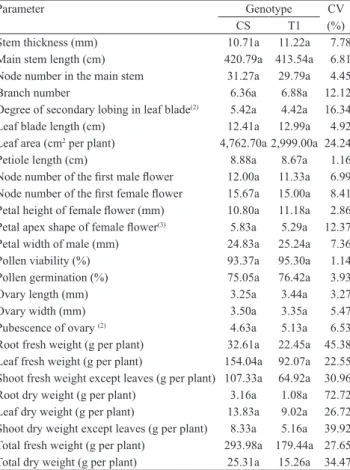
differences between genotypes were not significant. In the first experiment, there was no significant
difference between transgenic T1 and control plants
concerning stem, branch, leaf, and flower fresh and
dry weight parameters (Table 1). Seedling hypocotyl length and leaf blade width of transgenic T1 generation were respectively 22.04 and 7.77% higher than those of nontransgenic control (Table 2). However, seedling cotyledon width and length of transgenic T1 were
16.95 and 16.48% lower than those of parental control
(Table 2).
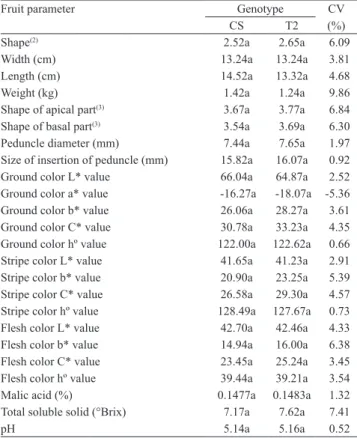
In the second experiment, fruit grooving or marbling, patches at hilum were absent, and testa ground color was brown in nontransgenic control or transgenic T2 seeds. The differences between transgenic T2 and nontransgenic control concerning stem, branch, leaf,
flower, and fruit parameters (Table 3 and 4), and
seed, fresh and dry weight, total yield, and cotyledon
parameters (Table 5) were not significant. However,
hypocotyl length of transgenic T2 seedling was 8.30% higher than that of nontransgenic control. Moreover,
flesh firmness, size of pistil scar, and flesh color a* value of genetically modified T2 fruit were respectively 7.19, 11.69 and 8.16% greater than those of control fruit. Fruit rind thickness and peduncle length of
Figure 1. Molecular analysis: A, ethidium bromide stained
agarose gel showing the amplification by PCR of the
ZYMV-CP gene present in transgenic plants. Samples from transgenic plants (lanes 1, 4, 6 and 8–11), escapee plants (lanes 2, 3, 5 and 7), positive control (lane 12, transgenic watermelon), positive control of pCIB10 plasmid (lane P),
and molecular size markers (lane M) are indicated. Molecular
weight markers (bp) are indicated on the side of the gel. B, Southern blot analysis of T2 progeny. The PCR fragment of
ZYMV‑CP gene, amplified from the pCIB10, was used as a probe. Total genomic DNA (10 µg), from a transformed
plant (lane 1) and a nontransformed control plant (lane 2), was digested with XbaI.
Table 1. Values of stem, branch, leaf, flower, and fresh
and dry weight parameters of nontransgenic 'Crimson Sweet' (CS) watermelon and T1 progeny with transgene ZYMV-CP (T1)(1).
Parameter Genotype CV
CS T1 (%)
Stem thickness (mm) 10.71a 11.22a 7.78
Main stem length (cm) 420.79a 413.54a 6.81
Node number in the main stem 31.27a 29.79a 4.45
Branch number 6.36a 6.88a 12.12
Degree of secondary lobing in leaf blade(2) 5.42a 4.42a 16.34
Leaf blade length (cm) 12.41a 12.99a 4.92
Leaf area (cm2 per plant) 4,762.70a2,999.00a 24.24
Petiole length (cm) 8.88a 8.67a 1.16
Node number of the first male flower 12.00a 11.33a 6.99
Node number of the first female flower 15.67a 15.00a 8.41
Petal height of female flower (mm) 10.80a 11.18a 2.86
Petal apex shape of female flower(3) 5.83a 5.29a 12.37
Petal width of male (mm) 24.83a 25.24a 7.36
Pollen viability (%) 93.37a 95.30a 1.14
Pollen germination (%) 75.05a 76.42a 3.93
Ovary length (mm) 3.25a 3.44a 3.27
Ovary width (mm) 3.50a 3.35a 5.47
Pubescence of ovary (2) 4.63a 5.13a 6.53
Root fresh weight (g per plant) 32.61a 22.45a 45.38
Leaf fresh weight (g per plant) 154.04a 92.07a 22.55
Shoot fresh weight except leaves (g per plant) 107.33a 64.92a 30.96
Root dry weight (g per plant) 3.16a 1.08a 72.72
Leaf dry weight (g per plant) 13.83a 9.02a 26.72
Shoot dry weight except leaves (g per plant) 8.33a 5.16a 39.92
Total fresh weight (g per plant) 293.98a 179.44a 27.65
Total dry weight (g per plant) 25.31a 15.26a 34.47
(1)Means of each parameter followed by equal letters, in the rows, do not
di-ffer by LSD test, at 5% probability. (2)According to the International Union
for the Protection of New Varieties of Plants (2004): 3, weak; 5, interme
-diate; and 7, strong. (3)According to TC Resmi Gazete (1998): 3, acute;
5, rounded; and 7, obtuse.
Table 2. Values of seedling and blade parameters of
nontransgenic 'Crimson Sweet' (CS) watermelon and T1 progeny with transgene ZYMV-CP (T1)(1).
Parameter (cm) Genotype CV
CS T1 (%)
Hypocotyl length 5.40b 6.59a 5.21
Cotyledon width 1.77a 1.47b 3.82
Cotyledon length 2.67a 2.23b 6.02
Leaf blade width 13.52b 14.57a 2.62
(1)Means of each parameter, followed by equal letters in the rows, do not
transgenic T2 individuals were 7.96 and 10.88% lower than those of control individuals. Stripe color a* value
of the nontransgenic control fruit was higher than that of transgenic T2.
Regarding differences between transgenic water-melon line with nontransgenic parental cultivar CS,
only four of the 36 characteristics investigated in the first experiment were significant. In the second experiment, only seven out of 80 were significant. The differences
between transformed and nontransformed genotypes, with regard to cotyledon width and length or leaf blade width, were not obvious, since the differences were
significant in the first experiment (Table 2), but not in
the second (Table 3 and 5). This may be attributed to the difference in environmental conditions between the growing seasons (winter-spring and summer-autumn),
when the experiments were carried out. It has been
reported that three profiling technologies were used to compare two transgenic maize lines with the respective
control line, and the effect of growing conditions as an additional environmental effect was also evaluated
by comparing the Bt‑maize line with the control line,
in three different locations in one growing season (Barros et al., 2010). The authors have concluded that environmental factors caused more variation in
different transcript/protein/metabolite profiles than the
genotypes.
In both experiments, in the present work, hypocotyl length of transgenic watermelon seedlings was
significantly higher than that of the nontransgenic
parental ones (Table 2 and 5). In the second experiment, the differences between transgenic and nontransgenic
Table 3. Values of stem, branch, leaf, and flower parameters
of nontransgenic 'Crimson Sweet' (CS) watermelon and T2 progeny with transgene ZYMV-CP (T2)(1).
Parameter Genotype CV
CS T2 (%)
Stem thickness (mm) 8.49a 8.75a 5.05
Main stem length (cm) 218.17a 219.92a 2.49
Node numbers in the main stem 30.50a 30.46a 5.66
Branch number 11.38a 10.92a 3.99
Degree of secondary lobing in leaf blade(2) 5.79a 5.96a 3.88
Leaf blade length (cm) 11.18a 11.18a 2.89
Leaf blade width (cm) 10.85a 10.92a 4.10
Leaf blade color L* value 42.42a 42.16a 1.45
Leaf blade color a* value ‑16.94a -17.18a -15.35
Leaf blade color b* value 19.18a 19.41a 21.99
Leaf blade color C* value 25.62a 25.94a 19.05
Leaf blade hº value 131.88a 132.04a 1.52
Leaf area (cm2 per plant) 7,500.00a 4,516.00a 22.69
Petiole length (cm) 6.96a 7.04a 6.55
Time of male flowering (day) 32.25a 32.29a 1.32
Node number of the first male flower 10.33a 11.00a 10.12
Time of female flowering (day) 32.96a 33.21a 1.12
Node number of the first female flower 14.67a 15.00a 5.50
Petal height of female flower (mm) 10.70a 10.90a 3.92
Petal apex shape of female flower(3) 5.71a 5.42a 3.04
Petal width of male (mm) 19.60a 19.04a 4.05
Pollen viability (%) 92.60a 93.53a 1.27
Pollen germination (%) 68.12a 78.57a 7.50
Ovary length (mm) 2.95a 2.97a 3.76
Ovary width (mm) 3.40a 3.43a 4.44
Pubescence of ovary(2) 5.17a 5.25a 7.06
(1)Means followed by equal letters, in the rows, do not differ by LSD test,
at 5% probability. (2)According to the International Union for the
Protec-tion of New Varieties of Plants (2004): 3, weak; 5, intermediate; and 7,
strong. (3)According to TC Resmi Gazete (1998): 3, acute; 5, rounded; and
7, obtuse.
Table 4. Values of fruit parameters of nontransgenic
'Crimson Sweet' (CS) watermelon and T2 progeny with transgene ZYMV-CP (T2)(1).
Fruit parameter Genotype CV
CS T2 (%)
Shape(2) 2.52a 2.65a 6.09
Width (cm) 13.24a 13.24a 3.81
Length (cm) 14.52a 13.32a 4.68
Weight (kg) 1.42a 1.24a 9.86
Shape of apical part(3) 3.67a 3.77a 6.84
Shape of basal part(3) 3.54a 3.69a 6.30
Peduncle diameter (mm) 7.44a 7.65a 1.97
Size of insertion of peduncle (mm) 15.82a 16.07a 0.92
Ground color L* value 66.04a 64.87a 2.52
Ground color a* value -16.27a -18.07a -5.36
Ground color b* value 26.06a 28.27a 3.61
Ground color C* value 30.78a 33.23a 4.35
Ground color hº value 122.00a 122.62a 0.66
Stripe color L* value 41.65a 41.23a 2.91
Stripe color b* value 20.90a 23.25a 5.39
Stripe color C* value 26.58a 29.30a 4.57
Stripe color hº value 128.49a 127.67a 0.73
Flesh color L* value 42.70a 42.46a 4.33
Flesh color b* value 14.94a 16.00a 6.38
Flesh color C* value 23.45a 25.24a 3.45
Flesh color hº value 39.44a 39.21a 3.54
Malic acid (%) 0.1477a 0.1483a 1.32
Total soluble solid (°Brix) 7.17a 7.62a 7.41
pH 5.14a 5.16a 0.52
(1)Means of each parameter, followed by equal letters in the rows, do not
di-ffer by LSD test, at 5% probability. (2)According to the European
Coopera-tive Programme for Plant Genetic Resources (2008): 1, flattened; 2, round; 3, broad elliptical; 4, elliptical; 5, pyriform; and 6, oblong. (3)According to
individuals were significant, concerning fruit rind thickness, flesh firmness, fruit peduncle length, size of pistil scar, and fruit flesh or stripe color a* values (Table 5). The variation in size of pistil scar in the
transgenic line was undesirable. However, variations in some characteristics of the transgenic genotype were favorable, since they were related to fruit with
less rind thickness, more flesh firmness and higher flesh color a* value. The differences between the
transgenic watermelon line and its nontransformed originating cultivar may be a result of pleiotropic effect of transgenes, as reported by Montero et al. (2011).
Our results are consistent with previous publications available in the literature indicating high similarity of the transgenic genotypes to their nontransgenic counterparts. Jiao et al. (2010) have revealed that the transgenic papaya composition showed great similarity to the nontransgenic cultivar. Venneria et al. (2008) showed that nutritional values of transgenic genotypes were similar to nontransgenic control cultivars of
wheat, corn, and tomato. No significant differences
were reported between transgenic (with ZYMV-CP) and control melon genotypes, with regard to L-ascorbic
acid, malic acid, citric acid, sucrose, glucose, fructose (Yalçin-Mendi et al., 2010). However, these authors
have shown that fruit total acidity was significantly
different in transgenic and control melon genotypes. According to Baudo et al. (2006) and Shewry et al.
(2007), the genetic modification has a lower effect
on the transcriptome of the wheat grain compared to
traditional breeding. Coll et al. (2009) showed that the gene expression profiles of maize (MON810) and comparable non‑genetically modified maize varieties cultured in the field are more similar than those of
conventional lines.
Some reports in the literature indicate that there are great similarities between transgenic genotypes transformed with one or two intended transgenes,
and nontransgenic parental lines (Baudo et al., 2006; Shewry et al., 2007; Venneria et al., 2008; Coll et al., 2009; Barros et al., 2010). However, when more than
two intended genes or transcriptional factor genes are transferred to a plant genome, the similarity of transformed and nontransformed counterpart may not be so great, what demands a careful study, as reported by Batista et al. (2008). Based on the results reported here, it is not possible to conclude that all transgenic
and nontransgenic crops are very similar; however, it is
possible to produce transgenic genotypes which have a great similarity with their originating conventional cultivars.
Conclusions
1. Transferring Zucchini yellow mosaic virus coat
protein (ZYMV-CP) gene to watermelon cultivar
Crimson Sweet (CS) via Agrobacterium tumefaciens
affects only a few traits from the 80 investigated ones.
2. Changes in rind thickness, flesh firmness, and flesh color a* value are favorable, while size of pistil
scar is undesirable.
3. The transgenic watermelon line containing ZYMV-CP gene and its parental cultivar CS are very similar.
Acknowledgements
To the State Planning Organization (Turkey), the Scientific and Technological Research Council of
Turkey, and the Mustafa Kemal University (Antakya,
Turkey), for funding; to Prof. Rebecca Grumet and the
Michigan State University, for generously providing Table 5. Values for parameters of seed, fresh and dry weight,
total yield, seedling and fruit of nontransgenic 'Crimson Sweet' (CS) watermelon and T2 progeny with transgene ZYMV-CP (T2)(1).
Parameter Genotype CV
CS T2 (%)
Number of seeds per fruit 66.86a 46.02a 38.40
Seed mean weight (mg per seed) 29.57a 28.32a 6.23
Root fresh weight (g per plant) 29.70a 33.45a 31.12
Leaf fresh weight (g per plant) 157.36a 135.55a 18.47
Shoot fresh weight except leaves (g per plant) 225.95a 219.32a 16.60
Root dry weight (g per plant) 1.60a 1.37a 28.99
Leaf dry weight (g per plant) 13.17a 12.64a 24.63
Shoot dry weight except leaves (g per plant) 13.47a 12.20a 27.04
Total fresh weight (g per plant) 413.01a 388.31a 18.32
Total dry weight (g per plant) 28.24a 26.22a 24.36
Total yield (kg m-²) 1.90a 1.68a 10.53
Cotyledon width (cm) 1.71a 1.77a 3.44
Cotyledon length (cm) 2.14a 2.38a 4.81
Hypocotyl length (cm) 4.94b 5.35a 2.64
Fruit rind thickness (mm) 7.79a 7.17b 3.08
Fruit flesh firmness (Newton) 7.23b 7.75a 2.13
Fruit peduncle length (cm) 2.39a 2.13b 3.57
Size of pistil scar (mm) 6.50b 7.26a 4.64
Fruit flesh color a* value 18.02b 19.49a 1.58
Fruit stripe color a* value ‑16.39a -17.82b -3.57
(1)Means of each parameter, followed by equal letters in the rows, do not
A. tumefaciens EHA 105 with pCIB10, containing NPTII and ZYMV-CP genes, and for sharing the
laboratory during the transformation experiments; and to Dr. Metin Tuna, for determination of the ploidy level
of the nontransgenic control and transgenic watermelon
plants by flow cytometry.
References
AMMANN, K. Molecular differences between GM- and non-GM crops over-estimated? Nepal Journal of Biotechnology, v.1, p.31-48, 2011.
ARUMUGANATHAN, K.; EARLE, E.D. Estimation of nuclear DNA content of plants by flow cytometry. Plant Molecular Biology Reporter, v.9, p.229‑241, 1991.
BARROS, E.; LEZAR, S.; ANTTONEN, M.J.; DIJK, J.P.V.; RÖHLIG, R.M.; KOK, E.J.; ENGEL, K.H. Comparison of two GM maize varieties with a near‑isogenic non‑GM variety using transcriptomics, proteomics and metabolomics. Plant Biotechnology Journal, v.8, p.436-451, 2010.
BATISTA, R.; SAIBO, N.; LOURENC, T.; OLIVEIRA, M.M. Microarray analyses reveal that plant mutagenesis may induce more transcriptomic changes than transgene insertion. Proceedings of the National Academy of Sciences of the United States of America, v.105, p.3640-3645, 2008.
BAUDO, M.M.; LYONS, R.; POWERS, S.; PASTORI, G.M.; EDWARDS, K.J.; HOLDSWORTH, M.J.; SHEWRY, P.R. Transgenesis has less impact on the transcriptome of wheat grain than conventional breeding. Plant Biotechnology Journal, v.4, p.369‑380, 2006.
CATCHPOLE, G.S.; BECKMANN, M.; ENOT, D.P.; MONDHE, M.; ZYWICKI, B.; TAYLOR, J.; HARDY, N.; SMITH, A.; KING, R.D.; KELL, D.B.; FIEHN, O.; DRAPER, J. Hierarchical metabolomics demonstrates substantial compositional similarity between genetically modified and conventional potato crops. Proceedings of the National Academy of Sciences of the United States of America, v.102, p.14458-14462, 2005.
COLL, A.; NADAL, A.; COLLADO, R.; CAPELLADES, G.; MESSEGUER, J.; MELÉ, E.; PALAUDELMÀS, M.; PLA, M. Gene expression profiles of MON810 and comparable non‑GM maize varieties cultured in the field are more similar than are those of conventional lines. Transgenic Research, v.18, p.801-808, 2009.
COMPTON, M.E.; GRAY, D.J. Shoot organogenesis and plant regeneration from cotyledons of diploid, triploid, and tetraploid watermelon. Journal of American Society for Horticultural Science, v.118, p.151‑157, 1993.
ÇÜRÜK, S.; ÇETINER, S.; ELMAN, C.; XIA, X.; WANG, Y.; YEHESKEL, A.; ZILBERSTEIN, L.; PERL‑TREVES, R.; WATAD, A.A.; GABA, V. Transformation of recalcitrant melon (Cucumis melo L.) cultivars is facilitated by wounding with carborundum. Engineering in Life Sciences, v.5, p.169‑177, 2005.
ÇÜRÜK, S.; DASGAN, H.Y.; MANSUROĞLU, S.; KURT, Ş.; MAZMANOĞLU, M.; ANTAKLI, Ö.; TARLA, G. Grafted eggplant yield, quality and growth in infested soil with Verticillium dahliae and Meloidogyne incognita. Pesquisa Agropecuária Brasileira, v.44, p.1673‑1681, 2009.
EUROPEAN COOPERATIVE PROGRAMME FOR PLANT GENETIC RESOURCES. Minimum descriptors for
Cucurbita spp., cucumber, melon and watermelon. 2008.
Available at: <http://www.ecpgr.cgiar.org/fileadmin/www.ecpgr. cgiar.org/NW_and_WG_UPLOADS/Cucurbits_DescriptorLists. pdf>. Accessed on: 11 Aug. 2011.
FANG, G.W.; GRUMET, R. Genetic engineering of potyvirus resistance using constructs derived from the Zucchini yellow mosaic virus coat protein gene. Molecular Plant‑Microbe Interactions, v.6, p.358‑367, 1993.
FOOD AND AGRICULTURE ORGANIZATION. Joint FAO/ WHO expert consultation on biotechnology and food safety. Rome: FAO: WHO, 1996. 26p.
GUSMINI, G.; WEHNER, T.C. Watermelon crops information: extraction of DNA from watermelon leaves. 2010. Available at: <http://cuke.hort.ncsu.edu/cucurbit/wmelon/wmhndbk/ wmgsbdna.html>. Accessed on: 4 Jan. 2010.
HELMS, C. Alkaline lysis minipreps of plasmid or cosmid DNA. 1990. Available at: <http://humgen.wustl.edu/hdk_lab_manual/ plasmid/plsmid05.html>. Accessed on: 3 June 2010.
INTERNATIONAL SERVICE FOR THE ACQUISITION OF AGRI‑BIOTECH APPLICATIONS. Global status of commercialized Biotech/GM crops: 2010. Ithaca: ISAAA, 2010. (ISAAA Brief, 42. Executive summary). Available at: <http://www.isaaa.org/resources/publications/briefs/42/ executivesummary/default.asp>. Accessed on: 11 Aug. 2011. INTERNATIONAL UNION FOR THE PROTECTION OF NEW VARIETIES OF PLANTS. Guidelines for the conduct of tests for distinctness, uniformity and stability: Watermelon (Citrullus lanatus (Thunb.) Matsum. et Nakai). Geneva: UPOV, 2004. 36p. (UPOV. TG/142/4).
JIAO, Z.; DENG, J.; LI, G.; ZHANG, Z.; CAI, Z. Study on the compositional differences between transgenic and non-transgenic papaya (Carica papaya L.). Journal of Food Composition and Analysis, v.23, p.640-647, 2010.
LEVI, A.; THOMAS, C. An improved procedure for isolation of high quality DNA from watermelon and melon leaves. Cucurbit Genetics Cooperative Report, v.22, p.41‑42, 1999.
MCGUIRE, R.G. Reporting of objective color measurements. HortScience, v.27, p.1254‑1255, 1992.
ORGANISATION FOR ECONOMIC CO‑OPERATION AND DEVELOPMENT. Safety evaluation of foods derived by modern biotechnology: concepts and principles. Paris: OECD, 1993. 79p. SADLER, G.O. Titratable acidity. In: NIELSEN, S.S. (Ed.). Introduction to the chemical analysis of foods. Boston: Jones and Bartlett, 1994. p.81‑91.
SAS INSTITUTE. SAS OnlineDoc. Version 8. Cary: SAS Institute, 1999. Available at: <http://v8doc.sas.com/sashtml/>. Accessed on: 25 Aug. 2010.
ŞENSOY A.S.; ERCAN, N.; AYAR, F.; TEMIRKAYNAK, M. The evaluation of pollen viability and the determine some pollen characteristics in some species of Cucurbitaceae family. Akdeniz Üniversitesi Ziraat Fakültesi Dergisi, v.16, p.1-6, 2003.
SHEWRY, P.R.; BAUDO, M.; LOVEGROVE, A.; POWERS, S.; NAPIER, J. A.; WARD, J.L.; BAKER, J.M.; BEALE, M.H. Are
GM and conventionally bred cereals really different? Trends in Food Science and Technology, v.18, p.201‑209, 2007.
TC RESMI GAZETE. Official Gazette of Republic of Turkey. Karpuz (Citrullus lanatus (Thunb.). 1998. Available at:
<http://www.resmigazete.gov.tr/main.aspx?home=http:// www.resmigazete.gov.tr/arsiv/23491.pdf&main=http://www. resmigazete.gov.tr/arsiv/23491.pdf>. Accessed on: 11 Aug. 2011. VENNERIA, E.; FANASCA, S.; MONASTRA, G.; FINOTTI, E.; AMBRA, R.; AZZINI, E.; DURAZZO, A.; FODDAI, M.S.; MAIANI, G. Assessment of the nutritional values of genetically modified wheat, corn, and tomato crops. Journal of Agricultural and Food Chemistry, v.56, p.9206‑9214, 2008.
YALÇIN‑MENDI, Y.; SARI, N.; AKYILDIZ, A.; SOLMAZ, İ.; ÜNEK, C.; ÖZKAYA, O.; SERÇE, S. Determination of gene escape and fruit quality characteristics in transgenic melon (Cucumis melo L. var. inodorus). Turkish Journal of Agriculture and Forestry, v.34, p.135-143, 2010.