RESEARCH NOTE
Reduction in the period for evaluation of the physiological
quality of newly harvested black oat seeds
1Camila Ribeiro de Souza Grzybowski
2*, Renato Farinacio
3, Maristela Panobianco
2ABSTRACT – Black oat seeds exhibit dormancy when newly harvested, which is normally broken in the interval between harvest and the sowing season. Dormancy, however, becomes a limiting factor in the estimate of the physiological quality of the seeds soon after harvest, requiring the use of methods for breaking dormancy, which delays making decisions in regard to the destination of seed lots. Given this situation, the aim of the present study was to evaluate the possibility of reducing the period for obtaining results in the germination test of newly harvested black oat seeds, studying variations on the recommended methods for breaking dormancy. Five seed lots of newly harvested seeds of cultivar IAPAR 61 (Ibiporã) were used, for which the following determinations were done: moisture content, germination test, and tetrazolium test. The following methods were tested for breaking dormancy: pre-cooling at 5 – 10 ºC for three and five days; and pre-drying at 33 ºC for five and seven days. Based on the results obtained, it was concluded that there is the possibility of reducing the period recommended for estimating the germination of newly harvested black oat seeds through the use of pre-drying of the seeds for five days or of pre-cooling for three days.
Index terms: Avena strigosa Schreb., dormancy, pre-drying, pre-cooling.
Redução do período para avaliação da qualidade fisiológica de
sementes recém-colhidas de aveia preta
RESUMO –As sementes de aveia preta apresentam dormência quando recém-colhidas, sendo normalmente superada no intervalo entre a colheita e a época de semeadura. A dormência, porém, torna-se um fator limitante na estimativa da qualidade fisiológica das sementes logo após a colheita, necessitando do emprego de métodos para superação da dormência, o que torna demorada a tomada de decisão quanto ao destino dos lotes. Diante disso, o presente trabalho objetivou avaliar a possibilidade de redução do período para obtenção de resultados no teste de germinação de sementes recém-colhidas de aveia preta, estudando variações dos métodos recomendados para superação da dormência. Utilizaram-se cinco lotes de sementes recém-colhidas, da cultivar IAPAR 61 (Ibiporã), que foram submetidas às seguintes determinações: teor de água; teste de germinação e teste de tetrazólio. Para superação de dormência foram testados os seguintes métodos: pré-esfriamento a 5 – 10 ºC por três e cinco dias; e pré-secagem a 33 ºC durante cinco e sete dias. Com base nos resultados obtidos, concluiu-se que há possibilidade de redução do período recomendado para estimar a germinação de sementes recém-colhidas de aveia preta, mediante o emprego da pré-secagem das sementes por cinco dias ou do pré-esfriamento por três dias.
Termos para indexação: Avena strigosa Schreb., dormência, pré-secagem, pré-esfriamento.
1Submitted on 05/7/2015. Accepted for publication on 09/10/2015.
2Departamento de Fitotecnia e Fitossanitarismo,UFPR, 80035-050 – Curitiba, PR,Brasil.
3IAPAR, Instituto Agronômico do Paraná, 86047-902, Londrina, PR, Brasil. *Corresponding author <[email protected]>
Introduction
The successful establishment of the crop and obtaining high yields depend on satisfactory seed production (Carvalho
as it allows the identification of lots which are more likely to have an adequate performance in the field (Souza et al., 2010).
Black oats seeds, when freshly harvested, may have primary type dormancy, which is characteristic of the species (Menezes and Mattioni, 2011), and systematically occurs with varying intensity (Marcos-Filho, 2005). Such behavior is genetically programmed, and may arise while the seed is still attached to the mother plant (settling during ripening), and remain after dispersion (Vivian et al., 2008), causing interference of one or more locking mechanisms and preventing the transcription of the genetic message for the activation of the metabolic sequence, which will result in germination (Marcos-Filho, 2005).
The intensity with which dormancy is expressed is related to the environment, especially climate variations, such as changes in temperature and rainfall during critical periods in the ripening phase (Tunes et al., 2009). The occurrence
and degree of seed dormancy intensity can be identified only
during laboratory testing.
In black oats seeds, breaking dormancy is usually done during storage, i.e., in the period between harvesting
and sowing; therefore, this feature hinders the immediate
assessment of their physiological quality, i.e., of newly harvested seeds, consequently causing problems in marketing and handling during hulling and storage.
The Regras para Análise de Sementes (RAS; Rules for
Seed Testing) (Brasil, 2009) recommend, to conduct the black oat seeds germination test, two methods for breaking dormancy:
pre-cooling at a temperature of 5-10 ºC for a period of five
days, or pre-drying at 30-35 ºC during seven days. when the treatment for promoting germination is needed, obtaining results is very time consuming, since the period for the germination test evaluation, ranging from 5 to 10 days, must be added, which generates additional costs for seeds producers, in addition to more time to decide the fate of seed lots. Therefore, the disposal of poor quality seeds, both on receiving and in hulling, favors the reduction of unnecessary storage (Carvalho et al., 2009).
Thus, the study aimed to evaluate the possibility of reducing the period to assess the physiological quality of freshly harvested black oats seeds, by studying variations in the recommended methods for breaking the dormancy of the species seeds.
Material and Methods
The research was conducted at Seed Testing Laboratory of the Phytotechnology and Phytosanitary Department, at Paraná Federal University, from August 2010 to July 2011.
Samples were used in five lots of freshly harvested seeds of
black oats, cultivar IAPAR 61 (Ibiporã), 2010/10 harvest.
Initially, the lots were homogenized by mechanical means, using a soil divider, according to the criteria established by Rules for Seed Testing (Brasil, 2009), and further divided into four subsamples, which make up the statistical repetitions. During the trial period, the seeds were stored in kraft paper bags under a controlled environment (temperature 16±2 °C and 55% relative humidity (RH)), to minimize the intensity of deterioration.
Seeds were subjected to the following determinations:
Moisture content – determined by the oven method at
105±3 °C during 24 hours, with two replication of 5.0 g per lot, after 15 days in the storage environment (Brasil, 2009).
Germination test – Four replications of 100 seeds per lot
were sown in a paper roll moistened with water in the amount equivalent to 2.0 times the mass of dry substrate, and placed to germinate at 20 °C. Counts were performed six days after sowing, computing the percentage of normal seedlings, in accordance with Rules for Seed Testing (Brasil, 2009).
At the end of the germination test evaluation, ungerminated seeds were subjected to the tetrazolium test, which has the ability to identify the viability, regardless of the occurrence of dormancy in seeds.
Tetrazolium test – Four replications of 50 seeds per lot were
initially hydrated by direct immersion in 30 mL of water for 18 hours, at 20 °C. After this preconditioning, the seeds were longitudinally bisected through the embryo and placed on the
two halves arranged on filter paper moistened with tetrazolium
solution at 0.5%, in an amount equivalent to 2.5 times the dry paper mass, being placed to be stained under a temperature of 40 °C for two hours (Souza et al., 2009). when achieving the
ideal color, the seeds were kept refrigerated (5-10 °C) on filter
paper until the time of evaluation, held the same day. To assess the seeds viability, their structures were observed with the aid of a stereoscopic microscope, following the recommendations
from the Regras para Análise de Sementes (RAS; Rules for
Seed Testing) (Brasil, 2009). The seeds were sorted into viable and nonviable, according to the staining displayed in the vital areas, that is, plumule, coleoptile, scutella central area, radicle, and the seminal roots area (Souza et al., 2009), computing the percentage of viable seeds.
To test the reduction of the period for breaking dormancy of black oat seeds the following treatments were studied:
Pre-cooling – Four replications of 100 seeds per lot were
sown in paper towel moistened with water in an amount equivalent to 2.0 times the dry substrate mass. The rolls were placed in plastic bags and taken to a refrigerator (5-10 °C), where they remained for
three and five days; after this period, they were withdrawn from
the bags and transferred to a germination chamber at 20 °C for six days, and then the percentage of normal seedlings was computed.
dried at 33 °C in an oven with forced air circulation for
five and seven days; subsequently, the germination test was
established as previously described.
The experimental design was completely randomized, with four replications per lot, and the comparison of means was done by the Tukey’s test at 5% probability. The moisture content data were not statistically analyzed.
Results and Discussion
It can be observed that the seeds moisture content was similar, with values of 14.1 to 14.6%, which is essential for holding the other physiological assessments (Table 1). Seed viability determined by the tetrazolium test ranged 91-96% (Table 1), and the lots were statistically similar.
This method has the ability of quickly estimating the seeds viability, even for those that have dormancy (Brasil, 2009), but has the disadvantage of not determining the percentage of dormant seeds, since in evaluation these have staining that is similar to that of non-dormant viable seeds, preventing their differentiation (Dias and Alves, 2008).
As for the germination test (GT) (Table 1), it can be seen that again lots showed similar physiological
quality; however, the percentage of seeds which proved
feasible, i.e., they developed normal seedlings, was much lower than that obtained in the tetrazolium test for all lots tested. This difference found between tests may be associated with the occurrence of dormant seeds, which was evidenced by the tetrazolium test completion on ungerminated seeds.
Table 1. Moisture content, tetrazolium test, germination (GT), ungerminated seeds tetrazolium chloride test (UGTz) and germination
+ ungerminated seeds tetrazolium chloride test (GT+UGTZ) of five lots of black oats cv. IAPAR 61 (Ibiporã).
Lots Moisture content
Viability Tetrazolium
test
Germination (GT)
Ungerminated seeds tetrazolium chloride test (UGTz)
GT + UGTz ...%...
1 14.4 96 a 84 a 15 99 a
2 14.6 96 a 85 a 13 98 a
3 14.4 91 a 81 a 15 97 a
4 14.1 94 a 80 a 18 97 a
5 14.6 96 a 79 a 19 98 a
C.V. (%) – 2.95 6.81 – 1.61
Means followed by the same letter in the column do not differ by Tukey’s test (p ≤ 0.05).
Accordingly, when analyzing the results from the ungerminated seeds tetrazolium chloride test – UGTz (Table 1), the existence of dormancy was proved, since part of the ungerminated seeds showed viability, ranging from 13 to 19%.
These values are quite significant, since the non-marketing
of lots might be recommended if it is believed that they are low quality, when they actually have a high physiological potential. This fact can be proven by the sum of the percentages of germination and tetrazolium of ungerminated seeds (GT+UGTz), which showed viability between 97 and 99%. The tetrazolium test performed in ungerminated seeds makes it possible to determine the percentage of viable and dormant seeds of the germination test, thus expressing the maximum physiological potential that newly harvested seeds could reach after breaking dormancy.
It is observed that the treatments employed to breaking dormancy have promoted increased initial germination percentage (Table 2) in all lots and they do not differ from
each other. The Regras para Análise de Sementes (RAS;
Rules for Seed Testing) (Brasil, 2009) recommend, for breaking dormancy of black oat seeds, pre-drying in an oven with forced air circulation for seven days or pre-cooling for
five days. Considering the results, it is observed that it is
possible to reduce in two days the time for performing the recommended methods, since the germination percentage of
lots of black oats was similar between the tested methods; this reduction becomes beneficial for laboratory routines, as it
promotes increased analytical capacity, optimizing the use of equipment and reducing the period for obtaining the results, thus generating lower cost and agility in the process.
It can be seen, by comparing the average germination percentage of the seeds, that there were differences between treatments performed for breaking dormancy (Table 3), with
better results for pre-drying for five or seven days, which did
shortest period (five days), providing benefits for laboratory
routine analyses.
treatment applied to wheat seeds from environments
favorable to the expression of dormancy can not be efficient
for completely breaking it. The effect of low temperatures
has a quantitative component, and may be more significant as
the period during which the seed is exposed to the treatment conditions is increased (Carvalho and Nakagawa, 2012).
Assessing the pre-cooling influence on black oats, ryegrass
and white clover seeds, Carvalho et al. (2003) have concluded that pre-cooling has not altered the percentage of germination and seed germination speed index of the species studied.
In seed analysis laboratories, the pre-cooling method has been the most widely used for breaking dormancy of winter cereal seeds. Research conducted with barley has revealed that the use of temperature from 5 to 10 °C for seven days was considered the most effective treatment for breaking dormancy of seeds during routine analyses (Tunes et al., 2009).
In the literature, it is found that for black oats, in a study developed by Menezes and Mattioni (2011), in which it was concluded that pre-cooling (5 °C) for six days, together with substrate wetting with gibberellic acid solutions at 0.5% and potassium nitrate at 0.2%, was the most effective for breaking dormancy of seeds. However, the period (six days) used is still higher than the one recommended by the Regras para Análise
de Sementes (RAS; Rules for Seed Testing) (five days),
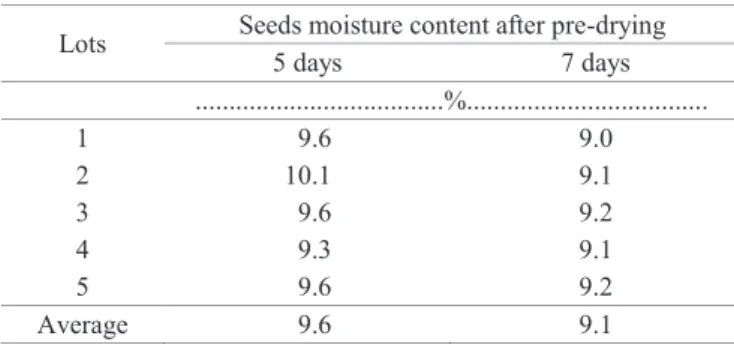
besides the need to have to include the solutions preparation. The seeds moisture content after pre-drying is shown in Table 4, in which there is a reduction in the amounts from 14.1 to 14.6% (Table 1) to 9.0 to 10.1% (Table 4), maintaining the similarity among lots, showing the data consistency.
Table 2. Seed germination percentage of five lots of black
oats cv. IAPAR 61 (Ibiporã), 2010/10 harvest, after application of methods for breaking dormancy at pre-drying (5 and 7 days) and pre-cooling (3 to 5 days).
Lots
Seed viability after treatment for breaking dormancy Pre-drying Precooling 5 days 7 days 3 days 5 days
………...%... 1 96 a 99 a 89 a 91 a 2 95 a 98 a 94 a 90 a 3 97 a 97 a 92 a 93 a 4 97 a 97 a 93 a 95 a 5 98 a 98 a 95 a 91 a C.V. (%) 1.67 2.00 3.02 3.71
Means followed by the same letter in the column do not differ by Tukey’s
test (p ≤ 0.05).
Table 3. Seed germination percentage of five lots of black oats
cv. IAPAR 61 (Ibiporã), 2010/10 harvest, without breaking dormancy, germination + tetrazolium test of ungerminated seeds (GT+UGTz), germination after pre-drying (5 and 7 days) and pre-cooling (3 and 5 days).
Evaluation methods Viability (%) Germination 82 c
GT + UGTz 98 a
Pre-drying (5 days) 96 a Pre-drying (7 days) 98 a Pre-cooling (3 days) 93 b Pre-cooling (5 days) 92 b
C.V. (%) 2.93
Means followed by the same letter in the column do not differ by Tukey’s
test (p ≤ 0.05).
Baldi et al. (2012) have managed to reduce the pre-drying period for breaking dormancy of rice seeds, but it was necessary to combine the method to soaking the seeds in a NaClO solution at 0.5% for 24 hours.
Pre-cooling was also higher than the germination test (Table 3) and less effective than pre-drying. Even so, the tested
methodology provided a reduction of the period from five to
three days for breaking dormancy, since statistical differences were not found between the two, revealing a breakthrough for more rapid assessment of the newly harvested black oats seeds viability.
Franco et al. (2009) have observed that pre-cooling
Table 4. Seeds moisture content of five lots of black oat after pre-drying for five and seven days.
Lots Seeds moisture content after pre-drying 5 days 7 days ...%...
1 9.6 9.0
2 10.1 9.1
3 9.6 9.2
4 9.3 9.1
5 9.6 9.2
Average 9.6 9.1
Based on the above, it appears that treatments pre-drying
(33 °C) for five days and pre-cooling (5-10 °C) for three days
have promoted the breaking of the primary dormancy of freshly harvested black oats seeds, providing results similar to those obtained with the recommendations from the Regras
(pre-cooling for five days or pre-drying for seven days), yet faster to estimate viability, thus benefiting the seeds laboratory
routine analyses.
Conclusions
It can be concluded that it is possible to reduce the recommended period to estimate the viability of freshly harvested black oats seeds by means of the use of seeds
pre-drying for five days or pre-cooling for three days.
Acknowledgments
To CNPq (Conselho Nacional de Desenvolvimento
Científico e Tecnológico) for granting the scholarship.
References
BALDI, M.E.; SEGALIN, S.R.; BARZOTTO, F.; ANDRADE, F.F.; MATTIONI, N.M.; MERTZ, L.M. Métodos alternativos para superação da
dormência em sementes de arroz irrigado. Informativo Abrates, v.22, n.2, p.16-19, 2012. http://www.abrates.org.br/images/Informativo/v22_n2/Artigo_2.pdf
BRASIL. Ministério da Agricultura, Pecuária e Abastecimento. Regras para análise de sementes. Ministério da Agricultura, Pecuária e Abastecimento. Secretaria de Defesa Agropecuária. Brasília: MAPA/ACS, 2009. 395p. http://
www.agricultura.gov.br/arq_editor/file/2946_regras_analise__sementes.pdf
CARVALHO, D.B.; CARVALHO, R.I.N.; BELLO, M. Pré-esfriamento de
sementes de aveia preta, azevém e trevo branco em diferentes proporções em mistura. Revista acadêmica: Ciências Agrárias e Ambientais, v.1, n.4,
p.49-53, 2003. file:///C:/Users/Home/Downloads/academica-913.pdf
CARVALHO, L.F.; SEDIYAMA, C.S.; REIS, M.S.; DIAS, D.C.F.S.; MOREIRA, M.A. Influência da temperatura de embebição da semente
de soja no teste de condutividade elétrica para avaliação da qualidade
fisiológica. Revista Brasileira de Sementes, v.31, n.1, p.9-17, 2009. http:// www.scielo.br/pdf/rbs/v31n1/a01v31n1.pdf
CARVALHO, M.N.; NAKAGAWA, J. Sementes: ciência, tecnologia e produção. 5 ed. Jaboticabal: FUNEP, 2012. 590 p.
CARVALHO, T.C.; KRZYZANOWSKI, F.C.; OHLSON, O.C.; PANOBIANCO, M. Tetrazolium test adjustment for wheat seeds. Journal of Seed Science, v.35, n.3, p.361-367, 2013. http://www.scielo.br/pdf/jss/v35n3/13.pdf
DIAS, M.C.L.L.; ALVES, S.J. Avaliação da viabilidade de sementes de
Brachiaria brizantha (Hochst. ex A. Rich) Stapf pelo teste de tetrazólio. Revista Brasileira de Sementes, v.30, n.3, p.145-151, 2008. http://www.scielo.br/scielo. php?script=sci_arttext&pid=S0101-31222008000300019&nrm=iso&tlng=pt
FRANCO, F.A.; PINTO, R.J.B.; SCAPIM, C.A.; VIGANO, J.;
MARCHIORO, V.S. BRACCINI, A.L. Pré-esfriamento para superação da dormência de sementes de trigo colhidas na época da maturidade. Revista Brasileira de Sementes, v.31, n.2, p.245-252, 2009. http://www.scielo.br/ scielo.php?script=sci_arttext&pid=S0101-31222009000200029
MARCOS – FILHO, J. Fisiologia de sementes de plantas cultivadas. Piracicaba: FEALQ, 2005. 495 p.
MENEZES, N.L.; MATTIONI, N.M. Superação de dormência em sementes
de aveia preta. Revista da FZVA, v.18, n.1, p.108-114, 2011. http:// revistaseletronicas.pucrs.br/ojs/index.php/fzva/article/view/8561
SOUZA, C.R.; OHLSON, O.C.; PANOBIANCO, M. Avaliação da viabilidade de sementes de aveia preta pelo teste de tetrazólio. Revista Brasileira de Sementes, v.31, n.3, p. 57-62, 2009. http://www.scielo.br/scielo. php?script=sci_arttext&pid=S0101-31222009000300006&lang=pt
SOUZA, C.R.; OHLSON, O.C.; PANOBIANCO, M. Avaliação da viabilidade de sementes de aveia branca pelo teste de tetrazólio. Revista Brasileira de Sementes, v.32, n.4, p.174-180, 2010. http://www.scielo.br/ scielo.php?script=sci_arttext&pid=S0101-31222010000400020&lang=pt
TUNES, L.M.; BADINELLI, P.G.; OLIVO, F.; BARROS, A.C.S.A.
Tratamentos para superação da dormência em sementes de cevada. Scientia Agraria, v.10, n.1, p.015-021, 2009. http://ojs.c3sl.ufpr.br/ojs/index.php/ agraria/article/view/12519
VIVIAN, R., SILVA, A.A.; GIMENES Jr., M., FAGAN, E.B., RUIZ, S.T.; LABONIA, V. Dormência em sementes de plantas daninhas