Development of a functional dairy food: exploring bioactive and
preservation effects of chamomile (
Matricaria recutita
L.)
Cristina Caleja1,2, Lillian Barros1, Amilcar L. Antonio1, Ana Ciric3, João C.M. Barreira1,2, Marina Sokovic3, M. Beatriz P.P. Oliveira2, Celestino Santos-Buelga4,
Isabel C.F.R. Ferreira1,*
1
Mountain Research Centre (CIMO), ESA, Polytechnic Institute of Bragança, Portugal.
2
REQUIMTE – Science Chemical Department, Faculty of Pharmacy, University of
Porto, Portugal.
3
University of Belgrade, Department of Plant Physiology, Institute for Biological
Research “Siniša Stanković”, Bulevar Despota Stefana 142, 11000 Belgrade, Serbia.
4
GIP-USAL, Faculty of Pharmacy, University of Salamanca, Campus Miguel de
Unamuno, 37007 Salamanca, Spain.
Abstract
The antioxidant (free radical scavenging activity, reducing power and lipid peroxidation inhibition) and antimicrobial (against bacteria and fungi) potential of Matricaria recutita L. (chamomile) extracts obtained by decoction was demonstrated. The characterization of the extracts highlighted dicaffeoyl-2,7-anhydro-3-deoxy-2-octulopyranosonic acid (diCDOA) and luteolin-O-glucuronide as the main phenolic compounds. Extracts containing these natural ingredients were incorporated into cottage cheese, and the prepared products were compared with samples incorporated with chamomile powder and plain cottage cheese (control). Nutritional composition, colour and antioxidant activity of all samples were evaluated along storage time. Chamomile decoctions (natural bioactive ingredient) did not alter significantly the nutritional and fatty acids profiles of cottage cheese, but improved its antioxidant potential, independent of the storage time. Moreover, it increased the shelf life since only the control samples showed signs of degradation after 14 days of storage. The development of this novel functional dairy product emphasizes the bioactive and preservation potential of chamomile.
Keywords: Functional food; Cottage cheese; Matricaria recutita;
1. Introduction
Novel functional foods with health promoting natural ingredients instead of synthetic additives have been intensively developed and commercialized by food industry (Carocho, Barreiro, Morales & Ferreira, 2014; Caleja et al., 2015). Furthermore, there is an increasing concern among consumers to seek healthier and “natural” foods to avoid a series of food safety risks that have become a global problem (Sarig et al., 2003). Food additives are widely used for various purposes in order to improve the appearance, flavour, colour, texture or shelf life of the food, making this the most desirable form to the consumers’ eyes. However, several studies have shown that consumption in excess can be harmful to health due to some toxicity effects (Randhawa & Bahna, 2009; Carocho et al., 2014).
There is a tendency for consumers to choose minimally processed foods instead of processed ones, or with minimum incorporation of synthetic additives, which are being passed over by natural ones. Natural additives include compounds or extracts from plants used to improve the qualities of food. One of the most studied effects of these additives is the antioxidant activity (Rasooli, 2007). Besides the importance of antioxidants as natural conservation ingredients, these compounds/extracts can also bring bioactive properties to food. Natural extracts rich in phenolic compounds arise as promissory alternatives to plant essential oils that, sometimes, could display toxic effects (Zapata & Smagghe, 2010; Assis, Gondim, Siqueira & Câmara, 2011). Furthermore, due to their antioxidant properties, these molecules have been related with the prevention of ageing and various diseases related with oxidative stress, such as coronary heart disease, cancer or neurodegenerative diseases (Procházková, Bousová & Wilhelmová,2011; Weng & Yen, 2012).
flavonoids, that are the main compounds contributing to its antioxidant properties (Mulinacci, Romani, Pinelli, Vincieri & Prucher, 2000; Nováková, Vildová, Mateus, Gonçalves & Solich, 2010; Lin & Harnly,2012; Raal, Orav, Püssa, Valner, Malmiste &
Arak, 2012; Guimarães et al., 2013; Matić, Juranić, Savikin, Zdunić, Nadvinski & Godevac, 2013; Roby, Sarhan, Selim & Khalel, 2013; Avula et al., 2014; Zielinski Haminiuk, Alberti, Nogueira, Demiate & Granato, 2014; Xie, Wang & Shi, 2014). Moreover, it has been used for its many beneficial health effects as antimicrobial, neuroprotective, anti-allergic, anti-inflammatory, and anticancer agent (Alanís, Calzada, Cervantes, Torres & Ceballos, 2005; Ranpariya, Parmar, Sheth & Chandrashekhar,
2011; Chandrashekhar et al., 2011; Bulgari et al., 2012; Silva, Barbosa, Seito &
Fernandes, 2012; Matić et al., 2013).
Goat cheese is highly appreciated for its nutritional value, good digestibility and low allergenic properties. In addition, goat milk has been associated with certain therapeutic values in human nutrition (Haenlein, 2004; Díaz-Castro et al., 2012).
In the present work, the antioxidant and antimicrobial effects of chamomile (M. recutita) were explored, developing a functional dairy food with improved preservation and bioactive properties. Therefore, natural ingredients based in chamomile phenolic compounds extracts obtained by decoction were prepared, characterized and incorporated in cottage cheese. Besides these aqueous extracts, chamomile powder was also used to functionalize different samples. The effects on nutritional value, shelf life and bioactive properties of the control and the functionalized samples were comprehensively evaluated.
2.Materials and methods
2.1. Standards and reagents
Formic and acetic acids were purchased from Prolabo (VWR International, France). 2,2-Diphenyl-1-picrylhydrazyl (DPPH) was obtained from Alfa Aesar (Ward Hill, MA, USA). Phenolic standards were from Extrasynthèse (Genay, France). The fatty acids methyl ester (FAME) reference standard mixture 37 (standard 47885-U) was purchased from Sigma (St. Louis, MO, USA), as also other individual fatty acid isomers, L-ascorbic acid, organic acid and sugar standards, trolox (6-hydroxy-2,5,7,8-tetramethylchroman-2-carboxylic acid) and positive controls, streptomycin, ampicillin, bionazole and ketokonazole. Mueller-Hinton agar (MH) and malt agar (MA) were obtained from the Institute of Immunology and Virology, Torlak (Belgrade, Serbia). Water was treated in Milli-Q water purification system (TGI Pure Water Systems, Greenville, SC, USA).
2.2. Chamomile-based natural ingredients
2.2.1. Preparation
Commercial samples of Matricaria recutita L. (chamomile) were provided by Américo Duarte Paixão Lda. (Alcanede, Portugal). The dried samples were powdered (~20 mesh) and submitted to decoction in order to obtain phenolic-enriched extracts. The decoction was performed by adding 1 g of plant material to 200 mL of distilled water, heated (heating plate, VELP Scientific, Usmate, Italy) and boiled for 5 min. The mixture was left to stand for 5 min, filtered, and then frozen and lyophilized (FreeZone 4.5, Labconco, Kansas City, MO, USA).
2.2.2. Characterization in phenolic compounds
authors (Barros et al., 2013). Double online detection was carried out in a diode array detector (DAD) using 280 at 370 nm as preferred wavelengths and a mass spectrometer (MS) connected to the HPLC system via the DAD cell outlet. The phenolic compounds were identified by comparing their retention time, UV-vis and mass spectra with those obtained from standard solutions, when available. Otherwise, peaks were tentatively identified comparing the obtained information with available data reported in the literature. The results are expressed in mg/g of lyophilized decoction.
2.2.3. Antioxidant properties
The lyophilized decoctions were re-dissolved in water (5 mg/mL) and successively diluted until determination of EC50 values (sample concentration providing 50% of
antioxidant activity or 0.5 of absorbance in the reducing power assay).
DPPH radical-scavenging activity and reducing power were evaluated using ELX800 microplate Reader (Bio-Tek Instruments, Inc., Winooski, VT, USA) at 515 and 690 nm, respectively. β-Carotene bleaching and lipid peroxidation (thiobarbituric acid reactive substances, TBARS) inhibition were evaluated spectrophotometrically at 470 and 532 nm, respectively. The complete protocols were previously described by the authors (Barros et al., 2013). Trolox was used as positive control in all the assays.
2.2.4. Antimicrobial properties
Antibacterial activity was evaluated against Gram-negative bacteria: Escherichia coli
(ATCC 35210), Pseudomonas aeruginosa (ATCC 27853), Salmonella typhimurium
(ATCC 13311), Enterobacter cloacae (ATCC 35030), and Gram-positive bacteria:
procedure previously described by the authors (Sokovic, Glamočlija, Marin, Brkić & van Griensven, 2010). The minimum inhibitory (MIC) and minimum bactericidal (MBC) concentrations were determined following the same reference. Streptomycin and ampicillin were used as positive controls. Antifungal activity was evaluated against
Aspergillus fumigatus (ATCC 1022), Aspergillus ochraceus (ATCC 12066), Aspergillus versicolor (ATCC 11730), Aspergillus niger (ATCC 6275), Penicillium funiculosum
(ATCC 36839), Penicillium ochrochloron (ATCC 9112), Penicillium verrucosum var.
cyclopium (food isolate), and Trichoderma viride (IAM 5061), following the procedure previously described by the authors (Sokovic & van Griensven, 2006). The minimum inhibitory (MIC) and minimum fungicidal (MFC) concentrations were determined following the same reference. Bionazole and ketokonazole were used as positive controls.
2.3. Development of the functional food
2.3.1. Preparation of cottage cheese by incorporation with chamomile-based natural
ingredients
All the samples of cottage cheese were prepared by “Queijos Casa Matias Lda.” (one of the main producer companies of “Serra da Estrela” cheese; being the latter the most famous Portuguese cheese). Three groups of samples were prepared (cottage cheeses with 250 g): control samples (cottage cheese without the chamomile-based natural ingredient); samples with the chamomile decoction (it was incorporated in cottage cheese at EC25 value previously determined by DPPH assay: 0.165 mg/mL,
Samples corresponding to each group were pooled together and further divided in three subgroups, which were submitted to individual extraction procedures.
2.3.2. Evaluation of nutritional composition, colour and antioxidant activity along
storage time
The samples (three different cottage cheeses for each storage time) were submitted to an evaluation of nutritional composition, colour and antioxidant activity, immediately after the incorporations and after 7 and 14 days of storage at 4 ºC.
The samples were analyzed for proximate composition (moisture, protein, fat, carbohydrates and ash) using the AOAC (2005) procedures. The crude protein content (N × 6.38) of the samples was estimated by Kjeldahl method; the crude fat was determined by extracting a known weight of powdered sample with petroleum ether, using a Soxhlet apparatus; the ash content was determined by incineration at 600±15 ºC. Total carbohydrates were calculated by difference. Total energy was calculated according to the following equation: Energy (kcal) = 4 × (g proteins +g carbohydrates) + 9 × (g lipids).
calibration curves from commercial standards.
The colour of the samples was measured in three different points, for each sample, by using a colourimeter (model CR-400, Konica Minolta Sensing Inc., Tokyo, Japan). Using the illuminant C and diaphragm aperture of 8 mm, the CIE L*a*b* colour space values were registered using a data software “Spectra Magic Nx” (version CM-S100W 2.03.0006) (Fernandes, Antonio, Barreira, Oliveira, Martins & Ferreira, 2012).
For evaluation of antioxidant activity, the samples were submitted to DPPH and reducing power assays, previously mentioned.
2.4. Statistical analysis
All the experiments were performed using three independent samples, being three different extracts obtained from each sample (n=9) and all the assays were carried out in triplicate. In the assessment of differences among antimicrobial assays, results were evaluated using 1-way ANOVA. The homogeneity of variance, was tested by means of the Levene’s tests. All dependent variables were compared using Tukey’s honestly significant difference (HSD) or Tamhane’s T2 multiple comparison tests, when homoscedasticity was verified or not, respectively.
All the statistical analysis were carried out using SPSS v. 22.0 program (IBM Corp., Armonk, NY, USA).
3. Results and discussion
3.1. Chemical characterization, antioxidant and antimicrobial properties of chamomile
phenolic-enriched extracts
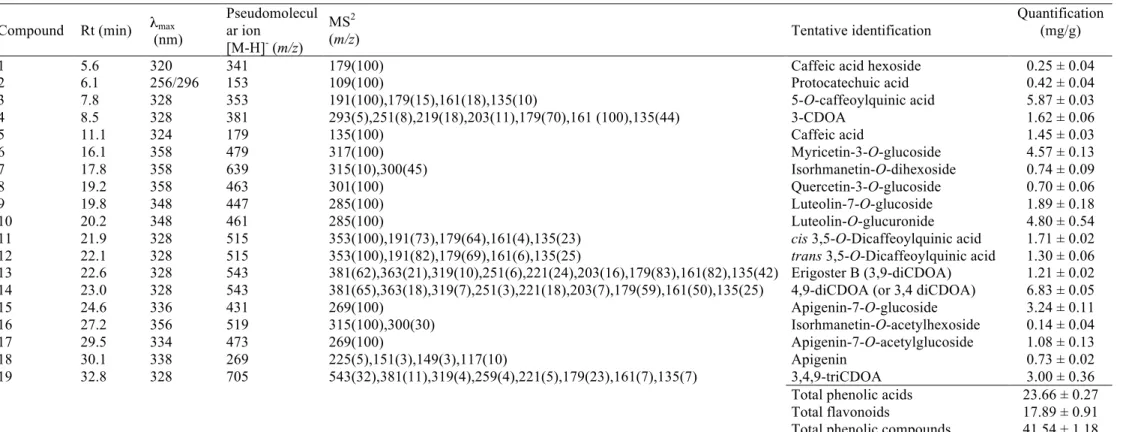
Up to nineteen phenolic compounds, including phenolic acids and flavonoids were detected in the M. recutita decoctions (Table 1).
Protocatechuic acid (compound 2), 5-O-caffeolylquinic acid (compound 3), caffeic acid (compound 5), myricetin-3-O-glucoside (compound 6), quercetin-3-O-glucoside (compound 8), luteolin-7-O-glucoside (compound 9), apigenin-7-O-glucoside (compound 15) and apigenin (compound 18) were positively identified by comparison of their retention time, mass and UV-vis characteristics with commercial standards. Most of these compounds have been previously described in M. recutita samples by different authors (Mulinacci et al., 2000; Nováková et al., 2010; Lin & Harnly, 2012; Raal et al., 2012; Guimarães et al., 2013; Matić et al., 2013; Avula et al., 2014; Zielinski et al., 2014; Xie et al., 2014).
more intense signal at m/z 179 [caffeic acid-H]-. Furthermore, cis hydroxycinnamoyl derivatives elute before the corresponding trans ones, as observed after UV irradiation (366 nm, 24 h) of hydroxycinnamic acids in our laboratory, justifying the elution order of these isomers. These and other dicaffeoylquinic derivatives have been previously reported in flowers of M. recutita (Nováková et al., 2010; Lin & Harnly,2012; Raal et al., 2012; Guimarães et al., 2013).
Compounds 4, 13, 14 and 19 were tentatively assigned as caffeoyl-2,7-anhydro-3-deoxy-2-octulopyranosonic acids (CDOA) derivatives (Figure 1) owing to the previous identification of compounds with similar UV and mass spectra characteristics in other members of the Asteraceae familiy, such as Erigeron breviscapus (vant.) Hand. Mazz. (Zhang, Shi, Qu, & Cheng, 2007; Zhang, Zhao, Ma, Wu, & Zeng, 2010; Liao et al., 2010) and Chamaemelum nobile (L.) (Zhao et al., 2014). To the best of our knowledge, such type of compounds has not been previously reported in M. recutita flowers.
al. (2010).In our case, an identity as 3,4,9-triCDOA was assumed taking into account that for the diCDOA glucoside an elution earlier to the diCDOAs should be expected due to its greater polarity.
The four remaining compounds (7, 10, 16 and 17) corresponded to flavonoids. UV and mass spectra of compound 17 ([M-H]- at m/z 473) allowed its identification as apigenin 7-O-acetylglucoside, a compound consistently reported in M. chamomilla flowers (Kunde & Isaac, 1979; Pietta, Manera, & Ceva, 1987; Svehlikova et al., 2004; Weber, Herrmann, Hartmann, Joppe, Schmidt & Heinz-Jürgen, 2008;Lin & Harnly, 2012; Raal
et al., 2012; Avula et al., 2014; Xie et al., 2014). Peak 10 presented a pseudo molecular ion [M-H]- at m/z 461, releasing a fragment at m/z 285 ([M-176]- (loss of a glucuronyl moiety). These characteristics and also its UV spectrum (λmax at 348 nm) suggest that it
The decoctions of M. recutita presented a higher content in phenolic acids than flavonoids, being a diCDOA (tentatively identified as 4,9-diCDOA or 3,4 diCDOA) the most abundant compound present and luteolin-O-glucuronide the most abundant flavonoid.
Matić et al. (2013) presented results for infusions and decoctions of M. recutita, in terms of area at 356 nm, therefore, it cannot be compared to our study, but nevertheless, two ferulic acid glucosides were the compounds with the highest area. Lin and Harnly
(2012) and Mulinacci et al. (2000) did not present quantification data. The phenolic acid, 5-O-caffeolylquinic acid was the most abundant compound in M. recutita flowers studied by Zielinski et al. (2014) and Nováková et al. (2010). The latest authors also presented apigenin-7-O-glucoside as the most abundant flavonoid. Raal et al. (2012) presented quantification results for infusions of Chamomilla recutita of different commercial samples, packaged in different countries; these results were presented in mg/200 mL. Of the thirteen compounds identified, a ferulic acid glucoside was the major compound found. Avula et al. (2014) studied extracts of Matricaria chamomilla
L. (Syn. M. recutita L.), identifying nine phenolic compounds and being cis GMCA [(Z)-2-β-D-glucopyranosyloxy-4-methoxycinnamic acid] the major molecule found.
Guimarães at al. (2013), also described and quantified the phenolic composition of the herbal flowers, infusion and decoction preparation of wild M. recutita, reporting a luteolin O-acylhexoside as the main phenolic compound found.
were close to those obtained with the standard trolox (Figure 2A). DPPH scavenging activity and reducing power of the decoction was similar to the ones previously described for methanolic extracts (Guimarães at al., 2013), whilethe lipid peroxidation
inhibition, measured by β-carotene bleaching and TBARS inhibition assays, was higher in the present study. Roby et al. (2013) reported a higher DPPH scavenging activity of chamomile methanolic and ethanolic extracts in comparison with diethyl ether and hexane ones.
The antibacterial and antifungal activities of the chamomile extract were tested against a panel of eight bacteria and fungi strains, respectively, selected on the basis of their relevance to public health. The most susceptible bacteria were Staphylococcus aureus,
Bacillus cereus and Salmonella typhimurium, while Penicillium funiculosum, Aspergillus versicolor (Figure 2B and C) and Trichoderma viride were the most vulnerable fungi to the tested extract (Figure 2D and E). It should be highlighted that the chamomile extract showed higher activity (lower MIC values) than the standard ampicillin (Figure 2B) for five of the tested bacteria (S. aureus, B. cereus, Pseudomonas aeruginosa, Escherichia coli and S. typhimurium), and than ketoconazole (Figure 2D) for three of the fungi (Aspergillus ochraceus, T. viride and Penicillium ochrochloron). Roby et al. (2013) had previously reportedB. cereus and A. flavus as the most sensitive microorganisms to chamomile extracts. Nevertheless, according to
3.2. Incorporation of chamomile-based natural ingredients in cottage cheese
Three groups of cottage cheese were prepared: the control (samples without any chamomile-based ingredient), the samples with the characterized chamomile phenolic extract obtained by decoction and also the samples incorporated with chamomile powder (this group was prepared in order to evaluate if the decoction process would be necessary or if it would be enough to incorporate the all plant instead of an extract). All the samples were evaluated for nutritional characteristics, colour and antioxidant activity.
3.2.1 Effects on nutritional parameters
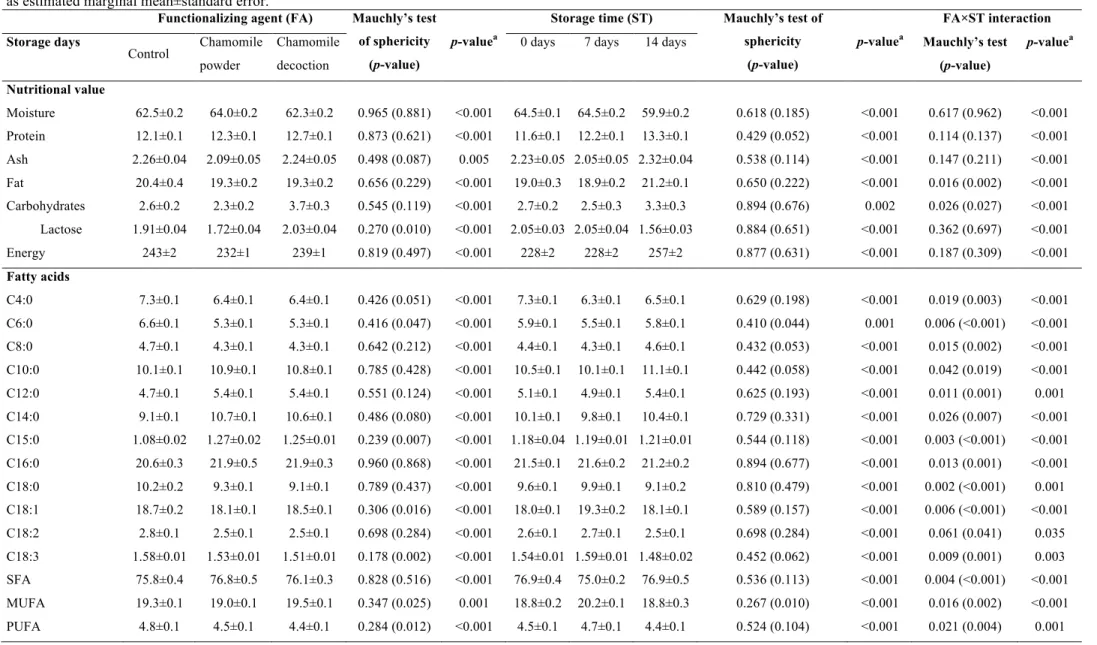
In all the evaluated parameters, it was intended to verify the effects of functionalizing agent, independently of the number of days kept in storage, as well as the specific effect of the storage time, irrespectively of having plain cottage cheese or one the prepared functionalized products. Thereby, results were compared through a 2-way ANOVA, following the generalized linear model coupled to the repeated measures analysis technique. In this analysis, it is important to check for the homogeneity of variances in the measures done for each assayed condition. Since the independence of variables cannot be assumed, the former requirement was evaluated by the Mauchly’s sphericity test.
reached maximal values after 14 days of storage (and consequently the highest energy values), while moisture and lactose had exactly the opposite behavior. The same tendency was described by Farahani, Ezzatpanah and Abbasi (2014) for protein and fat contents during ripening of Siahmazgi cheese (typical Iranian cheese). Nevertheless, other authors have reported a decrease in protein values along shelf life of ripe cheese (Pappa, Kandarakis, Anifantakis, Zerfiridis, Anifantakis and Sotirakoglou, 2006), and “coalho” cheese (Queiroga et al., 2013). The decrease in lactose is in agreement with the results obtained by Diezhandino, Fernández, González, McSweeney and Fresno (2015) during the ripening of Valdeón cheese (Spanish blue cheese).
Regarding the effect of FA, control samples tended to present higher contents in ash, fat and also the highest energy values. On the other hand, samples functionalized with chamomile decoctions presented the maximal values in protein and carbohydrates, while those prepared with chamomile powder gave higher moisture contents.
The significant interaction among factor was also observed for all studied fatty acids (Table 2), which were also significantly changed by each individual factor (p < 0.05). In all samples, the predominant fatty acids, independently of being added with chamomile-based ingredients, were palmitic (C16:0) and oleic (C18:1acids (Table 2), which is also supported by studies with other kinds of cheese such as Portuguese “coalho” cheese (Queiroga et al., 2013) and French goat milk cheeses (AFSSA, 2010). The order of abundance in fatty acids was saturated fatty acids (SFA), followed by monounsaturated fatty acids (MUFA) and polyunsaturated fatty acids (PUFA).
3.2.2. Effects on colour and antioxidant parameters
In the case of colour parameters, the interaction among factors was not significant for
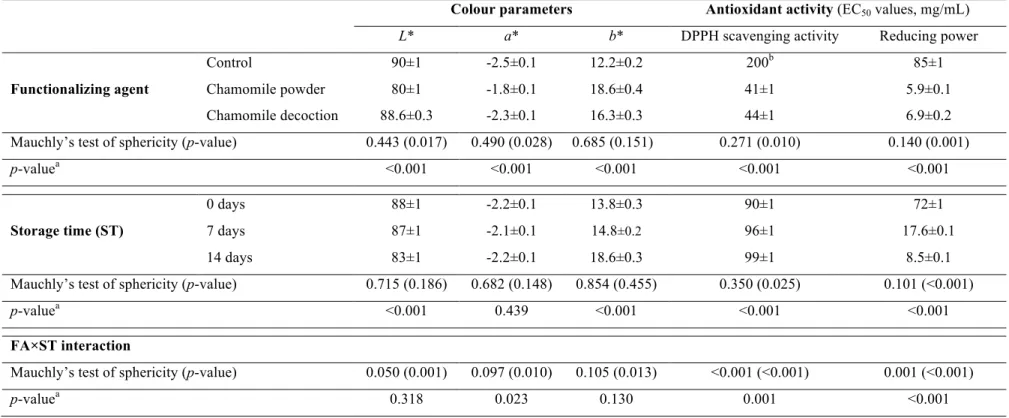
L* and b*, allowing to identify the exact way how each of the parameters is affected by the assayed conditions. Lightness (L*) diminished along ST, being also lower in those samples prepared with chamomile powder. Similar L* values were described in studies with ricotta cheeses (Pizzillo, Claps, Cifuni, Fedele & Rubino, 2005) and “coalho” cheeses (Queiroga et al., 2013). For a* parameter, which is a direct indicator of redness, no statistical significant difference was found along ST, while samples prepared with chamomile powder presented slightly higher values. A study with ricotta cheeses presented also redness values close to zero (a*=1.19-1.32) (Pizzillo et al., 2005). Other authors who studied the changes in colour characteristics during ripening of cheeses demonstrated that the a* value did not show a defined trend (Buffa et al., 2001). Regarding the blueness (b*) parameter, the highest values were obtained in samples functionalized with chamomile powder and those stored duting 14 days. On the other hand, the lowest values, i.e., the samples with less yellowness degree, were detected in plain cottage cheese and in non-stored samples. Ginzinger, Jaros, Lavanchy and Rohm (1999) confirmed that yellowness index increased with cheese aging. Previous research related with cheese colour as a function of ripening time reported a decrease in L* value and an increase in b* value (Rohm and Jaros,1996; Buffa, Trujillo, Pavia & Guamis, 2001).
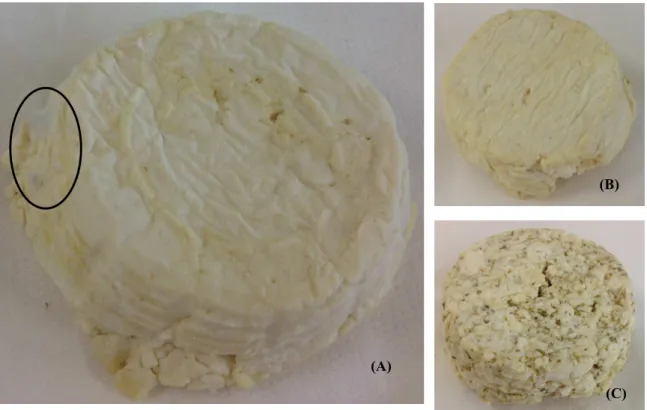
The appearance of the different cottage cheese samples after 14 days of storage is shown in Figure 3, where it can be observed that only the control sample showed signs of degradation.
(DPPH scavenging activity and reducing power) of plain cottage cheese samples (Table 3), without great differences among chamomile powder and decoction. Along the shelf life, DPPH scavenging activity showed a slight decrease, while reducing power showed a high increase, which might be related with the decrease in lactose (Table 2) and the consequent release of their reducing monomers. Another study conducted in our laboratory (Caleja et al., 2015) showed that the incorporation of a fennel (Foenniculum vulgare Mill.) phenolic-enriched extract, obtained by decoction, improved the antioxidant properties of cottage cheese, but the EC50 values reported demonstrate that
the improvement antioxidant capacity of fennel was lower than the one showed by chamomile in the present work.
4. Conclusions
The characterization of M. recutita (chamomile) extracts obtained by decoction revealed the presence of phenolic compounds, which can be related with their antioxidant and antimicrobial activities. The incorporation of those extracts (chamomile based ingredients) to goat cottage cheese improved its antioxidant properties without significantly modifying the nutritional characteristics or fatty acids profiles. Moreover, only the control samples not added with the chamomile extracts presented signs of degradation after 14 days of storage. In view of the growing interest of consumers for functional foods without chemical additives and taking into account that the studied dairy product is highly appreciated, it would be interesting to go further in the development of this novel formulation in order to preserve the antioxidant activity along the shelf life of cottage cheese by using stabilization/microencapsulation techniques.
Acknowledgements
and to Foundation for Science and Technology (FCT, Portugal) for C. Caleja PhD grant (SFRH/BD/93007/2013), J.C.M. Barreira post-doctoral grant (SFRH/BPD/72802/2010) and L. Barros research contract. The authors also thank Serbian Ministry of Education, Science and Technological Development for financial support (grant number 173032). The authors also thank to Ms Clarinda Paixão, from Américo Duarte Paixão Lda, for providing the plant samples.
References
AFSSA saisine no 2006-SA-0359 (1er mars 2010). Avis de l’Agence franc¸ aise de sécurité sanitaire des aliments relatif à l’actualisation des apports nutritionnels conseillés pour les acides gras, 1-10.
Alanís, A., Calzada, F., Cervantes, J.A., Torres, J., & Ceballos, G.M. (2005). Antibacterial properties of some plants used in Mexican traditional medicine for the treatment of gastrointestinal disorders. Journal of Ethnopharmacology, 100, 153-157.
AOAC. (2005). Official methods of analysis of AOAC international. In W. Horwitz, & G. Latimer (Eds.) (18th ed.). Gaithersburg, MD: AOAC International.
Assis, C., Gondim, M., Siqueira, H., & Câmara, C. (2011). Toxicity of essential oils from plants towards Tyrophagus putrescentiae (Schrank) and Suidasia pontifica
Oudemans (Acari: Astigmata). Journal of Stored Products Research,47, 311-315. Atoui, A.K., Mansouri, A., Boskou, G., & Kefalas, P. (2005). Tea and herbal infusions:
Their antioxidant activity and phenolic profile. Food Chemistry, 89, 27-36. Avula, B., Wang, Y.-H., Wang, M., Avonto, C., Zhao, J., Smillie, T. J., Rua, D., &
differentiate chemo-types of Chamomile/Chrysanthemum flower heads. Journal of Pharmaceutical and Biomedical Analysis, 88, 278-288.
Barros, L., Pereira, E., Calhelha, R.C., Dueñas, M., Carvalho, A.M., Santos-Buelga, C., & Ferreira, I.C.F.R. (2013). Bioactivity and chemical characterization in hydrophilic and lipophilic compounds of Chenopodium ambrosioides L. Journal of Functional Foods, 5, 1732-1740.
Buffa, M., Trujillo, A. J., Pavia, M., & Guamis, B. (2001). Changes in textural, microstructural, and colour characteristics during ripening of cheeses made from raw, pasteurized or high-pressure-treatedgoats’ milk. International Dairy Journal, 11, 927-934.
Bulgari, M., Sangiovanni, E., Colombo, E., Maschi, O., Caruso, D., Bosisio, E., & Dell’Agli, M. (2012). Inhibition of neutrophil elastase and metalloprotease-9 of human adenocarcinoma gastric cells by chamomile (Matricaria recutita L.) infusion. Phytotherapy Research, 26, 1817-1822.
Caleja, C., Barros, L., Antonio, A.L., Ciric, A., Sokovic, M., Oliveira, M.B.P.P, Santos-Buelga, C., & Ferreira, I.C.F.R. (2015). Foeniculum vulgare Mill. as natural conservation enhancer and health promoter by incorporation in cottage cheese.
Journal of Functional Foods, 12, 428-438.
Carocho, M., Barreiro, M., Morales, P., & Ferreira, I.C.F.R. (2014). Adding Molecules to Food, Pros and Cons: A Review on Synthetic and Natural Food Additives.
Comprehensive Reviews in Food Science and Food Safety, 13, 377-399.
Cvetanović, A., Svarc-Gajić, J., Masković, P., Savić, S., & Nikolić, L. (2014). Antioxidant and biological activity of chamomile extracts obtained by different techniques: perspective of using superheated water for isolation of biologically active compounds. Industrial Crops and Products, doi:10.1016/j.indcrop.2014.09.044.
Díaz-Castro, J., Pérez-Sánchez, L.J., López-Frías, M.R., López-Aliaga, I., Nestares, T., Alférez, M.J., Ojeda, M.L., & Campos, M.S. (2012). Influence of cow or goat milk consumption on antioxidant defence and lipid peroxidation during chronic iron repletion. British Journal of Nutrition, 108, 1-8.
Diezhandino, I., Fernández, D., González, L., McSweeney,P.L.H., & Fresno, J.M. (2015). Microbiological, physico-chemical and proteolytic changes in a Spanish blue cheese during ripening (Valdeón cheese). Food Chemistry, 168, 134-141. Farahani, G., Ezzatpanah, H., & Abbasi, S. (2014). Characterization of Siahmazgi
cheese, an Iranian ewe’s milk variety: Assessment of physico-chemical, textural and rheological specifications during ripening. LWT - Food Science and Technology, 58, 335-342.
Fernandes, Â., Antonio, A.L., Barreira, J.C.M., Oliveira, M.B.P.P., Martins, A., & Ferreira, I.C.F.R. (2012). Effects of gamma irradiation on physical parameters of
Lactarius deliciosus wild edible mushrooms. Postharvest Biology and Technology, 74, 79-84.
Gawde, A., Cantrell, C.L., Zheljazkov, V.D., Astatkie, T., & Schlegeld, V. (2014). Steam distillation extraction kinetics regression models to predictessential oil yield, composition, and bioactivity of chamomile oil. Industrial Crops and Products, 58, 61-67.
Ginzinger, W., Jaros, D., Lavanchy, P., & Rohm, H. (1999). Raw milk flora affects composition and quality of Bergkäse-3. Physical and sensory properties, and conclusions. Le Lait- Dairy Science and Technology, 79, 411-421.
Guimarães, R., Barros, L., Dueñas, M., Calhelha, R.C., Carvalho, A.M, Santos-Buelga, C., Queiroz, M.J.R.P., & Ferreira, I.C.F.R. (2013). Infusion and decoction of wild German chamomile: Bioactivity and characterization of organic acids and phenolic compounds. Food Chemistry, 136, 947-954.
Haenlein, G.F.W. (2004). Goat milk in human nutrition. Small Ruminant Research, 51,
155-163.
Haghi, G., Hatami, A., Safaei, A., & Mehran, M. (2014). Analysis of phenolic compounds in Matricaria chamomilla and its extracts by UPLC-UV. Research in Pharmaceutical Sciences, 9, 31-37.
Kunde, R., & Isaac, O. (1979). Über die Flavone der Kamille (Matricaria chamomilla
L.) und ein neues acetyliertes Apigenin-7-glucosid. Planta Medica, 37, 124-130. Liao, S.-G., Zhang, L.-J., Li, C.-B., Lan, Y.-Y., Wang, A.-M., Huang, Y., Zhen, L., Fu,
Lin, L.-Z., & Harnly, J.M. (2012). LC-PDA-ESI/MS Identification of the Phenolic Components of Three Compositae Spices: Chamomile, Tarragon, and Mexican Arnica. Natural Products Communication, 7, 749-752.
Matić, I.Z., Juranić, Z., Savikin, K., Zdunić, G., Nadvinski, N., & Godevac, D. (2013). Chamomile and marigold tea: chemical characterization and evaluation of anticancer activity. Phytotherapy Research, 27, 852-858.
Mulinacci, N., Romani, A., Pinelli, P., Vincieri, F.F., & Prucher, D. (2000). Characterization of Matricaria recutita L. flower extracts by HPLC-MS and HPLC-DAD analysis. Chromatographia, 51, 301-307.
Nováková, L., Vildová, A., Mateus, J.P., Gonçalves, T., & Solich, P. (2010). Development and application of UHPLC-MS/MS method for the determination of phenolic compounds in chamomile flowers and chamomile tea extracts. Talanta,
82, 1271-1280.
Pappa, E., Kandarakis, I., Anifantakis, E., Zerfiridis, G., Anifantakis, A., & Sotirakoglou, K. (2006). Influence of starter cultures on the proteolysis of Teleme cheese made from different types of milk. Le Lait- Dairy Science and Technology,
86, 273-290.
Petronilho, S., Maraschin, M., Coimbra, M.A., & Rochaa, S.M. (2012). In vitro and in vivo studies of natural products: A challenge for their valuation. The case study of chamomile (Matricaria recutita L.). Industrial Crops and Products, 40, 1-12. Pietta, P., Manera, E., & Ceva P. (1987). Simultaneous isocratic high-performance
liquid chromatographic determination of flavones and coumarins in Matricaria chamomilla extracts. Journal of Chromatography, 404, 279-281.
Production Science, 94, 33-40.
Procházková, D., Bousová, I., & Wilhelmová, N. (2011). Antioxidant and prooxidant properties of flavonoids. Fitoterapia, 82, 513-523.
Queiroga, R., Santos, B., Gomes, A., Monteiro, M., Teixeira, S., Souza, E., Pereira, C., & Pintado, M. (2013). Nutritional, textural and sensory properties of Coalho cheese made of goats’, cows’ milk and their mixture. LWT - Food Science and Technology, 50, 538-544.
Raal, A., Orav, A., Püssa, T., Valner, C., Malmiste, B., & Arak, E. (2012). Content of essential oil, terpenoids and polyphenols in commercial chamomile (Chamomilla recutita L. Rauschert) teas from different countries. Food Chemistry, 131, 632-638.
Randhawa, S., & Bahna, S. (2009). Hypersensitivity reactions to food additives.
Current Opinion in Allergy and Clinical Immunology, 9, 278-283.
Ranpariya, V.L., Parmar, S.K., Sheth, N.R., & Chandrashekhar, V.M. (2011). Neuroprotective activity of Matricaria recutita against fluoride-induced stress in rats. Pharmaceutical Biology, 49, 696-701.
Rasooli, I. (2007). Food preservation – A biopreservative approach. Food, 1, 111-136. Roby, M., Sarhan, M., Selim, K., & Khalel, K. (2013). Antioxidant and antimicrobial
activities of essential oil and extracts of fennel (Foeniculum vulgare L.) and chamomile (Matricaria chamomilla L.). Industrial Crops and Products, 44, 437-445.
Rohm, H., & Jaros, D. (1996). Colour of hardcheese-1. Description of colour properties and effects of maduration. Zeitschrift fur Lebensmittel Untersuchung Forschung, 203, 241-244.
Nääs, I., Centrangolo, H. (2003). Traceability of food products. International Commission of Agricultural Engineering, 5, 1-17.
Silva, N. C., Barbosa, L., Seito, L. N., & Fernandes, A. (2012). Antimicrobial activity and phytochemical analysis of crude extracts and essential oils from medicinal plants. Natural Product Research, 26, 1510-1514.
Soković, M., & van Griensven, L.J.L.D. (2006). Antimicrobial activity of essential oils and their components against the three major pathogens of the cultivated button mushroom, Agaricus bisporus. European Journal of Plant Pathology, 116, 211-224.
Soković, M., Glamočlija, J., Marin, M.D., Brkić, D., & van Griensven, L.J.L.D. (2010). Antibacterial Effects of the Essential Oils of Commonly Consumed Medicinal Herbs Using an In Vitro Model. Molecules, 15, 7532-7546.
Svehlíková, V., Bennett, R.N., Mellon, F.A., Needs, P.W. Piacente, S., Kroon, P.A., & Bao, Y. (2004). Isolation, identification and stability of acylated derivatives of apigenin 7-O-glucoside from chamomile (Chamomilla recutita [L.] Rauschert).
Phytochemistry, 65, 2323-2332.
Weber, B., Herrmann, M., Hartmann, B., Joppe, H., Schmidt C.O., & Heinz-Jürgen, B. (2008). HPLC/MS and HPLC/NMR as hyphenated techniques for accelerated characterization of the main constituents in Chamomile (Chamomilla recutita
[L.] Rauschert). European Food Research and Technology, 226, 755-760.
Weng, C., & Yen G. (2012). Chemopreventive effects of dietary phytochemicals against cancer invasion and metastasis: Phenolic acids, monophenol, polyphenol, and their derivatives. Cancer Treatment Reviews, 38, 76-87.
Zapata, N., & Smagghe, G. (2010). Repellency and toxicity of essential oils from the leaves and bark of Laurelia sempervirens and Drimys winteri against Tribolium castaneum. Industrial Crops and Products, 32, 405-410.
Zhang, Y., Shi, P., Qu, H., & Cheng, Y. (2007). Characterization of phenolic compounds in Erigeron breviscapus by liquid chromatography coupled to electrospray ionization mass spectrometry. Rapid Communications in Mass Spectrometry,21, 2971-2984.
Zhang, Y., Zhao, Q., Ma, J., Wu, B., & Zeng, X. (2010). Chemical characterization of phenolic compounds in Erigeron injection by rapid-resolution LC coupled with multi-stage and quadrupole-TOF-MS. Journal of Chromatography, 72, 651-658. Zhao, J., Khan, S.I., Wang, M., Vasquez, Y., Yang, M.H., Avula, B., Wang, Y-H, Avonto, C., Smillie, T.J., & Khan, I.A. (2014). Octulosonic Acid Derivatives from Roman Chamomile (Chamaemelum nobile) with Activities against Inflammation and Metabolic Disorder. Journal of Natural Products, 77, 509-515.
Table 1. Retention time (Rt), wavelengths of maximum absorption in the visible region (λmax), mass spectral data, identification and quantification of phenolic compounds in
chamomile decoction. The results are presented as mean±standard deviation (n = 9).
Compound Rt (min) λmax
(nm)
Pseudomolecul ar ion
[M-H]- (m/z)
MS2
(m/z) Tentative identification
Quantification (mg/g)
1 5.6 320 341 179(100) Caffeic acid hexoside 0.25 ± 0.04
2 6.1 256/296 153 109(100) Protocatechuic acid 0.42 ± 0.04
3 7.8 328 353 191(100),179(15),161(18),135(10) 5-O-caffeoylquinic acid 5.87 ± 0.03
4 8.5 328 381 293(5),251(8),219(18),203(11),179(70),161 (100),135(44) 3-CDOA 1.62 ± 0.06
5 11.1 324 179 135(100) Caffeic acid 1.45 ± 0.03
6 16.1 358 479 317(100) Myricetin-3-O-glucoside 4.57 ± 0.13
7 17.8 358 639 315(10),300(45) Isorhmanetin-O-dihexoside 0.74 ± 0.09
8 19.2 358 463 301(100) Quercetin-3-O-glucoside 0.70 ± 0.06
9 19.8 348 447 285(100) Luteolin-7-O-glucoside 1.89 ± 0.18
10 20.2 348 461 285(100) Luteolin-O-glucuronide 4.80 ± 0.54
11 21.9 328 515 353(100),191(73),179(64),161(4),135(23) cis 3,5-O-Dicaffeoylquinic acid 1.71 ± 0.02
12 22.1 328 515 353(100),191(82),179(69),161(6),135(25) trans 3,5-O-Dicaffeoylquinic acid 1.30 ± 0.06
13 22.6 328 543 381(62),363(21),319(10),251(6),221(24),203(16),179(83),161(82),135(42) Erigoster B (3,9-diCDOA) 1.21 ± 0.02
14 23.0 328 543 381(65),363(18),319(7),251(3),221(18),203(7),179(59),161(50),135(25) 4,9-diCDOA (or 3,4 diCDOA) 6.83 ± 0.05
15 24.6 336 431 269(100) Apigenin-7-O-glucoside 3.24 ± 0.11
16 27.2 356 519 315(100),300(30) Isorhmanetin-O-acetylhexoside 0.14 ± 0.04
17 29.5 334 473 269(100) Apigenin-7-O-acetylglucoside 1.08 ± 0.13
18 30.1 338 269 225(5),151(3),149(3),117(10) Apigenin 0.73 ± 0.02
19 32.8 328 705 543(32),381(11),319(4),259(4),221(5),179(23),161(7),135(7) 3,4,9-triCDOA 3.00 ± 0.36
Total phenolic acids 23.66 ± 0.27
Total flavonoids 17.89 ± 0.91
Table 2. Nutritional value (g/100 g), energy (kcal/100 g) and fatty acids composition (relative percentage) of the cottage cheese samples along shelf life. Results are presented
as estimated marginal mean±standard error.
Functionalizing agent (FA) Mauchly’s test
of sphericity
(p-value)
p-valuea
Storage time (ST) Mauchly’s test of
sphericity
(p-value)
p-valuea
FA×ST interaction
Storage days
Control Chamomile
powder
Chamomile
decoction
0 days 7 days 14 days Mauchly’s test
(p-value)
p-valuea
Nutritional value
Moisture 62.5±0.2 64.0±0.2 62.3±0.2 0.965 (0.881) <0.001 64.5±0.1 64.5±0.2 59.9±0.2 0.618 (0.185) <0.001 0.617 (0.962) <0.001
Protein 12.1±0.1 12.3±0.1 12.7±0.1 0.873 (0.621) <0.001 11.6±0.1 12.2±0.1 13.3±0.1 0.429 (0.052) <0.001 0.114 (0.137) <0.001
Ash 2.26±0.04 2.09±0.05 2.24±0.05 0.498 (0.087) 0.005 2.23±0.05 2.05±0.05 2.32±0.04 0.538 (0.114) <0.001 0.147 (0.211) <0.001
Fat 20.4±0.4 19.3±0.2 19.3±0.2 0.656 (0.229) <0.001 19.0±0.3 18.9±0.2 21.2±0.1 0.650 (0.222) <0.001 0.016 (0.002) <0.001
Carbohydrates 2.6±0.2 2.3±0.2 3.7±0.3 0.545 (0.119) <0.001 2.7±0.2 2.5±0.3 3.3±0.3 0.894 (0.676) 0.002 0.026 (0.027) <0.001
Lactose 1.91±0.04 1.72±0.04 2.03±0.04 0.270 (0.010) <0.001 2.05±0.03 2.05±0.04 1.56±0.03 0.884 (0.651) <0.001 0.362 (0.697) <0.001
Energy 243±2 232±1 239±1 0.819 (0.497) <0.001 228±2 228±2 257±2 0.877 (0.631) <0.001 0.187 (0.309) <0.001
Fatty acids
C4:0 7.3±0.1 6.4±0.1 6.4±0.1 0.426 (0.051) <0.001 7.3±0.1 6.3±0.1 6.5±0.1 0.629 (0.198) <0.001 0.019 (0.003) <0.001
C6:0 6.6±0.1 5.3±0.1 5.3±0.1 0.416 (0.047) <0.001 5.9±0.1 5.5±0.1 5.8±0.1 0.410 (0.044) 0.001 0.006 (<0.001) <0.001
C8:0 4.7±0.1 4.3±0.1 4.3±0.1 0.642 (0.212) <0.001 4.4±0.1 4.3±0.1 4.6±0.1 0.432 (0.053) <0.001 0.015 (0.002) <0.001
C10:0 10.1±0.1 10.9±0.1 10.8±0.1 0.785 (0.428) <0.001 10.5±0.1 10.1±0.1 11.1±0.1 0.442 (0.058) <0.001 0.042 (0.019) <0.001
C12:0 4.7±0.1 5.4±0.1 5.4±0.1 0.551 (0.124) <0.001 5.1±0.1 4.9±0.1 5.4±0.1 0.625 (0.193) <0.001 0.011 (0.001) 0.001
C14:0 9.1±0.1 10.7±0.1 10.6±0.1 0.486 (0.080) <0.001 10.1±0.1 9.8±0.1 10.4±0.1 0.729 (0.331) <0.001 0.026 (0.007) <0.001
C15:0 1.08±0.02 1.27±0.02 1.25±0.01 0.239 (0.007) <0.001 1.18±0.04 1.19±0.01 1.21±0.01 0.544 (0.118) <0.001 0.003 (<0.001) <0.001
C16:0 20.6±0.3 21.9±0.5 21.9±0.3 0.960 (0.868) <0.001 21.5±0.1 21.6±0.2 21.2±0.2 0.894 (0.677) <0.001 0.013 (0.001) <0.001
C18:0 10.2±0.2 9.3±0.1 9.1±0.1 0.789 (0.437) <0.001 9.6±0.1 9.9±0.1 9.1±0.2 0.810 (0.479) <0.001 0.002 (<0.001) 0.001
C18:1 18.7±0.2 18.1±0.1 18.5±0.1 0.306 (0.016) <0.001 18.0±0.1 19.3±0.2 18.1±0.1 0.589 (0.157) <0.001 0.006 (<0.001) <0.001
C18:2 2.8±0.1 2.5±0.1 2.5±0.1 0.698 (0.284) <0.001 2.6±0.1 2.7±0.1 2.5±0.1 0.698 (0.284) <0.001 0.061 (0.041) 0.035
C18:3 1.58±0.01 1.53±0.01 1.51±0.01 0.178 (0.002) <0.001 1.54±0.01 1.59±0.01 1.48±0.02 0.452 (0.062) <0.001 0.009 (0.001) 0.003
SFA 75.8±0.4 76.8±0.5 76.1±0.3 0.828 (0.516) <0.001 76.9±0.4 75.0±0.2 76.9±0.5 0.536 (0.113) <0.001 0.004 (<0.001) <0.001
a
Significance value for the tests of between subjects effects. When sphericity assumption was not met (p<0.05), the p-value was obtained from the Greenhouse-Geisser
correction.
Butiric acid (C4:0); Caproic acid (C6:0); Caprylic acid (C8:0); Capric acid (C10:0); Lauric acid (C12:0); Myristic acid (C14:0); Pentadecanoic acid (C15:0); Palmitic acid
(C16:0); Stearic acid (C18:0); Oleic acid (C18:1); Linoleic acid (C18:2); α-Linolenic acid (C18:3); SFA- Saturated fatty acids; MUFA- Monounsaturated fatty acids; PUFA-
Polyunsaturated fatty acids. The difference to 100% corresponds to other 17 less abundant fatty acids (data not shown). The results of control cottage cheese samples were
Table 3. Colour parameters, free radicals scavenging activity and reducing power of the cottage cheese samples along shelf life. Results are presented as estimated marginal mean±standard error.
Colour parameters Antioxidant activity (EC50 values, mg/mL)
L* a* b* DPPH scavenging activity Reducing power
Functionalizing agent
Control 90±1 -2.5±0.1 12.2±0.2 200b 85±1
Chamomile powder 80±1 -1.8±0.1 18.6±0.4 41±1 5.9±0.1
Chamomile decoction 88.6±0.3 -2.3±0.1 16.3±0.3 44±1 6.9±0.2
Mauchly’s test of sphericity (p-value) 0.443 (0.017) 0.490 (0.028) 0.685 (0.151) 0.271 (0.010) 0.140 (0.001)
p-valuea <0.001 <0.001 <0.001 <0.001 <0.001
Storage time (ST)
0 days 88±1 -2.2±0.1 13.8±0.3 90±1 72±1
7 days 87±1 -2.1±0.1 14.8±0.2 96±1 17.6±0.1
14 days 83±1 -2.2±0.1 18.6±0.3 99±1 8.5±0.1
Mauchly’s test of sphericity (p-value) 0.715 (0.186) 0.682 (0.148) 0.854 (0.455) 0.350 (0.025) 0.101 (<0.001)
p-valuea <0.001 0.439 <0.001 <0.001 <0.001
FA×ST interaction
Mauchly’s test of sphericity (p-value) 0.050 (0.001) 0.097 (0.010) 0.105 (0.013) <0.001 (<0.001) 0.001 (<0.001)
p-valuea 0.318 0.023 0.130 0.001 <0.001
aSignificance value for the tests of between subjects effects. When sphericity assumption was not met (p<0.05), the p-value was obtained from the Greenhouse-Geisser
correction. bThe presented value corresponds to the maximum assayed concentration, since it was not possible to reach 50% of activity up to that concentration. The results of
Figure 1. Structure of 2,7-anhydro-3-deoxy-2-octulopyranosonic acids; R
0 50 100 150 200 250 300 350 DPPH scavenging activity
Reducing power β-carotene bleaching
inhibition TBARS inhibition EC 50 v a lues ( µ g /m L ) A b b a a c b a c b b
b c b b c b
a a ab
b a a b a 0 0.1 0.2 0.3 0.4 0.5 0.6 0.7 0.8 0.9 M IC v a lu es ( m g /m L ) B c b a a c b a c b b
b c b c c
b
a a a b
a a b a b a b a
cbc c b c c c a c c
a bc a a a b 0 0.5 1 1.5 2 2.5 M IC v a lu es ( m g /m L ) D a a ab a ab a b a
c c c c b b c c
b b a b a a a bc 0 0.5 1 1.5 2 2.5 3 3.5 4 M F C v a lues ( m g /m L ) E
Figure 2. (A) Antioxidant activity of chamomile phenolic compounds extract obtained by
decoction ( ) and of the standard trolox (
¾
). The antioxidant activity was expressed as EC50values (µg/mL) (Mean ± SD, n = 9), what means that higher values correspond to lower
reducing power or antioxidant potential. EC50: Extract concentration corresponding to 50% of
antioxidant activity or 0.5 of absorbance in reducing power assay. (B) Minimum inhibitory
(MIC) and (C) bactericidal (MBC) concentrations for antibacterial activity of chamomile
phenolic compounds extract obtained by decoction (
¾
), and of the standards streptomycin (¾
)activity of chamomile phenolic compounds extract obtained by decoction (
¾
) and of thestandards bifonazole (
¾
) and ketoconazole ( ). The antimicrobial activity results wereFigure 3. Cottage cheese after 14 days of storage: control sample with signs of degradation
(A); sample with chamomile decoction (B) and sample with chamomile powder (C).
(A)
(B)