280 Revista Brasileira de Pesquisa em Turismo. São Paulo, 6(3), pp. 280-289, set./dez. 2012
User-generated content and travel planning:
An application of the theory of planned behavior
Conteúdo gerado pelo usuário e planejamento de viagens:
Uma aplicação da teoria do comportamento planejado
Contenido generado por el usuario y planificación de viajes:
Una aplicación de la teoría del comportamiento planificado
Luiz Augusto Machado Mendes Filho1 Felix B. Tan2 Annette Mills3
Abstract: User-Generated Content (UGC) such as online travel reviews written by travelers and posted to
virtual communities are being used more frequently to communicate travel-related information. UGC is therefore helping travelers to make decisions about their travel. Utilizing the Theory of Planned Behavior (TPB), which is one of the most comprehensive models explaining behavioral intention, this study contributes to the further development of theories of online consumer behavior by determining which factors are most important in relation to the use of UGC in the travel industry. The TPB has three independent determinants of behavioral intention: attitude toward the behavior, subjective norm, and perceived behavior control. Therefore the aim of this paper is to examine the roles of attitude, subjective norm and perceived behavior control in respect of travelers’ intention to use UGC when making travel plans.
Keywords: User-Generated Content; Theory of Planned Behavior; Travel industry.
Resumo: O Conteúdo Gerado pelo Usuário (UGC) tais como comentários online de viagens escrito por
viajantes, e publicado em comunidades virtuais, está sendo usado cada vez mais para comunicar informações relacionadas à viagens. O UGC está desta forma, ajudando os viajantes a tomarem decisões à respeito de suas viagens. Utilizando a Teoria do Comportamento Planejado (TPB), que é uma das teorias mais abrangentes em explicar a intenção comportamental, este estudo contribui para o desenvolvimento de teorias de comportamento do consumidor online, determinando quais são os fatores mais importantes em relação ao uso do UGC na indústria de viagens. A TPB tem três determinantes independentes de
1
Doutor em Administração (Auckland University of Technology, Nova Zelândia). Professor Colaborador do Departamento de Turismo (DETUR) da Universidade Federal do Rio Grande do Norte (UFRN). E-mail: [email protected]
2
Doutor em Administração (University of Auckland, Nova Zelândia). Professor Titular de Sistemas de Informação na Auckland University of Technology (Nova Zelândia). E-mail: [email protected]
3 Doutor em Administração (University of Waikato, Nova Zelândia). Professora Associada de Sistemas de Informação
da University of Canterbury (Nova Zelândia). E-mail: [email protected]
281 Revista Brasileira de Pesquisa em Turismo. São Paulo, 6(3), pp. 280-289, set./dez. 2012
Mendes Filho, L. A. M., Tan, F. B. , & Mills, A. User-generated content and travel planning: An application of the theory of planned behavior
intenção comportamental: atitude em relação ao comportamento, norma subjetiva e controle do comportamento percebido. Sendo assim, o objetivo desse artigo é examinar os papéis de atitude em relação ao comportamento, norma subjetiva e controle do comportamento percebido quanto à intenção de viajantes em usar o UGC ao fazer planos de viagens.
Palavras-chave: Conteúdo Gerado pelo Usuário; Teoria do Comportamento Planejado; Indústria de viagens.
Resumen: Contenidos generados por el usuario (UGC), tales como comentarios de experiencias de viajes que
los individuos producen y comparten en comunidades virtuales, están siendo utilizados cada vez con mayor frecuencia para comunicar información relacionada a viajes. Esto ha convertido UGC en una herramienta que está ayudando a los individuos a tomar decisiones cuando planean viajes. Mediante la utilización de la Teoría del Comportamiento Planificado (TPB), una de las teorías más completas que explican la intención de comportamiento, este estudio contribuye al desarrollo de teorías sobre comportamiento del consumidor en línea al determinar qué factores son los más importantes en lo que respecta al uso de UGC en la industria de viajes. TPB considera tres determinantes independientes de intención de comportamiento: actitud hacia el comportamiento, norma subjetiva y percepción de control sobre comportamiento. Por lo tanto, el objetivo de este trabajo es examinar la influencia de actitud hacia el comportamiento, norma subjetiva y percepción de control sobre comportamiento tienen sobre la intención de utilizar UGC cuando el individuo hace planes de viaje.
Palabras clave: Contenidos Generados por el Usuario; Teoría del Comportamiento Planificado; Industria de
viajes.
INTRODUCTION
Today, consumers are using electronic word-of-mouth websites more and more to share opinions and experiences about products and services (Rezabakhsh, Bornemann, Hansen, & Schrader, 2006). For example, consumers are generating a great deal of content on the Internet for entertainment and providing reviews on products and services such as books, restaurants, and hotels (George & Scerri, 2007).
User-generated content (UGC) constitutes the data, information, or media produced by the general public (rather than by professionals) on the Internet (Arriga & Levina, 2008). In all UGC activities, the user is the central point being not only the consumer, but also such content contributor simultaneously playing the roles of producer as well as consumer of the content on the Internet (Arriga & Levina, 2008). For example, Gretzel and Yoo (2008) assert that UGC such as online travel reviews written by tourists and posted to virtual communities are being used more frequently to communicate and share travel-related information. UGC is therefore changing the dynamics of the travel industry profoundly through its global word-of-mouth forces (Laboy & Torchio, 2007).
Even though the concept of travelers’ use of UGC is relatively new, such content is rapidly becoming more popular and more influential as travelers share their experiences and travel recommendations online (O'Connor, 2008). Examples of travel review websites that help people to interact and offer peer-to-peer advice on the Internet include TripAdvisor.com, IgoUgo.com, Virtualtourist.com, and Lonelyplanet.com (Chung & Buhalis, 2008). For example, TripAdvisor supports people in the pre-travel phase (e.g. research and travel books) as well as in the
post-282 Revista Brasileira de Pesquisa em Turismo. São Paulo, 6(3), pp. 280-289, set./dez. 2012
Mendes Filho, L. A. M., Tan, F. B. , & Mills, A. User-generated content and travel planning: An application of the theory of planned behavior
travel phase, to share experiences, review hotels and destinations, and post photos and videos from their trips (Chung & Buhalis, 2008). UGC is therefore enabling travelers to evaluate travel alternatives when making their travel plans (O'Connor, 2008).
There are some studies on online consumer behavior and UGC in the tourism, marketing and information systems literature. For instance, UGC has been shown to be a valuable tool for companies, which can use it to monitor consumer attitude toward their products (Dellarocas, Zhang, & Awad, 2007). UGC can also increase the consumers’ intention to purchase a product and the likelihood that consumers will buy a recommended product (Seneca & Nantel, 2004). Ye et al. (2011) assessed the impact of UGC on business performance using data from a major Chinese travel agency. The findings indicated that the tourists’ purchase decision is strongly influenced by online travel reviews. Casaló et al. (2011) investigated some of the antecedents of the travelers’ intention to follow the advice obtained from UGC in the online travel community. Perceived usefulness of the advice, trust in the online travel community, and attitude toward the advice were found to be relevant to Spanish speaking members of several online travel communities in determining their intention to follow the advice obtained in these communities.
However, little is known about the impact that UGC has on travel behavior and decision-making (Cox, Burgess, Sellito, & Buultjens, 2009; Vermeulen & Seegers, 2009). So what are the factors that influence and encourage people to use UGC when making travel plans? To address this question, this paper examines traveler decision-making through the lens of the Theory of Planned Behavior (TPB).
According to Ajzen (1991), the TPB is a theory that considers social behavior as a combined function of intention and perceived behavioral control. Intentions are motivational factors that indicate how hard people are willing to try or how much effort they would exert to perform the behavior. The TPB has three independent determinants of intention (Ajzen, 1991): attitude toward behavior, subjective norm (i.e. the perceived social pressure to perform or not to perform the behavior), and perceived behavior control (i.e. the perceived ease or difficulty of performing the behavior).
Drawing together key concepts from the TPB (i.e. attitude, subjective norm, perceived behavior control, and intention) and evidence from prior research, this study contributes to the further development of a theory of online consumer behavior by proposing a conceptual model that identifies a set of determinants of behavior that are most important in the context of UGC use in the travel industry.
Hence, the aim of this paper is to propose a conceptual model of consumer decision-making and behavior which accounts for the roles of attitude, subjective norms, and perceived behavior control in respect of travelers’ intention to use UGC when making travel plans.
THEORY OF PLANNED BEHAVIOR (TPB)
Models of behavior that have been developed by social psychologists to improve the predictive power of attitudes, include additional determinants of behavior such as social norms or
283 Revista Brasileira de Pesquisa em Turismo. São Paulo, 6(3), pp. 280-289, set./dez. 2012
Mendes Filho, L. A. M., Tan, F. B. , & Mills, A. User-generated content and travel planning: An application of the theory of planned behavior
intentions (Olson & Zanna, 1993). The most widely researched of these models are the Theory of Reasoned Action (TRA) (Ajzen & Fishbein, 1980) and its successor, the Theory of Planned Behavior (TPB) (Ajzen, 1991).
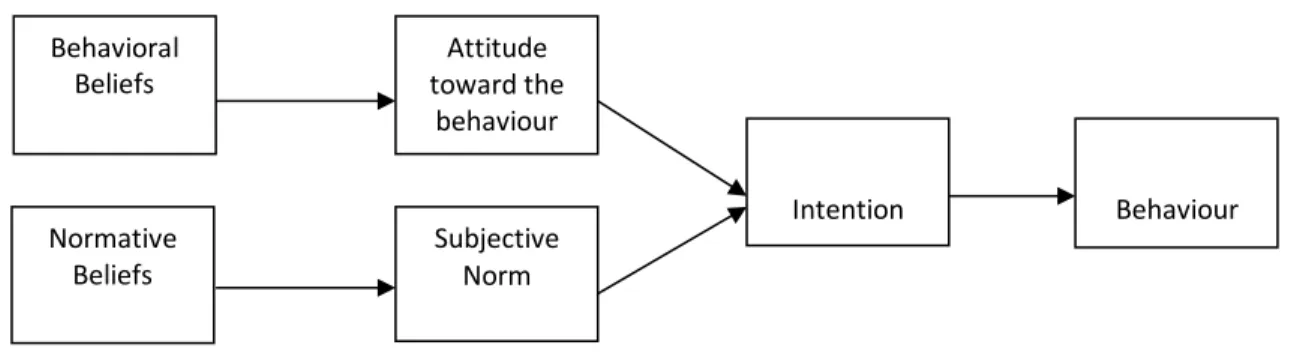
The TRA is a conceptual framework that predicts and explains an individual’s social behavior when such behavior is under his or her volitional control (Ajzen & Fishbein, 1980). The TRA has two independent determinants of behavioral intention (Ajzen & Fishbein, 1980): attitude toward the behavior (a personal component) and subjective norm (a social influence component) – see Figure 1. The TRA suggests that if people evaluate a behavior as being favorable, and believe that others who are important to them think they should perform the behavior, the stronger will be their intention to perform the behavior, and the more likely it is that the behavior will be performed (Ajzen & Fishbein, 1980).
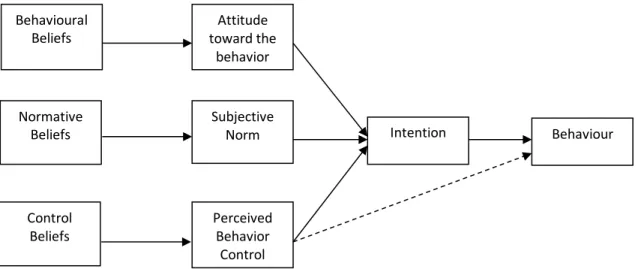
The TPB extends the TRA by adding a third determinant of behavioral intention that is, perceived behavioral control (PBC). This becomes necessary when persons do not have complete volitional control, that is, they may not be able to decide at will whether to perform or not perform the behavior. Two pathways are added to the TRA to form the TPB model: one from perceived behavioral control to behavioral intention and the other from perceived behavioral control directly to behavior (see Figure 2). Ajzen (1991) therefore claims that the TPB can explain more variance in behavioral intention and behavior in comparison with TRA in cases of incomplete volitional control. The TPB therefore has three independent determinants of behavioral intention (Ajzen, 1991, p. 188):
Attitude is “the individual’s positive or negative evaluation of performing the particular
behavior of interest”;
Subjective Norm is “the person’s perception of the social pressure to perform or not perform
the behavior under consideration”;
Perceived Behavioral Control is “the sense of self-efficacy or ability to perform the behavior of
interest”.
Figure 1. Theory of Reasoned Action (Adapted from Ajzen & Fishbein, 1980)
Behavioral Beliefs Normative Beliefs Attitude toward the behaviour Subjective Norm Intention Behaviour
284 Revista Brasileira de Pesquisa em Turismo. São Paulo, 6(3), pp. 280-289, set./dez. 2012
Mendes Filho, L. A. M., Tan, F. B. , & Mills, A. User-generated content and travel planning: An application of the theory of planned behavior
The antecedents of attitude, subjective norm and perceived behavioral control consists of salient behavioral, normative and control beliefs, respectively (Ajzen, 1991). Behavioral beliefs are assessments that influence attitudes toward the behavior; these account for the probability of the behavior’s consequences, whether desirable or undesirable. Normative beliefs are assessments concerning whether important referent individuals or groups are likely to approve or disapprove of performing a given behavior. Control beliefs are the antecedents of perceived behavior control, and are concerned with the presence or absence of requisite resources and facilitate or inhibit performance of the behavior (Ajzen, 1991).
The TPB is a well-established general theory of social psychology that has been shown to predict behavior across a variety of settings (Armitage & Conner, 2001). However, when it comes to the travel and tourism sector, there is a scarcity of more comprehensive studies on customers’ online purchase behaviors, particularly in the accommodation sector (Kim, Ma, & Kim, 2006). Little is known about what motivates travelers to follow the advice obtained in an online travel community (Casaló et al., 2011), and little is known about the role that UGC has in the users’ travel behavior and their decision-making processes (Cox et al., 2009; Vermeulen & Seegers, 2009). Chen (2009) further asserts that the research on online consumer behavior needs a more comprehensive model, describing not only the effect of personal beliefs, but also the impacts of social norms and personal behavioral control on intention in the online context. The TPB is expected to address this gap and better explain online consumer behavior (Ajzen, 1991; Pavlou & Fygenson, 2006).
Hence, the TPB has been chosen as the theoretical framework for this study of the use of UGC in travel planning. The TPB has three independent determinants of intention: attitude, subjective norm, and perceived behavioral control. This paper proposes a conceptual model of consumer decision-making and behavior which accounts for the roles of attitude, subjective norm, and perceived behavior control in respect of travelers’ intention to use UGC when making travel plans. The proposed research model in this study is shown in Figure 3.
Figure 2. Theory of Planned Behavior (Adapted from Fishbein & Ajzen, 2010)
Behavioural Beliefs Normative Beliefs Control Beliefs Attitude toward the behavior Subjective Norm Perceived Behavior Control Intention Behaviour
285 Revista Brasileira de Pesquisa em Turismo. São Paulo, 6(3), pp. 280-289, set./dez. 2012
Mendes Filho, L. A. M., Tan, F. B. , & Mills, A. User-generated content and travel planning: An application of the theory of planned behavior
Given the importance of UGC in online consumer behavior when making travel plans, this study contributes to the literature in tourism, marketing, and information systems, a better understanding of how attitude, subjective norm, and perceived behavior control, work together to determine online consumer behavior. Based on the preceding discussion, the following research question was derived: To what extent do attitude, subjective norm, and perceived behavioral control influence travelers’ intention to use UGC when making travel plans? The following sections look more closely at the TPB and the three determinants of behavioral intention: attitude, subjective norm, and perceived behavior control.
ATTITUDE
Attitude is the degree to which a person has a favorable evaluation of the behavior in question (Ajzen, 1991). The more favorable the attitude toward the behavior, the stronger should be the individual’s intention to perform it (Armitage & Conner, 2001). Attitude has long been shown to influence behavioral intentions (Ajzen & Fishbein, 1980). Following the TPB, a favorable attitude toward using UGC is likely to encourage travelers to use UGC when making travel plans.
The research literature supports the impact of attitude on behavioral intentions. For example, using the TPB, Pavlou and Fygenson (2006) investigated the process of e-commerce adoption by consumers, and found that attitude was related to online consumers’ behavioral intention to purchase a product and to get information from a web vendor. Bhattacherjee (2000) also examined intention to use online brokerage; their findings indicated a strong and positive link between attitude and intention.
Studies have also used the TPB in the tourism context. For example, Casaló, Flavián & Guinalíu (2010) used the TPB to examine individual participation in a firm-hosted online travel
Figure 3. Proposed Research Model
Intention to use UGC when making travel
plans Normative norm
toward using UGC
Perceived Behavior Control toward using UGC Attitude toward using UGC H1 H2 H3
286 Revista Brasileira de Pesquisa em Turismo. São Paulo, 6(3), pp. 280-289, set./dez. 2012
Mendes Filho, L. A. M., Tan, F. B. , & Mills, A. User-generated content and travel planning: An application of the theory of planned behavior
community, and its impact on intention to use the hosting firm’s products and to recommend the host firm. The findings showed a strong link between attitude towards participating and intention to participate in such communities. Attitude has also been linked to intention in studies of consumer behavior in relation to travel planning and destination choice. For example, in a study of travelers’ motivations to visit an international travel destination, Hsu and Huang (2012) found that attitude had a positive impact on behavioral intention. Lam and Hsu (2006) also showed attitude was related to the behavioral intention of Mainland Chinese travelers to visit Hong Kong. Thus, the following hypothesis is proposed:
Hypothesis 1: Travelers’ attitude toward using UGC positively influences intention to use
UGC when making travel plans.
SUBJECTIVE NORM
Subjective norm is “the person’s perception of the social pressure to perform or not perform the behavior under consideration” (Ajzen, 2005, p. 188). For instance, if significant others approve of doing something, an individual is more likely to intend to perform it; conversely if they disapprove of doing something, the individual is less likely to intend to perform it (Armitage & Conner, 2001). Applied to the UGC context, subjective norm reflects a traveler’s perception of the social pressure to use or not use UGC when making travel plans.
The relationship between subjective norm and behavioral intentions has received empirical support in the literature. For example, subjective norm was shown to be an important predictor of intention to use online brokerage services (Bhattacherjee, 2000). Using the TPB, Morris and Venkatesh (2000) analyzed adoption intentions and continued use of information technology, and showed that workers were strongly influenced by subjective norm.
In TPB-based studies in the tourism context, Casaló, Flavián & Guinalíu (2010) showed a strong link between subjective norm and intention to participate in an online travel community. When making travel plans, Hsu and Huang (2012) and Quintal, Lee and Soutar (2010) found that subjective norm was positively linked to travelers’ intention to visit an international travel destination. The following hypothesis is therefore proposed:
Hypothesis 2: Subjective norm toward using UGC positively influences intention to use UGC
when making travel plans.
PERCEIVED BEHAVIORAL CONTROL (PBC)
Perceived Behavioral Control (PBC) reflects a person’s perception of how easy or difficult it would be to carry out a behavior (Ajzen, 1991). The magnitude of the PBC-intention relationship is dependent upon the type of behavior and the nature of the situation (Ajzen, 1991). According to Bandura (1997), a person is more likely to engage in behavior that is believed to be achievable. In the context of this study, perceived behavioral control relates to the traveler’s perceived ease or
287 Revista Brasileira de Pesquisa em Turismo. São Paulo, 6(3), pp. 280-289, set./dez. 2012
Mendes Filho, L. A. M., Tan, F. B. , & Mills, A. User-generated content and travel planning: An application of the theory of planned behavior
difficulty of using UGC when making travel plans.
The literature supports the role of perceived behavioral control in relation to behavioral intentions. For example, Pavlou and Fygenson (2006) used the TPB to explain and predict e-commerce adoption by consumers. The results indicated that perceived behavioral control was a significant predictor of intention to purchase a product and to get information from a web vendor. Bhattacherjee (2000) investigated consumer use of online brokerages and found a positive relationship between perceived behavior control and intentions.
In the tourism literature, Casaló, Flavián & Guinalíu (2010) found a strong link between perceived behavioral control and intention to participate in a firm-hosted online travel community. In relation to travel planning, Sparks and Pan (2009) demonstrated that perceived behavioral control was correlated with the behavioral intention of Mainland Chinese in choosing Australia as an international destination. Quintal, Lee and Soutar (2010)’s three country study of traveler intentions also showed that perceived behavioral control influenced intention to travel to an international destination. Hence, the following hypothesis is proposed:
Hypothesis 3: Perceived behavioral control toward using UGC positively influences
travelers’ intention to use UGC when making travel plans.
CONCLUSION
This paper contributes to the current understanding of what factors influence the use of UGC when travelers make travel plans. Using the Theory of Planned Behavior (TPB), this paper proposes a conceptual model of online consumer behavior that is aimed at getting a better understanding of how attitude, subjective norm, and perceived behavioral control, work together to determine online consumer behavior, more specifically the use of UGC when making travel plans.
Since more studies of Internet consumer behavior are being conducted using the TPB framework (George, 2004), this research also contributes to the further development of a theory of online consumer behavior by evaluating factors that are most important for the UGC context in the travel industry.
In tourism marketing and planning, service providers need to understand which factors influence individuals’ travel decisions, how attitudes are formed, and how various reference groups affect travel behaviors (Moutinho, 1987). To address this need, this study draws on the TPB and prior research to propose a model that identifies key factors (e.g., attitude, subjective norm, and perceived behavioral control) that are likely to influence travelers’ intention to use UGC when making travel plans.
Future research is required to assess the proposed model and evaluate the impact of each of the determinants on behavioral intention and actual travel behavior. Further work can also examine the role of behavioral, normative and control beliefs (e.g. perceived usefulness, opinions of specific others such as friends and family, perceived resources, perceived uncertainty,
self-288 Revista Brasileira de Pesquisa em Turismo. São Paulo, 6(3), pp. 280-289, set./dez. 2012
Mendes Filho, L. A. M., Tan, F. B. , & Mills, A. User-generated content and travel planning: An application of the theory of planned behavior
efficacy) in forming attitude, subjective norm, and perceived behavior control respectively (Ajzen, 1991; Bandura, 1997; Casaló et al., 2010; Quintal et al., 2010; Sparks & Pan, 2009).
REFERENCES
Ajzen, I. (1991). The theory of planned behavior. Organizational behavior and human decision processes, 50(2), 179-211.
Ajzen, I. (2005). Attitudes, Personality and Behavior (2nd ed.). Maidenhead: Open University Press. Ajzen, I., & Fishbein, M. (1980). Understanding attitudes and predicting social behavior. New Jersey: Prentice Hall. Englewood Cliffs.
Armitage, C. J., & Conner, M. (2001). Efficacy of the Theory of Planned Behaviour: A meta-analytic review. British Journal of Social Psychology, 40, 471-499.
Arriga, M., & Levina, N. (2008. Social dynamics in online cultural fields. presented at the meeting of the 29th International Conference on Information Systems (ICIS'08), Paris.
Bandura, A. (1997). Self-efficacy: The exercise of control. New York: W. H. Freeman & Co.
Bhattacherjee, A. (2000). Acceptance of Internet applications services: The case of electronic brokerages. IEEE Transactions on Systems, Man, and Cybernetics - Part A: Systems and Humans, 30(4), 411-420. Casaló, L. V., Flavián, C., & Guinalíu, M. (2010). Determinants of the intention to participate in firm-hosted online travel communities and effects on consumer behavioral intentions. Tourism Management, 31, 898-911.
Casaló, L. V., Flavián, C., & Guinalíu, M. (2011). Understanding the intention to follow the advice obtained in an online travel community. Computers in Human Behavior, 27(2), 622-633.
Chen, L. (2009). Online consumer behavior: An empirical study based on Theory of Planned Behavior. Thesis. University of Nebraska, Lincoln.
Chung, J. Y., & Buhalis, D. (2008). Web 2.0: A study of online travel community. In P. O'Connor, W. Höpken, & U. Gretzel (Eds.), Information and Communication Technologies in Tourism 2008 (pp. 70-81). Innsbruck: Springer.
Cox, C., Burgess, S., Sellito, C., & Buultjens, J. (2009). The role of user-generated content in tourists' travel planning behavior. Journal of Hospitality Marketing & Management, 18(8), 743-764.
Dellarocas, C., Zhang, X., & Awad, N. (2007). Exploring the value of online product reviews in forecasting sales: The case of motion pictures. Journal of Interactive Marketing, 21(4), 23-45.
Fishbein, M., & Ajzen, I. (2010). Predicting and changing behavior: The reasoned action approach. New York: Psychology Press (Taylor & Francis).
George, C., & Scerri, J. (2007). Web 2.0 and User-Generated Content: legal challenges in the new frontier. Journal of Information, Law and Technology, 12(2), 1-22.
George, J. F. (2004). The theory of planned behavior and Internet purchasing. Internet Research, 14(3), 198-212.
Gretzel, U., & Yoo, K. H. (2008). Use and impact of online travel reviews. In P. O'Connor, W. Höpken, & U. Gretzel (Eds.), Information and Communication Technologies in Tourism 2008 (pp. 35-46). Innsbruck: Springer.
289 Revista Brasileira de Pesquisa em Turismo. São Paulo, 6(3), pp. 280-289, set./dez. 2012
Mendes Filho, L. A. M., Tan, F. B. , & Mills, A. User-generated content and travel planning: An application of the theory of planned behavior
of Hospitality & Tourism Research, 36(3), 390-417.
Kim, W. G., Ma, X., & Kim, D. J. (2006). Determinants of Chinese hotel customers' e-satisfaction and purchase intentions. Tourism Management, 27(5), 890-900.
Laboy, F., & Torchio, P. (2007). Web 2.0 for the travel marketer and consumer. Retrieved 17/12/2007, from www.esitemarketing.com/web2-travel-marketing.php
Lam, T., & Hsu, C. H. C. (2006). Predicting behavioral intention of choosing a travel destination. Tourism Management, 27(4), 589-599.
Morris, M. G., & Venkatesh, V. (2000). Age differences in technology adoption decisions: Implications for a changing work force. Personnel Psychology, 53(2), 375-403.
Moutinho, L. (1987). Consumer behavior in tourism. European Journal of Marketing, 21(10), 1-44. O'Connor, P. (2008). User-Generated content and travel: A case study on TripAdvisor. In P. O'Connor, W. Höpken, & U. Gretzel (Eds.), Information and Communication Technologies in Tourism 2008 (pp. 47-58). Innsbruck: Springer.
Olson, J. M., & Zanna, M. P. (1993). Attitudes and attitude change. Annual Review of Psychology, 44, 117-154.
Pavlou, P. A., & Fygenson, M. (2006). Understanding and predicting electronic commerce adoption: an extension of the Theory of Planned Behavior. MIS Quarterly, 30(1), 115-143.
Quintal, V. A., Lee, J. A., & Soutar, G. N. (2010). Risk, uncertainty and the theory of planned behavior: A tourism example. Tourism Management, 31, 797-805.
Rezabakhsh, B., Bornemann, D., Hansen, U., & Schrader, U. (2006). Consumer power: a comparison of the old economy and the Internet economy. Journal of Consumer Policy, 29(3), 3-36.
Seneca, S., & Nantel, J. (2004). The influence of online product recommendations on consumers' online choices. Journal of Retailing 80(2), 159-169.
Sparks, B., & Pan, G. W. (2009). Chinese Outbound tourists: Understanding their attitudes, constraints and use of information sources. Tourism Management, 30(4), 483-494.
Vermeulen, I. E., & Seegers, D. (2009). Tried and tested: The impact of online hotel reviews on consumer consideration. Tourism Management, 30(1), 123-127.
Ye, Q., Law, R., Gu, B., & Chen, W. (2011). The influence of user-generated content on traveler behavior: An empirical investigation on the effects of e-word-of-mouth to hotel online bookings. Computers in Human Behavior, 27(2), 634-639.
Artigo recebido em: 07/05/2012. Artigo aprovado em: 26/09/2012.