1. Sección de Estudios de Posgrado e Investigación, Escuela Superior de Medicina, Instituto Politécnico Nacional
2. Laboratorio de Inmunología, Facultad de Estudios Superiores Iztacala, UNAM
3. Laboratorio de Genética y Biología Molecular, Centro de Investigación y Estudios Avanzados (CINVESTAV)
4. Departamento de Reumatología, Hospital General de Zona 2-A Troncoso, IMSS
5. Facultad de Medicina, Facultad de Estudios Superiores Iztacala, UNAM
phism rs2275913, OR 6.6 (95%CI 1.6 – 27.0, P<0.01).
Conclusion: This study draws two main conclusions:
1) The presence of IL-17 polymorphism rs2275913 is closely related to a more severe form of the disease and as a result, a higher number of DMARDs required to control it, 2) The presence of IL-17 polymorphism rs2275913 may confer a risk of developing RA in Mexi -can carriers.
Keywords: Il-17 rs2275913; Rheumatoid arthritis;
In-terleukin-17.
INtrODUctION
Rheumatoid arthritis (RA) is a chronic autoimmune disea se whose pathogenesis is a complex interplay be-tween the patient’s genetics and environmental factors. Its etiology is multifactorial and it is considered the pro-totype disease of T-cells1. At an immunological level,
there is a dysregulation in cytokine-mediated signals that cause an infiltration of immune cells into the syn-ovium, an unceasing phenomenon that is maintained by the activation of amplification mechanisms prompt-ing chro nic inflammation and progressive destruction of the joint2.
It has been shown within cellular elements involved in the pathogenesis of the disease, that interleukin 17 (IL-17), a cytokine secreted exclusively by activated T-cells, is a major contributor to inflammation and joint destruction. IL17 substantially alters cartilage homeos -tasis and stimulates synoviocytes, chondrocytes and macrophages to release matrix metalloproteinases (MMPs), the most important enzymes involved in car-tilage destruction. In a mouse model, administration
Polymorphism rs2275913 of Interleukin-17A
is related to more intensive therapy with
disease-modifying anti rheumatic drugs in
Rheumatoid Arthritis Mexican patients
García de la Peña M1, Herrera-González NE1, Garrido Guerrero E3,
Galicia López A4, Pozo Molina G5, Méndez Cruz R2
ACTA REUMATOL PORT. 2017;42:155-161
AbstrAct
Aim: This study has two aims: 1) to evaluate the
asso-ciation of IL-17 polymorphism rs2275913 with RA severity and 2) to evaluate if this particular single-nu-cleotide polymorphism (SNP) is asso ciated with sus-ceptibility for RA in Mexican patients.
Methods: Seventy-six RA patients and ninety-four
healthy controls were included in the study. RA patients were evaluated according to DAS 28. Treatment with DMARDs was prescribed and radiological damage was evaluated according to the Larsen method. A case-con-trol study was used. Oral epithelial cells were obtained as source for genetic material. DNA was amplified using PCR. Subsequently, a RFLP was carried out. Finally, in order to confirm the IL17 SNP rs2275913 pre -sence, direct sequencing of the DNA was performed.
Results: A significant difference was observed between
the RA patients and controls when the prevalence of IL-17 SNP rs2275913 was compared. There was a sta-tistically significant disparity among the two groups with an OR of 5.6 (95%CI 1.5 – 20.9, P=<0.01).
This study showed that the RA patients who were positive for the IL17 polymorphism rs2275913 requi -red 3 DMARDs to control the disease compa-red to 32% of the patients who were negative for the IL17 polymor
-of recombinant IL-17 in a rodent’s joint, induced car-tilage destruction3. Furthermore, blocking of
endoge-nous IL-17 had a protective effect in inhibiting bone destruction.
IL-17 was initially identified in herpes virus saimiri4
and later in rodents, receiving the name of Cytotoxic T-Lymphocyte Antigen 8 (CTLA-8)5. It was described
in humans in 19976. It is encoded by a gene localized
on the short arm of chromosome 6, in the 6p12 locus, consisting of 1874 bp7. The IL-17 A is the founding
member of a new subclass of cytokines8and is mainly
produced by the pro inflammatory cells Th1/Th0. Now, with respect to the susceptibility to rheuma-toid arthritis, it is accepted that genetic factors play a major role. It was found that the concordance rate in homozygous twins was higher than 50%9. Also diffe
-rences were found in the prevalence in various coun-tries, ranging between 0.5% and 1% of the population. However, it has to be considered that most of the in-formation regarding rheumatic diseases comes from developed countries and data in Latin America (LA) is still scarce. Some reports in LA show epidemiological differences among which we find: a) the prevalence of RA is higher in LA than in the rest of the world10
(1.6%), b) the male/female ratio is higher than in other parts of the world (7: 1 Vs 3: 1), and c) some surveys of LA suggest that the onset of RA occurs around age 40, almost a decade earlier than in Cau-casians11. These differences may be the result of genetic
susceptibility or represent exposure to different envi-ronmental factors.
It is known that the variations in the human genome range from a change in a simple pair of bases to seve -ral hundred pairs. These changes may confer bio-chemical and physiological variations, which can be directly linked to susceptibility or resistance to speci -fic traits or certain diseases. The spectrum of the resulting effects caused by genetic variations in indivi -dual genes, functions or protein expression is very broad12.
In this regard, in order to determine whether it is re-lated to the severity of RA or to susceptibility, several studies had been done with the Polymorphisms IL-17 SNP rs2275913, which is located in the -197 position of initiation codon of the gene of IL-17A. However, the results were mixed.
In a study amidst the Algerian population, the pre -sen ce of IL-17 SNP rs2275913 showed no relationship to the risk of developing RA but a negative association with the production of IgA of rheumatoid factor was
found13. In an analysis carried out by Nordang et al. in
Norwegian patients14, the presence of IL-17 SNP
rs2275913 was associated with an increased risk of rheumatoid arthritis with an OR of 1.28 (95% CI 1.01 to 1.54, p = 0.01). Contrarily, in another research car-ried out among the population of China, Le Shen y cols. found a lower frequency of IL-17 SNP rs2275913 in patients with RA compared to the healthy popula-tion, resulting in an odds ratio of 0.77 (95% CI 0.59 to 0.99, P = 0.043)15.
Taking into account the varying results in different populations and considering that the relationship be-tween IL-17 SNP rs2275913 and development of RA remains uncertain, and the fact that Mexico has not evaluated the association between these variables, we proposed this investigation to establish the potential clinical effects of this genetic variant.
MAtErIAL AND MEtHODs PAtIENts AND cONtrOLs
We conducted a prospective case-control study in a general, secondary care hospital: 76 outpatients with RA, including men and women older than 18 years of age, were recruited who met the following criteria: 1) all patients satisfied the 2010 ACR/EULAR revised cri-teria for RA16, 2) progression time of disease was
infe-rior or equal to 5 years, 3) currently receiving a specific treatment by a rheumatologist, 4) Both, the cases and the controls were unrelated individuals and self-re-ported as having at least three generations of Mexican mestizo ancestry. Patients suffering from another au-toimmune diseases or dubious cases were excluded from the study. All the patients signed an informed consent form. The research protocol received approval from the National Committee for Clinical Research at the Social Security Mexican Institute (No. R-2013--785-060).
The controls were 94 healthy subjects sharing the same demographic characteristics as the patients un-der the following criteria: 1) absence of illness, 2) no relatives suffering from RA or any other known autoimmune or inflammatory disease (at least three gene rations), 3) of Mexican descent and from the same geo -graphical area where the study was conducted.
During the rheumatology consultation, buccal DNA samples were collected as described below, and the pa-tients were evaluated according to: a) Disease Activity Score 28 (DAS 28), b) treatment with diseasemodi
fying anti rheumatic drugs (DMARDs), and c) ra -diographic damage. Joint damage was assessed on radio graphs of hands and feet according to the Larsen method. The total score (range 0–160) was used to quantify RA structural severity. The radiological assessment was performed by an expert radiologist blin -ded to the results of the genetic analysis.
All patients enrolled in the study had previously been managed according to the Update of the Mexican College of Rheumatology Guidelines for the Pharma-cologic Treatment of Rheumatoid Arthritis.
Lastly DAS-28, Larsen scores and DMARDs treat-ments were compared between the patients with and without the Polymorphism rs2275916 to relate their association with it.
GENOtYPING
Collection of buccal swab samples
Porous foam-tipped swabs (Epicentre Biotechnologies, Madison, WI) were used to collect buccal epithelial cells from patients and controls (hospital volunteers). Buccal DNA samples were collected with Buccal Amp TM DNA Extraction Kits (Epicenter BioTech-nologies).
Preparation of DNA from buccal cell swabs
BuccalAmp samples were processed according to the manufacturer’s instructions. Buccal swabs were briefly swirled directly in tubes containing 500 l of Quick Ex-tract DNA exEx-traction solution. Samples were incuba ted at 65°C for 1 min, briefly vortexed (15 seconds), trans-ferred to 98°C for 2 min and stored at -20°C.Genotyping PCR of DNA samples prepared
from buccal cells
PCR products were subjected to electrophoresis on 1.5% agarose gels and the bands corresponding to the specific amplicons (300pb) were cut off from the gels. DNA was extracted using the Wizard RSV Gel and PCR Clean-Up System. Subsequently, a Restriction Fragment Length Polymorphism (RFLP) analysis was performed using the XmnI enzyme (PdmI, by Thermo Scien tific), which is a restriction endonuclease from bacterial strain
Xanthomonas manihotis with nucleotide sequences for
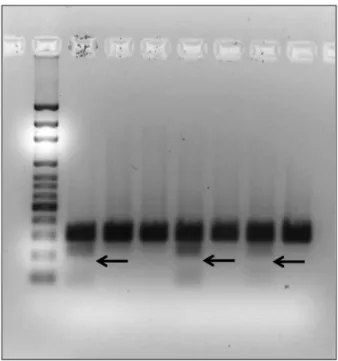
cleavage sites in 5’... G A A N N N N T T C …3’. The samples were then run on an agarose gel in order to identify the fragments generated by the restriction en-zyme. When there was a presence of polymorphism in the study, a cut was generated that produced two DNA fragments, a 56 bp (inferior) and an additional 244 bp
(superior) (Figure 1).
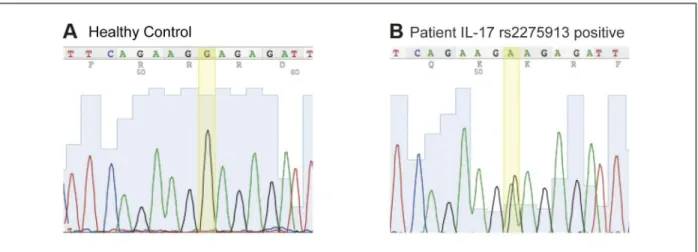
Finally, in order to confirm the SNP presence by RFLP, each product was used as a template to conduct a sequencing reaction with the Big Dye Terminator v3.1 Cycle Sequencing Kit (Applied Biosystems), according to manufacturer procedures. The sequences were ana-lyzed using the ABI 3130xl Genetic analyzer by Appli ed Biosystems, (Figure 2).
stAtIstIcAL ANALYsIs
Sample size was calculated using the formula to com-pare two means for a quantitative variable and the varian ce found in Larsen score. A type I error risk of 5% and a type II error risk of 20% were assumed. A two--sided P-value <0.05 was considered significant for all the analyses.
The odds ratio (OR) between the SNP rs2275913 carriers among the healthy subjects and the patients was calculated in order to assess the risk of developing RA among positive subjects.
Similarly, the OR was calculated to assess the risk to have more than 2 DMARDs depending on the presen ce or absence of the SNP among the patients with RA. This was calculated using the Epidat V 3.1 statistical software. The outcome variables were compared in a Chi--squared (χ²) test for qualitative variables and Student’s t for quantitative ones, using SPSS V.17.0 statistical
soft-FIGUrE 1. Agarose gel showing positive samples for IL-17 rs2275913 (arrows)
ware. In addition, a descriptive analysis was run for de-mographic variables.
rEsULts
Seventy-six RA patients satisfying the above-detailed criteria and ninety-four healthy subjects were recrui ted for this study. All participants had the same demo-graphic profile and ethnic background. Of the RA pa-tients 87% (N=66) were women vs 85% (N=80) in the healthy group, with an average age of 49 ± 13 years and 45± 15 years respectively (P=0.8). No difference in age
and sex distributions was found between the two groups (P= 0.8). Clinical and demographic characte -ristics of patients and controls are presented in Table I. The mean of disease duration of RA patients was 1.8 ± 1.2 years. Rheumatoid Factor and anti-cyclic citrul-linated peptide antibody (anti-CCP) concentrations were 265 ± 363 U/ml and 363 ± 619 UI/ml, respec-tively. The average of HAQ score was 1.7 ± 0.6, and the radiologi cal evaluation according to the Larsen method showed an overall mean of 43 ± 20 points. Mean di -sease acti vity (DAS28) was 1.97 ± 0.8. The complete clinical data and characteristics of the RA group are pre-sented on Table II.
When we analyzed the prevalence of IL-17 rs2275913 on RA patients and healthy controls, we found a significant difference between these two groups. Of the 76 patients evaluated, 15% (N=12) were positive for the IL-17 rs2275913 vs 3% (N=3) for the control group. This results in an odds ratio of 5.6 (95%CI 1.5 – 20.9, P=<0.01) for risk of Rheumatoid Arthritis in subjects carrying the polymorphism (Table III).
The review of the therapeutic schemes administered to the patients with RA showed that one patient (1%) received methotrexate monotherapy, 44% (N = 33) had dual scheme DMARDs, 50% (N = 38) had triple scheme DMARDs and only 5% (N = 4) were in biolo -gic therapy with infliximab.
When we compared the DMARDs regime according with SNP carrier status, 73% of the patients who tes -ted positive for the IL-17 rs2275913 required 3 DMARDs to control the disease compared with 32% who tested negative, this results in an odds ratio of 6.6 (95% CI 1.6 – 27.0, P=<0.01) (Table IV).
FIGUrE 2. Difference in gene sequence. A. Healthy control B. Patient who tested positive for IL-17 rs2275913
tAbLE I. bAsAL cHArActErIstIcs OF stUDY POPULAtION Patients Controls Characteristics n = 76 N = 94 Value Gender Female 66 (87%) 80 (85%) p = 0.8 Male 10 (13%) 14 (15%) P = 0.8 Age (years) 49 ± 13 45 ± 15 p = 0.6 Disease duration (years) 1.7 ± 0.6 – Rheumatoid Factor 265 ± 363 – Anti-CCP 385 ± 567 – HAQ† 1.7 ± 0.6 – DAS 28‡ 1.9 ± 0.9 † HAQ: Health Assessment Questionnaire ‡ DAS-28: Disease Activity Score 28
with an important genetic predisposition. Although many analyses have shown that genetic factors play an important role in the pathogenesis of RA, only a few have identified an association with the susceptibility to RA.
The aim of this study was to determine whether IL--17 polymorphism rs2275913 is associated with more severe clinical presentations and to explore their influ-ence on the risk of developing rheumatoid arthritis in Mexican patients.
In the current study, we found a modest but signifi -cantly higher prevalence of SNP IL-17 rs2275913 in patients with rheumatoid arthritis in relation to healthy tAbLE III. AssOcIAtION bEtwEEN IL-17 rs2275913 AND rHEUMAtOID ArtHrItIs
Cases Controls
Carrier status 76 (100%) 94 (100%) OR (95% CI) P
IL-17 rs2275913 (+) 12 (15%) 3 (3%) 5.6 (1.5 - 20.9) < 0.01 IL-17 rs2275913 (-) 64 (85 %) 91 (97%)
P value <0.05 indicates a significant difference. CI= Confidence interval. OR = odds ratio.
tAbLE IV. AssOcIAtION bEtwEEN IL-17 rs2275913 AND DMArDs PrOFILE ≥ 3 DMARDs ≤2 DMARDs
Patient group N (%) N (%) OR (95% CI) P
IL-17 rs2275913 (+) 9 (73%) 3 (27%) 6.6 (1.6 – 27.0) < 0.01 IL-17 rs2275913 (-) 20 (32 %) 44 (68%)
P value <0.05 indicates a significant difference. CI= Confidence interval. OR = odds ratio.
tAbLE II. cHArActErIstIcs OF PAtIENts AccOrDING tO tHEIr cArrIEr stAtUs OF POLYMOrPHIsM Patients with SNP rs2275913 Patients without SNP rs2275913
Characteristics N=12 N=64 Value
Gender
Female 9 (75%) 57 (89%) p = 0.4
Male 3 (25%) 7 (11%) p = 0.4
Age 49 ± 11 49 ± 14 p = 0.9
Disease duration (years) 1.4 ± 0.6 1.8 ± 1.3 p = 0.3
Rheumatoid Factor 181 ± 230 281 ± 383 p = 0.4
Anti-CCP 424 ± 766 352 ± 597 p = 0.7
HAQ† 2.0 ± 0.6 1.7 ± 0.6 p = 0.1
DAS‡ 1.8 ± 0.9 2.0 ± 0.7 p = 0.2
Larsen score (0-180 range) 39 ± 30 29 ± 26 p = 0.7
† HAQ: Health Assessment Questionnaire ‡ DAS-28: Disease Activity Score 28
Anti-CCP: cyclic citrullinated peptides antibodies; SNP: single-nucleotide polymorphism
No significant difference was found between IL-17 rs2275913 carriers and non-carriers for the radiologi-cal evaluation of proximal interphalangeal, metacar-pophalangeal, carpal and metatarsophalangeal joints using Larsen’s method (39±30 vs 29±26, P=0.7), HAQ score (2.0±0.6 vs 1.7±0.6, P=0.1) or DAS-28 score (1.8±0.9 vs 2.0±0.7, P=0.7).
DIscUssION
Our study has several limitations. First, although this primary approach allows us to formulate some conclusions regarding the frequency of the mutation in patients with RA, it should be noted that the size of the sample is small. It is necessary to conduct large-scale studies to determine the true prevalence of the SNP in both the RA and general population.
Moreover, with respect to the finding of an increased risk of RA in people who are carriers of SNP, one must be cautious in establishing an association of causality because as previously mentioned, the etiopathogenesis is multifactorial and there are many immunopa tho -genic mechanisms beyond the analysis of this study.
Finally, our observations are mainly based on fre-quency analysis but experimental studies are needed to accurately determine the biological or functional im-plications of change of bases of this polymorphism.
In short, to our knowledge, this is the first study conducted in Mexico that analyzes the relationship be-tween IL-17 rs2275913 and the clinical presentation of RA. This research allows us to establish two main con-clusions: 1) the presence of SNP IL-17 rs2275913 may confer a risk of developing the disease in patients who are carriers and, 2) the presence of IL-17 rs2275913 correlates closely with the number of DMARDs used for disease control.
cOrrEsPONDENcE tO
Maximiliano García de la Peña
Durango 291, Piso 9, Colonia Roma Norte E-mail: [email protected]
rEFErENcEs
1. McInnes IB, Schett G. The Pathogenesis of Rheumatoid Arthri-tis. N Engl J Med 2011; 365:2205-2219.
2. ByngMaddick R, Ehrnstein MR. The impact of biological the rapy on regulatory T cells in rheumatoid arthritis. Rheumatolo -gy. 2015; 54 (5): 768-775.
3. Chabaud M, Lubberts E, Joosten L, van Den Berg W, Miossec P. IL-17 derived from juxta-articular bone and synovium con-tributes to joint degradation in rheumatoid arthritis, Arthritis Res. 2001; 3:168–177.
4. Yao Z, Fanslow WC, Seldin MF, Rousseau AM, Painter SL, Comeau MR, et. al. Herpesvirus Saimiri Encodes a New Cy-tokine, IL-17, Which Binds to a Novel Cytokine Receptor. Im-munity, 1995; 3: 811-821.
5. Rouvier E, Luciani MF, Mattéi MG, Denizot F, Golstein P, et. al. CTLA-8, cloned from an activated T cell, bearing AU-rich mes-senger RNA instability sequences, and homologous to a her-pesvirus saimiri gene J. Immurrol.1993. 150: 5445.
6. Yao Z, Painter SL, Fanslow WC, Ulrich D, Macduff BM, Sprig-gs MK, Armitage RJ et. al. Human IL-17: a novel cytokine. de-rived from T cells. J. Immunol. 1995;155;5483-5486. 7. Moseley TA, Haudenschild DR, Rose L, Reddi AH.
Interleukin--17 family and ILInterleukin--17 receptors Cytokine Growth Factor Rev. controls, resulting in an OR of 5.6 (95% CI 1.5 - 20.9,
P = < 0.01) to develop the disease. These results are consistent with findings reported by Nordang et al.14,
although in our case the difference in the prevalence of SNP IL-17 rs2275913 between the control group and the patients group was much more noticeable, though it must be considered that the sample size reported by Nordang is certainly much higher.
In addition, we showed that patients carrying IL-17 SNP rs2275913, required a DMARDs scheme signifi-cantly more aggressive to achieve optimal disease con-trol OR 6.6 (95% CI 1.6 - 27.0, P = <0.01). It should be considered that the treatment for RA is individual-ly suited according to clinical, biochemical and radio-logical variables that determine disease activity such as: the number of painful and swollen joints, C-reac-tive protein concentrations, concentrations of anti-CCP and rheumatoid factor, among others. Overall, a hi gher activity level requires a more aggressive DMARDs scheme.
Our study shows that with the presence of IL-17 in patients with RA rs2275913, the probability of requi -ring more than two DMARDs increases by five times compared with patients without IL-17 SNP rs2275913. We observed that there was no greater radiographic damage in patients with polymorphism than in those with negative status, which is relevant considering that radiological progression is one of the most important variables in determining the aggressiveness of the di -sease17-18. These findings are concordant equally with
those reported by Pawlik, whose investigation found no difference in the immune profile or erosive lesions among patients who were carriers of polymorphism rs2275913 IL-17 compared to non-carriers19.
There are two factors to which we can attribute the fact that significant differences in Larsen scoring were found. First and foremost, those patients who are car-riers of IL-17 rs2275913 received a more aggressive DMARDs regime, which could have altered the course of the disease.
In various randomized clinical trials it has been shown that patients who were treated with a combina-tion of three DMARDs exhibit less radiographic pro-gression compared to patients receiving a lesser amount of these drugs20-21. Secondly, our group of patients had
an average disease progression of 1.8 years. This brief evolution probably had a significant impact on the mi -ni mal radiographic progression. The reported preva-lence of radiographic lesions in patients with early RA22
2003;14(2):155-74
8. Weaver CT, Hatton RD, Mangan PR, Harrington LE. IL17 Fami ly Cytokines and the Expanding Diversity of Effector T Cell Li -neages. Annu. Rev. Immunol. 2007. 25:821–52.
9. MacGregor AJ, Rigby AS, Ollier WE, Silman AJ. An estimation of the relative genetic and environmental contribution to rheumatoid arthritis based on covariance analysis of twin data. Br J Rheumatol, 1994; 33 (Suppl. 1):1583.
10. PeláezBallestas I, Sanin LH, MorenoMontoya J, AlvarezNeme -gyei J, Burgos-Vargas R, Garza-Elizondo M, et. al. Epidemiolo-gy of the Rheumatic Diseases in Mexico. A Study of 5 Regions Based on the COPCORD Methodology. J Rheumatol 2011; 86: 3-8.
11. Mody GM, Cardiel MH. Challenges in the management of rheumatoid arthritis in developing countries. Best Pract Res Clin Rheumatol. 2008 Aug; 22 (4):621-641.
12. Cardoso JG, Andersen MA, Herrgard MJ, Sonnenchein N. Ana -ly sis of genetic variation and potential applications in genome-scale metabolic modeling. Front. Bioeng. Biotechnol., 2015; 3: 1-12.
13. Louahchi S, Allam I, Berkani L, et al. Association study of sin-gle nucleotide polymorphisms of IL23R and IL17 in rheumatoid arthritis in the Algerian population. Acta Reumatol Port. 2016 41(2):151-157
14. Nordang GB, Viken MK, Hollis-Moffatt JE, Merriman TR, Forre OT, Helgetveit K, et al. Association analysis of the interleukin 17A gene in Caucasian rheumatoid arthritis patients from Nor-way and New Zealand. Rheumatology 2009;48:367–370. 15. Li Shen, Hui Zhang, Ting Yan et. al. Association between
inter-leukin 17A polymorphisms and susceptibility to rheumatoid arthritis in a Chinese population. Gene 2015; 566:18–22
16. Aletaha D, Neogi T, Silman AJ, Funovits J, Felson DT, Bingham CO 3rd, et. al. 2010 Rheumatoid arthritis classification criteria: an American College of Rheumatology/European League Against Rheumatism collaborative initiative. Ann Rheum Dis. 2010 69: 1580-1588.
17. Van der Heijde DM. Radiographic imaging: the “gold standard” for assessment of disease progression in rheumatoid arthritis. Rheumatology. 2000; 39:9–16 (Suppl)
18. Sanmartí R, Gómez-Centeno A, Ercilla G, Larrosa M, Viñas O, Vazquez I, et al. Prognostic factors of radiographic progression in early rheumatoid arthritis: a two year prospective study after a structured therapeutic strategy using DMARDs and very low doses of glucocorticoids. Clin Rheumatol. 2007 26:1111–1118 19. Pawlik A, Kotrych D, Malinowski D. IL17A and IL17F gene polymorphisms in patients with rheumatoid arthritis. Muscu-loskeletal Disorders 2016; 17: 208.
20. Möttönen T, Hannonen P, LeirisaloRepo M, Nissilä M, Kautiai -nen H, Korpela M, et. al. Comparison of combination therapy with single-drug therapy in early rheumatoid arthritis: a ran-domised trial. Lancet 1999; 353: 1568 –1573.
21. Çalgüneri M, Pay S, Çaliskaner Z, Apras S, Kiraz S, Ertenli I, et al. Combination therapy versus monotherapy for the treatment of patients with rheumatoid arthritis. Clin Exp Rheumatol 1999; 17: 699-704.
22. Ostergaard M, Ejbjerg B, Szkudlarek M. Imaging in early rheumatoid arthritis: roles of magnetic resonance imaging, ul-trasonography, conventional radiography and computed to-mography. Best Pract Res Clin Rheumatol. 2005;19(1):91-116.