• Nenhum resultado encontrado

Ecological intensification for managing biodiversity in agricultural systems: a systematic review

N/A
N/A
Protected

Academic year: 2021

Share "Ecological intensification for managing biodiversity in agricultural systems: a systematic review"

Copied!
116
0
0

Texto

(1)

IUL School of Social Sciences

Department of Social and Organizational Psychology

Ecological intensification for managing biodiversity in agricultural

systems - A systematic review

Ida Schou Brandis

Dissertation submitted as partial requirement for the conferral of

Master in Environmental and Sustainability Studies

Supervisor: Doutora Vânia Andreia Malheiro Proença, Investigadora,

MARETEC, Instituto Superior Técnico, Universidade de Lisboa

Co-supervisor: Doutora Fernanda Paula Martins e Castro, Professora

Associada, ISCTE, Instituto Universitário de Lisboa

October, 2017

(2)

(3)

IUL School of Social Sciences

Department of Social and Organizational Psychology

Ecological intensification for managing biodiversity in agricultural

systems - A systematic review

Ida Schou Brandis

Dissertation submitted as partial requirement for the conferral of

Master in Environmental and Sustainability Studies

Supervisor: Doutora Vânia Andreia Malheiro Proença, Investigadora,

MARETEC, Instituto Superior Técnico, Universidade de Lisboa

Co-supervisor: Doutora Fernanda Paula Martins e Castro, Professora

Associada, ISCTE, Instituto Universitário de Lisboa

October, 2017

(4)

(5)

My biggest thanks goes to Doutora Vânia Andreia Malheiro Proença, my supervisor and key

for success, that have worked with me and helped me with valuable guidance thought this

educational process.

(6)

I

(7)

II

Abstract

The intensive farming has been linked to biodiversity loss. However, food production is

required to increase to meet the growing demand of the world population. For long-time

security, ecological intensification, based on the intensive and smart use of ecosystem

services is proposed as a solution. This systematic review investigated the inclusion of

ecological intensification in research studies, the motivation (mitigation of impacts on

biodiversity or production concerns) behind its adoption by different agricultural

interventions (organic farming, integrating farm management or agri-environmental schemes)

and identified the associated ecosystem services. A total of 258 articles were included in the

final list for review. Most studies were motivated by the mitigation of agricultural impacts on

biodiversity, organic and integrated farm management were the most represented, and most

studies focused on regulating ecosystem services. No association between motivation and

agricultural intervention was found. Examples of ecological intensification were identified in

65 studies (25%); among these, the ones only motivated by biodiversity conservation

restricted their analysis to regulating services, while the studies motivated by both production

and biodiversity conservation also addressed other types of ecosystem services, namely

provisioning services. Moreover, studies assessing agri-environmental schemes often did not

include ecological intensification, these studies were mainly motivated by the mitigation of

agriculture impacts, in particular, on biodiversity values related to cultural services. Overall,

review findings suggest that studies focusing both on biodiversity and agriculture tend to be

more motivated by the mitigation of impacts of agriculture, and address less the contribution

of biodiversity to agricultural production. This suggests a window of opportunity for

agricultural management to strengthen the synergies between biodiversity and production.

Keywords:

Ecological intensification, ecosystem services, biodiversity, agri-environmental schemes,

organic farming, integrated farm management.

(8)

III

Resumo

A agricultura intensiva tem causado perda de biodiversidade. No entanto, é necessário

aumentar a produção de alimentos para responder ao aumento da população. A intensificação

ecológica apresenta-se como uma solução para conciliar segurança alimentar e proteção da

biodiversidade. Este estudo analisou a inclusão de práticas de intensificação ecológica em 258

artigos científicos, a motivação (conservação/mitigação de impactos na biodiversidade ou

melhoria da produção) para o uso dessas práticas por diferentes tipos de intervenção agrícola

(agricultura biológica e integrada, medidas agroambientais) e identificou os serviços de

ecossistema associados. A conservação/mitigação de impactos, a agricultura biológica e

integrada, e os serviços de regulação foram, respetivamente, a motivação, intervenções e

serviços de ecossistema mais frequentes. Não foi encontrada uma associação entre motivação

dominante e tipo de intervenção. Foram identificadas práticas de intensificação ecológica em

65 estudos; entre estes, os estudos motivados por conservação/mitigação focaram

essencialmente serviços de regulação, enquanto estudos motivados tanto pela produção como

pela conservação da biodiversidade também abordaram outros serviços, nomeadamente

provisão de alimento. Não foram detetadas práticas de intensificação ecológica na maioria dos

estudos sobre medidas agroambientais, estes estudos têm a conservação/mitigação de

impactos como a principal motivação. Os resultados desta revisão sugerem que os estudos

sobre biodiversidade e agricultura tendem a ser mais motivados pela conservação ou

mitigação de impactos da agricultura na biodiversidade, do que pelos contributos da

biodiversidade para a produção agrícola. Tal sugere a existência de uma janela de

oportunidade para fortalecer a sinergia entre biodiversidade e produção no âmbito das

políticas para a agricultura.

Palavras-chave: Intensificação ecológica, serviços dos ecossistemas, biodiversidade,

medidas agroambientais, agricultura biológica, agricultura integrada.

(9)

IV

Index

Index of tables ... V

Index of figures ... VI

Glossary of acronyms ... VI

1

Introduction ... 1

1.1

International goals towards the enhanced sustainability of farming systems ... 2

1.2

Ecological intensification ... 5

1.3

Ecosystem services and biodiversity ... 7

1.4

Interventions in agricultural systems ... 9

1.4.1

Organic Farming ... 9

1.4.2

Integrated farming management (IFM) ... 11

1.4.3

Agri-Environmental Schemes ... 12

1.5

Objectives ... 13

2

Methods ... 15

2.1

Systematic review: general goals and methods ... 15

2.2

The Randall and James systematic map ... 16

2.2.1

Literature retrieval from the database ... 18

2.3

Complementary literature search and database ... 19

2.3.1

Search methods ... 19

2.3.2

Study inclusion criteria ... 20

2.3.3

Study quality assessment ... 21

2.3.4

Screening process ... 21

2.4

Data extraction ... 23

2.5

Data synthesis and presentation ... 24

2.6

Statistical testing ... 25

3

Results ... 27

3.1

Main features of the reviewed literature ... 27

3.2

Motivation for the interventions ... 32

3.3

Ecological intensification in reviewed studies ... 36

3.3.1

Association between inclusion of ecological intensification and agric. interventions ... 39

3.3.2

Association between inclusion of ecological intensification and type of motivation ... 42

3.3.3

Association between inclusion of ecological intensification and ecosystem services ... 43

3.4

Differences in studies including/or not including ecological intensification ... 45

3.4.1

Association between motivation and agricultural intervention in studies including

ecological intensification ... 46

3.4.2

Association between ecosystem services and agricultural intervention in studies

including ecological intensification ... 47

3.4.3

Association between ecosystem services and motivation in studies including ecological

intensification ... 48

3.4.4

Association between motivation and agricultural intervention in studies not including

ecological intensification ... 49

3.4.5

Association between ecosystem services and agricultural intervention in studies not

including ecological intensification ... 50

3.4.6

Assocuation between ecosystem services and motivation in studies not including

ecological intensification ... 51

(10)

V

3.5

Ecosystem services in reviewed studies ... 52

4

Discussion ... 57

5

Conclusion ... 65

6

References ... 67

7

Appendix ... 75

Index of tables

Table 1.1: Sub-categories of provisioning, regulating and cultural ecosystem services 8

Table 1.2: Definition of the main agricultural interventions and strategies

10

Table 2.1: Summary of the methods used by Randall and James (2012)

16

Table 2.2: Search strings and number of hits by search

20

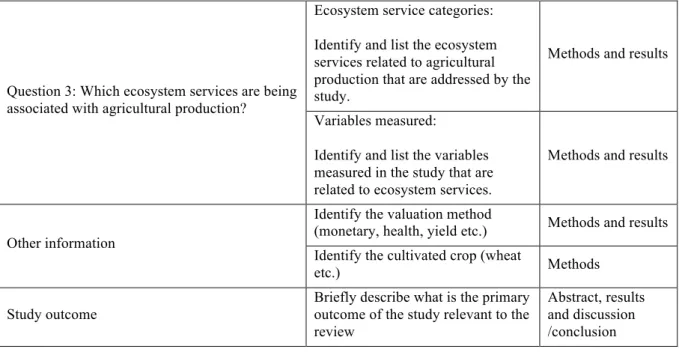
Table 2.3: Data extraction strategy

23

Table 2.4: Search terms for extracting data on regulating ecosystem services

24

Table 3.1: Ecosystem services; main and sub categories in reviewed studies

31

Table 3.2: Groups of agricultural interventions

32

Table 3.3: Groups of main motivations

33

Table 3.4: Chi-square test results: motivation by intervention

35

Table 3.5: Chi-square test result: ecological intensification a interventions

39

Table 3.6: Examples of ecological intensification from reviewed articles

40

Table 3.7: Chi-square test result: motivation by ecological intensification

42

Table 3.8: Groups of ecosystem services

43

Table 3.9: Chi-square test result: ecological intensification by ecosystem services

44

Table 3.10: Chi-square test result: motivation by intervention within ecological

intensification

46

Table 3.11: Chi-square test result: ecosystem services by intervention within ecological

intensification

47

Table 3.12: Chi-square test result: motivation by ecosystem services within ecological

intensification

48

Table 3.13: Chi-square test result: motivation by intervention within those not including

ecological intensification

49

Table 3.14: Chi-square test result ecosystem services by intervention within those not

including ecological intensification

50

Table 3.15: Chi-square test result: motivation and ecosystem services within those not

including ecological intensification

51

Table 3.16: Chi-square test result: motivation by ecosystem services

53

Table 3.17: Co-occurrence of ecosystem services in reviewed studies

54

Table 3.18: Association between crop systems and ecosystem services within

ecological intensification

55

(11)

VI

ecological intensification

58

Index of figures

Figure 1.1: Examples of effects of ecological intensification practices on regulating

ecosystem services

6

Figure 1.2: Agricultural limits and alternatives for global food production

7

Figure 2.1: Number of studies addressing agricultural interventions in database I

18

Figure 2.2: Database II: summary of systematic review stages

22

Figure 3.1: Final number of studies per intervention in Database I

27

Figure 3.2: Final number of studies per intervention in Database II

27

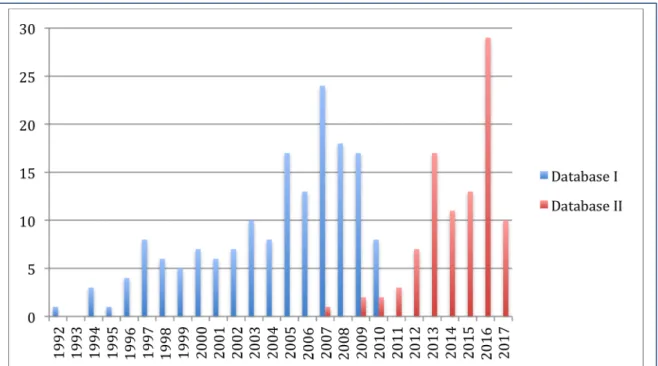
Figure 3.3: Number of studies per year, database I and database II

28

Figure 3.4: Number of studies per country

29

Figure 3.5: Map with distribution of studies

29

Figure 3.6: Distribution of study length in reviewed literature

30

Figure 3.7: Percentage distribution of motivations

33

Figure 3.8: Number of studies per agricultural intervention within the two motivations 34

Figure 3.9: Examples of ecological intensification

36

Figure 3.10: Agricultural intervention, ecosystem sevices and motivation within

articles explicity including ecological intensification practice

37

Figure 3. 11: Relative frequency of agricultural intervention types in groups of studies

including, or not, examples of ecological intensification and divided by

dominant motivation

38

Glossary of acronyms

ABT - Aichi Biodiversity Targets

AES – Agri-environmental schemes

CAP – Common Agricultural Policy

CBD – Convention on Biological Diversity

CICES – Common International Classification of Ecosystem Services

FAO - Food and Agriculture Organization of the United Nations

IFM – Integrated farming management

MEA - Millennium Ecosystem Assessment

SDG – Sustainable development goals

(12)

VII

(13)

1

1 Introduction

Food security and biodiversity conservation are key challenges for the 21st century (Glamann

et al. 2017). Increased food production needs to happen with minimized harm to biodiversity

(Pretty et al. 2010). The green revolution of the 1970s assumed that chemical fertilizers could

maintain and increase the soil fertility, enabling more intensifying practices (UN, 2013a).

These practices caused organic matter in cultivated soils to decrease in the 20th century,

leading to a decline in soil fertility and productivity (UN, 2013a). Moreover, between

11-15% of all global emissions come from farms, specifically industrial practices relying on

chemical fertilizers, petrol for heavy machinery and methane from the high density of

livestock (UN, 2013b). While industrial agriculture is causing high cost to the environment,

hunger continues to be a global challenge (UN, 2013c). By 2030 the greenhouse gas

emissions from agriculture methane (CH

4

) and nitrous oxide (N

2

O) are expected to increase

by 35-60%, in response to population growth and diet change (UN, 2013d). Although the

industrialized agriculture has succeeded in reducing hunger, by the increased food production

since the 1990s, its expansion also resulted in biodiversity loss (Kremen et al. 2012,

Bommarco et al. 2013 & FAO, 2017). With a population growth expected to reach 9 billion

by 2050 (Tittonell, 2014), food production needs to consider biodiversity conservation in

order to provide long-term security (Kremen et al. 2012).

Biodiversity conservation and food security have until recently been dealt with separately,

having their own respective scholar debates and understanding, but the awareness of the

interrelation between these two issues in the way to deal with a growing human population

have brought them together (Glamann et al. 2017). Conventional farming still relies on

external inputs. Although there have been improvements, climate change, water pollution,

degradation of land and losses in biodiversity are still happening, and the exceeded planetary

boundary for human modification of the nitrogen cycle requires the intensive agriculture in

the future to be input critical (UN, 2013e). Seufert et al. (2017) argue that since the primary

purpose of agriculture is production, the environmental impact should be examined by per

unit output rather than per unit area, which indicates that higher yield by intensive farming

could counteract the impacts because more land could be taken out of production for

restoration of natural ecosystem. The actual goal and challenge is to enhance food security,

ensure sufficient availability, access, and utilization of nutritious food. A growing food

(14)

2

demand from an increasingly wealthy population, together with the negative externalities to

biodiversity, show that food and biodiversity are part of a complex socio-ecological system

(Fischer et al. 2017). About 47% of the total European Union territory is occupied by

agriculture. The intensifying farming practices from the 1940s have been linked to a

widespread decline of several farmland species such as birds, mammals, arthropods, and

flowering plants (Randall et al. 2012). One of the key messages from the United Nations

“Wake up before it is too late” review of trade and environment (UN, 2013) is that the

agricultural development needs a paradigm shift from the ”green revolution” to an

”ecological intensification”. This paradigm shift indicates a significant and rapid change

from farming, based on monocultures and industrial production, depending on the high

supply of external inputs, to a diversity of regenerative and sustainable production systems,

also including small-scale farmers. Agricultural management needs to be seen as a holistic

approach, recognizing that in addition to agricultural goods, agro-ecological systems also

provide public goods and services, such as landscape, energy, biodiversity, soil, water and

recreation (UN, 2013d).

1.1 International goals towards the enhanced sustainability of farming systems

Future agriculture should adapt to reduce the impacts on biodiversity and reduce emissions

causing climate change, by mitigation and adaptation actions promoting more resilient

societies (European Commission. 2013a & 2015). In 2015, the parties to the United Nations

adopted, at the Conference of the Parties in Paris (COP 21), the Sustainable Development

Goals (SDG) towards 2030, which entered into force in 2016. The vision for this new

sustainable development agenda is that “We recognise that people are at the centre of

sustainable development and, in this regard, we strive for a world that is just, equitable and

inclusive, and we commit to work together to promote sustained and inclusive economic

growth, social development and environmental protection and thereby to benefit all” (UN,

2012).

Each of the 17 goals has specific targets to be achieved within the next 15 years. The

Sustainable Development Goals related to farming are recognized as SDG 2, SDG 12, SDG

13, SDG 15. SDG 2 - Zero hunger - has the aim to end hunger and malnutrition, with the

commitment to the universal access to sufficient, safe and nutritious food all year around.

This is achieved by a resilient agriculture and a sustainable food production system. For

boosting the agricultural productivity, the access to land, technology, markets and the

(15)

3

international infrastructure and technology investment cooperation should be equal (UN,

2015, Goal 2). SDG 12 - Responsible consumption and production - for achieving

development and economic growth, goods, and services should be produced to improve the

life quality. The use of natural resources, toxic materials, pollutants and waste should be

minimized throughout the whole production and consumption process, to enable

development and sustainable growth (UN, 2015, Goal 12). SDG 13 - Climate action – focus

on a key threat to development, which is climate change; this goal calls for an urged action to

combat climate change and minimize its disturbance. For building a resilience and adaptive

capacity to the effects of climate change, with low-carbon pathways and to speed up the

reduction of greenhouse gas emissions, an international cooperation is needed (UN, 2015,

Goal 13). SDG 15 - Life on land - this goal focuses on sustainable management of forest,

restoration of degraded land, combating desertification, and biodiversity loss and reduce the

natural habitat degradation (UN, 2015, Goal 15).

In addition to the SDGs, the Aichi Biodiversity Targets (ABT), adopted by the parties to

the Convention on Biological Diversity (CBD) at the 10th conference (COP 10) in 2010, are

also relevant to guide actions towards sustainable farming systems. The 20 Aichi targets are

part of the CBD strategic plan for 2011-2020 (UN, 2012). The 20 targets are grouped into 5

strategic goals: “Address the underlying causes of biodiversity loss by mainstreaming

biodiversity across government and society” (Strategic Goal A), “Reduce the direct pressures

on biodiversity and promote sustainable use” (Strategic Goal B), “Improve the status of

biodiversity by safeguarding ecosystems, species and genetic diversity” (Strategic Goal C),

“Enhance the benefits to all from biodiversity and ecosystem services” (Strategic Goal D),

and “Enhance implementation through participatory planning, knowledge management and

capacity building” plans (Strategic Goal E)”. While several of the ABT are relevant in

guiding the management of agricultural systems, three of them are particularly relevant for

sustainable food production: ABT 3 (subsidies and incentives harmful to biodiversity should

be eliminated by 2020 and be replaced by incentives positive for conservation and the

sustainable use of biodiversity), ABT 7 (the areas under agriculture, aquaculture and forestry

should by 2020 be managed sustainably for ensuring biodiversity conservation), and ABT 14

(restoration and safeguarding ecosystems that provide essential services, like services related

to water, and contribute to health, livelihoods, and well-being) (CBD, 2010).

(16)

4

Also at the global level, the Food and Agriculture Organization of the United Nations

(FAO) sets four strategic objectives for food production: 1) Help eliminate hunger, food

insecurity and malnutrition; 2) Make agriculture, forestry and fisheries more productive and

sustainable; 3) Reduce rural poverty; enable inclusive and efficient agricultural and food

systems; 4) Increase the resilience of livelihoods from disasters (FAO, 2013a). Of special

relevance is the second objective, which states the importance of innovative agricultural

approaches for increasing productivity, natural resource conservation and efficient and

sustainable use of inputs. It is required a holistic view of the agriculture sector with the

natural resources connected to it, introduced by technologies and sustainable production, that

promote the conservation and ecosystem service use (FAO, 2013a).

At the European level, the EU Biodiversity Strategy for 2020 recognizes the need for

reversing the degradation of biodiversity and ecosystem services in the region. It is composed

of 20 actions divided by six headline targets. Out of the six headline targets, Target 3, on

sustainable agriculture and forestry, is of special interest. This target states that the efforts to

reduce the biodiversity and ecosystem services degradation are far from sufficient, especially

with the knowledge of the important benefits these provide and calls for a measurable

improvement by 2020 (European Commission, 2011). The European Commission has

included the questions on how to best produce sustainable food, including protection,

maintenance, and enhancement of biodiversity on farmland into the recent consultation of the

Common Agricultural Policy, and by that confirming the need of understanding the benefit

provided by biodiversity in order to ensure value for money and continue to improve the

agri-environmental schemes (Randall et al. 2012). Rural development is considered to be

fundamental for climate change mitigation and adaptation, by “restoring, preserving and

enhancing ecosystems dependent on agriculture and forestry” and “promoting resource

efficiency and supporting the shift towards a low carbon and climate resilient economy in the

agriculture, food and forestry sectors” (European Commission, 2013a &2015).

All the international strategies and goals described above recognize the relevance of

biodiversity and ecosystems for human well-being in particular, in regard to food production,

but also their vulnerability to human activities, and consequently, the urged need for

implementing approaches such as ecological intensification which intends to work together

with ecosystem services and biodiversity, enhance and restore ecosystem functioning, while

maintaining or enhancing the levels of agricultural production.

(17)

5

1.2 Ecological intensification

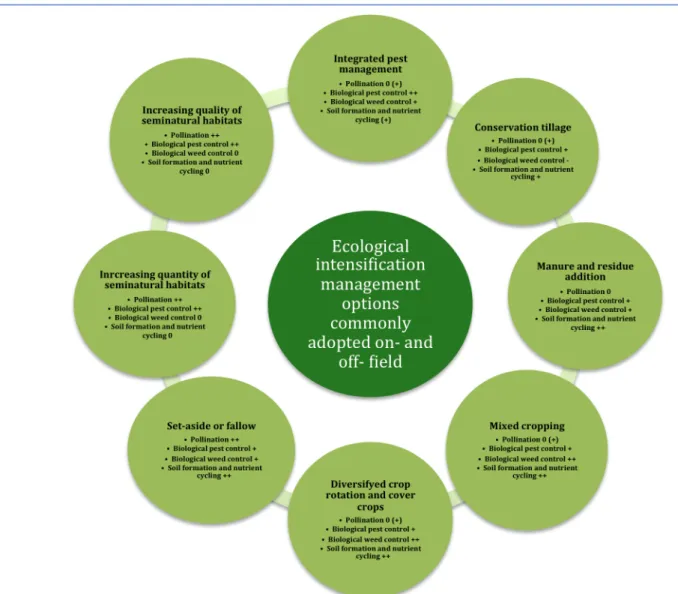
Ecological intensification (Figure 1.1) has been proposed as a solution to cope with the

challenge of providing food security while minimizing the degradation of biodiversity and

environment (UN, 2015). More specifically, ecological intensification aims to reduce the

reliance on external inputs by reestablishing soil and landscape ecosystem services, and

optimizing ecosystem services to maintain or enhance food production.

Sustainable intensification is another strategy for enhanced food productions, which

overlaps and can be confused with the concept of ecological intensification. Both sustainable-

and ecological intensification are referred to in the scientific and development literature as

alternative sustainable production models to feed the world today and in the future

(Bommarco et al. 2013, Pretty et al. 2011, Doré et al. 2011 & Kremen et al. 2012).

Sustainable intensification focus on the smart use of external inputs to increases production,

while reducing negative environmental impact, while ecological intensification focus on the

intensive and smart use of ecosystems’ natural functionalities to increase production. While

sustainable intensification works at the scale of the single crop or agricultural field,

ecological intensification goes beyond that, since support and regulation services are

underpinned by the complexity of ecological processes at a landscape scale (Tittonell, 2014).

In Europe where agricultural activity already attains high yields these are often dependent

on unsustainable levels of external inputs. In such case, the challenge for ecological

intensification is to reduce this reliance while maintaining high productivity through the

reestablishment of soil and landscape ecosystem services. Where productivity is not that

high, production could be enhanced through the optimization of ecosystem services rather

than by increased external inputs (FAO, 2013b). Ecological intensification has the challenge

to re-establish the ecosystem services on a landscape scale in order to provide ecological

resilience, which in hand could reduce the dependence of external inputs, and enable the

maintenance of production levels (Bommarco et al. 2013 & FAO, 2013b). Ecological

intensification promotes multifunctional agro-ecosystems, proposing landscape approaches,

that in an intelligent way make intensive use of the natural functionalities of the regulating

ecosystem services, to produce the same or more than conventional farming (Tittonell, 2014).

By strengthening the contribution of ecosystem services to agricultural production,

(18)

6

agricultural systems can reduce the reliance on external inputs and sustain agricultural

productivity (Bommarco et al. 2013).

Figure 1.1 represents some options for ecological intensification management, with the link

to their impact on the regulating ecosystem services.

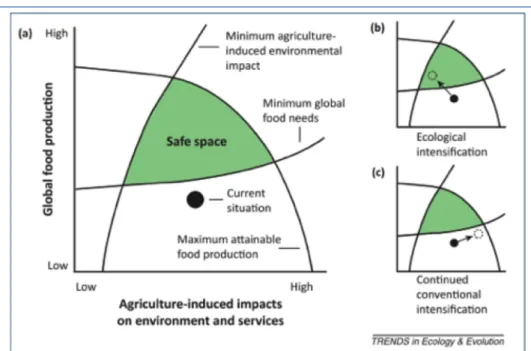
With the need for reduced agricultural impact on the environment and ecosystem services

and a continued high food production, the plots in Figure 1.2 show the safe space (in green),

where the production optimally should be within. As illustrated the current situation (a) does

not fulfill the global need for food, and by continuing the same way (c) the food production

could have a small increase but with extremely high impact to the environment and

ecosystem services. Ecological intensification (b) provides a solution, which moves into the

Figure 1.1: Examples of effects of ecological intensification practices on regulating ecosystem services: 0 no

impact, (+) likely but unproven positive impacts, - overall negative impacts, + moderate positive impacts,

++strong positive impacts. Information adapted from table 1 in Bommarco et al. 2013.

(19)

7

safe space and increases the food production with less negative impacts on ecosystem

services and environment.

1.3 Ecosystem services and biodiversity

Biodiversity is the “the variability among living organisms from all sources including,

inter alia, terrestrial, marine and other aquatic ecosystems and the ecological complexes of

which they are a part; this includes diversity within species, between species and of

ecosystems” (CBD, 1992). Changes to biodiversity have effects on ecosystem’s functioning,

resilience and the supply of ecosystem services, which have impacts on human well-being

(MEA, 2005).

Ecosystem services are the benefits and value that people receive from ecosystems,

through their functions and processes (Bullock et al. 2011 & MEA, 2005). The Millennium

Ecosystem Assessment (MEA) divided the ecosystem services into four categories, namely:

provisioning, regulating, cultural and supporting services (MEA, 2005). Provisioning,

regulating and cultural services provide services that are enjoyed by people while the

supporting services underpin those three categories (Heines-Young. et al. 2010 & MEA,

2005). In the follow up of the MEA, a new classification, the Common International

Classification of Ecosystem Services (CICES), has been proposed, which provides a

classification of the final ecosystem services (Heines-Young et al. 2013), the aim is to avoid

Figure 1.2: Agricultural limits and alternatives for global food production in the

current situation (a) and two scenarios for the future, ecological intensification (b)

and continued conventional intensification (c), adapted from Bommarco et al. 2013.

(20)

8

double counting in ecosystem assessments, particularly in economic valuation. Intermediate

services, namely supporting services, that are not directly enjoyed by people are either not

included in the CICES classification or included under regulating and maintenance services.

The CICES classification will be used in this thesis (Table 1.1). Specified, the two-level

categorization used by Boerema et al. (2017), which builds on the CICES classification

system.

Human activities, agricultural land use in particular (Seufert et al. 2017), have caused

worldwide ecosystem changes leading to severe biodiversity loss and affecting the delivery

of provisioning services, thus threatening long-term sustainable development worldwide

(Bullock et al. 2011 & CBD, History of the Convention). By managing diversity both in-field

and off-field ecologically intensive farming systems, compared to conventional systems,

have the ability to provide higher levels of regulating ecosystem services (Tittonell, 2014),

such as pest regulation, crop pollination, and soil nutrient cycling which support food

production (Seufert et al. 2017). Ecosystem services are valued differently, the provisioning

services like food, fiber, and energy are valued high, regulating services tend to be

undervalued because the value to humans is indirect (Heines-Young et al. 2010 & Bommarco

et al. 2013). However, regulating services underpin agricultural production, therefore, their

deterioration can limit production output. The integration of ecosystem services, such as pest

control, water retention and nutrient cycling into the agricultural management can have

long-term positive impacts on agricultural production, maybe even at reduced cost (MEA, 2005)

and have less negative externalities than an increased conventional intensification

(Bommarco et al. 2013). As human life depends on biodiversity and ecosystems, degradation

Table 1.1: Sub-categories of provisioning, regulating and cultural ecosystem services (adapted from Boerema

et al. 2017).

Provisioning

Regulating

Cultural

1. Food production

2. Water Provisioning

3. Materials & Fibre

4. Energy & Fuel

5. Genetic Resources

6. Medicinal Resources

7. Ornamental Resources

8. Water Purification

9. Water Regulation

10. Air Quality Regulation

11. Soil Quality Regulation

12. Soil Retention

13. Climate Regulation

14. Pollination

15. Life Cycle Maintenance

16. Biological Control

17. Recreational & Tourism

18. Scientific & Educational services

19. Heritage,

Cultural,

Bequest,

Inspirational & Art

20. Aesthetic Services

21. Symbolic, Sacred, Spiritual &

Religious Services

(21)

9

needs to slow down or be reversed (MEA, 2005 & UN, 2015). Because it is indicated that a

full restoration of the historical characteristics of biodiversity and ecosystem services is not

always beneficial or possible, it is suggested that it is sufficient and more easily achieved to

restore an ecosystem until it delivers the required services (Bullock et al. 2011).

1.4 Interventions in agricultural systems

Ecological intensification cannot be generalized into one single model or intervention, as the

practices depend on the context, the specific ecosystem, and landscape (Tittonell, 2014).

Interventions such as organic farming, integrated farm management, and agri-environmental

schemes, are often considered for their ability to conserve biodiversity in temperate Europe

(Randall et al. 2012). These interventions may include ecological intensification practices

that minimize anthropogenic inputs by managing the regulating ecosystem services, such as

to improve biological pest control, insect pollination, and minimize environmental impacts,

support- and increase biodiversity on farmland (Bommarco et al. 2013). The next sections

provide a general introduction to the three interventions in consideration: organic farming,

integrated management farming management, and agri-environmental schemes. Organic and

integrated farming are options within the agri-environmental schemes and conventional

farming could choose options within the schemes to improve biodiversity.

1.4.1 Organic Farming

The main goal of organic farming is to produce food as natural as possible so that the natural

life-cycle is respected and human environmental impact is minimized (European

Commission, 2017a & EU, 2007). In 2007, the European Council of Agriculture Ministers

agreed on a new regulation for organic production, which respects the natural cycles and

systems. To achieve biological sustainability, mechanical production processes and

land-related production should be used and without the use of GMOs. These aims were set as a

new course in developing organic farming: i) sustainable cultivation systems; ii) a variety of

products with high quality; iii) environmental protection get higher focus; iv) biodiversity

gets more attention; v) animal protection gets higher standards; vi) consumer confidence and

interest protection. Preferable is the utilization of a closed cycle of resources, where internal

on-farm resources are being used, rather than external inputs, but in cases where external

inputs have to be used, they should be organic and from other organic farms, natural

substances, naturally obtained or the mineral fertilizer should be of low solubility.

(22)

10

In cases where no other suitable alternatives exist, synthetic resources and inputs can be

permitted in organic production, to a minimum and where appropriate for a limited time

(European Commission, 2017b & EU, 2007). Organic food has experienced an increased

demand as a result of the rising concerns about sustainability, environmental impact and

health effects (Randall et al. 2012). Organic management has clear benefits to wildlife

biodiversity at farmland, typically 40 to 50% increase in organism abundance (Seufert et al.

2017). According to the Food and Agriculture Organization of the United Nations (FAO),

organic agriculture is a system that instead of external agricultural inputs relies on ecosystem

management. Synthetic fertilizers and pesticides, additives and irradiation, veterinary drugs

and genetically modified seeds and breeds are replaced with management that is on-site

specific and ought to increase and maintain soil fertility, prevent pest and diseases in the long

run. Biodiversity, biological cycles, and biological soil activity are through the holistic

production management system being promoted and enhanced (FAO, 1999). Many of these

management types are in hand with ecological intensification management options (Figure

1.1) (Bommarco et al. 2013). The International Federation of Organic Agriculture

Movements (IFOAM) describes four principles of organic agriculture: i) the principle- of

health, ecology, fairness, and care; ii) the health of soil, plant, animal, humans, and planet

Table 1.2: Definition of the main agricultural interventions and strategies considered in this thesis.

Conventional farming

-Is defined as mainstream agriculture dominantly practiced today,

representing both high-input and low-input systems, depending on the region

(Seufert et a. 2017).

Organic farming

-Is a farming system following organic certification guidelines (e.g., avoid

synthetic fertilizers and pesticides) and that is intentionally organic

(excluding organic-by-default systems that do not apply synthetic inputs due

to lack of access) (Seufert et a. 2017).

Integrated farming

management

-Aims to minimise pesticides and fertilisers use through better targeting, and

integration with cultural control of weeds, pests and diseases (Randall et al.

2012).

Ecological intensification -Based on intensive and smart use of the natural functionalities offered by

the ecosystem to increase or continue high agricultural production (Gonzáles

de Molina & Casado, 2017 & Tittonell, 2014).

Sustainable

intensification

-Refers to a production form that delivers increased food production by

continued intensification of the existing agricultural land, without adverse

impact to the environment, in a way that the future capacity of food

production is not undermined (Gonzáles de Molina & Casado, 2017).

Agri-environmental

schemes

-Is a scheme, which financially compensates farmers for any income loss

due to the introduced measure, meant to increase environment and

biodiversity (Kleijn &Sutherland 2003). Organic farming and integrated

farming management are part of the options.

(23)

11

should be sustained and enhanced as one, not divided; iii) ecological systems and cycles are

the basis, in which organic agriculture should work together with, imitate and sustain, and iv)

fairness should be ensured through relationships with regards to the common life and

environmental opportunities. A precautionary and responsible management provides care and

protection for health and well-being of today’s people, future generations and the

environment (IFOAM).

1.4.2 Integrated farming management (IFM)

Also called integrated crop management is considered as an alternative to organic farming,

by using improved targeting methods and integrated cultural control of diseases, pests, and

weeds. IFM aims to minimize the need for fertilizers and pesticides. (Randall et al. 2012 &

Alvarez et al. 2001) According to LEAF-Linking Environment and Farming

(

http://www.leafuk.org/leaf/farmers/LEAFs_IFM/Whatisifm.eb

),

a

UK

agricultural

organization, integrated management farming delivers sustainable farming through a whole

farm business approach. Its management enriches the environment and local communities’

engagement by applying the best out of both modern technology and the traditional methods,

delivering prosperous farming. IFM is said to not only be environmentally responsible and

socially acceptable, but even efficient and providing a profitable production (LEAF,

Retrieved: 16.02.17). IFM aims to optimise and sustain all use of on-farm resources, which

include staff, machinery, capital, soil, water, air, wildlife habitats, archaeological features,

and landscape. Easily said it increases the productivity while protecting the valuable

resources (LEAF, Retrieved: 16.02.17). The James Hutton Institute which does research in

developing the needs for LEAF describe IFM as follows: commits to good animal welfare

and husbandry; uses appropriate cultivation techniques and efficient soil management; uses

crop rotations; has minimized reliance on fertilisers and chemicals for crop protection; relies

on a careful selection of seed varieties; contributes to maintain rural communities and

landscape; contributes to enhance wildlife habitat; commits to team spirit through

communication, training and involvement (

http://www.hutton.ac.uk/learning/leaf/ifm

).

Integrated crop management is considered by the European Commission to be of

particular importance, having the capacity to ensure a good environmental outcome in

modern farming (Randall et al. 2012). The holistic approach to sustainable agriculture that

integrated crop management offers includes socio-economic and environmental factors, with

(24)

12

the aim of long-term benefit. Soil, pest, water and landscape management, seed and planting

material, crop rotation and nutrition are carefully selected for the particular local condition

and climate. It adapts to changing conditions, combining new research and technologies with

the local knowledge (CABI, Retrieved: 27.02.17).

1.4.3 Agri-Environmental Schemes

Environmental concerns are increasingly important in the Common Agricultural Policy

(CAP). The largest amount of EU´s funding goes to the rural development measures, directed

to incentives towards sustainable management of natural resources, ecosystem preservation

and increased valorisation of the landscapes diverse environment and condition (European

Commission, 2013b). The EU-Agricultural policy introduced the agri-environmental

schemes as early as in the late 1980s, and it became compulsory for all member states by

1992 (European Commission, 2017c). Farmers who voluntary subscribe to commitments

related to the environmental preservation and maintaining the countryside are provided with

payments. The payment to farmers for delivering environmental services is meant as

encouragement to protect and enhance farmland environment. The farmer’s transfer to

farming techniques that are environmental-friendly requires a minimum commitment of 5

years. The farmer is economically compensated for the additional costs and income losses

relating to the adoption of environmental-friendly farming practices.

Environmental outcomes provided by agriculture are being demanded by society, this is

where the compensation payment helps as an encouragement in the adoption process to levels

of production or agricultural activities that improve the environment, with less concern for

profitability. Some of the commitments under the national and regional agri-environmental

schemes include extensive farming in environmental favour, low-intensity pasture systems

management; organic agriculture and integrated farm management; conservation of

high-value habitats- and their biodiversity; preservation of landscape and historical features. For

instance, ecological compensation areas such as strips of herbaceous and wildflower in

intensively farming landscapes are of high value. They support a rich diversity and density of

plant, insects, and birds, as well as diverse and highly productive communities of mammals,

which are important for maintaining biodiversity in agricultural landscapes (Aschwanden et

al. 2007). Transparency and applicability at all levels of a farming system make it a tool

important for the achievement of environmental goals (European Commission, 2017c).

The effectiveness of the Agri-environmental schemes to conserve or increase biodiversity

has been examined in several studies (Kleijn et al. 2006 & Kleijn et al. 2003). The various

(25)

13

outcomes are strongly influenced by how the scheme is implemented and designed (Kleijn et

al. 2006). Inadequate location of the measure, pure coverage of the necessary resources or the

landscape structure, can reduce the positive outcomes of agri-environmental schemes

(Randall et al. 2012). Moreover, there is often a dependency on payments, that is, the use of

good environmental practices are only maintained as long as payments are given (e.g

Albrecht et al. 1998). Moreover, agri-environmental schemes often pay for the

implementation of environmental-friendly farming practices; instead of monitoring and

paying for the output of that implementation (i.e., payment-by-results; Reed et al. 2014 &

Birge et al. 2017).

1.5 Objectives

As introduced, intensive food production is today a cause of environmental impacts, affecting

biodiversity and ecosystem services that are crucial for long-term food security. Ecological

intensification has been put forward as a solution to increase food security today and in the

future, by introducing a management approach that uses biodiversity and ecosystem services

to support agricultural production, while maintaining or even increasing the level of

production (Bommarco et al. 2013). Economic costs and benefits estimates associated with

integrating ecosystem services into farming practices are increasing in availability,

demonstrating the economic benefits that agricultural production is receiving from regulating

and supporting environmental services, as well as the cost associated with these targeted

managements (Bommarco et al. 2013).

Ecological intensification interventions should not cause a decrease in production, for both

the farmer’ profit and for food provisioning. The farming community decision on adapting

ecological intensification strategies is affected by the final output yield, economic costs, and

benefits (Bommarco et al. 2013). According to recent ecosystem service valuation studies the

economic benefits from restoration are suggested to outweigh the economic costs (Bullock et

al. 2011), and the land can perform the same or more functions in agroecosystems managed

correctly, without increased land costs (Gonzáles de Molina et al. 2017). Another main goal

of ecological intensification relates to the need for improving biodiversity condition and

minimizing environmental impacts from agricultural activity. These goals are particularly

relevant where agricultural production is approaching maximum yields, but should also be a

priority for closing existing yield gaps around the world to support food security (Bommarco

et al. 2013). The management and use of ecological processes, such as in ecological

(26)

14

intensification, is suggested to be beneficial for modern agriculture, ensuring an

environmentally friendly production (Bommarco et al. 2013).

In summary, ecological intensification emerges as a potential response to the current

challenge of increasing food production while minimizing environmental impacts. While

interrelated, the motivations for the adoption and support of ecological intensification can be

primarily linked to environmental sustainability concerns or to food production, and in the

latter case to better food quality or reduced production costs.

The objective of this thesis is to assess the current relative importance of each of these

motivations, to better understand which factors are driving the adoption of ecological

intensification and also to identify potential knowledge gaps that could be explored in future

research. More specifically, a systematic review of literature will be conducted to address the

following questions:

1. Which of the motivations; enhanced food production or mitigation of impacts on

biodiversity, is the primary motivation behind the adoption of agricultural interventions

(organic farming, integrated farm management, and agri-environmental schemes) that can

make use of ecological intensification approaches, specified into two sub-questions:

a. Do the interventions primarily aim to restore or conserve biodiversity to mitigate the

impact of agricultural activity?

b. Do the interventions primarily aim to enhance biodiversity to promote, increase

agricultural production or increase economic profit?

Further, I wish to obtain the current practice of ecological intensification by reviewing the

studies for management that could be related to ecological intensification,

2. Do the studies include examples of practices related to ecological intensification?

Since ecological intensification is about smart use of biodiversity and ecosystem services for

enhanced agricultural production, the review will identify which ecosystem services are more

often subject to direct management.

3. Which ecosystem services are being included in studies, and of concern for agricultural

activity?

(27)

15

2 Methods

2.1 Systematic review: general goals and methods

“A systematic review is a literature review that is designed to locate, appraise and synthesize

the best available evidence relating to a specific research question to provide informative and

evidence-based answers” (Boland et al. 2013, p.3). It is considered the best way to synthesize

the findings from several studies that address the same question, following clearly defined

and transparent steps (Boland et al. 2013). Academic and scientific communities have

increasingly recognized the value of systematic reviews (Boland et al. 2013 & CEE, 2013).

Doing systematic review requires the development of a research question, a critic analysis

and a synthesis of findings and finally the use those findings to generate recommendations.

Systematic reviews can in combination with expert judgment bring to surface decisions about

new interventions or policy changes (Boland et al. 2013 & CEE, 2013). For the current

review, the guidelines from the “Collaboration for Environmental Evidence” (CEE, 2013),

together with “Doing a Systematic Review- A Student’s Guide” (Boland et al. 2013) have

been used.

The first step towards a systematic review is the production of a systematic map, which may

be used to inform one or more systematic reviews. Accordingly, part of the review for this

thesis made use of an existing systematic map about “The effectiveness of integrated farm

management, organic farming and agri-environment schemes for conserving biodiversity in

temperate Europe”, produced by Randall and James (2012). Their method will be described

briefly in the next subsection. A systematic map results from a literature search and delivers

an overview of the available evidence, nature, volume and characteristics of the literature on

a particular field. Systematic maps are used to narrow down (previously) open-framed

questions, on the basis of the evidence available (CEE, 2013). Systematic maps are therefore

used to identify and categorize relevant literature into factors that can be useful to structure

systematic reviews (Randall et al. 2012). Systematic reviews and systematic maps are robust,

repeatable and transparent scientific methods, which systematize the available literature on

the specific topic under study (CEE, 2013).

Systematic reviews may be complemented with meta-analysis. A meta-analysis is a

quantitative synthesis, which summarizes the data sets of all included studies in a weighted

manner regarding their reliability and sample size in order to construct one larger data set that

(28)

16

provides the summarized result (CEE, 2013). The meta-analysis is not required in a

systematic review but can be performed if the included studies contain sufficient similar data

and is sensible to combine them (Boland et al. 2013). As the objective of this thesis is to

understand the motivations behind implementing ecological intensification techniques, and

not to assess the effects of the several techniques, which would require dedicated searches for

quantitative data for each technique, only the systematic review was conducted.

2.2 The Randall and James systematic map

“The effectiveness of integrated farm management, organic farming and agri-environment

schemes for conserving biodiversity in temperate Europe - A systematic map” by Randall

and James (2012), provided a comprehensive database relevant to the goals of the present

thesis, hereafter designated as “database I”. In particular, their literature search is focused on

three main types of farming intervention: integrated farm management, organic farming, and

agri-environmental schemes. Hence, as this database includes interventions for biodiversity

conservation, it is considered highly relevant for studying ecological intensification, which is

about biodiversity conservation and ecosystem service improvement for supporting or

increasing agricultural production. The summary of the review methods used by Randall and

James (2012) are summarized in table 2.1.

Table 2.1: Summary of the methods used by Randall and James (2012).

Searches

Online literature databases and additional web searches were performed to identify relevant

literature. From each data source the first 50 hits were further examined. The search was done

in English. In order to pick up all variants of farm, farming etc., the wildcard (*) was used

with “farm”. Search strings:

-Farm*AND biodiversity;

-Organic AND biodiversity;

-Farm*AND (diversity or abundance) not fish;

-Agri-environment*(farmland or farming) AND bird*(Farm*AND invertebrate*) not fish;

-Agri-environment* AND biodiversity.

Each search result was imported, saved separately and a record was made including the date

of search, database name, search term, number of hits, date limits of database and notes. A

final library incorporating all the separate libraries was made.

Screening

articles for

relevance

First all duplicates were automatically removed, then the library was searched for relevant

topics by using the following inclusion criteria. Relevant subjects include some aspect of

farmland biodiversity or species diversity, on all scales. The biotopes; ponds, farm woodland

(29)

17

and orchards were excluded. Countries of studies included within temperate Europe were

defined as no countries south of France, Switzerland Austria, Hungary and Romania and all

countries west of Russia. Relevant interventions included some elements of increased

farmland biodiversity; organic farming, integrated farm management, agri-environment

schemes and specific options and biotopes that could be considered as part of one of these

three interventions. Conventional farming was used as comparator. Outcome of relevance was

considered to be studies including: any effects on organism(s) excluding bacteria, fungi and

agricultural pest; measurement of biodiversity; biodiversity differences or similarities between

farm types; biodiversity differences or similarities when changes on farmland performed. Any

type of study investigating farmland biodiversity was considered also correlative- and

manipulative studies. Excluding pure review papers, statistical models or ecology studies.

Only studies published in English language were included. No applied date restriction, only

the individual databases limits. To exclude irrelevant references in the initial library, filtering

keywords in the title was made. The references were only screened for relevance in title and

then by title and abstract, due to the high amount of relevant literature captured. References

accepted were used to form a searchable database. Each stage of the screening process a

record including numbers of references obtained and excluded.

Data

extraction

Keywords generated from the primary question, topics reported in the subject and expert

knowledge were used to describe, categorise and code the studies. The articles were

categorised with: author, full reference, publication date, type of publication, length of study,

country

of

study,

spatial

scale

of

experiment,

farming

system,

farming

intervention/prescription, biotope, organism, outcome, and experimental design. The

organisms in the studies were categorised into general groups and some subgroups according

to function. First the articles were coded by one reviewer then scrutinised by another.

Final

database

To describe the scope of the research and identify knowledge gaps the authors created a

searchable database, which can be used for further analyses. The database is available as

supplementary material of the article describing the systematic map.

(30)

18

2.2.1 Literature retrieval from the database

From the total Randall and James (2012) database of 743 articles, 241 articles were

considered relevant for inclusion in the final stage of the systematic review (Figure 2.1). The

included articles were then searched for at B-on (http://www.b-on.pt), Google Scholar

(https://scholar.google.pt) and a general web search, or requested directly from the author at

Researchgate (https://www.researchgate.net). From the 241 articles, 168 articles were

obtained and included for full-text review (Figure 2.1).

Articles not found in English were excluded. Also, because Randall and James (2012) focus

on interventions for biodiversity conservation, a bias towards biodiversity conservation

motivations may exist, so it was necessary to cover this gap by complementing with a new

literature search using keywords that cover agricultural production, as described in the next

section.

Figure 2.1: Number of studies addressing the four agricultural intervention types in database I, each

(31)

19

2.3 Complementary literature search and database

2.3.1 Search methods

As the Randall and James (2012) systematic map (database I) is about interventions for

biodiversity conservation, the primary motivation of the included literature may be biased

towards biodiversity conservation and less towards the effects on production. In order to

cover this gap a complementary and independent search of articles was conducted, which

includes both biodiversity and production related search terms. It has been decided to do the

search only in B-on (http://www.b-on.pt), as this search engine includes several of online

databases used by Randall and James 2012 and listed in Boland et al. 2013.

The search was performed in B-on, limited to the following disciplines: agriculture and

agribusiness, biology, botanic, environmental science, economy, consumer health and

zoology, and to English. The search strings (Table 2.2) were searched for in the full text and

the hits were sorted by relevance.

Description of search process:

• The six searches were done 10.05.2017, with the time interval 01.01.1950- 31.04.2017, a

record of the total number of hits was saved.

• Because of the high number of articles and the limited time, the first 300 articles within

each search, sorted by relevance, were selected for further screening totalizing 1800 articles.

• Duplicates were removed automatically using B-on tools; the final list, after merging the

six B-on searches, included 1043 articles.

(32)

20

Table 2.2: Search strings and number of hits by search. Searches were conducted using B-on search engine on

10.05.17.

Search string

Date limits

Total hits

Included articles

1: Farm* AND Organic AND (product* OR yield)

AND Biodiversity

01.01.1950-

31.04.2017

21 526

300

2: Farm* AND Organic AND (product* OR yield)

AND Biodiversity AND “Ecosystem services”

01.01.1950-

31.04.2017

4010

300

3: Farm* AND Integrated AND (product* OR yield)

AND Biodiversity

01.01.1950-

31.04.2017

19 668

300

4: Farm* AND Integrated AND (product* OR yield)

AND Biodiversity AND “Ecosystem services”

01.01.1950-

31.04.2017

4820

300

5: Farm* AND Agri-environment AND (product*

OR yield) AND Biodiversity

01.01.1950-

31.04.2017

1 573

300

6: Farm* AND Agri-environment AND (product*

OR yield) AND Biodiversity AND “Ecosystem

services”

01.01.1950-

31.04.2017

575

300

Total number of hits and included articles

52172

1800

2.3.2 Study inclusion criteria

The inclusion criteria used when searching for studies that include both production and

biodiversity is similar to those used by Randall and James (2012), to enable the combined

used of data.

Relevant subject: Studies including biodiversity or species diversity on farmland related to

food production. When mentioned that the crop production is used for biofuel and not for

food production, the articles are excluded. As in Randall and James (2012), all biotopes were

included, except ponds, farm woodland, and orchards. Similarly, includes studies were

conducted west of Russia and not south of France, Switzerland Austria, Hungary and

Romania, as defined in the systematic map as temperate Europe.

Relevant interventions: Integrated farm management, Organic farming, and

Agri-environmental schemes. Articles that mention conventional farming alone or together with

one of the other agricultural interventions, as an overall comparator, will also be included.

Comparator: Conventional farming is included in some studies as a comparator to

agri-environmental schemes, integrated management farming, and organic farming.

Type of outcome: Any measure of biodiversity, crop production or ecosystem property was

considered. Effects of interventions on any organism, excluding fungi and bacteria, namely

differences or similarities in biodiversity on different farm types, and differences or

similarities in biodiversity following management changes on farmland were considered.

Imagem

Figure 1.1 represents some options for ecological intensification management, with the link  to their impact on the regulating ecosystem services
Figure 1.2: Agricultural limits and alternatives for global food production in the  current situation (a) and two scenarios for the future, ecological intensification (b)  and continued conventional intensification (c), adapted from Bommarco et al
Figure 2.1: Number of studies addressing the four agricultural intervention types in database I, each  circle indicates the retrieved/initial number of selected articles.
Table 2.2: Search strings and number of hits by search. Searches were conducted using B-on search engine on  10.05.17
+7

Referências

Documentos relacionados