Quaternary elephants in Portugal: new data
M. T. ANTUNES+*
J.L.CARDOSO*
+AcademiadasCiencias de.Lisboa
*
Centro de Estratigrafia e Paleobiologia da UNL, Faculdade de Ciencias e Tecnologia, QuintadaTorre, P-2825 Monte de Caparica, Portugal.Cienciasda Terra (UNL) Lisboa N211 pp.17-37 1992
1
1
1
1
1
1
1
1
1 - 1
1
1
1
1
1
1 - 1
1
1
1
1
1
1
1
1
1
1
1
1
1
1
1
RESUMO
Palavras-chave: Elefantes- Quaternario- Portugal.
Alem do resumo de dados anteriores, apresenta-se a descricao deexemplares novos (*) ou ineditos, provenientes de jazidas quaternarias portuguesas - tufos de Condeixa; terraces do Tejo, perto do Carregado (*) e na Foz do Enxarrique (*); Gruta da Figueira Brava (*); Algar de Joao Ramos.
Na maior parte, sao atribufveis aElephas antiquus,a forma melhor representada. Material da Figueira Brava e do Algar de Joao Ramos pertence a Mammuthus primigenius,especie citada pela primeira vez em Portugal.
RESUME
Mots-ales: Elephants- Quaternaire- Portugal.
Outre une mise au point sur les donnees disponibles auparavant, on presente une etudeconcemantdes specimens nouveaux (*) ou inedits, recoltes dans les tufs calcaires de Condeixa; dans les terrasses du Tage pres Carregado (*) et
IiFoz do Enxarrique (*); dans le remplissage rnousterien (ca. 31000 BP) de la grotte de Figueira Brava (*); et dans I' Algar de Joao Ramos. La plupart des echantillons appartientIiElephas antiquus;des pieces de la Grotte de Figueira Brava et de I' Algar de Joao Ramos soot attribues
Ii Mammuthus primigenius, espece reconnue pour la premiere fois au Portugal.
ABSTRACT
Key-Words: Elephants- Quaternary- Portugal.
HISTORICAL DATA
The first account on fossil elephants in Portugal is that of Carlos RIBEIRO (1880). He reported the discovery at Mealhada of elephant remains ascribed by Albert Gaudry toElephas antiquus. A more de-tailed account was produced (RIBEIRO, 1884).
Paul CHOFFAT (1895-98) described a molar collected in the Condeixa tuffs and travertines, at the lower levels of this unit (conglomerates). Photo-graphs were sent by him to some distinguished paleontologists, i.e. Charles Deperet, who referred the specimen to Elephas meridionalis. However, Marcellin Boule and Pohlig classified it as an archaic Elephas antiquus. This opinion was adopted by Choffat.
References to portuguese quaternary elephants maybefound at Edouard Harle's memoir (HARLE, 1909/1910), but no further specimen was studied.
The opening ofa water well at Casal do Torquato near Carregado afforded some lamellae of one molar that were submitted to Eduardo Hernandez-Pacheco, who hesitatedbetweenElephas meridionalis andE. antiquus. R. S. PINTO (1931) ascribed this molar toElephas meridionaliscf.antiquus.
In 1941, Georges ZBYSZEWSKI (1943) col-lected some bones from an elephant (apparently killed by man) at the banks of a channel near Santo Antso do Tojal. A femur and a tibia were found in association with mousterian flint artifacts, an horse tooth and a coprolithe, reportedly from hyaena. Thirty years later, a phalanx (likely from the same indi-vidual) was found there again (ZBYSZEWSKI, 1977a). The same author produced some further references to a fossil elephant from Mealhada (ZBYSZEWSKI, 1977 b).
Until now, however, a single synthesis on the portuguese fossil elephants has been published (ZBYSZEWSKI, 1943). This paper deals with a revision of the previously known material and the description of some additional specimens.
LOCALITIES AND THEIR GEOLOGICAL SETTING
Elephant remains have been found at the fol-lowing sites[(*)caves;(+)terraces from the Mondego, Tagus or tributaries (Fig. 1)], whose age is given in bracketts:
- Mealhada(+)(Riss interstadial )
- Condeixa (+) (probably Mindel-Sicilian II insterstadial)
- Conimbriga(+)(the same as Condeixa) - Algar de Joao Ramos(*)(Wiirm IV, 14 170±
330BP)
- Foz do Enxarrique(+)(33 600
±
500 BP) - Casal do Torquato(+)(Riss- Wiirm, Eemian) - Carregado (motorway) (+) (as Casal doTorquato)
- Santo Antao do Tojal(+)(first Wiirm intergla-cial)
- Figueira Brava cave(*)(late Wiirm, 30 930
±
700BP)
- Santa Cruz (age not accurately known).
Mealhada
The discovery offossil mammals near Mealhada, in alluvial deposits from the Certima river lower terrace, was made during water well digging (last quarter of the XIX th century) at several points. Somewhat later, excavations were carried on under the sponsorship ofthe Geological Survey (RIBEIRO, 1880; CHOFFAT, 1895-98).
climate; this suggests instead that the fossil-bearing strata may be assigned to a Riss interstadial.
Condeixa
At Condeixa-a-Velha, near the ruins of the Ro-man town ofConimbriga, middle Jurassic limestones are overlain by some 5 to 6 meters of quaternary conglomerates with limestone elements, and these by a thick succession ofcalcareous tuffs and travertines. The latter define a platform at l00-IIOm.
A section was described by CHOFFAT (1894-95); he reported that an elephant molar was found (February 26th, 1894 at a point 700 m SW from Condeixa-a-Velha) inbed2, i.e., the conglomerates.
Conimbriga
The upper stratigraphic unit of tuffs and travertines (beds 3 and 4 of the section described by Choffat; see Condeixa) also yielded fossils. Most of these are impressions ofplant leaves. However, at the "Museu Monognifico de Conimbriga" is kept a frag-ment of a very large elephant tusk, not previously studied. No details are known about the precise point where it was found. It may tentativelybeassigned to bed 4, calcareous tuffs in thick layers. This finding is certainly rather old, and is most probably related to the ancient excavations of the Roman town made under the direction of Vergilio Correia.
Algar de
Joao
RamosThis site corresponds to part of the infilling of a karstic sinkhole in Jurassic limestones in the county ("concelho'') of Alcobaca. Excavations were carried on by M.Vieira Natividade, who exploited the neolithic and calcolithic beds (NATIVIDADE, 1899-1903). Pleistocene infillings were exploited later (1909) by Romao de Sousa (CARDOSO & CARREIRA, 1990).
The bone - richbedis overlain by reddish silty and argillaceous sediments, about 2 m in thickness, apparently devoid of fossils. A 14C date has been obtained for the fossiliferous layer: ICEN-349-14 170
±
330 BP (ANTUNESet al., 1989).Foz do Enxarrique
The Ribeira do Enxarrique is a small tributary of the right margin ofthe Tagus, close by Vila Velha de Rodao. A middle Paleolithic site is located just at the confluence. It has been excavated since 1982 and yielded large numbers oflithic implements and ver-tebrate remains. These materials have been found at
a bed with carbonate concretions related to a lower 5-10 m terrace of the Tagus. An elephant tooth lamella was recovered in 1985 (RAPOSO& SILVA, 1986), quite away from the area ofmaximum industries and fauna concentration (Raposo, personnal communi-cation), but it is contemporary of the remaining materials. The bed with concretions is covered by 6 meters of still pleistocene silts and sands (RAPOSO
& SILVA, 1987). A U series date: 33600
±
500 BP(RAPOSO, 1991), is in agreement with the terrace level chronology and indicates the survival of the elephant until the Wurm III. It is the latest reference forElephas antiquusin Europe.
Casal do Torquato
Two molar fragments accounted for by PINTO (1931) are from the same tooth as two additional ones secured later by H. da Costa Cabaco, All were found during the digging of a well at Casal do Torquato (Lugar da Torre, freguesia de Triana), i.e about 4 KIn southeast of Alenquer (PINTO, id.) or 1.5 KIn to the northeast ofCarregado (ZBYSZEWSKI, 1943). This locality concerns alow terrace ofthe right bank ofthe Tagus, at about 12 to 15 meters, that may be ascribed to the last interglacial (Riss-Wurm, Eemian).
The fossil was found 5 to 6 meters deep in a gravel and sandy bed with pebbles, overlain by yel-low clays with carbonate and lying on black clays (ZBYSZEWSKI, id., p.105).
ZBYSZEWSKI(1943)recognizedtbatthefrag-ments kept at the Museu Mineral6gico e Geologico, Faculdade de Ciencias, Universidade do Porto, for-merly studied by Pinto, as well as those from the Cabaco collection were parts of the same tooth. Zbyszewski persuaded Cabaco to offer the materials in. his possession to the Museum of the Servicos Geologicos de Portugal, where they were mounted together with one of the lamellae described by Pinto (the second one apparently was not located by Zbyszewski).
Recently, M.T.Antunes could observe it at Oporto; Professor M.Lemos de Sousa agreed in let-ting the specimenbestudied again. At last, we could ascertain that the two Cabaco's fragments corre-spond to both extremities of the tooth, whereas the lamellae studied by Pinto were from the intermediate part of the same molar (the 3d and the 4th counting from the distal end) (ZBYSZEWSKI, 1943, pUll).
Carregado (motorway)
.-- ;...
~~~~~~~~~~'~.~'-=
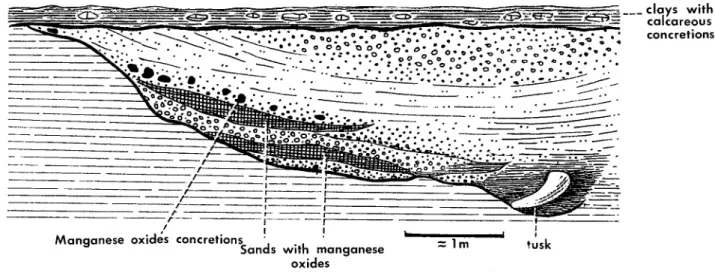
clays with~ .~ calcareous
concretions
Fig. 1 - Carregado motorway section.
Between Vila Franca de Xira and Carregado, at the "trincheira da Meirinha", M.T.Antunes found (March 24, 1977) the tip ofan elephant tusk (the only part that was exposed). Excavation was carried on the next day, by Antunes with help from O. da Veiga Ferreira, J. C. Pais, J. Cesar Lopes and Jose Relvas. The specimen was isolated but almost complete. It lied on the bottom of a channel cut in mostly clayey terrace deposits. No other fossil was found close by; only a rather atypical quartzite flake was collected there.
Santo Antiio do Tojal
The former "Junta de Hidraulica Agricola" pro-moted some draining works at the Baixa de Loures depression, situated to the Northeast of Lisbon. A channel was cut in sediments from the lower (5 to 8 meters) terrace that limits to the North this depres-sion, whose infillings are mainly modem alluvium.
In the channel banks, ZBYSZEWSKI (1943) collected in 1941 at several points some elephant and other mammalian remains. The main point is located 1080meters South27° West from the church ofSanto Antao do Tojal.
Much later, ZBYSZEWSKI (1977a) reported new findings at the same point, including a 1st phallanx, maybe from the same individual.
Elephant remains were in association with stone implements, among which two small silex flakes stuck into a femur. Hence it is possible that an elephant was killed and tom apart there, so it could possibly be expected to find some further bones nearby.
No radiometric date was obtained; a bone frag-ment sent to the Southern Methodist University (Dal-las, USA) for U - series dating failed to yield reliable results.
Figueira Brava cave
Figueira Brava cave is located at the southern versant ofthe Arrabida chain, at about 700 meters W
ofthe Portinho da Arrabida old fortress. As now, it is a cave opened in Miocene biocalcarenites, but it probably was a rock-shelter at middle Paleolithic (upper Mousterian) times. Stratigraphy is quite sim-ple. Sands rich in shells and bone fragments brought in by man and in stone implements, dated from between 30 and 31 thousand years BP (14 C, U series), directly overlie marine, Tyrrhenian III con-glomerates. In the outer, exposed parts the sands are calcite-consolidated into a hard breccia.
Mousterian sands are overlain by stalagmite deposits. At some points they are mixed up with much later deposits with Roman amphorae frag-ments and patina-less shells and some bones.
Paleolithic fauna is varied. It includes a few neanderthalian and many mammal remains (either large carnivores and other species hunted by man, and small mammals mostly brought in by owls), more than 30 species of birds, other vertebrates, crustaceans and mollusks (also collected for food by humans).
A more detailed account has been given (ANTUNES, 1992). Among the animal bones there are a few elephant tooth fragments.
Correlation with the well known rock shelter of Devil's Tower, Gibraltar, seems well established.
Santa Cruz
At Santa Cruz, near Santiago do Cacem, an elephant's unciform was found at the surface. Stratigraphy cannot be clearly recognized. However this specimen is possibly related to pleistocene de-posits that outcrop in this region-mainly rosy, some-times brownish or red sands and gravels, eventually showing black mineralisations by manganese ox-ides, lying upon Lias and Dogger formations (ZBYSZEWSKI, 1977a, p.133).
DESCRIPTION
Sacavem, to the Northeast of Lisbon), whose exact provenience is unknown, has been referred to by
CHOFFAT (1895-98), PINTO (1931) and
ZBYSZEWSKI (1943). It is kept at the museum of the Services Geo16gicos de Portugal. As the last author states, it belongs to a modem elephant maybe brought in by Romans and therefore is not a fossil at all. Indeed, a distinct loxodont sinus and grossly wrinkled enamel strongly point out to Loxodonta africana. Hence no further reference will be made in this paper.
Maximum length (1...) Operational
functional length (l...F) Max. width (A) Max.funct.width (AF) Height (H)
Enamel thickness (e), n=3 Number oflamellae as preserved (1')
Number of functional lamellae (U)
Functional laminar index, Q=I00U/LF 221.1 166.0 72.0 72.0 20.5 2.2 9.5* 9.5* 5.7*
Order Proboscidea ILLIGER, 1811 Family Elephantidae GRAY, 1821
GenusElephas L., 1758
Elephas antiquus FALCONER& CAUTLEY, 1847
(pI. 2, figs. 1-3; PI. 3, figs 1-4; PI. 4, fig. 3)
Localities
Mealhada
Several tooth and bone fragments are kept at Services Geol6gicos de Portugal, in Lisbon and at the Museu Mineral6gico e Geologico, Coimbra Univer-sity (ZBYSZEWSKI, 1943, 1977b). The most im-portant specimen, a molar, was referred to by C.
RIBEIRO (1880, 1884) and reported in his paperto E. antiquusaccording to Albert Gaudry and Charles Deperet (photographs having been submitted to them); however this specimen seems to be lost longtime ago and was not seen by Zbyszewski.
The same author (ZBYSZEWSKI, 1977b) as-cribes all the Mealhada specimens toE. antiquus,but he did not justify his viewpoints.
In our opinion, the enamel is too thin (about 2 mm) and too minutely wrinkled in an adult molar tooth lamella to belong toMammuthus meridionalis. Age and climate data concerning Mealhada also excludeM. primigenius. Hence we corroborate the determination asE.antiquus.
Condeixa
The specimen kept at the Services Geol6gicos de Portugal museum is poorly preserved. ZBYSZEWSKI (1943) regarded it as a molar, with-out more details. Indeed it is a lower right M 1 or M2, uncomplete at its mesial part. Small enamel "islands" are present since the 4th rear lamella. Poor preserv a-tion does not allow us to recognize whether loxodont sinus are present.
The measurements (in mm) and other data
*
are as follows (conventions as in AGUIRRE, 1968-1969):Length measures are not of much interest. Other ones were compared to those given by AGUIRRE (1968-1969) forM. meridionalisand E. antiquus.The most interesting are those concerning enamel thickness (e). These, the hypsodoncy index (K=HjA) and maximum width (A) show that the Condeixa tooth clearly belongs to E. antiquus. The functional laminar index corroborates this conclu-sion.
Furthermore, enamel is much more wrinkled than in M. meridionalis, where it also is much thicker. Different wrinkling was regarded by MAZO (1989) as very important in separatingM. meridionalisfrom E. antiquus.
Although evidence leaves no doubt about the inclusion of Condeixa's specimen in E. antiquus, several parameters are unconclusive. This also ex-plains the difficulties that previous paleontologists had in classifying it, and may eventually justify that the tooth could belong to a primitive form ofE.
antiquus (an hypothesis presented by
ZBYSZEWSKI, 1943). The same hypothesis maybe reinforced if the fossiliferous Condeixa basal con-glomerate can indeed be correlated to the Mindel interstadial, immediatly after E. antiquus first ap-pearance in Europe (KURTEN, 1968).
Conirnbriga
The only specimen, a fragment of a tusk, is kept at the Museu Monografico de Conimbriga.
The tusk fragment is but near half of a longitu-dinal section with the following measurements (in mm):
Length 158
Maximum transverse diameter 160 Distal part transverse diameter 153
The alveolar cavity is close. By comparison, this fragment may correspond to the proximal (alveo-lar) third of the tusk.
Algar de Joao Ramos
A fragment of femur (?) with plentiful bite marks has been reported to an undetermined elephant by ZBYSZEWSKI (1943). The specimen belongs to the collection ofthe Services Geo16gicos de Portugal museum, Lisbon.
This bone fragment seems to have been brought into the sinkhole by a large carnivore.
This is the latest elephant fossil in Portugal, in the present state of our knowledge (see 2; about 14 000 BP). Age is apparently much too late tobe compatible withE.antiquus.
Foz do Enxarrique
The only specimen, an unworn lamella from an upper molar, is kept at the Museu Nacional de Arqueologia.
On the mesial side there is a vestigial lamella like that of the Casal do Torquato molar.
Measurements (in mm):
Maximum heigth(II) 131.2 Max. width (A) in the lower
half of the tooth- 56.1 Enamel thickness (e) - n=3 2.47
Enamel thickness falls among the values for
Elephas antiquus(cf.AGUIRRE, 1968-1969). W rin-kling also is in agreement with this classification.
Casal do Torquato
Material: a single right molar, one lamella being kept at the Museu Minera16gico e Geo16gico, Faculdade de Ciencias, Universidade do Porto and all the remainder ones at the Museum of the Services Geo16gicos de Portugal.
The molaris almost complete, but the last (distal) lamella is lacking. Abrasion is slight; only the three mesial lamellae and the remaining part (about half) of the foremost one are worn. The specimen as it is preserved has ten and a half lamellae.
Each of the two intermediate worn lamellae shows a distal proeminence in the middle part that may suggest the presence of a median sinus.
Measurements (inmm) and other data(*)forthe whole specimen as reconstructed (references as in AGUIRRE, 1968-1969) are as follows:
ZBYSZEWSKI(1943,p.79) regarded the speci-men as a last molar from a rather evolvedElephas antiquus. Indeed it is a right upper Ml-2 (more probably a M 1). After comparison with the data from AGUIRRE (1968-1969) we can fully corroborate the attribution toE.antiquus.It may even be reported to an evolved morphotype of this species, if account is taken of the enamel thickness and of its minute wrinkling. This is also in agreement with the geologi-cal age of the specimen, definitely much younger than the less evolved morphotype represented at Condeixa.
Carregado (Motorway)
Material: a nearly complete left tusk kept at the Centro de Estratigrafiae Paleobiologiada UNL(INIC)
at Monte de Caparica campus. Only a small part of the tip is wanting. Pulpar cavity is almost entirely preserved.
The tusk is gently and regularly curved, which is typical ofElephas antiquus.
Measurements (in mm):
Overall length (accompanying the curve) 1800 Transverse anterior (distal) diameter 58 Dorso-ventral anterior (distal) diameter 58 Transverse posterior (proximal) diameter 149 Dorso-ventral post. (prox.) diameter 180 Diameters from the prox. end at 500, 750, 1000, 1250, 1500 and 1750 mm
transversal 133 127 111 106 94
dorso-ventral 153 139 127 123 105 ca72(*) (*) Tip was repaired (plaster).
Santo Antao do Tojal
Material: a right femur (about two-thirds col-lected in 1941 and the remainder about 1970 - see ZBYSZEWSKI, 1977 a) and a proximal half of a left tibia, both ascribed by this author (loc. cit.) to the same individual; a first phallanx, collected about 1970. Several bone fragments from the same locality may also be ascribed to elephants. The whole collec-tion is kept at the Services Geo16gicos de Portugal museum, in Lisbon.
The above referred bones have been ascribed to
Elephas antiquus by ZBYSZEWSKI (1943). No further data suggest any different classification.
Maximum length (L) Max. functional length (LF) Max. width (A)
Max. functional width (AF) Max. heigth(II)
Number of preserved lamellae(1) Number of functional lamellae (V) Enamel thickness (e) - n=3 Functional lamellar index (Q)
150.0 38.0 62.5 42.3 126.4 10.5* 3.5* 2.06 8.3* Santa Cruz
Material: a left unciform collected by R.Jaquemay(unknowndate).MuseumoftheServi~os
Geo16gicos de Portugal, Lisbon.
E. M.
M. trogontherii and aff. M. primigenius
antiauus meridiona/is
Localities Santa O1atelard Durfon Seneze Lerre Mosbach Stranska Skala Steinheim Skaratri Baulou Cruz
Lenath 149 150 130 130 123 128 137 165 150 165 187 161 152 151 Width 131 145 125 125 --- 109 122 130 137 131 151 131 122 123 Heizht 120 133 133 133 --- III 128 132 124 108 135 134 126 129 100 Antersor 97 99 --- 117 103 84 95 115 --- --- --- 72 95 93
heiaht
Our measurements are not identical to those presented by ZBYSZEWSKI (1977 a), who reported the bone from Santa Cruz to E. antiquus, without justifying his determination. After the comparisons established here we are not in measure to support or contradict Zbyszewski's attribution to Elephas antiquus; after measurements only, comparisons do not seem conclusive and do not allow a clear distinc-tion of the involved forms.
GenusMammuthus (BURNETT,1850)
Mammuthus primigenius (BLUMENBACH, 1799)
(p1.4,figs.I-2)
The presence ofMammuthus primigenius in Portugal was previously denied. It is a fact that elephant remains are not common, and most ones may be ascribed toElephas antiquus. Nevertheless a few remnants from Figueira Brava cave and Algar de
JoaoRamos may be reported to the woolly mammoth after their geological conditions and age.
Figueira Brava cave
A lamella fragment has been found at bed 2 (Antunes & Cardosoin ANTUNES, 1992). It is kept at the "Centro de Estratigrafia e Paleobiologia da UNL (INIC)", at Monte de Caparica campus.
The specimen is reduced to the upper part of a definitive molar; it is not abraded at all.
Enamel thickness is of about 2.0 mm; this value closely compares that of a lamella from Mealhada (E. antiquus), and approximately falls between the values given by E. AGUIRRE (1968-1969, fig. 45, 46) forE. antiquusandM. primigenius.However, in Figueira Brava specimen enamel is more intensely wrinkled; this characterpoints out toM. primigenius. This conclusion is corroborated by radiometric age (ca 31 000BP), since no E. antiquus remains are known in deposits of that (too modem) age.
•
CONCLUSIONS
In this paper are revised elephant materials collected in Portugal and studied some new
speci-mens from Carregado/motorway, Foz do Enxarrique and Figueira Brava cave or hitherto undescribed ones from Conimbriga and Algar de Joao Ramos. Our conclusions are the following ones:
1) By systematic and geological age order we iden-tified the following taxa:
Elephas antiquus (early form):
- Condeixa terrace conglomerate,ca70 meters; possibly Mindel.
Elephas antiquus (maybe the same early form): - Conimbriga, the same terrace; of the same age
or slightly youngerthan the Condeixa speci-men.
Elephas antiquus:
Mealhada, reported firstly to the Riss (TEIXEIRA,1944), to the Mindel-Riss interglacial (ZBYSZEWSKI, 1943), and later to the Riss-Wilrmor to the first halfof the Wurm (ZBYSZEWSKI, 1977b); we reported it probably (at least in part) to a Riss interstadial (ANTUNESet al., 1988). - Casal do Torquato, Carregado (motorway), 12-20 meters terrace; Riss-Wurm intergla-cial.
- SantoAntaodoTojal,5-8 meters terrace; first
Wurminterstadial.
- Foz do Enxarrique - 5-10 meters terrace of the Tagus river. U series age is 33 600
±
500 BP, which corresponds to the latest occur-rence known in Europe.Mammuthus primigenius:the remains described in-dicate the presence of this species. For the first time the presence ofM. primigeniusin Portugal is recog-nized at two caves (cave occupation was correlated with colder climate events - see ANTUNESet al., 1989):
2) Our results are in agreement with current views about iberian Peninsula being the last ref-uge for surviving Elephas antiquus (B. KURTEN, 1968), its last presence corre-sponding to the Wtirm I/II(E.AGUIRRE, 1968-1969). We have demonstrated their survivance until ca. 33 000 BP, the last ocurrence.
3) We confirm that the lamella from Catujal is a modem one and may be ascribed to Loxodonta africana; it has to be elimi-nated from portuguese fossil record.
REFERENCES
ACKNOWLEDGEMENTS
We thank the following institutions and persons: - Services Geokigicos de Portugal, and Prof. M. Magalhaes Ramalho who allowed us to study the speci-mens at this museum;
- Museu Mineralogico e Geologico from the Science Faculty, University of Oporto, and Prof. M.J. Lemos de Sousa, who kindly lent us the Casal de Torquato lamella in that collection.
- Museu Monografico de Conimbriga and its Direc-tor, Dr. A. Alarcao, by the facilities granted to us in studying the tusk fragment kept at this museum.
- Mr. L. Raposo, from the Museu Nacional de Arqueologia, who allowed us to study of the Foz do Enxarrique specimen.
- Service Nacional de Parques e Conservacao da Natureza, and Parque Natural da Arrabida for financial assistance that contributed to our excavations at the Figueira Brava cave.
AGUIRRE, E. (1968/69) - Revision sistematica de los Elephantidae por su morfologia y morfometria dentaria. II, 21
e 31Partes.Estudios Geologicos,24, pp. 109-167; 25, pp. 123-177,317-367.
ANTUNES, M. T. (1992) - 0 Homem da Gruta da Figueira Brava (ca. 30000 BP)/ Contexto ecologico, alirnentacao, canibalismo.Memorias daAcademia das Ciencias de Lisboa.,Classe de Ciencias,t.XXXI (1990-1991), pp. 487-536, 6 fig., 3 est.
ANTUNES, M.T.; CABRAL,J .M.P.; CARDOSO, J.L. ; PAIS, J. & SOARES, A.M.(198) - Paleolftico rnedio e superior em Portugal: datas 14C, estado actual dos conhecimentos, sfntese e discussao,Ciencias da Terra(UNL), 10, pp. 127-138.
ANTUNES, M.T.; CARDOSO,J.L. & FAURE, M. (1988) - Presence de Hippopotamus incognitus au Portugal et remarques sur les sites quaternaires de Mealhada.Comunic. Servo Geol. Portugal,74, pp. 165-172.
BEDEN, M. & GUERIN, C. (1975) - Les proboscidiens (Mammalia) du gisement pleistocene moyen des Abimes de la FageIiNoailles (Correze).Nouv. Arch. Mus. Hist,Nat.,Lyon, 13, pp. 69-87.
CARDOSO,J. L.&CARREIRA,J.R.(1990) - 0 espolio arqueologico do Algar deJoao Ramos (Alcobaca).Actas das
IV Jornadas de Associaqao dos Arque6logos Portugueses(no prelo).
CHOFFAT, P. (1895/98)-Note surles tufs de Condeixa et la decouverte de l'hipoppotame en Portugal.Comunic. Servo
Geol. Portugal,3, pp. 1-12.
KURTEN, B. (1968) - Pleistocene mammals of Europe, 303 p.,Weidenfeld& Nicholson, London.
MAZO, A. (1989) - Nuevos restos de Proboscidea (Mammalia) en la cuenca de Guadix - Baza. Trabajos sobre el Neogeno - Cuaternario (MNCN) 11 - Geologiay Paleontologia de la cuenca de Guadix- Baza, pp. 225-234. NATIVIDADE, M. VIEIRA (1899-1903) - Grutas de Alcobaca,Portugdlia, 1(3), pp. 433-474.
PINTO, R. SERPA (1931) - Sobre"Elephas meridionalis"cfr."antiquusdo Casal do Torquato" (Alenquer).Anais da
Faculdade de Cienciasdo Porto, 17, pp. 104-106.
RAPOSO,L. (1991) - Campanha deescavacocs arqucologicasno sitio da Foz doEnxarrique,Alto Alentejo,9, pp. 1-2.
RIBEIRO, C. (1880) - Discours du Sccretaire du Congres, C.- R. Congres International d' Anthrop et d' Archeol,
Prehistorique, geme Session(Lisboa, 1880), pp.12-18 (1884).
RIBEIRO, C. (1880) - Des formations tertiaires du Portugal.Comptes-rendus du Congres International de Geologie (paris, 1878), pp. 205-214.
TEIXEIRA, C. (1944) - A estacao arqueologica da Mealhada e a sua cronologia.Trabalhos da Sociedade Portuguesa
de Antropologia e Etnologia,Porto, 10(11),20 p.
ZBYSZEWSKI, G. (1943) - Les elephants quaternaires du Portugal.Comunic. Servo Geol. Portugal,24, pp. 71-94. ZB YSZEWSKI, G. (1971) - Carta Geologica do Quaterruirio de Portugal na escala de 1/1000000. Noticia explicativa,
Servo Geol. Portugal,39 p.
ZBYSZEWSKI, G. (1977a)- Tres ossos de vertebrados quaternarios.Comunic. Servo Geol. Portugal,61,pp.191-194. ZBYSZEWSKI, G. (1977b) - Nova contribuicao para0 conhecimento da jazida quaternaria da Mealhada.Memorias
DOCUMENTA~AO
PLATE 1
Fig. 1 -Trincheira da Meirinha, near Carregado. General view of the site. The elephant tusk was found at the point where people are gathered.
Fig. 2 - The same site, detail showing a channel with the elephant tusk at its bottom.
Fig. 3 - The same site: the tusk during excavation. Minimum scale divisions: 1 ern.