0
ORGANIZATIONAL CITIZENSHIP BEHAVIOUR AND SOCIAL
CAPITAL: GOING THE EXTRA MILE WHILE ILL?
PRESENTEEISM AS A NEW DIMENSION OF OCB
Marta do Val Lourenço
Dissertation submitted as partial requirement for the degree of Master in Management
Supervisor:
Professor Aristides Isidoro Ferreira, Assistant Professor, ISCTE Business School, Department of Human Resources and Organizational Behaviour
I AKNOWLEDGMENTS/AGRADECIMENTOS
Em primeiro lugar, um grande obrigada ao meu orientador, o Professor Aristides Ferreira, um enorme apoio desde os dias que comecei os meus estudos superiores. Lembro-me que costumava dizer algo como "Dá sempre o teu máximo, deixando o lugar onde estiveste melhor do que quando entraste”, frase que ficou comigo e me levou a fazer o que certamente foi a melhor escolha de orientador. Apoio moral e incentivo para os tempos mais difíceis assim como palavras positivas para quando tudo caminhava no bom sentido, graças à sua grande ajuda, entrego agora esta dissertação.
Ao Professor Ronald Heck que prontamente respondeu a todas as questões que lhe coloquei. Pela disponibilidade e simpatia nas demais conversas de e-mail que me permitiram dar passos na direção certa.
Às empresas e startups que aceitaram participar no estudo e sem as quais não teria conseguido terminar esta caminhada.
Ao meu grupo de trabalho de licenciatura e que seguiu para mestrado, pelas extensas conversas sobre tudo o que a dissertações diz respeito e pelo constante apoio.
A todos os meus amigos que me exclamaram “Bom trabalho!” um número incontável de vezes, questionando interessados o que consumia a maioria do meu tempo e atenção. Por me obrigarem a desanuviar nos momentos mais árduos e proporcionaram-me momentos inesquecíveis de carinho e amizade.
Por fim, e em especial, à minha querida família. Ao meu irmão e à minha tia pelas palavras de apreço e contínuo apoio. Aos meus pais pela ajuda incondicional nesta caminhada por vezes árdua, mas imensamente enriquecedora. Por me possibilitarem ter esta experiência e me ajudarem a voar mais além.
II RESUMO
Até à presente data, não houve tentativas para estudar se o presentismo pode ser abrangido como uma dimensão de Comportamentos Cidadania Organizacional (CCO). Consequentemente, uma lacuna na literatura de CCO é encontrada e uma questão essencial surge: será que o modelo existente de CCO pode beneficiar com a introdução do presentismo? O presente estudo analisa a relação entre o comportamento de ajuda, Presenteeism Citizenship Behaviour (PCB) e capital social, argumentando que comportamento de ajuda e capital social são ambos positivamente relacionados com PCB, com esta última variável como mediadora entre a duas anteriores. Além disso, explora a influência do compromisso organizacional e da percepção de justiça sobre a relação direta entre PCB e capital social e sobre uma indireta entre comportamento de ajuda e capital social por meio de PCB. Dados recolhidos a partir de 383 funcionários de empresas e startups de várias e diferentes áreas de conhecimento, revelam que comportamento de ajuda e capital social são ambos positivamente relacionados com PCB, sendo que este medeia a relação entre as duas referidas variáveis. Além disso, o compromisso organizacional tem um impacto positivo nos efeitos de PCB, moderando tanto a relação direta de PCB sobre capital social, bem como a influência indireta de comportamento de ajuda (através de PCB) sobre capital social. Contrariamente às expectativas, a percepção de justiça é somente significativa relativamente à relação direta, moderando a relação de PCB sobre capital social. Implicações assim como orientações para futuras pesquisas são igualmente discutidas no último capítulo deste estudo.
Palavras-chave: Comportamentos de Cidadania Organizacional, Presentismo, Capital
Social, Compromisso Organizacional.
JEL Classification System:
M10 – Business Administration: General
III ABSTRACT
To this date, there were no attempts to study if presenteeism can be encompassed as an Organizational Citizenship Behaviour (OCB) dimension, nonetheless some remarks. Therefore, a gap on the OCB literature is found, and a core question arises: can OCB “go the extra mile” with the introduction of presenteeism? The current study examines the relationship between helping behaviour, Presenteeism Citizenship Behaviour (PCB) and social capital, arguing that helping behaviour and social capital are both positively related to PCB, with PCB mediating the relationship between the two. Moreover, it explores the influence of organizational commitment and perception of justice on the direct relationship between PCB and social capital and on the indirect one between helping behaviour and social capital through PCB. Results from a pool of 383 employees from companies and startups of various different areas of expertise revealed that helping behaviour and social capital are both positively related to PCB, with PCB mediating the relationship between the two. Moreover, organizational commitment impacted the effects of PCB, moderating both the direct relationship of PCB on social capital as well as the indirect influence of helping behaviour (through PCB) on social capital. Contrary to our expectations, perception of justice did not help to improve our understanding of the indirect relationship although it was significant regarding the direct one, moderating the relationship of PCB on social capital. Insights on the implications of these findings and directions for future research are also discussed in the last chapter of this study.
Keywords: Organizational Citizenship Behaviour, Presenteeism, Social Capital,
Organizational Commitment.
JEL Classification System:
M10 – Business Administration: General
I TABLE OF CONTENTS
INTRODUCTION ... III CHAPTER 1 – Literature review | What do we know about OCB and
presenteeism? ... 1
1.1 Literature Review on Organizational Citizenship Behaviour ... 1
1.2 Literature review on Presenteeism ... 9
CHAPTER 2 – The research problem | OCB Literature gap: “going the extra mile while ill” ... 20
2.1 Research problem ... 20
2.2 Objectives ... 21
2.3 Presenteeism (citizenship behaviour) clarified ... 21
2.4 Theoretical overview and hypothesis ... 22
CHAPTER 3 – Methodological Approach | Road to answers on OCB and Presenteeism ... 27
3.1 Sample and Procedures ... 27
3.2 Development of the questionnaire... 28
3.3 Instruments ... 29
3.4 Data Analysis ... 30
CHAPTER 4 – Results | Was the “extra mile” achieved? ... 35
4.1 Descriptive Statistics ... 35
4.2 Hypothesis Testing ... 35
CHAPTER 5 – Discussion | What now? Impact of the study ... 39
5.1 Literature Implications ... 39
5.2 Managerial Implications ... 42
5.3 Limitations and Future research ... 44
5.4 Conclusion ... 45
II LIST OF TABLES
Table 1 - History of research on OCB dimensions ... 5
Table 2 - Measures of OCB ... 8
Table 3 - The many definitions of presenteeism ... 10
Table 4 - Antecedents of presenteeism: work-related demands and pressures (job design) 12 Table 5 - Antecedents of Presenteeism: organizational policies ... 13
Table 6 - Antecedents of Presenteeism: Personally related demands ... 14
Table 7 - Consequences of Presenteeism ... 17
Table 8 - Presenteeism instruments ... 18
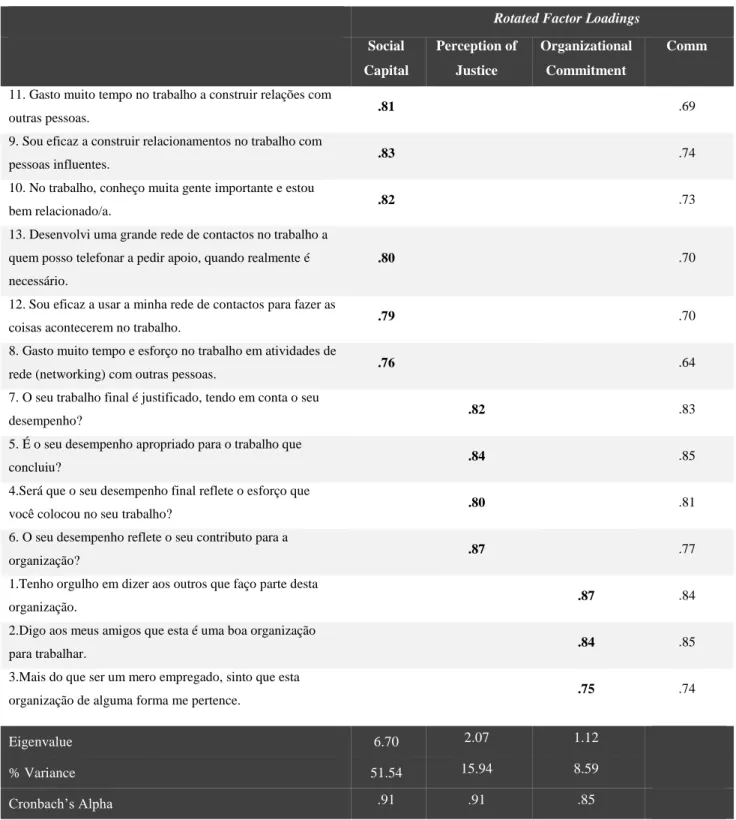
Table 9 - Rotated Factor Matrix (self-report instruments) ... 32
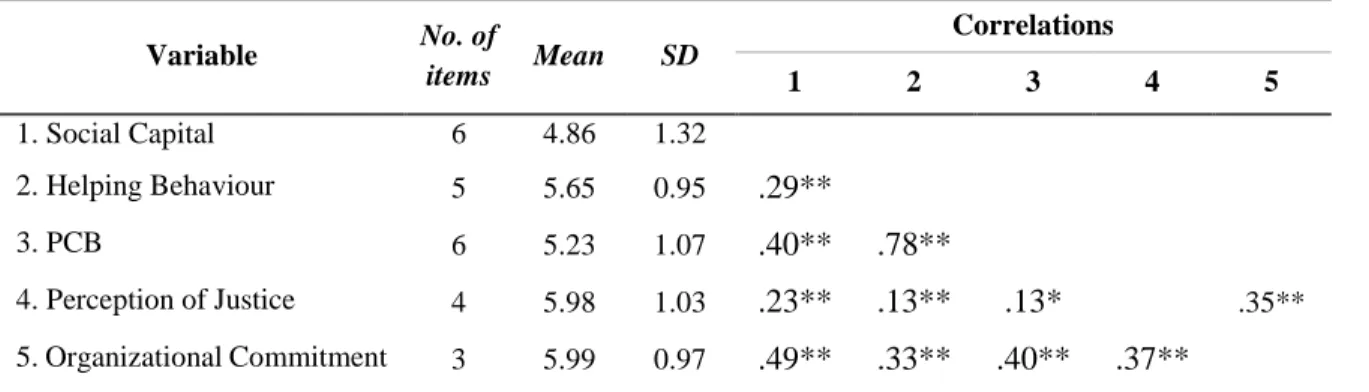
Table 10 - Descriptive statistics and correlations among studied variables ... 35
Table 11 - Results of the HLM Analysis ... 36
LIST OF FIGURES Figure 1 - Proposed conceptual model ... 26
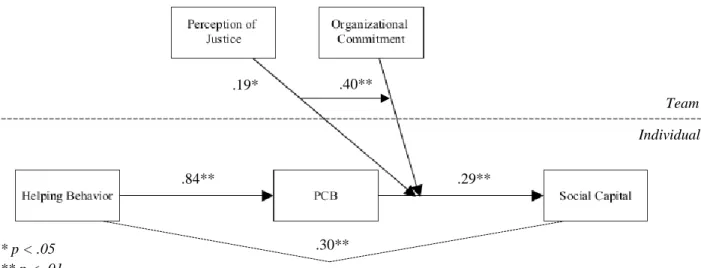
Figure 2 – Proposed conceptual model results ... 37
Figure 3 – Moderation of the effect of PCB on social capital by organizational commitment when perception of justice is low ... 38
Figure 4 - Moderation of the effect of PCB on social capital by organizational commitment when perception of justice is high ... 39
LIST OF ABBREVIATIONS AND SYMBOLS
Df – Degrees of Freedom
ICC – Intraclass Correlation Coefficient N – Sample Size
OCB – Organizational Citizenship Behaviour´ p – p value
PCA – Principal Factor Analysis
PCB – Presenteeism Citizenship Behaviour SD – Standard Deviation
α – Cronbach Alpha Coefficient β – Standardized regression coefficient
III INTRODUCTION
As we know, adapting to changes in a world that is constantly shifting at a vertiginous speed enhances the importance of innovation, resilience, responsiveness and cooperativeness, these concepts becoming of utmost importance if long-term organizational success is sought. In an ever-changing environment, “an organization which depends solely uponits blue-prints of prescribed behavior is a very fragile social system"(Katz, 1964:132) which makes organizations become more dependent on employees willing to engage in discretionary employee behaviours that are helpful but not absolutely required by employers – defined as citizenship behaviours – for progress and effectiveness.
More than 2100 articles on the topic of Organizational Citizenship Behaviour (OCB) were published since Organ introduced the construct decades ago, with interest about this concept dramatically increasing and becoming of value to the success of the organization in the 21st century (Podsakoff et al., 2013). To this day, researchers have different views with respect to the dimensionality of Organizational Citizenship Behavior. Nonetheless, researchers persist in using Organ´s (1998) dimensions of OCB which include sportsmanship, civic virtue, conscientiousness, altruism and courtesy (Borman, Ilgen & Klimoski, 2003)
However, and more recently, another concept emerged and raised some questions regarding OCB. Presenteeism has been defined in a number of ways, therefore, a definitional consensus has yet to come. However, the definition “attending work while ill” (Johns, 2010: 521) is the one employed by most organizational scholars. Although a relatively new field of study (Johns, 2010), the concept of presenteeism is not new in the workplace and has become an increasingly prevalent phenomenon in today’s work world. In 2008, Le Blanc et al. stated that presenteeism “can also be viewed more positively, i.e. a type of organizational citizenship behaviour” (pp.52). Two years later, Johns (2010) also mentioned that “under some circumstances, presenteeism might be viewed as an act of organizational citizenship and garner praise”. (pp. 521). Nonetheless these remarks, there were no attempts to study if presenteeism can be encompassed as an OCB dimension with the concept not having yet been identified as a possible dimension of OCB in any literature as far as we know.
IV
Therefore, a gap on the OCB literature is found, and a core question arises: can OCB “go the extra mile” with the introduction of presenteeism? In order for this question to be answered various objectives were set and a conceptual model was developed.
A first objective was set which relied on developing a new scale. Thus, the Presenteeism Citizenship Behaviour (PCB) construct was developed from the SPS-6 scale and the OCB dimensions. More specifically, the initial sentences of the items of the SPS-6 scale (“Because of my health problem” and “Despite my health problem”) were used together with the OCB dimensions chosen to form the items with the goal of analysing if despite having a health problem, the employee still displayed citizenship behaviours at work or, on the other hand, because of the health problem, those citizenship behaviours were not so present or were even not displayed. Subsequently, and after further investigation was pursued, a conceptual model was defined.
Firstly, and although different forms of OCB in varying combinations can be found in the literature, in the current study, the three factor model configuration was chosen, distinguishing between helping behaviour, sportsmanship and civic virtue, with items measuring helping behaviour grouped into the same single dimension. Thus, helping behaviour is considered and defined as a latent second-order construct comprising four first-order dimensions (altruism, courtesy, peacekeeping and cheerleading), aggregating Organ’s two additional dimensions introduced in 1990 (peacekeeping and cheerleading) and overcoming the difficulties that empirical research indicates, with managers often having difficulty making distinctions between the first order dimensions mentioned and considering them as part of an overall helping dimension (Bachrach et al., 2001; MacKenzie et al., 1991; Podsakoff & MacKenzie, 1994 cited by Podsakoff et al., 2009). Therefore, and considering that helping behaviour is one of the three main dimensions of OCB studied by researchers (Paillé, 2010), it was chosen as the independent or predictor variable and raised was the hypothesis that an individual already displaying helping behaviours at work will more likely exhibit the same behaviour at work while sick, thus engaging in Presenteeism Citizenship Behaviours.
Secondly, and since OCBs motivate employees to like, trust, and identify with each other and taking into account that social capital has its foundation in high quality social relations that possess these characteristics, we argue they are likely to be associated with social capital, increasing the social capital in organizations as research already shows
V
(Bolino et al., 2002 cited by Braun et al., 2012). Thus, and since PCB is an organizational citizenship behaviour, we argued that it would have a positive impact on social capital, helping to create and maintain it.
Consequently, the relationship between helping behaviour and social capital mediated through PCB was studied. Taking into account that helping behaviour is expected to elicit higher levels of PCB which in turn is expected to have a positive impact on social capital, increasing it, it was expected that PCB would mediate the relationship between helping Behaviour and social capital.
Lastly, concerning the outcomes that would influence the previous direct and indirect relationships, meta-analytic studies supported perception of justice and organizational commitment as moderators of these relationships. Therefore, perception of justice and Organizational Commitment would interact with PCB to increase its effect on social capital, so that the direct relationship between PCB and social capital becomes stronger when the mentioned moderators are at high levels. Moreover, the indirect relation of helping behaviour on social capital through PCB would also be conditional on the degree of perceived justice and organizational commitment, in that the mediation effects are stronger under conditions of high perceived justice and organizational commitment.
Therefore, and in sum, the present study argues that helping behaviour and social capital are both positively related to PCB, with PCB mediating the relationship between the two. Moreover, it explores the influence of organizational commitment and perception of justice on the direct relationship between PCB and social capital and on the indirect one between helping behaviour and social capital through PCB.
Providing a positive view on presenteeism and its relationship with OCBs, the study thus contributes to the emerging literature on these two constructs. Furthermore, it unveils a new construct termed PCB – although perhaps always hidden at the surface for as long as OCBs and presenteeism are known – and explores OCB dimension helping behaviour and the concept of social capital, as well as the impact of moderators’ organizational commitment and perception of justice. Moreover, Literature and managerial implications are drawn as are limitations and possible future research.
1 CHAPTER1–LITERATUREREVIEW|WHATDOWEKNOWABOUTOCB ANDPRESENTEEISM?
1.1LITERATURE REVIEW ON ORGANIZATIONAL CITIZENSHIP BEHAVIOUR
Definition
The beginning: extra-role behaviors
In 1964, Katz defined “extra-role behaviours” as the behaviors which employees assumed voluntarily in order to contribute to the progress of the organization (Pavalache-Ilie, 2014). These behaviors include any of those gestures (often taken for granted) that lubricate the social machinery of the organization but that do not directly inhere in the usual notion of task performance such as: helping co-workers with a job related problem; accepting orders without a fuss; tolerating temporary impositions without complaint; helping to keep the work area clean and uncluttered; making timely and constructive statements about the work unit or its head to outsiders; promoting a work climate that is tolerable and minimizes the distractions created by interpersonal conflict; and protecting and conserving organizational resources (Bateman & Organ, 1983).
First definition of Citizenship Behavior
However, the expression Citizenship Behavior was first used by Bateman & Organ in 1983. These authors founded their idea of OCB on the concept of “Willingness to Cooperate” proposed by Barnard (1938) and the concepts of dependable role performance and “innovative and spontaneous behaviors” described by Katz (1964) and Katz and Kahn (1966) (Olowookere & Adejuwon, 2015). Organ, considered the father of OCB, and his colleagues (Bateman & Organ, 1983; Smith, Organ & Near, 1983) expanded upon Katz's (1964) original work and defined Organizational Citizenship Behavior as an “individual behavior that is discretionary, not directly recognized by the formal reward system, and that in the aggregate promotes the effective functioning of the organization” (Organ, 1997: 86).
As we can see, this definition encompasses three critical aspects. By discretionary, Organ means that “the behavior is not an enforceable requirement of the role or the job description, that is the clearly specifiable terms of the person´s employment contract with the organization; the behavior is rather a matter of personal choice such that its omission is not generally understood as punishable” (Organ, 1997: 86). Moreover, Organ viewed OCB
2
as “contributions that might - or might not - invite some future recompense”. Thirdly, OCB could only comprehend the behaviors that “in the aggregate, across time and across persons, contribute to organizational effectiveness” (pp. 87).
The very nature of the construct makes it difficult to operationally define
Although some clarifications were made by Organ about the definition of OCB, Morrison in 1994 (as cited by Organ, 1997: 88) concluded that “OCB is ill-defined and varies from one employee to the next and between employees and supervisors”. Organ (1997: 88) then thought that perhaps the problem with defining OCB as “extra-role or beyond the job requirement inheres in the very fuzziness of the concepts role and job themselves”. This is even more true nowadays, since jobs have evolved from defined set of tasks and responsibilities into much more ambiguous roles, which makes it difficult to define what is discretionary.
Organ (1997) (cited by Borman, Ilgen and Klimoski, 2003) acknowledged conceptual difficulties associated with the definitional requirements that organizational citizenship behaviors are discretionary and not formally rewarded. Therefore, he redefined OCB according to the definition that colleagues Borman and Motowildo (1993) suggested for contextual performance: “contributions to the maintenance and enhancement of the social and psychological context that supports task performance” (Organ, 1997: 91). However, researchers persist in using Organ´s (1998) original definition of OCB and instruments developed to measure the construct according to its original definition (Borman, Ilgen and Klimoski, 2003). Recently, Organizational Citizenship Behaviors are defined as “discretionary employee behaviors that are helpful but not absolutely required by employers” (Dekas et al., 2013: 219).
Origins of OCB, Rise of interest and its consequences
The concept of OCB was born in an “intuitive conviction that (…) job satisfaction did bear a functional relation to performance of a sort” (Organ, 1977 as cited by Organ, 1997: 92). It was believed that “although job attitudes might have little to do with objective measures of individual output, satisfaction would affect people´s willingness to help colleagues and work associates and their disposition to cooperate in varied and mundane
3
from to maintains organized structures that govern work” (Organ, 1977 as cited by Organ, 1997: 92).
More than 2100 articles about the topic of OCB were published since Organ introduced the construct decades ago (Podsakoff et al., 2013). As recent studies show, such as the one from Podsakoff and colleagues (2009), citizenship behaviours increase work quality by 19%, financial effectiveness by 25%, and customer satisfaction indicators by as much as 38%, which makes them an asset for organization survival. The interest about OCB has dramatically increased and it is not surprising given that there are a number of undeniably factors contributing to this trend. First, OCBs are universally recognized as an important criterion measure in the organizational behavior literature and considered a vital part of the employee performance field (Podsakoff et al., 2013). Second, researchers have gone beyond traditional social exchange approaches to OCB and incorporated multiple perspectives in their development of theory in this area (Podsakoff et al., 2013). Finally, if we search about OCBs we will see that it is no longer confined to the area of organizational behavior but has expanded into many others´ including marketing, public administration, engineering, healthcare services, sports science, sociology, computer science, communication, and nursing (Institute for Scientific Information, 2013 cited by Podsakoff et al., 2013).
Furthermore, Organ et al. (2006) and Podsakoff and MacKenzie (1997) (as cited in Braun, Ferreira & Sydow, 2012) research showed that OCB promotes effectiveness outcomes and also increases the in organizations (Bolino et al., 2002 cited by Braun, Ferreira & Sidow, 2012). Effectively, OCBs have historically been linked to the key management concern of organizational effectiveness (Dekas, Bauer & Sullivan, 2013), indicating that it can have a positive impact on organizational success through improvements in coworker and managerial productivity, resource utilization, group activity coordination and across work groups, selection and retention, performance stability and the ability to adapt to environmental changes (Podsakoff, MacKenzie, Paine, & Bachrach, 2000). More recently, Podsakoff et al. (2009) found that OCBs have a positive relationship with performance ratings and reward allocations. Moreover, research shows that OCB also increases the social capital in organizations (Bolino et al., 2002 cited by Braun et al., 2012). For these reasons, and the fact that nowadays jobs have ambiguous roles – as mentioned before – the concept of citizenship behavior appears to be of increasing rather than decreasing value to the success of the organization in the 21st century.
4 Antecedents of OCBs
Much of the early work in this area focused on identifying the antecedents of OCBs and found that a variety of individual differences (e.g., conscientiousness and extroversion), attitudinal or perceptual variables (e.g., job satisfaction, organizational commitment, and justice perceptions), leadership-related factors (e.g., transformational and transactional behaviors and leader–member exchange), and job characteristics (e.g., task feedback and task interdependence) were significant predictors of employee OCBs (Organ, Podsakoff, & MacKenzie, 2006 cited by Podsakoff et al., 2013).
More recently, organizational researchers have begun to test the assumptions of antecedents of OCB and to examine the effects of OCBs on individual-level and organizational-level outcomes. A recent meta-analytic review of this literature (Podsakoff, Whiting, Podsakoff, & Blume, 2009) indicated that employee OCBs tend to account for as much, if not more, variance in performance evaluations compared with task performance and that unit-level OCBs were positively related to a variety of measures of unit-level performance, including profitability, productivity, product quality, and efficiency. Therefore, it seems that OCBs are important to the success of organizations, and the people that work in them.
OCB multidimensionality
Following in Organ’s footsteps, helping behaviour, sportsmanship and civic virtue are the three principal forms of OCB studied by researchers. Up until the 1990´s most of OCB studies took place in North America and research on American employees focused on different forms of OCB in varying combinations. Four types of configuration can be seen (Paillé, 2010).
In a first configuration, certain researchers choose to examine citizenship as a whole (e.g., Chen, Hui, & Sego, 1998; Hui et al., 2004; MacKenzie et al., 1998; Thau, Bennett, Stahlberg, & Werner, 2004, as cited by Paillé, 2010). There is no distinction between helping behaviour, sportsmanship and civic virtue. In this case, items on the three subscales (helping behaviour, sportsmanship and civic virtue) are blended into a single scale.
5
While certain researchers (e.g., Chen & Francesco, 2003; Cohen, 2006; Schappe, 1998, as cited by Paillé, 2010), in studying OCB, distinguish between citizenship behaviors towards individuals and towards the organization, others (e.g., Podsakoff & MacKenzie, 1994; Yoon & Suh, 2003 as cited by Paillé, 2010) examine citizenship by adopting a three-factor model distinguishing between helping behaviour, sportsmanship and civic virtue. In this third configuration, items measuring helping behaviour are grouped into the same single dimension. As there is no distinction between different facets of OCB (e.g., courtesy, altruism, etc.), helping behaviour is thus defined as a latent second-order construct (Podsakoff, Whiting, & Blume, 2009). Finally, certain researchers (e.g., Diefendorff, Brown, Kamin, & Lord 2002; Lievens & Anseel, 2004; Tansky, 1993) employ a five-factor structure to study OCB (courtesy, altruism, peacemaking, sportsmanship, and civic virtue).
History of Research on OCB dimensions
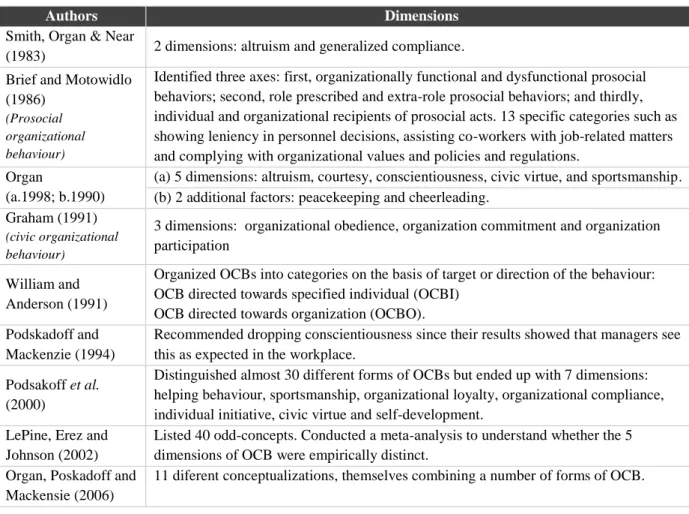
Researchers have different views with respect to the dimensionality of Organizational Citizenship Behavior, as we can see in Table 1
Table 1 - History of research on OCB dimensions
Authors Dimensions
Smith, Organ & Near
(1983) 2 dimensions: altruism and generalized compliance. Brief and Motowidlo
(1986)
(Prosocial organizational behaviour)
Identified three axes: first, organizationally functional and dysfunctional prosocial behaviors; second, role prescribed and extra-role prosocial behaviors; and thirdly, individual and organizational recipients of prosocial acts. 13 specific categories such as showing leniency in personnel decisions, assisting co-workers with job-related matters and complying with organizational values and policies and regulations.
Organ
(a.1998; b.1990)
(a) 5 dimensions: altruism, courtesy, conscientiousness, civic virtue, and sportsmanship. (b) 2 additional factors: peacekeeping and cheerleading.
Graham (1991)
(civic organizational behaviour)
3 dimensions: organizational obedience, organization commitment and organization participation
William and Anderson (1991)
Organized OCBs into categories on the basis of target or direction of the behaviour: OCB directed towards specified individual (OCBI)
OCB directed towards organization (OCBO). Podskadoff and
Mackenzie (1994)
Recommended dropping conscientiousness since their results showed that managers see this as expected in the workplace.
Podsakoff et al. (2000)
Distinguished almost 30 different forms of OCBs but ended up with 7 dimensions: helping behaviour, sportsmanship, organizational loyalty, organizational compliance, individual initiative, civic virtue and self-development.
LePine, Erez and Johnson (2002)
Listed 40 odd-concepts. Conducted a meta-analysis to understand whether the 5 dimensions of OCB were empirically distinct.
Organ, Poskadoff and Mackensie (2006)
6
Since the first developments of Smith, Organ & Near (1983) that conceptualized OCB with two dimensions - altruism and generalized compliance -, other authors came forward with revised and new constructs. One of the most prevalent classifications was advocated by Organ (1988), who differentiated five facets or factors: altruism, courtesy, conscientiousness, civic virtue, and sportsmanship. Subsequently, Organ (1990) also included two additional factors: peacekeeping and cheerleading. However, in 1994, Podskadoff and Mackenzie recommended dropping conscientiousness since their results showed that managers see this as expected in the workplace. Graham (1991) (cited by Podsakoff et al., 2000) revealed three dimensions to OCB: organizational obedience, organizational commitment and organizational participation.
Later on, in their critical review of literature, Podsakoff, MacKenzie, Paine, and Bachrach (2000) distinguished almost 30 different forms of organizational citizenship behavior, although there is a great deal of conceptual overlap between the constructs - for that reason, the authors organized them into seven common themes or dimensions: helping behaviour, sportsmanship, organizational loyalty, organizational compliance, individual initiative, civic virtue and self-development.
Two years after Podsakoff et al. critical review of literature, LePine, Erez and Johnson (2002) conducted a meta-analysis to understand whether the 5 dimensions of OCB offered by Organ (1988) were empirically distinct, concluding that the relations between these dimensions at the population level are generally about as high as their reliability estimates.
Taking another direction, Williams and Anderson (1991) (cited by Podsakoff et al., 2009) organized OCBs into categories on the basis of target or direction of the behavior. These authors identified three dimensions of OCB which include in-role behaviors (IRB), organizational citizenship behaviors directed at the organization (OCBO) and organizational citizenship behaviours directed at the individuals within the organization (OCBI). The in-role behaviors represent stipulated duties contained in the job description and employment contract - this set of behaviors is similar to the dependable role performance theorized by Katz (1964). The OCBO dimension encapsulates conscientiousness, sportsmanship and civic virtue dimensions as posited by Organ (1988), while OCBI consists of courtesy and altruism dimensions as posited by Organ (1988, 1990). As we can see, all of Organ´s OCB dimensions are captured in Williams and Anderson´s conceptual scheme. In addition,
7
Williams and Anderson´s conceptual scheme incorporates most other OCB constructs into it (Podsakoff et al., 2009) – and Organ (1997) himself seems to be favorably disposed to this approach.
Understanding Organs´ 5 dimensions of OCB
Since researchers persist in using Organ´s (1998) original definition of OCB and instruments developed to measure the construct according to its original definition (Borman, Ilgen and Klimoski, 2003), as said before, it is important to better understand the dimensions of OCB according to this author.
After the introduction by Smith et el. (1983) of the two types of OCB, Organ (1988) (cited by Podsakoff et al., 2009), redefined OCB to refer to extra role behaviors and subsequently revised its dimensions to include sportsmanship - defined as a “willingness on the part of employees to tolerate less than ideal circumstances without complaining and making problems seem bigger than they actually are”; civic virtue - “behavior indicating that employees take an active interest in the life of their organization”; conscientiousness (often called compliance) - “behavior indicating that employees accept and adhere to the rules, regulations, and procedures of the organization”; altruism – benevolence; and courtesy - consideration and respect for others. As we can see, the generalized compliance dimension was submerged into conscientiousness while altruism was retained as originally proposed.
There is good empirical evidence (Bell & Menguc, 2002; Hui, Lee, & Rousseau,2004; Lam, Hui, & Law, 1999; Podsakoff et al., 1990 cited by Podsakoff et al., 2009) that managers have little difficulty distinguishing between Organs´ (1988, 1990) sportsmanship, civic virtue, and conscientiousness dimensions. However, empirical research (Bachrach, Bendoly, & Podsakoff, 2001; MacKenzie et al., 1991; Podsakoff & MacKenzie, 1994 cited by Podsakoff et al., 2009) indicates that managers often have difficulty making some of the distinctions between the other dimensions identified in Organ’s conceptual model, and that they tend to view altruism (benevolence), courtesy (consideration and respect for others), peacekeeping, and cheerleading as part of an overall helping dimension. Therefore, helping behaviour is probably best viewed as a second-order latent construct comprising these four first-order dimensions since, as noted by Podsakoff, Ahearne, and MacKenzie (1997) (cited by Podsakoff et al., 2009), these dimensions “clearly involve helping others with or preventing the occurrence of work-related problems” (pp. 63). Thus,
8
and considering that helping behaviour is one of the three main dimensions of OCB studied by researchers (Paillé, 2010), it was chosen as the independent variable of our study.
Measures of Organizational Citizenship Behaviour
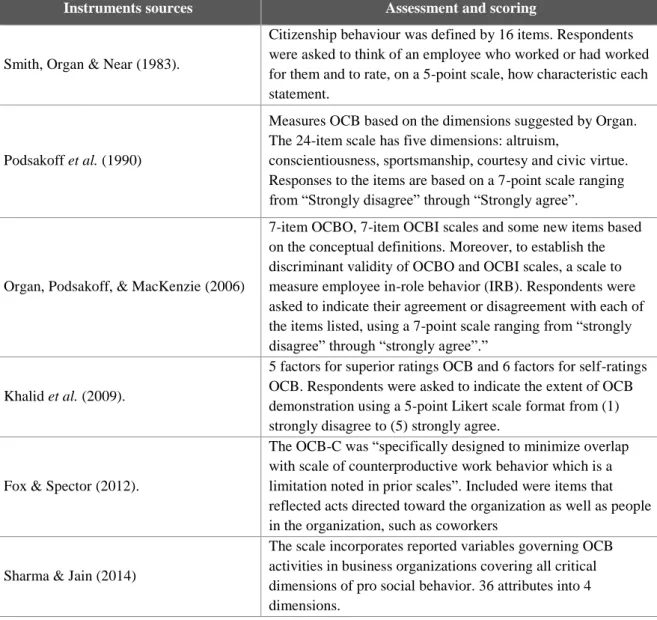
As for measures of OCB, Table 2 summarizes some of them.
Table 2 - Measures of OCB
Instruments sources Assessment and scoring
Smith, Organ & Near (1983).
Citizenship behaviour was defined by 16 items. Respondents were asked to think of an employee who worked or had worked for them and to rate, on a 5-point scale, how characteristic each statement.
Podsakoff et al. (1990)
Measures OCB based on the dimensions suggested by Organ. The 24-item scale has five dimensions: altruism,
conscientiousness, sportsmanship, courtesy and civic virtue. Responses to the items are based on a 7-point scale ranging from “Strongly disagree” through “Strongly agree”.
Organ, Podsakoff, & MacKenzie (2006)
7-item OCBO, 7-item OCBI scales and some new items based on the conceptual definitions. Moreover, to establish the discriminant validity of OCBO and OCBI scales, a scale to measure employee in-role behavior (IRB). Respondents were asked to indicate their agreement or disagreement with each of the items listed, using a 7-point scale ranging from “strongly disagree” through “strongly agree”.”
Khalid et al. (2009).
5 factors for superior ratings OCB and 6 factors for self-ratings OCB. Respondents were asked to indicate the extent of OCB demonstration using a 5-point Likert scale format from (1) strongly disagree to (5) strongly agree.
Fox & Spector (2012).
The OCB-C was “specifically designed to minimize overlap with scale of counterproductive work behavior which is a limitation noted in prior scales”. Included were items that reflected acts directed toward the organization as well as people in the organization, such as coworkers
Sharma & Jain (2014)
The scale incorporates reported variables governing OCB activities in business organizations covering all critical dimensions of pro social behavior. 36 attributes into 4 dimensions.
9 1.2LITERATURE REVIEW ON PRESENTEEISM
Definition
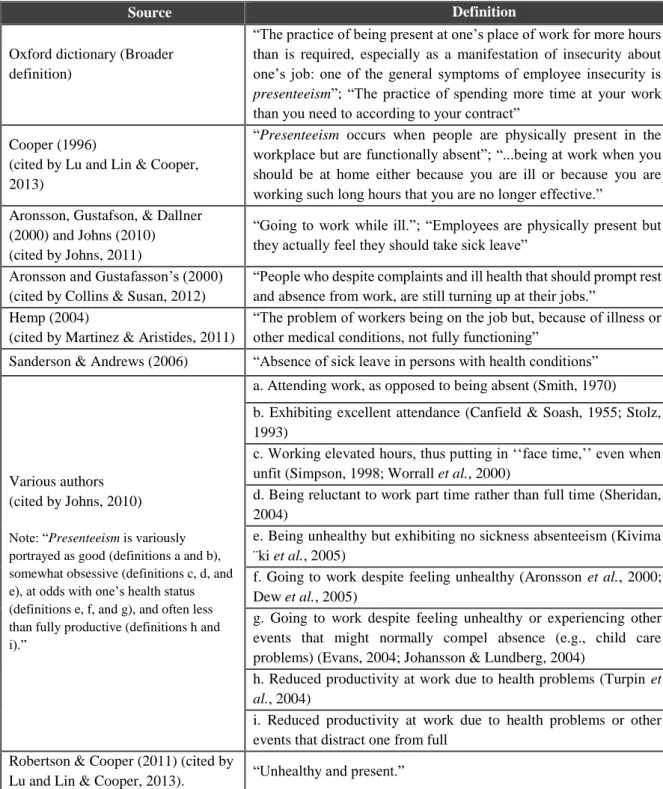
Presenteeism has been defined in a number of ways. Therefore, a definitional consensus has yet to come. The definition “attending work while ill” (Johns, 2010:521) is the one employed by most organizational scholars and is also either explicit or implicit in all related scholarship published in the occupational health literature (Johns, 2010). Moreover, this definition does not ascribe motives or consequences to presenteeism (John, 2010) while many others do (see Table 3) - as critiqued by Johns (2012) (cited by Lu and Lin & Cooper, 2013), while various definitions of presenteeism all refer to physical presence at work, many have merged the cause and the effect, not separating the behaviour from the consequences.
Although the study of presenteeism is a relatively new field (John, 2010), the concept is not new in the workplace and has become an increasingly prevalent phenomenon in today’s work world. In recent years, presenteeism has begun to attract increased academic attention, reflecting a wider recognition of its adverse effects on employee well-being and its negative impact on organizational productivity (Caverley, Barton Cunningham, & Macgregor, 2007; Gustafsson & Marklund, 2011; Schultz & Edington, 2007 cited by Deery et al., 2014). Which makes it curious to know that the first use of the term presenteeism documented presented it as a positive behaviour for individuals to move away from absenteeism towards presenteeism (Uris, 1955; Canfield & Soash, 1955).
Despite the significance of presenteeism as a fact of modern day work life has been established with large scale surveys in the developed economies such as the Scandinavia countries (e.g., Aronsson, Gustafsson, & Dallner, 2000; Demerouti, Le Blanc, Bakker, Schaufeli, & Hox, 2009 cited by Lu and Lin & Cooper, 2013), research in non-Western countries is non-existent. The majority of the existing work is done in the public health and nursing fields: it is prevalent in human service work where employees provide care or help to other people and have a strong professional commitment to the needs of their clients (Aronsson, Gustafsson & Dallner, 2000; Elstad & Vabø, 2008; McKevitt, Morgan, Dundas, & Holland, 1997 cited by Deery, Walsh & Zatzick 2014).
Presenteeism has not often been studied with a view to relate it to personality, and there are not many studies relating it to both antecedents and consequences. In fact, nearly all of the existing studies have focused on either its damaging consequences or antecedents in the work context which might trigger the act of presenteeism (Johns, 2010) and not on
10
positive personal and work-related factors such as hardy personality and work support which might perform protective roles in the presenteeism process have been overlooked. In addition, longitudinal studies are rather rare in this field. In fact, most of the existing studies on presenteeism have approached it as merely an overt behaviour (Aronsson, Gustafson, & Dallner, 2000; Johns, 2010; Johns,2011; cited by Lu and Lin & Cooper, 2013), not taking into account the underlying motives of such an act.
Table 3 - The many definitions of presenteeism
Source Definition
Oxford dictionary (Broader definition)
“The practice of being present at one’s place of work for more hours than is required, especially as a manifestation of insecurity about one’s job: one of the general symptoms of employee insecurity is
presenteeism”; “The practice of spending more time at your work
than you need to according to your contract” Cooper (1996)
(cited by Lu and Lin & Cooper, 2013)
“Presenteeism occurs when people are physically present in the workplace but are functionally absent”; “...being at work when you should be at home either because you are ill or because you are working such long hours that you are no longer effective.”
Aronsson, Gustafson, & Dallner (2000) and Johns (2010) (cited by Johns, 2011)
“Going to work while ill.”; “Employees are physically present but they actually feel they should take sick leave”
Aronsson and Gustafasson’s (2000) (cited by Collins & Susan, 2012)
“People who despite complaints and ill health that should prompt rest and absence from work, are still turning up at their jobs.”
Hemp (2004)
(cited by Martinez & Aristides, 2011)
“The problem of workers being on the job but, because of illness or other medical conditions, not fully functioning”
Sanderson & Andrews (2006) “Absence of sick leave in persons with health conditions”
Various authors (cited by Johns, 2010)
Note: “Presenteeism is variously portrayed as good (definitions a and b), somewhat obsessive (definitions c, d, and e), at odds with one’s health status (definitions e, f, and g), and often less than fully productive (definitions h and i).”
a. Attending work, as opposed to being absent (Smith, 1970) b. Exhibiting excellent attendance (Canfield & Soash, 1955; Stolz, 1993)
c. Working elevated hours, thus putting in ‘‘face time,’’ even when unfit (Simpson, 1998; Worrall et al., 2000)
d. Being reluctant to work part time rather than full time (Sheridan, 2004)
e. Being unhealthy but exhibiting no sickness absenteeism (Kivima ¨ki et al., 2005)
f. Going to work despite feeling unhealthy (Aronsson et al., 2000; Dew et al., 2005)
g. Going to work despite feeling unhealthy or experiencing other events that might normally compel absence (e.g., child care problems) (Evans, 2004; Johansson & Lundberg, 2004)
h. Reduced productivity at work due to health problems (Turpin et
al., 2004)
i. Reduced productivity at work due to health problems or other events that distract one from full
Robertson & Cooper (2011) (cited by
11 Antecedents of presenteeism
“Why or under what conditions would a person suffering from some acute, chronic, or episodic illness attend work rather than go absent?” Johns (2011) questioned himself about these and found out that “surprisingly little extant scholarship on presenteeism has concerned this issue”.
Although it remains an empirical question, some studies have already studied the correlates of presenteeism. However, the “why” still needs to be systematically explored. According to the transactional theory (Lazarus & Folkman, 1984 cited by Lu and Lin & Cooper, 2013), “people are constantly appraising, interpreting, and making sense of the situation, as well as evaluating their own personal resources to decide the best course of action in every encounter”. Therefore, it is crucial to understand people’s motives for committing the act of presenteeism for a more comprehensive representation of the underlying psychological process.
Hence, in order to better understand where we stand about this topic, the antecedents of presenteeism are enunciated through summary tables on the next pages. Table 4 concerns the work-related demands and pressures (job design), followed by organizational policies on Table 5 and personally related demands on Table 6.
One important note to have in mind is that according to Hansen and Anderson (2008) (cited by Collins & Cartwright, 2012) work-related factors may impact more on people’s decision to go to work whilst ill than personal factors.
12 Table 4 - Antecedents of presenteeism: work-related demands and pressures (job design)
1Aronsson and Gustafsson’s (2005) | 2Hansen and Andersen’s (2008)(cited by Colllins & Cartwright, 2012)
Bockerman and Laukkanen (2009) (cited
by Colllins & Cartwright, 2012)
1Ramsey (2006) | 2
Wynne-Jones et al. (2011); Baker-McClearn et al. (2010) (cited
by Colllins & Cartwright, 2012)
Baker-McClearn, Greasley, Dale, and
Griffith (2010)
(cited by Lu and Lin & Cooper, 2011)
Johns (2010)
[ (+) = positively associated with presenteeism; (-) = negatively associated with presenteeism]
WORK
-RELATED DEMANDS AND PRESSURES
(JOB DESIGN)
1Less control over the pace of work was associated with more presenteeism; control over pace of work; replaceability; sufficient resources, conflicting demands
2Time pressure at work contributes to presenteeism.
Working time
arrangements (to a greater extent than absenteeism) Long working hours Long working weeks Frequent overtime Mismatch between the
amount of hours wanted by the employee and actual hours worked
1Managers management style 2Managers relationships with employees and how they implement sickness absence policies
“Workplace pressures”
Management style and workplace culture. “Work context” Task significance (+) Job interdependence (+) Autonomy Ease of replacement (+) “Work Experiences” Equity (-) Job security (-) Family to work conflict Work to family conflict (+)
Caverley et al., (2007)
1CCH, Wolters Kluwer
Law and Business (2007) |
2Gorovsky (2008) (cited by Lack, 2011)
Weinberg (2007) (cited by
Lack, 2011)
1Hansen and Anderson (2008) | 2Leineweber et al. (2011) | 3Aronsson et al. (2000)
(cited by Colllins & Cartwright, 2012) Top reasons: (1) others
depending on them, (2) workload, (3) deadlines, (4) work commitments/meetings, and (5) did not feel so bad that they could not do some work
1 “Perception that they had too much work or too many deadlines” and no one to cover for them 2fear of disciplinary action and thus arrive to work regardless of the extent of their illness”
Fear of loss of Income or employment: workers may
fear managers or coworkers thinking less of them if they remain home sick.
1 Job insecurity
2 Support of colleagues (whereby a lack of support is associated with a greater risk of presenteeism)
3Occupational group (professions in care, welfare and education having the highest levels)
1Punnett, Greenidge and Ramsey (2007) | 2Hausknecht, Hiller and Vance (2008) (cited by
Bierla, Huver & Richard, 2012) | 3Caverley et al. (2007)
1Grinyer and Singleton (2000) | 2Baker-McClearn et al. (2010)
| 3Ashby and Mahdon (2010) (cited by Colllins & Cartwright, 2012) 1Increase in job satisfaction leads to a reduction in the level of absenteeism, whether for
intrinsic satisfaction (responsibility, interesting tasks, flexible hours) or extrinsic satisfaction (relationship with colleagues, job security); 2both organizational commitment and job satisfaction are related to lower absenteeism (3variables also associated with more presenteeism, leading to over-commitment)
Teamwork: 1 individuals are reluctant to let colleagues down and 2take into consideration whether their absence will affect other (“being the member of a team instilled an obligation to fellow team members which resulted in a reluctance to take sick leave”). 3However, people appear to experience a conflict with the decision as they do not want to pass on illness to colleagues.
13 Table 5 - Antecedents of Presenteeism: organizational policies
1Johns (1997) | 2Aronsson
et al., (2000) (cited by Johns, 2010)
1Johns (1997) | 2Chatterji
& Tilley (2002) | 3Lovell
(2004) (cited by John, 2010)
Baker et al., (2010) (cited by Lu, Lin & Cooper, 2011)
Chatterji and Tilley (2002) (cited
by Colllins & Cartwright, 2012)
Grinyer and Singleton (2000) 1(cited by Colllins & Cartwright, 2012) 2(cited by
Johns, 2010) ORGANIZATIONAL POLICIES PAY, SICK PAY, AND ATTENDANCE CONTROL*1 1There is considerable evidence that those earning higher wages generally exhibit less absenteeism. 2 Occupational groups exhibiting the most presenteeism were among the poorest paid (comparable data are lacking on
presenteeism per se)
1Less liberal sick pay plans result in less absence. 2These could also stimulate presenteeism. 3Lack of paid sick leave is a particular stimulus for presenteeism among female workers; 3workers report going to work ill to ‘‘save’’ any sick leave they have for dealing with children’s health problems. Organization’s attendance policy Policies intended to reduce absenteeism such as reducing sick pay may ultimately increase presenteeism *2
1Organizational policies introduced to reduce short-term sickness made employees resentful and stressed because staff were reluctant to take sick leave. 2Systems put in place to stimulate good attendance can contribute to presenteeism fixed “trigger points” for a certain number of absence episodes that led to disciplinary action stimulated presenteeism, and they also converted potential
presenteeism into absence since employees became concerned to return to work too soon (and thus risk going absent again and accruing two absence episodes instead of one).
DOWNSIZING*1
1Kammeyer-Mueller, Liao, & Arvey (2001) | Simpson
(1998) (cited by Johns, 2010)
1Simpson (1998) | 2Caverley et al. (2007) (cited by Lack, 2011) | 3Firns, Travaglione and O’Neill (2006) (cited by Bierla, Huver & Richard, 2012)
1On one hand, downsizing might be expected to stimulate absenteeism due to damaged job attitudes, perceptions of injustice, breached psychological contracts, and stress-related illness. 2On the other hand, it might reduce absenteeism due to fear of job loss, job design changes that make absence less viable, increased workload, or flatter organizational structures that increase competition for promotions and demand visible symbols of commitment.
Organizational restructuring: 1Employees tending to remain at work longer than needed to demonstrate their commitment (competitive presenteeism); 2Feeling insecure about their positions after the organizational changes and those remaining with the company not having fully recovered (”shell shocked”); 2Presenteeism directly or indirectly related to feelings of insecurity, poor communication, and lack of trust following organizational changes and restructuring; 3The rate of sick leave is higher when employees anticipate lay-offs.
PERMANENCY OF EMPLOYMENT*1
1Benavides et al. ,2000; Gimeno, et al., 2004 & others (cited by Johns, 2010)
Virtanen et al. (2003) (cited by Johns, 2010)
(inferring presenteeism from patterns of absence)
Contingent or non-permanent employees exhibit less sickness absence than their more permanent counterparts
1Employees who changed their employment from a fixed term contract to permanent status, it was observed that their recorded absence rate nearly doubled (along with their perceptions of job security) to approximate that of permanent employees. “The authors inferred presenteeism on the part of the fixed term employees prior to conversion to permanency.”
*1 Organizational policies divided according to Johns, 2010. | *2 “Any attempt at reducing the potential productivity loss from absence has to be offset against the potential productivity loss from
presenteeism” (Chatterji and Tilley, 2002). However, it is difficult to measure the effects of presenteeism because measures rely upon individuals’ self-reporting when they have attended work
while sick, as well as their personal estimation of productivity, which could be subject to distortion (Johns, 2010). Different variety (and complexity) of measures also make it difficult to make comparisons across studies (Sanderson et al., 2007, cited by Colllins & Cartwright, 2012).
14 Table 6 - Antecedents of Presenteeism: Personally related demands
1Aronsson and Gustafsson’s (2005); Hansen and Anderson (2008) | 2Hansen and Anderson (2008)
(cited by Colllins & Cartwright, 2012)
Ashby and Mahdon (2010) | Aronsson and Gustafsson’s (2005)
(cited by Colllins & Cartwright, 2012)
Johns (2010)
[ (+) = positively associated with
presenteeism; (-) = negatively associated
with presenteeism ]
Baker-McClearn, Greasley, Dale, and Griffith (2010) (cited by Lu and Lin & Cooper, 2013)
PERSONALLY RELATED DEMANDS
1Individual boundarylessness (difficulty in saying no) and over commitment 2Conservative attitudes towards absence
People with financial difficulties (financial pressure to attend work*)
“Personal characteristics”
Strong work ethic (+) Affective and normative
organizational commitment (+) Workaholism (+)
Psychological hardiness (+) Conscientiousness (+)
Internal health locus of control (-) Neuroticism (-)
” Personal Motivations”
Work values and beliefs such as: “no one else can do the job,” “loyalty to own professional image,” and “obligation and commitment to colleagues, clients, and organizations.”
Löve et al. (2010) (cited by Lu and Lin
& Cooper, 2013) Lack (2011)
1Rogerson (2007) | 2MacGregor, Cunningham, & Caverley (2008) (cited by Lu and Lin & Cooper, 2011)
1Aronsson et al. (2000) | 2Hansen and Andersen
(2008)
(cited by Bierla, Huver & Richard, 2012)
Self-esteem
Health concerns: physical and mental health concerns
Health risk concerns Dependent care issues
The stress factor: 1Stress and sleep deprivation were the second and fourth most common reasons for presenteeism; 2Stressful life events are significantly related to both presenteeism and absenteeism
1People with children at home are more often at work being sick. 2Family life could foster presenteeist behavior (yet, it seems unclear why having children should reinforce presenteeism)
*However, it is likely that organizational policies in terms of whether, and to what extent, sick pay is given to staff taking sickness absence will also influence the impact of financial pressure on an individual’s decision to go into work. “(Aronsson and Gustafsson, 2005). Moreover,when a ‘three-day rule’ is applied (three days of absence are fully compensated, without certificate), presenteeism decreases (Bockerman and Laukkanen, 2010).
15 Consequences of presenteeism
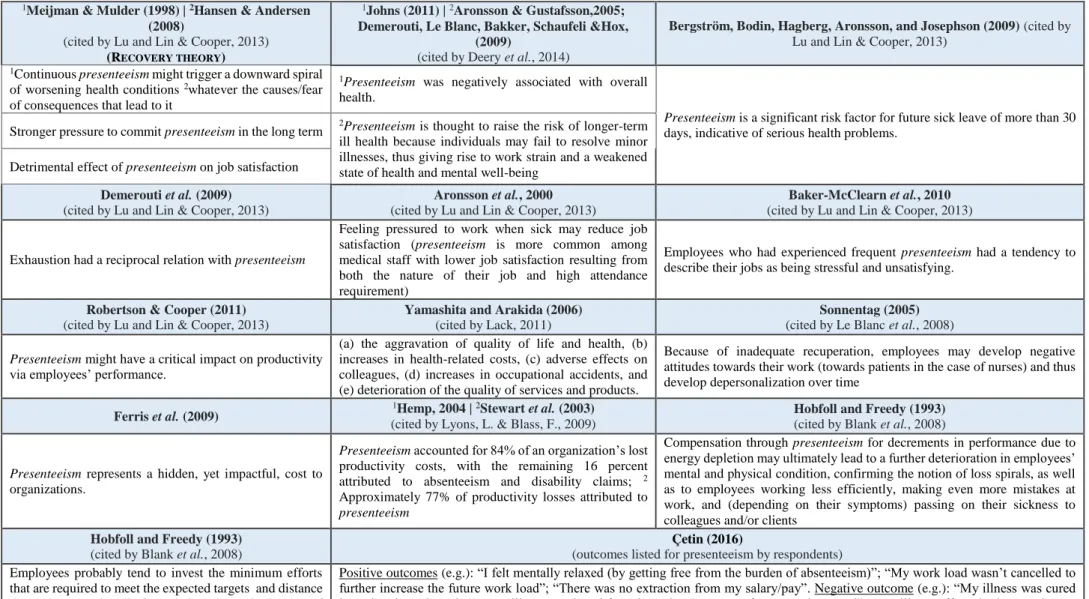
Although studies tend to agree that greater productivity loss is associated with presenteeism than absenteeism, there is a great deal of variation reported across studies in terms of both the effects and costs with respect to presenteeism (Johns, 2010). Since the time presenteeism was identified, epidemiological and medical researchers have investigated the impact of health on productivity loss which is allegedly attributable to the act of working while ill (e.g. Collins et al., 2005; Turpin et al., 2004 cited by Lu, Cooper & Lin, 2013). From an employee perspective, “presenteeism is important in that it might exacerbate existing medical conditions, damage the quality of working life, and lead to impressions of ineffectiveness at work due to reduced productivity” (Johns, 2010: 521). Moreover, various organizational practices and policies designed to curtail absenteeism could in fact stimulate attendance while sick (Johns, 2010).
There have been suggestions that the incidence of presenteeism may be rising due to the greater reluctance of employees to take time off work in times of economic uncertainty, downsizing, and staff shortages (Baker-McClearn, Greasley, Dale, & Griffith, 2010, cited by Deery, Walsh & Zatzick 2014). While absenteeism has long been seen a cost to employers, some scholars now claim that being excessively present could prove even costlier (Burton et al., 2006; Hemp, 2004; Robertson and Cooper, 2011 cited by Lu and Lin & Cooper, 2013). While presenteeism might have seemed attractive at first glance, organizations are realizing now that it represents a “silent” but significant drain on productivity (Demerouti et al., 2008).
Nonetheless, and although the numerous enunciated negative consequences of presenteeism, there is also a bright side: Johns (2010) voices that, under some circumstances, “presenteeism might be viewed as an act of organizational citizenship and garner praise” and that “focusing narrowly on productivity loss, as opposed to productivity gain compared to absenteeism, is unduly restrictive” (pp. 521). Likewise, Demerouti et al. (2008) revealed that although presenteeism is normally viewed as negative, “it can also be viewed more positively, i.e. a type of organizational citizenship behavior” (pp.52). Moreover, Çetin (2016) enunciates positive outcomes listed for presenteeism by respondents in his study “An Exploratory Study of Presenteeism in Turkish Context” (as we can see in the Table 7). Important to note the author mentions that “there are positive outcomes that are about getting rid of negative outcomes of
16
absenteeism and positive outcomes that are actually providing additional positive consequences directly related with act of presenteeism.” (Çetin, 2016: 31)
A summary table on presenteeism consequences is presented on the following page (Table 7).
17
1Meijman & Mulder (1998) | 2Hansen & Andersen (2008)
(cited by Lu and Lin & Cooper, 2013) (RECOVERY THEORY)
1Johns (2011) | 2Aronsson & Gustafsson,2005;
Demerouti, Le Blanc, Bakker, Schaufeli &Hox, (2009)
(cited by Deery et al., 2014)
Bergström, Bodin, Hagberg, Aronsson, and Josephson (2009)(cited by Lu and Lin & Cooper, 2013)
1Continuous presenteeism might trigger a downward spiral of worsening health conditions 2whatever the causes/fear of consequences that lead to it
1Presenteeism was negatively associated with overall health.
Presenteeism is a significant risk factor for future sick leave of more than 30
days, indicative of serious health problems. Stronger pressure to commit presenteeism in the long term 2Presenteeism is thought to raise the risk of longer-term
ill health because individuals may fail to resolve minor illnesses, thus giving rise to work strain and a weakened state of health and mental well-being
Detrimental effect of presenteeism on job satisfaction Demerouti et al. (2009)
(cited by Lu and Lin & Cooper, 2013)
Aronsson et al., 2000 (cited by Lu and Lin & Cooper, 2013)
Baker-McClearn et al., 2010 (cited by Lu and Lin & Cooper, 2013)
Exhaustion had a reciprocal relation with presenteeism
Feeling pressured to work when sick may reduce job satisfaction (presenteeism is more common among medical staff with lower job satisfaction resulting from both the nature of their job and high attendance requirement)
Employees who had experienced frequent presenteeism had a tendency to describe their jobs as being stressful and unsatisfying.
Robertson & Cooper (2011) (cited by Lu and Lin & Cooper, 2013)
Yamashita and Arakida (2006) (cited by Lack, 2011)
Sonnentag (2005) (cited by Le Blanc et al., 2008)
Presenteeism might have a critical impact on productivity
via employees’ performance.
(a) the aggravation of quality of life and health, (b) increases in health-related costs, (c) adverse effects on colleagues, (d) increases in occupational accidents, and (e) deterioration of the quality of services and products.
Because of inadequate recuperation, employees may develop negative attitudes towards their work (towards patients in the case of nurses) and thus develop depersonalization over time
Ferris et al. (2009)
1Hemp, 2004 |2Stewart et al. (2003)
(cited by Lyons, L. & Blass, F., 2009)
Hobfoll and Freedy (1993) (cited by Blank et al., 2008)
Presenteeism represents a hidden, yet impactful, cost to
organizations.
Presenteeism accounted for 84% of an organization’s lost
productivity costs, with the remaining 16 percent attributed to absenteeism and disability claims; 2 Approximately 77% of productivity losses attributed to
presenteeism
Compensation through presenteeism for decrements in performance due to energy depletion may ultimately lead to a further deterioration in employees’ mental and physical condition, confirming the notion of loss spirals, as well as to employees working less efficiently, making even more mistakes at work, and (depending on their symptoms) passing on their sickness to colleagues and/or clients
Hobfoll and Freedy (1993) (cited by Blank et al., 2008)
Çetin (2016)
(outcomes listed for presenteeism by respondents)
Employees probably tend to invest the minimum efforts that are required to meet the expected targets and distance themselves emotionally from their patients (in the case of medical care)
Positive outcomes (e.g.): “I felt mentally relaxed (by getting free from the burden of absenteeism)”; “My work load wasn’t cancelled to further increase the future work load”; “There was no extraction from my salary/pay”. Negative outcome (e.g.): “My illness was cured later than it ought to be”; “My illness continued for a long time”; “My performance decreased”; “My illness affected other employees negatively”; “My illness defected other employees”.
18 Measuring presenteeism
The Stanford SPS-6 is selected as the most useful instrument to test for the characteristic of presenteeism as an intrinsic capacity for performing while distracted, i.e., it seeks to determine “the employee’s ability to focus on work without being distracted by health problems”. Consisting of six questions related to presenteeism, respondents reply on a five-point Likert-type response scale ranging from “strongly disagree” to “strongly agree” (Ferreira & Martinez, 2012).
Table 8 displays some of the instruments used to measure presenteeism according to Despiégel et al. (2012).
Table 8 - Presenteeism instruments
Instruments Assessment and scoring: presenteeism
Instruments amenable to monetization
Health & Labour Questionnaire (HLQ) [Employed] level of impediment while working on a 0–10 scale
Health and Work Performance Questionnaire (HPQ)
Absolute presenteeism: actual performance on a 1–100 scale
Relative presenteeism: ratio of actual performance to the performance of most workers at the same job, as reported by the respondent
Health and Work Questionnaire (HWQ)
Efficiency, quality, and amount of work completed over the recall period on a 0–10 scale
Indication of how a supervisor and a co-worker would respond to the same questions about the respondents’ productivity
Work and Health Interview (WHI)
Concentration loss while unwell, repeated a job
while unwell, worked more slowly while unwell, felt fatigue while unwell. % of effectiveness while ill (from categorical responses on
presenteeism)
Work Limitations Questionnaire (WLQ)
Average of the fourdomains to productivity- related questions and converting the average to an interval scale to achieve a 0–100 scale of productivity
Work Productivity and Activity Impairment (WPAI) questionnaire
Self-reported work performance is assessed with a 0–100 visual analogue scale
Lam Employment Absence and Productivity
Scale (LEAPS) Total impairment score on a 0–28 scale (level of energy, concentration,
Instruments not amenable
to monetization
Endicott Work Productivity Scale (EWPS)
Frequency of productive behaviors during the previous 1 wk using a five-point Likert scale. A
sum of scores is computed, ranging from 0 (best score) to 100 (worst score)
Sheehan Disability Scale (SDS)
Rate (0–10 scale) on how symptoms have
disrupted work or school work Number of days ‘‘underproductive’’ due to symptoms
19 Some thoughts on Presenteeism
Unlike absenteeism, presenteeism is not always apparent. It is visible when someone does not show up for work, but you often cannot tell when or how much illness or a medical condition deters someone’s performance (Hemp, 2004).
Moreover, Hemp (2004) states that presenteeism, as defined by researchers, “is not about malingering (pretending to be ill to avoid work duties) or goofing off on the job”. Instead, it refers to productivity loss resulting from real health problems. Underlying the research on presenteeism is the assumption that employees do not take their jobs lightly, that most of them need and want to continue working if they can. Additionally, Caverley et al. (2007) (cited by Lack, 2011) study results imply that presenteeism may be a more sensitive measure of employee health than absenteeism. Furthermore, wellness-related policies and programs to improve health and productivity may have a greater impact on presenteeism than on absenteeism.
20 CHAPTER2–THE RESEARCH PROBLEM |OCBLITERATURE GAP:“GOING THE EXTRA MILE WHILE ILL”
2.1RESEARCH PROBLEM
Presenteeism and OCB: a possible linkage?
As we read through the literature review on Presenteeism and OCB some questions arise: could presenteeism be a dimension of OCB? Does it make sense for the construct of Organizational Citizenship Behavior to encompass the dimension of presenteeism beyond the five that it already comprises?
Although presenteeism is not identified as a possible dimension of OCB in any literature as as far as we know, some authors have made a few comments about the relation between it and OCB. As we can see from the literature review on presenteeism, authors such as Le Blanc et al. (2008) stated that presenteeism “can also be viewed more positively, i.e. a type of organizational citizenship behavior”. More recently, and as mentioned before, Johns (2010) also mentioned that “under some circumstances, presenteeism might be viewed as an act of organizational citizenship and garner praise” (pp. 521). Moreover, it was recently revealed that the withdrawal of citizenship behaviors led to lateness and absenteeism and that similar dynamics might be applicable to some cases of presenteeism (Harrison et al., 2006 cited by Johns, 2010). Nonetheless these remarks, there were no attempts to study if presenteeism can be encompassed as an OCB dimension.
Therefore, a gap is found on the OCB literature, and a core question arises: can OCB “go the extra mile” with the introduction of presenteeism? If we review Organs´ five dimensions of OCB (altruism, courtesy, conscientiousness, civic virtue, and sportsmanship) it is possible to understand that neither of them relates to the construct of presenteeism (“attending work while ill”) (Johns,2010: 521), which could make this construct a new one to the OCB model, possibly bringing new meaning and enforcing its theory, carrying into something more that it is now.
21 Research questions
In that line of thought, the dissertation will evaluate if OCB can “go the extra mile” with the introduction of presenteeism as a new dimension – with this being the main research question/research purpose –, addressing the following (partial) research questions:
1. Is there space for a new construct in the OCB literature?
2. What is the weight of the presenteeism dimension in the OCB dimensions? 3. What are the outcomes of the presenteeism dimension?
4. What are the variables that will influence the outcomes of the presenteeism dimension?
2.2OBJECTIVES
In order to answer the previous research questions, underlying objectives are as follows:
1. Develop a Presenteeism Citizenship Behaviour (PCB) scale.
2. Ascertain the contribution of the presenteeism construct to the OCB literature. 3. Confirm if the presenteeism construct has predictive validity in the OCB model. 4. Study the relationship between the helping organizational citizenship behaviour
dimension and presenteeism.
5. Assess the impact of the presenteeism dimension on the social capital dimension. 6. Study the impact of perception of justice and organizational commitment in the
conceptual model.
2.3PRESENTEEISM (CITIZENSHIP BEHAVIOUR) CLARIFIED
The first of the objectives states the development of a presenteeism citizenship behaviour scale in order to later on fulfil the other two objectives. Therefore, the next step comprehends the clarification of the “Presenteeism Citizenship Behaviour” construct that is going to be used in the next chapters of the dissertation.