Performance of zebu donor cows in vitro production of embryos
Desempenho de vacas doadoras zebu na produção in vitro de embriões
DOI:10.34117/bjdv6n2-182
Recebimento dos originais: 30/12/2019 Aceitação para publicação: 17/02/2020
Braion Becher
Policlínica Pioneiros, Carambeí, Paraná, Brasil
Adalgiza Pinto Neto
Universidade Federal da Fronteira Sul, Campus Realeza. Avenida Edmundo Gaievisky, 1000. Caixa Postal 153. CEP: 85770-000. Realeza, Paraná, Brasil
Hélton Garcia Gregianini
In Vitro Acre. Rio Branco, Acre, Brasil
João Paulo Jelonschek
Universidade Estadual de Maringá. Campus Umuarama, Paraná, Brasil
Marcelo Falci Mota
Universidade Federal da Fronteira Sul, Campus Realeza. Avenida Edmundo Gaievisky, 1000. Caixa Postal 153. CEP: 85770-000. Realeza, Paraná, Brasil
Jennifer Teodoro Ferreira Gregianini In Vitro Acre. Rio Branco, Acre, Brasil
Jonatas Cattelam
Universidade Federal da Fronteira Sul, Campus Realeza. Avenida Edmundo Gaievisky, 1000. Caixa Postal 153. CEP: 85770-000. Realeza, Paraná, Brasil
Antônio Campanha Martinez
Universidade Estadual de Maringá. Campus Umuarama, Paraná, Brasil
Rodrigo Mateus de Souza
Universidade Federal da Fronteira Sul, Campus Realeza. Avenida Edmundo Gaievisky, 1000. Caixa Postal 153. CEP: 85770-000. Realeza, Paraná, Brasil
José Marques Carneiro Júnior Embrapa Acre. Rio Branco, Acre, Brasil
ABSTRACT
In vitro production (IVP) of embryos is a biotechnology capable of increase bovine production. Thus, the performance of Brahman, Gir, and Nellore donor cows in IVP was evaluated. Data from 2012 to 2017 were collected from donors subjected to ovum pick up (OPU) for IVP at the In Vitro Acre Company, Rio Branco, Acre, Brazil. The numbers of aspirated oocytes, viable oocytes, viable embryos, and pregnancy per OPU, and the cleavage, viable embryo, and pregnancy rates were analyzed considering the breed, location, time, number of OPU/day, and number of OPU/donor. The numbers were compared by the Student t test, and the rates by the chi-square test. Brahman donors
presented higher rates of cleavage, and viable embryos, followed by Nellore, and Gir (p<0.05), and lower number of pregnancies (p<0.05). Donors raised in the state of Acre, Brazil, had higher numbers of aspirated oocytes, viable oocytes, and viable embryos (p<0.05), whereas those raised in Peru had higher cleavage and pregnancy rates (p<0.05). Pregnancy rates were higher in the rainy season (p<0.05). Cleavage rates were higher when more than 20 OPU/day were performed (p<0.05), and intermediate when performing 11-20 OPU/day. The numbers of aspirated and viable oocytes of donors subjected to one OPU were higher than those of donors subjected to four to seven OPU (p<0.05). Cleavage rates of donors subjected to two OPU were higher than those of donors subjected to more than three OPU (p<0.05). The breed, location, number of OPU/day, and number of OPU performed in the same donor affected, with different intensities, the performance variables of Brahman, Gir, and Nellore donors in IVP.
Keywords: Bovine; Biotechniques; IVF; ovum pick up. RESUMO
A produção in vitro de embriões (PIVE) é uma biotecnologia capaz de incrementar os resultados da produção de bovinos. Nesse contexto, avaliou-se o desempenho de doadoras Brahman, Gir e Nelore na PIVE, onde dados de 2012 a 2017 foram coletados de doadoras submetidas à ovum pick up (OPU) visando PIVE, na In Vitro Acre, em Rio Branco-AC. Avaliou-se a média por OPU de oócitos aspirados, oócitos viáveis, embriões viáveis e gestação, taxas de clivagem, de embriões viáveis e de gestação, considerando raça, local da propriedade, época do ano, número de OPU/dia e número OPU/doadora. As médias foram testadas pelo teste t de Student, e as taxas pelo Qui-quadrado. Doadoras Brahman apresentaram maiores taxas de clivagem e de embriões viáveis, seguidas pela Nelore e Gir (p<0,05), e menor média de gestação (p<0,05). Doadoras mantidas no Acre apresentaram maior número de oócitos aspirados, oócitos viáveis e embriões viáveis (p<0,05), enquanto que as no Peru apresentaram maior taxa de clivagem e de gestação (p<0,05). A taxa de gestação foi superior na época das águas (p<0,05). A taxa de clivagem foi maior quando ocorreu mais de 20 OPU/dia em relação a até 10 OPU/dia (p<0,05), e intermediária quando se realizaram de 11-20 OPU/dia. A média de oócitos aspirados e de viáveis foi maior nas doadoras submetidas a uma OPU, quando comparada as submetidas de quatro a sete OPUs (p<0,05). A taxa de clivagem foi maior em doadoras submetidas até duas OPUs, que nas submetidas a mais de três (p<0,05). Nas condições desse estudo, concluí-se que as variáveis atribuídas ao desempenho de doadoras Brahman, Gir e Nelore em PIVE sofreram influência, em diferentes graus, da raça, da localização da propriedade onde as doadoras são mantidas, do número de OPU realizada por dia e do número de OPU realizada na mesma doadora.
Palavras-chave: Bovinos; Biotécnicas; FIV; OPU. 1 INTRODUCTION
In vitro production (IVP) of embryos is the third generation of assisted reproduction biotechnology after artificial insemination, and cryopreservation of gametes, superovulation, and embryo transfer (Bertolini and Bertolini, 2009). Brazil is the world's largest producer of in vitro embryos, accounting for 57.7% of all cattle in vitro embryo production (Viana et al., 2017).
IVP has been used by farmers to accelerate the multiplication of females of high genetic and zootechnical value (Pontes et al., 2011). Bovine females can be subjected to a follicular aspiration process called ovum pick up (OPU) from two to six months of age (Currin et al., 2017). This process
can be performed twice a week for long periods (Jin et al., 2016), with promising results, without compromising the animals' health (Currin et al., 2017; Jin et al., 2016).
The IVP process for cattle involves several steps, from the oocyte collection in the farms to the laboratory. Moreover, factors inherent or not inherent to the donor, such as race, age, estrous phase, nutrition, seasonality (Mello et al., 2016), hormone stimulation (Silva et al., 2017), number of OPU sessions (Gimenes et al., 2015), embryo culture media (Guemra et al., 2013), and semen used for in vitro fertilization (IVF) (Fernandéz-Gonzalez et al., 2008) can affect the results.
Considering the variables that affect the production of viable in vitro-produced embryos, the selection of donors and recipient females should be carefully conducted to generate positive results during pregnancy (Honorato et al., 2013).
In this context, the objective of this study was to evaluate the in vitro production (IVP) of embryos of zebu cows of the Brahman, Gir, and Nellore breeds.
2 MATERIAL AND METHODS
The data of IVP of cows of the Brahman, Nellore, and Gir breeds used in this study were collected from 2012 to 2017 by the In Vitro Acre Company, Rio Branco, Acre, Brazil; 496 donor cows (84 Brahman, 327 Nellore, and 105 Gir) underwent 887 OPU sessions, with production and collection of 33,339 Cumulus Oophorus complexes (oocytes), which resulted in 6,983 in vitro-produced (IVP) embryos, in properties located in Brazil (state of Acre) and in Peru.
The numbers of aspirated oocytes in each OPU performed in the donors, viable oocytes, cleaved embryos, viable embryos, pregnancy, and the cleavage rate (number of embryos cleaved / number of viable oocytes), and viable embryo rate (number of viable embryos / numbers of viable oocytes) were evaluated (Gimenes et al., 2015). In addition, the pregnancy rate from IVP embryos transferred to the recipient cows was evaluated; these cows were previously synchronized using a hormonal protocol (Vieira et al., 2016).
The effects of the breed (Brahman, Nellore, and Gir), location of the farms where they were raised (state of Acre in Brazil, and Peru), time of year (rainy season: October to March; and dry season: April to September), number of OPU per day (up to 10 OPU/day, 11 to 20 OPU/day, and more than 20 OPU/day), and number of OPU performed in each donor cow (1, 2, 3, and 4 to 7) on the variables related to the donor cows were also evaluated.
The evaluation of cow breed, location, time of year, and number of OPU/day were based on data from the 582 OPU performed in the 887 OPU sessions for the present study.
The data were subjected to analysis of variance; the numbers were compared by the Student t test. Pregnancy, cleavage, and viable embryo rates were compared by chi-square, and the results were
expressed as percentages. The SAS statistical package was used for the analyses, considering a 5% significance level.
3 RESULTS
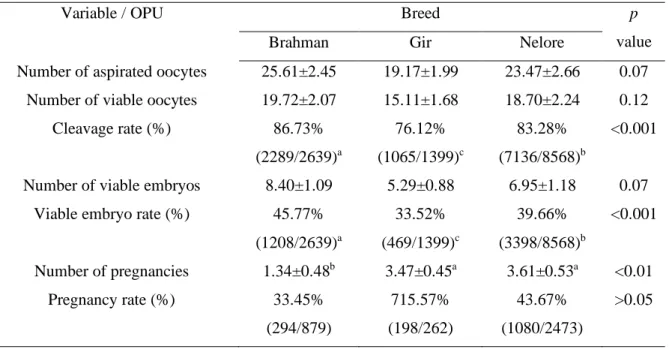
The numbers of aspirated oocytes, viable oocytes, and viable embryos, and pregnancy rates of donor cows of the Brahman, Gir, and Nellore breeds presented no significant differences (p>0.05) (Table 1).
Table 1. Performance of donor cows of the Brahman, Gir, and Nellore breeds subjected to ovum pick up
(OPU) for in vitro production of embryos
Variable / OPU Breed p
value
Brahman Gir Nelore
Number of aspirated oocytes 25.61±2.45 19.17±1.99 23.47±2.66 0.07 Number of viable oocytes 19.72±2.07 15.11±1.68 18.70±2.24 0.12
Cleavage rate (%) 86.73% (2289/2639)a 76.12% (1065/1399)c 83.28% (7136/8568)b <0.001
Number of viable embryos 8.40±1.09 5.29±0.88 6.95±1.18 0.07 Viable embryo rate (%) 45.77%
(1208/2639)a 33.52% (469/1399)c 39.66% (3398/8568)b <0.001 Number of pregnancies 1.34±0.48b 3.47±0.45a 3.61±0.53a <0.01 Pregnancy rate (%) 33.45% (294/879) 715.57% (198/262) 43.67% (1080/2473) >0.05
a,b,c Means followed by different letters in the same row differ (p<0.05)
Donor Brahman cows presented higher (p<0.05) cleavage, and viable embryo rates, followed by Nellore cows, which had higher (p<0.05) means than Gir cows. However, the mean number of pregnancies per OPU of Brahman donors (1.34±0.48) was lower (p<0.05) than those of Nellore (3.61±0.53), and Gir (3.47±0.45) donors, which had similar means (p>0.05) (Table 1).
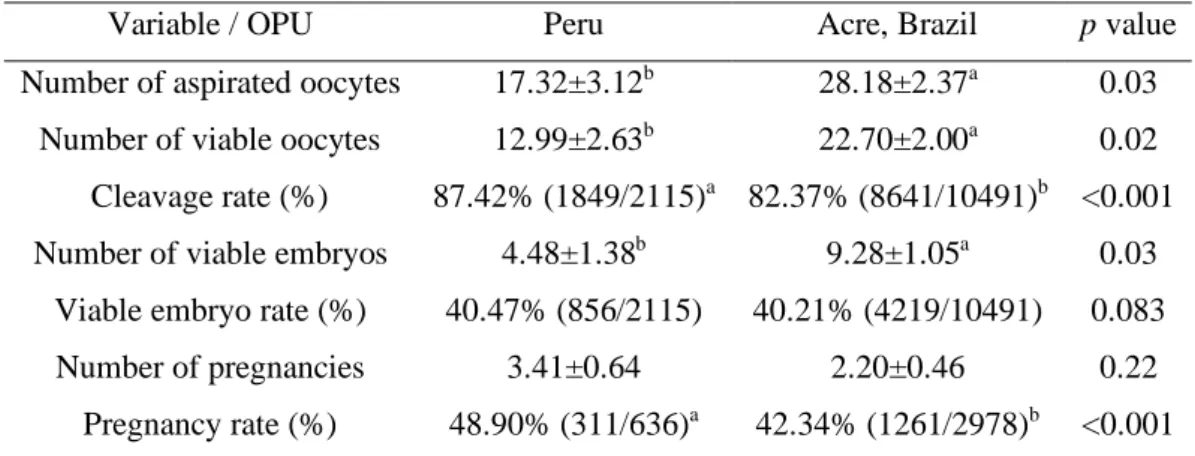
Viable embryo rate, and number of pregnancies per OPU of donor cows raised in Brazil and in Peru were similar (p>0.05) (Table 2).
Table 2. Effect of the location of the farm on the performance of donor cows of the Brahman, Gir, and
Nellore breeds subjected to ovum pick up (OPU) for in vitro production of embryos
Variable / OPU Peru Acre, Brazil p value
Number of aspirated oocytes 17.32±3.12b 28.18±2.37a 0.03 Number of viable oocytes 12.99±2.63b 22.70±2.00a 0.02
Cleavage rate (%) 87.42% (1849/2115)a 82.37% (8641/10491)b <0.001 Number of viable embryos 4.48±1.38b 9.28±1.05a 0.03
Viable embryo rate (%) 40.47% (856/2115) 40.21% (4219/10491) 0.083
Number of pregnancies 3.41±0.64 2.20±0.46 0.22
Pregnancy rate (%) 48.90% (311/636)a 42.34% (1261/2978)b <0.001 a,bMeans followed by different letters in the same row differ (p<0.05)
Donors raised in Brazil, had higher number of aspirated oocytes, viable oocytes, and viable embryos (p<0.05) (Table 2), whereas those raised in Peru had higher cleavage, and pregnancy rates (p<0.05) (Table 2).
Although presenting higher number of aspirated oocytes, and viable oocytes, donor cows raised in Peru, which were more distant from the laboratory (approximately 2300 km from Rio Branco, Acre, Brazil), had higher cleavage and pregnancy rates than those raised in Brazil, closer to the laboratory (Acre) (p<0.05) (Table 2).
The time of year did not affect the numbers of aspirated oocytes, viable oocytes, viable embryos, and pregnancy, and cleavage and viable embryo rates of the Brahman, Gir, and Nellore donors (p>0.05) (Table 3). However, a higher pregnancy rate was found when the embryos were produced in the rainy season (p<0.05) (Table 3).
Table 3. Effect of the time of year on the performance of donor cows of the Brahman, Gir, and Nellore
breeds subjected to ovum pick up (OPU) for in vitro production of embryos
Variable/OPU Time of year p value
Rainy season Dry season
Number of aspirated oocytes 23.77±1.63 21.73±1.61 0.35 Number of viable oocytes 18.93±1.37 16.76±1.35 0.24 Cleavage rate (%) 82.32% (3497/4248) 83.67% (6993/8358) 0.79
Number of viable embryos 7.49±0.72 6.27±0.71 0.21
Viable embryo rate (%) 40.51% (1721/4248) 40.12% (3354/8358) 0.68
Number of pregnancies 3.16±0.34 2.45±0.32 0.11
Pregnancy rate (%) 46.92% (626/1254)a 40.08% (946/2360)b <0.001
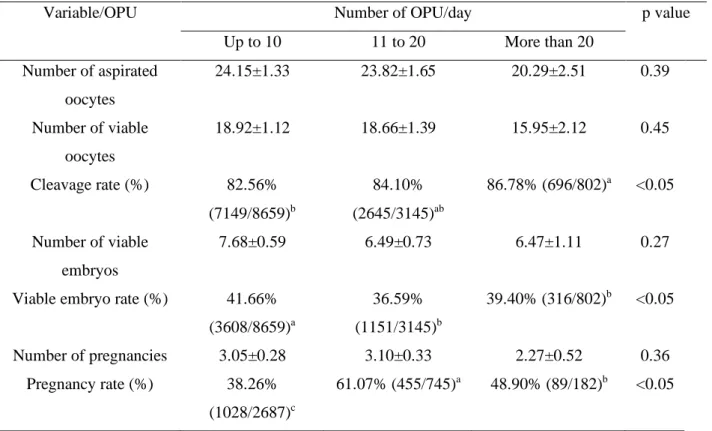
The numbers of aspirated oocytes, viable oocytes, viable embryos, and pregnancies were not affected by the number of OPU performed on the same day (p>0.05) (Table 4).
Table 4. Effect of the number of ovum pick up (OPU) performed on the same day on the performance of
donor cows of the Brahman, Gir, and Nellore breeds subjected to ovum pick up (OPU) for in vitro production of embryos
Variable/OPU Number of OPU/day p value
Up to 10 11 to 20 More than 20 Number of aspirated oocytes 24.15±1.33 23.82±1.65 20.29±2.51 0.39 Number of viable oocytes 18.92±1.12 18.66±1.39 15.95±2.12 0.45 Cleavage rate (%) 82.56% (7149/8659)b 84.10% (2645/3145)ab 86.78% (696/802)a <0.05 Number of viable embryos 7.68±0.59 6.49±0.73 6.47±1.11 0.27
Viable embryo rate (%) 41.66% (3608/8659)a 36.59% (1151/3145)b 39.40% (316/802)b <0.05 Number of pregnancies 3.05±0.28 3.10±0.33 2.27±0.52 0.36 Pregnancy rate (%) 38.26% (1028/2687)c 61.07% (455/745)a 48.90% (89/182)b <0.05
a,b,cMeans followed by different letters in the same row differ (p<0.05)
The cleavage rate was higher when performing more than 20 OPU/day when compared to that when performing up to 10 OPU/day, and intermediate when using 11 to 20 OPU/day (p<0.05) (Table 4).
The viable embryo rate was higher when using up to 10 OPU/day (p<0.05) when compared to those from 11 to 20 OPU/day and more than 20 OPU/day, which were similar (p>0.05) (Table 4).
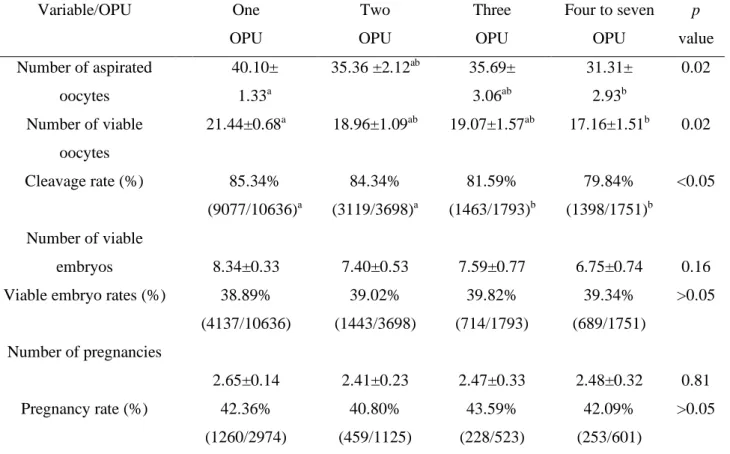
Greater numbers of aspirated and viable oocytes were found when performing one aspiration of oocytes per donor, when compared to the results found when performing four to seven aspirations in the same donor (p<0.05) (Table 5); two or three aspirations per donor resulted in intermediate results (p>0.05) (Table 5).
Table 5: Effect of number of ovum pick up (OPU) performed in the same animal on the performance of
donor cows of the Brahman, Gir, and Nellore breeds subjected to ovum pick up (OPU) for in vitro production of embryos Variable/OPU One OPU Two OPU Three OPU Four to seven OPU p value Number of aspirated oocytes 40.10± 1.33a 35.36 ±2.12ab 35.69± 3.06ab 31.31± 2.93b 0.02 Number of viable oocytes 21.44±0.68a 18.96±1.09ab 19.07±1.57ab 17.16±1.51b 0.02 Cleavage rate (%) 85.34% (9077/10636)a 84.34% (3119/3698)a 81.59% (1463/1793)b 79.84% (1398/1751)b <0.05 Number of viable embryos 8.34±0.33 7.40±0.53 7.59±0.77 6.75±0.74 0.16
Viable embryo rates (%) 38.89% (4137/10636) 39.02% (1443/3698) 39.82% (714/1793) 39.34% (689/1751) >0.05 Number of pregnancies 2.65±0.14 2.41±0.23 2.47±0.33 2.48±0.32 0.81 Pregnancy rate (%) 42.36% (1260/2974) 40.80% (459/1125) 43.59% (228/523) 42.09% (253/601) >0.05
a,bMeans followed by different letters in the same row differ (p<0.05)
The cleavage rate was higher in donor cows subjected to one or two OPU when compared to those subjected to three or more OPU (p<0.05), which had similar results (p>0.05) (Table 5).
The n umbers of viable embryos/OPU of the donors evaluated were similar, regardless of the number of OPU to which they were subjected (p>0.05) (Table 5).
4 DISCUSSION
IVP is a biotechnology often used in reproductive programs, however, the breed of the animals directly affects the success of this technique. Donor cows of the taurine and zebu races can present significant hormonal differences, and ovarian function, even when raised under the same environmental conditions (Sartori et al., 2016). Zebu donors have better performance in IVP programs (Sales et al., 2015). Moreover, considering the breeds used in the present study, differences in the performance of donors in the IVP program were found even among the zebu breeds, which could share some of the characteristics presented by Sartori et al. (Sartori et al., 2016).
Gir donor cows presented a lower cleavage rate compared to Brahman, and Nellore. However, even lower values (59.1% to 68.4%) have been found for Gir donors (Viana et al., 2004). It is
expected that donors of dairy breeds present lower reproductive performance than meat breeds, even when they are in the same genetic group (zebu) (Watanabe et al., 2017). This could explain the result found in the present study, in which Gir donors had lower performance than Brahman and Nellore donors.
The variability in IVP results for different breeds may be associated with the donor nutritional status (Kouamo et al., 2014), estrous cycle phase (Reis et al., 2006), reproductive stage (Landry et
al., 2016), age, number of deliveries (Su et al., 2012), and even gene sequence of each animal (Biase et al., 2008), which were not evaluated in the present study.
A study found variation in the number of aspirated oocytes, with means of 15.7 to 24.9 oocytes per OPU for the Gir breed (Watanabe et al., 2017), which were similar results to those found in the present study.
Nellore donors present considerable variability in oocyte production, with means varying from 18.4 to 30 oocytes per OPU, and of 8.13 viable embryos (Pontes et al., 2011). These were similar results to those found in the present study. However, a study showed means of 46.18 oocytes and 10.09 embryos per OPU (22), which were higher than those found in the present study (Table 1).
Studies of IVP commonly report that laboratories are often far from the site where the donors are raised (Loiola et al., 2014). This increases the time of transport of oocytes from the farm to the laboratory, and of embryos in the opposite direction, compromising the quality and viability of gametes and embryos (Cavalieri et al., 2015). However, studies reported that the transport of embryos for 48 hours, and terrestrial transport of aspirated oocytes through up to 2000 km between farm and laboratory do not affect IVP results (Loiola et al., 2014; Cavalieri et al., 2015).
However, although donor cows raised in Peru, in a more distant location (approximately 2300 km) from the laboratory in Rio Branco, Acre, Brazil, had a higher number of aspirated oocytes and viable oocytes, they had higher cleavage and pregnancy rates when compared to those raised in farms closer to the laboratory (p<0.05) (Table 2), indicating that the distance between the sites where the cows are raised and the laboratory affected the results found.
The performance of the donor cows could have been also affected by other factors related to the animal itself (Reis et al., 2006; Landry et al., 2016; Su et al., 2012; Biase et al., 2008) management (Kouamo et al., 2014), seasonality (Watanabe et al., 2017), hormonal protocol used (Silva et al., 2017), and number of OPU performed in the same donor (Gimenes et al., 2015).
Regarding the effect of time of year on the IVP (Table 3), a study in the Southeastern Region of Brazil, found similar results, with no differences in the number of recovered structures, and viable embryos by OPU, in Gir donor cows raised in winter or summer times (Dourado et al., 2012).
A study with Sindi zebu animals found that the proportion of viable oocytes was higher in the rainy season, and non-viable oocytes was higher in the dry season (Mello et al., 2016). However, the time of year had no influence on the number of viable or non-viable oocytes of the donors in the present study (Table 3).
The availability of grazing in adequate quantity and quality for animal nutrition is important for beef cattle breeds in extensive systems, in which pasture is the main or the only source of nutrients and energy for the animals (Carvalho et al., 2010). Air temperature and rainfall increases in the rainy season, which benefits pasture development, resulting in greater food availability for the animals (Mello et al., 2016). This could explain the higher pregnancy rate found in the present study, after the transference of the IVP embryos produced in the rainy season (Table 3); the greater pasture availability could have resulted in better nutritional status of the recipient cows, favoring the establishment of pregnancy (Torres et al., 2015).
The waiting time of the donors in the corral affects negatively the IVP results, since the contact with humans and the corral environment can cause stress and release of cortisol, which affects follicular maturation, and reproductive hormone dynamics (Costa e Silva et al., 2010). This could explain the results presented in Table 4, since a greater number of OPU performed on the same day would lead to an increase in waiting time in the corral, affecting negatively the IVP results.
Contrastingly to the results in Table 5, a study found no difference in number of viable oocytes when performing one to six OPU in the same donor at intervals shorter than 15 days (Pontes et al., 2011). Moreover, a study with Holstein, Nellore, and buffalo heifers, and OPU performed every 14 days found that the number of OPU only affected the performance of zebu cows, with a decrease in the number of viable oocytes, and cleavage rate (Gimenes et al., 2015), as observed in the Brahman, Gir, and Nellore donors evaluated in the present study.
The number of OPU sessions in the donors and the interval between them can affect the number of aspirated follicles and, consequently, the number of recovered oocytes (Gimenes et al., 2015). Thus, the number of OPU/donor, and other factors such as interval between OPU could have affected the results found (Table 5).
Cows with higher oocyte production present a higher risk of ovarian damage due to the greater number of perforations by OPU; and the number of oocytes decreases along with increases in the number of blastocysts per OPU (Monteiro et al., 2017). This effect was not observed in the present study; the number of viable embryos per OPU of the donors was similar, regardless of the number of OPU performed in each donor (p>0.05) (Table 5).
However, a decrease in the cleavage rate of donors subjected to more than three OPU was observed, which could indicate a decrease in the quality of the aspirated oocytes (Merton et al., 2003).
Considering the conditions of the present study, the variables related to the performance of donor cows of the of Brahman, Gir, and Nellore breeds in in vitro production (IVP) of embryos were affected, with different intensities, by their breed, location of the farms where they were raised, number of ovum pick up (OPU) performed per day, and number of OPU performed in the same donor. However, some variables still need to be studied to overcome some obstacles for IVP, since animals of the same race, and raised under the same conditions have different performances in IVP.
Acknowledgements Conflicts of interest
The authors declare they have no conflicts of interest with regard to the work presented in this repor.
REFERENCES
1. Bertolini M, Bertolini LR. Advances in reproductive technologies in cattle: from artificial insemination to cloning. Rev MVZ Cordoba 2009: 53(3): 184-194.
2. Viana JHM, Figueiredo ACS, Siqueira LGB. Brazilian embryo industry in context: pitfalls, lessons, and expectations for the future. Anim Reprod 2017; 14(3): 476-481. http://dx.doi.org/10.21451/1984-3143-AR989
3. Pontes JHF, Melo Sterza FA, Basso AC, et al. Ovum pick up, in vitro embryo production, and pregnancy rates from a large-scale commercial program using Nelore cattle (Bos indicus) donors. Theriogenology 2011; 75(9): 1640-1646. http://dx.doi.org/10.1016/j.theriogenology.2010.12.026 4. Currin L, Michalovic L, Bellefleur AM, et al. The effect of age and length of gonadotropin stimulation on the in vitro embryo development of Holstein calf oocytes. Theriogenology 2017; 104: 87-93. http://dx.doi.org/10.1016/j.theriogenology.2017.08.011
5. Jin JI, Ghanem N, Kim SS, et al. Interaction of donor age, parity and repeated recovery of cumulus– oocyte complexes by ovum pick-up on in vitro embryo production and viability after transfer. Livest Sci 2016; 188: 43-47. https://doi.org/10.1016/j.livsci.2016.04.002
6. Mello RRC, Ferreira JE, Sousa SLG, Mello MRB, Palhano HB. Fatores ligados à doadora que influenciam na produção de embriões in vitro (PIVE). Rev Bras Reprod Anim 2016; 40(2): 51-57. 7. Silva JCB, Ferreira RM, Maturana Filho M, et al. Use of FSH in two different regimens for ovarian superstimulation prior to ovum pick up and in vitro embryo production in Holstein cows. Theriogenology 2017; 90: 65-73. https://doi.org/10.1016/j.theriogenology.2016.11.016
8. Gimenes LU, Ferraz ML, Fantinato-Neto P, et al. The interval between the emergence of pharmacologically synchronized ovarian follicular waves and ovum pickup does not significantly affect in vitro embryo production in Bos indicus, Bos taurus, and Bubalus bubalis. Theriogenology 2015; 83(3): 385-393. https://doi.org/10.1016/j.theriogenology.2014.09.030
9. Guemra S, Monzani PS, Santos ES, et al. Maturação in vitro de oócitos bovinos em meios suplementados com quercetina e seu efeito sobre o desenvolvimento embrionário. Arq Bras Med Vet Zootec 2013; 65(6): 1616-1624. http://dx.doi.org/10.1590/S0102-09352013000600005
10. Fernandéz-Gonzalez R, Moreira PN, Pérez-Crespo M, et al. Long-term effects of mouse intracytoplasmic sperm injection with dna-fragmented sperm on health and behavior of adult offspring. Biol Reprod 2008; 78: 761-772. https://doi.org/10.1095/biolreprod.107.065623
11. Honorato MT, Ferro RAC, Ferro DAC, Santos JC, Costa MA, Rodrigues Filho JL. Importância da escolha de receptoras em um programa de transferência de embriões em bovinos. PUBVET 2013; 7(19). Ed.242. Art.1601.
12. Vieira LM, Rodrigues CA, Castro Netto A, et al. Efficacy of a single intramuscular injection of porcine FSH in hyaluronan prior to ovum pick-up in Holstein cattle. Theriogenology 2016; 85(5):877-886. https://doi.org/10.1016/j.theriogenology.2015.10.036
13. Sartori R, Gimenes LU, Monteiro PL Jr, Melo LF, Baruselli PS, Bastos MR. Metabolic and endocrine differences between Bos taurus and Bos indicus females that impact the interaction of nutrition with reproduction. Theriogenology 2016; 86(1):32-40. https://doi.org/10.1016/j.theriogenology.2016.04.016
14. Sales JN, Iguma LT, Batista RI, et al. Effects of a high-energy diet on oocyte quality and in vitro embryo production in Bos indicus and Bos taurus cows. J Dairy Sci 2015; 98(5): 3086-3099. https://doi.org/10.3168/jds.2014-8858
15. Viana JH, De Almeida Camargo LS, De Moraes Ferreira A, De Sa WF, De Carvalho Fernandes CA, De Pinho Marques Junior A. Short intervals between ultrasonographically guided follicle aspiration improve oocyte quality but do not prevent establishment of dominant follicles in the Gir breed (Bos indicus) of cattle. Anim Reprod Sci 2004; 84(1-2):1-12. https://doi.org/10.1016/j.anireprosci.2003.12.002
16. Watanabe YF, Souza AH, Mingoti RD, et al. Number of oocytes retrieved per donor during OPU and its relationship with in vitro embryo production and field fertility following embryo transfer. Anim Reprod 2017; 14(3):635-644. https://doi.org/10.21451/1984-3143-AR1008
17. J Kouamo, SM Dawaye, AP Zoli, GS Bah. Evaluation of bovine (Bos indicus) ovarian potential for in vitro embryo production in the Adamawa plateau (Cameroon). Open Vet J. 2014; 4(2): 128– 136.
18. A Reis, R Metelo, P Santos, F Moreira da Silva. Efeito da estrutura ovárica e da idade de bovinos da raça Holstein Friesian na quantidade e qualidade de ovócitos e de embriões produzidos in vitro. Braz J Vet Res Anim Sci 2006; 43(5): 629-636. https://doi.org/10.11606/issn.1678-4456.bjvras.2006.26571
19. Landry DA, Bellefleur AM, Labrecque R, et al. Effect of cow age on the in vitro developmental competence of oocytes obtained after FSH stimulation and coasting treatments. Theriogenology 2016; 86(5): 1240-1246. https://doi.org/10.1016/j.theriogenology.2016.04.064
20. Su L, Yang S, He X, et al. Effect of Donor Age on the Developmental Competence of Bovine Oocytes Retrieved by Ovum Pick Up. Reprod Domest Anim 2012; 47(2): 184-189. https://doi.org/10.1111/j.1439-0531.2009.01349.x
21. Biase FH, Fonseca Merighe GK, Santos Biase WK, Martelli L, Meirelles FV. Global poly(A) mRNA expression profile measured in individual bovine oocytes and cleavage embryos. Zygote 2008; 16(1): 29-38. https://doi.org/10.1017/S0967199407004455
22. Loiola MVG, Chalhoub M, Rodrigues AS, Ferraz PA, Bittencourt RF, Ribeiro Filho AL. Validação de um Programa de Produção In Vitro de Embriões Bovinos com Transporte de Oócitos e de Embriões por Longas Distâncias. Cienc Anim Bras 2014; 15(1): 93-101. https://doi.org/10.5216/cab.v15i1.23327
23. Cavalieri FLB, Andreazzi, MA, Colombo AHB, Emanuelli IP, Moreski DAB, Silva WM. Estudo Sobre o Cultivo In Vitro de Embriões Bovinos Durante o Transporte. Ars Vet 2015; 31(1): 07-11. http://dx.doi.org/10.15361/2175-0106.2015v31n1p07-11
24. Dourado AP, Torres Filho R, Cardoso EC, et al. Produção estacional de embriões in vivo em vacas da raça Gir (Bos indicus) na região sudeste (clima tropical), Brasil. R Bras Ci Vet 2012; 19(13): 183-189. http://dx.doi.org/10.4322/rbcv.2014.103
25. Mello RRC, Mello MRB, Sousa SLG, Ferreira JE. Parâmetros da produção in vitro de embriões da raça Sindi. Pesq Agropec Bras 2016; 51(10): 1773-1779. http://dx.doi.org/10.1590/s0100-204x2016001000009
26. Carvalho DMG, Zevoudaski JT, Cabral LS, De Paula NF, Koscheck JFW, Oliveira AA. Fontes de energia em suplementos múltiplos para o período da seca: parâmetros nutricionais. Uniciências 2010; 14(2): 303-323. http://dx.doi.org/10.17921/1415-5141.2010v14n2p%25p
27. Torres HAL, Tineo JO, Raidan FS. Influência do escore de condição corporal na probabilidade de prenhez em bovinos de corte. Arch Zootec, 2015; 64(247): 255-260. https://doi.org/10.21071/az.v64i247.403
29. Monteiro FM, Batista EOS, Vieira LM, et al. Beef donor cows with high number of retrieved OÓCITO produce more in vitro embryos compared with cows with low number of OÓCITO after repeated ovum pick-up sessions. Theriogenology 2017; 90:54-58. https://doi.org/10.1016/j.theriogenology.2016.11.002.
30. Merton JS, Roos APW, Mullaart E, et al. Factors affecting oocyte quality and quantity in commercial application of embryo technologies in the cattle breeding industry. Theriogenology 2003; 59(2): 651-674. https://doi.org/10.1016/S0093-691X(02)01246-3