UNIVERSIDADE DE LISBOA
FACULDADE DE MEDICINA DENTÁRIA
CYCLIC FATIGUE BEHAVIOUR OF WAVE
ONE GOLG
TMCOMPARED TO RECIPROC
BLUE
TMINSTRUMENTS
ISABEL PEREIRA
DISSERTAÇÃO
MESTRADO INTEGRADO EM MEDICINA DENTÁRIA
UNIVERSIDADE DE LISBOA
FACULDADE DE MEDICINA DENTÁRIA
CYCLIC FATIGUE BEHAVIOUR OF WAVE
ONE GOLG
TMCOMPARED TO RECIPROC
BLUE
TMINSTRUMENTS
ISABEL PEREIRA
Dissertação orientada
Pelo Prof. Doutor António Ginjeira
MESTRADO INTEGRADO EM MEDICINA DENTÁRIA
INDEX
AGRADECIMENTOS... i
RESUMO ... iii
PALAVRAS-CHAVE: WaveOne Gold, WaveOne Gold Primary, Reciproc Blue, resistência à fadiga, movimento recíproco, lima única, endodontia, M-Wire. ...vi
ABSTRACT ... viii KEYWORDS: ... ix 1.1 Endodontic evolution ... 1 1.2 Disadvantages ... 2 1.2.1Torsional fatigue ... 3 1.2.2 Cyclic fatigue ... 3 1.2.2.1 Fatigue tests ... 3 1.3 Reciprocating movement ... 5 1.3.1 Reciprocating movement ... 5 1.3.2. Temperature treatment ... 6
1.3.3. Wave One Gold® System... 7
1.3.4. Reciproc® Blue System ... 8
1.4. Study relevance ... 10
1.5. Null hypothesis ... 10
2. AIMS ... 11
3. MATERIALS AND METHODS ... 12
3.1 Reciprocating Files System ... 12
3.2 Equipment ... 14 3.3 Experimental procedure... 16 3.4 Statistical Analysis ... 20 4. RESULTS ... 21 5. DISCUSSION ... 25 6. CONCLUSIONS ... 29 7. ACKNOWLEDGMENTS ... 29 REFERENCES ... xxx APPENDIX ... xxxvii Abbreviations ... xxxvii Symbols ... xxxviii Units ... xxxviii
i
AGRADECIMENTOS
Ao meu orientador, Professor Doutor António Ginjeira, pela orientação e confiança depositada durante o curso. Ao Professor Doutor Rui Martins, pela constante disponibilidade, rapidez, bondade, simpatia, pela orientação e clareza na explicação do protocolo experimental. Ao Professor Doutor Henrique Luís, pela orientação no processamento dos resultados a nível estatístico, pela disponibilidade e simpatia. A Dra Mariana, por se ter disponibilizado e pela ajuda indispensável.
Ao Dr. Luís Barreiros e Dra. Ana Oliveira, que me fazem ver o lado bom da vida, pelos bons conselhos e por mudarem o meu core. Sem vós seria impossível..
Aos meus colegas e ex-colegas de curso, professores da faculdade, assistentes da pré e pós graduação, outras pessoas da casa com quem eu partilhei bons e maus momentos, e que tiveram um impacto positivo na minha vida. À Lara, Flor, Isaac, Ivana, Sónia, Ana Paula, Susana, Inês,Ana, Mel, Elisabete, David, MºJoão, Beta, Pedro pela amizade, companheirismo e diversão.
A minha família: primos, tios e madrinha.
Para as pessoas mais importantes da minha vida: a minha mãe e o meu irmão. Pelo apoio incondicional, amor, por me aturarem, por me fazerem lutar para ultrapassar todos obstáculos, pela paciência, confiança e carinho. São os amores da minha vida, os que me almejam conquistar a felicidade e os que me fazem feliz.
iii
RESUMO
INTRODUÇÃO: Os instrumentos rotatórios de níquel titânio tem sido largamente utilizados na preparação de canal radicular. Usados tanto por generalistas como especialistas de forma a facilitar a limpeza e instrumentação do canal. Os instrumentos de níquel-titânio contém 56% de níquel e 44% de titânio tem como propriedades a superelasticidade e memória, as quais lhe confere maior flexibilidade e resistência. Contudo, uma grande desvantagem apontada a este tipo de lima, é o risco inesperado da sua fratura. Devido a variações de anatomia, tamanho e calibre de canais, número de utilizações prévias, experiência de operador, esterilização, seção de design da lima, processo de fabrico, entre outros fatores. A fratura pode ocorre por uma combinação de uma ou duas formas: torção ou/e fadiga. A torção ocorre quando o limite elástico de metal é ultrapassado. A fadiga ocorre com a lima livre na curvatura de um canal, sujeita a ciclos de tensão/compressão no ponto máximo de curvatura. Clinicamente, a fratura deve-se maioritariamente a fratura por fadiga. Esta ocorre sem sinais visíveis de deformação e de uma forma inesperada. Os testes de fadiga podem ser realizados tanto em modelos estáticos, como em dinâmicos. Sendo realizada maioritariamente, em modelos estáticos. Várias estratégias tem sido desenvolvidas para aumentar a sua resistência, como alteração de design da lima, tratamento térmico e uso de movimento de reciprocante. Em 2011, surgiram dois novos sistemas de limas únicas de NiTi e de uso único: WaveOne TM (Dentsply Maillefer, Ballaigues, Suíça) e Reciproc TM (VDW, Munique, Alemanha). Desde 2015, a WaveOne TM foi substituída pela WaveOne Gold TM e a Reciproc TM pela Reciproc Blue TM. Estes dois sistemas utilizam um movimento recíproco. O movimento ocorre com ângulos diferentes de rotação nos sentidos horário e anti-horário. Quando o instrumento é movimentado no sentido anti-horário (ângulo maior), ele avança apicalmente cortando a dentina. Com o movimento contrário, ele desprende-se da dentina. Avançando de forma segura e automática através de uma aplicação mínima de pressão no sentido apical. As limas WaveOne Gold TM possuem uma seção de design no formato de um paralelograma e tem uma cor única, dourada, resultante de aquecimento e arrefecimento do seu tratamento térmico. As limas Reciproc Blue TM possuem uma seção de design em formato de S e tem uma cor única, azul, resultante de tratamento térmico a que são submetidas. As limas sucessoras, WOG e RB, apresentam melhoria nos resultados de flexibilidade e resistência a fadiga.
(WOG) e Reciproc Blue (RB).
MATERIAIS E MÉTODOS: Foram analisadas 40 limas endodônticas, novas e sem utilização prévia, com 25mm de comprimento, dos sistemas WaveOne Gold TM
(Dentsply Maillefer, Ballaigues, Switzerland) (WOG) e Reciproc BlueTM (VDW,
Munich, Germany) (RB) que foram agrupadas em 4 grupos (n=10).
Grupo A1: WaveOne Gold® Primary sem hipoclorito,
Grupo A2: Reciproc® Blue R25 sem hipoclorito
Grupo B1: WaveOne Gold® Primary com hipoclorito,
Grupo B2: Reciproc® Blue R25 com hipoclorito.
Estas limas foram testadas usando o sistema mecânico desenvolvido no âmbito da parceria com a Faculdade de Ciências e Tecnologia da Universidade Nova de Lisboa (Departamento de engenharia mecânica).
O sistema de teste é composto por uma calha metálica que simula o canal artificial com um raio de curvatura de 4,7 mm e um ângulo de curvatura de 45º. As limas são inseridas neste sistema acopladas a um contra- ângulo de um motor endodôntico, a velocidade de rotação de 350 rpm para o programa WaveOne ALL e de 300 rpm para o programa Reciproc ALL (a indicada pelo fabricante). Cada instrumento foi inserido no contra- ângulo acoplado ao micromotor WaveOneTM e submetido ao teste de fadiga. O
tempo que a lima demorou a fraturar foi registado visualmente com um cronómetro digital, em segundos, sempre pelo mesmo operador. O comprimento da ponta da lima partida foi medida com um paquímetro manual, em mm. De seguida foi calculado o Número de Ciclos à Fratura (NCF), pela multiplicação da velocidade de rotação, em rpm, pelo tempo, minutos, decorrido até à fratura. Os dados obtidos em relação ao tempo, local de fratura e NCF foram estatisticamente analisados pelos testes não-paramétricos de Mann-Whitney U e pelo teste paramétrico t-student para amostras independentes tendo em conta os resultados dos testes de normalidade Kolmogorov-Smirnov e Shapiro-Wilk previamente aplicados. O nível de significância estabelecido foi de 95%.
v
RESULTADOS: O grupo B2 apresentou maior número de ciclos até à fratura (NCF) com uma média de 2254 ± 587,8 ciclos até à fratura, comparado com 1307,8 ± 186,6
ciclos para o grupo A1, 1446,5 ± 494,3 ciclos para o grupo A2, 970,3 ± 215,9 ciclos para o grupo B1, com um valor de p= 0,2. Os testes estatísticos revelam que esta é uma diferença estatisticamente significativa. O local de fratura mostrou diferenças estatisticamente significativas entre os quatro grupos de instrumentos, com um valor de p= 0,24. Nos grupos A1 e B1 registou-se normalidade, no qual foi usado o teste independente t-student. Os seguintes valores de média foram calculados: grupo A1 5,2 ± 0,7 mm, grupo A2 5,27 ± 0,4 mm , grupo B1 5,6 ± 0,5 mm e no grupo B2 5,8± 0,5mm .O tempo de fratura mostrou diferenças estatisticamente significativas entre os quatro grupo de instrumentos , com um valor de p = 0,2. Para grupo A1 242,2 ± 31,9 segundos, grupo A2 301,3 ± 103,1 segundos, grupo B1 165,3 ± 37,6 segundos e no grupo B2 449,8 ± 117,1 segundos.
DISCUSSÃO E CONCLUSÃO: Para realizar este estudo e torná-lo válido, é necessário avaliar as limitações do mesmo.O primeiro fator do estudo se limitar a uma posição estática do instrumento no canal, ao invés de reproduzir o movimento de vaivém no canal, traduzindo características mais semelhantes ao dente natural. Apesar de modelo estático ser um bom método para comparação entre estudos. Outro fator refere-se a não medição de temperatura do hipoclorito de sódio usado para simular a irrigação que decorre durante o procedimento endodôntico (reduzindo deste modo a fricção e produção de calor no teste de fadiga).Foi descrito que o hipoclorito e outras soluções usadas na irrigação e lubrificação durante a instrumentação podem contribuir para uma corrosão adicional, potenciar ou iniciar uma fratura na superfície da lima. Outro fator é o erro de operador aquando de uso de cronómetro, para medição do tempo, e paquímetro para medição de comprimento da ponta da lima fraturada. De acordo com as limitações deste estudo, verificou-se diferentes resistências à fadiga entre diferentes instrumentos. O instrumento do grupo B2 (RB com NaOCl) apresenta-se como o mais resistente à fadiga, seguido por ordem decrescente dos grupos: A2, A1 e B1. Apenas um artigo foi encontrado na literatura que compara limas WaveOne® Gold Primary(WOGP) e Reciproc®
Blue(RB), os resultados são semelhantes com o estudo presente: Grupo RB provou ser mais resistente que grupo WOG. Em vários estudos anteriores foi verificado que as limas WOG apresentam resistência superior as limas R. Neste caso a diferença poder-se-á dever ao tratamento térmico que a RB é sujeita e outra razão também poderá ser o design em S da RB. Relativamente ao local de fratura dos instrumentos, o instrumento de grupo
de curvatura. Relativamente ao tempo de fratura dos instrumentos, houve diferenças estatisticamente significativas entre os 4 grupos, sendo que o grupo B2 apresentou-se como o mais duradouro.
Conclui-se que o sistema Reciproc BlueTM com irrigação constante parece apresentar uma resistência à fadiga superior em relação a RB sem hipoclorito de sódio (NaOCl) e WOG com e sem hipoclorito. Os médicos dentistas, devem estar cientes das propriedades mecânicas de forma a selecionar limas com alta resistência à fratura. Existe uma necessidade de padronização dos testes de fadiga específicos de instrumentos rotatórios para assegurar a uniformidade da metodologia e a comparabilidade dos resultados, tal como no método de análise estatística.
PALAVRAS-CHAVE:
WaveOne Gold, WaveOne Gold Primary, ReciprocINTRODUCTION: Mechanical files have drastically altered the treatment protocol in endodontics, allowing for quicker and easier treatment times and more thorough debridement of the canal system. Despite the advantages of the Ni-Ti alloy files, instrument separation still remains a major concern when using these files.
OBJECTIVES: The purpose of this study was to compare the cyclic fatigue behavior of WaveOne® Gold instruments and compare it to Reciproc® Blue instruments.
MATERIAL AND METHODS: Forty nickel-titanium files of WOG and RB systems were analyzed in this study. Files were divided into 4 experimental groups (n=10):Group A1: WaveOne® Gold Primary files without sodium hypochlorite, Group
A2: Reciproc® Blue files without sodium hypochlorite, Group B1: WaveOne® Gold
Primary with sodium hypochlorite and Group B2: Reciproc® Blue with sodium
hypochlorite. A mechanical device was used to simulate the root canal system , a radius of curvature 4,7mm and an angle of curvature 45º. Each WOG and RB files, were submitted to a respectively, rotational speed of 350 rpm and 300 rpm . The time to fracture was registered with a digital chronometer until tip separation occurred. The number of cycles to fracture was calculated by multiplying time by rotational speed. The fracture length was measured with a manual caliper. Data obtained was recorded and statistically analyzed using the non-parametric Mann-Whitney U test or the independent t-student test taking into account the results of the normality tests previously applied. Significance was set at 95% confidence level.
RESULTS: B2 instrument proved to be statistically more resistant to cyclic fatigue than A1, A2 and B2.
CONCLUSION: Within the limitations of this study, Reciproc® Blue files with
irrigation demonstrated statisticallygreater resistance to cyclic fatigue. Clinicians should be aware of the mechanical properties to choose the best file, selecting systems with higher fracture resistance to cyclic fatigue.
ix
KEYWORDS:
WaveOne Gold, WaveOne Gold Primary, Reciproc Blue. Cyclic fatigue, reciprocating motion, single files, endodontics,M-Wire.
INTRODUCTION
1.1 Endodontic evolution
NiTi alloy was developed by W. F. Buehler in early 1960s. NiTi rotary files were introduced by Walia in 1988, and have since changed the way we practice endodontics. For the past 2 decades NiTi rotary instruments have been used to shape root canals because of their flexibility and cutting efficiency (Arias et al. 2012, Perez et al. 2013).
The NiTi alloys, used in endodontic instruments was named 55-Nitinol, containing 56% nickel and 44% titanium. They have a nearly equiatomic ratio of nickel and titanium and can exist in various crystallographic forms, contains three microstructural phases (austenite, martensite and r-phase) (figure1).
Figure 1 – Diagramatic representation of the martensitic transformation and shape
memory effect of NiTi alloy (reproduced from Thompson et al. 2000).
NiTi files have an inherent ability to alter their type of atomic bonding with temperature and stress, which causes unique and significant changes in the mechanical properties and crystallographic arrangement, as a result transition between the austenite to martensite form.
CYCLIC FATIGUE BEAHVIOUR OF WAVE ONE GOLDTM COMPARED TO RECIPROC BLUE TM INSTRUMENTS
2 ISABEL PEREIRA
The crystalline structure of the NiTi alloy at high temperature ranges (> 100ºC) is a stable, face-centered cubic lattice which is referred to as the austenite phase or the parent phase (figure 1 – top left).
When nitinol is cooled through a critical transformation temperature range (TTR), a change occurs in its crystallographic structure called a martensitic transformation, that originates the martensitic or daughter phase at a low temperature (figure 1, bottom left). Resulting the twinned martensite, a packed hexagonal lattice, that can be easily deformed to de-twinning martensite, a single orientation form (figure 1, bottom right).
The deformation is reversed by heating above the TTR, reverting to the original parent phase. This ability, is called shape memory. Translating in an ability to remove any deformation by heating the files above 125ºC. The austenite (low temperature phase) to martensite (high temperature phase) also occurs, as the result of tension produced during root canal preparation.
Superelasticity is associated when stress exceeds the critical level, without
increasing the strain, and the ambient temperature is above the austenite-finish (Af) temperature of the material (Shen et al 2011, Uygun et al. 2015, Ozyurek et al. 2016). Therefore to alow this property, the working temperature must be above Af. This property also means that on unloading they return to their original shape before deformation.
Super elasticity and shape memory effect, can maintain the original canal curvature and create a tapered root canal shape (Enalgy et al. 2014).
Flexibility of endodontic files can be defined as the elastic bending when subjected to load applied to its extremity in a perpendicular direction to its long axis. This property is one of the most important in choosing files, mainly because high flexibility translates in a less resistance to torsional fatigue, but higher resistance to cyclic fatigue (Ya Shen et al. 2013, Peters et al. 2011).The geometry, size, cross-sectional design, composition and thermomechanical treatment improvements affects the flexibility (Lopes et al. 2013).
1.2 Disadvantages
Despite these advantages, the fracture risk of the NiTi instrument during treatment is significantly high in curved or narrow canals (Knowles et al. 2006, Parashos et al. 2006). Fractured NiTi files might affect the success of root canal treatment (Mcguian et al. 2013, Ha et al. 2013). Total fatigue life consists of three stages: crack initiation in
which microcracks form and start to grow, crack propagation, until the crack results in an overload zone. This zone features a ductile failure (Hull et al. 1999, Cheung et al. 2005, Cheung et al. 2007). The mechanism by which file separation occurs is by one or a combination of two ways: either by torsional fracture (shear failure) or cyclic fatigue (flexural fatigue) (Pedullà et al. 2015, Satapan et al. 2000).
1.2.1Torsional fatigue
This type of fracture occurs when the tip or another part of the instrument binds in the root canal, while the shank continues to rotate (Kim et al. 2012, Parashos & Messer 2006, Lopes et al. 2011), when elastic limit of metal is exceed by torque exerted by the handpiece.
1.2.2 Cyclic fatigue
In this type of fracture, the instrument rotates freely inside a curvature canal, generating tension/compression stress cycles at the point of maximum bending until fracture occurs. Is due to metal fatigue and its usually localized at the point of maximum curvature (Bouska et al. 2012, Setzer et al. 2013). Cyclic fatigue has been the major cause of the separation of NiTi rotary instruments during clinical use (Cheung et al. 2005), affected by operator experience, radius and degree of canal curvature, the instrument: diameter taper, number of utilizations and mass.
1.2.2.1 Fatigue tests
Cyclic fatigue tests can be static or dynamic. In static tests the instruments rotate at a fixed length with no axial displacement, whereas in the dynamic tests the instrument is moved back and forth within the canal (Rodrigues et al. 2011). Dynamic testing extends the lifetime of rotary files (Dederich et al. 1986). However, a tooth can be used only once and due to anatomic variation the same exact conditions cannot be reproduced. Tests for file fracture are usually performed using static models because they provide standardized conditions for each tested instrument (Larsen et al. 2009). Nevertheless, static tests are
CYCLIC FATIGUE BEAHVIOUR OF WAVE ONE GOLDTM COMPARED TO RECIPROC BLUE TM INSTRUMENTS
4 ISABEL PEREIRA
not able to reproduce the real conditions faced in clinical practice (Pessoa et al 2013). Fatigue life is determined by multiplying the time the instrument takes to fracture, in minutes, by rotational speed in rpm (rotations per minute)(Lopes et al 2009).The greater the value of NCF (number of cycles to fracture), the greater is its resistance to fracture.
Canal shape influence the fracture of the file. The shape of any root canal curvature can be expressed using two independent parameters: radius and angle of curvature (figure 2) (Pruett et al. 1997). The angle of curvature is the angle between two radii of the osculating circle intersecting the end points of the canal curvature. The radius of curvature is the radius of the circle that approaches the curvature canal most tightly- the radius of the osculating circle. The smaller the radius of curvature, the more abrupt the canal deviation gets, increasing the instrument separation. The variation of both the angle and radius of curvature of a canal will induce different stresses on an instrument, extending or reducing its fatigue life (Wan et al. 2011).
Figure 2 – Canal geometry: radius of curvature(r) and angle of curvature (α) (reproduced from Pruett et al 1997).
Defects of Surface finishing, like grooves acts as stress concentration factors. Which favors nucleation, growth, and propagation of cracks (Lopes et al. 2010).
Regarding Rotational speed, some studies found that higher rotational speed decreased cyclic fatigue resistance. The effect remains unclear (Lopes et al. 2010).
Some strategies have been used such as alteration of the cross-sectional design, heat treatments, and the use of different kinematics, among others (Gambarini et al. 2008, Karatas et al. 2016) to enhance files performance and mechanical properties. Some studies concluded that the cross section had no effect (Cheung et al. 2007, Chaves et al.
2002), others came to the opposite conclusion (Grande et al. 2006, Ray et al. 2007). Instruments that have a triangular cross-sectional geometry showed better fatigue resistance than a square section (Cheung et al. 2011), as well as an S-shaped cross section than a rectangular cross section (Cheung et al. 2011).
NiTi systems have continuously evolved and new files and file systems are constantly being marketed. New innovations that intend to reduce file separation and improve performance and safety have been proposed such as: reciprocation motion (instead of traditional rotary movement), surface treatment and temperature treatment of the metal alloy. (Peters et al. 2012).
1.3 Reciprocating movement
Its described as an oscillatory movement turns in the clockwise direction, and then counter- clockwise before completing a full 360º rotation cycle (Gavini et al. 2012). Where a larger clockwise (CW) angle cuts the dentine, and a shorter counterclockwise (CCW) angle prevents a locked file inside the canal, which requires a minimal pressure in the apical part. The kinematics increases the cyclic fatigue life and extend the lifespan of NiTi files (Ferreira et al. 2016, De-Deus et al. 2010,Varela et al. 2010, Karatas et al 2015, Weber 2015). In which, the instrument travel a shorter angular distance than the rotary, being subjected to lower stress values (De-Deus et al. 2010, Pedulla et al. 2013, Kiefner et al. 2014). Manufacturers suggest ideal speeds and torques for these instruments, although clinicians often modify the values (Gambarini et al. 2012)
1.3.1 Reciprocating movement
In 2007, Yared introduced a new technique in root canal preparation, using only one file, one time, in two directions: a CW and CCW movement, using a multiple reciprocation motion completing a 360º rotation, that simulates a balanced force. Manufacturers advocate that the preparation of the root canal can be made with only one file. It can be used in a reciprocal or in a continuous motion, providing a shape technique, regardless of any length, diameter and curvature. As they are easier to apply, reduce the
CYCLIC FATIGUE BEAHVIOUR OF WAVE ONE GOLDTM COMPARED TO RECIPROC BLUE TM INSTRUMENTS
6 ISABEL PEREIRA
mean preparation time by 3 times and safer canal progression 4 times in comparison with multi-file rotational system, reduced number of failures, and have lower cross contamination (Burklein et al. 2012).
1.3.2. Temperature treatment
Thermal treatment of NiTi alloys optimizes files mechanical properties such as fatigue resistance, flexibility, cutting efficiency, and canal centering ability (Perez-Higueras et al. 2013, Lopes et al. 2013, Shen et al. 2012, Pereira et al. 2013) by altering its microstructure (NiTi wire blanks) and transformation behavior, via cold work and heat treatment.
Three different treatments have been introduced:
In 2007, Memory Wire (M-Wire®) (Dentsply Tulsa Dental Specialties, Tulsa, OK),
In 2008, R-phase Wire (SybronEndo, Orange, CA)
And in 2010, Controlled Memory Wire (CM-Wire®) (DS Dental, Johnson City, TN).
Instruments made from M-wire exhibit more resistance to cyclic fatigue compared to those made of conventional NiTi (Ye et al. 2012).
In 2011, both Reciproc® (R) (VDW, Munich, Germany) and WaveOne® (WO)
(Dentsply Maillefer, Ballaigues, Switzerland) systems were launched as single file shaping techniques. Since 2015, WaveOne (WO) was replaced by a new improved version – WaveOne® Gold (WOG) (Weber, 2015) and Reciproc® was replaced by Reciproc® Blue.
1.3.3. Wave One Gold® System
WaveOne Gold™ (WOG) system introduced in 2015 (Dentsply Tulsa Dental Specialties) is the new generation of reciprocating single file, single-use technique (150º counterclockwise motion followed by 30º clockwise rotation in one single process). WOG keep the simplicity of the first generation but offers additional benefits over its predecessor (Dentsply Tulsa Dental Specialties 2015, Weber 2015). Manufacturers advocate that they improve its strength (50% more resistant to cyclic fatigue) and flexibility (at least 80%), as the result of a unique heat-treatment process applied after manufacture procedure, a result of a two-stage a-r-m transformation, which creates finely dispersed Ti3Ni4 precipitates in the austenitic matrix (Otsuka et al. 2005, Duerig et al. 1990). The raw metal is nickel titanium, is repeatedly heated and slowly cooled (opposed to the M-Wire technology based on heat treatment before production, as a result of a single stage transformation a-m), giving the distinctive gold appearance of the files. Another change is the cross-section at the tip and coronal ends, that has been enhanced from the triangular shape of its predecessor to a unique parallelogram design (figure 4), which gives one or two cutting edges depending on the location along the file. These edges were designed to improve cutting efficiency (at least 23%) and allowing better removal of debris. All these improvements reduce the risk of file fracture and therefore enhancing patient safety and enable the negotiation of a wider range of canal morphologies and curvatures (Weber, 2015). The off center designed is the same as used in Protaper Next (Dentsply Maillefefer).
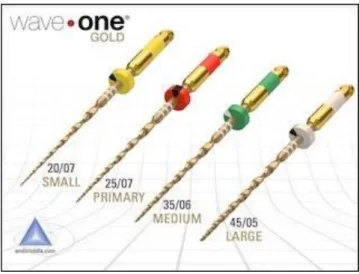
There are four WaveOne Gold files available in various lengths. The four files are termed: (figure 3) – Small (yellow 20.07), Primary (red 25.07), Medium (green 35.06) and Large (white 45.05), in three lengths (21, 25 and 31mm). These files have a noncutting tip, work in a 150° CCW and 30° CW reciprocating motion. Each file has a fixed taper from D1 to D3, yet a progressively decreasing percentage tapered design from D4 to D16, which serves to preserve dentin. Variable reducing tapers ensures that the final shape of the prepared canal is more conservative, fulfilling the requirements of minimally invasive endodontics aiming to remove less of the existing tooth structure in order to preserve the integrity of the natural tooth. (Dentsply®; Raftery, 2015).
CYCLIC FATIGUE BEAHVIOUR OF WAVE ONE GOLDTM COMPARED TO RECIPROC BLUE TM INSTRUMENTS
8 ISABEL PEREIRA
Figure 3 – WaveOne® Gold system composed by four different single files
(Dentsply Maillefer)
a) b)
Figure 4 – a)Parallelogram-shaped cross section (Dentsply Maillefer) b)
Reciprocal motion using unequal bidirectional angles (CCW=150º; CW=30º)
1.3.4. Reciproc® Blue System
Reciproc Blue™ system introduced in 2016 (VDW, Munich, Germany) is the new generation of reciprocating file, single-use technique and single file, as the successor of the Reciproc™ system (RPC,VDW). The instrument undergoes a new heat treatment altering the molecular structure, which controls the transition temperatures, resulting in a visible titanium oxide layer, giving the distinctive blue appearance of the files (Plotino et al. 2014). It features a S-shaped cross-section (figure 6), specifically designed for curved and calcified canals (Dhingra et al. 2015), with 2 cutting edges, and a noncutting tip.
Works in a 150º CCW and 30º CW reciprocating motion. The tip can be curved to obtain an easier access to the canals (smooth preparation). According to the manufacturer it offers greater flexibility, and also provides two times more resistance to cyclic fatigue (than the original, fracture level 0,2% for R) (VDW ®).Longer cyclic fatigue life and lower
bending resistance than the original (De-Deus et al.2016).
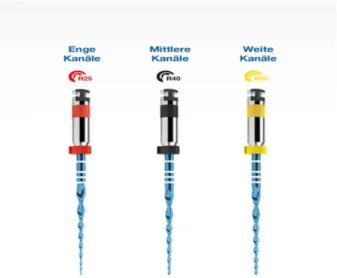
There are three Reciproc Blue files available in various lengths. The three files are : (figure 5) – R25(red 25.08) narrow canals, R40 (black 40.06) medium canals and R50(yellow 50.05) wide canals, in three lengths (21, 25 and 31mm) . The manufacturer advocates that no glide path is required (in most cases) (VDW ®).
Figure 5 – Reciproc® system composed by three single files (VDW, Munich, Germany).
Figure 6 – S-shaped cross section of Reciproc® files (VDW, Munich, Germany).
CYCLIC FATIGUE BEAHVIOUR OF WAVE ONE GOLDTM COMPARED TO RECIPROC BLUE TM INSTRUMENTS
10 ISABEL PEREIRA
1.4.
Study relevance
No other study was found examining the cyclic fatigue resistance of the Reciproc Blue files and WaveOne Gold files using sodium hypoclorite.
1.5.
Null hypothesis
Was that there would be no difference between the cyclic fatigue resistance of the tested groups.
2.
AIMS
The aim of this in vitro study is to compare the fatigue life of two reciprocating NiTi single files: WaveOne® Gold and Reciproc® Blue and compare instruments with and without irrigation.
Specific goals:
1 – To compare the fatigue life of instruments A1, A2, B1 and B2. H0 – The number of cycles until break is alike in all instruments. H1 - The number of cycles until break is different for A1 instrument. H2 - The number of cycles until break is different for A2 instrument. H3 - The number of cycles until break is different for B1 instrument. H4 - The number of cycles until break is different for B2 instrument. H5 - The number of cycles until break is different in all instruments.
2 - To compare the lengthof fracture instruments A1, A2, B1 and B2. H0 – The length of fracture is alike in all instruments.
H1 - The length of fracture is different for A1 instrument. H2 - The length of fracture is different for A2 instrument. H3 - The length of fracture is different for B1 instruments. H4 - The length of fracture is different for B2 instruments. H5 - The length of fracture is different in all instruments.
3 - To compare the timeto fracture instruments A1, A2, B1 and B2. H0 – The time to fracture is alike in all instruments.
H1 - The time to fracture is different for A1 instrument. H2 - The time to fracture is different for A2 instrument. H3 - The time to fracture is different for B1 instruments. H4 - The time to fracture is different for B2 instruments. H5 - The time to fracture is different in all instruments.
Main goals:
To compare the fatigue life of WaveOne® Gold and Reciproc® Blue instruments data within this study and with other studies.
CYCLIC FATIGUE BEAHVIOUR OF WAVE ONE GOLDTM COMPARED TO RECIPROC BLUE TM INSTRUMENTS
12 ISABEL PEREIRA
3.
MATERIALS AND METHODS
3.1 Reciprocating Files System
Two brands of NiTi reciprocating single file system WaveOne® Gold and
Reciproc® Blue were selected. Group A1: WaveOne®Gold Primary (WOGP) without sodium hypochlorite, Group A2: Reciproc® Blue without sodium hypochlorite (RB), Group B1: WaveOne®Gold Primary with sodium hypochlorite (WOGP), and Group B2: Reciproc® Blue with sodium hypochlorite (RB).
Files were grouped according to instrument type as shown in chart 1:
Chart 1 – Number of instruments per group by type of file A1, A2, B1 and B2.
WaveOne® Gold Primary file (figure 7), had a tip size of 0.2 mm and a 0.07
taper in the apical 3 mm. These files have a fixed taper from D1 to D3, yet a progressively decreasing percentage tapered design from D4 to D16, which serves to preserve dentin.
Reciproc® Blue file, R25 (figure 8), tip size 25 with a taper of 0.08 over the first apical
millimeters, has a progressively taper from D1 to D16. All the files used were sterilized and new, without any previous utilization. Manufacturer DENSTPLY had no influence in the present study.
10 10 10 10 0 1 2 3 4 5 6 7 8 9 10 A1 A2 B1 B2
n (number of instruments per group)
A1 A2 B1 B2
Figure 7 – Sterilized WaveOne® Gold Primary file (25.07), 25mm (Dentsply
Maillefer).
Figure 8 – Sterilized Reciproc® Blue R25 file (25.08), 25mm (VDW, Munich, Germany).
All files were operated with WaveOne™ endo motor (Dentsply Maillefer, Ballaigues, Switzerland) with their respective recommended settings: “WAVEONEALL” mode and “RECIPROC ALL” mode (figure 9).
a) b)
Figure 9 - WaveOne™ endo motor (Dentsply Maillefer, Ballaigues, Switzerland) a) WaveOneALL program b) ReciprocALL program.
CYCLIC FATIGUE BEAHVIOUR OF WAVE ONE GOLDTM COMPARED TO RECIPROC BLUE TM INSTRUMENTS
14 ISABEL PEREIRA
3.2 Equipment
The instruments were tested to fatigue life in a mechanical system previously created by Alexandre and Pinto 2013 due to a partnership between the department of Endodontics in Faculdade de Medicina Dentária da Universidade de Lisboa (Lisbon Faculty of Dentistry) and the Mechanical and Industrial Engineering Department of Faculdade de Ciências e Tecnologia da Universidade Nova de Lisboa. The system tries to simulate the inner forces of a root canal, recreating the bending forces. The two parameters related are:
radius of curvature - 4,7 mm angle of curvature - 45º
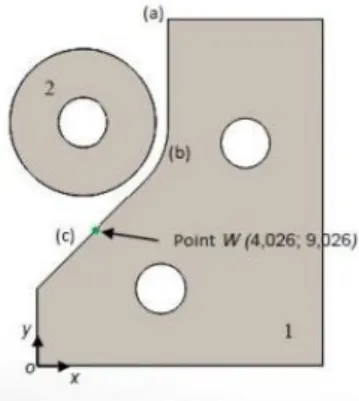
The geometric drawing of the mechanical system is outlined in Figure 10. In (a) the instruments enters, it’s forced to bend and adjust to the curvature in (b) and in (c) the tip is visible. The W point - coordinates (4,026; 9,026) represents the place where the extremity of the instrument should be in each test, to standardize instrument placement, and had a distance of 5 mm form the beginning of the curvature of the simulated root canal. To guarantee that the whole system was static, except the instrument to be tested, it was necessary to use three tight bolts in the prototype, in order to prevent the different pieces from moving apart. The reproducibility of the testes is guaranteed by these parameters.
Figure 10 – Schematic representation of the mechanical system (adapted from
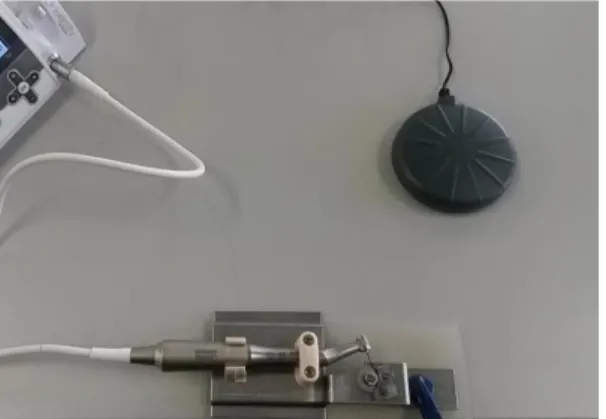
The piece number 1 (block) was manufactured by a computerized numerical control machine (CNC) and piece number 2 (washer) was manufactured from a rod of stainless steel that was machined to a diameter of 4,7 mm and hole-drilled. The stand structure was manufactured from a stainless steel plate with 1,5mm thick with several folding, cutting and welding. The contra-angle of the motor WaveOne™ (Dentsply Maillefer) was fixed to the metallic stand structure with two plastic pieces. The system was all supported by a malleable screen of Teflon which was fixed to the table with two staples (figure11 e 12). Testing time was visually registered with a digital chronometer manually operated, started at the moment the motor was turned on and stopped as fracture was detected visually and/or audibly.
Figure 11 – The Wave-One motor and the experimental apparatus.
a) b)
Figure 12 – The experimental apparatus close-up: headpiece and file
CYCLIC FATIGUE BEAHVIOUR OF WAVE ONE GOLDTM COMPARED TO RECIPROC BLUE TM INSTRUMENTS
16 ISABEL PEREIRA
3.3 Experimental procedure
The same operator conducted all the tests and measurements.
Preparation of the Group A1 - WaveOne® Gold Primary without sodium hypochlorite
The following procedure was used in all instruments: 1º Place the motor in the fixed system
2º Place the instrument to be tested in the contra-angle and rotate the head of the contra-angle until the instrument is parallel to be table
3º Make sure that the instrument is between pieces no. 1 and 2 4º Ensure that the extremity of the file is well positioned at the W point (Figure 10) and that it is perpendicular to the upper part of the block 5º Tighten the three bolts and nuts according to the previous adjustments
6º Turn on the WaveOne™ motor and select the WaveOne ALL Universal Program
7º Get the chronometer set up and ready to use
8º Step on the pedal initiating the chronometer at the same time, until separation of the instrument occurs
9º Stop the chronometer when the tip of the instrument fractures 10º Remove the instrument off the contra-angle and measure the length of the instrument with a manual caliper
11º Repeat every step for each instrument
Preparation of the Group A2 - Reciproc® Blue R25 without sodium hypochlorite
The following procedure was used in all instruments: 1º Place the motor in the fixed system
2º Place the instrument to be tested in the contra-angle and rotate the head of the contra-angle until the instrument is parallel to be table
3º Make sure that the instrument is between pieces no. 1 and 2 4º Ensure that the extremity of the file is well positioned at the W point (figure 10) and that it is perpendicular to the upper part of the block
5º Tighten the three bolts and nuts according to the previous adjustments
6º Turn on the WaveOne™ motor and select the Reciproc ALL Universal Program
7º Get the chronometer set up and ready to use
8º Step on the pedal initiating the chronometer at the same time, until separation of the instrument occurs
9º Stop the chronometer when the tip of the instrument fractures 10º Remove the instrument off the contra-angle and measure the length of the instrument with a manual caliper
11º Repeat every step for each instrument
Preparation of the Group B1 – WaveOne® Gold Primary with sodium hypochlorite
The following procedure was used in all instruments: 1º Place the motor in the fixed system
2º Place the instrument to be tested in the contra-angle and rotate the head of the contra-angle until the instrument is parallel to be table
3º Make sure that the instrument is between pieces no. 1 and 2 4º Ensure that the extremity of the file is well positioned at the W point (Figure 10) and that it is perpendicular to the upper part of the block 5º Tighten the three bolts and nuts according to the previous adjustments
6º Turn on the WaveOne™ motor and select the WaveOne ALL Universal Program
CYCLIC FATIGUE BEAHVIOUR OF WAVE ONE GOLDTM COMPARED TO RECIPROC BLUE TM INSTRUMENTS
18 ISABEL PEREIRA
8º Step on the pedal initiating the chronometer at the same time, until separation of the instrument occurs
9º Irrigate continuously with 6ml of sodium hypochlorite
10º Stop the chronometer when the tip of the instrument fractures 11º Remove the instrument off the contra-angle and measure the length of the instrument with a manual caliper
12º Repeat every step for each instrument
Preparation of the Group B2 – Reciproc® Blue R25 with sodium hypoclorite
The following procedure was used in all instruments: 1º Place the motor in the fixed system
2º Place the instrument to be tested in the contra-angle and rotate the head of the contra-angle until the instrument is parallel to be table
3º Make sure that the instrument is between pieces no. 1 and 2 4º Ensure that the extremity of the file is well positioned at the W point (Figure 10) and that it is perpendicular to the upper part of the block 5º Tighten the three bolts and nuts according to the previous adjustments
6º Turn on the WaveOne™ motor and select the Reciproc ALL Universal Program
7º Get the chronometer set up and ready to use
8º Step on the pedal initiating the chronometer at the same time, until separation of the instrument occurs
9º Irrigate continuously with 6ml of sodium hypochlorite
10º Stop the chronometer when the tip of the instrument fractures 11º Remove the instrument off the contra-angle and measure the length of the instrument with a manual caliper
All instruments were tested under the same conditions and by the same operator. The time of fracture was registered in each teste(t)(seconds). The NFC for each file was calculated by multiplying the time of failure, in minutes, by the rotational speed which in this study was 350 rpm (WaveOne ALLprogram) for WOG and 300 rpm (Reciproc ALL
)
program for RB:
NCF = 300𝑡
60 ⇔ NCF = 5t
The fracture point in relation to the tip of the instrument was determined by measuring the fractured file with a manual caliper (figure 13).
a)
a)
b) c)
CYCLIC FATIGUE BEAHVIOUR OF WAVE ONE GOLDTM COMPARED TO RECIPROC BLUE TM INSTRUMENTS
20 ISABEL PEREIRA
Additionally, to complement further knowledge, a bibliographic research was made at the FMDUL library between January and May 2017 using database PubMed®/Medline® with a combination of the following keywords: WaveOne Gold, WaveOne Gold Primary, Reciproc Blue, cyclic fatigue, reciprocating motion, single files, endodontics, M-Wire. Trough evaluation of the abstract, relevant content articles were selected.
3.4 Statistical Analysis
The statistical analysis was obtained using the IBM® SPSS® Statistics version 23.0.0 software (IBM Corporation, CA, USA). Descriptive statistical analysis was performed to each group (A1, A2, B1 and B2). For each experimental was calculated group mean, standard deviation and variance.
Kolmogorov-Smirnov and Shapiro-Wilk tests analyzed the data obtained on time to fracture (sec), fracture length (mm) and NCF (numbers of cycles). In the samples that showed normality, the parametric test t-student for independent samples was applied in groups that compare one variable, and the Leven test showed homogeneity. The data that showed no normality was analyzed by non-parametric testes. The Mann- Whitney U test was used in groups that compare three variables.
Significance was set at the 95% confidence level and differences were considered statistically significant when p<0,05.
4.
RESULTS
Table 1 and 2 shows the results of the experimental procedure: time to fracture in seconds, fracture length in millimeters and number of cycles to fracture (NCF) for each type of file.
Type of file Time (sec) Fracture length (mm) NCF A 11 257 5,8 1499,17 A 12 252 5,85 1470 A 13 235 5,8 1370,83 A 14 246 5,85 1435 A 15 247 5,7 1440,83 A 16 200 5,5 1166,67 A 17 155 5,8 904,17 A 18 229 4,3 1335,83 A 19 226 4 1318,33 A10 195 4,2 1137,5 A 21 293 5,5 1465 A 22 262 5,6 1310 A 23 388 5,65 1340 A 24 193 5,3 965 A 25 385 5,05 1925 A 26 371 4 1855 A 27 326 5,35 1630 A 28 109 5,55 545 A 29 448 5,25 2240 A 210 238 5,5 1190
Table 1 – Results from group A1 and A2, for each instrument - test for time to
CYCLIC FATIGUE BEAHVIOUR OF WAVE ONE GOLDTM COMPARED TO RECIPROC BLUE TM INSTRUMENTS
22 ISABEL PEREIRA
Type of file Time (sec) Fracture length (mm) NCF B11 166 5,65 969,33 B12 215 5,8 1254,17 B13 115 4 670,83 B14 123 5,85 717,5 B15 197 5,9 1149,17 B16 190 5,9 1108,33 B17 139 5,9 810,33 B18 218 5,75 1271,67 B19 149 6 869,17 B110 141 5,8 882,5 B 21 595 5,85 2925 B 22 454 6,3 2270 B 23 429 6,7 2145 B 24 312 5,8 1560 B 25 286 6,6 1430 B 26 533 5,3 2765 B 27 645 5,1 3225 B 28 483 5,75 2415 B 29 366 5,6 1830 B 210 395 5,5 1975
Table 2 – Results from group B1 and B2, for each instrument- test for time to
fracture (seconds), length of the fractured tip(mm) and Number of Cycles to Fracture.
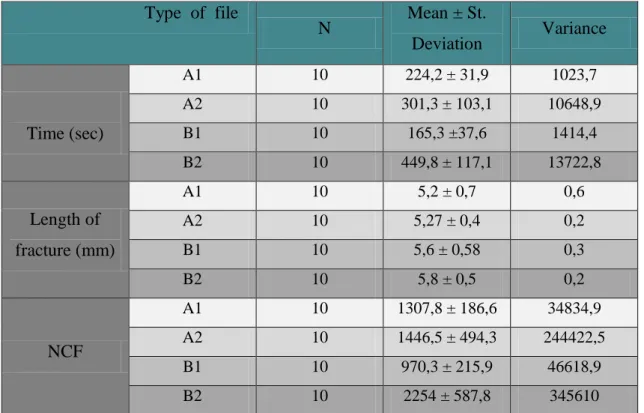
Table 3 shows the mean, standard deviation and variance value of time to fracture, fracture length, and number of cycles to fracture (NCF), for each group of file.
Type of file N Mean ± St. Deviation Variance Time (sec) A1 10 224,2 ± 31,9 1023,7 A2 10 301,3 ± 103,1 10648,9 B1 10 165,3 ±37,6 1414,4 B2 10 449,8 ± 117,1 13722,8 Length of fracture (mm) A1 10 5,2 ± 0,7 0,6 A2 10 5,27 ± 0,4 0,2 B1 10 5,6 ± 0,58 0,3 B2 10 5,8 ± 0,5 0,2 NCF A1 10 1307,8 ± 186,6 34834,9 A2 10 1446,5 ± 494,3 244422,5 B1 10 970,3 ± 215,9 46618,9 B2 10 2254 ± 587,8 345610
Table 3 – Descriptive statistics for time(seconds), length of fracture(mm) and
NCF according to each group of file.
Through statistical analysis previously described and considering the initially formulated hypothesis, the following data were earned:
Group A1-showed normality only in the variable: fracture length
Group A2-showed no normality in the 3 variables
Group B1-showed normality only in the variable: fracture length
Group B2-showed no normality in the 3 variables
When comparing group A1 versus group A2, non-parametric tests, Manny-Whitney U test was used. It was found a significant statistic difference in the variable time, rejecting the null hypothesis(H0). A2 (301,3 ± 103,1) showed higher mean value regarding variable time than A1 mean value for time (242,2 ± 31,9).p =0,043.
When comparing group B1 versus B2, non-parametric tests, Manny-Whitney U test was used. It was found a significant statistic difference in 2 variables: time and NCF,
CYCLIC FATIGUE BEAHVIOUR OF WAVE ONE GOLDTM COMPARED TO RECIPROC BLUE TM INSTRUMENTS
24 ISABEL PEREIRA
for:time (449,8 ± 117,14) and NCF (2254 ± 587,8), than B1 mean value for: time (165,3 ± 37,6) and NCF (970,3 ± 215,9). p=0 for both variables.
When comparing group A1 versus B1, non-parametric tests, Manny-Whitney U test was used. It was found a significant statistic difference in the two variables: time and NCF, rejecting the null hypothesis(H0) for both variables. A1 showed higher mean value for: time (242,2 ± 31,9) and NCF (1307,8 ± 186,6) than B1 mean value for: time (165,3 ± 37,6) and NCF (970,3 ± 215,9).p=0,002 for both variables. However parametric test t-student was used for the variable fracture length, there was not found significant statistic differences between the two groups. The leven test showed homogeneity. The mean valuables for fracture length was for B1(5,6 ± 0,5) and for A1 (5,2 ± 0,7). p= 0,240.
When comparing group A1 versus B2, non-parametric tests, Manny-Whitney U test was used. It was found a significant statistic difference in the two variables: time and NCF, rejecting the null hypothesis(H0) for both variables. B2 showed higher mean value for: time (449,8 ± 117,1) and NCF (2254 ± 587,8) than A1 mean value for: time (242,2
± 31,9) and NCF (1307,8 ± 186,6). p=0 for both variables.
When comparing group A2 versus B1, non-parametric tests, Manny-Whitney U test was used. It was found a significant statistic difference in the three variables: time, fracture length and NCF, rejecting the null hypothesis(H0) for three variables. A2 showed higher mean value for: time (301,3 ± 103,1), NCF (1446,5 ± 494,3) than B1 mean value for: time (165,3 ± 37,6) and NCF (970,3 ± 215,9). B1 mean value for fracture length (5,6 ± 0,1) and A2 mean fracture length (5,27 ± 0,15).p=0,004 for time, p=0,011 for NCF and p= 0,002 for fracture length.
When comparing group A2 versus B2, non-parametric tests, Manny-Whitney U test was used. It was found a significant statistic difference in the three variables: time, fracture length and NCF, rejecting the null hypothesis(H0) for three variables. B2 showed higher mean value for: time (449,8 ± 117,14) and NCF (2254 ± 587,8) than A2 mean value for: time (301,3 ± 103,1) and NCF(1446,5 ± 494,3). B2 mean value for fracture length (5,8 ± 0,53) A2 mean value for fracture length (5,27 ± 0,48). p=0,011 for time, p=value 0,005 for NCF and p= 0,023 for fracture length.
5.
DISCUSSION
Instrument separation remains a major concern in endodontics as unexpected fracture may occur during clinical practice, mainly because of cyclic fatigue (Inan et al. 2009).
The purpose of this study is to compare the cyclic fatigue of two single-file systems: Reciproc® Blue R25 and WaveOne® Gold Primary. These files were selected because they are currently one of the newestsingle files commercially available, designed specifically to be used in reciprocating motion. According to the results of the present study, the RB file system with sodium hypochlorite was found to be statistically significantly more resistant to cyclic fatigue than the other three groups, by this order B2, A2, A1 and B1. For this reason, the null hypothesis of the present study was rejected. The mean lengths of the fractured segments in all the groups shown statistically significant difference. The mean time of the fractured segment also shown statistically significant difference.
Currently there is limited information in the literature on the cyclic fatigue resistance of WaveOne Gold and Reciproc Blue systems, mainly regarding the last one.
In order to enrich this study, a posterior evaluation of the type of fracture and tension points should be done, by using SEM to analyze the fractured surfaces , the use of dynamic models, to reproduce the in and out movement, and mimic the tooth , that would be closed to the reality, and evaluating the temperature effect on NCF by the use of sodium hypochlorite.
In fact, the research relate to cyclic fatigue of endodontic instruments could be improved. There is a necessity of making well-designed studies with standardizes specifications to minimize uncontrolled variables and to reproduce the same conditions between researchers.
Time to failure data(t) was recorded along the experimental procedure and NFC
was determined afterwards. These two parameters have been used to asses cyclic fatigue resistance, in which t presents more clinically relevance information, as time is much easier for the operator to observe than the NCF the instrument endures. The NCF offers more pertinent information regarding the ability of the instrument design to withstand
CYCLIC FATIGUE BEAHVIOUR OF WAVE ONE GOLDTM COMPARED TO RECIPROC BLUE TM INSTRUMENTS
26 ISABEL PEREIRA
cyclic fatigue (Wan et al 2011), since NCF is cumulative and relates to the number of times compressive and tensile stresses occur in the bend portion of the file. B2 instrument proved to be statistically significant more resistance than A1, A2 and B1, rejecting the null hypothesis (H0). The RB with sodium hypochlorite file was more resistant than without NaOCl, and WOG with and without NaOCl, presenting a mean value of NFC (2254± 587,8). A limitation was the operator error, regarding the variable time registered with a digital chronometer. Throughout the study the operator was the same, meaning the error is constant.
In this study, another parameter was the fracture length where a significant statistically difference was seen .A designed system to simulate a root canal that does not constrain the instrument in a precise trajectory may alter bending properties of the files and therefore contribute to different fracture sites, even in instruments with same lengths (Plotino et al. 2009). The localization of the fractured segment could provide information for clinicians by identifying the most fragile portion of the instrument. The point of maximum flexure in this experiment was at 5 mm from the tip. Different instruments subjected to the same cyclic fatigue testing setup fractured at different working lengths, there are differences because of bending moments, because they were manufactured from different alloys (Capar et al. 2015). One of the limitation is the operator error regarding the inaccurate measurement of the fracture length, in mm, since a manual caliper was used, but the error was constant because the operator was the same throughout the study.
Static cyclic fatigue tests showed lower results compared to dynamic testes in
which endodontic instruments are subjected to axial movements. The alternating compressive and tensile stresses are likely concentrated at the same area of the instrument in static tests. Therefore, higher cyclic fatigue resistance is expected in a clinical situation in which instruments are operated in constant in and out motion (Pérez-Higueras et al. 2014). This could mean the NCF and thus time to fracture of the sample could be higher than the observed. The use of a static model makes possible the comparison among the groups and minimizes the influence of other variables (Vadhana et al. 2014). Further studies with dynamic models are required.
The increase of angle and radius of curvature results in a decreased lifespan(Plotino et al).An increase in angle of curvature is related with the decrease of time to fracture(Wan et al. 2011, Ulmane et al.2005), and also an increase radius
of curvature was proven to decrease time to fracture (Tripi et. al 2006, Inan et al. 2007, Kim et al. 2010). Corroborates that torsional and cyclic fatigue can both act together and diminish the life span of endodontic instrument (Park et al. 2010, Bhagabati et al. 2012)
The effect of rotational speed on instrument fracture is related to the generation of heat, so higher speeds produce more heat and thereby induce a faster increase in the instrument temperature. This raise of temperature leads to a rapid increase in surface tension, causing precocious fatigue fracture (Lopes et al. 2009). .Even though the rotational speed used was the recommended by the manufacturer, the influence of rotational speed in resistance to cyclic fatigue is not clear because some studies found that this parameter did not influence the cyclic fatigue of NiTi files (Pedullà et al. 2013).
In this study, continuous lubrication flow with sodium hypochlorite was used, which possibly meant an increase NCF of the sample used. NiTi instruments come into contact with NaOCl during desinfection or during instrumentation either in the pulp chamber and root canal (Darabara et al. 2004), it has been reported that longer immersion time in NaOCl affects the fatigue resistance of the files trough corrosion (Berutti et al. 2006, Peters et al. 2007, Elnaghy & Elsaka2016), diminishing the cyclic fatigue resistance. Some studies indicated that lubrication with various agents did not result directly in different cyclic fatigue and scores, but helped to reduce heat generated, file friction, leading to a higher fatigue life (Peters et al. 2005, Shen et al. 2012).
The cross-section design has an impact on the stress developed by an instrument under either tension or bending (Zhan et al 2010). Different cross-sectional designs influence cyclic fatigue resistance. Triangular section geometry showed better fatigue resistance than a square section, as well as an S-shaped cross section than a rectangular cross section (Cheung et al. 2011).
The Thermal treatment has an effect on higher flexibility and resistance of files. In previous studies, the cyclic fatigue of WOG was superior than R (Taha 2016, Mehmet
CYCLIC FATIGUE BEAHVIOUR OF WAVE ONE GOLDTM COMPARED TO RECIPROC BLUE TM INSTRUMENTS
28 ISABEL PEREIRA
& Ismail 2016). Manufactures also claims that R and RB have the same mechanical properties. However, a study about blue thermomechanical treatment, observed highest results for RB than his predecessor, R. (De-Deus et al. 2017)
Only one study (table4) was found comparing Wave One Gold Primary and Reciproc Blue R25 files. Where RB showed highest cyclic fatigue resistance than WOG, this might to due to the blue thermal treatment and S-Shape Cross section. Which supports the present findings.
Article
Type of
instrument Testing conditions Rotational speed (rpm) NCF (mean/st. dev) Fracture length (mean/st.dev) Conclusions Present study WOG dry WOG with NaOCl RB dry RB with NaOCl 45º 4,7 mm Dry and lubricated conditions (NaOCl) 350-WOG 300-RB 1307,8 ± 186,6 970,3± 215,9 1446,5 ±494,3 2254 ± 587,8 5,2 ± 0,7 5,65 ± 0,58 5,27 ± 0,48 5,85 ± 0,53 RB>WOG RB with lubrication was significantly more resistance than RB without, WOG without and WOG
with. Gundugar and Ozyrek, 2017 Hyflex EDM RB WOG OneShape 60º 5 mm Synthetic oil 500-Hyflex EDM 300-RB 350-WOG 400-OneShape 3456,33 ± 633,37 2875,89± 105,35 1737 ± 376,32 1221,63 ± 812,4 5,77 ± 0,52 5,72 ± 0,53 5,76 ± 0,57 5,73 ± 0,54 RB>WOG
Hyflex EDM was significantly more resistance than RB,
WOG and OneShape.
6.
CONCLUSIONS
In this study, WaveOne® Gold Primary and Reciproc® Blue R25 files were tested.
Within the limitations of this in vitro study, there were significant differences between the cyclic fatigue of the two systems. The cyclic fatigue resistance of RB was better than the WOG, specifically the RB with NaOCl. Therefore, the null hypothesis was rejected. Use of single-file reciprocating systems such as WOG and RB is increasing. Manufacturers claim that it reduced clinical time and procedural errors and they are gaining increasing popularity.
Clinicians should be aware of the mechanical properties to choose the best file, selecting systems with higher fracture resistance to cyclic fatigue.
The conclusions are limited, due to the few existing data and comparison studies between the novel WaveOne® Gold and Reciproc® Blue files.
Further studies are required in dynamic models.
There is also, a need for specifications and international standards to evaluate cyclic fatigue tests regarding endodontic rotary instruments, to ensure the uniformity of methodology and comparable results, as well in statistical analysis.
7.
ACKNOWLEDGMENTS
CYCLIC FATIGUE BEAHVIOUR OF WAVE ONE GOLDTM COMPARED TO RECIPROC BLUE TM INSTRUMENTS
xxx ISABEL PEREIRA
REFERENCES
1 Arias A, Perez-Higueras JJ, de la Macorra JC. Differences in cyclic fatigue resistance at apical and coronal levels of Reciproc and WaveOne new files. J Endod 2012;38:1244–8.
2 Bhagabati N, Yadav S, Talwar S. An In Vitro Cyclic Fatigue Analysis of Different Endodontic Nickel-Titanium Rotary Instruments. J Endod 2012, 38, 515– 518.
3 Berutti E, Paolino DS, Chiandussi G, Alovisi M, Cantatore G, Castellucci A, Pasqualini D. Root canal anatomy preservation of WaveOne reciprocating files with or without glide path. J Endod. 2012 Jan;38(1):101-4.
4 Bürklein S, Hinschitza K, Dammaschke T, Schäfer E. Shaping ability and cleaning effectiveness of two single-file systems in severely curved root canals of extracted teeth: Reciproc and WaveOne versus Mtwo and ProTaper. Int Endod J. 2012 May;45(5):449- 61.
5 Bouska J, Justman B, Williamson A, DeLong C. Resistance to Cyclic Fatigue Failure of a New Endodontic Rotary File. J Endod 2012; 38(5): 667–669.
6 Capar ID, Kaval ME, Ertas H, Sen BH. Comparison of the Cyclic Fatigue Resistance of 5 Different Rotary Pathfinding Instruments Made of Conventional Nickel-Titanium Wire, M-wire, and Controlled Memory Wire. J Endod 2015; -:1–4.
7 Cheung GS, Darvell BW. Fatigue testing of a NiTi rotary instrument. Part 2: Fractographic analysis. Int Endod J 2007;40:619–25.
8 Cheung GS, Peng B, Bian Z, Shen Y, Darvell BW. Defects in ProTaper S1 instruments after clinical use: fractographic examination. Int Endod J 2005;38:8029.
9 Cheung GS, Zhang EW, Zheng YF. A numerical method for predicting the bending fatigue life of NiTi and stain- less steel root canal instruments. Int Endod J 2011;44:357–61.
10 Dederich DN, Zakariasen KL. The effects of cyclical axial motion on rotary
endodontic instrument fatigue. Oral Surg Oral Med Oral Pathol 1986;61:192– 6.
11 De-Deus G, Moreira E, Lopes H, Elias C. Extended cyclic fatigue life of F2 Pro-Taper instruments used in reciprocating movement. Int Endod J 2010;43:1063–8.
12 De-Deus G, Silva J, Vieira V, Belladona G.,Moreira E, Plotino G.Elias C. Blue Thermomechanical Treatment Optimizes Fatigue Resistance and Flexibility of the Reciproc Files. Int Endod J 2016;43:1063–8.
13 Dentsply. The gold standard in file systems. Endodontic Practice looks at advancements in file systems and the developments behind Dentsply’s Waveone Gold. British dental journal 2015:218(8):495.
14 Dhingra A, Ruhal N, Miglani A. Evaluation of Single File Systems Reciproc , Oneshape , and WaveOne using Cone Beam Computed Tomography – An In Vitro Study. 2015;9(4):30–4.
15 Duerig TW, Melton KN, Stockel D, Wayman CM, eds. Engineering Aspects of Shape Memory Alloys. London: Butterworth-Heinemann; 1990:3–35.
16 Elnaghy AM. Cyclic fatigue resistance of ProTaper Next nickel-titanium rotary files. International Endodontic Journal 2014, 47, 1034–1039;
17 Fernandes A. Caracterização do comportamento à fadiga de instrumentos de Ni-Ti para aplicações de endodontia. Universidade Nova de Lisboa - Faculdade de Ciências e Tecnologias, 2013.
18 Ferreira F, Adeodato C, Barbosa I, et al. Movement kinematics and cyclic fatigue ofNiTi rotary instruments: a systematic review. Int Endod J 2016;50:143–52. 19 Gambarini G, Grande NM, Plotino G et al. Fatigueresistance of engine-driven rotary nickel-titanium instrumentsproduced by new manufacturing methods. Journalof Endodontics 2008: 34, 1003–5.
20 Gambarini G, Plotino G, Grande NM, Al-Sudani D, De Luca M, Testarelli L. Mechanical properties of nickel–titanium rotary instruments produced with a new manufacturing technique. International Endodontic Journal 2011, 44, 337–341.
21 Gavini G, Caldeira CL, Akisue E, Candeiro GT, Kawakami DA. Resistance to fl exural fatigue of Reciproc R25 files under continuous rotation and reciprocating movement. J Endod 2012;38:684-7.
CYCLIC FATIGUE BEAHVIOUR OF WAVE ONE GOLDTM COMPARED TO RECIPROC BLUE TM INSTRUMENTS
xxxii ISABEL PEREIRA
22 Grande NM, Plotino G, Pecci R, Bedini R, Malagnino VA, Somma F. Cyclic fatigue resistance and three-dimensional analysis of instruments from two nickel–titanium rotary systems. International Endodontic Journal 2006, 39, 755–763. 23 Gundogar M. amd Ozyurek T. Cyclic Ftaigue Resistance of OneShape,Hyflex EDM,WaveOne Gols, and Reciproc Blue Nickel-Ttitanium Instruments. JOE:2017
24 Ha JH, Kim SK, Cohenca N, Kim HC.Effect of R-phase heat treatment on torsional resistance and cyclic fatigue fracture. Journal of Endodontics 2013: 39, 389– 93.
25 Hull D. Fractography: Observing, Measuring and Interpreting Fracture Surface Topography. Cambridge, UK: Cambridge University Press; 1999.
26 Inan U, Gonulol N. Deformation and Fracture of Mtwo Rotary Nickel-Titanium Instruments After Clinical Use. J Endod 2009, 35, 1396–1399.
27 Karatas E, Arslan H, Buker M, Seckin F, Capar Effect of movement kinematics on the cyclic fatigue resistanceof nickel-titanium instruments. InternationalEndodontic Journal 2016 49, 361–4.
28 Kiefner P, Ban M, De-Deus G. Is the reciprocating movement per se able to improve the cyclic fatigue resistance of instruments? Int Endod J 2014;47:430–6.
29 Kim HC, Kwak SW, Cheung GS, Ko DH, Chung SM, Lee W. Cyclic fatigue and torsional resistance of two new nickel-titanium instruments used in reciprocation motion: Reciproc versus WaveOne. J Endod. 2012:38(4):541-4.
30 Knowles KI, Hammond NB, Biggs SG, Ibarrola JL. Incidence of instrument separation using LightSpeed rotary instruments. J Endod 2006;32:14–6.
31 Larsen CM, Watanabe I, Glickman GN, He J. Cyclic Fatigue Analysis of a New Generation of Nickel Titanium Rotary Instruments. J Endod 2009 Mar; 35(3): 401–403.
32 Lim YJ, Park SJ, Kim HC, Min KS. Comparison of the centering ability of Wave·One and Reciproc nickel-titanium instruments in simulated curved canals. Restor Dent Endod. 2013:38(1):21-5.
33 Lopes HP, Chiesa WMM, Correia NR, Navegante NCS, Elias CN, Moreira EJL, Chiesa BEC. Influence of curvature location along an artificial canal on cyclic fatigue of rotary nickel-titanium endodontic instruments. J.Endo, 2011; 111(6):792-796.
34 Lopes HP, Elias CN, Vieira VT, Moreira EJ, Marques RV, de Oliveira JC, Debelian G, Siqueira JF Jr.. Effects of Electropolishing Surface Treatment on the Cyclic Fatigue Resistance of BioRace Nickel-Titanium Rotary Instruments. J Endod 2010, 36, 1653–1657.
35 Lopes HP, Ferreira AA, Elias CN, Moreira EJ, de Oliveira JC, Siqueira JF Jr.. Influence of Rotational Speed on the Cyclic Fatigue of Rotary Nickel-Titanium Endodontic Instruments. J Endod 2009, 35, 1013–1016.
36 Lopes HP, Gambarra-Soares T, Elias CN, Siqueira JF Jr, Inojosa IF, Lopes WS, Vieira VT. Comparison of the Mechanical Properties of Rotary Instruments Made of Conventional Nickel-Titanium Wire, M-Wire, or Nickel-Titanium Alloy in R-Phase. J Endod 2013, 39, 516–520.
37 McGuigan MB, Louca C, Duncan HF. Clinical decision-making after endodontic instrument fracture. BritishDental Journal 2013 : 214, 395–400.
38 Otsuka K, Ren X. Physical metallurgy of Ti–Ni-based shape memory alloys. Prog
Mater Sci 2005;50:511–678.
39 Ozyurek T. Cyclic Fatigue Resistance of Reciproc, WaveOne, and WaveOne Gold Nickel-Titanium Instruments. J Endod 2016;42:1536–9.
40 Parashos P, Messer HH. Rotary NiTi Instrument Fracture and its Consequences. J.Endod 2006; 32(11): 1031–1043.
41 Park SY, Cheung GS, Yum J, Hur B, Park JK, Kim HC. Dynamic Torsional Resistance of Nickel-Titanium Rotary Instruments. J Endod 2010, 36, 1200–1204.
42 Pedulla E, Grande NM, Plotino G, et al. Influence of continuous or reciprocating
motion on cyclic fatigue resistance of 4 different nickel-titanium rotary instruments.
J Endod 2013;39:258–61.
43 Pedulla E, Lo Savio F, Boninelli S et al.Influence of cyclic torsional preloading on cyclic fatigue resistance of nickel – titanium instruments. International Endodontic
Journal 2015: 48, 1043–50.
44 Perez-Higueras JJ, Arias A, de la Macorra JC. Cyclic fatigue resistance of K3, K3XF,