TOURISM AND ALGARVE´S UNDERWATER ARCHAEOLOGICAL HERITAGE VALORISATION: A CASE STUDY
ABSTRACT
This paper aims to investigate the interrelation between sea, tourism and culture associated with underwater archaeological heritage. Its main objective is to determine the existence of creative actions and projects that valorise tourism related with underwater archaeological heritage in the Algarve. The assumption is that underwater heritage is a valuable resource to tourism economy of seaside territories. Regarding the Algarve, WTTC (2003) refers that “the Travel & Tourism industry directly contributes 45% of GDP and 37% of jobs”. However, as is also refereed in this document “forecasts for the next ten years (2013) are very modest”. This means that, unless Algarve Tourism (Turismo do Algarve) and the private sector succeed in changing direction and surpassing the baseline forecasts, the share of visitor exports in the scheme of total exports will fall. As MEID/TP (2011) and Governo de Portugal (2013) point out for the Algarve region, the Sun and Sea, as well as Golf, are considered to be the main strategic products. The core Sun and Sea product should have a multi-segmented offer and be able to widen the summer season. In this context, it is important to develop new tourism products related with sea, nautical and cultural tourism. The present paper is based on a documental research of tourism public policies and also on a set of interviews of entities connected with underwater archaeological heritage with the intention of determining their role in the valorisation of this type of heritage in the Algarve.
1. INTRODUCTION
The present article aims to reflect on the interrelationship between culture, tourism and sea, associated with underwater archaeological heritage. This kind of material heritage (culture) is understood in the context of its tourist-cultural valorisation (tourism) in underwater environments (sea). The assumption is that the relationship between culture, tourism and sea can contribute to the tourism product development either as a complement to the "sun and sea” and nautical tourism or by fostering cultural tourism demand.
Simultaneously, this paper considers the growing recognition, by a significant number of public and private entities, of underwater archaeological heritage (UAH) as part of the cultural heritage and as an element of peoples’ history, as pointed out by UNESCO (2001) and ICOMOS (1999).
In this context, a case study is presented circumscribed to the Algarve’s region – quintessential tourist region of southern Portugal – which the main objective is to assess the importance of the underwater archaeological heritage touristic valorisation, by public and private (schools / centres diving) entities, as well as actions and current and future projects associated with this heritage. In this sense, the valorisation of the underwater archaeological heritage is framed in the perspective of a political intervention and joint efforts between public / private entities for this resource tourism development.
Thus, in addition to bibliographical and documental research associated with this type of heritage conceptualization, an analysis is made of the main tourism policy and planning instruments in the region followed by a reflection on the results of a survey directed to a set of public and private entities linked respectively to the sectors of culture, tourism and the sea, in the Algarve and Portugal.
In the survey, along with the identification of the elements of underwater archaeological heritage with greater tourist potential in the Algarve, determining strengths, weaknesses, opportunities and threats in UAH tourism valorisation is also required. The main current and future projects in this domain are also asked.
Finally, a set of conclusions on the tourism development of the underwater archaeological heritage in the Algarve is presented.
2. TOURISM AND UNDERWATER CULTURAL HERITAGE: A
RELATIONSHIP APPROACH
2.1. Underwater cultural heritage: conceptualization
With the twentieth century, new uses are associated with heritage, as evidenced in the Athens Charter (ICMS, 1931) and in the Venice Charter (ICOMOS, 1964).
Regarding underwater cultural heritage, the UNESCO’ Recommendation on International Principles Applicable to Archaeological Excavations (1956) and the Commission for Culture and Education (Council of Europe) (1970) establish international principles governing the protection and excavation of archaeological sites.
However, it is only in the 90s, that the UAH begins to attract more attention, particularly since the adoption of the Convention on the Protection of the Underwater Cultural Heritage and the recognition of UNESCO as a responsible entity.
The 1990 ICOMOS Charter for the Protection and Management of Archaeological Heritage defines the "archaeological heritage" as “that part of the material heritage of which archaeological methods provide primary information, comprising all vestiges of human existence and consisting of places relating to all manifestations of human activity, abandoned structures, and remains of all types, together with all the portable cultural material associated with them. For the purposes of this Charter, underwater cultural heritage is understood to mean the archaeological heritage that is in, or has been removed from, an underwater environment. It includes submerged sites and structures, wreck-sites and wreckage and their archaeological and natural context” (in ICOMOS, 1996).
The 1996 Charter on the Protection and Management of Underwater Cultural Heritage (as a supplement of 1990 Charter) “is intended to encourage the protection and management of underwater cultural heritage in inland and inshore waters, in shallow seas and in the deep oceans” (ICOMOS, 1996).
As Article 1 points out “the preservation of underwater cultural heritage in situ should be considered as a first option”. Simultaneously, it states that a set of actions should be implemented, namely: “public access should be encouraged”, “non-destructive techniques, non-intrusive survey and sampling should be encouraged in preference to excavation”, “investigation must not adversely impact the underwater cultural heritage more than is necessary for the mitigatory or research objectives of the project”, “investigation must avoid unnecessary disturbance of human remains or venerated sites” and “investigation must be accompanied by adequate documentation” (ICOMOS, 1996).
The 1996 Charter also highlights the relationship between underwater cultural heritage and tourism: “archaeology is a public activity; everybody is entitled to draw upon the past in informing their own lives, and every effort to curtail knowledge of the past is an infringement of personal autonomy” (ICOMOS, 1996). Underwater cultural heritage contributes to the formation of identity and can be important to people's sense of community. If managed sensitively, underwater cultural heritage can play a positive role in the promotion of recreation and tourism”.
The UNESCO Convention on the Protection of the Underwater Cultural Heritage, adopted in 2001, intends to enable States to better protect this heritage. “Acknowledging the importance of underwater cultural heritage as an integral part of the cultural heritage of humanity and a particularly important element in the history of people, nations, and their relationships with each other concerning their common heritage, intends to enable States to better protect this heritage” (UNESCO, 2001). For the purposes of this Convention, article 1 states: “Underwater cultural heritage” means all traces of human existence having a cultural, historical or archaeological character which have been partially or totally under water, periodically or continuously, for at least 100 years such as: (i) sites, structures, buildings, artefacts and human remains, together with their archaeological and natural context; (ii) vessels, aircraft, other vehicles or any part thereof, their cargo or other contents, together with their archaeological and natural context; and (iii) objects of prehistoric character” (UNESCO, 2001).
Regarding objectives and general principles (article 2), this “Convention aims to ensure and strengthen the protection of underwater cultural heritage”. It also states that Parties shall preserve and cooperate in the protection of underwater cultural heritage. Simultaneously, among others actions that shall be implemented, it features: “the preservation in situ of underwater cultural heritage shall be considered as the first option before allowing or engaging in any activities directed at this heritage”; “recovered underwater cultural heritage shall be deposited, conserved and managed in a manner that ensures its long-term preservation” and “responsible non-intrusive access to observe or document in situ underwater cultural heritage shall be encouraged to create public awareness, appreciation, and protection of the heritage except where such access is incompatible with its protection and management”.
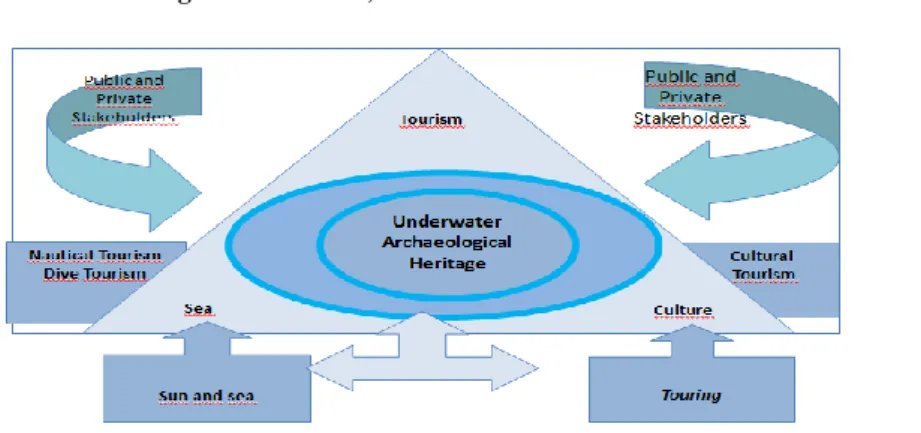
In this context, the framework associated with underwater cultural tourism takes us to a conceptual interrelation based on three major research dimensions (Figure 1). The first one is related with the underwater cultural (archaeological) heritage, the second refers to tourism, namely cultural tourism/heritage tourism and the third one is associated with the sea, in particular sun and sea, nautical and tourism.
Figure 1. Tourism, culture and sea framework
Source: Own elaboration
Cultural tourism is related with visits motivated (in whole or in part) by interests in the history, arts, science (stricto sensu), but also with the way of life of a community, region, group or institution (lato sensu) (Group 106, 2013). Regarding heritage tourism,
it values a community history and past artefacts. As Cuvelier et al. (1994) point out, heritage is a set of tangible and intangible elements that safeguard the identity of its holder and its adaptation over time in a changing world. Consequently, heritage contextualization within an environmental preservation area and resources
heritagization is crucial (Talavera, 2003; Gellner, 1993) in order to strengthen culture
(Roberts, 1996; Costa, 2009).
Concerning underwater cultural heritage, it is also seen as a “reinforcing factor of a sense of cultural identity and collective memory” associated with the reconstruction and development of a narrative (Claudino/CNU, 2012: 64).
The importance of culture in tourism destination attractiveness and competitiveness is a crucial aspect that should be considered in a region of sustainable development (OECD, 2009; ETC, 2005). Additionally, OECD (2013), regarding cultural and creative resources associated with tourism, states that “cultural and creative resources are key drivers of attractiveness”. The perspective is that it is important to build “a strategy that capitalises on cultural and creative resources” that “can provide competitive advantages. The challenge is to identify a consolidated measure” (OECD, 2013).
Considering underwater cultural heritage human interventions´, Claudino/CNU (2012) shares examples such as “Madrague de Giens”, “Skuldelev I”, “Elisabeth and Mary”, “Bodrum”, “Vasa”, “Labrador”. The purpose is to foster an increase in knowledge about the culture and human behaviours of the past.
As stated in Claudino/ CNU (2012: 19), there are several types of archaeological sites, such as "pre-historic flooded sites (...), marshes or lakes where offerings were deposited and buried the dead, flooded port cities". However, what tends to capture the majority of underwater archaeologists is "the study of the construction and use of all types of boats and ships". We should have in mind that a large part of the past has been connected to the water, in particular oceans. “Civilizations linked in crossing oceans. Continents were settled by seafarers. Battles were fought on the sea or for the rule of the sea. And, in even older times, a decisive part of the development of human life took place on lands that are now submerged by water” (Guérin, in Cláudino/CNU, 2012: ii).
As for scuba diving, it can be associated with numerous options, such as “sports, wreck diving, underwater photography, archaeological diving” (Aleixo, 2010: 68). And also: “this type of action can attract all kinds of amateur and professional divers as a strong bet with regard to nautical tourism of sun and sea tourism”. As for archaeological diving, it holds “an enriching significance from the standpoint of cultural enjoyment, in relation to important underwater cultural heritage (…)” (Aleixo, 2010: 70).
When UAH and tourism are interconnected there are some attributes and activities that should be considered, as suggested in a Spanish Ministry of Culture guide named “Rota do Património Arqueológico Marítimo de Espanha e Portugal”. They are the following: 1) Institutions involved in the research, management, conservation and protection of the UAH, 2) Museums (containing important or relevant sets related to Maritime and Underwater Cultural Heritage), 3) Heritage artefacts linked to maritime and underwater archaeology (e.g. cities and port structures, shipwrecks, ports, anchorages, sunken cities, submerged structures, etc.), 4) Areas of Maritime and Archaeological Heritage (ARQUA, 2008).
2.2. Tourism and underwater archaeological heritage safeguard strategies in Portugal
2.2.1. Institutional framework
In 1958, the Portuguese Centre for Underwater Activities (Centro Português de Atividades Subaquáticas - CPAS), in collaboration with the National Museum of Archaeology and Ethnology (Museu Nacional de Arqueologia e Etnologia), undertook a set of missions related with underwater archaeological heritage.
In Portugal, the Decree-Law No. 416/70, of 1 September, by the Portuguese Navy is the first public entity reference to underwater archaeological heritage. The Decree-Law No. 577776, 21 July, also contributes to structuring the legal framework.
In 1975, the constitution of a Defence of Underwater Archaeological Heritage Working Group allowed the achievement of a multiplicity of activities in the field of underwater archaeology.
However, it is only in the 80s that we can attend the foundation of the National Commission for Underwater Archaeology (Comissão Nacional Provisória de Arqueologia Subaquática - Secretaria de Estado da Cultura). It constitutes a step forward in the defence policy of underwater cultural heritage.
The year 1985 reveals a change of attitude regarding the Portuguese heritage (Arqueonáutica – Centro de Estudos, 1992). The Decree-Law 13/85 defines the basis of cultural heritage and clearly states its fundamental principles. It stands out: “Article 1: Portuguese cultural heritage integrates all tangible and intangible artefacts that by their own recognized value must be regarded as relevant interest through time (Diário da República, Decreto-Lei nº13/85, de 6 de Julho).
In this Decree-Law, the concern with heritage valorisation through its characterization as not only a material benefit, but also as an immaterial benefit related with identity values, is expressed.
Furthermore, it establishes the duty of all citizens to preserve and enhance heritage. The assumption is that it is a common heritage and its safeguard is not only a government responsibility but also a citizen’s responsibility. As for UAH, numerous and successive discoveries in the field of underwater archaeology in Portugal, especially in recent decades, led to the recognition of its importance and expressiveness (Alves, 2002).
For instance, in the 1980s a campaign of excavations, promoted by Museu Nacional de Arqueologia (MNA) and with the support of the Instituto Português do Património Cultural (IPPC) at the wreck site of the Spanish Galleon San Pedro de Alcantara (1988, Peniche), as well as the first archaeological prospection using the geophysical detection systems both onshore) and in underwater environments (1986-1989), contributed to the development of UAH state of art.
However, as Alves (1986, in Aleixo, 2010: 65) points out, the underwater archaeology sector showed evidence of occasional initiatives launched officially.
In Portugal, the harmonization of legislation concerning archaeology in underwater environment activities led to the empowerment of the Portuguese Institute of
Formatada: Inglês (Estados Unidos) Formatada: Inglês (Estados Unidos)
Archaeology (Instituto Português de Arqueologia - IPA) as the responsible for the management of archaeological activity within the national territory (Decree - Law No. 164/97, 27 June), embodied in the creation of a service called the National Centre for Nautical and Underwater Archaeology (Centro Nacional de Arqueologia Náutica e Subaquática - CNANS). This Decree eliminated the licensing of the commercial exploitation of underwater cultural heritage and archaeological activity held in all underwater environments. The Decree considers the underwater cultural heritage as “(...) consisting of all movable and immovable property and surrounding areas, evidence of a human presence, possessed of historical, artistic or scientific value, situated wholly or partly in underwater environments, soggy or wet (...)” (Decree - Law No. 164/97 of 27 June) .
In the twenty-first century, there are some important highlights that should be pointed out in the underwater archaeological domain, namely the Ria de Aveiro Project (2005), Navio Arade I (Ship Arade I) (2005), archaeological prospection works of construction of the piers at Oeiras Harbour , initiatives such as “Project IPSIIS", “Diving with a purpose”, “Adopt a shipwreck”, “ANSER Project”.
In 2007, the Decree – Law No. 376/2007, of 30 March, approved the statutes of the Institute of Management of Heritage Architectural and Archaeological (Instituto de Gestão do Património Arquitetónico e Arqueológico IP) whose Safeguard Department, incorporates now the Division of Archaeology Nautical and Underwater (Divisão de Arqueologia Náutica e Subaquática (DANS). Paragraph 1, article 2, states as DANS powers: “(...) the promotion, protection and enhancement of maritime and underwater archaeological sites (...), the promotion and support of the Archaeological Charter of National Cultural, Nautical and Underwater Heritage (Carta Arqueológica do Património Cultural Náutico e Subaquático Nacional), within the Archaeological Charter of Portugal (Carta Arqueológica de Portugal) (...), the supervision and monitorization of archaeological work within the nautical and underwater archaeological heritage” (Decree - Law No. 376/2007; in IGESPAR, 2012).
The future forecasts of tourism development associated with UAH are positive, when considering the growing number of PADI worldwide membership (from 81,321
individual members in 1996 to 135,710 individual members in 2012; and from 4,036 retail & resort membership to 6,161 in 2012), with a growth percentage of 66.9% and 53,4%, respectively in individual members and retail & resort membership (between 1996 and 2012) (PADI, 2013). Concerning worldwide certification, in 2012, the cummulative number of certifications was 21,258,914, of which 34,0% are female and 66,0% male, with a medium age of 29 years old (PADI, 2013).
According to estimates of the Associação Portuguesa para a Dinamização do Mergulho (APDM) in Portugal there are approximately 40,000 certified divers, and 6,000 engaged in the activity on a regular basis. Considering the commercial and business activity of diving there are about 80 schools and diving centres in Portugal (Aleixo, 2010: 69). A brief analysis of their websites shows that the most frequent services are education and training of diving activity and, appearing as a secondary source, funding equipment sales and rental of equipment.
2.2.2. Tourism and safeguard strategies
The Strategic Commission for the Oceans (Comissão Estratégica dos Oceanos, 2003) tells us that the development of tourism is directly linked to culture and environment sectors. This statement leads to the emphasis on sustainable touristic development policies, in a context of safeguarding natural resources in such a manner that contributes simultaneously to cultural heritage valorisation. This Report Commission (CEO, 2003) states that, tourism; nautical recreation and boating and maritime tourism activities, develop a genuine connection between the tourism industry and the ocean. This connection enhances a new tourism product, complementary to “Sun and Sea”, called “Ocean Tourism”.
The European Commission (EU, 2006) published a Green Paper entitled, “Towards a future Maritime Policy for the Union: A European vision for the oceans and seas”. In its Strategic Objectives for 2005-2009, the European Commission identified “the particular need for an all-embracing maritime policy aimed at developing a thriving maritime economy and the full potential of sea-based activity in an environmentally sustainable manner”. Among the main themes highlighted in the Green Paper, the “attempts to address a wide range of issues and deliver multiple benefits including the cultural
aspects of a shared European maritime environment” is emphasized. However, it points out that: “we are mindful that an effort to conserve archaeological interests beyond the Territorial Seas of member states must be in compliance with The United Nations Convention on the Law of the Sea 1982. In this regard, the recommendation that Member States are to be encouraged to sign the UNESCO Convention for the Protection of the Underwater Cultural Heritage 2001 will require far more attention and further negotiation” (EU, 2006).
Regarding UAH, the Green Paper seeks to highlight the interconnections and interdependence of different domains such as sea and tourism, which could enhance UAH touristic valorisation. “It points out, for example, how the development of port infrastructure has to be weighed against the protection of local ecosystems, the promotion of coastal aquaculture and tourism development, as well as the benefits of economic growth through foreign trade. It shows how fishing vessels, container ships, pleasure boats, oil companies and wind farms, for example, have to jostle for position in our increasingly crowded waters” (EU, 2006a).
According to the Task Group for Maritime Affairs (Estrutura de Missão para os Assuntos do Mar 2006), the National Strategy for the Sea (Estratégia Nacional para o Mar) shows the crucial importance in promoting national objectives towards the sea valorisation and the development of activities related to the sea. With regard to the actions and measures to be undertaken, chapter V in subparagraph h) suggests: “Tourism, leisure, sports and recreational nautical, valuing the sea as a factor of tourism supply differentiation (…); promotion of oceanic and nautical tourism by international sports events and prestigious maritime tourism activities such as sailing, rowing, canoeing, recreational boating, diving and bird watching and cetaceans; boosting tourism associated with fishing activity, taking advantage of important natural areas classified on our coast ( ... )”.
In the preamble of strategic actions, with emphases on awareness raising and mobilization of society, with regard to activities that develop sea-related (Ministério da Defesa Nacional, 2006): “i. To adopt the ocean as a differentiating factor in the country, ii. To promote the continuing media coverage of maritime activities along the
Portuguese society, iii. To promote environmental education, iv. To promote sports related to the sea; v. To promote the preservation and enhancement of historic underwater cultural heritage, archaeological and encouraging the study of sociocultural aspects of sea-related activities, as well as the preservation in museums of art relevant historical evidence, archaeological and cultural vi. To promote achievement in Portugal’s international prestigious events related to sea and ocean themes, vii . To promote actions under the CPLP related to the sea that foster cooperation, contributing to the International Oceans Agenda”.
Under current National Ocean Strategy 2013-2020 (Estratégia Nacional para o Mar 2013-2020 (Governo de Portugal, 2013) “sun and sea” and “nautical” tourism development is considered important. The document also reinforces the idea of the creation of underwater archaeological sites that may potentiate the development of a tourism sector of added value to the local scale, as well as activities related to the observation of cetaceans and other marine life also of particular importance. The implementation of the National Ocean Strategy requires collaboration with other strategies, policies and national programs, such as the National Strategy for Sustainable Development, the National Program of Policy Planning and the National Strategic Plan for Tourism, among others.
The implementation of a National Strategy to the Sea (Estratégia Nacional para o Mar) requires an interconnection with others political documents as a National Strategy for Sustainable Development (Quadro de Referência Estratégica Nacional - QREN) and the National Strategic Plan for Tourism (PENT 2006-2015).
3. METHODOLOGY
In accordance with the objectives outlined, the study was based on a questionnaire applied between December 2012 and January 2013 to 15 public and 23 private entities; a total of 38 entities. From the 38, 23 answers were obtained.
The public entities were selected according to a criterion, namely their intervention capacity in culture, tourism and sea sectors, in a national, regional and local context. With this aim, the entities that were referred in the document entitled “Projeto
MUSUBMAR – Museu Subaquático da Marinha Portuguesa” (2011) were considered for the sample. The public entities considered were: Instituto do Turismo de Portugal, Entidade Regional de Turismo do Algarve Turismo, Instituto de Gestão do Património Arquitetónico e Arqueológico (IGESPAR), Direção Regional de Cultura do Algarve (DRCA), Câmara Municipal de Portimão (Vereadora da Cultura), Museu de Portimão (Núcleo de Arqueologia), Associação para a Promoção e Desenvolvimento do Turismo Subaquático (MUSUBMAR), Comissão de Coordenação e Desenvolvimento Regional do Algarve (CCDR), Estrutura de Missão para Assuntos do Mar (ENAM), Instituto da Água e do Mar (INAG), Estado-Maior da Armada (EMA - Comissão Cultural da Marinha), Instituto da Conservação da Natureza e da Biodiversidade (ICNB), Instituto de Investigação das Pescas e do Mar (IPIMAR), IPTM – Instituto Portuário e dos Transportes Marítimos (IPTM). The total of respondents was 7.
The private entities are Schools or Diving Centers included in the Portuguese Classification of Economic Activities (CAE) / INE (2007), which are associated to the recreation and leisure Services, other sport activities, organization of animation activities and other amusement and recreational activities. The Schools or Diving Centers selected were: Algarve Divexperience (Praia do Carvoeiro), Blue Ocean Divers (Lagos), Centro de Mergulho da Universidade de Faro, Deep Blue (Faro), Delphinus Divers (Armação de Pera), Divers Cove – Escola de Mergulho (Lagoa), Diverscape (Sagres), Dive Spot (Armação de Pera), Dive Time International (Lagos), Easy Divers (Albufeira), Exclusive Divers (Alvor), Hidroespaço (Faro), Indigo Divers (Albufeira), Isla Subvrsa (Vila Real de Santo António), Mar Ilimitado (Sagres), Open Waters Dive (Quarteira), Pinguim Sub Lda (Portimão), Portisub (Portimão), Subnauta (Portimão), Scuba Tour (Armação de Pera), Sudeste Scuba Diving (Sagres), Torpedo Diving (Quarteira), Udiving (Faro).
After completion of the questionnaire application process, data were imputed and analyzed with the help of SPSS (Statistical Package for Social Sciences, Version 20.0 for Windows) program.
Data associated with closed questions were analysed with the help of descriptive statistics. The open questions analysis was based on a content analysis (“categorical
analysis”) (Bardin, 1977). “This aims to take into account the totality of a text by passing it through the sieve of the classification and the census, according to the frequency of presence (or absence) of items of sense. (…). It is the method of the categories, species of drawers or significant items that allow the classification of the elements of constitutive significance, of the message” (Bardin, 1977).
4. CASE STUDY: UNDERWATER ARCHAEOLOGICAL HERITAGE AND ITS TOURISTIC VALORISATION
4.1. Algarve’s underwater archaeological heritage: brief characterization
The Algarve region is located in the south of Portugal, with a surface near 5,000 km ², which corresponds to 5% of the national territory (CCDR-Algarve, 2006). The region has almost 200 kilometres of coastline with long sandy beaches, where the waters of the Atlantic Ocean meet the Mediterranean, resulting in water temperatures ranging between 14-22 degrees Celsius, 300 days per year (ABAE 2012). Forecasts for the next ten years (2013) are very modest.
According to WTTC (2003), the Travel & Tourism Industry and the Travel and Tourism Economy have an important weight in terms of GDP and employment, respectively 45% and 37% in 2003 with growing forecast to 2013. These data are due to the fact that the tourism industry, associated primarily with the “Sun and Sea” product, has revealed to be the heart of economic growth in the region. According to IMPACTUR (2013), in 2012, the Algarve has 14 million overnights, 3 million guests and income of EUR 593 455 789.
Over the years, the sea has been a common denominator of Algarve´s identity (Ministério da Defesa Nacional, 2007), highlighting the underwater resources of the region and their significant scientific interest and cultural tourism potential (CCDR - Algarve 2008), which tend to be associated with diving activity growth. This activity can also be understood as a "dive in history" or as a possibility to observe in situ UAH (Alves and Rieth, 2005).
An article published in the “Jornal do Algarve” (2009) entitled “Treasures submerged waiting to be rescued”, mentioned that data from DANS show that Algarve seas have about 400 records of submerged vessels.
Following Ministério da Cultura de Espanha (2008), “Faro A” and “Museu de Portimão” integrate the UAH route – Ruta del Património Arqueológico Maritimo de
España y Portugal. Much of Algarve´s underwater wealth is recorded in Algarve´s
database of shipwrecks (PORTISUB, 2012), which is constituted by iconic dive sites integrated in three main zones:
1) Zone 1: is not associated with underwater archaeological heritage, but with flora and marine species wealth (includes “Jardim do Ivo”, “Bota de Fora 2” and “Castelo”) (PORTISUB, 2012).
2) Zone 2: is fundamentally associated with “Spyros” shipwreck located at about 10 feet, which consequently tends to suffer more from the force of the waves. However, although this wreck is quite destroyed, it is possible to see a large part of the hull, the bow and the stern rudder (PORTISUB, 2012).
3) Zone 3: is associated with a relevant set of shipwrecks, including the “Castillo Moncada”, “Kaolack”, “Torvore”, “Nordsoen”, “Wilhelm Krag” and “L' Ocean” (PORTISUB 2012 ).
Regarding “L'Ocean” (in Salema beach), in July 2005 a team from CNANS set up an itinerary that allows a guided visit to the site in the sequence of a pioneer experience promoted since 1993 (Subnauta, 2012). In the shipwreak “in situ” which is between 6 and 9 meters deep, the largest iron ship currently in reserve can be seen (measured about 5.5 m and weighs about 3 tonnes), as well as cannons, a large hoist and many other pieces (Subnauta, 2012).
The ARADE archaeological complex and the OCEAN REVIVAL, both near Portimão, are considered attractive from a tourism point of view (Ocean Revival, 2012). Complex artificial reefs Ocean Revival includes: Ocean Patrol Zambezi (292 tons, 44 meters long and 8 of mouth); Corvette Oliveira e Carmo (1430 tons, 85 meters long and 12 mouth);
Hydrographic Ship Almeida Carvalho (1320 tons, 64 meters long and 12 mouth); Frigate Commander Hermenegildo Capelo (2700 tons, 102 meters long and 12 mouth).
4.2. Tourism planning framework
The QREN (2007-2013) recognises the tourism, recreation and leisure cluster as strategic for Portugal and its regions (MEID, 2006). In the Algarve Operational Programme (PO Algarve, 2006), the Integrated Programs (as anchors of regional development), stand out on the environmental improvement of the Arade Area and Vincentina Coast. They suggests a set of actions, among which highlights the navigability of the Arade river, and the improvement of nautical tourism, cruise tourism, heritage and cultural tourism, among others (CCDR, 2006). All these actions tend to value UAH.
In terms of tourism planning, PENT (2006-2015), in the revision of 2013, states that all the ten tourist products previously defined are still valid. Regarding the Algarve region, sun and sea, golf and residential tourism are considered consolidated products. Health tourism, nature tourism, nautical tourism and business tourism are products in development. All the other products were considered as complementary or expressionless (Governo de Portugal, 2013).
Concerning nautical tourism, it is referenced by PENT, as one of the innovative products with a high development tendency in the Algarve region. Nautical tourism registered an annual growth of 0.5% over the last 5 years, estimating future growth of 3% to 4% per year (Governo de Portugal, 2013). It is associated with sports, such as scuba diving, which is related with underwater archaeological heritage.
In order to benefit of the sea opportunities, the guidelines of the regional strategy for the sea – “Algarve sea”, propose: “to ensure the maintenance and enjoyment for the present and future generations of their marine heritage (natural and cultural) associated with social development and the sea economy through coastal zone and Algarve sea management in a sustainable, equitable, holistic and integrated way (...)” (CCDR - Algarve 2008).
In this strategy there´s a concern to promote and develop the maritime and cultural
Formatada: Tipo de letra: Itálico, Inglês (Reino Unido) Formatada: Tipo de letra: Itálico, Inglês (Reino Unido) Formatada: Inglês (Reino Unido)
Formatada: Inglês (Reino Unido) Formatada: Inglês (Reino Unido)
heritage in an Action Plan (Algarve Regional Sea Agenda, CCDR-Algarve, 2008) for the cluster Algarve Sea based on a Maritime Cultural Heritage SWOT matrix. The strengths pointed out are the diversity of relevant historical archaeological heritage resources; the existence of underwater archaeological resources; the existence of underwater archaeological itineraries; valorisation initiatives regarding archaeological and industrial heritage linked to maritime activities. The main weaknesses were the lack of strategy for the enjoyment of cultural heritage associated with the sea and economic activities, the lack of full integration of archaeological heritage in the region’s touring, and also the lack of means and funds for a more active intervention.
The SWOT matrix opportunities highlight the growing demand for tourism products with higher added value and creating skilled employment associated with the environment, the sea, culture and heritage. As threats the insufficient appreciation of the cultural heritage for economic activities, the potential conflict between port construction and preservation of archaeological findings and the lack of coordination between levels of government for the preservation and enhancement of classified sites, are noted.
Also, under the Regional Algarve Plan - PROT Algarve (CCDR-Algarve, 2007) and in the context of a profound articulation between the definition of regional priorities of the territorial scope, it is noted a concern with safeguarding and valuing the historical and archaeological heritage (CCDR-Algarve, 2007).
5. RESULTS
The questionnaire / survey applied to public and private entities related to culture, tourism and sea sectors highlighted the importance attributed to the Algarve, respectively as a “tourism”, “cultural tourism” and “underwater archaeological heritage tourism” destination. The majority of respondents considered the Algarve (87%) a “very important” tourism destination. In terms of cultural tourism, the “important” category (34.8%) gains prominence, where as only 13% responded with “very important”.
Regarding the importance of tourism associated with “underwater archaeological heritage”, respondents point out a relative weight of "very important" (22%), which is
more significant than that attributed to “cultural tourism”. UAH is also seen as "very important" (21%) or "important" (38%).
For the major icons of UAH in the Algarve, respondents advance in the first and second choice option, respectively, the sites wrecks of “L'Ocean” (34.8%) and “Willhelm Krag” (21.7%). “Shipwrecks”, “Gunboat Faro”, “submerged Quarteira”, “B24 Bomber”, “Torvore” and “Spyros” are also mentioned, as well as “Algarve´s University surveys”, and the “Algarve museums” (table 1).
Table 1. Algarve´s UAH icons
Ranking Icons of Algarve’s UAH Nº %
1º L’Ocean (34,8%), Shipwrecks (17,4%), Armação de Pera (natural reef) (8,7%), Submerged Quarteira (4,3%), Faro A (4,3%), Algarve Museums (4,3%)
18 78.3
2º Wilhelm Krag (21,7%), Arade (13%), underwater wrecks (8,7%), underwater fauna and flora (8,7%), Submerged Quarteira (4,3%), shipwrecks (4,3%)
17 73.9
3º Gunboat Faro (Canhoeira Faro) (17,4%), underwater caves (8,7%), Wilhelm Krag (8,7%), shipwrecks (4,3%), Nordsoen (4,3%), Submerged Quarteira (4,3%)
13 56.5
4º Faro A (21,7%), B24 Bomber (4,3%), Torvore (4,3%) 10 43,5 Source: Own elaboration based on the questionnaire
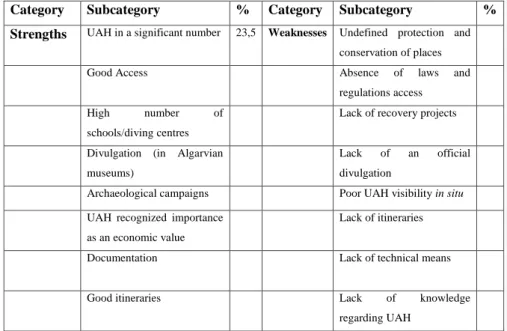
Respondents were also asked about strengths, weaknesses, opportunities and threats of Algarve as a tourist UAH destination in order to trace the SWOT matrix. As for strengths, the “significant number” of these heritage resources and “good access” (both 23.5%) were distinguished interconnected with “excellent sea conditions” (17.6%) (Table 2). It should be noted that “good accessibility” (23.5%) along with the “supply of schools / dive centres” (8.8%) are considered elements of tourism supply upgrade. This easy access is related with free maritime traffic, which is reflected in the respondents’ opinion regarding the weaknesses such as “undefined protection and conservation of the places” (17.6 %), in the “absence of laws and regulations access” (11.8%) and “lack of
recovery projects” (11.8%) applicable to underwater archaeological heritage, among others (table 2).
Table 2. SWOT Analysis and underwater archaeological heritage tourism valorisation – Strengths and Weaknesses
Category Subcategory % Category Subcategory %
Strengths UAH in a significant number 23,5 Weaknesses Undefined protection and conservation of places
Good Access Absence of laws and
regulations access High number of
schools/diving centres
Lack of recovery projects
Divulgation (in Algarvian museums)
Lack of an official divulgation
Archaeological campaigns Poor UAH visibility in situ UAH recognized importance
as an economic value
Lack of itineraries
Documentation Lack of technical means
Good itineraries Lack of knowledge
regarding UAH Source: Own elaboration based on the questionnaire
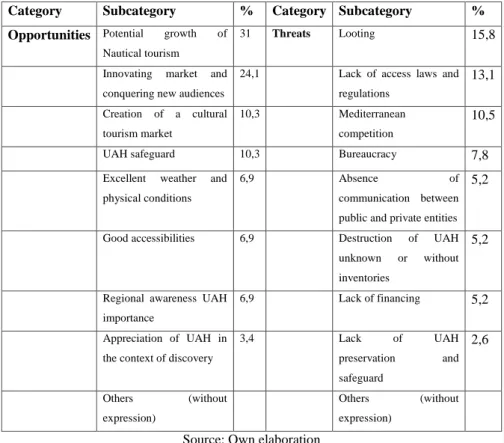
Regarding the opportunities, the strategic measures that should be harnessed to render the Algarve as a competitive UAH destination stand out. The “growth of nautical tourism potential” (31%) followed by the opportunity to explore a “innovator market and conquer new audiences” (24.1%).
With regard to threats, there is the fear of “looting” (15.8%), followed by “lack of access laws and regulations” (13.1%). In order to achieve sustainability, it is necessary to implement innovative management models to counter other threats such as the “Mediterranean competition” (13.1%), the “bureaucracy” (10.5%) as well as the “absence of communication between public and private entities” (7.8%) (Table 3).
Table 3. SWOT Analysis and underwater archaeological heritage tourism valorisation – Opportunities and Threats
Category Subcategory % Category Subcategory %
Opportunities Potential growth of Nautical tourism
31 Threats Looting 15,8
Innovating market and conquering new audiences
24,1 Lack of access laws and regulations 13,1 Creation of a cultural tourism market 10,3 Mediterranean competition 10,5
UAH safeguard 10,3 Bureaucracy 7,8
Excellent weather and physical conditions
6,9 Absence of
communication between public and private entities
5,2
Good accessibilities 6,9 Destruction of UAH unknown or without inventories
5,2
Regional awareness UAH importance
6,9 Lack of financing 5,2
Appreciation of UAH in the context of discovery
3,4 Lack of UAH preservation and safeguard 2,6 Others (without expression) Others (without expression)
Source: Own elaboration
Concerning the entities identified by their involvement and role in the recovery of underwater archaeological heritage in the Algarve, in descending order of importance, respondents have marked as first option, “DGPC” (30.4%) , followed by “ERTA” (21.7%), “Schools / Dive centres” (13%), IP (8.7%), “Algarve University-UALG” (8.7%) and “Municipalities” (4.3%).
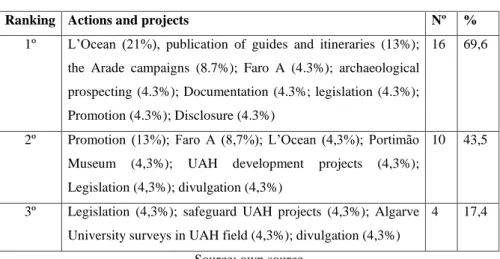
Regarding the question about the indication of both projects and actions in the field of tourism development of underwater archaeological heritage in the Algarve, the majority of respondents chose as their first option the actions regarding “L' Ocean” (21.7%)
followed by “publication of guides and itineraries” (13%), the “campaigns in the Arade river” (8.7%) and “Faro A” ( 4.3%) (Table 4).
Table 4. Most relevant actions and projects in the field of underwater archaeological heritage in the Algarve
Ranking Actions and projects Nº %
1º L’Ocean (21%), publication of guides and itineraries (13%); the Arade campaigns (8.7%); Faro A (4.3%); archaeological prospecting (4.3%); Documentation (4.3%; legislation (4.3%); Promotion (4.3%); Disclosure (4.3%)
16 69,6
2º Promotion (13%); Faro A (8,7%); L’Ocean (4,3%); Portimão Museum (4,3%); UAH development projects (4,3%); Legislation (4,3%); divulgation (4,3%)
10 43,5
3º Legislation (4,3%); safeguard UAH projects (4,3%); Algarve University surveys in UAH field (4,3%); divulgation (4,3%)
4 17,4
Source: own source
When requested to report UAH current and future actions and projects related with tourism development as well as respectively its classification level of achievement, articulation, degree of innovation, degree of tourist attraction and level of economic impact, the response rate was not very high.
Regarding the current actions and projects in the Algarve, the most referenced subjects were the “UAH excavations and prospection and underwater environment studies” (18.8%). The wreck site of “L' Ocean” and its importance within tourism development in underwater environments (12,5%) was also mentioned (12,5%). “Archaeological campaigns in Faro A” and “disclosure/divulgation of UAH in Algarve’ museums” were also pointed out (both with 12.5%).
Actions and future projects were associated with “maps of location” creation (37.5% and 40%) and “documentation and safeguard research projects” (25%). Actions in the field of “development of nautical tourism product” (12.5%) were also referred.
6. CONCLUSION
The underwater archaeological heritage has been recognized internationally and in Portugal, by multiple entities, for its intrinsic value but also for its association with the tourism sector.
In the National Tourism Strategic Plan (PENT and its revisions), regarding the Algarve, the valorisation of products such as “sun and sea”, “nautical tourism” and “touring” allows the possibility to also enhance the UAH. However, the lack of an effective policy of valorisation and dissemination of this important touristic/cultural/sportiv activity is still evident, but has not yet managed to affirm itself as an heterogeneous and distinguished product in the nautical tourism sector, thus remaining undefined in the industry without any kind of visibility. This fact is due solely to the lack of tourism marketing of the Algarve as the destination for the practice of leisure and cultural diving.
Also, regarding territorial planning and regional planning, PROTAL states the need to plan the coastline. Regarding the Regional Agenda of the Algarve Sea (CCDR-Algarve, 2008), there are contributions to an Action Plan to the Algarve Sea Cluster. In the SWOT matrix of maritime cultural heritage, strengths such as “the diversity of relevant archaeological-historical resources” as well as the reference to the existence of “underwater archaeological itineraries” and “valorisation initiatives of archaeological or industrial structures linked to maritime activities” are referred.
In the survey carried out at public and private entities related to culture, tourism and sea sectors, the recognition of tourism, cultural tourism importance, namely associated with icons of UAH’s value in the region, were explicit. This is consistent with the growing recognition of organizations, such as UNESCO (2010), among others, of the importance of culture as a factor of economic and territorial competitiveness.
At the same time, a significant number of underwater heritage assets, as well as the possibility of access through the schools / diving centres contribute to UAH’s touristic development. On the other hand, this heritage tourist potential has not yet been integrated in an effective regional planning and management, since there remains,
Formatada: Tipo de letra: Negrito, Cor do tipo de letra: Automática, Inglês (Reino Unido)
Formatada: Tipo de letra: 12 pt Formatada: Tipo de letra: 12 pt Formatada: Tipo de letra: 12 pt Formatada: Tipo de letra: 12 pt Formatada: Tipo de letra: 12 pt Formatada: Tipo de letra: 12 pt Formatada: Tipo de letra: 12 pt Formatada: Tipo de letra: 12 pt Formatada: Tipo de letra: 12 pt Formatada: Tipo de letra: 12 pt Formatada: Tipo de letra: 12 pt
according to the respondents, “undefined protection and conservation of sites”, “absence of laws and regulations for access” and “absence of recovery projects applicable to underwater archaeological heritage”.
In this context, the weak reference to actions and projects can be understood. The highlights go namely to the L' Ocean and the publication of guides and itineraries. As for activities and projects in which respondents participated, the references went to “UAH excavations and prospections” and “underwater environmental surveys”. Regarding the future, the emphasis should be on the “location maps elaboration”.
Thus, it is expected that Algarve develops strategic measures/actions that transforms UAH to a competitive tourism product. The growth potential of nautical tourism followed by the opportunity to explore innovative marketing and attract new audiences are opportunities that must be achieved.
ACKNOWLEDGEMENTS
This paper was partially financed by the Foundation for Science and Technology.
REFERENCES
Alves, F. J. S., (2002), O Desenvolvimento da Arqueologia Subaquática em Portugal: Uma Leitura. Arqueologia & História. Revista da Associação dos Arqueólogos Portugueses, vol. 54., pp. 255-260.
Alves, F. J. S.; Rieth, E., (2005), Um Mergulho na História: O Navio do Século XV Ria
de Aveiro A. Ílhavo: Museu Marítimo; Lisboa: Câmara Municipal: Centro Nacional de
Arqueologia Náutica e Subaquática: Instituto Português de Arqueologia.
Centro Nacional de Arqueologia Náutica e Subaquática (CNANS), (2005), O Navio
Arade 1 – Relatório da Campanha Arqueológica de 2005, Lisboa.
Comissão de Coordenação e Desenvolvimento Regional do Algarve (CCDR-Algarve), (2006), Quadro de Referência Estratégico Nacional – QREN (PO Algarve 21) (2007-2013), CCDR – ALG., Faro.
Comissão de Coordenação e Desenvolvimento Regional do Algarve (CCDR-Algarve), (2008), Agenda Regional do Mar Algarve. Contributos para o Plano de Ação para o
Cluster Mar Algarve, CCDR – ALG., Faro.
Costa, F.R., (2009), Turismo e Património Cultural: Interpretação e Qualificação. São Paulo, Editora Senac.
Cunha, T. P., (2011), Portugal e o Mar. Fundação Francisco Manuel dos Santos, Guide Artes Gráficas, Lisboa.
Cuvelier, P.; Torres, E.; Gadrey, J., (1994), Patrimoine, Modèles de Tourisme et
Développement Local. L´Harmattan, Paris.
Dupeyras, A. and Maccaluum N. (2013), “Indicators for Measuring Competitiveness in Tourism: A Guidance Document”, OECD Tourism Papers, OECD Publishing.
http://dx.doi.org/10.1787/5k47t9q2t923-enhttp://www.oecd.org/cfe/tourism/Indicators%20for%20Measuring%20Competitivene ss%20in%20Tourism.pdf. (Accessed February 2013).
European Travel Commission (ETC), (2005), Report on City Tourism and Culture. ETC, Bruxelas, September 2006.
EU, (2006). In http://www.eu-un.europa.eu/articles/en/article_6018_en.htm. (Accessed February 2013).
EU, (2006a). Towards A Future Maritime Policy for the European Union: A European Vision for the Oceans and Seas Responding to the Consultation. In London, October 12th, 2006, in http://www.coastms.co.uk/resources/f8cf80fd-1173-4963-8248-000b30524775.pdf. (Accessed February 2013).
Governo de Portugal, (2013), Plano Estratégico Nacional de Turismo – para o
Desenvolvimento do Turismo em Portugal (Revisão do PENT 2006-2015), Ministério
da Economia e do Emprego. In
http://www.turismodeportugal.pt/Portugu%C3%AAs/turismodeportugal/destaque/Docu ments/ 20130111%20consulta%20publica%20pent.pdf. (Accessed March 2013)
International Council on Museums and Sites (ICOMOS), (1999), International Cultural
Tourism Charter, Managing Tourism at Places of Heritage Significance, ICOMOS.
International Council on Museums and Sites (ICOMOS), (1996), Charter on the Protection and Management of Underwater Cultural Heritage, ICOMOS.
Instituto Nacional de Estatística (INE), (2007), Classificação Portuguesa de Atividades
Económicas. INE, Lisboa.
MUSUBMAR, (2011), Projeto Musubmar: Museu Subaquático da Marinha Portuguesa. Maio, Lisboa.
Ocean Revival, (2012), Site. In http://www.oceanrevival.pt/pt/.
Organization for Economic Cooperationand Development (OECD), (2009), The Impact
of Culture on Tourism, OECD Publishing.
PADI (2013), PADI Statistics. In http://www.padi.com/scuba/about-padi/padi-statistics/Default.aspx
PORTISUB (Clube Subaquático de Portimão), (2012), Site. In http://www.portisub.com/portisub/.
Subdirección General de Museos, Museo Nacional de Arqueología Subacuática. ARQUA, Museu de Arqueologia Nacional (2008), RUTA DEL PATRIMONIO ARQUEOLÓGICO/MARÍTIMO DE ESPAÑA Y PORTUGAL/I.- Instituciones y Museos/Rafael Azuar Ruiz • Mercedes Navarro Tito (Eds.) Proyecto Europeo del programa/Interreg III B Medocc (FEDER)/nº 2005-05-4.1-I-149. In http://www.pportodosmuseus.pt/?p=4334. (Acessed February 2013).
Talavera, A.S., (2003), Turismo, Cultura, Culturas Turísticas. In Antropológicos, ano 9, n. 20, pp. 31 -57, Porto Alegre.
United Nations Educational, Scientific and Cultural Organization (UNESCO), (2001),
Convenção para a Proteção do Património Cultural Subaquático, UNESCO.
United Nations Educational, Scientific and Cultural Organization (UNESCO), (2010),
APPENDIX
RESUMEN
Este trabajo tiene como objetivo investigar la interrelación entre el mar, el turismo y la cultura asociada con el patrimonio arqueológico subacuático. Su objetivo principal es determinar la existencia de acciones y proyectos creativos que valorizan el patrimonio arqueológico subacuático en el turismo de Algarve. El supuesto es que el patrimonio subacuático es un recurso valioso para la economía turística de los territorios costeros. En relación con el Algarve, WTTC (2003) se refiere que “la industria de viajes y turismo contribuye directamente el 45% del PIB y el 37 % de los puestos de trabajo”. Sin embargo, como también se arbitrado en este documento “las previsiones para los próximos diez años (2013) son muy modestos”. Esto significa que, a menos Turismo en Algarve (Turismo do Algarve) y el sector privado a tener éxito en el cambio de dirección y superando las previsiones iniciales, la participación de las exportaciones de los visitantes en el esquema de las exportaciones totales se caerá. Como MEID/TP (2011) y Governo de Portugal (2013) señalan para la región del Algarve, el sol y playa, así como golf, se considera que son los principales productos estratégicos. El producto Sol y Mar debe tener una oferta de varios segmentos y ser capaz de ampliar la temporada de verano. Es importante el desarrollo de nuevos productos turísticos relacionados con el mar, el turismo náutico y cultural. El presente trabajo se basa en una investigación documental de las políticas públicas de turismo, así como en una serie de entrevistas a las entidades relacionadas con el patrimonio arqueológico bajo el agua con el objeto de determinar su papel en la puesta en valor de este tipo de patrimonio en el Algarve.
3. METODOLOGÍA
De acuerdo con los objetivos planteados, el estudio se basó en un cuestionario aplicado entre diciembre de 2012 y enero 2013 a 15 públicos y 23 entidades privadas, un total de 38 entidades, donde se obtuvieron 23 respuestas.
Las entidades públicas fueron seleccionadas de acuerdo a un criterio, es decir, su capacidad de intervención en los sectores de la cultura, el turismo y el mar, en un contexto nacional, regional y local. Con este objetivo, las entidades que fueron referidos en el documento titulado “Proyecto MUSUBMAR - Museu Subaquático da Marinha Portuguesa” (2011) se consideraron para la muestra. Las entidades públicas consideradas fueron: Instituto do Turismo de Portugal, Entidade Regional de Turismo do Algarve Turismo, Instituto de Gestão do Património Arquitetónico e Arqueológico (IGESPAR), Direção Regional de Cultura do Algarve (DRCA), Câmara Municipal de Portimão (Vereadora da Cultura), Museu de Portimão (Núcleo de Arqueologia), Associação para a Promoção e Desenvolvimento do Turismo Subaquático (MUSUBMAR), Comissão de Coordenação e Desenvolvimento Regional do Algarve (CCDR), Estrutura de Missão para Assuntos do Mar (ENAM), Instituto da Água e do Mar (INAG), Estado-Maior da Armada (EMA - Comissão Cultural da Marinha), Instituto da Conservação da Natureza e da Biodiversidade (ICNB), Instituto de Investigação das Pescas e do Mar (IPIMAR), IPTM – Instituto Portuário e dos Transportes Marítimos (IPTM). El total de los encuestados fue de 7.
Las entidades privadas son Escuelas o Centros de Buceo incluidas en la Clasificación Portuguesa de Actividades Económicas (CAE) / INE (2007), que se asocian a los servicios de recreación y esparcimiento, actividades deportivas, organización de actividades de animación y otras actividades de esparcimiento y recreativas. Los Centros de Escuelas o de Buceo seleccionados fueron: Algarve Divexperience (Praia do Carvoeiro), Blue Ocean Divers (Lagos), Centro de Mergulho da Universidade de Faro, Deep Blue (Faro), Delphinus Divers (Armação de Pera), Divers Cove - Escola de Mergulho (Lagoa), Diverscape (Sagres), Dive Spot (Armação de Pera), Dine Time International (Lagos) , Easy Divers (Albufeira), Exclusive Divers (Alvor) , Hidroespaço (Faro), Indigo Divers (Albufeira), Isla Subvrsa (Vila Real de Santo António), Mar Ilimitado (Sagres), Open Waters Dive (Quarteira), Pinguim Sub Lda (Portimão) ,
Portisub (Portimão), Subnauta (Portimão), Scuba tour (Armação de Pera), Sudeste Scuba Diving (Sagres), Torpedo Diving (Quarteira), Udiving (Faro).
Después de completar el proceso de aplicación del cuestionario, los datos fueron imputados y se analizaron con la ayuda del programa SPSS (Statistical Package for Social Sciences, versión 20.0 Windows).
Los datos asociados con preguntas cerradas fueron analizados con la ayuda de la estadística descriptiva. El análisis de las preguntas abiertas se basó en un análisis de contenido (“análisis categórico “) (Bardin, 1977). “Esto tiene como objetivo tener en cuenta la totalidad de un texto pasándolo a través del tamiz de la clasificación y el censo, de acuerdo con la frecuencia de la presencia (o ausencia) de los elementos de sentido (…). Es el método de las categorías, especies de cajones o elementos significativos que permiten la clasificación de los elementos de importancia constitutiva del mensaje” (Bardin, 1977).
6. CONCLUSIÓN
El patrimonio arqueológico subacuático ha sido reconocido a nivel internacional y en Portugal, por múltiples entidades, por su valor intrínseco, sino también por su asociación con el sector turístico.
En el Plan Nacional Estratégico del Turismo (PENT y sus revisiones), en relación con el Algarve, la valorización de los productos como de “sol y playa”, “turismo náutico” y “turismo” permite la posibilidad de también mejorar la UAH. Sin embargo, la falta de una política eficaz de valorización y difusión de la actividad cultural/deportiva/turística es todavía evidente, pero aún no ha logrado afirmarse como un producto heterogéneo y distinguido en el sector del turismo náutico, quedando así definida en el industria sin ningún tipo de visibilidad. Este hecho se debe únicamente a la falta de marketing turístico del Algarve como destino para la práctica del ocio y el buceo cultural.
Además, respecto a la planificación territorial y la ordenación del territorio, PROTAL afirma la necesidad de planificar la costa. En cuanto a la Agenda Regional del Mar Algarve (CCDR- Algarve, 2008), existen aportaciones a un Plan de Acción para el Mar Algarve. En la matriz SWOT del patrimonio cultural marítimo, “la diversidad de los
recursos arqueológicos históricos relevantes”, así como la referencia a la existencia de “itinerarios arqueológicos submarinos” y “iniciativas de valorización de las estructuras arqueológicas o industriales vinculados a las actividades marítimas” se hace referencia.
En la encuesta realizada a las entidades públicas y privadas relacionadas con sectores de la cultura, el turismo y el mar, el reconocimiento de la importancia del turismo, el turismo cultural, es decir, asociados con los iconos de valor de UAH en la región, fueron explícitos. Esto es consistente con el creciente reconocimiento de las organizaciones, como la UNESCO (2010), entre otros, de la importancia de la cultura como factor de competitividad económica y territorial.
Al mismo tiempo, un número importante de bienes del patrimonio subacuático, así como la posibilidad de acceso a través de los centros de las escuelas/buceo contribuyen al desarrollo turístico de la UAH. Por otro lado, este potencial turístico del patrimonio aún no se ha integrado en una planificación y gestión regional eficaz, ya que sigue existiendo, según los encuestados, la “protección indefinida y conservación de los sitios”, “ausencia de leyes y reglamentos para el acceso” y “ausencia de proyectos de recuperación aplicables al patrimonio arqueológico subacuático”.
En este contexto, la referencia débil para acciones y proyectos se puede entender. Los aspectos más destacados van a saber a L´Ocean y la publicación de guías e itinerarios. Cuanto a las actividades y proyectos en los que participaron los encuestados, las referencias fueron a “excavaciones y prospecciones UAH” y “estudios ambientales bajo el agua”. En cuanto al futuro, el énfasis debe estar en la “mapas de localización de elaboración”.
Por lo tanto, se espera que Algarve desarrolla medidas estratégicas / acciones que transforma UAH a un producto turístico competitivo. El potencial de crecimiento del turismo náutico seguido por la oportunidad de explorar un marketing innovador y atraer a nuevos públicos son oportunidades que se deben alcanzar.