Intertemporal Choices: Framing Effect on Household Food Waste
Nuno Filipe Rocha Fernandes
Master in Social and Organizational Psychology
Supervisor:
Doctor Rita Jerónimo, Assistant Professor,
ISCTE-IUL,
CIS-IUL
Co-supervisor:
Doctor Cláudia Simão, Assistant Professor,
Católica-Lisbon School of Business and Economics,
Universidade Católica Portuguesa
Department of Social and Organizational Psychology
Intertemporal Choices: Framing Effect on Household Food Waste
Nuno Filipe Rocha Fernandes
Master in Social and Organizational Psychology
Supervisor:
Doctor Rita Jerónimo, Assistant Professor,
ISCTE-IUL,
CIS-IUL
Co-supervisor:
Doctor Cláudia Simão, Assistant Professor,
Católica-Lisbon School of Business and Economics,
Universidade Católica Portuguesa
Acknowledgements O meu especial agradecimento…
Mãe, Pai, pelo apoio incondicional.
Professora Rita, Professora Cláudia, por me fazerem superar em cada etapa desta jornada.
Professora Sandra Soares, pelo ensino e orientação na investigação, na licenciatura.
Professor Marco Vasconcelos, pelo empenho em partilhar Conhecimento.
Joanna, pelo suporte ao longo de 3 anos.
Matilde, pela entreajuda ao longo deste ano.
Cláudia, Daniela, Patrícia, Jéssica, pela amizade.
Bia, Carmona, Daniela, Tiago, por fazerem de Lisboa a minha nova casa.
Aos meus amigos para além da esfera académica.
Resumo
O desperdício alimentar acarreta implicações a longo prazo em termos ambientais, económicos, e sociais, sendo as famílias os principais responsáveis. O medo de não ser um “bom” anfitrião está associado a um comportamento de preparar comida em excesso. A literatura sugere que este comportamento poder-se-á dever a um efeito de aversão ao risco face às perdas de estatuto, contudo isto nunca foi testado experimentalmente. Desta forma, hipotetizámos que as perdas de estatuto impediriam a redução das quantidades de comida servida, sendo isto explicado por uma aversão ao risco superior para perdas imediatas. Assim, 126 participantes foram apresentados com paradigmas de escolhas binárias relativamente a opções hipotéticas de escolhas de quantidades de comida (cozinhar à justa vs cozinhar de sobra). Num desenho intra-sujeitos, estas duas opções foram acompanhadas por uma descrição das suas possíveis consequências relativamente a dois domínios específicos diferentes (ambiental, económico, social, e de estatuto), sendo manipulado o enquadramento temporal dessas mesmas consequências (perdas imediatas e ganhos futuros vs ganhos imediatos e perdas futuras). Os resultados mostram que as perdas de estatuto aumentaram as quantidades de comida servida, enquanto que o efeito temporal não teve um efeito significativo nesta relação. As nossas descobertas possibilitam que outros investigadores explorem o desperdício alimentar doméstico do ponto de vista empírico, assim como têm implicações práticas para os consumidores, para os responsáveis por mercadorias embaladas, e para os oficiais de políticas públicas, uma vez que poderão ser um insight útil para o desenho de intervenções com vista à redução do desperdício alimentar.
Palavras-chave: desperdício alimentar, cozinhar em excesso, aversão ao risco, desconto hiperbólico, nudging.
Classificação APA (PsycINFO Classificação de Categorias e Códigos): 3900 Psicologia do Consumidor
3920 Atitudes e Comportamentos do Consumidor 2300 Psicologia Experimental Humana
Abstract
Food waste has several long-term implications for the environmental, economic, and social domains, with households assuming the major responsibility for these losses. Specifically, the fear of not being a “good” provider is linked to an over-serving behaviour. Despite literature suggesting that this over-serving behaviour could be due to a risk aversion effect towards facing status losses, this was never experimentally tested. So, we hypothesized that status losses would prevent people from reducing their served food quantities, and that this would be explained by a higher risk aversion towards these immediate losses. To accomplish that, 126 participants were presented with binary choice paradigms regarding hypothetical food quantities options (cook just the enough food vs cook more than the enough food). In a within-subjects design, where each of these two options were accompanied by a description of its possible consequences relatively to two different specific domains (environmental, economic, social, and status), we manipulated the temporal framing perspective of those consequences (immediate losses and delayed gains vs immediate gains and delayed losses). The results show that the salience of the status losses increased the served food quantities, while temporal effect had no significant effect in this relationship. Overall, our findings open a path for other researchers to explore the household food waste from an empirically perspective, as well as these have practical implications for consumers, for packaged goods managers, and for public policy officials, since these findings may be a useful insight towards the designing of effective food waste reduction nudging interventions.
Key-words: food waste, over-serving, risk aversion, hyperbolic discounting, nudging.
American Psychological Association (PsycINFO Classification Categories and Codes): 3900 Consumer Psychology
3920 Consumer Attitudes & Behaviour 2300 Human Experimental Psychology 2340 Cognitive Processes
Index
Introduction ... 1
The Background of Food Waste ... 1
Food-waste reduction: Advantages and strategies ... 2
Reasons and Motives to over-serving of food ... 4
Theories of judgment and decision making under risk and under uncertainty... 7
Normative theories ... 7
Descriptive theories... 9
Prospect Theory (PT) ... 11
Exponential time discounting ... 14
Hyperbolic time discounting ... 15
Dissertation overview... 20 Method ... 23 Overview ... 23 Participants ... 23 Experimental design ... 24 Procedure ... 24
Trials and variables ... 25
Experimental trials ... 25
Control trials ... 26
Moderators ... 27
Social Mindfulness (SOMI) ... 28
Consciousness for sustainable consumption scale ... 29
Risk aversion scale ... 29
Control variable: Attitude about food waste scale ... 30
Results... 31
Discussion ... 35
Conclusion ... 43
References ... 45
Index of Figures
Figure 1. Weighting function for gains and losses. ... 12
Figure 2. Subjective value function for gains and losses. ... 13
Figure 3. The hyperbolic discount Function Φ(t) = (1 + αt)−β/α for three different levels of α. ... 18
Figure 4. SOMI experimental trial. ... 28
Figure 5. SOMI control trial... 29
Introduction The Background of Food Waste
Food consumption assumes a central role on people’s lives and sense of identity, since it contributes to the physical well-being and pleasure, consumes energy and time and is the worldwide main expenditure of families (Rozin et al., 1999).
However, 1.3 billion tonnes of food is wasted every year, which represents one third of the food globally produced (Gustavsson et al., 2011). Food waste during the production and supply chain, usually referred as “food loss”, results in waste of resources such as water, land and labour (FAO, 2019; Hanson & Mitchell, 2017). Importantly, consumers are also responsible for food waste by purchasing food they will never prepare or preparing food they will never eat (Quested et al., 2013). In developed countries, households have the major responsibility for producing food waste (Parfitt et al., 2010). In Western countries food waste at consumer levels assumes 30% to 40% of the total food waste (Principato et al., 2015). Relatively to Portugal, PERDA project, which studied food waste, in 2012 calculated a total of one million tonnes of food being wasted annually, with 324 thousand tonnes (32,4%) of that food being wasted by consumers (Baptista et al., 2012) A triple bottom line evaluation shows that food waste has environmental, economic, and social impacts (FAO, 2019; Hanson & Mitchell, 2017; Quested et al., 2013).
Food waste contributes to forest land exploitation for agricultural use and has also implications for water wastage, resulted from the production and cooking processes (FAO, 2019; Graham-Rowe et al., 2014). Food waste is responsible for an estimated eight percent of the annual greenhouse gas emissions due to the emission of methane gases, which is a more powerful greenhouse gas than carbon dioxide, because of the disposal biodegradable waste into landfills (Graham-Rowe et al., 2014; Hanson & Mitchell, 2017). Moreover, the energy, water, and other resources used to grow, harvest, transport, process and sell the food, as the storage and cooking at home, also contribute to greenhouse gas emission (Quested et al., 2013).
Secondly, food waste constitutes an economic threat with an impact of 940 billion of dollars per year in global economy (Hanson & Mitchell, 2017). As Graham-Rowe et al. (2014) reported, purchasing food and then sending it to the garbage constitutes a direct economic problem for families, who most of the time struggle to buy food. Graham-Rowe et al. (2014) found that the negative belief towards food waste was commonly shared, as is exemplified in one of their participants’ opinion regarding food waste:
“It does annoy me. It annoys me more now, recently, my habit. I’ve just thought it’s just a waste of money. Because you go out to earn don’t you? You work and
2
then you get paid and you’ve only got a finite amount of resources. I now see that if I throw away twenty pounds worth of food a week, that’s. . . I had to work to earn that twenty pounds, sit behind a desk or drive a car or whatever I’m doing at work” (p.17)
From a social perspective, food waste is a barrier for ending the world hunger (FAO, 2019). It contributes to the continuously inflation of food prices, making food less accessible for the poorest, as well as reinforcing the number of malnourished people (Quested et al., 2013). Individuals’ are aware of this negative social impact of food waste, and confess the importance to reverse the actual situation, such is described in the following excerpt:
“I worry about it [food waste] on a bigger scale, more globally. Because you know we are the generation that has bequeathed our children disaster. That our generation profligate and used up the world’s resources and now everything is running out so I do take on board being very careful about not wasting food.” (Graham-Rowe et al., 2014, p.18)
Food-waste reduction: Advantages and strategies
The reduction of food loss and food waste fits in ONU’s sustainable development goals for 2030 which includes, amongst its objectives, “halve per capita global food waste at the retail and consumer level, and reduce food losses along production and supply chains” (FAO, 2019). The main target of food loss and waste reduction is to meet the goal of achieving economic growth and sustainable development through the responsible consumption and production (FAO, 2019). Additionally, it also contributes to other eight from the seventeen ONU’s sustainable goals to 2030, which are: no poverty; zero hunger; industry innovation and infrastructure; reduce inequalities; sustainable cities and communities; climate action; life below water; and life on land (Principato, 2018).
Several studies report that economic reasons are the ones mostly referred by consumers who want to reduce their food waste (Graham-Rowe et al., 2014; Quested et al., 2013). However, in addition to the economic motivations, households would also avoid the negative feelings of having to throw food away (Graham-Rowe et al., 2014). It was found that these feelings were associated with a higher fairness sense regarding the negative consequences of food waste (Doron, 2013 cit in Graham-Rowe et al., 2014).
At a consumer level, household food waste has been highly debated and several strategies aiming at its reduction have been implemented (FAO, 2019; Hanson & Mitchell, 2017;
Principato, 2018). These strategies towards food waste reduction can be classified in 5 different clusters: food waste redistribution; food waste reduction; awareness raising campaigns; food waste reuse; and sale of short-date products (Principato, 2018).
The mostly adopted strategies are the awareness raising campaigns due to their effectiveness and ease of implementation (Principato, 2018). “Love Food, Hate Waste” is one of the awareness raising campaigns which was organized by the waste and resources action program (WRAP), and implemented by the UK Government in 2007. That campaign encouraged people not to waste food by warning for its economic and environmental impacts (Principato, 2018). Some recommendations of WRAP with that campaign were: making a shopping list; checking food quantities present at home prior to shopping; storing food in appropriate packaging or wrapping; portioning rice and pasta; and using up leftovers (Quested et al., 2013).
People acknowledge the importance of reducing their food waste and report having the intention to do that, but strive to change their actual behaviour (Aktas et al., 2018; Graham-Rowe et al., 2014, 2015). These findings were framed under Ajzen’s (1991) theory of planned behaviour (TPB) and Fishbein’s and Ajzen’s (2010) theory of reasoned action (TRA) which predict that intention towards action is the ultimately chain element responsible for the behavioural change, which in its instances is preceded by others factors such as attitude towards behaviour, subjective norms and perceived behavioural control. Aktas et al. (2018) found that these factors helped explaining people’s motivation to reduce food waste, but that this intention was not a good predictor of their actual behaviour. Graham-Rowe et al. (2014, 2015) achieved similar results and identified some barriers that could be preventing people from achieving their results, such is the example of: the “good” provider identity; minimizing inconvenience; lack of priority; and exemption from responsibility.
Despite the educational strategies which are usually adopted to promote food waste reduction, such as the awareness raising campaigns, Wansink (2018) argues that a critical analysis of these type of motivation raising campaigns should be made, as they frequently lack adequate efficiency. Also, and as another route, instead of focusing on education, strategies could follow a behavioural economics approach and promote the convenience, the attractiveness, and the easiness of wasting less in order to make it “normal” not to waste food (Wansink, 2018).
Finally, marketers could help consumers reduce their food waste. Wansink (2018) compiled a set of suggestions regarding such marketing strategies, divided between the three stages of the consumption process: helping consumers buy food that they serve; helping consumers serve
4
the food they prepare; and helping consumers eat the food they serve. Relatively to the excessive quantities that are usually prepared, a possible strategy should be offering single serving packages or to offer resealable packaging to prevent people from being impelled to cook the entire amount (Wansink, 2018). Additionally, packages should provide clear information relatively to the typical serving sizes, so that people can use that as an anchor for their food quantity judgements (Wansink, 2018).
Despite these possible solutions to the over-serving behaviour, Wansink’s (2018) agrees that these strategies may have not the exact desired effect on the food waste reduction. This relates with the reasons why people over-serve, such as people feeling afraid of not providing the enough quantity of food, even if they had clear guidelines relatively to the ideal food quantities. The desire to avoid negative feelings related with environmental, economic, and social losses increases the motivation to reduce food waste, but at the same time decreases consumers’ ability to achieve that behaviour, as people assumed to over-prepare, and consequently waste more, because of being afraid of not being a “good” provider (Graham-Rowe et al., 2014). People’s fear of not providing enough food for their family or guests, with the consequent behaviour of over-serving was, as in Graham-Rowe et al. (2014), found to be a constraint to the success of food waste reduction campaigns and households’ intention of behavioural change (Wansink, 2018).
Over-serving in order to let others have the choice to repeat is an activity in which is implicated the weighting of others’ needs. Acknowledging others’ needs and so, to guarantee that during their decision-making processes they are offered with plenty of available options in order to letting them have the chance to decide for their own best interests is being social mindful (Van Doesum et al., 2013). So, over-serving could be described as a socially mindful behaviour. However, if this behaviour contributes to food waste, a paradox emerges. Food waste, with its negative impacts to the world economy, promotes the social gap between people in need and their access to food, amongst the other implications already discussed. Thus, while some people persist to waste food, and others do not have the means to eat, over-serving could also be interpreted as a hostile behaviour since it diminishes the access to food of future generations.
Reasons and Motives to over-serving of food
There might be different factors leading to household food waste. One consists in preparing food that is neither served nor eaten, due to problems during the preparation phase, like food ending up burnt or dropped, or the recipe not turned out as planned (Wansink, 2018). Other
might be the occurrence of unpredictable situations, like change of plans and a family member ending up eating away from home or not being able to eat the packed lunch prepared for work (Wansink, 2018).
The over-preparation of food is another factor which contributes to household food waste (Graham-Rowe et al., 2014; Wansink, 2018). One possible explanation for this is that culinary recipes have gotten their caloric per serving increased because of using more caloric ingredients such as sugar, butter or nuts, while families are getting smaller (Wansink, 2018).
Moreover, people experience cognitive bias regarding their own appetite, which could promote mistakes when judging food quantities, and consequently lead to over-serving (Marchiori et al., 2014; Wansink et al., 2005). When making their judgments and decisions, people use heuristics, which are mental shortcuts that allow humans to perform complex cognitive tasks with less cognitive effort, but also lead to predictable and systematic errors which are usually referred as cognitive bias (Tversky & Kahneman, 1974). Specifically, the anchoring and adjustment heuristic suggests that people make decisions by starting with a reference point (the anchor) and proceed with consequent adjustments to that initial value (Tversky & Kahneman, 1974). Marchiori et al. (2014) reported that the anchoring and adjustment heuristic is also applied to the food consumption behaviour, since people adjust their appetite to the portion size being served (Marchiori et al., 2014): people who were asked to imagine bigger portions reported having a higher desire to consume more food. Similarly, Wansink et al. (2005) found that visual cues influence food intake: people who had unknowingly been given self-refilling soup bowls (the biased visual cue) ended up eating more soup than those given normal soup bowls.
Another aspect that contributes to the over-serving behaviour is the aspiration to be a “good” provider, since people report to intentionally over-prepare to ensure that they provide their family or guests abundant quantities of food (Graham-Rowe et al., 2014). A possible motive for that behaviour is to provide the necessary amount of nutrients by serving plenty of healthy food, or to allow others to eat whatever amount of food they desire, even if it represents massive quantities in their plate (Graham-Rowe et al., 2014):
“. . . (my husband) … doesn’t like having not very much, he always likes having a massive amount on his plate and leaving it if he doesn’t want it which he does quite a lot. So I feel pressure like to make sure he has enough food so he’s not feeling hard done by.” (p.19)
There is also an evolutionary reason for over-serving (Graham-Rowe et al., 2014). In past times, families would have to ration the available food between their members and so,
6
nowadays, people do not want to experience this fear of not having enough food for everyone (Graham-Rowe et al., 2014):
“I am always afraid of running out [of food]…I suppose embarrassment you see that’s the thing. . .just wanting to please, that’s basically what it would be, I want everyone to be happy” (p.19)
The “empty plate fear” is also increased by a social status condition (Graham-Rowe et al., 2014). Over-serving is believed to be a behaviour characteristic of families with higher disposable money so, when people have guests, they report to over-prepare so that their social status will not be compromised (Graham-Rowe et al., 2014):
“No, I think that everyone wastes, I think probably most people do waste like me. I think especially people that I know or I speak to do. I suppose it is because people do seem to have more disposable income or have had disposable income and it’s become habit to live like that.” (p.19)
From an economic, social, and environmental perspective, this fear of not providing enough is regarded as an irrational fear since people are wasting unnecessary resources only to avoid the possibility of disappointing their family or guests (Wansink, 2018).
All in all, despite the cognitive bias that could influence the judgement of food quantities, as reported by Marchiori et al. (2014), people seem consciously aware of their over-serving habits and justify that behaviour by stating they want to ensure enough food for their family or guests (Graham-Rowe et al., 2014). Also, since households continuously report that failing in serving enough food would result in negative feelings towards themselves, the desire to avoid these possible status losses, as mentioned by Wansink (2018) and explainable by the phenomena of loss aversion (see Prospect Theory’s section), should be considered as an important factor for explaining the over-serving behaviour.
A possible explanation to that irrational behaviour could be substantiated by the main concept of Kahneman’s and Tersky’s (1979) prospect’s theory: loss aversion, which refers to the notion that losses are heavier experienced than gains (see Prospect Theory’s section) (Wansink, 2018). The households are believed to over-prepare food because the negative impact of disappointment associated with social status losses should outweigh the gains in terms of saved money, environmental and social contributions (Wansink, 2018). Environmental and social problems associated with food waste are not salient during the cooking process, and the money for purchasing the food had also been spent. Given this, food waste losses are perceived as psychologically distant from individuals (Spence & Pidgeon, 2010). Since these negative consequences are delayed, this could explain why people show a loss aversion attitude to
cooking just the necessary amount of food, as its status losses consequences would be experienced right after the event. This assumption is supported by Shelley’s (1994) findings of loss aversion to immediate losses since people reported preferring delayed losses over immediate ones (see hyperbolic time discounting’s section).
Therefore, household food waste must be conceptualized under judgement and decision-making theories to understand whether loss aversion to immediate losses could be an important insight into the over-serving behaviour. If this proves to be the case, the solution to the reduction of food waste could be a matter of framing the temporal consequences.
Theories of judgment and decision making under risk and under uncertainty
Theories of decision making under risk and under uncertainty deal both with choices regarding uncertain outcomes (Fishburn, 1988). Decision under risk refers to choices between various outcomes with known probabilities, such as the case of gambling decisions (Fishburn, 1988). In contrast, decisions under uncertainty apply to more usual cases in which outcomes are linked to uncertain events, whose probabilities are unknown (Fishburn, 1988). Deciding about the amount of food to cook for other people is an example of a decision under uncertainty: The outcome of serving a certain quantity is dependent upon unknown situational factors, such as individuals’ appetite and satisfaction with the meal. However, the decision about how much food to cook has relevant implications at several levels (environmental, economic, social and status), as seen in previous sections. The question is how such decisions are performed based on the relative weight attributed to each of these dimensions.
Normative theories
Traditional economic theory, such as expected utility theory (EU) developed by Bernoulli (1738), and later by Von Neumann and Morgenstern (1944), defines man as a perfectly rational decision maker. Economic theory states humans have a comprehensive view of the available information in their environment, and that they can integrate all that complex information in a computational way (Kahneman & Tversky, 1979; Simon, 1955). These economic approaches of decision making are described as normative models of human behaviour (Kahneman & Tversky, 1979; Simon, 1955; Stanovich & West, 1999). They aim to predict the expected preferences, based on the assumption that humans are rational decision makers who always try to maximize the expected utility (Kahneman & Tversky, 1979; Simon, 1955; Stanovich & West, 1999).
8
Expected value (EV), which was the starting concept of economic theories, and the precedent of the utility value, is expressed by the probability of an outcome times its payoff, without any subjective evaluation being considered (Bernoulli, 1738). Therefore, the maximization of the EV, to what food choices is concerned, should be achieved by increasing the probability of providing the necessary amount of food, as much as possible, but without having unnecessary costs, as these would reduce the payoff. So, the normative rational behaviour in cooking behaviour, the one which increases probability without compromising the payoff, and then maximizes the EV, should be to provide only the sufficient quantities of food with the fewer resources as possible, in order to avoid unnecessary costs associated with environmental, social, and economic losses resulted from cooking excessive quantities.
However, Bernoulli (1738) stated that rational decision makers maximize the expected utility (EU) rather than the expected value. Expected utility underlines that decisions are not merely dependent on the maximization of the expected value, but rather on the subjective evaluation that the decision maker does relatively to a given outcome (Bernoulli, 1738). So, the EU attributed to a given asset varies between decision-makers as different subjective evaluations are considered when judging the possible outcome (Bernoulli, 1738). Therefore, the expected utility of a given option (E(x)) is shown by the following expression:
E(x) = pu(x) (EU) (1) where p refers to the probability and u to the utility function.
Then, the expected utility of over-preparing or preparing just the necessary amount of food is dependent on people’s subjective evaluation of its possible outcomes times the probability of either ending up producing food waste or not serving enough food. The maximization of the expected utility predicts that if people attribute a high subjective value to the economic, social, and environmental implications of food waste, their desired behaviour should be the reduction of food waste, and then aiming to cook only the necessary amount of food in order not to produce waste. On the other hand, if people prefer to over-serve, this suggests that they attribute a higher subjective value to the status losses over the food waste consequences.
EU considers the systematic deviations from the expected value (EV), such is the case of the famous St. Petersburg paradox (see Bernoulli (1738), for a detailed explanation) and postulates that rational decisions are dependent upon people’s subjective evaluations of the outcomes. Instead of a general linear model, each person has its own subjective expected utility function that accomplishes for their personal attributions to food waste consequences. Imagine now a person who has less consciousness about spending money, environmental issues or future generations’ food access; he/she should not be expected to attribute such a high value for
preventing food waste (and, thus, for saving money, reducing the environmental impact of food waste, or for guaranteeing others’ access to food, respectively), compared to individuals’ who are more conscious about those issues.
Von Neumann and Morgenstern (1944) introduced logic axioms to the EU theory and argued that rational decision-makers were supposed to behave accordingly to those axiomatic rules. The axioms are transitivity, dominance, and invariance (Von Neumann & Morgenstern, 1944). Transitivity points that if A is preferred over B, and B is preferred over C, then, A is preferred over C. Dominance states that if A dominates B in one aspect and is as equally preferred in the other aspects, A must be preferred over B. Invariance states that a preference between two options should be independent of the order or method of presentation; thus, if A is preferred to B, it should still be preferred despite C being also presented. Different personal preferences are allowed, which result in different utility functions between people (Von Neumann & Morgenstern, 1944). But, once these ordering of preferences is made, and the individual utility function is established, axioms underlies rational people to be coherent in their preferences (Von Neumann & Morgenstern, 1944). For this reason, if people are really concerned about the environmental, economic, and social impact of food waste, and show the intention to prevent it, their behaviour should be coherent with that desired goal. Therefore, the imminent risk of losing status should not influence consumers’ behaviour as this would result in a shift of preferences not predicted by the logic axioms.
Normative models understate that people have unlimited time and cognitive resources to process all the available information thus, preferences should be stable and independent of situational factors, such as emotional status, type of information or mode of presentation (Gigerenzer & Selten, 2001; Shafir & LeBoeuf, 2002). So, preference for reducing food waste should not be influenced by situational factors such as time, stress or status of the guests. The actual human behaviour often do not, however, follow the laws of rationality, and systematically violates the axiomatic assumptions (Allais, 1953; Ellsberg, 1961).
Descriptive theories
Since rationality is known for what distinguishes humans from non-human animals, it is hard to refute that humans intend to behave in a non-rational way (Stanovich, 1999). So, Stanovich (1999) proposed that a solution to this problem would be an empirically identification of the gaps between what normative models predicted and the actual mean and modal preferences of individuals. Despite the debate of how rational decision makers should behave, descriptive
10
theories focused more on explaining what the actual causes of those gaps could be (Stanovich, 1999).
Descriptive models do not imply that humans are irrational decision makers who consciously choose, for example, to waste food; but, instead, they are rational individuals with a bounded rationality (Simon, 1955). Bounded rationality states that human cognition has some limitations and that decision makers use clues to help them processing all the complex available information with fewer cognitive strain, which could result in systematic deviations from the EU (Kahneman, 2003; Simon, 1955; Thaler, 1980; Tversky & Kahneman, 1974). An example of a deviation from rationality is the act of overjudging the necessary food quantities. Food waste, at least for its economic, environmental, and social implications, should be avoided if we consider a rational decision. So, this irrational behaviour of food wasting suggests that decision makers do not always follow the rational guides for cooking activities.
An analogy between the normative and descriptive models of decision making and two proposed systems of reasoning could be made (Sloman, 1996). A dual system of reasoning was proposed and has been receiving converging empirical evidence, to account for the fact that individuals sometimes follow normative predictions, but at other times behave in a systematic biased way (Kahneman, 2003; Sloman, 1996). The distinction between each one of these systems of reasoning is the amount of effort put into the judgment process. System 1, described by Kahneman (2003) as an intuitive system and by Sloman (1996) as an associative system, is described as: “a fast, parallel, automatic, effortless, associative, slow-learning, emotional process of judgment” (Kahneman, 2003, p.698). Whereas System 2, described by Kahneman (2003) as the reasoning system and by Sloman (1996) as the “rule based” system, is defined by “slower, serial, effortful, more likely to be consciously monitored and deliberately controlled” operations (Kahneman, 2003, p.698).
Therefore, when people behave accordingly to normative models of decision making, they consciously pursue the maximization of the expected utility, and is implied that they follow the axiomatic rules “System 2” (Sloman, 1996). However, when decision making is based on an intuitive process of judgment “System 1”, this often leads to divergencies regarding EU, as descriptive models predicts (Sloman, 1996). Altough, Sloman (1996) adverts that this approach should be taken cautiously because in certain cases both systems contribute at the same time for the judgment process.
Through the analysis of these systematic biases, Tversky and Kahneman (1974) identified a set of effects that operated in the automatic System 1 and formulated a descriptive theory of decision making under uncertainty, called prospect theory. As Wansink (2018) suggested, loss
aversion, as is described in prospect theory, could help to explain the fear of not serving enough food that increases household food waste.
Prospect Theory (PT)
Kahneman’s and Tversky’s (1979) prospect theory (PT) is a descriptive theory of decision making under risk, but which could also be applied to other situations with unknown probabilities (i.e., decision making under uncertainty). The theory emerged as an explanation of the reasons that lead people to systematically deviate from EU (Kahneman & Tversky, 1979).
So, instead of judging options by their utility value, as predicted in EU, PT postulates that decisions are made based on individuals’ subjective evaluations of a given prospect (Kahneman & Tversky, 1979). By this way, decision-makers weight each prospect, which refers to the likelihood and the consequent impact of some future event occurring, through a subjective value and a decision weight (Kahneman & Tversky, 1979).
The subjective value expresses a judgement made in terms of state changes (losses and gains) relatively to a referential point rather than in the absolute magnitude value of the outcome (Kahneman & Tversky, 1979). For an illustrative example, consider two families which are both aiming to reduce their food waste, but are in different stages of the process. “Family A” had already committed to the task a few weeks ago and has a mean record of 60% reduction in their weekly food waste, while “family B” has not yet started their journey towards the reduction of food waste. Now imagine that in the following weeks, for any reason the “family A” only achieves a 50% reduction in their weekly food waste in comparison to their initial record, and “family B”, who is in their first weeks, registers a decline of 40% in their food waste. If judgement was made in terms of magnitude of the decline, “family A” would still have registered a better outcome than “family B”, but subjective value suggests that “family A” would experience this result as a loss because their reference value (60%) was higher than the achieved outcome. Although, “family B” would probably experience this conquest as a gain, since their reference point was a zero decline. Given this, increases from the reference point are perceived as gains while decreases are perceived as losses, despite the magnitude value of the outcome being positive or negative (Kahneman & Tversky, 1979).
Additionally, decision weights are not probabilities nor must be interpreted as degrees of belief, but instead as the estimated impact of choosing one prospect (Kahneman & Tversky, 1979). When faced between the options of cooking extra quantities or reducing the food portions, PT states that this decision is not merely dependent on the probability of the served
12
food being enough or not, but rather on the possible impacts (in terms of environmental, social, status or economic costs) of these outcomes.
Prospect value (V(x)), which refers to the perceived impact resulted from a possible state change, is then expressed by the subjective value (v(x)) times the decision weight (𝜋(𝑝)), and is represented by the following expression:
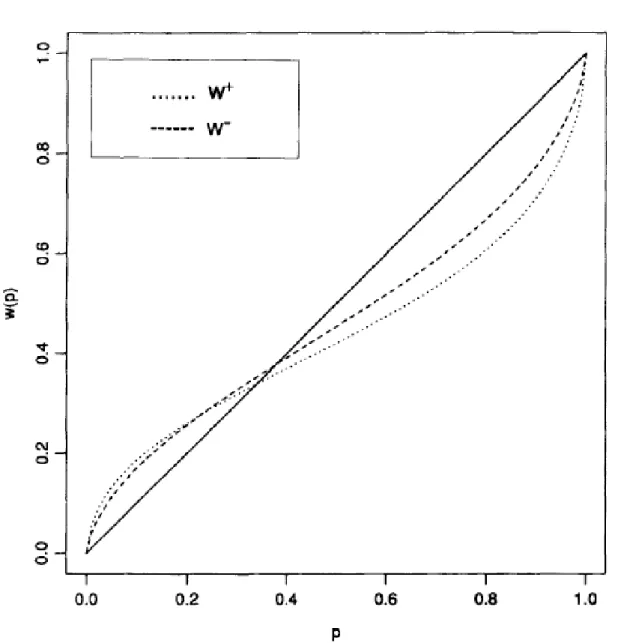
V(x) = 𝑣(𝑥)𝜋(𝑝) (2) where the decision weights (𝜋) are obtained by a transformation of the real probabilities (p) by a weighting function (w) (Figure 1) (Kahneman & Tversky, 1979, 1992).
Then 𝜋 = 𝑤(𝑝) (3)
Figure 1. Weighting function for gains and losses.
This weighting function overweighs very low probabilities and underweights high probabilities, both for gain and losses, 𝜋(𝑝) > 𝑝, for small 𝑝 (Kahneman & Tversky, 1979).
Changes of probabilities near certainty (p approaches 1) and impossibility (p approaches 0) are more weighted such that “…an increase of .1 in the probability of winning a given prize has more impact when it changes the probability of winning from .9 to 1.0 or from 0 to .1, than when it changes the probability of winning from .3 to .4 or from .6 to .7.” (Tversky & Kahneman, 1992, p.303). Similarly, even if the probability of the served food not being enough is very low, people overweight the possible impact of it occurring, and end up cooking unnecessary quantities. This results in a weighting function concave for changes near 0 (the impact of small probabilities is overweighed) and convex near 1 (the impact of high probabilities is underweighted) and is translated to other real life situations as the payment of an insurance premium despite the low probability of a negative event occurs (Kahneman & Tversky, 1979).
The subjective value (v(p)) represents how judgements are made based on state changes from a reference point, in terms of gains and losses, rather than in the outcomes’ objective value (Kahneman & Tversky, 1979, 1992). This subjective evaluation is made through and S-shaped function (Figure 2) which represents how gains and losses differently impact people’s judgements (Kahneman & Tversky, 1979, 1992). This S-shaped function, with its concave region for gains but convex for losses and with the additional particularity of being steeper for losses than for gains, is the result of losses being heavier experienced than gains.
14
The subjective value function convexity and steepness for the region of losses implies that people experience more psychological discomfort for a possible loss (V(-x)) than enjoyment for a possible gain (V(x)), (|V(-x)|>|V(x)|) (Kahneman & Tversky, 1979). Since losses are heavier experienced than gains, people direct their behaviour in order to avoid any possible losses, which can be described as loss aversion (Kahneman & Tversky, 1979). As Wansink (2018) hypothesized, the possible status losses of the food not being enough would be heavier felt than the environmental, economic and social gains derived from the food waste reduction (Kahneman & Tversky, 1979, 1992).
Kahneman’s and Tversky’s (1979) loss aversion concept explains why people make certain decisions towards minimizing any possible loss despite the higher gains of the alternative option, such is the case of preparing excessive quantities of food.
Since people avoid losses more than they desire gains, this results in a risk seeking behaviour for losses, but in a risk aversion behaviour for gains, which is referred as the reflection effect (Kahneman & Tversky, 1979). The reflection effect, due to loss aversion, shows that people are risk aversive for gains, as they avoid taking risks to have higher gains (because of the fear of facing some losses), while they are risk seeking for losses because in order to avoid losses, they prefer to take risks in order not to lose, even if it means that they could end up with higher losses (Kahneman & Tversky, 1979).
Households avoidance to reduce their served food quantities seems to be explained by risk aversion, as its possible status losses should outweigh the gains of reducing food waste (Wansink, 2018). However, what prospect theory lacks to explain is why people continuously over-judge the necessary food quantities despite the environmental, economic and social losses of food waste in comparison to what would be the unique advantage of preventing status losses associated with the over-serving behaviour.
After a carefully examination of both losses resulted from food waste and from not serving enough food, we suggest that a possible distinction between them, which could influence people’s preference towards over-serving, is the fact that status losses of not serving enough food are immediately experienced, while environmental, economic and social losses of food waste are felt in the long run. Given this, the temporal effect of those losses could be a useful insight on why people seem to be risk averse for the imminent status losses, but risk seeking for the long-term consequences of food waste. This idea is well expressed in the concepts of exponential time discounting and hyperbolic time discounting.
Similarly to the expected utility theory (EU), normative models of judgment and decision making under uncertainty predict that intertemporal preferences (decisions involving different temporal consequences) follow a discounted utility (DU) model (Loewenstein & Prelec, 1992). Samuelson (1937) introduced this DU model which describes the utility loss of a given outcome as its time delay increases by a discount factor transformation. An example of the time delay effect on outcomes is the common preference of receiving 1000€ now over 2000€ in one year (Fishburn & Rubinstein, 1982). This discount factor in normative models is described by an exponential function (Loewenstein & Prelec, 1992).
DU, through the exponential discount function, postulates continuity, sensitivity and stationarity between time preferences (Samuelson, 1937). Continuity implies that it is possible to make any utility transformation, even for the smallest of intervals whose difference (t-t’) approaches 0, which allows the model to predict any difference in value between two time periods, whatever this is in terms of years, months, days, etc. (Samuelson, 1937). By this way, people should be able to judge food choices consequences, respecting their value lost through time, whereas they will be felt e.g. now, in the following week or in a year.
Sensitivity accomplishes that different outcomes suffer different discounting transformations (e.g. higher outcomes are less discounted) (Samuelson, 1937). If we consider the social, environmental and economic impacts of food waste, despite they would all be felt in the future, these dimensions could suffer different discount transformations through time, e.g. economic costs of food waste could lose less weight as it is reported to be the most important factor that motivates consumers to reduce their food waste.
The stationarity property denotes that the value lost through time must be independent of the time period in which that transformation occurred. (if U(tx1)>U(tx2), for any t’, U(t’x1)>U(t’x2)) (Samuelson, 1937). So, the value which an attribute loses in one week should be the same whether this week was framed to occur in the following month or in the next year. Consider the above example of the common preference for receiving 1000€ now over 2000€ in one year; stationarity property states that if this is verified, the same people should also prefer 1000€ in one year over 200€ in two years from now, since preferences are independent of time passage.
Hyperbolic time discounting
As in EU, there were, however, found systematic violations from DU predictions. Thaler (1981) exemplified how people could prefer having one apple today instead of two apples tomorrow, but at the same time preferring to have two apples in a year and one day, instead of one apple
16
in one year, which reveals a dynamic inconsistency, as formerly noted by Ainslie (1975) and Strotz (1955). Dynamic inconsistency shows that the discount factor is not merely dependent on the absolute time interval (t`- t) between preferences, as predicted by the stationary axiom, but that it could change as these intervals depart from the reference point (Loewenstein & Prelec, 1992; Thaler, 1981).
Dynamic inconsistency is also suggested to appear in the judgment of food quantities. As already discussed, people recognize the severity of the long-term consequences of food waste, so they report having the intention to reduce the amount of their served food (Aktas et al., 2018; Graham-Rowe et al., 2014, 2015). Although, like in Thaler’s (1981) dynamic inconsistency example, this preference could shift as the actual cooking moment takes place, resulting in food being wasted. A possible reason for this is that the status losses of not serving enough food, which were once perceived as distant, are turned salient, in contrast to the still long-term perceived losses of food waste.
Moreover, despite sensitivity stated that higher outcomes should be less discounted, it did not predict that changes in the discount factor were not proportional to changes in the outcomes’ magnitude (Loewenstein & Prelec, 1992). Thaler (1981) also reported that the same individuals who were indifferent between receiving 15$ now and 60$ in a year, were also indifferent between 250$ now and 350€ in a year, or 3000$ now and 4000$ in a year. As in prospect theory, this suggests that temporal discounting is not merely dependent on the absolute time interval, but rather on the time period in which that discount occurs relatively to a reference point.
These anomalies suggest that intertemporal preferences were better described by a hyperbolic discounting function which accomplishes for outcomes being heavier discounted near the present than in the future, and outcomes with higher magnitude being less discounted over time (Ainslie, 1975). Despite the environmental, social and economic consequences of food waste being highly discounted near the present, as its impacts would only be perceived in the long-term, they are still a high concern for households since people recognize their future severity. Although, even if people generally attribute a lower weight to the possible status losses that can arise from reducing their served food, since these consequences have immediate effects, they are going to be less discounted at the moment of cooking. If this overweight of the immediate status losses proves to be true, this could be an important explanatory reason of the over-serving behaviour. This is supported by Herrnstein’s (1961) matching law which says that when faced between multiple options, people prefer the one which offers the highest reinforcement rate. In terms of food quantities, people should adjust their behaviour accordingly to the option which offers them the possibility of avoiding greater losses. Analogously, choices
between different time contingencies, as food quantities choices, show “…that the time allocated to an activity is discounted by reinforcement contingent on an alternative activity.” (Rachlin, 2006, p.432). Therefore, Rachlin (2006) states that when faced with choices with different time contingencies, the option with the delayed contingencies, e.g. losses resulted from excessive quantities, will lose as much value as the other options’ contingencies approach the decision moment, e.g. status losses associated with not serving enough food.
Consequently, when judging whether to cook higher quantities of food (B1) or only the necessary ones (B2), the choice of over-serving will be proportional to its reinforcement rate (R1). At the actual moment of cooking, the avoidance of the immediate status losses (R1) seems to be preferred over the avoidance of the long-term food waste consequences (R2), which will result in a tendency to prepare excessive quantities.
B1 B1+B2 =
R1
R1+R2 (4) The changes that the discount factor suffers through time, and how this temporal effect influences food waste can be described by the following hyperbola (Harvey, 1986 cit in Loewenstein & Prelec, 1992):
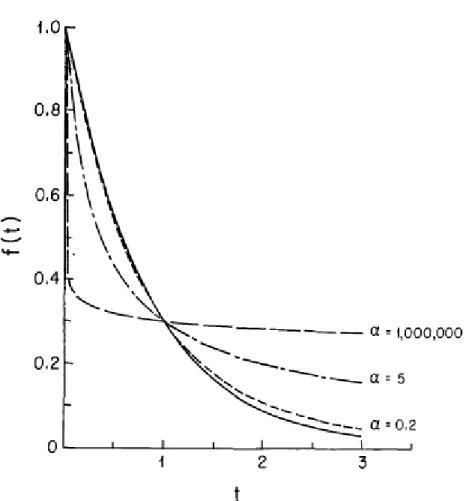
Φ(t) = (1 + α𝑡)−β/𝛼, α, β > 0 (5) The α-coefficient (α) defines the depart from the constant discounting, and as it goes to zero, the function is the exponential discount function Φ(t) = 𝑒−β/𝑡 (Loewenstein & Prelec, 1992). In hyperbolic discounting, the higher the α-coefficient, the smaller the differences in the discount value (Φ) as the discount function departs away from the reference point (t), which contradicts the original predictions of the exponential discounting where α=0, and then, differences in discount values were independent of the reference point (Loewenstein & Prelec, 1992). Translated to food behaviour, this could mean, for example, that the benefits of avoiding food waste losses would be more discounted (lose more weight) if its economic, social and environmental consequences were framed within a one month time period compared to the present moment, than if its consequences were also framed within a one month period, but in this case in a year from now. This example would therefore contradict the exponential discount, as discount transformations for a one-month period should be the same independently of the time of their occurrence.
Figure 3 shows the hyperbolic discount function for 3 different values of α in contrast to the exponential discount function (Loewenstein & Prelec, 1992). β was adjusted for each value of α in order to Φ(t)=0.3 at t = 1 (Loewenstein & Prelec, 1992).
18
Figure 3. The hyperbolic discount Function Φ(t) = (1 + α𝑡)−β/𝛼 for three different levels of α.
Given these observed particularities involved in the judgement of intertemporal options, as is the case of food quantities choices, the hyperbolic discount function through its reference dependence concept could contribute to explain why the imminent fear of losing status outweighs all the other food waste negative consequences.
In addition to the temporal reference implicit in the hyperbolic discount function, the subjective value function of choices involving delayed outcomes, as in Kahneman’s and Tversky’s (1979) prospect theory, is also different for gains and losses (Loewenstein & Prelec, 1992; Thaler, 1981). Thaler (1981) asked participants what amount of money would be required to either postponing a fine or anticipating a prize. The results showed that the amount of money needed to delay a reward was higher than the amount of money needed to have a reduction in the fine (Thaler, 1981). So, Thaler (1981) found a higher discount factor for gains than for losses, which means gains are believed to lose more weight as they are delayed in time (see also Loewenstein & Prelec, 1992).
However, in those studies, the signal effect the authors were trying to detect was always manipulated by changes in the outcome timing (delay or anticipation), which could possibly have led to an interaction between the outcome’s sign and the direction of the proposed change (Shelley, 1994). The postponing of a fine, if analyzed as a change in status, could be regarded as a gain, and so, the conclusions would be that gains suffer a smaller discount factor. The same analogy applies for the postponement of prizes, since having a reward being delayed could be perceived as a loss, we could conclude that losses are heavier discounted. Similarly, status losses of not serving enough food should outweigh the delayed gains of reducing food waste, as these are heavier discounted.
Shelley (1994), contrarily to Loewenstein and Prelec (1992) and Thaler (1981), found that losses were heavier discounted than gains, which by other words means losses lose more power over time (delay), than gains gain to the present (anticipation) (Shelley, 1994). Moreover, the author stated that future outcomes receive a risk premium associated with the uncertainty of time passage, and this risk premium is one of the possible explanations of people’s preference towards low immediate (free risk premium) rewards instead of high (high risk premium) rewards (Shelley, 1994). The decision of preparing more food than the absolutely necessary is an example of people’s preference for avoiding the immediate status losses (free risk premium) in spite of the delayed environmental, economic and social losses of food waste (high risk premium). The underlying cognitive assumption which could explain this effect is a belief that some random event will prevent those negative consequences to take place, or if they take place, people will have the necessary mechanisms to deal with them (e.g. environmental, economic and social impact of food waste) (Shelley, 1994).
Shelley (1994) asked people to rate the attractiveness of 128 lottery stimuli in which time, probability, losses and gains were manipulated (outcome’s signal). The model which had the best fit to the results, and so the one that better explained the variation found between choices with different temporal consequences, was the one which allowed for a risk premium, and for the discount rates to vary across outcome’s sign (Shelley, 1994). So, intertemporal preferences are dependent on the uncertainty of time passage (risk premium) and the value that an outcome loses over time (discount rate), with this discount rate being more pronounced for losses than gains, as is defined in Shelley’s (1994) work by the following equation:
v(L) = 𝛽1(𝑡)𝜋(𝑝)𝑣1(𝑥) 𝑔1(𝑡) +
𝛽2(𝑡)𝜋(1 − 𝑝)𝑣2(𝑥′)
𝑔2(𝑡) (6) The overall value, v, of a risky option, L, is composed of the subjective value for gains, v(x), times the probability weight, 𝜋(𝑝), times the discount factor, 𝛽1, and times the implicit
20
risk, (1)/(g1(t)) added up to the subjective value for losses v2(x’), times the probability weight, 𝜋(1 − 𝑝), times the discount factor 𝛽2, and times the implicit risk, (1)/(g1(t)) (Shelley, 1994). When people are confronted with the negative consequences of food waste, they judge the implications of reducing their served food quantity by equating its possible gains and losses in a temporal perspective. If the combination of the gains and losses of reducing food waste, with the correspondents temporal discounts transformations and risk premiums, is superior to the other alternative, which in this case would be over-serving, then people would choose to reduce their served quantities.
However, since people show an inferior risk perception of future losses (g2(t)) compared to future gains (g1(t)), and a higher discount ratio of losses over gains (𝛽2 > 𝛽1), that results in a risk seeking attitude for delayed losses (Shelley, 1994). This explains why people fear the possibility of not cooking enough food, as its status losses consequences’ are immediate, but do not seem to attribute the sufficient weight to the impact of food waste, as its environmental, social and economic risks are delayed.
People often fail to achieve their future intentions of quitting smoking, losing weight, saving money, and having a healthier lifestyle (O'Donoghue & Rabin, 2000; Thaler & Shefrin, 1981). The inability to reduce food waste is another situation which reflects a poor self-control problem, with a prior preference of reducing the served food quantities being altered as the reinforcement of the more immediate lower reward approaches, in this case, the avoidance of the imminent fear of losing status, achievable by over-serving (Ainslie, 1975; Hoch & Loewenstein, 1991; Thaler, 1981). Hyperbolic time discounting, through its reference dependence concept states that changes near the present are more meaningful than changes in the future, helps explaining these type of self-control problems (Ainslie, 1975). People under-indulge for tasks with immediate costs, even if with higher but delayed rewards (e.g. writing an important report), and over-indulge for activities with immediate rewards, even if with higher costs in the future (e.g. overeating) (O'Donoghue & Rabin, 2000). Akerlof (1991) also denotes that self-control problems are explained by the cognitive psychological concept of undue salience or vividness. Irrational decisions emerge as present benefits and costs are unduly salient with future costs and benefits (e.g. procrastination) (Akerlof, 1991; see also Ariely & Wertenbroch, 2002).
Dissertation overview
Under Wansink’s (2018) assumption that households usually over-serve food because they are afraid of facing social disapproval, we propose to study whether status losses promote food
waste. Additionally, as these status losses are immediately experienced, while food waste’s environmental, social, and economic losses are experienced in the long-term, loss aversion to immediate losses could explain the households’ fear of losing status (Shelley, 1994). This fear and its consequent result of cooking excessive quantities of food show a shift in preferences which contradicts Aktas’s et al. (2018) and Graham-Rowe’s et al. (2014, 2015) claiming that people report the intention of reducing their food waste. If this shift in preferences is explained by a common preference for immediate but lower gratifications over delayed but higher ones, as Ainslie’s (1975) and Herrnstein’s (1961) have found (1994), designers of food waste reduction interventions should take the temporal framing of food waste losses into account when rethinking its strategies.
Since cooking less food is associated with the possibility of facing status losses, and as these are less discounted and have a fewer risk premium associated due to its immediate effects, it increases households’ loss aversion (Wansink, 2018; Shelley, 1994). Consequently, people are supposed to be risk-averse of reducing their served food, as compared to the alternative option of cooking additional quantities (Wansink, 2018). Then, our first hypothesis (H1) is that the probability of “cooking just the enough food” will be lower when immediate losses are highlighted as compared to when delayed losses are made salient.
Additionally, we will see if enlightening the often delayed environmental, social, and economic consequences of food waste, which, as reported in Aktas et al. (2018) and Graham-Rowe et al. (2014, 2015) studies, contributes to the households’ food waste reduction intention, leads to a significantly food waste reduction improvement. Thus, we expect that the probability of “cooking just the enough food” will be higher for the environmental, social, and economic consequences compared to the status dimension (H2).
Concerning people’s relatively degree of awareness about certain food waste problems, this could lead to different choices depending on the dimension that is made salient. Since people with higher awareness about food waste should be more concerned about those issues, their perceived value regarding the environmental, economic, and social losses should be higher, and consequently these dimensions should lose less value through time (Samuelson, 1937). For this reason, we predict that social mindfulness and consciousness about sustainable consumption will act as moderators in the relationship between dimension and food waste (Aktas et al., 2018; Graham-Rowe et al. 2014, 2015; Van Doesum et al., 2013). So, we expect that social mindfulness (H3) and consciousness about sustainable consumption (H4) will have a positive effect in the relationship between dimension and the reduction of food quantities, when social, environmental, and economic dimensions are enlightened.
22
Finally, if food waste is explained by a loss aversion effect, people who show a stronger risk aversion should choose less frequently to “cook just the enough food” when its immediate losses are salient (Shelley, 1994). Thus, we expect risk aversion to act as a moderator between temporal framing and food waste, with a negative effect on the probability of choosing to “cook just the enough food” when immediate losses are salient (H5).
Method Overview
The present study was conducted online through the Qualtrics platform. Our experimental manipulation aimed to test if temporal framing and the different dimensions (environmental, economic, social and status) would have an effect on the judgement and decision-making process of participants’ food quantities choices. Moreover, participants’ social mindfulness (SOMI), consciousness about sustainable consumption, and risk aversion degree were measured and tested as potential moderator variables. Also, attitude towards food waste was measured and treated as a control variable.
In our main experimental task, comprised of experimental and control trials, participants were asked to imagine they had to cook in that day for some guests, and for that reason they had to choose between “cooking just the enough food” or “cooking more than the enough food” (see: Kahneman’s and Tversky’s (1979) binary choices paradigms of loss aversion or Thaler’s (1981) experimental formulations of temporal discount).
In the experimental trials, temporal framing was manipulated by presenting both immediate and delayed consequences of the options “cook just the enough food”/“cook more than the enough food”. Moreover, this temporal framing was made for each of the main dimensions that have been associated with food portion choices (i.e., status, economic, environmental, and social dimensions).
In the control trials, the options “cook just the enough food”/“cook more than the enough food” were also presented, but these were only matched with immediate consequences (gains and losses), while future consequences were keep constant. Thus, we predicted that, when isolated from the temporal effect, dimension (status, economic, economic, and social) would influence participants’ choice, allowing to see how would people behave when only immediate consequences are salient, as usually occurs in real life settings.
Participants
We first conducted a power analysis using G*Power to compute the necessary sample size to an effect. Although the necessary sample size was of 75 participants, we were able to collect data from 126 participants, ranging in age from 18 to 47 years old (M = 22.52; SD = 5.63). The sample was comprised of 81 females (64%), 35 males (28%) and 10 who preferred not to specify their gender (8%). A total of 61 of these participants were psychology students enrolled at the ISCTE - University Institute of Lisbon and obtained a half course credit as an exchange
24
for their contribution to the scientific research. The remaining participants were online recruited through the dissemination of the study on social networks, and they did not receive any reward for their collaboration.
To participate in this study, participants had to previously answer some questions regarding their eating habits. The questions related to these prescreen restrictions were: “Are you diagnosed with any eating disorder?”; “Are you currently on some food diet?”; and “Are you currently subject to any food restrictions?”, and only participants who did not meet any of these restrictions were asked to participate in our study.
Experimental design
The study had a within-subjects design, with temporal framing (immediate losses and delayed gains vs delayed losses and immediate gains) and dimension (status vs environmental vs social vs economic) being manipulated in the experimental trials (2x4), while in the control trials only dimension was manipulated amongst its four levels.
In the experimental trials, the temporal framing was orthogonally rotated across dimensions and quantities options. So, each option (“cook just the enough food”/“cook more than the enough food”) was always presented with two different dimensions at the same time, with one of these dimensions having its consequences framed in the present and the other in the future. Hence, both options were presented by having one gain and one loss relatively to two different dimensions each trial, with one being framed as immediate and the other delayed. If, e.g., the immediate consequence was framed as a loss, the delayed consequence would be framed as a gain, and for the complementary option, the reverse was applied: the immediate consequence would be framed as a gain, and the delayed consequence would be framed as a loss, for the same two dimensions. These six possible pairs of dimensions combined with the two levels of temporal framing and the two alternatives of choice made a total of 24 experimental trials.
In the control trials, only immediate consequences (gains and losses) were salient, while future consequences were kept neutral. So, each of the four dimensions was presented one time as having immediate gains, while in the other trial was framed as having immediate losses, which makes a total of 8 control trials.
Procedure
Participants took part in our online study through the Qualtrics platform, and the average duration time was 30 minutes. After answering the inclusion criteria, and reading the informed consent, participants provided some sociodemographic data, and were forwarded to the
experimental task. The aim of the experimental manipulation was to assess participants’ judgement and decision making of food quantities. In the experimental task, with both experimental and control blocks, we simulated real life decisions where participants were faced between the options of choosing “to cook just the enough food” or “to cook more than the enough food”. In every trial, both options appeared side by side on the screen and were followed by the possible consequences which were being manipulated. The participant selected which of the two options he/she would choose, without any time limit for the response. Finally, the control variable and the moderators considered for our study were assessed.
Trials and variables
For each trial, food quantity choice was the dependent variable and it was categorized as follows: Either participants had to choose cooking just enough (categorized as 1) or participants had to choose cooking more than enough (categorized as 0). Thus, we measured the probability of choosing to cook just enough food vs. to cook more than enough food. Accordingly, participants could choose only one of the two possible options. Paired options were constructed to manipulate both temporal framing and dimension at the same time as described next.
Experimental trials
In the experimental trials, we tested whether having the four dimensions (status vs environmental vs economic vs social) temporally framed (immediate and delayed) in terms of gains and losses would have an effect on the food quantities choices (“cook just the enough food” vs. “cook more than the enough food”).
The following transcription of a trial illustrates how in experimental trials, the temporal framing and dimension were orthogonally rotated. If “cooking just the enough food” was framed as having immediate status losses and delayed environmental gain, then the “cooking more than the enough food” was associated with immediate status gains and delayed environmental losses, preceded by the corresponding framework:
“Imagine that you are having some guests today and you are going to cook at your place for them. When deciding what to cook, and what quantities, you are faced with two options.”
Option A: “Cook only the enough food, your guests will not be able to repeat the dish and they might get the idea that you did not have the ability to judge the necessary quantities and, thus, at the end of the dinner they will have the impression that you were not a good host.