
João Manuel Araújo Machado Vilaverde
An interoperability API for E-Procurement
and E-Tendering platforms
Driving E-Procurement
Dissertação de Mestrado
Mestrado em Engenharia de Sistemas
Trabalho efetuado sob a orientação de
Professor Doutor Luís Miguel da Silva Dias
Rui Manuel Andrade Barreira
DECLARAÇÃO
Nome: João Manuel Araújo Machado Vilaverde
Endereço eletrónico: [email protected] Telefone: 253311159/911551003 Bilhete de Identidade/Cartão do Cidadão: 13588446
Título da dissertação: An Interoperability API for E-Procurement and E-Tendering platforms Driving E-Procurement
Orientadores:
Professor Doutor Luís Miguel da Silva Dias Rui Manuel Andrade Barreira
Ano de conclusão: 2014
Mestrado em Engenharia de Sistemas
DE ACORDO COM A LEGISLAÇÃO EM VIGOR, NÃO É PERMITIDA A REPRODUÇÃO DE QUALQUER PARTE DESTA TESE/TRABALHO.
Universidade do Minho, 31/10/2014
A
GRADECIMENTOS
Este trabalho marca o fim de um ciclo académico e ao mesmo tempo marca um o inicio de um ciclo profissional na minha. Mais do que qualquer aspecto, importa sempre realçar a componente humana de qualquer trabalho desta natureza.
Assim sendo, começar por agradecer à minha família, pelo seu apoio incondicional a todos os níveis. Por me darem sempre todas as condições para prosseguir a minha carreira académica, pelo apoio em todas as decisões que tomei. Sem eles nada do que consegui até agora teria sido possível. Um agradecimento especial aos meus amigos mais próximos, pela sua amizade, por comigo partilharem ideias, conhecimento e perspectivas que me ajudaram a evoluir para aquilo que sou hoje como pessoa e que de certa forma, me permite estar neste preciso momento a escrever estas palavras.
A nível profissional, mas também a nível pessoal, quero agradecer a todos os colegas que encontrei na Vortal que foram parte fundamental para a minha integração no meio, naquilo que foi a minha primeira experiência profissional. Para além de ajudas técnicas, foi-me possível aprender algo com toda a gente, numa estrutura altamente profissional, competente e que acima de tudo promove um excelente ambiente de trabalho. Agradecimentos especiais para o Rui Barreira pela orientação que me deu no desenvolvimento da dissertação e paciência que teve com as dificuldades que fui encontrando ao longo do caminho, que não foi um caminho fácil de percorrer, para o Hugo Neto pela oportunidade que deu de entrar numa estrutura forte, com um projecto desafiante. Sem duvida que me permitiu crescer como profissional e pessoa. Agradeço também ao Bruno Santos pelas boas orientações que me deu ao longo do projecto. Por fim, um agradecimento muito especial a toda a stream técnica da Vortal, pelo apoio a nível técnico e companheirismo, especialmente ao João Mendes, uma pessoa que admiro a nível pessoal e profissional.
Agradeço ainda ao meu orientador pelo apoio prestado durante a realização da dissertação, à professora Teresa Monteiro que foi fundamental para duas experiências enriquecedoras no percurso percurso académico, o meu Erasmus e a minha entrada na Vortal.
Ás pessoas mencionadas e a todas as outras que de alguma maneira contribuíram para o meu percurso, o meu mais profundo obrigado.
R
ESUMO
Desde a sua criação, uma das grandes premissas da União Europeia é criar condições para a unificação, a vários níveis, dos seus estados membros. Consequentemente, muitos esforços têm sido feitos no sentido de unificar a União Europeia a nível do comércio. No actual contexto económico, ninguém poderá negar o impacto das tecnologias de informação na forma como as empresas conduzem negócios hoje em dia, nomeadamente na compra e venda de bens e serviços. Assim sendo, a Vortal está atenta às mudanças estratégicas, no contexto da contratação electrónica, na União Europeia. Uma grande mudança acontecerá em 2016, onde todos os procedimentos públicos de contratação, terão de ser feitos obrigatoriamente de forma electrónica. No âmbito da referida medida, é expectável que surjam no contexto da União Europeia mais plataformas de contratação electrónica, ou pelo menos, mais utilizadores a aderirem às plataformas existentes no mercado. Havendo mais entidades no mercado, esta situação poderá apresentar-se como uma oportunidade de negocio, se houver maneira de ultrapassar os problemas de interoperabilidade entre as plataformas e as entidades presentes numa determinada plataforma serem capazes de conduzir negócios com entidades noutras plataformas, apenas estando, cada entidade, registada numa plataforma. Havendo a necessidade de uma solução que permita resolver o problema de falta de interoperabilidade entre plataformas de contratação electrónica, são estudados e comparados três Open Standards de contratação electrónica: cXML, Xvergabe e PEPPOL. É apresentada uma solução onde um Open Stardard é peça fundamental para resolver o referido problema de interoperabilidade.
Por fim, é apresentada a arquitectura de uma solução de integração, chamada Driving E-Procurement, onde é utilizado o Open Stardard de forma a atingir interoperabilidade entre a Vortal Next> e todas as plataformas que usem o cXML. Contudo, a solução está pensada e desenhada para que no futuro seja possível atingir interoperabilidade com plataformas que usem outros Open Standards, como o Xvergabe ou o PEPOOL. Desta forma, será possível aproximar as entidades no mercado duma forma transparente, flexível e eficaz para essas mesmas entidades.
KEYWORDS: OPEN STANDARD, INTEGRAÇÃO, PLATAFORMA CONTRATAÇÃO ELECTRÓNICA, CXML,INTEROPERABILIDADE.
A
BSTRACT
Since its creation, one of the European Union big premises is creating the proper conditions for their member states unification on several levels. Therefore, efforts have been carried out to unify the European Union into a single market. On the actual economic context, it is undeniable the information technology impact upon the way company conduct business, especially regarding buying and selling of goods and services. Thus, Vortal (Portuguese market leader on electronic procurement and having strong intentions to expand internationally, with its Vortal Next> platform), is closely following the strategic changes occurring within the European Union, regarding electronic procurement. A big change will happen by 2016, where all public procurement procedures will have to be carried out electronically by then.
Under the referred measure, it is expectable for procurement platforms to be created, or at least, more users joining the existing ones. Having then more users on the market, it can be seen as a business opportunity, if there is a way to overcome the existing interoperability problems between procurement platforms. That would allow the users residing in a certain platform to be able to conduct business with users residing in other platforms on a transparent fashion. Having the need for a solution that solves the interoperability problem between procurement platforms, three E-Procurement Open Standards are analyzed and compared: cXML, XVergabe and PEPPOL.
It is presented then the architecture of an integration solution, called Driving E-Procurement, where an Open Standard is used in order to attain interoperability between Vortal Next> platform and every platform using cXML. However, the solution is thought and design for the future possibility of integration with platforms using other Open Standards such as XVergabe or PEPPOL. With this kind of solution, it would be possible to bring the market entities together in a transparent, flexible and effective fashion.
KEYWORDS: OPEN STANDARD, INTEGRATION, PROCUREMENT PLATFORM, CXML,
I
NDEXAgradecimentos ... iii
Resumo ... v
Abstract ... vii
Index Of Figures ... xii
Index Of Tables ... xv
Lista de Abreviaturas, Siglas e Acrónimos ... xvii
1. Introduction ... 1
1.1 Context and Motivation ... 1
1.2 E-Procurement and E-Tendering in the world ... 3
1.3 Vortal and its platform ... 5
1.3.1 Functional Perspective ... 5
1.3.2 Portuguese Public Procedures: A walk through Vortal Next> ... 8
1.3.3 Architectural Overview ... 12
1.4 Research Plan and benefits ... 14
1.5 How to read this dissertation ... 15
2. Interoperability ... 19
2.1 A deep dive into interoperability ... 19
2.2 Open Standards in E-Procurement ... 22
2.2.1 cXML ... 23
2.2.2 PEPPOL ... 27
2.2.3 XVergabe ... 29
2.2.4 A comparison of E-Procurement open standards ... 31
3. Structured Language ... 33
3.1 Domain Specific Languages ... 33
3.2 Syntactic and Lexical analysis ... 36
4. Driving E-Procurement ... 39
4.1 The Product... 39
4.2 Architectural vision ... 40
4.3 Mapping into reality ... 41
5.1 Intermediate Representation ... 43
5.2 The Message Broker ... 51
5.2.1 Content Based Router ... 54
5.2.2 Message Filter ... 55
5.2.3 Dynamic Router ... 56
5.2.4 Recipient List ... 57
5.2.5 Scatter-Gather ... 58
5.3 Build blocks: “4+1” View Model ... 60
5.4 Use Cases View ... 61
5.5 Development perspective ... 63
5.6 Logical View ... 64
5.6.1 Design Patterns ... 64
5.6.2 Driving E-Procurement Package ... 65
5.6.3 Driver Package ... 66
5.6.4 Parser package ... 68
5.6.5 Broker package ... 71
5.6.6 Vortal Internal Services package ... 77
5.7 Process view ... 80 5.8 Physical view ... 82 6. Conclusions ... 84 6.1 Research Review ... 84 6.2 Futurology ... 87 7. Reference ... 89
I
NDEX
O
F
F
IGURES
Figure 1 - e-procurement landscape in Europe ... 2
Figure 6 - Vortal Next> Procedure Request setup: Settings ... 9
Figure 7 - Vortal Next> Procedure Request setup: Settings part two ... 10
Figure 8 - Vortal Next> Procedure Request: Questionnaire ... 10
Figure 9 - Vortal Next> Procedure Reply: Questionnaire ... 11
Figure 10- Vortal Next> Award ... 11
Figure 12 - Community Architecture ... 13
Figure 13 - E-Marketplace Architecture ... 14
Figure 16 - PEPPOL Components [12] ... 28
Figure 17 - XVergabe Architecture [13] ... 30
Figure 18 - Use Case Scenario [13] ... 30
Figure 19 - cXML page rank ... 32
Figure 20 - PEPPOL page rank ... 32
Figure 21 - XVergabe page rank ... 32
Figure 22- DSL and the Domain Model [14] ... 34
Figure 23 - DSL processing Architecture [14] ... 35
Figure 24- Syntax tree example [13] ... 37
Figure 25 - Lexical and syntactic analysis: an overview ... 38
Figure 26 - Multiplexer: A very high level conceptual model ... 40
Figure 27 - High level architecture ... 41
Figure 28- Mapping into reality ... 42
Figure 29 - Intermediate Representation on Compilers ... 44
Figure 30 - Messaging System Diagram ... 52
Figure 31 - Spaghetti Integration Diagram ... 53
Figure 32 - Message Broker integration diagram ... 54
Figure 33 - Content Based Router Diagram ... 54
Figure 34 - Message Filter diagram ... 55
Figure 35 - Message Filter implementation option 1 ... 55
Figure 36 - Message Filter implementation option 2 ... 56
Figure 38 - Recipient List ... 57
Figure 39 - Scatter-Gather diagram ... 58
Figure 40 - Aggregator diagram ... 59
Figure 41 - "4+1" View Model Diagram ... 61
Figure 42 - Use Cases diagram ... 62
Figure 43 - Package Diagram ... 63
Figure 44 - General Driving E-Procurement class diagram ... 66
Figure 45 - Generic Factory pattern diagram [24] ... 67
Figure 46 - Generic Singleton pattern diagram [24] ... 67
Figure 47 - Driver class diagram ... 68
Figure 48 - Generic Strategy pattern diagram [24] ... 69
Figure 49 - Parser class diagram ... 70
Figure 50 - Broker class diagram ... 74
Figure 51 - Aggregator class diagram ... 76
Figure 52 - Generic Facade pattern diagram [24] ... 78
Figure 53 - Vortal Next> Internal Services class diagram ... 79
Figure 54 - RFQ sequence diagram part 1 ... 81
Figure 55 - RFQ sequence diagram part 2 ... 81
Figure 56 - Quote sequence diagram part 1 ... 81
Figure 57 - Quote sequence diagram part 2 ... 82
Figure 58 – Deployment/Physical diagram ... 82
Figure 59 - Send RFQ sequence diagram ... 93
Figure 60 - Send RFQ 2 sequence diagram ... 93
Figure 61 - Send RFQ 3 sequence diagram ... 95
I
NDEX
O
F
T
ABLES
Table 1 - Comparison of E-Procurement Open Standards ... 31
Table 2 - QuoteRequestHeader Mapping ... 46
Table 3 - QuoteRequestHeader Elements Mapping ... 47
Table 4 - QuoteItemOut Mapping ... 48
Table 5 - QuoteMessageHeader Mapping ... 50
Table 6 - QuoteItemIn Mapping ... 51
Table 7 - Implementation options... 56
L
ISTA DE
A
BREVIATURAS
,
S
IGLAS E
A
CRÓNIMOS
AMPQ Advanced Message Queuing Protocol
API Application Programming Interface
BIS Business Interoperability Specifications
BOM Business Object Models
CA Contracting Authorities
CSS Cascading Style Sheets
CXML Commerce eXtensible Markup Language
DSL Domain Specific Language
DTD Document Type Definition
EO Economic Operator
HTML HyperText Markup Language
HTTP Hypertext Transfer Protocol
HTTPS HyperText Transfer Protocol Secure
IEEE Electrical and Electronics Engineers
IR Intermediate Representation
ISO International Organization for Standardization
IEC International Electrotechnical Commission
MSMQ Microsoft Message Queuing
OWL Web Ontology Language
PEPPOL Pan-European Public Procurement Online
RFQ Request For Quotation
SOA Service Oriented Architecture
SOAP Simple Object Access Protocol
SQL Structured Query Language
STS Security Token Service
TCP/IP Transmission Control Protocol/Internet Protocol
UDP User Datagram Protocol
UML Unified Modeling Language
XML EXtensible Markup Language
XSD XML Schema Definition
1. I
NTRODUCTION
1.1 Context and Motivation
In today’s competitive economy, there is the need for companies to buy better and sell more. Most European Union member states are going through a rough economic crisis, and people often hear cutting on government expenses is the way to go in order to get more balanced public finances and consequently overcome this economic crisis. Facing this situation, public entities typically tend to reduce the level of services they provide citizens with… what if there are ways to avoid it by delivering those services on more efficient and effective fashion? An option to accomplish that is procurement. According with the European Commission, e-procurement could be defined (rather broad definition) as “the use of electronic communications and transaction processing by government institutions and other public sector organizations when buying supplies and services or tendering public works” [1]. In the section 1.2, a closer look at the concept of E-Procurement is taken, providing a deeper and more detailed definition.
There are evidence pointing out E-Procurement as a way to achieve better results in terms of lowering costs and process simplicity when it comes to procurement of goods and/or services done by public organizations. But after all, what are the many advantages about using e-procurement? Once again, the European Commission has stated E-Procurement as “a potential to streamline and accelerate public purchasing benefiting both public purchasers and suppliers along the way. It could lead to more efficient procurement administration resulting in cost and time savings…By automating and strengthening the flow of information about individual tender opportunities, E-Procurement should reach a wider audience and provide greater publicity, which could lead to increased participation by economic operators and as a consequence increased competition. E-Procurement could also promote cross-border procurement, not just through greater publicity of contracts, but also by enabling a certain degree of language independence (through the use of e-Catalogues for example) and standardizing certain practices. Equally, e-Procurement presents an opportunity to introduce more rigor within procurement systems, providing ways to apply more objectivity in selecting suppliers and support better governance. Ultimately, this should all lead to better value for money for the taxpayer, which in the current financial climate could be very welcome,
maximizing the potential of constrained resources. E-Procurement systems have already proved useful in speeding up the expenditure of public procurement budgets. “ [2]
Currently, Vortal is the Portuguese leader company on the electronic procurement market, trying to gain a strong international market position as well, with its e-procurement online platform, Vortal Next>, presented in more detail in the section 1.3, which aggregates vertical solutions on a wide range of sectors (e.g. government, health, construction, etc.) and thus making electronic procurement possible on those sectors, whether the nature of procurement may be public or private. Consequently, Vortal Next> contains entities acting as suppliers, buyers or both, interacting with each other in the platform. What if they want to conduct business with external parties? Before answering this question, it is important to make a parenthesis and take a look at the landscape of E-Procurement in Europe.
In the Electronic Procurement, Challenges and Opportunities conference organized by the European Commission an e-procurement landscape in Europe was presented. The landscape is depicted in the Figure 1.
From the Figure 1 one can conclude that the number of E-Procurement platforms across Europe is high... and the tendency is for this number (or at least the number of clients using the existing ones) to increase due to the mandatory use of e-procurement directive for certain phases of e-procurement: notification of tender opportunities and availability of tender documents, by 2014. Two years later, this measure goes further imposing E-Procurement as mandatory for all public contracting entities and all procurement procedures. Allied to these measures, another factor justifying the number of e-procurement platforms increase is the fact that only 5%-10% of procurement procedures in the EU are being carried out through E-Procurement. [1]
With the input given by the last parenthesis, let’s get back to question, what if Vortal Next> entities want to conduct business with external parties? This project proposes a system in which entities such as clients, suppliers or both are able to conduct business between them independently of the platform they are in, increasing business opportunities and giving them the idea of a global procurement market.
1.2 E-Procurement and E-Tendering in the world
In section 1 a broad definition of the E-Procurement process is introduced, but there is much more to say about it. This section pretends to provide a deep dive into the E-Procurement with the frame mainly set on how the concept has evolved through the last years in the European Union. So, at its very core e-procurement is a set of electronic features, each supporting a distinct phase of the procurement process. The phases are:
Publication of tender notices
Provision of tender documents
Submission of tenders Evaluation Award Ordering Invoicing Payment
The implementation of all these phases isn’t mandatory for a system to be considered an e-Procurement provider. In the European Commission evaluation of the Action Plan [4] [2], it was stated that a system only had to implement publication of tender notices, access to tender
documents and submission of tenders, in order to be considered an e-procurement system. The Figure 2 - Set of phases possible of being implemented in E-Procurement.shows the phases, making a clear distinction between pre-award and post-award phases.
Figure 2 - Set of phases possible of being implemented in E-Procurement. [2]
The E-Procurement movement had begun to gain some force, at least in Europe, since 2004 when the European Commission released an Action plan [4] to promote the use of E-Procurement, following the release of procurement directives (2004/17/EC and 2004/18/EC) which were delivered with the purpose to set up a new legal framework for electronic public procurement.
Six years later, an evaluation of the Action Plan [2] concluded that the adoption of E-Procurement was falling short of what would be expected or desired. While on a national/regional level there were some improvements, with a reasonable appearance of nation/region wide e-procurement solutions, the same couldn’t be said about cross-border
national/regional solutions grows, higher the granularity of the implemented solutions is, thus making it harder to attain interoperability. With these concerns in mind, the European commission launched a public consultation, called the Green Paper [5]. The consultation had the purpose of getting interested parties to provide some feedback on how E-Procurement adoption and interoperability issues could be addressed.
Briefly, following the launch of the consultation, its results were announced [6], a group composed by experts on design and implementation of e-procurement systems was created, as well as a group for monitoring and benchmarking the development of e-procurement. Finally, this historical contextualization comes to reach a major measure, surely will have a significant impact on the European E-Procurement market, announced by the European Commission by 2012: By mid-2014, notification of tender opportunities, availability of tender documents and submission of bids will be mandatory and then by mid-2016, all phases of public E-Procurement as well, for all contracting authorities and procurement procedures [1]. This may cause the appearance of more E-Procurement platforms across Europe or at least the adherence of more clients to existing ones which can be seen as business opportunity for Vortal and therefore one of the main reasons why this project was created.
1.3 Vortal and its platform
In this section is pretended to provide a general architectural overview of Vortal Next> platform. The main concepts, components and a functional perspective are presented.
1.3.1 Functional Perspective
Vortal Next> provides a set of solutions on several economic fields. Those solutions are delivered on the platform as procurement procedures which in turn may be of public or private nature. The private procedures are typically grouped by economic fields and at the present time, Vortal Next> provides solutions in the corporate, health and construction markets. Regarding public procedures, those are used by the governmental entities and other public agents.
The fundamental goal of this project is to propose a solution where buyers and suppliers are able to conduct business without the necessary condition of being in the same platform. This clearly suggests that procedures must be public, therefore the focus here is on public procedures. Furthermore, is expected that all suppliers, at least on qualification phase, are able
to have knowledge about the opportunities, to have access to their information documents and to place, at least, a qualification bid. Consequently, public supplier invitation restricted procedures fall out of the scope of this project as well. So, with the functional scope clearly defined, it’s time to take a close look at the Portuguese public procedures which are the baseline, along with cXML’s standard specification, to come up with an intermediate language for the system. The concept of intermediate language is introduced and fully detailed on chapter 1.1. The Figure 3 shows the Portuguese public procedures along its main characteristics which are the procedure phases, whether it has product lots and/or allows parties to negotiate over a bid, or not.
Figure 3 - Portuguese Public Procedures
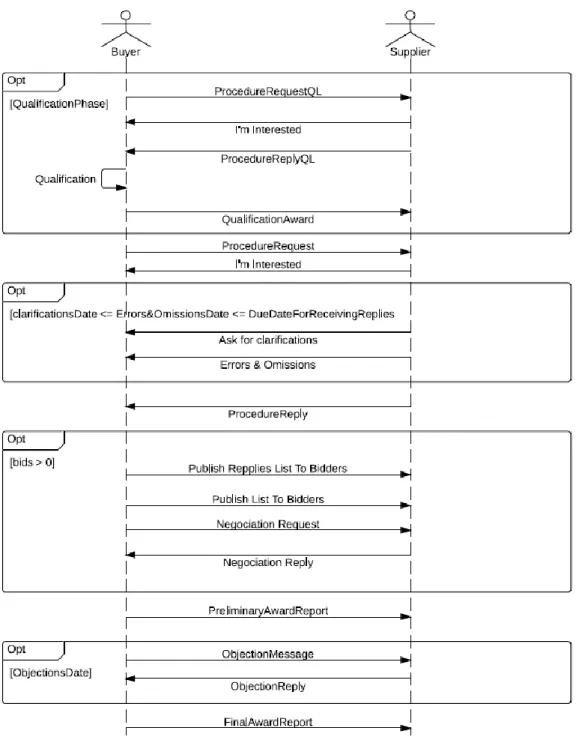
The Figure 4 - Portuguese Public Procedure Sequence Diagram depicts a sequence diagram capturing the events that may happen during the lifetime of a procedure, from the buyer’s and supplier’s perspective. It’s important to bear in mind that the diagram is intended to show the flow of messages exchanged between a buyer and a supplier. The setup of the procedure request, procedure reply, negotiation request, etc., isn’t contemplated in the diagram due to fact that those are platform specific operations. In order to get a view of platforms specific operations a full Vortal Next> procedure is presented in the section 1.3.2.
Figure 4 - Portuguese Public Procedure Sequence Diagram
Like it is shown on Figure 3 - Portuguese Public Proceduresa Portuguese Public Procedure may have a qualification phase (Prévia Qualificação and Por Negociação) in which a supplier is able to show interest and submit a qualification phase procedure reply where the supplier formally applies for approval to submit a bid on the proposal phase which in turn, exists on every Portuguese Public Procedure. The proposal phase starts with the launch of the Procedure Request by the buyer and then the suppliers, whether those selected in the qualification phase or simply every supplier the platform is able to reach, may submit interest and a formal Procedure Reply.
If there are bids placed by suppliers at the end of the previously specified deadline for submissions, a set of optional features are available to the buyer: Publication of replies list and/or list of bidders and a negotiation request. To finish the Procedure, the buyer must evaluate the bids and award them which means selecting the proposals that best fits the buyer’s needs. The award phase involves sending a preliminary award report, a final award report and there is a timeframe where the supplier may place objections and the buyer is obliged to reply.
1.3.2 Portuguese Public Procedures: A walk through Vortal Next>
In the last section the flow of messages that may happen between a buyer and supplier within a public procedure is presented. Now it’s time to dive right into a walk through Vortal Next> implementation of a Portuguese public procedure. For illustrative matters, the chosen procedure is Concurso Público.
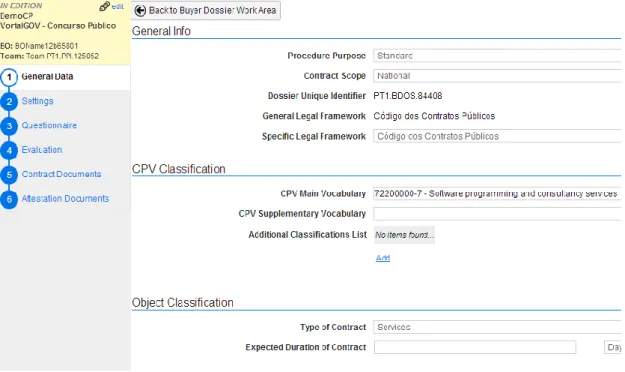
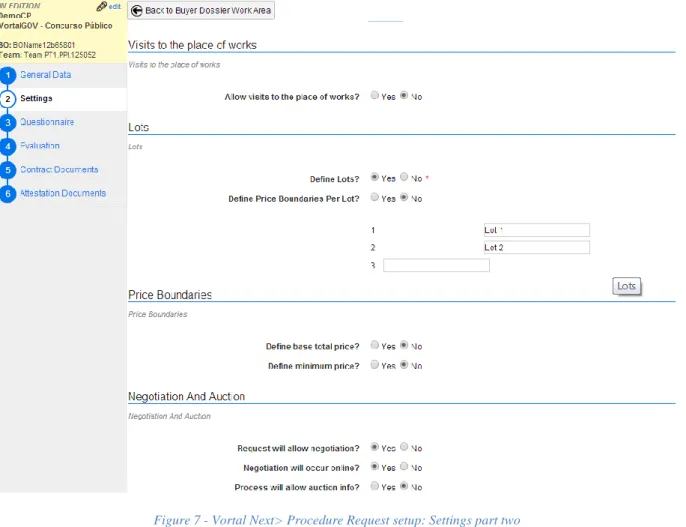
The purpose of the qualification phase is to determine which suppliers may be interested on the opportunity. So, when a qualification procedure request is launched by the buyers, the buyers can reply with a procedure reply and both, qualification procedure request and qualification procedure reply, are pretty much similar to the proposal phase procedure request and proposal phase procedure reply. The only difference is on the specification of the items, suppliers will be bidding for, and that is, on the qualification phase there isn’t a specification whereas on the proposal phase the items are fully specified. Based on the referred similarity, only the proposal phase is depicted here. In the FiguresFigure 5,Figure 6, Figure7 and Figure 8 the main steps of setting up a procedure request are depicted. These steps contain general procedure request data, the defined dates of important events on the procedure request lifecycle (e.g. Due date for receiving replies), whether the procedure has item lots and allows negotiation or not, and finally, detailed information on the items.
Figure 5 - Vortal Next> Procedure Request setup: General Data
Figure 7 - Vortal Next> Procedure Request setup: Settings part two
Figure 8 - Vortal Next> Procedure Request: Questionnaire
When a procedure request is launched, suppliers are able to submit a procedure reply until the due date for reception of replies, previously defined by the buyer in the procedure request. If the procedure has a qualification phase, all suppliers are able to submit a qualification procedure reply and after a proposal phase procedure reply, if they come out of the
qualification phase as qualified suppliers. The Figure 9 depicts the fundamental step on the set-up of a procedure reply, which is the proposal for items specified in the procedure request.
Figure 9 - Vortal Next> Procedure Reply: Questionnaire
So, after the due date for receiving replies, the buyer is supposed to have all procedure replies to further analyze which proposal best fits his needs. This analysis involves an awarding phase where the buyer is able to award by lot, as in award different lot items to different companies or even choose not to award all the lots. The fundamental step of setting up an award is shown in the Figure 10.
Figure 10- Vortal Next> Award
So, these are the fundamental steps about the lifecycle of a public procedure launched on Vortal Next>. Obviously the configuration of the operations associated with the setup of a procurement procedure is more extensive and it involves more details than the information depicted and discussed in this section. The idea here is to present a general functional
overview of how public procedures are implemented on Vortal Next>, instead of a comprehensive functional analysis of Vortal Next>.
1.3.3 Architectural Overview
Given the proper functional perspective, it’s time to take a look at a brief presentation of Vortal Next> architectural aspects. The platform was architecturally thought to attain high scalability and availability levels.
In the Figure 11, a system’s architecture general overview is depicted. It’s possible to observe that the platform is constituted by abstract components such as marketplaces, community and portals.
Figure 11- Vortal Next> Macro Architecture
The Vortal Next> platform is composed by two sub-platforms, the e-Marketplace and the Community. The first one, is designed to be an environment where the user can perform his procurement activities, like ordering, purchasing, etc. Since Vortal acts on several business areas then for each business area a virtualization of the E-Marketplace could be generated. The reference data such as profiles, preferences, identity, is all managed by the other sub-platform, Community. It also supports (in back-end) some of the activities performed on the E-marketplace, like authentication, registration, and has to ensure the interoperability between the several E-Marketplaces, acting like a connection hub.
Both sub-platforms, despite of providing different services, share some basic architectural concepts like delivering services based on web services, and both are subdivided in Front-End and Back-End.
The fact that the platforms have different objectives imply that the services available to the user are different, which in turn implies different architectures. The Figure 12 depicts the Community architecture.
Figure 12 - Community Architecture
As can be seen in Figure 12, the community provides its users four kinds of services:
Authentication Service to handle all authentication platform based on the methodology Claims Based Access Control;
Management service to provide management features on the Community's;
Support service to support activities associated with the Vortal E-Marketplace (interoperability, authorizations, identification, etc...);
Achieving service store all documentation associated with the activities occurring on the platform;
It can also be determined from Figure 12 that the architecture, generally, is divided into two sections. A section to address user interaction, called Front-End and another section to support this interaction, called Back-End. In the Front End reside all the services available to the user and they are delivered in ways: Web Services and Web Applications.
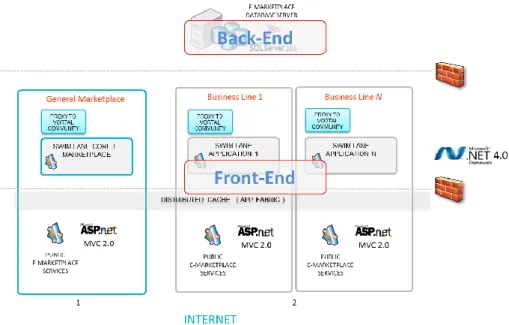
The Figure 13 the architecture of the Vortal E-Marketplace that follows some aspects of architecture of the Vortal Community, such as the division of architecture in Front-End and Back-End, as well as provide the user with the two forms of service, Web Services and Web Applications.
As can be seen in Figure 11, the E-Marketplace offers its users two kinds of services:
Management service to provide management features on the E-Marketplace itself;
Electronic procurement service to enable users to perform activities within the areas of e-Sourcing, e-Commerce and e-Procurement.
Figure 13 - E-Marketplace Architecture
1.4 Research Plan and benefits
In this chapter the E-Procurement/E-Tendering state of art is presented, including how Vortal and its platform, Vortal Next>, fits in the E-procurement/E-tendering market. So, given this context, the main question to be asked is, how could interoperability between e-procurement platforms be achieved?
With the mandatory move to full e-procurement by 2016, the appearance of new E-procurement/E-tendering platforms across the European Union, or at least more clients using the existing ones, it’s very likely to happen. It is perfectly safe to make this kind of
procedures in the European Union were being done electronically. [1] Thus, the European Union could be seen as a relatively huge market with a lot of solutions that wouldn’t talk with each other. This raises the question, which can be seen as an extension of the question introduced in the last paragraph, how to make a heterogeneous set of platforms communicate with each other?
One factor essential in order to attain interoperability between e-procurement applications is the use of e-commerce open standards such as cXML, PEPOOL or XVergabe, which are fully presented in the chapter 2. But if the objective is to connect all the platforms, situations may come where some platform uses cXML to communicate and another uses PEPOOL, for instance. This points out that there has to be an effort of integration and interoperability. Summing it up, this research tries to give answer to the following questions:
The European market of E-Procurement solutions is predictively getting bigger, with a growing set of E-Procurement platforms unable to communicate with each other. So, the main question this research project tries to address is… how can the E-Procurement interoperability problem be addressed?
How to create a structured intermediate language for a subset of e-procurement open standards?
How to set up the system in order to quickly and effectively add platforms and open standards?
1.5 How to read this dissertation
This research encompasses several areas of knowledge such as the concept of E-procurement/E-tendering, interoperability between E-Procurement platforms as well as the necessary open standards in order to attain the referred interoperability. Also, there is the need to come up with a common structured language to all those standards, hence a close look at structured domain languages is done. The application can be seen as a service provided electronically. It is connected to several e-procurement entities and the communication is made by documents specified with the open standards. As the scope of this research is mainly focused on interoperability with the Vortal platform through cXML, the connection with Vortal Next> is of special attention.
So, this dissertation can be roughly divided into two parts. The first part brings up the E-Procurement state of art, introduces the Vortal Next> and presents the concepts of interoperability, E-Procurement open standards and Domain Specific Languages. (Chapters 1, 2 and 3). In contrast with the first part, the second part is more of a practical approach. It starts with the introduction of the concrete product, named Driving E-Procurement, (chapter 1.1) and then a drill down into the design of the system core components (chapter 5). It ends with conclusions on the work developed on this research project and how this system can possibly evolve in the future done (chapter 0).
The following list summarizes the structure of the document:
Chapter 1. This chapter defines the concept of E-procurement, identifies its phases/tools and presents an historical overview of how e-procurement has evolved throughout the years, in the European Union context. It also introduces Vortal’s platform, Vortal Next>, by the means of a functional perspective (where a Portuguese Public Procedure life cycle in Vortal Next> is present) and an architectural overview where Vortal Next> macro components are briefly presented.
Chapter 2. This chapter starts off with a deep dive into the concept of interoperability. Conceptual definitions are presented along with the categorization of four interoperability levels: Machine, Syntactic, Semantic and Organizational. It also introduce three E-Procurement open standards: cXML, PEPPOL and XVergabe.
Chapter 3. This chapter presents important concepts related with structured languages. It starts with the Domain Specific Languages (DSL), its definition and how can cXML business documents can be seen as a DSL. Concepts on the general parsing process, such as syntactic and lexical analysis, are also presented.
Chapter 4. This chapter has the purpose of introducing the concrete product, named Driving E-Procurement. The main goal of Driving E-Procurement is presented and the issues it tries to address. A macro architecture of the system is also illustrated and then an introductory example of how the system is intended to behave.
Chapter 5. This chapter encompasses all the system’s design issues. It defines a mapping between cXML elements and Vortal Next> entities. This mapping is the core of the
Systems, how Driving E-Procurement can be seen as a Messaging System and how the typical Messaging concepts and design patterns can be applied on Driving E-Procurement design. In order to present a drill down of the system, the “4+1” view model approach is used. This approach uses UML diagrams to represent the views (Logical, Development, Process, Physical and Scenarios).
Chapter 0. The conclusions to be drawn of this research project. A final example of how the system behaves is made as well as some predictions on how the system can evolve in the future.
2.
I
NTEROPERABILITY
This section presents in detail the concept of interoperability. Firstly a generic approach at the concept is done, followed by a drill down onto e-procurement open standards, which are presented also. Three E-Procurement open standards are considered in this research project: cXML, PEPPOL and XVergabe. But why open standards should be considered on an E-Procurement platforms integration solution? This chapter tries to address this question and once it’s clear that E-Procurement open standards are of value when looking for interoperability between E-Procurement platforms, a comparison between the three referred standards is made.
2.1 A deep dive into interoperability
Interoperability is widely discussed topic in the software world and thus there are several definitions of interoperability.
The American Department of Defense defines interoperability as “the condition achieved among communications-electronics systems or items of communications-electronics equipment when information or services can be exchanged directly and satisfactorily between them and/or their users. The degree of interoperability should be defined when referring to specific cases”. [7]
The institute of Electrical and Electronics Engineers (IEEE) defines interoperability as “the ability of two or more systems or components to exchange information and to use the information that has been exchanged”. [7]
Yet another definition of the concept is proposed by the International Organization for Standardization/International Electrotechnical Commission (ISO/IEC) as “The capability to communicate, execute programs, or transfer data among various functional units in a manner that requires the user to have little or no knowledge of the unique characteristics of those units”. [7]
All the definitions presented are rather broad but they seem to converge to the same generic idea of entities sharing information and working together in order to achieve something. At
this point is important to make a clear distinction between data and information. While all the information is data, not all data is information. Is important to bear in mind this notion because two systems or component might able to agree upon data exchange but that doesn’t necessarily means they can do something useful with it.
Open Standards have been fundamental on achieving interoperability because they play a big role on achieving machine-to-machine interoperability. A good example is the web services standardization in which the World Wide Web Consortium (W3C), with the Simple Object Access Protocol (SOAP), Cascading Style Sheets (CSS), HyperText Markup Language (HTML), XML, and OASIS with Advanced Message Queuing Protocol (AMQP) and OData. For instance, the main objective of web services is to provide a standardized way in which systems are able to interoperate in loosely coupled way in order to complete complex operations. [8]
The referred examples can be categorized as machine-to-machine. This indicates that there are levels of interoperability. On [8] interoperability is categorized into four levels: Machine level, Syntactic level, Semantic level and Organizational level.
The Machine level interoperability guarantees mechanisms which allow exchange of date at the lowest level, typically hardware level. Nowadays, components such as compilers, virtual machines or operating systems provide abstractions enabling interoperability at machine level. Good examples of machine level interoperability are the transport layer protocols, Transmission Control Protocol (TPC/IP) and User Datagram Protocol (UDP) because of their ability to get users to communicate with each other, hiding from them the details of how the connection is made. [8]
Nowadays in the software development world is quite typical to find software systems of components implemented with several high level programming languages and running on different platforms. So, those system must be able to communicate with each other and thus have a common understanding of the format and structure of the data exchanged. A popular Syntactic interoperability enabler are the nowadays popular XML-based web services which allows systems developed in different languages/platforms to exchange data with each other. In this project a similar approach is followed in order to attain interoperability between E-Procurement/E-tendering platforms, where XML-based open standards (cXML, PEPPOL,
XVergabe) specifying business transactions related with the E-Procurement/E-Tendering domain are used. [8]
While at Syntactic interoperability level the format and structure of data exchange is of main concern, the Semantic interoperability level deals with the actual meaning of the data exchanged. Systems are able to successfully exchange data attaining interoperability at Machine and Syntactic levels, but when it comes to do something useful with it those two levels of interoperability might not be enough. Normally this fact imposes interacting systems to agree upon a common semantic model for the data being exchanged between them. For this matter Domain-Specific ontologies have been gaining some force (e.g. OWL, endorsed by the W3C). Accounting to [9], “an ontology is an explicit specification of some topic. For our purposes, it is a formal and declarative representation which includes the vocabulary (or names) for referring to the terms in that subject area and the logical statements that describe what the terms are, how they are related to each other, and how they can or cannot be related to each other. Therefore, Ontology provides a vocabulary for representing and communicating knowledge about some topic and a set of relationships that hold among the terms in that vocabulary”. [8] [9]
The fourth and final level is organizational interoperability level and also the most complex level. To get to this level, all other levels are required. When data is exchanged between, besides the ability to send, receive and understand data, there’s also the need to perform some actions on it, thus change the data. Those changes should be expected by the other interoperating systems, furthermore, those changes shouldn’t affect the normal behavior of those systems. As stated on [8], “... current technologies, standards, and tools support machine-to-machine transactions in the first two levels and to some extent in the third level. Achieving level 3 (Semantic Interoperability) often requires human interpretation of data, while level 4 (Organizational Interoperability) requires human-to-human interaction to ensure that actionable information is treated in a manner that is consistent with organizational processes of each interacting entity.”
In this section the concept of interoperability is explored alongside with the importance of open standards on the process. The following sections in this chapter are intended to provide a description of the open standards existing in the E-Procurement/E-Tendering domain.
2.2 Open Standards in E-Procurement
This section is an overview of the most important e-procurement open standards: cXML, PEPPOL and XVergabe. Before getting into details about these standards, it’s important to clarify what exactly means open standards in E-Procurement.
In the E-Procurement context, open standards allow the collaboration and integration required to conduct on-demand business. An on-demand business can be seen as an entity whose business processes are integrated across the organization and with key partners, suppliers and customers. This integration allows a flexible and fast response to the customer demands and market opportunities. [10]
According with [10], “Open Standards are published without restriction, freely available for adoption by the industry, controlled by and open industry organization and implemented by offerings available in the market. Open Standards and Open Sources enable open computing and interoperability. Open Computing permits interoperability by using published specifications for API’s protocols, data and file formats. These specifications must be published without restrictions that limit implementations… Open Standards are based on open architecture, a service-oriented (SOA) that underpins e-government programs. SOA enables flexible connectivity of applications or resources by representing every application or resource as a service with a standard interface and enabling them to exchange structured information. Developing and instituting open standards most often begins with a need such as a lack of operability or need to provide a customer with a technical solution. In response to this need, initiatives are undertaken by a core group which agrees to develop specific technical procedures to solve the initial need or problem. Once these specifications have been adopted and approved, and made available to the public, a standards boy can review these specifications and standardize these solutions across multiple vendors.”
From the definition presented above, it’s possible to conclude that open standards present themselves as a solution conceived by people trying to address a common interoperability problem on a given business area. This is exactly the purpose of cXML, PEPPOL and XVergave, open standards created with the sole purpose of being a fundamental part on the lack of E-Procurement interoperability.
2.2.1 cXML
The main focus of this research project is to attain interoperability between e-procurement platforms which implement business transactions through cXML. In other words, those platforms are able of send and receive cXML documents which specify business transactions. The cXML is a XML-based open standard and relies on the Request-Response (Synchronous) and One-Way (asynchronous) communication models and all cXML documents are specified accordingly with one of these standards. Both types of documents have a header element which contains addressing and authentication information about the parties involved in the transaction. In terms of document structure, the main difference between Request-Response and One-Way resides on what comes after the header element. Request-Response type of documents contain either a request or a response element, where the first specifies some kind of request (e.g. OrderRequest, ProfileRequest, PunchOutSetupRequest, etc.) and the second specifies the documents that can be sent in response to those requests, letting the requester know about the results of the transactions (e.g. ProfileResponse, PunchOutSetupResponse, GetPendingResponse, etc). One-Way type of documents only have a message element after the header. [11]
Presented an overview of the cXML document structure it’s time for a description of the core functionalities of cXML. They are:
Profile Transaction
PunchOut Transaction
Purchase Orders
Path Routing
Request for Quotations
Payment
TimeCard Transaction
Master Agreements
Invoices
Catalogs
The Profile Transaction is composed by the simple request-response pair of ProfileRequest/ProfileResponse. An entity may query another entity by ProfileRequest and a reply is given through ProfileResponse. While the ProfileRequest document has a very simple
structure, it only addresses the request, the ProfileResponse document contains a list of server supported transactions (e.g. PunchOutRequest, OrderRequest, SessionStatus, etc). [11]
The PunchOut is another request/response transaction. With PunchOut there isn’t the need for suppliers to display full static catalog files. Instead, clients may select buttons which in turn asks the supplier’s web service for the specific selected information. The pair PunchOutSetupRequest/PunchOutSetupResponse is responsible for setting up a PunchOut Session between the client (in the procurement application) and the supplier. At some point the client finishes selecting products and may want to buy something. Therefore, when the client checks-out, a PunchOutOrderMessage specifying the contents of the remote shopping basket is sent from the supplier to the client. The Figure 14 - PunchOut Transaction illustrates the described interaction.
Figure 14 - PunchOut Transaction [11]
Is also worth referring the PunchOutIndexcatalog and Direct PunchOut. The last is a faster way to initiate PunchOut sessions, giving clients the possibility directly access PunchOut supplier sites without going through other entities, such as commerce hubs, for authentication and routing. PunchOutIndexCatalogs are lists of PunchOut items. [11]
A purchase order is defined in the cXML user guide [11] as “a formal request from a buying organization to a supplier to fulfill a contract”. A buyer may send an OrderRequest document (through a procurement application) and the supplier reply with a generic response document. Those documents pass by a network commerce hub for authentication and routing.
The OrderRequest document contains an OrderRequestHeader element and one or more ItemOut elements which specifies the requested items in full detail. The Response document it’s a very simple and straightforward acknowledgment on the received OrderRequest document. [11]
The Path Routing it’s not a standalone business transaction like Purchase Orders, it is a cXML capability transversal to all cXML documents defined on the cXML user guide as “Path Routing enables documents to be routed by and copied to intermediary systems such as marketplaces and commerce network hubs.” A feature like Path Routing is needed when complex relationships between buyers and suppliers may happen. On these kind of scenarios a document might be routed through several intermediary systems before reaching the intended recipient. [11]
The cXML Request For Quotations is the business transaction which allows buyers to ask the suppliers for quotes on a given item or product. This cXML capability is the most import in the context of this project because it is the one that may allow Vortal Next> procedures to interoperate with cXML, but this is an issue to be addressed in the chapter 1.1, where the system’s intermediate language is fully detailed.
A buyer is able then of submit a request for quotations into a sourcing application through the quoteRequest document which in turn suppliers may reply with a quoteMessage document. A quoteRequest document contains details on the request sent by the buyer and it is composed by a quoteRequest and a QuoteItemOut elements. The quoteRequest contains generic information regarding the procedure (e.g. open and close dates for the suppliers to submit quotes, currency, etc), while the QuoteItemOut stores information on the items subject to quotation. Regarding the quoteMessage, it is composed by a quoteMessageHeader element, which stores information on the quote sent by the supplier to the buyer, and a QuoteItemIn which is the supplier side representation of the quoted items. It obviously includes the proposals for the items. [11]
The cXML payment functionality allows for automation of the payment process with schedule payment and remittance advice documents which allow business partners to track and progress payments. So, there are two main types of documents, PaymentProposalRequest and PaymentRemittance. The first is a scheduled payment and it allows buying organizations to specify payment due dates and discounts, while the second lists payment transaction details for a wide variety of business scenarios, including standard invoices, credit and debit memos. The TimeCard transaction is used for temporary labor orders and they can be generated and sent by the buyer or the supplier. There are two kinds of documents, TimeCardRequest, which
is sent from a supplier to a buyer and a TimeCardInfoRequest which is sent from a buyer to a supplier. [11]
A Master Agreement is a contract between trading partners and it is supported by cXML. So, Master Agreements allow buyers to set a commitment for good or services with suppliers. It is a mechanism to manage supplier and budget commitments, enabling buyers to negotiate discounts by basing those discounts on future purchases. On the other side, Master Agreements also allow suppliers to more accurately forecast demand. So, the MasterAgreementRequest document defines the Master Agreement created by the buyer. In this document beginning and end dates, minimum and maximum values of the agreement are specified. [11]
Regarding invoices, those are used by suppliers to bill buyers for provide products or services. The cXML possesses an InvoiceDetail transaction which supports cancel invoices, credit memos, line-item credit memos, debit memos, and receipts. It further describes purchase orders, line items, partners involved, accounting, distribution, payment terms, discounts, shipping and special handling, taxes, deposit, prepayment and remittance information. The InvoiceDetail transaction is represented on cXML through InvoiceDetailRequest documents which is replied with a generic response document. [11] Another cXML relevant aspect is the support it provides on security and authentication. Every cXML document contains a Header element whether it is of Request-Response or One-Way nature and the Header element wraps up authentication and addressing information. So, the Header element always contains the From, To and Sender elements. The From and To elements represent the initial and final recipients of the message being sent, while the Sender is used to represent intermediary nodes such as commerce hubs and it contains a Credential element which allows the receiving party to authenticate the sender. The Credential element is able to do authentication by either containing a SharedSecret or a CredentialMac elements. Basically the SharedSecret element is a password that both Sender and receiver recognize. The CredentialMac goes one step beyond encoding the SharedSecrets through a hash. The client (procurement application) uses a trusted third party (such as a commerce hub) to make the hash encoding and then the client is able to send direct requests to the receiving server. The cXML also supports digital signatures which are described in the cXML user guide as “Digital signatures confirm the identity of the sender of an electronic document, and ensure
that the document was not modified after it was generated by the signer. They consist of a series of bytes that contain cryptographic information, including the sender’s public key and detailed information about the contents of the document being signed.” [11]
2.2.2 PEPPOL
PEPPOL stands for Pan-European Public Procurement Online and it is a project founded by the European Commission and the PEPPOL consortium members. As described on PEPPOL official web site, “PEPPOL enables trading partners to exchange standards-based electronic documents over the PEPPOL network. PEPPOL is not an E-Procurement platform but instead provides a set of technical specifications that can be implemented in existing E-Procurement solutions and services to make them interoperable across Europe.” [12]
PEPPOL has three main components, its network or PEPPOL Transport Infrastructure, the document specifications or PEPPOL Business Interoperability Specifications – BIS and the legal framework defining the network governance. The network is accessible through access points which enables the exchange of standardized electronic documents which are PEPPOL BIS based. So, the suppliers have the freedom to engage to the Access Point provider they want and thereby send and receive electronic documents from and to any organization residing in the PEPPOL network through one single source. This network is supported by a transport infrastructure which is based on a set of standardized communication protocols ensuring a secure and reliable exchange of electronic documents between buyers and suppliers. The Figure 15 depicts the architecture of PEPPOL’s transport infrastructure. [12]
Figure 15 - Architecture of PEPPOL’s transport infrastructure [12]
Another important aspect regarding interoperability issues is the PEPPOL Business Documents (BIS) for E-Procurement processes, represented in the Figure 16 .
Figure 16 - PEPPOL Components [12]
As described on [12], “PEPPOL has developed the Business Interoperability Specifications (BIS) for common E-Procurement processes such as eCatalogue, eOrders, eDespatch Advices
and eInvoices to standardize electronic documents exchanged and validated through an open and secure network, between sending and receiving Access Points for public sector buyers and their suppliers across Europe.”
2.2.3 XVergabe
Xvergabe is a German E-Procurement/E-Tendering interoperability project. The very fundamental premise of XVergabe is that the high number of E-procurement/E-tendering platforms operating in the European Union might be a problem for economic operators (suppliers) because they must interact with many different platforms if they want to get to most opportunities. As it is stated on XVergabe White Paper, “The goal of XVergabe is to create a sustainable basis for electronic interoperability between EOs and CAs. The result of the project makes it possible that from one bid client an EO can access all compatible E-Tendering platforms. Instead of learning 330 platforms the EO has to learn only one. This will lead not only to a much higher satisfaction on the side of an EO but also on the buyer's side.” [13]
The Figure 17 depicts the basic XVergabe architecture which basically provides a notice interface and a bidder interface.
Figure 17 - XVergabe Architecture [13]
The XVergabe proxy basically translates notices between two formats (e.g. XVergabe format into TED format), while the bidder interface provides all the necessary process steps to enable full electronic communication. So, wrapping it up, the eNotice phase is covered by the Xvergabe interface whereas eSubscription, eAcess, eEnquiry, eSubmission and eAward phases are covered by the Xvergabe bidder interface. [13]
Let’s look at a use case scenario for a better understanding of how XVergabe works. For more technical information about Xvergabe, the reader should consult the XVergabe’s white paper [13]. So, the use case scenario is about how a user can subscribe for an open tendering procedure through XVergabe bidder interface. The use case is depicted in the Figure 18.
Figure 18 - Use Case Scenario [13]
As depicted on Figure 18, the user is able to call the subscribe service and the platform proceeds with the subscription registration. After a synchronization process between the user and the platform, the getMessages service is invoked and the proper messages regarding the subscribed tendering procedure are retrieved by the user. In this case, the messages are
containing, among other information, IDs of tendering documents. With those IDs, the user is able to call the getDocument service in order to download the proper documents on those IDs. [13]
2.2.4 A comparison of E-Procurement open standards
In Order to measure the adoption level of the previously introduced E-Procurement Open Standards, the number of google search results and the page rank algorithm classification of their official web sites were used. The Table 1 shows the google search results and page rank of each Open Standard web site.
Table 1 - Comparison of E-Procurement Open Standards
As shown in Table 1, XVergabe is the Open Standard presenting the lowest results of internet generated traffic. Also, it is a German E-Procurement Open Standard and all existing documentation (except the XVergabe Whitepaper [13], which is in English) is written in German. Hence, XVergabe is the last option to be considered for this research project.
Having discarded XVergabe, the remaining options are cXML and PEPPOL. In terms of google search results, the advantage is clearly on cXML’s side, whereas in terms of page rank, PEPPOL has a slightly better result. Given these results and Vortal’s belief that cXML will be a big player on the market, cXML is the chosen E-Procurement Open Standard for this research project.
Figure 19 - cXML page rank
3. S
TRUCTURED
L
ANGUAGE
3.1 Domain Specific Languages
Domain Specific Languages, or simply DSLs, are defined by Martin Fowler in [13] as “a computer programming language of limited expressiveness focused on a particular domain.” Another definition presented on [14] describes DSLs as “languages tailored to a specific application domain. They offer substantial gains in expressiveness and ease of use compared with general-purpose languages in their domain of application.” So, from these definitions is clear that DSLs are applied to specific domains, contrasting with the typical General Purpose Languages (e.g. Java, C, etc.) which can be used across domains. Basically, this is its main characteristic, but the concept of DSL is further characterized as follows:
Computer programming language: A DSL is used by humans to instruct a computer to do
something. As with any modern programming language, its structure is designed to make it easy for humans to understand, but it should still be something executable by a computer. [14]
Language nature: A DSL is a programming language, and as such should have a sense of
fluency where the expressiveness comes not just from individual expressions but also from the way they can by composed together. [14]
Limited expressiveness: “A general-purpose programming language provides lots of
capabilities: supporting varied data, control, and abstraction structures. All of this is useful but makes it harder to learn and use. A DSL supports a bare minimum of features needed to support its domain. You can't build an entire software system in a DSL; rather, you use a DSL for one particular aspect of a system.” [14]
Domain focus: “A limited language is only useful if it has a clear focus on a small domain.
The domain focus is what makes a limited language worthwhile.” [14]
Martin Fowler also divides DSLs into categories: External DSLs and Internal DSLs. Internal DSLs are written with a subset of a general-purpose language syntax, in which the application is written in, while external DSLs are written on a different language. Both DSLs types aim to handle one small aspect of the overall system. [14]
![Figure 1 - E-procurement landscape in Europe [3]](https://thumb-eu.123doks.com/thumbv2/123dok_br/17697823.828125/22.892.114.783.582.1079/figure-procurement-landscape-in-europe.webp)
![Figure 2 - Set of phases possible of being implemented in E-Procurement. [2]](https://thumb-eu.123doks.com/thumbv2/123dok_br/17697823.828125/24.892.137.747.220.772/figure-set-phases-possible-implemented-e-procurement.webp)


![Figure 15 - Architecture of PEPPOL’s transport infrastructure [12]](https://thumb-eu.123doks.com/thumbv2/123dok_br/17697823.828125/48.892.176.720.109.514/figure-architecture-peppol-s-transport-infrastructure.webp)
![Figure 17 - XVergabe Architecture [13]](https://thumb-eu.123doks.com/thumbv2/123dok_br/17697823.828125/50.892.107.788.451.940/figure-xvergabe-architecture.webp)