The Open Access Israeli Journal of Aquaculture – Bamidgeh
As from January 2010 The Israeli Journal of Aquaculture - Bamidgeh (IJA) will be
published exclusively as an on-line Open Access (OA) quarterly accessible by all
AquacultureHub (
http://www.aquaculturehub.org
) members and registered individuals
and institutions.
Please visit our website (
http://siamb.org.il
) for free registration form,
further information and instructions.
This transformation from a subscription printed version to an on-line OA journal,
aims at supporting the concept that scientific peer-reviewed publications should be made
available to all, including those with limited resources. The OA IJA does not enforce author
or subscription fees and will endeavor to obtain alternative sources of income to support
this policy for as long as possible.
Editor-in-Chief
Dan Mires
Editorial Board
Sheenan Harpaz
Agricultural Research OrganizationBeit Dagan, Israel
Zvi Yaron
Dept. of ZoologyTel Aviv University Tel Aviv, Israel
Angelo Colorni
National Center for Mariculture, IOLREilat, Israel
Rina Chakrabarti
Aqua Research LabDept. of Zoology University of Delhi
Ingrid Lupatsch
Swansea UniversitySingleton Park, Swansea, UK
Jaap van Rijn
The Hebrew UniversityFaculty of Agriculture Israel
Spencer Malecha
Dept. of Human Nutrition, Foodand Animal Sciences University of Hawaii
Daniel Golani
The Hebrew University of JerusalemJerusalem, Israel
Emilio Tibaldi
Udine UniversityUdine, Italy
Copy Editor
Ellen Rosenberg
Published under auspices of
The Society of Israeli Aquaculture and
Marine Biotechnology (SIAMB),
University of Hawaii at Manoa Library
and
University of Hawaii Aquaculture
Program in association with
AquacultureHub
http://www.aquaculturehub.org
ISSN 0792 - 156X
Israeli Journal of Aquaculture - BAMIGDEH.
PUBLISHER:
Israeli Journal of Aquaculture BAMIGDEH
-Kibbutz Ein Hamifratz, Mobile Post 25210,
ISRAEL
Phone: + 972 52 3965809
EFFECTS OF PRE-WEANING FEEDING FREQUENCY ON
GROWTH, SURVIVAL, AND DEFORMATION OF
SENEGALESE SOLE, SOLEA SENEGALENSIS (KAUP, 1858)
Sofia Engrola*, Luis E.C. Conceição, Paulo J. Gavaia, M. Leonor Cancelaand Maria T. Dinis
CCMAR, Universidade do Algarve, Campus de Gambelas, 8005-139 Faro, Portugal
(Received 10.7.04, Accepted 29.8.04)
Key words: feeding frequency, growth, malformations, Senegalese sole, survival
Abstract
Despite much interest in the production of Senegalese sole (Solea senegalensis) in southern Europe, weaning of this species onto artificial diets is problematic and varying results are obtained. The aim of this study was to test two feeding frequencies during a 13-day pre-wean-ing period and assess their impact on the growth and survival of Senegalese sole. Postlarvae were fed Artemia metanauplii with a peristaltic pump every hour for 12 hours per day or twice daily (morning and late afternoon). Both groups were suddenly weaned onto a commercial diet for an additional 30 days. At the end of the experiment, the relative growth rate and final dry weight were significantly higher and the survival significantly lower in the 12-hour treatment than in the twice-daily treatment. The feeding frequency had no effect on condition factor. The inci-dence of deformities was about 80% in both treatments.
Introduction
It is generally believed that a high feeding fre-quency maximizes growth in fish juveniles and larvae (e.g., Haylor, 1993), especially in pre-weaning stages when postlarvae are usu-ally fed Artemia metanauplii exclusively
(Houde, 1989; Conceição et al., 1997). Growth rates vary greatly and in many cases appear to be limited by food availability, as in Arctic charr (Miglavs and Jobling, 1989) and flounder (Lee et al., 2000). Animals compete * Corresponding author. Tel.: +351-289-800900; fax: +351-289-818353; e-mail: [email protected]
11
intraspecifically for resources and it is gener-ally assumed that more competitive individu-als with a higher feeding rank have higher growth rates (Damsgård et al., 1997). Commercial hatcheries that produce marine fish generally supply food to postlarvae sever-al times during the day or even continuously. This procedure may enhance the growth rate and decrease size variation, helping to short-en the time required to reach market size. More frequent meals reduce size dispersion in several species such as whitefish, Coregonus lavaretus (Koskela et al., 1997), and green-back flounder, Rhombosolea tapirina (Chen and Purser, 2001).
Skeletal abnormalities are a serious eco-nomic problem in aquaculture as they affect fish appearance and survival, reducing market value (Koumoundouros et al., 1997a). Nutritional factors have been indicated as possible causes for alterations in the normal development of skeletal structures that lead to abnormalities in adult fish (Takeuchi et al., 1995; Gapasin and Duray, 2001).
Studies of husbandry techniques in flatfish show that feeding amounts, frequencies, and durations significantly impact growth and homogeneity (Carter et al., 1996; Shelverton and Carter, 1998; Verbeeten et al., 1999; Chen and Purser, 2001). Senegalese sole (Solea senegalensis) postlarvae differ from other species not only because they settle on tank bottoms well before weaning but also because they display peculiar feeding behav-ior; settled Senegalese sole do not react read-ily to supplied food and prefer grazing on Artemia or dry diets from tank bottoms (Dinis et al., 2000).
Despite the high potential of Senegalese sole as an aquaculture species, only a few studies relate to larvae rearing conditions (Esteban et al., 1995; Dinis et al., 1999) and weaning periods (Marin-Magan et al., 1995; Cañavate and Fernández-Díaz, 1999). The aim of this study was to test two feeding fre-quencies with the same quantity of the same food during a 13-day pre-weaning period and assess the impact of feeding frequency on weaning success and postlarvae quality in Senegalese sole, S. senegalensis.
Materials and Methods
Fish and rearing. Senegalese sole larvae were reared until the beginning of the experi-mental period as described by Dinis et al. (1999). Newly hatched larvae were reared in a 200-l cylindro-conical tank in a closed recircu-lating system at a density of 100 larvae per liter. Larvae were fed rotifers (Brachionus rotundiformis) enriched with microalgae, Isochrysis galbana and Tetraselmis chuii, three days after hatching. At five days, Artemia sp. nauplii (Be 480 strain, INVE Aquaculture) were added to the diet. Rotifers were gradually reduced until day 8. After 10 days, Artemia metanauplii enriched with I. galbana and T. chuii were provided.
At 20 days, postlarvae were transferred to six 50-l white flat-bottom plastic tanks (surface area 0.5 m2) in a closed recirculating system
of 3000-l at 3000 individuals/m2. Artemia
metanauplii (RH strain, INVE Aquaculture) enriched with Super SELCO (INVE Aquaculture) were supplied to the postlarvae.
Environmental parameters were mea-sured daily. Temperature and salinity aver-aged 20.9±0.6°C and 32.0±1.0‰, respective-ly. Dissolved oxygen was around 6.45±0.7 mg/l. A photoperiod of 12h light:12h dark was produced by overhead fluorescent tubes.
Tanks were cleaned and dead fish were removed and counted daily.
Food and feeding regime. The pre-wean-ing period started 26 days after hatchpre-wean-ing to avoid possible stress effects due to transfer from the cylindro-conical tanks to the flat-bot-tom tanks and ensure that fish were eating normally. Treatments were randomly assigned to the tanks, with three replicate tanks per treatment. In the pulse treatment, postlarvae were fed Artemia metanauplii by peristaltic pump every hour for twelve hours per day. In the second treatment, two meals were provided (morning and late afternoon). Both treatments received the same daily ration per fish. Between days 30 and 37, the metanauplii supply was gradually changed from live to frozen until, on days 37 and 38, postlarvae were fed frozen metanauplii exclu-sively. The postlarvae were weaned on day 40, after a one-day fast, and given AgloNorse Effects of pre-weaning feeding frequency on weaning of sole
no. 2 (0.6-1.0 mm) until day 63 and AgloNorse no. 3 (1.0-1.6 mm) afterward. The experiment ended on day 69. In both treatments, the inert diet was supplied by automatic feeders every hour for 18 hours a day. Throughout the experiment, it was attempted to feed close to satiation, based on the predicted maximum growth. Daily adjustments were based on visual inspection (to avoid excess uneaten food).
Sampling. At the end of the pre-weaning period, samples of twenty 40-day postlarvae were taken from each tank (60 postlarvae per treatment). At the end of the experiment, thir-ty 69-day postlarvae were sampled from each tank (90 postlarvae per treatment). The post-larvae were measured (total length) and kept frozen at -80ºC for dry weight determination. On day 69, samples taken for skeleton evalu-ation were fixed overnight in 4% formalde-hyde buffered to pH 7.4 with PBS.
Fish were counted at the end of the wean-ing period to determine survival.
Skeleton evaluation. Specimens for skele-ton evaluation were submitted to a double staining procedure using Alcian Blue 8GX to stain cartilage and Alizarin red S to stain bone, according to the procedure described in Gavaia et al. (2000). Specimens were pre-served in glycerol until observation. Structural development was determined on the axial skeleton based on Gavaia et al. (2002) and eye migration was determined.
Data analysis. Relative growth rate (RGR, %/day) at the end of the experiment was cal-culated by the formula: (e(g)-1) x 100 where g
= (lnfinal wt- lninitial wt)/(time) and e = Napier's
constant (2.71). The coefficient of variation (CV) was determined as: (treatment standard deviation/treatment mean) x 100 to determine inter-individual weight and length variation among fish in the same treatment at the end of both periods. Food conversion ratio (FCR) was determined as: feed supplied to the tank/(final wt - initial wt) x number of fish per tank, where the proportion of food wasted (e.g., flushed out or dissolved) was considered negligible. The condition factor (K) was calcu-lated as: (fish wt/total length3) x 100. Data are
presented as arithmetic means with standard
deviations. One-way ANOVA was used to test differences between treatments. Differences were considered significant when p<0.05. When significant differences were found, Tukey’s Honest Significant Difference (HSD) test was used to determine if the treatments differed significantly at p<0.05. All statistical analyses were carried out using the Statistica 5.1 and SigmaPlot packages software.
Results
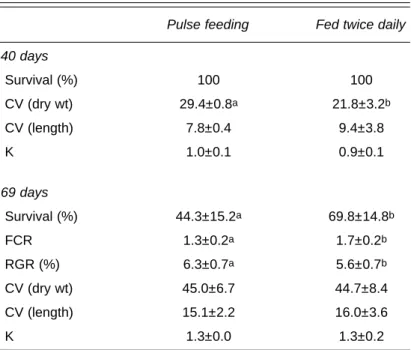
Growth performance and survival. The mean dry weight at the end of the pre-weaning peri-od (40 days) did not significantly differ between treatments and was 13.7±4.0 mg in pulse-fed fish and 13.9±3.0 mg in fish fed twice daily. At the end of the experiment (69 days), however, postlarvae from the pulse feeding regime were significantly larger (76.2±2.1 mg) than those fed twice daily (64.1±7.7 mg). Accordingly, the relative growth rate at 69 days was significantly high-er in the pulse feeding treatment than in the daily treatment (Table 1). The twice-daily feeding frequency significantly increased survival and the food conversion ratio at 69 days, while there was no significant difference between treatments in condition factor. The coefficient of variation of weight in the fish fed twice a day was significantly lower than for the pulse-fed fish at 40 days, but there was no significant difference at 69. These results are visible in the distribution of fish weights (Fig. 2). There was no significant difference in the coefficient of variation of length at either 40 or 69 days.
Skeletal evaluation. The most common deformities on caudal and pleural vertebra were the fusion and compression of vertebral centra, affecting adjacent neural arches and spines, however parapophysis was rare. The preural vertebrae 1-4 that contribute to the caudal fin internal skeleton were commonly fused or deformed, in some cases with an absence of neural or hemal arches. In the hypuralia, only hypurals 1-5 and the parhypur-al were affected. Abnormparhypur-ality in the hypurparhypur-alia usually involved fusion of hypurals 1-2 or hypurals 3-5 and, sometimes, absence of any of these structures. The caudal, dorsal, and
13
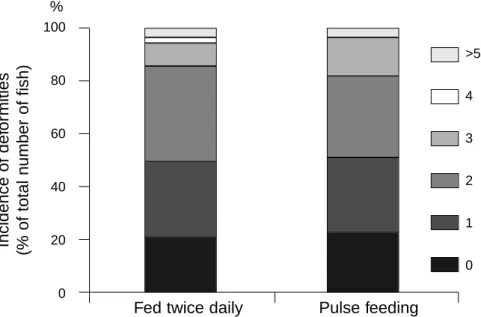
anal fins were rarely affected, with only minor malformations of pterigophores and rays that were either shortened or abnormally bent. Cases of abnormal eye migration (uncomplet-ed or no migration) were rare. There was no significant difference between treatments in number of skeletal abnormalities (Fig. 2), however the number of fish considered nor-mal was low (~20%) in both treatments. In both treatments, some 60% of the fish had one or two deformities while fish with more than two deformities were less common.
Analysis of double stained speci-mens showed that the most affected struc-tures were the caudal vertebra, adjacent arch-es, and spines. There were no significant dif-ferences in abnormalities between treat-ments, with the exception of the neural and hemal spines (Fig. 3). The number of deformed pleural vertebrae 1-4 was
compara-ble to the neighboring area, presenting fusions between vertebral centra and malfor-mations in the adjacent arches and spines.
Discussion
At the end of the pre-weaning period, the dry weight of the postlarvae was the same in both treatments and higher than values reported earlier (Cañavate and Fernández-Díaz, 1999). However, there was a significant differ-ence in the coefficient of variation of the weight. The pulse-fed postlarvae had a greater weight distribution than those fed twice daily. A high coefficient of variation in fish may lead to aggressive behavior and/or reduced availability of food to less competitive animals (Jobling and Wandsvik, 1983). Despite the absence of apparent aggressive behavior in our study, the high coefficient of variation suggests that a feeding hierarchy Effects of pre-weaning feeding frequency on weaning of sole
Pulse feeding Fed twice daily 40 days Survival (%) 100 100 CV (dry wt) 29.4±0.8a 21.8±3.2b CV (length) 7.8±0.4 9.4±3.8 K 1.0±0.1 0.9±0.1 69 days Survival (%) 44.3±15.2a 69.8±14.8b FCR 1.3±0.2a 1.7±0.2b RGR (%) 6.3±0.7a 5.6±0.7b CV (dry wt) 45.0±6.7 44.7±8.4 CV (length) 15.1±2.2 16.0±3.6 K 1.3±0.0 1.3±0.2
Table 1. Survival, coefficient of variation (CV) for weight and length, condition factor (K), food conversion ratio (FCR), and relative growth rate (RGR) of Senegalese sole at weaning (40 days) and at the end of the experiment (69 days).
Fig. 1. Distribution of fish weight (n = 90) by treatment at the end of the experiment (69 days). <20 20-40 40-60 60-80 80-100 100-120 120-140 140-160 >160 <20 20-40 40-60 60-80 80-100 100-120 120-140 140-160 >160 <20 20-40 40-60 60-80 80-100 100-120 120-140 140-160 >160 32 28 24 20 16 12 8 4 0
F
requency (%)
Fed twice daily
Pulse feeding
Incidence of def
or
mities
(% of total n
umber of fish)
Fed twice daily
Pulse feeding
>5 4 3 2 1 0 100 80 60 40 20 0
%
15 Effects of pre-weaning feeding frequency on weaning of sole
Number of deformities
Aff
ected str
ucture
F
ed twice daily
Pulse F
eeding
Eye migration Anal fin Dorsal fin Caudal rays Parhypural Hypural 3-5 Hypural 1-2 Preural vertebrae 1-4 Parapophysis Hemal spines Neural spines Hemal arch Neural arch Caudal vertebrae Pleural vertebrae 16 14 12 10 8 6 4 2 0may have existed. It is unlikely that a lack of food availability caused the high coefficient of variation since the fish were fed in slight excess. The smallest fish in the pulse treat-ment were probably those that died during the weaning period, suggesting that they may have been under some sort of stress, nutri-tional or other, as suggested by Jobling (1982). Experiments with turbot indicate that larger juveniles cause stress to smaller fish, preventing them from obtaining a normal feed intake (Carter et al., 1996).
At the end of the experiment, survival rates were high compared to those in other studies (Cañavate and Fernández-Díaz, 1999). The high survival rates were possibly a result of different rearing and weaning tech-niques. At the end of our pre-weaning period, postlarvae were larger and suddenly weaned instead of fed both commercial feed and A. metanauplii as in Cañavate and Fernández-Díaz (1999). The pulse-fed sole had signifi-cantly lower survival than the twice-daily sole, but significantly better growth and food con-version. During feedings, Senegalese sole usually respond passively, similar to Arctic charr (Linnér and Brännäs, 2001). In these two species growth results were similar: fish fed more frequently grew better. Size-selec-tive mortality in the pulse treatment may part-ly explain the absence of a difference in coef-ficient of variation for weight at the end of the experiment, in contrast to the end of the pre-weaning period.
The total number of individuals with skele-tal abnormalities in both groups (~80%) was much higher than the 44% obtained for the same structures in postlarvae and juveniles in earlier studies (Gavaia et al., 2002). One explanation for the differences between stud-ies may be different feeding regimes. In Gavaia et al. (2002), no rotifers were offered as first feeds and A. metanauplii were enriched only with microalgae. Similar figures and variability were obtained for Paralichtys olivaceus seedlings where 30-60% had mal-formations in the caudal complex (Hosoya and Kawamura, 1998). In Sparus aurata, the num-ber of hatchery reared individuals with deformed caudal complex and vertebral
col-umn can reach 100% (Boglione et al., 2001). Although a high number of skeletal abnormali-ties were observed in our study, survival was comparable to previous studies of this species (own unpubl. results). Earlier studies suggest that malformations are induced in the early embryonic and larval stages, although the causes and mechanisms are not well under-stood (Koumoundouros et al., 1997b). Most axial skeleton structures appear, and probably acquire deformities, prior to and during meta-morphosis (around 10-18 days after hatching). Therefore, differences due to dietary treatment would not be expected. The absence of signif-icant differences between treatments in fre-quency of abnormalities indicates that skeletal abnormalities do not interact with pre-weaning feeding frequency to define selective mortality during the subsequent period.
In summary, the present study indicates that pre-weaning feeding frequency affects weaning performance in Senegalese sole. Pulse feeding produces fewer but larger fish while feeding twice daily leads to smaller fish with a higher survival rate. This suggests that mortality during weaning is selective (higher amongst smaller fish) under a pulse feeding regime but is unaffected by skeletal abnor-malities.
References
Boglione C., Gagliardi F., Scardi M. and S. Cataudella, 2001. Skeletal descriptors and quality assessment in larvae and postlarvae of wild-caught and hatchery-reared gilthead sea bream (Sparus aurata L. 1758). Aquaculture, 192:1-22.
Cañavate J.P. and C. Fernández-Díaz, 1999. Influence of co-feeding larvae with live and inert diets on weaning the sole Solea senegalensis onto commercial dry feeds. Aquaculture, 174:255-263.
Carter C.G., Purser G.J., Houlihan D.F. and P. Thomas, 1996. The effect of decreased ration on feeding hierarchies in groups of greenback flounder (Rhombosolea tapirina: Teleostei). J. Mar. Biol. Assoc. UK, 76:505-516.
Chen W.-M. and G.J. Purser, 2001. The effect of feeding regime on growth, locomotor
17
activity pattern and the development of food anticipatory activity in greenback flounder. J. Fish Biol., 58:177-187.
Conceição L.E.C., Houlihan D. and J. Verreth, 1997. Fast growth, protein turnover and costs of protein metabolism in yolk-sac larvae of the African catfish (Clarias gariepi-nus). Fish Physiol. Biochem., 16:291-302. Damsgård B., Arnesen A.M., Baardvik B.M. and M. Jobling, 1997. State-dependent feed acquisition among two strains of hatchery-reared Artic charr. J. Fish Biol., 50:859-869. Dinis M.T., Ribeiro L., Soares F. and M.C. Sarasquete, 1999. A review on the cultivation potential of Solea senegalensis in Spain and Portugal. Aquaculture, 176:27-38.
Dinis M.T., Ribeiro L., Conceição L.E.C. and C. Aragão, 2000. Larvae digestion and new weaning experiments in Solea sene-galensis. pp. 193-204. In: Recent Advances in Mediterranean Aquaculture. Finfish Species Diversification. CIHEAM/FAO, Vol. 47, CIHEAM/FAO, Zaragoza.
Esteban J.C., Calderon J.A., Carrascosa M. and F. Pecci, 1995. Cria larvaria, destete y preengorde del lenguado (Solea senegalen-sis) realizado en el departamento de cultivos marinos del IES Sancti-Petri. pp. 426-431. In: F. Castelló i Orvay, A. Calderer i Reig (eds.). V Congresso Nacional de Acuicultura. Universitat de Barcelona, Sant Carles de la Ràpita, May10-13.
Gapasin R.S.J. and M.N. Duray, 2001. Effects of DHA-enriched live food on growth, survival and incidence of opercular deformi-ties in milkfish (Chanos chanos). Aquaculture, 193:49-63.
Gavaia P.J., Sarasquete M.C. and M.L. Cancela, 2000. Detection of mineralized structures in early stages of development of marine Teleostei using a modified Alcian blue-Alizarin red double staining technique for bone and cartilage. Biotech. Histochem., 75: 79-84.
Gavaia P.J., Dinis M.T. and M.L. Cancela, 2002. Osteological development and abnor-malities of the vertebral column and caudal skeleton in larval and juvenile stages of hatch-ery-reared Senegal sole (Solea senegalen-sis). Aquaculture, 211:305-323.
Haylor G.S., 1993. Controlled hatchery pro-duction of Clarias gariepinus (Burchell 1822): an estimate of maximum daily feed intake of C. gariepinus larvae. Aquacult. Fish. Manage. 24:473-482.
Hosoya K. and G. Kawamura, 1998. Skeletal formation and abnormalities in the caudal complex of the Japanese flounder, Paralichthys olivaceus (Temminck and Schlegel). Bull. Natl. Res. Inst. Fish. Sci., 12: 97-110.
Houde E.D., 1989. Comparative growth, mor-tality, and energetics of marine fish larvae: temperature and implied latitudinal effects. Fish. Bull. US, 87:471-495.
Jobling M., 1982. Some observations on the effects of feeding frequency on food intake and growth of plaice, Pleuronectes platessa. J. Fish Biol., 20:431-444.
Jobling M. and A. Wandsvik, 1983. Effect of social interactions on growth rates and con-version efficiency of Artic charr, Salvelinus alpinus L. J. Fish Biol., 22:577-584.
Koskela J., Jobling M. and J. Pirhomen, 1997. Influence of the length of the daily feed-ing period on feed intake and growth of white-fish, Coregonus lavaretus. Aquaculture, 156: 35-44.
Koumoundouros G., Oran G., Divanach P., Stefanakis S. and M. Kentouri, 1997a. The opercular complex deformity in intensive gilt-head sea bream (Sparus aurata L.) larvicul-ture. Moment of apparition and description. Aquaculture, 156:165-177.
Koumoundouros G., Gagliardic F., Divanach P., Boglione C., Cataudellad S. and M. Kentouri, 1997b. Normal and abnor-mal osteological development of caudal fin in Sparus aurata L. fry. Aquaculture, 149:215-226.
Lee S.-M., Cho S.H. and D.-J. Kim, 2000. Effects of feeding frequency and dietary ener-gy level on growth and body composition of juvenile flounder, Paralichthys olivaceus (Temminck & Schlegel). Aquacult. Res., 31: 917-921.
Linnér J. and E. Brännäs, 2001. Growth in Artic charr and rainbow trout fed temporally concentrated or spaced meals. Aquacult. Int., 9:35-44.
Marin-Magan V., Anguis V. and J.P. Canavete, 1995. Uso de alimento inerte en lar-vas y alevines del lenguado Solea senegalen-sis. pp. 432-436. In: F. Castelló i Orvay, A. Calderer i Reig (eds.). V Congresso Nacional de Acuicultura. Universitat de Barcelona, Sant Carles de la Ràpita, May10-13.
Miglavs I. and M. Jobling, 1989. Effects of feeding regime on food consumption, growth rates and tissue nucleic acids in juvenile Artic Charr, Salvelinus alpinus, with particular respect to compensatory growth. J. Fish Biol., 34:947-957.
Shelverton P.A. and C.G. Carter, 1998. The effect of ration on behaviour, food
consump-tion and growth in juvenile greenback flounder (Rhombosolea tapirina:Teleostei). J. Mar. Biol. Assoc. UK, 78:1307-1320.
Takeuchi T., Dedi J., Ebisawa C., Watanabe T., Seikai T., Hosoya K. and J.I. Nakazone, 1995. The effect of beta-carotene and vitamin A enriched Artemia nauplii on the malforma-tion and color abnormality of larval Japanese flounder. Fish. Sci., 61:141-148.
Verbeeten B.E., Carter C.G. and G.J. Purser, 1999. The combined effect of feeding time and ration on growth performance and nitrogen metabolism of greenback flounder. J. Fish Biol., 55:1328-1343.