Knowledge and attitudes development through didactic competitions:
Spaghetti Bridge Contest at UBI
Pedro Dinis Gaspar
1,a,*, Anna D. Guerman
1,b, Paulo Fael
1,c, and Carlos
Fernandes
1,d1
University of Beira Interior, Department of Electromechanical Engineering, Calcada Fonte do Lameiro – Edifício 1 das Engenharias, 6201-001 Covilhã, Portugal
a
[email protected], [email protected], [email protected], [email protected] *Corresponding author
Keywords: Applied Mechanics, Education, Knowledge, Attitude, Contest, Spaghetti bridge.
Abstract. The main objective of the Spaghetti Bridge Contest promoted by the Department of Electromechanical Engineering of the University of Beira Interior (Portugal) is to encourage the creative capacities of students and improve their attitudes towards learning. The knowledge acquired in the Applied Mechanics course is applied in the project of a bridge built with such a common material as spaghetti. This annual event aims to increase the students' interest in research providing ingenious solutions to problem. Up to date, the contest had twelve editions; it is precursor in Portugal of similar events organized by other institutions of Higher, Secondary and Basic education levels. This paper presents the evolution of the event since its origin, regarding both the solutions found by students to consecutively beat the resistance records, and the motivation in participating in such a didactic contest devoted to engineering education.
1. Introduction
The integration of Portuguese higher education system in the international framework created by the Bologna agreement implies an increase of the teaching effectiveness. The three years duration of the undergraduate course, when compared to five years in pre-Bologna structure, results in a higher concentration of syllabus in various subjects. The greatest impact is felt in the first year courses, since they lose its introductory nature and become more intensive. On the other hand, these changes should not lead to a loss of education quality.
In parallel, the engineering faculties in Portuguese universities face today a general vocations crisis. Apart from the decrease of the total number of applicants to higher education institutions in the developed countries, the candidates sometimes avoid the engineering courses due to the apparent difficulty that today is associated with mathematics and physics. Besides, one can notice the lack of interesting didactic projects in engineering with which the students can identify themselves. So, there is a greater need to motivate, stimulate and encourage students of various education levels to pursuit engineering studies. Related to this purpose, there is also the need to provide practical and didactic examples of the concepts learned by the students [1-7]. To this end, we used a creative pedagogical practice that consists in a didactic contest for the design and construction of simple truss structures, as a supplement to classroom and individual studies.
2. Applied Mechanics subject
The Spaghetti Bridge Contest aims fundamentally at the application of knowledge, mainly that included in the syllabus of the Applied Mechanics course unit at the University of Beira Interior (UBI) –Portugal. This syllabus contains topics related to the design of truss structures. However, within the framework of this contest, other course units contribute to this purpose. Part of the syllabus of the Materials Science course unit is devoted to mechanical properties of materials, so, experimental tests and theoretical calculation can be exemplified with the properties of spaghetti, in order to start immediately in the 1st year of 1st cycle course in Electromechanical Engineering and 1st year of the integrated Master in Sciences in Aeronautical Engineering, to arouse students' interest in this extracurricular activity. Meanwhile, given the enthusiasm triggered by the contest in the academic community, students from several courses tend to participate, having or not course units with some affinity to those described above. The podium is contested by students from different courses, from Civil Engineering students, passing by Industrial Design students, and even to students of Biomedical Sciences and Pharmaceutical Sciences.
3. Spaghetti Bridge Contest at UBI (Portugal)
Teachers during their practice frequently face attitudes and habits incompatible with the basic ideas beneath the Bologna educational model, including:
• Passive behaviour of students with regard to learning and even lack of career ambitions; • Lack of synthetic vision and of combination of knowledge from different subjects of the
curriculum of their courses;
• Segmentation of acquired knowledge; • Lack of initiative and creativity; • Inability to collaborate effectively.
To mitigate these deficiencies, an opportunity for a student to develop his/her first Engineering project has been proposed. In 2001 the Department of Electromechanical Engineering of UBI became the precursor in the Spaghetti Bridge Contest in Portugal. At that time, it was an event that at international level already presented good results as motivation driver of engineering students in design, construction and testing of truss structures. So, it was decided to adopt this experience to conditions and reality of UBI and to organize an annual event of this nature. The principal goals are to increase the students' interest in research and finding ingenious solutions related to the idealization and design of a truss bridge using such a common low-cost material as spaghetti, and to motivate students’ active attitude when faced with as engineering problem.
This initiative can be resumed to the development of an extra-curricular project by the student involving the knowledge acquisition ranging from the actual perception of the mechanical characteristics of materials, and in this particular case, of spaghetti, to the project of a truss structure which will later be subjected to a failure test by the hands of the author, in the presence of teachers and colleagues in a session open to public. In this context, students acquire knowledge about how a bridge should be designed, taking the decisions about every detail, from the material (trademark of spaghetti) to be used, passing by the bridge geometry determining which areas should be subject to tension or compression, bearing in mind that the union points of bars (nodes) will be considered labeled (without bending) up to the actual construction of the structure. It should be emphasized that the process is iterative, since the choice of material or geometry of the bridge has direct influence on the supported load, which may lead the student to reconsider his/her options. Due to the low cost of spaghetti, construction and test of several bridges is quite affordable to any budget.
The contest consists of two categories: "Load" and "Aesthetics". The purpose of the bridges competitors to the "Load" category is to build a truss bridge that supports the highest possible load. The purpose of the bridges competitors to the "Aesthetics" category is to build a bridge that meets a specific regulation regarding minimum size and supported load, as well as use of the glue, and is
architecturally enjoyable. With the success provided by the load support results, the event achieved great notoriety that brought several Portuguese higher and secondary education institutions to conduct similar events.
The initial step is the design and dimensioning of the truss bridge. It should be taken into account that spaghetti is an inexpensive common material whose general mechanical properties are well known. The spaghetti has a good tensile strength, but is very fragile to bending, and breaks relatively easily when subject to compression due to stability loss. The choice of the spaghetti trademark to use is very important, and is often based on preliminary tests carried out using the equipment of the Laboratory for Mechanics of Materials. The load calculation on each bar can be performed by such methods as the nodes balance [8], making use of simple freeware program for the distribution analysis the internal forces such as Ftool [9] West Point Bridge Designer [11] MDSolids [12] or Arcade [13]. Some other options are Computer Aided Engineering platforms such as COSMISWorks, project analysis software integrated in SolidWorks, or Multiframe [14] software for structural analysis suited to design and simulate these type of structures.
4. Technical rules
In order to ensure uniformity of the variables governing such structures during the contest, it follows a specific regulation that includes the construction and testing of spaghetti bridges. The principal rules for the bridges built for the “Load” category are:
a) The bridge must be built using only commercial spaghetti, excluding therefore the use of another type of pasta. The use of home-made pasta is not allowed. The spaghetti cannot be modified to make it stronger. The use of ink, glue or other material to increase the spaghetti strength is not allowed.
b) The minimum length of a spaghetti bar is 50 mm.
c) Glue can only be used in bar joints (nodes).It is allowed to use any thermal glue which should be applied within10 mm from the joints.
d) The weight of the whole structure cannot, under any circumstances, exceed 350 grams. During the load test, the bridges are put upon the structure with the span of 400 mm. Weights are suspended on the hook placed on the steel piece mounted in the center of the bridge; the charge is increased until the collapse of the structure. The test starts with an initial load of 5 kg. The following loads are placed progressively being the structure able to hold the weight for at least 5 seconds before placing an additional load. The maximum supported charge is determined during the structure failure. The panel checks if the internal structure of the bridge has not been tampered.
In the “Load” category, the classifications are ordered by decreasing the maximum load before failure. The prize for the best bridge in "Load" category, prepared by a student enrolled in the Applied Mechanics course unit means a bonus of 2 points on his final grade. All others have a corresponding classification to the following formula: N = 2 × P / Pmax, where 'P' is the load supported by a bridge and 'Pmax' is the load supported by the best bridge of an Applied Mechanics student.
5. Contest organization
The major objective is to involve a large number of students and general public participating in this contest. These participations can be: building and testing the bridge or following the competition in
situ or via Internet web streaming. Thus, a special attention is given to creating a show environment
around the load tests of bridges in "Load" category. The contest is developed in a room with 160 seated places, and usually the room is so crowded that the some audience is standing in the corridors and behind the entrance doors. Thanks to the sponsors support, three monetary prizes are offered in each edition of the contest. To foster the interest of the audience and to trigger their enthusiasm during the contest, the entire load test is monitored and projected on a screen, providing to the audience a more detailed picture of the process.
6. Results analysis and discussion
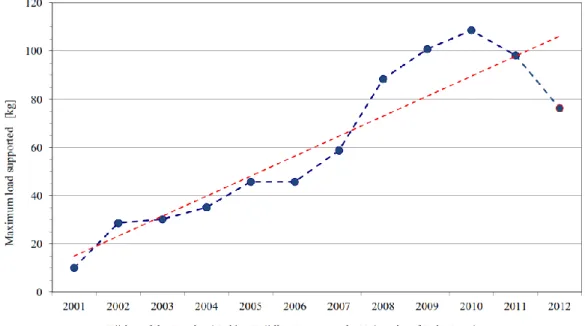
Since 2001 there has been an increasing trend in the number of students participating in the contest, which indicates the students’ motivation. It should be noted that often a student begins to participate in this event with a bridge without great study or dedication, but in the following editions the same student shows solutions already well thought out, calculated and tested, reaching, in some cases, amazing results. Fig. 1 shows some of the contest winners bridges while in Fig. 2 show the evolution of the maximum load in the successive editions of the event since its genesis.
a) Max. load: 30,27 kg (2003). b) Max. load: 58,80 kg (2007). c) Max. load: 88,40 kg (2008).
d) Max. load: 108,60 kg (2010). e) Max. load: 98,20 kg (2011). f) Max. load: 76,30 kg (2012). Fig. 1. Example of winner bridges in different editions of the event.
As shown in Fig. 2, the maximum load value was obtained in 2008 edition, which is still the national record for load. The increase of maximum load supported by the bridge is due to: a) the experience gained by students and by the education institution itself in successive editions of the event; b) better design and more accurate dimensioning of bridges; c) improvement in construction techniques, d) choice of spaghetti beams with better mechanical performance, among others.
Note that the trend of load results has grown very rapidly. However, the increase of the load supported by the bridge is now more dependent of external factor as the mechanical limits of spaghetti, environmental conditions, or the effects of "generation change" when experienced participants finished their studies and eventually cease to participate in the contest, giving place to younger students. However, whether the record is surpassed or not, the main outcome of the Spaghetti Bridge Contest is reached in all editions: the growing interest of all participants in engineering activities and creative solutions.
7. Conclusion
This kind of events that bring together competition, sportsmanship, creativity, and engineering becomes increasingly a teaching tool with very good results in terms of learning and concepts application, given the inspiration and enthusiasm both of teachers and students.
Over the twelve editions of the event, an amazing evolution of the load supported by the bridges has been observed, motivating students to apply more dedication and interest in concepts of more advanced subjects of their engineering courses.
This form of practical engineering competition is proved to be a valuable teaching tool, allowing both the enhancement of several key concepts taught during classes and learning to control time and cost in the development of practical projects. Being practical applications very important in engineering courses but also resources consuming, this approach proved to be very motivating and stimulating for students; it results in noticeable change of students’ attitude regarding the problem solving in engineering courses and beyond.
8. Dedication
This paper is dedicated to the memory of our colleague Eng. Humberto Santos, the founder of the Spaghetti Bridge Contest at the University of Beira Interior, who with his great enthusiasm and dedication made this type of teaching approach pioneer in Portugal, apart from becoming a differentiating factor in motivating students.
References
[1] A. Guerman, H. Santos and C. Fernandes, Ensino da “Mecânica Aplicada“ na Universidade da Beira Interior: Experiência de e-Learning, in Proc. of CIBEM6 – 6º Congresso Iberoamericano
de Engenharia Mecânica, Coimbra, Portugal, pp. 417 – 422, 2003 (in portuguese).
[2] A. Guerman, H. Santos, P. D. Gaspar, A. Espirito Santo and C. Santos, Exercícios acompanhados: conjunto inovador de funcionalidades de plataformas de e-learning, in Proc. of
Engenharia'2003 - Inovação e Desenvolvimento, Covilhã, Portugal, 2003 (in portuguese).
[3] A. Guerman and H. Santos, Web-based support for teaching of Applied Mechanics, in Proc. of
SEFI 2004 Annual Congress, Valencia, Spain, 2004.
[4] A. Guerman, H. Santos and C. Santos, Use of e-learning platform for teaching Applied Mechanics", in Proc. of 3rd ASEE Int. Colloquium on Eng. Education, Beijing, P.R. China, 2004. [5] A. Guerman , H. Santos, P. D. Gaspar, A. Espírito Santo and C. Santos, Módulo de gestão e resolução de exercícios: tutoria on-line, in Proc. of Conferência eLES ’04 – eLearning no Ensino
Superior, Aveiro, Portugal, 2004 (in portuguese).
[6] H. Santos, A. Guerman and C. Fernandes, O uso da Internet no ensino da Engenharia, in Proc. of
IIIº Congresso Luso-Moçambicano de Engenharia, Maputo, Mocambique, pp. 43 – 52, 2003 (in
[7] H. Santos, R. Costa, A. Guerman, C. Santos, A. Espírito Santo and M. C. Lopes, Plataforma SAMURAI – Um Ambiente de Apoio ao Ensino Universitário, in Proc. of Conferência eLES ’04
– eLearning no Ensino Superior, Aveiro, Portugal, 2004 (in portuguese).
[8] F. P. Beer and E. R. Johnson. Mecânica Vectorial para Engenheiros. Vol.1, 2, 6ª Ed., McGraw-Hill, 1998 (in portuguese).
[9] H. C. Biscaia e L. B. Pinto, Concursos didácticos no ensino da Engenharia: construção de estruturas e dimensionamento de pontes em esparguete, in Proc. of 5º Congresso
Luso-Moçambicano de Engenharia, Maputo, Moçambique, 2008 (in portuguese).
[10] L. F. Martha, Programa Gráfico-Interativo para Ensino de Comportamento de Estruturas, http://www.tecgraf.puc-rio.br/ftool, 2002 (in portuguese).
[11] United States Military Academy, http://bridgecontest.usma.edu/, West Point Bridge Designer, Version 10.0.0, 2007.
[12] R. R.Craig Jr., Mechanics of Materials, 2nd Edition, , John Wiley and Sons, 2000.
[13] K. Martini, Arcade - Interactive Non-linear Structural Analysis and Animation, Version 4.2, 2007.
[14] Multiframe User Manual, Formation Design Systems Pty Ltd, 2011.
[15] L. A. S. González, I. B. Morsch, J. R. Masuero, Didactic games in engineering teaching - case: spaghetti bridges design and building contest, in Proc. of COBEM 2005, 18th International