Received November 28th, 2012; revised March 15th, 2013; accepted March 21st, 2013
Schizophrenic Patients’ Expectations Facing
Technology in a Cognitive Rehabilitation
Therapy Environment
Carla Freire
1, Catarina Reis
2, Josep Monguet
3, Joaquin Fernandez
41Department of Mathematics and Natural Science, ESECS / iACT / IPLeiria, Campus 1 - Rua Dr. João Soares, 2411-901 Leiria, Portugal
2Department of Computer Science, ESTG/IPLeiria, Campus 2 - Morro do Lena - Alto do Vieiro, 2411-901 Leiria, Portugal
3, 4Multimedia Laboratory, BSE/UPC, Diagonal 647, 8028 Barcelona, Spain
1[email protected]; 2[email protected]; 3[email protected]; 4[email protected]
Abstract- eTherapy can bring numerous advantages, however people have to adapt to a different discourse. It would be interesting to
know patients’ expectations regarding to this type of therapy. A questionnaire was developed with the most studied factors proved to have an important role in technology acceptance. The results allowed highlighting some important factors that influence behavioral intention, and made it possible to verify that some of these factors may be linked or influence others among different dimensions.
Keywords- eTherapy; Expectations; Technology Acceptance; Behavioral Intention; Schizophrenic Patients I. INTRODUCTION
The Internet allied to health offers the potential of promoting health, prevents diseases [1], and delivers health services [2,3] through the world [1- 4]. Being at home receiving treatment or being monitored remotely besides enabling more freedom and comfort to patients and families involved [1] also reduces unnecessary physical travels [1,3,5,6].
However, the use of technology in health can’t be viewed only as a technological development but as a rearrange of healthcare processes that must contemplate social aspects, because people are the center of health services being provided by medical professional’s intersection in order to meet their health needs [1].
As the use of technologies in healthcare requires the incorporation of new tools [7], it requires an acculturation process that, according to Le [8], is a process where people have to adapt to a different and new discourse, which may result negatively or positively. In order to overcome this acculturation process it’s important to train and educate adequately the people involved in these systems [7,9].
The internet can play a key role in health if seen as an additional extension of technology used to transmit and receive communication between people [10].
The literature shows that there already exist a large variety of health services associated with Information and Communication Technologies (ICT), such as health basic information or counseling [10,11] assistance in decision making, self-help guides, psychological tests and diagnosis [12]. Therapeutic approaches through the internet may be via email [13,14], stand-alone software [11,15], videoconferencing [11] and chat [14]. In order to distinguish the various services available, several concepts emerge, such as telehealth, telepsychiatry, eTherapy, Web Counsellling and others, but in one way or another they all mean almost the same [16], the use of electronic means in health services. Some differences between terms seem to differ due to the level of health expertise (e.g. mental health, general health), the way they are delivered (e.g. at distance, local) and, the type of intervention (e.g. counseling, virtual reality. activities). For the purpose of this paper, the authors define eTherapy as the use of electronic means, capable of record and share data, to deliver treatment and care locally or at distance in order to prevent and combat illness and/or symptoms. This definition can be sub-divided depending on the level of expertise, the way of delivery and the type of intervention ranging all concepts found in literature.
eTherapy does not intend to change medical approaches, but it can affect patient-health professional relation [17]. It would be necessary a rearrangement in healthcare organization in order to increase interest in eTherapy tools [18].
The study presented here was applied to schizophrenic patients in a real clinical context. According to the hospital that firstly hosted this project, there already exist many multimedia tools for some of mental diseases, such as autism, however for schizophrenic illness, they considered that there were only a few experiments.
II. EXPECTATIONS AND BEHAVIORAL INTENTION STUDY
The scientific literature on the acceptance of the technology has been spreading research about an individual expectation due to the introduction of new electronic tools applied to different contexts. Expectations are the person ’s perceptions related to the future [19], these may help to predict behavioral intention, which is the strength of intention to perform a particular behavior [20].
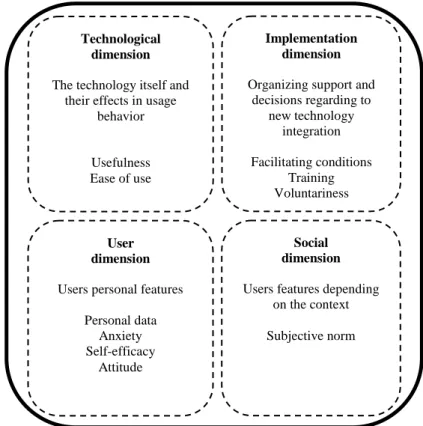
When referring behavioral intention, scientific literature allows pointing up four large dimensions that in turn reflect the major constructs identified (Fig. 1).
Fig. 1 Four dimensions with the major constructs identified in literature
Technological dimension refers to technology itself [21]and its effects in usage behavior, such as usability, quality and interaction [20]. The most studied factors, proved to have an important role in technology acceptance are: Usefulness, the degree to which an individual believes that using a particular technology can improve his performance [22]; and, Ease of Use, the degree to which an individual believes that using a specific technology is free of effort [22].
Implementation dimension, that regards to the organization which must create favorable support and encouragement conditions to technology usage [20] and must make decisions regarding to new technology integration with existing technology [21]. In this direction the following factors were considered: Facilitating Conditions, the degree to which an individual believes that an organization exists and infrastructure to support a specific technology usage [23]; Training, the users’ perceptions about learning programs for the system usage, prior to their introduction and during the period of use [20]; Voluntariness, the degree to which the use of an innovation is perceived as being voluntary [24]; and, Environment, related to an individual behavior may be different in public spaces, aware of others, or in private sphere, knowing that is alone [25].
Users’ dimension, which refers to users’ personal features that may range personality traits related to technology acceptance [20] to demographic data. In the present study the personal data asked were: age, genre, academic skills, occupation and informatics knowledge. The factors considered in this dimension were: Anxiety, anxiety evocation or emotional reactions when performing a particular behavior [23]; Self-Efficacy, an individual own judgment of the ability to use a particular technology to perform a given task [23]; and, Attitude, the positive or negative individual feelings about the performance of certain task [23].
Social dimension is related to the influence that a given society, organization or culture may have in a person, contributing to different behaviors [20]. Human expectations, beliefs, emotional trends and cognitive skills developed and changed by social influence, which transmit information and activate emotional reactions, through modeling, education and social persuasion [26]. This dimension is composed by the Subjective Norm, an individual’s perception that the most important people, for him, think he should perform a specific behavior [27].
Technological dimension
The technology itself and their effects in usage
behavior
Usefulness Ease of use
Implementation dimension
Organizing support and decisions regarding to new technology integration Facilitating conditions Training Voluntariness User dimension
Users personal features Personal data Anxiety Self-efficacy Attitude Social dimension
Users features depending on the context Subjective norm
III. METHOD
The present work is exploratory and intends to explore the phenomenon of introducing multimedia tools into schizophrenic patient’s cognitive rehabilitation. The main study goal is to know schizophrenic patients’ expectations to eTherapy use, before any contact with it. In this sense, the study was made in a real clinic environment with schizophrenic patients that were participating in a traditional cognitive rehabilitation therapy, during a period of November 2009 to June 2010.
A. Subject
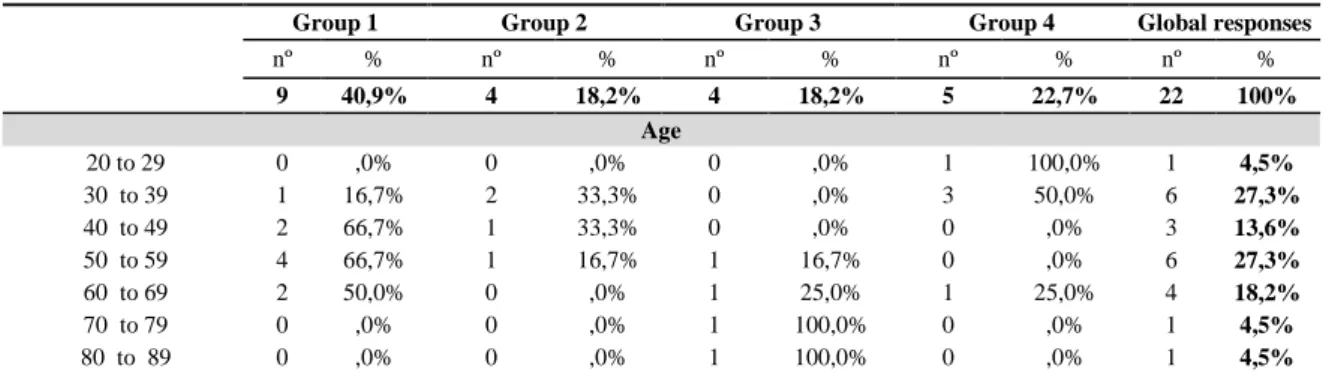
This work counted with the participation of three psychiatric hospitals, two in Spain and one in Portugal. One of the hospitals in Spain, Parc Sanitari Sant Joan de Déu was attended by two groups of patients which have allowed the participation of four test groups, formed by patients with different schizophrenia typologies: Group 1 formed by 9 patients aged between 30-39 and 60-69; Group 2 – Same hospital than Group 1, but with different therapist and 4 patients aged between 30-39 and 50-59; the Hospital Sant Joan de Déu Serveis Sociosanitaris in Spain, formed Group 3 with 4 patients aged between 50-59 and 80-89; and the Hospital Magalhães Lemos, from Portugal, constituted Group 4 with 5 patients aged between 20-29 and 60-69. In the total there were 22 schizophrenic patients participating in this study.
B. Questionnaire
In the present study the factors identified were considered as the most relevant in scientific literature related to an individual behavioral intention. These factors have allowed the creation of an items list, where the participants should answer expressing their opinion in a Likert Scale from 1 (Strongly disagree) to 5 (Strongly agree). Considering the disease features and the potential difficulty of some patients, to answer the questionnaire, this was made short, but considering the most important factors of the influence behavioral intention. After the questionnaire fill, it should be possible to identify the main factors that influence a patient’s decision regarding the use of eTherapy tools.
Due to the small number of schizophrenic patients involved in the study, it was not possible to make the pilot test with them. As the questionnaire had the main goal to study expectations, regarding to eTherapy use, and as we all can be a potential eTherapy user, it was important to test the questionnaire with different types of potential users. The pilot test was made with 17 Ph.D. students in Multimedia Engineering (ME) at Universitat Politècnica de Catalunya (UPC), that were working in different domains (e.g. elearning, networks) not related with the present work; and with a group of 6 persons that have tested a multimedia system for aphasia therapy. After completion of the pilot test, a response analysis was made and the questionnaire rectified, proceeding then to a second test. This was done with a different group of 6 Ph.D. students of ME and with 2 mental health professionals of the Hospital Sant Joan de Déu (HSJD). The results did not raise more questions, just a few adjustments on the written language of the items, which were corrected.
IV. RESULTS
A. Participants Characterization
Most of the participants in this study (77,3%) are male and 54,4% are more than 50 years old, being Group 4 formed by younger patients whereas Groups 1 and 3 are formed essentially by older patients.
Regarding to educational skills, 54,5% of participants have basic education, with the majority of Group 1, while 16,6% attended higher education and 9,1% secondary education. Participants in Group 3 (22,7%) did not provide this information.
Most of the participants have no occupation, 54,5% are unemployed and 13,6% retired, whereas 13,6% of the elements have a Job and 18,2% did not answer this question.
Regarding to computer skills, most elements of the sample (81,8%) have basic computer knowledge, only 9,1% considered to have medium knowledge and 9,1% advanced knowledge. Table I presents the response distribution of participant’s characterization.
TABLE I RESPONSE DISTRIBUTION OF PARTICIPANT’S CHARACTERIZATION
Group 1 Group 2 Group 3 Group 4 Global responses
nº % nº % nº % nº % nº % 9 40,9% 4 18,2% 4 18,2% 5 22,7% 22 100% Age 20 to 29 0 ,0% 0 ,0% 0 ,0% 1 100,0% 1 4,5% 30 to 39 1 16,7% 2 33,3% 0 ,0% 3 50,0% 6 27,3% 40 to 49 2 66,7% 1 33,3% 0 ,0% 0 ,0% 3 13,6% 50 to 59 4 66,7% 1 16,7% 1 16,7% 0 ,0% 6 27,3% 60 to 69 2 50,0% 0 ,0% 1 25,0% 1 25,0% 4 18,2% 70 to 79 0 ,0% 0 ,0% 1 100,0% 0 ,0% 1 4,5% 80 to 89 0 ,0% 0 ,0% 1 100,0% 0 ,0% 1 4,5%
Genre Male 7 41,2% 3 17,6% 4 23,5% 3 17,6% 17 77,3% Female 2 40,0% 1 20,0% 0 ,0% 2 40,0% 5 22,7% Educational skills Basic education 8 66,7% 1 8,3% 0 ,0% 3 25,0% 12 54,5% Secondary Education 0 ,0% 1 50,0% 0 ,0% 1 50,0% 2 9,1% Higher education 0 ,0% 2 66,7% 0 ,0% 1 33,3% 3 13,6% Didn’t answer 1 20,0% 0 ,0% 4 80,0% 0 ,0% 5 22,7% Accupation Employed 0 ,0% 2 66,7% 0 ,0% 1 33,3% 3 13,6% Unemployed 9 75,0% 0 ,0% 0 ,0% 3 25,0% 12 54,5% Retired 0 ,0% 2 66,7% 0 ,0% 1 33,3% 3 13,6% Didn’t answer 0 ,0% 0 ,0% 4 100,0% 0 ,0% 4 18,2% Computer skills Basic 9 50,0% 3 16,7% 4 22,2% 2 11,1% 18 81,8% Medium 0 ,0% 1 50,0% 0 ,0% 1 50,0% 2 9,1% Advanced 0 ,0% 0 ,0% 0 ,0% 2 100,0% 2 9,1% B. Expectations
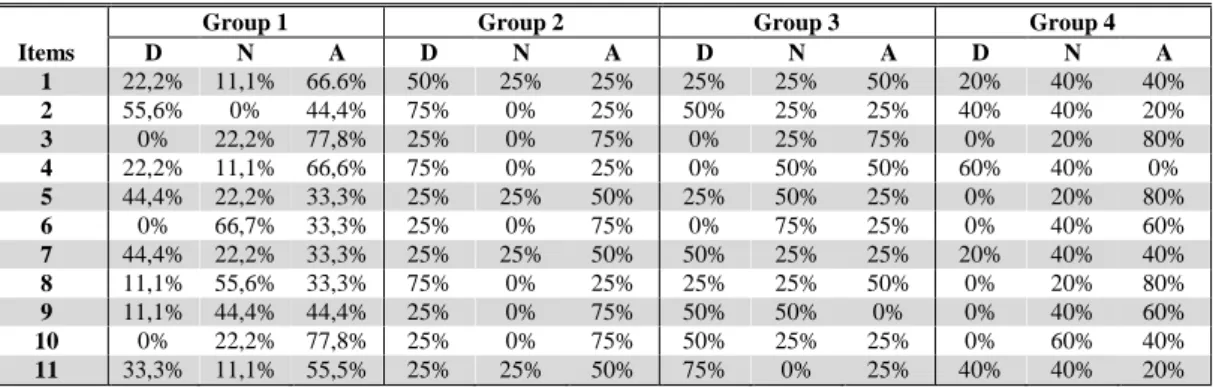
The Likert Scale was reorganized to a three point scale (Disagree, neutral and agree), given the small number of participants. The opinions of strongly disagree were added to disagree; Opinions of Strongly agree were added to agree; and the opinions in the middle (3) were considered neutral.
Table II shows the overall percentage results, while Table III presents the percentage results of each test group. TABLE II OVERALL PERCENTAGE OF RESPONSES IN DISAGREE, NEUTRAL AND AGREE TO THE ITEMS
Factor e Items Disagree Neutral Agree
Anxiety
1 - I would hesitate using an eTherapy tool because it’s not familiar to me 27,2% 22,7% 50%
Self-efficacy
2 - I believe I could complete an eTherapy task with no additional help 54,6% 13,6% 31,8%
Voluntariness
3 - If I had the opportunity I would like to experiment an eTherapy tool 4,5% 18,2% 77,3%
Subjective Norm
4 - I would use an eTherapy tool if I saw other people use it 36% 22,7% 40,9%
Environment
5 - I believe doing Therapy outside the usual clinical setting would bring benefits for the therapy process
27,2% 27,3% 45,5%
Usefulness
6 - Using an eTherapy tool will improve therapy process 27,2% 27,3% 45,5%
Ease of Use
7 - Using an eTherapy tool would be easy for me 36,4% 27,3% 36,3%
Training
8 - I believe that training may influence the adherence to an eTherapy tool 22,7% 31,8% 45,5%
Facilitating Conditions
9 - If I were provided with the necessary resources and conditions, I would use an eTherapy tool
18,2% 36,4% 45,5%
Attitud
10 - Using an eTherapy tool is a good idea to the therapy process 13,6% 27,3% 59,1%
Behavioral Intention
11 - If I was in a therapy context I would look forward for activities that require the use of an eTherapy tool
40,9% 18,2% 40,9%
TABLE III PERCENTAGE OF RESPONSES IN DISAGREE, NEUTRAL AND AGREE TO THE ITEMS, BY TEST GROUP
Group 1 Group 2 Group 3 Group 4
Items D N A D N A D N A D N A 1 22,2% 11,1% 66.6% 50% 25% 25% 25% 25% 50% 20% 40% 40% 2 55,6% 0% 44,4% 75% 0% 25% 50% 25% 25% 40% 40% 20% 3 0% 22,2% 77,8% 25% 0% 75% 0% 25% 75% 0% 20% 80% 4 22,2% 11,1% 66,6% 75% 0% 25% 0% 50% 50% 60% 40% 0% 5 44,4% 22,2% 33,3% 25% 25% 50% 25% 50% 25% 0% 20% 80% 6 0% 66,7% 33,3% 25% 0% 75% 0% 75% 25% 0% 40% 60% 7 44,4% 22,2% 33,3% 25% 25% 50% 50% 25% 25% 20% 40% 40% 8 11,1% 55,6% 33,3% 75% 0% 25% 25% 25% 50% 0% 20% 80% 9 11,1% 44,4% 44,4% 25% 0% 75% 50% 50% 0% 0% 40% 60% 10 0% 22,2% 77,8% 25% 0% 75% 50% 25% 25% 0% 60% 40% 11 33,3% 11,1% 55,5% 25% 25% 50% 75% 0% 25% 40% 40% 20%
D – Disagree; N – Neutral; A - Agree
According to the results, 50% of the participants are shown to have some Anxiety, agreeing that they would hesitate using an eTherapy tool for not being familiar to them.
Regarding the Self-Efficacy levels, 54,6% of the elements don’t believe they could complete an eTherapy task without further assistance.
However, regarding the Voluntariness, 77,3% of the participants show that if they had the opportunity, they would like to try an eTherapy tool.
In what concerns the Subjective Norm, the answers are more divided, 40,9% of the elements states that if they saw other people using an eTherapy tool, they would use it, while 36% would not.
Regarding the Environmental factor, 45,5% of patients believed that having therapy off-site clinical set (e.g. home) could be beneficial for the treatment process, while 27,2% do not agree. These results are similar to the Usefulness factor, wherein 45,5% of patients agree that eTherapy may improve therapy process and 27,2% disagree.
As regards to the Ease of Use, the responses are also equally distributed among the agreement (36,4%) and disagreement (36,4%).
As regards Training, 45,5% of participants believe that this may influence adherence to an eTherapy tool, while 22,7% disagree and 31,8% maintained a neutral position.
Concerning Facilitating Conditions, 45,5% of the elements would use an eTherapy tool, if they had the features and required conditions, while 18,2% of the elements would not use and 36,4% remained neutral.
The patients’ Attitude levels have significant results, 59,1% of the participants stated that using a tool eTerapia is a good idea for the therapy process.
Regarding the Behavioral Intention, the responses are equally divided between the levels of agreement (40,9%) and disagreement (40,9%) to the item “If I was in a therapy context I would look forward for activities that require the use of an eTherapy tool”.
V. DISCUSSION
It is possible to verify that some factors seem to cross between different dimensions: technological, implementation, individual and social. Some factors may be linked or even influence others.
Anxiety may be related to the Self-Efficacy, i.e., the belief of having low Self-Efficacy regarding to a technology may contribute to increase Anxiety related to that technology. The age, computer knowledge or even qualifications might be somehow related to the level of Self-Efficacy, since the fact of knowing similar tools may contribute to the removal of technology fears. Rahimpour and colleagues [28] point out that their study participants have showed significant anxiety levels, because of their age and their fear to contact with new technologies. It is important to refer that in quite a few items the Groups 1 and 3, where most of patients have more than 50 years old and basic computer skills, seemed to reveal more difficulties in accepting the technology.
The Ease of Use and Training on tools that is intended to introduce in a specific context, may also contribute to increase Self-Efficacy beliefs, thereby reducing Anxiety. According to some studies (e.g. [29, 30]) training have also showed significant effects on self-efficacy.
The Environment factor may be related to the place where technology is implemented referring to physical conditions (such as luminosity, noise, temperature) [31] which is very important to the user well-being so that he can comfortably perform his tasks. However it can also be viewed from a social perspective as the social roles that an individual performs in society, depending on the environment and context. According to Bandura [26], a person may activate different reactions depending on their social roles and social status.
Voluntariness may also measure behavioral intention. An individual may express his willingness to try a technology, which transmits signals of voluntariness which simultaneously reflect his behavioral intention. Tsiknakis and Kouroubali [32] also noted that the possibility of having free choice about using a technology has impact in use intention.
Voluntariness, Attitude and Behavioral Intention play an important role, since allow knowing exactly what an individual thinks in that particular moment. Although it is difficult to predict future, because the expressed opinions do not always correspond to a real use, the study of these factors allows performing estimations of usage of a particular system.
VI. CONCLUSION
Adetailed analysis of all variables that influence behavior and the satisfaction of basic needs, such as friendly interfaces development and training in the tools that is wanted to implement, may increase self-efficacy and reduce anxiety, contributing
to change an individual behavioral intention.
Some limitations have conditioned this study, among which we highlight: the difficulty accessing psychiatric hospitals and the common working routines that are already established, made difficult carry out the pilot test with schizophrenic patients and to introduce new patients in the study, which have contributed to a reduced sample; each factor may represent one or more features, as the questionnaire was made short, to facilitate the patients’ answers, we might have lost important information about different features of each item.
However, the study presented here was exploratory with the main goal of knowing schizophrenic patients expectations, regarding the introduction of technology in therapy processes.
The study development and the results analysis have raised new questions whose answers could enrich the scientific knowledge in this area. Some of the questions are: what would be the results of this study applied to different users, such as health professionals and families or care givers? Would the results be different if the same study was applied to different types of persons, like autism patients, elderly persons or handicap people? What would be the results with the same participants after using an eTherapy tool? In order to accomplish this, it would be interesting to apply expectation studies to wider samples, but including all kind of eTherapy users, different type of patients, health professionals and families; it would be also interesting longitudinal studies of expectations and real usage of electronic tools for therapy, that could help to verify if an individual behavioral intention corresponds to a real use of a particular technology.
ACKNOWLEDGMENTS
The authors are grateful to: FCT - Fundação para a Ciência e Tecnologia, Portugal and Instituto Politécnico de Leiria, Portugal for their financial support; Parc Sanitari Sant Joan de Déu, Spain, Hospital Magalhães de Lemos, Portugal, Sant Joan de Déu Serveis Sociosanitaris, Spain for their health professional support and for giving the chance of working with their patients and to all patients that have work with us.
REFERENCES
[1] Kaplan B, Litewka S. Ethical Challenges of Telemedicine and Telehealth [Internet]. Cambridge Quarterly of Healthcare Ethics 2008;17 (04):401–416.Available from:
http://journals.cambridge.org/action/displayAbstract?fromPage=online&aid=2151420&fulltextType=RA&fileId=S0963180108080535. [2] Eysenbach G. What is e-health? [Internet]. J Med Internet Res 2001;3(2):e20.Available from: http://www.jmir.org/2001/2/e20/. [3] Ganapathy K. Telemedicine and neurosciences [Internet]. Journal of Clinical Neuroscience 2005;12(8):851–862.Available from:
http://www.sciencedirect.com/science/article/B6WHP-4HPM9G1-2/2/3f5499ed569c6c5312c655ca189d697d.
[4] Dyer KA. Ethical Challenges of Medicine and Health on the Internet: A Review. J Med Internet Res. 3(2): e23. Published online 2001 June 28. doi: 10.2196/jmir.3.2.e23 2001.
[5] Cuijpers P, Straten A, Andersson G. Internet-administered cognitive behavior therapy for health problems: a systematic review [Internet]. Journal Of Behavioral Medicine 2008;31(2):169–177.Available from: Publisher URL: www.cinahl.com/cgi-bin/refsvc?jid=749&accno=2009910305.
[6] Czaja SJ, Rubert MP. Telecommunications Technology as an Aid to Family Caregivers of Persons With Dementia [Internet]. Psychosom Med 2002;64(3):469–476.Available from: http://www.psychosomaticmedicine.org/cgi/content/abstract/64/3/469.
[7] Guler NF, Ubeyli ED. Theory and applications of telemedicine [Internet]. J Med Syst 2002;26(3):199–220.Available from: http://www.ncbi.nlm.nih.gov/entrez/query.fcgi?cmd=Retrieve&db=PubMed&dopt=Citation&list_uids=12018607.
[8] Le Q. Health informatics: an intercultural perspective [Internet]. Stud Health Technol Inform 2007;129(Pt 2):1194–1198.Available from: http://www.ncbi.nlm.nih.gov/entrez/query.fcgi?cmd=Retrieve&db=PubMed&dopt=Citation&list_uids=17911904.
[9] Kanani K, Regehr C. Clinical, ethical and legal issues in e-therapy. Families in Society - The Journal of Contemporary Human Services 2003;84(2):155–162.
[10] Griffiths M, Cooper G. Online therapy: implications for problem gamblers and clinicians [Internet]. British Journal of Guidance and Counselling 2003;31:113–135.Available from:
http://www.ingentaconnect.com/content/routledg/cbjg/2003/00000031/00000001/art00009.
[11] Richards D, Tangney B. An informal online learning community for student mental health at university: a preliminary investigation [Internet]. British Journal of Guidance & Counselling 2008;36(1):81–97.Available from: http://content.epnet.com/ContentServer.asp?T=P&P=AN&K=28462483&EbscoContent=dGJyMNLe80Sep7A4xNvgOLCmrlGeprZSr6 +4SLKWxWXS&ContentCustomer=dGJyMOzprkiuqLdIuePfgeyx+Eu3q64A&D=a9h.
[12] Barak A. Emotional support and suicide prevention through the Internet: A field project report. Computers in Human Behavior (CHB) 2007;23(2):971–984.
[13] Johnson L. Utah Deaf Videoconferencing Model: Providing Vocational Services via Technology. Journal of Rehabilitation 2004;70(4):p33–37.
[14] Haug S, Strauss B, Gallas C, Kordy H. New prospects for process research in group therapy: Text-based process variables in psychotherapeutic Internet chat groups [Internet]. Psychotherapy Research: Journal Of The Society For Psychotherapy Research 2008;18(1):88–96.Available from: http://search.ebscohost.com/login.aspx?direct=true&db=mnh&AN=18815959&site=ehost-live&scope=site.
[15] Copeland J, Martin G. Web-based interventions for substance use disorders: A qualitative review [Internet]. Journal of Substance Abuse Treatment 2004;26(2):109–116.Available from:
http://www.sciencedirect.com/science/article/B6T90-4C0HDV6-7/2/cc7006457efb2f75278759d9f548d544.
[16] Heinlen KT, Welfel ER, Richmond EN, O’Donnell MS. The nature, scope, and ethics of psychologists’ e-therapy web sites: What consumers find when surfing the Web. Psychotherapy 2003;40(1-2):112–124.
[17] Castelnuovo G, Gaggioli A, Mantovani F, Riva G. New and Old Tools in Psychotherapy: The Use of Technology For the Integration of Traditional Clinical Treatments. Psychotherapy: Theory/Research/Practice/Training 2003;40(1-2):33–44.
[18] Castelnuovo G, Gaggioli A, Mantovani F, Riva G. From psychotherapy to e-therapy: the integration of traditional techniques and new communication tools in clinical settings [Internet]. Cyberpsychology & Behavior: The Impact Of The Internet, Multimedia And Virtual Reality On Behavior And Society 2003;6(4):375–382.Available from:
http://search.ebscohost.com/login.aspx?direct=true&db=cmedm&AN=14511449&site=ehost-live&scope=site.
[19] Lankton NK, Wilson EV. Antecedents and dimensions of Online service expectations. IEEE Transactions on Engineering Management 2007;54(4):776–788.
[20] Aggelidis VP, Chatzoglou PD. Using a modified technology acceptance model in hospitals [Internet]. International Journal of Medical Informatics 2009;78(2):115–126.Available from:
http://www.sciencedirect.com/science/article/B6T7S-4T4HJMY-1/2/cbb9a403d838032c3807b01f97f83d79.
[21] Karsh BT. Beyond usability: designing effective technology implementation systems to promote patient safety [Internet]. Quality and Safety in Health Care 2004;13(5):388–394.Available from: http://qshc.bmj.com/content/13/5/388.abstract.
[22] Davis F, Bagozzi RP, Warshaw PR. User Acceptance of Computer Technology: A Comparison of Two Theoretical Models [Internet]. Management Science 1989;35(8):982–1003.Available from:
http://search.ebscohost.com/login.aspx?direct=true&db=bah&AN=6698817&site=ehost-live&scope=site.
[23] Venkatesh V, Morris M, Davis G, Davis F. User Acceptance of Information Technology: Toward a unified view [Internet]. MIS Quarterly 2003;27(3):425–478.Available from:
http://search.ebscohost.com/login.aspx?direct=true&db=bth&AN=10758835&site=ehost-live&scope=site.
[24] Moore GC, Benbasat I. Development of an Instrument to Measure the Perceptions of Adopting an Information Technology Innovation [Internet]. Information Systems Research 1991;2(3):192–222.Available from: http://isr.journal.informs.org/cgi/content/abstract/2/3/192. [25] Nijholt A. Where computers disappear, virtual humans appear [Internet]. Computers & Graphics 2004;28(4):467–476.Available from:
http://www.sciencedirect.com/science/article/B6TYG-4CK1V62-3/2/32776aad739a5b42420b7d9ac6fbedbc.
[26] Bandura A. Social cognitive theory. In R. Vasta (Ed.), Annals of child development. Vol.6. Six theories of child development (pp. 1-60). Greenwich, CT: JAI Press. 1989.
[27] Fishbein M, Ajzen I. Belief, Attitude, Intention, and Behavior: An Introduction to Theory and Research. Reading, MA: Addison-Wesley; 1975.
[28] Rahimpour, M., Lovell, N. H., Celler, B. G. & Mccormick, J. Patients' perceptions of a home telecare system. International Journal Of Medical Informatics, 2008; 77, 486-498.
[29] Wu, J. H., Wang, S. C. & Lin, L. M. Mobile computing acceptance factors in the healthcare industry: A structural equation model. International Journal of Medical Informatics 2007; 76, 66-77.
[30] Morton, M. E. & Wiedenbeck, S. A framework for predicting EHR adoption attitudes: a physician survey. Perspectives in Health Information Management 2009; 6, 16p.
[31] Or, C. K. L. & Karsh, B.-T. A Systematic Review of Patient Acceptance of Consumer Health Information Technology. Journal of the American Medical Informatics Association 2009; 16, 550-560.
[32] Tsiknakis, M. & Kouroubali, A. Organizational factors affecting successful adoption of innovative eHealth services: A case study employing the FITT framework. International Journal of Medical Informatics 2009; 78, 39-52.