
Evolving artificial terrains with automated genetic terrain programing
184
0
0
Texto
(2)
(3) Organization: Dept. de Tecnolog´ıas de los Computadores y de las Comunicaciones Universidad de Extremadura Title: Evolucionando Terrenos Artificiales con Programaci´on Gen´etica Automatizada de Terrenos Evolving Artificial Terrains with Automated Genetic Terrain Programing Author: Miguel Monteiro de Sousa Frade E-mail: [email protected] School of Technology and Management, Polytechnic Institute of Leiria, Portugal. Supervisors: Dr. Francisco Fern´ andez de Vega E-mail: [email protected] Centro Universitario de M´erida, Universidad de Extremadura, Spain Dr. Carlos Cotta Porras E-mail: [email protected] ETSI Inform´atica, Campus de Teatinos, Universidad de M´alaga, Spain.
(4)
(5) Dr. D. Francisco Fern´andez de Vega, professor titular de la Universidad de Extremadura y Dr. D. Carlos Cotta Porras, professor titular de la Universidad de M´alaga, CERTIFICAN: que la presente memoria, titulada “Evolucionando Terrenos Artificiales con Programaci´on Gen´etica Automatizada de Terrenos” ha sido realizada por D. Miguel Monteiro de Sousa Frade, bajo la direcci´on del Dr. Francisco Fern´andez de Vega y el Dr. Carlos Cotta Porras, en el Departamento de Tecnolog´ıa de los Computadores y de las Comunicaciones de la Universidad de Extremadura. Y para que conste, y en cumplimiento d ela legislaci´on vigente, firma la presente,. Dr. Francisco Fern´andez de Vega.. Dr. Carlos Cotta Porras.
(6)
(7) Resumen La industria del videojuego afronta en la actualidad un gran reto: mantener el coste del desarrollo de los proyectos bajo control a medida que estos crecen y se hacen m´as complejos. La creaci´on de los contenidos de los juegos, que incluye el modelado de personajes, mapas y niveles, texturas, efectos sonoros, etc, representa una parte fundamental del costo final de producci´on. Por eso, la industria est´a cada vez m´as interesada en la utilizaci´on de m´etodos procedurales de generaci´on autom´atica de contenidos, para amplificar la efectividad de las inversiones en los procesos de dise˜ no de videojuegos. Sin embargo, crear y afinar los m´etodos autom´aticos de generaci´on de contenidos no es una tarea trivial. En esta memoria, se describe un m´etodo procedural basado en Programaci´on Gen´etica, que permite la generaci´on autom´atica de terrenos para videojuegos. Los terrenos presentan caracter´ısticas est´eticas, y no requieren ning´ un tipo de parametrizaci´on para definir su aspecto. As´ı, el ahorro de tiempo y la reducci´on de costes en el proceso de producci´on es notable. Para conseguir los objetivos, se utiliza Programaci´on Gen´etica de Terrenos (Genetic Terrain Programming, GTP, en ingl´es). La primera implementaci´on utilizada de GTP utiliz´o un m´etodo basado en Evoluci´on Interactiva, en la que la presencia del usuario que gu´ıa el proceso evolutivo es imprescindible. A pesar de los buenos resultados, el m´etodo est´a limitado por la fatiga del usuario (algo com´ un en los m´etodos interactivos). Para resolver esta cuesti´on se desarrolla un nuevo modelo de GTP en el que i.
(8) el proceso de b´ usqueda es completamente autom´atico, y dirigido por una funci´on de aptitudo. La funci´on considera accesibilidad de los terrenos y per´ımetros de los obst´aculos. Los resultados obtenidos se incluyeron como parte de un videojuego real.. ii.
(9) Abstract Nowadays video game industry is facing a big challenge: keep costs under control as games become bigger and more complex. Creation of game content, such as character models, maps, levels, textures, sound effects and so on, represent a big slice of total game production cost. Hence, video game industry is increasingly turning to procedural content generation to amplify the cost-effectiveness of the efforts of video game designers. However, creating and fine tunning procedural methods for automated content generation is a time consuming task. In this thesis we detail a Genetic Programming based procedural content technique to generate procedural terrains. Those terrains present aesthetic appeal and do not require any parametrization to control its look. Thus, allowing to save time and help reducing production costs. To accomplish these features we devised the Genetic Terrain Programming (GTP) technique. The first implementation of GTP used an Interactive Evolutionary Computation (IEC) approach, were a user guides the evolutionary process. In spite of the good results achieved this way, this approach was limited by user fatigue (a common trait of IEC systems). To address this issue a second version of GTP was developed where the search is automated, being guided by a direct fitness function. That function is composed by the weighted sum of two morphological metrics: terrain accessibility and obstacle edge length. The combination of the two metrics allowed us remove the human factor form the evolutionary process and to find a wide range of aesthetic and fit iii.
(10) terrains. Procedural terrains produced by this technique are already in use in a real video game.. iv.
(11) Acknowledgements I wish to express my sincere thanks and appreciation to my supervisors, Dr. Francisco Fernandez de Vega and Dr. Carlos Cotta, for their attention, guidance, insight, support, constructive comments, suggestions and encouragement during the research period. I would like to express also my gratitude to the following projects, that directly or indirectly funded this research: TIN2007-68083-C02-01, TIN200805941, and TIN2011-28627-C04 from Spanish Ministry of Science and Education; GRU-09105, GR10029 from Gobierno de Extremadura; TIC-6083 from Junta de Andalucia; and the Chapas Video Game project, a partnership between Centro Universitario de M´erida (Universidad de Extremadura), GLOW (an animation studio) and Junta de Extremadura, who made possible the development of Chapas to test our technique in a real video game. Finally a word of appreciation to the Polytechnic Institute of Leiria, Portugal who welcomed me in their laboratories with support from the PROTEC grant SFRH/BD/49610/2009 of Portuguese National Foundation for Science and Technology (FCT). I am also deeply grateful to the Informatics and Communications Services of Computer Science department from University of Coimbra, Portugal, for giving us a time slot on 18 nodes of their MILIPEIA cluster. Also, a special word of appreciation to Patr´ıcio Domingues that made the required arrangements that made possible the use of the cluster. Without their generosity most of our tests would not have been possible. v.
(12) A big thank to my brother, Nuno Frade, for his helpful assistance to generate some of the 3 dimensional renders of the terrains. I cannot end without thanking my son Manuel and my daughter Carolina for their patience and understanding. Lastly, and most importantly, I wish to deeply thank my wife C´eu for her constant encouragement and love throughout this journey. To them I dedicate this thesis.. vi.
(13) Contents. Resumen. i. Abstract. iii. Acknowledgements. v. Abbreviations. xvii. 1 Introduction. 1. 1.1. Aims and Contributions . . . . . . . . . . . . . . . . . . . . .. 4. 1.2. Thesis Structure . . . . . . . . . . . . . . . . . . . . . . . . . .. 6. 2 Evolutionary Algorithms. 7. 2.1. Evolutionary Algorithms in Video Games . . . . . . . . . . . .. 8. 2.2. Evolutionary Design . . . . . . . . . . . . . . . . . . . . . . . 11. 2.3. Genetic Programming . . . . . . . . . . . . . . . . . . . . . . 12 2.3.1. Representation . . . . . . . . . . . . . . . . . . . . . . 14. 2.3.2. Initializing the Population . . . . . . . . . . . . . . . . 14 vii.
(14) 2.3.3. Selection . . . . . . . . . . . . . . . . . . . . . . . . . . 17. 2.3.4. Genetic Operators . . . . . . . . . . . . . . . . . . . . 18. 2.3.5. Terminal Set . . . . . . . . . . . . . . . . . . . . . . . 21. 2.3.6. Function Set . . . . . . . . . . . . . . . . . . . . . . . . 22. 2.3.7. Fitness Function . . . . . . . . . . . . . . . . . . . . . 25. 2.3.8. GP Parameters . . . . . . . . . . . . . . . . . . . . . . 26. 2.3.9. Termination . . . . . . . . . . . . . . . . . . . . . . . . 27. 3 Artificial Terrains. 29. 3.1. Representation . . . . . . . . . . . . . . . . . . . . . . . . . . 29. 3.2. Generation Techniques . . . . . . . . . . . . . . . . . . . . . . 34. 4 Interactive GTP. 43. 4.1. Method . . . . . . . . . . . . . . . . . . . . . . . . . . . . . . 45. 4.2. GenTP Tool . . . . . . . . . . . . . . . . . . . . . . . . . . . . 47. 4.3. Tests and Results . . . . . . . . . . . . . . . . . . . . . . . . . 52. 5 Automated GTP. 57. 5.1. Adding Zoom Feature to Terrain Programs . . . . . . . . . . . 58. 5.2. Terminal and Function Sets . . . . . . . . . . . . . . . . . . . 61. 5.3. Terrain Programs Evaluation . . . . . . . . . . . . . . . . . . . 67. 5.4. Used Tools . . . . . . . . . . . . . . . . . . . . . . . . . . . . . 73. 5.5. Tests and Results . . . . . . . . . . . . . . . . . . . . . . . . . 73 viii.
(15) 5.6. 5.7. 5.5.1. GP System . . . . . . . . . . . . . . . . . . . . . . . . 78. 5.5.2. Occurrence Analysis . . . . . . . . . . . . . . . . . . . 85. 5.5.3. Overlap . . . . . . . . . . . . . . . . . . . . . . . . . . 88. Sample Terrains . . . . . . . . . . . . . . . . . . . . . . . . . . 93 5.6.1. Terrains with a single metric . . . . . . . . . . . . . . . 93. 5.6.2. Terrains with both metrics . . . . . . . . . . . . . . . . 93. Creativity . . . . . . . . . . . . . . . . . . . . . . . . . . . . . 105. 6 Chapas Video Games. 111. 7 Conclusions. 115. 8 Future Work. 119. A Terrain Programmes. 135. A.1 Interactive GTP . . . . . . . . . . . . . . . . . . . . . . . . . . 135 A.2 Automated GTP . . . . . . . . . . . . . . . . . . . . . . . . . 136 B Additional Graphics. 143. C List of Publications. 157. ix.
(16) x.
(17) List of Figures 1.1. Gears Of War video game costs . . . . . . . . . . . . . . . . .. 2.1. Evolutionary design categories . . . . . . . . . . . . . . . . . . 11. 2.2. GP tree representation of max(x + x, x + 3 ∗ y) . . . . . . . . 14. 2.3. Example of a tree created with the full method . . . . . . . . 15. 2.4. Example of a tree created with the grow method . . . . . . . . 16. 2.5. Example of subtree crossover . . . . . . . . . . . . . . . . . . . 19. 2.6. Example of subtree mutation. 2.7. Interpretation example of a GP tree . . . . . . . . . . . . . . . 26. 3.1. A discrete height map example . . . . . . . . . . . . . . . . . 30. 4.1. Terminals fftGen, gauss, step and sphere . . . . . . . . . . . . 49. 4.2. GenTP ’s functional modules (Frade, 2008) . . . . . . . . . . . 50. 4.3. GenTP main user’s interface (Frade, 2008) . . . . . . . . . . . 51. 4.4. GenTP analyse user’s interface (Frade, 2008) . . . . . . . . . . 52. 4.5. Exotic terrains generated with GT Pi . . . . . . . . . . . . . . 53. 4.6. TPs evolved by GT Pi with specific features in mind . . . . . . 54 xi. 2. . . . . . . . . . . . . . . . . . . 20.
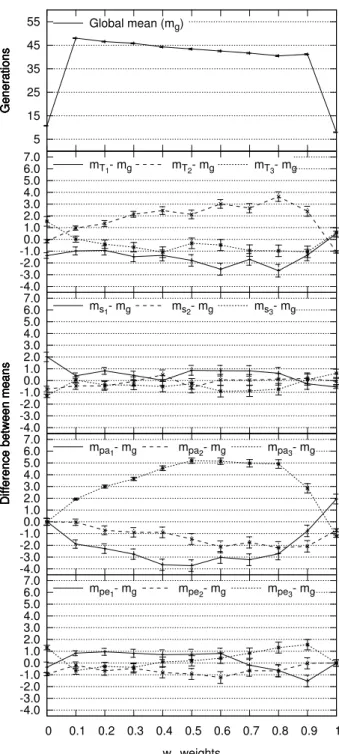
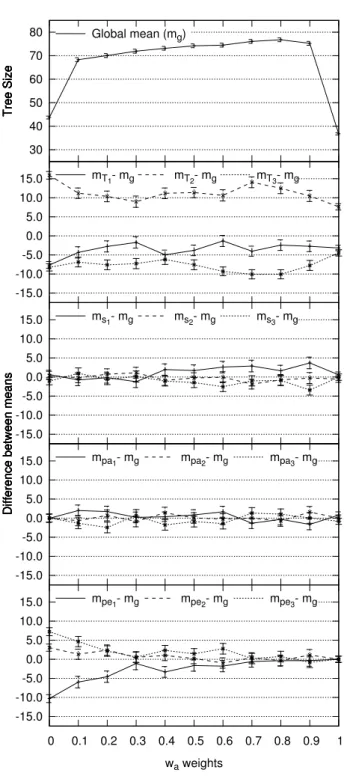
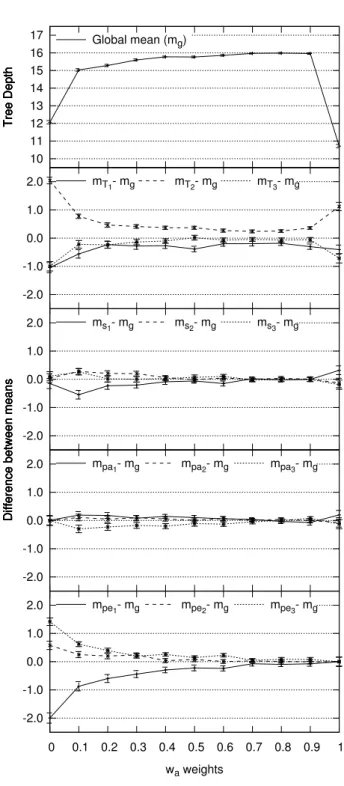
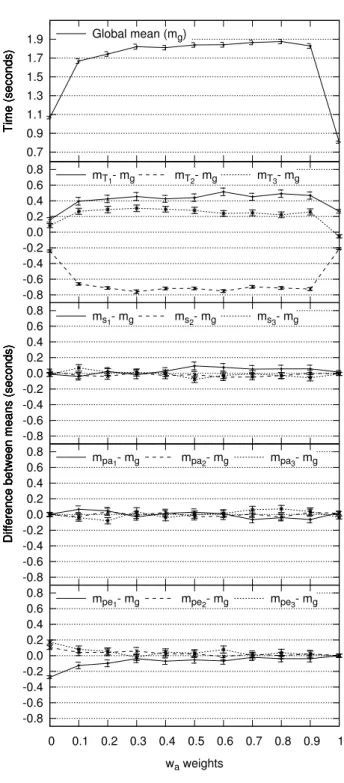
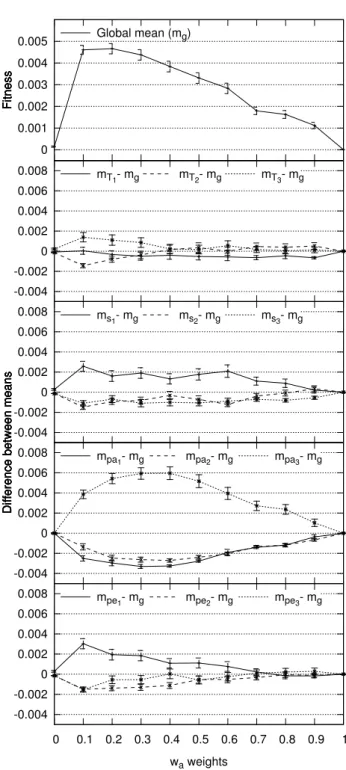
(18) 5.1. Example of a continuous function sampling . . . . . . . . . . . 59. 5.2. Sampling grid of a continuous functions before and after zoom. 5.3. Terrain view area . . . . . . . . . . . . . . . . . . . . . . . . . 61. 5.4. Zoom problem in GT Pi implementation . . . . . . . . . . . . . 62. 5.5. Terrain generated by myN oise(x, y) . . . . . . . . . . . . . . . 67. 5.6. Neighbor positions . . . . . . . . . . . . . . . . . . . . . . . . 68. 5.7. Example of two accessibility maps . . . . . . . . . . . . . . . . 70. 5.8. Edge maps built from the accessibility maps on Fig. 5.7 . . . . 71. 5.9. Visualization of the different slopes . . . . . . . . . . . . . . . 74. 60. 5.10 Mean percentage of pe values . . . . . . . . . . . . . . . . . . . 75 5.11 Mean number of generations versus wa . . . . . . . . . . . . . 80 5.12 Mean of GP tree sizes versus wa . . . . . . . . . . . . . . . . . 81 5.13 Mean of tree depths versus wa . . . . . . . . . . . . . . . . . . 82 5.14 Mean of TP execution times versus wa . . . . . . . . . . . . . 84 5.15 Mean fitness values versus wa . . . . . . . . . . . . . . . . . . 86 5.16 Percentage of TPs that reached fitness 0 versus wa . . . . . . . 87 5.17 Mean occurrence of functions and terminals versus wa . . . . . 89 5.18 Occurrence of functions and terminals for each wa . . . . . . . 90 5.19 Overlap of inaccessible areas between two maps. . . . . . . . . 91 5.20 Overlap of inaccessible areas versus wa . . . . . . . . . . . . . 92 5.21 Terrain T1 , s1 , pa1 , pe3 , w0 , r4 , and T1 , s1 , pa3 , pe2 , w0 , r1. . . . . 94. 5.22 Terrain T2 , s1 , pa1 , pe2 , w0 , r3 , and T2 , s3 , pa2 , pe3 , w0 , r2. . . . . 94. xii.
(19) 5.23 Terrain T3 , s2 , pa1 , pe1 , w0 , r2 , and T3 , s3 , pa2 , pe1 , w0 , r10 . . . . 95 5.24 Terrain T1 , s3 , pa1 , pe2 , w10 , r10 , and T1 , s3 , pa3 , pe2 , w10 , r8 . . . 95 5.25 Terrain T2 , s2 , pa2 , pe1 , w10 , r19 , and T2 , s2 , pa3 , pe1 , w10 , r11 . . . 96 5.26 Terrain T3 , s1 , pa1 , pe2 , w10 , r15 , and T3 , s3 , pa3 , pe3 , w10 , r1 . . . 96 5.27 Terrain T1 , s1 , pa1 , pe1 , w2 , r5 , and T1 , s1 , pa2 , pe3 , w4 , r16 . . . . 98 5.28 Terrain T1 , s2 , pa1 , pe2 , w9 , r9 , and T1 , s2 , pa2 , pe3 , w8 , r1. . . . . 99. 5.29 Terrain T1 , s2 , pa3 , pe1 , w1 , r14 , and T1 , s2 , pa3 , pe1 , w5 , r2 . . . . 99 5.30 Terrain T1 , s3 , pa1 , pe2 , w4 , r18 , and T1 , s3 , pa3 , pe2 , w5 , r10 . . . . 100 5.31 Terrain T2 , s1 , pa1 , pe2 , w7 , r2 , and T2 , s1 , pa2 , pe1 , w6 , r4. . . . . 100. 5.32 Terrain T2 , s2 , pa1 , pe2 , w9 , r9 , and T2 , s2 , pa2 , pe2 , w1 , r18 . . . . 101 5.33 Terrain T2 , s2 , pa3 , pe1 , w8 , r3 , and T2 , s2 , pa3 , pe2 , w9 , r8. . . . . 101. 5.34 Terrain T2 , s3 , pa1 , pe2 , w2 , r13 , and T2 , s3 , pa3 , pe3 , w1 , r2 . . . . 102 5.35 Terrain T3 , s1 , pa3 , pe1 , w2 , r6 , and T3 , s1 , pa3 , pe2 , w4 , r11 . . . . 102 5.36 Terrain T3 , s2 , pa1 , pe3 , w8 , r17 , and T3 , s2 , pa2 , pe3 , w4 , r16 . . . . 103 5.37 Terrain T3 , s2 , pa3 , pe1 , w8 , r16 , and T3 , s2 , pa3 , pe2 , w7 , r8 . . . . 103 5.38 Terrain T3 , s3 , pa2 , pe2 , w8 , r10 , and T3 , s3 , pa3 , pe2 , w2 , r8 . . . . 104 5.39 Terrain with 4 zoom levels . . . . . . . . . . . . . . . . . . . . 106 5.40 Percentage of repeated TPs versus wa . . . . . . . . . . . . . . 108 6.1. Screenshots of Chapas video game . . . . . . . . . . . . . . . . 112. 6.2. Screenshots of Chapas video game . . . . . . . . . . . . . . . . 113. xiii.
(20) xiv.
(21) List of Tables 4.1. Parameters for a GTP run (Frade, 2008) . . . . . . . . . . . . 46. 4.2. GP Function Set (Frade, 2008). 4.3. GP Terminal Set (Frade, 2008) . . . . . . . . . . . . . . . . . 49. 5.1. GP function set . . . . . . . . . . . . . . . . . . . . . . . . . . 66. 5.2. Test parameters and their values. 5.3. Mann-Whitney U-test for edge values . . . . . . . . . . . . . . 76. 5.4. GP Parameters . . . . . . . . . . . . . . . . . . . . . . . . . . 77. 5.5. Height map parameters . . . . . . . . . . . . . . . . . . . . . . 77. 5.6. Runs where a TP was the best solution . . . . . . . . . . . . . 109. xv. . . . . . . . . . . . . . . . . . 48. . . . . . . . . . . . . . . . . 74.
(22) xvi.
(23) Abbreviations AI. Artificial Intelligence. DEM. Digital Elevation Models. EA. Evolutionary Algorithms. EC. Evolutionary Computation. ERC. Ephemeral Random Constant. GIS. Geographic Information Systems. GP. Genetic Programming. GTP. Genetic Terrain Programming. GTPa. Automated Genetic Terrain Programming. GTPi. Interactive Genetic Terrain Programming. GUI. Graphical User Interface. H. Hurst index. IEC. Interactive Evolutionary Computation. NPC. Non-Player Character. PCG. Procedural Content Generation. RPG. Role-Playing Game. SBPCG. Search Based Procedural Content Generation. TIN. Triangular Irregular Network. TP. Terrain Program. xvii.
(24) xviii.
(25) Chapter 1 Introduction Video games constitute a crucial area of the entertainment industry, with impressive financial investments. For the top publishers, gaming businesses is becoming increasingly more similar to Hollywood: each new game is a costly bet that can generate big profits, or big losses. M2 Research estimates the production cost of high quality video games for the 7th generation consoles at $10 million for one platform and $18-$28 million for multiple platforms (Meloni, 2010). Conversely, prior console generations had development costs ranging between $3-5 million per platform. This cost increase is driven mainly by the higher complexity of new and more powerful hardware and the effort required to fully exploit its capacity to present players with richer content (Loftus, 2011). With costs increasing at this pace, video game industry is facing a big challenge: keep costs under control as games become bigger and more complex. Creation of game content, such as character models, maps, levels, textures, sound effects, animations and so on, represent a big slice of total production costs (Edwards, 2006). On Gears Of War. 1. these costs represented. the largest share with 25%, see Fig. 1.1 (Rosmarin, 2006). Traditionally, the main techniques used in content development for video games have been 1. video game published by Microsoft Game Studios in 2006. 1.
(26) 2. CHAPTER 1. INTRODUCTION. !" #. Figure 1.1: Gears Of War video game costs. artistry. Generally, all game content has been handcrafted by artists and designers working specifically to that end. This approach ensures game designers full control over their creations. Nevertheless, by delegating most or all of the details up to the designer, manual content production impose high requirements on designer in terms of time and effort, which has a huge impact on production costs. Therefore, game industry is increasingly turning to procedural generation techniques that allow the automation of content creation (Nelson and Mateas, 2007) and this way can save significant expenses. Procedural content generation allows the automation of game content creation through algorithmic means and parametric control (Ebert et al, 2003). For instance, it is possible to generate a forest where each plant specie is represented by a set of parameters and each tree is slightly different just by changing the seed for the pseudo-random numbers generator (Lane and Prusinkiewicz, 2002; Prusinkiewicz and Lindenmayer, 2004). This allows the amplification of designers inputs: a few parameters yield large amounts of details (Ebert et al, 2003). Therefore, it will require less effort and time than modeling techniques to create complex content. Procedural techniques also allow more dynamic processes during the game development cycle. Designers can change the location of some level elements without having to redraw everything else. The procedural content can have rules built in to automat-.
(27) 3 ically adapt to those changes, thus allowing to save precious development resources. Financial benefits are not the only advantage of procedural content generation techniques. The representation of procedural content is also extremely compact and can be measured in Kilobytes, while others require Megabytes of storage. One good example of compactness is the classic game Elite 2 , which succeed to keep 8 galaxies of 256 planets each in a few tens of kilobytes by representing each planet with just a few numbers. When procedural algorithms produce the same content given the same parameters they can also be considered as a form of data compression. Another advantage that some procedural content has is the ability to be computed at any desired resolution. Fractals are a good example of this characteristic (Mandelbrot, 1983). A third advantage is that the quality of procedural generated content is independent of user skills, therefore they can be used by people without the designing skills that are required for handcrafted content. Furthermore, procedural content generation techniques can also allow the emergence of new types of games, where their contents can be created according to some criteria like player satisfaction, challenge, novelty, etc. This might lead to the creation of games that never end, that whatever the player does or whenever he goes, there always will be something new to explore. Although this kind of games is not yet a reality, they would have infinite replay value. Finally, procedural generation algorithms have the potential to generate entirely new content designs, that challenge human imagination. These new designs can serve as inspiration and serve as a base for designers to create their own creations (Togelius et al, 2011). However, procedural content generation has also its own drawbacks. One disadvantage is its evaluation. This operation requires intense computations which can be very expensive. Another disadvantage is the modeling problem: how to achieve the desired features? Typically, procedural methods offer a set of parametric controls that enable a procedure to generate many 2. video game published by Acornsoft in 1984.
(28) 4. CHAPTER 1. INTRODUCTION. different outputs. To make a procedure more flexible, more controls can be added. While the power of a procedure may be enhanced in this way, the resulting interface can become overly complex. In the case of a human using the interface, coming up with good results from a powerful procedure often degenerates into an authoring processing of trial and error. Besides, procedural algorithms present a certain degree of unpredictability: a small change in one parameter can result in big changes on the outcome, or big changes might not result in any significant modification. Whatever is the case, designers end up performing a lot of tests and simulations until they learn how the procedural system behaves to tune it. The search for the right input parameters and algorithm tune to achieve the desired output is time consuming. For example, the development of “Far Cry 2” 3 video game took as much as 15 times more time to refine and tune procedural tools than the amount of time developing the underlying game engine (Remo, 2008).. 1.1. Aims and Contributions. Among the many video game contents that can be generated procedurally, we find artificial terrains, the main focus of our research. Artificial terrains have an important role in video games dynamics (Forbus et al, 2002) and contribute greatly to re-playability (Sampath, 2004). Nowadays there are a wide range of techniques for terrain generation, which are detailed in Section 3, but all of them present some constraints. More elaborated methods depend highly upon designer’s skills, time and effort to obtain acceptable results or are not entirely procedural, which prevents them from being used in an automated fashion. The simpler methods allow only a narrow variety of terrains types and are difficult to model. Therefore, the aim of this research was to develop a new technique, employing Evolutionary Algorithms, to overcome the main constraints of current procedural methods, namely: • the modeling problem, to avoid the time consuming process of proce3. video game published by Ubisoft in 2008.
(29) 1.1. AIMS AND CONTRIBUTIONS. 5. dure tune to achieve the desired terrain features; • and allow a broad range of terrain types with emphasis on aesthetic. All current procedural techniques are focused on the generation of realistic terrains. Although this is important, it might prevent designers from achieving their goals when they attempt to represent an alien or exotic looking terrain. Terrain novelty might have also a positive impact on video game’s target audience and increase players interest.. This thesis presents and discusses a new procedural generation technique of terrains for video games, which was coined as Genetic Terrain Programing (GTP) (Frade et al, 2008c, 2009b). GTP is a search-based procedural content technique that employs Genetic Programing (GP) as an evolutionary search tool for procedural terrains, designated Terrain Programs (TPs). This technique combines the advantages of procedural content generation with the ability to create novel and innovative solutions of Evolutionary Algorithms. This approach allows the generation of new terrain types with novel looks and aesthetic appeal. The evolutionary search of terrains with the desired characteristics will produce TPs that do not require any parameter input to control its looks. Therefore, once evolved, TPs can be integrated in video games without the need for a human performing parameter tuning, thus allowing to save time and money. Another purpose of GTP could be its integration in authoring tools to inspire designer imagination and serve as base of their work. Two versions of the GTP technique were developed during the research period. The first version, designated GT Pi , is interactive where a human guides the evolution process of TPs. This approach allowed the generation of many aesthetic procedural terrains, but also required expensive human resources for the evaluation process (more details in Chapter 4). Therefore, a second version was devised to eliminate the human intervention during the evolutionary phase. This new version, designated GT Pa , performs an automated search based on geomorphological metrics..
(30) 6. CHAPTER 1. INTRODUCTION. 1.2. Thesis Structure. In this thesis we tried to organize the chapters from broader scope to more specific topics. Chapter 2 presents an introduction to Evolutionary Algorithms (EAs) in general, followed by a description of evolutionary design. Then, some examples of EAs applied to video games are shown and at the end of this chapter we present the inner working of genetic programming. Chapter 3 shows the different data structures available to represent terrains followed by a literature survey with existing terrain generation techniques. The work developed during the research period is presented in chapters 4 and 5. The first approach, GT Pi , to the research question is address in Chapter 4. Chapter 5 focus on the limitations of GT Pi , explains GT Pa solution to address them and finally presents a series of tests and discusses its results. To show the viability of our technique some TPs were incorporated in Chapas video game, detailed in Chapter 6. Conclusions and future work are laid out in Chapters 7 and 8 respectively. Some additional information was added as appendices. Terrain Programs from all presented terrains throughout this thesis are displayed at Appendix A. Appendix B shows more detailed graphics from the tests presented in Chapter 5, which helped to interpret some results. A list of publications achieved during the research period is presented in Appendix C..
(31) Chapter 2 Evolutionary Algorithms Evolutionary Algorithms (EAs) are a kind of bioinspired algorithms that apply Darwin’s theory (Darwin, 1859) of natural evolution of the species, where living organisms are rewarded through their continued survival and the propagation of its own genes to successors. There are four main classes of EAs: genetic algorithms (GA) (Holland, 1975), evolutionary strategies (Rechenberg, 1971; Schwefel, 1977), genetic programming (GP) (Koza, 1992) and evolutionary programming (Fogel et al, 1966). They can be seen as search techniques (Langdon and Qureshi, 1995) and are able to achieve good approximate solutions to a large number of problems, thanks to their flexibility and adaptability to different search scenarios. Evolutionary algorithms do not make any assumption about the underlying search landscape and this characteristic is the key factor of success in such diverse fields as: engineering, art, biology, economics, marketing, genetics, operations research, robotics, social sciences and physics just to name a few. More recently EAs have also been used to generate video game content a field where our research fits in. Section 2.1 presents a summary of what has been done in this specific area. Another area where EAs have been employed is to design artifacts, Section 2.2 presents an overview of this topic. Finally, Section 2.3 presents an explanation of GP algorithm.. 7.
(32) 8. CHAPTER 2. EVOLUTIONARY ALGORITHMS. 2.1. Evolutionary Algorithms in Video Games. Much of the early work on computational intelligence and games was directed toward applying Evolutionary Computation (EC) methods to evolve tactical and strategic content common to Non-Player Characters (NPCs) Artificial Intelligence (AI). The work on this area is well documented (Bourg and Seemann, 2004; Lucas and Kendall, 2006; Miikkulainen et al, 2006; Rabin, 2002). Therefore, the following paragraphs will focus instead on techniques to generate procedural content for video games, such as: tracks and levels; weapons; buildings and vegetation. There are also some research in this field regarding terrains, the main topic of this thesis, but they will be described in Chapter 3. The techniques that fit this category were designated Search-Based Procedural Content Generation (SBPCG) by Togelius et al (2011). They propose to search the right input parameters or to generate the procedure itself that will produce content with the desired characteristics. SBPCG techniques incorporate a generate and test approach. After a candidate content instance is generated, it is tested according to some criteria. A test function (also called fitness function) grades the procedural content instead of simply accepting or rejecting it. Then, new content is produced, that is dependent on the score of previous content, and this way tries to find better scoring content. The process is repeated until the content is considered good enough (Togelius et al, 2011). Evolutionary algorithms are a perfect match for this approach, although not the only search mechanism of SBPCG. An overview of the SBPCG techniques employed to generate video game content is presented below. Tracks and levels, represent an important aspect of video games as they impose restrictions or difficulties to players progress. Togelius et al (2006, 2007) designed a system for generation of tracks for a simple racing game. A racing track is created from a parameter vector by interpreting it as the parameters for b-spline (a sequence of Bezier curves). The resulting shape forms the mid-line of the racing track. Each candidate track is evaluated by.
(33) 2.1. EVOLUTIONARY ALGORITHMS IN VIDEO GAMES. 9. letting a neural network-based car controller drive on the track. The fitness of the track is dependent on the driving performance of the car: amount of progress, variation in progress and difference between maximum and average speed. Pedersen et al (2009) designed a user study focused on a version of the Super Mario Bros platform game to allow the creation of personalized levels. The fitness functions uses a neural network that converts level parameters and information about player’s playing behavior to one emotional state predictors, such as: fun, challenge, frustration, predictability, anxiety and boredom. The neural networks were trained by collecting game play metrics and data from player reported emotions through a questionnaire. Sorenson and Pasquier (2010) presented a framework to generate levels for different but related game genres. They employ a Feasible-Infeasible Two-Population (FI-2Pop) genetic algorithm (Kimbrough et al, 2002) that was designed for constraints satisfaction problems. Level designers specify a set of constraints, which determine the basic requirements for a level to be considered playable. The infeasible population consists solely of levels which do not yet satisfy all these constraints, and these individuals are evolved towards minimizing the number of constraints violated. When individuals are found to satisfy all the constraints, they are moved to the feasible population where they are subjected to a fitness function that rewards levels based on any criteria specified by the level designers. Jennings-Teats et al (2010) also describes a framework, for 2 dimensional platform game, to generate levels at runtime that adapt their difficulty to player skills. Short level segments are used to collect data of player’s behavior, level features and inquired ranking. The collected data was used to train a neural network to order segment levels by its difficulty. Then, while playing, the level is generated ahead of the player with a rhythm-based generation mechanism, that is ranked either higher or lower according to player’s gaming skills. Landscapes are another important facet of modern video games, in particular the ones that aim at representing realistic scenarios. They help to increase the immersion feeling on players. Some of the most critical features of a good landscape are: terrains (see Chapter 3), cities and vegetation. Mar-.
(34) 10. CHAPTER 2. EVOLUTIONARY ALGORITHMS. tin et al (2010) designed an interactive system to generate 3D buildings for the commercial video game Subversion, which is being developed by Introversion, to allow users to procedurally build cities. Buildings are composed by a stack of three-dimensional objects, each described as a two-dimensional shape that is vertically extruded. They applied an IEC approach (Takagi, 2001), which we also applied in our first implementation, GT Pi (more details on Chapter 4). In each generation the user chooses two parent buildings and from them a screen of 16 new offspring are presented to the user. Each object or group of objects can be subject to various transform operations such as translation, rotation and union. Lindenmayer (1968) devised L-systems with the aim to modulate plants and all kinds of vegetation. Parametric L-systems (Lindenmayer, 1974) are a powerful and flexible technique for plant modeling. However, it is a hard task to specify a PL-system, that generates a plant of a desired species. To address this issue Traxler and Gervautz (1996) used GAs to interactively find the appropriate production rules that produced the desired plant. Jacob (1996a,b) took another approach, using GP to evolve context sensitive PLsystems using plant characteristics, such as the number of blooms blossoming and the number of leaves, in the fitness function. Although none of these works were specifically developed with video games in mind, the content generated by them can be easily incorporated into a video game during its development phase. The evolutionary approach to generate video game content also allows the appearance of new games types. Hastings et al (2009) propose a new algorithm to automatically generate game content while the game is played, based on the past preferences of the players. They developed Galactic Arms Race (GAR), a online multiplayer gaming platform, that is able to generate and evolve particle system weapons. The fitness of each weapon depends on how often the several users logged onto the same server choose to fire the weapon relative to how long it stays unused. This way players implicitly indicate their preferences and guide evolution without knowing the underlying system..
(35) 2.2. EVOLUTIONARY DESIGN. 11. Figure 2.1: Evolutionary design categories. 2.2. Evolutionary Design. Evolutionary design might be seen as a particular case of SBPCG techniques, where EAs are the search mechanism. Evolutionary design is a branch of evolutionary computation which has its roots in three different disciplines: computer science, evolutionary biology and design. Evolutionary design has taken place in many different areas over the last decade. Designers have optimized selected parts of their designs using evolution, artists have used evolution to generate aesthetically pleasing forms (Machado et al, 2005), architects have evolved new building plans from scratch (Soddu, 2003), computer scientists have evolved morphologies and control systems of artificial life. Evolutionary design can be divided into four main categories (Bentley, 1998): evolutionary design optimization, creative evolutionary design, evolutionary art and evolutionary artificial life forms. However, some author’s work may be included in two or more categories creating four overlapping sub-categories shown in Figure 2.1. Our first implementation of GTP, GT Pi , fits in Aesthetic Evolutionary Design, a branch of the evolutionary art category. On the other hand, GT Pa fits in the evolutionary design optimization..
(36) 12. CHAPTER 2. EVOLUTIONARY ALGORITHMS. 2.3. Genetic Programming. Genetic programming is the evolutionary algorithm used in the work presented in this thesis. Therefore, some details about its inner working are presented in this section. However, for the readers who wish to deepen their knowledge, the book A Field Guide to Genetic Programming from Poli et al (2008) offers a very good introduction and overview to GP. A thoroughly analysis on this topic is provided by the book Genetic Programming - On the Programming of Computers by Means of Natural Selection by Koza (1992), the main proponent of GP who has pioneered the application of genetic programming in various complex optimization and search problems. Genetic programming (GP) is an evolutionary computation (EC) technique that automatically solves problems without requiring the user to know or specify the form or structure of the solution in advance. At the most abstract level GP is a systematic, domain-independent method for getting computers to solve problems automatically starting from a high-level statement of what needs to be done. In GP a population of computer programs is evolved, after several generations a population of programs is stochastically transformed into new, hopefully better, populations of programs (Poli et al, 2008). Due to its random nature GP can never guarantee results, however it has been used successfully in many areas. A brief list of GP applications follows (Langdon and Qureshi, 1995): • Artificial life; • Robots and autonomous agents; • Financial trading; • Neural networks; • Art; • Image and signal processing; • Prediction and classification; • Optimization; There are now 36 instances where GP has automatically produced a result.
(37) 2.3. GENETIC PROGRAMMING. 13. Algorithm 2.1 Genetic programming basic algorithm 1: Randomly create an initial population of programs from the available primitives 2: repeat 3: Execute each program and ascertain its fitness 4: Select one or two program(s) from the population with a probability based on fitness to participate in genetic operations 5: Create new individual program(s) by applying genetic operations with specified probabilities 6: until an acceptable solution is found or some other stopping condition is met (e.g., a maximum number of generations is reached) 7: return the best-so-far individual. that is competitive with human performance: 15 instances where GP has created an entity that either infringes or duplicates the functionality of a previously patented 20th century invention; 6 instances where GP has done the same with respect to a 21st century invention and 2 instances where GP has created a patentable new invention (Koza, 2004). Algorithm 2.1 shows the basic steps of GP. The generated programs are run for evaluation (line 3) and compared with some ideal. This comparison is quantified to give a numeric value called fitness. The best programs are chosen to breed (line 4) and produce new programs for the next generation (line 5). The primary genetic operators used to create new programs from existing ones are:. • Crossover - The creation of a child program by combining randomly chosen parts from two selected parent programs;. • Mutation - The creation of a new child program by randomly altering a randomly chosen part of a selected parent program;.
(38) 14. CHAPTER 2. EVOLUTIONARY ALGORITHMS max +. x. +. x. x. *. 3. y. Figure 2.2: GP tree representation of max(x + x, x + 3 ∗ y). Adapted from (Poli et al, 2008).. 2.3.1. Representation. In GP, programs are usually expressed as syntax trees rather than as lines of code. For example Figure 2.2 shows the tree representation of the program max(x + x, x + 3 ∗ y). The variables and constants in the program (x, y and 3) are leaves of the tree, or terminals in GP terminology. The arithmetic operations (+, * and max) are internal nodes called functions. The sets of allowed functions and terminals together form the primitive set of a GP system. It is common in the GP literature to represent expressions in a prefix notation similar to that used in Lisp. For example, max(x + x, x + 3 ∗ y) becomes (max(+xx)(+x(∗3y))). This notation often makes it easier to see the relationship between (sub)expressions and their corresponding (sub)trees. From now on it will be used trees and their corresponding prefix-notation expressions interchangeably to represent GP programs.. 2.3.2. Initializing the Population. Like in other evolutionary algorithms, the individuals in the initial GP population are typically randomly generated. There are a number of different approaches to generating this random initial population. In the following paragraphs we present a description of the two simplest methods, the full.
(39) 2.3. GENETIC PROGRAMMING. 15 +. *. x. /. y. 1. 3. Figure 2.3: Example of a tree having maximum depth 2 created with the full initialisation method. Adapted from (Poli et al, 2008).. and grow methods, and a widely used combination of the two known as ramped half-and-half. In both the full and grow methods, the initial individuals are generated so that they do not exceed a user specified maximum depth. The depth of a node is the number of edges that need to be traversed to reach the node starting from the trees’ root node (which is assumed to be at depth 0). The depth of a tree is the depth of its deepest leaf (e.g., the tree in Figure 2.2 has a depth of 3). In the full method, where all leaves are at the same depth, nodes are taken at random from the function set until the maximum tree depth is reached. Beyond that depth, only terminals can be chosen. Figure 2.3 shows an example of a tree having maximum depth 2 created with the full initialization method, where all leaves are at the same depth. However, this does not necessarily mean that all initial trees will have an identical number of nodes (often referred to as the size of a tree) or the same shape. In fact, this only happens when all the functions in the primitive set have the same number of input values, also known as arity. Nonetheless, even when mixed-arity primitive sets are used, the range of program sizes and shapes produced by the full method may be rather limited. On the contrary the grow method allows the creation of trees of more varied sizes and shapes. Nodes are selected from both the primitive function and terminals set until the depth limit is reached. Once the depth limit is reached only terminals may be chosen (like the full method). Figure 2.4 illustrates an example of a tree created with the grow initialization method.
(40) 16. CHAPTER 2. EVOLUTIONARY ALGORITHMS +. x. -. 2. y. Figure 2.4: Example of a tree having maximum depth 2 created with the grow initialization method. Adapted from (Poli et al, 2008).. with depth limit 2. Here the first argument of the + root node happens to be a terminal. This closes off that branch preventing it from growing any more before it reached the depth limit. The other argument is the function −, but its arguments are forced to be terminals to ensure that the resulting tree does not exceed the depth limit. Because neither the grow or full method provide a very wide array of sizes or shapes on their own, Koza (1992) proposed a combination called ramped half-and-half. Half the initial population is constructed using full and half is constructed using grow. This is done using a range of depth limits (hence the term “ramped”) to help ensure that it generates trees having a variety of sizes and shapes. These methods are easy to implement and use, but are difficult to control regarding the statistical distributions of important properties such as the sizes and shapes of the generated trees. For example, the sizes and shapes of the trees generated via the grow method are highly sensitive to the sizes of the function and terminal sets. If, for example, one has significantly more terminals than functions, the grow method will almost always generate very short trees regardless of the depth limit. Similarly, if the number of functions is considerably greater than the number of terminals, then the grow method will behave quite similarly to the full method. The arities of the functions in the primitive set also influence the size and shape of the trees produced by grow. While these are particular problems for the grow method, they.
(41) 2.3. GENETIC PROGRAMMING. 17. illustrate a general issue where small (and often apparently inconsequential) changes such as the addition or removal of a few functions from the function set can in fact have significant implications for the GP system, and potentially introduce important but unintended biases. For more information about this and other initialization mechanisms check (Poli et al, 2008).. 2.3.3. Selection. In GP the genetic operators are applied to individuals that are probabilistically selected based on their fitness. Which means that better individuals are more likely to have more child programs than inferior individuals. The most commonly employed method for selecting individuals in GP is tournament selection. In tournament selection a number of individuals are chosen at random from the population. These are compared with each other and the best of them is chosen to be the parent. For crossover two parents are needed, so, two selection tournaments are made. Tournament selection only looks at which program is better than another, it does not need to know how much better. This automatically rescales fitness, so that the selection pressure on the population remains constant. Hence, a single extraordinarily good program cannot immediately flood the next generation with its children. If that happened, it would lead to a rapid loss of diversity with potentially undesirable consequences. In reverse, tournament selection amplifies small differences in fitness to prefer the better program even if it is only marginally superior to the other individuals in a tournament. An element of noise is inherent in tournament selection due to the random selection of candidates for tournaments. So, while preferring the best, tournament selection does ensure that even average quality programs have some chance of having children. On interactive systems the selection is performed by a human, usually based on a visual representation of the individuals. Many other selection methods are possible, such as the ones proposed by Goldberg (1989); Luke.
(42) 18. CHAPTER 2. EVOLUTIONARY ALGORITHMS. and Panait (2002):. • Fitness Proportional Selection; • Lexicographic Parsimony Pressure Tournament; • Doubletour;. 2.3.4. Genetic Operators. The GP implementation of the genetic operators crossover and mutation are significantly different from other evolutionary algorithms. The choice of which operator, mutation or crossover, should be used to create an offspring is probabilistic. Operators in GP are normally mutually exclusive (unlike other evolutionary algorithms where offspring are sometimes obtained via a composition of operators). Their probability of application are called operator rates. Typically, crossover is applied with the highest probability often being 90% or higher. On the contrary, the mutation rate is much smaller, typically being near 1%. When the sum of crossover and mutation rates are equal to p which is less than 100%, an operator called reproduction is also used. Reproduction is the selection of an individual based on fitness and the insertion of a copy of it in the next generation, with a rate of 1 − p (Poli et al, 2008). The next two sections provide a brief description of the most common GP operators.. Crossover The most commonly used form of crossover is subtree crossover. Given two parents, subtree crossover randomly (and independently) selects a crossover point (a node) in each parent tree. Then, it creates the offspring by replacing the subtree rooted at the crossover point in a copy of the first parent with a copy of the subtree rooted at the crossover point in the second parent, as.
(43) 2.3. GENETIC PROGRAMMING. 19. Parents. Offspring. +. + 3. +. x. 3. /. y. x. 2. * +. x. /. y. Garbage x. 2. Figure 2.5: Example of subtree crossover (the trees on the left are copies of the parents). Adapted from (Poli et al, 2008).. illustrated in Figure 2.5. Copies are used to avoid disrupting the original individuals. This way, if selected multiple times, they can take part in the creation of multiple offspring programs. It is also possible to define a version of crossover that returns two offspring, but this is not commonly used. Often crossover points are not selected with uniform probability. Typical GP primitive sets lead to trees with an average branching factor (the number of children of each node) of at least two, so the majority of the nodes will be leaves. Consequently the uniform selection of crossover points leads to crossover operations frequently exchanging only very small amounts of genetic material. Some times the operation is reduced to simply swapping two leaves. To counter this, Koza (1992) suggested the widely used approach of choosing functions 90% of the time and leaves 10% of the time. Many other types of crossover are possible, such as (Poli et al, 2008): • One-point crossover; • Uniform crossover; • Context-preserving crossover;.
(44) 20. CHAPTER 2. EVOLUTIONARY ALGORITHMS Parent. Offspring. +. + 3. +. x. 3. /. y. x. 2. Randomly generated sub-tree / Garbage x. 2. Figure 2.6: Example of subtree mutation. Adapted from (Poli et al, 2008).. • Size-fair crossover;. Mutation The most common type of mutation in GP is called subtree mutation and randomly selects a mutation point in a tree and substitutes the subtree rooted there with a randomly generated subtree. This is illustrated in Figure 2.6. Another kind of mutation implementation is the point mutation, which is the GP’s equivalent of the bit-flip mutation used in genetic algorithms. Point mutation, on the other hand, is typically applied on a per-node basis. A random node is selected and the primitive stored there is replaced with a different random primitive of the same arity taken from the primitive set. If no other primitives with that arity exist, nothing happens to that node, but other nodes may still be mutated. Each node is considered in turn and, with a certain probability, it is altered as explained above. This allows multiple nodes to be mutated independently in one application of point mutation. Many other types of mutation are possible, such as (Poli et al, 2008):.
(45) 2.3. GENETIC PROGRAMMING. 21. • Size-fair subtree mutation; • Hoist mutation; • Shrink mutation; • Permutation mutation; • Mutating constants at random; • Mutating constants systematically;. 2.3.5. Terminal Set. GP is commonly described as evolving programs, but is not typically used to evolve programs the same way humans do for software development. Instead, it is more common to evolve programs (or expressions, or formulae) in a more domain-specific language. The definition of the terminal and function sets specify such a language. That is, together they define the ingredients that are available to GP to compose computer programs. The terminal set may consist of: • the program’s external inputs - these typically take the form of named variables (e.g., x, y); • functions with no arguments - these may be included because they return different values each time they are used, such as the function rand() which returns random numbers, or a function distance to wall() that returns the distance to an obstacle from a robot that GP is controlling. Another possible reason is because the function produces side effects. Functions with side effects do more than just return a value: they may change some global data structures, print or draw something on the screen, control the motors of a robot, etc; • constants - these can be pre-specified, randomly generated as part of the tree creation process, or created by mutation; Using rand() as terminal can cause the behavior of an individual program.
(46) 22. CHAPTER 2. EVOLUTIONARY ALGORITHMS. to vary every time it is called, even if it is given the same inputs. This is desirable in some applications. However, it is more common to want a set of fixed random constants that are generated as part of the process of initializing the population. This is typically accomplished by introducing a terminal that represents an ephemeral random constant. Every time this terminal is chosen in the construction of an initial tree (or a new subtree to use in an operation like mutation), a different random value is generated which is then used for that particular terminal, and which will remain fixed for the rest of the run. The use of ephemeral random constants is typically denoted by including the symbol < in the terminal set, see example in Eq. (2.1). T = {x, y, <} .. 2.3.6. (2.1). Function Set. The function set used in GP is based on the nature of the problem domain. For example, in a simple numeric problem the function set can be only the arithmetic functions (+, −, ∗, /). However, all sorts of other functions typically encountered in computer programs can be used, such as: • Arithmetic; • Mathematical; • Boolean; • Conditional; • Looping; • Signal processing functions; • etc;. Closure For GP to work effectively, function sets are required to have an important property known as closure (Koza, 1992). The closure property can be divided.
(47) 2.3. GENETIC PROGRAMMING. 23. into consistency and evaluation safety properties. Subtree crossover, as described in Section 2.3.4, can mix and join nodes arbitrarily, thus the need for type consistency. As a result, it is necessary that any subtree can be used in any of the argument positions for every function in the function set, because it is always possible that subtree crossover will generate that combination. So, all the functions must return values of the same type, and that each of their arguments also have this type. For example +, −, ∗, and / can be defined so that they each take two integer arguments and return an integer. Sometimes type consistency can be weakened somewhat by providing an automatic conversion mechanism between types. It is possible, for example, convert numbers to Booleans by treating all negative values as false, and non-negative values as true. However, conversion mechanisms can introduce unexpected biases into the search process, so they should be used with care (Poli et al, 2008). The other component of closure is evaluation safety, this property is required because many used functions can fail at run time. An evolved expression might, for example, divide by 0. This is typically dealt with by modifying the normal behavior of primitives. It is common to use protected versions of numeric functions that can otherwise throw exceptions, such as division, logarithm, exponential and sqrt. The protected version of a function first tests for potential problems with its input(s) before executing the corresponding instruction. If a problem is spotted then some default value is returned. It is common to use the prefix my to denote protected functions, for example mySqrt. An alternative way to protect functions is to trap run-time exceptions and strongly reduce the fitness of programs that generate such errors. However, if the likelihood of generating invalid expressions is very high, this can lead to too many individuals in the population having nearly the same (very poor) fitness. This makes it hard for selection to choose which individuals might make good parents..
(48) 24. CHAPTER 2. EVOLUTIONARY ALGORITHMS. Sufficiency Sufficiency is another property that primitives sets should have. Sufficiency means it is possible to express a solution to the problem being solved using the elements of the primitive set. Unfortunately, sufficiency can be guaranteed only for those problems where theory, or experience with other methods, tells that a solution can be obtained by combining the elements of the primitive set. An example of an insufficient set is +, −, ∗, /, x, 0, 1, 2, which is unable to represent the function exp(x). This function cannot be expressed as a ratio of polynomials, so, it cannot be represented exactly by any combination of +, −, ∗, /, x, 0, 1, 2. When a primitive set is insufficient, GP can only generate programs that approximate the desired one. However, in many cases such an approximation can be very close and good enough for users purpose. Adding a few unnecessary primitives in an attempt to ensure sufficiency does not tend to slow down GP overmuch, although there are cases where it can bias the system in unexpected ways (Poli et al, 2008).. Evolving Structures There are many problems where solutions cannot be directly generated as computer programs. This is common in many design problems were the solution is an artifact of some type: a bridge, a circuit, an antenna, a lens, a terrain, etc. To address this issue the primitive set is set up so that the evolved programs construct solutions to the problem. For example, if the goal is the automatic creation of an electronic controller for a plant, the function set might include common components such as integrator, differentiator, lead, lag, and gain, and the terminal set might contain reference, signal, and plant output. Each of these primitives, when executed, inserts the corresponding device into the controller being built. If, on the other hand, the goal is to synthesize analogue electrical circuits, the function set might include components such as transistors, capacitors, resistors, etc..
(49) 2.3. GENETIC PROGRAMMING. 2.3.7. 25. Fitness Function. The fitness function has the task to measure how good programs are and rank them. It is through the fitness function that a high-level statement of the problem’s requirements is given to the GP system. For example, suppose the goal is to get GP to synthesize an amplifier automatically. Then the fitness function is the mechanism which tells GP to synthesize a circuit that amplifies an incoming signal. Fitness can be measured in many ways. For example, in terms of: the amount of error between its output and the desired output; the amount of time (fuel, money, etc.) required to bring a system to a desired target state; the accuracy of the program in recognizing patterns or classifying objects; the payoff that a game-playing program produces; the compliance of a structure with user-specified design criteria. Fitness functions used in GP are different from those used in other evolutionary algorithms. This happens because the structures being evolved in GP are computer programs, were fitness evaluation normally requires executing all the programs in the population and typically multiple times. While one can compile the GP programs, the overhead of building a compiler is substantial, so it is much more common to use an interpreter to evaluate the GP programs. Interpreting a program tree means executing the nodes in the tree in an order that guarantees that nodes are not executed before the value of their arguments is known. This is done by traversing the tree recursively starting from the root node, and postponing the evaluation of each node until the values of its children (arguments) are known. This depth-first recursive process is illustrated in Figure 2.7. In some problems the solution that is being looked for is the output produced by a program, such as the returned value of the evaluated tree. On other problems the solution that is being looked for is the actions performed by a program composed of functions with side effects. In either case the.
(50) 26. CHAPTER 2. EVOLUTIONARY ALGORITHMS x = -1. -. 2 -1. +. -. 3. -. 3. 0. /. 1. x. -2. 1. -. 3. -. 3. 0. x. -3. 2. Figure 2.7: Interpretation example of a GP tree (the terminal x is a variable and has a value of -1). The number to the right of each internal node represents the result of evaluating the subtree root at that node. Adapted from (Poli et al, 2008).. fitness of a program typically depends on the results produced by its execution on many different inputs or under a variety of different conditions. For example the program might be tested on all possible combinations of inputs x1, x2, . . ., xN . Alternatively, a robot control program might be tested with the robot in a number of starting locations. These different test cases typically contribute to the fitness value of a program incrementally, and for this reason are called fitness cases (Poli et al, 2008). There are also interactive GP systems were individuals evaluation is performed by a human. The main reason for this approach is the impossibility, or impracticably, to define a fitness function to represents the desired solution. This type of evaluation is commonly used to evolve aesthetic designs or other forms of art work.. 2.3.8. GP Parameters. There are several parameters that need to be specified before running the GP system. The most important control parameter is the population size. Other control parameters include the probabilities of performing the genetic operations and the maximum size for programs. There are no general recom-.
(51) 2.3. GENETIC PROGRAMMING. 27. mendations for setting optimal parameter values, as these depend too much on the details of the application. However, genetic programming is in practice robust, and it is likely that many different parameter values will work. As a consequence, one need not typically spend a long time tuning GP for it to work adequately. It is common to create the initial population randomly using ramped half-and-half with a depth range from 2 to 6. The initial tree sizes will depend upon the number of the functions, the number of terminals and the arities of the functions. However, evolution will quickly move the population away from its initial distribution (Poli et al, 2008). The main limitation on the population size is the time taken to evaluate the fitnesses. So, it is preferable to have the largest population size that the system can handle gracefully. Normally, the population size should be at least 500, but larger populations are often used. GP runtime can be estimated by the product of: the number of runs R, the number of generations G, the size of the population P , the average size of the programs s and the number of fitness cases F (Poli et al, 2008). Typically, the number of generations is limited to between 10 and 15. The most productive search is usually performed in those early generations, and if a solution has not been found then, it is unlikely to be found in a reasonable amount of time. A common wisdom on population size is to make it as large as possible. It is also common to impose either a size or a depth limit or both on tree’s sizes to prevent bloat - the uncontrolled growth of program sizes during GP runs (Poli et al, 2008).. 2.3.9. Termination. The last step of GP algorithm is the specification of the termination criterion and the method of designating the result. The termination criterion may include a maximum number of generations to be run as well as a problemspecific success predicate. Typically, the single best-so-far individual is designated as the result of the run, although additional data might be returned..
(52) 28. CHAPTER 2. EVOLUTIONARY ALGORITHMS. In case of interactive systems the user decides when to stop the run..
(53) Chapter 3 Artificial Terrains Artificial terrain generation has been addressed by several researchers for a long time. They are used for a broad range of applications in many fields, from computer generated art and animation, architecture to virtual reality and video games. A thorough list of application examples can be found in Virtual Terrain website (Virtual Terrain Project, 2009). This chapter summarizes what have been done on this field and starts by analyzing in Section 3.1 the different data structures that exist to represent terrains, their benefits and shortcomings (Frade, 2008). Then Section 3.2 addresses the existing terrain generation techniques.. 3.1. Representation. Before we can generate terrains, it is necessary to define how to represent them. The chosen data structure will influence the way the terrain is built, the available tools to manipulate it and might affect also the terrains features that can be represented. Regarding these topics there are several considerations, namely: render scale (arbitrary or limited); ability to represent all real terrain features (like caves) or only simpler ones; need to account for planetary curvature, or only a flat approximation; and finally, is it required 29.
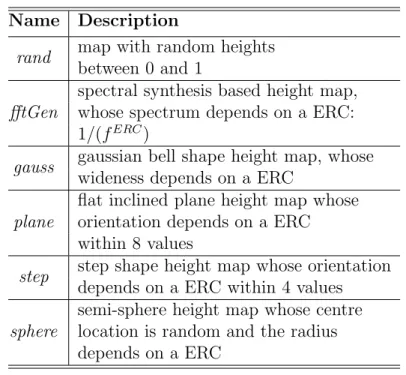
(54) 30. CHAPTER 3. ARTIFICIAL TERRAINS. Figure 3.1: A discrete height map example. to perform collision detection in an efficient way. Having this considerations in mind, several alternative data structures to represent terrains will be analyzed: • height maps; • voxel grids; • non-uniform meshes; • analytical and fractal functions (procedural functions); Height Maps - Height maps are probably the most common method used to represent terrains. Formally, a height map is a scalar function of two variables, such that for every coordinate pair (x, y) corresponds an elevation value h, as shown in Eq. (3.1). In practice a height map is a two-dimensional, rectangular grid of height values, where the axis values are spaced with regular intervals valid over a finite domain (see Figure 3.1). The most common data structure to represent them are 2D arrays filled with the elevations values. h = f (x, y) .. (3.1). The height maps’ regular structure is their main advantage: it allows the optimization of operations such as rendering, collision detection and.
(55) 3.1. REPRESENTATION. 31. path finding. The render of huge height maps in real-time is now possible due to the creation of several continuous level of detail (CLOD) algorithms (Duchaineau et al, 1997; Li et al, 2003; Losasso and Hoppe, 2004), which render highly visible areas of the terrain with detailed geometry, using progressively simpler geometry for more distant parts of the terrain. Collision detection is greatly simplified if one of the objects is a height map, because only a few surrounding triangles need to be checked for collision. If the values of a height map are normalized it becomes the same thing as gray scale image. This means that image processing and computer vision techniques may be used to construct, modify and analyze terrain models represented as height maps. For example, a height map can be stored, imported or exported using an image file format, or a filter can be applied to smooth a rough terrain. Finally, Geographic Information Systems (GIS) use height maps to represent real world terrain, which are commonly built using remote sensing techniques such as satellite imagery and land surveys. This is another advantage due to the significant amount of real world terrain models available to work with. The main limitation of height maps is the inability to represent structures where multiple heights exist for the same pair of coordinates. So height maps are inherently unable to represent caves, overhangs, vertical surfaces, and other terrain structures in which multiple surfaces have the same horizontal coordinates. Fortunately, only a small percentage of natural terrain fall into this category and this limitation can be overcome by using separate objects placed on top of the terrain model. A second disadvantage of height maps is that it has a finite uniform resolution, which means there is no simple way to handle a terrain with different local levels of details. If the resolution is chosen to match the average scale of the features in the terrain, then any finer-scale features will be simplified or eliminated. Conversely, if the resolution is chosen to be high enough to capture the fine-scale features, areas containing only coarse features will also be captured at this same high resolution, an undesirable waste of space and processing time. Ideally, a terrain representation for terrain generation would either be infinite in resolution, or else would adaptively increase its resolution to accommodate the addition of.
(56) 32. CHAPTER 3. ARTIFICIAL TERRAINS. fine scale details, rather than requiring an a priori decision about resolution. A third disadvantage of height maps is its inadequacy to represent terrain on a planetary scale. Rectangular height maps do not map directly to spheroid objects, usually a two-pole spherical projection is used. In those cases the density of height field points will be substantially greater in areas near the poles than at those near the equator. Voxel Grids - A voxel grid is a discrete three-dimensional grid of volumetric pixels (voxels) where each voxel is filled or not. This structure allow the representation of arbitrary 3D shapes. The voxel grids’ advantage over height maps is their ability to represent any terrain structures like caves, overhangs and vertical surfaces. Hoever, voxel grids share the same disadvantages of height maps, such as finite resolution and inability to gracefully handle planetary curvature. Additionally, operations like rendering and collision detection consumes more processor power and memory than height maps. Non-Uniform Meshes - The terrain surface can be represented as an arbitrary mesh of 2D primitives, usually polygons, in the 3D space. This is a more general representation of 3D objects and there are several tools to work with this representation. A special case of a non-uniform mesh is TIN (triangular irregular network) (Pajarola et al, 2002). A TIN is a vector based representation of a physical surface made up of irregularly distributed nodes and lines with three dimensional coordinates (x, y, z) that are arranged in a network of non-overlapping triangles. TINs are often derived from the elevation data of a rasterized digital elevation model (DEM). The main benefit of using non-uniform meshes to model the terrain surface is that they are extremely general. The surface may have arbitrary geometry (overhangs, caves, etc.). This is the most common paradigm used in 3D tools and allows an artist to freely model any arbitrary 3D object using a single modeling paradigm. Furthermore, there are a significant amount of available tools to work with. A second advantage of using a TIN over a height map is that the points of a TIN are distributed variably based on.
(57) 3.1. REPRESENTATION. 33. an algorithm that determines which points are most necessary to an accurate representation of the terrain. So, they naturally support variable level of detail, allowing more vertices in areas of sharp change and relatively few vertices in flat areas. As a result, a mesh structure can store some terrain models much more efficiently than regular grid methods, since it does not require a globally high resolution in order to achieve fine-scale features in a few places. The main problem when using meshes for terrain generation is that it is not clear how to generate them automatically. Although a terrain is always tessellated into polygons before rendering, to the best of our knowledge, there are no methods (other than manual sculpting) to directly generate a non-uniform mesh. Analytical and Fractal Functions - Another way to represent terrains is through the use of fractal functions or analytic expressions (procedural content). This approach is not used often, being MojoWorld 1 and GTP, our technique (see Chapter 5) two examples. The main advantage of analytical and fractal functions is the ability of being displayed at any scale without losing resolution. Due to the continuous nature analytical functions it is possible to recalculate the terrain so it does not look faceted when viewed close-up, like height maps tend to do. Some analytical functions are render friendly and/or amenable for collision detection. Others, such as polynomial surfaces of low degree (quadratic and below), allows ray/surface intersections to be calculated in a straightforward way. However, terrains produced by analytic functions tend to become more and more linear when enlarged. On the other hand, fractals functions continue to produce new details as they are evaluated progressively at finer scales. One problem with this approach is the complexity to render the terrain directly from the functions, because ray tracing systems and hardware were built to work with polygon-based rendering. One way to address this issue is the introduction of an additional stage were the function is converted to another form of terrain representation, like height maps, before rendering, 1. http://www.pandromeda.com/products/.
(58) 34. CHAPTER 3. ARTIFICIAL TERRAINS. but with performance costs. But the main challenge of analytical functions is to model them. If a single, global function is used, it is difficult to know how to modify it to achieve a certain local effect. A more common approach is the use of several functions to compose a full landscape, were B-spline patches are an example. Fractals present the same disadvantage due to the few input variables to control the output.. 3.2. Generation Techniques. Terrain generation techniques can be divided in three main categories: measuring, modeling, and procedural. Although our interest is on procedural techniques, we briefly review the two other categories, because some techniques present characteristics from more than one category. Measuring - In the measuring techniques elevation data is derived from real-world measurements to produce Digital Elevation Models (DEM), commonly built using remote sensing techniques such as satellite imagery and land surveys 2 . This is the most common basis for digitally-produced relief maps. Measuring has the advantage of producing highly realistic terrains with very little human effort, but at the expense of control. If the designer has specific goals for the the terrain’s design and features (e.g. mountains, valleys, lakes) this approach may be very time-consuming, as the designer might have to search extensively to find real-world data that meets his specific criteria. Modeling - Modeling is by far the most flexible technique for terrain generation and all kins of handcrafted content. A human artist models or sculpts the terrain morphology manually using a 3D modeling program (e.g. Maya 3 , 3D Studio 3 , or Blender 4 ), or a specialized terrain editor program 2. http://rockyweb.cr.usgs.gov/nmpstds/demstds.html http://www.autodesk.com/fo-products 4 http://www.blender.org 3.
Imagem
+7

Documentos relacionados
Como ponto negativo, temos a dificuldade de interpretação de alguns comentários feitos pelo professor, pois o não entendimento provoca um obstáculo no processo
No âmbito dessas discussões, neste artigo teve-se como objetivo identificar os impactos decorrentes de iniciativas de ES no que tange às possibilidades, desafios e
Tem experiência na área de Educação, com ênfase em História da Educação, História da Infância e Educação Infantil, atuando principalmente nos seguintes temas: história
Foi com certeza a época que ouve novas manifestações e com isso, os estudantes, as organizações da população foi ganhando mais espaço, foram cada vez mais lutando pelos seus
PhD Thesis of Frederico Maia 154 Figure 64: (a) release studies and (b) biological activity of MBT@SiNC and DCOIT@SiNC when incorporated in carbon steel aqueous
Este é o inicio do decrescimento como uma área de pesquisa académica e em debate internacional na sociedade civil (Research and Degrowth, 2012b). A declaração de Paris, que
A Inteligência Artificial (IA) pode ser definida como a teoria e/ou desenvolvimento de sistemas para execução de tarefas que, normalmente, requerem inteligência humana, como
Figura 7 - Comparação entre cockpits e numa varanda de uma casa rural, de manhã cedo no Verão.. .A fim de explorar melhor a redução dos tempos de registo durante as
