Printed version ISSN 0001-3765 / Online version ISSN 1678-2690 http://dx.doi.org/10.1590/0001-3765201720170233
www.scielo.br/aabc | www.fb.com/aabcjournal
Periodic complex map germs and foliations
LEONARDO M. CÂMARA and BRUNO A. SCÁRDUA Universidade Federal do Espírito Santo, Departamento de Matemática - CCE,
Av. Fernando Ferrari, 514, 29075-910 Vitória, ES, Brazil
Universidade Federal do Rio de Janeiro, Instituto de Matemática, Caixa Postal 68530, 21945-970 Rio de Janeiro, RJ, Brazil
Manuscript received on April 10, 2017; accepted for publication on June 1, 2017
ABSTRACT
In this paper we study topological and analytical conditions on the orbits of a germ of diffeomorphism in the complex plane in order to obtain periodicity. In particular, we give a simple proof of a finiteness criteria for groups of analytic diffeomorphisms, stated in Brochero Martínez 2003. As an application, we derive some consequences about the integrability of complex vector fields in dimension three in a neighborhood of a singular point.
Key words:Complex germs of diffeomorphims, singular holomorphic foliations, integrability of vector fields, closed orbits.
1 - INTRODUCTION
The relationship between periodic subgroups of Diff(C,0)and the integrability of germs of vector fields at (C2,0)was established in Mattei and Moussu 1980. There the authors show that the topological condition
of finiteness of the orbits is sufficient to ensure the periodicity of a finitely generated sugbroup at Diff(C,0).
As a consequence, they obtain that the topological condition of closeness of the orbits of a germ of vector fieldX is equivalent to the existence of a first integral, i.e., a germ of mapf : (C2,0)−→ (C,0)whose
level sets contain the orbits ofX. The link between these two objects is obtained in terms of the so called holonomy group, introduced by Charles Ehresmann.
In this paper we show that forn = 2a completely distinct phenomena occur. In fact we present and
explicit example (Example 2.1) showing that the finiteness of the orbits of a cyclic subgroup of Diff(C2,0)
is not enough to ensure its periodicity. From this example we construct a vector fieldXat(C3,0)(Example
3.1) whose leaves are closed but are not contained in the level sets of a map-germF : (C3,0)−→(C2,0).
In the sequel we show that the periodicity of a germ of diffeomorphism at(C2,0)is achieved if we
add one further topological condition, i.e., the finiteness of the orbits together with the Lyapunov stability
AMS Classification: Primary 37F75, 57R30; Secondary 32M25, 32S65. Correspondence to: Leonardo Meireles Câmara
condition. In terms of vector fields this may be translated by saying that X admits a first integral F : (C3,0)−→(C2,0)if and only if its orbits are closed off the origin and transversely stable (in the sense of
Lyapunov and Reeb) with respect to a distinguished smooth separatrix.
In the final part of the paper we show that these new topological aspects may be reinterpreted in terms of flags of foliations (Theorem 3.4). Finally we want to mention that we also present in this paper a simple proof of a finiteness criteria for groups of analytic diffeomorphisms (Theorem 2.2), stated in Brochero Martínez 2003, since it is one of our main ingredients.
2 - GERMS OF DIFFEOMORPHISMS WITH FINITE ORBITS 2.1 - PRELIMINARIES
Let Diff(Cn,0)denote the group of germs of diffeomorphisms ofCnfixing the origin. LetG∈Diff(C2,0)
andV be a neighborhood of the origin, where a representative (also denoted byG) of the germGis defined. Then we denote by
O+V(G, x) =nG◦(n)(x) : G◦(j)(x)∈V,j = 0, . . . , no
the so-calledpositive semiorbitofx ∈V byG. Analogously, thenegative semiorbitofx∈ V byGis the setOV−(G, x) :=O+V(G−1, x). Theorbitofx∈V byGis the setOV(G, x) =O+
V(G, x)∪ O
−
V(G, x). The
cardinality ofOV(G, x)is denoted by|OV(G, x)|.
A diffeomorphismf ∈ Diff(Cn,0)is said to betangent to the identityif it can be expanded in series
of homogeneous polynomials asf = (f1, ..., fn)withfj(z) = zj +fj,νj(z) +· · ·, wherefj,νj 6≡ 0and
ord(fj,k) = kwheneverfj,k 6≡0. Then one says thatν(f) = min{ν1, ..., νn}is theorderoff. The set of germs of diffeomorphisms tangent to the identity is denoted by Diff1(Cn,0).
Letf ∈Diff1(C2,0), then we say thatϕ: Ω−→Cnis aparabolic curveforf at the origin if it is an injective holomorphic map satisfying the following properties:
(1) Ω⊂Cis a simply connected domain with0∈∂Ω;
(2) ϕis continuous at the origin andϕ(0) = 0∈Cn;
(3) ϕ(Ω)is invariant underf and(f|ϕ(Ω))◦(n)→0∈Cnasn→ ∞.
Let f(x) = x +fν(x) +O(kxkν+1), where fν(x) = (f1,ν(x), f2,ν(x)) 6≡ 0 with fj,ν being
ho-mogeneous polynomial of degree ν. Then we say that f is dicritical if x2f1,ν(x) −x1f2,ν(x) ≡ 0 and
non-dicritical otherwise. The relationship between parabolic curves and dicritical fixed points is given by the following result.
Theorem 2.1(Abate 2001). Letf ∈Diff1(C2,0)be a dicritical germ of holomorphic map tangent to the
identity, thenf admits infinitely many parabolic curves.
2.2 - INFINITELY MANY INVARIANT SETS
Theorem 2.2. LetG ∈ Diff(C2,0), then the group generated by Gis finite if and only if there exists a
neighborhoodV of the origin such that|OV(G, x)| < ∞for allx ∈ V andGpreserves infinitely many
analytic invariant curves at0.
Here we shall present a simple and consistent proof for it. Since the necessary part of Theorem 2.2 is trivial, then we only prove its sufficient part in the following series of claims. For this sake, we need to recall some terminology from complex dynamics.
A germ of curveS⊂(C2,0)is aseparatrixforfiff(S) =Sas germs of curves at the origin. Such a separatrix is calledperiodicof periodn∈Niff◦(n)(x) =xfor eachx∈S. The curveSis not necessarily irreducible and may have several branches. The mapf takes a branch into a branch and may interchange these branches. Nevertheless, sinceShas only a finite number of branches, we conclude that for each branch Sj ⊂ Sthere is1 ≤ mj ∈ Nsuch thatf◦(mj)(Sj) = Sj. Then clearly we havef◦(m)(Sj) = Sj, for all
j= 1, ..., r, wherem=m1· · ·mr. Thus, we have:
Claim 1. For each separatrixS of f there ismS ∈ Nsuch that each branchSj ofS is invariant with
respect tof◦(mS).
Remark 2.1. It is well-known that a map germh ∈ Diff(C,0)with finite orbits is necessarily periodic
(Mattei and Moussu 1980). Let nowS ⊂ (C2,0)be an irreducible separatrix of f ∈ Diff(C2,0). Put
h=f|S. We claim that ifhhas finite orbits thenhis periodic. Indeed, in caseSis (irreducible and) smooth this is immediate. In the general (irreducible) case we take a Newton-Puiseux parametrizationσ: (C,0)→ (S,0). This is a holomorphic injective map so that we may consider the “lift”h: (C,0)→(C,0), i.e., the
holomorphic map that satisfiesσ◦h=h◦σ. Thenh∈Diff(C,0)also has finite orbits and thus, is periodic.
Therefore, the same holds forh.
Combining Claim 1 and Remark 2.1 we promptly obtain:
Claim 2. For any separatrixSoff ∈Diff(C2,0)there existsN(S)∈Nsuch thatf|Sis periodic of period
N(S), i.e.,(f|S)◦(N(S))= (f◦(N(S)))
S=Id.
In view of the above result, from now on we suppose thatfadmits infinitely many periodic separatrices. We say that a set of separatrices for f is in general position if their first tangent cone intersect the exceptional divisor in at least three distinct points.
Claim 3. Letf ∈Diff(C2,0)and{Sj}∞
j=1be distinct periodic separatrices forf, then after a finite number
of blowing-ups onSthere appears a local map-germfe∈Diff(C2,0)admitting an infinite set of irreducible
periodic separatrices in general position.
Proof. It is immediate that after blowing-upS a finite number of times at least three distinct curves will intersect the exceptional divisor in three distinct points in such a way that one of these points intersects infinitely many separatrices.
Claim 4. Supposef ∈Diff(C2,0)has a set of irreducible periodic separatrices in general position. Then
there existsn∈Nsuch thatf◦(n)is tangent to the identity.
Proof. LetSj,j = 1,2,3, be three distinct periodic separatrices in general position of orders respectively
Figure 1 -Blowing-up infinitely many separatrices.
e
gbe the strict transform ofgby a blow-upπ :M −→D. IfD=π−1(0)is the exceptional divisor of this blow-up, then it follows immediately from the hypothesis that eg|D =Id. Let us prove that the first jet ofg is given by a diagonal matrix. Letg = (g1, g2), whereJ1gj(x, y) = αjx+βjy. After one blowing-up we
have
e
g(t, x) =
g2(x, tx) g1(x, tx)
, g1(x, tx)
=
α2+β2t α1+β1t
+x(· · ·), g1(x, tx)
.
Since eg|D = Id, then α2 = β1 = 0andα := α1 = β2 ∈ C∗. Therefore,J1g(x, y) = (αx, αy).Now, suppose the three irreducible invariant curves are smooth (or resolved after one blowing-up), then we may suppose without loss of generality that S : (y = 0)is an invariant periodic curve forg. In particular, its
strict transformSe: (t= 0)is periodic with respect toeg. Since eg|D(0, x) = (0, g1(x,0)) = (0, αx+· · ·), thenα = exp(2nπim )is a root of unity. The result then follows. On the other hand, supposeSis a singular irreducible curve invariant byg(not necessarily periodic) and recall Remark 2.1. Letσ(s) = (sm, µsn+· · ·)
be the Newton-Puiseux parametrization forSeandg ∈ (C,0)be given byσ ◦g(s) = eg◦σ(s). Ifg(s) =
λs+· · ·, then
(λmsm+· · · , µλnsn+· · ·) =eg(sm, µsn+· · ·) = (sm+· · · , αµsn+· · ·),
thusλm = 1andα=λn; i.e.,α =exp(2knπi
m )is a root of unity. The result then follows.
Claim 5. Supposeg ∈ Diff1(C2,0)admits an infinite number of separatrices, then along its resolution π : (M, D) −→ (C2,0)there appears a dicritical map-germ eg ∈ (M, p) tangent to the identity in a
neighborhood ofp∈D.
Proof. Letegbe the strict transform ofgby a resolutionπ :M −→(C2,0), then to each invariant curveS there corresponds a fixed point foregalongM. Therefore, at least one of the projective spaces composing
the exceptional divisorD = π−1(0)admits infinitely many separatrices forgtransversal to it. The result then follows.
Therefore, in order to prove Theorem 2.2 we just have to combine the above claims with Abate’s theorem.
2.3 - INVARIANT FUNCTIONS
A finitely generated subgroupG⊂Diff(C,0)is finite provided that it has finite pseudo-orbits (Mattei and
Moussu 1980). Contrasting with the one dimensional case, in greater dimensions the finiteness of the orbits is not enough to ensure the periodicity of the group.
Example 2.1. Consider the mapG(x, y) = (x+y2, y). The orbits ofGare confined in the level sets of f(x, y) =yand are clearly finite. Notice that #OV(G,(x, y))→ ∞asy → 0, thusGis not periodic nor linearizable. Furthermore, the orbitsOV(G,(x, y))are far from being stable, since in each line(y=c)the
Blowing up this diffeomorphism (cf. Abate 2001)G= (g1, g2) = (x+y2, y)at the origin one has
e
G(t, x) =
g
2(x, tx) g1(x, tx)
, g1(x, tx)
=
t
1 +t2x, x+t 2x2
= (t(1−t2x2+t4x4−t6x6+· · ·), x(1 +t2x))
= (t−t3x2+t5x4−t7x6+· · ·, x+t2x2)
whose orbits are finite and confined in the level sets offe(t, x) =tx. Further,Gacts in these level sets offe in some sort of translation whose orbits increase in cardinality asfe(t, x)→0.
Therefore in order to obtain periodicity we need to ask some further conditions. We say that two germs of holomorphic functionsf, g∈ O2 aregenerically transverseifdf ∧dgis not identically zero.
Theorem 2.3. Letf, g∈ O2be generically transverse germs andG∈Diff(C2,0)be a complex map germ
having finite orbits and preserving the level sets of bothf andg. ThenGis periodic.
Proof. The idea of the proof is the following: Sincef andg are generically transverse, then one can find a pure meromorphic functionho =fo/gowhose level sets are preserved byG. Hence, the infinitely many
curvesfo(x, y)−c·go(x, y) = 0, withc∈ C, intersect the origin and are invariant byG. Thus Theorem 2.2 ensures thatG is periodic. Now let us construct ho. If f/g is already pure meromorphic, then it is
enough to pickho :=f/g. Otherwise one hasf =h·gk, wherek ∈Z+, andhis a germ of holomorphic function not divisible byg. Clearly,hisG-invariant, thus if it has an irreducible component distinct from the irreducible components ofg, thenh/gmust be aG-invariant pure meromorphic function. Suppose that the decomposition in irreducible components ofgandhare of the formg=gp1
1 · · ·g
pn
n andh=gq11· · ·gqnn .
Sinceh is not divisible by g, then there must be j0 ∈ {1,· · ·, n} such that qj0 < pj0. If there is also
j1 ∈ {1,· · · , n} such that qj1 > pj1, thenh/g is a pure meromorphicG-invariant function. From now
on we suppose thatqj ≤ pj for allj = 1, . . . , n with at least onej0 ∈ {1,· · · , n}such that qj0 < pj0.
If there isj1 ∈ {1,· · · , n}such that qj1 = pj1, then after reordering the indexes (if necessary) we may
suppose that: (i)qi < pi for all i = 1, . . . , n0; (ii)qi = pi for all i = n0 + 1,· · · , n; for somen0 ∈
{1,· · · , n−1}. Thenh:=g/h=gp1−q1
1 · · ·g
pn0−qn0
n0 is aG-invariant germ of holomorphic function. Now,
lets1 := [p1/(p1−q1)] + 1(where[x]denotes the integer part ofx∈R), then a straightforward calculation
shows thatg/hs1
is a pure meromorphic function. Hereafter we suppose thatqj < pj for allj = 1, . . . , n.
Recall that the Euclid’s algorithm of a pair of positive integers(p, q), p > q, is the sequence of pairs of positive integers{(pj, qj)}jn=1+1 given by: (1)(p1, q1) := (p, q); (2)pj = qj ·rj +sj, whererj := [p/q]
andsj < qj; (3)(pj+1, qj+1) := (qj, rj); and (4) sn > 0 and sn+1 = 0. This is called the Euclid’s sequence of the pair(p, q). For simplicity, suppose thatgandhhave only two irreducible components, say g=fp(f)pandh=fq(f)q, and let{(p
j, qj)}nj=1+1and{(pj, qj)}nj=1+1be the Euclid’s sequence of(p, q)and
(p, q), respectively. Ifr1 = [p1/q1]< [p1/q1] =r1, thenp1−(r1+ 1)q1 <0andp1 −(r1+ 1)q1 ≥ 0.
Ifp1 −(r1 + 1)q1 6= 0, then g/hr1+1 is a G-invariant germ of pure meromorphic function, otherwise g/hr1+1
= 1/f(r1+1)q1−p1andg
·(g/hr1+1
)p1is aG-invariant germ of pure meromorphic function. Arguing
inductively along the Euclid’s sequences of(p, q)and(p, q)one can always construct aG-invariant pure
meromorphic function unlessrj = rj for allj = 1,· · · , n+ 1. But this means that (p, q) = (αsn, βsn)
and(p, q) = (αsn, βsn)for someα, β ∈Z+. Therefore,g,h, andf are powers of the same holomorphic functionfsn(f)sn, thusfandgcannot be generically transverse. A contradiction! The reasoning in the case
Figure 2 -A dicritical component ofFe.
In particular, Theorem 2.3 ensures that the mapGdefined in Example 2.1 does not preserve the level sets of a couple of generically transverse functionsf, g∈ O2.
2.4 - INVARIANT FOLIATIONS
Letω be a germ of holomorphic 1-form at0∈C2. Assume that Sing(ω) = {0}and letFω be the germ of
foliation at0 ∈C2 given by the Pfaff equationω = 0. We denote by Aut(Fω)the subgroup of Diff(C2,0)
given by thoseφ∈Diff(C2,0)preservingFω, i.e., such thatφ∗ω∧ω = 0.
Given a mapφ∈Diff1(C2,0), we haveφ(x, y) =exp[1]Xb(x, y)for a (unique) formal vector fieldXb of order at least two (cf. Brochero Martínez et al. 2008, Câmara and Scárdua 2012) called theinfinitesimal generator ofφ. Let F be a germ of foliation at 0 ∈ C2 having a dicritical component (i.e., admitting
infinitely many separatrices through the origin). We shall say thatF isadapted toφif there is a resolution π : (M, D) −→ (C2,0)ofXb such thatπ∗(F)has infinitely many curves transverse toD(this happens precisely when we blow-up a dicritical component ofF along the resolution ofXb).
Lemma 2.4. LetFω be a germ of foliation at(C2,0)having a dicritical component and adapted toφ ∈
Diff1(C2,0). Thenφ∈Aut(Fω)having finite orbits if and only ifφis the identity.
Proof. For simplicity we shall writeF =Fω. Letπ : (M, D)→(C2,0)be the resolution ofφintroduced in Abate M. 2001,Fe:=π∗Fthe strict transform ofF viaπ, andφethe lifting ofφ. Sinceφ∈Diff
1(C2,0), then φe|D = Id|D. IfFje ⊂Fe is a dicritical component ofFedefined in a neighborhood of the irreducible
componentDj ⊂D, then it is given in appropriate coordinate systems by a fibration transversal toDj, up
to a finite number of singular leaves or smooth leaves tangent toDj. More precisely, there is an open set
Uj := Dj\{p1,· · · , pr}such that φe|Uj can be seen as a family of germs of automorphisms of(C,0)with
parameters in Uj ⊂ Dj ≃ CP1 (see Figure 1). Letφet ∈ (C,0)be given byφet(x) := φe(t, x) for some
t∈Uj, then the classical Leau-Fatou flower theorem (Bracci 2004) says thatφethas a parabolic fixed point
at the origin, unless it is the identity. The result then follows by analytic continuation.
2.5 - STABILITY
A germ of mapG∈Diff(C2,0)is said to bepositively semistableif for any representativeG:U −→G(U),
whereU is an open neighborhood of the origin, and any open setV ⊂U there is an open subsetW ⊂ V such thatG◦(n)(W) ⊂V for alln∈Z
Lemma 2.5. LetG ∈ Diff(C2,0)be represented by the mapG :U −→ V, whereU, V ⊂ C2 are open
neighborhoods of the origin with compact closure. Suppose that:
1. Gis positively semistable.
2. Ghas finite orbits.
ThenGis periodic, i.e., there isp∈Z+such thatG◦p =Id.
Proof. By the positive semistability, there areW andV as above withW ⊂V and satisfyingG◦(n)(x)⊂V for allx ∈ W andn ∈ Z+. Now consider the analytic setCq := {x ∈ W :G◦q = x}, whereq ∈ Z+. ThenCqis a closed set without interior points. Since the orbits ofGare all periodic we haveW =S∞q=1Cq.
From Baire’s category theorem, someCqmust have an interior point and therefore by the Identity Principle
Gis periodic.
3 - APPLICATIONS TO FOLIATIONS 3.1 - INTEGRABILITY, FIRST INTEGRALS, AND CLOSED ORBITS
The problem of deciding whether a vector field or, more generally, an ordinary differential equation can be integrated by studying its number of non-transcendent solutions goes back to H. Poincaré, Dulac (cf. Dulac 1912) and other authors. The classical theorem of G. Darboux (cf. Jouanolou 1979) states that a polynomial vector field in the complex plane admits a rational first integral provided that it admits infinitely many algebraic solutions. Our natural framework is the class of analytic equations. With the arrival of the Theory of Foliations the use of geometrical/topological methods has given an important contribution to the comprehension of the problem as well as some important results. Indeed, a holomorphic vector fieldX defined in a neighborhoodU ⊂Cn,n≥2, of the origin0∈Cn, with an isolated singularity at the origin,
defines a germ of one-dimensional holomorphic foliation (with a singularity at the origin), and vice-versa. In dimension two (or codimension one) a classical result (cf. Mattei and Moussu 1980) states that a germ of holomorphic vector field at the origin ofC2admits a holomorphic first integral if and only if : (i)
the leaves are closed off the origin; (ii) only finitely many of them are separatrices, i.e., adhere to the origin. Condition (ii) is usually known asnon-dicriticalnessof the (germ of) foliation induced by the (germ of) vector field (cf. Camacho and Sad 1982). A foliation germ admitting a pure meromorphic first integral is necessarily dicritical. An example of Suzuki shows that there is no such topological criteria for existence of a meromorphic first integral (cf. Suzuki 1977, Klughertz 1992). Also interesting is the point of view adopted in Alexander and Verjovsky 1988, where the authors prove the existence of a holomorphic first integral for a germ of singular holomorphic vector field in dimensionn ≥ 2, under the hypothesis of existence of a
uniform bound for the volume of the orbits of the vector field and some additional condition that restricts the“dicritical case”.
Our goal is to investigate topological conditions assuring the existence of holomorphic first integrals for vector field germs in dimension3. This is done in Theorem 3.4. In few words, our result shows, for a
Let us introduce the notation we use, already used in Câmara and Scárdua 2009. Denote the ring of germs of holomorphic functions at(Cn,0)by Onand its maximal ideal byMn. By X(Cn,0)we denote
theOn-module of germs at the origin0 ∈Cnof holomorphic vector fields. Given a germX ∈X(Cn,0),
we denote byFX the germ of one-dimensional holomorphic foliation at(Cn,0)induced byX. Let us make clear the notions we use:
Definition 3.1(holomorphic first integral). LetFX be a germ of one-dimensional holomorphic foliation at
0∈Cn, n≥2. A germ of holomorphic mapF: (Cn,0)→(Cn−1,0)is a holomorphic first integral forFX
if:
(a) Fis a submersion off a codimension≥1analytic subset.
(b) The leaves ofFX are contained in the level curves ofF.
A meromorphic function germf ∈ Mn at 0 ∈ Cn is called FX-invariant if the leaves of FX are
contained in the level sets off. This can be written asiX(df) =X(f)≡0.
3.2 - NON-DEGENERATE GENERIC VECTOR FIELD GERMS
Next we describe the class of vector field germs we shall work with.A germX∈X(Cn,0)isnon-degenerate
if its linear part DX(0) ∈ Lin(Cn) is non-singular. Generically (in terms of the Krull topology for the
coefficients ofX) the mapDX(0)∈Lin(Cn)hasndistinct eigenvalues, is diagonalizable, andXhas an isolated singularity at the origin. From Poincaré-Dulac, Siegel, and Brjuno linearization theorems and from Camacho, Kuiper, and Palis 1978,generically(i.e., for a full measure subset of the set of the set of germs of holomorphic vector fields), up to a change of coordinates, the vector fieldXleaves invariant thecoordinate
hyperplanesx1· · ·xn= 0. We then introduce the following definition:
Definition 3.2(Non-degenerate generic vector field germs). We shall say thatXis non-degenerate generic ifDX(0)is non-singular, diagonalizable and, after some suitable change of coordinates,Xleaves invariant the coordinate planes.
We shall denote by Gen(X(Cn,0))the set of germs of non-degenerate generic vector fields at(Cn,0).
LetX∈Gen(X(Cn,0))andSbe aseparatrixofX, i.e., an analytic curve germ invariant byFXintersecting
the origin. From the Newton-Puiseux parametrization theorem one knows thatS\ {0}has the topology of
a punctured disc D\ {0}. Then we denote by Hol(FX, S,Σ)the cyclic holonomy ofFX with respect to
S evaluated at a sectionΣtransverse toS, whereΣ∩S = {qΣ}is a single point. We can choose Σto be biholomorphic to a disc in Cn−1 with center corresponding toq
Σ. With this identification the group Hol(FX, S,Σ)is analytically conjugate to a subgroup of the group Diff(Cn−1,0).
AnFX-invariant germf ∈ Mnis called adaptedto(FX, S) if it can be written locally in the form
f =g/h, whereg, h∈ Onare relatively prime,S ⊂Z(g)∩Z(h), whereZ(g)andZ(h)denote the zero
sets of gandhrespectively, and f|Σ is pure meromorphic for a generic transverse sectionΣtoS. Given
X, Y ∈Gen(X(C3,0))we haveFX =FY if and only if for some nonvanishing holomorphic function germ
uwe haveY =uX. In this case we say thatXandY aretangent.Any vector field germX∈Gen(X(C3,0))
Definition 3.3(condition(⋆)). A germ of generic vector fieldX ∈Gen(X(C3,0))satisfies condition(⋆)
if there is a real lineL⊂Cthrough the origin containing all the eigenvalues ofXand such that not all the eigenvalues belong to the same connected component ofL\ {0}.
There is therefore oneisolatedeigenvalue ofX. The above condition holds forXif and only if holds for any vector fieldY such thatXandY are tangent. Condition(⋆)implies thatXis in the Siegel domain, but is stronger than this last. Denote byλ(X)the isolated eigenvalue ofXand bySX its corresponding invariant
manifold (the existence is granted by the classical invariant manifold theorem). We callSXthedistinguished
axisofX. We shall say thatXistransversely stablewith respect toSX if for any representativeXUof the
germX, defined in an open neighborhoodU of the origin, any open sectionΣ⊂U transverse toSX with Σ∩SX ={qΣ}, and any open setqΣ∈V ⊂Σthere is an open subsetqΣ ∈W ⊂V such that all orbits of XU throughW intersectΣonly inV.
In this paper we prove various equivalent conditions for the integrability of a generic germ of complex vector field singularity in dimension three (cf. Theorem 3.4). This full statement involves the notion offlag
(Corrêa and Soares 2013, Mol 2011) and Kupka singularities (Calvo-Andrade 1994, Kupka 1964), to be developed later in this paper. For the moment we state the following topological criteria.
Theorem 3.1. For anyX∈Gen(X(C3,0))the following conditions are equivalent:
1. FX has a holomorphic first integral.
2. Xsatisfies condition(⋆)and the leaves ofFX are closed off the origin and transversely stable with
respect toSX.
From this result we conclude the invariance of the existence of a holomorphic first integral for generic germs in dimension three under topological equivalence.
Corollary 3.2. LetX, Y ∈Gen(X(C3,0))be generic germs of holomorphic vector fields, both satisfying
condition(⋆). Assume thatXandY are topologically equivalent. ThenXhas a holomorphic first integral
if and only ifY admits a holomorphic first integral.
We stress that Theorem 3.1 above can be completed (cf. Theorem 3.4) by weakening the topological hy-pothesis on the orbits, replacing the transverse stability by the existence of a suitable flag, i.e., a codimension one foliation tangent toFX.
3.3 - CLOSED LEAVES AND FIRST INTEGRALS
We show that the closing of the leaves is not sufficient to ensure the existence of first integrals forFX with
X ∈ Gen(X(C3,0)). We first remark (cf. also Câmara and Scárdua 2009, Proposition 1, Section 2.3) that
for a generic vector field germXthe local holonomy group Hol(FX, SX,Σ)is generated by a resonant map
preserving two smooth curves crossing transversely. In particular, one cannot expect a map like the mapG in Example 2.1 appearing as the (generator of the) holonomy of someX ∈Gen(X(C3,0))with respect to
SX. Thus, we blow up such map and look to a neighborhood of the point determined by the exceptional
divisor and the strict transform of(y= 0). LetX∈X(C3,0)be given by
X(x) =−m1[x1(1 +a1(x)) +x2b1(x)] ∂ ∂x1 −
m2x2(1 +a2(x)) ∂ ∂x2 +
where m1, m2 ∈ Z+, S := (x1 = x2 = 0), and Σ := (x3 = 1). Now consider the closed loop γ :
[0,1] −→ S given by γ(t) = (0,0, e2πit) and letΓ(x1,x2)(t) = (Γ1(t, x1, x2),Γ2(t, x1, x2), γ(t))be its
lifting along the leaves ofFX starting at(x1, x2,1)∈ Σ. In particular, the maph ∈ Diff(C2,0)given by
Γ(x1,x2)(1) = (h(x1, x2),1)is a generator of Hol(FX, S,Σ). SinceΓ(x1,x2)(t)belongs to a leaf ofFX, then
∂
∂tΓ(x1,x2)(t) =αX(Γ1(t, x1, x2),Γ2(t, x1, x2), γ(t)).
From this vector equation one hasγ′(t) =αγ(t), thusα= 2πi. Furthermore
∂
∂tΓ1 =−2m1πi[Γ1·(1 +a1(Γ1,Γ2, γ)) + Γ2·b1(Γ1,Γ2, γ)], (1) ∂
∂tΓ2 =−2m2πiΓ2·(1 +a2(Γ1,Γ2, γ)). (2)
Example 3.1. LetX(x) =−[x1+x22b(x3)]∂x∂1 −3x2∂x∂
2 +x3
∂
∂x3, thenS:={x1=x2 = 0}is invariant
byXand the holonomy ofFX with respect toSevaluated atΣ = (x3= 1)has the formh= (h1, h2)with hj(x1, x2) = Γj(1, x1, x2), whereΓ1andΓ2satisfy respectively equations (1) and (2) above. Now if we let
Γn(t, x1, x2) =Pi+j≥1cni,j(t)xi1x
j
2, then (2) is written in the form
∂
∂tΓ2=−6πiΓ2.
More precisely d
dtc2i,j(t) = −6πi· c2i,j(t), thus ci,j2 (t) = λ2i,jexp(−6πit) for some λ2i,j ∈ C. Since Γ2(0, x1, x2) = x2, then λ20,1 = 1andλ2i,j = 0otherwise. Therefore Γ2(t, x1, x2) = exp(−6πit)·x2 andh2(x1, x2) =x2. On the other hand, (1) is written in the form
∂
∂tΓ1 =−2πi[Γ1+e −6πitx2
2b(γ(t))] =−2πi(Γ1+e−6πitb(e2πit)·x22).
Analogously, d
dtc1i,j(t) = −2πi·c1i,j(t)for all (i, j) 6= (0,2). Since Γ1(0, x1, x2) = x1, thenc11,0(t) = exp(−2πit) ·x1 and c1i,j(t) = 0 for all (i, j) /∈ {(1,0),(0,2)}. Finally dtdc10,2(t) = −2πi(c10,2(t) +
e−6πitb(e2πit)). Now recall that the solution to the Cauchy problem
α′(t) =−2πi·α(t)−2πie−6πitb(e2πit), α(0) = 0
is given by
α(t) =−2πie−2πit Z t
0
e2πise−6πisb(e2πis)ds=−e−2πit Z t
0
e−6πisb(e2πis)2πie2πisds
In particular,α(1) = −e−2πiR γ
b(z)
z3 dz. Thus, if we setb(z) = −z2/2πi, thenα(1) = 1andh(x1, x2) =
(x1+x22, x2).
Completing the above example we obtain:
Proposition 3.3. There is a vector fieldX∈Gen(X(C3,0))which satisfies condition(⋆)and has all leaves
Proof. We consider the vector field X(x, y, z) = −[x − 21πiy2z2]∂ ∂x − 3y
∂ ∂y + z
∂
∂z. Then X ∈
Gen(X(C3,0)). After one blow up along thez-axis one has
π∗X(t, x, z) =−(x− 1 2πit
2x2z2) ∂ ∂x+
1
x(−3tx−t(−x+t
2x2z2))∂ ∂t +z
∂ ∂z
=−x(1− 1 2πit
2xz2) ∂
∂x−t(2 +t
2xz2)∂ ∂t +z
∂ ∂z
which has an isolated singularity at the origin, and whose holonomy with respect to thez-axis is precisely the mapGein Example 2.1. Thus it satisfies condition(⋆)and has all leaves closed but, from Proposition 2.3
and from what we have observed in Example 3.1 above,FXdoes not admit a holomorphic first integral.
3.4 - STABILITY, FLAGS, AND FIRST INTEGRALS
Proposition 3.3 shows that the statements of Theorems 1.2 and 1.3 in Câmara and Scárdua 2009 are in-complete. The correct statement involves a natural adaptation of a classical notion for regular smooth foliations.
3.4.1 - Stability
We consider a germX ∈Gen(X(C3,0))satisfying condition(⋆).
Definition 3.4(stability). The germX is transversely stable with respect toSX if for any representative
XU of the germX, defined in an open neighborhoodU of the origin, any open sectionΣ⊂U transverse to
SX withΣ∩SX ={qΣ} 6={0}, and any open setqΣ∈V ⊂Σthere is an open subsetqΣ ∈W ⊂V such that all orbits ofXUthroughW intersectΣonly inV.
As above mentioned, Definition 3.4 is a natural adaptation to our singular framework of the classical notion of stability due to Lyapunov (Lyapunov 1892) and rediscovered by Reeb (cf. Godbillon 1991).
3.4.2 - Flags, dicritical components, and Kupka singularities
Let us first recall some basic notions from singularities of foliations in dimension two. LetF be a germ
of singular foliation at the origin0 ∈ C2, then Seidenberg’s theorem (Seidenberg 1968) gives a reduction
of the singularities ofF by the blow-up method. This is also calleddesingularizationorresolutionofF.
We say thatF has adicritical component if its resolution contains a non-invariant projective line. This is
equivalent to say thatF has infinitely many separatrices, i.e., infinitely many analytic leaves intersecting
the origin (Camacho and Sad 1982).
GivenX ∈X(C3,0), we denote its corresponding foliation byFX. By aflag containingFX, we mean
a germ of codimension one holomorphic foliationFωat0∈C3giving by an integrable holomorphic1-form
ω=Adx+Bdy+Cdzwith singular set Sing(Fω)of codimension≥2containing the origin and with the
property that (for some representatives of each foliation defined in a common domain containing the origin) each leaf ofFX is contained in some leaf ofFω. This last property is enclosed in the formulaiXω≡0. The
notion of flag is detailed in Mol 2011. A codimension two irreducible componentK ⊂ Sing(Fω)\ {0}is
integrable holomorphic 1-formωU, and a representativeKU ⊂Sing(FU)of the componentK⊂Sing(Fω),
there is a germ of foliation η(K) at 0 ∈ C2 such that for each point q ∈ KU there is a holomorphic
submersionϕq: Vq → C2, with the property thatq ∈ Vq ⊂ U, ϕq(q) = 0andϕ∗q(η(K)) = FU|Vq. The
foliationη(K)is then called theKupka transverse typeofFωalong the Kupka componentK. One says that the Kupka componentKisdicriticalif the corresponding transverse typeη(K)has a dicritical singularity
at the origin0∈C2, in the above sense.
Example 3.2. A particular case of a dicritical Kupka component is the one induced by the codimension one foliationFωm,n, whereωm,n = nydx−mxdy andm, n ∈ Z+. In fact it represents the product foliation FXm,n×(C,0)withXm,n =mx∂x∂ +ny∂y∂.
We shall call a dicritical Kupka componentη(K)ofradial typeif in suitable coordinatesη(K)is given
by a1-formωm,nas above.
Given a flagFω containing the foliationFX, consider its restriction Fω|Σ to a transverse sectionΣ≈
(C2,0)as above. SinceΣis transverse toFX, it is also transverse toFω off the singular set Sing(FX)and
therefore one may identify the germ induced byFωat the pointqΣ = Σ∩S(X)with the germ of foliation at the origin0 ∈C2. Then one says that Fω|Σ isdicritical if this corresponding germ in dimension two is
dicritical.
Definition 3.5(Adapted flag). Let nowX ∈Gen(X(C3,0))with linear part given byJ1(X) =mx∂x∂ +
ny∂y∂ −kz∂z∂ , then the local holonomy generatorhofFX with respect to the distinguished axiszis periodic
with linear part given byJ1(h)(x, y) = (exp(−2mπi
k )x,exp(−
2nπi
k )y). In particular,φ:=h
◦(k)is tangent to the identity. Therefore, this map can be written locally in the formφ(x, y) =exp[1]Xb(x, y), whereXb is its infinitesimal generator. Then one says that(FX,Fω) is an adapted flag ifFX ⊂ Fω is a flag such that
Fω|Σis a germ of foliation having a dicritical component adapted toφ=h◦(k).
Notice that the last definitions are of finite determinacy character. Furthermore, if Fω|Σ is dicritical,
then(FX,Fω)is automatically an adapted flag. Using this terminology, one may complete the statements
in Câmara and Scárdua 2009 as follows.
Theorem 3.4. Suppose thatX ∈ Gen(X(C3,0))satisfies condition (⋆) and let SX be the distinguished
axis ofX. Then the following conditions are equivalent:
1. The leaves ofFX are closed off the origin and transversely stable with respect toSX;
2. Hol(FX, SX,Σ)has finite orbits and is (topologically) stable;
3. Hol(FX, SX,Σ)is periodic;
4. FX has a holomorphic first integral.
Moreover, in terms of flags of foliations, the above conditions are also equivalent to each of the following conditions:
5. The leaves ofFX are closed off the origin and there is an adapted flag(FX,Fω);
6. The leaves ofFX are closed off the origin and there is a flag FX ⊂ Fω such that Fω is a Kupka
Proof of the first part of Theorem 3.4. It follows immediately from the definition of transverse stability of germs of vector fields and from (topological) stability of maps that (1) implies (2). It comes from Lemma 2.5 that (2) implies (3). Now let us prove that (3) implies (4). SinceXsatisfies condition(⋆)and Hol(FX, SX,Σ)
is linearizable, then Elizarov and Ilyashenko 1984 ensures thatFX is linearizable. Therefore, one may sup-pose without loss of generality thatX(x) = λx1∂x∂
1 +µx2
∂
∂x2 −κx3
∂
∂x3, where λ, µ, κ ∈ R+. Since
Hol(FX, SX,Σ)is periodic, one may suppose without loss of generality thatλ=m, µ=n, κ=k∈Z+. The result then follows from Lemma 2.3 in Câmara and Scárdua 2009. Finally let us verify that (4) im-plies (1). The existence of a first integral forFX ensures that the leaves of FX are closed off Sing(FX).
Furthermore, Hol(FX, SX,Σ) = hHi admits a couple of generically transverse FX-invariant
holomor-phic functions whose restrictions toΣhave the level sets preserved byH. Thus Theorem 2.3 ensures that
Hol(FX, SX,Σ)is periodic and, in particular, topologically stable. Hence the leaves ofFX are transversely
stable with respect toSX. This proves the first four equivalences in Theorem 3.4.
As a straightforward consequence (cf. Theorem 2 in Câmara and Scárdua 2009), one has the following topological criterion for the existence of invariant meromorphic functions for elements in Gen(X(C3,0)).
Theorem 3.5. LetX ∈ Gen(X(C3,0))satisfy condition(⋆)with distinguished axisSX. Suppose thatFX
has closed leaves off the origin and is transversely stable with respect toSX. Then there is anFX-invariant
meromorphic function adapted to(FX, SX).
Now we study the topological invariance of the existence of a holomorphic first integral for a generic germ of holomorphic vector field, as a consequence of our preceding results. We recall that two germs of holomorphic vector fieldsX andY at the origin0 ∈Cnaretopologically equivalentif there is a
homeo-morphismψ:U → V, whereU, V are neighborhoods of the origin0 ∈ CnandXU, YV are vector fields
representingX, Y respectively, such thatψtakes orbits ofXU into orbits ofYV. Such a mapψtakes
sepa-ratrices ofXU into separatrices ofYV: indeed, a separatrix ofXU is an orbit which is closed off the origin,
and the same holds for its image underψ. Assume that the vector fieldXis generic satisfying condition(⋆)
and admits a holomorphic first integral. In this case one has:
Claim 6. The vector fieldXis analytically linearizable, sayX(x, y, z) =Xn,m,−k:=nx∂x∂ +my∂y∂ −k∂z∂
with n, m, k ∈ Z+ in suitable local coordinates (x, y, z) ∈ (C3,0). In particular, X admits a unique
separatrix off the dicritical plane{z= 0}, and this separatrix corresponds to the distinguished separatrix
SX.
Proof. Indeed, the analytic linearization ofX is a straightforward consequence of the first part of Theo-rem 3.4 (or, since by hypothesis there is a holomorphic first integral, in view of Lemma 2.5 and Elizarov and Ilyashenko 1984). In this normal form
X(x, y, z) =Xn,m,−k:=nx
∂ ∂x+my
∂ ∂y −k
∂ ∂z
the “dicritical plane” is the plane{z = 0}and the distinguished separatrix is thez-axis. The orbitO(a,b,c) ofXthrough the point(a, b, c)is given by
Thus, if O(a,b,c) accumulates at the origin, eitherc = 0 orc 6= 0 anda = b = 0. For instance, ifc 6=
06=a, then the orbit is contained in the hypersurfacexkzn=akcn 6= 0, which does not accumulate at the
origin.
Lemma 3.6. A topological equivalence takes the distinguished axis ofXinto the distinguished axis ofY.
Proof. Indeed, as we have seen above, the imageψ(SX) is some separatrix ofY. If this is not the
distin-guished axis ofY, then the distinguished axis ofY is taken byψ−1 into a separatrix other than the distin-guished axis ofX. Therefore, according to Claim 6,ψ−1(S
Y)must be a separatrix of the “dicritical” part
ofX, i.e., in the coordinates(x, y, z)above, whereX(x, y, z) =Xn,m,−k, we haveψ−1(SY)⊂ {z = 0}.
Nevertheless, any invariant neighborhood of a leaf contained in a dicritical separatrix ofX off the origin intersects infinitely many separatrices (namely, those contained in the intersection of this neighborhood with the dicritical plane{z= 0}). On the other hand, this same phenomena does not occur for arbitrarily small
invariant neighborhoods of a leaf contained in the distinguished axisSY ofY. Therefore, necessarilyψ(SX)
is the distinguished axes ofY.
From the above considerations we immediately obtain Corollary 3.2 from Theorem 3.4.
3.4.3 - Flags and integrability
In this section we prove the remaining part of Theorem 3.4. We address therefore the following problem. Given a germ of foliation by curvesFX induced by a germ of vector field of the form
X=mx(1 +a(x, y, z)) ∂
∂x+ny(1 +b(x, y, z)) ∂
∂x −kz(1 +c(x, y, z) ∂
∂z (3)
with a, b, c ∈ M3, what are the consequences of the existence of a codimension 1germ of holomorphic foliation tangent toX, which is transversely dicritical with respect toS?
We begin by studying the consequences of the existence of a flag foliation with a dicritical transverse type for a vector filedX∈Gen(X(C3,0)).
Lemma 3.7. LetFX be a germ of foliation by curves at(C3,0),S an invariant curve ofFX through the
origin, andFω a codimension one foliation satisfying the following conditions:
(i) Fωis tangent toX;
(ii) There is a sectionΣtransverse toSsuch that Fω|Σis dicritical.
ThenFωis transversely dicritical with respect toS.
Proof. Since the orbits ofX are contained in the leaves ofF, then these leaves are invariant by the flow ofX. Therefore, ifΣ′ is another section transversal toSandh: Σ−→ Σ′is an element of the holonomy pseudogroup ofXwith respect toS, then it is a diffeomorphism taking the leaves of F|Σonto the leaves of
F|Σ′.
We are now in a position to finish the proof of Theorem 3.4. For this sake, let us first recall some facts proved along this work and introduce some terminology. First notice that any X ∈ Gen(X(C3,0))
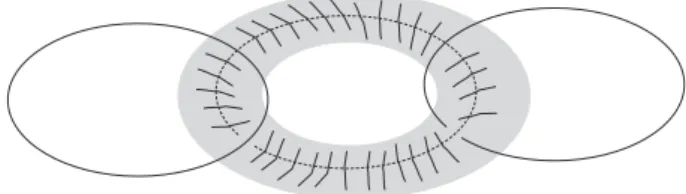
Figure 3 -The liftings ofγalong the leaves ofFXstarting at points ofL.
2009). Assume the curve SX is thez-axis, let Σz := (z = const.) be a section transverse toSX, and
Hol(FX, SX,Σz)be the holonomy ofFX with respect toSX evaluated atΣz.
End of the proof of Theorem 3.4. First suppose all the leaves ofFX are closed off the origin{0} ⊂C3and
that there is an adapted flagFX ⊂Fω. Given a germ of leafLofFX it follows that the closureL⊂L∪ {0}
is a germ of analytic subset of pure dimension one (Gunning and Rossi 1965) at(C3,0). Since this leaf is
transverse toΣz, one concludes thatL∩Σz is a finite set. On the other hand, given a pointx ∈ L∩Σz,
its orbit in the holonomy group is also contained inL ∩Σz, so that it is a finite set. Thus the orbits of
the generator of Hol(FX, SX,Σz)are finite. By hypothesis, for anyz0 ∈ S(X)the foliation Fω|Σz0 has
a dicritical component. Now consider a simple loopγ around the origin inside thez-axis starting fromz0. Pick a leafLof Fω|Σz
0 and consider the liftings of
γ starting at points ofL, along the trajectories ofFX.
Then these liftings form a three dimensional real variety, saySL, whose intersection withΣz0 is given byL
andL′(see Figure2). In particular, ifh:=h
γis the generator of Hol(FX, SX,Σz), thenL′ =h(L). For the 1-formω, one has thatSLis tangent to Ker(ω)andSL∩Σz0is tangent to the induced foliationFω|Σz
0. Thus,
L′ is a leaf of F
ω|Σz0. Since Fω|Σz0 has a dicritical component andh is a diffeomorphism with resonant
linear part having finite orbits, then Lemma 2.4 ensures thath is periodic (in particular linearizable and finite). SinceFX ∈ Gen(X(C3,0))has linearizable periodic holonomy, then it follows from Elizarov and
Ilyashenko 1984 that the foliationFX is also analytically linearizable. Therefore, one may suppose without
loss of generality thatX(x, y, z) =mx∂x∂ +ny∂y∂ −kz∂z∂ . This vector field has a holomorphic first integral. From the above linearization, it is easy to see that the flag foliationFω containing FX must have a linear dicritical Kupka transverse type along thez-axis. In particular,Fω is of radial type. This proves that (5)
implies (1)-(4) and also (6). Since the converse is immediate, this proves that the first four conditions in Theorem 3.4 are equivalent to conditions (5) and (6).
Remark3.1 (Parabolic curves and smooth sets of fixed points cf. Abate 2001). In our previous paper Câmara and Scárdua 2009 it is stated an integrability result mentioning only the fact that the leaves ofFX are closed
off Sing(FX). Nevertheless, as we saw above, this result is not correct. Indeed, there are such kind of vector
fields without holomorphic first integral (cf. Example 3.3).
(Theo-rems 1.2 and 1.3 in Câmara and Scárdua 2009). Along these lines we shall keep all the notations introduced in Câmara and Scárdua 2009. In Theorem 3.6 of Câmara and Scárdua 2009 we have stated that every non trivial complex map germ fixing the origin admits a parabolic curve. Javier Ribon draw our attention to the fact that this is not true with the following example:
Let Xo = py∂y∂ −qx∂x∂ with p, q ∈ Z+ and X = xyXo, then the orbits of the map Φ(x, y) = exp[1]X(x, y) are confined in the level sets of the first integral f(x, y) = xpyq to the vector field X. Therefore,Φhas no orbit attracting to the origin, thus it does not admit any parabolic curve at the origin.
Some time after that Marco Abate communicated us the same fact showing that Theorem 3.6 in Câmara and Scárdua 2009 contradicts Proposition 2.1, p. 185, in Abate 2001. As a matter of fact, Lemma 3.5 (and thus Theorem 3.6) is not correct. This is due to the authors misinterpretation of the proof of Corollary 3.1 in Abate 2001 wrongly stated as Theorem 3.2 in Câmara and Scárdua 2009. Indeed, the correct statement is the following:LetG∈Diff1(C2,0)and suppose thatS:=Fix(G)is a smooth curve through the origin
such thatind0(G, S) /∈Q+. ThenGadmitsν(f)−1parabolic curves.
More precisely, one can check that this would be the appropriate hypothesis looking to the proof of Theorem 3.1 in Abate 2001. Now one can check that the diffeomorphism in the proof of Lemma 3.5 in Câmara and Scárdua 2009 does not satisfy the conditions of the above theorem.
We finish with an immediate consequence of the proof of Theorem 2.3.
Corollary 3.8. LetX ∈Gen(X(C3,0))andSX be the distinguished axis ofX. Suppose thatFX admits a
pure meromorphic first integral, then the holonomy groupHol(FX, SX,Σ)is periodic.
4 - REFERENCES
ABATE M. 2006. The residual index and the dynamics of maps tangent to the identity. Duke Math J 107: 173-207.
ALEXANDER JC AND VERJOVSKY A. 1988. First integrals for singular holomorphic foliations with leaves of bounded volume. Lecture Notes in Math 1345: 1-10.
BRACCI F. 2004. Local dynamics of holomorphic diffeomorphisms. Boll Unione Mat Ital 7-B(8): 609-636.
BROCHERO MARTÍNEZ. 2003. Groups of germs of analytic diffeomorphisms in(C2,0). J Dyn Control Syst 9: 1-32.
BROCHERO MARTÍNEZ, CANO F AND LÓPES-HERNANZ L. 2008. Parabolic curves for diffeomorphisms in(C2,0). Publ
Mat 52: 189-194.
CALVO-ANDRADE O. 1994. Irreducible components of the space of holomorphic foliations. Math Ann 299: 751-767.
CAMACHO C, KUIPER NH AND PALIS J. 1978. The topology of holomorphic flows with singularities. Publ Math Inst Hautes Études Sci 48: 5-38.
CAMACHO C AND SAD P. 1982. Invariant varieties through singularities of holomorphic vector fields. Ann of Math 115(2): 579-595.
CÂMARA LM AND SCÁRDUA BA. 2009. On the integrability of holomorphic vector fields. Discrete Contin Dyn Syst 25: 1-13. CÂMARA LM AND SCÁRDUA BA. 2012. A Fatou type theorem for complex map germs. Conform Geom Dyn 16: 256-268. CORRÊA JR AND SOARES MG. 2013. Inequalities for characteristic numbers of flags of distributions and foliations. Int J Math
24: 12.
DULAC H. 1912. Solutions d’un système de équations différentiale dans le voisinage des valeus singulières. Bull Soc Math France 40: 324-383.
ELIZAROV PM AND ILYASHENKO YUS. 1984. Remarks on the orbital analytic classification of germs of vector fields. Math USSR-Sb 49: 111-124.
GODBILLON C. 1991. Feuilletages. Études géométriques. With a preface by G. Reeb. Prog in Math 98. Birkh’́user Verlag, Basel. GUNNING RC AND ROSSI H. 1965. Analytic functions of several complex variables. Prentice Hall, Englewood Cliffs, NJ. JOUANOLOU JP. 1979. Équations de Pfaff algébriques. Lecture Notes in Math. 708, Springer-Verlag, Berlin.
KUPKA I. 1964. The singularities of integrable structurally stable Pfaffian forms. Proc Natl Acad Sci USA 52: 1431-1432. LYAPUNOV AM. 1892. The General Problem of the Stability of Motion (In Russian). Doctoral dissertation, Univ Kharkov. English
translations: (1) Stability of Motion. Academic Press. New-York & London 1966 (2) The General Problem of the Stability of Motion, (A. T. Fuller trans.) Taylor & Francis, London 1992.
MATTEI JF AND MOUSSU R. 1980. Holonomie et intégrales premières. Ann Sci Ec Norm Supér 13(4): 469-523. MOL RS. 2011. Flags of holomorphic foliations. An Acad Bras Cienc 83: 775-786.
SEIDENBERG A. 1968. Reduction of the singularities of the differentiable equationAdy=Bdx. Amer J Math 90: 248-269.