(Annals of the Brazilian Academy of Sciences) ISSN 0001-3765
www.scielo.br/aabc
Water extracts of Brazilian leguminous seeds as rich sources
of larvicidal compounds against
Aedes aegypti
L.
DAVI F. FARIAS1, MARIANA G. CAVALHEIRO1, MARTÔNIO P. VIANA2, VANESSA A. QUEIROZ3, LADY C.B. ROCHA-BEZERRA1, ILKA M. VASCONCELOS1,
SELENE M. MORAIS3 and ANA F.U. CARVALHO2 1Departamento de Bioquímica e Biologia Molecular, Campus do Pici
Universidade Federal do Ceará, 60455-760 Fortaleza, CE, Brasil
2Departamento de Biologia, Campus do Pici, Universidade Federal do Ceará, 60455-760 Fortaleza, CE, Brasil 3Departamento de Química, Campus do Itaperi, Universidade Estadual do Ceará, 60740-000 Fortaleza, CE, Brasil
Manuscript received on May 5, 2009; accepted for publication on June 23, 2009
ABSTRACT
This study assessed the toxicity of seed water extracts of 15 leguminous species uponAedes aegyptilarvae. A par-tial chemical and biochemical characterization of water extracts, as well as the assessment of their acute toxicity in mice, were performed. The extracts ofAmburana cearensis,Anadenanthera macrocarpa,Dioclea megacarpa, En-terolobium contortisiliquumandPiptadenia moniliformiscaused 100% of mortalit y after 1 to 3 h of exposure. They showed LC50and LC90 values ranging from 0.43±0.01 to 9.06±0.12 mg/mL and from 0.71±0.02 to 13.03±
0.15 mg/mL, respectively. Among the secondary metabolite constituents, the seed water extracts showed tannins, phenols, flavones, favonols, xanthones, saponins and alkaloids. The extracts also showed high soluble proteins content (0.98 to 7.71 mg/mL), lectin (32 to 256 HU/mL) and trypsin inhibitory activity (3.64±0.43 to 26.19±0.05 gIT/kg
of flour) The electrophoretic profiles showed a great diversity of protein bands, many of which already described as insecticide proteins. The extracts showed low toxicity to mice (LD50 >0.15±0.01 g/kg body weight), but despite
these promising results, further studies are necessary to understand the toxicity of these extracts and their constituents from primary and secondary metabolism uponAe. aegypti.
Key words:Aedes aegypti, larvicidal compounds, leguminous seeds, water extracts.
INTRODUCTION
The mosquito Aedes aegypti is the vector for the ar-boviruses responsible for dengue and yellow fever, both of which endemic to Central and South America, Asia and Africa (Consoli and Oliveira 1994). Contrary to yellow fever, which has been reasonably brought under control with its vaccine, dengue is still a major public health problem in many countries around the world. The only effective approach to reduce the incidence of dengue fever is by attacking the breeding places ofAe. aegypti larvae (Gluber 1989, Corbel et al. 2004), since it is more
Correspondence to: Ana Fontenele Urano Carvalho E-mail: [email protected]
difficult to control the adult mosquito population (Dhar-magadda et al. 2005).
Ae. aegypti populations with Bacillus thuringiensis is an effective alternative on combating the larval stage of the mosquito, since it is more biodegradable, non-pollutant and shows selective toxicity towards inverte-brates (Polanczyk et al. 2003). Nevertheless, it is more expensive than synthetic insecticides and its effective-ness decreases in high solar incidence regions, where mosquitoes usually develop. Furthermore, studies have pointed out to the development of resistance toBacillus spp. inCulexsp. (vector of filarial disease) (Silva and Trgis 1997, Wirth and Georghiou 1997). Considering that insects in general, and Ae. aegypti in particular, develop resistance to a variety of insecticides, this phe-nomenon might be demonstrated forAe. aegyptiin the near future (Hemingway and Ranson 2000, Murugan et al. 2007).
An alternative for conventional chemical and bio-logical control is the use of natural products from plants, which have been shown to be effective insecticides and to minimize environmental impact (Fatope et al. 1993, Consoli and Oliveira 1994). In the last years, several studies have focused on plant products for controlling Ae. aegyptias larvicides and adulticides, or repellents for personal protection (Jang et al. 2002, Carvalho et al. 2003, Ramos et al. 2006, Choochote et al. 2007, Silva et al. 2008). The Leguminosae (Fabaceae) family has a wide global distribution, being well represented in Brazilian ecosystems by over 2,000 native species con-gregated in 188 genera. Leguminosae species are espe-cially recognized by the nutritional value of their seeds, which are rich in proteins, carbohydrates and oil. Nev-ertheless, seeds do not keep only storage material. They also need physical and chemical mechanisms for pro-tection and/or defense of the developing embryo. The compounds involved in chemical defense include lectins, protease and amylase inhibitors, toxins and low molecu-lar mass secondary metabolites (Xavier-Filho 1993). In spite of the diversity of defense compounds, few studies have been performed with seeds, especially those from Leguminosae family concerning toxicity upon larvae of Culicidae mosquitoes. In addition, works regarding the effectiveness of seed water extracts, which are rich in primary and secondary metabolites, againstAe. aegypti larvae, are even rarer. Thus, the aim of the present study was to evaluate the larvicidal activity of water extracts of
15 leguminous seeds from the Northeast Brazil against larvae ofAe. aegypti, to characterize chemical and bio-chemically the active compounds, as well as to assess their acute toxicity in mice.
MATERIALS AND METHODS
PLANTMATERIAL
The fresh pods (at least 500 g) of each plant species (Ta-ble I) were collected in Ceará, Northeast Brazil. Plants were identified by the botanist Edson de Paula Nunes from the Universidade Federal do Ceará (UFC, Forta-leza, Brazil), and voucher specimens were deposited at Herbarium Prisco Bezerra (EAC) of the same institution.
PREPARATION OFSEEDWATEREXTRACTS
The seeds were separated from pods and transformed into fine flour (mesh size 1.0 mm) by using a blender and a coffee mill. The fine powder was placed in an oven at 45◦C for three days to remove moisture and, then, stored
in plastic bottles. The water extracts were prepared by suspending 1 g of seed flour into 10 mL of distilled wa-ter, mixing with a magnetic stirrer at 4◦C for 4 h. The
mixture was filtered through nylon cloth and centrifuged at 20,000 x g, for 30 min. The supernatant was used in the bioassays (larvicidal test and acute toxicity test in mice), in the quantification of soluble proteins, in the de-termination of protein profile and in phytochemical tests. The extracts were tested at different concentrations ac-cording to specific solubility of protein and non-protein constituents. We did not standardize the concentration to avoid extra manipulations, such as freeze-drying and other procedures, which could cause loss of the native structure of proteins and subsequent loss of activity.
LARVICIDALACTIVITYASSAY
TABLE I
Leguminous species (Fabaceae) employed in this study, soluble solids concentration, protein content and toxic activities of seeds water extract againstAedes aegyptilarvae and mice.
Subfamily Extract soluble Protein Larvicidal activity Acute
Botanical name solids content (% 3rdlarvae toxicity
Voucher number (mg/mL) (mg/mL) mortality) (LD50g/kg)1
Caesalpinoideae
Caesalpinia bracteosaTul. 28.11±0.08 2.17±0.02 ND ND
EAC 39616
Caesalpinia ferreaMart. 28.14±0.54 1.40±0.01 85.04±3.84 ND EAC 39616
Dimorphandra gardneriana 26.17±0.31 2.33±0.10 65.08±2.56 ND
EAC 39617
Hymenaea courbarilL. 11.80±0.10 1.13±0.07 13.33±0.54 ND
EAC 38108
Senna obtusifolia(L.) H.S. Irwin & Barneby 25.22±0.95 1.47±0.02 41.67±1.97 ND EAC 39320
Senna rugosa(L.) H.S. Irwin & Barneby 54.71±2.02 2.40±0.11 16.67±0.78 ND
EAC 38112 Faboideae
Amburana cearensis(Fr. Allem.) A.C.Sm. 24.75±1.31 0.98±0.01 100.0±0.0 ND EAC 39618
Dioclea megacarpaRolfe 26.33±1.09 7.46±0.73 100.0±0.0 0.77±0.04
EAC 38110
Erythrina velutinaWilld 32.25±1.37 7.71±0.66 75.12±1.89 1.00±0.01 EAC 35979
Lonchocarpus sericeus(Poiret) Kunth 33.29±1.22 7.70±0.81 70.09±2.34 ND EAC 39615
Mimosoideae
Anadenanthera macrocarpa(Benth.) Brenan 42.64±2.45 1.56±0.21 100.0±0.0 0.15±0.008 EAC 38697
Enterolobium contortisiliquum(Vell.) Morong 35.23±1.54 3.13±0.15 100.0±0.0 1.1±0.01 EAC 38115
Parkia platycephalaBenth. 28.50±0.82 1.32±0.08 7.89±0.27 ND
EAC 38109
Piptadenia moniliformisBenth. 36.70±1.36 4.30±0.21 100.0±0.0 ND EAC 35974
Plathymenia reticulataBenth. 22.31±0.75 1.22±0.06 81.67±3.29 ND
EAC 38114
Distilled water — — ND ND
1Acute toxicity to mice(n= 6)was verified by intraperitonial injection (30 mL/Kg body weight) of diluted and crude water
extract of each seed (Vasconcelos et al. 1994). ND=Not Detected. Values are means±standard deviation(n=3).
into 150-mL disposable plastic cups containing 100 mL of water extract of each seed. Larval mortality/survival was monitored during the first three hours of exposure and registered after 24 h at room temperature (25◦C). For
each extract, three independent experiments were run in triplicate and distilled water was used as negative con-trol. Larvae were considered dead when no movement could be detected after they had been touched with a tiny brush. The results were expressed as mean±standard deviation of per cent mortality for all experiments. The
water extracts that showed 100% of larval mortality were diluted and evaluated again to determine the lethal con-centration for 50% and 90% of larvae (LC50 and LC90,
respectively).
ASSAY FORACUTETOXICITY INMICE
Animal Experimentation Ethics Committee of Univer-sidade Federal do Ceará (CEPA), Protocol No. 34/09, which adopts the guidelines of Colégio Brasileiro de Experimentação Animal (COBEA).
CHARACTERIZATION OFSEEDWATEREXTRACTS
Soluble protein content
The total soluble protein content was determined by the colorimetric method of Coomassie Brilliant Blue according to Bradford (1976).
Content of some bioactive proteins
Lectin activity was assessed by serial two-fold dilution of samples (Moreira and Perrone 1977). The water ex-tracts were diluted with 0.15 M NaCl and mixed with erythrocytes from rabbit blood (20 mg/mL suspension prepared in 0.15 M NaCl) treated with proteases from Aspergillus oryzae (EC 232-642-4, Sigma-Aldrich Co. USA), in a concentration of 1 mg/mL. The degree of ag-glutination was visually monitored after the tubes had been left to stand at 37◦C for 30 min, and at room
tem-perature (22±3◦C) for an additional 30 min. The results
are reported as hemagglutination title (HU), which is the reciprocal of the highest dilution giving visible agglu-tination. Trypsin inhibitory activity was determined by a slight modification of the method originally described by Kakade et al. (1969), using trypsin enzyme and L-BAPNA as substrate. Activity was expressed as the amount of trypsin inhibited, calculated from a calibra-tion curve using soybean trypsin inhibitor.
Electrophoresis
Sodium dodecyl sulphate-polyacrylamide gel electro-phoresis (SDS-PAGE) was performed according to the method of Laemmli (1970). SDS-PAGE was carried out in a 2-mm vertical slab gel (10 ×8 cm) contain-ing stackcontain-ing gel mix, 5% total acrylamide, and main running gel mix, 17.5% acrylamide, prepared in 3.0 M Tris-HCl, pH 8.8. Samples (20µl of each water extract) were dissolved in Tris-HCl 0.0625 M, pH 6.8, contain-ing 1% SDS and 1%β-mercaptoethanol (1:1, v/v) and incubated at 100◦C for 10 min. Treated samples
con-taining approximately 50µg of protein content were in-oculated in wells, and electrophoresis was carried out
at 20 mA constant current for 2 h. Bands were visual-ized by staining with 0.05% Coomassie Brilliant Blue R-250. Molecular mass markers employed were phos-phorilase B (97.4 KDa), bovine serum albumin (66.2 KDa), ovalbumine (45.0 KDa), carbonic anhydrase (31.0 KDa), soybean trypsin inhibitor (20.1 KDa) and lysozyme (14.2 KDa) (AMRESCO Inc., Ohio, USA).
PHYTOCHEMICALSTUDY OFSEEDWATEREXTRACTS
Phytochemical tests to detect the presence of second-ary metabolites as phenols, tannins, leucoantocianidins, flavonoids, esteroids, triterpens, and alkaloids were per-formed according to Matos (1988). These tests are based on visual observation of color modification or precipi-tates formation after the addition of specific reagents.
STATISTICALANALYSIS
Mortality data were subjected to probit analysis (Finney 1971) to estimate lethal concentration that kills 50% and 90% ofAe. aegyptilarvae (LC50and LC90,
respec-tively).
RESULTS AND DISCUSSION
Many studies have described the larvicidal activity againstAe. aegyptiof extracts from leaves, stems, and roots of leguminous species prepared with organic sol-vents (Pohlit et al. 2004, Luna et al. 2005, Mendonça et al. 2005, Omena et al. 2007). Nevertheless, little at-tention has been addressed to the potential of seeds as sources of secondary compounds with larvicidal proper-ties (Jang et al. 2002, Luna et al. 2005). Much scarcer are the studies that use water extracts for obtaining pri-mary compounds admittedly toxic toAe. aegyptilarvae (Carlini et al. 1997).
authors have described only 5% of larval mortality af-ter the exposure to ethanolic extract ofDioclea virgata leaves, which is much smaller than that shown for D. megacarpaseed water extract (100%) observed in the present work. In spite of the water extracts present high concentrations of total soluble solids (>20 mg/mL), it seems that these are not directly associated with the mor-tality rate. One extract (Senna rugosa) with a concen-tration above 40 mg/mL showed a relatively low larval mortality rate, whereas other extracts with half this con-centration caused 100% of mortality after a short expo-sure time.
Can these promising results be attributed only to secondary metabolites present in the extracts? Accord-ing to Table II, among secondary metabolites, the seed water extracts of these five plant species contain mainly tannins, phenols, flavones, favonols, xanthones, saponins and alkaloids. These secondary compounds were sim-ilar to those shown by Luna et al. (2005) in leaves, roots and wood bark alcoholic extracts of several plant species. Specifically, the leguminous species studied by Luna et al. (2005) with strong larvicidal activity were shown to contain flavones, phenols and alkaloids, the same compounds detected in the present work. Be-sides, the role of phenol compounds, such as thymol (an alkyl-derivative of phenol) and tannins as larvicidal com-pounds againstAe. aegypti, is well known (Carvalho et al. 2003, Silva et al. 2004). However, it is evident that these compounds are also present in the water extracts of species with the lowest activities,Senna rugosaand S. obtusifolia. Thus, it is questionable whether this could be explained only by the low levels of these larvicidal compounds in the less active extracts, or whether other compounds, such as proteins with insecticide activity, are present in the extracts. It is possible that proteins with insecticidal activity such as lectins, toxins, arcelins and protease inhibitors (Carlini and Grossi-de-Sá 2002, Whetstone and Hammock 2007) may be present in the water extracts, considering the extraction conditions and the common occurrence of these compounds in species of the Leguminosae family (Vasconcelos and Oliveira 2004). Thus, it is likely that these compounds contrib-ute for larvicidal activity of the five most potent seed extracts aforementioned.
The soluble protein contents (Table I) ranged from
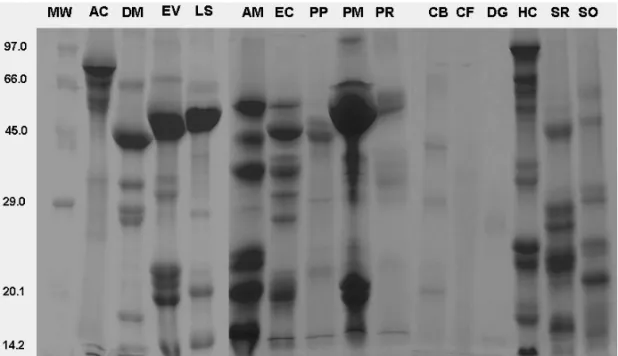
4 to 28% of total soluble solids. Ramos et al. (2006) have detected high mortality rates of Ae. aegypti lar-vae working with fractions ofCalotropis proceralatex, which are rich in cysteinic proteases (5.2 mg/mL). Re-cently, Sá et al. (2008) showed the first report of larvi-cidal activity againstAe. aegyptiof a plant purified pro-tein, the lectins fromMyracrodruon urundeuva. It has been reported that lectins and toxins possess insectici-dal activity against Diptera, but little is known about the toxic activity of serine and cysteine protease inhibitors, alfa-amylase inhibitors and arcelins, in spite of the re-ported action of these compounds against other insect orders (Carlini and Grossi-de-Sá 2002). The five most potent plant species described in the present work con-tain potentially active proteins against insects (Table III). Lectin activity was detected in the seed water extracts from D. megacarpa(256 HU/mL) and E. contortisili-qüum(32 HU/mL). Besides, all the studied seed water extracts showed trypsin inhibitory activity, ranging from 3.64±0.43 to 26.19±0.05 g of inhibited trypsinperkg of flour. Some compounds responsible for these activi-ties in the water extracts were previously purified. TheA. cearensisandE. contortisiliqüumseeds possess trypsin inhibitors with molecular mass of 13.6 KDa (Tanaka et al. 1989) and 23.0 KDa (Oliva et al. 1987), respectively. D. megacarpaseeds possess a three subunits lectin with molecular masses of 25-26, 13-14, and 8-9 KDa (Mor-eira et al. 1983). Recently, a chitin-binding vicilin from E. contortisiliqüumseeds was purified and shown to be toxic against bean bruchid pests (Callosobruchus macu-latus and Zabrotes subfasciatus) (Moura et al. 2007). These protein compounds could be observed in the elec-trophoretic profiles of the water extracts (Fig. 1). There-fore, it is reasonable to consider that the proteins natu-rally involved in plant defense can contribute somehow to the larvicidal activity of the seeds water extract.
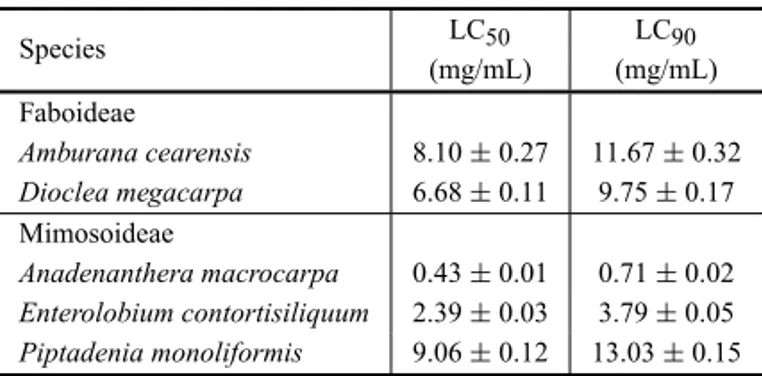
The LC50 and LC90 values of the most active seed
water extracts (A. macrocarpa,A. cearensis,D. mega-carpa,E. contortisiliquum, andP. moniliformis) against Ae. aegyptilarvae (Table IV) ranged from 0.43±0.01 to 9.06±0.12 mg/mL and from 0.71±0.02 to 13.03 ±0.15 mg/mL, respectively. TheA. macrocarpa wa-ter extract was the most powerful with LC50 of 0.43
±0.01 mg/mL and LC90of 0.71±0.02 mg/mL. These
Fig. 1 – Electrophoresis of water extract proteins ofAmburana cearensis(AC),Dioclea mega-carpa(DM),Erythrina velutina(EV),Lonchocarpus sericeus(LS),Anadenanthera macrocarpa (AM),Enterolobium contortisiliquum(EC),Parkia platycephala(PP),Piptadenia moniliformis (PM),Plathymenia reticulata(PR),Caesalpinia bracteosa(CB),Caesalpinia ferrea(CF), Dimor-phandra gardneriana(DG),Hymenaea courbaril(HC),Senna rugosa(SR),Senna obtusifolia (SO). A total of 50µg of protein was applied in the gel.
TABLE III
Content of some bioactive proteins (lectins and trypsin inhibitors) in leguminous seed water extracts with larvicidal activity against
3rdinstars ofAedes aegypti.
Lectin Trypsin Species
activity1 inhibitor activity Faboideae
Amburana cearensis ND 12.23±0.29
Dioclea megacarpa 256 10.78±0.10
Mimosoideae
Anadenanthera macrocarpa ND 3.64±0.43
Enterolobium contortisiliquum 32 26.19±0.05 Piptadenia monoliformis ND 8.85±0.47
1Lectin activity is expressed as hemagglutination unit (HU)permL of
water extract. One HU represents the reciprocal of the highest dilu-tion giving visible agglutinadilu-tion of the treated rabbit erythrocytes with protease solution (1mg/mL; 1:100, v/v).2Trypsin inhibitory activity is
expressed as g of trypsin inhibitedperkg of flour. ND=Not Detected.
The values are mean±standard deviation(n=3).
obtained from more selective extractions with apolar solvents such as ethanol, methanol etc. Jang et al. (2002), working with methanolic extracts of leguminous seeds, showed approximately 50% ofAe. aegyptilarvae
mortality at the concentration of 0.04 mg/mL. However, the LC50value ofA. macrocarpawater extract is much
lower than that found by Sá et al. (2008) for bark and heartwood crude water extracts ofMyracrodruon urun-deuva(LC508.81 and 14.86 mg/mL, respectively). The
lectins purified from these extracts showed low values of LC50, 0.125 mg/mL for bark lectin, and 0.04 mg/mL
for heartwood lectin (Sá et al. 2008). Thus, if the com-pound responsible for the larvicidal activity in the most promising water extracts is of protein nature, its activity during the purification process will tend to increase, be-ing comparable to extracts rich in secondary compounds. All these considerations may provide evidences that seeds may be promising sources of larvicidal com-pounds, and that water may be an efficient solvent to extract bioactive substances.
Among all evaluated water extracts (15), only four of them (A. macrocarpa, D. megacarpa, E. contorti-siliquum and E. velutina) presented acute toxicity on mice (Table I). The extract of the speciesA. macrocarpa showed the highest toxicity with a LD50 of 0.15 g/kg
TABLE IV
LC50and LC90of water extracts of leguminous seeds against 3rdinstars ofAedes aegyptiafter 24h of exposure1.
Species LC50 LC90
(mg/mL) (mg/mL) Faboideae
Amburana cearensis 8.10±0.27 11.67±0.32 Dioclea megacarpa 6.68±0.11 9.75±0.17
Mimosoideae
Anadenanthera macrocarpa 0.43±0.01 0.71±0.02
Enterolobium contortisiliquum 2.39±0.03 3.79±0.05
Piptadenia monoliformis 9.06±0.12 13.03±0.15
1LC
50and LC90are the lethal concentrations (mg/mL) at which 50%
and 90% of the larvae showed mortality, respectively. Values are means
±standard deviation(n=3).
toxic by WHO’s criteria (1994). On the other hand, the extract of the other most active species, A. cearensis, D. megacarpa,E. contortisiliquumandP. moniliformis, were considered slightly toxic (Hodge and Sterner cri-teria) and noxious (WHO cricri-teria). Thus, it seems that there is a trend of these bioactive compounds to show higher toxicity towards invertebrates and be safe to mammals.
In conclusion, leguminous seeds are promising sources of primary metabolites, especially proteins, and secondary metabolites with larvicidal activity against Ae. aegyptiwith low toxicity to mammals. Neverthe-less, further studies must be dedicated to understand the high toxicity of the seed extracts upon larvae ofAe. aegyptiand to identify the compounds from primary and secondary metabolism involved in the toxicity.
ACKNOWLEDGMENTS
The authors wish to thank Ministério da Saúde, through Departamento de Ciência e Tecnologia (DECIT), Secre-taria de Ciência, Tecnologia e Insumos Estratégicos (SCTIE), Conselho Nacional de Desenvolvimento Cien-tífico e Tecnológico (CNPq) and Fundação de Amparo à Pesquisa do Estado do Ceará (FUNCAP) for their finan-cial support.
RESUMO
Este trabalho objetivou avaliar a toxicidade dos extratos aquo-sos de sementes de 15 espécies de leguminosas contra larvas deAedes aegypti. Foi realizada uma caracterização química e
bioquímica parcial dos extratos aquosos e a avaliação da toxi-cidade aguda em camundongos. Os extratos deAmburana cearensis, Anadenanthera macrocarpa, Dioclea megacarpa, Enterolobium contortisiliquumePiptadenia moniliformis cau-saram 100% de mortalidade depois de 1 a 3 h de exposição e mostraram valores de CL50e CL90entre 0,43±0,01 e 9,06±
0,12 e entre 0,71±0,02 e 13,03±0,15 mg/mL,
respectiva-mente. Dentre os constituintes do metabolismo secundário, os extratos das sementes apresentaram taninos, fenóis, flavonas, flavonóis, xantonas, saponinas e alcalóides. Os extratos apre-sentaram alto teor de proteínas solúveis (0,98 to 7,71 mg/mL), lectina (32 to 256 UH/mL) e inibidor de tripsina (3,64±0,43
to 26,19± 0,05 gIT/kg de farinha). O perfil eletroforético
mostrou uma grande diversidade de proteínas, muitas das quais já descritas como inseticidas. Os extratos mostraram baixa toxicidade ao camundongo (DL50>0,15±0,01 g/kg
peso corporal), porém apesar desses resultados promissores, estudos posteriores são necessários para compreender a toxi-cidade desses extratos e de seus constituintes do metabolismo primário e secundário sobreAe. aegypti.
Palavras-chave:Aedes aegypti, compostos larvicidas, semen-tes de leguminosas, extratos aquosos.
REFERENCES
BESERRA EB, FERNANDESCRM, QUEIROGA MFCAND CASTRO-JRFP. 2007. Resistência de populações de Ae-des aegypti(L.) (Diptera: Culicidae) ao organofosforado temefós na Paraíba. Neotrop Entomol 36: 303–307. BRADFORDMM. 1976. A rapid and sensitive method for the
quantification of microgram quantities of protein utilizing principle of protein-dye binding. Anal Biochem 72: 248– 254.
CARLINICRANDGROSSI-DE-SÁ MF. 2002. Plant toxic proteins with insecticidal properties. A review on their potentialities as bioinsecticides. Toxicon 20: 1519–1539. CARLINICR, OLIVEIRA AE, AZAMBUJA P, XAVIER-FI -LHO J ANDWELLS MA. 1997. Biological effects of canatoxin in different insect models: evidence for a pro-teolytic activation of the toxin by insect cathepsin-like enzymes. J Econ Entomol 90: 340–348.
CHOOCHOTE W, CHAITHONG U, KAMSUK K, JITPAKDI A, TIPPAWANGKOSOLP, TUETUNB, CHAMPAKAEWD ANDPITASAWATB. 2007. Repellent activity of selected essential oils againstAedes aegypti. Fitoterapia 78: 359– 364.
CONSOLIRAANDOLIVEIRARL. 1994. Principais Mosqui-tos de Importância Sanitária no Brasil. Fiocruz, Rio de Janeiro.
CORBELV, DUCHONS, ZAIMMANDHOUGARDJM. 2004. Dinotefuran: a potential neonicotinoid insecticide against resistant mosquitoes. J Med Entomol 41: 712–717. DHARMAGADDAVSS, NAIKSN, MITTALPKANDVASU
-DEVANP. 2005. Larvicidal activity ofTagetes patula es-sential oil against three mosquito species. Biores Technol 96: 1235–1240.
FATOPEMO, IBRAHIMHANDTAKEDAY. 1993. Screen-ing of higher plants reputed as pesticides usScreen-ing the brine shrimp lethality assay. Pharm Biol 31: 250–254. FINNEYDJ. 1971. Probit Analysis. Cambridge University
Press, Cambridge.
GLUBER D. 1989. Aedes aegyptiandAedes aegypti-borne disease control in the 1990’s: top down or bottom up. Am J Trop Med Hyg 40: 571–578.
HEMINGWAYJANDRANSONH. 2000. Insecticide resistance in insect vectors of human disease. Annu Rev Entomol 45: 371–391.
HODGEHCANDSTERNERJH. 1949. Tabulation of toxicity classes. Am Ind Hyg Assoc Quart 10: 93–98.
JANGYS, KIMMK, AHNYJANDLEEHS. 2002. Larvici-dal activity of leguminous seeds and grains againstAedes aegyptiandCulex pipienspallens. J Am Mosq Control Assoc 18: 210–213.
KAKADEML, SIMONNANDLIENERIE. 1969. An eval-uation of natural vs synthetic substract for measuring the antitryptic of soybean samples. Cereal Chem 46: 518– 526.
LAEMMLIUK. 1970. Cleavage of structural proteins during the assembly of the head of bacteriophage T4. Nature 227: 680–685.
LUNA JS, SANTOS AF, LIMA MRF, OMENA MC, MEN -DONÇAFAC, BIEBERLWANDSANT’ANAAEG. 2005. A study of the larvicidal and molluscicidal activities of some medicinal plants from northeast Brazil. J Ethno-pharmacol 97: 199–206.
MATOSFJA. 1988. Introdução à Fitoquímica Experimental. Edições UFC, Fortaleza.
MENDONÇA FAC, SILVA KFS, SANTOS KK, RIBEIRO -JUNIORKALANDSANT’ANAAEG. 2005. Activities
of some Brazilian plants against larvae of the mosquito Aedes aegypti. Fitoterapia 76: 629–636.
MENDONÇA FAC, SILVA KFS, SANTOS KK, RIBEIRO -JUNIORKALANDSANT’ANAAEG. 2005. Activities of some Brazilian plants against larvae of the mosquito Aedes aegypti. Fitoterapia 76: 629–636.
MOREIRA RA ANDPERRONE JC. 1977. Purification and partial characterization of a lectin fromPhaseolus vulga-ris. Plant Physiol 59: 783–787.
MOREIRARA, BARROSACH, STEWARTJCANDPUSZTAI A. 1983. Isolation and characterization of a lectin from the seeds ofDioclea grandiflora(Mart). Planta 158: 63– 69.
MOURA FT, OLIVEIRA AS, MACEDO LL, VIANNA AL, ANDRADE LB, MARTINS-MIRANDA AS, OLIVEIRA JT, SANTOS EA ANDSALES MP. 2007. Effects of a chitin-binding vicilin fromEnterolobium contortisiliquum seeds on bean bruchid pests (Callosobruchus maculatus and Zabrotes subfasciatus) and phytopathogenic fungi (Fusarium solaniandColletrichum lindemuntianum). J Agric Food Chem 55: 260–266.
MURUGAN K, MURUGAN P ANDNOORTHEEN A. 2007. Larvicidal and repellent potential ofAlbizzia amaraBoivin andOcimun basilicumLinn against dengue vector,Aedes aegypti(Insecta: Diptera: Culicidae). Biores Technol 98: 198–201.
OLIVAML, SAMPAIOUMANDSAMPAIOCA. 1987. Ser-ine- and SH-proteinase inhibitors fromEnterolobium con-tortisiliquumbeans. Purification and preliminary charac-terization. Braz J Med Biol Res 20: 767–70.
OMENA MC, NAVARRO DMAF, PAULA JE, LUNA JS, LIMA MRFAND SANT’ANA AEG. 2007. Larvicidal activities againstAedes aegyptiof some Brazilian medic-inal plants. Biores Technol 98: 2549–2556.
POHLIT AM ET AL. 2004. Screening of plants found in the State of Amazonas, Brazil for larvicial activity against Aedes aegyptilarvae. Acta Amazônica 34: 97–105.
POLANCZYKRA, GARCIAMOANDALVESSB. 2003. Po-tencial deBacillus thuringiensis israelensisBerliner no controle deAedes aegypti. Rev Saúde Pública 37: 813– 816.
SÁ RA, SANTOS NDL, SILVA CSB, NAPOLEÃO TH, GOMESFS, CAVADA BS, COELHOLCBB, NAVARRO DMAF, BIEBERLWANDPAIVAPMG. 2008. Larvici-dal activity of lectins fromMyracrodruon urundeuvaon Aedes aegypti. Comp Biochem Physiol Part C: Toxicol Pharmacol 149: 300–306.
SILVAMHANDTRGRISL. 1997. Reversal of low level re-sistance toBacillus sphaericusin field population of the southern house mosquito (Diptera: Culicidae) from an ur-ban area. J Ecol Entomol 90: 229–303.
SILVA HHG, SILVA IG, SANTOS RMG, FILHOER AND ELIASCN. 2004. Larvicidal activity of tannins isolated of Magonia pubescens St. Hil. (Sapindaceae) against Aedes aegypti(Diptera, Culicidae). Rev Soc Bras Med Trop 37: 396–399.
SILVAWJ, DÓRIAGAA, MAIA RT, NUNESRS, CARVA -LHO GA, BLANKAF, ALVESPB, MARÇAL RMAND CAVALCANTI SCH. 2008. Effects of essential oils on Aedes aegyptilarvae: Alternatives to environmentally safe insecticides. Biores Technol 99: 3251–3255.
TANAKA AS, SAMPAIO MU, SAMPAIO CA AND OLIVA ML. 1989. Purification and preliminary characterization ofTorresea cearensistrypsin inhibitor. Braz J Med Biol Res 22: 1069–71.
VASCONCELOSIM ANDOLIVEIRAJTA. 2004. Antinutri-tional properties of plants lectins. Toxicon 44: 385–403.
VASCONCELOS IM, TRENTIN A, GUIMARÃES JA AND CARLINI CR. 1994. Purification and hysicochemical characterization of soyatoxin, a novel toxic protein iso-lated from soyabeans (Glycine max). Arch Biochem Bio-phys 312: 357–366.
WHETSTONEPAANDHAMMOCKBD. 2007. Delivery meth-ods for peptide and protein toxins in insect control. Toxi-con 49: 576–59.
WIRTHMCANDGEORGHIOUGP. 1997. Cross-resistance among Cry IV toxins ofBacillus thuringiensissubsp. is-raelensisinCulex quinquefasciatus(Diptera: Culicidae). J Ecol 90: 1471–1477.
WORLD HEALTHORGANIZATION (WHO). 1994. Interna-tional Programme on Chemical Safety – IPCS. Assessing humam health risks of chemical: derivation of guidance values for health – based exposure limits. World Health Organization, Geneva.
WORLD HEALTH ORGANIZATION (WHO). 2005. Guide-lines for laboratory and field testing of mosquito larvi-cides. WHO/CDS/WHOPES/GCDPP/2005.13.