BEHAVIOURAL AND PSYCHOLOGICAL SELF-PERCEIVED IMPACT OF USING THE INTERNET TO MEET SEXUAL PARTNERS AMONG MSM
Nuno Miguel Nodin Manteigas
Dissertação orientada por:
Professora Isabel M.P. Leal (ISPA Instituto Universitário de Ciências Psicológicas, Sociais e da Vida)
Professor Alex Carballo-Diéguez (HIV Center for Clinical and Behavioral Studies – Columbia University and New York State Psychiatric Institute)
Tese submetida como requisito parcial para obtenção do grau de Doutoramento em Psicologia
Área de especialidade Psicologia Clínica
Tese apresentada para cumprimento dos requisitos necessários à obtenção do grau de Doutor em Psicologia na área de especialização.de Psicologia Clínica realizada sob a orientação da Prof.ª Doutora Isabel Maria Pereira Leal e do Prof. Doutor Alex Carballo-Diéguez, apresentada no ISPA – Instituto Universitário, no ano de 2014.
O presente trabalho foi financiado pelo Programa Operacional Ciência e Inovação [POCI–2010] da Fundação Para a Ciência e Tecnologia, Portugal [SFRH / BD / 17396 / 2004].
To my parents, with much love Para os meus pais, com muito amor
Acknowledgements
Even during periods of lonely work, this dissertation was the result of an enriching collaborative process and was made possible by the support and encouragement of numerous people and institutions. I would like to thank the following people and offer my sincere apologies to those whom I have left out:
Fundação para a Ciência e Tecnologia, for funding this research
Isabel Leal, for the amazing support she has given throughout the years, for being my mentor and inspiration and for her friendship; it has been a great journey
Alex Carballo-Diéguez, for welcoming me into his dynamic academic world, for his patience, positivity and continued support; it has been an honour and a pleasure to work with him
Gary Dowsett, for allowing me to spend three fantastic months at the Australian Research Centre in Sex, Health and Society at La Trobe University in Melbourne; his attentive mentorship influenced me greatly and helped shape the theoretical core of this dissertation
Ana Ventuneac, for teaching me a few tricks in the art of research, for her precious assistance in data analysis and for making my time at the HIV Center so richly rewarding
Susie Hoffman, for her professional guidance on the craft of writing scientific articles and for her valuable feedback on some of the studies included here
Daniel Saloman, for generously proof-reading and providing helpful suggestions throughout the writing of this dissertation
Leonel Jorge Sousa Duarte, for his invaluable support during an important phase of my doctoral process
Catarina Patrício, for the artwork commissioned to mark this important step in my life and for sharing the dissertation writing pains, as well as other pains over the last few years
All the participants who took part in the studies, without whom none of this research would have been possible
Bob Remien, Cláudia Villalobos, Cristina Salsinha, Família Porto, Hiro Yoshikawa, Ivan Balan, João Maroco, Lucia Maroco, Mark Davis, Michael Hurley, Pamela Valera, Rosário Torres da Costa and my dear colleagues at the HIV Center and at ARCSHS, for their inspiration and support of various sorts
My wonderful friends, for always believing that I would eventually succeed in completing this dissertation, even when I doubted it myself
Palavras-chave:
Percepção do self; Internet; homens que têm sexo com homens; tecnologia
Key words:
Self-perception; Internet; men who have sex with men; tecnology
PsycINFO Classification Categories and Codes:
2700 Communication Systems
2750 Mass Media Communications
2900 Social Processes & Social Issues
2980 Sexual Behavior & Sexual Orientation
3000 Social Psychology
RESUMO
Esta investigação debruça-se sobre a população de homens que têm sexo com homens (HSH) que utilizam sítios na Internet para encontros amorosos e sexuais. Teve como objectivo compreender qual o impacto dessa experiência sobre o comportamento, percepção do self e percepção dos outros e qual a natureza desse impacto. Recorreu-se a uma metodologia de carácter misto para o efeito.
Para a fase qualitativa foram entrevistados 36 HSH sobre a sua utilização da Internet, encontros com parceiros sexuais contactados online (PO) e sexo seguro. Depois de transcritas, as entrevistas foram analisadas tematicamente para os estudos apresentados. Para a fase quantitativa desenvolveu-se um questionário e uma escala destinados a compreender em detalhe a questão sob investigação, baseados nas temáticas identificadas durante a fase qualitativa. Os dados foram recolhidos online. Um total de 317 HSH que cumpriram com os critérios de seleção foram utilizados para o primeiro estudo quantitativo e 313 para o segundo.
Cada uma das fases da investigação levaram à produção de dois estudos.
O primeiro estudo qualitativo (Estudo Exploratório) analisou os conceitos e práticas de sexo seguro de um grupo de HSH com experiência de conhecer PO. Neste estudo verificou-se que, para a maioria dos participantes, as estratégias de prevenção utilizadas com PO ou com aqueles contactados offline eram os mesmos, assim não confirmando a nossa hipótese inicial sobre a influência da Internet sobre comportamentos.
O segundo estudo qualitativo (Estudo 1) explorou as percepções de alterações no self associadas à experiência de encontrar PO. Os resultados sugeriram a existência de tais alterações tanto ao nível do self quanto das percepções de outros, de formas positivas (e.g. exploração de potencial individual desconhecido; aquisição de competências de comunicação sexual), negativas (e.g. sentimentos de desconfiança em relação aos outros) e neutras.
O primeiro estudo quantitativo (Estudo 2) descreveu o desenvolvimento de uma escala de avaliação das percepções e preferências relativas a conhecer PO, a Sexual Use of the Internet Scale (SUIS), recorrendo aos temas identificados no Estudo 1. A análise factorial exploratória identificou seis factores estatística e tematicamente coerentes: “Impacto positivo da Internet”, “Autoexposição sexual online”, “Vantagens de conhecer homens online”, “Preferência por conhecer homens online”, “Desconfiança de homens online”, e “Impacto negativo da Internet”.
Por último, o segundo estudo quantitativo (Estudo 3) averiguou se certos aspectos da experiência de conhecer PO e características dos utilizadores de sites de encontros se associavam a percepções de impacto dessa experiência sobre o self, tal como avaliados pela SUIS. As ANOVAs realizadas sugerem que homens que conhecem PO há menos tempo, homens mais novos e homens solteiros apresentam maior percepção desse impacto. O número de PO, a frequência de conhecer PO e a orientação sexual não apresentaram resultados significativos.
Os resultados são discutidos no contexto de preocupações e debates antigos sobre o impacto de tecnologias sobre os seres humanos e sobre a sociedade. Os nossos estudos não suportam o lado tecnofóbico nem o tecnofílico deste debate, mas contribuem para uma visão mais detalhada desta área de investigação. A nossa investigação contribui para o aumento do conhecimento relativo a processos de alteração identitária associados à utilização de plataformas virtuais de encontros de carácter social e sexual entre HSH e também de forma mais alargada.
ABSTRACT
This research focuses on men who have sex with men (MSM) and use dating and sexual networking websites. Its aims are to understand if and how using these websites affects the men’s behaviour, self-perceptions and perceptions of others. A mixed methods approach was used to investigate this topic. The research was organised into a qualitative and a quantitative phase, each leading to the production of two studies.
For the qualitative phase, 36 MSM were interviewed about their internet use, meeting sexual partners online, and safe sex. Transcribed interviews were thematically analysed for both studies presented.
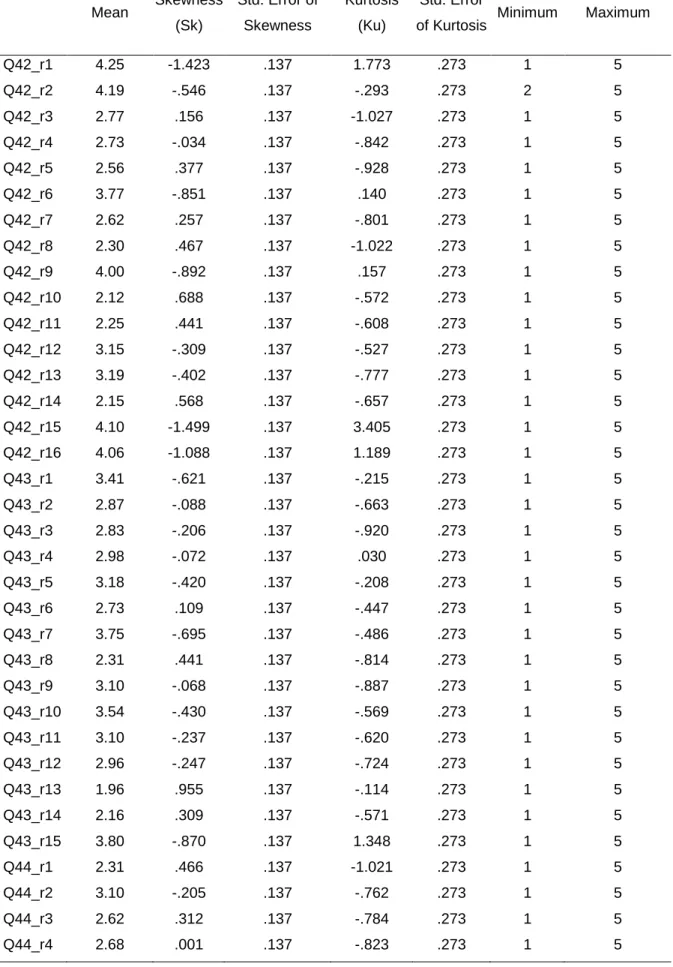
For the quantitative phase, a survey and a scale aimed at further understanding the research topic were developed based on themes identified during the qualitative phase. Data was collected online. In total, 317 MSM who met selection criteria were retained for the first and 313 for the second quantitative study.
The first qualitative study (Exploratory Study) analyses the safer sex concepts and practices of a group of MSM who meet sexual partners online. This study reports that for most participants, the prevention strategies used with partners met for sex online were the same as those used with partners met for sex offline, thus failing to confirm our initial hypothesis of internet-mediated behaviour change.
The second qualitative study (Study 1) explores these men’s perceptions of self-change associated with their online sexual experience (OSE). The results suggest that OSE does impact on these men’s perceptions of themselves and of others in positive (e.g. exploration of unknown personal potential; development of better sexual communication skills), negative (e.g. increased suspiciousness of others) and neutral ways.
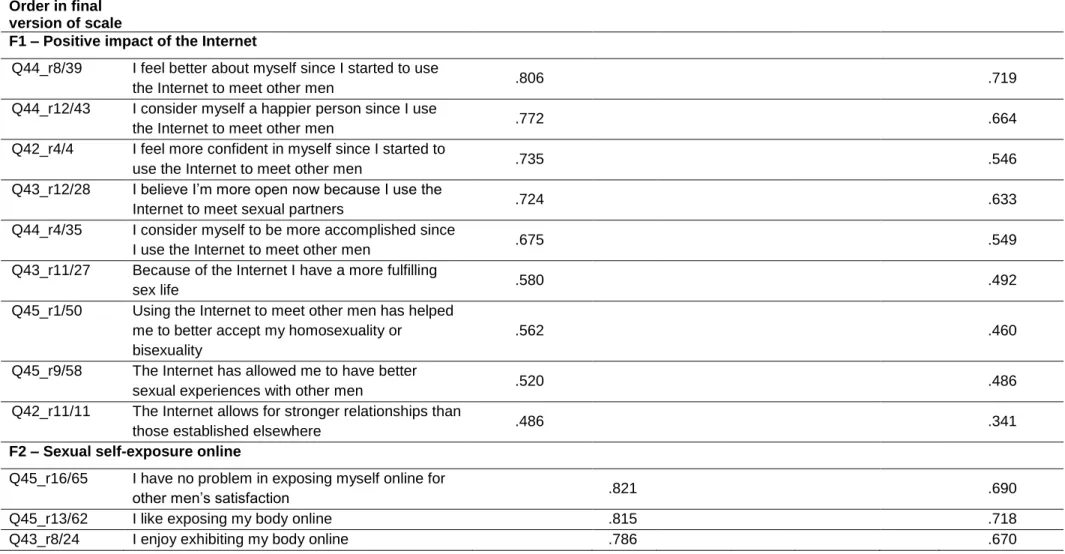
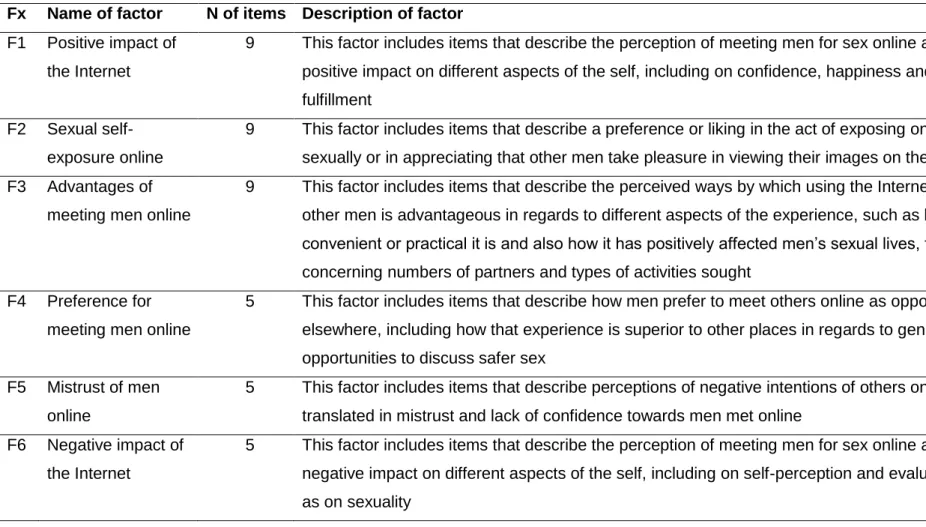
The first quantitative study (Study 2) describes the development of a scale aimed at investigating men’s perceptions and preferences of meeting sexual partners online - the Sexual Use of the Internet Scale (SUIS) - which was informed by the findings of Study 1. The exploratory factor analysis identifies six thematically interconnected and statistically coherent factors: “positive impact of the internet”, “sexual self-exposure online”, “advantages of meeting men online”, “preference for meeting men online”, “mistrust of men online”, and “negative impact of the Internet”.
Finally, the second quantitative study (Study 3) aims to ascertain whether specific aspects of the online sexual networking experience and site-user characteristics affect perceived impact upon the self, by using the SUIS. The ANOVA analyses carried out indicate that men with less experience of meeting others online, younger men and single men have significantly higher levels of perceived self-change associated with using the internet to meet sexual partners. The number of online partners, frequency of meeting partners online and sexual orientation has no significant impact on self-perception.
The results are discussed in the context of centuries-old debates and concerns about the impact of technology on humans and society. Our findings provide no support for the technophile or the technophobic sides of this debate, but contribute to a more nuanced reading of this field of inquiry. Our research adds to the knowledge of ongoing processes of identify and self change associated with using online social and sexual networking platforms amongst both MSM and more at large.
Table of contents
Introduction ... 1
Dissertation structure ... 5
Literature review ... 7
1. Of technology and its impact ... 9
1.1. History ... 11
1.1.1. Early and mid 20th Century ... 13
1.1.2. Late 20th and early 21st Centuries ... 14
1.2. The debate... 17
1.3. Cultural views of technology ... 20
2. The dawn of the Internet ... 21
2.1. Is the Internet changing us? ... 23
2.1.1. Cognitive change ... 24
2.1.2. Social change ... 26
2.1.3. Identity change ... 30
3. The impact of online dating and sexual networking ... 33
3.1. Online dating – An overview ... 34
3.2. Change associated with online dating ... 37
3.3. Online sexual networking and its impact ... 40
4. MSM and the Internet ... 42
5. Relevance of the topic ... 46
Methods ... 49
1. Qualitative phase (Exploratory Study and Study 1) ... 51
1.1. Participant recruitment ... 51
1.2. Procedures ... 52
1.3. Measures ... 52
1.4. Analysis ... 53
2. Quantitative Phase (Studies 2 and 3) ... 54
2.1. Procedures and participant recruitment ... 54
2.2. Measures ... 54
2.3. Study Sample ... 55
3. Ethics approval ... 55
Studies... 57
1. Exploratory Study: HIV knowledge and related sexual practices among Portuguese men who have sex with men ... 59
Abstract ... 60 Introduction ... 61 Methods ... 62 Results ... 64 Discussion ... 70 References ... 74
2. Study 1: Sexual use of the Internet: Perceived impact on MSM’s views of self and others ... 79 Abstract ... 80 Introduction ... 81 Methods ... 83 Results ... 85 Discussion ... 92 References ... 97
3. Study 2: Validation of a scale assessing perceptions, processes and preferences of using the Internet to meet sexual partners among men who have sex with men... 103
Introduction ... 105
Method ... 107
Results ... 108
Discussion ... 109
Table 1 – Sensitivity analysis of the scale ... 112
Table 2 – Factorial structure of the scale, after extraction of the factors by using principle component analysis with Varimax rotation, retaining 6 factors... 114
Table 3 – Thematic Analysis of Final Factors ... 117
References ... 118
4. Study 3: Meeting sexual partners online: A study of MSM’s perceptions of self-change using the Sexual Use of the Internet Scale (SUIS) ... 123
Abstract ... 124
Introduction ... 125
Materials and Methods ... 127
Results ... 129
Discussion ... 130
References ... 134
Discussion and conclusions ... 139
Limitations of the research ... 149
Conclusions and future directions ... 150
References ... 153
Appendices ... 175
Appendix 1 – Screen shot of recruitment profile and recruitment text ... 177
Appendix 2 – Screening questionnaire (qualitative phase) ... 179
Appendix 3 – Interview guide (English translation) ... 181
Appendix 4 – Demographic questionnaire (qualitative phase) ... 185
Appendix 5 – Online Survey ... 187
Appendix 6 – Parallel Article 1: The sex life of personal ads: A literature review ... 199
Appendix 7 – Parallel Article 2: The internet, our cyborg mind ... 213
Appendix 8 – Parallel Article 3: “Through the machine it is easier” – definitions and reactions to the concept of cibersex ... 219
Appendix 9 – Parallel Article 4: The Internet profiles of men who have sex with men within bareback websites... 229
Appendix 10 – Abstract: The laws of online attraction – The good the bad and the ugly . 247 Appendix 11 – SPSS Outputs: Study 2 EFA (available in the CD version only) ... 249
The Internet has had a profound impact in the ways people live, work and socialise, including how they connect and relate to each other emotionally and sexually. Some of the features of the Internet that may be facilitating this are the facts that it is easily accessible, affordable and potentially anonymous (Cooper, Putnam, Planchon & Boies, 1999).
The coming into being of new ways to select, interact with and get to know mates made possible by the Internet has created new contexts and experiences that might have facilitated processes of self-reflexion and of potential change for those who use it. A growing body of scientific research and analysis suggests that the ubiquitous and ever-growing use of the Internet is changing relevant aspects of our cognition, identity and social interactions (e.g. Goren, 2003; Litowitz, 2012; Thompson, 2013; Turkle, 2011; Tylim, 2012). This body of research, in turn, cannot be detached from larger discussions about the impact that technology has had on people and society, which can be traced as far back as Ancient Greece (Plato & Jowett, 1990).
Also inseparable from this discussion are the reactions that new and particularly revolutionary technologies cause in individuals and society, typically alternating between enthusiasm with mass adherence (e.g. television; mobile phones) and concerns associated with the alienation that these instruments might induce, demonstrated by the dystopian scenarios often conveyed by science fiction.
Gay men and other men who have sex with men (MSM)1 embraced the Internet from a very early stage as a means of easy and uncomplicated access to sexual partners and remain eager users of cyberspace for that purpose (Bolding, Davis, Hart, Sherr & Elford, 2005; Frankland et al., 2008; Mettey, Crosby, DiClemente & Holtgrave, 2003; Pitts, Smith, Mitchell & Patel, 2007). I propose to explore specific aspects of how that reality is experienced by these men in the context of the centuries-long discussion about technologically induced change.
1
MSM, gay men and other equivalent expressions will be used throughout this dissertation interchangeably according to the context of what is being discussed or the source reference cited
My research was initially inspired by the growing body of evidence about the possible connections between using the Internet to meet sexual partners, or online sexual networking, and sexual risk behaviours (Adam, Murphy & de Wit, 2011; Fernández-Dávila & Zaragoza Lorca, 2011; Klausner, Wolf, Fisher-Ponce & Katz, 2000; Liau, Millett & Marks, 2006; McFarlane, Bull & Rietmeijer, 2000; McKirnan, Houston & Tolou-Shams, 2007). To investigate whether a similar connection existed amongst Portuguese MSM I collaborated in the conduct of an initial exploratory study, based on one about MSM in New York City who used the Internet to seek sexual partners for sex without condoms (Carballo-Diéguez, Ventuneac, Bauermeister, Dowsett, Dolezal, et al., 2009; Nodin, Valera, Ventuneac, Maynard & Carballo-Diéguez, 2011). However, this exploratory study revealed that no such connection was evident in our sample of Portuguese men who used the Internet to seek sexual partners (Nodin, Leal & Carballo-Diéguez, in press). The research was then repositioned by focusing on the psychological aspect of Internet-mediated change. More specifically, we became interested in investigating whether using the Internet to meet sexual partners has had an influence on MSM’s perception of themselves and on their perceptions of others, which became the core topic of the research I will be presenting and discussing. Despite a growing body of sociological research about this area of Internet-related phenomena (e.g. Barraket & Henry-Waring, 2008; Davis, Hart, Bolding, Sherr & Elford, 2006; Quiroz, 2013), only a limited number of studies have addressed it from a psychological perspective.
This topic of research is pertinent from a clinical perspective, as increasingly individuals use the Internet to seek emotional and sexual partnerships and these experiences are becoming embedded in processes of identity exploration, as they open up spaces for discovery of oneself that would be harder if not impossible to explore elsewhere (Turkle, 1995). Therefore, and importantly for Clinical Psychology, the Internet and the experiences it allows raise questions about the extent to which using technological tools fundamentally changes the experience of the self and the ways in which we interact with others, both on- and offline.
With this as a background, my research questions were: Has online sexual networking influenced MSM’s perception of themselves and of others? If there is such an influence, what is the nature of these changes? And, finally, which specific aspects of the online sexual networking experience and site-user characteristics are associated with perceived impact upon the self? To answer these questions I collaborated in the conduct of three additional studies (Studies 1-3) that along with the Exploratory Study mentioned above make up the empirical core of this dissertation. Study 1, Sexual use of the Internet: Perceived impact on MSM’s views of self and others (Nodin, Carballo-Diéguez & Leal, 2013), was a qualitative study to investigate the first and second research questions by exploring a group of MSM’s
narratives about if and how they perceived online sexual networking to have affected different aspects of themselves or their perceptions of others.
The findings of this study were then used to develop an online survey, which included a scale to assess various aspects of men’s experiences of using the Internet to meet sexual partners: the Sexual Use of the Internet Scale (SUIS). In Study 2, Validation of a scale assessing perceptions, processes and preferences of using the Internet to meet sexual partners among MSM (Nodin, Leal & Carballo-Diéguez, submitted a), the factor analysis of the SUIS was presented and its psychometric qualities were evaluated. This showed that the SUIS includes two sub-scales specifically about the perceived impact of online sexual networking, namely Positive impact of the Internet and Negative impact of the Internet. The SUIS was then applied to address the third research question, presented in Study 3, Meeting sexual Partners online: A study of MSM’s Perceptions of Self-change using the Sexual Use of the Internet Scale (SUIS) (Nodin, Leal & Carballo-Diéguez, submitted b).
Dissertation structure
The first part of this dissertation covers the literature review. In it, I start by reviewing the history and perspectives regarding the impact of technology on society and individuals, to contextualise the analysis. From there, I move on to cyberspace, defining the concept and briefly presenting the history of the Internet, and then discuss some of the psychological implications of the online experience. This is followed by an examination of the theories and research about the extent to which the Internet might be affecting people in regard to their cognition, sociability and identity. I then review the concept and practices associated with online dating and online sexual networking, as well as the research into how they might affect those who use them. The literature review still includes an overview of the reasons for choosing MSM as the target study group and ends with a discussion of the reasons why this research is relevant.
The methods section then describes in detail the different processes, methods and instruments that were used in the qualitative phase of the research and in its quantitative phase. The four studies that support my thesis are then presented. Finally, I discuss the findings from all the studies and make conclusions based on the findings and research process, including the limitations, and make suggestions of further research.
Additional materials such as the research instruments used are included as appendices, as are the studies and papers produced during the research process. Despite not being a part of this dissertation these studies and papers were valuable elements that helped shape it; they are referenced and discussed throughout the text where appropriate.
1. Of technology and its impact
“Technology wasn’t created by us humans. Rather the other way around” (Lyotard, 1991, p.12)
The word technology comes from the Greek technē, meaning art or skill, and logos, meaning word or speech (Buchanan, 2010). There is no consensus about how to define technology (Arthur, 2009; Nusselder, 2009). The Encyclopaedia Britannica defines it as “the application of scientific knowledge to the practical aims of human life or, as it is sometimes phrased, to the change and manipulation of the human environment” (Buchanan, 2010) whereas Wikipedia offers a more elaborate definition: “making, modification, usage, and knowledge of tools, machines, techniques, crafts, systems, and methods of organization, in order to solve a problem, improve a pre-existing solution to a problem, achieve a goal, handle an applied input/output relation or perform a specific function”, complementing it with yet another, broader but more concise definition: “the entities, both material and immaterial, created by the application of mental and physical effort in order to achieve some value” (“Technology”, n.d.). Mitcham (1994), an authority on the topic of technology, simply defines it as “the making and using of artefacts” (p.1). There is considerable debate about animal’s use of tools and about the ways by which theirs compare with humans’ (e.g. Boesch, 2003; Penn, Holyoak & Povinelli, 2008; Stout & Chaminade, 2007) with recent findings underlying the continuities more than the differences (Gowlett, 2009).
The history of technology encompasses human evolution (Buchanan, 2010). In fact, it is impossible to conceive of humanity without the technological landscape in which humans have developed and which has been an essential part of their history. Technologies as basic as the wheel or as sophisticated as nuclear power stations; as niche as a diamond laser-cutter or as pervasive as the pen; as devoid of a physical existence as a piece of software or as solid as a skyscraper; as life-saving as a pace-maker or as irrelevant as a tamagotshi; all have their part to play and impact on the existence of millions of people around the globe. Even groups that reject modern technologies, like the Amish in the USA, live in highly
technological environments made of a diverse range of artefacts, agricultural instruments and techniques, etc. (e.g. Wetmore, 2007). Arthur (2009) described technology as “this thing that fades to the background of our world but also creates that world” (p.10), thus emphasising its ubiquitous presence that has become something second-nature, often unquestioned and taken for granted.
Mitcham (1994) described the use of the term technology as applying to four categories: artefacts (e.g. bricks, telephones, guns); activity used for making and using those artefacts (e.g. invention, creation, manufacture); knowledge that allows the production of artefacts (e.g. theories, models, laws); and finally volition (e.g. aims, desires, intentions). In turn Carr (2010) described four categories of technological achievement: extending physical strength, dexterity or resilience (e.g. the plough, the fighter jet); extending the range of sensitivity of the senses (e.g. the telephone, the magnifying glass, the stethoscope); reshaping nature to serve humans’ needs or desires (e.g. the birth control, the dam); and extending or supporting mental abilities, including the memory, the ability to calculate and to measure (e.g. the clock, the map, the sextant, the Internet).
Postman (1992) pointed out that taxonomies of historical eras are often based on the technological achievements that marked them. He lists, among others, the Stone Age, the Bronze Age and the Steel Age; the Industrial revolution and the Post-industrial revolution; the Eotechnic, the Palaeolithic and the Neolithic eras. He then proposed his own technology-based classification of cultures, but not eras: Tool-using cultures, Technocracies and Technopolies. Tool-using cultures are described as those for which “technology is not seen as autonomous, and is subject to the jurisdiction of some binding social or religious system” (p.24); Technocracies are those in which “tools play a central role in the thought-world of the culture” (p.28), i.e., they become dominant in society to the point of “attacking” and attempting to replace traditions, social mores, politics and religion; and, finally, Technopolies are totalitarian technocracies which redefine the very meaning of things like art, family, religion, history or privacy, rendering them “invisible and therefore irrelevant” (p.48) and subject to the agenda of technological development. Postman was indeed a leading voice in late 20th Century techno-scepticism, criticising the way that technology has gained a primary and, in his view, undesirable role in modern societies. We will return to some of his views in light of the debate around the possible impact of technology on humanity.
Some authors have, however, taken a less critical tone, and claimed that technology has developed alongside Humankind in a symbiotic relationship, through which both have gained and grown (Heim, 1991) or, in the words of Clark (2003) “[w]e exist, as the thinking things we are, only thanks to a baffling dance of brains, bodies, and cultural and technological scaffolding” (Clark, 2003, p.11).
Other authors have gone further, and suggested an agency to technology, considering it to evolve independently of human intention (Arthur, 2009; Kelly, 2010). Kelly (2010) proposed that technology should be included in the general classification of living creatures as an extension of the human branch, arguing that artefacts follow a certain “Darwinian” pattern of evolution. For him, technology, like galaxies and biological organisms, follows a trend of increasing and accelerating complexity over time. According to his views, technology is a sort of semi-autonomous “brain child” of humans that we should “parent” to help it evolve in adequate ways. McLuhan (1964) had previously contributed a similar viewpoint by claiming that humans are the sex organs of machines, therefore acting as mere agents in their reproduction until they gain the ability to reproduce themselves.
As some of these ideas illustrate, the relationship between technology and humans has been a topic of interest for philosophers and researchers for a long time. Their reflections form relevant background to my research, which explores the tight links between the tools people use, in this case online dating and sexual networking websites, and the humans that use them. In the next section I will review some of the ways these links have been conceptualised throughout Western history, particularly regarding the potential impact of technologies on humans, with a focus on contemporary discourses and analyses. This will be followed by a closer exploration of the debate between those who are enthusiasts of this impact and those who, like Postman (1992), believe it should be a matter of concern.
1.1. History
“Any sufficiently advanced technology is indistinguishable from magic.” (Clarke, 1961, p.36)
In a passage of Plato’s Phaedrus, the advantages of writing as an aid to memory and wisdom are discussed against its possible negative outcomes (Plato & Jowett, 1990), an oft-cited first reference to the concerns surrounding the impact of a new technology (Carr, 2011; Postman, 1992; Thompson, 2013). In that passage, it is argued that writing is good for reminding but not for not remembering and is said to cloud the distinction between information and “real wisdom”, with adverse consequences for society.
Another technological innovation created over a 1000 years later would come to be considered one of the most influential technologies of all times, alongside writing itself (McLuhan, 1962). The Guttenberg press had a profound impact, initially in Europe and later in the rest of the world, by allowing the speedy production of books that until then required hand copying and were available only to the elite (Buchanan, 2010). The cultural, social and religious ramifications and impact of the invention of the printing press, spreading onto the advent of the Protestant Reformation, the Renaissance, and the scientific revolution, were
analysed in detail by Eisenstein in The printing press as an agent of change (1979). McLuhan (1962) also considered the printing press to have allowed the onset of a new era for humankind (the Guttenberg Galaxy) by enhancing and speeding up cultural and cognitive changes that had been developing at a slower pace since the invention of the alphabet. However, despite the general enthusiasm with which the invention of the printing press was received, its potential impact was not necessarily anticipated at the time. In fact, “[t]here is considerable irony about the enthusiastic reception accorded to printing by the Church. Heralded on all sides as a ‘peaceful art,’ Gutenberg's invention probably contributed more to destroying Christian concord and inflaming religious warfare than the so-called arts of war ever did” (Eisenstein, 1979, p.155).
In 1627, Francis Bacon’s novel New Atlantis put forward the idea of a utopian society ruled by science and technology, allowing the control of nature to improve society and the life of its members (Bacon, 1627/1990). Later, the 19th Century witnessed the unfolding of the Industrial Revolution, made possible by the mechanisation of production and its technological advancements, which was seen as the coming into being of the realities envisioned by Bacon and others. However, industrialisation and mass production had a deep impact on the lives of many and changed urban, as well as rural landscapes, not necessarily for the better. The Luddite movement (1811–1817) was possibly one of the most notorious reactions against this process. Originated in Nottingham, England, but quickly spreading to other locations, it was led by a group of artisans who destroyed the textile machines that they felt were displacing them from their work (“Luddite”, 2010). The movement was eventually repressed by force, but the name ‘Luddite’ remains synonymous with anti-technological views to this day. In fact, a Neo-Luddite movement was established at the end of the 20th Century, serving as an umbrella designation for a wide range of ideologies advocating the abandonment of new technologies such as the Internet or mobile telephones, and a return to simpler living (Jones, 2006).
The new realities, both technological and social, generated by the Industrial Revolution were prone to reflection by leading 19th Century intellectuals about the possible effects of technology upon humans. Karl Marx wrote several notebooks about technology (Wendling, 2009) and in the first volume of Capital: Critique of political economy he discussed how machines used for production alienated workers (Marx, Engels, Moore & Marx, 1952). However, Marx’s views on technology were complex and some scholars have highlighted that he was by no means a Luddite: rather than being against technology he was against a system that used machines to exploit instead of benefiting humankind (Cotter, 2013; Dyer-Witheford, 1999).
A contemporary but different reflexion on the impact of machines on people came from Nietzsche, as a consequence of his having to use a typewriter due to his progressive
loss of sight. The philosopher reflected on this process in his work Our writing instruments contribute to our thoughts (1882) and indeed Kittler (2006) has argued that after starting to use the typewriter, Nietzsche´s writing “changed from arguments to aphorisms, from thoughts to puns, from rhetoric to telegram style” (p.203).
1.1.1. Early and mid 20th Century
“The medium is the massage” (McLuhan, 1967)
Heavily influenced by Nietzsche’s oeuvre, Martin Heidegger is considered to be one of the leading 20th Century thinkers about technology. Ontological in his approach, Heidegger’s main concern was the extent to which the essence of man was being contaminated by technology. For this author, the technological viewpoint considered nature, including humans, as resources to be exploited, reducing beings to non-beings, therefore ultimately reorganising our perception of reality (Heidegger, 1977).
Heidegger was not alone in his critique, and has been linked with thinkers from the Frankfurt School, including Adorno, Horkheimer and Marcuse. For them, the progressive domination of nature equated an instrumental and exploitative view of man by man, therefore becoming a source of social organization and control (Kellner, 1997). According to Marcuse, “[i]n the course of the technological process a new rationality and new standards of individuality have spread over society, different from and even opposed to those which initiated the march of technology” (Marcuse & Kellner, 1998, p.41). Marcuse further suggested that the forces of rationalisation and technocracy (“the technological truth”) have subdued individuality and free will, to the point where even dissident voices are framed within those same forces without awareness thereof or the possibility of autonomy or escape (Marcuse & Kellner, 1998).
In spite of not having written extensively on the issue of technology, Freud, in Civilization and its discontents, also briefly assessed what technologies such as railway or the telephone have brought to the modern world, and concluded that the negative consequences he discerned (separation from loved ones, a longer life full of suffering) might not justify their existence (Freud & Dickson, 1985). Others within the early psychoanalytical movement, like Tausk (1933), tried to understand the ways by which machines often became relevant elements in the delusions of schizophrenics. He believed that these delusions translated a need to rationalise internal feelings of strangeness and transformation (Tylim, 2012).
A key figure in technology and media discourses in the 20th Century, Marshall McLuhan, analysed the historical evolution of technologies and concluded that each new
revolutionary technology brings about changes in society that are progressively faster with each new technology (from writing to movable print to electronic media) (McLuhan, 1962). One of the core ideas of his book The Guttenberg Galaxy is that communication technology affects dimensions such as perception and cognition and consequently has a societal impact (McLuhan, 1962). This idea was distilled in his famous principle ‘the medium is the message’, which can be interpreted as suggesting that the format of any communication technology (e.g. television, printed books or the telephone) is more relevant and has a more critical impact upon society than its content (e.g. news, entertainment or advertisement) (McLuhan, 1964). McLuhan later reformulated and further refined this idea in his book The medium is the massage, in which he inventoried the effects of the medium (the massage it provides) over the senses and posited that each medium has different effects over the human organs of sense (McLuhan, 1967). Carr’s reading of McLuhan is that “[a]s our window onto the world, and onto ourselves, a popular medium molds what we see and how we see it – and eventually, if we use it enough, it changes who we are, as individuals and as a society” (Carr, 2010, p.2).
Although his influence faded after his death in 1980, McLuhan was rediscovered later as his ideas regained relevance in light of contemporary media analyses and have been used at length for that purpose, even if not without criticism (Debray, 1996; Horrocks, 2000).
1.1.2. Late 20th and early 21st Centuries
“To wear a device as powerful as the Apple Watch makes you ever so slightly posthuman” (Grossman & Vella, 2014, p.32)
Baudrillard (1983) criticised the overall replacement of the symbolic with the immediacy delivered by communication and information technologies. He qualified this immediacy as obscene, emerging “when all becomes transparence and immediate visibility, when everything is exposed to the harsh and inexorable light of information and communication” (Baudrillard, 1983, p.130). Therefore, for Baudrillard this “obscene” is not of the same nature as that traditionally associated with pornography, often hidden from sight, “on the contrary, it is the obscenity of the visible, of the all-too-visible, of the more-visible-than-visible. It is the obscenity of what no longer has any secret, of what dissolves completely in information and communication” (p.131).
Virilio is another influential theorist who wrote extensively about the effects of technology, and particularly of media, on society. One of the ways he did this was by analysing the effects of the live television coverage of the first Gulf War (1990–91), with his interests later expanding to include how new communication technologies cause radical
changes in the ways we experience the world by deeply altering the nature of distance and hence causing the “disappearance of the horizon” (Virilio, 1997, p.40). He also discussed the effects of these technologies on our memory and ways of thinking, postulating that they bring about the loss of the “possibility of some kind of interpretation, which will be coupled with a sharp loss of memory, or rather, with the flourishing of a paradoxical immediate memory linked to the all-powerful nature of the image” (Virilio, 1997, pp.25–26).
Virilio coined the term ‘dromology’, the science or logic of speed, and claimed that acceleration is central to the transformation of the modern world (Virilio, 1986). He believed that speed has a transformative potential, and the speedier the event, the more it will allow the possibility of something new, different and potentially catastrophic to happen. For instance, he discussed how technologies carry with them the possibility of the accident: “with the invention of the ship, the train, the aeroplane, the nuclear power station, we simultaneously invented the shipwreck, the derailment, the plane crash and Chernobyl” (Virilio, 1995, p.3). According to Virilio, the speedier the technology the more intense the effect: “When we speculate about the dangers of accidents on the information superhighways, the issue is not the information but the absolute speed of its processing by computer technology” (p.4).
Other perspectives have analysed the ways in which technologies are connected in closer ways to humans, therefore changing our very nature. One of these perspectives considers artefacts and indeed all objects within human reach as extensions of people (Nodin, 2009). One of the first thinkers to suggest this was John Locke in 1689 in his discussion over property rights. He proposed that by mixing objects with labour these objects gain the same rights as those of the body of the labourer (Locke & Laslett, 1988). Later, Freud through his own conceptual lens made analogous suggestions about the appropriation of external elements into the realm of the mind, and therefore of the human (Freud & Dickson, 1985).
Another thought-provoking way in which the close connections between humans and artefacts have been conceptualised has been through the metaphor of the cyborg, particularly as envisioned by Haraway in her Cyborg Manifesto, in which she defined the cyborg as a “cybernetic organism, a hybrid of machine and organism, a creature of social reality as well as a creature of fiction” (Haraway, 1991, p.149), and the scholarly literature that it inspired (Bell, 2007). The word cyborg was originally coined by Clynes and Kline (1960) in relation to the possible use of self-regulating technological systems to help humans survive in space. However, the cyborg is perhaps better known in its science fiction materializations of an amalgamated man–machine creature portrayed in films like The Terminator (Daly, Gibson, Hurd & Cameron, 1984) or Robocop (Schmidt & Verhoeven, 1987).
Haraway’s project was, in essence, feminist. She saw the cyborg as a way to move past binary views of gender and away from seminal discourses, such as those of Christianity or Psychoanalysis, that conceive women as inferior to men. For Haraway, with the cyborg “[t]he dichotomies between mind and body, animal and human, organism and machine, public and private, nature and culture, men and women, primitive and civilized are all in question ideologically” (Haraway, 1991, p.163).
Haraway’s strong image and metaphor of the machine–human hybrid and her questioning of boundaries is in line with a different way of thinking about the relationship between humans and technology, not only from a purely physical point of view, but also from a psychological one. Echoing Haraway, Stone wrote that “many of the usual analytical categories have become unreliable for making the usual distinctions between the biological and the technological, the natural and artificial, the human and mechanical, to which we have become accustomed” (Stone, 1991, p.101).
Many other authors have since formulated similar ideas. For Turkle, the self is “multiple, fluid, and constituted in interaction with machine connections” (Turkle, 1995, p.15). In Carr’s words “[t]he tight bonds we form with our tools go both ways. Even as our technologies become extensions of ourselves, we become extensions of our technologies (Carr, 2010, p.209), and Tylim discusses the “techno-body”, one that “cannot anymore be described as purely organic, and its organization attains a technological status” (Tylim, 2012, p.474). All of these perspectives may ultimately be linked to one of the main interests of post-modernity – that of identity and its fractured boundaries, particularly in relation with gender, sexuality and technology (Angerer, 1999; Heim, 1991; van Doorn, 2011).
From a cognitive perspective, others have suggested that humans may actively be using technologies as external resources of the mind. For instance Mitchell suggested that we rely on the “machine intelligence” (Mitchell, 2003, p.35) embedded in mobile phones, cars, domestic appliances, operating systems, and software. The branch of cognitive science that studies this premise is called Distributed Cognition (Salomon, 1993), but similar ideas have also been explored under designations such as Active Externalism (Clark & Chalmers, 1998) and Collective Intelligence (Lévy, 1997). According to Clark and Chalmers “[i]f, as we confront some task, a part of the world functions as a process which, were it done in the head, we would have no hesitation in recognizing as part of the cognitive process, then part of the world is (so we claim) part of the cognitive process” (Clark & Chalmers, 1998, p.8).
What many of these theories have in common is that they claim that we are already cyborgs of sorts, incorporating artefacts and features of the external world into our bodies and minds. This approach moves the discussion from a view that regards humans as being passively affected by technology to one in which we have a truly dynamic merger between flesh, thought and machine.
1.2. The debate
“Modern technology is like a Great Dane in a small apartment. It may be friendly, but you still want to make sure there’s nothing breakable within reach.”
(Pool, 2003, p.15)
The tensions between acknowledging the positive impact of technology and the concerns about its negative consequences, as illustrated by the various discourses and analyses reviewed, have possibly been present since humans started to think reflectively about created artefacts. For instance, while machines were often seen during the Modern Age as the solution to many of humankind’s problems, at the same time fear of alienation has also been present as demonstrated by the positions of Heidegger or Marcuse and by the extreme reactions of the Luddites. But even early proponents of the technologically-induced alienation argument like Marx were ambivalent about technology and capable of identifying some of its possible benefits for humankind.
Positioning himself clearly in the debate, Postman (1992) argued that the world is full of “one-eyed prophets who will see only what new technologies can do and are incapable of imagining what they can undo. We might call such people technophiles”, continuing by saying that, on the other hand, others “are inclined to speak only of burdens (…) and are silent about the opportunities that new technologies make possible. The Technophiles must speak for themselves, and do so all over the place. My defence is that a dissenting voice is sometimes needed to moderate the din made by the enthusiastic multitudes” (Postman, 1992, p.5). Therefore, despite his techno-scepticism, Postman recognises that there isn’t only one side to the discussion (“Every technology is both a burden and a blessing; not either-or, but this-and-that”, p.5) but chooses to give voice to the side that he considers to be less visible.
However, by reviewing the history of the discourses about technology’s impact on society, there seems to be a clearer techno-sceptic, if not full blown technophobic trend that accompanies the whole discussion about the effects of technology in society, from Plato to Virilio.
A lively technophile stream certainly exists in today’s world, much motivated by the progress achieved in communication technologies, including mobile telephony, increased Internet availability and connection speeds as well as social media. This side of the debate has its own visionaries, such as Steve Jobs, Bill Gates and the founders of companies like Google and Facebook (Isaacson, 2011; Schmidt & Cohen, 2013). Even if these individuals and groups have not always profoundly reflected on the current and future possibilities raised
by the same technologies they are responsible for (Grossman, 2010), some voices from within the technophile faction have raised concerns over the social and individual impact of these innovations (Lanier, 2010; Turkle, 2011).
Lanier (2010), for instance, who was involved in the initial development of virtual reality interfaces, defended humanity and subjectivity in the context of new technologies. He argued that technologies such as the Internet and diverse pieces of software, with their rigid designs, standardise people’s experiences and ultimately existences. Therefore he posited that “[t]he digital hive is growing at the expense of individuality” (Lanier, 2010, p.26), and discussed how this is a consequence of the ideas of a few which have a great impact upon many: “It takes only a tiny group of engineers to create technology that can shape the entire future of human experience with incredible speed” (Lanier, 2010, p.5).
Sides have also been taken in discussions about the future of humanity in light of technologic progress. On one side we find the cyborg vision of Haraway (1991), one that embraces a post-humanist condition in which machine is conceived as integrative with humanity, a source of pleasure and an object of desire. In Haraway’s words, “[t]he machine is not an it to be animated, worshipped, and dominated. The machine is us, our processes, an aspect of our embodiment.” (Haraway, 1991, p.180). Alongside Haraway, others, like Kurtzweill (2005) and Stock (2003), are apologists for post-humanism, although they move beyond the metaphor and effectively advocate technologically-mediated change to humans. Kurtzweill (2006) predicts the near future of humankind and believes we will be able to accomplish “the virtual elimination of disease, dramatic expansion of human potential, and radical life extension” (p.40) as well as “wireless communication from one brain to another” (p.41), among other phenomena, facilitated by advancements and the convergence of genetics, nanotechnology and robotics technologies, over the next few decades.
Clark (2003) makes an argument for considering biotechnological alterations to humans as an ultimate expression of humanity itself, postulating that “[w]hat makes us distinctively human is our capacity to continually restructure and rebuild our own mental circuitry, courtesy of an empowering web of culture, education, technology, and artefacts” (p.10).
On the other side of this discussion we find the grim post-humanity envisioned by authors such as Heidegger (1977) with his view of beings transformed into non-beings due to “contamination” by technology, or Fukuyama (2002) who dreads the coming into existence of new entities that are no longer recognisable as human, products of processes such as bioengineering or cloning. For Fukuyama, this post-human existence will arrive as biotechnologies continue to evolve in the context of a lack of an ethically sound framework and regulatory bodies, already a reality in industrialised societies, with disastrous consequences (Fukuyama, 2002). Winner (2002), another fierce critic of the post-humanists,
is concerned about their proposals and research “placing homo sapiens on the list of endangered species list” (p.35). He also criticises the post-humanists’ interest in improving traits of intelligence, strength, beauty, physical health and longevity, which contrasts with their lack of sensitivity towards the social dimensions of humans.
Additionally Lyotard discussed the future of humankind in light of the predicted death of the sun (in approximately 4.5 billion years) and therefore of Earth and all life on it (Lyotard, 1991). This led him to question the possibility of human thought carrying on without a body and of the technological endeavours that might allow this to happen. Lyotard argued against the idea that a machine could carry human thought in this scenario, as machines “think” in a binary fashion that is unlike the more flexible and intuitive ways that humans do. He also considered that thought is embedded in suffering, which means that any machines for carrying human thought would need to “suffer from the burden of memory” (p.20), as well as to experience the “irremediable difference of gender” (p.22). These, he contends, are basic conditions of humanity, which, however, are not in the best favour of techno-science that considers them counter-productive and therefore redundant.
As Sim (2001) points out, Lyotard’s anti-inhuman position expresses concerns with a world progressively driven by the forces of science and technological development, which value mechanisation and efficiency of production at the expense of the difference that defines human beings who will ultimately be rendered superfluous in this process. The inhuman has indeed already “infiltrated our daily existence to quite a remarkable degree – in the sense of the supersession of the human by the technological” (Sim, 2001, p.6) and “[w]e may decide it is more appropriate to fear, resist, welcome, actively encourage or perhaps just simply tolerate the inhuman; but one thing is certain – we cannot avoid it” (p.7). Tylim (2012) also aligns with this view and affirms: “the twenty-first century may be remembered as the century of the World War against machines that threaten to dethrone humanism” (p.472).
There is however middle ground to this debate. For instance, for some "[e]lectronics is neither the arrival of apocalypse nor the dispensation of grace. Technology is technology; it is a means for communication and transportation over space, and nothing more" (Carey, 1992, p.139). Or, as Buchanan suggested, “just as it was naive for the 19th-century optimists to imagine that technology could bring paradise on Earth, it seems equally simplistic for the 20th-century pessimists to make technology itself a scapegoat for man's shortcomings” (Buchanan, 2010).
A seminal paper by Pinch and Bijker (1984) set the conceptual structure for reading technology as a social construction, and therefore devoid of any sort of determinism. For these authors, in order to understand technology one needs to understand the meanings that “relevant social groups” place on specific artifacts (Pinch & Bijker, 1984, p.414). Therefore
and importantly, the model they proposed, the Social Construction of Technology (or SCOT), posits that it is not technology that determines human behavior, but vice versa.
This social constructivist view of technology is not without its critics, namely Nusselder (2009) who points that putting social actors at the centre of technological progress falls into the same deterministic trap that it tries to counter, while it simultaneously disregards the unconscious and unintentional aspects of technological production and usage.
1.3. Cultural views of technology
“Dystopian fiction doesn't make people fear technology – technology makes people fear technology” (Maloney, 2014)
No discussion of the historical and theoretical views of the relationship between technology and society would be complete without a reference to the discourses of the machine within culture, particularly in literature and cinema. For a long time science fiction has provided narratives encompassing sophisticated technologies that, more than improbable tales of an imaginary future, often reflect concerns about the present (Booker, 2001; Maloney, 2014).
At least since the 19th Century that literature has produced works that reflect the uneasiness caused by the manipulation of humanity through science or technology, of which some well known titles are Mary Shelley’s Frankenstein (1818/1994), Aldous Huxley’s Brave new world (1932/1946), George Orwell’s 1984 (1949), or Antony Burgess’s A clockwork orange (1963). In spite of being quite diverse in their styles, storylines and in the worlds they portray, all of these books tell dystopian tales about the use of tools to control human behaviour and even life itself, with potential negative consequences, echoing concerns surrounding technological progress.
Futuristic cinema also includes abundant dystopian storylines, such as those found in Metropolis (Pommer & Lang, 1927), 2001: A space odyssey (Stanley Kubrik, 1968) or I, Robot (Mark, Davis, Dow, Godfrey & Proyas, 2004), in which sentient computers and machines either control or are used to control and dominate humans, vividly reflecting anxieties about technology and its potential to command our lives. Others, like The Matrix (Silver, Wachowski & Wachowski, 1999) and eXistenZ (Cronenberg, Hámori, Lantos & Cronenberg, 1999) question the boundaries of what is real in the context of immersive virtual reality technologies. For instance, in eXistenZ, players of a game console that links directly to the nervous system enter a realistic gaming experience, eventually losing the ability to judge whether they’re inside or outside the game. In Until the end of the world (Felsberg & Wenders, 1991), people become addicted to a device that allows them to see their dreams
on a screen, progressively becoming disconnected from one another in order to become increasingly self-absorbed and spend time in that activity. All of these stories can be read as reflecting the fears of alienation that various modern technologies may have on individuals and society (Turkle, 1996; Tylim, 2012).
Finally, Her (Ellison, Jonze, Landay & Jonze, 2013) pictures a near-future scenario in which intelligent operating systems become people’s best friends and lovers. Its story of lonely people finding company and comfort in their devices not only links with the topic of alienation and isolation mentioned above, but also addresses the question asked by Turkle when discussing relational artefacts, such as pet robots: “in a world in which machines present themselves as emotional, what is left for us?” (Turkle, 2004, p.27). In other words, what remains human when machines can mimic emotion to the point of eluding our own emotions, a question poignantly asked in Artificial intelligence (Kennedy, Spielberg, Curtis & Spielberg, 2001) in which the ‘artificial’ love of a humanoid robot–boy for his human mother leads him on a quest for her that transcends humanity’s very existence? Furthermore, what does this need for attachment with smart and ‘sensitive’ objects tell of our very human nature? Science fiction may not deliver answers, but it will ask questions about human identity and sociability in a progressively more technological world.
2. The dawn of the Internet
“We will adjust to cyberspace far more easily than cyberspace will adjust to us.” (Novak, 1991, p.239)
The Internet as we know it today is the product of the confluence of diverse historical contexts and technical achievements (Castells, 1996; Dery, 1996; Seel, 2012) that are beyond the scope of this analysis. I will, however, provide a very brief overview of its history as it provides relevant context to this study, before focusing on the domains of experience it has opened up and on its potential psychological impact on humans.
Initially developed in 1969 by the Department of Defence of the USA, with the Cold War and the technical competition with the Soviets in the background, the Internet was conceived as a fail-proof communication system in case of a nuclear war (Castells, 1996). The ARPANET, as it was then called, was devised as a network of computers that communicated with each other via telephone lines by breaking down information into smaller packages that were then sent by multiple routes to be reassembled at the point of destination, the same principle that still governs it today. Since its very early stages, this network was also linked with universities and research centres, initially in the United States, but later also in Europe. Its potential for sharing ideas and facilitating communication led to a
growing adoption and usage within academia, soon making this its main use (Rheingold, 2000).
Worried about security breaches, the US military decided to abandon the network it had created, leaving it to its predominantly civilian uses, and developed its own independent communication network in the early 1980s (Castells, 1996; Seel, 2012). By the early 1990s, after exponential growth in use from organisations, individuals and businesses, the Internet was a massive network of connections between computers organised in the form of the World Wide Web (“a hypertext-based system that enables users around the globe to point and click from one multimedia site to another”, Dery, 1996, p.6). Today the Internet is used by over 2.5 billion people (ITU, 2013) for the most varied reasons, from research to entertainment, from work to social interchange.
It is also a medium of media, progressively engulfing previous technologies like the telephone, the television or the video recorder, as prophesised by McLuhan years before it had even been developed: “The next medium, whatever it is – it may be the extension of consciousness – will include television as its content, not as its environment, and will transform television into an art form. A computer as a research and communication instrument could enhance retrieval, obsolesce mass library organization, retrieve the individual's encyclopedic function and flip into a private line to speedily tailored data of a saleable kind” (McLuhan, 1962, in Horrocks, 2000, p.52-53). In many ways, the Internet can be considered to be the ultimate artefact or, using Daniel Bell’s terminology, an intellectual technology (Bell, 1973).
According to Rheingold, the Internet is “the latest phase in a long sequence of mental changes brought about by the invention and widespread use of symbolic tools” (Rheingold, 2000, p.150). Others have used the metaphor of a collective skin to describe the Internet, associated with the fantasy of taking part in an immaterial and collective body (Romano, 2000) or as a “return to a symbiotic relationship with an Other in which the deluge of semblances seems to abolish the dimension of the Real” (Zizek, 2004, p.803).
The virtual dimension of the online experience is captured in the word cyberspace, a term originally coined in science fiction (Gibson, 1984), which has been described as a “globally networked, computer-sustained, computer-accessed, and computer generated, multidimensional, artificial, or ‘virtual’ reality. In this reality, to which every computer is a window, seen or heard objects are neither physical nor, necessarily, representations of physical objects but are, rather, in form, character and action, made up of data, of pure information” (Benedikt, 1991, p.122–3). If this is a very accurate but matter-of-fact definition, a better-fitting one has been proposed by Barlow (cit. by Elmer-DeWitt, 1995) as the place where you are when you are on the phone. By removing the visual element (of the computer or smartphone screen) from the equation, this description underlines cyberspace ontology as
the experience of being beyond space, neither here nor there; yet somewhere real even if not palpable. Similarly, Clark (2003) described people on a city street around him talking on the phone and texting as not being “entirely where they seem to be” (p.9). Therefore, by framing online (including telephone) communication in this way, these authors render the very use of “space” in cyberspace problematic.
As Nusselder (2009) put it, “we should avoid considering cyberspace as an objective fact or objective information. It is a product of human imagination, in which we use known metaphors for a new domain of information and communication” (p.17). This is not in itself a new idea and it has been formulated in different ways. Heim (1991), for instance, defined cyberspace as “a metaphysical laboratory, a tool for examining our very sense of reality” (p.59), and for Novak (1991), very simply, “[c]yberspace is a habitat for the imagination” (p.225).
In addition, several authors have stressed the psychological and emotional reality of communicating with others on the Internet, arguing how online experiences are often lived as real by its users, including but not only romantic interactions and game playing (Ben-Ze’ev, 2004; Turkle, 1995). In the context of this debate, the virtual is conceived as an extension of reality, not as its opposite (van Doorn, 2011). While discussing online relationships, Ben-Ze’ev (2004) contrasted the ontological sense of the real, meaning the factual experience of an event, with its epistemological sense, which refers to the vividness of the event. For Ben-Ze’ev, the Internet offers a low ontological but a high epistemological level of experience, enhanced by the fact that the fantasies developed online involve real interactions with real others.
2.1. Is the Internet changing us?
“Technology is not a demon” (Alapack, Blichfeldt & Elden, 2005, p.60)
The number of hours that many people spend in front of the computer or browsing smart phones has raised questions and concerns regarding the extent to which this pervasive experience is changing our lives and ourselves (Carr, 2010; Goren, 2003; Litowitz, 2012; Thompson, 2013; Turkle, 2011; Tylim, 2012). In Goren’s formulation, the “revolutionary rapidity inherent in many forms of communication today has collapsed the temporal and psychological space between internal and external, between an individual’ s perceptual and cognitive processing and the expectations for immediate interpersonal communication” (Goren, 2003, p.501).