A model of fashion-oriented impulse buying behaviour – a case study of
Portu-guese consumers
Daniela Alves da Silva Ferreira Santos
Dissertation
Master in Economics
Supervised by
Diogo Campos Monteiro de Melo Lourenço
Biographic Note
Daniela Alves da Silva Ferreira Santos was born on July 14, 1993, in Porto, Portugal. She was raised in the city of Vila Nova de Gaia and completed the Bachelor in Economics at Faculdade de Economia do Porto of University of Porto (FEP) in 2016, prior to enrolling the Master in Economics at the same institution. During that time, she was part of Grupo Coral da FEP and a member of AIESEC.
For most of her Master, she worked as an Internal Auditor at Mota-Engil, in Porto, but is now looking forward to a new challenge.
Acknowledgments
This thesis would not have been possible without the collaboration of several people. First and foremost, I would like to thank Professor Diogo Lourenço, from whom I received a great deal of expertise and assistance through the journey of writing this thesis. For all the hours of effort, feedback and professionalism, I appreciate it.
I thank all the respondents to the survey, who gave a few minutes of their time and precious information to contribute to my thesis.
To my grandmothers, who always give me the strength to pursue my dreams. To my grandfathers, whom I miss and are always with me.
To my mother, my father and my brother who incessantly support me through all times and especially during the preparation of this project, and that never stop believing in me and my competences.
I would like to thank my family who sticks together no matter what and that con-stantly have my back.
I would also like to thank all my friends, special gratitude to Tatiana, Andreia, Edu-arda, Elisa and Filipa who kept pushing me and giving me the strength to keep working without forgetting to have fun in the meanwhile.
To the universe, that conspired and eventually made all the events lead to the right direction towards finishing my thesis.
Abstract
Consumers’ impulse buying behaviour has been for many years one of the areas of study of behavioural economics. Recent developments in the behavioural economics’ theory show the importance there is to conduct research on the departures from the homo economicus por-trayed in mainstream economics and neoclassical theory to show a more complete picture of decision-making. Building on an existent model on fashion-oriented impulse buying from Joo Park et al. (2006), this study aims to determine whether involvement, especially involve-ment with fashion clothing and hedonic consumption tendency leads to a more fashion-oriented impulse buying behaviour from the consumers. Based on a review of the literature on impulse buying, fashion involvement, and hedonic consumption tendency, an online questionnaire was administered to a convenience sample of 276 individuals in Portugal. Re-spondents were asked to answer questions on their sociodemographic profile and 5-point Likert-type questions on the subject that is being studied. Analysis of the responses demon-strated that an individual with a higher hedonic consumption tendency is more likely to en-gage in fashion-oriented impulse buying and also that an individual with a higher degree of fashion involvement has a higher hedonic consumption tendency. Further research is sug-gested to not only identify other motivations that lead to fashion-oriented impulse buying but also to raise awareness of the importance of the field of behavioural economics in getting a bigger picture of consumer behaviour.
Key-words: behavioural economics; fashion-oriented impulse buying; Portugal; SEM. JEL Classifications: D90, D12, L67
Resumo
O comportamento de compra impulsivo por parte dos consumidores tem sido por muito tempo um dos focos de estudo da economia comportamental. Desenvolvimentos recentes na teoria da economia comportamental demonstram a importância do estudo dos desvios ao
homo economicus retratado na economia tradicional e teoria neoclássica com o objetivo de
for-necer uma visão mais completa do processo de tomada de decisão. Com base num modelo existente de compra impulsiva de roupa de Joo Park et al. (2006), este estudo tem como propósito compreender de que forma o envolvimento, em particular o envolvimento com roupa/moda bem como a tendência de consumo hedónica podem levar a um comporta-mento de compra mais impulsivo por parte dos consumidores de roupa. Através de uma revisão de literatura em compra impulsiva, envolvimento com roupa/moda e tendência de consumo hedónica, foi construído um questionário e posteriormente aplicado a uma amostra de conveniência de 276 indivíduos em Portugal. Aos inquiridos foi pedido que respondessem a um conjunto de questões sociodemográficas e a questões em escala de Likert que medem as dimensões a estudar. A análise das respostas sugere que um indivíduo com uma maior tendência de consumo hedónica é mais provável de se envolver numa compra de roupa im-pulsiva. Adicionalmente, um indivíduo com uma maior tendência para estar envolvido na compra de roupa é mais suscetível à tendência de consumo por motivos hedónicos. Futuras investigações são sugeridas para não só identificar outras motivações que possam levar à compra impulsiva de roupa, mas também para consciencializar outros investigadores para a necessidade de se desenvolverem mais trabalhos na área da economia comportamental per-mitindo assim a obtenção de um panorama mais alargado sobre o comportamento do con-sumidor.
Index of Contents
Introduction ... 1
Part I - Literature review ... 3
1. Theory of consumer choice and Neoclassical economics ... 3
2. Bounded rationality and behavioural economics ... 5
3. Fashion-oriented impulse buying ... 10
3.1 Impulse buying ... 11
3.2 Involvement and fashion involvement ... 15
3.3 Hedonic consumption tendency ... 18
4. Consumption of fashion clothing in Portugal ... 21
Part II – Methodology ... 25
1. Investigation model and hypotheses ... 25
2. Research method ... 26
2.1 Questionnaire ... 27
2.2 Data collection ... 28
Part III – Results ... 29
1. Validation ... 29
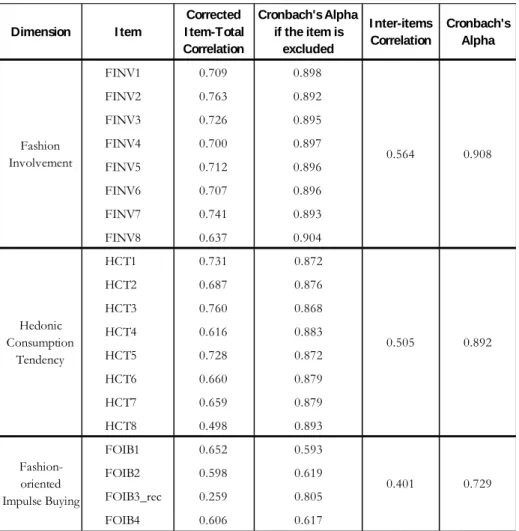
2. Internal consistency ... 32
3. Sample characterization ... 34
4. Descriptive analysis ... 36
5. Investigation model and hypotheses ... 39
Conclusions ... 48
Bibliographic references ... 50
Annexes ... 60
1. Annex A – Research questionnaire (English) ... 60
2. Annex B – Research questionnaire delivered (Portuguese) ... 63
3. Annex C – Bibliography of the items composing the questionnaire ... 67
Index of Tables
Table 1 - Clothing and footware (%) in terms of total consumption in Europe ... 22
Table 2 - Portuguese textile and clothing industry indicators ... 23
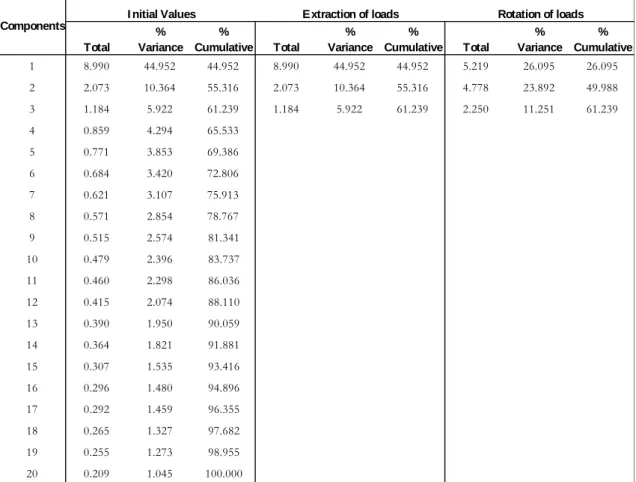
Table 3 - Percentage of total variance explained by the three primary factors ... 31
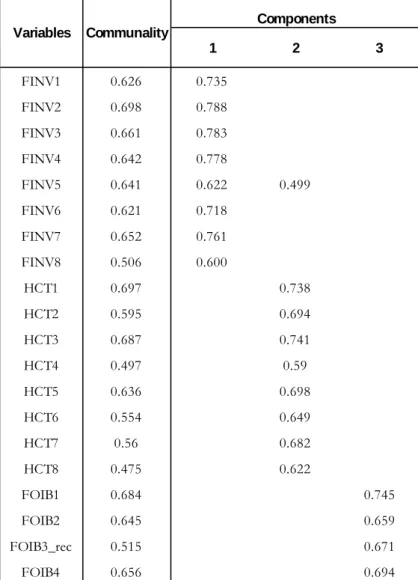
Table 4 - Communality and principal components of the scale ... 32
Table 5 - Internal Consistency ... 34
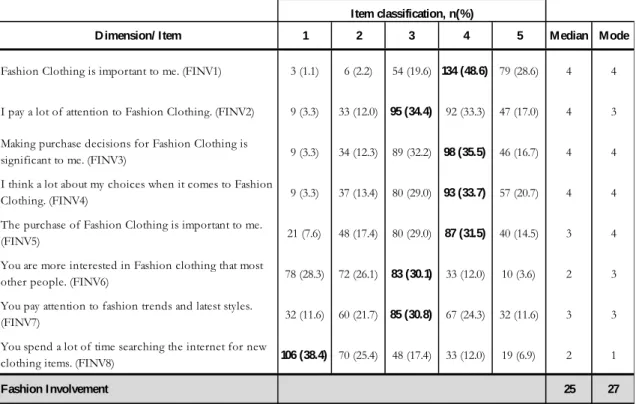
Table 6 - Results obtained for the dimension of fashion involvement ... 37
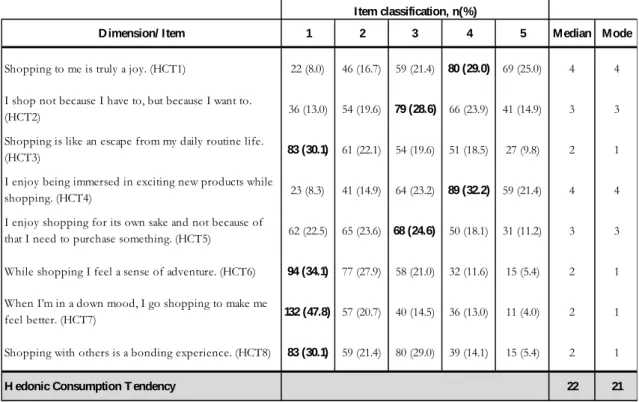
Table 7 - Results obtained for the dimension of hedonic consumption tendency ... 38
Table 8 - Results obtained for the dimension of fashion-oriented impulse buying ... 39
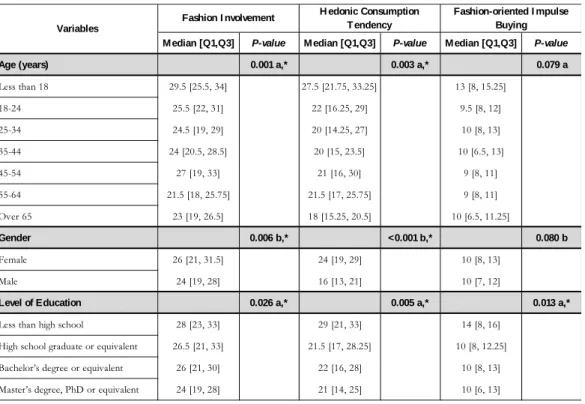
Table 9 - Non-parametric tests regarding age, gender and level of education ... 42
Table 10 - Non-parametric tests regarding employment status, NUTS II and monthly net income ... 43
Table 11 - Non-parametric tests regarding frequency of purchase, season of the year and average expenditure per shopping trip on new clothing ... 44
Table 12 - Goodness of fit indexes of the estimated model ... 46
Table 13 - Hypotheses results ... 47
Index of Figures
Figure 1 - Conceptual model of Fashion-oriented impulse buying ... 25Figure 2 - Representation of the estimated SEM ... 45
Introduction
Behavioural economics has been gaining importance in the last decades. A recogni-tion of this can be found in 2017’s Nobel prize, which was awarded to Richard Thaler on his contributions to this subject. As the Committee wrote: “Economists aim to develop models of
human behaviour and interactions in markets and other economic settings. But we humans behave in complex ways. Although we try to make rational decisions, we have limited cognitive abilities and limited willpower.”
(The Committee for the Prize in Economic Sciences in Memory of Alfred Nobel, 2017). Human beings make choices. Even though, in general, individuals try to make the best decisions (through their view at least) when purchasing goods or services, human rea-soning is far from perfect and often is guided by emotion, leading to decisions that are not maximizing their utility (Mankin, 2014; Soukup, Maitah, & Svoboda, 2015) .
The idealized consumer, which mainstream economics presents to us while studying this discipline is often far from behaving consistently. The theory of consumer choice (utility maximization) and the theory of the firm (profit maximization) are two of the paradigms that can be found within the Neoclassical economics that rest upon the assumption that agents behave according to homo economicus (Urbina & Ruiz-Villaverde, 2019).
Here, it is addressed one of the many deviations from idealized behaviour, and this is impulse buying. In particular, I wish to address this matter by adopting a view of rationality that is informed by recent contributions of behavioural economists.
This dissertation aims to be an empirical contribution to the development of the concept of impulsiveness existent in economics. Although there are many studies about im-pulsiveness, these mostly focus on the marketing side. The focus is rather to understand consumer behaviour and a couple of motivations that lead to impulse buying, in the fashion-clothing context using a Portuguese sample. The motivations considered to this thesis are fashion involvement and hedonic consumption tendency.
Since impulse buying consists of a broad concept within behavioural economics and consumer behaviour, there are many questions still to be discussed on this topic. I am con-vinced that there is a wide gap to be filled and that this dissertation may contribute to fill in a small part of that gap, especially in the Portuguese context. Additionally, this thesis also aims to generate interest in future possible investigations within the area of behavioural eco-nomics, raising awareness of the need to bring closer the relationship between the fields of economics and psychology.
This thesis is divided into five components. After this brief introduction which allows to clarify the pertinence of this thesis and to contextualize the nature of this investigation, Part I introduces the theoretical framework relevant to the concept of impulse buying.
It begins with a brief review of the theory of consumer choice and Neoclassical economics moving on to the concept of bounded rationality and behavioural economics. This is followed by the discussion of the existent literature on the concept of impulse buying and fashion-oriented impulse buying, fashion involvement and hedonic consumption ten-dency. And ends with a short review on the state of fashion clothing consumption in Portu-gal.
In Part II it is presented a description of both investigation model and hypotheses and continues with the methodology. The research method used was a questionnaire and the collection of the data and further details on the questionnaire are also given in this part.
In Part III, the results obtained from the questionnaire are subject to an extensive analysis, with a previous validation and internal consistency analysis before proceeding to the sample characterization and results analysis.
At last, the conclusions of this thesis will be presented, together with the limitations associated with this investigation, pointing to potential future improvements and suggestions for later investigations being made concerning this scope.
Part I - Literature review
1. Theory of consumer choice and Neoclassical economics
Economics is a social science that has been evolving for centuries. It is a diverse science, with different schools of thought. At the beginning of the 20th century, the term Neoclassical
economics was introduced by Thorstein Veblen in his book ‘Preconceptions of Economic Science’. He used it to classify Marshall’s economics (Lawson, 2013). But Neoclassical economics has been associated with the use of mathematics and of marginalist reasonings, i.e. with the work descended from the Marginalist Revolution (Colander, 2002; Weintraub, 2002). The contin-uous rise of marginalism and the works of economists such as Jevons, Walras or Marshall created the conditions for the development of modern economics (Morgan, 2016).
It is claimed that Neoclassical economics dominates modern microeconomic thought. According to Hall & Lieberman (2012), Microeconomics studies the behaviour of individuals (households or firms) on an economic basis. It is concerned with human choice and the way individuals interact and make transactions with each other.
Neoclassical economics’ approach is based on several assumptions. Among them, we find methodological individualism, which essentially states that economic phenomena should be explained in terms of the behaviour of economic ‘agents’ (the units). A second assump-tion is that it works towards understanding the reacassump-tion of individuals to a set of prices, that while aggregated lead to the market equilibrium. Thus, it is important to comprehend the circumstances under which it is possible to find this equilibrium and whether it is stable (Himmelweit, Simonetti, & Trigg, 2001). The last assumption is that “all individual behaviour is
‘rational’ according to a very specific definition of the term” (Himmelweit, Simonetti, & Trigg, 2001,
p.19).
Agents’ rationality depends on the choices they make. As consumers, they are rational if their consumer behaviour can be represented as maximizing a utility function. The concept of utility first arose in the work of the philosopher Jeremy Bentham in the 19th century: “An action then may be said to be conformable to the principle of (…) utility, (meaning with respect to the community at large) when the tendency it has to augment the happiness of the community is greater than any it has to diminish it” (Bentham, 1996, p.12). Benthamite utility was thus the tendency of an
object or action to increase or decrease overall happiness. According to utilitarians, like Ben-tham or John Stuart Mill, utility was a measure of well-being and therefore the ultimate ob-jective of all public and private actions (Mankin, 2014).
Utility is an abstract measure of satisfaction or happiness, which reflects consumer’s preferences. The Marginalist Revolution of the 1870s, with contributions of Jevons, Menger, Walras and Marshall, showed the importance of comparisons of utility rather than absolute levels of utility. Also, the law of diminishing marginal utility became a central hypothesis. Marginal utility is the additional amount of utility a consumer receives from the consumption of an additional unit of a certain good. Thus, what the diminishing marginal utility states is that there is a point after which an additional unit of a good will provide less utility to the consumer than a previous unit (Mankin, 2014; Salvatore, 2005).
Early conceptions of utility could be expressed in terms of a unit and was measura-ble. This is called cardinal utility and the idea was to provide an index of satisfaction for the individual which could represent observable choice (Abdellaoui, Barrios, & Wakker, 2007; Salvatore, 2005). In the 1930s, mostly as a result of Hicks and Allen’s (1934) work, econo-mists understood that a consumer theory was possible with a notion of utility that was ordi-nal, i.e. subject to ranking rather than measurement. This advance owed much to the previous contributions of Vilfredo Pareto.
In the Hicks-Allen theory, preferences are defined over all goods, i.e. complete. Given two bundles of goods, the consumer either strictly prefers one or the other, or is indifferent between the two. Preferences are monotonic, i.e. the individual always prefers to have more goods than less. Preferences are consistent. This means that given bundles A, B and C, if the consumer prefers A to B, he will not prefer B to A. And if he prefers B to C, he will prefer A to C, since he prefers A to B. Lastly, preferences are subject to the law of diminishing marginal rate of substitution (Mankin, 2014; Wong, 2006).
While this theory was being developed, Paul Samuelson offered an alternative theory of consumer behaviour. He intended to eliminate the concept of utility or its surrogate, preferences, which were not directly observable. Samuelson developed his ‘Revealed Preference
Theory’, based on a postulate of consistency of behaviour (Houthakker, 2016; Keita, 2012;
Wong, 2006). In this theory, preferences are given by choice behaviour, and not the other way around. Samuelson used a ‘choice structure’ to model individual behaviour. In his work, he postulated that: “if an individual selects batch one over batch two, he does not at the same time select
two over one” (Samuelson, 1938, p.65) and this has since became known as the Weak Axiom
of Revealed Preference (Heufer, 2009; Mas-Colell, Whinston, & Green, 1995; Varian, 2005). In greater detail, the Revealed Preference Theory states that given two different bundles of goods and corresponding prices (A and B for example) and given a budget constraint, if a
consumer chooses bundle A over bundle B, we say that A is revealed preferred to B. The Weak Axiom of Revealed Preference says that if A is ever chosen over B, when B is available, then there is no budget set containing both alternatives for which B is chosen and A is not (Mas-Colell et al., 1995).
The Weak Axiom rests upon a postulate of consistency, according to which there can be no conflicting evidence to the individual’s preference between two observations of choice behaviour (Mas-Colell et al., 1995). But Samuelson’s theory did not exhaust the classical, preference-based approach. This was only achieved with Houthakker’s (1950) extension of the Weak Axiom, his ‘Strong Axiom of Revealed Preference’. As an example of this, there are now three bundles of goods: A, B and C. A is chosen over B as the previous example. But now the combination of C is chosen over A. Then C is revealed preferred to A, as A is revealed preferred to B. Given this, what is the relation between C and B? This axiom adds the property of transitivity, in this case, the idea of indirectly revealing preferences. With this property, if C is revealed preferred to A and A is revealed preferred to B (regardless of the reasons), it is possible to conclude that C is indirectly revealed to be preferable to B (Heufer, 2009; Mas-Colell et al., 1995; Varian, 2005).
After Houthakker’s contribution, Samuelson (1950) asserts in his paper ‘The Prob-lem of Integrability in Utility Theory’ that thanks to Houthakker’s research his goal was achieved. There was finally a revealed preference theory equivalent to the ordinal utility the-ory (Wong, 2006).
2. Bounded rationality and behavioural economics
Whether in the preference-based or revealed preference approach, the idealized consumer proposed by microeconomic theory is a self-interested individual, who has a complete knowledge of the market, is perfectly informed about all choice alternatives, and behaves as if maximizing expected utility while minimizing costs (Soukup et al., 2015; Wood, 1998). However, many of the assumptions upon which the decision theory of Neoclassical eco-nomics is based are repeatedly violated, as many behavioural economists have discovered in their works (Baumeister, Sparks, Stillman, & Vohs, 2008). Despite seeming rational, cautious and reflective in their actions, real people are still ‘homo sapiens’ and not ‘homo economicus’. Hu-man reasoning has imperfections and is frequently led by emotion rather than reason, which until a few years ago was neglected (Mankin, 2014).
Herbert Simon, one of the most responsible authors for the renewed interest in top-ics on behavioural economtop-ics due to his outstanding contributions to economtop-ics and psy-chology, among other fields of study (Cartwright, 2014; Sent, 2004), studied reasoning im-perfections. In 1955, the economist published a paper where he alternatively proposed the concept of bounded rationality. In his point of view, the Neoclassical models were incapable of portraying human choice behaviour accurately (Muramatsu, 2009). This difficulty was, according to him, due to various human cognitive limitations. He recognized that humans face limitations when it comes to their thinking capacity, available information and time (Barros, 2010; Cartwright, 2014; Samson (ed.), 2014). Simon believed that there is a “disparity between
the complexity of the world and the fitness of human computational capabilities, with or without computers”
(as cited in Kalantari, 2010, p.512). The major flaw in the Neoclassical model is that it con-siders the person who makes the decision an observer instead of an actor in the process of decision making. To Simon, despite being a powerful and useful tool with its assumptions of rationality, the classical theory “fails to include some of the central problems of conflict and dynamics
with which economics has become more and more concerned” (Simon, 1959, p.255). Also, he was able
to identify multiple limits of rationality such as incomplete information about alternatives, complexity, risk, and uncertainty (Schilirò, 2011).
The concept of bounded rationality is part of a much broader subject, which has been continuously growing interest among economic researchers and that is Behavioural Economics.
Behavioural economics can be defined in many distinct ways. This concept is about
understand-ing human behaviour when it comes to their economic actions and choices (good or bad), its consequences and how to make better choices (Berg, 2014; Cartwright, 2014).“It is about
working constructively with the standard economic model to get a better understanding of economic behaviour”
(Cartwright, 2014, p.4). The subject is focused on the connection between concepts existent in both economics and psychology. In 1998, Matthew Rabin published an article stating the importance of linking psychological findings to economics. The way he sees it, psychology can give a new insight to the way that humans are traditionally defined by economists, since its main objective is to analyse human behaviour and judgement (Rabin, 1998; Sent, 2004).
It is claimed by Cartwright (2014) and Thaler (2016) that despite only more recently the interest in this subject has been growing, the history of behavioural economics can be traced back to Adam Smith’s contributions. In 1759, he published a book called Theory of
Moral Sentiments, in which he defended that human behaviour could be determined both by
hand firstly arose (Ashraf, Camerer, & Loewenstein, 2005). Furthermore, with this book, it is possible to acknowledge many ideas that have recently become major issues in behavioural economics (Cartwright, 2014; Thaler, 2016).
Regardless of having different specific motivations, the behavioural economists that emerged at the same time as Herbert Simon but were part of different streams studying this discipline all agreed they were dissatisfied with mainstream economics and were craving for an alternative. In this regard, Sent (2004) provides a straightforward distinction between what he called mainstream economics, an approach that establishes a connection between ration-ality, utility and profit maximization and the old behavioural economics more directed to the departure of behaviour from neoclassical assumptions. This first establishment of behav-ioural economics as a subject was labelled as “old behavbehav-ioural economics” with the purpose of distinguishing it from the advances that were made more recently, and which are part of the “new behavioural economics” as mentioned in Sent (2004) and Agner & Loewenstein (2012).
The new behavioural economics and the current debates on its status can be mostly traced to the works of Daniel Kahneman and Amos Tversky. The main difference between Simon’s work and the one that these two psychologists developed is that the first had a radical depar-ture and sought to develop behavioural economics as an alternative to mainstream econom-ics, while the latter use the existent economic hypothesis as a baseline and then consider some deviations to the model (Sent, 2004; Thaler, 2016). Since the work developed by Her-bert Simon (1955) on people’s cognitive limitations, Tversky and Kahneman (1974) devel-oped a model of heuristic judgement which considers these limitations or biases. In this model, they describe three heuristics used to assess probabilities and to predict values, namely: representativeness, availability, adjustment, and anchoring (Tversky & Kahneman, 1974). Heuristics are cognitive shortcuts used by people on a daily basis to reduce mental effort in decision making. Despite heuristics being helpful in many situations, since “these
rule-of-thumb strategies shorten decision-making time and allow people to function without constantly stopping to think about their next course of action” (Lishman, Yuill, Brannan, & Gibson, 2014) they lead to
systematic cognitive biases or errors in judgement.
The existence of heuristics can be related to the way individuals process information in the decision-making process. Kahneman can recognize the complexity of decision-making in the book, “Thinking, Fast and Slow”. This book, which gathers his main researches, adopts the two-system model of processing from Stanovich and West (2000), which has been de-scribed in different ways but can be referred to as dual-process theory (Baumeister et al.,
2008; Shleifer, 2012). According to this theory there are two thinking systems which can be denoted as System 1 and System 2. The System 1 processes fast and automatic decisions with no sense of voluntary control whereas System 2 decisions require attention, mental effort and occur more slowly (Kahneman, 2012).
Additionally, the decisions occurring in System 1 can be described as intuitive and impulsive and originate impressions and feelings which are the sources of the beliefs and deliberate choices of System 2. System 1 is based on associations, stereotypes and metaphors. In contrast, decisions in System 2 tend to be reflective, deliberative and analytical and often associated with rational choice. This system is in charge of self-control, particularly one of its tasks is to control the impulses formed by System 1 (Baumeister et al., 2008; Kahneman, 2012; Stojanovic, 2013; Thorgeirsson & Kawachi, 2013).
Kahneman is able to conclude that self-control requires attention and effort, which means this is a form of mental work. One theoretical model on self-control is the limited-resource model which states that the effort of will or self-control is tiring (Kahneman, 2012). In other words, the capacity for self-control is limited and therefore gets depleted. When this occurs, it is called ego depletion. The American social psychologist Roy Baumeister alongside a group of researchers conducted several experiments to show the ego depletion effects (Baumeister, 2003; Baumeister et al., 2008). The experiments typically involved two tasks: the first one would reduce the ability of self-control and later they were given a difficult cognitive second task. One of the many indicators that was discovered as being a sign of the depletion of self-control was impulsive purchases (Kahneman, 2012; Vohs & Faber, 2007).
According to Vohs and Faber (2007), when the self-regulatory resources become de-pleted there is an increase in impulsive spending. More specifically, “When regulatory resources
are low, people feel stronger urges to buy impulsively, are willing to spend more money for a product, buy more items, and spend more total money than when their regulatory resources are intact.”(Vohs & Faber, 2007).
Recently, this concept has been subject to controversy due to some reviews of the research, which advocate that ego depletion is not a real phenomenon. One of the first researchers to enquire this was Evan Carter who managed to repeat some of the experiments which were positive on ego depletion and reported that there is low evidence of its existence (Friese, Loschelder, Gieseler, Frankenbach, & Inzlicht, 2018). Referring to the views of Carter, Kofler, Forster, & Mccullough (2015), which conducted a series of meta-analytic tests on ego
it relies on a limited resource, at least when measured as it typically is in the laboratory” 1.
Another approach to the study of impulsive buying is related to consumer’s prefer-ences. The standard economic theory is built upon the assumption that an individual’s pref-erences are time-consistent (DellaVigna, 2009). To capture impatience, it is assumed by econ-omists that people’s streams of utility are weighted by an exponentially declining discount factor 𝑑(𝑡) = 𝛿𝑡, where 1 > 𝛿 > 0.2 (Camerer, Loewenstein, & Rabin, 2004, p.22;
O’Donoghue & Rabin, 1992). However, research in this field suggests that the assumption of time consistency is not correct. In real life, people have a preference to avoid costs that seem to be closer in time while they are in for immediate gratification. What happens is that short-term emotions have such an impact on consumers’ preferences resulting in a disregard for their long-term interests, which is related to how the impulse buying phenomenon works (Verplanken & Sato, 2011). Strotz (1956) was one of the first economists to study this ques-tion and to show that an individual’s discount funcques-tions can be nonexponential through the formalization of a theory of commitment (Laibson, 1997). Even before, Jevons among other renowned economists had already recognized that individuals discount the future (Ainslie, 1975). Instead of an exponential function, it is proposed a hyperbolic discount function that is capable of modelling these inconsistent preferences (Laibson, 1998).
Hoch and Loewenstein (1991) go beyond the economic discounting perspective and alternatively recognize that time-inconsistent preferences are a result of a change in the con-sumer’s reference point (Verplanken & Sato, 2011). As described by these researchers, the
refer-ence point “reflects the fact that people are less concerned with absolute attainments than with attainments relative to some psychologically relevant comparison point” (Hoch & Loewenstein, 1991, p.494). That
is to say that utility should rather be measured in terms of gains and losses which are relative to the present state of wealth rather than being defined by final wealth state (Markowitz, 1952) (as cited in O’Donoghue & Sprenger, 2018). In the view of Hoch and Loewenstein (1991) impulsive purchases can be related to changes in the consumer’s reference point. Assum-ing that the default reference point of a consumer is not havAssum-ing purchased any good, when the purchase has been made, the consumer’s reference point is now owning a good (Hoch & Loewenstein, 1991; Verplanken & Sato, 2011). The feelings usually associated with impulsive purchases can shift this default reference point to one as if the consumer had already made that
1Further literature on the current debate on ego depletion can be found in Friese et al. (2018). 2 The discount factor is usually expressed by 1/(1+r), where r is a discount rate.
purchase. The authors state that the consequence of this is that when the consumer tries to walk away from the desired good, there is a feeling of deprivation or loss of that good leading to a never-ending desire to its purchase or consumption sooner as possible in order to stop the feeling of deprivation (Hoch & Loewenstein, 1991; Verplanken & Sato, 2011).
The evaluation of outcomes as gains and losses from a reference point is also one of the main current subjects of behavioural economics. The reference point plays an important role in Kahneman and Tversky's Prospect Theory (Bruni & Sugden, 2007; Thaler, 2016). What Kahneman and Tversky offered in their 1979 paper was a theory of non-rational behaviour based on psychological assumptions as a complement to the established economic theories of decision making, namely the expected utility theory from von Neumann & Morgenstern (1947) (Bruni & Sugden, 2007; Thaler, 2016).
Throughout the history of behavioural economics, the subject of impulse buying emerged several times as an important departure from ideal consumption behaviour. Many researches have been conducted with samples gathered from different countries, explaining the factors or variables that may lead to impulsive buying behaviour. However, very few in-vestigations have been found referring to those factors and motivations among the Portu-guese consumers (Cardoso, Costa, & Novais, 2010) and therefore it is about time to address this issue.
3. Fashion-oriented impulse buying
Impulse buying is a significant aspect of consumer behaviour. Testament to its prevalence are the examples we come across, on a daily basis, of consumers buying something instinc-tively, something they do not need (Cobb & Hoyer, 1986; Hausman, 2000). This prevalence has led researchers from different areas, such as economics and psychology, to be interested in the study of impulse buying behaviour.
There is an extensive literature on different motivations that are related to the impulse buying behaviour. Motivations such as positive/negative feelings (Youn & Faber, 2000), proximity to the product (Peck & Childers, 2006), store environment (Mohan, Sivakumaran, & Sharma, 2013), hedonic (Hausman, 2000) and involvement (Jones, Reynolds, Weun, & Beatty, 2003) are among the most discussed.
In this thesis, firstly it is important to get an insight into the concepts of impulse buying, specifically the case of fashion-oriented impulse buying, as well as fashion involve-ment and hedonic consumption tendency. Impulse buying as it will be further explained can
be summarily described as the purchase of goods without a planned intention of doing so, as a result of a sudden urge or stimuli (Bayley & Nancarrow, 1998; Piron, 1991; Rook, 1987). Fashion involvement has been identified as a relational variable that helps to understand and predict purchase behaviour (O’Cass, 2000). This construct refers to the interaction between an individual and a product, with an unobservable state of interest or arousal provoked by the product. It has been found to lead to impulse buying (Kapferer & Laurent, 1985; O’Cass, 2000).
Therefore, one of the purposes here is to study if there is an influence of the dimen-sion of fashion involvement in fashion-oriented impulse buying, like few researches have previously shown support for (Joo Park, Young Kim, & Forney, 2006). In other words, if fashion involvement is related to fashion-oriented impulse buying.
In like manner, other investigators suggest that clothing consumption is often related to hedonic motivations (such as fun, novelty and adventure) as opposed to utilitarian moti-vations (satisfying a need), and the first often leads to impulse buying behaviour (Cardoso et al., 2010; Hausman, 2000; Joo Park et al., 2006). And so, the other purpose is thus to study the influence of hedonic consumption tendency in fashion-oriented impulse buying.
3.1 Impulse buying
Every day, people find themselves or others behaving impulsively. Anyone can cheat in their diet by, on the spur of the moment, eating a tempting piece of cake, unduly prolong a cigarette break, or make a purchase and regret it moments later. Everybody can recall more than one time they acted impulsively.
To better understand this behaviour, there has been a concern, mainly from psy-chologists at first, in coming up with a definition of impulsivity. As it is possible to acknowledge many examples of impulsive behaviour, it is natural that there is more than one definition of this idea. And so, in line with Evenden (1999), impulsivity should not be seen from just one point of view, but rather according to the field people are working on (Evenden, 1999).
The focus of this thesis is on the impulse buying behaviour, in the definition of which there has been an interest for over sixty years. According to Stern (1962), impulse buying can be used to describe a purchase that was not previously planned, a synonym for unplanned buying. He argues that many factors influence impulse buying, such as time, lo-cation, economic, personality or cultural. With these factors in mind the author came up with
4 broad classifications of impulse buying: (1) pure, characterized by being a fresh or “getaway” purchase, which breaks with the regular buying pattern; (2) reminder, arises during a trip to the store when the shopper remembers to buy after seeing the item or recalls its advertise-ment; (3) suggestion, despite not having any previous knowledge of the item, the will to buy it arises with the product quality being evaluated at the point of sale; (4) planned, originated by a previous intention of buying an item, but is dependent of the purchase conditions (offer and discounts for example). The main difference among them is that whereas the pure im-pulse buying happens due to an emotional stimulus and almost without any cognitive in-volvement, the other 3 are a combination of both characteristics (Stern, 1962).
Before 1973, investigation on impulse buying behaviour focused on goods or items being classified as impulsive or not, but with authors like Shapiro (1973), Belleneger (1978) or Rook and Hoch (1985) there was a shift on the way of thinking. These authors agreed that any good might be subject to impulsive behaviour and thus the research should rather focus on impulsive behaviour and purchases (Belleneger, Roberston, & Hirschman, 1978; Rook & Hoch, 1985).
A reconceptualization of the impulse buying concept was suggested in 1987, when Rook argued that the term was more specific and narrower than an unplanned purchase. In his article he defined impulse buying as “a sudden, often powerful and persistent urge to buy something
immediately” that the consumer feels, disregarding the consequences. This lead him to
con-clude that it is not true that all unplanned purchases are impulsively decided and also that the impulsive behaviour was rather emotional instead of rational (Rook, 1987).
Before such reconceptualization, Weinberg and Gottwald (1982) had already shared a similar point of view. If impulsive purchase decisions are unplanned in the sense of thoughtless, not every unplanned purchase is impulsively decided, as some of these can be done rationally. Additionally, these authors state that impulsive decisions are based on three dimensions of consumer behaviour: affective, cognitive and reactive (Weinberg & Gottwald, 1982).
Following Rook’s work, several researchers have offered different definitions for the impulse buying concept. Worth mentioning is the view of Francis Piron (1991). The author argues that, contrary to the perspective of Rook (1987), the experience of an emotional and/or cognitive reaction (the feeling of acting sudden and spontaneously for example) is not by itself a determinant characteristic of an impulsive purchase. Instead, he proposed that impulse purchasing could be formally composed by three characteristics. A purchase that
was simultaneously (1) unplanned, (2) the result of an exposure to a stimulus and (3) decided on-the-spot (Piron, 1991). The stimulus may be triggered by the environmental manipulation of the shopping atmosphere, the positioning of the product on a certain shelf or aisle, or even through tie-ins, connecting different items by positioning them next to each other to make the other product stand out (Piron, 1991). In the case of fashion products, one can easily come across examples of this environmental manipulation of the shopping atmos-phere. To increase the desirability of fashion products, brands and stores often resort to visual merchandising (Kim, 2003). It is simple to infer from these authors that after the 1980s the researchers centred their attention on the behavioural dimensions of impulse buying (Hausman, 1992).
Frequently associated with impulse buying is a disregard for the consequences of this behaviour (Rook, 1987). Wood (1998) suggests that emotional responses such as regret, or dissatisfaction are “connected to retrospective judgements about the (marginal) utility of a purchase”. When looking back to an acquisition made impulsively, the consumer may later find it as a waste or unnecessary (Wood, 1998). Furthermore, Wood (1998) emphasizes that consumer displeasure and regret can be related to time-inconsistent preferences from a cognitive and experiential side. To Hoch and Loewenstein (1991), a time-inconsistent choice “is one that
would not have been made if it had been contemplated from a removed, dispassionate perspective” (p.493).
Impulse buying poses a problem to the rational choice model since these purchases are associated with time-inconsistent preferences and consequently with post-purchase re-gret (Dittmar, Beattie, & Friese, 1995; Dittmar & Drury, 2000). Many researchers have worked towards incorporating impulse buying and regret into economic theory, and one of these representations is the impatience model3 from Hoch and Loewenstein (1991).
Also on regret, Sugden (1985) defines it as a “painful sensation of recognising that ‘what is’
compares unfavourably with ‘what might have been’ ”(p.77). Moreover, this author acknowledges that
regret is composed of two distinct components. The first one is to wish that the decision made would have been another, and the second is self-recrimination or self-blame. Self-recrimi-nation is “the state of mind you have when you come to believe that a previous decision involved an error of
judgement, that it was wrong at the time you made it” (p.79) and this also can be experienced even
3The impatience model can be understood with more detail by reading: Coley & Burgess (2003), Dittmar &
when it results in a positive outcome from the decision itself (Sugden, 1985). Sudgen, along-side with Graham Loomes, were able to incorporate regret into a theory of rational choice (the idea is that decision-makers focus on minimizing the regret that arises if their choice leads to a low payoff)4 and explained some of the violations on expected utility theory
(Loomes & Sugden, 1982; Sugden, 1985).
In addition to regret, other negative outcomes can be traced to impulse buying, such as: financial problems after purchase, feelings of guilt, social disapproval and ruined (nonfinan-cial) plans (Rook, 1987; Rook & Fisher, 1995).
Although there have been many researches concerned with impulse buying, most of these are focused on supermarket or department store purchases (Han, Morgan, & Kotsiopulos, 1991). On impulse buying of clothing specifically, though there has been a growing interest in the subject due to the fashion sector being one of the industries with the highest degree of impulse purchasing, there is still much to be discovered and understood (Fairhurst, Good, & Gentry, 1989; Liapati, Assiouras, & Decaudin, 2015).
In the last 20 years, there have been significant changes to the fashion clothing in-dustry (Bhardwaj & Fairhurst, 2010). Namely: the decline of mass production, the growth of the number of fashion seasons, changes in the supply chain characteristics with a focus on lowering production costs while getting quickly to the market and adaptable design (Bhardwaj & Fairhurst, 2010). Additionally, during this time there has been an increase in the fashion consciousness of consumers, as it helps to express the way individuals define them-selves (Bhardwaj & Fairhurst, 2010; Dhurup, 2014). Christopher, Lowson, and Peck (2004) have characterized the fashion markets with the following features: short life cycles, high volatility of market demand, low predictability of the demand and high impulse purchasing.
According to Dittmar and Drury (2000), items like clothes, jewellery, and ornaments were reported as items which are more frequently subject to being purchased impulsively compared to other types of consumer goods. Fashion-oriented impulse buying arises “when
consumers see a new fashion product and buy it because they are motivated by the suggestion to buy new products” (Han et al., 1991) (as cited in Joo Park, Young Kim, & Forney, 2006).
Han et al. (1991) in their research on impulse buying behaviour of apparel purchasers were able to modify Stern’s (1962) classifications of impulse buying and adapted it to
4More details on the Regret Theory developed by Loomes and Sudgen (1982) can be found in: Quiggin,
oriented impulse buying. As reported by these authors, impulse buying can be classified into 4 categories: planned, reminder, fashion-oriented and pure impulse buying. The novelty in this clas-sification is the replacement of Stern’s (1962) suggestion impulse buying for fashion-oriented im-pulse buying. Han et al. (1991) explained that “this type of buying occurs when the customer sees a
product (in this study an apparel item) in a new style, design, or fabric and decides to buy it. Originally, Stern called this type of buying suggestion impulse buying.” (p.16).
Among their findings, Han et al. (1991) found evidence that the textile and clothing students as compared to non-students had more chance to be fashion-oriented impulse buy-ers (Joo Park et al., 2006). The way Dittmar and Drury (2000) see it, fashion clothing is more subject to impulse buying compared to other items due to a higher discount rate associated with this type of consumer good. The researchers argue that “having to wait for something a
person wants, like a new dress, entails a psychological cost” (p.113) and on items such as clothing the
costs of waiting for these items is higher and so consumers demand a higher compensation (discount rate) to wait for those goods (Dittmar & Drury, 2000).
3.2 Involvement and fashion involvement
In many studies, especially in marketing literature, it is not difficult to come across the con-cept of involvement. Involvement is generally seen as “a construct linked to the interaction between
an individual and an object and refers to the relative strength of the consumers’ cognitive structure related to a focal object (e.g., products)” (O’Cass, 2000, p.548). Researchers seem to agree that this is an
important variable that helps to explain consumer behaviour and therefore they have been focused not only in defining but also examining involvement in different contexts.
It is claimed that involvement originates from the notion of ego-involvement and social psychology, particularly from social judgement/involvement approach which is a theory of attitude change5 (Michaelidou & Dibb, 2008).
The construct of involvement is often claimed to be somewhat difficult to define, as scholars have contradicting views concerning the issue of the dimensionality of the concept. Nonetheless, there were many studies focused on coming up with a generalized definition of the involvement construct. As stated in Kapferer and Laurent (1985) there was an agree-ment in defining involveagree-ment as "an unobservable state of motivation, arousal or interest. It is evoked
5 To understand the Social Judgement Theory and the concept of ego-involvement read the following:
by a particular stimulus or situation and has driven properties. Its consequences are types of searching, information-processing and decision making." (Rothschild, 1984). Also, Mittal and Lee (1989) in
their model of consumer involvement agree that involvement “reflects the extent of personal
relevance of the decision to the individual in terms of her basic values, goals and self-concept” (Mittal &
Lee, 1989, p.364).
There is a lack of agreement on whether the involvement construct should be con-ceptualized as unidimensional or multidimensional. Although earlier investigations have de-veloped unidimensional measures (Fairhurst et al., 1989; Zaichkowsky, 1985) to this concept, in the literature the reader can look predominantly at examples of involvement as a multidi-mensional construct. As stated by Laurent & Kapferer (1985), researchers should “stop
think-ing in terms of sthink-ingle indicators of the involvement level and instead use an “involvement” profile to specify more fully the nature of the relationship between a consumer and a product category” (p.41). The
involve-ment profile proposed by these authors includes dimensions of interest, pleasure, risk im-portance, risk probability, and sign-value. They suggest that by measuring an individual’s po-sition on each of these dimensions it is possible to get a complete picture of the origin of consumer involvement and therefore they should be taken into consideration (Kapferer & Laurent, 1985).
The struggle to find an appropriate measure to the involvement construct also seems to arise from the distinction between different types of involvement, “which relates to the
stim-ulus and its context” (Michaelidou & Dibb, 2006, p.445). Addressing this issue, Houston and
Rothschild (1977) presented a framework for the involvement construct, identifying three types of involvement: situational, enduring and response6.
With the understanding that involvement is associated with a variety of contexts in mind, in the literature it is easy to encounter this concept related to impulse buying. Previous researches propose that involvement can play a significant part in the impulse buying process (Jones et al., 2003). There are several reasons why involvement influences impulsive pur-chases. Between these, it can be pointed out the strong emotions developed by the proximity with a certain product (Jones et al., 2003; Rook, 1987).
All things considered and regardless of the variety of products which can be subject to involvement, the focus of the present thesis is to comprehend the involvement associated
6To understands the three types of involvement read: Houston & Rothschild (1977), Bloch (1982), Richins &
with fashion clothing. Fashion involvement refers to the extent of interest with a fashion product, thus fashion clothing involvement is linked to the importance that fashion clothing has in an individual’s life.
Prior studies have explored the concept of fashion involvement and developed vari-ous ways to measure it. One of the most acknowledged works in fashion involvement is the one of Tigert, Ring & King (1976) in which was developed and validated an index of fashion
involvement. They sought to demonstrate that when a consumer is highly involved with fashion
there is a higher possibility that the consumer buys fashion items more frequently. In the study’s ‘index’, five fashion behavioural dimensions were explored and tested, namely: fash-ion innovativeness, fashfash-ion interpersonal communicatfash-ion, fashfash-ion interest, fashfash-ion knowl-edgeability and fashion awareness and reaction to change in fashion trends (Tigert, Ring, & King, 1976).
Also, O’Cass (2000) developed a measurement of fashion involvement by consider-ing four different forms of involvement. O’Cass (2000) proposes an alternative model to classify the different types of involvement in his attempt to understand consumer behaviour in fashion clothing. Rather than using the notion proposed by Houston and Rothschild (1976) or Arora (1982), he argues that an individual could be involved in different stimuli or objects, such as (1) products, (2) advertisements of products, (3) purchase decisions and (4) consumption involvement (O’Cass, 2000). The author explains that the purpose of estab-lishing these four types is to “represent basic types of involvement relevant to a consumer’s environment
and maintain involvement as an enduring relationship between a consumer and an object, not a temporary or situational one” (O’Cass, 2000, p.553). In other words, involvement should be seen as a
rela-tionship variable, where involvement is linked to the interaction between the object and the consumer (O’Cass, 2004).
Regarding this thesis, the attention turns to two of the types of fashion involvement indicated by O’Cass (2000) which are: product involvement and purchase-decision involve-ment. Product involvement (PI), can be defined as “an internal state variable that indicates the
amount of arousal, interest or drive evoked by a product class”(Dholakia, 2001, p.1341). Mittal & Lee
(1989) consider product involvement as “the interest a consumer finds in a product class”, when a determined product class can fulfil important values and goals, and this is noticed by the consumer.
Following a lack of investigation for purchase-decision involvement in prior litera-ture, Mittal (1989b) conceptualized purchase decision involvement as “the extent of interest and
concern that a consumer brings to bear upon a purchase decision task” (p.150). To understand the
im-portance of making the distinction between product involvement and purchase decision in-volvement purchase-decision inin-volvement, Mittal (1989b) gives the following example: “most
consumers would have no enduring involvement in a washing machine, but they would have a high purchase-decision involvement” (p.148). Putting it differently, a consumer can have a high involvement
with a certain product class (high product involvement), but when it comes to the choice of a brand (if it is indifferent for example) the purchase decision involvement can be low (Mittal, 1989).
Subsequently to Mittal’s (1989b) generalized measure to the purchase involvement decision construct, O’Cass (2000) followed similar procedures adopted by Mittal and Lee (1989) and came up with a scale to measure purchase involvement decision specific for fash-ion clothing (O’Cass & Choy, 2008).
3.3
Hedonic consumption tendency
It is common to find the concept of hedonism in economic books. The word is derived from the ancient Greek (hedone) which means pleasure. Simultaneous to the discussion that revolves around rational choice and the rational men in economics more recently, the diffi-culty regarding the coexistence of psychological and non-psychological ideas within eco-nomics can be traced to other debates, namely on the controversy around hedonism (Lewin, 1996).
Around the nineteenth century, Jeremy Bentham proposed the use of hedonic calculus as the foundation of his theory (Lewin, 1996). According to him, “Nature has placed mankind
under the governance of two sovereign masters, pain and pleasure” (Bentham, 1907, p.1). And so, his
measure of utility was connected to an individual’s inner happiness, in other words, utility was a psychological magnitude (Lewin, 1996). Bentham’s Utilitarianism was therefore based on the concept of hedonism and the “greatest happiness principle”. Jevons was also pro-foundly influenced by Bentham’s ideas as he “attempted to treat Economy as a Calculus of Pleasure
and Pain” (Jevons, 1888)(as cited in Read, 2007).
Mainstream economics has long abandoned the Benthamite approach to utility. Nev-ertheless, Daniel Kahneman and other researchers have more recently attempted to bring
back hedonism into utility and more specifically a new empirical approach named theory of
ex-perienced utility (Kahneman, Wakker, & Sarin, 1997; Read, 2007) 7.
Additionally, the importance of considering other aspects, such as the experiential aspect of consumption, in contrast to the existing rational models of decision making, has been highlighted by researchers like Olshavsky and Granbois (1979), Sheth (1979) and Khan, Dhar, & Wertenbroch (2005). This research focuses on the distinction between the actual
hedonic and utilitarian consumption, understanding its motivations and differences, to better
comprehend the fashion-oriented impulse buying behaviour.
It is relevant to keep in mind that the use of the term utilitarian when it comes to consumer behaviour is different from the notion of utilitarianism given by Bentham (Babin, Darden, & Griffin, 1994). To his sense the utilitarianism “reflects much of both hedonic and
utili-tarian dimensions of consumer behaviour” (Babin et al., 1994, p.645), which is quite distinct from
the utilitarian value that it is focused on this thesis.
There are several reasons for consumers to acquire products or services and two possible explanations for this are the utilitarian and hedonic motivations (Babin et al., 1994; Hirschman & Holbrook, 1982; Holbrook & Hirschman, 1982; Voss, Spangenberg, & Grohmann, 2003).
Concerning the utilitarian motivation, this can be associated with rational behaviour and the utility related to a certain good (Batra & Ahtola, 1991). Batra and Ahtola (1991) argue that this feature is presumed to be based on the instrumentality or function (“means-ends”) of a product attributed by the consumer. And, according to Strahilevitz and Myers (1998), the utilitarian or “goal-oriented consumption is motivated mainly by the desire to fill a basic need or
accom-plish a functional task (e.g., the consumption of a bottle of dishwashing liquid or a box of trash bags)”
(Strahilevitz & Myers, 1998, p.436).
When compared to utilitarian motivation, hedonic motivation has not been studied and understood in so much detail but has over the past few years been attracting more atten-tion (Babin et al., 1994). This might be due to difficulties understanding what is behind the concept itself as it is more subjective and personal than its counterpart. (Holbrook & Hirschman, 1982)(as cited in Babin et al., 1994). In other words, a part of the customer’s shopping experience was not being properly considered, namely the weight of emotions re-lated to consumption activities (Bloch & Richins, 1983; Hirschman, 1984; Holbrook,
1986)(as cited in Lim, Cyr, & Tan, 2012).
The definition given by Hirschman and Holbrook (1982) of hedonic consumption, also referred to as experiential consumption, can be found in most of the academic literature on this subject. The authors relate this concept to a specific behaviour of the consumer, who seeks an experience characterized by fun, emotion, fantasy and sensory stimuli (Childers, Carr, Peck, & Carson, 2001).
While many researchers consider the hedonic consumption as unidimensional, Arnold and Reynolds (2003) are able to identify within the aspects of shopping six hedonic motivations that lead consumers to buy. The categories are the following: adventure, social, gratification, idea, role and value shopping (Arnold & Reynolds, 2003).
Additionally, the hedonic shopping value reflects that the experience a consumer goes through is in itself the reward of interacting with an environment. This means that when the consumer goes through positive emotional experiences such as pleasure and excitement or, that is to say, the consumer has a pleasant interaction with an environment both hedonic shopping value and unplanned purchases can be increased (Babin & Babin, 2001).
Intuitively, the characterization from both hedonic and utilitarian consumption makes it easier to conclude that the affective content and the motives that lead to these types of consumption are reasonably different (Strahilevitz & Myers, 1998).
In addition to being defined as a type of consumer experience, hedonic and utilitarian characteristics can also be applied in an attribute level, in other words, as a classification of a product instead of a type of consumption (Chernev, 2004; Dhar & Wertenbroch, 2000). Taking as an example the one given by Chernev (2004), an ice cream can be regarded as a hedonic product but containing both hedonic and utilitarian attributes. Utilitarian attribute in the sense that the ice cream possesses a certain number of calories necessaries for the human body to attain and hedonic attribute the flavour and taste of that ice cream (Chernev, 2004). Overall, a combination of utilitarian and hedonic motives can drive a consumer to make purchases and identifying which has more weight in the consumer choice can be a difficult task (Alba & Williams, 2013).
Many studies indicate conceptual support for a connection between impulse buying and hedonic consumption motives (Hausman, 2000). Considerable research contends that to satisfy hedonic needs, the consumers often engage in impulse buying behaviour (Hausman, 2000).
he suggested a relation between this concept and hedonism: “The impulse to buy is hedonically
complex and may stimulate emotional conflict” (Rook, 1987, p. 191). It appears to be of general
agreement that impulse buying involves a hedonic component (Cobb & Hoyer, 1986; Dhar & Wertenbroch, 2000; Wertenbroch, 1998). This relationship also applies to the consumption of fashion clothing. On a study conducted with college students, Joo Park et al. (2006) were able to identify that to fulfil hedonic needs the students engaged in fashion-oriented impulse buying (Liapati et al., 2015).
4. Consumption of fashion clothing in Portugal
Before proceeding to the analysis of the sample collected to this thesis, it is relevant to get an insight into a few sociodemographic characteristics of the Portuguese population and also the framework of Portuguese consumption, specifically the consumption of fashion clothing. Additionally, it is shown the considerable relevance that the textile and clothing sector have not only within the Portuguese economy but correspondingly across the globe. According to data from 2018 (INE), Portugal has around 10.3 million inhabitants, of which 52.8% are females. Considering the population by age groups, the most representative are the people above 65 years old (22%) followed by the 19 years old or less (19%). On the level of education, about 60% of the population (over 15 years old) has a level of education lower than high school or equivalent, and about 18.7% have a superior education diploma. Regarding the labour market, around 60% of the population (over 15 years old) was active, and of the active population, 7% were unemployed.
Focusing on the Portuguese consumption for the category of “Clothing and Foot-wear”, in comparison with other European countries between 2007 and 2017, it is possible to verify in Table 1 that Portugal has one of the highest percentages (around 6%) in the category “Clothing and Footwear” in terms of total consumption. Of the countries repre-sented in the table, only Italy surpasses Portugal between the years of 2007-2014, and Por-tuguese consumption is above both the average for the European Union and the Euro Area. It should be highlighted that not only has Portugal grown more fashion-conscious over the last 20 years with the increasing access to the internet and social media, the help of sales and advertisements but also because the “Clothing and Footwear” industry has been transform-ing over these years. Stepptransform-ing from a more traditional and labour-intensive production to a modern and highly competitive one (Batista, Matos, & Matos, 2017)(aicep Portugal Global, 2018).
Table 1 - Clothing and footwear (%) in terms of total consumption in Europe
Years European Coun-tries 2007 2012 2017 European Union (28 countries) 5.3 4.9 4.9 Euro Area (19 countries) 5.4 4.9 4.8 Belgium 4.9 4.7 4.2 Denmark 4.6 4.5 4.1 France 4.6 4 3.8 Germany 5.3 4.9 4.8 Greece 5.4 3.4 3.7 Hungary 3.3 2.6 3.8 Ireland 4.6 4 3.9 Italy 6.7 6.3 6.1 Luxembourg 5 5.4 5.2 Netherlands 5.4 5.4 5.4 Portugal 6.3 5.6 6.2 Spain 5.4 4.3 4.4 United Kingdom 5 5.3 5.5
Source: Data retrieved from INE
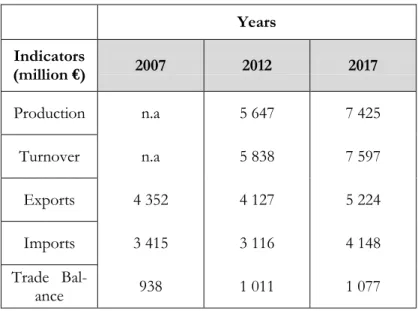
The Portuguese textile and clothing industry (“Indústria Têxtil e Vestuário”-ITV), is one of the most important industries of the Portuguese economy. In 2017, this industry produced 7.4 billion euros and generated a turnover of 7.6 billion euros, of which 5.2 billion euros are the result of export activity (ATP, 2019) as is shown in Table 2. Table 2 also shows that between 2007-2017, the production, turnover, exports and imports have increased over-all, despite a decrease around 2008 explained by the impact of the global economic and financial crisis. The industry started to recover around 2010 and since then has grown steadily until 2017, under a set of critical factors, namely the industrial know-how, the high quality of goods, combined with strong innovation skills (ATP, 2019).
Based on information from the “Associação Têxtil e Vestuário de Portugal” (ATP) – a Portuguese association regarding the textile and clothing sector, this industry accounts for
19% of the manufacturing industry employment, 10% of the national exports and is con-sidered one of the few activities with a positive balance of trade of goods (aicep Portugal Global, 2018; ATP, 2019). It should be stressed that this industry is mainly located in the North region of Portugal, representing 87% of the sector turnover (aicep Portugal Global, 2018; ATP, 2019).
Table 2 - Portuguese textile and clothing industry indicators
Years Indicators (million €) 2007 2012 2017 Production n.a 5 647 7 425 Turnover n.a 5 838 7 597 Exports 4 352 4 127 5 224 Imports 3 415 3 116 4 148 Trade Bal-ance 938 1 011 1 077
Source: Data retrieved from INE
Bearing in mind Portugal and considering the case of online purchases, a report on e-commerce from “CTT - Correios de Portugal”8, informed that e-commerce grew 12.5 p.p.9
in 2017, reaching a total of 4.1 billion euros and about 36% of the population made online purchases. It should be highlighted that most purchases (around 50% of the total) were made in the category of “Clothing and Footwear”.
The outlook for the future is positive when talking about e-commerce in Portugal. According to the CTT report, 5 out of 10 e-buyers expects to increase the number of prod-ucts bought online, and 4 out of 10 e-buyers anticipate an increase of the amount spent on online shopping as well as the number of categories of purchase (CTT - Correios de Portugal, 2018).
Altogether, the economic relevance of the sector of textiles and clothing in Portugal
8 “CTT - Correios de Portugal” is a Portuguese post office company. 9 Percentage points.
is clear. However, there is still a lack of understanding of many aspects of the Portuguese consumption, in particular the impulsive consumption of fashion goods, which is the issue the present thesis aims to address.
Part II – Methodology
1. Investigation model and hypotheses
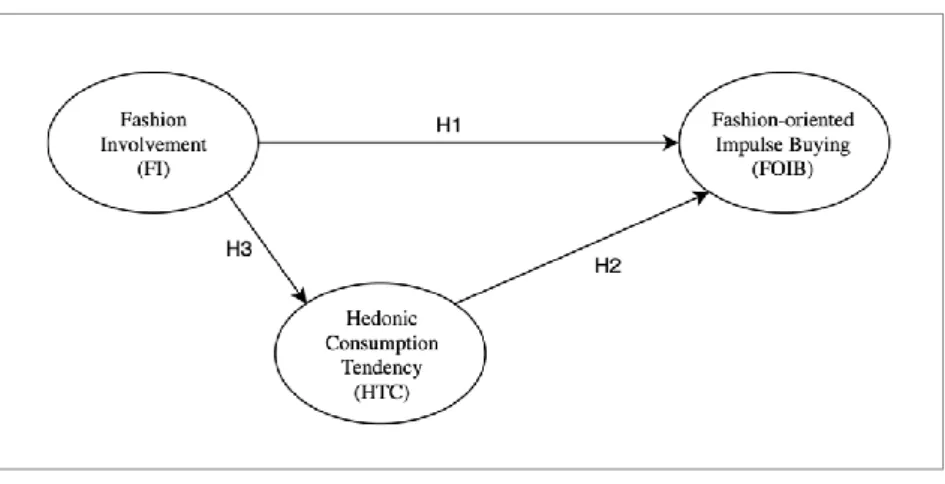
Based on prior impulse buying studies, this thesis introduces three variables to the model of fashion-oriented impulse buying and which is the one proposed below in Figure 1. The model shown is similar to the one presented in the work of Joo Park et al (2006), but the main objective here is to illuminate the relationships among three variables: fashion in-volvement (FI), hedonic consumption tendency (HCT) and fashion-oriented impulse buying (FOIB).
Figure 1 - Conceptual model of Fashion-oriented impulse buying
Source: Author
As seen, fashion involvement is characterized by an interest, arousal or drive that a consumer finds for a fashion good, which is in this case clothing products (Dholakia, 2001; Fairhurst et al., 1989; Han et al., 1991). This drive is often responsible for stimulating con-sumers to make purchases of apparel that were not among the previous intentions of these consumers. In other words, when consumers have a higher fashion involvement the more likely they are to engage in the impulse buying of fashion clothing as previous studies have shown (Cardoso et al., 2010; Joo Park et al., 2006). Therefore, it is hypothesized that:
H1: An individual with higher fashion involvement is more likely to engage in fash-ion-oriented impulse buying behaviour.
As proposed by Hirschman and Holbrook (1982), consumers search for products for several reasons, being one of them for hedonic or experience purposes. Hedonic shopping is characterized by emotion, fantasy and sensory stimuli, rather than simply focusing on fill-ing a basic need a consumer has (Childers et al., 2001). This motivation has historically been demonstrated to have a positive influence on the general impulse buying behaviour from the